Archive
-
Competent and Valued
Comments Off on Competent and ValuedUnderstanding cultural and Linguistic Diversity (CLD) as an asset has discursively been present within Canadian society, and by extension Canadian schools, for many years. Although generally accepted as one of the grand narratives that Canadians take pleasure in celebrating, what has not been well established is how Canadian society and schools are responding to this increased diversity. Our collective response to diversity within our schools is, however, inarguably vital given the assimilative orientation Canadian schools have historically taken. The need for effective responses to CLD is further demonstrated when we consider our current socioeconomic context. North American educational settings are more culturally and linguistically diverse than they have ever been as a result of international restructuring and a subsequent increase in labour market mobility.[1] A significant number of children in Canadian classrooms located in urban centers now speak a first language (L1) other than English or French. Ontario alone has experienced a 29 percent increase of ESL students within elementary schools since 2000.[2] Several researchers have noted that despite these changing demographics, there is a dearth of research about culturally and linguistically diverse (CLD) children in educational contexts and disparity in providing for them.[3]
This article contributes to the more recent and growing body of research that addresses gaps in the provision of responsive education for CLD children in Canadian elementary schools. Drawing on research that explored CLD children’s literacy and identity in two Grade 1 and two Kindergarten classrooms over the course of a school year, it identifies, describes and explores culturally responsive multilingual and multicultural pedagogies, and articulates various ways of approaching linguistic and cultural incorporation within diverse classrooms.
PERSPECTIVES
My research was informed by multiliteracies and critical perspectives. Multiliteracies theory conceptualizes literacy as a social practice and socially mediated. Meaning making is understood as varied and dependent upon different cultural, social or professional contexts. Meaning is also made in increasingly multimodal ways, and as such involves interactions with written, visual, verbal and non-verbal communication and objects.[4] Within this dynamic and generous conceptualization, literacy is understood and positioned as multiple, expansive and contextually specific. A critical perspective as it relates to fostering multilingual literacy, therefore, not only values and develops proficiency in speaking, writing or reading in two or more languages but also fosters the ability to control and choose discourses in various contexts and understands the connections between power and language. During the year-long ethnography I conducted within two Kindergarten and two Grade 1 classrooms, I drew on these perspectives to analyze the literacy practices and events that I observed.
PRACTICES THAT FOSTER MULTILINGUAL LITERACY
Intake
First, it is essential to accurately identify languages spoken by students. Based on my research, official student record information must be understood as fallible. The processes by which schools gather data and the conditions parents encounter during the initial information-gathering meeting with the school secretary can create inaccuracies. It is therefore essential for schools to review the initial intake process and form they currently use with and for CLD students. These preliminary meetings communicate a great deal about what is valued in schools and how languages and cultures are positioned within a school’s culture. Whenever possible, a translator who speaks the same language as the parent(s) should be present to assist with the information gathering and aid with the welcoming and transition of the parent(s) and their child to the school community. Further, despite whatever mechanisms are put in place to collect initial information about citizenship and language(s) spoken at home, it would benefit a teacher to ask students, older sisters and brothers (if any) and parents about first languages spoken at home for any CLD child in their classroom.
A multilingual environment
Once students’ first languages have been identified, teachers can create multilingual environmental print consisting of common items (e.g. blackboard, window, shelf) and concepts (e.g. colours, numbers) found in the classroom. Online sources can be used to translate English words into different languages. Whenever possible, involve students in writing and placing multilingual environmental print in the classroom and provide opportunities for them to verbalize the words in their first languages. During this process it is also valuable to make cognates explicit and ask students to do the same. (Cognates are words that are similar in terms of the CLD student’s first language and English – e.g. fruit/fruta is an English/Spanish cognate). Multilingual posters, alphabets of the languages spoken by class members, the names of children in their own languages and in English, product packaging in various languages, common phrases in various languages, and work done by students in their first language can also be displayed in the classroom to create a multilingual print environment.
What is key is to immerse students in an environment where various languages are used purposefully and are part of the instructional space. However, multilingual or multicultural window dressing should be avoided. In various schools I have visited, I have noticed posters with the word “Welcome” written in large letters in the middle of the poster, surrounded by the word for “welcome” written in smaller font in various other languages. These posters are almost never at a height where children can read them, but rather placed at adult eye level. Further, their effectiveness in communicating that languages other than English are valued is highly questionable.
Multilingual texts
Bilingual books written in both English and first languages are purposeful and effective multilingual texts for use in read-aloud, independent and home reading programs. Bilingual books can be versions of titles that are commonly found in elementary classrooms as well as speciality titles that deal with culturally specific content and/or situations that may be relevant to a variety of cultures and available in a variety of languages (e.g. English with Albanian, English with Arabic etc.). Another Story is a Canadian bookstore that carries a variety of bilingual book titles.
Teachers can purposefully draw on their students’ first languages and thus reposition CLD students as knowledgeable communicators.
When using bilingual books during read-aloud or shared reading sessions, students who speak the language the book is written in can sit beside the teacher and either read what is written in their first language or translate what the teacher has read in English. If they translate, the teacher can follow the text written in their first language and look for words that resemble what they have said while pointing these words out to the student and the rest of the class. Most of the CLD students in my study were eager to participate in this shared read aloud. In fact, this practice arose as a result of one student’s desire to demonstrate her knowledge of Spanish to her classmates. She asked to sit next to me and showed me how to incorporate her into the shared reading I was conducting with a Spanish/English bilingual book. I replicated the practice with other students, who also became my co-teachers. This practice repositioned them within their classrooms from “quiet,” “shy” children who “didn’t speak English” to classmates who possessed assets that became explicit and instructionally relevant. They were no longer solely reduced to what they were learning (i.e. “ESL”) but rather seen as capable communicators who knew another language that other students both valued and were interested in learning. CLD children began to be understood as having something they could share and teach.
In making linguistic assets further explicit within a classroom, literacy instruction can be organized in ways that enable students to create their own bilingual books or texts. Although none of my participants had an opportunity to create a complete bilingual narrative, some of them wrote and drew various “identity texts” (texts in which CLD students have invested their identities and reflect who they are).[5] These texts mirrored the structure of the bilingual books they were being exposed to and could have been extended into a complete book. One student, for example, valued the bilingual books I read so much that she asked for her own copy of several titles. She relayed to me that she was reading them to her mom at home and therefore teaching her mom English as well as continuing to develop her ability to read Spanish. Her immersion and interest in bilingual books developed to the point where she created a text that followed the structure of these books. In the identity text she created, she drew a picture of me and underneath wrote “Man” and then her phonetic hypothesis of the word “Hombre.” Another student in the study wrote her name in a proud and pronounced way across the page and then made declarative statement about who she was: “I am an artist.” On top of the powerful sentence was a self-portrait of her at work at her art.
Codeswitching
In order to further develop classrooms spaces that are responsive to and respectful of the multilingual and multicultural assets students bring with them into the classroom, acceptance of codeswitching (CS) must be made explicit and recognized as a viable pedagogic resource. Classrooms that allow for CS (switching between two languages) set conditions that allow students learning English to renegotiate their “less than” and deficient school identities by showcasing and instructionally drawing on the linguistic resources they possess. When this occurred within the classrooms I observed, children whose first language was English began to understand that their often quiet “ESL” classmates had fully developed thoughts they could express in their first language, but were simply not as proficient in the privileged code. Incidents that required them to use their classmate’s first language further reinforced this understanding.
Teachers frequently question their ability to allow for and foster CS when they don’t speak the language their students speak. Many of the events I observed during my research confirmed that it is not necessary for the teacher to know the languages of their students (an impossibility) but rather to be open to negotiating what their interactions and literacy curriculum in general looks and sounds like. This meant, for example, that some teachers asked CLD students to use and/or teach specific words and phrases to them that were relevant to the classroom. One teacher asked a student who spoke Albanian to do a head count of students in her first language out loud to verify if everyone was present. During a lesson on the letter “e,” the same teacher elicited responses from students in their first language about various illustrations of things featured in a picture dictionary that all began with “e.” Teachers can purposefully come in and out of English during their interactions and lessons in order to draw on their students’ first languages and thus reposition CLD students as knowledgeable communicators. Improvisation and situated decision-making is key to instructionally engaging and including CLD students while validating and occasionally using their first language to support their English language learning. More importantly, students’ identities can become valued and pronounced within the classroom as opposed to being hidden and silenced. Encouraging codeswitching can therefore perhaps improve learning conditions for CLD learners while creating classroom spaces that allow them to be and become who they are.
More strategies
There are many other practices teachers can develop that access and instructionally draw on CLD students’ first languages. One example is inviting students to bring in a word of the day that is meaningful to them, and then having the rest of the class learn the word and talk about its meaning and cultural connotations.[6] One of the mothers I interviewed during my study mentioned similar practices when discussing what might have helped her daughter feel welcomed and accepted in school. Teachers can also generate a list of words that are commonly used and important to classroom life (e.g. bathroom, coats, lunch) and keep the list in an accessible place. One of the Kindergarten teachers in my study had this list of words laminated and at hand in several key places around the classroom so that she could understand and communicate essential words and phrases. Again, the Internet can serve as a translation resource. When CLD parents volunteer to work in classrooms, teachers can make explicit how accepted codeswitching is and encourage them to CS or converse with students who share their first language. Parent volunteers can also be encouraged to share their language and culture with the class, and to help students who share their first language and culture create bilingual books and other identity texts that can also be shared with the class and celebrated.
CONCLUSION
The approaches and practices offered throughout this article are by no means all-encompassing, definitive, prescriptive or examples of “best practices” (a problematic and dangerous concept). What is offered is meant to provide educators with ideas that can assist them in responding to the increasing cultural and linguistic diversity they are experiencing within their schools and classrooms. How these practices are integrated and used should remain flexible, malleable and ultimately responsive to and respectful of the CLD students we have the good fortune of teaching. Multilingual, multicultural literacy practices should continue to evolve and be recognized as sound pedagogy that extends classroom language barriers, increases the status of students’ first languages and ultimately, opens up identity options available to CLD students within schools.
If we are genuinely interested in being able to respond to the rich cultural and linguistic diversity of our ever-changing classrooms, then we need to consider and experiment with a variety of practices that value and cultivate who these students are and what they bring to our schools and classrooms.
Photo: Christopher Futcher (iStock)
First published in Education Canada, January 2014
EN BREF – Cet article faisant référence à une étude ethnographique d’un an réalisée par le chercheur, examine la littératie et l’identité d’enfants d’origines culturelles et linguistiques diverses dans deux classes de maternelle et deux classes de première année. Les constatations sont issues de la pédagogie plurilinguistique et des perspectives critiques. L’article identifie, décrit et explore des littératies et des pédagogies multilingues et multiculturelles démontrant l’enseignement adapté à la culture. Différentes façons d’aborder l’intégration linguistique et culturelle dans des classes diversifiées sont examinées. Les pratiques de littératie favorisant cette adaptation sont ciblées afin de proposer aux éducateurs un répertoire d’approches susceptibles de les aider à tenir compte efficacement d’une diversité culturelle et linguistique croissante dans les milieux scolaires canadiens.
[1] Nicholas C. Burbules and Carlos Alberto Torres, Introduction to Globalization and Education: Critical perspectives (New York: Routledge, 2000); Jim Cummins, “Diverse Futures: Rethinking the image of the child in Canadian schools,” presented at the Joan Pederson Distinguished Lecture Series, University of Western Ontario (April 2005); Festus E. Obiakor, “Research on Culturally and Linguistically Diverse Populations,” Multicultural Perspectives 3, no. 4 (2001): 5-10.
[2] People for Education, The Annual Report on Ontario’s Public Schools, (2007). www.peopleforeducation.com/adx/aspx/adxGetMedia.aspx?DocID=634
[3] R. Falconer and D. A. Byrnes, “When Good Intentions Are not Enough: A response to increasing diversity in an early childhood setting,” Journal of Research in Childhood Education 17, no. 2 (2003): 188-200; Carola Suárez-Orozco, “Afterword: Understanding and serving the children of immigrants,” Harvard Educational Review 71, no. 3 (2001): 579-589; Kelleen Toohey, Learning English at School: Identity, social relations and classroom practice (Great Britain: Multilingual Matters Ltd., 2000).
[4] Nancy Hornberger, “Multilingual Literacies, Literacy Practices, and the Continuation of Biliteracy,” In M. Martin-Jones and K. Jones (Eds.), Multilingual Literacies (Amsterdam/Philadelphia: John Benjamins Pub. Co., 2000), 353-369; James Paul Gee, “The New Literacy Studies: From ‘socially situated’ to the work of the social,” in D. Barton, M. Hamilton and R. Ivanič (Eds.), Situated Literacies: Reading and writing in context (London: Routledge, 2000), 180-196.
[5] Jim Cummins, “Diverse Futures.”
[6] Jim Cummins, Negotiating Identities: Education for empowerment in a diverse society (CA: California Association for Bilingual Education, 2001).
-
The Peaceful Village
Comments Off on The Peaceful Village“If I can hear the Djembe drum heartbeats, I know that I am close to The Peaceful Village. This is a place where I am loved even though I am so new to this place. Here I will become someone who will make my new community stronger.”
– Peaceful Village high school student
When you visit The Peaceful Village after-school program, you will find physics tutors who make high-level math sound beautiful and soccer players who defy those same laws of physics. Around every corner a symphony of languages erupts, because a microcosm of the world gathers in this remarkable place each day after school. The cultural commons in Canada is enriched each time a new family arrives, and although many former refugee youth face daunting barriers when they enter the public school system in Canada, many of their settlement stories are filled with powerful lessons about survival, love and resilience.
The Peaceful Village after-school program offers academic, social/emotional, arts, and sports programming across three sites to over 300 former refugee families who live in Winnipeg’s inner city. Since the program’s inception in 2009, every learning activity, conversation, meal, artwork, game, and musical note has been an attempt to contribute to the development of a more critically conscious, healthy, and joyful community. All Peaceful Village community members are strongly encouraged to bring their knowledge and talents to bear in order to enrich Manitoba’s extraordinary cultural mosaic. Program director Daniel Swaka describes this commitment in relation to his own story:
“As a former refugee and a newcomer myself, I easily identify myself with the youth and families and with all the challenges they are going through in their new communities. The diversity in The Peaceful Village speaks volumes. Everyone has a sense of belonging and all voices are heard. Despite enormous challenges, we believe in developing our program from the ‘roots up,’ meaning we build and evaluate our program with students and parents. It is not a top-down approach. And we stay connected with our families after their children leave the program. Once in the Village, always in the Village.”
This article examines a few of the lessons The Peaceful Village staff and partners have learned about making space for newcomer youth to thrive in their new school communities. The four essential tenets that frame our work are: start with questions; open multiple artistic learning opportunities; see the power in intergenerational learning; and challenge youth to drive program direction and evaluation.
Start with questions
The Peaceful Village program was born out of a participatory action research project conducted in 2009 by the Manitoba School Improvement Program (MSIP) to identify the barriers that were impacting former refugee families in two school communities. As MSIP consultant, I spoke with parents, youth, settlement service providers, community leaders, teachers, administrators, and representatives from Manitoba Labour and Immigration. The action research process yielded profound results. The program’s mission, key activities, and evaluations are directly connected to the testimonials given by the families and community leaders during the action research phase. We learned that inquiry processes can build coalitions of committed and passionate community and school advocates who are able to work in solidarity to reduce the “push-out” rates of former refugee youth in high schools.
One of my former Grade 10 students once told me that “the world would be a lot better if people asked questions before they started giving answers. We need to get curious.” Her profound comment continues to influence my work as a teacher, educational consultant, and researcher. All of our partners are continuously asked to critique the program in relation to their own understandings about the gaps in services for newcomer youth. These cyclical “problem posing” conversations ensure a higher degree of resonance between our mission and our practices, and have spread beyond the program itself. As one of our school partners, a high school teacher, stated, “Because of The Peaceful Village in our school, I have become a better informed and conscientious teacher who seeks out others’ viewpoints and experiences and attempts to include them in designing the curricula of my students. It has also caused me to be more aware of various communities in Winnipeg, whose populations are continually changing.”
Offer multiple artistic learning opportunities
Arts-based learning helps us to think more deeply about who we are in the world and the ways in which we are sometimes marginalized by other people or systems. In fact, powerful artworks can compel us to see the world as it is, and then incite us to work towards a more just and joyful future. We invite all Peaceful Village participants to use their wisdom, deeds, beats, and words to make their lives and their communities works of art. For example, The Peaceful Village Drummers use djembe drumbeats to make space for youth empowerment at various community meetings and celebrations. Our hip-hop dancers use movement and their music to disrupt negative social constructions of youth and resistance.
In The Peaceful Village program we also use the language of the theatre to address challenges that cause some of the difficulties in our lives. The students play theatre games, put on plays in the wider community, and invite audience members to wrestle with shared dilemmas. After a recent Forum Theatre performance that focused on the program participants’ struggles with language barriers, one of the youth actors discussed the impact of the work on her personal development:
“I learned a lot about myself and about a lot of other people. And kind of like I’m more to who I am going to become when I grow up. Like I said before, don’t be afraid to stick up for yourself, you know? And I think that really stuck to me. So I think that’s going to be one of the parts that’s going to make me who I am.”
See the power in intergenerational learning
We are committed to building assets across families. Each of The Peaceful Village sites operates a “Learning Centre,” which students and parents both attend to access tutoring and mentoring supports. Over 84 percent of the youth participants receive an additional 15 instructional hours per week. On Saturdays, parents and grandparents can gather together for three hours to work on their own literacy development goals. Children often learn new languages more quickly than their parents, so many newcomer children act as interpreters and liaisons for the family. This gives too much power to the children and undermines the leadership capacity of the parents. Therefore Peaceful Village staff members work hard to ensure the parents are able to access the settlement and literacy supports they need in order to be successful. As one of our parent participants noted,
“The multicultural parenting classes organized by Peaceful Village are really important for us to learn about many positive things. It helps me a lot to improve my language and it promotes my ability to deal with several school challenges that might come up in my family.”
Each month we host Village Kitchens to provide parents with another opportunity to advocate for their children’s education and to build relationships with other families in their school community. Interpreters are available to break down communication barriers. On average, there are over 150 parents and children who attend each community feast. According to one of our high school participants,
“The Village Kitchens are the best moments to be in The Peaceful Village. Every Village Kitchen is unique, different guest speakers motivate us, seeing my family present, the fun games, and different cultural displays from the villagers. The food is always great. I love the Village Kitchens.”
These events build bridges within the community and have fostered the development of several informal parent support networks. According to one of the parents in the program,
“The Village Kitchens give me an opportunity to visit the school of my daughter, and see her drumming. It gives me joy and smiles. Through the Village Kitchens, I get a chance to meet other newcomers and to make new friends.”
Youth-driven program development and evaluation
The Peaceful Village program is committed to youth empowerment and mentorship. A number of our junior community development tutors are graduates of the program. Just like our senior staff, all of our junior staff are multilingual and understand the unique challenges facing former refugee youth in Canadian public schools. One of our junior community development tutors eloquently explains the importance of mentorship and her commitment to the ethos of the program:
“In 2010 I started going to Peaceful Village as a student in order to get help with my studies. I loved Peaceful Village since it was the only place where I felt equal and I could fit in. There were many different students from very different countries and cultures. As a student in Peaceful Village I had some expectations such as having healthy snacks, and being tutored individually which I always got from PV. In 2011 I finished high school; before graduating high school I did some volunteering during my second year in PV helping other students. A few months after graduating, I wanted to be part of PV. It was easy for me to get to know other kids and give them the attention they deserve. My role in PV has changed. My past experiences as a new student taught me how to take care of these kids. I know what they are going through as new students and as people who are new to the country. I know what kind of help they need because I’ve just been through it and I’m also a student myself at university.”
Each Peaceful Village site has a youth leadership team that is responsible for ensuring students’ voices legitimately inform program planning and evaluation. Students collaborate with staff to assess the effectiveness of their tutoring supports in relation to their successes and challenges in their school subjects. Another example of student voice in the program is that all summer and spring break activities are determined by the youth participants. Students are able to provide their feedback in numerous ways. Program staff use image theatre, forum theatre, interviews, focus groups and photo-voice to gather information. Recently, several of the students used poetry to share their thoughts and feelings on the program (See Sidebar).
In Canada, public schools are one of the few social institutions where children, adolescents, and adults have the potential to gather together to become living expressions of the codified dreams and judgments about what constitutes the “good life.” They are places where students and families share a myriad of experiences that promote both community renewal and the individual questioning of the status quo. It is imperative that former refugee families are given the opportunity to influence the method and matter of education in their new communities.
The Peaceful Village
Very calming and silent
Until we arrived…
I’ve learned much
Quizzes were given
We got ice cream treatsThe village helped me
Solve many of my problems
Keeping me more calmI am not perfect
The people in the village,
No one is perfectIn my lonely room
Or in the peaceful village
I am not aloneMy experience here
Was a long learning pathway
It wasn’t easy
But totally worth it all
I love The Peaceful Village
– a Grade 7 Peaceful Village student
For more information about The Peaceful Village Program, contact Program Director Daniel Swaka at dswaka@msip.ca or 204-949-1858.
Photos: Courtesy The Peaceful Village
First published in Education Canada, January 2014
EN BREF – Le patrimoine culturel canadien s’enrichit chaque fois qu’arrive une nouvelle famille. Bien que de nombreux jeunes qui étaient des réfugiés soient confrontés à d’importants obstacles lorsqu’ils intègrent le réseau d’écoles publiques du Canada, de puissantes leçons de survie, d’amour et de résilience caractérisent souvent leurs récits d’adaptation. Cet article examine certaines des leçons apprises par le personnel et les partenaires du programme parascolaire The Peaceful Village au sujet de la façon d’encadrer les jeunes arrivants afin qu’ils s’épanouissent dans leurs nouveaux milieux scolaires.
-
Hope for Canadian Multiculturalism
Comments Off on Hope for Canadian MulticulturalismGurbaj Multani doesn’t know it, but he helped shape me into the scholar I am today. I was just beginning my Master’s of Education when his case petitioning the Quebec government for the right to wear a kirpan (or ceremonial dagger) to school went before the Supreme Court of Canada (SCC). He was 12. What a brave kid.
This case caught my interest. An elementary school teacher at the time, I wondered how my students might respond to the case that was before the SCC. I decided I needed to find out how the children I taught understood what “ethnic diversity” means. But how would I go about doing so? Surveys about people’s attitudes towards diversity are plentiful and so-called politically correct answers are too easily given in surveys: “Should immigrants be able to get jobs in Canada?” Of course! “Should they be able to speak their own language?” Sure! But there isn’t much research on how people actually understand the concept of ethnic diversity. I was interested not only in my students’ attitudes towards it but also in the knowledge structures – conceptions, misconceptions, naïve understandings – that shaped whatever attitudes they might hold.
And just like that, my program of research was born.
Howard Gardner, noted scholar at Harvard, knows how influential prior knowledge is on learning: “If one wants to educate for genuine understanding… it is important to identify these early representations, appreciate their power, and confront them directly and repeatedly.”[1] Constructivist research aims to discover and understand the nature of students’ prior conceptions in an effort to better shape curricula and refine teaching approaches, and ultimately, increase a student’s ability to incorporate new and more complex knowledge into that which they already know.
My early work with Grade 7 students in New Brunswick revealed some interesting results.[2] Using common scenarios – such as a “no hats day” in school – I asked them to consider if all students, including those wearing a hijab or turban, should be required to follow the rule. Most of the students didn’t know the labels “turban” or “hijab.” None of them could name the religion that might require these as part of its followers’ adherence to their faith. Instead, they suggested that perhaps the boy wearing the turban was having a bad hair day and just didn’t want to show his hair. These were kids I knew well. They weren’t trying to be silly or funny with their answers.
There were other examples too. I asked them about the kirpan issue. They didn’t know what a kirpan was and for most, ideas about safety trumped any right to wear a kirpan, even if the kirpan itself was perfectly safe. When asked who they thought might wear such items, one student said, “People who live across the ocean or something.” For these students, diversity was something that was foreign. Canadian society isn’t diverse – other places are.
What were the consequences of these misconceptions? Put simply, my students really saw no reason to accommodate difference because they didn’t understand what it was. Most of my students simply didn’t understand that a turban is not just a hat, that in some religions, material expressions of one’s religious faith are an integral part of one’s identity.
One might argue that perhaps these were just sheltered students; after all, compared to large urban centres like Montreal, Toronto, or Vancouver, New Brunswick doesn’t seem that diverse. But it is. It is the only officially bilingual province in Canada, a fact that harkens back to its early Acadian history. It has substantial populations of Maliseet and Mi’kmaq. And yes, N.B. is also home to thousands of visible minorities. In other words, the context in which my students lived included various forms of diversity – some with roots in the province’s history and others that mirrored the kind of diversity (granted, not to the same degree) found in more urban centres.
In addition, learning outcomes related to diversity were (and continue to be) key components of the N.B. social studies curriculum, so even if we imagine the impossible and suggest that my students had never seen or experienced an example of diversity in their day-to-day lives, they were learning about it in school.
There is some good news, however. Although my students did not understand most aspects of ethnic diversity, and although they did not demonstrate an understanding that, in a multicultural, democratic society, some forms of reasonable accommodation are warranted, they were not hostile to the idea. Their minds were open; they were willing to discuss it and some even tried to come up with possible solutions to resolve whatever scenario I’d put before them. Even a small amount of discussion and education with these students went a long way.
Now living in Alberta, I am working with colleagues in Nova Scotia, New Brunswick and Ontario on an expanded version of this research. Ten years later, we are interviewing more students and also elementary school teachers about their understandings of ethnic diversity.
Diversity is even more prominent in social studies curricula across the country now, with many jurisdictions paying explicit attention to teaching for and about diversity to students of all ages. Social studies curricula in Canada include standards that encourage progression from knowledge of diversity, through acceptance and respect, to justice. The desired end is not only an understanding of difference, but also willingness to adapt, to accommodate, and to advocate for accommodation.
Our early findings with Alberta students are encouraging. In Alberta’s recently revised K-12 social studies curriculum, educating about diversity is central to its educational goals. The program rationale and philosophy reads, in part: “Students will have opportunities to value diversity, to recognize differences as positive attributes and to recognize the evolving nature of individual identities.”[3] Explicit attention is also paid to Francophone and Aboriginal groups, an acknowledgement, in part, of political philosopher Will Kymlicka’s understanding of these groups as “national minorities” within Canada.[4]
The 12- and 13-year-old students I interviewed in Alberta seem to have fairly well developed understandings of ethnic diversity. Most of the students I interviewed could name religious symbols and many could also explain the significance of such symbols to an individual’s identity. With these deeper understandings of diversity, most students understood why someone might ask for accommodation and – even more encouraging – some students even advocated for reasonable accommodation. Those that did connected it to the concepts of rights and justice and the Canadian Charter of Rights and Freedoms. They weren’t just paying lip service to the Charter. They knew what Section 2 said about Fundamental Freedoms and could explain why these are important in Canadian society.
Although I cannot claim any causal relationship, I do suggest that the explicit learning outcomes and instruction related to diversity that are now fundamental aspects of Alberta’s social studies curriculum are one important factor in breaking down misconceptions and helping students understand key ideas related to democracy.
Our research is ongoing and recent events have made it possible to conduct a small sample of interviews with teachers in Quebec.
Which brings me back to Gurbaj Multani. Ultimately, the Supreme Court of Canada ruled in his favour in 2006 and upheld the basic tenets of a social justice-oriented multiculturalism. Now, as a result of the Marois government’s decision to legislate a “Values Charter” that would effectively ban all material forms of religious expression for public-sector employees, he is contemplating leaving his province – his home.[5] What a shame that the Marois government sees fit to turn its back on the fundamental freedoms and values that are an integral part of Canada’s democracy.
To Mr. Multani, for whatever it’s worth, thank you for inspiring my work. I know there’s more to be done.
Photo: Zurijeta (iStock)
First published in Education Canada, January 2014
EN BREF – La rubrique Point de vue présente une réflexion de Carla Peck à propos de ce qui l’a motivée à entreprendre un programme de recherche axé sur la diversité et l’éducation. Inspirée par Gurbaj Multani (un élève montréalais de 12 ans qui s’est rendu jusqu’à la Cour suprême du Canada pour défendre son droit d’exprimer son identité religieuse), madame Peck examine d’abord les premiers résultats de sa recherche sur les perceptions des élèves en matière de diversité ethnique, puis indique des constatations préliminaires de ses travaux récents. Elle conclut par un commentaire sur les événements récents (la charte proposée des valeurs québécoises) qui minent, à son avis, la démocratie canadienne.
[1] Howard Gardner, The Development and Education of the Mind: The selected works of Howard Gardner, World Library of Educationalists Series (London and New York: Routledge, 2006), 77.
[2] Carla Lee Peck and Alan Sears, “Uncharted Territory: Mapping students’ conceptions of ethnic diversity,” Canadian Ethnic Studies 37, no. 1 (2005); Carla Lee Peck, Alan Sears, and Shanell Donaldson, “Unreached and Unreasonable: Curriculum standards and children’s understanding of ethnic diversity in Canada,” Curriculum Inquiry 38, no. 1 (2008).
[3] Alberta Education, “Social Studies K-12,” Alberta Learning, 5. www.education.gov.ab.ca/k_12/curriculum/bySubject/social/sockto3.pdf
[4] Will Kymlicka, Finding Our Way: Rethinking ethnocultural relations in Canada (New York: Oxford University Press, 1998).
[5] Sean Fine, “Sikh student who won kirpan case now considers leaving Quebec,” Globe and Mail, October 22, 2013. www.theglobeandmail.com/news/national/sikh-student-who-won-kirpan-case-now-considers-leaving-quebec/article15014254/
-
A Chance to LEARN
Comments Off on A Chance to LEARNIn 2001-2002, due to a change in federal immigration policy, schools in Canada began to see an increase in the arrival of government-assisted refugees (GARs). As an itinerant ESL teacher in the St. John’s, N.L. area at the time, I quickly realized that these displaced persons from war-torn countries were in a completely different category than many past claimants of political asylum. In the 80s and 90s, the majority of refugee claimants were educated people from Eastern block or other communist states who had defected while on international flights that chanced to stop in Canada. The GARs in the K-12 system of the 21st century, on the other hand, were truly displaced people: children and teens who had spent years, and in some cases their whole lives, in UN refugee camps, and thus had had little opportunity for formal schooling. Some students as old as 18 years were unable to carry out even primary school arithmetic operations.
With no preparation for the arrival of this new class of immigrants, schools placed students according to age and elicited ESL teachers’ support. However, it was obvious to ESL teachers that the needs of these students went well beyond learning English. As a matter of fact, learning English was the easiest need to address, and the albeit necessary labelling of the kids as ESL often masked or detracted from their more profound needs. Fortunately, in 2007 the provincial government of Newfoundland and Labrador launched its immigration strategy and the Department of Education hired an ESL program specialist. In that newly created position, with a very supportive manager and a director of curriculum who understood the need to address issues of struggling learners, I immediately began to work on developing an academic bridging program for these students.
In early 2008, two teachers were hired to teach literacy and numeracy skills to GAR students in two St. John’s schools with high refugee populations, one an intermediate school and the other a high school. (Because of the availability of settlement services, all GARs received by the province of Newfoundland and Labrador are settled in the St. John’s area.) At the same time, a working group was assembled to develop a compacted curriculum, based on provincially prescribed K-9 outcomes, in Language Arts, Mathematics, Science and Social Studies. I had read about the bridging program offered by the Toronto District School Board (TDSB) and later had an opportunity to meet TDSB’s Betty Ann Taylor, the driving force behind the program. Our new program in Newfoundland and Labrador, inspired by Toronto’s Literacy Enrichment Academic Program (LEAP) was entitled Literacy Enrichment and Academic Readiness for Newcomers (LEARN). By February 2009, we were ready to launch the new program.
The government-assisted refugee students in the two pilot schools, most from Bosnia and several countries in Africa, were assessed in English, first-language literacy, and mathematics. The majority were found to be functioning at the K-3 level. Math assessment was a key component of the initial assessment as it can be carried out with very little language and it sheds light on a student’s previous formal education. First-language literacy was assessed through interviewing and other measures, such as having the student write a paragraph on a familiar topic. Even when translation was not available, it was often apparent from the handwriting, length of passage and student confidence during the writing session, that the student had a very limited literacy level. Some teenagers were barely able to write their own names in any language. Students were placed in the LEARN curriculum and began studies at the assessed achievement level. Initially, students spent about 50 percent of their day in the LEARN courses and were integrated into mainstream subject areas with low language and literacy demands.
The LEARN curriculum consists of two levels, with six bridging courses in total. Level One, which can be carried out over one or more years as needed, focuses on Language Arts (basic literacy) and Mathematics. The goal is to get students to a low/mid elementary school level. The LEARN curriculum is based on prescribed curriculum in those subject areas and materials are drawn from a range of age-appropriate resources. For example, we found that some of the best K-3 reading materials for older children and teens from various countries were, apart from their own stories, non-fiction texts and folk tales. These are of universal appeal. Functional texts also play a large role in basic literacy. Level Two of the LEARN program consists of four courses, covering the four core curriculum areas: Mathematics, Language Arts, Science and Social Studies. In the meantime, a new ESL course was developed for grades 7-12: ESL Foundation is targeted to beginning English learners with limited first-language literacy skills.
The LEARN courses are sheltered instruction courses. Teachers use techniques to develop content skills, language and literacy simultaneously. As with any good reading program, guided reading, shared reading, shared writing, journal writing and language experience are among the teaching techniques employed. Classrooms are equipped with educational posters, math manipulatives and a classroom library. Students whose first language is other than English, which is the majority of GARs, are eligible for ESL support in addition to LEARN. ESL teachers work closely with LEARN teachers and the LEARN teachers are experienced in both general education and ESL teaching.
The results of the LEARN program were immediately evident. School attendance and engagement was the most notable change. In the four months prior to beginning the program, nine refugee students had dropped out of the main cluster high school for ESL students. In the first year of the LEARN program, 36 students were registered in the two pilot schools. The attendance was tracked by the Department of Education and the program had a zero dropout rate. The program was welcomed by students and parents, as well as by principals and classroom teachers, who had been at a loss as to how to support students who were functioning up to ten years below grade level.
The LEARN program has led to improved academic performance and much lower rates of dropout among our refugee students.
As of spring 2013, about 100 students have taken advantage of the LEARN program at the two cluster schools, and the LEARN courses are now available to any school in the province. Many former LEARN students are fully transitioned to mainstream courses. Their progress continues to be monitored. There are lots of success stories, stories of teens who arrived in Canada with low primary skills and have since been successfully transitioned to intermediate and high school classes. To quote one LEARN teacher, “The students are making great academic gains… I don’t know how they would manage without LEARN.” Another teacher reports, “The results have been outstanding. The LEARN program has helped improve students’ confidence and sense of belonging. It has led to improved academic performance and much lower rates of dropout among our refugee students.”
Flexibility in scheduling has been a big factor in transitioning from LEARN to mainstream. The priority is to integrate the students into regular classes as soon as they are ready. Students are placed in classrooms where they can be successful. A student may be receiving some support from the LEARN program and at the same time enrolled in mainstream courses at different grade levels. This could mean a student is taking Grade 7 Math and Grade 8 Language Arts or any combination of courses.
In conjunction with the LEARN program, in 2008 the Department of Education began funding a summer enrichment program for immigrant students. The program focuses on literacy, numeracy and social integration and targets teens with limited prior schooling. The Department of Education has partnered with the Association for New Canadians, the official settlement agency for GARs, to offer the summer program and liaises closely with the Association and the school district in addressing immigrant needs in general.
The success of the LEARN program is largely due to administrators and teachers, from the Department of Education to the school level, who were open to addressing educational needs through innovation. As new issues come to the forefront, educators must find new ways of doing things. Established practices need to be questioned and interventions have to be results driven. Education theories must be tempered with consideration of the realities of the particular situation. For example, while inclusion is the ultimate goal for most students, placing a student in a classroom and a curriculum based only on the student’s birth year does not guarantee inclusion. It negates what we know about academic readiness, may eliminate the student’s chances of taking part in curriculum that would address his or her needs, and often forces the student into an environment in which he or she can only feel marginalized.
We can only teach a student what he or she is ready to learn. When I was a child, I heard about Marilyn Bell swimming across Lake Ontario. At the time I thought, how could she do it? All alone swimming for 20 hours! I later learned that long-distance swimmers have a boat with a support team, a coach and someone passing them food, drinks or whatever else they may need to keep moving forward. The support team can only be effective, of course, if it moves along with the swimmer. It would be pointless for the support team to stand at the finish line and cheer from there.
Photo: Courtesy Kawartha Pine Ridge District School Board
First published in Education Canada, January 2014
EN BREF – Quand les écoles de St. John’s (T.-N.-L.) ont commencé à accueillir des réfugiés parrainés par le gouvernement (RPG) de camps de réfugiés de l’ONU du monde entier, de nouveaux programmes étaient clairement nécessaires pour répondre à leurs besoins en matière de littératie et de numératie. Cet article explique la mise en place d’un programme passerelle dans deux écoles faisant partie d’un regroupement à St. John’s. Après l’élaboration de cours passerelles et l’évaluation initiale des niveaux respectifs de littératie et de numératie des élèves, ces derniers ont été placés dans des cours correspondant à leurs besoins. Le programme a immédiatement donné lieu à une réduction du taux de décrochage du secondaire des RPG et au relèvement de leurs niveaux de lecture et de mathématiques. Jusqu’ici, plus de 100 élèves ont profité du programme LEARN dans ces deux écoles et beaucoup d’entre eux ont intégré avec succès le programme régulier.
-
Building Bridges with Indigenous Learners
Comments Off on Building Bridges with Indigenous LearnersAs a student embarking into the sciences more years ago than I care to admit, I fell in love with the periodic table. For me it was a metaphor for life and living. The relationships and inter-relationships spoke to me of human engagement and interaction, the results of such interactions leading to a myriad of potential products. As a student it all came together in the lab, when I experienced the chemistry in a hands-on way. To me, understanding where it fit in the real world was critical because then it had context, relevance and application and it really counted.
In his interview Re-thinking Curriculum and Pedagogy, Ted Aoki1 talks of “curriculum-as-lived” in contrast to “curriculum-as-taught,” and how the two often differ. I believe for many Aboriginal students in the current Eurocentric-based Western education system, this is the challenge: connecting the curriculum as taught with the curriculum as lived. It’s an even greater challenge because their lived experience is a different paradigm from the Eurocentric-based Western education system.
As an oral culture, Aboriginal knowledge is not held in textbooks, but rather is held by cultural experts such as elders, in ceremony, and in traditional practices. It is passed on (taught) through story, narrative or demonstration and learning is by doing.2 The laboratory for Aboriginal peoples is the real and applied world. This juxtaposition in ways of knowing and coming to learn is, I believe, key to the challenges many Aboriginal students experience in the Western education system. Context and relevancy are critical and without those, understanding is nearly impossible.
For my Master’s degree, I developed a narrative periodic table,3 in which each of the elements and their interaction with each other was illustrated with a short story. Those who read my stories would often tell me how it enabled them to understand a particular concept by putting it into a context they understood. Teachers would often ask for the stories to read to their class. So I began using narrative in my own teaching practice, and would demonstrate a concept with a mini-skit involving the students. Their favourite was when I demonstrated the difference between ionic and covalent bonds in terms of attraction to another person, dating and commitment – topics that were the focus of their current adolescent life. In thinking about the various chemical reactions, they became very creative in their own scenarios. It was easy to expand to concepts such as bond-breaking, with a jealous girlfriend as the contaminant who breaks up a relationship. Various scenarios expanded and morphed from there. I could then take those stories and further demonstrate them in the “real chemistry laboratory,” and finally in terms of pedagogical chemistry. It made for many “aha!” moments for the students. A Blackfoot student who struggled greatly with the sciences and mathematics said, “I don’t understand the textbook because I don’t know what most of the words mean. It helps when you explain it first with something that makes everyday sense to me so I can see the relationship.”
The concept of teaching through “acting,” a methodology specifically known as performative inquiry,4 became the foundation for a small university research grant5 I garnered to pilot this methodology as a means to engage Aboriginal students in learning science. Performative inquiry, based foundationally on relationships and inter-relationships, is a journey of “knowing, doing, being, creating.”6 While not specifically intended to be used to “put on a play” (although that can be the forum for communicating the message), it is used to enable understanding by bridging practice to theory in a practical, hands-on way – much as laboratory experiments enable the scientist to put theory into practice. Importantly, performative inquiry blurs definitive boundaries in an interdisciplinary way that enables students’ understanding. Performative inquiry allows students to understand how things work and to modify their “script” to try different approaches or scenarios. This methodology dovetails nicely with Aboriginal ways of knowing and learning, which are pedagogically based on relationships and inter-relationships, as well as with the experimental method of science, which continually makes adjustments to the parameters of an experiment to understand how it works.
I am fortunate in my position as Coordinator of the First Nations’ Transition Program (FNTP) to be able to tap into a resource of students who have successfully transitioned through the program. Connections to the neighbouring Blood Reserve high school allow me to work with a cohort of Aboriginal students with similar backgrounds and starting points. Two Blackfoot 2nd year university students, both from the community, worked as research assistants on the project. My purpose in choosing these students was to enable them to gain research experience, as First Nations students are often overlooked for such positions. Just as importantly, they were valuable mentors for our cohort. If high school students see post-secondary education success in others from the community whom they admire, they are more likely to see that possibility for themselves as well. Additionally, we had the good fortune of having experienced dance and drama academics volunteer their expertise on the project: one at the university and one nationally known performing theatre artist from the community, who was a great inspiration and mentor for the students.6
Video Clips
Get a glimpse of Michelle Hogue’s performative inquiry project, Chemistry Through Theatre, in action:
https://www.youtube.com/watch?v=N00sQi6dIKU&NR=1&feature=endscreen
https://www.youtube.com/watch?v=lrEQYc8VvJI
https://www.youtube.com/watch?v=RlgHW3VUmMk
Our work took place with Grade 10 and 11 students from Kainai High School who were daunted by the prospect of having to take a chemistry course. We alternated between working at the high school and working at the university, so that the university would not seem like such a foreign place to come in the future. Of the 22 students initially registered in the pilot project, 13 stayed with the program to performance and received Science, Drama and elective course credits towards their high school diploma. Importantly, we continued to work with this cohort in a second pilot, using our culturally based performative inquiry methodology to augment and teach the curriculum of their Chemistry course.
Initially, it was our intention to use six Blackfoot Napi stories[8] to illustrate the six basic reactions of chemistry. As a result of unforeseeable circumstances as well as the readiness of the students in the time we had to work with them, it soon became evident that we had bitten off more than we could chew in this pilot. So we distilled our six stories down to three, and eventually to one longer story. The last thing we wanted for this first-time endeavour was to further turn the students off science by having it become a frustrating experience. Of the six stories we had initially selected, the students chose to continue with the story “Napi and the Rock,” one they were all familiar with growing up and that was complex enough to find and illustrate four of the six basic chemical reactions.
We chose a less-familiar version of “Napi and the Rock” to honour the family tradition of one of the students, though a number of versions were blended together to produce the final script. It was critical that the story also be embedded with Western chemistry, to build the bridges between the two paradigms. This turned out to be a very challenging process, and what looked good on paper often did not work in the performance development. There were continual rewrites to the script. For me, it was a learning experience that closely paralleled developing a lab to teach: what looks feasible on paper often does not necessarily translate to the chemistry lab, particularly if it has to be scaled to work for an entire class. I also developed a new appreciation and respect for what is involved in scriptwriting as well as in “carrying out” the script.
As already mentioned, one paramount and consequent result of the current Western education system is that Aboriginal students are expected to learn science through the White-Western way. Seldom, if ever, is the Western-educated scientist educated in Aboriginal ways of knowing. To address the issue of different paradigm views, we wanted the story to be an “educational” conversation between an elder and a scientist, both considered to be respected experts in their own culture, who come to understand the way each other sees science.
The Blood Reserve, situated on the prairie, has the beautiful backdrop of Chief Mountain, prefaced by the Belly Buttes (rolling hills), the Timbers, the Elbow River, and Cypress Hills, with the prairies in the foreground. This home of the students became the set design and is where the story takes place. Very few props were used in the set design or the performance; rather the geography of the Reserve as described above was depicted by the choreographed bodies of the students, who were also the actors of the play. Two of the less shy students became the elder and the scientist, who meet while the scientist, a chemist, is collecting specimens from the Aboriginal lands. The elder wants to know what the scientist is doing on their land. The scientist explains that he is “doing chemistry,” to which the elder explains that unlike the “science” of Aboriginal peoples, the science the “educated” scientist does destroys Mother Earth. The scientist asks the elder for an explanation of what he means by that; to him there is only one kind of science/chemistry, the one he has learned. The elder invites the scientist to “watch and learn” and the story unfolds. Through their conversation, connections between the two worldviews are made. The other characters include Napi (the trickster), coyote, rock, deer, rabbit, wind, sun, trees and nightingales. The play is comprised of six scenes, each of which morphs into the next through the dance movements of the students. A slapstick comedy “reaction” illustrates the chemistry throughout the play.
One might say this is just theatre or drama, and that is certainly a criticism I have heard many times, but this pilot project was a huge success on many levels. One of the most important outcomes was the students’ understanding of the chemistry they had learned. To assess whether the students had in fact learned any chemistry, in the final week I brought the chemistry lab to the theatre. I did each of the six basic reactions and without hesitation the students were able to identify the reaction, tell me the general formula, and give me a real-life example as well as a chemical reaction they had learned in class.
In interviews with the students, the key statements we heard over and over, were that:
- they were not afraid of science any longer;
- they gained much confidence, both in doing science and also in “being out there”;
- they felt better about themselves;
- they felt they belonged;
- they were proud of themselves;
- they believed in themselves because we believed in them;
- they wanted to do it again next term; and
- each said they saw themselves attending some form of post-secondary education, with ten of the 13 planning to attend university.
The most important take-away for me was that they wished more courses could be taught this way because “it made sense” for them.
Dufault wrote, “The chasm between non-Native and Native worldviews can be made smaller through increased awareness… both worldviews seek a balance of mind, body and spirit, but from different angles.”[9] I believe if we are aware of the “different angles,” and are willing to work with the differences in a new space, we can create bridges to enable success for Aboriginal students in science in the current education system.
Photo: Courtesy of Kainai High School
First published in Education Canada, November 2013
EN BREF – La chimie, telle qu’elle est enseignée dans le système scolaire occidental, rebute et exclut les élèves autochtones, dont la vision du monde est différente et qui sont généralement des personnes visuelles qui apprennent par la pratique et par l’expérience. Pour mettre les sciences à la portée des élèves autochtones et favoriser leur réussite, les éducateurs doivent explorer des techniques pédagogiques différentes intégrant les modes autochtones d’apprentissage et d’acquisition de connaissances. Appliquant une méthodologie d’acquisition de connaissances par la performance, ce projet pilote a abordé l’enseignement des sciences en créant des liens entre les sciences autochtones et occidentales, adoptant une approche théâtrale et visuelle intégrant la danse, le conte, la vidéo et la musique comme outils pédagogiques. Un conte traditionnel des Pieds-noirs (« Napi et la roche ») et les six réactions chimiques de base ont constitué la pédagogie de base de ce projet théâtral de chimie. Les élèves ont développé des compétences et des connaissances interdisciplinaires et ont établi des liens entre les concepts scientifiques de ces deux paradigmes.
1 “Rethinking Curriculum and Pedagogy: Interview with T. Aoki,” Kappa Delta Phi Record 35, no.4 (1999): 180-1.
2 See G. S. Aikenhead
3 Michelle M. Hogue, The Chemistry of Education: A periodic relationship (unpublished master’s thesis, University of Lethbridge, 2004).
4 L. Fels and G. Belliveau, Exploring Curriculum: Performative inquiry, role drama, and learning (Vancouver, B.C.: Pacific Educational Press, 2008).
5 CAETL Teaching Development Grant, “Chemistry Through Theatre” (University of Lethbridge, 2011). The second pilot was funded by an internal Social Sciences and Humanties Research grant (SSHRC).
6 L. Fels, “In the Wind Clothes Dance on a Line,” Journal of Curriculum Theorizing 14, no. 1 (1998): 29.
7 Dr. Lisa Doolittle, a Fine Arts professor from the University of Lethbridge and Troy Twigg, a Blackfoot choreographer and performance artist from the Centre for Indigenous Theatre and York University.
8 Napi stories are Trickster stories in the Blackfoot culture intended to teach young children various life lessons. Blackfoot children grow up with these stories, much as children of the dominant culture grow up with fairy tales, so, they were a good cultural starting point.
9 Y. Dufault, A Quest for Character: Explaining the relationship between First Nations teachings and “character education” (master’s thesis, Ontario Institute for Studies in Education, University of Toronto, 2003).
-
Placing Value on Citizenship Education in a Dog-Eat-Dog World
Comments Off on Placing Value on Citizenship Education in a Dog-Eat-Dog WorldMy prejudice on the question: What’s standing in the way of change in education? can be plainly stated. When all is said and done, good citizenship amounts to the Golden Rule: “Do unto others as you would be done by”. That’s foolproof, I think, though it’s too preachy for some, too self-congratulatory for others, too idealistic, and too impractical in a dog-eat-dog world.
I believe that public education here and throughout much of the industrialized West has never come to grips with schooling for good citizenship as a prime value. Most folks think that good parenting and good teaching of skills are sufficient unto the need thereof. That’s not good enough.
Education for citizenship should be education for living in a democratic society – where cooperation and good will are just as important as numeracy and literacy. The typical counter argument is that it’s a hard world out there and schooling to please taxpayers should not be compromised by soft-headed semi-socialist twaddle. Old-timers still argue that the Hall-Dennis experiment in soft education of the 1970s is a warning never to go that way again.
I believe that public education here and throughout much of the industrialized West has never come to grips with schooling for good citizenship as a prime value. Most folks think that good parenting and good teaching of skills are sufficient unto the need thereof. That’s not good enough.
Let me refer to Finland. The educators of that country steer kids away from dog-eat-dog competition in the classroom – unlike Canadian educators. How do they do it? I Googled “Finnish Education” for a partial answer. First and above all, they select superior persons for teacher certification. Second, the government gives teachers and municipalities a lot of independence in running the schools (within national guidelines). For instance, teachers have freedom to select textbooks! Can you imagine the cries of Chicken Little if that were the case in Canada?
Finnish early childhood educators encourage the little ones to pay attention to other people’s needs and interests, to care about others. Older students are taught to participate in society as active citizens. By contrast, the record of voter participation by Canadian youth (approximately 25%) is a disgrace. There are no standardized tests in Finland by which schools and students are measured as they are in Canada and the U.S. The testing habit to which we are addicted is called high stakes testing, which means that above average schools by test results get the best teachers while ambitious real estate agents roam the neighbourhood.
The Education Index published recently as part of the United Nation’s Human Development Index lists Finland among the highest in the world, tied for first with Denmark, Australia and New Zealand. Furthermore, the highly respected PISA tests (Programme for International Student Assessment) conducted every three years in 40 countries with the participation of half a million 15-year-olds world-wide show Canada near the top in literacy and science, trailing somewhat in math, but behind Finland in all three.
The Finns are exceptionally high achievers in education whilst teaching their children the arts and science of living peacefully and democratically. They have rejected the autocratic tendencies of educators in Canada and more broadly across North America.
Let me repeat my main point. The Finns are exceptionally high achievers in education whilst teaching their children the arts and science of living peacefully and democratically. They have rejected the autocratic tendencies of educators in Canada and more broadly across North America. They understand, it seems, that there is a lot more to democracy than voting every four or five years, having well trained judges on the bench, obeying regulations based on public statutes, paying taxes to maintain essential services. Most of those same benefits are enjoyed by the citizens of authoritarian states like China. Going the extra mile to full blown democracy calls for a school system operating by democratic principles from the opening bell in the morning till dismissal time in the afternoon.
Achieving such a goal calls for a lot of hard work. It will be necessary to start with teacher training founded on principles of democratic citizenship – contentious but worth the effort. A world without war is a potential reward.
This blog post is part of a series of thoughtful responses to the question: What’s standing in the way of change in education? to help inform CEA’s Calgary Conference on Oct 21-22, (#CEACalgary2013) where education leaders from across Canada will be answering the same question. If you would like to answer this question, please tweet us at: @cea_ace
-
Science Takes a Back Seat
Comments Off on Science Takes a Back SeatAny medication is packaged with a litany of disclaimers from the pharmaceutical company identifying potential side effects, or unintended consequences beyond the intended effect of the drug. Similarly, government policies and initiatives can also have “side effects” that are neither planned, nor positive.
In education, studies have identified negative impacts of high-stakes testing on “low-stakes” curricular subjects.1 In Ontario, where we have been practitioners, educators and researchers of science education for over 23 years, we’ve discovered that province-wide initiatives aimed at improving literacy and numeracy outcomes on high-stakes provincial tests are having negative impacts on the quality of science education in elementary schools. We first drew this conclusion through extensive observations and discussions with preservice and practicing elementary teachers. We were told, for example:
“I have to teach science in a portable without a sink or running water . . . the school I’m in has little if any equipment or resources to teach basic science.”
“I rarely saw inquiry-based or hands-on activities during my practicum. Most science in my school was taught out of the textbook.”
Hearing these and similar stories from elementary teachers over the years, we began to suspect that science education was taking a back seat in schools, regardless of the fact that it was a mandated curriculum subject. The recent release of international science testing data for elementary schools in Ontario provides additional evidence to support our claim.
Large-scale assessment in science
Many jurisdictions mobilize significant resources and implement policies to foster improvement in large-scale assessment scores for specified curricular areas. For instance in Ontario, since the late 1990s literacy and numeracy priorities and related accountability policies have had a significant impact on the educational landscape.2 However in this province, science (and technology)3 is not assessed using province-wide accountability tests.
Many jurisdictions around the world have implemented educational initiatives and made policy decisions to improve student achievement scores as measured by large-scale assessments in language, mathematics, and science.4 In Canada, The Pan-Canadian Assessment Program (PCAP) is the only national cyclical test of student achievement for 13- and 16-year olds in science (also mathematics and reading). It provides provinces and territories with a basis for examining their curriculum and improving assessment strategies for middle and secondary schools.
Canada also participates in international comparison tests for elementary students. For science education, it’s the Trends in International Mathematics and Science Study (TIMSS) assessment. This assessment has measured trends in mathematics and science achievement at the fourth and eighth grades on a regular four-year cycle since 1995.5 This data can be used to monitor changes over time in educational systems and the results can often stimulate discussion for analyzing education policies in order to improve students’ achievement outcomes. In Canada, the last iteration occurred in 2011. The assessment was only administered to Alberta, Ontario and Quebec students, as these provinces were considered benchmarking participants for this cycle of testing. Over 74 jurisdictions around the world took part in this latest international measure.
Results of TIMSS in Ontario
Over 9,000 Grade 4 and 8 students from Ontario participated in the 2011 international TIMSS assessment, with results released in December 2012.6 Overall, the average test scores in science among Ontario’s Grade 4 and 8 students was at the Intermediate benchmark7 with, on average, 13 jurisdictions worldwide achieving higher than Ontario in science. Comparing within Canada, Ontario is found to be below science scores in Alberta for 2011 and on par with Quebec.
When we look at trends over time, the picture becomes worrying. Since 2003, over two successive testing cycles, there has been a decline in Ontario’s science achievement with respect to students reaching or exceeding the international benchmarks established by TIMSS (see Table 1).
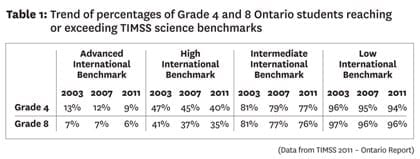
While there’s been improvement in results since the inception of the TIMSS assessment in the mid-1990s, for 2011 the average test scores are significantly lower than they were in 2003 for Grades 4 and 8 (see Figure 1).
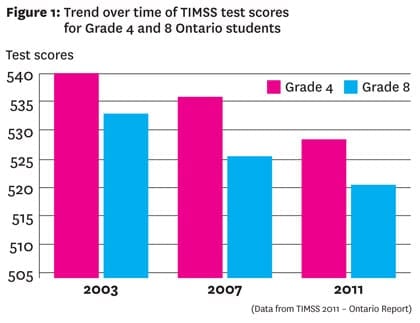
The trend is clear: science achievement has been decreasing over the last decade. What are possible reasons for this downturn in science achievement?
The erosion of science education
In the 1930s, distinguished sociologist Robert K. Merton advanced the theory of “unintended consequences”8 of social action, with particular reference to social policies and priority initiatives implemented by governments. His theory is a useful framework for examining educational policies and initiatives. Over the last decade, the TIMSS results in Ontario, alongside our deliberations with elementary teachers, suggest that the subject of science is being unintentionally undermined by educational accountability initiatives in literacy and numeracy. We believe that one palpable consequence of these initiatives is the negative impact on science achievement by elementary students.
This undermining of science manifests itself in elementary schools through reduced instructional time for science, curtailed learning opportunities which are resource intensive and promote higher-order thinking (e.g. scientific inquiry and technological design), and the reduced hiring of, and support for, highly qualified science teachers prepared to confidently teach science in elementary schools. Elementary teachers we have spoken to offered many concrete examples of these issues:
“I saw science taught twice in 40-minute intervals during a six-day cycle.”
“In the primary division of the school we had an itinerant science teacher who taught science on a cart. She came around to the primary classrooms and provided planning time for the homeroom teacher.”
“In the middle school I was in, the teachers were required to teach their own science program, whether they have a science background or not.”
Furthermore, as described in an interview with a Grade 5 teacher:
“I need a rationale for implementing any new science program . . . if I find that I can’t connect it to my literacy or my mathematics, I may not implement it.”
Recommendations
We believe that decisive steps are now required to build on earlier success in science observed at the beginning of the 21st century. Below are some recommendations for reprioritizing science education in elementary schools:
- Although international measures document important changes over time in educational systems, more local and specific data collection is required to create a more accurate picture of what’s going on in elementary schools with respect to science education. Research aimed at collecting both aggregate and case-specific data on the enactment of science curriculum in schools and districts is needed.
- School districts have autonomy to design pedagogical innovations and promote science leadership within their district. In collaboration with community stakeholders, students’ science outcomes can be improved through leadership and instructional resource development.
- Highly successful school systems around the world invest in their teachers. Promoting science teacher education and development practices that are collaborative and practice-oriented are essential for supporting science education.
- Parents and students must be advocates for science education in schools. Valuing science education and engaging in discussions with school practitioners on how to improve science outcomes for all students will help reprioritize science education.
As we go forward into the second decade of the 21st century, it is indisputably important that students possess a deep understanding and appreciation of science. We must act to limit the current erosion of quality science education. Re-evaluating the high-stakes accountability ethos in schools, resulting in subject hierarchies, and establishing a more equitable approach where science and other subjects are similarly valued is an important enterprise. Recognizing the unintended consequences of educational initiatives is the first step to ensure that students achieve in all subject areas.
First published in Education Canada, June 2013
1 John S. Wills, “Putting the Squeeze on Social Studies: Managing teaching dilemmas in subject areas excluded from state testing,” Teachers College Record (2007): 1980–2046.
2 Educational Quality and Accountability Office, Trends in International Mathematics and Science Study (TIMSS), 2011: Ontario Report, (Toronto: Educational Quality and Accountability Office, 2012). http://www.eqao.com/pdf_e/12/TIMSS_Ontario_Report_2011.pdf.
3 In Ontario, “Technology” refers to structures, mechanisms and design problem-solving learning expectations, and is subsumed under the “Science & Technology” curriculum policy. For brevity purposes, we will use “science” throughout the article.
4 Michael Fullan, Great to Excellent: Launching the next stage of Ontario’s education agenda, (Toronto: Ontario Ministry of Education, 2012). http://www.edu.gov.on.ca/eng/document/reports/fullan.html.
5 Andy Hargreaves, and Shirley Dennis. “The International Quest for Educational Excellence: Understanding Canada’s high performance.” Education Canada 52, no. 4 (2012).
6 Educational Quality and Accountability Office, Trends in International Mathematics and Science Study (TIMSS) 2011: Ontario Report..
7 TIMMS establishes four descriptive benchmarks (advanced, high, intermediate, low) based on a single scale value (e.g. 625 is considered advanced) allowing for broad reporting of science achievement, alongside the mean scale scores. This reporting method helps to facilitate comparison and analysis among jurisdictions and cycles of assessment.
8 Robert K. Merton, “The Unintended Consequences of Purposive Social Action,” American Sociological Review 1, no. 6 (1936): 894-904.
-
STEMming the tide of creativity in schools
Comments Off on STEMming the tide of creativity in schoolsThis time of year, I find myself having the same conversations with students with what seems like increasing frequency.
Me: “Hey Janice! I see you are doing your course selections for next year. Coming back to drama?
Janice: (With a pained, embarrassed and somewhat apologetic expression) “Sorry, Mr. Frost. I can’t take Drama in grade 11. I have to get my (*Insert Science class here) next year. I will be a) too busy or b) have no room in my schedule.”
If I had a nickel for every time I heard that, I might actually be able to retire at a reasonable age. Whether it be Advanced Placement this or High Academic that, students in our public schools, it seems, are often forced to choose. And for many, the choice is not really a choice. As a society, many Canadians seem to think of Arts education as a quaint little endeavour, meant to serve no greater purpose than to “round out” a course load. A nice little diversion from the rigors of academia. Not to be dismissed, mind you, unless of course, it gets in the way of true educational pursuits.
It seems that even here in Nova Scotia, where we tend to be fairly Art centered, we are not immune to the view of Arts education as secondary subjects. We like to say that we consider the Arts as valuable as the core sciences, but proof to the contrary can be found in the latest move by our Province towards a full year math program in grade 10. One day, the media is reporting that our math scores are low and the next day, BAM!, a brand new full year math course and a brand new curriculum. This may mean better math students, but it may also means students with fewer course options. I would love to see what sort of media storm could bring about a similar result for, say, dance.
There is a large body of research that points to the retention of math skills being inversely related to time away from the classroom, so I certainly see the value in a full year math credit. But why must there be a trade-off? Why must the pursuit of one academic path so often eliminate the exploration of another?
For many students in our schools, this is the reality that is their high school experience. In school after school, year after year, this conversation is repeated. Students must choose between courses which they feel, (and are often told), are valuable and those which are self enriching. The recent rabid “slash and burn” approach to cutting public education funding certainly has not helped the matter. I have always considered this constant, often one-sided battle for students as a fundamental structural flaw in the system. And the more I read about education, the more I see people who are agreeing with me.
All over the world, from Canada, to the US, to the U.K., people are recognizing that in order to remain vibrant and innovative, economies need to embrace areas of development outside what has been referred to as the STEM core (Science, Technology, Engineering, Math). Just this past week, the Globe and Mail carried two such stories, one talking about how educator’s in Oklahoma are working toward focussing more on the Art , and one from the UK, which had an expert exclaiming that “creative types…are key figures who have the potential to push stagnant economies back into growth.”
It is interesting to note that both these articles appeared in the paper’s business section.
I am not anti STEM. I am simply pragmatic. We want innovation and creativity in our villages, towns and cities. We want vibrant, engaged next generations. We want new ways of approaching old problems. If this is what Canadians truly want, then we need to see the value in a wide based approach to public education which equally foots Chemistry and Drama, Physics and Dance. Yes, it will cost. But to not encourage creativity and innovation among our youth will ultimately prove much more expensive.
-
Drama Festival Proof of Value of Arts in the Schools
Comments Off on Drama Festival Proof of Value of Arts in the SchoolsAs the Rehtaeh Parsons tragedy moves slowly, sadly and inevitably off the front page of the country’s newspapers, there can be little doubt that her death has had an impact beyond the massive hole it has left in the hearts of those who knew and loved her. In the fervor that immediately followed her death, politicals from Prime Ministers to Premiers took to the soap box to decry the incident. Thumping their chests soundly, they railed that more needed to be done. More by government, more by the police, and, of course, more by the schools. As a result, promises have been made, consultants have been hired, and policy will be written.
And all that effort won’t make one damn bit of difference.
This is not an issue that can be fixed by policy, or by governments, or even by schools. No, this issue can only be fixed by the kids themselves. This very sentiment was echoed last week in Toronto where experts gathered at a conference hosted by the Promoting Relationships and Eliminating Violence Network (PREVnet). According to a Canadian Press article on May 8th, the focus of the conference, the 7th of its kind to be held, was on developing tools and strategies to combat bullying. And whether it was Rehtaeh Parsons or Amanda Todd, British Columbia or Nova Scotia, speakers were of the opinion that the focus needs not be on the policies. The focus, rather, needs to be on helping kids deal with the issue and step up to confront bullying when they see it happen.
Well, last weekend, quietly and out of the limelight, I saw that exact mode of thinking validated when I attended the 41st Nova Scotia High School Drama Festival, at Dalhousie University in Halifax.
For those who may not know, this festival brings high school students and their drama teachers from all across the province to a three-day gathering to celebrate all things dramatic. During the day the kids take workshops in everything from lighting to make-up, stage combat to musical theatre. In the evenings, they have a chance to perform dramatic pieces they have written for an appreciative audience of peers. And every year it is a celebration of all the things that make drama great for kids, characterized by a buzz of positive energy that can, at times, make your hair stand on end.
This year, however, was different. This year was…well…subdued.
Oh there was excitement of course, particularly on the first day when the kids arrived in the early hours of Thursday morning to start attending classes and workshops. But as the evening rolled around it became clear that, for many of our students, the tragedy of Rehtaeh Parsons was still very raw. For show after show after show dealt with the topic of bullying and its horrific effects.
These are truly rare moments for educators, for the student production gives us a glimpse of how the world appears through the students’ eyes. It is a world that can be harsh, a world where words like “policy” have little impact, and a world where the fumbling attempts of adult interventions are often greeted with tolerant disdain. “I know you want to help, teacher, but you just don’t understand”.
You could see the kids struggling through their emotions, wrestling with their own behaviours as well as the way they have been treated by others. Trying to craft pieces on stage that would provide some hope, some glimmer of an answer as to how to stop this sort of thing from happening again. Shows performed without cameras flashing or media paparazzi looking for some kind of an angle. Shows performed without fear of recrimination or judgment. Performed in front of the most trusted of adults, and the most trusted of peers.
And it was a thing of beauty.
You see, in many cases, drama classes and clubs are filled with the outsiders, kids on the periphery. The geeks. The bullied. And they understand the pain that can be caused by an errant word or an inopportune comment. But drama also draws in the cool kids. The jocks. The beauty queens. And as their shows played out on stage, one thing became very apparent.
All the kids get it.
They don’t need a policy. They don’t need procedure. They understand the power of bullying. They have bullied. They have been bullied.
And they struggle with what to do about it.
By the final day of the festival, the kids were back to their normal “love of life” form, and the Dalhousie Arts center was abuzz with time-honoured shouts of “Kumquat!” and “I lost!”. It almost seemed as if they had, collectively, healed somewhat. None of them, I am sure, actually believed they had stomped out bullying, nor had they forgotten Rehtaeh’s death. But surrounded by caring teachers and accepting peers, they were able to, at least for a weekend, address the issue head on in a form that they have come to trust.
And I am humbled to have been a part of it.
-
Drama teaching experience NOT going to help Trudeau
Comments Off on Drama teaching experience NOT going to help TrudeauRecently, a great deal of concern has been expressed around the Tory ad campaign attacking Justin Trudeau as “too inexperienced” to tackle the complexities of being Prime Minister. As well, a great deal has been made about the slant the Tories have taken in this campaign, which points to Trudeau’s past work experience as a detriment to true leadership. In particular, his experience as, of all things, a drama teacher, has caused his leadership ability to be questioned.
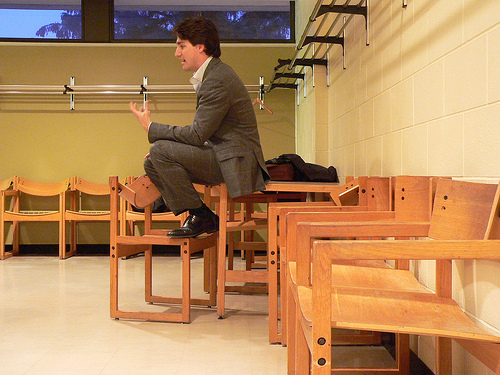
-
Our Roots Are Showing
Comments Off on Our Roots Are Showing“Sir, why are we learning this?”
“Miss, when am I ever going to use this?”All of us will likely recall asking similar questions ourselves at some point along our journey through school. Those of us who are teachers, especially those involved with students older than, say, TEN, will likely have memories of that uncomfortable silence that hangs between, “I don’t know what to tell you” and “I should know what to tell you”. As a grade eight teacher, when all else failed, there was always an easy—but less than satisfying—default position. “You’ll need to know this for high school,” I would say, a little bit of an edge to my voice.
It is always a little discomforting when the context for learning is expressed as preparation for the next stage of learning. While there is no denying the fact that there are many aspects of learning that, necessarily, build on accumulated skills and knowledge, when it comes to creating a context for learning, the storage for future reference argument is never that inspiring.
The parochial roots of our education systems are showing and they are holding us back from taking seriously the renewed conversations about widened contexts for learning that we so desperately need to be having. Oh, we’ve done a fine job of imagining what transformed schools could look like if we opened up the doors of the schoolhouse to new technologies. We’ve dreamed of learning spaces that both reflect and encourage a focus on skills like collaboration, creativity and communication. We’ve talked about forging new types of relationships between schools and the wider communities that surround them. This is all important stuff but, to borrow from Simon Sinek’s now famous TED Talk , it is the stuff of the what and not the why.
Yet, when we talk about creating a context for learning that is, at once, compelling and inspiring for all involved, we need to hold the why firmly in front of us. Perhaps the best way to reconnect with the why of schooling is by looking closely at the curriculum structures that currently form the foundations of modern schooling. Instead of asking how we can make history more interesting, science more relevant and mathematics more accessible, let’s start to take a deeper look at why these disciplines are important to our sense of quality education in the first place. Curriculum reform movements, including the ones that are happening across the country, and south of the border, all seem to begin with questions about what is important to know and be able to do at various stages of the educational process. But what might happen if our energies were first spent on coming to a clearer understanding of the purpose behind studying particular disciplines and what that study can do to nurture our vision of the educated person?
Why is it so important that we learn history? What is it that science can do for our individual and collective consciousness? What is it about mathematics that contributes to our image of a civil society? Why continue to study the great literature of both the past and present? These are questions that are often glossed over when we talk about new approaches to curriculum and pedagogy.
But they are the very questions that will help us to engage in deeper, albeit more philosophical, conversations about deeper and richer contexts for learning.
In his brief, yet powerful, essay, The Reform of Thinking and Education in the Twenty-First Century, philosopher/sociologist Edgar Morin suggests four foundational aims of education:
1) A brain well-formed rather than a brain well-filled
2) Learning about the human condition
3) Learning how to live
4) Citizenship training
In Morin’s view, curriculum needs to placed in the service of our aims, and not the other way around. And he starts to provide some engaging thinking around how our thinking about existing curriculum approaches might begin to change.
For example, when science is seen as a way of helping us place human existence within the cosmic story, a powerful and compelling context is created. When the study of history takes on a similar narrative purpose by helping learners to better understand the creation of communities, nations and cultures, then the discrete facts that we associate with the discipline take on a a richer and more meaningful purpose.
But, Morin argues, education is also about the subjectivity that can be realized and understood through the study of literature, poetry, art and media. These are the places where the human condition is brought home and placed in the context of personal and interpersonal relationship. It is here where the art of living is explored and connections among individuals and cultures are made manifest. And what’s more exciting, possibilities for connections between traditional disciplines become much more apparent and realistic
In a sense, curriculum is the place where the dance between the objective and subjective, between the global and personal contexts, takes place—an important and necessary dynamic! For me, the exciting part of this type of thinking is that it brings us face-to-face with the why of our work as educators. It doesn’t in any way discount the importance of learning content but it forces us to make our intentions very clear around how it fits into the wider context of our work.
How might our response to the why are we learning this questions change if these types of these deeply-rooted conversations began to take place at all levels of our education systems, throughout our communities, and in the public square?
-
Charles Fadel: Rethinking the Curriculum that Students Really Need
Comments Off on Charles Fadel: Rethinking the Curriculum that Students Really NeedGlobal education thought leader Charles Fadel shares his ideas on redesigning the curriculum that students really need.
-
Voice of Experience: Little Square Pegs
Comments Off on Voice of Experience: Little Square PegsThe other day, I got a bucket of water and a cloth, and called my youngest daughter. Admittedly, it was a rather pathetic attempt to appease some “mommy-guilt.” Struggling to find the tenuous balance between my need to get stuff done, while still spending quality time with the kids, sometimes leads me to combine those binaries and try to sell it as fun.
I don’t know how this plays out in the classroom. I can see value in enabling our students to dunk their soapy hands in their learning. The imaginative possibilities encompassed by a flexible curricula appeal to me; I believe these very things will teach students to think critically and adequately prepare them for a changing world.
But there is practicality to consider. Nobody wants a free-for-all! Outcomes-based curricula and assessment provide helpful structure, equity between students, and general organization. But are specific outcomes the best way to encourage authentic learning? Certainly they create destinations we are driving toward; but they also, by definition, limit the journey. In the process, do we limit our children?
Do we create and implement curriculum outcomes because we truly believe they are best for our students – or because we haven’t imagined how to do it differently? Are we ready to transform?
I have few workable answers to the practical challenges this educational transformation would present. However, I do think we are tumbling in a world that is a shifting kaleidoscope, unable to predict what picture will appear tomorrow. I am not confident the structure of schools and our current practices encourage the flexibility, creativity, and healthy curiosity our children will need as they navigate the ever-changing landscape of the future.
There is one thing I am sure of: that the weighty responsibility of preparing children for a world of possibilities, and the challenges that come with change, face educators and parents alike.
First published in Education Canada, January 2013
-
Oasis Skateboard Factory – Curriculum by Design
Comments Off on Oasis Skateboard Factory – Curriculum by DesignThe teacher and students explain how the skateboard becomes a catalyst for hard-to-engage youth.
-
Students tackle academics in practical context at Skateboard Factory
Comments Off on Students tackle academics in practical context at Skateboard FactoryHigh school student Nick Robertson came to Oasis Skateboard Factory (OSF) from a suburban Toronto district where, he says, “I was being spoon fed the exact same education as parents and grandparents, and that did not fit with me. They tried to diagnose me as ADD, ADHD.” He says his average grade was about 60. He “squeaked by” in Grade 9 and finished Grade 10 “in bits and pieces.”
He was surfing the web when he spotted a reference to Oasis Skateboard Factory, an alternative program in the Toronto District School Board. He says his first reaction was “Skateboards in school? It didn’t seem possible.” He applied, was accepted and took up residence with a relative in Toronto. He started in September 2011 as a Grade 11 student.
He became immersed in OSF and adopted the brand “Kid Sqwid” for his boards and other artwork. In his previous school experiences, he tried to avoid writing but not now. Nor are there any issues about meeting deadlines. “There is a lot more pressure on us [than in previous school experience] – not negative, but you have deadlines to meet. We have done writing in magazines; there’s a sense of pride that goes with that.”
Caption: Oasis Skateboard Factory student Jacob Skinner and his dad, John
Credit: Photo courtesy of Jennifer LewingtonHe now expects to return to his suburban Toronto high school in January, a move he sees as a “lot easier” after his OSF experience. “I can get a lot of work done. I have learned to cope with deadlines; it’s been really good practice.”
“One of the main things about this place is that I can actually draw and not feel like I am doodling away and being yelled at for drawing on the side of my notes,” he says. “[Drawing] is an actual talent I have that can be used.”
Jake Skinner, 19, attended a high school in a suburb east of Toronto. By Grade 12, he was still six credits short of graduating and unhappy at a school he felt was too impersonal. “They are not trying to teach you; they are talking at you like a wall,” he says. He discovered OSF through an aunt who lived within the Toronto District School Board catchment area and now stays with her while attending OSF.
He is thrilled about his school experience at OSF. “One of the main things about this place is that I can actually draw and not feel like I am doodling away and being yelled at for drawing on the side of my notes,” he says. “[Drawing] is an actual talent I have that can be used.” Having learned the business side of art at OSF, he now plans to apprentice at a tattoo shop and start his own business.
Caption: Oasis Skateboard Factory student Carly Bond and her toy creation
Credit: Photo courtesy of Jennifer LewingtonHis parents, John and Kimberly Skinner, were “thrilled” to discover a school where their son could pursue art. When she attended an open house early in the school year, Kimberly Skinner says, “Craig couldn’t say enough good things about Jacob, [including] his maturity level and his leadership skills. I thought, ‘are we talking about the same boy?’” John Skinner adds, “[In the past] a teacher meeting would start with an apology. This was different.”
Jake received a scholarship to attend a course at the Ontario College of Art and Design (OCAD). After that, says Ms. Skinner, “who knows? We got through high school and that was a big step.”
At her previous school, Carly Bond, 17, often skipped school and finally got kicked out. She credits her then-school guidance counselor for recognizing her preference for hands-on learning and recommending she attend Oasis Alternative Secondary School. Then a friend suggested OSF, one of three Oasis alternative schools. Carly says she “fell in love with everything” at OSF, including “how all the projects are not fake.” Moreover, she says, “now that I know my project is going somewhere and being sold, I am going to work really, really, really hard on it because of that.”
“I go to school because it is giving me experiences of what I want to do with the rest of my life.”
She stayed at OSF for three semesters. In her final semester last spring, she did a job shadow with street artist Slurg, who makes model toys. Carly has made her first toy, Snapper, a “man-eating ice cream cone.” She eschews “sexist” toys such as Barbie and says she will create “more playful and creative toys, not just a girl with clothes.”
Caption: Oasis student leads workshop at Art Gallery of Ontario
Credit: Photo courtesy of Jennifer LewingtonShe still needs more credits to graduate but doesn’t want to go to school just to get credits. “I go to school because it is giving me experiences of what I want to do with the rest of my life.” Her parents, she says, “are really happy. I used to be a bad kid when it came to school. Now I get better grades than my sister or brother.”
At the Toronto District School Board, Karen Grose is Central Coordinating Superintendent of Strategy and Program Planning and has oversight responsibility for the system’s alternative schools. She is clearly impressed with OSF. “The anecdotal comments from parents and from students and from staff around the Skateboard Factory [show] they’re positive, they’re passionate,” she says. “It’s just inspiring.”
Does the TDSB intend to replicate it? “It’s only just three years old, she reflects, “but I think we have enough data and enough understanding of the success of this program, the passion that the students have for this type of learning to know that these are the types of things that we need to move forward with. We’ll explore possibilities for where Skateboard will go next. I think there are a number of possibilities.”
OSF teacher Craig Morrison gives much credit to Ted Hunter and Norah Jackson, co-owners of Roarockit Skateboard Company, for their close participation in the work of the alternative program. Mr. Hunter is a fulltime professor at OCAD specializing in furniture design. His wife, Ms. Jackson, comes from a graphic arts background. Mr. Hunter has a special feeling for the OSF students whose learning styles often don’t fit well in mainstream schools. “That’s exactly how I went through school,” he says. “Finally for me it was one teacher at the end of high school who said ‘boy, you’ve got to go down to the Ontario College of Art and take some courses.’ That one teacher totally changed my life. That’s the way Craig is.”
Caption: Students at work in Oasis Skateboard Factory
Credit: Photo courtesy of Jennifer LewingtonFor their business, the couple invented a kit that enables youths – or anyone – to build a professional-quality skateboard, a key starting point for activities at OSF. As well, the two have worked side-by-side with Mr. Morrison during the school year to sponsor social events (part of the program’s student engagement strategy), mentor OSF students engaged in higher-level skateboard builds and coach advanced students to become instructors for Roarockit workshops.
EN BREF – Renseignements additionnels au sujet de l’Oasis Skateboard Factory
-
The Skateboard Factory: Curriculum By Design
Comments Off on The Skateboard Factory: Curriculum By DesignSince its opening three years ago, Oasis Skateboard Factory (OSF), founded by teacher Craig Morrison, has attracted considerable media exposure and received a Ken Spencer Award from the Canadian Education Association (CEA) for its innovative program. OSF is one of three programs offered by Oasis Alternative Secondary School, one of 22 alternative secondary schools of the Toronto District School Board (TDSB). Students design, build and market skateboards, along with paraphernalia for the skateboard culture, and earn academic credit. Students may enrol for as many as three semesters.
Students who fared poorly in their previous schools re-engage through their OSF experience. Nearly all OSF students graduate from high school. What goes on at the Skateboard Factory that makes this happen? Here is what Mr. Morrison told Education Canada:
What gave you the idea to start the Oasis Skateboard Factory?
When I was curriculum leader at Oasis Alternative Secondary School, I was the onsite principal’s representative. So I had a great experience at how to run a whole school. At the same time, I was also the arts teacher and I ran a street-art program.
I started a skateboard design class with the help of Roarockit Skateboard Company and its co-owner, Ted Hunter, who had adapted a method of pressing skateboards. He’s a professor at the Ontario College of Art and Design (OCAD). Prior to that, the whole skateboard industry was constantly telling kids: you can’t make your own skateboards or that a real skateboard had to be bought from a company in California. And the irony of that is all the wood is Canadian – hard- rock maple – which gets shipped to China, then sent to a skateboard company in California, to put their logo on it and ship it back to us.
People had been doing skateboard building in shop classes. I was interested in this as a vehicle for graphics originally, the really funky street-art graphics that we were doing, until I realized that it could be a vehicle for so much more. Early on in that program, I started a blog. I’d take a picture of a kid who’d finished a board, just simply that. If there’s anything that has made this explode, it’s people’s responses to a picture of a kid holding that skateboard. The look on their faces … that really helped me convince people why they should support this. So we have a kid who never comes to school, never gets credits, and all of a sudden they’re engaged in their education. I had good attendance in that class and good achievement.
Caption: Oasis Skateboard Factory teacher Craig Morrison
Credit: Photo courtesy of Jennifer LewingtonI ran the skateboard art class for three years. The kids were selling their boards. I thought if I had a whole school, I could teach the whole curriculum through this, through the experience of running it as an entrepreneurial business. So three years ago I pitched to my school and then to the principal the idea that I would step down from my position to do a satellite program, because my skateboard class was super-successful.
I have to say, that was a huge leap of faith, although I did have resources. I had a gallery I had done shows with before; my skateboard class did an art show in a coffee shop; and I had the Roarockit Skateboard Company and all the people I knew in the arts community. It also arose from my frustration of wanting things to happen.
You see these students, who are superstars, just no one has given them the spotlight or the focus, or no one has put the wedge in the door before it slams shut. I wanted to do this thing with these kids. Right now we have a 100 per cent success rate; for the previous two years, I had like 97 percent last year, it was in the 90s in the first year of the program. That’s a huge success rate for any kind of alternative school, let alone school.
What happens at the Oasis Skateboard Factory?
Students go to school 10:30am to 3:30pm. It’s a workshop for five hours a day in order to get the four credits…So we’re probably one of the latest-starting schools. You know, many kids are always late in the morning. Let’s get them in and engage them and then keep them the whole day. So I don’t really do breaks and they’re with me all day. And it means they’re really productive, like kids don’t go out and smoke pot and come back late. I have hardly any classroom management issues. We have breakfast and lunch here. We eat together. We don’t have a lunch hour but we eat while we’ll have a business meeting. Or if it’s a workshop day like today, they’ll just eat at their own pace when they need to. They know their projects. They get assessed and given feedback every day; being on task, being on time, being respectful (laughs), being a good advocate for our program – the leadership part of this, the outreach part.
How is the course structured?
It’s a semester school; students receive four credits per semester. I’ve got students here now who have been here for three semesters – it’s usually a semester then students do a leadership program with me and our community partners.
What is your teaching background?
I went to teachers college at Queen’s University in the artists-in-community-education program. I’d done a lot of activism with youth and I’m an artist and designer. So I did the community-artists-in- education program in which you got to design your own practicums. I made sure I did one of them at an alternative school in Toronto. There I started an arts and social change program, and this is back in the old days in alternative schools where they were called catalyst teachers and it was just people in the community who were experts in their field, so me being really tapped into street art, I’d teach a bunch of classes to kids who were interested. My first job was at Lakeshore Collegiate in Etobicoke. Then I took my daughter to Alpha (opened in 1972, the first alternative elementary school in the TDSB), one of the freest alternative schools and I walked upstairs to Oasis and I said, hey, I’m a teacher and I love alternative schools. I started the next day!
How do OSF students earn credits?
I’m probably running 20 different courses. And that’s just something alternative schools teachers do. You have classes that are Grade 9, 10, 11 and it’s up to me to differentiate that. We have four groupings of courses: English and leadership; business and entrepreneurship; art; design.
I do an English grouping: English Grade 10 and 11, English Media then leadership. A lot of what we do is writing, for promotion, non-fiction, a focus on business writing. They’re writing about their products – how do you write technical specs, advertising, that kind of stuff.
We do a skateboard “zine” [a small-circulation self-published magazine], which is a hugely popular form of alternative media, so they can promote what they’re interested in. Our theme is always around street art or skateboard culture. We do interviews with bands and skateboard makers in our local community. We distribute the zines and sell them at art shows.
Every semester we write for Concrete Wave Magazine, which is the professional skateboard magazine. This year we get four glossy pages. You know, it’s funny how kids who don’t want to write or would never check their spelling or grammar do awesome work when they know it’s going to be read…The last one we did was really interesting: the emotions of skateboarding, the stoke you feel when you’re skateboarding.
The next step is a leadership course and we do a lot of outreach in that. Our students become teachers. Last semester we did a workshop series at an elementary school, a workshop series at a Montessori school and another through a youth arts program at the Art Gallery of Ontario (AGO).
Business credits include a grouping of courses like Business 9 and 10, Grade 11 Entrepreneurship and Grade 11 Marketing. That grouping of courses we run in partnership with The Baitshop in Parkdale. We’re taking kids through the experience of building their own company, branding that company and making the products that surround those skateboards: buttons, skateboard stickers, and other merchandise…We make really professional t-shirts, which we sell.
Then it’s double art. It’s visual art, street-art class. We’re doing street art, legally, of course. We deal with people’s businesses for space. It makes kids realize the legalities and how to negotiate, because some of these kids do this on their own outside of school whether adults like it or not. It’s helping them to see they can actually connect to something bigger – a mural, for example.
And the last course is the skateboard design class. People a lot of times think of the school as a skateboard school. Actually it’s a skateboard design program. It’s a design school. Usually schools don’t encourage kids to take more than one credit in art in high school. Here I connect art to the central skills that are the most valuable skills, and make connections to transferable entrepreneurship and business skills.
How do you assess students?
We don’t do exams. But students are evaluated. I’m seeing curriculum through the lens of skateboard culture. There’s boring stuff, like in the business textbooks. Characteristics of an entrepreneur – you know how boring that is to read to a kid? But you show them Big Daddy Roth, grandfather of custom cars. Let’s look at how he embodies that. What can we learn about that with our skateboards? All of a sudden it’s wild and exciting. Or we’re talking about design. Why are we looking at famous artists? What about the graffiti right on the corner? You build from their experience.
I completely cover the curriculum. These kids do more than the curriculum, because they’re connecting the curriculum to the world in a real physical way. We’re out in the community. We’re doing projects. This semester they’ve taught workshops to OCAD students. It’s this great inversion. There’s this person who’s a designer and artist, who’s an authority on teaching others. He said our kids are better behaved, better engaged than kids from university. They’re superstars. It’s amazing.
How are OSF students benefiting beyond the credits they’re earning?
We like to work independently. At the same time, we’re part of a team. When we get into jams and deadlines, we’re working together. There is no acceptable late here, because late doesn’t cut it in the world. Like that board over there has to be finished on Friday to go to a client.
There’s no pre-existing economy for student-made skateboards. So these kids are creating that economy. We’re not just about making a profit. It’s about working with good people we want to work with. They share our values.
Then there’s the embedded learning, how we look at a board as being about a lot of things. It’s not just a design project or a business project. It’s everything all together. It’s project-based learning. The projects go out into the world. That board when it’s done will have been shown in an art show. It will probably have been bought by someone in a shop. It will have been written about. The kid will have learned to market their business.
We’ve got boards right now in Longboard Living in Kensington Market, which are sold alongside professional skateboard brands, and people buy our stuff. So we’re not making toys, we’re making professional-level stuff using technology and methods developed by Roarockit Skateboard Company. We don’t do just passing-level work. I have high expectations of them, and they thrive on that. They see the real stuff they’re capable of. So when they experience that, it’s powerful. So it’s high expectations, which is hard for some kids. But we offer support for them. This is something alternative schools are really good at, because we’re not authoritarian; we know as much as possible the individual needs of our students.
Why does OSF work for kids who had been disengaged from school?
Because of the engagement with art. You show me a better engagement tool; I don’t think it exists. Every project we do here is art or design in a way, even in business class or English class. Everything we do gets shown in public. I have a really strong negative feeling about projects that a teacher marks and puts in a file folder and that’s the end of it.
Caption: Oasis Skateboard Factory student applies stencil art to skateboard
Credit: Photo courtesy of Jennifer LewingtonWe’re a re-engagement program and we are reconnecting kids with something that got them in trouble: graffiti and skateboards, things that adults don’t like. Half the books in the art section of a bookstore are on graffiti and street art now. Graffiti is not a marginal activity. Young folks who work in advertising agencies have backgrounds in street art, appreciation of graffiti. You see it all around us. So I hook kids with the things that get them in trouble to a productive outlet. And we reconnect them to adults. So they have adult mentors in the community, and their parents actually start to reconnect with them because these kids do art shows – we show everything. The parents show up to the art shows, our events, our sales, our pop-up shop [classroom]. All of a sudden they’re proud of their kids. That’s a nice feeling to feel proud of your teenager.
What is the selection process for new students?
We do hour-long info sessions, which is my advertising for this program. At the end of that I give them an information package. I ask them to design a skateboard – just a rough thing. I’m not looking for art skills; I’m looking for something I can use to engage them in conversation. Then we invite them in for a group interview. We run them through an experience with our students. I get to see how they work as a team. I take kids who I think will benefit from this experience. Here a kid doesn’t need to be good at art, but they have to want to do it. It’s for that kid who’s into skateboarding but also likes art or likes computer or visual culture or graphics.
What happens to students when they leave OSF?
Students are here for a semester. Then, if they have success, which they all do, they can move on to the leadership program. And the kids want to do that because they do all this stuff that’s really cool. And some kids have been here for three semesters because they just don’t want to leave. For some girls who are in that situation this year, we wrote a grant. They work with middle school girls. The girls got materials to start their own companies. So when they’re done with this, they can just do it themselves.
I often counsel students to go to another kind of alternative school because they still get that arm around the shoulder, someone is there for them. Some kids want to go back to a regular school because of the program, like a shop or music program. They come in needing so many credits to graduate. I help them get over the hump. I had a girl who wouldn’t talk to anyone when she started, wouldn’t pick up a pen. Last year she was valedictorian at her school and graduated.
How does your location benefit the program?
The Toronto District School Board has always had a classroom here [in the Scadding Court Community Centre]. Oasis Skateboard Factory is one of three components of Oasis Alternative Secondary School. The other two are The Triangle Program [LGBTQ] and The Arts and Social Change Program. I saw the opportunity here because we have a skate park right here – an infamous skate spot. You have all these other official skate spots built of concrete. This is a real infamous skate spot right here. Kids built their own ramps. It’s a real great location. For an entrepreneurial business like ours, what better spot to be than across from Kensington Market? New Canadians are opening businesses, young people are opening things like vintage clothing stores and screen printing studios, and you have young fashion designers. The arts district has spread up here. We have a gallery show coming up near here. So it’s really an amazing, rich-in-resources area in terms of visual culture. Then we have the more corporate kind of art, which is the advertising and marketing all down King Street with all the design firms. So we’re in a perfect location to capitalize on the resources the community brings to us. We work with community partners all the time.
How is the community involved in the OSF program?
Ted’s [Ted Hunter, Roarockit] really my partner that started this. We have many partners, but he’s really the core of what we do. He teaches at OCAD and these kids get to work with him on advanced projects like this one right here (shows a student’s skateboard). It looks like a boom-box, sort of a radio thing with a handle. Ted helped that kid figure that out. No one’s ever done something like that in the world of skateboards. That’s why we get a lot of attention from the skateboard community. Here are these high school kids doing stuff that no one’s thought of. It’s amazing. And we’re bending wood like that drop-deck (shows another board). That’s a saleable shape in longboards right now. We’re figuring out how to bend wood like that. We’re getting expert mentorship. A lot of resources are in-kind, like working with people who believe in our mission. Our mission this year is to be doing professional work. We want no one to ever say, ‘oh that’s a student product.’ Some of our designs this year would sell on the spot. Skateboard shirts. Kids wear those things.
If you go on our website and look at the clients we have and have built boards for, we do almost every independent coffee company. Most are owned by young people who probably skateboarded when they were in high school or have that value about supporting their local community. They support us. So I put these kids in relationship with other young people who are next up the path: graduated high school, maybe from an alternative high school, and are now young business persons. When kids sell a board it’s really about a relationship they’re building with the client.
Could OFS be a prototype for other alternative schools?
People talk to me all the time: how do you expand on this? Don’t just expand this. Take the model we’re doing here and just apply it to something else, because it doesn’t have to be skateboards. Take that auto shop that no one is doing something with, and instead of just repairing motors all the time, start painting those cars with pinstripes and flames and stuff, like “Pimp My Ride.” Engage them in visual culture, which they’re experts in and consumers of; they just don’t experience being makers of it. I’m trying to turn that around, making stuff with your own hands, making your own culture.
Oasis Skateboard Factory, a program of the Oasis Alternative Secondary School and the Toronto District School Board, opened in 2009 at Scadding Court Community Centre in Toronto. Craig Morrison is the creator and teacher of OSF.
EN BREF – Fondée il y a trois ans par l’enseignant Craig Morrison, la Oasis Skateboard Factory (OSF) (l’usine de planches à roulettes Oasis) a fait l’objet de nombreux reportages et son programme innovateur lui a valu le prix Ken Spencer de l’ACE. L’OSF compte parmi les trois programmes de l’école Oasis Alternative Secondary School, l’une des 22 écoles secondaires alternatives du Toronto District Board of Education. Les élèves, qui peuvent s’inscrire à l’OSF pendant trois sessions, dessinent, fabriquent et commercialisent des planches à roulettes et des accessoires connexes, obtenant ainsi des crédits scolaires. Grâce à l’expérience OSF, des élèves autrefois désengagés ont raccroché aux études. Presque tous les élèves de l’OSF obtiennent leur diplôme d’études secondaires.
-
Cdn EdWire – New Quebec Government Stirs Up Multiple Education Controversies
Comments Off on Cdn EdWire – New Quebec Government Stirs Up Multiple Education ControversiesQuebec’s plan for education slammed – Winnipeg Free Press
PQ wants to trim English classes, boost sovereignty studies – CBC
Private schools trying to count learning-challenged students – Montreal Gazette
OTHER NEWS
Quebec study of post-reform students yields disappointing results – Montreal Gazette
Progress slow with high-school dropout rate – Montreal GazetteOntario slammed for outdated sex ed and mental health curriculum – Toronto Star
Divisions could share new facilities
Ontario Catholic groups slam education minister for appearing to call anti-abortion views ‘misogynistic’ – National Post
CBE plan for corporate naming inside schools sparks debate – Calgary Herald
BC Education Plan Linked to Private Corporations – The Tyee
Partnership between education ministry and not-for-profit with billionaire partners raises concerns.Quebec private schools willing to accept more challenged students – Montreal Gazette
Quebec Education Minister Marie Malavoy defends history course proposal – Montreal Gazette
France proposes homework ban, should Canada do the same? – CBC
Province ponders regional schools – Winnipeg Free Press
Education Director laments over the TDSB’s hard year, looks to the future – Globe and Mail
National study to quiz teachers on homophobia – Winnipeg Free Press
EDUBLOG HIGHLIGHTS
Let’s Figure This Out– The Principal of Change
I watched as Bruce Dixon spoke to a group of leaders. To be honest, I had only kind of heard of him before though his name has popped up in blogs, twitter, etc. As he was introduced, one of the statements about him was, “he has been pushing for 21st century learning for 23 years”, and I kind of laughed it off.And then he spoke and I was blown away. To be honest, he really pushed my own thinking as well on what I do in my role.
He talked about the “elephants in the room” and one was the lack of access for students with technology and the pressure of time that we have, yet only providing kids time on a computer for an hour a week. He spoke passionately about the ubiquitous access that students need to a tool that is necessary in our world today. If you look around at most conferences, every teacher has some device that they use, whether it is a computer, tablet, or smartphone. Go into the classroom though, and you will be lucky if you see that as the norm...Read more
On Obama, Dinner and being Superintendent – Culture of Yes
On being superintendent – having been appointed to this position three years ago, and now just completing my second full year in the role, I do find the position is a bit what one makes of it, and there are so many ways to “do it right”. I have seen others in the role who are masters of the community, attending events at arts clubs, chambers of commerce, community centres and many other community events. And, this is important work, because it raises the profile and interests of a school district. One still needs to pick and choose how they will spend their time.My focus is really getting the learning right in classrooms, so classrooms over community has sometimes been the priority. And, to be honest, I have had no problem with working hard, I do want to be sure that my own family sees me some evenings. Yes, I nod my head knowingly at presentations to parents where we discuss the importance of family dinners and other similar connections, knowing full well, that at that moment, I’m doing the very opposite this. I have had to make choices to forgo evening opportunities, and redefining the role of superintendent, aligned with those values. I also do realize what I attend speaks to what I say is important – so these decisions are always taken carefully...Read more
Standardized test scores are like a broken clock – For the Love of Learning
Many Albertans might take these standardized test score results as prima facia evidence that things are well. Many Albertans may be satisfied with this information and confidently move on with their regularly scheduled day, thinking that Alberta schools are not only doing well, but they are improving.What if we are wrong? What if these scores are giving us false confidence? What if standardized test scores aren’t telling us what we think they are telling us?…Read more
Just Put the Puck In the Net – The Value of Student and Teacher Goal Setting – At the Principal’s Office
Hockey is a simple game really with one ultimate goal: put the puck in the net more times than the opposing team does. Everyone knows the goal, everyone helps get to the goal, and everyone knows when the goal has been achieved. The tricky part is in the strategies; many great coaches and hockey-minds have developed hundreds of different strategies to reach the goal. There is no one right definitive way, in fact there are many factors that good coaches will take into consideration before choosing the right strategy. No strategy works with all people all the time.So is the game of education. There is one ultimate goal, or is there? Last time I checked I found numerous different curriculum areas, each with dozens of goals, that changed every year. How is any one every to know the goal?….Read more
-
If I Didn’t Laugh I’d Cry: An Essay on Happiness, Productivity, and the Death of Humanities Education
Comments Off on If I Didn’t Laugh I’d Cry: An Essay on Happiness, Productivity, and the Death of Humanities EducationI am not happy these days. I teach in the humanities at a Canadian University. And – unlike my more Protestant-minded, less eudemonistical colleagues – I think persistent, intractable unhappiness is a clear sign that something is wrong. The following remarks are therefore a hybrid of personal therapy and scholarly analysis. My suspicion is that the state of post-secondary humanities education is the source of my unhappiness. Curing myself, or less ambitiously, simply understanding the cause of my malaise, will require a little self-reflection and a little rummaging around in the potpourri of modern higher education.
Twenty years ago I enjoyed my job and looked forward to teaching classes. I do not mean to suggest that all was well in those days; it wasn’t – not by a long shot. As early as 1969, George Grant argued that a fundamental shift in the university – away from study of the liberal arts and sciences toward the creation of research institutions animated by the spirit of technology and aimed at mastery of human and non-human nature – had been underway for decades and was already nearing completion.[1] If Grant was right, then the pleasant experiences I remember as a young scholar were merely the residual influence of a tradition that had, in fact, capitulated decades earlier and in whose glory I was basking naively, like an amateur astronomer delighting in the light of a star that has been dark for centuries.
By turns sobering and discouraging, this awareness makes me wonder what in the world I am doing. I am trying to make an argument my betters made over forty years ago without having any appreciable influence on their institutions; and I am making it in a context so far removed from theirs that the voice of that small residue of tradition is growing fainter by the day and can no longer be appealed to without soliciting looks of incredulity. So thin is the living, experiential core of that traditional world that even shame can no longer be counted on as a means of getting people to pause and reflect before jumping into the humanities curriculum with both entrepreneurial feet.
It won’t do therefore merely to defend the university as it was in my day. That might satisfy my nostalgia and make me happier for a time, but it won’t address the problem at its source. If we are going to learn once again what a genuine and robust education in the humanities is about, we’re going to have to question our nostalgia and memory as vigorously as our immediate circumstances. And in order to do that we will need to explore that strange thing on which humanities education ultimately rests – our humanity.
Of course, that sounds like the simplest thing in the world. We’re all human. But it turns out our humanity is a moving target and much more slippery and open to abuse than we might imagine. Indeed there are days when I feel so far removed from my humanity that I wonder whether our condition is so different from that of Winston Smith in Orwell’s Nineteen Eighty-Four. I don’t mean that we live under a totalitarian regime that actively prohibits us from thinking beyond its dehumanizing agenda – though there are days. I am thinking rather of the difficulty Winston has discovering a true measure by which to judge the unreality of his condition, an unreality he senses but has no words to describe. When an old clipping from the Times “inadvertently” crosses his desk and “proves” the earlier confessions of three Party members were pure fabrications, Winston is first shocked and then elated; he thinks the clipping so powerful that it alone could “blow the Party to atoms” – much like today’s journalistic exposés. However, what Winston fails to realize is that the clipping itself is just another Party lie. In the end Winston recognizes his dilemma and describes it with stunning clarity in the following formula: “I understand HOW: I do not understand WHY.” [2]
It is the “why” question that promises real freedom – for Winston and for us. Why am I unhappy? Why is it that everything that seems meaningfully to me is disregarded as irrelevant? Such questions are the natural expression of our disaffection with our world. What is more human than that experience, even in this strange age of compulsory happiness? Doubting, questioning, and wondering – if we would only follow these promptings, our humanity itself would lead us back to the humanities proper and teach us what we lose through their neglect.
Doubting, questioning, and wondering – if we would only follow these promptings, our humanity itself would lead us back to the humanities proper and teach us what we lose through their neglect.
* * *
Asking hard, unpopular questions is never easy. But it is particularly difficult if you are alone or if doing so exposes or calls into question the interests of an institution that has little financial or ideological reason to encourage public audit and discussion. I would argue that universities have become such institutions.
To begin, they are everywhere tied to business interests, whether small or large, and in many instances are actually in business with private companies, frequently with faculty members having roles on both sides of the commercial arrangement. This is new. To indicate how new it is, I remember in my student days that you could not even buy a decent cup of coffee on campus, not because students and faculty members had lower culinary standards back then but because they still believed that academic independence would be compromised by being tied to commercial interests. This idea now seems quaint to us in an age in which many universities have their own malls. And like all malls and the businesses they house, universities are run by bosses – administrative elites like Presidents, Vice Presidents, and their minions – who are responsible for many things, among them “compelling” a recalcitrant mass known as The Faculty to perform in a way that mirrors the productive ethos of the administrative caste itself.
Productivity is the raison d’être of Western capitalist societies. Malls retail domestically the fruits of productivity. Universities do R & D and create “ideas” that support the manufacturing sector which supplies retail markets with their goods. Ken Auletta describes succinctly the nature of this new relationship between universities and business in his recent article in The New Yorker, “Get Rich U”: “Stanford is the farm system for Silicon Valley.”[3]
The productive ethos works well enough so long as you are producing widgets to sell to widget lovers. But it proves disastrous when applied to humanities education, though it is much more tolerated by faculty members today than it was in the past. This toleration is likely due to a combination of exhaustion, corruption, and a shift in values. You can fight only so many losing battles before you say to hell with it, the devil take them, and run for your pension. The depletion of the old guard through attrition coupled with the addition of new faculty members schooled from birth in the new ethos explains the decline in large part. After all, university professors too share the productive ethos. We live in a productive society, animated by productive people, which profits immeasurably from productive practices. Why wouldn’t we share that ethos?
Consider one of the fundamental principles of the productive ethos – the quantitative principle. Though it may be possible to argue that an academic whose pile of publications at the end of a stipulated period – say the period covered by the annual report – weighs ten pounds is more productive than an academic whose publications over the course of the same period weighs only five pounds, still we might wonder what we actually know about either person’s work as a result of the application of the quantitative principle. For instance, if Hamlet is one of the documents tucked into that five pound package while the ten-pounder includes two recent volumes by John Grisham, surely we would want to revise our judgment. In any event, if an unvarnished application of the quantitative principle seems unlikely and insufficiently nuanced to be a legitimate measure of performance in the context of an annual academic report (though I would caution anyone about underestimating the proclivities of the administrative caste when it comes to the ethos of productivity), we might add the matter of the work’s “impact” to the calculation to arrive at a better metric. Impact too is a quantitative measure, though a more complex one. It asks concerning the effect of one’s work on other things – institutions, political and social events, people – both within and without the university, though today preference is given to the latter in keeping with the business ethic underlying the productive ethos.
The impact test is one that Stephan Collini has analyzed in his recent book What Are Universities For? Collini teaches us that the most problematic aspect of the impact test derives from the term itself. To impact something is to strike or bang into it – in my experience never a good measure of anything except perhaps in war and at those demolition derbies my father used to take me to. But setting aside the silliness of the term, a more troubling picture emerges regarding its actual consequences when tied to funding formulas. As Collini demonstrates, you can have an absolutely first-rate piece of scholarship that illuminates, say, the transition from a feudal to a capitalist economy, that ranks as completely worthless when measured by its impact and when compared to the impacts of “products” issuing from other faculties within the university.[4] Placed alongside a new gadget for collecting pennies, the impact of which would be staggering, this little corner of the human experience seems trivial at best. But what an odd inversion of things that judgement entails. A gadget which, beyond its economic potential, could not hold your attention for more than a few moments trumps an intrinsically interesting field of study whose complexity alone offers the mind a rich, expansive field in which to explore the human condition. No wonder humanities professors are unhappy. How could they possibly compete with penny rolls? And why would they want to?
No wonder humanities professors are unhappy. How could they possibly compete with penny rolls? And why would they want to?
Collini wishes to defend humanities education, but like all of us today he has trouble knowing how when all the measures of intellectual worth seem to guarantee the irrelevance of our teaching and research from the outset. In other words, the game is rigged, and Collini knows it. This is the thing I find most refreshing about his book – he is not taken in by the old lines and strategies.
During an earlier dispensation of the game, humanities professors naively thought they could beat the odds by playing the game on its own terms. What they did was to concede the fundamental point of the defenders of the productive ethos – namely, that humanities education was intrinsically worthless. However, they argued that the matter of its intrinsic worth being settled, its practical value as a cultivator and provider of intellectual “skills” was considerable. The argument worked well enough for a time, if by “worked” we mean kept the wolves at bay and the reformer’s axe away from the root of the tree. But two can play at that game. Once the concession was made, administrators and fellow-travelling faculty members argued that these skills could be much more effectively cultivated by completely different pedagogical strategies and curricula.
The old argument said: medieval history might be an awful waste of time, but at least it produces people who can think analytically and write clear and penetrating memos once they find themselves in the corporate world. [5] As Collini says, this argument amounts to the assertion that “what is valuable about leaning to play the violin well is that it helps us develop the manual dexterity that will be useful for typing.” The new model says: if it is a waste of time, then it is a waste of time. Let’s get rid of the curriculum and those expensive curriculum delivery units (faculty) and just teach memo writing and critical thinking. That is a parody, to be sure, but not much of one. Every humanities professor feels its contempt somewhere deep down in her bones. (Let me quickly add that this contempt is felt equally by my colleagues in the sciences and social sciences. In the former case, it is present in the denial of funding for “discovery-based” research in favour of short term projects with obvious financial potential and technological applications.)
* * *
An old professor of mine used to say that there is living and there is living well. The productive ethos that guides our society has created a civilization that lives more comfortably, more affluently, and longer than any other in history. As to living well, early supporters of the ethos still had enough culture (pardon the word) and sense to leave a few places untouched by its demands. These were, again according to my professor, sacred spaces – churches, theatres, museums, and universities. But the ethos has grown in our time and has spread around the globe. Now we are told that our mere survival is predicated not only on its acceptance but on a single-minded pursuit of its goods in all aspects of our lives. So, we adjust the curriculum, eliminate a couple more departments, and erase yet another body of images of humankind’s long effort to live well. We will survive, as a result, and live, at least for a time. But in those moments when the lights go out and the TV goes dark, I fear we will no longer understand our unhappiness or what we have lost.
EN BREF – La productivité est devenue la raison d’être des sociétés occidentales capitalistes, soutenue par des principes fondamentaux : la quantité et l’impact. Ces deux principes bien connus des universités placent les connaissances utilitaires au-dessus des préoccupations relatives à la condition humaine, au doute, au questionnement et à la curiosité. La prédominance de cette forme d’éthique place les facultés de sciences humaines devant un dilemme : soit reformuler leurs programmes en fonction de l’éthique de la productivité, soit en conserver l’intégrité, au risque d’être taxées de manquer de pertinence. Quoique la stratégie laisse entendre qu’un choix existe, les deux options mènent à la même issue : l’élimination d’une éducation authentique en sciences humaines. Le mécontentement des professeurs de sciences humaines n’étonne donc pas. Pour réapprendre ce qu’est une éducation véritable et solide en sciences humaines, nous devrons explorer cette chose étrange sur laquelle elle repose ultimement : notre humanité.
[1] George Grant, Technology and Empire: Perspectives on North America (Toronto: House of Anansi, 1969), 113-133.
[2] George Orwell, Nineteen Eighty-Four (London: Penguin, 1990), 78-80.
[3] Ken Auletta, “Get Rich U,” The New Yorker, April 30, 2012. Accessed at http://www.newyorker.com/reporting
/2012/04/30/120430fa_fact_auletta
[4] Stephan Collini, What Are Universities For? (London: Penguin, 2012), 168-177.
[5] Ibid., 91.
-
Building Cool Things
Comments Off on Building Cool ThingsI grew up in the small town of Snow Lake, Manitoba, in the 70s. This means, first of all, that I’m getting old. But also it means that when we wanted entertainment as kids, we had to make it. In our community, we had two TV channels (seriously), one radio station, and one store that sold magazines. No one was coming to save us from boredom; it was all up to us. So we spent endless hours building cool things – forts or go carts – or ripping apart things that we found in our parents’ garages.
When I was a young teenager, one of my friend’s dads brought home a Commodore 64 computer. We were interested in it, but only because it had a game that let us pretend we were in the Olympics. Besides that – with no one giving us a screwdriver and wanting us to tear it apart – we couldn’t think of what we would use it for.
But with every passing season, we saw new and improved computers for sale, more powerful and surprisingly useful. It wasn’t long before desktop publishing came along, followed by the ability to edit photos and videos. Within a few years, computers let us connect with others we hadn’t seen for years and forge new friendships. They became invaluable tools that let us do things almost unimaginable only a few years before. But as I grew into an adult, I could still make the connection between these machines and the times when, as a kid, I wanted to make new things and create something cool; computers were machines that gave us the ability to be creative in new ways.
But lately I’ve been wondering. Does our commitment to educational technology allow us to do new things or just get new things?
I am an absolute advocate for ICT in classrooms. I believe it gives us an opportunity to reach into new corners of learning and expand what happens in classrooms in ways that are not possible without it. But I also believe that simply throwing technology into classrooms will change nothing. We need to challenge our students to use these tools to create, to connect, and to tinker. Do we believe that we are preparing students for the future simply because we’ve spent thousands on iPads or SMART Boards or whatever shiny gadget has garnered society’s attention for the moment? If so, then our educational technology is focused on the consumption of products and information at the expense of creativity, connection, and community.
We often make the mistake, in North America, of judging the success of our educational technology programs the way we would judge a car. Shiny? New? Thinking like consumers, if the answer is yes, we have to have it. Instead, we should be evaluating the success of our programs by thinking like producers. Will the purchases we are making challenge our students to think, to communicate with real people, to create new artifacts? A key question we should ask ourselves before we make any purchase is, “Will this give our students the opportunity to make cool things with interesting people from far away?”
The students in my classroom connect with people around the world. We’ve worked with kids who live in the slums of cities in Brazil. We’ve exchanged photos with students in Indonesia. Connecting with others has helped us to understand how our lives compare with students living in places like Los Angeles and the farm towns of Ontario. The connections that my students have to the outside world are as essential as the papers that fill their binders. We’ve built software, designed animations, and traded videos with other classrooms. Creating and communicating – the overriding goals of everything that happens in my classroom.
I hope that we in education take advantage of the opportunities that technology gives us, but I worry that we won’t. I worry that, instead, we will chase after the newest machines that come with a textbook installed and a set of teacher “photocopiable” worksheets. We will buy what is best marketed at us to help raise test scores. We’ll buy what we’re told is easy to use. If we go that route, there is a real danger that we are locking our students into a place where form is more important than function and where they are simply consumers of information and not active creators of global understanding and connections.
I used the tools I had as a kid to build cool things; lets give the students in our classrooms today that same opportunity.
-
Cdn EdWire – Back-to-school Issues-a-plenty
Comments Off on Cdn EdWire – Back-to-school Issues-a-plentyHow to help your kids succeed? Talk, talk, talk – Globe and Mail
One more reason why your kids should eat breakfast – Globe and Mail


IDEAS TO SUPPORT EDUCATORS : Subscribe to the EdCan e-Newsletter
Quality research, reports, and professional learning opportunities.