Archive
-
How Change in Education Happens
Comments Off on How Change in Education HappensOntario student success teacher Rodd Lucier shares this case study story on how to make change in schools.
http://vimeo.com/113926512
-
15 Years After the Quebec Education Reform: Critical Reflections
Comments Off on 15 Years After the Quebec Education Reform: Critical ReflectionsSome key figures from the world of education agreed to answer the following question:
According to its creators, Quebec’s education Reform was designed to generate innovation and bring about major change. Do you think the Reform’s implementation produced the desired results?
As you read these observations, you will see that these education leaders agree on a number of points related to both pedagogy and administration that could explain the Reform’s successes as well as its potential shortcomings.
N.B. The original content was in French and has since been translated to English
Flawed Rollout, But Sound Foundation
by Josée BouchardWe must not forget that as the 21st century was approaching, Quebec’s 1995 Estates General on Education affirmed the importance of having our education system and civil society adapt to the realities of a rapidly changing world. The resulting education Reform called for a profound, yet fundamental, shift in our basic learning paradigms. It was a tall order for a public that was not necessarily ready for it.
In the absence of an effective communication plan, the perception – and I emphasize the word – of the Reform’s basic relevance and implementation among some school personnel, and among even more members of the public, was undoubtedly negative. This situation invited ridicule, notably about the concept of the competency-based approach, particularly cross-curricular competencies. Other shortcomings, like the lack of clear information about learning assessments and the delayed approval of textbooks adapted for the new program, contributed to the misunderstanding about the Reform. Successive political decisions concerning its very name (the “Reform” became the “renewal”), learning cycles, the renewed emphasis on knowledge, and the letter grade versus numbers report card debate did nothing to help change the initial perceptions of the communities affected, both the general public and education professionals, and especially not those of the media, which had a field day demonizing it.
Despite the criticism, the Reform has endured. Elected school commissioners repeatedly voiced their support for the Reform and, over time, identified improvements and corrective measures for it. Administrative and professional personnel did the same thing and, of course, the majority of teachers showed enthusiasm and a high degree of professionalism in their commitment to making the Reform a success. In so doing, they ensured that what students learned was meaningful, while the students themselves demonstrated openness and an ability to work well in groups with a multidisciplinary approach. Incidentally, now that the first cohort has graduated from high school and started college, many detractors have been silenced by this inspiring new generation that is optimistic about the future! The stage is set for ongoing improvement and an opportunity to learn from a Reform that retains a solid foundation, despite its flawed rollout.
Lessons Learned
by Ron CanuelIn the late 1990s, the Quebec Ministère de l’Éducation (MEQ) began a movement to completely overhaul the parameters of classroom teaching and learning. The goal was to revitalize the conditions, organization and assessments of learning and, ultimately, develop classrooms adapted to the new century. In the middle of the 2000s, the movement introduced political ideologies founded on traditional concepts of education; accountability measures and standardized tests began to enter the curriculum. By the end of the first decade of the 21st century, the “Reform” (or “pedagogical renewal”) was a mere shadow of its original concept.
At that time, the program had obvious problems with its implementation and communication strategies. The MEQ’s lack of consistency and clarity with regard to content and process was striking.
Here then are several valuable lessons we can learn from this experience.
1. Before undertaking a large-scale reform, the education system must establish clear evaluation criteria and ensure that these are well understood by all educators.
2. Before the reform is implemented, parents must be sent communication materials written in language free of the jargon that is used too often in the field of education.
3. College (CEGEP) and university prerequisites must be completely overhauled because any major reform of the system implemented from Kindergarten to the end of high school must also include a review of post-secondary levels of education.
4. For a period of at least five years, the reform must be implemented “as is” – in other words, without being subjected to a constant assault of questions or external ideologies that create instability in the classroom.
5. At least 12 months before the new curriculum is launched, the system must provide professional development courses on the new educational approaches so that teachers receive the best training and preparation possible.
6. A steering committee (max. 15 individuals) made up of educators (teachers, principals, senior administrators), communication experts and parents must be given a firm mandate of five years to truly lead the initiative and deal with any challenges.
Of course, we can’t use old professional development models and outdated pedagogical tools to create stimulating new teaching and learning models. As for technology, it can – and should – have a significant positive impact, especially if it is not used solely to reproduce existing teaching and learning models.
The Challenge of the Reform
by Claude LessardThe education Reform had two goals: get schools back on track in terms of equality of opportunity to ensure the academic success of all students and improve the cultural content of the basic teaching curriculum. Although the Reform failed to achieve everything it set out to do, some actions are noteworthy.
Examples of educational equity introduced through the Reform include: full-day Kindergarten for 5-year-olds, junior Kindergarten in disadvantaged neighbourhoods, smaller class sizes in the first few years of elementary school, and the Supporting Montréal Schools Program, New Approaches, New Solutions. Learning cycles, which were shortened, and the end of grade retention are in the same vein. At the high school level, reformers wanted to eliminate the selective practices of public schools and re-examine the status of private education. This, however, required a political gesture; in the end, it was limited to encouraging private schools to accept more special needs students.
Combatting the fear of watering down this notion of educational equity went hand in hand with a demanding view of the culture of school. This was the meaning behind the title of the Inchauspé Report: Reaffirming the Mission of Our Schools. With its emphasis on teaching core subjects, including written French and Math, and introducing a cultural perspective in all subjects, this report aimed to strengthen the mission of instruction. However, the debate on cross-curricular competencies and the shift from curriculum to pedagogical renewal obscured the original intent of the adopted programs.
The Reform’s implementation strategy encountered three issues: the first involved the evaluation of competencies and the report card format; the second pitted the teachers’ collective professionalism against the “state as pedagogue,” which saw teachers as technicians and defined their work in detail; the third set socio-constructivism, self-regulated learning and complex situations against formal education, mastery learning and simple situations. Since these issues influenced the professional identity of teachers, the Reform’s implementation must be better understood and worked out with teachers and parents in order to cut these issues down to size.
The challenge of the Reform was to ensure that schools are both fair and demanding, and this remains valid. The Conseil supérieur de l’éducation will review the Reform in its next report on the state and needs of education.
The Implementation of the Quebec Education Reform: Between Relevance and Influence
by Raynald ThibeaultThe job of a school board Director General offers one a certain perspective on what the Ministère de l’Éducation, du Loisir et du Sport (MELS), school boards and schools have managed to introduce with the Reform, notably by using proximity management with school administrators.
The numerous modifications made to the Reform during its rollout created confusion; the situation also hobbled teachers, who had to constantly adapt, particularly with regard to learning.
The Reform aimed to provide equality of opportunity by employing an approach based on cycles and competencies. The cycle-based approach is designed, among other things, to encourage group work, take each student’s pace of learning into account and promote a variety of educational approaches. Under the competency-based approach, the acquisition of knowledge leads to the mastery of competencies that enable students to become responsible citizens and make practical use of these skills.
When it comes to teacher leeway with regard to student evaluation, the creation of a single report card, with its percentages, different weightings for each stage and group averages, has proved to be problematic. Since teachers now have much less flexibility, they must adjust and their professional judgment plays a much smaller role.
The Reform has experienced some setbacks as a result, but it has nonetheless made a good deal of progress that should continue to support efforts to mobilize it. It is essential that education stakeholders ensure that this doesn’t become an ersatz reform that causes us to move backwards, to the dismay of students. Since the organization of school recognizes that acquiring knowledge can help students develop a competency, it is understandable that evaluating a competency inevitably means evaluating the acquisition of knowledge.
Given that the Reform has actually accomplished quite a lot, we must not stray far away from its primary goal, which is to give all students an opportunity to succeed. Although I believe that education stakeholders are working towards this, there must be consistency, stability, mobilization and support before we can safely proclaim “Mission accomplished!”
The Education Reform’s Highs and Lowsby Louise ChabotIn 1997, the Minister of Education noted that the Quebec Reform targeted three things: success, quality and effectiveness. Reaching these goals would require a new of power and a major restructuring.
With regard to the of power, in hindsight, the creation of governing boards for every school can be seen as a step forward for participatory school democracy. These boards give parents and staff a forum for sharing their viewpoints and making decisions for the smooth operation of the school. However, these organizations have gradually assumed so many responsibilities over time that it has become increasingly complex for representatives to effectively fulfil their roles. In this respect, the movement toward decentralization in schools has perhaps reached its limits.
The Reform has also led to major upheavals, causing education stakeholders to become increasingly polarized. Among the primary criticisms of this Reform is its rushed implementation, the policy of not repeating grades at the elementary level, the disappearance of Individual Paths for Learning classes at the high school level and the evaluation of cross-curricular competencies. After much hesitation, the government finally made some concessions in these areas to reduce the tension in schools. For example, schools once again have the option of having a student repeat a grade at the end of every elementary cycle, not just at the end of Grade 6.
The government has progressively distanced itself from this Reform by trying to put aside its more controversial elements like the evaluation of cross-curricular competencies and the debate on the role of knowledge in the evaluation of competencies. Furthermore, in 2007, the Minister of Education began to speak more or less openly of her concern that the Reform was not helping more students succeed and this perception appears to be borne out by the facts: after ten years, the number of students earning a secondary school diploma or certification has barely risen.
The Education Reform Implementation: Good Intentions, But Mixed Resultsby Gaétan NeaultDesigned to bring about major change and innovation, the Reform did, in fact, generate the desired curriculum improvement. The educational approach will never be the same, and that’s a good thing! However, when it comes to real change in school practices, it will be several years before we can truly qualify this Reform as a success.
Why has it only partially succeeded? The curriculum Reform revealed the limitations of the socio-constructivism approach, particularly with regard to differentiated learning, the needs of special needs students and evaluation. If problems had been addressed using a scientific approach, the education community would have been able to tackle these limitations and apply possible solutions. Of course, for this to happen, the debate would have had to be constructive, less polarized and accessible to everyone.
The Reform did not realize its full potential because the implementation program was poorly designed, the strategy shifted constantly and the education system’s senior levels lacked leadership. It was plagued by obscure terminology, extreme negativity and a lack of clear communication. As a result, school administrations found it difficult to rally their teams around concepts that were so controversial, especially at the high school level.
This context also influenced the approach. With its intent, quite rightly, to distance itself from Skinner’s factory-inspired model of teaching, the Reform prioritized the higher mental faculties and the cross-curricular aspect of learning. Paradoxically, it also introduced a results-based management (RBM) approach by bringing in number grades, group averages and success as measured by exam grades – a dichotomy that was painfully obvious in the debate over the report card. An adequate reform of governance and management practices would have supported the implementation of the desired pedagogical changes. However, the proponents of traditional models, political issues, pressure from special interest groups, the insecurity inherent in any major structural change and the massive turnover in administrative staff carried the day and reinforced the status quo.
Admittedly, the curriculum itself is the key to ensuring that the pedagogical renewal’s original meaning is not lost. Just like its authors, who are experts from the world of learning and communication, we should move away from theoretical discussion and institute practical methods for applying the Reform that will finally encourage stakeholders to seek a dynamic, progressive pedagogical approach.
Lessons From An Imprecise Recipeby Gaston RiouxSignalling a major change in culture, Quebec’s education Reform significantly modified teaching methods to accommodate students who are hard to reach with traditional teaching. Since we have no wish to portray ourselves as pedagogy experts, we would like to talk instead about what we have observed.
The Reform’s strengths and benefits were obscured by the inept management of its communications, notably on the part of the government, which was in charge of the dossier. If you want to implement a program, you are better off giving yourself the time, the means and the tools to do so. In this case, the goal may have been noble, but it was impossible to properly assess its impact.
The numerous unanswered questions and intense public pressure ended up eclipsing the main message. As a parent, how do you make sense of it all? Stuck between a rock and a hard place, parents were caught between the education community and the government. While debates and arguments swirled, students were the ones to experience the launch of this “educational lab experiment.”
In fact, numerous articles have been published in recent months on the academic results of the “children of the Reform.” Despite the dire predictions, the results are very clear: at worst, students perform as well as before the Reform; at best, they perform better.
What a confusing message! Did the Reform fall short, but not the students? What are we to think? Perhaps the lesson is that while the Reform contained all the ingredients needed to achieve its stated goals, the cookbook was not written clearly enough for the education community to follow the recipe properly.
Parents have learned something from the Reform’s implementation: one must take the time needed to do things and respond to the specific characteristics and needs of communities. This is essential for the success of a major project such as this. The same message applies to the teaching of intensive English at the elementary level. Having learned from past experience, we emphatically affirm that these key prerequisites must be in place if such a program is to be successfully implemented. If we can remember this, our experience with the Reform’s somewhat troubled implementation will not have been in vain.
The Quebec Reform: Not the Disaster Predicted
by Léo Bureau-BlouinIn the 1990s, Quebec’s education specialists observed that our world was changing very rapidly, but that our education system was not always keeping pace. To remedy the situation, the government proposed an education Reform of the elementary and high school levels that would focus on student-centred learning and the acquisition of competencies rather than the transmission of knowledge.
A great deal has already been said and written about this Reform, also known as the “pedagogical renewal.”
Let’s begin by examining the major changes made. Hours of classroom instruction increased for several core subjects. For example, the time devoted to teaching French rose from 150 to 200 hours per year, while that for math increased from 100 to 150 hours.[1] Another major change was that English-as-a-second-language was introduced in Grade 1.[2] Class sizes were gradually reduced and students with learning disabilities received better support.[3]
If we look at a few statistics, we note that pre-2009, or before the Reform, new college students passed 84.8% of their classes while this rate was 85.1% in 2010.
The Reform increased the number of classroom hours devoted to core subjects and students are performing well, so why did it generate so much criticism? Much of the public’s criticism of the Reform seems to stem from problems of its presentation and communication. Research on this topic conducted by the Fédération étudiante collégiale du Québec[4] quotes Paul Inchauspé, one of the thinkers behind the Reform, who identified the following culprits: the Reform was clumsily presented and those in charge of its implementation provided verbose, pedantic communications that focussed solely on the means.[5] In fact, many complex educational concepts were not explained in plain language, which helped fuel the dissatisfaction of a large number of teachers and parents.
In conclusion, the education system is constantly evolving and, while far from perfect, the Reform was in no way the disaster it was predicted to be. Future educational theorists would, however, be well-advised to more clearly explain any modifications that the governments would like to make to our children’s education.
[1]Ministère de l’Éducation, du Loisir et du Sport, The Education Reform, The Changes Under Way, 2005, p. 5.
[2]Ibid.
[3] Idem p. 7.
[4]Julien Boucher, La réforme passe aux ligues majeures, August 2010, Fédération étudiante collégiale du Québec, p. 19.
[5] Paul Inchauspé. Pour l’école : Lettres à un enseignant sur la réforme des programmes, 2007, Montreal: Éditions Liber, p. 1.
EN BREF – Plusieurs leaders de la scène éducative se prononcent sur les résultats de la réforme, en nous livrant leurs perceptions de son implantation, 15 ans plus tard. Toutes ces personnalités reconnaissent unanimement la pertinence de ses fondements. Ceux-ci ont été élaborés à la suite des États généraux sur l’éducation (1995-1996) qui ont abouti à un certain nombre de recommandations. Cependant, plusieurs facteurs doivent être pris en considération dans l’évaluation des résultats de cette réforme. Son implantation a été parfois plus difficile que prévue car, selon plusieurs leaders, il aurait fallu se donner le temps et les outils nécessaires pour bien réussir une telle opération. Plusieurs d’entre eux ont mentionné l’importance de bien planifier les actions en revenant toujours aux orientations fondamentales qui ont précédé sa mise en œuvre. Ces décideurs de l’éducation nous donnent leur propre vision des succès et des possibles dérapages d’un changement éducationnel important, centré essentiellement sur la réussite de tous les élèves.
-
Teaching People Skills
Comments Off on Teaching People SkillsI work in an alternative school setting with students whose lives are complicated by emotional turmoil, substance abuse, anxiety and other mental health issues. They are typically referred to as “at-risk” students. They do not do well in school partly because their desires do not comply with the primary mandate of schooling, which is the development of a capable workforce able to participate successfully in society as economically productive citizens.1 Yet many of them desire an education, because a high school diploma has become an essential prerequisite to basic survival in a consumer society.
The development of healthy beings capable of contending with the emotional vagaries of living is peripheral to the primary goal of schooling. Yet in discussions with my colleagues, we agreed that one of the most outstanding difficulties our students have is in dealing with human relationships, particularly when in conflict. They tend to lack the interpersonal skills that are essential for success in school, in work and in life.
Typically, in our classrooms, students work independently on the different credits they need to accumulate toward graduation. We decided that we could enrol the entire class of students in a single course which had, in its curriculum, components of ontological development. In doing so we would be able to have students work as a communal group on various problems that fulfilled other curriculum goals. More important to our purpose was the ability to create an environment in which the students would feel safe in confronting previously uncomfortable social development issues.
Recognizing the human need while respecting our duty to the social mandate and credit integrity created complications. There are very few courses in the standard curriculum that encompass aspects of human development that include communication and dealing with conflict, or that address the process of learning, with all its psychological and emotional influences. Further, students typically do not want to spend time on programs of a more developmental nature. Such programs are not given social value within school culture, even though the skills they develop are recognized as essential to social success. Within this paradoxical dynamic, we searched for courses that had ontologically developmental aspects as core learning. Through these courses, students would be able to move toward graduation while discovering who they were and how to relate to others.
The three courses that offered the best fit were: General Learning Strategies, Managing Personal Resources, and Managing Personal and Family Resources. These courses have some ontologically developmental aspects embedded within their curricula, offering the opportunity to further develop these aspects without threatening their integrity within the system.
These courses are not recognized by most students as essential to their future goals.
However, many of our students don’t care what credits they get: they just want to accumulate enough credits to get out of school. They accept that getting their high school education is important, but they are not engaged in the process of schooling. Ironically, this is one of the conditions that made it possible to offer the courses we used in this study. For students motivated by the “snatch and grab” mentality of credit accumulation, they would work while allowing us to explore the value of meeting ontologically developmental needs.
Methodology
We ran separate courses each semester, as some students continued with us from one semester to the next. We all used Tribes – an approach to the classroom as a learning community developed by Jeanne Gibbs and Teri Ushijima2 – to develop an environment in which students felt safe about sharing and reflecting on learning. Students learn how to work with the topics of their courses in an environment that respects them as individual learners. Being newer to the Tribes model, and at the suggestion of a colleague, I invited a program called Peer Power to lead group sessions so that I could learn through observation and participation.
Peer Power, provided through Saint Leonard’s Community Services of London (Ont.) and Region, uses a model exactly like Tribes. Saint Leonard’s supports schools implementing Restorative Justice. Peer Power engages students through an experiential and activity-based model. The activities raise issues of communication and conflict in a safe communal environment. The representative who ran our sessions had a calm, easy way with our students. She addressed issues as they arose. If two students had an issue with each other she would calmly acknowledge the tension and ask if there was something we needed to talk about before we continued. She was always ready to listen. When students said things that were questionable, they were responded to in a non-judgmental way: “We don’t do things that way, but everyone handles things differently.”
The content was central to the courses we were working on, so it was possible to assess students on their interactions in the Peer Power circle connected with topics we had been learning in class. The Peer Power experience gave the students an expert model of the kinds of things we were hoping to achieve in the course. It also offered me information on how better to run my own sessions, as what I was trying was out of my comfort zone.
In my class, the desk arrangement was changed so that the students formed an inward-facing shape around an open central area. My colleagues, working in separate classrooms across our board, used similar “community circles.” We also sometimes used a boardroom formation for meetings in which students made decisions about the direction of the course. The boardroom formation provided a glimpse at another social situation in which communication and respect was essential.
Students were given curriculum documents to determine what they had to know and do to meet curriculum expectations. Assignments had some aspect of group participation within them. Each assignment had to do with self-knowledge and how to interact with others. Communication and self-discovery were important to earning these credits.
Discussion of results
Our students, for the most part, enjoyed the activities included in the group courses. Those who did not – because they were made more uncomfortable by having to interact with a group – were the very students in whom we saw the greatest amount of positive change. That they learned the material was evidenced in their marks on assessments. Those who did poorly overall did not attend or did not complete all of the work. We believe the more important indicator was in students’ attitude to being in class and their demeanour. At our site we saw two very self-conscious boys bravely get up and do a presentation when they might just as easily have skipped that day. Another student opened up about the things that were going on in his life and agreed to meet with a psychologist, but only in our space. Previous attempts at the school to get this boy to speak with someone had not been successful.
There is obvious value to including interpersonal communication and personal self-awareness in the educational curriculum. I have witnessed the value of providing a learning environment where students can explore their doubts and assertions and have their opinions respected, even if we don’t all agree. Granted, the structures we put in place this year nowhere near met our vision. I had hoped, for example, to have students have more responsibility in planning learning experiences. However, our experience in using these courses has demonstrated some real success with some truly hard-to-serve students.
Disciplines can act as anchor points from which to explore more poignant issues. We have seen that when we link learning with personal growth, students increase their capacity to reflect and therefore to learn.
EN BREF – Travailler avec des élèves qui ne réussissent pas bien dans un environnement scolaire typique pose d’authentiques problèmes. Après avoir constaté que des facteurs développementaux de nature ontologique étaient courants dans une population d’élèves à risque, un groupe d’enseignants a élaboré des programmes pour répondre aux besoins de communication interpersonnelle des élèves tout en leur permettant d’accumuler les crédits requis. Bien que le curriculum normalisé n’inclue que quelques cours comportant des éléments développementaux de nature ontologique, les enseignants ont cerné trois cours qui pouvaient légitimement servir à rehausser la capacité de connaissance de soi et de communication personnelle des élèves. En utilisant des stratégies pour créer des communautés d’apprentissage fortes et respectueuses, les enseignants ont constaté que le fait d’acquérir des habiletés pour la vie est fondamental pour favoriser la réussite personnelle et scolaire.
Photo: Courtesy Sam Oh Neill
First published in Education Canada, November 2014
1 The language here is paraphrased from the Ontario Ministry Of Education’s mission statement in Achieving Excellence: A renewed vision for education in Ontario (Queen’s Printer for Ontario, 2014).
2 J. Gibbs and T. Ushijima, Engaging All by Creating High School Learning Communities (Windsor, CA: CenterSource Systems, 2002). See also www.tribes.com.
-
The Problem with Physics
Comments Off on The Problem with PhysicsEach year, frustration with my Senior Physics students’ expectations grew. Students entered my classroom expecting to encounter contrived problems, watch me solve sample problems using rigorous mathematics, and reproduce repetitive steps to solve similar problems on an exam. While many of my students excelled in these mathematics-based problems, they struggled with physics. They were unable to apply or explain physical principles to the world, despite being able to mathematically calculate the result. At some point, scientific learning had lost its exploration-based roots for these students.
My pedagogical philosophy has always centered on exploration, but it was not met with such enthusiasm from students. For years, I attempted to implement various activities designed to have students think about physics beyond basic word problems, including inquiry-based lab experiments, brainteasers, and student-led discussion. Unfortunately, students were resistant to this change in learning styles to say the least; they had grown accustomed to a certain type of science instruction and were not easily dissuaded.
Given the demands of content, time and testing, I had reluctantly conformed to the desired, lecture-based classroom, but I grew increasingly unfulfilled. Science seeks to explain and predict the world around us; why were we focusing on pencil-and-paper problem solving in class when we could be using physics to explore our world? My physics classroom no longer focused on explaining and predicting, but simply applied mathematics to artificial problems. This lack of true science went unrecognized and students understood physics as merely mathematically challenging problems.
This tension between my beliefs and practice sparked a semester-long action research project investigating exploration-based physics. The process of action research drove immense change within my pedagogy, helping me decipher this problem and paving the way for immeasurable growth.
The action research path
Action research forces the investigator to be an active participant throughout action implementation, the analysis of academic resources, and the interpretation of data as well as experience. Action research is extremely conducive to education, since it connects knowledge, observation, and reflection.1 All teachers have educational experiences; action research allows these experiences to be considered when reflecting on new data. Action research allows collected evidence to move beyond the empirical into a realm unifying academic knowledge, classroom practice, and experience.
To solve the disconnect between my classroom practice and desired experiences, I needed action research. I began by reflecting on my experiences leading to this tension, which then led me to academic research. Ultimately, this reconnaissance resulted in an intensive action research project involving two major actions.
First, students were removed from the traditional, mathematics-based physics classroom they expected. Science is much more than doctrine and facts and it needs to be presented as such.2 I developed reflection problems to encourage my students to ponder physics away from mathematics. Students reflected on questions such as “What would happen if the moon were larger than the earth?” and “How would our world be different if the sun were blue?” While these thought-provoking questions were first met with resistance and uncertainty, soon students began asking their own questions about the universe, deviating from assigned questions, such as “Why do we need glasses?” and “What is the fate of the universe?” Many of these questions were based on information encountered in students’ daily lives. Physics was starting to become more than calculation.
Scientific reflection requires viewing physics from new angles, exposing and revising students’ conditioned expectations. This first action gave students a glimpse of physics beyond mathematics, but I wanted to take them further. Several students shared that exploring physics was easier in this class since they felt more confident after thinking within their reflections. Over time, students recognized physics as an exploration-based, not lecture-based, subject. This type of thinking had been integral to our daily learning right from the start of the semester, and this made it easier to drive my students further into exploratory science.
Action research forced me to evolve beyond my direct-instruction based methods. Students flourished when given ownership of their learning.
After reflecting on data collected through interviews, surveys, written work, and personal experiences, it was clear my students craved more than simply word-problem-based physics. Through further academic reading and consideration, I decided my next action should involve physics-based investigation. What better way to achieve this than solving a real-world problem?
My second action evolved into problem-based learning projects designed to utilize real-world physics. Students developed common areas of interest through surveys and three projects were created: crime scene investigation, building an off-ramp, and investigating food irradiation. Students were placed into interest-based groups and asked to develop a solution to one of these problems using research, their experiences, and a connection to an expert in their field. Finally, we were investigating real-world physics. While I had anticipated this change in my classroom, I did not expect the immense amount of personal and professional growth action research would provide me.
How action research changed everything
Action research was meant to create a classroom fitting my desired practice; however, I neglected to realize the self-transformation this required. Action research helps teachers become the educator they aspire to be by facilitating change.3 The integral role of the educator as researcher enables personal and professional evolution along with the immense classroom changes. This holistic involvement paves the way for growth.
Action research forced me to evolve beyond my direct-instruction-based methods, which were discouraging the successful implementation of non-traditional activities. For years, I watched students despair while attempting non-traditional learning and immediately reverted to lecturing to help students learn the concepts they were meant to explore. Distaste is a normal symptom of problem-based learning,4 but that made it no less difficult to handle. However, this project forced me to allow students to explore without teacher-centered instruction. Students flourished when given ownership of their learning.
Changing a previously used exploration activity on waves showed me the true impact of giving up control. Although this activity was not part of my action research project, I decided to alter it to focus on student exploration, with guided questions similar to those in our reflections. At first, students experienced the same frustrations as classes before them; I maintained my role as guide and avoided jumping in to “save” my students. As a result, new and better explanations of wave motion emerged. For example, one student easily compared wave refraction to the entire school attempting to pass through one door at the same time. She clearly identified that wave refraction occurs because of a necessary change in speed when a new medium is encountered. Given the freedom to explore, these students came to brilliant physics-based conclusions. It was obvious that action research had altered my teaching, even beyond my project.
Once I had removed my need for material management, I began fully involving students in my pedagogy. Previously, I had neglected to realize the teacher-centered nature of my pedagogical decisions, even the exploratory activities I deployed sporadically. Action research taught me to keenly watch my students and analyze their enjoyment, interest, thoughts and discussions. I found more time to collect both formal and informal data using individual conversation, surveys, focus groups, and written work. For the first time, I was confident I had an understanding of how each of my 30 students felt in class.
Action research gave me the tools to recognize student comprehension beyond percentages. Many high school teachers will relate to “losing a few students” each year because of the vast number of learners we teach each day; action research enabled me to spend time reviewing each students’ grasp of (and comfort with) the material on a consistent basis. As the course progressed, students were more likely to share their ideas on how they would like to learn. I received emails from shy students and had many students drop in with ideas throughout the school day. Since students were comfortable expressing how they would like to learn, we were able to develop a better environment for everyone. My role grew to be a guide for learning; no longer was I simply the person in charge of the classroom.
Concluding thoughts
Action researched eternally changed me. I wish this experience for every educator. Not only did I gain knowledge of problem-based learning, but was able to see its impact on my students and the classroom environment. Consequently, problem-based learning has permeated into several of my other courses. Secondly, action research forced me to guide learning rather than control content. No longer the educational dictator, I allow my students to discover science in its natural context. Finally, I am a far more reflective educator. I am constantly reflecting on my classroom experiences, my students, and academia to revise my educational tactics. This allows me to differentiate each classroom environment to best suit that particular group of students. Action research gave me the skills to effectively change, experience, and reflect on my classroom, while honing my pedagogical intuition to be keener than ever.
EN BREF – Cet article examine l’emploi de principes de conception comme méthodologie de réforme scolaire, en se basant sur l’expérience de la Lakeshore School Division à Interlake, au Manitoba. Cette division utilise des principes de conception pour guider son processus d’amélioration scolaire. L’article explique les cinq étapes du processus de conception (comprendre, poser le problème, proposer des idées, expérimenter et modéliser) et en décrit l’instauration avec des enseignants de toute la division. Il porte aussi sur les répercussions du processus de conception, sur le travail de la division et sur la culture d’apprentissage professionnel dans les écoles.
Photo: Dave Donald
First published in Education Canada, November 2014
NOTES
1 J. Arhar, M. Holly, and W. Kasten, Action Research for Teachers: Traveling the yellow brick road (Upper Saddle River, NJ: Prentice-Hall, 2009).
2 J. McPeck, “Stalking Beasts, but Swatting Flies: The teaching of critical thinking,” Canadian Journal of Education 9, no. 1 (1984): 28-44.
3 J. Launius and W. Saul, “Making the Case for Action Research,” Science Scope 34, no.1 (2010): 24-29.
4 W. Hung, “The 9-step Problem Design Process for Problem-based Learning: Application of the 3C3R model,” Educational Research Review 4 (2009): 118-141.
-
Fostering Vibrant School Communities: An Asset Oriented Endeavour
Comments Off on Fostering Vibrant School Communities: An Asset Oriented EndeavourAs a result of my experiences as an elementary school teacher, an educational researcher and a professor of education, it has become clear that fostering school communities requires a paradigm shift in our collective thinking about students, parents/guardians and the community context in which schools are located.
All stakeholders involved in education need to understand and position people connected and engaged in schools in ways that are asset rather than deficit-oriented. There are many factors that currently ensure that deficit constructions of communities engaged in and with schools remain intact. These problematic and limiting ways of seeing and responding to people require that we re-think what we understand about and what we do in education. An asset-oriented focused approach to creating and sustaining vibrant school communities requires that we conceptualize what students, parents and the school community context possess in the way of diversity (e.g.: learning, cultural, linguistic, physical, socioeconomic, gender, sexual, religious, etc.) as valued and valuable capitol that needs to be brought into the school and drawn on in ways that help to create co-constructed, negotiated and contextually specific curriculum.
All stakeholders involved in education need to understand and position people connected and engaged in schools in ways that are asset rather than deficit-oriented.
Curriculum therefore needs to be understood as something that is not just simply written, officiated and given to school communities to deliver, but rather what occurs through reciprocal interactions or transactions between teachers, students, parents and the larger community within a particular context. Curriculum is comprised of or shaped by the activities, events, practices, materials and decisions made within a particular space negotiated between everyone who has a stake in and is part of the school community in relation to its contextual specificities. The culture created in classrooms and the school at large by all of these factors constitutes the development of a curriculum that fosters vibrancy, inclusivity, and support through a responsiveness to the diversity of assets located within that school community.
It is therefore essential for asset-oriented ways of creating curriculum to be aligned with an asset-oriented assessment and evaluation paradigm and its practices.
This necessary shift in thinking and doing is in line with basic human rights that have been identified in various documents that are legally binding. It is therefore essential that curriculum, and therefore assessment and evaluation practices begin to be shaped by a vehement belief in – and a focused gaze on – the plethora of resources that a variety of people interacting with schools possess. Curriculum and assessment and evaluation are inextricably linked to how well educators are able to understand, come to know and draw on students, their parents and the larger context. It is therefore essential for asset-oriented ways of creating curriculum to be aligned with an asset-oriented assessment and evaluation paradigm and its practices.
Educational systems that discursively herald community building and diversity cannot simultaneously insist on and require tools and procedures that cast entire school communities as deficient, broken and pathological. The structural continuance and subsequent understanding of curriculum and assessment and evaluation as mandated (standardized and fossilized instruments of normalization) does not allow for the professional and personal autonomy required of school communities to create a culture that allows for multiple ways of knowing and being to be tapped into. This is in order to ensure that personhood and not politics remains at the forefront of collective thoughts and efforts to create vibrant, human rights focused school communities that help foster critical autonomous citizens who see their worth reflected in schools.
Reference
Heydon, R. & Iannacci, L. (2008). Early childhood curricula and the de-pathologizing of childhood. University of Toronto Press.
This blog post is part of CEA’s focus on The New School Community, which is also connected to Education Canada Magazine’s The New School Community theme issue and a Facts on Education fact sheet How does parent involvement in education affect children’s learning? Please contact info@cea-ace.ca if you would like to contribute a blog post to this series.
-
Aboriginal education needs to be place-based education
Comments Off on Aboriginal education needs to be place-based education“Indian Control of Indian Education” was a brilliant piece of agenda-setting in the early 1970s.
Anything governments did about Aboriginal education from that point on could be measured against a common yardstick: Is this what the community wants? Is it what parents want?
All over Canada, education agreements have been negotiated with local Bands and other Aboriginal organizations on the basis of that simple idea.
The trouble is that the realities are not simple.
Aboriginal students are extremely diverse, and the histories and current situations of their communities are extremely diverse. Yet schools have a hard time dealing with diversity – not just in Aboriginal communities or towns and cities with large Aboriginal populations, but everywhere.
The fact is that schools were designed, back in the 19th century, to create a more homogenous, unified, mobile population across Canada. That is basically what schools are for. Sure, they can be tweaked in various ways to try and accommodate local differences, but such efforts are add-ons, not part of the basic logic of school.
Aboriginal students are extremely diverse, and the histories and current situations of their communities are extremely diverse. Yet schools have a hard time dealing with diversity – not just in Aboriginal communities or towns and cities with large Aboriginal populations, but everywhere.
A good example is the teaching of Aboriginal languages in schools. Bringing a community language into school changes it, and how students identify with it. Ironically, the effect can be to emotionally distance students from the language, especially if they don’t encounter it in daily use in the community.
This kind of double-bind is at the heart of the problems experienced by Aboriginal students. If they buy into the logic of school, they will find it very difficult to balance that view of the world with a strong sense of rootedness in a particular community and place. If they reject the logic of school, it can be a pretty meaningless and hostile environment to have to endure.
The solution, I think, is to come up with a different vision of schools in general – one that emphasizes their connections with place and community.
Aboriginal education needs to be place-based education in order to attend to the particularity of each community and nation, without making assumptions about the identities, backgrounds and values of individual students. By place-based, I mean that as much of the curriculum as possible should be taught in ways that connect directly with the history and circumstances of where and how the students and their families live.
Aboriginal education needs to be place-based education in order to attend to the particularity of each community and nation, without making assumptions about the identities, backgrounds and values of individual students.
This implies different ways of training teachers, different ways of designing curriculum, and different ways of teaching. It implies getting away from the simple idea of “control” of education. Control means relatively little unless you can change the logic of school so that the local and particular become more central to its mission.
In Canada, good place-based education has to be, among other things, good Aboriginal education. Aboriginal history, values, perspectives and issues need to have a central place in any authentically place-based curriculum. So do, for example, issues of environmental awareness, resource management, energy use, habitat protection, social justice, economic equity, democratic governance, fair trade, human rights, mental and physical health, sustainable agriculture, and so on.
These are issues of concern in every community in Canada – precisely because they are not fully amenable to local control, and larger forces that care nothing for community needs (Aboriginal and non-Aboriginal alike) are steadily undermining our ability to address them.
Our ambitions for Aboriginal students need to extend beyond academic success as currently defined. We need schools dedicated to their well-being as whole persons, and to that of their communities and the natural systems that sustain them.
Enough of add-ons. Let’s tackle the heart of the problem.
This blog post is part of CEA’s focus on aboriginal student success, which is also connected to Education Canada Magazine’s aboriginal student success theme issue and a Facts on Education fact sheet on what the research says about how can we create conditions for Aboriginal student success in our public schools. Please contact info@cea-ace.ca if you would like to contribute a blog post to this series.
-
Engage Aboriginal Students In Education
Comments Off on Engage Aboriginal Students In EducationI must state that I am a non-Aboriginal person who has worked in the field of First Nations Education spanning 30 years. I am not an expert in First Nations education, but I have worked with many First Nations students, educators, elders, and leaders in Nova Scotia, Ontario, and Manitoba.
What I have learned from my experience comes mostly from my students. Their perspective is the most interesting and valid because the opinions and ideas that they have shared with me – as their teacher and/or administrator – comes from a place of truth and reality, unaltered to suit an agenda or edited to conform to another’s requirements. I mention this because in education, we are most often provided with criteria, guidelines, and requirements before we complete a written or oral assignment. It sometimes causes us to focus on what the reader or evaluator wants to see more than what we have to say. It can be a distraction from the truth.
The concept of “student engagement” can be viewed in many ways. Some educators define it as a student who listens, pays attention, participates, makes eye contact with the teacher, and follows all school rules related to behavior. He is engaged; he is a good student; he tries.
Schools that focus more on embracing the student than promoting and rewarding conformity will provide a higher quality education to Aboriginal students.
Student engagement is actually much more complex as it is defined in a comprehensive way, such as students having the power of choice in school – that they have influence on what, and how they learn. This approach of student engagement allows for students’ culture, language, and worldview to come alive in their learning. They see themselves in the curriculum and their process in terms of ways of knowing and doing in the pedagogy. And while this process is less prescriptive, students meet and exceed the outcomes.
Student engagement can allow for students to take ownership over their own education – to learn how they want to learn through setting their own goals and measuring their own success. Multiple intelligences, differentiated learning, cultural intelligence, cultural education, and holistic education can all be addressed through authentic student engagement. This approach requires trust from educators that the students will choose to learn; and that they will make decisions that will take them on a path of academic success. It can be done; it has been done. It happens in classrooms and schools that take risks and trust that students naturally want to learn when provided with an opportunity that validates them and their perspective on the world. Schools that focus more on embracing the student than promoting and rewarding conformity will provide a higher quality education to Aboriginal students. More of these success stories should be shared with educators, leaders, and policymakers. Whether the documentation shares how a certain policy was developed to create student engagement or how not following the policy actually created student engagement and an environment more conducive to quality programming is interesting to note.
The most basic requirement for student engagement is attendance and reciprocally; attendance requires engagement. Many Aboriginal students face enormous challenges that interfere with attendance and engagement. Schools must engage these students in a way that connects with their strengths and validates their experience.
It may take a long time to convince many educators, policymakers, and curriculum developers to adopt this holistic approach, so decision-makers need to continue to pursue the available avenues within First Nation and provincial jurisdiction to develop more schools that are based on different philosophies.
It may take a long time to convince many educators, policymakers, and curriculum developers to adopt this holistic approach, so decision-makers need to continue to pursue the available avenues within First Nation and provincial jurisdiction to develop more schools that are based on different philosophies.
The short answer to the question of what needs to change to improve the success of aboriginal students is recognition of First Nation jurisdiction in education by the government and the allocation of the necessary resources to develop and sustain an education system that fits within the cultural framework of the individual First Nation. In this context, students will then be engaged.
This blog post is part of CEA’s focus on aboriginal student success, which is also connected to Education Canada Magazine’s aboriginal student success theme issue and a Facts on Education fact sheet on what the research says about how can we create conditions for Aboriginal student success in our public schools. Please contact info@cea-ace.ca if you would like to contribute a blog post to this series.
-
A Truthful Narrative
Comments Off on A Truthful NarrativeFirst Nations, Métis and Inuit (FNMI) peoples derive from nations that are rich in cultures, traditions, languages, values, ceremonies and unique worldviews. Each of the 500 Nations on Turtle Island (North America and the Mesoamericas) have also given an abundance of innovations and inventions to the world.[1] Many of these gifts have not been credited to the FNMI Nations from which they originate and have been appropriated through colonial laws. Prior to the 1950s, FNMI peoples in Canada were not allowed to have legal representation as a means of patenting original ideas and technologies.[2] This oppressive situation was mirrored in countries around the world where Indigenous Nations were marginalized, relocated and regulated by settler cultures. FNMI practices in architecture, engineering, dentistry, economics, aquaculture, medicine, metallurgy, pharmacology, transportation and many other areas need to be highlighted and shared. The self-esteem and success of FNMI students in our schools depends upon this curricular and pedagogical change,[3] and the fostering of stronger relations between non-FNMI and FNMI peoples requires that this part of a greater truthful narrative be told.[4]
FNMI contributions to the world
At the time of contact (1492) there were 500 distinct Indigenous Nations living on Turtle Island. Each of these Nations thrived in their environment and learned to work with nature to lead balanced lives. Five hundred Nations were co-existing and creating technologies (seen and unseen) that housed, fed, entertained, organized, enlightened and enriched them all.[5] Each person and being was defined by a sacred role and purpose. This way of life provided a sense of belonging that was critical to the greater community and world.[6] Keoke and Porterfield, in the Encyclopedia of American Indian Contributions to the World, provide a rich geographical lens for readers to experience FNMI peoples. FNMI Nations are identified through the 12 specific geographical areas they lived in: Arctic, California, Circum-Caribbean, Great Basin, Great Plains, Mesoamerican, Northeast, Northwest Coast, Plateau, Southeast, Southwest and Subarctic. Each of these areas represents a particular topography and physical region that highlight FNMI peoples’ innovative ability to live within that landscape.
Curriculum considerations Kindergarten to Grade 12
FNMI students’ self-esteem is grounded in classrooms where they recognize themselves in the curriculum through the inclusion of various resources, teachings, strategies, histories and knowledge exchanges.[7] The presence of FNMI contributions also facilitates an enhanced understanding between all students and challenges preconceived stereotypes and myths.[8] So, how do we initiate and implement curricular change that provides a balanced narrative of FNMI peoples? Where do we begin and who is to be involved?
Across Canada, FNMI and non-FNMI organizations, ministries and boards are working to mobilize policies and programs in schools to develop more culturally competent, relevant classrooms for Indigenous learners.[9] Nearly every province and territory has a policy framework and department dedicated to this very task. The impacts of these plans vary from region to region; however, the content focus requires reflective balance (i.e. need to tell the colonial story, but also strongly highlight the contributions and beauty of FNMI Nations).
As classroom teachers, we have great impact and influence on our students. The building of community, the creation of learning opportunities and the knowledge shared in our classes can be facilitated by our ongoing commitment to equity and diversity.[10] The tables that follow offer potential content for educators to consider as part of their regular curriculum plans. These tables are not meant to be all-inclusive, but represent starting points for further development with the FNMI peoples of the area. Helpful contacts for starting this process may be the FNMI Lead with your school board, the FNMI Education Counsellor assigned to your region, the local FNMI Friendship Centre, or the FNMI communities themselves.
FNMI inclusion benefits all
Educators committed to equity, diversity and human rights understand the value to all learners of including FNMI (and other marginalized voices) content across the curriculum. Providing authentic and balanced knowledge exchanges builds relationships of understanding and compassion and fosters citizens who are aware and conscious of the impacts they have on each other and this world.[11] Building on the foundation of a truthful narrative, we can empower each other in a place of truth and action.
Curriculum tables (Download PDF)
The following tables highlight potential curriculum inclusions at each grade level for teachers to consider.
Table 1. Early Learning / Kindergarten: Holistic Engagement with FNMI Nations
From the age of four to five years, children’s emotional and moral development is rapidly growing and greatly impressionable. At this stage they are forming images of self, beginning to express ideas, asking questions and learning to engage in discussion.[12] This is a time for growth, compassion and understanding FNMI peoples through a holistic perspective.
Table 2. Primary Division (Grades 1 to 3): Building Community with FNMI Peoples
Children aged six to eight have a social and moral development phase where they begin to form strong group identities and have resilient ideas about fairness. This creates opportunities to learn about what makes FNMI peoples unique and what the students may have in common with FNMI Nations.
Table 3. Junior Division (Grades 4 to 6): FNMI Contributions in Our Lives
From nine to 11, children develop the ability to understand abstract ideas and to identify/label their feelings. This provides teachers with spaces to investigate FNMI contributions and the effects that these gifts have on the lives of the students today.
Table 4. Intermediate Division (Grades 7 and 8): Investigating FNMI Nations
Youth aged 12 to 13 are forming their own personal morality codes and are capable of introspection (i.e. visions of what is and what can be). This is a time in their educational career when they can respectfully confront FNMI stereotypes and make connections to authenticity.
Table 5. Secondary Division (Grades 9 and 10): FNMI Resources
From 13 to 15, our youth (FNMI and non-FNMI) experience challenging emotional and social development. They often feel misunderstood and rely heavily on peers for acceptance and meaning. This is a critical time for educators to provide our youth with FNMI role models and mentorship opportunities.
Table 6. Secondary Division (Grades 11 and 12): FNMI Present Realities
Young adults aged 15 to 18 are confronted with many decisions and experience intellectual and moral development benchmarks. They have reasoning abilities that require evidence and believe/understand that behaviours are influenced by authorities (and can challenge these powers). This time represents an opportunity to provide lessons on FNMI current issues, successes and innovations.
Photo: courtesy Saskatchewan School Boards Association
First published in Education Canada, June 2014
EN BREF – Cet article présente aux éducateurs des stratégies d’intégration des apports des Premières Nations, des Métis et des Inuits (PNMI) aux classes de la maternelle à la 12e année. L’estime de soi des élèves PNMI et la promotion des relations avec des groupes autres que PNMI bénéficient de cette approche inclusive. L’article indique comment bâtir l’esprit communautaire des élèves en remettant en question les stéréotypes et en favorisant un regard culturellement richemettant en valeur les 500 nations. Du primaire au secondaire, chaque niveau d’enseignement est décrit brièvement en utilisant les termes, les apports et les possibilités pédagogiques PNMI appropriés dans tout le curriculum. Les niveaux développementaux des élèves constituent également un facteur critique de la présentation, du positionnement et de l’acquisition d’un récit élargi et plus vrai au sujet des nations PNMI.
[1] Emory Dean Keoke and Kay Marie Porterfield, Encyclopedia of American Indian Contributions to the World: 15,000 years of inventions and innovations (New York, NY: Facts on File Inc., 2002).
[2] Pamela Toulouse, Achieving Aboriginal Student Success: A guide for K to 8 classrooms (Winnipeg: Portage and Main Press, 2011).
[3] Mary Hampton and Joan Roy, “Strategies for Facilitating Success of First Nations Students,” The Canadian Journal of Higher Education 32, No. 3 (2002): 1-28.
[4] Sabrina Redwing-Saunders and Susan Hill, “Native Education and In-Classroom Coalition-Building: Factors and models in delivering an equitous authentic education,” Canadian Journal of Education 30, No. 4 (2007): 1015-1045.
[5] Keoke and Porterfield, Encyclopedia of American Indian Contributions to the World, xiii.
[6] Best Start Resource Centre, Founded in Culture: Strategies to promote early learning in First Nations children in Ontario (Toronto: Health Nexus, 2010).
[7] David Bell, K. Anderson, T. Fortin, J. Ottman, S. Ros, L. Simard and K. Spencer, Sharing Our Success: Ten case studies in Aboriginal schooling (Kelowna: Society for the Advancement of Excellence in Education, 2004).
[8] Judith Maxwell, “First Nations’ Quiet Revolution will begin in the classroom,” The Globe and Mail (December 23, 2010). www.theglobeandmail.com/report-on-business/economy/economy-lab/first-nations-quiet-revolution-will-begin-in-the-classroom/article4084190/
[9] Verna St. Denis, “Aboriginal Education and Anti-Racist Education: Building alliances across cultural and racial identity,” Canadian Journal of Education 30, No. 4 (2007): 1068-1092.
[10] Anne McKeough, S. Bird, E. Tourigny, A. Romaine, S. Graham, J. Ottman and J. Jeary, “Storytelling as a Foundation to Literacy Development for Aboriginal Children: Culturally and developmentally appropriate practices,” Canadian Psychology 49, No. 2 (2008): 148-154.
[11] St. Denis, “Aboriginal Education,” 1085.
[12] This and all child development information in tables from: Calgary and Area Child and Family Services, “Developmental Stages for Children/Youth.” www.calgaryandareacfsa.gov.ab.ca/home/index.cfm
-
Teaching by the Medicine Wheel
Comments Off on Teaching by the Medicine WheelThis article explores the teachings of Medicine Wheels from an Anishinaabe cultural perspective. A focus on its applications to education is addressed through pedagogy and the transmission of Medicine Wheel teachings. These concepts are then illustrated with an example of Medicine Wheel pedagogy in practice through the Anishinaabe Bimaadiziwin Cultural Healing and Learning Program, an Anishinaabe culture-based school.
A key question that needs to be addressed in the creation of an Indigenous, culturally relevant educational process is how to create a schooling environment that reflects Indigenous culture and instils traditional values while providing the students with the skills they need to “survive” in the modern world. Indigenous knowledge thus becomes important to understand. This knowledge is crucial to creating a culturally relevant space, pedagogy, and environment for teaching Indigenous children.
In many Indigenous cultures, the Medicine Wheel1 metaphor contains all of the traditional teachings and can therefore be used as a guide on any journey, including the educational process. While there is some variation in its teachings and representations, the underlying web of meaning to Medicine Wheels remains the same: the importance of appreciating and respecting the ongoing interconnectedness and interrelatedness of all things. Therefore, there is no “right” or “wrong” way of representing or using Medicine Wheels: all forms hold particular meaning to the various Indigenous nations while all transmit a common understanding of the interconnectedness and interrelatedness of all things.
The wheel drawing simply begins by making a circle. Superimposed on this circle are four equidistant points. These points symbolically identify the power/medicine of the four directions (east, south, west, north) using four different colours. The final drawing resembles a compass for human understanding. Around the spirit world of the four directions is the Creator above and Mother Earth below, whereby “a three dimensional sphere is created which mysteriously contains, reflects, and possesses within itself the perimeters and powers of the entire universe, indeed of reality itself.”2
There are many different ways that Elders and traditional teachers have expressed the four directions: the four teachings, the four winds, the four cardinal directions, and many other relationships that can be expressed in sets of four. “Just like a mirror can be used to see things not normally visible (e.g. behind us or around a corner), Medicine Wheels can be used to help us see or understand things we can’t quite see or understand because they are ideas and not physical objects.”3 Calliou reminds us that “Medicine Wheels can be pedagogical tools for teaching, learning, contemplating, and understanding our human journeys at individual, band/community, nation, global, and even cosmic levels.”4
Within Medicine Wheels there are many, many “rings” of teachings that exist. A ring of teaching is created by considering a part of the teaching from each of the four directions. These rings of teachings have significant meaning independently but are all the more powerful when understood as a collective of interdependent knowledge teachings and practices. Some of these rings include: seasons (spring, summer, fall, winter), times of day (morning, afternoon, evening, night), stages of life (infant, youth, adult, elder), and life givers (earth, sun, water, air).
Using Medicine Wheel pedagogy
The following Medicine Wheel diagram (Figure 1) reviews the gifts of each of the directions as informed by Cree Elder Michael Thrasher. In the east the gift of vision is found, where one is able to “see.” In the south one spends time in which to relate to the vision. In the west, one uses the gift of reason to figure it out. In the north, one uses the gift of movement to do or actualize the vision. According to Absolon,5 in following the path of Medicine Wheels “the fourth direction involves creating a healing movement towards change – this is possible only when the other components have been acknowledged.”6
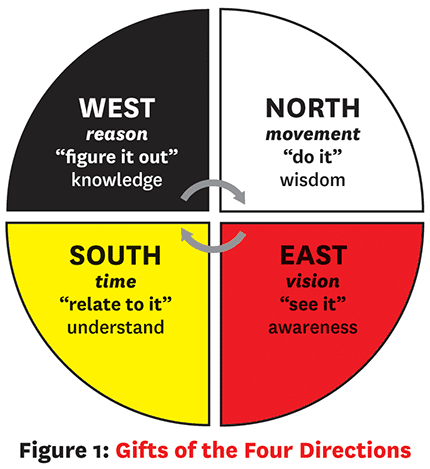
Moving into the “doing” phase of the north requires taking the knowledge gained from all the directions and enacting that knowledge. This form of praxis makes the balance achievable. Using Medicine Wheels as a tool for analysis in healing and learning demands the continuous and ongoing reflection of oneself in relation to others – thus balance must be maintained while embracing change. “The teaching and healing process is evolutionary and cyclical in nature, as is the continuum of medicine wheels. It begins with a desire to understand and identify with the balance, wholeness and interconnectedness expressed in the medicine wheel.”7
In order to create the movement required by the northern direction, one must re-visit the other directions to achieve a 360-degree vision.8 By going to the east where one visions to transform that which is, one can actively create a better life for oneself and others. Indigenous people can envision how they can be active in the “creation of oppositional analytical and cultural space.”9 Visioning allows them to engage in the hopeful utopian thinking necessary for radical transformation.10 Once a guiding vision is received or created, strategies can then be planned to help actualize it. Each person then has the responsibility to do the work required to fulfill the vision.11
Indigenous people are fighting to actualize their visions for change in the education of their children. A revolutionized world will not “come into existence in a linear way, as the result of a single-minded drive, but in a cyclic, circular way, working in all dimensions of a culture, moving from one position to another, not in reaction but in interaction with other forces.”12 Moving from linear models to the interconnectedness of the circle can guide the development of pedagogy and vision for the future.13
The transmission of Medicine Wheel teachings
Understanding Indigenous knowledge and worldview begins with Medicine Wheel teachings previously discussed: the gifts of the directions (vision, time, reason, movement), the actions of those gifts (see it, relate to it, figure it out, do it), and the learning process (awareness, understanding, knowledge, wisdom). Building from these understandings, Indigenous knowledge embraced by Medicine Wheels can be defined as wholeness, interrelationships, interconnections, and balance/respect. Wholeness requires that we look in entireties; that the whole is greater than the sum of its parts, yet the parts cannot be fully seen until the shape of the whole can be seen. Interrelationship requires that we establish a personal relationship with the “whole” – with all that surrounds us. In addition, we must establish a relationship with our whole being; this includes our spiritual, physical, mental, and emotional aspects. Interconnections create an environment which is mutually sustaining; where there is a transcending of logic and linear thought to reveal synthesis and dynamic interdependence. Balance and respect provide an order and structure to the whole and all its relationships and interconnections, while providing an appreciation for the “awe” of it all. (Figure 2)
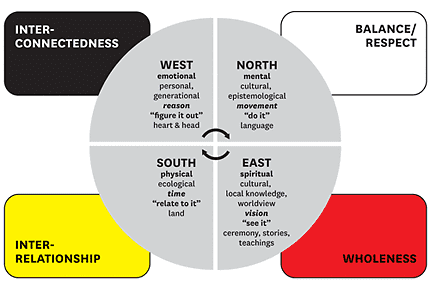
It is necessary to consider Indigenous knowledge as a collection of knowledges from different Indigenous nations. Indigenous knowledge is therefore culture specific, contained within the local knowledge and worldview of the nation. It therefore also has to be ecological, where the knowledge is contained within the land of the geographic location of the nation. Knowledge is also contained within the people of the nation. Indigenous knowledge then becomes personal and generational, as there is a process of generational transmission. Indigenous knowledge is epistemological, in that each nation culturally determines for itself how it knows what it knows.
While Indigenous worldview articulates that Indigenous people need to develop themselves, including their children, in a holistic way that addresses their spiritual, physical, emotional, and mental capacities, they need to address how to transmit learning through all of those personal aspects. The spiritual can be touched through ceremony, teachings, and stories. The physical can be transmitted through the land, while the emotional aspect can be developed through a balanced connection between the heart and the head. Mental capacities can be developed through ancestral languages and integrative learning.
Moving from linear models to the interconnectedness of the circle can guide the development of pedagogy and vision for the future.
Wisdom becomes the goal of any educational process including living – to say that we are truly knowledgeable as a person is to say that we not only “know” what is valued by a nation, but that we have lived our life in such a way that we have experienced what we know and can therefore be considered wise. Indigenous knowledge and worldview is attained by choosing to do what is necessary to obtain multiple perspectives from which to view the world. This in-depth searching for knowledge is what leads to wisdom. Wisdom is achieved by first becoming aware of the learning through all the senses, requiring the learning to be introduced to the students in multiple modalities. Understanding is achieved by providing students with enough time to solidify the learning so that they are able replicate the learning. A deeper understanding is achieved by students relating to the learning at a deeper level to become knowledgeable to the point that they are able to apply the learning in any situation. To say that the students have achieved wisdom requires that they are able to create some action with the learning and teach it to others.
Medicine Wheel pedagogy in practice
The Anishinaabe Bimaadiziwin Cultural Healing and Learning Program (operational from 2002-2006) was created to fulfill the cultural and academic needs of Anishinaabe children in the Burleigh Falls (Ont.) area. The program involved a synthesis of Anishinaabe worldview, spirituality and traditional education philosophy, incorporating these components into an Anishinaabe culture-based school program for Junior Kindergarten to Grade 12. The school was registered as a private school with the Ontario Ministry of Education and the curriculum was organized on a Medicine Wheel framework, where cultural teachings and traditional practices were addressed in the corresponding season on the Medicine Wheel.
A holistic educational experience was provided through a balanced emphasis on all personal aspects of the student. The spirit of the student was celebrated through daily ceremony such as a morning circle (similar to a sunrise ceremony), and the learning of traditional teachings and stories. The physical aspect of the student was actualized by interacting with the land through traditional practices such as maple syrup making, wild rice picking and fasting (a traditional ceremony of personal physical sacrifice to gain spiritual enlightenment). The emotional aspect of the student was addressed by an emphasis on healing and connecting the heart with the head through weekly healing circles, individual counselling, and following the seven sacred teachings (core values often referred to as the seven grandfather teachings). The mental aspect of the student was developed through the teaching and learning of the Anishinaabe language and integrative learning that blended Euro-Canadian and Anishinaabe knowledge, such as the study of earth and space systems in science and the Anishinaabe traditional worldview of all creation along with its teachings, stories, and songs.
The Anishinaabe learning process of awareness, understanding, knowledge, and wisdom as presented on the Medicine Wheel were actualized on an ongoing basis to ensure complete and deep learning occurred. An example of this included providing the students with the awareness of their culture by allowing them to experience it with all their senses (seeing it, tasting it, feeling/touching it, smelling it, hearing it) and then expecting them to show that they understood it by replicating it, such as being able to sing a traditional song. Knowledge of the learning was illustrated by the students in the school when they applied the learning in any situation, such as when a child made a connection between the concept of greed and a traditional Nanaboozhoo story. The ability to teach their culture to others and thus prove wisdom was achieved by becoming the teacher and sharing their culture with other children through workshops with Brownies or Cub Scouts groups.
While the above examples are specific to an Anishinaabe culture-based educational setting, the teachings of Medicine Wheels provide an educational framework that can be applied to any educational setting. The fundamental concepts of wholeness, inter-relationship, inter-connectedness and balance/respect are valuable for all.
Photo: courtesy Saskatchewan School Boards Association
First published in Education Canada, June 2014
Explore the latest edition of Education Canada, powered by voicEd Radio (March 2022)
EN BREF – Cet article explore les enseignements des roues de médecine selon la perspective culturelle anishinabe. L’accent est mis sur ses applications en éducation par le biais de la pédagogie et de la transmission des enseignements des roues de médecine. Ces concepts sont illustrés par un exemple pédagogique pratique de l’emploi de la roue de médicine dans le cadre du programme culturel de guérison et d’apprentissage des « Anishinabe-Bimaadiziwin », offert dans une école basée sur la culture anishinabe.
[1] The term “Medicine Wheel” was established when stone constructions in the shape of wheels were found on Medicine Mountain.
[2] J. Sanderson, The Cree Way: Traditional paths to learning (masters’ thesis, University of Saskatchewan, 1991), 51.
[3] J. Bopp, M. Bopp, L. Brown, and P. Lane, The Sacred Tree (Four Worlds Development Project, 1984), 9.
[4] S. Calliou, “Peacekeeping Actions At Home: A Medicine Wheel model for a peacekeeping pedagogy,” in First Nations Education in Canada (UBC Press, 1995), 51.
[5] K. Absolon, Building Health From the Medicine Wheel: Aboriginal program development. Paper presented at the meeting of the Native Physician’s Association (Winnipeg, Manitoba, March 1994).
[6] Absolon, Building Health From the Medicine Wheel, 18.
[7] F. J. Graveline, Circle Works: Transforming Eurocentric consciousness (Halifax, NS: Fernwood Publishing, 1998), 182.
[8] Dumont in S. Stigelbauer, The Individual is the Community; The Community is the World; Native Elders Talk About What Young People Need to Know. Paper presented at the meeting of the American Educational Research Association (San Francisco, CA, 1992).
[9] C. T. Mohanty, “On Race and Voice: Challenges for liberal education in the 1990’s,” in Between Borders: Pedagogy and the politics of cultural studies, eds. H. Giroux and P. McLaren (New York, NY: Routledge, 1994), 148.
[10] S. Benhabib, Situating the Self: Gender, community, and post-modernism in contemporary ethics (New York, NY: Routledge, 1992).
[11] G. Cajete, Look To The Mountain: An ecology of Indigenous education (Asheville, NC: Kivaki Press, 1994).
[12] French in K. Gould, “Feminist Principles and Minority Concerns: Contributions, problems, and solutions,” Affilia 2, no 3 (1987): 18.
[13] Graveline, Circle Works, 288.
-
Perfect Practice Makes Perfect
Comments Off on Perfect Practice Makes PerfectIt was the first week of classes and the Chemistry 11 students were busy reviewing the core concepts from junior science. Most students were sailing through the review because of the strong junior science program in our school. Randy, on the other hand, was a different story.
-
Physical Activity in Kindergarten
Comments Off on Physical Activity in Kindergarten“In the past, it was assumed that children were naturally active on their own, but sadly, this is no longer the case.” – Myriam Benoit, BPHE.
Members of the Laurentian University Nutrition, physical activity, and Community Health (LUNCH) Research Group regularly engage in discussions related to the peripheral impacts that administrative change has on children’s health. Specifically, during educational reform, a key component to consider is the need for meaningful physical and health education; and not just in the gymnasium. One important example is school schedules. Schools have moved away from traditional schedules, which incorporated two recesses separated by a single lunch period. Today, many schools have adopted alternative schedules, the most prevalent of which is the “Balanced School Day,” which has two 40-minute nutrition/activity breaks, separated by three 100-minute teaching blocks. While modern schedules have their benefits, assessment prior to implementation seldom considers how the changes will impact children’s physical activity levels.
Most recently, implementation of the Early Learning Kindergarten (ELK) program has begun across Ontario. In this article, we discuss the impact of the ELK program on physical activity in Kindergarten-aged children and recommend ways to safeguard this important aspect of health and well-being.
The new ELK program has been developed on the premise that Kindergarten lays the foundation for future school experiences. According to former Ontario Minister of Education, Leona Dombrowsky,
“Full-day learning is part of our overall plan to help more children get a strong start in school, so they can go on to have successful, rewarding lives. By giving them more opportunities at a young age, we’re giving our children a brighter future.”[1]
Research has consistently shown that early success predicts long-term success and adjustment outcomes. We would like to extend this argument to include healthy lifestyles. Children who enjoy and participate in activities in kindergarten are likely to build upon this success in later years. We would also like to highlight that suitable physical activity can lay the foundation for academic success. Engagement in physical activity throughout the school day has been shown to improve student achievement and readiness to learn in addition to bettering classroom behaviour.
The ELK program will be fully implemented across Ontario in the 2014-15 school year. Several key changes have occurred with the implementation of this program, which have potentially positive and negative consequences with respect to student physical activity.
First, while Kindergarten class size will increase to a maximum of 30 students, they will be team-taught with both an Ontario Certified Teacher (OCT) and an Early Childhood Educator (ECE). We see this as being highly beneficial to maximizing individual needs, including health behaviour instruction. Second, children as young as three are now enrolled in school for the full day, and for the entire school week. This is a noteworthy change from previous generations that should facilitate children’s accommodation to the school setting and provide significant opportunity for developing healthy behaviours in the early years. Schools now have the opportunity to engage a large audience in active play and education from a very young age. Third, the curriculum has moved to an inquiry- and play-based approach. Students are given a leading role in their own learning, in an environment that is supportive of their self-regulation and development. We strongly support this type of learning and speculate that it will involve less desk-time and therefore enhance physical activity levels in the classroom.
In addition, some schools are also implementing a 60-minute Outdoor Exploration (OE) block, to use the outdoors as an extension of the classroom as the Ontario Curriculum suggests. We see this as an amazing opportunity for students to learn in a different environment, and also see potential for this time to be used as an opportunity for students to achieve an increased level of physical activity during the day.
However, we also note an important negative consequence of this schedule-change – specifically, the coinciding change in recess times. Before implementation of the 60-minute OE block, Kindergarten children went outdoors for free play during recess, which occurred twice a day in schools using the Balanced School Day schedule. However, with the implementation of the OE block, Kindergarten students remain in the school during these two blocks of time, extending their nutrition breaks. This gives the children more time to eat their lunches, addressing a concern that many parents have (i.e. that their children do not have enough time to eat). Research in our centre, however, has shown that this causes an overall decrease in the total amount of physical activity that the children engage in. From a time perspective, this seems surprising since 60 minutes outside is more time than the combined time for two recesses (40 minutes). However, there are two reasons why this does not result in increased activity. First, the instructional nature of this time may alter the degree of physical activity that the children engage in. Second, we know that during free time, children are most active in the first ten minutes. Therefore, frequent shorter breaks achieve more physical activity among students than fewer, longer breaks, as seen with this modified schedule.
Another significant factor is that individual school boards, rather than the Ministry of Education, decide how much time is allocated to Health and Physical Education instruction. Currently, Kindergarten children are excluded from the Daily Physical Activity Program mandated for other grades in Ontario. Therefore, the allocated time varies from school to school.
So how can schools adopt the ELK program while still creating a school environment that supports physical activity for our youngest learners?
We first need to consider the recommendations from the Canadian Society for Exercise Physiology for children’s physical activity.[2] In this document, young children between the ages of one and four are suggested to achieve a minimum of 180 minutes of physical activity at any level throughout the day, while children aged five to 11 should achieve at least 60 minutes of moderate-to-vigorous physical activity. Kindergarten students range from 3-5 years of age and therefore cross over into both of these categories. In this scenario, the benchmark more commonly used is that for the older children, i.e., 60 minutes of moderate-to–vigorous physical activity each day. Additional physical activity above these recommendations produces even greater health benefits for children.
Given that Active Healthy Kids Canada has rated Canadian children with a failing grade for physical activity levels for the last nine years, and less than half of all school-aged children are achieving daily activity recommendations, it’s important for schools to build physical activity into the curriculum right from the beginning.[3] When evaluating physical activity in the classroom, there are three target areas.
• First, recess time is important for children to have unstructured play. Play allows children to explore and interact socially with other students and learn from these experiences. As such, we recommend that all school children should enjoy two scheduled recess breaks.
• Second, we strongly support the adoption of the 60-minute OE block; however, we would urge instructors to ensure that physical activity is included as a component of this time. We note that resources, such as the Ontario Physical & Health Education Association, are readily available for schools to use and provide step-by-step instructions for a variety of games and activities for this age group.
Third, Physical Education (gym) classes are another important component of the elementary school curriculum, and we stress the importance of a structured program, delivered daily, for Kindergarten children. While the Ministry of Education has mandated 20 minutes of Daily Physical Activity (DPA) for grades 1 to 8 during classroom time, no recommendations have been made regarding DPA for Kindergarten classes, and the number of Physical Education classes expected per week is not explicitly stated.
We strongly recommend that these important elements be added to the Ministry of Education’s agenda. Likewise, teachers must ensure that a structured approach to physical activity is taken to maximize the benefits for children during this scheduled time. Schools need to have adequate infrastructure to support daily physical education and every school should have at least one Physical Education Specialist. To date, the many capabilities of these specialists are largely under-utilized and overlooked and we would urge all schools to examine their capacity in this area.
We are very excited about the direction the Ontario Ministry of Education has taken in developing this forward-thinking curriculum for the Kindergarten cohort. However, currently lacking are specific development plans to address best practice for physical activity during the school day. We believe the recommendations put forward in this article will promote future success.
Photo: McIninch (iStock)
First published in Education Canada, June 2014
EN BREF – L’activité physique est une importante partie d’une vie saine. L’intégration d’un mode de vie actif à un jeune âge jette les bases de la pratique d’activités plus tard dans la vie. Dans cet article, nous suggérons aux gestionnaires et éducateurs d’écoles primaires des « pratiques exemplaires » à mettre en œuvre pour que soient respectées les lignes directrices recommandées en matière d’activité physique. Nous proposons également l’élaboration de politiques en fonction de ces lignes directrices pour les élèves du nouveau programme d’apprentissage de la maternelle et du jardin d’enfants en Ontario.
[1] Leona Dombrowsky, Ontario Minister of Education, in The Full-day Early Learning Kindergarten Program (2010-11), 5. www.edu.gov.on.ca/eng/curriculum/elementary/kindergarten_english_june3.pdf
[2] Canadian Society for Exercise Physiology (CSEP), Canadian Physical Activity Guidelines. www.csep.ca/english/view.asp?x=804#
[3] Active Healthy Kids Canada, Report Card on Physical Activity for Children and Youth (2013). www.activehealthykids.ca/ReportCard/ReportCardOverview.aspx
-
Neuromyths are a Barrier to Changing Education
Comments Off on Neuromyths are a Barrier to Changing EducationDr. Steve Masson, Co-Winner of the 2013 Pat Clifford Award for Early Career Research in Education. (Bilingual video)
https://vimeo.com/94571413
-
A Curriculum of Relationship
Comments Off on A Curriculum of RelationshipThe boy sat hunched over his desk, watching with wide eyes as his teacher worked with a pair of students a few desks up from his own. His eyes slid to the other side of the classroom where groups of students chatted loudly with one another as they tackled the worksheet assigned to them, matching pictures of different types of bird beaks to their written definition. His fingers fidgeted with the pencil he held in his hand. In a cacophony of sounds, he was an island of solitude. He appeared lost.
As part of a graduate class on immigration and settlement issues, several of us had chosen to volunteer our time in a local English Language Learners’ (ELL) classroom composed of junior high students. Many of the students were refugees and had left countries characterized by strife. We had been informed on one of our previous visits that this boy was newly arrived at the school. Shy and unassuming, he was easy to miss in the loud, chattering crowd of kids who dominated the class. The bell rang and two of us lagged behind. Sonia* expressed her shock that the boy was “not learning” despite being placed in this special class. Ill at ease, wanting to support my fellow teacher and simultaneously disturbed by the idea that a student was perhaps being left behind, I struggled to formulate a response. Sadly, what emerged from my lips – a weak platitude – left us both dissatisfied.
The following week, my eyes landed once more on the new student. Sandwiched between an empty desk and a tall, lanky boy, I saw that yet again he appeared rudderless. I looked up without really seeing as the teacher provided directions for a language arts activity. My mind was busily sorting out ways in which help could be offered to this student. He could use an iPad. He could use the picture cards sitting on a shelf at the side of the classroom. He could have a scribe…
Instructions given, the teacher smiled at her class and jokingly urged them to get to work. My thoughts drifted and suddenly I was thinking about a young girl I had taught in my Grade 5 class the previous year. She had recently arrived from India and her English had been limited. Then, too, I had been worried about the type of learning which was occurring. I had not wanted her to fall even more behind. Making arrangements with her parents for her to stay after school, I spent time with her each day, trying to get her up to speed in Math and Language Arts. One day she came to me crying, saying that the other girls in the class didn’t want to include her in their play at recess. This was truly devastating for me to hear. I wanted all my students to feel they had a space of belonging in their classroom. While I had been concerned with the young girl’s skills in the different subject areas, I had not been attendingenough to how the students were engaging with one another. I had not been attending enough to how relationships were being shaped in our classroom. That year, I was reminded that while the mandated curriculum is important, a curriculum which speaks to children’s actual lives is equally if not more important.
The scraping of chairs against the floor brought me back to the present, and I allowed myself a moment to eavesdrop as the teacher moved from group to group. She was voicing words of encouragement and the rapport between her and the students was obvious. The boy was smiling shyly as his partner flipped the page of a textbook. The tension I carried in my shoulders eased. He and his classmates would face many challenges, but they were being supported in their learning in meaningful and tangible ways. Through the creation of caring relationships with their teachers and amongst themselves, they were learning a most valuable curriculum – one that puts citizenship and humanity first.
* Name changed
Photo: Vitchanan (iStock)
First published in Education Canada, March 2014
-
Building Community through Online Contact
Comments Off on Building Community through Online ContactAround the world, many children live and attend schools in environments that separate them from neighbours who are different in religion, race or ethnicity. They are living what British Prime Minister David Cameron has called “separate lives.”[1] In other places, children may be separated by distance or historical conflicts. Sometimes it is difficult or impossible to cross these boundaries with face-to-face contact, so innovative educators in many countries have turned to online learning programs as a way of bringing children from diverse communities together. In this article, we will look at some examples of projects that bring students together in this way in Ireland, the U.K., Europe, and Israel and we suggest ways in which the approach might work in Canada.
Community cohesion
In the United Kingdom at the turn of the century, concerns about ethnic strife that focused on immigrant communities, specifically race riots in Bradford, led to a study commonly called The Cantle Report.[2] In that report, the authors found that Britain’s children were living in socially isolated communities, in what some researchers called “isolated, parallel lives” and others referred to as a process of “enclivisation.” The issues seemed similar to those that led to the famous 1954 U.S. Supreme Court decision[3] that concluded “separate is not equal” when it comes to schooling.
Concern about the impact of social divisions on school children is not limited to the U.K. and the U.S. Immigrants from former colonies face similar “parallel lives” across Europe, and there is religious and ethnic separation in Israel. There are tribal conflicts in Africa and ethnic divisions in Asian countries. We see similar phenomena in Canada in the “two solitudes” of French and English Canada, in the isolation of Aboriginal communities, and in efforts to deal effectively with the needs of new Canadians.
The idea behind “community cohesion,” then, is to find ways to build a sense of inclusion or belongingness in which individuals who differ in religion, ethnicity, or other ways identify themselves with a common set of social goals.[4]
Why use online learning to promote community cohesion?
It might seem that the logical way to bring communities together would be to have people meet face to face to work collaboratively on issues that would give them shared experiences and a basis for greater mutual understanding. This is the reasoning that led the U.S. Supreme Court to abolish segregated schools. It is also the heart of what social scientists call the “contact hypothesis” – a clearly elaborated and highly researched argument that says when people from different groups work together, there is a reduction in prejudice among members of those groups.
However, in Israel, teacher education researchers at the Mofet Institute have found that when cultural norms (and possibly safety concerns) demand separate schools for students of different religious and ethnic groups (as well as separation of the sexes in some cultures), both teachers and children can grow increasingly comfortable with cross-community communication in online environments that minimize the appearance of those differences.
On the island of Ireland, the Dissolving Boundaries Programme has accumulated over a decade of experience in bringing children from the Republic of Ireland together with children in Northern Ireland to work collaboratively online on curriculum questions.
We have found no examples of North American school projects that used online learning methods with the explicit objective of increasing community cohesion. In the U.S., the difficulty at present is that although many children attend racially and ethnically integrated schools, few are actually in classes with students who differ racially or ethnically from themselves.[5] If 60 years of bringing groups together in the same building has not resulted in increased social and academic contact, then it might well be time to try online communication that is designed to do just that. In Canada, the more pressing problem may be the great distances that separate many Aboriginal students from other Canadians, but once again, online communication could overcome the challenges posed by those distances.
In short, the focus of online communication is communication and the goal of community cohesion is to get people communicating with others who differ from themselves. We have the technology; why not give it a try?
International examples
Ireland’s Dissolving Boundaries Programme[6] began in 1999 as a collaboration between the National University of Ireland at Maynooth, in the Republic of Ireland, and the University of Ulster in Northern Ireland. Ireland was divided in two by a 1921 treaty that sought to end centuries of conflict between Ireland and England. Throughout the 20th century, however, conflict continued until the Good Friday Agreement of 1998. This history of conflict has left a legacy of suspicion and distrust that continues to affect relations between the two parts of Ireland, and also between those in Northern Ireland who favour union with the Republic and those who prefer to maintain a closer connection with the U.K.
The Dissolving Boundaries Programme, importantly, was funded by the governments of both parts of Ireland. The project draws inspiration from the “contact hypothesis” and provides support for teachers who are willing to use technology to enable their students to work on common curriculum issues with students in the other part of Ireland. Currently, over 200 school-based projects involve hundreds of teachers and thousands of children who use online conference software, videos, and email to work together on teacher-developed activities that engage students in shared research, problem solving and writing in all curriculum areas. Face-to-face annual meetings are seen as an important motivational aspect of this program. Research and evaluations have consistently shown that the students enjoy the experience, that they feel they know more about students in the “other” community, and that they have more positive attitudes toward people who are different from themselves.
The eTwinning program[7] in Europe seeks to address a host of challenges involved in creating a political and economic union of people from a variety of cultures with different languages and a long history of conflict – including the two world wars in the 20th century. Additional challenges relate to the influx of people from former colonies and the further cultural and religious differences brought by immigrant workers. In 2005, the eTwinning program was created to promote the use of computer-based communication technologies to bring school children together in education projects that crossed national boundaries, with the intention of promoting mutual understanding and tolerance.It is telling that eTwinning changed its motto in 2008, from “school partnerships in Europe” to “the community for schools in Europe.” By July of 2012, there were 33 ministries of education participating in eTwinning and over 170,000 participants in more than 5,300 school-based projects. Assessments of the effects of the eTwinning program have largely been in the form of case studies and the perceptions of participants. In general, they indicate that participants believe the projects have increased technological skills, supported meaningful collaboration, and fostered improved understanding of other members of the European community.
Israel’s Mofet Institute also uses communications technologies to bring together children from the country’s ethnically and religiously diverse community. (Major religious groups are Jewish, Islamic, Christian and Druze; major ethnic groups are Jewish and Arabic.) The task is complicated by the diversity within these major religious and cultural groups. Since some of these groups require religiously separate education and some also require separate education by gender, many of Israel’s children attend schools with classmates who are very like them; however, there are also schools with a greater diversity in the student population. The divisions reflect the divisions in society, including housing patterns, and for many of Israel’s children there is little opportunity for face-to-face interaction with children from other Israeli communities.
Israeli researchers began their online work by bringing together teacher educators who were prepared to conduct online projects in the schools. The project leaders in the teacher education faculties have developed a variety of models of online educational interaction, including games that stimulate discussion of social issues. More recently, Israeli projects have engaged students in the use of social media to reach out across religious and ethnic barriers. Research based on interviews with teachers and students has generally showed that students begin the online class projects with concerns and reservations about communication with members of the “other” group, but that at the end, they report increased levels of trust and reduced levels of prejudice.
Challenges to community cohesion in Canada
How might such programs be of value in Canada? As noted earlier, many Aboriginal Canadians live in remote areas that impose a form of geographical isolation. We also have the French-English linguistic divide. Lastly, new Canadians often live in urban areas where school children may have contact with their own and other immigrant communities, but may not have much exposure to Canadian communities that were established long before their arrival. In each of these cases, in different ways, we believe that online school projects aimed at common curriculum objectives would contribute to a more cohesive Canada.
Canada has the technology to implement such programs and many of its teachers (and students) already have the necessary technological skills, so what is stopping us? One major challenge may be the issue of jurisdiction – education is a provincial responsibility so there are different curricula and no formal mechanism for national projects. Exacerbating this issue, Aboriginal education is a federal responsibility. However, if we look at the European Union, the national differences are even greater than our provincial differences. The E.U. put eTwinning into operation as a voluntary program built on individual teacher initiative, with professional development and small financial support as incentives. The Council of Ministers of Education of Canada is well situated to take a similar leadership role in building a comparable pan-Canadian program, and doing so would be a nation-building enterprise of considerable importance.
For this to work, we need to have faith in the ingenuity of Canadian teachers to find the curriculum matches that would make joint projects feasible. It may well be that such matches would prove to be easier than we might expect, given previous collaborative initiatives like the “Western protocol” and the use of a relatively common set of textbooks. Here, too, the example of the E.U. could be useful – the eTwinning website provides extensive guidance on how to find partner teachers and how to design and develop online learning projects.
Online schooling services in many provinces could also be a strong catalyst to moving quickly once an initiative has begun. As a bonus, such a program could provide the incentive for technological skill development in some teachers who have yet to find a reason to bring technology into their classrooms.
Language issues could, of course, be a sensitive point in developing Canadian online projects. While most eTwinning projects are conducted in English, the only language requirements of the program are that the teachers agree which language is to be used and the students have comparable levels of achievement in that language. In Canada we might want to encourage some bilingual projects in which learners use both official languages. Teachers working with Aboriginal students might see merit in projects that give their students opportunities to teach Native languages to other Canadian students. The key point is that the projects should encourage appreciation of linguistic diversity and support the learning of language skills.
Having examined the use of online learning to build community cohesion elsewhere in the world, we see a grand opportunity for Canada to not only learn from what has been done elsewhere, but also to develop a homegrown version that could be an important part of Canadian nation-building in the 21st century.
Illustration: Dave Donald
First published in Education Canada, March 2014
EN BREF – Les comparaisons internationales des résultats scolaires ont suscité beaucoup d’intérêt au cours des 20 dernières années. Ces comparaisons tendent à porter sur la littératie, la numératie et les habiletés de résolution de problèmes, en partie parce que l’Organisation de coopération et de développement économiques a ouvert la voie à l’élaboration de mesures fiables. Toutefois, dans de nombreux pays, les gouvernements reconnaissent que les écoles jouent un important rôle pour développer l’identité communautaire ou nationale – elles ont la responsabilité de rapprocher les gens. L’article porte sur quelques exemples internationaux de programmes scolaires élaborés pour développer la cohésion communautaire et demande aux enseignants canadiens d’établir quelles leçons peuvent être tirées de ces initiatives.
[1] D. Cameron, Speech on radicalisation and Islamic extremism (Feb. 5, 2011), reprinted by the NewStatesman.www.newstatesman.com/blogs/the-staggers/2011/02/terrorism-islam-ideology
[2] T. Cantle, Community Cohesion: A report of the independent review team (London: Home Office, 2001).http://resources.cohesioninstitute.org.uk/Publications/Documents/Document/DownloadDocumentsFile.aspx?recordId=96&file=PDFversion
[3] Brown v. Board of Education, United States Supreme Court, 347 U.S. 483 (1954). http://caselaw.lp.findlaw.com/scripts/getcase.pl?court=us&vol=347&invol=483
[4] S. Muers, “What is community cohesion, and why is it important?” The Guardian (March 21, 2011).www.theguardian.com/housing-network/2011/mar/21/community-cohesion-definition-measuring
[5] G. Orfield, J. Kucsera, and G. Siegel-Hawley, E Pluribus . . . Separation: Deepening double segregation for more students, The Civil Rights Project/Proyecto Derechos Civiles (Los Angeles: University of California at Los Angeles, 2012). http://civilrightsproject.ucla.edu/research/k-12-education/integration-and-diversity/mlk-national/e-pluribus…separation-deepening-double-segregation-for-more-students
[6] The Dissolving Boundaries Programme website is: www.dissolvingboundaries.org
[7] The eTwinning Programme website is: www.etwinning.net/en/pub/index.htm
-
School Mental Health Literacy
Comments Off on School Mental Health LiteracyThe increasing global awareness of the need to address youth mental health in the school setting is now spreading across Canada. Numerous initiatives at the school, school board and policy (provincial and territorial) levels have begun to develop. Evergreen, the national child and youth mental health framework created under the direction of the Mental Health Commission of Canada,1 identified the importance of developing school mental health initiatives as part of a comprehensive approach to addressing the complex mental health needs of young people. The recent national report by the School-Based Mental Health and Substance Abuse Consortium2 and national child and youth mental health policy development documents, such as the Canadian Institutes of Health Research white paper on access and wait times in child and youth mental health,3 have further highlighted the importance of this issue nationwide.
Many approaches to addressing the complexities of school mental health have been applied and studied. While the results have been mixed and hopes for universal interventions leading to significant and substantial positive mental health results have not yet been achieved,4 much has been learned and these lessons can help us here in Canada bring a more thoughtful and informed approach to addressing school mental health. Two important lessons have to do with:
- the need for research-based interventions that achieve sustainable positive results by building on the existing ecological strengths of schools; and
- the importance of creating integration across the many separate systems traditionally involved in providing human services to young people (education, health, child welfare, etc.).
Such approaches can avoid the high-cost and often less-than-effective “program in a box” applications so commonly being applied to address mental health in school settings and can be designed to meet specific mental health needs of young people within the context of local realities.
Foundational to all school mental health domains is the need to effectively address the mental health literacy of students, educators and administrators alike. Like any form of literacy, mental health literacy is a foundational component upon which additional structures – such as mental health promotion, validated and effective prevention, enhanced access to the most appropriate mental health care, etc. – can be built.
Early approaches to addressing mental health literacy were often one-dimensional, focusing mostly on addressing one mental disorder, such as depression. They were not contextualized to the school setting, not designed to fit into students’ usual class/course-based educational experiences, and not related to existing school ecologies. Moreover, they were often applied in isolation from existing health and human services organizations that needed to be included to meet student’s mental health care needs. As a result, according to a recent systematic review of school-based mental health literacy interventions,5 the positive results of these early applications were difficult to determine. A more recent Canadian approach has been informed by the need to widen the concept of mental health literacy and to create interventions that are student-, teacher- and administration-friendly, easily integrated into the school curriculum, sustainable and inexpensive to apply. Further, this approach facilitates horizontal integration across existing human services systems and builds upon the professional capabilities of teachers, as described in the School-Based Integrated Pathway to Care Model for Canadian Secondary Schools.6
Mental health literacy in the junior high and high school setting can be defined as having four unique but integrated components:
- understanding how to foster and maintain good mental health;
- understanding mental disorders and their treatments;
- decreasing stigma; and
- seeking help effectively.
In order to help address mental health literacy in the Canadian school setting, the Canadian Mental Health Association, in collaboration with Dr. Kutcher, created and field tested the Mental Health & High School Curriculum Guide (hereafter the Guide), a resource for teachers designed for classroom use primarily in Grades 9 and 10. This target point was chosen because of the data that demonstrates a rapid increase in the onset of mental disorders beginning around the onset of puberty and lasting until about age 25.7
Written in collaboration between educators and mental health professionals, the Guide underwent extensive field tests and multiple modifications based on those tests. It addresses mental health literacy in the classroom through six teacher-ready, online-available modules (http://teenmentalhealth.org/curriculum) covering:
- the stigma of mental illness;
- understanding mental health and mental illness;
- information on specific mental illnesses;
- first-person experiences of mental illness;
- seeking help and finding support;
- the importance of positive mental health.
Teacher self-study and face-to-face training programs to support the classroom application of the Guide were created, and extensively evaluated with highly positive outcomes.[8] Both the teacher training programs and classroom application were implemented in the Province of Nova Scotia. There, the Guide was applied by teachers trained in its use by school board-based training teams and used to meet the provincial curriculum standards in the Healthy Living course taken by all Grade 9 students. This has been followed by widespread school- and board-level applications in various jurisdictions across Canada.
Evaluation results for seven English school boards in N.S.9 demonstrate that the teacher training program on the classroom use of this resource significantly and substantially increased teachers’ knowledge about mental health (Figure 1). In addition, the training program significantly and substantially decreased participants’ mental health related stigma (Figure 2). It is noticeable that participants’ attitudes towards mental illness were highly positive before the training, yet even so, their attitudes were substantially enhanced after the training.
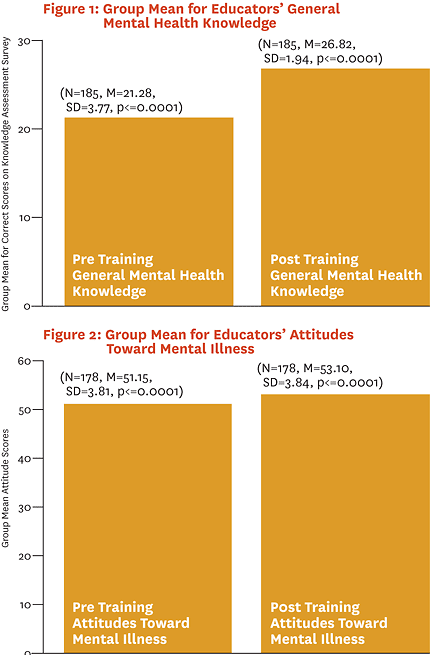
In other words, the data demonstrate that simply providing training to teachers on how to use the Mental Health Curriculum Guide resource and helping them integrate this resource into their existing professional competencies has significant and substantial positive impacts on their own mental health literacy. This occurs without creating and delivering a stand-alone teachers’ mental health program or exposing teachers to non-contextualized, expensive and less impactful universal approaches. Participants further provided overwhelmingly positive comments on this training program. Some examples from teachers include:
Thank you for a curriculum that includes mental health! This guide and in-service is are great resources.
I truly appreciate all of the resources. I feel I wasn’t simply told to be better, but shown how to teach mental health better. I wish all outcomes were addressed in this manner. Thank you. Very interesting information and useful resources.
In addition, two large independent research studies conducted in Ontario have demonstrated similar significant and substantial impacts of the classroom curriculum approach using the Mental Health Curriculum Guide on students. A study using a case-controlled cohort design conducted in a number of school boards demonstrated that students exposed to the curriculum in the classroom substantively improved their mental health literacy, showing increased knowledge and decreased stigma from pre-test to post-test.[10] These positive impacts in knowledge and attitudes were maintained over a two-month follow-up. Further, a randomized, controlled trial in 25 Ottawa schools demonstrated similar outcomes, as well as significant improvement in student-reported help-seeking efficacy.11 Qualitative feedback from teachers was positive and identified ease in classroom application and no demonstrated negative outcomes. Quotes from teachers and students include:
Before this mental health unit, I thought that people with a mental illness couldn’t have a normal life and couldn’t have any friends. I also thought that people with a mental illness could get better if they wanted to but I know that they can’t do it by themselves and they need help from family, friends, counselors etc. – an Ontario student
Thank you for a very meaningful and informative session. Very valuable and important information for all teachers. – an Ontario teacher
Similar studies in other locations, including globally in countries as different as Malawi and Brazil, have been implemented and are awaiting completion.
How to Access the Mental Health Curriculum Guide
- The Mental Health Curriculum Guide resource is now available online: http://teenmentalhealth.org/curriculum
- The Guide includes lesson plans, classroom resources (e.g. first-person and animated videos), teaching resources (e.g. handouts and web-based directions for information retrieval), student evaluations, etc. Further enhancement of this material for use by teachers is underway with the development of an enhanced pre-screened and validated resource kit that will be posted soon.
- Information about training programs for use of the Mental Health Curriculum Guide is also available through: www.teenmentalhealth.org
- For more information, email inquiries to: info@teenmentalhealth.org
Overall, this approach to addressing mental health literacy as the foundation for mental health promotion, prevention and care in teachers and students is based on utilizing the existing ecological strengths of schools and the professional competencies of teachers instead of parachuting costly stand-alone programs into schools. It provides a relatively simple, economical and effective method to improve knowledge, decrease stigma and enhance help-seeking efficacy in both teachers and students. This approach mirrors the method by which teachers usually learn and prepare for their teaching, and by integrating student learning about mental health into existing curriculum, it avoids isolating mental health from everyday school activities. The creation of school board-based training teams that can meet training needs in-house enhances the probability of sustainable integration at minimal cost. Positive results have been found in every school in Canada where the resource has been applied and evaluated, thus making it feasible for use across the diverse Canadian mosaic.
Photo: iStock
First published in Education Canada, March 2014
EN BREF – La sensibilisation mondiale croissante à l’égard de la nécessité de porter attention à la santé mentale des jeunes dans un cadre scolaire s’étend actuellement au Canada.
L’article décrit La santé mentale et l’école secondaire – Guide de formation, une ressource nationale en matière de formation en santé mentale à l’école qui a été instaurée et a fait l’objet d’études dans des écoles secondaires (9e et 10e années / 3e et 4e secondaire) partout au Canada. Il est question du contenu du guide et de ses processus d’instauration qui peuvent être contextualisés pour répondre aux besoins des élèves, quelle que soit l’école fréquentée. L’article présente également les plus récents résultats de recherche et d’évaluation de l’application du guide, lesquels font état de connaissances considérablement enrichies, d’une stigmatisation moindre et d’une efficacité accrue de la recherche d’aide chez les élèves et les éducateurs qui l’ont utilisé dans le cadre du curriculum scolaire habituel.
[1] S. Kutcher and A. McLuckie for the Child and Youth Advisory Committee, Evergreen: A child and youth mental health framework for Canada(Calgary, AB: Mental Health Commission of Canada, 2010).
[2] School-Based Mental Health and Substance Abuse Consortium (supported by the Mental Health Commission of Canada), Survey on School-Based Mental Health and Addictions Services in Canada (April 2012).
[3] The Canadian Association of Paediatric Health Centres, The National Infant, Child, and Youth Mental Health Consortium Advisory, and The Provincial Centre of Excellence for Child and Youth Mental Health at CHEO, Access and Wait Times in Child and Youth Mental Health: A background paper, for the Institute of Human Development, Child and Youth Health (Oct. 2010).www.excellenceforchildandyouth.ca/sites/default/files/policy_access_and_wait_times.pdf
[4] K. Weare and M. Nind, “Mental Health Promotion and Problem Prevention in Schools: What does the evidence say?” Health Promotion International 26, Suppl. 1 (Dec. 2011): i29-69.
[5] Y. Wei, J. Hayden, S. Kutcher, A. Zygmunt, and P. McGrath, “The Effectiveness of School Mental Health Literacy Programs to Address Knowledge, Attitudes, and Help-Seeking among Youth,” Early Intervention Psychiatry 7, no. 2 (May 2013): 109-21.
[6] Y. Wei, S. Kutcher, and M. Szumilas, “Comprehensive School Mental Health: An integrated ‘School-Based Pathway to Care’ model for Canadian secondary schools,” McGill Journal of Education 46, no. 2 (2012): 213-229.
[7] R. C. Kessler, P. Berglund, O. Demier, R. Jin, K. R. Merikangas, and E. E. Walters, “Lifetime Prevalence and Age-of-Onset Distributions of DSM-IV Disorders in the National Comorbidity Survey Replication,” Archives of General Psychiatry 62, no. 6 (June 2005): 593-602.
[8] S. Kutcher, Y. Wei, A. McLuckie, and L. Bullock, “Educator Mental Health Literacy: A program evaluation of the teacher training training education on the mental health & high school curriculum guide,” Advances in School Mental Health Promotion (2013); A. McLuckie, S. Kutcher, Y. Wei and C. Weaver, “Sustained Improvements in Students’ and Teachers’ Mental Health Literacy with Use of a Mental Health Curriculum in Canadian Schools,” unpublished manuscript (Sun Life Financial Chair in Adolescent Mental Health, 2013).
[9] Sun Life Financial Chair in Adolescent Mental Health, “Mental Health & High School Curriculum Guide Training Report for Nova Scotia,” (2013).http://teenmentalhealth.org/images/uploads/mental_health_curriculum_guide_training_NS_final_July_25_2013.pdf
[10] McLuckie et al., “Sustained Improvements in Students’ and Teachers’ Mental Health Literacy.”
[11] R. Milin, S. Kutcher, S. Lewis, S. Walker, and N. Ferrill, “Randomized Controlled Trial of a School-Based Mental Health Literacy Intervention for Youth: Impact on knowledge, attitudes, and help-seeking efficacy” (poster presentation at American Academy of Child and Adolescent Psychiatry 60th Annual Meeting, 2013).
-
Teen Stress in Our Schools
Comments Off on Teen Stress in Our SchoolsFor the average high school student, life is full of potential stressors. In a recent survey, our research team asked over 900 Grade 7 students what they identified as the biggest stressors in their lives. “Academic difficulties” was reported as the greatest stressor by 33.2 percent of students, followed by “conflict with parents/family” (31.4 percent), “conflict with peers” (20.7 percent), and “conflict between parents” (13.9 percent). Of particular concern is how these students are coping with their stress.[1]
-
World Traveler
Comments Off on World TravelerI love maps! In my filing cabinet at home I have multiple maps from places I have been and places I would love to see. I dream of traveling around the world, and in my classroom I try to inspire my students’ curiosity about the world.
Three years ago, I began the World Traveler project, which is based on the Flat Stanley books by Jeff Brown, with my Grade 6 students. This is a project that is part tourist and part chain letter. Here’s how it works:
My students’ first task is to find someone they know, or someone their parents know, outside of their hometown – the further away the better. Once the students locate an initial contact, they start making a paper character to act as their traveler. Much like the old custom of travelers in days past presenting a letter of introduction, my students write a letter introducing their paper traveler to all the people their character might encounter. Each traveler is enclosed in a school notebook with the student’s introductory letter and a note from me. In my letter, I ask each person who receives this journal to take the traveler around their location, documenting the visit with a written account and pictures and/or tourism pamphlets of their locations in the notebook. I then encourage whoever receives the journal to pass it on to someone else they know. The notebook acts as the passport chronicling the journey of our travelers. Each participant is asked to send a postcard with a small update of our travelers’ progress around the world to the class. I also ask whoever has the traveler on June 1st of that year to return it to our school.
I wanted my students to see multiple adventures through the eyes of their paper stand-ins. The students and parents of my first group embraced the idea, and we started making our travel buddies. At the front of my classroom waited an empty world map, begging to be filled with pins marking the path of our travelers.
By the end of that first year of “traveling,” our characters had seen the depths of the Grand Canyon and the heights of the Himalayas. That first year was a fantastic success. I knew I had to do it again.
This past year when I moved schools and grades, I wondered how my project would succeed. My Grade 3/4 students were curious, the parents were receptive, and so we made our travelers, packed their books, and sent them into the world.
Just as before, postcards started coming in the mail and the world map began filling with pins.
The first postcards came from North America and Europe. Pictures of the London Eye, Venetian gondolas, and the faces of Queen Elizabeth II and Pope Francis were among the early arrivals. Halfway through the year, images of Egypt and Machu Pichu in South America arrived. By the end of the year, some of our travelers had made it to the pyramids of Egypt, Jerusalem, Australia, the Great Wall of China, and the mythical lands of Middle Earth in New Zealand. Some lucky travelers had lounged on the beach in Cuba and Jamaica, and caught a parade at Walt Disney World. One traveler ventured to Cape Agulhas, the southernmost point in Africa, to see where the Atlantic Ocean met the Indian Ocean.
The kids were thrilled to hear about the latest adventures of their world travelers, and we started learning about the countries where our travelers were sightseeing. The students were making connections to the world beyond the classroom.
The last weeks of school were filled with wonder as the travel journals and the paper travelers started to return home. Their journeys were detailed for the students in writing and with accompanying photos by the willing participants.
This current school year I am back teaching Grade 5/6 in a new town, with a chance to try my project on a new group of students. This year I plan to create a website for our travelers and their friends to upload pictures and blog about their adventures. My Grade 3/4 students had travelers that made it to six continents; I wonder if this time we could make it to Antarctica?
Getting started
To start your own World Traveler project, begin by reading Flat Stanley by Jeff Brown to your students. Then send a letter home to your parents explaining your project and asking them to locate someone they know, either family or friends, who can help be a part of this project.
At school, have the students create a paper character. I have always provided the students with the outline of a paper character; they colour and decorate it, then I laminate it for travel. After the character is created, I have the students write an introductory letter about their character, describing the unique characteristics of their paper friend. This allows for a couple of assessment opportunities in Language and Visual Arts. When that is done, the letter is stapled to the first page of each student’s travel journal, usually a classroom notebook. On the cover I paste my letter explaining the project and the goal of continual travel for our friends until the first of June, which requires the initial participant to find someone else to forward the traveler to. The students take the journals home, and with their parents they mail them off.
This is a fun project, but it requires faith in others. Though all students send out a journal, sometimes we lose some world travelers in the mail. It is important to stress at the beginning that this can happen, but that we as a class experience the world through all our travelers.
Photo: courtesy Bill Gowsell
First published in Education Canada, March 2014
EN BREF – J’adore voyager, et pour aider mes élèves à s’ouvrir sur le monde, j’ai lancé un projet appelé World Traveler (voyageur du monde). Les élèves créent une voyageuse ou un voyageur de papier et amorcent son voyage en l’envoyant à une connaissance qui apporte ensuite le personnage de papier dans ses déplacements dans la ville où elle vit (et lors de tout autre voyage effectué), puis rend compte à la classe au moyen de cartes postales traitant des progrès du personnage voyageur. Les élèves rédigent une lettre de présentation décrivant leur personnage et, à la fin de septembre, ils postent à leur destinataire un paquet contenant la lettre, le personnage voyageur, un cahier et une lettre que j’ai rédigée. La classe attend ensuite des nouvelles des aventures.
Au début de juin, le trajet prend fin, les cahiers de voyage commencent à revenir à la classe et les élèves peuvent constater la grande distance parcourue par leur petite création.
-
The Power of Engaged Reading
Comments Off on The Power of Engaged ReadingReading with pleasure, and especially reading fiction, is far more important than we have ever imagined.
If I were a father living in poverty, I would dedicate myself to encouraging my children to be engaged readers of relevant, age-appropriate fiction. If I were a school teacher, I would dedicate my professional development time to learn strategies to promote and develop engaged readers of meaningful and relevant novels, short stories and drama, no matter if I was a Grade 1 teacher or Grade 12 Physics teacher. It is the most important thing I could do for a child, especially a boy.
A perplexing issue within this broad realization is the disturbing disconnect between boys and reading. It verges on a problem of epidemic proportions. Finding ways to develop engaged readers is important for every child, but particularly for boys.
The state of Arizona forecasts the number of future prison cells needed based on Grade 4 state reading scores.[1] Perhaps we should examine what they know that we may not. Increasingly, new research across many countries is showing that the best predictor of future education achievement and life success is reading ability – or, more significantly, being an engaged reader. (The engaged reader, according to Guthrie, is “purposeful, intrinsically motivated, and socially interactive.”[2]) While most research has shown, for example, that family income is the best predictor of who goes to college, Ross Finnie and Richard Mueller at the University of Ottawa have shown that “the largest determinant of university participation, however, is the score on the reading portion of the PISA.”[3] Those reading scores proved to be by far the best predictor of post-secondary attendance, even pre-empting family income and parental education.
The connection between engaged reading and life success is, in a way, intuitive. But Timothy Bates and Stuart Ritchie, at Edinburgh University, have proven the connection between reading well and future job success empirically. They analyzed the relationship between early reading skills at seven and later socio-economic life, following more than 17,000 people in England, Scotland and Wales over 50 years from 1958. They showed that reading well at age seven was a key factor in determining whether people went on to get a high-income job. Reading level at age seven was linked to social class even 35 years on. “Children with higher reading and maths skills ended up having higher incomes, better housing and more professional roles in adulthood,”[4] the authors concluded.
By contrast, 79 of 100 people entering Canadian correctional facilities don’t have their high school diploma; 85 percent of them are functionally illiterate, and the vast majority are male.[5]
In his study of 4th Graders, John Guthrie at the University of Maryland found that engaged readers from homes with few material advantages routinely outperformed less engaged readers from the most advantageous home environments. “Based on a massive sample, this finding suggests the stunning conclusion that engaged reading can overcome traditional barriers to reading achievement, including gender, parental education, and income.”[6] This is a remarkable finding as we continuously search for ways to narrow the gap between the achievement of the advantaged and the disadvantaged children in society. Literacy is the key to economic and social power, regardless of socio-economic class. As we consider the growing gender gap between boys and girls, it is even more important.
What about the boys?
The aggregate data masks a major problem that exists for boys. The gender gap is a central element in understanding the power of engaged reading. A recent Ontario Ministry of Education report on boys’ literacy[7] cites declining achievement and concludes that boys score lower than girls on all measures of literacy. There is a literacy gap between boys and girls from Grade 3 right through to Grade 12. Boys dominate behavioural and other special education classes and are twice as likely as girls to be diagnosed with an attention deficit or learning disability. They are more likely to be held back and to drop out. If they do graduate, they are less likely to attend college or university. If they do go to college, they get lower grades than female students and are less likely to graduate. Concomitant social factors are equally troubling. For example, suicidal behaviours are increasing in boys; boys are twice as likely to abuse alcohol[8] and have higher unemployment, crime, and incarceration rates.
I believe a major factor in this growing problem with boys is the exponential use of video games, especially violent ones. While playing video games may also have positive effects, Leonard Sax posits they are the major reason for boys’ declining reading scores, school achievement and increasing social problems. He argues in Boys Adrift, for example, that the evidence is unequivocal. The more time a child spends playing video games, the less likely he is to do well in school, at every level from elementary to college. But it is not just declining achievement, it is declining social behaviour as well. According to Sax, playing violent video games such as Doom or Grand Theft Auto “clearly and unambiguously causes young men to have a more violent self-image and to behave more violently”; playing violent video games leads directly “to aggressive behaviour, aggressive cognition, aggressive affect, and cardiovascular arousal, and to decreases in helping behaviour.” Boys who play these games, he argues, are more likely to engage in “serious, real-world types of aggression.”[9]
But engaged reading of fiction offers a powerful antidote to all these negative effects, particularly for boys.
The fiction factor
If all reading is helpful, reading fiction offers added benefits – in fact, astounding benefits! It has long been argued that reading great literature improves us as human beings. Neuroscience is proving this claim to be truer than we ever imagined. Functional magnetic resonance imaging (fMRI) studies show us that the same regions of the brain that are activated during a real event are activated while reading about it in a story. Reading a story produces a vivid replica of reality. Novels are not only a simulation of reality, but permit readers to enter viscerally into the thoughts, feelings, and problems of others.
Raymond Mar, at York University performed an analysis of 86 fMRI studies.[10] He found narratives in novels offer a unique opportunity to engage what is called “theory of mind.” He, along with Keith Oatley and others, reveal how we identify with the hopes, dreams and frustrations of the novel’s characters, speculate about their motives, and follow their relations, conflicts and activities with friends, lovers and family, the same areas of the brain are activated as when experiencing real-life issues. Literature allows not just learning about emotions, but experiencing them, It is a form of practice for real life. It is, both psychologically and practically, immensely beneficial.
It appears from this growing body of research that individuals who read fiction are better able to understand other people, empathize with them and see the world from their point of view. These researchers found a similar result in preschool-aged children: the more stories they had read to them, the keener their “theory of mind.” For example, five-year-olds exposed to egalitarian material showed more egalitarian responses on tests of stereotypes for women’s occupations that persisted over time. These results indicate an improved capacity to empathize with a marginalized group. Exposure to narrative fiction was positively associated with empathic ability, whereas exposure to expository non-fiction was negatively associated with empathy. Reading fiction not only leads readers to be more empathetic, but also leads to personal growth and improves us as individuals. Reading fiction, these researchers conclude, leads to self-understanding, a relevant key to improving ourselves. They call this effect the Self-Improvement Hypothesis, wherein “changes in selfhood can occur as a function of reading certain kinds of fiction.”[11]
The act of reading, particularly engaged reading as opposed to the mechanics of reading, is a powerful predictor of life success by any measure. It is the best predictor of who goes to university regardless of socio–economic background and parental education. It is the best predictor of life income, career options, even life partner choices. And neuroscience is proving that reading fiction is one of the most powerful means of developing sympathetic individuals, with better social skills and higher levels of self esteem, resulting in increasing self improvement and prosocial behaviours.
The converse, especially for unengaged young male readers, especially many of those engaged in long hours playing video games, is higher unemployment and dependence on social welfare, antisocial behaviours and increased crime rates.
So, what’s not to like? Let’s get our kids reading!
Photo: Jerry Diakiw
First published in Education Canada, March 2014
EN BREF – L’art de la lecture, particulièrement la lecture qui engage l’esprit par opposition à la mécanique de lecture, est un puissant indicateur du succès futur, quels que soient les critères utilisés. Non seulement prédit-il mieux qui fréquentera l’université – sans égard au statut socioéconomique et à la scolarisation des parents – c’est aussi le meilleur prédicteur des revenus futurs, des possibilités professionnelles et même des choix de partenaire de vie. La neuroscience confirme actuellement que lire de la fiction constitue l’une des meilleures façons de développer des personnes sympathiques possédant de meilleures habiletés sociales et une bonne estime de soi. L’inverse, particulièrement pour les jeunes garçons que la lecture n’engage pas et qui passent des heures à jouer à des jeux vidéo, prend la forme de taux accrus de chômage, de dépendance aux programmes sociaux, de comportements antisociaux et de criminalité. Jamais n’a-t-on eu des preuves aussi éloquentes du pouvoir que recèle une lecture qui engage l’esprit pour nos jeunes et leurs perspectives d’avenir.
[1] Arizona Republic , September 15, 2004, cited in Educational CyberPlayGround® Internet Database. http://www.edu-cyberpg.com/Literacy/stats.asp
[2] J. T. Guthrie, “Teaching for Literacy Engagement,” Journal of Literacy Research 36 (2004): 1-30.
[3] R. Finnie and R. E. Mueller, “The Backgrounds of Canadian Youth and Access to Post-Secondary Education: New evidence from the youth in transition survey,” in Who Goes? Who Stays? What Matters? Accessing and persisting in post-secondary education in Canada, eds. R. Finnie, R. E. Mueller, A. Sweetman and A. Usher (Montreal and Kingston: McGill-Queen’s University Press, 2008).
[4] S. J. Ritchie and T. C. Bates, “Enduring Links from Childhood Mathematics and Reading Achievement to Adult Socioeconomic Status,” Psychological Science 247 (July 2013): 1301-1308.
[5] Canadian Association of Chiefs of Police, “Target Crime with Literacy: The link between low literacy and crime.” http://policeabc.ca/literacy-fact-sheets/Page-5.html
[6] Guthrie, “Teaching for Literacy Engagement,” 5.
[7] D. Booth, S. Elliot-Johns and Fiona Bruce, Centre for Literacy at Nipissing University, Boy’s Literacy Attainment: Research and related practice (Ontario Ministry of Education, 2012. http://www.edu.gov.on.ca/eng/research/boys_literacy.pdf
[8] K. Morris, “Increase in Teen Boys’ Suicidal Behaviour Linked with Alcohol Misuse,” The Lancet 352, No. 9126 (Aug. 8, 1998): 459
[9] L. Sax, Boys Adrift: The five factors driving the growing epidemic of unmotivated boys and underachieving young men (Philadelphia: Basic Books, 2007).
[10] R. A. Mar, M. Djikic, and K. Oatley, “Effects of Reading on Knowledge, Social Abilities, and Selfhood,” in Directions in Empirical Studies in Literature: In honor of Willie van Peer, eds. S. Zyngier, M. Bortolussi, A. Chesnokova, & J. Auracher (Amsterdam: Benjamins, 2008), 127-137.
[11] Mar et al., “Effects of Reading on Knowledge, Social Abilities and Selfhood.”
-
Minding Your Mind
Comments Off on Minding Your MindRecently, in Canada and indeed globally, the unmet emotional and mental health needs of young people stand squarely in the spotlight. Many young people navigate the changes of adolescence well, yet some experience serious difficulty. Mental health problems such as anxiety and mood disorders, psychosis, eating disorders, personality disorders and substance abuse begin in childhood, during peaks in brain development and impacted by complex social contexts.[1] One in five Canadian youth is at risk for a mental illness,[2] while only 25 percent of youth get the help they need, in the way they need it.[3]
Stigma is a massive barrier for youth experiencing mental health challenges. It contributes to feelings of shame for being different and perpetuates silence. A young adult describes the burden of stigma during her extended high school experience: “You don’t know how to tell them (peers) and it’s not something they can visibly see is wrong with you… I wish I could go back now, stand in front of my class and just say, Hi I’m Paige and I have an anxiety disorder and that’s that.” Instead of finding support from her peers, she tackled completing high school – something that felt impossible – alone.
Removing the barriers of stigma requires increased understanding and improved recognition of mental health problems, and this can begin in the classroom by incorporating mental health content. A recent Canadian study found that older teens and young adults are most inclined to self-manage or seek support from friends or family before accessing more formal, traditional interventions for mental health care.[4] To support self-care, it is essential for adults and youth to be equipped with knowledge and resources to draw upon in their daily lives.
mindyourmind
Building this knowledge base early is one of the goals of mindyourmind, a not-for-profit program funded in part by the Ontario Ministry of Health and Long Term Care. The program recognizes that young people want credible information and provides a 24-hour-a day space – through a website and social media platforms – where youth can seek out resources about mental health that appeal to them. Resources on the website, designed to reduce the stigma associated with mental illness and increase access and use of both professional and peer-based support, are created in collaboration with youth. This partnership ensures that resources resonate with the user. By engaging youth in mental health promotion online and in person, mindyourmind promotes relevant mental health awareness and inspires youth to act, to “reach out, get help and give help” during difficult times.
Community partnerships
Responding to the need for resources, Learning Coordinators in the Thames Valley District School Board (TVDSB) in Southwestern Ontario approached mindyourmind to develop resources for Grade 11 Physical Health Education and Grade 9/10 Guidance and Learning Strategies. Over several brainstorming sessions, mindyourmind’s clinical and educational staff and TVDSB Learning Coordinators collaborated on the outlines of the “Minding Your Mind” lessons. The lessons are based on Ministry expectations and the unique needs of the TVDSB’s populations, and reflect a comprehensive view of mental health rather than solely a bio-medical model. A teacher’s guide is included in the lessons, which offers class discussion primers and activity extension suggestions.
The team decided on digital formats because it allowed for student-directed units and for information to be presented using multiple delivery methods, appealing to a variety of learning styles and differentiated learning. Existing interactive digital tools, previously created by mindyourmind’s youth-adult teams during intensive “charette” or design workshops, were integrated into the outlines of written content to provide different representations of facts about mental health. These tools and other resources find a permanent home on the mindyourmind website in addition to being used in other resources. One of the interactive tools in the Grade 11 lessons, “The Anatomy of a Panic Attack,” was co-developed earlier by a group of 10 youth aged 15-24 from across Canada and describes what a panic attack looks and feels like while offering suggestions on coping.
Existing and custom-created videos of youth discussing mental health issues provide concise information, and personal stories written by young people convey an authenticity that learners can identify with and learn from, allowing for reflection and a transfer of knowledge between youth.
Once the technical and graphic design team added their expertise, field-testing began. As part of testing, Learning Coordinators facilitated meetings between mindyourmind and TVDSB department heads, where lesson delivery was demonstrated. Questions were addressed and then feedback from classroom surveys was collected. During this phase, the Mental Health Commission of Canada[5] put out an offer to evaluate existing programs that aimed to reduce stigma in youth, and an evaluation of the Grade 11 Minding Your Mind lessons was accepted.
Evaluation of the Grade 11 lessons on stigma reduction
As part of the MHCC evaluation, Dr. Heather Stuart’s research team at Queen’s University found that the students’ attitudes moved toward understanding that the course of a mental illness is not entirely in one’s control. One student responded, “… it (having a mental illness) doesn’t make them any less than you.” Beliefs about the potential for recovery from a mental illness were shifted positively. The most positive shift for students occurred in a category focusing on unpredictability and social distance. Questions about unpredictability addressed the myth that all people with mental illnesses are unreliable or unpredictable. Questions about social distance asked about a person’s comfort with being a classmate with or even dating someone with a mental illness. A student responded, “They are normal people too and deserve respect.” Attitudes also changed around valuing socially responsible actions such as volunteering with a program that benefits people with a mental illness.
The changes in stigma and the increased social tolerance in student responses as a result of the Minding Your Minds lessons showed that this digital approach was effective. Together with the TVDSB Research Manager, mindyourmind co-presented preliminary evaluation results to the TVDSB Mental Health and Wellness Committee and then participated as Youth Team Advisors in the five-year School-Based Strategic Mental Health Plan.
In the classroom
Many positive responses indicated that the students enjoyed the delivery of the lessons. In a computer lab, students access and use the modules in either a self-directed or guided way, depending on teacher preference, to learn about and practice increased self-awareness through goal-setting, decision-making, and interpersonal skill building. Students explore the positive and negative effects of stress, describe the influence of mental health on overall well-being, and encounter personal stories about young people dealing with mental health issues ranging from everyday stress all the way to specific illnesses such as anxiety and schizophrenia.
The digital format is designed to meet youth “where they are,” in terms of readiness and learning preferences. Students determine the speed of learning and return to previously viewed materials, encouraging self-regulation and responsibility. Assessment for and as learning are dispersed throughout units, prompting learners to reflect and to review where necessary. Evaluations are differentiated based on learning preferences, allowing students to work to their strengths to demonstrate learning.
Students taking next steps
Using a format that builds on the pillars of youth culture (e.g. music, fashion, technology, art, sports), the modules scaffold learning about mental health in relatable, relevant and practical ways using materials co-created by their peers. Students are better informed about mental health issues and know where to go later if and when information is needed for themselves or for friends. Lessons introduce students to resources in the community as well as mindyourmind’s website. Through the lessons, students see the positive results of their peers’ volunteering in the community. At the end of the lessons, students are invited to initiate activities and get involved in their own personal networks, schools or wider communities to make change.
The most effective change happens when youth, educational teams and community partners work together. In order to engage youth in the discussion, we need to start where they are, using ever-changing youth culture as an entry point for partnerships and in the classroom to participate in dialogues that concern their health, and to build the capacity to reach out, get help give help.
Photo: Ethan Myerson (iStock)
First published in Education Canada, March 2014
EN BREF – L’amélioration des connaissances en santé mentale constitue une façon essentielle de répondre aux besoins non comblés des jeunes en matière de santé mentale. Les jeunes, les équipes pédagogiques et les partenaires communautaires peuvent travailler ensemble pour réduire la stigmatisation et habiliter les enseignants et les jeunes. Grâce à un partenariat entre mindyourmind, un organisme communautaire axé sur l’engagement des jeunes, et le conseil scolaire local, des leçons numériques ont été instaurées en 9e, 10e et 11e années. Une évaluation réalisée par l’initiative « Changer les mentalités » de la Commission de la santé mentale du Canada a constaté des changements en matière de stigmatisation et une tolérance sociale accrue dans les réactions des jeunes par suite des leçons, indiquant que l’approche fonctionne.
[1] T. Paus, M. Keshavan and J. N. Giedd, “Why do many psychiatric disorders emerge during adolescence?” Nature Reviews Neuroscience 9, No. 12 (2008): 947-957.
[2] Canadian Psychiatric Association, Youth and Mental Illness (2013). http://publications.cpa-apc.org/browse/documents/20
[3] Statistics Canada, Canadian Community Health Survey: Mental health and well being (2002). www.statcan.gc.ca/daily-quotidien/030903/dq030903a-eng.htm
[4] M. Marcus and H. Westra, H., “Mental Health Literacy in Canadian Young Adults: Results of a national survey,” Canadian Journal of Community Mental Health 31, no. 1 (2012): 1-15.
[5] Mental Health Commission of Canada, Opening Minds. www.mentalhealthcommission.ca/English/initiatives-and-projects/opening-minds?routetoken=4e7e3879325d7eb9d62c51a03176d8ac&terminitial=39
-
What is the Value of Standardized Testing?
Comments Off on What is the Value of Standardized Testing?Standardized testing is a contentious issue in Canada, and internationally. Education in Canada falls within provincial jurisdiction and every province and territory develops its own curricula. Additionally, every province/territory conducts large-scale assessments at specific grade levels. Provinces and territories also participate at the national level in the Pan-Canadian Assessment Program (PCAP) and at the international level in the Programme for International Student Assessment (PISA).
There is a large body of literature about these large-scale standardized tests with no consensus on their effectiveness. However, while there is some support for standardized testing, overwhelmingly, research suggests that it does not lead to improved educational outcomes for students.
Arguments against standardized testing include:
- There is a tendency to “teach to the test”, which results in narrowing of the curriculum.
- The tests do not allow for linguistic or other cultural differences among students.
- There is the potential for subgroups of students to become lost within the overall numbers.
- Standardized testing leads to student disengagement.
- The tests do not adequately assess 21st Century skills such as creativity, technological ability, problem solving, or critical thinking skills.
Arguments in favour of standardized testing include:
- The opportunity for comparison of educational outcomes across schools, provinces, or countries.
- Results of standardized tests provide an opportunity to assess the strengths and weaknesses of the system.
- Offering a means to assess accountability.
- Provincial assessments provide a way to evaluate curricula and determine which schools/districts/regions are meeting goals.
Even proponents of standardized testing recognize the limitations of wide scale comparison due to the differences between countries, provinces, and even school districts. Some countries with the longest history of standardized testing recognize these limitations and their reliance on standardized testing is declining. In Canada, some provinces, such as Alberta and Ontario, have recognized the importance of adapting standardized testing to suit varying circumstances and to meet the needs of 21st century learners.
Methods such as problem based learning are at the forefront of curriculum design yet are not evaluated in standardized tests. Standardized testing is, therefore, counterproductive as it focuses on memory and knowledge acquisition rather than ability to apply learning. Educators and students should be provided with assessment tools to identify issues and gaps for individual students as well as schools and/or school districts, improve learning, increase capacity to be independent learners, promote goal-setting, and encourage reflection on learning. A balanced approach to student assessment includes standardized testing coupled with rigourous classroom assessment.
Websites
Programme for International Student Assessment (PISA)
http://www.oecd.org/pisa/aboutpisa/
The New Face of Standardized Testing in Schools – Canadian Family Magazine
http://www.canadianfamily.ca/kids/the-new-face-of-standardized-testing-in-schools/
References
Aydeniz, M., & Southerland, S. A. (2012). A national survey of middle and high school science teachers’ responses to standardized testing: Is science being devalued in schools? Journal of Science Teacher Education, 23(3), 233-257.
Azzam, A. M. (2009). Why creativity now? A conversation with Sir Ken Robinson. Educational Leadership, 67(1), 22-26.
Barrier-Ferreira, J. (2008). Producing commodities or educating children? Nurturing the personal growth of students in the face of standardized testing. Clearing House, 81(3), 138-140.
Bower, J. (2013). Telling time with a broken clock: The trouble with standardized testing. Education Canada, 53(3), 24-27.
Camacho, D., & Cook, V. (2007). Standardized testing: Does it measure student preparation for college & work? Online Submission, Retrieved from http://eric.ed.gov/?id=ED495251
Government of Alberta. (2013). Student learning assessments update. (Information Bulletin). Edmonton, AB: Author.
Government of Ontario. (2010). Growing success: Assessment, evaluation, and reporting in Ontario schools. Toronto, ON: Government of Ontario.
Haladyna, T. M. (2006). Perils of standardized achievement testing. Educational Horizons, 85(1), 30-43.
Harris, P., Smith, B. M., & Harris, J. (2011). The myths of standardized tests: Why they don’t tell you what you think they do? Lanham, MD: Rowman & Littlefield.
Hayden, M. J. (2011). Standardized quantitative learning assessments and high stakes testing: Throwing learning down the assessment drain. Philosophy of Education Yearbook, 177-185.
Hewson, K., & Parsons, J. (2013). The children in the numbers: Why aggregate achievement goals miss the mark. Education Canada, 53(3), 9-11.
Ickes-Dunbar, A. (2005). Testing, testing. Phi Kappa Phi Forum, 85(2), 3-9.
Kearns, L. (2011). High-stakes standardized testing & marginalized youth: An examination of the impact on those who fail. Canadian Journal of Education, 34(2), 112-130.
Klinger, D. A., DeLuca, C., & Miller, T. (2008). The evolving culture of large-scale assessments in Canadian education. Canadian Journal of Educational Administration and Policy, 76, 1-34.
Mora, R. (2011). “School is so boring”: High-stakes testing and boredom at an urban middle school. Penn GSE Perspectives on Urban Education, 9(1), 1-9.
Morris, A. (2011). Student standardised testing: Current practices in OECD countries and a literature review. (OECD Education Working Papers, No. 65).OECD Publishing.
Nelson, L. P., McMahan, S. K., & Torres, T. (2012). The impact of a junior high school community intervention project: Moving beyond the testing juggernaut and into a community of creative learners. School Community Journal, 22(1), 125-144.
Ozturgut, O. (2011). Learning by example: Standardized testing in the cases of China, Korea, Japan, and Taiwan. Academic Leadership (15337812), 9(3), 1-9.
Riffert, F. (2005). The use and misuse of standardized testing: A Whiteheadian point of view. Interchange: A Quarterly Review of Education, 36(1-2), 231-252. http://dx.doi.org/10.1007/s10780-005-2360-0
Visone, J. D. (2010). Science or reading: What is being measured by standardized tests? American Secondary Education, 39(1), 95-112.
Zwaagstra, M. (2011). Standardized testing is a good thing. (FCCP Policy Series No. 119). Winnipeg, MB: Frontier Centre for Public Policy.
Bibliography of Related Articles
Au, W., & Gourd, K. (2013). Asinine assessment: Why high-stakes testing is bad for everyone, including English teachers. English Journal, 103(1), 14-19.
Driscoll, H. (2013). Power, protest and posters. Our Schools / Our Selves, 22(3), 29-46.
Government of Manitoba. (2010). Provincial assessment policy Kindergarten to Grade 12: Academic responsibility, honesty, and promotion/retention. Winnipeg, MB: Author.
Hill, B. (2005). Learning styles and standardized test scores: Is there a connection? Delta Kappa Gamma Bulletin, 71(3), 27-30.
Neal, M. (2012). Appreciative assessment: Inquire! Education Canada, 52(2), 6-9.
Phelps, R. P. (2006). Characteristics of an effective student testing system. Educational HORIZONS, 85(1), 19-29.
Santiago, P., Donaldson, G., Herman, J., & Shewbrdige, C. (2011). OECD reviews of evaluation and assessment in education: Australia. OECD Publishing.
Stiggins, R. (2007). Five assessment myths and their consequences. Education Week, 27(8), 28-29.


IDEAS TO SUPPORT EDUCATORS : Subscribe to the EdCan e-Newsletter
Quality research, reports, and professional learning opportunities.