Archive
-
A Whole-School Approach to Teaching the UN Sustainable Development Goals
Comments Off on A Whole-School Approach to Teaching the UN Sustainable Development GoalsCOVID-19 has put students in a unique situation when it comes to reflecting on our planet’s future. Difficult as it is, the pandemic has been instructive. It shows how we are interdependent, sustained by nature, and that our actions matter. This experience provides a timely opportunity for students and educators to focus on sustainability action, using the United Nations’ Sustainable Development Goals (SDGs).
The UN’s goals, agreed on by Canada and nearly all other countries, are far-reaching and important. They target 17 areas directed toward sustaining life on Earth – human and all other forms – as well as ending poverty and inequity, achieving social justice, and combating climate change.
As sustainability becomes ever more important, strategies are emerging to help schools and educators inspire students to understand that their learning and community action contribute to progress on the Global Goals. These approaches make the goals both real and achievable, as youth begin to see new ideas and progress scale up across nations and regions of the world.
Using strategies to integrate the SDGs within a whole-school approach is a key focus for Learning for a Sustainable Future (LSF). LSF is a Canadian charity whose mission is to promote, through education, the knowledge, skills, values, perspectives, and practices essential to a sustainable future. Working with schools, school policies, and curricula is a core part of LSF’s activities, explains the organization’s President and Chief Executive Officer Pamela Schwartzberg.
LSF began its whole-school approach with support for Belfountain Public School in Ontario in 2005 and continued with the first Education for Sustainable Development (ESD) Lighthouse School project at Stouffville District Secondary School in 2006. In 2007, in partnership with the UNESCO Chair in Reorienting Education for Sustainable Development, York University’s Schulich School of Business, and its Faculty of Education, LSF began Sustainability and Education Academy (SEdA) seminars to engage senior education officials from school boards across Canada in:
- understanding education for sustainable development (ESD)
- envisioning how it could be embedded into school board policy, programs, and culture
- providing a SEdA framework to assess their current sustainability initiatives
- developing action plans for change.
How a whole-school approach can advance the SDGs
The whole-school approach is designed to help students, teachers, principals, staff, parents, and community members integrate the SDGs into school culture, teaching and learning, facilities and operations, and community partnerships. “We get farther, faster if we work as a whole school,” says Pamela Gibson, LSF consultant. A whole-school approach helps reinforce engaging teaching methods and moves schools toward practising sustainability. It optimizes learning in synergistic ways and models 21st century skills – collaboration, innovation, and action.
Global Competencies and the SDGs
In 2016, the Council of Ministers of Education, Canada (CMEC) articulated six broad Pan Canadian Global Competencies to: “provide learners with the abilities to meet the shifting and ongoing demands of life, work, and learning; to be active and responsive in their communities; to understand diverse perspectives; and to act on issues of global significance.” With some variation across the provinces and territories, the attitudes, skills, and knowledge needed for 21st century citizens include:
- critical thinking and problem solving
- collaboration
- innovation, creativity, and entrepreneurship
- learning to learn/self-awareness and self-direction
- communication
- global citizenship and sustainability.
These Global Competencies support SDG 4.7 (Global Citizenship and Sustainable Development) as well as the education component of all of the other 16 SDGs.
By the same token, applying an SDG lens to course content and class work gives students the opportunity to practise all six competencies relevant to school success and their future roles. Any local or school issue embraced by students needs to be supported by specific instruction and guided practice of oral, written, and digital communication skills in order to gain support, design innovations, and find partners for collaboration. Students need to learn methods of collecting, organizing, and critically reflecting on data and research to determine best options for action. Educators have both the curriculum and the instructional strategies to build these competencies and help students practise them on a project that, whatever its size or scope, can contribute to achieving the Sustainable Development Goals.
Greening a school playground with support from a local plant nursery and hardware store? Think about Goal 15: Life on Land; Goal 13: Protect the Planet and Goal 11: Sustainable Cities and Communities. Taking action involves many stages and steps requiring organization, planning, and self-regulation skills when plans don’t go as expected or take more time. The competencies build core functional skills, a big-picture perspective, strong learning skills, and resources for well-being. The SDGs give practice a purpose.
Strategies to engage students with the SDGs
Introduce students to environmental, social, and economic issues. These will vary based on the community, and might include, for example, dealing with single-use plastics, exploring green jobs, understanding food insecurity, etc. Finding community partners is a great first step to making issues relevant and including practical experiences.
Provide context and purpose. Learning is more powerful when it’s applied. For example, data management comes to life when you step outside the classroom and learn to measure and graph the amount of food waste your classmates diverted from landfill and the compost that resulted. Relating this work to specific SDGs (See Goal 12 and Goal 15, for example) helps make abstract ideas real.
Transform teaching strategies and thinking tools. Using inquiry, systems thinking, and other tools for student engagement can link curriculum and local issues, leading to action projects that relate to SDGs. This extends learning, develops hands-on skills, provides valuable life/work experiences, and more. For example, researching and planting native plants can be linked to Goal 13 (Climate Action) and Goal 11 (Sustainable Cities and Communities).
Use SDGs to guide curriculum and practices. Educators can tap into nearby nature and the surrounding built, natural, or cultural community to see how their learning can be used to improve or support innovation right where they live. They can embed this process in curriculum learning – for example, integrating environment-based budgeting into math or working on advocacy skills in writing. This place-based approach to learning is applicable to all grade levels.
Adopt inclusive models of planning and decision-making that consider the SDGs. Students, teachers, parents, and community members are valued voices in making decisions and problem solving. They can strengthen relationships by consulting each other, through interviews, questionnaires, or small focus groups. Other models include a Council of All Beings, where participants take on roles of different stakeholders in a decision including the people, plants, and animals. Important to include are Indigenous community partners or Elders as well as local experts. The SDGs gives discussions a wider context that can help build consensus.
A framework for Sustainable Future Schools in Canada
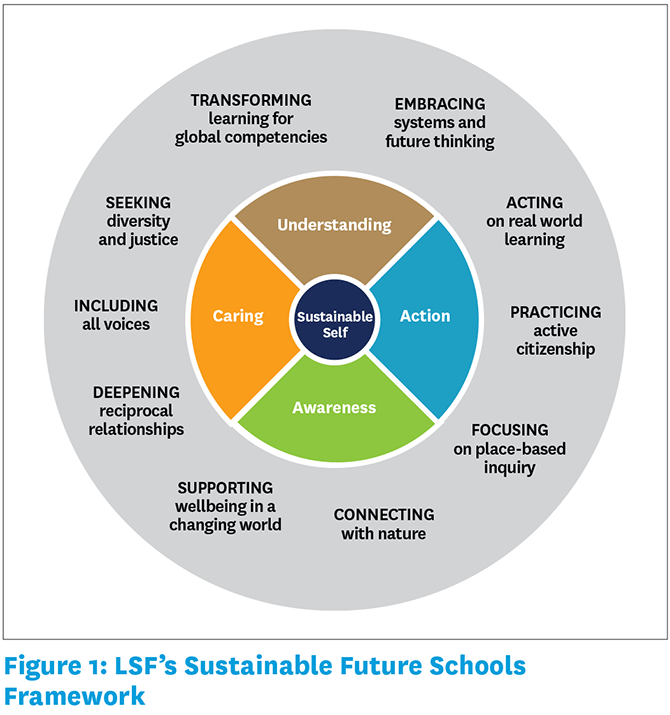
LSF is now piloting a Sustainable Future Schools program (see Figure 1) promoting a whole-school approach using the SDGs and the global competencies as a foundation.
“The program will be a resource for schools to design their own path for advancing the SDGs. It is not set out as a prescribed journey, but rather as a map and set of planning tools using the SDGs as a lens,” Schwartzberg says.
It provides tools and strategies to monitor and evaluate progress, crucial for support from the board and parents.
Outcomes of a Sustainable Future School
- Enhanced and diverse learning opportunities
- Authentic experiences and action-based learning
- Opportunities for students to engage in sustainability projects
- Improved educational outcomes
- Development of informed citizens for future success
- Development of skills, knowledge, and attitudes necessary to create positive changes in the school and/or community.
The Sustainable Self and Four Human Attributes
The circular structure of the program framework allows schools and classrooms to start anywhere. The “Sustainable Self” is every individual child in our care at school, putting the student’s growth and well-being at the centre of the learning community. Students build awareness, caring relationships with others and with nature, learn new skills and knowledge – all in support of taking action to better their lives and communities.
Ten Elements of Practice
The ten pedagogical elements are cited by research and practice as transformative tools for change. Educators’ depth of understanding and implementation for each practice may vary. Resources and professional learning on each are available and accessible. Teachers can learn independently, or with a teaching colleague, course, local partner, or faculty as a professional learning community.
- Focusing on place-based inquiry Encourage, through place-based inquiry, a shared respect and responsibility for learning, for each other, and for the land.
- Deepening reciprocal relationships Develop and sustain school and community practices by collaborating with others. Schools model interdependent, complementary relationships that are connected, balanced, and mutually beneficial. The key to creating reciprocal relationships is a respect and appreciation for the common goal.
- Connecting with nature Connect all learners to the wonder of the natural world, our interdependence with it, and the skills needed to protect it.
- Supporting well-being in a changing world Maintain physical and mental well-being to build resilience, emotional strength, and self-care in the face of complex challenges.
- Including all voices Foster inclusive, collaborative, and equity-centred leadership in schools and community partnerships. Everyone – students, teachers, parents, and local citizens – has a voice.
- Seeking diversity and justice Show respect for alternative perspectives and diverse ideas; seek to understand and innovate together in the pursuit of social and environmental justice.
- Embracing systems and future thinking Use systems thinking tools to help students engage with complex questions, leading to sustainable solutions. Including the future as an important voice in all decision-making helps us to “think long” and avoid the problems caused by short-term thinking. This also reflects Indigenous teaching about respect for the land and people, now and in the future.
- Transforming learning for global competencies Build on a strong foundation of numeracy and literacy by incorporating the six global competencies to prepare students for a complex and unpredictable future with rapidly changing political, social, economic, technological, and ecological landscapes (UNESCO, 2020).
- Acting on real-world learning Connect curriculum concepts and knowledge to issues that students have encountered or are likely to encounter in life. This brings relevance, complexity, and motivation to their learning. (Kozak & Elliott, 2012).
- Practising active citizenship Through community experiences connected to their learning, inspire the values and build the skills for active citizenship.
The Sustainable Future Schools pilot
LSF launched the Sustainable Future Schools pilot program in 2020, with support from 3M Canada, at Belfountain Public School. In early 2020, all classes at Belfountain learned about the Sustainable Development Goals. Using reflection time over the year, teachers asked students how their course content, information, or projects could be linked to one of the 17 goals. Noting these connections on a learning wall and in class discussions helped teach the SDG framework. It also provided evidence that students were understanding the goals over time. The connections showed the students the relevance of what they were learning at school. Students could link their own assignment goals to a website about an SDG initiative, showing how their work aligns with positive action taking place around the world.
For the 2020–2021 school year, the Sustainable Development Goals have become more integrated in classes throughout the school. The program began with a virtual school assembly in October, with a call to action on food waste and SDG 2: End hunger and achieve food security. In November each class shared their learnings and actions on the SDGs through videos, songs, and writings.
School culture is key
Starting from a shared understanding of a school’s culture and its unique sense of place ensures that success is not wholly dependent on one principal, teacher, or club for leadership and energy! The next step is to link the local action to one or more of the Sustainable Development Goals. Framing school learning to the wider world of the SDGs in school priorities is critical to the success of a whole-school approach. When the school is connected to local partners and tuned into real-life concerns, students, staff, and parents can work together on actions rooted in what matters to them, making acting on learning motivating and sustained over time.
Belfountain Principal Lynn Bristoll says, “When I was new, I sent out a short questionnaire to parents to find out their priorities and concerns and what they loved about the school. Overwhelmingly important for them was the environment and getting students outside.” For many years, Belfountain staff, students, and parents have connected to nature and the community.
“This is a core value of the school and a foundation to its culture. Students apply their lessons to making a difference, globally and locally,” says Bristoll. “For example, they participate in an annual Garlic Mustard Festival – a program that engages the public to identify and remove invasive garlic mustard from local green spaces. That underscores the importance of integrating the Sustainable Development Goals into our thinking and action.” (See Belfountain Grade 4 Water Inquiry for a class example).
The Sustainable Development Goals also help build awareness and understanding for other important social issues that are school priorities, such as the Black Lives Matter movement and Indigenous knowledge. Bristoll explains, “The goal is that students will leave the school knowing they can act on what they have learned.”
Belfountain Grade 4 Water Inquiry
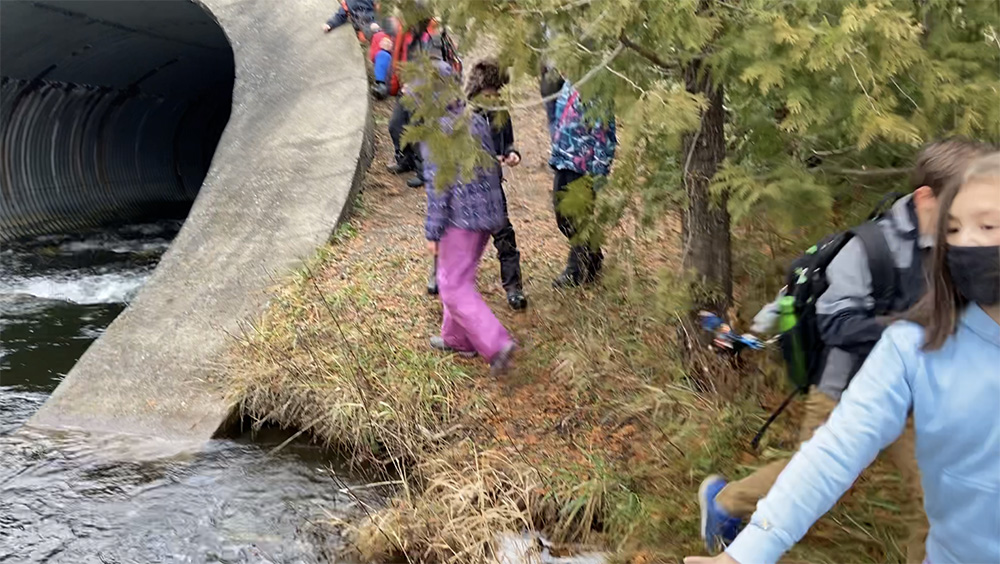
Grade 4 students wanted to learn and do something about water. They live in homes with well water, so potable water is important for them. They are concerned about a possible new development in the area and what might happen. SDG 6 is about Clean Water and Sanitation and SDG 14 is about Life below Water, so making the local relate to the global need was a clear imperative.
“Take them to the river,” LSF consultant Pamela Gibson advised the teacher. “I told her that the students are like investigative journalists, finding out what’s important for them and their community. That way they are attached to what they are learning, dialed in.”
The students observed and collected data on the river near the school. They had many questions from this initial visit. What will happen to the water table? Where is the water coming from and where is it going? Is it clean water? Their questions directed their lessons and research back at school. They learned about artesian wells, surface water, and underground rivers. The students could proceed in many directions with many projects, simply through collecting information and using their learning. The teacher could find many curriculum links through this process across several subject areas. Key to this was the outdoor experience.
It is important that teachers view the process through their curriculum. There were links to Science, Social Studies, Math and Language right from the start. Teachers can see what is possible and can guide learners to the curriculum concepts and the big ideas. Through the river and water experience, the teacher saw how her curriculum, the SDGs, and the integration of new pedagogies could all be linked.
Gibson says, “The idea is to reflect on learning experiences through the SDGs. Ask questions: How does this relate to our own future? To our local community? To global challenges?“
Make it real
Belfountain kindergarten teacher and LSF Consultant Janice Haines has been part of the sustainability culture of the school for many years. “To make the goals understood you have to make them real for children. Big ideas need to be connected to their day-to-day experiences,” Haines explains. “For example, children can grasp a science idea like adaptation when they see the animals outside managing to survive in winter. They really get it.” Finding community partners is especially helpful. “A parent got us working on squirrel conservation a few years ago and we continued with it for five years,” she says.
It’s important to offer context and reassurance to students that what they are doing makes a difference. “We don’t stress them with catastrophes, but instead relate it to what is happening in their school playground,” Haines says. “My ultimate vision is of happy kids who are eager to learn and do more in their community. They know they have a voice.”
Resources
World’s Largest Lesson
https://worldslargestlesson.globalgoals.orgPosters and Lesson Plans https://worldslargestlesson.globalgoals.org/resource/introducing-explorers-for-the-global-goals/
Intro to Goals video: Sustainable Development Goals: Improve life all around the globe
https://www.youtube.com/watch?v=kGcrYkHwE80&feature=youtu.beResources from Learning For a Sustainable Future (http://lsf-lst.ca)
Webinars: http://resources4rethinking.ca/en/outdoor-learning
These webinars introduce teachers to the SDGs and provide opportunities to share ideas and resources for integrating key SDGs into lesson plans and action projects.Resources for Rethinking: www.R4R.ca
A free online database where educators and the general public can search, by the SDGs, for the highest quality, peer-reviewed, curriculum-matched teaching resources, children’s literature, videos, outdoor activities, and apps/games.Our Canada Project: www.ourcanadaproject.ca
Allows schools to share their sustainability action projects with others to inspire youth agency, access resources, and apply for funding. More than 850 projects are currently posted and searchable by SDG.Youth Leadership Forums:
These forums engage students in local sustainability issues, equip them with the knowledge and skills needed to make a change, and empower them to take action.Banner Photo: Adobe Stock
Images courtesy of Learning for Sustainable Futures
First published in Education Canada, March 2021
Read other articles from this issue
References
Council of Ministers of Education, Canada. (2016). Pan-global competencies.
https://www.cmec.ca/682/global_competencies.htmlThe Global Goals. (2015). The Global Goals for Sustainable Development.
www.globalgoals.orgKozak, S., & Elliott, S. (2014). Connecting the Dots: Key strategies that transform learning for environmental education, citizenship and sustainability. Learning for a Sustainable Future.
http://lsf-lst.ca/dotsUnited Nations Department of Economic and Social Affairs. The 17 Goals. United Nations.
https://sdgs.un.org/goalsUNESCO International Bureau of Education. (2020). Canada establishes a Pan Canadian Global Competencies Framework for Education. UNESCO.
www.ibe.unesco.org/en/news/canada-establishes-pan-canadian-global-competencies-framework-education -
Shaping a Fairer World
Comments Off on Shaping a Fairer WorldLet me introduce the Sustainable Development Goals (SDGs), also referred to as Global Goals. We have 17 goals with one global aim: to make this world a better and peaceful place. We have to achieve these goals by the year 2030, also known as Vision 2030. We need to act right NOW. If we don’t waste food, water, and electricity that will help save the Earth. If people are treated fairly and respect each other, these small efforts will make a big difference too.
As a student activist and a community worker, human rights and the empowerment of the girl child are the areas closest to my heart. The first time I became aware of the UN SDGs was in 2016, when I was 13 years old and studying in Grade 9. I participated in an exhibition by my school, Ahlcon International in India, which was solely based on the SDGs.
Inspired by the exhibition’s message to spread the word about SDGs, I created short YouTube videos on each of the 17 goals for sustainable development that addressed various social issues like girl child education, bullying, and climate change. I also hosted various talk shows, ran campaigns, hosted Skype sessions with students in different countries and motivated them to take action at local and global levels.
I founded a Twitter community – @SDGsForChildren – in 2016 to provide a unique platform for children across the globe to connect, create, and collaborate for a better and sustainable world. Since then, the community has not only impacted millions of children and youth, but also inspired many educators to initiate their journey of SDGs in their classrooms. SDGs For Children is now incorporated under the Canada Not-For-Profit Corporation Act to support Agenda 2030 globally (www.sdgsforchildren.org). Many schools and children around the world are now part of this community and collaborating wholeheartedly in spreading awareness about basic human rights and global goals.
My experiences organizing the collaborations, both in India and here in Canada, have been life-changing. However, I am not special. There are hundreds of youth-led organizations that are working for climate change. The people leading such initiatives are all incredible teenage activists. Zero Hour, Sunrise Movement, Fridays for Future, School Strikes for Climate are just a few of many organizations that take our concerns to leaders worldwide. We young world-changers are noisy and can change the conversation. We are sharing our emotional sides when we are writing essays or doing rallies, interviews or strikes, or even speaking or writing on platforms like this. It’s next to impossible to ignore our noisy voices. Social media has given us exposure to what is happening around the world. I have learned so much on these digital platforms. Instagram may be a tool to share selfies or food for many adults, and a lot of people say Facebook is a parents’ app, but many of the youth of my age have a different experience on Instagram, Twitter, or Facebook. There are thousands of accounts spreading awareness and knowledge about the Global Goals. And, as youth activism becomes more popular, sharing information gets easier and is ever increasing.
Serving the community has really developed my sensitivity to the requirements of others and has transformed me completely. I believe that success isn’t in only winning alone, but taking people along and winning together. The Sustainable Development agenda is not about my issue or your issue. These are global issues and we need every one of the 17 SDGs to be achieved.
The 2030 Plan for Sustainable Development offers a historic chance for Canada and the world to positively shape how tomorrow’s economies can evolve and thrive sustainably and inclusively for the mutual good of all. It is a chance to make a more resilient society by leaving no one behind.
In Canada, a number of schools are taking a leadership role in supporting sustainable development across the country. Some of the academic institutions undertake activities and studies that enable students to make informed decisions in favour of sustainable development. But this is not enough. There are many more schools that still do not understand the importance of the SDGs or are still exploring various options to apply them and integrate them into their daily curriculum.
There is an opportunity to continue building awareness, partnerships, and collaborations with other global educational networks and to learn from their best practices and success stories of working on the Global Goals. This is what SDG 17, “Partnership for the Goals,” is all about. In the official words, “Strengthen the means of implementation and revitalize the global partnership for sustainable development.” We need to create a specific and trained task force of educators, students, and parents to work toward incorporating SDGs not only in policy and governance documents across all educational institutions in Canada, but also in supporting their implementation at the grassroots level. The work needs to be measured by defined key performance indicators (KPIs) for this project.
A new vision for education
The COVID-19 pandemic has changed our lives forever. We take stock of what is necessary when we experience a loss. We appreciate the things that maybe we took for granted. We revisit our values and our relationships, and we think about how we might honour them if we had another chance.
COVID-19 is not only a health crisis or an economic crisis, it is an education crisis as well. As per UNESCO, “290 million students are out of school due to COVID-19.” It’s time we take stock of what’s important. We must review what is good in our education system and what we must leave behind now.
This is a time when a lot of standardized curriculum and tests are going to be set aside. All the schedules have been turned upside down. Let’s change this uncertainty in school systems into an opportunity. This is a chance not only to reform education but also to bring reform through education.
SDGs are not just 17 goals with 169 targets. When these goals are brought into classrooms, they become the launchpad or the framework for collaboration in problem solving. Entire communities of students and teachers then become part of the solution by adding their action plans to make a difference in the world. SDGs have the power to integrate academics with activism. They are the tools for students to recognize they have a seat at the table and that their voice matters. SDGs let students explore what they are curious about, and they can pursue that curiosity with the help of their educators.
Let’s bring reforms in our education system and let’s address these basic questions through our curriculum:
- How to become self-directed learners?
- How to be media literate?
- How to be responsible consumers?
- How to support neighbours who do not have access to technology?
- How to share our resources with the community?
- How to create and maintain sustainable cities where we want to live?
The SDGs should become the language of any conversation within the class. Let’s design an open-ended, self-directed, inspiring research-based curriculum that allows our students to attempt the impossible. There are two possibilities when we take this approach:
- The students fail to solve the problem but learn a lot of valuable lessons along the way. OR
- They surprise us all and actually solve the problem at hand.
Remember, everyone wins when we include failure, resilience, determination, persistence, and reflection as our learning outcomes.
I am happy that children are now mobilizing globally to own up to their responsibility and inspire adults to protect their future. Social distancing may have caused us to stay physically apart from each other, but the spirit of humanity cannot be restrained. We must prepare students as global citizens who are inclusive, informed, and engaged globally. We need to knock down walls so that students can learn to go beyond “me,” “my place,” and “my time,” and use the world as the biggest context for daily learning.
Photo : Adobe Stock
First published in Education Canada, March 2021
Read other articles from this issue
Video
-
Providing a Quality Education in a Multicultural Environment
Comments Off on Providing a Quality Education in a Multicultural EnvironmentThe Marguerite-Bourgeoys School Service Centre (CSSMB) is located in the west end of Montreal. Covering over 100 schools and institutions, it is Quebec’s second largest school service centre (CSS). The territory served is divided into seven networks, each encompassing one or two high schools and their feeder elementary schools. This structure ensures consistency in the interventions for client groups living in relatively homogeneous areas. Administrators and educators from both levels maintain close ties, facilitating the students’ transition from elementary to high school. An example of this is Amène ton parent au théâtre, an initiative in which elementary students, accompanied by their mother or father, are invited to attend a bullying prevention activity presented by high-school students.
In addition, the CSSMB relies on the insights of a small team of statisticians who closely monitor hundreds of indicators, notably those associated with the 17 goals listed in its Plan d’engagement vers la réussite (Commitment to Success Plan). This information is valuable because it helps us quickly identify and address our students’ academic and social vulnerabilities.
The activities carried out in the CSSMB’s 102 institutions interconnect with many of the 17 Sustainable Development Goals (SDGs) adopted by the United Nations. In this article, we will focus primarily on Goal #4: Quality Education.
Access to quality education for all
Quebec’s student population has changed dramatically in the past few decades, especially in Montreal. In the CSSMB’s elementary and high schools, over 80 percent of students are first- or second-generation immigrants. This diversity creates a number of challenges when it comes to organizing educational services. For example, many recently arrived immigrants are unable to speak French, their new language for school and socializing. During the 2019-2020 school year, 4,500 students attended “welcome” classes, which are designed to teach French while fostering the academic and social integration of non-French-speaking young people.
If we are to provide a quality education to all (SGD 4), notably students with diverse cultural backgrounds and life experiences, we must rethink the way in which educational services are delivered. This process requires in-depth reflection, adapted tools and, ultimately, a review of existing practices. We have successfully met this challenge because we have the highest graduation and qualification rates of any Quebec school service centre – not bad for a CSS where students speak over 150 different mother tongues!
Implementing practices supported by research
To efficiently coordinate the activities of all the experts working with our students, we have created reference documents and frameworks to define everyone’s role. These resources are inspired by research in various areas to ensure that best practices are integrated and applied. In 2015, we published Vivre-ensemble en français (Living Together in French). This document offers guidelines for learning how to live together in French, clarifies some key concepts, and provides tools to better focus activities (CSMB, 2015, p. 9), while taking into account the school’s diversity, which is integral to providing all students with access to a quality education.
Together, our reference documents and frameworks have enabled us to implement a shared vision of an organization that supports the school experience of all its students, which is our primary objective. These tools establish a culture of accountability and co-operation among those who work to support the success of all students. In this way, the responsibility for teaching and monitoring learners does not fall to a single individual.
Some of our reference documents are also inspired by the tiered approach to intervention. This model, also known as Response to Intervention (RTI), is a system that prevents problems, identifies necessary interventions and improves the chances of success for all students (Bissonnette et al., 2020).
An applied research centre to support sustainable success
Although educational success includes success in school, it involves more than just obtaining a diploma or qualifications. It means encouraging children to reach their full potential intellectually, emotionally, socially, and physically. It also aims to instil values, attitudes, and obligations to help students become responsible citizens who are prepared to play an active role in society (Government of Québec, 2017).
As mentioned earlier, a majority of our students come from linguistically and ethnoculturally diverse backgrounds; increasingly, our staff reflect this diversity as well. While immensely enriching, this reality generates some everyday issues. To address these issues, the CSSMB created the Centre for Pedagogical Intervention in Diverse Environments (CIPCD, cipcd.ca) in 2012. Initially serving the “living together in French” orientation of our 2014-2018 strategic plan, the CIPCD then shifted its orientation to “provide an inclusive, welcoming environment open to the world and the future” in accordance with the CSSMB’s 2018-2022 Commitment to Success Plan. This innovative initiative is unique because we are the only CSS to have our own applied research centre affiliated with various partners.
The CIPCD has six working groups to study challenges related to ethnocultural and linguistic diversity in schools, each with its own priority focus. A university researcher and CSSMB administrator or educational consultant are assigned to each group, which has three primary mandates: research, transfer of scientific knowledge, and training.
Focus 1: Teaching French in a multi-ethnic and multilingual environment
Since 2012, various projects have been carried out to address issues of diversity at the CSSMB. Working Group 1 was created because of the very linguistically diverse student population. French is not the mother tongue of over 60 percent of our elementary and high-school students. This working group focuses on the overall problem of adapting pedagogical practices when teaching French to bilingual and multilingual learners for whom French is a second, or even third, language.
In 2015, the CSSMB and Université de Montréal launched a continuing education project called Taking Action in Multi-ethnic and Multilingual Environments with Preschool and Daycare Students. One outcome of this initiative was to increase staff awareness of the importance of recognizing and acknowledging the different languages spoken by students (e.g. Festival “Pluri-Pluri”). This project has changed our perceptions of languages of origin and the need for inclusive practices.
Focus 2: Academic success and school-family-community relations
As noted earlier, over 80 percent of our students are first- or second-generation immigrants. For a variety of reasons related to their migratory experience or that of their parents, these students may face numerous social vulnerabilities and/or academic challenges. Working Group 2 concentrates its activities on the twofold challenge of academic success and school-family-community relations.
In the last few years, the group has organized a number of activities. Several CIPCD-affiliated researchers carried out a study entitled Intercultural Climate and Educational Success of Immigrant Students. This research aimed to evaluate the state of the intercultural climate in several multi-ethnic schools in Quebec (including two at the CSSMB) and examine the impact of this climate on the educational success of immigrant students. Ultimately, a diagnostic tool must be developed to help administrators assess their school’s intercultural climate, as it is a key factor in supporting the educational success of immigrant students.
Focus 3: Vulnerable immigrant populations and psychosocial intervention in educational settings
Recent immigrant students entering the Quebec school system sometimes arrive with emotional baggage that includes grief and trauma. Working Group 3 studies the psychological well-being and academic success of these students, particularly those in psychological distress.
During the 2016-2017 school year, an action research project provided insight on the academic and social integration of young Syrian refugees. Discussion groups were formed in welcome classes to help these students develop a sense of well-being and belonging. At the end of the project, a guide on organizing discussion groups in schools, Mener des groupes de parole en contexte scolaire (2017), was published for school practitioners. Professionals in many of our schools now use this guide to organize such groups so students can express themselves on various topics like death and violence. These groups are designed to foster the psychological well-being of young people in school and, consequently, their educational success.
Focus 4: Inclusive education and intercultural understanding
Working Group 4 was created to address the interpersonal relationship challenges generated by the diversity of our CSS. Its work focuses on making the concept of “living together” a reality in our schools, notably by explaining the foundations of the inclusive perspective. It also looks at activities to promote intercultural understanding and seeks to document their impact.
In 2015, this working group developed a pedagogical guide to help school staff who would like to discuss sensitive topics with students: Aborder les sujets sensibles avec les élèves. This practical tool can be used on a daily basis to discuss topics, whether related to diversity or not, that can provoke discomfort or sometimes heated class discussions.
Focus 5: Socio-professional integration of recently immigrated staff and work relationships in a multi-ethnic environment
More and more CSSMB staff members have been educated outside Quebec, a reality that creates challenges with regard to their socio-professional integration and the school climate. In the last few years, teachers have been trained as peer mentors to help welcome their foreign-trained colleagues, and school administrators have been invited to awareness training on the topic. Teachers educated outside the province have also taken part in group discussions to learn more about the profession in Quebec (challenges and advantages). Finally, this work has led to the publication of a guide for school administrators on facilitating the socio-professional integration of foreign-trained teachers: Faciliter l’intégration socioprofessionnelle du personnel enseignant formé à l’étranger (2019).
Focus 6: Vocational training for youths and adults with an immigrant background
Ethnocultural and linguistic diversity is also increasingly present in vocational training (VT), raising a number of issues particular to this educational sector. In addition to studying the pathways of VT students from ethnocultural minority groups, the members of this working group examine the problems these students face when acquiring skills and trying to enter the job market. In the last few years, the group has led projects to raise awareness of the realities experienced by young people from immigrant backgrounds and revisit the practices supporting their occupational integration, for example, in internship settings.
***
The makeup of our student population has been transformed over the past few decades. Children named Bertrand, Roberge and Lauzon now sit alongside those named Traoré, Chang and Hernandez, primarily because the Charter of the French Language dictates that the majority of new immigrants must attend French-speaking schools. These students come from around the world. Upon arrival, many of them spend one or two years in a welcome class, discovering the language of Félix Leclerc, before joining a regular classroom where they will be successful.
This is possible because we have taken measures to ensure their success, notably by creating more partnerships with university academics. We offer these experts a vast testing ground and, in return, they share what they learn with us. The results speak for themselves: at the end of the 2019-2020 school year, the graduation and qualification rate of our students was ten points higher than the average for all French-speaking school service centres in Quebec. We can therefore safely infer that we are on the right track!
Photo : Adobe Stock
First published in Education Canada, March 2021
Read other articles from this issue
References
Bissonnette, S., Bouchard, C., St-Georges, N., Gauthier, C., & Bocquillon, M. (2020). Un modèle de réponse à l’intervention (RàI) comportementale : Le soutien au comportement positif (SCP). Enfance en difficulté, 7, 129–150.
Commission scolaire Marguerite-Bourgeoys (2015). Référentiel d’accompagnement vivre-ensemble en français. Service des ressources éducatives.
www.csmb.qc.ca/~/media/Files/PDF/CSMB/veef/Referentiel_Vivre-ensemble.ashxCommission scolaire Marguerite-Bourgeoys (2018). Plan d’engagement vers la réussite 2018-2022. https://www.csmb.qc.ca/fr-CA/csmb/pevr.aspx
Festival « Pluri-Pluri » à l’école Terre-des-jeunes.
www.elodil.umontreal.ca/videos/presentation/video/eveil-aux-langues-et-aux-cultures-a-lecole-ter/Government of Québec. (2017). Policy on educational success: A love of learning, a chance to succeed. Ministère de l’Éducation et de l’Enseignement supérieur.
www.education.gouv.qc.ca/fileadmin/site_web/documents/PSG/politiques_orientations/politique_reussite_educative_10juillet_A_1.pdfHirsch, S., Audet, G., & Turcotte, M. (2015). Aborder les sujets sensibles avec les élèves — Guide pédagogique. Centre d’intervention pédagogique en contexte de diversité, Commission scolaire Marguerite-Bourgeoys.
https://cipcd.ca/wp-content/uploads/2014/04/CSMB_-Guide_sujets-sensibles_final.-1.pdfAmène ton parent au théâtre.
www.mfa.gouv.qc.ca/fr/intimidation/prix/Pages/Ecoles-secondaires-Saint-Georges-Saint-Laurent-2018.aspxMorrissette, J. (2019). Faciliter l’intégration socioprofessionnelle du personnel enseignant formé à l’étranger. Guide à l’intention des directions d’établissement. Centre d’intervention pédagogique en contexte de diversité, Commission scolaire Marguerite-Bourgeoys.
https://cipcd.ca/wp-content/uploads/2014/04/GuideFaciliterInte%CC%81gration_VF_HauteRe%CC%81so_190708_pagesSimples.pdfPapazian-Zohrabian, G., Lemire, V., Mamprin, C., Turpin-Samson, A., & Aoun, R. (2017). Mener des groupes de parole en contexte scolaire. Guide pour les enseignants et les professionnels. Centre d’intervention pédagogique en contexte de diversité, Commission scolaire Marguerite-Bourgeoys et Université de Montréal.
https://cipcd.ca/wp-content/uploads/2014/04/Mener-des-groupes-de-parole-en-contexte-scolaire-Guide-pour-les-enseignants-et-les-professionnels.pdf -
Amplifying the UN’s Sustainable Development Goals to engage and empower Canadian K-12 students to lead societal change
Comments Off on Amplifying the UN’s Sustainable Development Goals to engage and empower Canadian K-12 students to lead societal changeToronto, February 11, 2021 —The EdCan Network is pleased to launch – in partnership with the Canadian Commission for UNESCO (CCUNESCO), – an awareness campaign highlighting how educators can engage students in meaningful learning using the UN Sustainable Development Goals (SDGs). More teachers and students will discover their role in solving local, regional, and global problems such as poverty, access to quality healthcare, gender equality, and access to inclusive, equitable quality education, to name a few. This extensive focus on how the SDGs can transform learning will include the release of a special issue of Education Canada Magazine dedicated to showcasing the educational importance and transformative impacts the SDGs can have on teaching practice and student learning.
“There’s no more opportune moment than now to showcase a movement of Canadian and international educators and organizations devoted to inspiring students to define their futures and make a difference in our world,” says Denise Andre, EdCan Network Chair, “Our network is delighted with this opportunity to collaborate with CCUNESCO to amplify the SDGs to spark deep learning across the country.”
‘’To build a better future for all, we need to mobilize the education sector, especially teachers and students, in order to achieve the 17 Sustainable Development Goals (SDGs) by 2030. This sector has the unmatched possibility to raise awareness, develop the critical thinking skills of young people and serve as a powerful lever for changing behaviours and lifestyle habits. We are happy to partner with EdCan on this important campaign,’’ says Sébastien Goupil, Secretary-General, Canadian Commission for UNESCO.
From now until April, this campaign will deliver infographics, fact sheets, a professional learning discussion kit, and an online professional learning course that will be available to EdCan members. For educators, schools, and school districts looking to learn more about the SDGs or to share how they’ve successfully integrated the SDGs into their school communities, please visit: https://www.edcan.ca/magazine/spring-2021/ and follow @EdCanNet and @CCUNESCO for latest campaign updates.
About the EdCan Network
The EdCan Network has maintained its 129-year tradition as the only national, nonpartisan, bilingual organization representing 110,000 educators across Canada. Our role as an intermediary connects K-12 education systems across the country by producing and disseminating authoritative and evidence-based, yet accessible content that is trusted by educators, parents, and policymakers alike. EdCan aims to improve education policies that heighten equity and support deeper learning (i.e. a combination of the fundamental knowledge and practical basic skills all students need to succeed), and expanding the reach of educational resources in an effort to bridge the research-implementation gap. Learn more at www.edcan.ca or @EdCanNet.
About the Canadian Commission for UNESCO
The Canadian Commission for UNESCO (CCUNESCO) serves as a bridge between Canadians and the vital work of UNESCO—the United Nations Educational, Scientific and Cultural Organization. Through its networks and partners, the Commission promotes UNESCO values, priorities and programs in Canada and brings the voices of Canadian experts to the international stage. The Commission facilitates cooperation and knowledge mobilization in the fields of education, sciences, culture, communication and information to address some of the most complex challenges facing humanity. Its activities are guided by the United Nations’ 2030 Agenda for Sustainable Development and other UNESCO priorities. CCUNESCO operates under the authority of the Canada Council for the Arts.
For more information contact:
Sarah Ranby
Research Analyst
EdCan Network
sranby@edcan.caIsabelle LeVert-Chiasson
Program Officer, Education and ASPnet National Coordinator
CCUENSCO
isabelle.levert-chiasson@ccunesco.ca -
The UNESCO Schools Network
Comments Off on The UNESCO Schools NetworkThe 17 Sustainable Development Goals – also known as the SDGs or the Global Goals – offer a blueprint for a more just and sustainable future for all. As many as 193 governments from around the world adopted these goals in 2015 and agreed to implement them in their own countries in order to achieve the 2030 Agenda for Sustainable Development. Over the coming decade, these countries will continue to mobilize efforts to end poverty, fight inequalities and tackle climate change. These new, interconnected goals build on the earlier Millennium Development Goals while encompassing new priority areas, such as climate change, economic inequality, innovation, sustainable consumption, peace and justice, and others.
SDGs have a huge part to play in today’s classrooms. As a road map for making the world a better place, these goals can support student engagement and can also inform and influence lesson plans. The Canadian Commission for UNESCO (CCUNESCO) has been supporting students and educators in bringing these global goals to the classroom through the UNESCO Schools Network, a global network of schools contributing to the achievement of the 2030 Agenda for Sustainable Development. Here are a few examples of how members of this network are taking action on the SDGs in their schools across Canada.
Agenda 2030
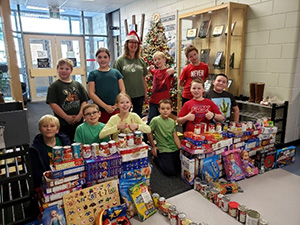
Elm Creek School – Sustainability in Action At Elm Creek School, a K–12 community school in Elm Creek, Manitoba, their UNESCO team of students and lead teachers launched a school-wide project to bring more awareness to, and take action on, the SDGs. The World’s Largest Lesson, launched in 2015 to bring these global goals to children everywhere, was shared with all students in a special school assembly. At this assembly, students were placed into various multi-graded groups. The school’s UNESCO committee collected various print and electronic resources, and then assigned each of these groups one or two of the goals to research. This research process led to planning that supported the ultimate goal of the entire school working together to implement action projects that could address the SDGs. Action projects that continue to be implemented and sustained include:
- an annual food drive to collect non-perishable food items for children and families in need within the school’s community and surrounding areas (SDG #2: Zero Hunger)
- an annual drive to collect school supplies, personal care items, and small toys for children in developing countries (SDG # 4: Quality Education)
- a school-wide waste composting project using worms to break down food waste into useable compost for the school’s garden, which then raises produce for the school’s canteen (SDG #12: Responsible Consumption and Production).
SDG #4: Inclusive and Equitable Quality Education for All
In 2020, the CCUNESCO and the Global Centre for Pluralism launched online teacher training on “Talking About Racism in the Classroom” in response to racial injustice in Canada and in our schools. More than 1,000 teachers responded and more than 500 participated in online training as it was clear that teachers and school administrators urgently wished to be equipped and supported to have these conversations and to explore systemic racism within their school systems.
In order to continue this important conversation with students, CCUNESCO partnered with TakingItGlobal and the Centre for Global Education to organize an online live video conference for schools across the country titled “#BlackLivesMatter in Canadian Schools.” The two keynote speakers for this video conference were two students from the David Suzuki Secondary School from Brampton, Ontario. As members of the United Souls, a Black student leadership group that shares a common ideal of upholding Black excellence, they were able to share their personal experiences of racism and how we can address systemic racism within our school systems.
SDG #3: Good Health and Well-Being
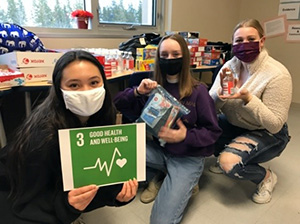
F. H. Collins Secondary – Sharing and Caring To promote health and well-being in their community, some of the students at F.H. Collins Secondary School in Whitehorse, Yukon, organized care packages for people in need this winter. Students purchased arm socks and mitts along with personal-care products and some chocolate to be distributed locally. The students enjoyed working together to spread some holiday cheer and work toward SDG #3: Good Health and Well-Being.
SDG #13: Climate Action
Climate action is essential for sustainable development, which, at heart, is a way for people to benefit from natural resources without using them all up and depriving future generations. For example, reducing carbon emissions is key to living within environmental limits. So is being responsible about excess packaging, waste disposal, and how we treat the world’s oceans. It is increasingly urgent to preserve the world’s ecosystems and natural and cultural heritage, and to protect the Earth from the most devastating effects of weather extremes, such as wildfires, floods, severe storms, and more.
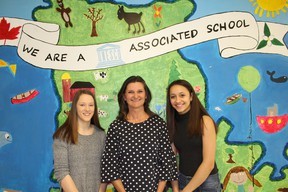
A whole-school approach was implemented by lead UNESCO Schools teacher Terri Munn at Bruce Peninsula District School At Bruce Peninsula District School in rural Ontario, teachers, students, and staff have implemented a comprehensive program driving climate action in every classroom, with monthly challenges and tips. As part of this approach, the entire K–12 school completed ten monthly challenges focused on climate action during the school year. The projects supported what students were learning in class and involved parents and community members. To ensure everyone stayed on track, the school kept tally sheets of climate actions and had one student elected by each class to make sure climate actions were being taken.
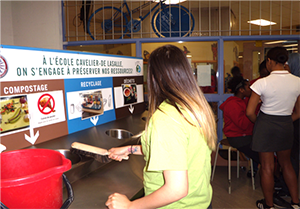
École Sécondaire Cavelier-De LaSalle – Waste Reduction At École secondaire Cavelier-De LaSalle in Quebec, reducing waste is serious business. After installing an industrial composter, the school redirected 176 kg of waste as compost in 2017, and 200 kg of waste in 2018. The school also reduced plastic waste by selling reusable water bottles in the 2017–2018 school year, which are fillable at the school’s bottle fountains.
SDG # 16: Peace, Justice, and Strong Institutions
In order to ensure peace, justice and strong institutions in Canada, Indigenous peoples’ rights must be respected. According to the Truth and Reconciliation Commission of Canada, the United Nations Declaration on the Rights of Indigenous Peoples (UNDRIP) is the framework for reconciliation at all levels and across all sectors of Canadian society. The UNESCO Schools Network supports initiatives that promote reconciliation between Indigenous and non-Indigenous peoples in Canada within UNESCO’s program areas. To facilitate the conversation around reconciliation within the classroom, CCUNESCO partnered with Wapikoni, an organization that works with Indigenous youth through cinema and music to develop their artistic, technical, social, and professional skills, and broadcasts their films to increase public awareness of issues facing Indigenous communities. The result was a teaching guide intended to encourage high-school teachers to engage students in discussions about current issues and to introduce them to the diversity of Indigenous cultures in Canada.
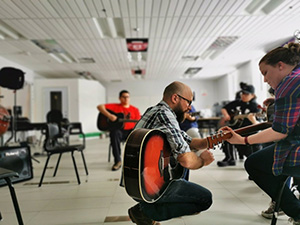
Allison Bernard Memorial High – Celebrating Indigenous culture At Allison Bernard Memorial High School, located in Eskasoni First Nation in Nova Scotia, the school uses music and technology to help students engage with, share, and celebrate their cultural identity. For example, high-school students put Rita Joe’s famous poem, I Lost My Talk, to music. “It’s all about reconciliation through art – that was the overriding idea with this whole project,” says Eskasoni teacher Carter Chiasson. They are also in the process of developing a language app to revive Mi’kmaq.
A global network that supports local action
Imagine more than 11,500 schools in 182 countries connecting and learning from one other, where students reflect on global challenges such as peace, climate action, human rights, cultural diversity, and sustainable development, while taking action to contribute to positive changes in their own communities. This is what the UNESCO Schools Network is all about. Created in 1953, it connects schools across the world to promote quality education for all in the pursuit of peace and development. There are more than 100 UNESCO schools across Canada.
There is a particularly important role for UNESCO schools in Canada to take action on SDGs. A Teacher’s Toolkit was recently created to support all educators and students who are interested in implementing UNESCO values at their schools. While all schools can access UNESCO and CCUNESCO educational resources and publications, those that are part of the network also get to learn from one another with other schools that are committed to tackling local and global issues related to the SDGs, thereby contributing to a better and more sustainable future for all. Learn more about the SDGs, connect with others across Canada and the world, and join the movement!
Photos: CCUNESCO
First published in Education Canada, March 2021
Read other articles from this issue
References
Canadian Commission for UNESCO.
https://en.ccunesco.caCanadian Commission for UNESCO. (March 2020). Teachers toolkit: UNESCO Schools Network in Canada. UNESCO.
https://en.ccunesco.ca/-/media/Files/Unesco/Resources/2020/04/ToolkitUNESCOSchoolsTeachers.pdfRita Joe Song Project. Gentle warrior. National Arts Centre.
https://nac-cna.ca/en/ritajoesong/gentle-warriorGlobal Centre for Pluralism. (2020). Talking about racism in the classroom: Webinar and resources for educators on anti-Black racism.
www.pluralism.ca/talking-racismUNESCO Schools Network.
https://en.ccunesco.ca/networks/unesco-schools-networkWapikoni. (n.d.) Wapikoni teaching guide: An introduction to the diversity of Indigenous cultures in Canada.
www.wapikoni.ca/about/services-offered/wapikoni-teaching-guideWorld’s Largest Lessons.
https://worldslargestlesson.globalgoals.org -
Your SDGs To-Do List
Comments Off on Your SDGs To-Do ListFor years, I thought I was checking all the “global education” boxes. Committed to diversity, building global competencies, and supporting my students to seek out different perspectives and viewpoints, I was set on making sure my young students were preparing for a world that would require them to work and live as global citizens. We placed emphasis on reading about cultures different from our own. We learned about holidays and customs of people in distant lands. Daily language practice included English, Spanish, and Mandarin Chinese. As early adopters with technology, we aimed to make connections to global issues and current events around such topics as the environment and human rights.
Then, around 2010, I realized that though I had been checking boxes, my instructional to-do list as a global educator needed to move students beyond simply learning about the people and issues of our world to a new level of action.
The Four Domains of Global Competence offered by the Asia Society (2005) (See Figure 1) showed me that globally competent students need the knowledge and skills to:
- Investigate the world
- Recognize perspectives
- Communicate ideas
- Take action.
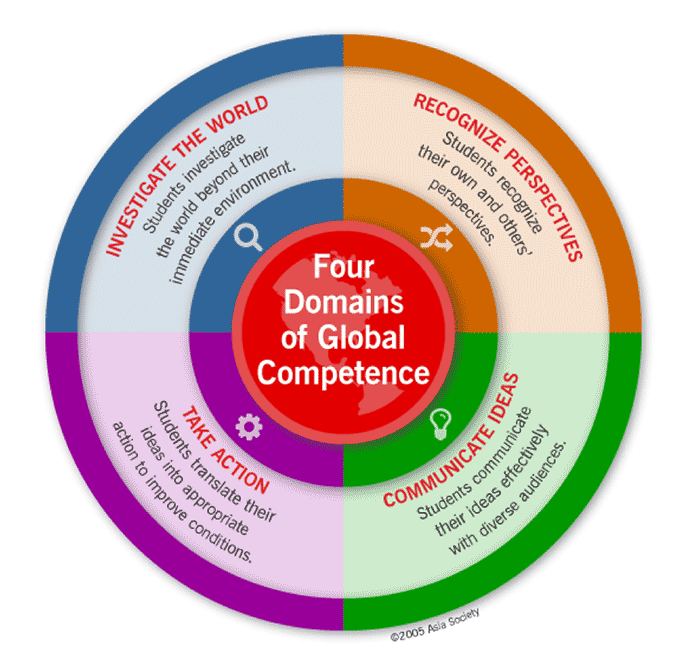
Figure 1 : Four Domains of Global Competence
The first three domains – that was where I was existing. Take action – that was where we needed to go.
Looking back, I would say that was the first defining moment that changed my course as a global educator. The next was in 2015, when I met the United Nations Sustainable Development Goals (SDGs).
“The Sustainable Development Goals are humanity’s to-do list for a sustainable planet, a roadmap for a better future.” – United Nations Office at Geneva
The 17 Global Goals that our world together agreed to reach by 2030 cover critical topics such as life on land, climate action, gender equality, clean water, and food security. We in education even have our very own Global Goal in SDG 4: Quality Education. As I explored the SDGs, I started to see how we as educators can fit into this global conversation and universal call to end poverty, protect the planet, and improve the lives of all people.
Over the years, I have gathered with like-minded educators from all over the world who are also committed to bringing the SDGs to our classrooms and schools. Mobilized as a professional learning network and coming together in collaborative spaces such as Twitter and with projects such as the Goals Project (www.goalsproject.org), we see education as one of the greatest paths to achieving the SDGs, with teachers and students working together in solidarity and with purpose.
The TeachSDGs community
The start of TeachSDGs, now a community of more than 50,000 international educators taking action for the Global Goals, really came from the idea that the goals could be the roadmap for teachers seeking new ways of teaching and learning.
I remember sitting with my global education friends Alice McKim of New Brunswick, and Amy Rosenstein of New York and thinking together that the goals were what we had been searching for – the bridge to connect the work happening in classrooms out to the world and to industry. For us, the goals became the entry point into how we as teachers, along with our students, could join the conversation and have a “seat at the table” – be it in New York City at the UN headquarters or at the level of local policy or projects. The Global Goals, in our minds, laid out the plan and also the pathways into the work.
After being tasked by the UN to organize as a Global Goals Task Force, we knew we needed to move beyond being a handful of North American educators. We set out to invite in our global colleagues, many of whom we had never met and only knew from social media. We did what we knew best – we created a hashtag (#TeachSDGs) and a simple website (TeachSDGs.org), and we got to work. Soon after, we went from being a few educators to 17 to now tens of thousands, all working for this shared purpose – to support and empower students and teachers to take action for people and the planet through the work of the SDGs. And now that we have entered this Decade of Action, with less than ten years left until 2030, we are all operating with urgency and a clear vision of what we can do to help.
Why the SDGs? Why now?
So why the Global Goals? Why now? We seem to be at a pivotal moment in education. We are seeing students rise up as activists to inspire and create needed change based on their viewpoints and the needs of our world; we as citizens of planet Earth are tackling climate change and combating human rights violations and global pandemics; we are seeing new technologies change the way we live and work at just the time when we are also prioritizing the human part of living and working, with emphasis on social-emotional learning, well-being, empathy, and design thinking. We as educators have been on the front lines of the change – seeing the shift as it occurs and pivoting and advancing right along with it.
The Sustainable Development Goals bring opportunity. They bring hope and a guide to get us there. Within classrooms, I see how the goals allow for collaboration and interdisciplinary work. Just as the goals are for everyone, everywhere, they also see no boundaries within curricula, allowing us to cross content areas and work as teams toward a common purpose. The Global Goals are the sciences and the arts; they are language and humanities. They are our history and our future, and for us as teachers, they can be the “today” of our teachings.
Goals Project: One way to jump in
After several years of our work in building awareness of the goals, we started to hear teachers saying, “Now we see the ‘why,’ but what about the ‘how’?” In 2019, I was inspired by one of my former university students, who shared with me a project she did with teachers around the ABCs. If a project around 26 letters of the alphabet could work, I thought, why not build one around the 17 SDGs? I decided to see if teachers from the TeachSDGs community might be interested in joining me for a short project on the goals.
Once again, I created a name (Goals Project), a hashtag (#GoalsProject), and a free website (www.goalsproject.org), and started to share it on Twitter. My original stretch goal was finding 16 other classes. Within weeks, more than 350 people had asked to join, and in that first year of our Goals Project we had nearly 2,000 classrooms participate. The 2021 Goals Project kicked off on January 25, welcoming in nearly 3,000 classrooms from more than 120 countries. Students aged three–20 are joining in to take on the SDGs in a six-week project of solutions. For us, it is a space for exploring of ideas and building hope for a better planet as stewards for the environment and for the goodwill of people.
Create your to-do list for action in the classroom
For educators ready to dive into the Global Goals today, here are five tips and then a listing of top resources designed to help K–12 educators take action on the SDGs in classrooms.
- Clearly identify your own instructional goals and bring the Global Goals in naturally.
- Consider your own interests, skills, and curiosities. Your excitement around specific goals and targets can inspire and motivate students!
- Keep your to-do list short, specific, and manageable. Focus on collective action over time, and build action into your routines and even lesson plans.
- Connect to events and organized projects. Check out the SDG Planning Calendar (listed below), established global collaboration projects, and even local community events, and align with activities happening throughout the year.
- Share with a friend – near or far. As you take on this new challenge, invite a teacher from your school (or find someone from another part of the world) to join with you as you jump in and start checking things off!
RESOURCES
Free printable classroom resources
Print out and post the SDG Poster or the individual Global Goals:
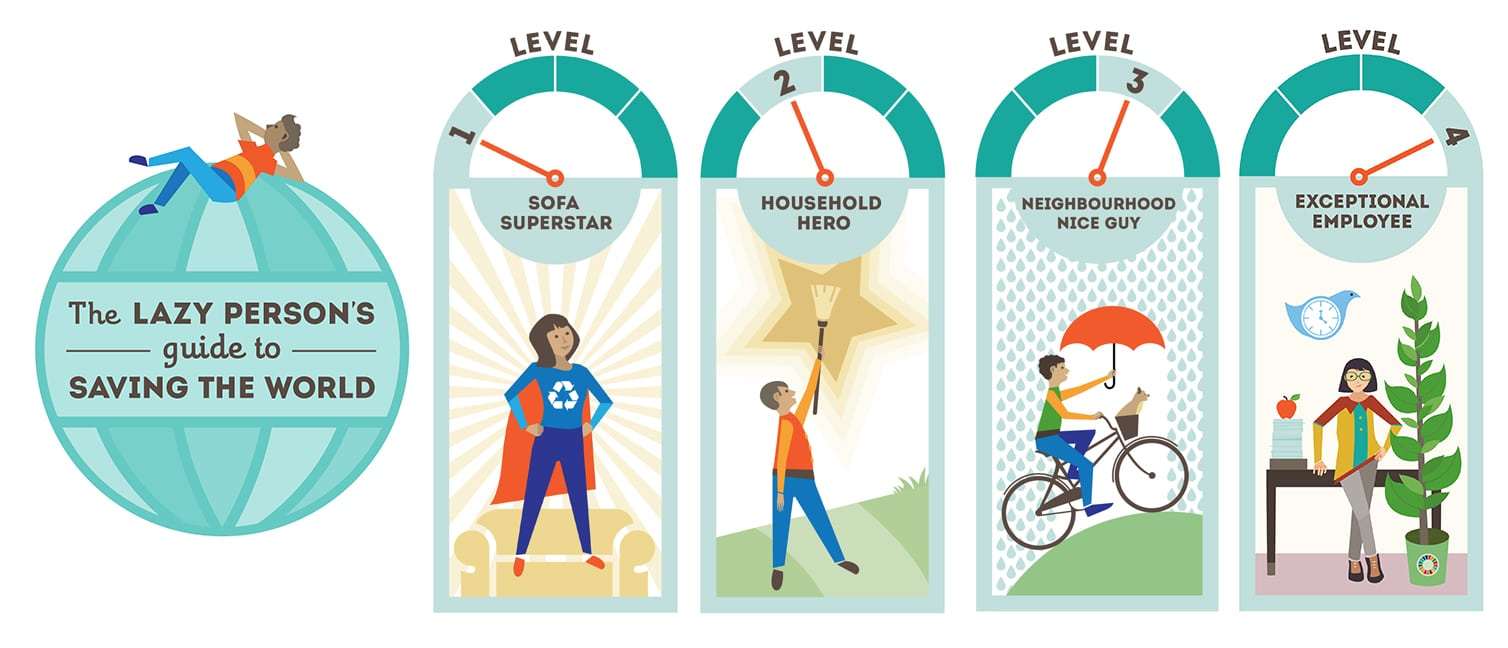
The Lazy Person’s Guide to Saving the World (UN, 2019) suggests SDG actions you and your students can take from your couch, your home, your community, and your work/school:
Download and share infographics, GIFs, and translations for inspiring action in your school and community:
Create your deck of action cards with the 170 Daily Actions to Transform our World resource from the UN Office at Geneva:
Activities and lesson plans
Download the annual World’s Largest Lesson and access videos, printables, and other resources from
Do you work with students ages 4–8? The Explorers for the Global Goals lessons are a great place for you to start. Learn more at:
Gamify learning with the Go Goals! SDG Board Game for Children offered in 21 languages. https://go-goals.org
Help end hunger by playing the Freerice online learning game by the World Food Program. For every correct answer, five grains of rice will be donated to people in need of food
Opportunities to connect and collaborate
Connect with thousands of educators from around the world who teach the Global Goals in their classrooms. Visit www.teachsdgs.org and follow the #TeachSDGs conversation on social media.
Join the annual Goals Project to be a part of a six-week online experience to learn about the goals and collaborate with classrooms from more than 120 countries. Visit www.goalsproject.org and follow #GoalsProject on social media.
Check out all the events and international days on the SDGs Planning Calendar:
Banner Photo: Adobe Stock
First published in Education Canada, March 2021
-
Design Thinking
Comments Off on Design ThinkingA new life for plastic waste
In the little village of Bades near the Moroccan Mediterranean coast, Fatima knows that plastic washed up on the beach sometimes ends up in the stomachs of the chickens she prepares for her family. The teacher running the “Ressacs sans plastiques” project (Rahmani et al., submitted) also told her that many marine animals get sick from eating plastic. Fatima, a member of a local crafts cooperative, spent a lot of time looking for solutions to this problem. It was very challenging because her cooperative had decided to reuse plastic waste to make marketable products. Fatima thought of stuffing toys with bits of plastic. She posted a photo of her first bird toy prototype on the “Ressacs” project Facebook group page for a quick product assessment. Fatima’s prototype was inspired by the fabric jewelry stuffed with plastic bags one of her friends made.


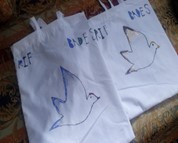
Other women made reusable bags to package the cooperative’s products. Plastic plates covered with fabric and embroidery were also proposed as possible solutions. Finally, the cooperative made multiple trips to the beach to remove plastic waste coming from the village, the river, and ocean currents. Efforts to resolve the plastic problem, which are ongoing in Bades, will end when the prototypes for replacing and reusing plastic have been evaluated and refined to meet the challenge raised by the women of Bades: How can we reduce the amount of plastic on our beach and at the same time develop new marketable products?
Design thinking: A means of cultivating core competencies
The problem-solving approach used by the young artisans in the “Ressacs sans plastiques” project is called design thinking. This term, popularized by California design and innovation firm IDEO in 2006, describes a creative, collaborative work process that generates multiple solutions, rapidly prototypes and tests, and focuses on users’ needs. Initially employed to create commercial products, design thinking is now used by organizations (e.g. IDEO.org and d.school, in the United States) and schools (Design for Change, in India) to develop solutions for improving quality of life and the environment. Whether applied in the sciences, humanities or environmental education, design thinking offers the opportunity to analyze local problems and find solutions that foster sustainable development goals (UNESCO, 1995): creating sustainable communities (Goal 11), fighting climate change (Goal 13), and protecting land-based ecosystems (Goal 15). Moreover, since the design thinking process is both relevant and meaningful, it supports the acquisition of numerous core competencies: critical thinking, problem solving, innovation, creativity, etc.
For example, young students working with the Design for Change organization built remote-control planes out of recyclable materials to carry and disperse seeds for revegetating land adjacent to their school. Other students, also inspired by Design for Change, installed a special ramp so students with disabilities could board the school bus instead of relying on adapted transportation, enabling these children to take part in class field trips and enjoy opportunities to socialize on the bus. The Design for Change philosophy is based on the premise, “I can!”
Stages in the design thinking process
Design thinking is a non-linear, iterative process involving defined stages that can be carried out sequentially, simultaneously, out of order or even repeated. The ultimate goal is to bring about transformative change. The steps presented below (see Figure 1) were inspired primarily by Brown (2009) and Scheer, Noweski and Meinel (2012).
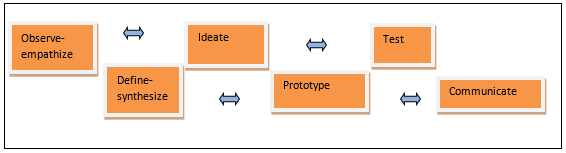
Figure 1: Steps of Design Thinking
Inspired by Brown (2009) and Scheer, Noweski and Meinel (2012)
- Observe-empathize: Conduct an ethnographic survey to understand the problem situation, and empathize with the people involved (users). Observe users as they go about their daily lives to gain insight into their aspirations and unmet needs (pain points).
- Define-synthesize: Define the problem multiple times. Look for information and a variety of perspectives on the problem. Synthesize this information to describe the conceptual challenge in several problem statements, often with the help of visual aids. A visual representation helps problem solvers come together and focus on their common goal (the conceptual challenge).
- Ideate: Generate numerous ideas and then select some for development.
- Prototype: Quickly build prototypes illustrating the ideas selected so they can be shared with and tested by others.
- Test: Evaluate the prototypes by collecting feedback from users and experts. Refine the best prototypes.
- Communicate: Promote the product.
A human-centred approach
An iterative approach focused on the needs of users, design thinking is also practical and flexible when it comes to experimentation. Both divergent and convergent, the process values empathy and optimism. Design thinking is non-linear because as problem solvers gain empathy for the needs of users and work on refining the best solution, their attention constantly shifts between the problem space and the solution space. Unlike a traditional scientific investigative approach, design thinking focuses on both the problem and its solutions. In the problem space, a lot of attention is paid to defining the problem in terms of the user experience and position. The team of problem solvers spends a lot of time observing the problem situation and user behaviours in situ. The effectiveness of the process relies on participants amassing and deepening their knowledge about the problem. In the solution space, problem solvers investigate multiple possibilities by developing plans and building prototypes. These prototypes, created quickly, without trying to achieve perfection, serve as “playgrounds” for discussing and exploring various solutions. In this fashion, the problem and its solutions co-evolve, constantly interacting.
Learning about sustainable development in the classroom
Design thinking has recently been presented as an effective, motivating tool for teaching elementary and high-school students how to solve local problems. To address local ecological issues, students could use this approach to create or organize:
- shelters for small wildlife (hares, ruffed grouse, amphibians, oysters, fish) designed to meet their needs for food and protection
- tasty menus of meatless meals
- tools for collecting rainwater
- bird baths
- hotels for useful insects: ladybugs, mason bees (solitary wasps)
- adaptation measures for climate change events like floods, droughts, erosion, heavy rains
- mini-preserves to promote biodiversity in urban settings
- toys to encourage their friends to play outside
- ways to express affection to friends and family while maintaining the social distancing recommended under COVID-19
- techniques for greening riparian buffers, etc. (Pruneau et al., 2019)
By using design thinking, teachers and their students can help achieve the Sustainable Development Goals (SGDs) defined by the United Nations in 2015. The 17 goals in question focus on areas for action that promote, for example, sustaining life (both human and nonhuman), ending poverty, and achieving social justice. In the case of the aforementioned “Ressacs sans plastiques” project, the artisans’ work focused primarily on goal 14: Conserve and sustainably use the oceans, seas, and marine resources. The examples suggested above for elementary and high-school students would include the following SGDs: 3 (health), 6 (water quality), 11 (resilient, healthy cities), 12 (environmentally responsible behaviour), 13 (climate change), and 15 (land-based ecosystems).
The meaning and nature of sustainable development and the actions required to achieve it are starting to become known. Emerging sustainability initiatives include the slow food movement (Petrini, 2006), conservation design (Arendt, 2010), smart growth (Duany et al., 2010), eco-cities (Register, 2016), and biodiversity restoration (El Jai & Pruneau, 2015). Slow food aficionados take the time to share locally grown “clean” food with people in their community. In conservation design, urban planners developing new neighbourhoods begin by identifying sites of natural and cultural interest, then concentrate the built environment outside the areas where these treasures are found. Proponents of smart growth and eco-cities use a variety of techniques to reuse rainwater, calm traffic, increase the density of residential areas, and promote universal access to parks. Finally, efforts to restore biodiversity include measures such as wildlife crossings, living plant walls, green roofs, hedgerows for biodiversity, and hotels for insects, amphibians and small mammals. Over time, these sustainability initiatives modify existing systems, structures and practices, with the ultimate goal of regenerating natural systems that support human life and that of other living beings.
With design thinking, students can work with their classmates to contribute their own ideas to the sustainability movement. This investigative approach is well suited for the complex nature of environmental problems. Design thinking fosters more appropriate solutions because it invites students to define complex problems from different perspectives (social, scientific and environmental), which enables them to expand the problem space before looking for solutions. According to our field tests, design thinking can encourage students to work collaboratively, pique their interest in the problem under study, and strengthen their high-level skills like creativity, empathy, critical thinking and problem solving (Pruneau et al., 2019). The iterative design thinking process encourages learners to ask questions, look for information, collaborate with their peers and the community, propose concrete ideas, and test and model solutions, all while focusing on the needs of users. Engaging in this dynamic process develops their sustainability skills.
When solutions generated by design thinking become realities, learners gain confidence in their capacity for action. Moreover, organizations that employ design thinking also mentioned other educational benefits, especially with regards to teamwork: richer discussions thanks to a diverse group of problem solvers, enhanced communications, a shared understanding of the vocabulary used, and greater cohesion (Pruneau et al., 2019).
Banner Photo: Adobe Stock
Photos provided by the authors
First published in Education Canada, March 2021
Read other articles from this issue
References
Arendt, R. (2010). Envisioning better communities. Seeing more options, making wiser choices. Routledge.
Brown, T. (2009). Change by design: How design thinking transforms organizations and inspires innovation. Harper Collins.
Duany, A., Speck, J. & Lydon, M. (2010). The smart growth manual. McGraw-Hill.
El Jai, B. & Pruneau, D. (2015). Favoriser la restauration de la biodiversité en milieu urbain : les facteurs de réussite dans le cadre de quatre projets de restauration. VertigO, 15(3).
Petrini, C. (2006). Slow Food, manifeste pour le goût et la biodiversité. Yves Michel.
Pruneau, D. (ed.). (2019). Design thinking for sustainable development. Applied models for schools, universities and communities. Université de Moncton, Groupe Littoral et vie. Available free of charge online in French and English: https://competi.ca/ and https://lel.crires.ulaval.ca/categorie/guidesoutils-pedagogiques.
Rahmani, Z., Pruneau, D. & Khattabi, A. (submitted). La pensée design et Facebook comme outils pédagogiques pour accompagner des femmes dans la résolution d’un problème de pollution plastique au Maroc. VertigO.
Register, R. (2016). World rescue: An economics built on what we build. Ecocity Builders.
Scheer, A., Noweski, C. &Meinel, C. (2012). Transforming constructivist learning into action: Design thinking in education. Design and Technology Education: An International Journal, 17(3).
1 Abdellatif Khattabi, Zakia Rahmani, Michel Léger, Boutaina El Jai, Liliane Dionne, Vincent Richard, Viktor Freiman, Natacha Louis, Anne-Marie Laroche, and Maroua Mahjoub
-
UN SDGs in Education
Comments Off on UN SDGs in Education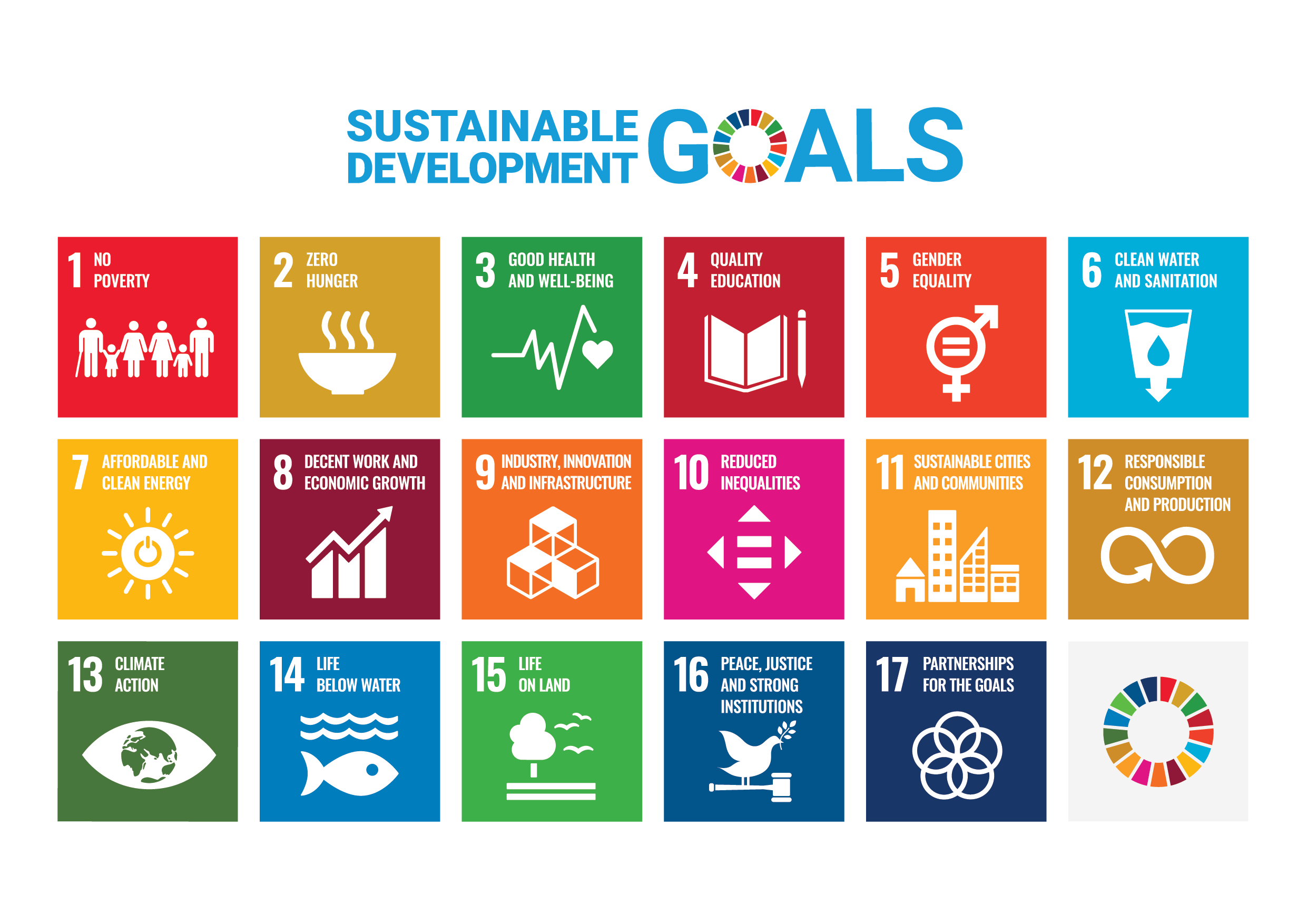
Image: United Nations
Sustainability gives purpose to education.1
THE IDEA of education for sustainable development is not entirely new. My introduction to it began in 2008, with a simple request. A group of students required a staff advisor in order to participate in the Plan International Canada program, Spread the Net. Co-founded by Rick Mercer and Belinda Stronach, Spread the Net was a friendly national fundraising initiative among K–20 institutions to engage communities in international development actions. As a science teacher, it was not lost on me that malaria had been eradicated in Canada for more than 60 years (70+ years today), yet it remained a challenge for some nations globally. Moreover, due to changing global climate systems, there was the potential for Canada to face similar challenges with malaria in the future.
Months later, I learned that the Spread the Net initiative was rooted in one of the United Nations’ eight international development goals, known as the Millennial Development Goals (MDGs). Spread the Net was my introduction to the world of education for sustainable development (ESD) and the work of the United Nations Educational Scientific and Cultural Organisation (UNESCO) for global education. Because of this experience, my philosophy for “why I teach” broadened in scope from subject-specific curriculum expectations to a more global perspective: How will students apply this information to address the complexities of today and of the future?
The What: The Sustainable Development Goals
On September 15, 2015 at the UN General Assembly, global leaders unanimously adopted Transforming Our World: The 2030 Agenda for Sustainable Development, a new set of progressive universal and transformative goals for global development. The new UN framework that superseded the MDGs was created so that nations could continue to reimagine and reshape the future, with one major difference – this framework had global significance and was positioned in a way that all nations could plan, act on, and measure their progress over a 15-year period. The resulting 17 Sustainable Development Goals (SDGs) and 169 targets were developed with the input of people from all over the world to ensure they represented the needs of the global population. That is why the framework has come to be known in education circles as the Global Goals.
Building on the principle of “leaving no one behind,” the new Agenda emphasizes a holistic approach to achieving sustainable development for all. The 17 Global Goals for Sustainable Development are integrated and indivisible.
The Why: What does this have to do with education?
The 2030 Agenda is an ambitious plan in which education is mentioned 28 times across six goals (#1, #3, #5, #8, #12, and #13), in addition to Goal #4, which is dedicated solely to education. Education is positioned as both an enabler and a driver of capacity building toward achieving the SDGs.
But the SDGs also bring to education systems an exciting new model on which to scaffold teaching through the 17 cross-cutting themes that intersect all societies, all grade levels, and all disciplines. Using the 17 SDGs as lenses for teaching presents subject-matter content in a relevant context, helping students to apply what they are learning locally to global conditions and current events.
The appeal of the framework for me is the interconnected, interlinked nature of the goals. At first glance the SDG poster with the 17 tiles, vivid hues of primary colours, and skillfully arranged composite of squares to form a rectangle, looked simple. But it is not. No tile exists in isolation! Once I ventured behind each tile, exploring each indicator (measure of progress) and tangential connection, I realized that in its wholeness these 17 tiles represented life’s challenges and opportunities that could be investigated and discussed in varying magnitudes/scales, e.g. individual, community, region, country, continent, and the world. I had discovered concrete and flexible ways to actively engage learners in critical thinking and systems practice.
Consider the discipline of science, my playground. It is a powerful tool that learners can use to understand natural and social phenomena in their communities. These phenomena, usually distilled into discrete subject areas, are presented in the SDGs with all their beautiful real-world complexities and nuances. Learners are required to mobilize knowledges (from areas other than science) skills, and attitudes – including the pan-Canadian global competencies2 – to identify local problems and action solutions. Since the SDGs serve to spark the problem-finding, the solutions that arise can have global application.
The SDGs position the subject-specific knowledges in their true form: multifaceted, multilayered, and complex. When learners apply subject-specific knowledge in a context that is positioned in local realities, they are empowered to explore, analyze, and engage with their environment, both natural and human-made, and to strengthen skills (global competencies) that will enable them to tackle complex issues that are affecting their communities now and in future.
Strength in purpose
When I agreed to contribute to this publication, I knew that the narrative I would share could not be my story alone. This was an opportunity to serve as a knowledge broker for the SDGs. I decided to provide space for more voices to be heard and posted a call for contributors via a brief survey to the TeachSDGs Ambassador Slack platform. It did not take long for responses to come in – from Greece, Canada, Lebanon, Nigeria, the U.K., the U.S., United Arab Emirates, and France – a global community bound together by their belief in the power of education to transform the world. Formal and informal educators, former teachers, and an administrator responded to the call.
My first question centred on the benefits of membership in a global community of practitioners (Teacher SDGs Ambassadors). Here are just a few responses:
“Sharing of best practices with each other. Networking with like-minded people from across the world. Learning from a global community to help prepare students to think local and act global.” – Anita Singh, teacher at a Farm School, United Arab Emirates
“… collaborating with other educators on ideas to teach the SDGs.” – Doreen N. Myrie, teacher-educator, U.S.
“The main benefits are creating partnerships with each other to increase our implementation efficiency. These partnerships would be in different forms like sharing resources, expertise, affiliation, and all kinds of support.” – Jinan Karameh, school principal, Lebanon
“Access to a community of like-minded practitioners who share the same vision and ultimately the same goal. Sharing best practice. Kept informed with current initiatives and learning development opportunities.” – Tim Black, former teacher, France
Reading these comments, a proverb came to mind: “If you want to go fast, go alone; if you want to go far, go together.” Through the global collaboration and partnership enabled by the TeachSDGs Ambassador program, my voice, my work, and my contribution to education benefits many more individuals than I actually see, and every opportunity to collaborate serves to amplify the actions that support desirable practices in education.
Engaged teachers and learners
In order to engage students, teachers must understand the purpose of learning – the collective why – for themselves and the students. Whether it be social studies, the arts, science, or math, teachers must consider:
- Why do students need to know this?
- How will the material support students’ understanding of themselves and of the world, now and in the future?
The 17 Global Goals offer teachers myriad ways to educate students about global complexities through local contexts. Research on Education for Sustainable Development supports this approach for enhancing student self-esteem, character development, empathy, and empowerment. Framing the learning at the community level also provides students the chance to apply knowledge to authentic contexts. In addition, ESD pedagogies encourage teachers to consider more learner-centred approaches, enabling students to be self-governing in their learning. Schooling must now prioritize the development of competences for sustainability3 that support participatory action of students by identifying alignment between curricula and perspectives that the 17 Goals and 169 targets provide.
Since my induction into ESD, my role in education has shifted from classroom teacher to a curriculum developer working at the ministerial level. To demonstrate the potential for SDGs to positively impact education, I defer once again to the educators from the TeachSDGs community. I asked them to share their insights on how framing subjects through many perspectives of the UN SDGs empowers learners. Here are a few responses:
“When you bring the Global goals to a local level, and the students can make the connection with what you are learning and discussing in class and their life and lived experience, it is a powerful combination. If you can ignite a passion within a student to work to make a positive change in the world, what could be better?” – Mahfuza Rahman, teacher (Science) and technology coach, Canada
“Learners… realize the need for inclusive solutions (Leave No One Behind) and develop their critical thinking, innovation, and creativity trying to help the future of our planet.” – Stavroula Skiada, teacher (ICT), Greece
“Encourages broader thinking. Helps them [students] become global citizens and can inspire them [students] to take action as a global change-maker.” – Kirsten Thompson, former teacher, U.K.
“Learners are empowered to problem solve, to use their voice to teach others to make a change and a difference about issues that they care about. They are empowered to learn about cultures and see the value in learning about other cultures and the world.” – Lynn Thomas, teacher (English Literature), Canada
“Students see and experience the world as an interdependent ecosystem and acknowledge, create, and find their place in it.” – Julia Fliss, teacher (English Language Arts), U.S.
Kristen Thompson summed it up nicely when she reflected that framing subject matter through the many perspectives of the SDGs, “brings education to life for students by focusing on real-world issues.”
The How: Weaving the Global Goals into your practice
Currently, there are many challenges to embedding the Global Goals into our teaching practice – such as communication gaps within ministries and districts/school boards, competing interests and priorities within public education, and a lack of professional development opportunities for interested teachers on SDGs topics. But difficult is not impossible. An important driver for reorienting education is knowledge mobilization, sharing of resources, and professional learning support.
Since the inception of the Global Goals, a flood of resources have been created by ESD champions and developed by teachers to support related work on regional, national, and international levels. Schools that put the Global Goals at the centre of their approach to education are part of a greater whole. There are multiple on-ramps for individual teachers as well as school communities to get involved.
Wondering how you can start weaving the Global Goals into teaching and supporting a sustainability mindset for learning in school communities? Here are a few accessible suggestions:
- Commit to becoming a globally competent educator. Strive to value multiple perspectives and promote equity, keep abreast of local and current events, and cultivate a learning environment that values diversity and global engagement.
- Read A Curriculum Framework for the Sustainable Development Goals (Osman et al., 2017) or Education for Sustainable Development Goals – Learning Objectives to identify areas where you can apply theory to practice.
- Start small – examine how you might map your teaching and learning onto the SDGs.
- Learn from educators proficient with theory of practice rooted in ESD and SDGs.
- Join a community of practice (e.g. TeachSDGs) to share promising ESD practices.
- Scale up when you are ready: involve schoolwide actors, conduct a curriculum audit4, and evaluate the physical facilities using the SDG framework.
- Create opportunities for students to identify the social, economic, and environmental challenges to well-being in their local community and innovate developmentally appropriate solutions.
Call to action for Global Goals knowledge brokers
My discovery of ESD and the 17 Global Goals has led me to bring a more holistic approach to my practice and served as a window to the world by opening my professional community to places and people in ways that I could have never imagined! Good news stories in the education sector (or at least the dissemination of them) are typically in short supply, and I hope that by sharing my story, readers will come to understand the many ways the Global Goals will provide learners – both teachers and students – with on-ramps to meaningful community-based learning that has global significance. Education in 2021 is glocal!
Information about the UN SDGs and their potential to positively impact teaching and learning is sorely required, especially now. September 2020 marked the five-year milestone of the 15-year action-oriented framework and launched the Decade of Action: a call to accelerate sustainable solutions to all the world’s biggest challenges by 2030. The clock is counting down. Let’s continue the good work of making the world a safe, just, and equitable place through education, for everyone.
RESOURCES FOR EDUCATORS
The What
Video: UNESCO: The Lab of Ideas, the Lab for Change!
The Why
Teach SDGs Manifesto: https://drive.google.com/file/d/1CUlNQpAd4YfwC8QjC1MK8qNQV3lUr67U/view
The How
These are my go-to resources that I access regularly.
- A Curriculum Framework for the Sustainable Development Goals, By A. Osman, S. Ladhani, et al. Commonwealth Secretariat (2017). thecommonwealth-educationhub.net/commonwealth-curriculum-framework-for-sdgs
- Climate Action Project climate-action.info
- Global Action Project https://en.unesco.org/globalactionprogrammeoneducation
- Global Goals for Sustainable Development globalgoals.org
- Global Schools Program Resources globalschoolsprogram.org/resources
- MCIC Sustainable Foundations http://mcic.ca/sustainable-foundations
- SDG Academy https://sdgacademy.org
- SDGs Book Club un.org/sustainabledevelopment/sdgbookclub
- Sustainable Development Solutions Network https://resources.unsdsn.org/education
- Teach SDGs teachsdgs.org
- Teaspoons of Change https://teaspoonsofchange.org/index.php/the-global-goals
- The Goals Project goalsproject.org
- The World’s Largest Lesson https://worldslargestlesson.globalgoals.org
- UNESCO Associated Schools Network https://aspnet.unesco.org/en-us/Pages/default.aspx
- Education for Sustainable Development Goals: Learning objectives, UNESCO (2017). https://unesdoc.unesco.org/ark:/48223/pf0000247444
- (2012). Education for Sustainable Development: Source Book. 7. https://sustainabledevelopment.un.org/content/documents/926unesco9.pdf
Banner Photo: Adobe Stock
First published in Education Canada, March 2021
Read other articles from this issue
Notes
1 Source: G. Connelly, former Superintendent of Toronto Board of Education. Education for sustainable development is designed to raise students’ awareness of and encourage them to become actively engaged in working for a sustainable society.
2 Articulated by the Canadian Ministers of Education (CMEC) in 2016:
www.globalcompetencies.cmec.ca/global-competencies3 Competencies for sustainability include systems and future-oriented thinking, normative competency, strategic competency, critical thinking, collaboration, integrated problem-solving, and knowledge about planetary phenomena.
4 A curriculum audit involves surveying courses offered to identify which units/topics currently include sustainability topics and mapping them to the 17 Goals (and 169 targets).
-
Educating for a Sustainable World
Comments Off on Educating for a Sustainable WorldWhen we were offered the opportunity to partner with the EdCan Network on this special issue dedicated to the UN Sustainable Development Goals (SDGs), we did not hesitate for a moment. When we look to translate our high ideals into concrete action, teachers are natural and key allies.
The Canadian Commission for UNESCO is the link between Canadians and the essential work of UNESCO – the United Nations Educational, Scientific and Cultural Organization. Through our members, networks, and partners, many of whom are directly linked to the education community, we play an active role in promoting UNESCO’s values, priorities, and programs in Canada. We also help to ensure that the voice of civil society is heard internationally, so that our good ideas and practices also benefit the rest of the world.
While it is states like Canada that are ultimately responsible for implementing the United Nations’ ambitious Agenda 2030, all of us need to commit to sustainable development. Ensuring that our economy and our society develop in a more sustainable and equitable way, while respecting the environment and the limited capacities of our planet, requires thinking globally and acting locally. And this is the extraordinary strength of the networks gradually built up by UNESCO over the decades: they encourage innovation and new forms of intellectual and moral cooperation among peoples, including the advancement of quality education that leaves no one behind, as called for in SDG 4.
Mobilizing the education sector, especially teachers, is critical to advancing the entire set of SDGs. This sector has the unmatched potential to raise awareness and develop the critical thinking skills of young people in relation to the greatest challenges facing our humanity, including the climate crisis. Indeed, the world of education can serve as a powerful lever for changing behaviours and lifestyle habits. The strength of schools also lies in their capacity to act in a very holistic manner, and even extend their reach beyond staff and students.
It is our wish that this issue will inspire you to learn more about SDGs and how you can help our world achieve them. Present and future generations share an interest in – and the right to – successful implementation of the goals.
Thank you in advance for your commitment, and I hope you enjoy reading these pages.

Sébastien Goupil
Secretary-General, Canadian Commission for UNESCO
Photo: Adobe Stock
First published in Education Canada, March 2021
-
Education Canada, January 2021 – Flipbook Edition
Comments Off on Education Canada, January 2021 – Flipbook EditionEducational Equity in the COVID-19 Era
Extraordinary times call for creative, resourceful solutions. The COVID-19 pandemic has challenged educators, students and parents alike. It has also shone a spotlight on the inequities that made school closures and distance learning especially hard on some students and families, and raised new equity issues that must be addressed as we move forward. Researchers and innovative educators share their evolving knowledge, learnings and insights to create an ongoing conversation about how we can deliver equitable, high-quality education for all students through this pandemic and into the future.
Web Exclusives:
- Threads of Continuity
- School Shutdowns
- Teacher Expertise Is Key
- “Does It Have to Be That Hard?”
- Centring Equity in the COVID-19 Era
- Opportunity Solving
- Lessons Learned
- Back to School: The First 30 Days
- Redoing Gym Class
Related EdCan Fact Sheets:
- How can parents and teachers support elementary students as they learn from home during COVID-19?
- How can Compassionate Systems Leadership embed SEL and well-being across an entire school district?
- How can parents promote student well-being?
Photo : Adobe Stock
-
Testing and Adapting Two Innovative Approaches to Workplace Wellbeing in K-12 Education
Comments Off on Testing and Adapting Two Innovative Approaches to Workplace Wellbeing in K-12 EducationThe Behavioural Insights Team (BIT) generates and applies behavioural insights to inform policy, improve public services, and deliver positive results for people and communities. BIT works in partnership with governments, local authorities, businesses and charities, often using simple behaviour changes to tackle policy.
Behavioural insights is an approach that uses evidence of the conscious and non-conscious drivers of human behaviour to address practical issues. It is an approach inspired by the more nuanced and realistic understanding of human behaviour offered up by research in the behavioural sciences. Early applications of behavioural insights focused primarily on making small changes to how government services were structured and communicated. For example, a well known trial dramatically brought forward tax payments by informing late tax payers of the “descriptive social norm” that nine out of ten people pay their tax on time. In the decade since the phrase “behavioural insights” was coined, practitioners have started tackling increasingly complex challenges, like trying to find light-touch approaches to reduce burnout and increase workplace wellbeing.
BIT created and tested organizational approaches to improve school wellbeing in Canada. To develop organizational approaches, BIT conducted exploratory research including a literature review of current wellbeing and burnout initiatives, qualitative interviews with educators in Canada, and interviews with leading academics. These activities grounded the project in the best available evidence and the lived experience of Canadian educators. Following this exploratory research, BIT, with continued input from a range of Canadian educators, developed two low-cost, scalable approaches for evaluation in a randomized controlled trial.
Schools from British Columbia, Manitoba and Alberta were invited to participate in the trial. A total of 2,178 school staff completed a baseline survey, and 1,217 of them (from three Canadian provinces, five school districts, and 109 schools) consented to participate in the study.
Check out the full report and practical tools for school principals
-
EdCan’s New Theory of Change
Comments Off on EdCan’s New Theory of ChangeWhen the beginning of the pandemic closed schools and left district leaders like me in a constant state of disruption, I joined a small working group of EdCan Network staff and colleagues from our Advisory Council for an important virtual planning process. We engaged in a series of sessions to get to the heart of the impact that our Network can achieve to support K-12 educators across Canada. After many iterations, our creative team wholeheartedly endorsed the following three priorities to respond to the rapidly evolving opportunities and challenges that our education systems are currently facing:
- Increasing workplace well-being for K-12 staff, to make it a top policy and investment priority via our Well at Work initiative.
- Engaging and empowering students to lead societal change through meaningful learning and discovering their crucial role in solving local, regional, national, and global problems. Our upcoming awareness campaign on the potential for educating with the UN’s Sustainable Development Goals will help to kickstart this focus.
- Equipping K-12 staff by informing them on emerging issues and actionable strategies to support the shift from knowledge to action. This magazine provides relevant and timely ways to support all our stakeholders as we rethink how we can “do education” in a better way for all students.
These priorities were the focus of our virtual December 2020 EdCan Advisory Council Meeting. (The first ever gathering of the CEA was in 1891 in Montreal.) We will continue to explore how we can align our focus with supporting Ministries of Education, faculty, and school district leaders, principals, teachers, and staff throughout 2021 as we strive to increase the capacity, self-efficacy, and well-being of our 110,000 members, and through them, to heighten every student’s well-being and opportunities for meaningful learning to help them discover their purpose and path in life.
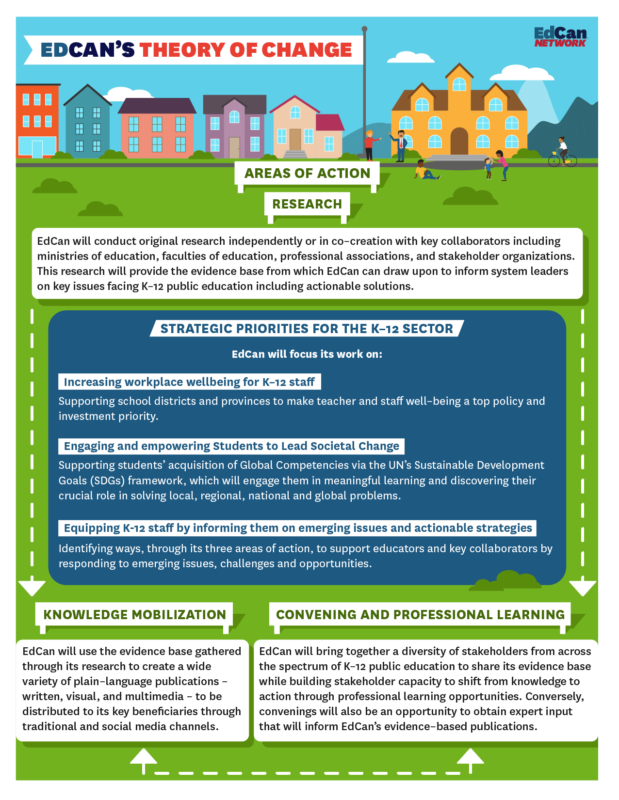
For more information about EdCan’s Theory of Change, Intended Impacts and Strategic Priorities, please visit: www.edcan.ca/aboutus
For a list of the education and philanthropic leaders who serve on EdCan’s Advisory Council, please visit: www.edcan.ca/council
First published in Education Canada, January 2021
-
Compassionate Systems Leadership
Comments Off on Compassionate Systems LeadershipWhat else can be said about our experiences since the onset of the pandemic? “Unprecedented, stress producing, disrupting, mind boggling, unimagined.” All of the descriptors of our current context have been used and overused. Yet somehow the magnitude of it all never seems quite properly conveyed. The pandemic has shone a light, as rarely before, on the possibilities and opportunities for innovation and change in the education system. And we are all engaged in thinking about how we can respond in ways that not only address immediate needs but also capitalize on the opportunity for much larger and more significant innovation.
As children and teachers return to the classroom, we have searched for an accurate description of the impact of the pandemic on the education system and all the people within it. COVID-19 has exacerbated existing stressors and challenges as administrators, educators, and support staff return to school: it has been tough, really tough. Regular routines have been disrupted; the needs of many learners have increased, and those with special needs especially so; the need to be innovative and try new things, though exciting, has also depleted energy; children are experiencing high levels of anxiety and sadness.
Simultaneously though, the disorder presents us with an extraordinary opportunity to consider actions that are capable of transforming the system in ways that we could not have envisaged at the start of 2020. We have a chance now, from this place of disruption, to create a new kind of environment; one that is compassionate and nurturing as an essential foundation for learning; one that focuses on our shared humanity and provides continuous collaboration and learning for both students and educators; one that is grounded in an understanding of the complexity of the education system and acknowledges this in all of the decisions that need to be made.
Compassionate Systems Leadership (CSL) is a framework that can facilitate such a transformation. CSL is an approach to educational leadership that explicitly builds skills and practices in three interconnected domains (see Figure 1) that are required in this new reality: self (building a practice of personal reflection, mindfulness, and compassion), each other (building authentic relationships that can support generative conversations), and the system (developing skills and capabilities to use tools that honour the complexity of the work that needs to be done).
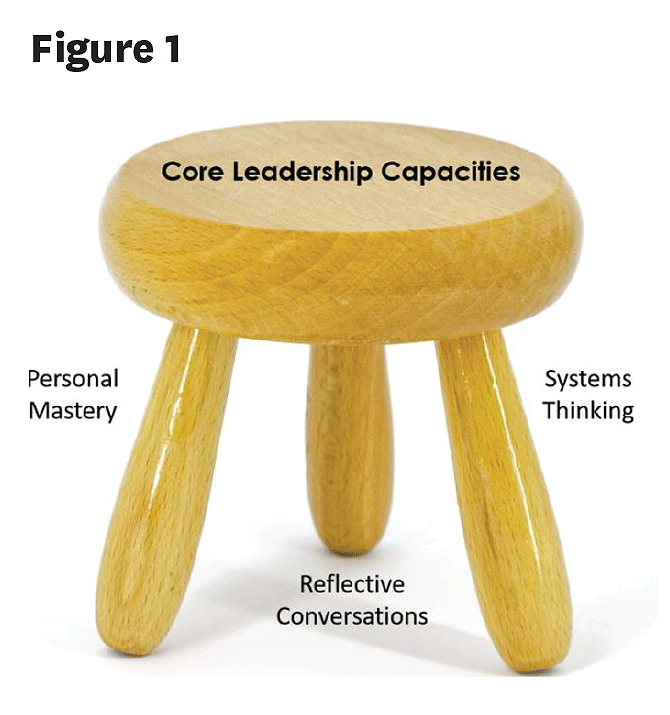
CSL draws on practices that are similar to those that have proven effective in building teacher well-being and supporting the social and emotional capacity of learners. It extends these to include the strengthening of interpersonal relationships, while deepening the understanding of how the system can perpetuate, rather than diminish, stress in the workplace. CSL can shift us out of that continuous cycle of doing what we can to take care of ourselves, while always returning to a structure that does not take care of the health and well-being of the people within it.
Self
The foundation of CSL is a continuous practice of mindfulness and reflection. It draws on the premise that increasing the awareness of ourselves as leaders – our values and beliefs, our passions and our challenges – allows us to become more alert to how we are “showing up” at work every day and how our behaviour and approach might be impacting those around us. CSL uses simple tools to build this awareness. It encourages a practice of personal mindfulness meditation (the deep skill of pausing, understanding our emotions and thoughts, and responding from a place of clarity), and regular reflective journaling.
Each other
The CSL process also introduces practices that facilitate awareness and deeper, more authentic, and trusting relationships amongst groups of colleagues: these are essential to more courageous systems work. For example, “Check-in” (See Steps in Facilitating a Check-In) is a CSL tool that is simple and powerful. It creates the time and space for each person to share their thoughts and emotions without judgment. It creates a place where all those involved can bring their whole selves into the work. It asks that we practise the basic skills of intentional speaking and listening that can generate a new and shared personal understanding with our colleagues. The CSL approach also supports a curiosity into the possibility for more transformative conversations that take us beyond our existing ways of thinking and solving problems into a more aspirational approach that can encourage more innovative and creative solutions.
Steps in Facilitating a Check-In
- First, open up by asking a group of people to take two to five minutes to individually and quietly reflect on a guiding question. You can also do this as a simple guided meditation.
- Next, take time (five minutes) to journal whatever comes to mind. Maintain silence throughout the journaling time.
- Place everyone into groups of three to five (either in small circles or in virtual breakouts), and take one to two minutes per person to share personal reflections. Encourage people to share only what they are comfortable with and to listen without judgment or interpretation, only to understand and hold what people have to say.
SYSTEM
The core concepts of systems thinking (Meadows, 2008; Stroh, 2015) that are included in the CSL framework provide a broad set of tools for viewing the challenges and opportunities faced by schools and the system more generally at the moment. CSL incorporates a series of practices and concepts that facilitate perspective taking (from multiple perspectives), deepen knowledge about systemic behaviour, and illuminate the patterns that often lead to us into a continuous cycle of frustration and powerlessness, where we keep on doing the same things and getting the same outcome. One such concept is the Systems Iceberg (see Figure 2). This concept provides a structure to explore and unpack the system challenges that consume too much time and energy, and yield little progress. The iceberg moves us from seeing daily events, to understanding the patterns in these events and then digging deeper to understand the structures, processes, values, and beliefs that continue to generate non-optimal outcomes and leave us feeling stuck.
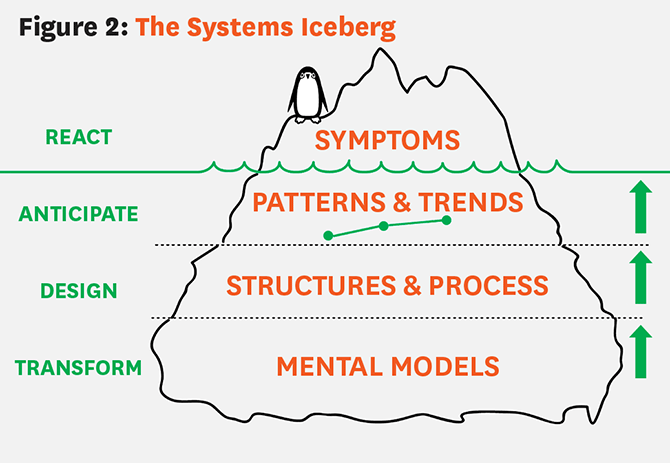
The CSL framework that we are developing in B.C. is a compilation of the work of many others. It is connected to the work of Peter Senge (2006) and Mette Boell at the Centre for Systems Awareness at the Massachusetts Institute of Technology. Through the Centre, a global community for systemic change in education is developing. In B.C. we have also integrated an approach to cultivating compassion that was developed at Stanford University and the Cultivating Compassion Institute based in California. And we are grateful to be able to draw on tools and approaches developed by Otto Scharmer (2018) (Theory U), Robert Fritz (1989) (Creative Tension), and others.
We are testing and applying this emerging framework with educators and other child-serving professionals in B.C. The B.C. Ministry of Education recently incorporated a CSL component in its Mental Health in Schools strategy. Through a robust and growing Community of Practice of educators and professionals from a range of sectors, which meets on a regular basis, we are continuously adapting the approach to integrate shared learnings and best fit the systemic context of participants. Our discussions and emergent practice focus on collaborative learning. And we are grounded in the idea that “we are the system,” that what we each do, individually and collectively, is an essential contribution toward meaningful and effective systemic change. We are also connected in a common commitment to approach the work ahead of us with an intention toward kindness and compassion (Jinpa, 2016); cultivating compassion for ourselves and for those we connect with every day is an essential foundation for the transformation that we seek.
Curious to know more? Check out the website: compassionatesystemsleadership.net
Photo: iStock
First published in Education Canada, January 2021
REFERENCES
Fritz, R. (1989). Path of least resistance: Learning to become the creative force in your own life. The Random House Publishing Group.
Jinpa, T. (2016). A fearless heart: How the courage to be compassionate can transform our lives. Penguin Random House LLC.
Meadows, D. (2008). Thinking in systems: A primer. Chelsea Green Publishing.
Scharmer, O. (2018). The essential of Theory U: Core principles and applications. Berret-Koehler Publishers, Inc.
Senge, P. (2006). The fifth discipline: The art and practice of the learning organization. Crown Business.
Stroh, D. (2015). Systems thinking for social change: A practical guide to solving complex problems, avoiding unintended consequences and achieving lasting results. Chelsea Green Publishing.
-
Unmasking Hidden Heroes through Creative Writing
Comments Off on Unmasking Hidden Heroes through Creative WritingIt was September, the start of a new school year. Lunchtime was almost over and I remember leaning over the shiny wooden dining hall tables of Ackerman Hall to pitch an idea to my colleague, Suparna. I wanted to provide a creative writing opportunity for my Grades 9 and 10 students to think outside of themselves and build meaningful relationships with those beyond their own Senior School community. As we brainstormed, wisps of ideas coalesced. The service-learning opportunity that emerged was a cross-divisional project where my students would each interview a Junior School (JS) student from Grades 4, 5, or 6 and then craft a story, making the latter the hero of the story. We even leapt ahead and imagined the grand finale: Senior School students reading their masterpieces to the littler ones, with the latter listening with rapt attention and nibbling on chocolate chip cookies.
Teacher trepidations
As an Academic English teacher, I consistently endeavour to stretch my pedagogy to benefit the personal learning journeys of my students. However, the intention to stretch beyond my pedagogical comfort zone brought trepidations. Despite my excitement for facilitating an innovative learning task, I felt nervous about possible challenges. For example, what if my students considered that writing a 1,000 to 1,500-word short story for JS students was too elementary and superficial? A lack of engagement on their part could result in insensitivities, hurting the JS students who looked up to them. I thought of the school community. Would they see this service-learning creative writing project as I did and accept it as an opportunity to go beyond normal coursework and explore not-yet-visible possibilities? I worried that the quality of the final pieces would be less than those produced through more traditional approaches. I moved beyond my concerns, however, with the support of Suparna and my administration. I deeply felt that the benefits and value of this project would far outweigh the drawbacks.
Unmasking hidden heroes
I pitched the idea to my students, and what a relief it was to see that there was no apathy, only excitement. My students decided to first conduct their own research to find out more about Grades 4, 5, and 6 students. What did they do in their spare time? What kinds of books did they like to read? What words were linguistically “cool” in their world? After a class discussion of their findings, each of my classes appointed subgroups to interview the JS teachers to gain further insight.
What happened next was sweet. Many of my students had already been taught four to five years ago by the teachers they were to interview. Stepping into their classrooms was, to my students, like stepping into their childhood. The teachers marvelled at their poise and maturity. They exchanged shy smiles. The students’ eyes shone with respect while the teachers’ glowed with care and joy. Patiently, the teachers answered their questions.
Next, my students conducted two sets of 30-minute interviews at the Junior School. Many of the Senior-Junior school pairings were done at random, whereas some were more deliberate to respect learner needs. For the first interview, the Junior students were asked to bring in three objects of personal significance from home to conduct a show-and-tell. Thrilled to be the centre of attention, they spoke openly about themselves. My students followed up with a second interview as they began formulating the type of story in which they would cast their young partners as heroes.
Once my students had their plots in order, they asked the Junior students to create three illustrations. My students provided just enough guidance for the drawings, but not enough detail to reveal the plot. It was a visual arts opportunity. The younger students, tickled pink that their new friends were thinking so deeply about them, zealously drew with an insatiable curiosity about the plot.
The revising and editing process took time. I had 40 students and wanted to provide meaningful feedback. Meanwhile, they continued with other language arts tasks. It was December by the time the Junior students received their personalized gift. My students carefully inserted their young friends’ drawings amongst the printed pages and bound their books neatly with ribbon. This time the Junior students visited the Senior School classroom, which was decorated for the holiday season. Clumps of Senior and Junior students sat all over the classroom, spilling into the hallway… and yes, the younger ones listened with rapt attention while drinking hot chocolate and nibbling on chocolate chip cookies. When the readings were over, the groups just carried on chatting. The sessions ended with hugs and the question, “When will I see you again?”
Building meaningful relationships
From a curricular perspective, my Grades 9 and 10 students developed their creative writing skills. However, what my students gained from this project went far beyond creative writing accomplishments. In particular, they began to learn that meaningful relationships lie at the heart of service, and that such relationships can benefit the school community in unpredictable ways.
The resulting stories were of higher quality than I have ever received. My students were not creating for a mark. They were focused on their new little friends.
It was serendipitous that two students who both loved music and had a penchant for breaking out into dance move sessions were paired together as partners. It was both fascinating and amusing to watch how they collaborated with each other during the interview sessions. They developed a common understanding of how to work together and an appreciation for their similar interests and qualities.
I watched an artistic Grade 10 student, who initially knew very little about video games, step outside of her comfort zone to learn all that she could about her Grade 6 student’s favourite game. As a result, she was able to celebrate her partner’s interest by writing about a protagonist who overcame the trials of a video game world.
One of my fairly serious students was paired with a couple of Grade 5 students who loved romances. With dreamy countenances and a twinkle in their eyes, they begged their senior partner to write a romance story. Also, the story had to include a pig. Although my student was challenged by the requests, she committed herself to the task because she was invested in bringing the story to life for her young partners.
My students were moved to see the JS students demonstrate an equal investment in the process when asked to provide illustrations for their stories. While distributing the completed illustrations to my students, I heard many of them excitedly cry out, “This is exactly what I had envisioned!”
Suparna and I noted that all of the students involved were able to experience positive emotions, felt fully engaged in the process, and built relationships that brought meaning into their lives. In the end, together they created a product that made their accomplishments visible. In fact, these experiences represent the five key elements that psychologist Martin Seligman believes promotes psychological well-being and happiness.1 We did not intentionally manufacture a project to “cover” these elements. A post-project reflection session revealed that we did.
The sum is greater than the parts
The positive outcomes of this service-learning project were numerous and reached beyond relationship building.
Our school’s strategic plan includes:
- creating more cross-divisional opportunities, as our campus is housed in three separate buildings
- fostering our core values, which include compassion, inclusivity, and celebrating individuality
- encouraging teachers to share innovative teaching practices.
My students had many opportunities to shift perspectives and see the world through the eyes of a JS student, cultivating a sense of care, empathy, and compassion. I frequently highlighted how chuffed the Junior students were to have new, older Senior friends. Their trust in my students helped the Grade 9s and 10s build confidence in their oral communication skills and experience growth in their interview techniques. All of the students transcended the barriers of traditional classroom walls and experienced an innovative form of meaning making. Cumulatively, all of these aspects increased my students’ investment in their finished products, and the resulting short stories were of higher quality than I have ever received. My students were not creating for a mark. Rather, my students were focused on making visible to their new little friends the heroes that they already were.
The JS teachers were impressed to see the quality of work that their past students were creating and were eager to adjust their current expectations to further nurture the skills they saw developed at the senior level. One JS teacher had her class create lovely thank-you cards. Another teacher planned to have his students dramatically recreate their story using a green screen in the future.
Unmasking future heroes
Unfortunately, the green screen dream did not materialize, as the COVID-19 pandemic hit and students were tucked away in isolation. The pandemic made Suparna and I wonder what such a project would look like if completely carried out online. Interviews and sharing sessions could all happen in virtual breakout rooms that could be monitored by teachers and recorded and submitted by the Senior School students to ensure ethical behaviour. Expectations and ground rules would need to be set in advance. Delicious cookies, I suppose, would also need to be mailed out to students.
No matter what the scenario, oftentimes as teachers, we postpone innovative ideas for more traditional approaches due to lack of time or confounding logistics. However, both Suparna and I feel that if it is at all possible (even on a smaller scale), service-learning initiatives are well worth the effort. The school community benefits, and students realize that perhaps the greatest secret in receiving an education is that they have the power to express that learning in an act of giving.
Photo: courtesy the authors
First published in Education Canada, January 2021
Note
1 According to Dr. Martin Seligman, the five pillars of well-being are: positive emotion, engagement, relationships, meaning, and accomplishment. See: Seligman, M. E. (2012). Flourish: A visionary new understanding of happiness and well-being. Free Press.
-
THE POWER OF US: How we connect, act, and innovate together
Comments Off on THE POWER OF US: How we connect, act, and innovate togetherThe Power of Us enters the pandemic publishing parade with a compelling message that is both challenging and hopeful. Change consultant and author David Price makes a strong case for unseating traditional hierarchical ways of organizing our businesses, schools, and community organizations. That’s the challenge. But the hope lies in Price’s illustrative efforts to show us where in the world it is already happening.
The result of nearly three years of deep inquiry, The Power of Us draws us into a story of mass ingenuity, or what he refers to as people-powered innovation. Much more than just the sharing of ideas or organizing ourselves into cooperative clusters, it is the innovation that happens when groundswells of public activity, including inspiring examples of youth activism, meet up with organizations that understand and acknowledge that the traditional divisions between producer and consumer, artist and audience are quickly melting away. It’s what happens when companies start to see their users as co-creators, when the health-care sector starts to value highly invested patients as highly invested innovators, when schools begin to see their educators, parents, and students as co-learners, imbued with a sense of agency to make a difference outside the walls of the schoolhouse.
Price examines many of the familiar themes of change literature – ethos, structure, mindset, and leadership – through the lens of people power, supported by some very robust and compelling case studies written from the author’s own commitment (pre-pandemic) to travelling the world to find the organizations, companies, and schools that were actually showing up to their work differently. The generous summary of key points and take-aways at the end of each section invites the reader to look at their own practice and their own organizations through the lens of people powered innovation.
The COVID-19 pandemic forced David Price into rewrite mode, not because he was wrong, but because his ideas were so very right. COVID-19 is cast here, not as part of the scenery but as a main character, allowing The Power of Us to make a strong contribution to our rethinking of how we want to be in a post-pandemic world.
Photo: Dave Donald
First published in Education Canada, January 2021
Thread, 2020. ISBN: 9781800191181
-
A New Year, a New Vision
Comments Off on A New Year, a New Vision“Ring out the old, ring in the new,” goes Tennyson’s poem, “Ring Out Wild Bells.”
Many of us were only too happy to ring out 2020, or maybe give it a firm boot out the door. With COVID-19 vaccines rolling out, we hope for a better year ahead.
But what are we ringing in – the new and better, or the same old? After a year of disruption, the longing to return to the status quo is completely understandable. But if that’s all we do in our schools, it’s an opportunity lost. This year brought us many lessons, including wider awareness of the pervasiveness of systemic racism. We saw both the drawbacks and the potential of online learning, and we also saw how less privileged and higher-needs students suffered disproportionately from the loss of in-person classes. Some students became frustrated and disengaged – but others thrived as they became free to follow their own interests without the social stresses of a classroom. All these experiences and more should lead us to question just what school could and should be as we move beyond the COVID-19 Era.
Through fall/winter 2020, and culminating in this magazine, we tracked the learning that was emerging from the struggle to adapt an education system to pandemic conditions and still provide quality, equitable education (read the whole series on our website). One standout for me was Vidya Shah’s article (p. 15) showing how we can (and why we must) work towards greater equity in education during and beyond the pandemic.
It’s important to acknowledge the huge effort and serious stress that educators at every level of the system have shouldered during this crisis. But now we have a chance to look forward, to ring in the new. In our spring issue, EdCan will explore how the UN Sustainable Development Goals can be used to engage students with global and local issues and help them acquire essential competencies. And in June, we invite contributors to share their vision for the (near) future of education. How can we create a schooling experience that truly prepares today’s students to build tomorrow’s world?
Photo: Adobe Stock
First published in Education Canada, January 2021
Write to us!
We want to know what you think. Send your comments and article proposals to editor@edcan.ca – or join the conversation by using #EdCan on Twitter and Facebook.
-
Redoing Gym Class
Comments Off on Redoing Gym Class*Note: The aims of the article are certainly applicable to girls’ physical education, but this particular piece centralizes boys and young men.
AS A RECENT elite-level athlete, varsity coach, and current educational researcher, I remain very concerned with the ways that locker rooms and physical education classes are still reproducing, reiterating, and regurgitating hegemonic forms of masculinity. A social hierarchy that rewards typical bodies, traditional expressions of masculinity, and athletic ability still seems to come to fruition as a result of the ways that gym class is taught. These elements of doing masculinity and doing sport collide head-on in gym class. Masculinity is policed and labelled by the ways that boys physically move their bodies (Kehler, 2016). Thus, male gym class must not be seen as an environment for “boys to be boys,” nor one of hardcore competitive sport. It is a comprehensive educational domain that needs to focus on the development of holistic young men (Gerdin & Larsson, 2017). School hierarchies will never change if gym class continues to reward the most physically typical and gender-conforming learners. Physical education can be about teamwork, collaboration, hard work, positivity, fun, and friendships (Gerdin & Larsson, 2017). Until this is applied to pedagogy, physical education will remain a regressive forum for the recapitulation and celebration of hegemonic masculinity.
Much research has recognized that the construction of masculinities is heavily linked to physical endeavours and sport (Wellard, 2009). This makes the appropriate facilitation of inclusive physical education even more important for the robust development of young men and boys. Despite the hegemony within physical education, now, more than ever, boys and young men are desperately trying to safely and publicly perform types of masculinity that do not meet the traditional requirements of what it means to be a “boy.” But these attempts at gender diversity seem to draw the most attention and danger in the realm of physical education and school-sanctioned sports. It is sadly known, province to province, that physical education enrolment numbers after Grade 9 often drop precipitously (Dwyer et al., 2006). Too often, educators are ignoring the early warning signs of many boys’ discomfort with physical education. Many boys intentionally forget their athletic wear, conjure up imaginary injuries, skip class, and create ailments, all as a way to avoid gym class. The same avoidance tactics are deployed within the locker room because many boys fear how their masculinity will be read based on their physicality. This means many of them nervously change in a washroom before entering the locker room, seek refuge in a cubicle, strategically position themselves in a corner, or simply do not participate (Kehler & Chaudhry, 2018).
Physical education should not promote an uncomfortable atmosphere of ableism and heteronormativity, and its pedagogy should not perpetuate this. I am concerned with how physical education is still pedagogically deployed in such an exclusive manner. Gym and physical education classes are comprised of learners who range from the lowest of physical capabilities to the highest, and of learners who express masculinity in a multiplicity of ways. Pedagogy should reflect this. It is certainly not always an easy task to fulfill the athletic or social needs of all learners, but the young men and boys who struggle in the domain of sport and fitness, or express diverse masculinity, deserve a serious effort. They deserve to not be forgotten and to not be left out. They deserve to flourish in an athletic environment that supports their broad range of masculine gender expressions and athletic skills.
I would like to encourage educators and teacher-coaches to foster a physical education environment that instills confidence, positivity, passion, and excitement in all learners, no matter their physical capabilities or unique expressions of masculinity. To do so, I provide a framework of steps that can be cyclically applied within the classroom, and on the field, court, or rink.
Step 1: Always start with a conversation. Before every class, unit, or semester it is important to transparently set the stage, much like providing learning goals. Learners need to know the structure of the class and what the aim of the time being spent there is. It is essential to let learners know that this is not a place of high-intensity competitive sport. It is a place to learn about inclusivity, collaboration, teamwork, fun, and friendship. Additionally, learners need to realize that understanding a sport is simply one assessed component of their time in gym class. They need to know that they are being evaluated in the areas listed above.
Step 2: Level the playing field. The curriculum is certainly a guideline for what to teach, but diversifying it as much as possible is an exciting way to reposition or disrupt traditional ability and the social power imbalance it can create. Incorporating adaptive modes of sport that make them accessible to all learners is a fantastic way to level the playing field (Wood, 2015; School Adapted Team Sports, n.d.) It is important to strive toward equally spreading the feeling of comfort. By disrupting or altering traditional sport, educators are allowing students who may have otherwise never felt it to feel comfortable in gym class. Or, create a more universal sense of discomfort by introducing new forms of sport that allow all students to be of equal ability and confidence.
Step 3: Never stop role modelling. Often physical education teachers or teacher-coaches are highly regarded by students as being cool. I encourage educators to use this influence as a way to constantly perform masculinity or allyship in a healthy, robust way. This means speaking up when phobic pejoratives are used, establishing relationships equally with all learners, and embodying inclusivity at all times.
Step 4: Always debrief. Allocate at least ten minutes to unpack the lesson, practice, or class. It is another explicit reminder of what was learned and gained from the session. Refer back to Step 1’s emphasis on inclusivity, collaboration, teamwork, fun, and friendship. Have students share moments where they collaborated, engaged in teamwork, had fun, and built new friendships. Let them leave knowing that these were the true goals of the session.
Step 5: Never stop checking in. Make it a habit to speak confidentially with learners or observe while teaching. Ask what their needs are. Discuss ways to address or remedy their needs. Restructure pedagogy in a way that facilitates the solution to these issues or needs. This step is the engine of inclusivity. Continue to come back to this step as way to persistently address the needs of all learners in a physical education class or school-sanctioned sport. When you begin a new season, class, practice, school year, or semester. Return to Step 1 and fuse it with Step 5. The cycle will then restart.
Photo: Adobe Stock
References
Dwyer, J., Allison, K., LeMoine, K., Adlaf, E., Goodman, J., Faulkner, G., & Lysy, D. (2006). A provincial study of opportunities for school-based physical activity in secondary schools. Journal of Adolescent Health, 39, 80–86.
Gerdin, G., & Larsson, H. (2017). The productive effect of power: (Dis)Pleasurable bodies materialising in and through the discursive practices of boys’ physical education. Physical Education and Sport Pedagogy, 23(1), 66–83.
Kehler, M. with U. Chaudhry (2018). Body building or building bodies: Improving male body image through Health and Physical Education. What works? Research Into Practice, The Literacy and Numeracy Secretariat.
Kehler, M. (2016) Examining boys, bodies and PE locker room spaces: “I don’t ever set foot in that locker room.” In M. Messner & M. Musto (Eds.), Child’s play: Sport in kids’ worlds (pp. 202–220). Rutgers University Press.
School Adapted Team Sports (n.d.). American Association of Adapted Sports Programs. http://adaptedsports.org/school-programs
Wellard, I. (2009). Sport, Masculinities and the Body. Routledge. https://doi.org/10.4324/9780203874400
Wood, R. (2015, August). Sports for the Disabled. Topend Sports. https://www.topendsports.com/sport/disabled-sports.htm
-
Pan-Canadian Supports for K-12 Workplace Wellbeing
Comments Off on Pan-Canadian Supports for K-12 Workplace WellbeingCanadian K-12 education stakeholders are increasingly concerned about the mental health and wellbeing of education staff. Rising rates of staff stress and burnout threaten to undermine student wellbeing and educational outcomes, while the legal, financial, and human resource costs continue to escalate.
The McConnell Foundation has been supporting workplace wellbeing in K-12 education through its WellAhead initiative since 2017. In early 2020, it brought together relevant thought-leaders to consider how to make measurable improvements in the wellbeing of K-12 education staff across Canada. A Design Team was formed to develop a preliminary concept based on that initial thinking.¹ The Design Team then engaged with education stakeholders to get their feedback on the concept, and learn from their experience.
The stakeholders who participated generously shared their time, expertise, and encouragement, including pitfalls to avoid, opportunities to strengthen the approaches, and perspectives that had not previously been considered. Their feedback contributes to developing approaches that fit their environments, and accurately reflect their needs and preferences — which will ultimately lead to a greater impact.
Based on the insights generated in this consultation report, EdCan plans to implement a revised set of approaches over the next three years with a wide variety of partners and stakeholders. Stay tuned for more details!
¹Charlie Naylor (Independent Consultant), Felicia Ochs (Wellness Coordinator, Parkland School Division), André Rebeiz (Research Manager, EdCan), Tammy Shubat (Director of Programs, Ophea), and Kim Weatherby (School Health Promotion Consultant).
-
Lessons Learned
Comments Off on Lessons LearnedThis week, the librarian who wrote the Yale Book of Quotations published his list of the top quotes of 2020; unsurprisingly, the top two spots on the list were held by “Wear a mask” (Dr. Anthony Fauci) and “I can’t breathe” (George Floyd). These two quotes, which speak to the COVID-19 pandemic and to racial/social injustice and inequity, point clearly to two of the most pressing issues we face in today’s world. So it is fitting that the EdCan Network has chosen the theme of “Educational Equity in the COVID-19 Era.”
The series of 12 articles published this fall tackle the issue’s theme from a wide array of perspectives, including school and central office leaders, teachers, students, and parents. As the series comes to a close, we consider the narratives and lessons that emerge from both the content of these articles and our own experiences, and we ask ourselves what these narratives might tell us about where we go from here.
Lesson 1: Educators can, and do, leverage technologies in powerful and creative ways, but inequitable access to devices and connectivity remains a major barrier to student success.
In her article, “Teaching through the Screen,” Stephanie Cortese describes her struggle to connect authentically to her students via digital platforms, as well as the joy she experiences as she discovers new ways to leverage technology to “cradle interconnection and create a new dimension of teacher/student relationships.” Indeed, as we progress through the pandemic, we have witnessed incredible examples of teachers’ creative, effective, and innovative uses of technology, with educators turning to platforms like YouTube and TikTok to engage students in learning. However, we can’t rely on educators alone to make e-learning work for all students; in “E-learning at Home,” the authors note that access to digital devices has been a significant challenge, particularly for children in more vulnerable communities. And while many provincial and territorial initiatives have been devised to equip low-income families with laptops and Internet access, the fact remains that without sufficient training on the use of technology for educational purposes, these programs will do little to remedy the inequities that exist. It is clear that more comprehensive long-term solutions, including equitable access and tech-related instruction for students, and professional learning programs and support for teachers and administrators, are needed to bridge the digital divide in our schools.
Lesson 2: As home-school relationships become increasingly important, parents’ abilities to support their children’s learning can have a major impact.
As educators, we’ve long known the importance of strong home-school relationships. But as schools transitioned to online learning in the spring, those relationships became even more critical as the tasks of supervising and supporting children’s learning fell increasingly on parents and guardians. For example, researchers found that for families of students with special education needs (SEN), the quality of at-home schooling was closely correlated with the quality of the “working alliance that existed between parents and school staff”; the best outcomes occurred when there was frequent and positive communication between home and school. However, for many working parents, the task of supervising at-home learning presented a considerable challenge, with lower-income families finding it particularly difficult to balance their own work schedules with the added pressures of increased parental involvement in remote learning. Indeed, in “Class Matters,” Andy Hargreaves argues that the issue of socio-economic diversity is frequently ignored in discussions of inclusivity and calls for increased focus on the effects of class inequality on educational outcomes.
Lesson 3: School climate has a significant effect on how teachers, learners, and parents experience school, but care must be taken to ensure inclusivity for all members of the school community.
Life in the midst of a pandemic can be incredibly stressful, and adding the anxiety of remote learning into the equation creates incredible pressure for families. A positive school climate can play a major role in lowering stress levels all around, and effective, frequent, and consistent communication is an important factor. School and central office leaders can set the tone for teachers, parents, and students, and a “clear focus on calm, steadfast, patient messaging” is key. As we grapple with the disproportionate effects of the pandemic on vulnerable communities, however, leaders must also ensure that they maintain focus on these inequities and should carefully consider “what kind of spaces they are creating for teachers, students, and their families to dialogue about equity issues.”
Lesson 4: The move to remote learning has laid bare the degree to which teachers’ (and schools’) roles extend beyond academic instruction.
With the move to online learning, those outside of the field of education are beginning to understand what we as educators have known all along: that “the role of ‘teacher’ is much more than one of providing academic knowledge and skills to students.” Indeed, schools and teachers play a number of important roles in students’ lives, relating to many aspects of students’ health and well-being. For the most vulnerable students, at-home schooling has in some cases meant a loss of access to food, to a safe space, or to mental and physical health supports. This is partly why, as Paul Bennett notes, “Closing all schools should be the last resort this time around.” But some researchers now point to the opportunity offered by this realization of the critical role of schools and teachers, calling not for a return to business as usual but to a future in which teachers are no longer asked to “do more with less” and our education systems are rebuilt on “solid foundations of sustainable equity and well-being.” And this brings us to our final lesson.
Lesson 5: The challenges of the COVID-19 pandemic offer a tremendous opportunity for transformational change in our education systems, should we choose to take it up.
While many of us may crave a return to normalcy, we must also consider the injustice and inequity that “normalcy” actually entails. The current moment, while challenging on numerous fronts, also offers a chance for a fresh start; this message of hope and possibility is woven through a number of the articles in this issue. Indeed, as Stephanie Cortese reminds us, “As we transfer our binders and printed lessons onto digital platforms, and blend our classrooms into interactive and accessible hubs, we need to embrace a new vision of what an educator can be. It is not the end of the role, but rather a transformation of it, which we get to be part of.”
This transformation holds the promise of profound structural change: it might allow us, for instance, to explore “the ways that white supremacy has been manifested by COVID-19 and to challenge the devastating effects the pandemic has on racialized students.” The return to “normalcy” is certainly the easier route to take, but as educators, we must recognize the profound implications of the path that we choose going forward, and the impact that it will have on the students in our classrooms for many years to come. As we sit at the crossroads of the twin crises of COVID-19 and social inequity, we should take to heart Vidya Shah’s words: “May we find the individual and collective courage to centre relationality, community, and collective care above our individual fears, insecurities, and self-interest.”
Photo: Adobe Stock
-
Teacher Expertise Is Key
Comments Off on Teacher Expertise Is KeyI want to be clear about two things. The first is that everyone within the education system has made herculean efforts to keep kids safe, maintain positive environments, and in the midst of all this still cultivate the conditions for learning. Teachers, educational assistants, bus drivers, custodians, clinicians, library technicians, secretaries – all have done what is needed and beyond.
By way of example, music educators have adjusted countless times, redesigning their entire practice on a moment’s notice. Physical education teachers continue to take their learners outdoors for high-intensity experiences that are critical to wellness. These are just a few of the ways educators have pushed the boundaries of their expertise.
Second, teaching children remotely – whether that is for four days or two weeks, half of them in and half out, hybrid, hyflex, or hub-based – is really difficult. It requires expertise, an ability to work with families, and a fundamental shift in design. Simply teaching online does not equate to learning, and in some cases can be deemed miseducative. Moving worksheets online isn’t remote learning. It’s just worksheets online.
British researcher and consultant Dylan Wiliam makes the claim, supported by cognitive science, that the single most important factor in a child’s learning is the quality of the teacher and the day-to-day interactions that child and adult have. Not class size. Not the design of the classroom space. Not the amount of technology strapped to the wall. Not even the curriculum.
What counts is the expertise of teachers – teachers who spend countless hours designing deep learning experiences to engage their learners, to cause cognitive dissonance, and to fundamentally cause learning. And this comes in all sorts of forms. From traditional teachers at the front of the class, to project-based-learning teachers, and to those who weave back and forth with ease, a teacher’s expertise in teaching is what counts in learning.
COVID has certainly challenged this. With Senior Years learners attending every second day in most of our school divisions, and Early and Middle Years students having to leave for periods of time when cases occur, educators’ expertise has been put to the test. Their ability to replicate what they do in the classroom has been stunted, fractured – perhaps even sabotaged – by a virus that has shown no mercy.
And despite all these challenges, our teachers have persevered.
We have seen that success in the micro and macro adjustments educators make toward deep remote learning derives from three design assumptions. These assumptions rely in turn on the experience, research, critical thought, and desire to collaborate on the part of educators. Again, teachers are engaged in this work, despite the masks, the plexiglass, and the many unknowns.
The first of these assumptions is that what is done in the classroom cannot be replicated. We know the best learning happens in the classroom, on the land, at the internship, or in the lab. With the potential of face-to-face learners, learners connected online in the moment, and learners who need to learn in an asynchronous way, the expertise of a teacher can be stretched and distorted. In these cases, educators have reconceptualized their time. We have learned that an educator’s online time is best spent with small groups and individuals, and engaged in conferencing, coaching, planning, and feedback. Our teachers have expertly designed stations where learners rotate from asynchronous blocks of providing each other with feedback, to a small-group discussion with the teacher, and then time to read, reflect, and design significant projects.
The second assumption of deep remote learning is that the educator knows the curriculum well. Our educators see the curriculum dripping from the buildings and trees when they walk down the street. There are no limits for them. They read ferociously, they are engaged in the community, and they always seek to bring their passion into the classroom. They are able to bring curriculum areas together in powerful transdisciplinary projects that ask learners to engage in adult work – that is work that obliterates silos and domains and work that forces us to wrestle with the unknowns about the human experience.
The final assumption on which deep remote learning is predicated upon is the critical relationship that the educator has not only with the child, but with the family. We have seen this in the Kindergarten teacher who reads with her learners from the front door or in the backyard. We have seen this in the Middle Years educator who knows the circumstances of each of his children and is able to engage with each of them through the choice in reading and writing workshops. We have also observed this through the Seniors Years educator who follows the golden rule when teaching in a pandemic: less is more. There are countless examples of teachers who pull back and bring to light what Parker Palmer deems “the grace of great things.” Big questions, big struggles, big ideas, big history.
All educators are making quick cuts in muddy fields as they react to where their learners are – physically, emotionally, and cognitively. To meet the needs of learners, educators across the system demonstrate what matters: expertise. Expertise in design, expertise in passion, and expertise in love.
We need to nurture and support this expertise as we move further into the abyss that is COVID-19.
Photo: Adobe Stock


IDEAS TO SUPPORT EDUCATORS : Subscribe to the EdCan e-Newsletter
Quality research, reports, and professional learning opportunities.