Archive
-
Student Agency in COVID Times
Comments Off on Student Agency in COVID TimesWe were at the mercy of the pandemic. Powerless. The pandemic stripped teachers from what we knew or believed was good teaching and learning. We had to make choices to regain this power. The pandemic served as a catalyst for change and forced educators to exercise their agency and think critically about what’s really important to teach and learn – with less time and more barriers. Getting through the curriculum seemed like an impossible task… and it was.
One way to regain our power as educators was to let go. We had to let go of our routines and expectations. What we used to do in the classroom could not be done during the pandemic. We had to figure out how to create learning experiences that were engaging, yet wholeheartedly embraced learning intentions that best reflected the curriculum. Not everyone was in class and some students were learning online. Deciding to let go of what was is a choice.
Understanding that we have choice as educators is key to our freedom to create and design experiences that meet the learning needs of the students in our classroom – and also meet our learning needs as educators. Teaching during a pandemic inherently involves a steep learning curve that we’ve had to tackle whether we like it or not.
Wishing away the pandemic or hoping that all schools would close and go online are not outcomes within our control. Choosing to let go and reconsider what teaching and learning looks during the pandemic is within our control. Exercising our professional autonomy and making decisions that best suit the learners in our classroom is our agency as educators. As educators, we are collectively questioning what we can do to make teaching and learning viable for our students: to meet them where they are, make learning fun, and stay loyal to the curriculum.
Lessons in agency
As a teacher educator, I have the privilege of peeking into K–12 schools to observe teacher candidates, but also to imagine what is possible in teaching and learning during COVID times. I saw classes ranging from five students, to classes split into morning and afternoon cohorts, to full classrooms. I loved watching classes that were held outside. Students in a multi-graded class would gather and sit under the “poetree,” in the snow, to read, listen, share, and create poetry together.
In another class, where there were very few students, the lesson focused on movement and play-based activities to learn how to sound out words and spell. Students were encouraged to get up and move around the room to find words about food (their favourite topic), and they could choose to work in partners or independently. Students were engaged, on-task, and worked at their own rate. The words hidden around the room were inclusive and students had choice in what words they found, how they would sound out the words, and how they would practise spelling the words.
By letting go and embracing our autonomy and agency as designers of learning, we can create learning experiences for students so that they are able to develop and exercise their agency by having choice within the learning activity. Students, in turn, will feel empowered. They take ownership of their learning. They can choose how they learn, who they learn with, and what they produce. The driving force to this kind of learning is the why that’s embedded.
In British Columbia, the provincial curriculum has three Core Competencies: Communication, Thinking, and Personal/Social. These core competencies are developed and embedded in the learning. Students are learning how to communicate, collaborate, and think critically, creatively, and reflectively. They are also developing social responsibility, cultural awareness, and positive personal identity, which serve as underpinnings to what is being taught and why it’s important.
The Core Competencies not only connect and interconnect different subject areas into more meaningful and purposeful interdisciplinary learning experiences that are holistic and experiential; they also prioritize the humanness of learning back into education. The mastery of content is no longer the goal. Instead, content serves as the vehicle for learning. Curricular competencies are introduced, developed, and honed. And context and community matter.
When we focus on the competencies, we not only free ourselves from the burden of singular outputs and striving to create a high level of sameness amongst our learners, we empower students to personalize their learning, make choices about their learning, and
Understanding that we have choice as educators is key to our freedom to create experiences that meet the learning needs of our students.
be the agents of their learning and achievement. Joy becomes part of the learning experience. Learning with others and co-constructing knowledge and criteria become the norm for students.
In a Grade 3–6 class, the primary focus was to make their math thinking visible. The topic was estimating. The class started out with a jar of dominoes and students estimated how many were in it. The lesson moved onto working in small groups at locations around the classroom, where each group collaboratively make their thinking and learning visible on whiteboards.
With each problem projected, the students became more engaged. The learning environment was inclusive, collaborative, and dynamic. Students had the freedom to move, discuss, and solve.
Throughout the math lesson, students were practising their numeracy skills, understanding of math facts, and number estimating. They were also developing their skills in communication, collaboration, and thinking. The Core Competencies were central to this learning experience, which enabled the teacher to facilitate the learning while also having students choose how they would approach the problem, work in small groups, and mutually agree or negotiate an answer.
The lesson concluded with students returning to the jar of dominoes to see if they would change their original estimation based on what they had just learned and collectively experienced in small groups. Some students chose to keep their answer while others opted to change. In the end, they counted the dominoes in the jar to see how close their estimation was to the actual answer. There were cheers, smiles, and a few groans once the answer was revealed.
The students provided feedback to the teacher at the end of the lesson by holding one to four fingers up to their chest to reveal their level of confidence and understanding of estimation. The students also offered many opportunities during the lesson for the teacher to assess how they were doing with the learning. One could assess the noise level in the room (a.k.a. the hum) when students broke off into small groups. One could look at the thinking made visible on the white boards. One could see how they well they estimated the number of dominoes in the jar, before and after.
What I appreciated most about this lesson was not only that the educator created a learning experience that provided many choices for students to engage in the learning, but that there were also many different opportunities and ways to assess student learning and progress, and multiple ways for students to demonstrate their learning throughout the lesson. Assessment is not limited to the traditional pen and paper, and what was important was more than the answer.
The way forward
The global pandemic stopped everyone in their practice and allowed us to take a moment to reflect, reassess, and recalibrate. What is working, what’s not working, and what is worth keeping? I invite you to reflect on these questions and self-assess how you have pivoted during the pandemic and what you would consider keeping in your practice or return back to.
To regain our sense of power during the pandemic and beyond is to understand and exercise our agency as educators and feel good about letting go of some of what we previously did – because doing so allows us to get to the heart of teaching and learning. We want to create, design, and facilitate learning experiences where students feel empowered because they have agency to choose within flexible and reflexive frameworks and guidelines that you determine and provide.
Trust your professional judgment. Take a risk. Break (your) rules and be vulnerable to the uncertainty of not doing things in the same way you have known or experienced. Go outside with your class. Be intentional with the learning. Notice and wonder. What are the students learning? What’s working? What’s not working? Tweak it and try again. Try assessing students in ways that empower them, include their input and voice; this can be done in a variety of ways.
We must break away from the industrial model of mass education. COVID-19 separated us and now we pine to be together as a community and learn together as a community. We want and need to bring back humanity, strive for learning that is student-centred, competency-based, personalized, and interdisciplinary. The pandemic kept us home, which helps us to value being local, learning from our community, and learning more about local Indigenous knowledge and perspectives.
We want students to love learning, feel in control of their learning, and understand the intrinsic good of learning.
Be vulnerable. Let go. Be the agent of your learning. Choose what will work best for your students as it relates to the curriculum. Less is more. We are choosing what is best for our students to learn, meeting them where they are, and focusing on quality over quantity. Enable and encourage students to be the agents of their learning. We can empower ourselves and also the students by giving them voice, choice, community, and context.
What we hope for post-pandemic is for teachers to embrace their professional autonomy to create learning experiences for students that give them opportunities to exercise their own agency. We want students to love learning, feel in control of their learning, and understand the intrinsic good of learning. When we achieve this, students will extend their learning, take risks, and be vulnerable. They will develop their competencies and sense of self as they construct and co-construct deeper understandings of their identity, of others, and of the environment.
Photo: iStock
First published in Education Canada, June 2021
-
The Mental-Health Risks of Pandemic Teaching
Comments Off on The Mental-Health Risks of Pandemic Teaching“What’s wrong with me? Why can’t I manage? I feel like a failure. I can’t go on like this.”
If only one teacher had said this to me – or even just a handful – I would not be writing this article. However, over the course of the past 12 months, and especially the last six, I have heard these statements from teachers so consistently and with such frequency that I cannot help but see a bigger pattern emerging.
As a psychotherapist, I have been privileged to support many educators in finding ways to maintain their mental health amid personal struggles, strikes, resource management issues, and changes in job expectations. Prior to the beginning of the COVID-19 pandemic, many reported feeling an understandable sense of burnout and frustration, but always present in each session was a very palpable love and devotion to their occupation as teacher.
Things are different now.
In the clients I see, the educators and administrators I speak with, and the articles I search through for a sign I might be wrong, the evidence is everywhere… teachers and school leaders are not OK.
This isn’t the kind of “not OK” that gets restored after a summer break. Nor is it the kind that is resolved by a politically stale “We appreciate all that you do.” This is the kind of not OK that does lasting and long-term damage to one’s view of the world and one’s self. This is the kind of not OK that results in trauma.
Informed consent
Educators, like other front-line workers, have been asked to face the challenges and changes brought on by the pandemic while helping others do the same. But at what cost? Is there more that can be done to shine a light on the potential risks for teachers? While the COVID-19 pandemic is a new obstacle for the world, research on the mental health impact on front-line workers during crisis situations is plentiful and clearly details the hazards of prolonged exposure to heightened stress. With such risks landing on the shoulders of those who care for our children, it is imperative that educators are provided with the information and supports needed to protect their mental well-being. Without a true understanding of the risks they face, educators cannot protect themselves against the long-term consequences of pandemic teaching.
Mental-health risks to teachers
My intention is not to encourage teachers to abandon their post, but instead to renew their commitment to their craft in a way that is informed and intentional. It is also to provide a look at the very real risks of continuing to ignore their mental health as they try to meet the ever-changing demands of pandemic learning.
Here are the top three psychological risks teachers currently face:
- Compassion fatigue If you ask anyone about a teacher they remember fondly, they tell you how they felt cared for. It is a hallmark of some of the world’s greatest teachers. The ability to connect with children, be present to their needs (not always academic in nature), and leave them feeling seen and valued every single day takes an incredible amount of patience and energy. Patience and energy come from a rested, well nourished (physically and emotionally), healthy human being.
The pandemic restricted access to many resilience-enhancing factors that help teachers stay healthy, such as social connection, supportive routines, and a sense of safety and security. As the demands on educators increased, the opportunities for reset and restoration quickly dried up. The result: compassion fatigue.
Compassion fatigue is a psychological response to existing in a continual state of burnout for an extended period. The act of caring and connecting is costly to a nervous system that is running out of energy, so to protect us, our brain creates emotional distance from those in our charge. This is well documented in health-care professions, but discussed less in reference to our educational system.
Compassion fatigue will not only compromise the connection between teacher and student, it will also compromise other connections, such as relationships with the teacher’s own child(ren), spouse, family members or friends. One of the most prevalent increases in my clinical practice after March 2020 was in front-line workers navigating relational conflict at home. - Trauma Psychological trauma occurs when a threat to our safety and well-being overwhelms our capacity to cope. As educators faced the risk to their own health (amplified by a 24-hour news cycle of death and tragedy), worried about their children and families, and faced working in ways never before imagined, they became (and have remained) incredibly vulnerable to the risk of trauma and PTSD.
Post-traumatic stress disorder can result in an individual living in a constant state of alert known as hypervigilance. With a nervous system in overdrive, those with PTSD struggle with heightened and uncontrollable anxiety, depression, and difficulty managing emotional responses. They often develop distorted thinking, marked with a persistent worry about their own safety or the safety of their loved ones. Every problem becomes amplified and filtered through a constant sense of personal insecurity.
These symptoms, left untreated, can disrupt an individual’s ability to function in the long term, compromising their overall health, careers and relationships. - Anxiety and depression Anxiety and depression are best understood as the brain’s natural responses to cope with being overwhelmed. Through this lens, we can understand how, as teachers become more and more overwhelmed by the demands of the pandemic, we will see a correlated increase in anxiety and depression.
With limited ability to change the level of output (energy and focus required to navigate the demands of work and life), and restricted access to restorative inputs, it is understandable that an increasing number of teachers have reported struggles with anxiety and depression,1 with a significant portion seeking pharmaceutical or psychotherapeutic intervention for the first time. Left unresolved, anxiety and depression increase in intensity over time, putting educators at risk for panic attacks, persistent low mood, and many other harmful outcomes including self-harm and suicide.
Teacher-centered reform?
To assume that all of the risks stated above are solely the result of this pandemic is to overlook the conditions that educators faced prior to March 2020. The demands on teachers to provide the best learning experience (often with limited or insufficient resources), manage the weight of public opinion (which is not always compassionate and appreciative), and provide for the intricate and diverse emotional, cultural and sociological needs of their students has grown steadily over time. For decades, some of the best minds have explored how the education system can better meet the needs of the students – but what of the needs of teachers? How can any model of improvement not include those who are on the front lines for any change we wish to make?
I do not presume to know what a system needs to look to like support both students and teachers alike, but I do know that the risks educators face during these challenging times are real. I also know that these risks are not limited to a few months of disruption or challenge but, instead, have the ability to tragically impact their health, careers and relationships well into the future.
The first step toward change is informed consent. Teachers, and all front-line workers, need to be aware of the risks of the work they do and the conditions in which they do them. Secondly, the mental health risks to educators need to be considered a primary occupational hazard and treated as such. Resources should be mobilized and allocated in a way that reflects the system’s commitment to protecting educators through and beyond the pandemic. Where time, funding or other resources are limited, the potential for community support should be considered. This might include inviting local mental-health professionals or community-based social organizations to partner in providing information or supports. Restructuring or re-allocating professional development opportunities may also be an option. Supporting teachers may require innovative new methods, but the pandemic has provided many examples of how communities can come together to meet the needs of our most vulnerable.
The care of our children – and those who support them – is not a government issue or a union issue. It is a public-health issue. Effectively supporting our educators as front-line workers is well within our capacity as a community and as a nation. To begin this important work we only need to acknowledge and accept that educators are facing a mental-health crisis and refuse to minimize the very real hazards of pandemic teaching any longer.
Survival Tips for Teachers
There are steps teachers can also take to build resilience and fortify their mental health. These include:
- Modify expectations: “Doing your best” will not look the same each day, and striving for perfect is the path to poor mental health. Each day, check in with yourself and consider what doing your best means to you, today. Your circumstances and stress levels can change day to day, so being able to recalibrate your own expectations will help you to work in a satisfying and sustainable way.
- Self-Advocate: It is important to consistently advocate for yourself and your mental health. The more educators share their experiences, the more information the education system has on which to develop and implement supports. You don’t have to disclose every aspect of your mental health experience or sacrifice your privacy. Just know that every voice added to the growing call for support can matter significantly.
- Practice Self-Care: Self-care isn’t spa visits and golf trips. Taking care of yourself can include daily steps such as taking your breaks diligently, eating well, sharing a laugh with a loved one, or disconnecting through engagement in the arts or time outside. Find a practice that is restorative for you and make it a priority and a non-negotiable part of each day.
- Reconnect with your Why: Do you remember why you decided to become a teacher? If not, take some time to reconnect with what you loved about being an educator. Consider ways you can recapture that love in the current climate. I have encouraged all of my teacher clients to start a daily “Win Diary” where they can capture at least one moment each day that felt positive and reconnected them with their craft. It can be a student’s breakthrough or a shared moment of laughter with your colleagues.
- Finally, understand that the public (including parents) may not always appreciate the selfless commitment you have to your work and to our children. Do not let this convince you that your work is unimportant or undeserving of recognition. You must set your own standard of excellence and let it – and the impact you will have on an entire generation of future adults – be your guiding light.
Photo: iStock
First published in Education Canada, June 2021
Note
1 In a poll conducted by Dr. David Dozois, teachers were five times more likely to report experiencing heightened anxiety.
- Compassion fatigue If you ask anyone about a teacher they remember fondly, they tell you how they felt cared for. It is a hallmark of some of the world’s greatest teachers. The ability to connect with children, be present to their needs (not always academic in nature), and leave them feeling seen and valued every single day takes an incredible amount of patience and energy. Patience and energy come from a rested, well nourished (physically and emotionally), healthy human being.
-
Is All Play Created Equal?
Comments Off on Is All Play Created Equal?Play: It’s a word most people use without much forethought. We have all engaged in play at some point in our life, so we know what it is, right? Yet this seemingly simple word is more complex than we first imagined.
Picture a young child playing with blocks. The child uses the blocks to build a tower. As the child adds blocks to the top of the tower, it becomes less stable and eventually tumbles to the floor. At this point, the child either becomes frustrated and gives up or perseveres and tries again. If block building persists, it is highly unlikely that the child will instinctively establish the wide tower base needed for stability; prior knowledge about structures would be needed for this. You see, in young children most child-directed play involves what they already know; it is assimilative in nature (Piaget, 1962). This brings into question the widely held belief that children must be learning if they are playing. Perhaps, but how can they learn new, more challenging concepts by using knowledge and skills they already possess?
To distinguish regular play from educational play, The Council of Ministers of Education, Canada (CMEC) uses the term “play-based learning,” which is “intentional” and “purposeful” play (CMEC, 2012). Play-based learning is seen as different from regular play because it has specific learning objectives, requiring educators to structure the learning within play. There are three main ways educators can structure play to promote new learning:
- introduce vocabulary and ideas during play
- present a play challenge
- use structured activities and games.
There is growing awareness of the importance of developing strong early math skills in young children. Not only is math learning cumulative, but early math skills predict future math and academic achievement (Duncan et al., 2007). However, many primary teachers and early childhood educators lack knowledge about early math education and development (Youmans et al., 2018), do not feel comfortable teaching math (Germeroth & Sarama, 2017), and may be afraid to interfere in children’s play (Pyle & Danniels, 2016). There is clearly a need for early math-focused training that is tailored to suit the needs of classroom educators.
Children’s spontaneous play can involve explicit math content, like numbers and patterns. However, it is unlikely that new math learning will occur without intentional instruction. To support early math development, educators of young children need to plan for and prioritize math learning (Ginsburg et al., 2008). This can be done by “mathematizing” the learning environment with playful materials, tools, and activities that support math understanding (Clements & Sarama, 2013). Ultimately, structured play is ideal for building a solid early math foundation because it capitalizes on children’s natural curiosity, while incorporating targeted learning objectives. Educators can effectively promote early math learning by structuring math play in three key ways:
1. Use playful math tasks to introduce vocabulary and ideas. One of the most important steps educators can take to mathematize play is to introduce materials and tools that promote mathematical understanding (e.g. pattern blocks, pentominoes, relational rods, linking cubes, number paths, tens frames). After students have a chance to explore a material, educators should present a playful task and engage in meaningful interactions with their students (e.g. encourage the use of math vocabulary, ask questions that prompt student thinking and help them communicate their understanding).
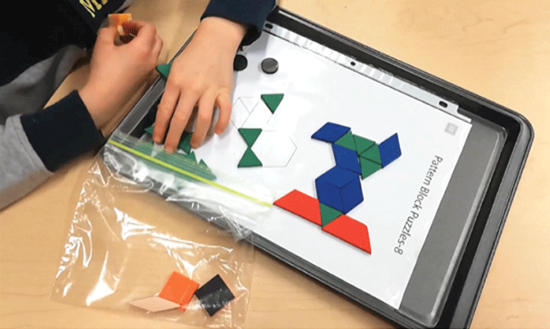
For example, pattern block puzzles (shown above) can be used to build children’s visualization skills and geometric understanding. In this playful task, students are asked to match pattern blocks with their shape outlines, as educators model the use of geometric vocabulary (vertices, sides, rotation, shape names) and discuss strategies students use for matching pattern blocks with the appropriate outlines (shape discrimination and rotation). To extend learning, pattern block puzzles that require multiple shapes (two or more) to fit into one space can be used.
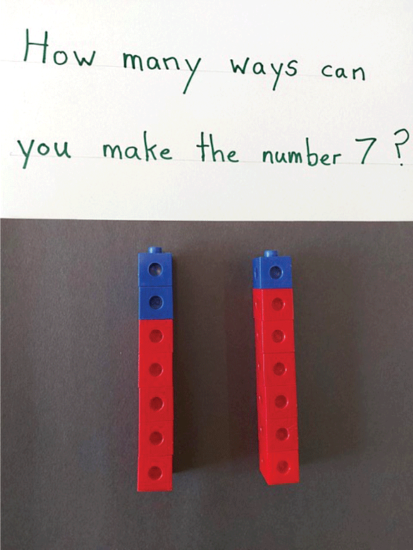
2. Present math play challenges to deepen students’ conceptual understanding. Young students are far more capable of mathematical understanding than previously thought and can engage with complex mathematical concepts with sustained attention (Bruce et al., 2016). Presenting students with a math play challenge encourages them to work with different ideas and make connections among them. One early math play challenge involves asking students to represent a number, like the number 7, using two sets of coloured linking cubes, in as many ways as possible (two blue cubes and five red cubes, one blue cube and six red cubes, and so on). This math play challenge helps students develop a greater understanding of the value a number represents and the multiple ways in which it can be composed.
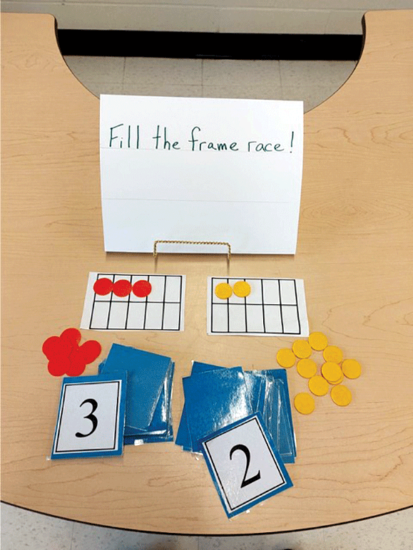
3. Use structured math activities and games to promote automaticity. The more frequently young students engage with structured math activities and games, the more automatic their early math skills become. The activity of having students match quantity cards (pictures of small sets of objects represented as dots, fingers, frames, etc., shown right) with their corresponding numbers helps promote numerical knowledge. Dice games help students learn to subitize numbers (recognize the number of items in a group without counting), and playing dominoes can support student learning of basic addition facts. Moreover, using activities and games to promote automaticity in math is a great alternative to “drill and kill” worksheets that tend to leave students feeling unsuccessful and demotivated.
There is little doubt that early mathematics plays a critical role in promoting future math and school success. At the same time, many Kindergarten teachers and early childhood educators are ill-equipped to teach mathematics and are, understandably, uncomfortable with doing so. Structured math play is ideal for supporting early math learning because it promotes student engagement and targets important foundational skills.
First Photo: iStock
All other photos: Courtesy of the authors
First published in Education Canada, June 2021
Resources
For more information about ways to incorporate structured math play in preschools and Kindergarten classrooms, visit these websites:
The Robertson Program – Early Years Math
https://wordpress.oise.utoronto.ca/robertson/early-years
Erikson Institute – Big Ideas of Early Math
https://earlymath.erikson.edu/why-early-math-everyday-math/big-ideas-learning-early-mathematics
Play Learning Lab – Examples of Play
www.playlearninglab.ca/examples-of-play
References
Bruce, C., Flynn, T, & Moss, J. (2016). Early mathematics: Challenges, possibilities, and new directions in the research. http://mkn-rcm.ca/wp-content/uploads/2016/11/M4YC_LiteratureReview_25June12_RevisedSept2016.pdf
Clements, D. H., & Sarama, J. (2013). Rethinking early mathematics: What is research-based curriculum for young children? In L.D. English & J.T. Mulligan (Eds.), Reconceptualizing early mathematics learning (pp. 121–47). Springer.
Council of Ministers of Education of Canada (CMEC). (2012). CMEC statement on play-based learning.
www.cmec.ca/Publications/Lists/Publications/Attachments/282/play-based-learning_statement_EN.pdfDuncan, G. J., Magnuson, K., et al. (2007). School readiness and later achievement. Developmental Psychology, 43, 1428–1446.
Germeroth, C., & Sarama, J. (2017). Coaching in early mathematics. In J. Sarama, D. H. Clements, et al. (Eds.), Advances in Child Development and Behavior: Vol. 53. The development of early childhood mathematics education (pp. 127–167). Academic Press.
Ginsburg, H. P., Lee, J. S., & Boyd, J. S. (2008). Mathematics education for young children: What it is and how to promote it. Social Policy Report: Giving child and youth development knowledge away, 22(1), 1–23. https://eric.ed.gov/?id=ED521700
Piaget, J. (1962). Play, dreams, and imitation in childhood. W. W. Norton & Co.
Pyle, A. & Danniels, E. (2016). A continuum of play-based learning: The role of the teacher in a play-based pedagogy and the fear of hijacking play. Early Education & Development. doi: 10.1080/10409289.2016.1220771
Youmans, A., Coombs, A., & Colgan, L.E.C. (2018). Early childhood educators’ and teachers’ early math education knowledge, beliefs, and pedagogy. The Canadian Journal of Education, 41(4), 1080–1104.
https://journals.sfu.ca/cje/index.php/cje-rce/article/view/3442 -
How can teachers and parents promote students’ digital literacies skills?
Comments Off on How can teachers and parents promote students’ digital literacies skills?Students who are digitally literate know how to use computers and the Internet to find, read, organize, and critically analyze information, to compose digital texts such as infographics, blogs, or videos for a range of purposes using a range of applications, and to participate ethically on social media platforms and in other networked spaces using multiple modes such as text, image, sound, or hashtags. Teachers and parents play a crucial role in helping young people to develop the foundational digital skills and social practices that enable them to become critical readers, writers, and participants in a complex world where digital technologies shape how we think, understand and interact.
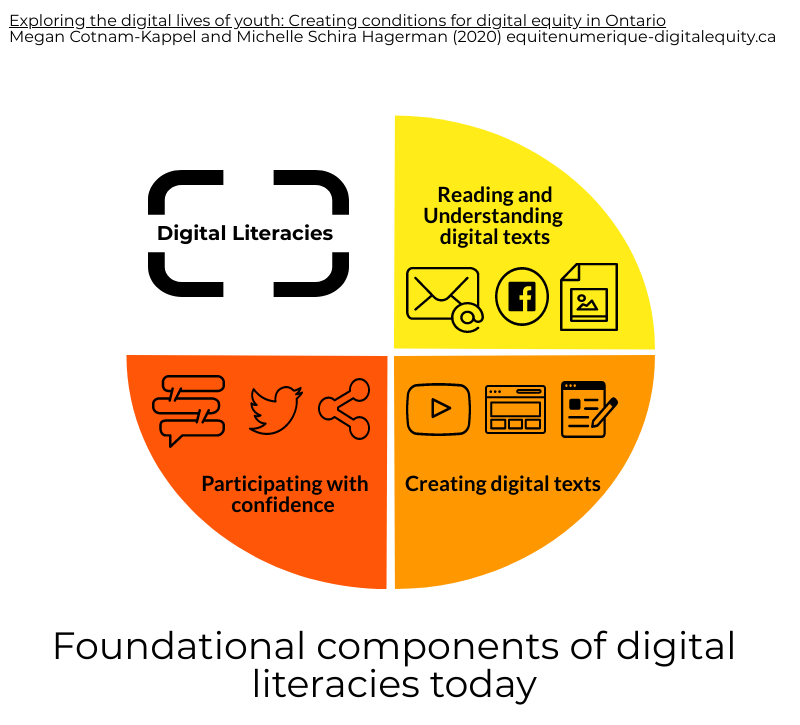
HERE ARE THREE STRATEGIES THAT TEACHERS AND PARENTS CAN USE TO SUPPORT DIGITAL LITERACIES LEARNING
Teach emergent print-based and digital literacies at the same time
As children learn to recognize, decode and print the letters of the alphabet, they can also learn to recognize and type letters on keyboards, use digital applications to listen to and interact with e-books, use audio recording applications to record and share their ideas, and use block-coding platforms (e.g., SCRATCH) to design commands that computers can read. Young children require developmentally appropriate opportunities to make meanings with and through all of the technologies that will shape their literacies practices in life.
Encourage meaningful digital co-creation
Creative collaboration sets the stage for students to think beyond the consumption of digital information as they negotiate and solve complex problems using a range of digital tools. For example, co-creating a digital video on a topic of social importance might require students to use cloud-based writing platforms for storyboarding, digital video cameras for recording, data management practices for organizing files, digital editing software, and online video sharing platforms with permissions set according to privacy needs. Through collaboration and peer review, students learn what it means to create, curate, and disseminate their work as active participants in networked cultures.
Offer multiple opportunities to learn critical evaluation skills and mindsets
When searching the Internet for information, students who adopt an evaluative stance, and who read across information sources in order to compare facts, arguments, and perspectives (also called lateral reading) tend to construct more accurate understandings of topics. To develop an evaluative stance, students need opportunities to judge the relative trustworthiness of information sources using indicators such as context, author identity and credentials, point of view, evidence of funding, text genre, modality, use of emotional triggers, how the information circulates via social media and whether information can be verified. Students also benefit when they have to justify their trustworthiness rankings, through debate, with peers and when their parents and teachers model critical evaluation practices by thinking aloud as they make judgments about information.
Just as learning to read and write printed texts requires explicit instruction over many years with many types of text, and for many communicative purposes, learning to become digitally literate requires similar support. Even though people sometimes think children are born “just knowing” how to use digital tools, research has dispelled this myth. Even highly educated young adults who grew up using the Internet are susceptible to fake news, and may not know how to solve complex problems using computers. Given the importance of global digital networks to nearly every aspect of life today, prioritizing digital literacies teaching and learning in every grade and in every subject area at school is important so that students learn foundational digital reading, composition and participation practices from an early age.
Additional Information and Resources
- SCRATCH: https://scratch.mit.edu/
- NCTE Definition of Literacy in a Digital Age : https://ncte.org/statement/nctes-definition-literacy-digital-age/
- Stanford History Education Group Civic Online Reasoning Curriculum: https://cor.stanford.edu/
- Media Smarts Research Report on Young Canadians and Algorithmic Awareness:https://mediasmarts.ca/research-policy/algorithmic-awareness-conversations-young-canadians-about-artificial-intelligence-privacy
WITH THE GENEROUS FINANCIAL SUPPORT OF:


-
Webinar: Learning our Way out of the Pandemic: Beyond “back to normal” for students
Comments Off on Webinar: Learning our Way out of the Pandemic: Beyond “back to normal” for students
Wednesday, May 19 at 1pm ET on Zoom | One-hour webinar
Presented by Karen Mundy and Kelly Gallagher-Mackay
Like so many families and children around the world, Canadians are looking with relief to a more open, carefree summer and normal return to school later this year. But after 18 months of profound disruption – will ‘normal’ be good enough? Are we on track to set all children up for success in a world that often seems more uncertain – and unequal – than ever before?
This webinar, sponsored by online learning toolmaker IPEVO, will examine how Canadian schools have fared during COVID19 compared to those in other jurisdictions. We then turn to evidence-based ways that educators can ensure a better, stronger, and more equitable start in September 2021.
don’t miss our SPECIAL GIVEAWAY!
If you sign up to receive special offers by email from both the EdCan Network and IPEVO, your name will be added into a draw at the end of this webinar to get one of two IPEVO Document Cameras!
Biographies
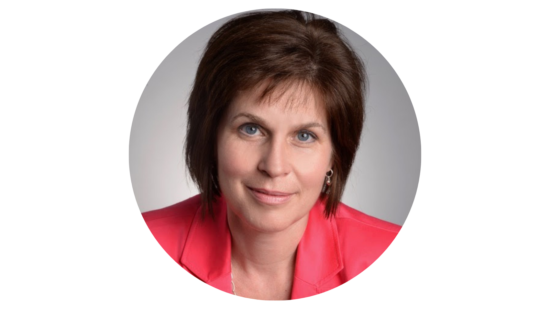
Karen Mundy is a Professor of Education Leadership and Policy at the Ontario Institute for Studies in Education, University of Toronto (OISE/UT). An expert on educational reform in lower-income countries, she is also an advocate and parent committed to improving educational equity in Canadian schools. She recently launched an academic support program that partners OISE volunteers with underserved students in the Toronto District School Board.

Kelly Gallagher-Mackay is an Assistant Professor at Wilfrid Laurier University. Past roles include Research Director at the Future Skills Centre and at People for Education, and Northern Director of Akitsiraq Law school in Nunavut. She has two kids in public school.

IPEVO is a design-driven company dedicated to creating teaching, learning, presentation, and communication tools for the connected world, with a focus on Document Cameras. IPEVO has been leading the communication and visual transmission industry for more than 10 years and it is the number one choice for educators across the globe.
-
Education Canada, March 2021 – Flipbook Edition
Comments Off on Education Canada, March 2021 – Flipbook EditionTeaching with the UN Sustainable Development Goals
Published by the EdCan Network in partnership with
On a global scale, we’re faced with complex societal and environmental challenges such as climate change, poverty, inequality and environmental degradation that we must address in order to achieve a more sustainable future for all. The United Nations’ Sustainable Development Goals (SDGs) lay out 17 action areas aimed at sustaining life (both human and non-human), ending poverty, and achieving social justice. These are the building blocks of global well-being.
For educators, the SDGs have enormous educational importance and potential. They offer cross-curricular relevancy and invaluable learning opportunities for students to discover their crucial role in solving local, regional, and global problems, starting in their own community. Simultaneously, education ministries, school districts and school communities will discover that engaging with the SDGs can support students in the important goal of acquiring the six pan-Canadian Global Competencies identified by the Council of Ministers of Education, Canada (CMEC), to equip them to thrive in and shape their world.
In this issue, we explore how educators can engage students to become active global citizens and authentically address global issues in empowering and hopeful ways.
Cover photo: courtesy MCIC
WEB EXCLUSIVES
- Much More Than a Bilingual Country
- Active citizenship education to empower young people
- Appreciating biodiversity to better protect it
- Providing a Quality Education in a Multicultural Environment
- Design Thinking
RELATED EDCAN FACT SHEETS
-
Real-Life Learning
Comments Off on Real-Life LearningWhew. We made it through the winter. For many of you it has been, professionally and/or personally, the hardest winter ever. But with vaccination underway and warm weather ahead, we think we see light at the end of the COVID-19 tunnel.
After a year that forced educators to teach, or lead, reactively in response to a mountain of new challenges, we thought it might be a welcome change to look forward to a more aspirational approach to teaching and learning. Yes, there are ongoing and critical COVID issues. But we can also start thinking about how to re-engage students, build school community and make education the best training ground possible for our future leaders and citizens.
Taking on the United Nations’ Sustainable Development Goals (SDGs), whether as a school or as a class, is an exciting way to address all three of these goals. I like to think of this issue as a seed catalogue. The catalogue arrives when it’s still too cold to plant, but it conjures up big dreams for gardening season. We hope this issue will sow lots of ideas, and also lead you to the resources to develop them into a real plan. How great would it be to cover the curriculum in a way that engages students in real-world problems, encourages them to claim a stake in making the world a better place, and develops essential competencies in the process?
The authors in this issue are in the vanguard of integrating the SDGs into Canadian schooling, and part of an international network of educators who are helping to achieve these ambitious Agenda 2030 goals while providing their students with a positive, empowering opportunity to learn about and take action on global issues that are also urgent problems here at home, such as clean drinking water for Indigenous communities, homelessness, climate change, food insecurity, and racial inequities. See how other schools have taken on one or more of the goals in our article on UNESCO Schools, from our partners at CCUNESCO (p. 11). Or dive right into the features to learn about what the UN SDGs are, why they present such a great opportunity for educators, and how to integrate the SDGs into your classroom and school.
I hope this issue inspires educators, schools, and school boards to start planning how they might get involved in this world-changing initiative – and sow the seeds for a sustainable future.
Photo: courtesy MCIC
First published in Education Canada, March 2021
Read other articles from this issue
Write to us!
We want to know what you think. Send your comments and article proposals to editor@edcan.ca – or join the conversation by using #EdCan on Twitter and Facebook.
-
The Colour of Wellbeing: How do we ensure the wellbeing and success of BIPOC students and K-12 staff?
Comments Off on The Colour of Wellbeing: How do we ensure the wellbeing and success of BIPOC students and K-12 staff?BIPOC (Black, Indigenous, and People of Colour) K-12 students and staff experience lower levels of wellbeing. Yet, a growing focus on wellbeing approaches such as mindfulness, social-emotional learning, trauma-informed practices, and self-regulation can have harmful effects on racialized students and educators and may lead to cultural appropriation (i.e. adopting aspects of a culture that’s not your own). These approaches to wellbeing often don’t take into consideration the unique experiences and perspectives of BIPOC students and staff.
Wellbeing is systemic. When wellbeing is understood as one individual’s experience, it fails to account for the harmful effects of systemic racism, White supremacy, and colonialism that create unwelcoming, exclusionary, and unsafe environments for BIPOC students. This approach absolves systems from taking any responsibility in creating and perpetuating harm, which could look like:
- Overlooking the histories, experiences, and positive contributions of BIPOC people within the curriculum
- Disproportionate punishment, suspension, and expulsion of Black and Indigenous students
- Disproportionately greater numbers of Black and Indigenous students, and students marginalized by poverty in lower academic streams and particular special education classes, and disproportionately greater numbers of White, middle-class, or wealthy families in gifted classes, French Immersion, and specialty programs.
- Continuing to hire and promote White employees for leadership positions instead of BIPOC employees with strong understandings of anti-racism (i.e. actively identifying and eliminating racism by changing policies, practices, and attitudes that perpetuate racist ideas and actions).
Here are 4 key tips to support the wellbeing of BIPOC students and staff:
1) There is no one-size-fits-all approach. Place identity – such as race, gender, sexuality, abilities, social class, and faith – at the center of approaches to student and staff wellbeing.
2) Avoid taking individual approaches to wellbeing that place both the source and solution of wellbeing with individuals and instead take a more systemic approach. This includes identifying and disrupting structures and policies that have had disproportionate effects on access, opportunity, and outcomes for BIPOC students and staff.
3) Connect with students, staff, families, and communities in meaningful ways to understand the experiences of institutional harm (e.g. residential schools).
4) Embed multiple understandings and approaches of wellbeing that value the physical, social, emotional, cognitive, and spiritual needs of students and staff.
By not acknowledging the depth and breadth of systemic racism, we end up focusing on symptoms rather than the root causes of achievement and wellbeing, while expecting individual students and staff members to overcome the numerous structural barriers placed before them. When schools take a systemic approach, they instead identify and take action to change the ways in which student and staff wellbeing is impacted by anti-Black, anti-Indigenous, and other forms of racism. Every student and educator deserves to feel safe, valued, and know that they belong at school.
Additional Information and Resources
Anti-racism: the active identification and elimination of racism and intersecting forms of oppression, by changing systems, structures, policies, practices and attitudes, for the equitable redistribution of power and resources.
Streaming means that students are placed into groups defined by their ability levels. Students may be grouped by ability either for a subject (for example for mathematics or reading) or for all or almost all their instruction. Students’ assignment to an ability group may be temporary, changing during the year, or relatively permanent.
White supremacy refers to a political, economic and cultural system in which Whites overwhelmingly control power and material resources, conscious and unconscious ideas of White superiority and entitlement are widespread, and relations of White dominance and non-White subordination are daily re-enacted across a broad array of institutions and social settings (Ansley as cited in Gillborn, 2016, p. 48).
Colonialism: systems and practices that seek to impose the will of one people on another and to use the resources of the imposed people for the benefit of the imposer. Colonialism can operate within political, sociological, economic and cultural values and systems of a place even after occupation by colonizers has ended (Assante, 2006).
- Faculty of Education Summer Institute 2020-21 Webinar Decolonizing Mental Health – https://fesi.blog.yorku.ca/november-25th-2020-webinar/
- VoicEd Equity Podcast Series – https://voiced.ca/project/rsekn-equity-podcast-series/
- Documentary: This is Not a Resilience Story – https://www.youtube.com/watch?v=7wkh1sxKGxI
- https://thunderbirdpf.org/first-nations-mental-wellness-continuum-framework/
- https://smho-smso.ca/wp-content/uploads/2020/09/Understanding-Anti-Black-Racism-For-MHL.pdf
- http://www.ontariodirectors.ca/downloads/Listening_Stone/Dion_LS_Final_Report%20Sept_10-2014-2.pdf
- https://ofifc.org/?research=trauma-informed-schools-in-indigenous-contexts-module
- https://www.raiseyouraq.ca/files/2017/04/Towards-Race-Equity-in-Education-April-2017.pdf?x60002
- https://thelearningexchange.ca/partnering-for-black-student-well-being-a-teachers-journey/
- https://issuu.com/ontarioprincipalscouncil/docs/opc_fall20-aoda-final/s/11099619
- https://www.cbc.ca/player/play/935078979530/
References
Dei, G.J.S. (2008). Schooling as community: Race, schooling, and the education of African youth. Journal of Black Studies, 38(3), 346-366.
Dion, S. (2014). The listening stone: Learning from the Ontario Ministry of Education’s First Nations, Métis and Inuit–focused collaborative inquiry 2013-2014. http://www.ontariodirectors.ca/downloads/Listening_Stone/Dion_LS_Final_Report%20Sept_10-2014-2.pdf
James, C. E. (2012). Students “at risk”: Stereotyping and the schooling of black boys. Urban Education, 47(2), 464-494.
James, C.E. & Turner, T. (2017). Towards race equity in education: The schooling of Black students in the Greater Toronto Area. https://edu.yorku.ca/files/2017/04/Towards-Race-Equity-in-Education-April-2017.pdf?x60002
Thompson, R. (2020, Sept. 29). Addressing trauma in the K-12 workplace: The impact of racial trauma on Black and non-white educators. https://www.edcan.ca/articles/addressing-racism-in-the-k-12-workplace/
-
How can the Sustainable Development Goals (SDGs) support K-12 teaching and learning?
Comments Off on How can the Sustainable Development Goals (SDGs) support K-12 teaching and learning?In 2015, all 193 countries of the United Nations along with scientists and political leaders agreed to partner together to implement the Sustainable Development Goals (SDGs) by the year 2030. The SDGs are a set of 17 goals aimed at achieving peace and prosperity worldwide by addressing pressing issues such as climate change, quality education, and poverty, to name a few. Issues such as these are expected to have devastating impacts on people and the planet if not addressed. For example, climate change is expected to lead to global challenges in this lifetime that no single country alone can resolve. Approximately 42% of the world’s population is currently under 25-years-old, children and youth are at most at risk of experiencing the impacts of these issues, making schools an ideal place for learning about the SDGs.
HERE ARE KEY TIPS FOR K-12 EDUCATORS WHEN TEACHING ABOUT THE SDGs:
1. Start Small
Choose one or a few SDGs to start with when planning class activities and discussions. Each SDG also comes paired with “Global Targets,” which can make them more manageable to address.
2. Learn alongside your students and connect with their interests
Students are often already passionate about global issues, and the SDGs provide a way for them to learn how to become active global citizens. Take the opportunity to learn about what your students are passionate about and build activities, projects, and discussions around these.
3. Find ways to connect the SDGs to the curriculum
The SDGs can enhance the curriculum by making space for learning about global issues and including perspectives from people around the world, which are often left out of national curriculums. There are many resources available for teachers that can be used as content for teaching the SDGs across subject areas.
4. Partner with other classrooms around the world
There are programs where you can partner with other classrooms locally or in other countries to work on projects that address global issues. This gives students an engaging opportunity to learn from other students who have different perspectives and to see how their actions can impact other people – even people halfway across the world.
In an increasingly interconnected world where local and regional decisions can have global impacts on world economies, policies, and societies, it’s evermore important for countries to find ways to collaborate on issues that affect us all. Teaching about the SDGs offers meaningful learning opportunities and encourages students to discover their role in solving local, regional, and global issues. As today’s children and youth will become the next generation of voters and leaders, it is necessary to equip them with the knowledge and skills to make sound decisions in an increasingly complex world – and the SDGs provide a framework to do just that.
Read More
- Creating education goals and activities that help students have a planetary or global view. This moves education beyond merely providing skills for individuals’ future employment but instead, provides the knowledge and skills for living on a shared planet.
- Engaging students around the world in shared research and collaboration to identify different experiences and responses to global issues (see for example, the Global Classroom projects on Global Citizenship and Energy Futures)
- Accessing portals of research and information shared by people around the world as the content for learning. For example, the work of South Korean APCEIU
- Teaching students from an integrated curriculum approach that makes space for learning about global issues from multiple perspectives including from people in locations often left out of national focused curriculums. This will include building a global historical consciousness (see for example https://historicalthinking.ca)
WITH THE GENEROUS FINANCIAL SUPPORT OF:
-
How can teachers and parents help students build up their financial literacy?
Comments Off on How can teachers and parents help students build up their financial literacy?As the financial landscape becomes increasingly complex (e.g. debt repayments, mortgages, line of credit, retirement savings), children and youth require a wide range of skills and knowledge to be able to successfully make informed choices about money that will serve them well as adults. School is crucial in strengthening students’ financial literacy skills including practical lessons about money. Research has shown that financial education tends to improve financial confidence and increases positive changes in financial behaviour such as saving and investing money. This is important for overall financial freedom and wellbeing: feeling in control of your finances and having the flexibility to make choices that allow you to enjoy life.
HERE ARE FOUR KEY TIPS TO PROMOTE STUDENTS’ FINANCIAL LITERACY SKILLS:
1. It’s never too early to start
Financial skills are complex, but having conversations with children early on can help them understand the value of money. One easy way to teach this is to encourage them to think about what they could buy if they were to save their money, instead of spending it on toys or a treat. Metaphors like, “Money does not grow on trees, but if you put it in a bank, it could grow like a tree” are good ways of communicating about money to young children.
2. Teaching is not enough – practice matters
Learning through practice and receiving feedback, especially negative feedback, results in better learning than simply learning from a textbook. For example, using a mock credit card or creating a mock investment portfolio for students to track. Parents can also get children and youth involved with tracking household bills and expenses, which can help create healthy financial habits.
3. Make it easy and fun
Financial education can easily be integrated into existing subjects such as math or social sciences. Using games and apps can make learning about money more engaging and allow students to learn how to make informed decisions, receive feedback, and understand the consequences of their choices (whether positive or negative).
4. Recognize that the last two years of high school are crucial
Students will soon be making independent financial decisions. The last two years of high school is the right time to ramp up your efforts by getting specific about debit cards, bills, debt, budgeting, and savings. This is also the time to engage in deeper conversations about money and consider the social and cultural taboos (i.e. the belief that talking about money signals vulnerability or feelings of being judged) that prevent families from discussing money matters. Fostering openness will allow for better confidence in financial decision-making.
Building up students’ financial literacy is critical not only to their understanding of personal finances, but also to their role in the local and global economy as consumers, employees, and employers. Teachers and parents have an important role in equipping students with the knowledge and skills to make healthy and informed financial decisions. Setting simple, age-appropriate goals that focus on the value of money, the importance of budgeting and saving, and evaluating the consequences of financial decisions, sets the foundation for students to become financially confident adults.
Additional Information and Resources
Child and Youth Finance International: https://childfinanceinternational.org/
Financial Literacy in Canada: https://www.canada.ca/en/financial-consumer-agency/programs/financial-literacy.html
Global Financial Literacy Excellence Centre: https://gflec.org/
FuturFund: http://www.futurfund.org/
PlayMoolah: http://www.playmoolah.com/
References
Alsemgeest L. Talking about money is taboo: Perceptions of financial planning students and implications for the financial planning industry. Industry and Higher Education. 2016;30(6):394-401. doi:10.1177/0950422216670065
Amagir A, Groot W, Maassen van den Brink H, Wilschut A. A review of financial-literacy education programs for children and adolescents. Citizenship, Social and Economics Education. 2018;17(1):56-80. doi:10.1177/2047173417719555
Atkinson, A. and F. Messy (2013), “Promoting Financial Inclusion through Financial Education: OECD/INFE Evidence, Policies and Practice”, OECD Working Papers on Finance, Insurance and Private Pensions, No. 34, OECD Publishing, Paris, https://doi.org/10.1787/5k3xz6m88smp-en.
Blue, Levon, Peter Grootenboer, Mark Brimble (2014). Financial literacy education in the curriculum: Making the grade or missing the mark?, International Review of Economics Education, Volume 16, Part A, Pages 51-62, https://doi.org/10.1016/j.iree.2014.07.005.
Fernandes, Daniel & Lynch, John & Netemeyer, Richard. (2014). Financial Literacy, Financial Education, and Downstream Financial Behaviors. Management Science. 10.1287/mnsc.2013.1849.
Lusardi,A., OS Mitchell, V Curto (2010) Financial Literacy Among the Youth. Journal of consumer affairs, 44 (2), 358-380
Mandell L. (2008) Financial Literacy of High School Students. In: Xiao J.J. (eds) Handbook of Consumer Finance Research. Springer, New York, NY. https://doi.org/10.1007/978-0-387-75734-6_10
Sherraden, M.S., Johnson, L., Guo, B. et al. Financial Capability in Children: Effects of Participation in a School-Based Financial Education and Savings Program. J Fam Econ Iss 32, 385–399 (2011). https://doi.org/10.1007/s10834-010-9220-5
Soman, D (2017), Why financial Literacy should be taught in every school, The Conversation https://theconversation.com/why-financial-literacy-should-be-taught-in-every-school-88458
Te’eni-Harari, T. (2016), “Financial literacy among children: the role of involvement in saving money”, Young Consumers, Vol. 17 No. 2, pp. 197-208. https://doi.org/10.1108/YC-01-2016-00579
WITH THE GENEROUS FINANCIAL SUPPORT OF:
-
The Escalating Crisis of Violence Against Educators (Part 2)
Comments Off on The Escalating Crisis of Violence Against Educators (Part 2) -
The Escalating Crisis of Violence Against Educators (Part 1)
Comments Off on The Escalating Crisis of Violence Against Educators (Part 1) -
Workplace wellness while busy doing other things
Comments Off on Workplace wellness while busy doing other things -
Active citizenship education to empower young people
Comments Off on Active citizenship education to empower young peopleAnxiety about the environment, a sense of helplessness, pessimism about the future, individualism – the world is going through a dark time and many people are concerned about the morale of young people and their ability to exercise active citizenship. However, Oxfam-Québec meets thousands of young people every year who are exercising their citizenship in the fields of climate, economics and gender justice, with both hope and ingenuity.
For over 45 years, our organization has been active in schools to encourage youth civic engagement so we can build a fair, sustainable world. We believe that young people wield citizen power and that it is crucial to treat them as what they are – agents of change – and in light of what they do – take unified action to fight inequalities.
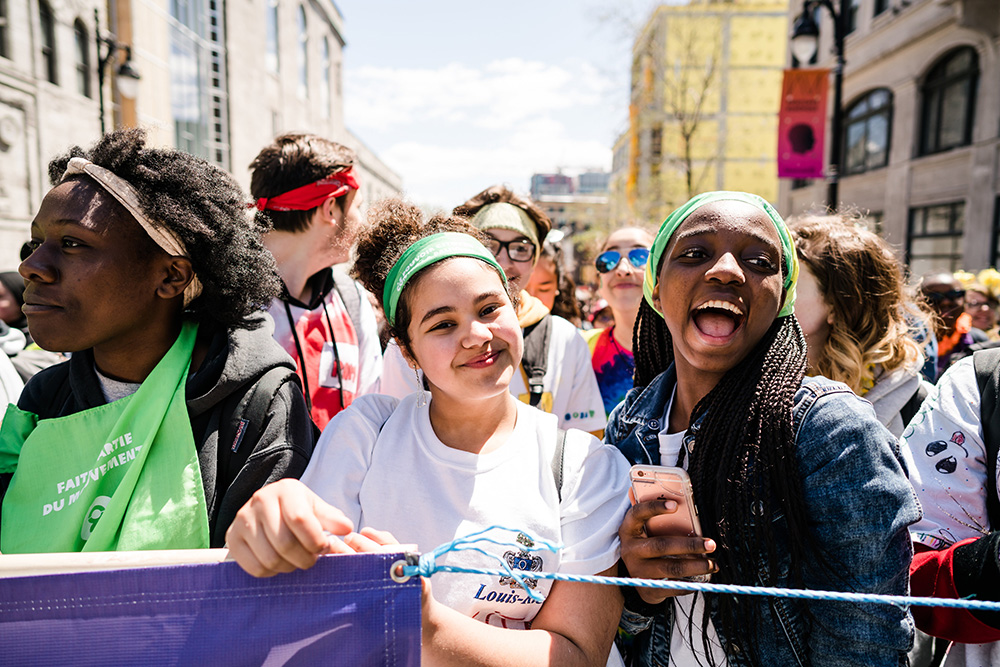
When describing Oxfam-Québec’s current educational activities, we talk about global citizenship education, an educational approach that helps young people grow into responsible, united citizens of the world. The goal of this educational continuum is to inform youth, mobilize them, encourage them to influence the halls of power, and promote their activities. Young people join this movement by attending in-class workshops; taking part in the World Walk, which for many is their first experience of collective action; working on long-term projects like fundraising for sustainable development projects; or by engaging in calls for action as part of mobilization campaigns.
All of these activities correspond to specific elements in the Quebec Education Program (QEP), in terms of its mission, broad areas of learning, skills to be developed, and progression of learning. Oxfam is even cited as a cultural reference in the school curriculum, under the theme of wealth disparity in the Contemporary World course offered in Grade 11. All of our resources clearly identify the corresponding QEP elements. Many teachers, as well as non-teaching staff like spiritual leaders and community programmers, use these resources in class or as part of extracurricular activities. Given their demanding mandates and busy schedules, school staff members appreciate the support of our team, which offers learning activities to meet their needs. To use these resources, one can find all the information needed on the Oxfam-Québec site, under the heading Ressources pour les milieux scolaires (School resources, in French only).
The educational activities we offer are both transformative and empowering. In particular, they enable girls and minority youth to have a voice and be heard in their fight against injustice. We can build a fair world without poverty if young people mobilize to exercise their global citizenship, solve problems, and work with their peers around the globe.
In accordance with UNESCO guidelines, the Oxfam confederation believes that the Sustainable Development Goals (SDGs) set by the United Nations must be the priorities driving global citizenship education. In the following paragraphs, we present groups of educational activities tailored for four SDGs. These activities have been adapted to remain accessible during the pandemic, using online communication tools and interactive digital resources.
SDG 5, Achieve gender equality and empower all women and girls, is the heart of our work: it is impossible to build a just world if half of humanity cannot flourish and have their rights respected.
For example, the campaign Les tâches ménagères et le travail de soin. Ça compte! (Make Care Count) teaches young people about the unequal division of care work between the sexes, notably through a policy paper entitled Time to Care. A free workshop, Libres de choisir (Free to Choose), teaches high school students about sexual rights – which are a human right – and encourages them to consider the social and cultural context when reflecting on the impact of failing to respect these rights. The workshop’s title, referencing the question of freedom of choice, is significant: when it comes to choice, the inequalities faced by teenage girls around the world have major consequences on their lives. In Quebec as well, young people must make choices about their sexual rights. After taking this workshop, young people are invited to support a project in the Democratic Republic of Congo, Healthy Mothers, Healthy children, which aims to improve the health of women, teens, and children. In the case of older youth ages 18 to 30, the project C’est pour elles aussi (It’s her right, too) can help develop their abilities to mobilize friends and family and disseminate positive messages using coordinated actions, digital action plans, and meetings with elected officials.
“My participation in the Oxfam-Québec project ‘C’est pour elles aussi’ (It’s her right, too) helped me understand that my voice is valid and that I have the right to be heard. Social networks are powerful allies for raising people’s awareness and advancing the debate. […] The team introduced me to theoretical concepts related to cyber activism and gave me the courage I needed to use my voice! I was even empowered to develop my own platform of inspiring resources on Instagram (@lesensduchaos) to counter the psychological stress caused by the lockdown.”
– Laurence C. Germain, participant in the Oxfam-Québec “C’est pour elles aussi” project
SDG 13, Take urgent action to combat climate change and its impacts, plays a key role in Oxfam’s educational outreach efforts. This issue is intertwined with all global issues of inequality: historic, socioeconomic, and gender inequalities.
The campaign devoted to this topic is called Climat de justice (Climate justice). Like the content in the free workshop offered to young people ages 12 to 30, the campaign highlights the injustices associated with the climate crisis, and the outsized impact this crisis is having on the people who produce the fewest carbon emissions. Since indignation can be a powerful driving force, the young people involved can then participate in the 50th World Walk for Climate Justice. The World Walk is the culmination of a year of action. To highlight these efforts, the Oxfam-Québec team has asked the young people preparing for the walk to meet several challenges, from filming a video to speaking to the media. At the beginning of the school year, young people can also organize a symbolic, united action in their respective schools called Stand Up for the Planet to tell decision-makers they are committed to climate justice.
“To everyone who says that we can’t accomplish anything, look at us – 6,000 young people marching for the world! I am really proud to see this! It is our place, meaning that, regardless of our age, gender, colour, or religion, we have the right to use our voice.”
– Estelle Lafrance, age 17, member of the Oxfam-Québec Youth Seat, participant and spokesperson for the World Walk
Of course, SDG 1, End poverty in all its forms everywhere, underpins all the others. It is important to talk to young people about the economy and deconstruct dogmas that hinder a real understanding of possible solutions so everyone can live with dignity on this planet.
Along these lines, there is a free workshop for young people on the new economic model created by Oxfam. L’économie du beigne (Doughnut Economics) rejects the obsession with infinite growth at all cost and proposes instead that the economy target the well-being of humanity by respecting a series of social indicators without overshooting any planetary boundaries. This new model has already been adopted by many cities around the world, including Brussels, Amsterdam, and Nanaimo in Canada. This workshop is part of the campaign Taxing wealth: Flattening inequalities. Young people are invited to sign the petition addressed to the Canadian government asking it to rebuild an economy that is capable of tackling inequalities. In anticipation of the upcoming municipal elections, young people could ask candidates if they are interested in applying the doughnut economics model to their city. A wonderful way to learn about politics!
Doughnut economics also refers to SDG 8: Promote inclusive and sustainable economic growth, employment and decent work for all.
An innovative Oxfam-Québec project started some 15 years ago introducing young people to the values of innovation, creativity, and sustainability advocated by the Council of Ministers of Education, Canada (CMEC): Magasin du Monde (World Shop). This initiative has students create social economy businesses to promote fair trade. Participants create a shop, sit on a board of directors, and share the tasks involved: market research, inventory management and sales, activities to educate the school community, and internal and external communications. The shops do not sell ordinary products, as everything is certified fair trade and a percentage of the profits are used to support a sustainable development project. In some cases, the entire local community participates in the project, which becomes an engine of development. This happens, for example, when local farmers’ markets and tourism agencies help to promote these extraordinary shops.
“The work we accomplished on the committee for a sustainable City of Mont-Saint-Hilaire has increased my desire to have an impact on the world in which I live. It is proof that when you work at it, anything is possible!”
– Émile Chapdelaine, founding member of the World Shop at École Ozias-Leduc, member of the Oxfam-Québec Youth Observatory, and a member of the committee that helped get Mont-Saint-Hilaire recognized as a Fair Trade Town.
Research on and assessments of student participation in these so-called “civic engagement” activities reveal many benefits for the young people themselves. Those interviewed report improved self-esteem and a greater sense of responsibility. In addition, they exhibit an increase in positive social attitudes and a decrease in risky behaviours. This is mainly due to a greater sense of belonging to their school and improved academic results.
An external impact assessment carried out last year (Sogémap) confirmed the positive effect of youth civic engagement. According to this document, Oxfam-Québec’s global citizenship education programming enables young people to develop an awareness of global issues, an open, engaged mind and an increased ability to defend arguments. Not surprisingly, young people who take part in these activities maintain their civic engagement when they become adults.
In light of the above, it is easy to understand why encouraging young people to exercise their citizenship is crucial to supporting democracy and achieving the UN’s Sustainable Development Goals. Back in 2017, the United Nations Population Fund noted that meeting the SDGs relies on bold measures to ensure that 60 million girls around the globe can live a life of dignity. In this pandemic period, young people, like the rest of the world, are experiencing unprecedented crises that directly threaten their present and future lives. By working with schools, Oxfam-Québec hopes to provide them with concrete measures for overcoming this challenge and support their efforts to create a more sustainable, inclusive society.
Resources
This article is translated from the original French. Some resources are also available in English; check the websites.
Resources for SDG 5:
- Campaign “Les tâches ménagères et le travail de soin. Ça compte!” (Make care count): https://oxfam.qc.ca/reduire-inegalites-travail-domestique/
- Free workshop “Libres de choisir” (Free to Choose): https://oxfam.qc.ca/wp-content/uploads/2018/10/DescriptifLibres-de-choisir.pdf
- Mobilizing project “C’est pour elles aussi” (It’s her right, too): https://oxfam.qc.ca/agissez/engagez-les-milieux-educatifs/post-secondaire/pour-elles-aussi/
Resources for SDG 13:
- “Climat de justice” (Climate justice) campaign: https://oxfam.qc.ca/climat-de-justice/
- Free workshop “Climat de justice”: https://oxfam.qc.ca/wp content/uploads/2021/02/atelier-climat-de-justice-pfeq.pdf
- Activity “50th World Walk for Climate Justice”: https://oxfam.qc.ca/agissez/world-walk/
- Activity “Stand Up for the Planet”: https://oxfam.qc.ca/stand-up-for-the-planet/
- Activity – webinars about climate justice: https://www.ymcaquebec.org/en/Community-Programs/Global-Initiatives-en/Collectifs-de-la-societe-civile
Resources for SDG 1:
- Free workshop “L’économie du beigne” (Doughnut Economics): https://oxfam.qc.ca/wp-content/uploads/2021/02/atelier-economie-du-beigne-pfeq.pdf
- Campaign “Taxing wealth: Flattening inequalities”: https://oxfam.qc.ca/flattening-inequalities-petition/
Resources for SDG 8:
- Project “World Shop”: https://oxfam.qc.ca/agissez/engagez-les-milieux-educatifs/ressources-gratuites-secondaire/magasin-du-monde/
Photos : La Boîte 7
First published in Education Canada, March 2021
Read other articles from this issue
References
Caron, C. (2018). La citoyenneté des adolescents du 21e siècle dans une perspective de justice sociale : pourquoi et comment ? www.erudit.org/fr/revues/lsp/2018-n80-lsp03532/1044109ar/
Gingras, M.-P., Phillipe, F.L., Poulin, F., Robitaille, J (2018). Étude sur les obstacles à la mise en place d’activités d’engagement civique en milieu scolaire au Québec. Canadian Journal of Education, 41(3), 661-687. https://journals.sfu.ca/cje/index.php/cje-rce/article/view/3177
Philippe, F. (2019). Projet de recherche Réussir : 15 constats révélateurs sur l’impact des activités d’engagement civique chez les jeunes de niveau secondaire au Québec. www.elaborer.org/pdf/R3.pdf
United Nations Population Fund. (2017). Worlds apart: Reproductive health and rights in an age of inequality. www.unfpa.org/swop-2017
-
Global Citizenship and the SDGs
Comments Off on Global Citizenship and the SDGsSeventeen Sustainable Development Goals – also known as the SDGs or the Global Goals – came into effect on January 1, 2016, following a historic United Nations Summit in September 2015. 193 governments from around the world agreed to implement the SDGs within their own countries in order to achieve what has become known as the 2030 Agenda for Sustainable Development. To meet these new SDGs, countries are to mobilize efforts to end all forms of poverty, fight inequalities, and tackle climate change, all while ensuring that no one is left behind. To achieve this global challenge, everyone must take action both here and around the world. We know that these goals highlight issues that affect our students and communities as well as the broader world, and offer powerful points of connection to engage students on global issues in the classroom.
Global citizenship, the idea that the actions we take here can affect lives all over the world, is a compelling lesson for the classroom. Engaging students on global issues, and especially taking action locally, can spark exciting projects and build global awareness in students. Students who understand these local-global connections are building their understanding of issues facing the world today, developing compassion for the world around them, and discovering the power of taking action.
The Manitoba Council for International Cooperation (MCIC) has a long history of engaging students in classroom workshops and student conferences that are focused on educating students about global issues and empowering them to take action. If you need ideas on how to bring the SDGs into your classroom, we’ve developed Sustainable Foundations: A guide for teaching the Sustainable Development Goals, a new bilingual resource for educators that includes multiple lesson plan ideas and action steps for each SDG. The guide includes lesson plans for Grades 2–12, but largely focuses on Grade 5+, where the content around global issues is more relevant to the curriculum.
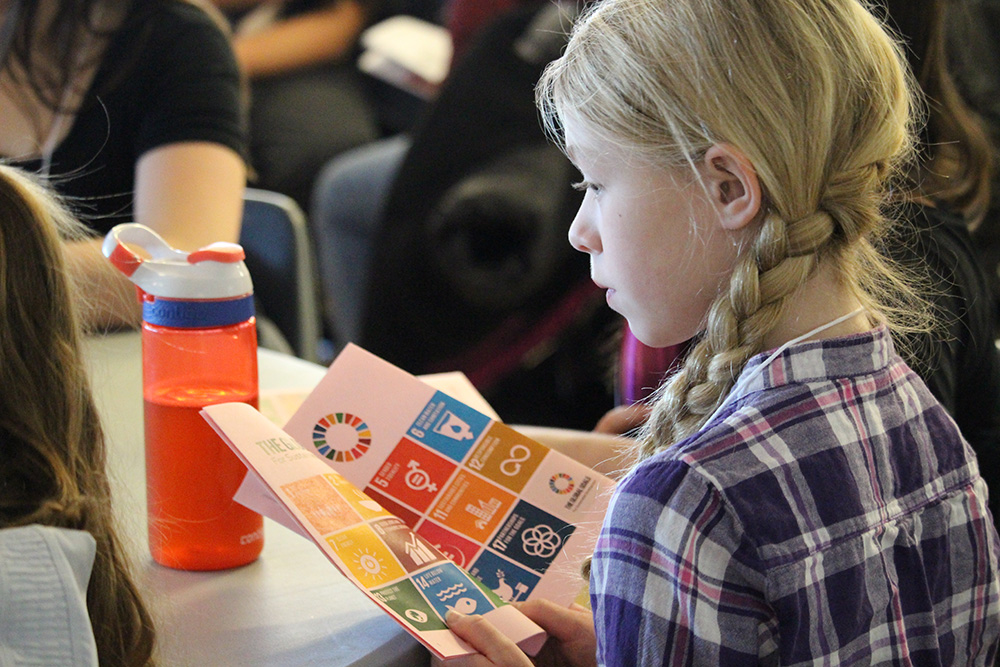
Taking an inquiry approach, each chapter in the guide offers an overview of a specific goal, including learning objectives, a summary of important international targets, and the ways to tell if we are on track to reach the goals. Each chapter offers inquiry-style questions that connect back to the curriculum, exploring some key questions, such as: Where did this goal begin? Why does this issue matter? Who and what are affected? and What is being done?
The guide explores the interconnected nature of the goals, taking care to highlight, for example, how we can’t reach Goal 1: Zero Poverty, without also reducing inequalities (Goal 10), ensuring decent work and economic growth (Goal 8), protecting life on land (Goal 15), and many others. There are many connections between each goal, and students can quickly begin to see how the success of one goal is tied to another.
Each chapter also highlights the consequences of inaction, sharing what might happen if we do nothing to reach the goal, and offers further reflection questions, inspiring quotes, and more. Of special importance to educators are the sections with resources, including ideas for taking action, lesson plans, activities, and video educational resources for use in the classroom.
Teaching Goal 1: Zero Poverty
For example, how can you teach your students about Goal 1: Zero Poverty? For students in Grades 5–8, consider the lesson “The World is Not Equal. Is that fair?” from the World’s Largest Lesson website and featured in the guide. This lesson highlights different types of inequality and helps students explore the impact inequality has on the wider society and economy. The lesson starts with students receiving an unequal amount of something (candy, stickers, etc.) and moves from fairness to a discussion on equality.
MCIC has also created lessons you can use in your classroom, now available directly on our website at mcic.ca. First, for students in Grade 5+, considering using the “Building Blocks for a Good Life” lesson, where students order a list of items from most important to least important for a good life. This lesson opens a discussion about poverty and what it means to have a good quality of life. Students will explore poverty as a “lack of opportunities” rather than a “lack of basic needs.” Framing poverty this way allows students to appreciate the complexity of the issue and promotes empathy in lieu of judgment.
Students work in groups to decide which items (a range including access to food, a television, cell phones, shelter, toys, health care and more) are most important and which are least important to a good life. Labels are provided that can be placed on blocks so students can build structures, or you can print a list of the items and cut them into individual squares so students can order them individually on their desks or at home.

This lesson has also been successfully used with high-school students, and we recommend leaving more time for older students to discuss differences of opinion and the debrief questions. Many great discussions can arise with all ages, based on student perspectives of the items on the list. There are several discussion questions and prompts included in the lesson, such as asking students if everyone needs the same things for a good life, a prompt that can be used to expand the conversation and include global perspectives. Do we need the same things as other countries? Use student answers to these prompts and differences in their prioritized lists to spark conversations about basic needs and lack of opportunities in the world.
Another MCIC activity with more global perspectives is “Breaking the Cycle,” for students in Grades 5–8. In this activity, students learn that poverty is not a result of individual choices alone; it is affected by societal systems. Students travel in groups through four different stations, making decisions about health and the environment inside scenarios from around the world, choosing how to spend their resources to survive. Focused on the themes of poverty and the poverty cycle, barriers associated with poverty, and a lack of access to health care and education, this activity brings home the real-world challenges people can face and opens a conversation about inequality around the world.
Putting learning into action
Learning about global issues is a great start, but true impact and passion can be inspired by taking action on the issues. Students who take action in their communities to effect change become engaged global citizens, learning powerful lessons about how their actions can change the world.
To encourage your students to take action, consider the ideas in the “How to Take Action” section included for each chapter of the guide, or the general tips on taking action in the introduction. For example, students could be encouraged to support a local organization through creating a fundraiser, or writing to their local government representative about the issues. Explore dosomething.org to find an issue your students care about and to find ways to take action on the issues. You can also see examples of how other students have taken action on the MCIC Take Action Blog, or consider connecting with an international cooperation organization working around the world. You can find examples of these organizations and their work through the case studies in each chapter of the guide or by contacting MCIC or another Council for International Cooperation in your area.
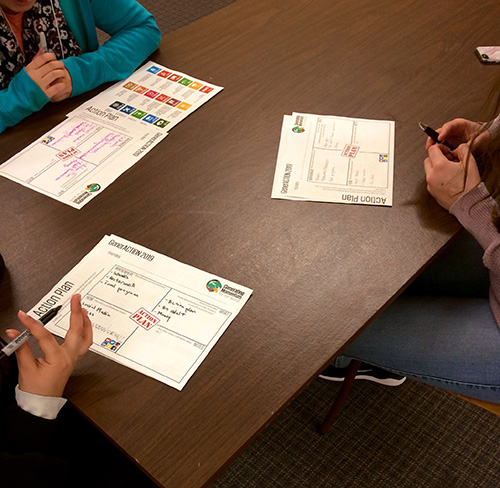
One school’s journey
At our Generating Momentum for Our World student conferences, and as we share classroom resources, we encourage educators to let us know how their students take action on global issues. Following a student conference in rural Manitoba where students learned about the SDGs and how to take action on the issues, we heard about an exciting project one school had undertaken in their community.
With the support of their teachers, middle-years students created an “SDG Week” where they connected with their peers on a different goal each day. For example, when they talked about Goal 2: Zero Hunger, students baked and offered everyone in school a muffin. They hosted assemblies, shared information, invited MCIC to lead workshops, and created posters to share. One day they planted fruit trees on the school property, as a way to help reach several goals (no hunger, climate change, life on land, and more). With a new project each day, it was a great way to share what they learned with their fellow students and take action on the SDGs.
It was exciting to see how students took the knowledge gained about the SDGs and turned it into action, while sharing with their schoolmates.
AS EDUCATORS, you know that you hold the power to transform your students’ understanding of the world. As you teach them the universality of the SDGs and the issues facing the world today, we encourage you to also teach your students to be good global citizens who take actions that change the world for the better. Students who understand that they have the power to help reduce inequalities around the world and create a more sustainable future for all, are students who will take knowledge and turn it into action, making a more just world for everyone.
Resources for Teachers
MCIC offers many free classroom resources at mcic.ca:
- Sustainable Foundations: A guide for teaching the Sustainable Development Goals (2018) (English and French versions available)
- Online resources for teaching the SDGs at home (or remotely)
- Lesson plans, classroom posters, reading lists, and more
- Global Citizens, Local Classrooms e-newsletter with monthly resources for educators
- Classroom workshop bookings (currently virtual)
- Take Action Blog showcasing examples from educators and students taking action on global issues: https://takeactionmanitoba.org
See also the World’s Largest Lesson website, with lesson plans and other classroom resources searchable by type of resource, age group, and duration:
Photos: courtesy MCIC
First published in Education Canada, March 2021
-
Indigenous Justice Means a Sustainable Future for All
Comments Off on Indigenous Justice Means a Sustainable Future for AllWhen I think about the necessary steps to meet the Sustainable Development Goals (SDGs) by 2030, Indigenous rights and justice come to mind immediately. To me, it is clear that there can be no sustainable world without creating the conditions that allow Indigenous people to thrive.
Many of the objectives of the SDGs (such as a sustainable world for future generations to inherit, responsible practices of consumption, strong partnerships, etc.) already align with the values and practices of most Indigenous nations, which, according to a 2018 United Nations report, make up only five percent of the global population, but protect more than 80 percent of the world’s biodiversity (Raygorodetsky, 2018). Not only this, but the emphasis that the 2030 Agenda for Sustainable Development puts on reducing inequalities “is of particular relevance to Indigenous peoples, who are almost universally in situations of disadvantage vis-à-vis other segments of the population” (United Nations, 2018). In Canada, Indigenous people are grossly overrepresented in every area of inequity.
Despite these clear points of connection, I think for some people, and certainly for many environmentalists, policy-makers, and educators I have known, emphasizing Indigenous people’s role in the SDGs is approached as an afterthought rather than as a necessity. This line of thinking and inaction is something we must change, especially in Canada, as progress on the SDGs lags – incredibly so when it comes to the state of Indigenous communities.
This is not to say that there has been a complete failure in the conversation about Indigenous people and the SDGs. Indeed, in Canada’s 2018 Voluntary National Review of Implementation, Indigenous people were mentioned under the progress reports for almost every one of the SDGs to date (Global Affairs Canada, 2018). However, I have long maintained that the degree to which Indigenous people are centred in conversations about the SDGs is insufficient. Moreover, I believe the approaches Canada and Canadians have taken to collaborate with Indigenous people thus far, are the wrong ones.
As of 2019, the primary approach Canada had taken to addressing Indigenous concerns regarding the SDGs was to “invest in existing Indigenous-focused programming relevant to each SDG and aim for greater consultation and collaboration with Indigenous people in every sector” (Yesno, 2019). None of these approaches are transformational. Consultation and increased dollars are not enough to bring about the changes Indigenous communities deserve or the impact the 2030 Agenda seeks to achieve; these types of changes necessitate a restructuring of power and jurisdiction; a provision of tools and capacity so Indigenous people can chart their own paths to self-determination.
Why self-determination? Because Indigenous people cannot protect the land if it is always under threat of seizure. They cannot pursue sustainable development practices if threats of mining, damming, pipelines, and other forms of extraction loom without consent. Indigenous people already have the knowledge to uphold sustainable relationships between ourselves and the natural world; we had been in harmonious relationships with the environment for a millennia before colonization. It is hard to pursue those ways of living though, ones which would benefit all people living in Canada, when we have to fight for basic rights at the same time. This is where education plays a critical role. As current and future generations navigate sustainability crises into 2030 and beyond, it is important they, too, see Indigenous rights as central to a sustainable world.
One of young people’s greatest strengths, I believe, is their ability to seek and embrace radical change – a skill that can be increasingly challenging for people as they age. Transforming Canada’s relationship with Indigenous people in the ways I have described above is a truly radical and momentous change. It will take an entire coming generation fighting for, and believing in, this change in order for it to be realized. It is up to current generations of educators, parents, thought-leaders, and policy-makers to help them understand this, emphasize the importance of building strong relationships with Indigenous people, and ultimately, guide them in this fight.
The SDGs offer a great entry point for discussions about the specific ways Indigenous people are left behind in this country, and how that might be able to change. Discussing SDG 5: Gender Equality? Highlight Murdered and Missing Indigenous Women and Girls (MMIWG). There is a whole list of action items necessary to address this inequality. Tackling SDG 6: Clean Water and Sanitation? Identify the dozens of Indigenous communities who lack reliable, clean water and the many Indigenous voices finding ways to overcome this challenge. Let young people know that Indigenous people all around them are fighting for their future as well as our own.
I should note that there are individuals all over the country, including educators, who are leading by example and already sharing this information in and out of the classroom. I know this because I have been lucky enough to be taught and mentored by such people. For those who have the essential job of educating and shaping young people, and want to do more to bring Indigenous justice to their work, the resources are already there – they are just waiting for you to embrace them. (See OISE, 2001; Gamblin, 2019; Yellowhead Institute, 2019, for starters.)
Overall, Indigenous rights and justice, especially the right to self-determination, needs to be a major priority as we collectively tackle the SDGs and address what feels like an increasingly precarious world; not only because it’s the moral thing to do, but because it is a critical part of the path forward. It is long time we realize that, ultimately, there is no sustainable future without Indigenous rights, and that we all have a role to play in ensuring that these rights are realized.
The United Nations (2015) said it well when they stated: “The future of humanity and of our planet lies in our hands. It lies also in the hands of today’s younger generation who will pass the torch to future generations. The road to sustainable development is already mapped; it will be for all of us to ensure that the journey is successful and its gains irreversible.”
Indigenous people have long been ready to embark on that journey; it is my hope that we can work together so the next generations will be ready too.
Photo: Adobe Stock
First published in Education Canada, March 2021
Read other articles from this issue
References
Gamblin, R. (2019, November 4). LAND BACK! What do we mean? 4 Rs Youth Movement.
http://4rsyouth.ca/land-back-what-do-we-meanGlobal Affairs Canada. (2018). Canada’s implementation of the 2030 Agenda for Sustainable Development (pp. 1–148). Government of Canada.
Deepening Knowledge Project.(2001). Best practices for teaching Aboriginal students. Ontario Institute for Studies in Education.
www.oise.utoronto.ca/deepeningknowledge/UserFiles/File/UploadedAmina_/Best_Practices_for_Teaching_Aboriginal_Students.pdfRaygorodetsky, G. (2018, November 19). Can indigenous land stewardship protect biodiversity? National Geographic.
https://www.nationalgeographic.com/environment/2018/11/can-indigenous-land-stewardship-protect-biodiversity-/United Nations Department of Economic and Social Affairs. (2015). Transforming our world: The 2030 Agenda for Sustainable Development. United Nations.
https://sdgs.un.org/2030agendaUnited Nations Department of Economic and Social Affairs. (2018). Indigenous Peoples and the 2030 Agenda. United Nations.
Yellowhead Institute. (2019, October 29). Land Back: A Yellowhead Institute Red Paper
https://redpaper.yellowheadinstitute.orgYesno, R. (2019, June 11). UNDRIP and the SDGs: There’s no sustainable future without Indigenous rights. Alliance2030.
https://alliance2030.ca/undrip-and-the-sdgs-theres-no-sustainable-future-without-indigenous-rights/ -
How the UN SDGs Can Support Career Education
Comments Off on How the UN SDGs Can Support Career EducationThere is a unique opportunity before us to inspire and mobilize our students to engage with the world’s most pressing issues, as defined in the United Nations Sustainable Development Goals (SDGs). The SDGs provide educators with a wonderful canvas to embed global issues that require collective expertise and solutions into our curriculum. In this article, I share my experience with incorporating the SDGs into one of my courses to help students realize their lifelong mission and career purpose. While the example I provide was used in a post-secondary setting as a career education framework, my intention is to inspire you to consider how you might incorporate a similar approach toward helping your K–12 students connect with these critical topics and relate them to their own career aspirations.
I teach a post-university transitions course at both the University of the Fraser Valley and Kwantlen Polytechnic University in British Columbia. The main course objective is to ensure students are well prepared for their journey after post-secondary graduation. I elected to use the SDGs as a framework to help students consider three ambitious questions that can evoke personal values and their sense of purpose:
- What is the world that you want to live in?
- What are the global problems or opportunities that need your attention?
- What are your talents and experiences that may help address these problems, and in turn improve the condition of our world?
Rather than simply pose these questions in a single lecture, I elected to embed them in various capacities within assignments and activities throughout the term. In particular, I chose to structure these as “renewable assignments” that aim to provide value and impact beyond the course, as opposed to disposable assignments that students set aside once they are completed.
The results demonstrated immediate impact; students felt that the content was engaging and they immersed themselves into their assignments and activities. As one student noted:
“This course [and the SDG components] has me more focused on my dream of being more than a teacher… to ensure children are receiving more than a quality education… [and that they] do not go without food, have access to clean water, are healthy (mentally, physically, and emotionally), have equality, and gain skills to thrive in their community.”
Furthermore, a common insight that many students shared is articulated in this student’s comment about introducing the SDGs within the K–12 system:
“I found it surprising that the SDGs… (or the MDGs, which was the earlier version) were not introduced earlier in my undergrad, or even while I was in elementary and high school! Learning about them earlier on would have helped me better connect what I want to know and how I can help my community.”
I agree with this student that the SDGs can and should be introduced at a much earlier age. Three assignments that resonated particularly well with my students are described below, along with ideas for adapting them to suit the K–12 environment:
Incorporating SDGs into career education
Occupational research
In the course, students are asked to research labour market information related to their career aspirations, using search engines such as the Government of Canada’s National Occupation Code (National) and WorkBC’s Labour Market Information Office (Provincial). What skills, education, and experiences are required to enter the occupation? What might be their career outlook and prospects, provincially and nationally? Having conducted this research, students are asked to consider which of the 17 SDGs their chosen profession or field might help advance and how.
Applicability to K–12: This assignment and its activities are likely suitable to the more senior secondary school years to help students further their research literacy and critical thinking skills. Students may also use this opportunity to explore the types of work – both in terms of paid employment and unpaid volunteer/service pursuits – that directly support or are involved within one or more of the SDGs, to help expand their understanding of how diverse occupations might be.
Information interview
In the information interview project, students speak with three individuals whom they believe can provide insight into a type of work they are considering, and then they reflect on these conversations. One of the reflective questions embedded in the project asks them to consider the common themes that emerged in their conversations, and how they believe these themes and individuals shed further insights into the SDGs.
Applicability to K–12: This assignment can be adapted to suit a particular grade level, from teachers providing a list of questions to ask in the lower grades, to empowering students to generate questions on their own in the higher levels. This assignment might be comparable to a career/occupation activity where teachers invite guest speakers to visit the class and talk about their profession, resulting in a group information interview where any students can pose questions. For example, a student interested in pursuing an occupation in trades might interview an electrician and learn that she is either explicitly or unknowingly supporting SDG 11: Sustainable Cities and Communities by sourcing and using local materials in her projects, as well as SDG 5: Gender Equality through her advocacy work as a female in her trade association. If an obvious connection isn’t immediately made, the student and professional can engage in a conversation about how someone working in the profession could potentially align their work with one of the SDGs. This then becomes an interesting two-way instructional opportunity where the student can, in turn, help educate the professional about the SDGs.
Mission statement
Students develop their mission statement as part of an ePortfolio. During the development process, they consider: What is the work they want to pursue? Who are they doing this work for? And how might the SDGs be furthered as a result of their work? In the last question, they are able to again infuse the SDGs and talk about the overarching goal and connect it back to their ideal work and profession.
Applicability to K–12: Teachers can adjust the scope of this project based on the grade level to have students identify what they can do in their own life to help advance one or more of the SDGs; a charter of sorts. This may also align with a research project on how one can make a specific impact in their local (school or neighbourhood) community.
Final advice
Ultimately, the SDGs as a career education framework can be used with students to generate ideas on occupations they’d like to pursue. Using the UN SDGs as a framework helps them expand their current career aspirations by asking, “Which of the SDGs do you think you can contribute to as you work in your chosen field, and how so?” By doing this they can better connect their work aspiration to a bigger purpose, and that purpose can also be a motivating factor in their coursework and post-secondary options. Additionally, the SDGs can help students who are unsure about their occupational goals answer the question: “What is a cause I am passionate about and how might I contribute to that cause, either through paid work or through volunteering?”
Getting started with the SDGs
I’d like to offer a few tips for educators who wish to incorporate the SDGs into their curriculum as a means to enhance their students’ career development:
- Start small and wherever it makes sense. Start by reviewing your course and program objectives.
- Don’t reinvent the wheel if you don’t need to. There are some excellent resources to help you get started, such as the UNESCO Teachers Toolkit (UNESCO, 2020) and Saskatchewan Council for International Cooperation’s global citizenship education modules (2021).
- Consider if there are particular SDGs that are a better fit, based on the nature of your course or program, and consider focusing on those.
- Conduct both formal and informal evaluations to evaluate whether students found that incorporating the SDGs was helpful to fulfilling your original objective. What would they do differently if they were the educator? How can we better help them think global, and act local?
In the case of my students, the response has been very positive. I’ve had students and graduates tell me they are incorporating the SDGs in their job and graduate school applications and even during job and admissions interviews.
This quote from one student reveals the seemingly lifelong impact that embedding the SDGs into my curriculum achieved:
“Something that I have learned about myself in relation to the UN SDG(s) that I have identified was that it is not easy to accomplish these goals right away, as it happens over time… The way I treat others and the actions I take always depend upon peace and justice as everyone should be treated equally and be able to have a second chance to grow from their mistakes.”
Photo: Adobe Stock
First published in Education Canada, March 2021
Read other articles from this issue
References
Canadian Commission for UNESCO. (2020). Teacher’s toolkit: UNESCO Schools Network in Canada. UNESCO.
https://en.ccunesco.ca/-/media/Files/Unesco/Resources/2020/04/ToolkitUNESCOSchoolsTeachers.pdfSaskatchewan Council for International Cooperation (2021). Online global citizenship education resources.
www.saskcic.org/education_resources_collection -
Much More Than a Bilingual Country
Comments Off on Much More Than a Bilingual CountryCanada is internationally known as a bilingual country. Twelve years ago, when I moved here from Brazil to complete my graduate studies, I thought that most Canadians would speak both English and French, but I quickly realized that that was not the case. I lived in Toronto, Ont., and when I met people who had grown up there, they mainly considered themselves Anglophones, even if they spoke some French. Others who had immigrated to Canada were plurilingual: they spoke two, three, or four languages at different levels of proficiency. Despite having Portuguese, Spanish, English, and Italian in my repertoire, I have never been considered bilingual in Canada because I do not speak French perfectly yet. The popular discourse of being bilingual here places value on the two official languages only, and even if you speak both languages, you need to sound like a native speaker or you will have your bilingual identity stripped away from you. This issue causes language insecurity and anxiety and demotivates people to learn languages. It is time to rethink what bilingualism means, recognize that Canada is a multilingual country, and focus on innovating language education.
Canada: From bilingualism to multilingualism
Canada is no longer a bilingual country. It is multilingual. In fact, it has been multilingual since pre-colonial times. In addition to the two official languages, 60 Indigenous languages and more than 140 immigrant languages are woven into the Canadian landscape. Recently, in a span of only five years, Canada witnessed a 13.3 percent increase in the number of people speaking an immigrant language, and nearly 20 percent of Canadian residents speak more than one language at home (Statistics Canada, 2016). With recent announcements that the federal government plans to welcome more than 1.2 million immigrants by the end of 2023, this multilingual reality will continue to grow (Harris, 2020). In fact, multilingualism is a global phenomenon and is now in the spotlight because of recent trends in mobility, travel, internationalization of education, language revitalization efforts (UNESCO, 2019), and online work demands during the COVID-19 pandemic. All of these factors contribute to people using different languages at home, online, and in their various communities.
The youth in Canada are accustomed to linguistic and cultural diversity, at least outside of the classroom: they can read a book in English, listen to K-pop, mix languages while interacting with others in online role-playing games, and listen to their grandparents speak in their heritage languages. They may not have high proficiency levels in these languages, but they are certainly exposed to them. Multilingualism is on the rise, in Canada and elsewhere, and so we must innovate how we teach languages and how teachers view their students. Indeed, preparing the youth to learn only the two official languages of Canada is not enough. Canada needs to go beyond English/French bilingualism and move toward equipping youth to have plurilingual and pluricultural competence; to encourage students not only to be tolerant of linguistic and cultural diversity, but to be active agents of social change, learn new languages, and be advocates for a world that is more linguistically and culturally inclusive. One of the United Nations’ sustainable development goals for a better future is to provide inclusive, equitable, and quality education for all and in language education, one way to accomplish this is to implement a plurilingual approach in the classroom.
What is a plurilingual approach?
First, what is the difference between multilingualism and plurilingualism? A useful distinction is offered in a 2020 publication by the Council of Europe, which states that multilingualism is the coexistence of different languages in a society, while plurilingualism is the dynamic development of an individual’s linguistic repertoire. In Canada, we have more than 200 languages in our society (multilingualism), while individuals may have several languages in their repertoire (plurilingualism). For example, one person may speak English fluently, understand different Englishes (e.g. from Newfoundland and South Africa), speak some Cree and a little bit of Spanish, and may be currently developing basic French and its different varieties (e.g. French from France, Quebec, and Haiti). In education, a plurilingual approach will encourage the development of this repertoire along with the cultures related to these languages; languages and cultures have long been suggested to be inseparable (Galante, 2020), that is, when learning a language, we also learn about related cultures, traditions, behaviours, beliefs, and how language is used across cultures and contexts.
This approach may sound complicated, but it is not. In fact, some educators may already teach, at least implicitly, through a plurilingual approach, but they may not be exploring its maximum potential. They may still view their students as simply language learners (e.g. English language learner), or bilinguals, but not as plurilingual and pluricultural citizens. So, what can educators do to start? Here are three initial ideas:
- Linguistic portraits Teachers can ask students what languages they speak or understand, even if the proficiency levels are limited. They can also ask them about both their own cultural heritage and other cultures they appreciate. The answers to these questions can lead to a multimodal project such as a linguistic portrait: students draw their portrait and place all of their languages and cultures on it so they can embody their own plurilingualism and pluriculturalism. They can also do a short presentation about what these languages and cultures represent to them. (See Figure 1.)
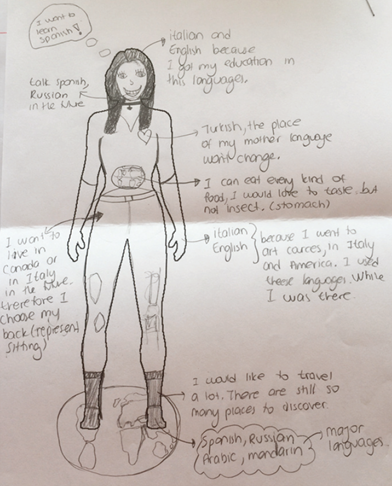
Figure 1. Linguistic Portrait, taken from Galante, 2019
- Translingual mediation Teachers can get students to read or listen to texts in the languages they already know, take notes, and bring them to the language classroom. For example, in a French class with the topic of global warming, the teacher can ask students to do some research at home about the topic in different languages. A student who speaks Mandarin can access information in a Chinese online newspaper, bring the knowledge to the classroom, and present the information in French. By doing this, students are mediating knowledge across languages, learning French, and developing critical thinking by analyzing content produced in texts in different languages and published in different venues.
- Translanguaging buddies If in a language class there are two or more students who share the same languages, the teacher can sometimes have these students help each other in the languages they share. For example, in a French class where there are two students who speak Spanish, the teacher can encourage them to use Spanish to clarify information, understand the content, and even teach their peers some Spanish words. Translanguaging buddies do not necessarily have to speak the same languages. One student who speaks Russian can be paired up with a student who speaks Arabic; they can both discuss the topic in a mix of French, Russian, and Arabic and make sense of the content.
These three examples may already look familiar among some teachers, but others may find them radical. But why should teachers even attempt to use a plurilingual approach? In the first part of this article, I provided a rationale based on the increase of multilingualism in Canada and in the world. Below, I will provide some arguments based on recent research.
What does research say about plurilingual education?
Many studies conducted in different language classrooms (ESL, FSL, immersion, bilingual programs, etc.) and countries suggest several benefits of a plurilingual education, including language development, empathy, self-esteem, cognition, and motivation, among other factors. In my own research (2020), I have investigated teachers’ perceptions of a plurilingual approach in the English-language classroom compared to a monolingual approach (English-only). Seven teachers participated in the study and they taught two classes using two different approaches: plurilingual with one class and English-only with another class, for a period of four months. The content was similar but the approach was different, and the teachers did not have to change their entire curriculum to apply a plurilingual approach. In fact, they introduced one plurilingual task per week, for about 30–40 minutes in one class, while the other class had similar content but used one English-only task per week. After I interviewed the teachers at the end of the program, they unanimously reported preference for a plurilingual approach compared to English-only. For these teachers, a plurilingual approach:
- taps into students’ lived experiences, and develops English based on their personal trajectories rather than on unrealistic scenarios where they need to use the target language
- challenges teachers’ monolingual and monocultural mindset and the idea that students are not plurilingual
- helps students develop agency and feel free to use their linguistic repertoire whenever they want or need for the purposes of learning
- allows students to feel pride in the languages and cultures in their repertoire
- engages students in learning not only the target language but also about the languages and cultures of their peers
- provides a safe space for students to discuss topics about cultural similarities and differences and demystify stereotypes.
The teachers also highlighted that they did not have to speak several languages themselves to use a plurilingual approach, and that even teachers who think of themselves as monolinguals (speaking one language only) can and should try to implement it in the classroom.
Moving forward
Given the current multilingual trends in Canada and recent calls for the provision of inclusive education to all students, innovative pedagogical approaches that prepare them to communicate across languages, cultures, and contexts are now needed. People will continue to communicate face-to-face and online, and being able to use their repertoire to understand how language use and culture may vary across contexts, be open to more language and cultural learning, and advocate for linguistic and cultural inclusiveness in schools and other spaces is paramount for an inclusive society. If we want to better prepare our students for current and future Canadian realities of multilingualism, change needs to happen soon. Canada has a unique opportunity to remain a leader in language education, but it needs to go beyond bilingualism and encourage Canadians to become plurilingual speakers. Supporting plurilingualism will not take away from the languages already existent in Canada; it will add openness to the English/French bilingual dichotomy and the popular discourse that the country is bilingual. Canada is much more than that.
For more research and resources, visit McGill University’s Plurilingual Lab.
Banner Photo : Adobe Stock
First published in Education Canada, March 2021
Read other articles from this issue
References
Council of Europe. (2020). Common European Framework of References for languages: Learning, teaching, Assessment. Companion Volume. Council of Europe Publishing.
www.coe.int/lang-cefrGalante, A. (2020). Plurilingual and pluricultural competence (PPC) scale: The inseparability of language and culture. International Journal of Multilingualism.
https://doi.org/10.1080/14790718.2020.1753747Galante, A. (2019). “The moment I realized I am plurilingual”: Plurilingual tasks for creative representations in EAP at a Canadian university. Applied Linguistics Review, 11(4), 551–580.
Galante, A., Okubo, K., Cole, C., Abd Elkader, N., Wilkinson, C., Carozza, N., Wotton, C., & Vasic, J. (2020). “English-only is not the way to go:” Teachers’ perceptions of plurilingual instruction in an English program at a Canadian university. TESOL Quarterly Journal.
https://doi.org/10.1002/tesq.584Harris, K. (2020, October 30). Federal government plans to bring in more than 1.2M immigrants in next 3 years. CBC News.
Statistics Canada. (2016). Linguistic diversity and multilingualism in Canadian homes.
UNESCO. (2019). International literacy day 2019: Revisiting literacy and multilingualism, background paper.
United World Schools. (n.d.). UN sustainable development goals: Our role.
-
Appreciating biodiversity to better protect it
Comments Off on Appreciating biodiversity to better protect itGlobal climate change and biodiversity loss are major contemporary challenges. To address these challenges, in 2015 the United Nations set 17 Sustainable Development Goals (SDGs), with a timeline to achieve them by the year 2030. Goal 15 reads as follows:
“Protect, restore and promote sustainable use of terrestrial ecosystems, sustainably manage forests, combat desertification, halt and reverse land degradation and halt biodiversity loss.”
The UN’s 2020 report on these goals (page 55) notes that, “The world is falling short on 2020 targets to halt biodiversity loss, despite some progress.”
Discovering life in nearby ecosystems
To familiarize students with the important issues facing humanity, school curricula generally present these subjects at the elementary and high-school levels. From a young age, students are introduced to major global problems like pollution, deforestation and extinction, as well as their impact on the planet’s inhabitants. However, perhaps schools should start by helping young people discover the organisms that inhabit the ecosystems around them.
The outdoor spaces surrounding schools are rich learning environments, as both urban and rural areas are always full of life. Every environment is inhabited by a variety of arthropods, plants, birds, and small mammals.
These environments can help children develop scientific skills like curiosity, observation and experimentation from a very young age (Ayotte-Beaudet, 2020a). For example, to teach students about plants often described as weeds, ask them to draw a chalk circle around any plants pushing through a concrete sidewalk near school. Then have them write in the plant’s name to inform passersby (www.sciencesdehors.com).
Nearby areas off school property can also be used to learn about natural phenomena in situ (Ayotte-Beaudet, 2020b). Students can adopt a tree to make systematic observations about it throughout the school year. This will enable them to determine the adaptation and survival mechanisms used by the tree while also discovering the variety of living organisms that interact with it (e.g., lichen and birds). This type of monitoring helps children develop a shared sense of ownership in the tree under study.
Outdoors, students can also carry out field activities just like scientists do. Citizen science projects give schools a well-defined observation framework to follow and provide knowledge about certain local species (Secours et al., 2020). Some examples of citizen science projects are eBird for birding and NatureWatch for environmental monitoring programs.
Learning to appreciate
The findings of a recent research project suggest that we should reflect on how schools teach biodiversity. The goal of the study in question was to better understand the impact on students of contextualized teaching and learning in a nearby ecosystem (Ayotte-Beaudet et al., in press). The participants, elementary-school students (ages 10-12), took part in a citizen science project designed to help them better understand the effects of global change on urban ecosystems (www.chenilles-espionnes.com). For the instructional phase, the researchers had decided to talk about nature in positive terms only, without ever mentioning environmental problems. During interviews conducted at the end of the project, many of the young people expressed the desire to protect living organisms, even though conservation was never explicitly mentioned. In other words, discovering nature in situ and hearing only positive things about it were enough to heighten young people’s awareness of the life around them.
Where to start?
If you are unaccustomed to holding outdoor classes on biodiversity, the first thing you should probably do is think about your motivation and set a clear learning objective for the first outing. This will help you plan the teaching and learning activities and persuade parents and administration to agree to your approach.
The first few times, it is better to go outside for short periods so you and your students can get used to this new learning environment (www.sciencesdehors.com). Research has also shown that it is important to properly prepare students for these outings, get them engaged in activities, and give them an opportunity to make choices (Ayotte-Beaudet & Potvin, 2020; Ayotte-Beaudet et al., 2019). Most importantly, stimulate the children’s curiosity and trust them. Furthermore, if you are a school principal, trust your teaching staff and give them a chance to experiment!
Conclusion
Elementary school curricula often focus on the gravity of environmental issues, but everyone involved in education should reflect on the best ways of making children aware of biodiversity. At what age can we, in good conscience, burden younger generations with the weight of the problems they will inherit? Before asking them to protect and restore terrestrial ecosystems, I believe we have a duty to teach them how to appreciate the diversity of life in the ecosystems around them.
Photos: Courtesy of Jean-Philipe Ayotte-Beaudet
First published in Education Canada, March 2021
Read other articles from this issue
References
Ayotte-Beaudet, J.-P. (2020a). Éveiller aux sciences de la nature à ciel ouvert. Revue préscolaire, 58(4), 36-38. http://aepqkiosk.milibris.com/reader/9d1311ef-ccbb-4df1-af16-ebc7f44582ae?origin=%2Frevue-prescolaire%2Frevue-prescolaire%2Fn584-2020
Ayotte-Beaudet, J.-P. (2020b). Regarder dehors pour apprendre et enseigner les sciences. Vivre le primaire, 33(3), 38-40. https://aqep.org/wp-content/uploads/2020/09/D-Regarder-dehors-pour-apprendre.pdf?fbclid=IwAR248QqdERwurwv755FVeGYMItC61bYxQ9GOjs4hbwxSiUN_-fT45NxlV8k
Ayotte-Beaudet, J.-P., Chastenay, P., Beaudry, M.-C., L’Heureux, K., Giamellaro, M., Smith, J., Desjarlais, E., & Paquette, A. (2021, in press). Exploring the impacts of contextualised outdoor science education on learning: The case of primary school students learning about ecosystem relationships. Journal of Biological Education.
Ayotte-Beaudet, J.-P., & Potvin, P. (2020). Factors related to students’ perception of learning during outdoor science lessons in schools’ immediate surroundings. International Journal of Environmental and Science Education, 16(2), 1-13. https://doi.org/10.29333/ijese/7815
Ayotte-Beaudet, J.-P., Potvin, P. and Riopel, M. (2019). Factors related to middle-school students’ situational interest in science in outdoor lessons in their schools’ immediate surroundings. International Journal of Environmental & Science Education, 14(1), 13-32. http://www.ijese.net/makale/2100.html
Chenilles-espionnes (https://www.chenilles-espionnes.com) is a Website dedicated to a citizen science project developed by a partnership involving Les Clubs 4-H du Québec, Université du Québec à Montréal and Université de Sherbrooke.
Des sciences dehors (https://www.sciencesdehors.com) is a Quebec-based knowledge-sharing website developed by and for people interested in and passionate about teaching and learning science.
United Nations. (2020). The sustainable development goals report 2020. UN. https://unstats.un.org/sdgs/report/2020/The-Sustainable-Development-Goals-Report-2020.pdf
Secours, É., Paquette, A., Ayotte-Beaudet, J.-P., Gignac, A., & Castagneyrol, B. (2020). Chenilles-espionnes, un projet de sciences citoyennes pour sensibiliser les jeunes à la biodiversité. Spectre, 50(1), 27-31. https://fr.calameo.com/aestq/read/00518148392339471f721
-
Implementing Social Emotional Learning During a Pandemic
Comments Off on Implementing Social Emotional Learning During a Pandemic
Join us for a special virtual event focusing on the increasing importance of supporting social-emotional learning (SEL) amidst a global pandemic. This event will feature Avon Maitland District School Board in Ontario, who will be sharing their experience implementing and measuring SEL using Peekapak resources. The flexibility of Peekapak’s SEL in either remote or in-class formats makes it easy for educators to implement. This event is intended to help school administrators support their educators, and it will be recorded and available to all those who register.


IDEAS TO SUPPORT EDUCATORS : Subscribe to the EdCan e-Newsletter
Quality research, reports, and professional learning opportunities.