
Archive
-
Webinar: Teacher and School Staff Wellbeing 101
Comments Off on Webinar: Teacher and School Staff Wellbeing 101
Co-presenters: Dr. Kim Schonert-Reichl and Dr. Mark Greenberg
In this webinar, Dr. Kim Schonert-Reichl and Dr. Mark Greenberg review the latest research on how teacher stress impacts student wellbeing, contributing factors to teacher/staff stress and burnout, and what we know (and don’t know) about how to address this issue.
-
Infographic: Why Focus on Teacher and School Staff Wellbeing?
Comments Off on Infographic: Why Focus on Teacher and School Staff Wellbeing?
This infographic provides an overview of key research and references from Canada and beyond that outlines the case for investing in teacher and school staff wellbeing.
-
Losing My Voice
Comments Off on Losing My Voice -
Losing your most powerful tool in the classroom – your voice
Comments Off on Losing your most powerful tool in the classroom – your voiceAs an educator, you never know what your day is going to look like as you try to balance the different learning styles and needs that your students bring to the classroom. We far too often are tasked to consider – in addition to these diverse learning needs – that many students have experienced trauma and/or stress, which they innately bring with them to school. As such, we sometimes find ourselves in a position where we’re unable to discuss these experiences due to their sensitive nature, which can lead us as educators to self-internalize these traumas and negative emotions that our students are experiencing.

Still, we push through and continue to put a smile on our faces while keeping the day moving along as smoothly as possible for our students’ sake. Why? Because we care for our students and want to protect them, which is part of the trust-based relationship that we work hard to build with each of them. However, when we suppress our natural and innate responses by merely “pushing through,” we aren’t allowing our bodies to feel and respond naturally. For me personally, in continuing this pattern of putting on a smiling face for my students, my body eventually found a way to let me know that I wasn’t okay – voice loss.
WHAT MY BODY WAS TRYING TO TELL ME
I was experiencing voice loss almost monthly. I was unable to socialize with friends and unable to be a vocal part of my family. It became overwhelmingly clear to me just how much my voice loss was affecting my ability to participate in day-to-day events. At my son’s soccer game, all I could do was sit – which meant no cheering and no conversations with other parents whom I normally spoke with. I quickly learned that voice loss is a very isolating experience.

As a Special Education Resource Teacher (SERT) my voice is an important part of my job. As I was losing my voice so often, I also had to miss days off work. It was at this point that I decided that I needed to seek medical help. I wasn’t sure what to expect and nothing could have prepared me for the verdict on what would be the true cause of my voice loss. After consulting with my family doctor, an Ear-Nose-throat Specialist (ENT), a Speech and Language Pathologist (SLP), and a counsellor, the verdict was that I had experienced voice loss due to Vicarious Trauma (VT) and Stress. I remember thinking, “That can’t be right!” I always knew there was stress in teaching, but I wasn’t aware of the toll it could end up having on my own physical health.
I had no idea just how much time, energy, and vulnerability it took to become well again. To begin my healing journey, I reduced my workload to half-time. Part of me felt ashamed for missing work for something that didn’t seem to be a common problem among my colleagues. Why weren’t they losing their voices, too? I was scared to tell my coworkers the truth about my voice loss, and so I lied to everyone by instead saying that I had “voice strain.” Above all, what I truly wasn’t ready to share was that my voice loss had really meant that I was stressed out and traumatized.
Throughout my journey, I’ve realized that listening to my body and taking a break to look after myself does not make me weak. This realization, along with the wonderful support I’ve received from my family, my counsellor, my SLP, and my friends, gave me the confidence to be more open and equipped to share my story. While I was initially terrified of what my colleagues would think, I soon learned how fortunate I was to work with an amazing group of people. As I continued to share my story, I realized just how many of my coworkers have had similar experiences of stress in the workplace – that I wasn’t alone.
HOW I’M REGAINING CONTROL OF MY WELLNESS
In an effort to build a work culture that promotes wellness, I’ve taken part in creating a ‘Wellness Committee’ at our school. The Committee has done several things including providing a snack bowl for staff, putting plants in the staffroom, celebrating staff members’ birthdays, sharing daily uplifting quotes, organizing team-building activities, and creating a space known as the ‘Rejuvenation Room’ for staff and students.

As I look back at the journey that has brought me to where I am today, I at times debate the future of my career. After yet another visit to the clinic due to voice loss, my family doctor had straight-up asked me, “You’re not giving it up yet?” What’s more, after I had disclosed that I’ve always wanted to be a teacher, even my counsellor had challenged my belief that I am “living my dream.” To be honest, I do debate my future in education. I never would have thought I’d receive a diagnosis for Vicarious Trauma and Stress in direct relation to my work as a SERT.
So many things are out of our control in education, but what we do have control over is our wellness and ourselves. Voice loss has shown me that I was giving too much without adequately looking after myself. At this point, I’m able to better listen to my body and identify when my stress level is getting too high. I feel more in control of my wellness than I used to. I’ve been able to find joy and happiness throughout this experience and I’m thankful for what I’ve learned and continue to learn, and how I feel right now in this very moment as I continue to teach.

-
Sommet pancanadien sur le bien-être au travail des intervenants scolaires d’écoles primaires et secondaires
Comments Off on Sommet pancanadien sur le bien-être au travail des intervenants scolaires d’écoles primaires et secondairesStratégies pratiques pour améliorer le bien-être du personnel dans les écoles et les commissions scolaires au Canada.
Le bien-être du personnel d’écoles primaires et secondaires est une priorité dans les écoles et les conseils et commissions scolaires du Canada, et pourtant, le stress et l’épuisement professionnel ne cessent d’augmenter chez les surintendants*, directeurs d’école, enseignants et autres membres du personnel scolaire. Êtes-vous prêt à changer ce scénario et à découvrir COMMENT promouvoir un milieu de travail plus positif qui favorise le bien-être de l’ensemble du personnel?
Inscrivez-vous dès maintenant!
À noter que l’événement se déroulera principalement en anglais. Certains ateliers seront bilingues.
Veuillez nous contacter si vous souhaitez ovtenir de l’aide pour vous inscrire au sommet.En savoir plus sur l’événement
↓
Aperçu du sommet

APERÇU DES FRAIS D’INSCRIPTION
Prix de pré-inscription (jusqu’au 13 mars 2020)
MEMBRE ÉDCAN NON-MEMBRE Conférence seulement (12 et 13 mai) 350 $ 400 $ Pré-conférence (11 mai) + conférence (12 et 13 mai) 425 $ 500 $ Prix régulier (après le 13 mars 2020)
MEMBRE ÉDCAN NON-MEMBRE Conference Only (May 12-13) 400 $ 450 $ Pré-conférence (11 mai) + conférence (12 et 13 mai) 500 $ 575 $ TEAM DISCOUNT ON CONFERENCE FEES: -$50.00/PERSON FOR TEAMS OF 3 OR MORE FROM THE SAME ORGANIZATION OR SCHOOL DISTRICT
RÉDUCTION SUR LES FRAIS DE CONFÉRENCE : – 50 $ / PERSONNE POUR LES ÉQUIPES DE 3 OU PLUS DE LA MÊME ORGANISATION OU DU MÊME SECTEUR SCOLAIRE
Vous ne savez pas si vous êtes membre? Consultez la liste de tous nos membres, ou contacter la responsable des adhésions au membership@edcan.ca OU 866-803-9549, poste 223.
Tarif de l’hôtel : 229 $ / nuit + taxes
Voici nos conférenciers principaux!

Mark T. Greenberg
Auteur, spécialiste international renommé de l’apprentissage socio-émotionnel et directeur-fondateur du Bennett Prevention Research Center for the Promotion of Human Development.

Kimberly Schonert-Reichl
Éminente spécialiste de l’apprentissage socio-émotionnel et de l’éducation des enfants et des enseignants fondée sur l’empathie, la résilience et la pleine conscience.

Sue Roffey
Auteure et conférencière de renommée internationale, elle travaille sur une approche globale du bien-être du personnel d’écoles primaires et secondaires en Australie et au Royaume-Uni.

Susan Rodger
La plus éminente spécialiste au Canada en matière de stress, d’épuisement professionnel, de travail émotionnel, de fatigue de compassion et de résilience.

Katina Pollock
La plus éminente spécialiste au Canada en matière d’intensification du travail et de bien-être des directeurs et directeurs adjoints d’écoles.
Consultez la liste complète de nos conférenciers au www.edcansummit.ca/agenda
Un sommet PLUS trois expériences novatrices
Cette expérience d’apprentissage sans précédent ne se termine pas avec les remarques de clôture. En plus d’allocutions et d’ateliers de qualité, ce sommet vous offre trois expériences novatrices visant à solidifier votre réseau et à faire profiter votre école, commission scolaire ou organisme de stratégies pratiques qui vous permettront d’entreprendre l’amélioration à long terme de votre milieu de travail.
Séances de coaching en petits groupes
Les bonnes idées ne resteront pas sur le papier. Apprenez à mettre en œuvre des stratégies efficaces de bien-être adaptées à votre milieu de travail grâce à des séances de coaching en petits groupes dirigés par des spécialistes en la matière.

Salon des ressources en bien-être au travail
Rien ne sert de réinventer la roue. Inspirez-vous de programmes novateurs qui font déjà du bien-être en milieu de travail une priorité absolue dans certaines écoles et commissions scolaires. Explorez à votre rythme ce salon des ressources et discutez avec des champions du bien-être au Canada.

Sorties pédagogiques
Les idées ne sont bonnes que si elles sont adaptées aux réalités quotidiennes du personnel des écoles primaires et secondaires. Des sorties pédagogiques favoriseront l’apprentissage au-delà des murs du colloque en vous faisant connaître des écoles, commissions scolaires et collectivités de la région.

Photos : SquareSpace
Pour tout savoir sur notre Sommet, consultez les sections
ci-dessous en cliquant sur les flèches. -
EVENT RECAP: The Case for Investing in K-12 Staff Well-being
Comments Off on EVENT RECAP: The Case for Investing in K-12 Staff Well-being
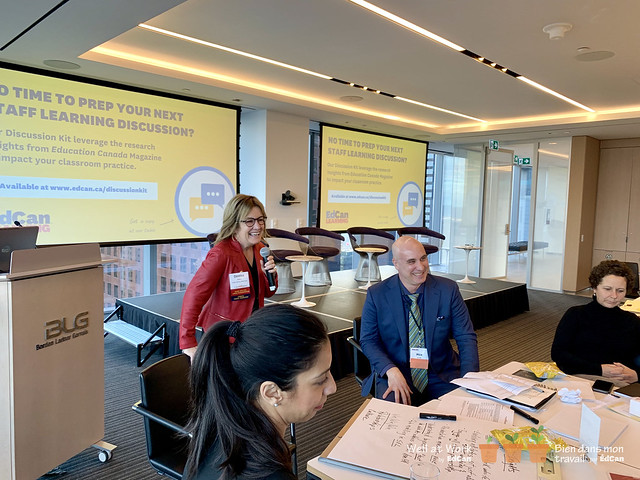
On November 22, 2019, ministry and faculty of education representatives, Directors of Education/CEOs, and other K-12 leaders from across Canada attended our EXCLUSIVE professional learning session, where they:
-
Learned the fundamental principles and evidence behind workplace well-being in K-12 education
-
Found out how investing in educator well-being can heighten student achievement and save precious resources
-
Discussed ways to go beyond one-off unsustainable programs to a long-term, system-wide approach
Click on the album to see more photos from our event.
ALL-STAR PROGRAMME AND PRESENTATIONS
Led by Edcan Network and the McConnell Foundation
CLICK HERE TO DOWNLOAD THE PRESENTATION
PRESENTATIONS LINEUP:
1. The Business Case for Workplace Well-Being: Rationale for an Upstream Approach
Led by Leanne Keyko, Health Strategies Liaison & Trudy Lakusta, School Jurisdiction Liaison, Alberta School Employee Benefit Plan (ASEBP)
CLICK HERE TO DOWNLOAD THE PRESENTATION
2. The Legal Case for Workplace Well-Being: How Health and Safety Legislation Can Help You Achieve the Best Return-on-Investment
Led by Anna V. Karimian, Associate – Labour and Employment Group, Borden Ladner Gervais (BLG) LLP
CLICK HERE TO DOWNLOAD THE PRESENTATION
3. The Student Achievement Case for Workplace Well-Being: Raising Student Outcomes through a Whole-System Approach to Well-Being
Led by Dr. Bill Morrison, Professor of Educational Psychology & Co-Executive Director, Health and Education Research Group (HERG), University of New Brunswick; President, WMA Wellness
CLICK HERE TO DOWNLOAD THE PRESENTATION
Led by Dr. Charlie Naylor, Affiliated Scholar – Simon Fraser University; District Well-Being Coach; former Senior Researcher – British Columbia Teachers’ Federation (BCTF)
CLICK HERE TO DOWNLOAD THE PRESENTATION

Small group facilitated discussions supported participants to consider and share “Where they’re at,” “What they learned,” and “What they need to do to move forward” to lead greater investments into workplace well-being in their own school communities.
Couldn’t make it?
Stay tuned for our Pan-Canadian Summit on K-12 Workplace Well-Being!
Learn more about the summit here
Thank you to our partners

Special thank you to

Toronto’s preeminent meditation studio for providing free class passes
Gift raffle prize sponsored by:




-
-
Recess for Everyone
Comments Off on Recess for Everyone -
How you can start taking more effective breaks – and inspire your students and colleagues to do the same
Comments Off on How you can start taking more effective breaks – and inspire your students and colleagues to do the sameAs teachers, we often grumble amongst ourselves during break time as we walk briskly through the halls and come across students who are either glued to their smartphones or sitting or leaning on lockers. “No social skills,” we confidently diagnose. “No one talks to each other anymore,” we lament. Our lost suggestion of “they should go outside and run around” is as empty as the playground itself. As we make our way to the staff room to check our mailboxes, we then promptly head back to our classrooms to frantically check items off our to-do list – emails, assignments that need grading, or spaces that need tidying up. After the break, everyone returns to class just a little bit less focused and certainly more fatigued, and it’s clear that we haven’t effectively used our break time.

THE DIFFERENCE BETWEEN A ‘BREAK’ AND AN ‘EFFECTIVE BREAK’
Everyone can benefit from taking a step back and reconsidering how they spend their breaks throughout the school day. Sure, our students can benefit from “going outside and running around,” but so can adults! There are three things we need to remind ourselves when it comes to taking an effective break during our workdays, which can literally restore our brains and rest our minds if we put these into practice:
- It’s NEVER unproductive or ‘time lost’ to spend our breaks getting a bit of physical activity.
- Spending our breaks in the outdoors allows us to return to work refreshed and rested.
- Leaving our smartphones and devices behind every now and then may actually allow us to reconnect with others – or at least give our brains a rest.

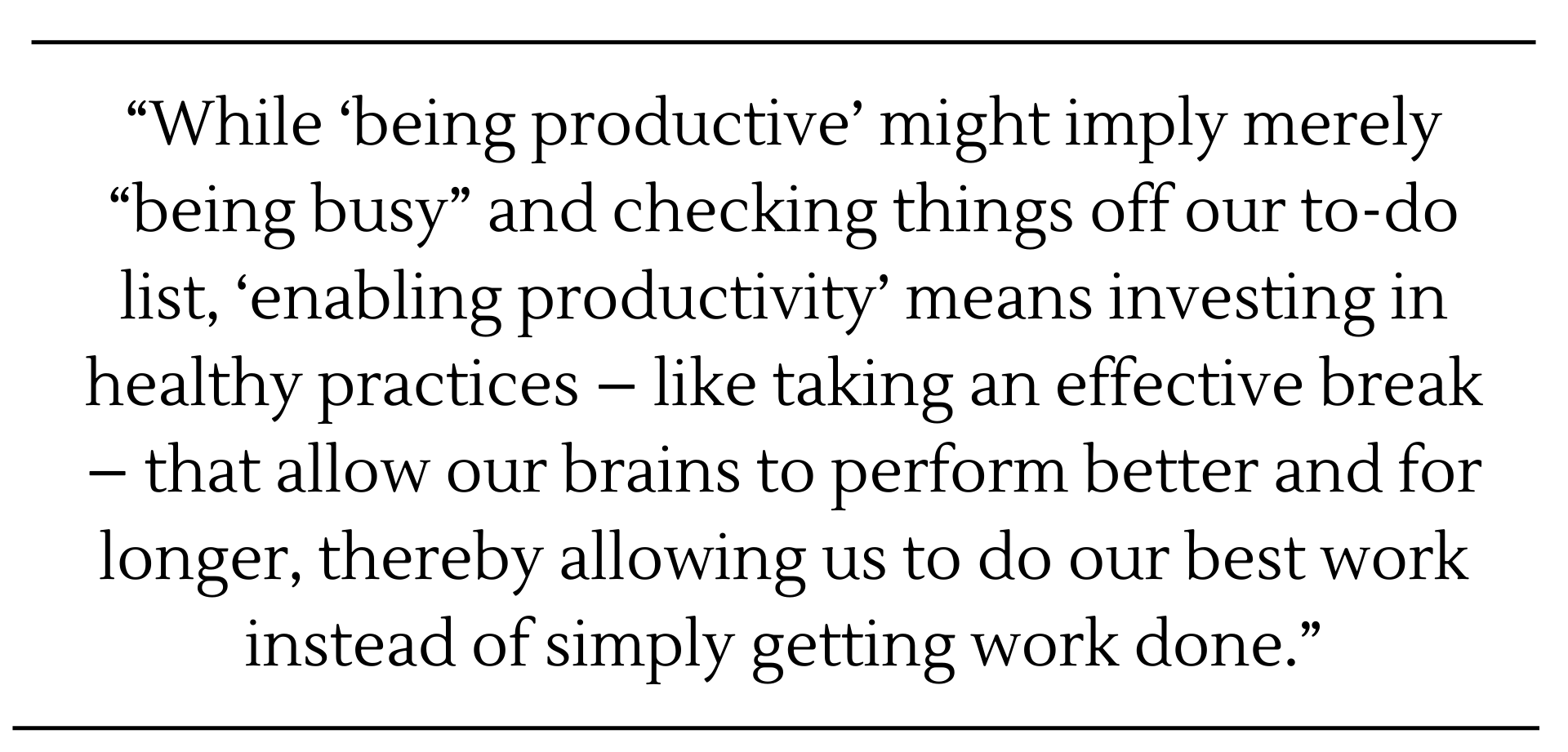
Integrating these reminders into our daily work lives represents an attempt at reorienting our minds to the idea that taking time out isn’t just about ‘being productive’; rather, it’s about ‘enabling productivity.’ While ‘being productive’ might imply merely “being busy” and checking things off our to-do list, ‘enabling productivity’ means investing in healthy practices – like taking an effective break – that allow our brains to perform better and for longer, thereby allowing us to do our best work instead of simply getting work done.
We also know that sedentary behaviours and physical inactivity are directly linked to all kinds of chronic health issues. This is true for all age groups from the younger years to the older years. We also know that sleep, nutrition, and screen time are variables in our personal wellness equation. So how do we put these all together and ensure that we’re getting enough of each of these variables? The good news is that the Canadian Society for Exercise Physiology has created a very articulate set of evidence-based infographics that allow the general public to make sense of all of the health recommendations that often get thrown at us. Fundamentally, what you need to know is that all types of movement are important: slow, moderate, and vigorous. And remember that there isn’t anything wrong with sitting down, but it’s also important to limit how long we remain sedentary while making sure that we’re not inactive for extended periods of time.
Sweat, Step, Sleep, and Sit are the so-called Four S’s of a healthy day. While the nuts and bolts of these four components differ depending on how old you are, the core recommendation is that we all need to pay attention to how long we:
1. Sweat through moderate to vigorous physical activity on the playground, during physical education, while leading extracurricular activities, or during our own workout routines.

2. Step through light physical activity during unstructured play, walking, or practicing ‘body movement breaks’ throughout the day.

3. Sleep without interruption and with consistent bedtime and wake-up times.

4. Sit and limit sedentary behaviour through the day.

Never forget – as a school community, we have the ability to encourage each other to be more physically active. Although a 7-minute walk around the block with colleagues during lunch hour may not work up a sweat, it’s nevertheless valuable in improving our overall mood. Creating opportunities for students and staff to move together during breaks is also a great way for us to sustain our collective well-being as a school community.
WHY RECESS ISN’T JUST FOR KIDS
There’s a clear connection between our well-being and being outdoors. Throughout the day, our brains get tired and our cognitive functions decrease. Some of the more obvious symptoms of cognitive fatigue include reduced performance and productivity, decreased effectiveness in completing tasks, and reduced competency. But some of the less obvious symptoms, which may manifest in students and staff, include impulsiveness and increased risk taking, irritability and negative emotions, insensitivity to interpersonal cues, and impatience. Do any of these symptoms sound like you or your students after a morning of indoor recess?

Research on cognitive restoration has found that exposure to natural environments helps aid recovery from physiological stress and mental fatigue. In fact, Kaplan’s ‘Attention Restoration Theory’ (ART) has been around for decades and is still used by researchers to this day. ART tells us that being in nature gives us a sense of ‘being away’ by shifting our attention from whatever demands we may be experiencing in our workplace, which helps restore our cognitive functions. Plus, we don’t need to go far – the schoolyard, neighbourhood park, or even our backyards provide this healthy sense of ‘being away.’ We also don’t need to spend lengthy amounts of time outdoors, either – brief contact with nature can boost our mood, with research recommending 20 minutes as the optimal amount of time to reap the benefits of spending time outdoors. Above all, even making small efforts to take deep breaths or look around at the trees can leave our brains feeling a bit more rested and a bit more restored.
WHY YOU NEED TO PUT DOWN YOUR PHONE
Addiction to technology and excessive use of online communications is directly related to psychological factors such as stress, anxiety, and depression. Although we may not personally consider ourselves technology addicts, we know that taking an effective break during the day doesn’t entail using our devices or other technology. In fact, walking around, sitting, and looking at our devices while spending time outdoors actually counteracts the benefits that nature provides. Unsurprisingly, overuse of our devices is a growing issue that’s most prevalent in people under the age of 30. That said, I’m sure we can all agree that time away from our screens is refreshing. Promoting social activities on the playground, inviting colleagues to take a ‘walking meeting’ outside instead of a typical ‘sit down meeting’ in a classroom, or even just taking a ‘time out’ from our devices are all great ways that we can role model taking effective breaks throughout the day.

THE TAKEAWAY: WE NEED TO RETHINK ‘PRODUCTIVITY’
I’m just as guilty as the next person for feeling a strong desire to be productive during my breaks by working through my to-do list. At times, I’m guilty of not taking a break at all – I hate being cold in the middle of winter and I cringe at the thought of stepping out in the rain. However, when we begin reorienting our minds towards the importance of taking effective breaks that entail (A) moving around more during the day, (B) getting outside, and (C) leaving our devices behind, we may actually begin to see some changes in our behaviour, concentration, and ability to learn new skills at work. It’s easy to tell our students that “they should go outside and run around” but, as adults and role models, we’d be better off actually taking a piece of our own advice.
LISTEN TO THE PODCAST WITH DR. SHANNON KELL ON TAKING EFFECTIVE BREAKS:
Listen to “Recess for Everyone ft. Dr. Shannon Kell” on Spreaker.
References and Further Reading
Atchley, R. A., Dtrayer, D. L. & Atchley, P. (2012). Creativity in the wild: Improving creative reasoning through immersion in natural settings. PloS one, 7(12), e51474. https://doi.org/10.1371/journal.pone.0051474
Berto, R. (2014). The role of nature in coping with psycho-physiological stress: A literature review on restorativeness. Behavioral Sciences, 4, 394-409. https://doi.org/10.3390/bs4040394
Capaldi, C. A., Passmore, H., Nisbet, E. K., Zelenski, J. M., & Dopko, R. L. (2015). Flourishing in nature: A review of the benefits of connecting with nature and its application as a wellbeing intervention. International Journal of Wellbeing, (5)4. https://doi.org/10.5502/ijw.v5i4.449
Hartig, T., Evans, G., Jamner, L. D., Davis, D. S., & Garling, T. (2003). Tracking restoration in natural and urban field settings. Journal of Environmental Psychology, 23, 109-123. https://doi.org/10.1016/S0272-4944(02)00109-3
Hunter, M. R., Gillespie, B. W., & Chen, S. Y-P. (2019). Urban nature experiences reduce stress in the context of daily life based on salivary biomarkers. Frontiers in Psychology, (2)722, 1-16. https://doi.org/10.3389/fpsyg.2019.00722
Jiang, B., Schmillen, R., & Sullivan, W. C. (2018). How to waste a break: Using portable electronic devices substantially counteracts attention enhancement effects of green spaces. Environment and Behavior,1-28. https://doi.org/10.1177/0013916518788603
Kaplan, S. (1995). The restorative benefits of nature: Toward an integrative framework. Journal of Environmental Psychology, 15, 169-182. https://doi.org/10.1016/0272-4944(95)90001-2
Lee, U., Lee, J., Ko, M., Lee, C., Kim, Y., Yang, S. & Song, J. (2014). Hooked on smartphones: An exploratory study on smartphone overuse among college students. In Proceedings of the SIGCHI Conference on Human Factors in Computing Systems (pp. 2327-2336). https://doi.org/10.1145/2556288.2557366
Pearson, D. G., & Craig, T. (2014). The great outdoors? Exploring the mental health benefits of natural environments. Frontiers in Psychology, 5(1178). https://doi.org/10.3389/fpsyg.2014.01178
- It’s NEVER unproductive or ‘time lost’ to spend our breaks getting a bit of physical activity.
-
Love, Heartbreak, and Teacher Emotional Well-being
Comments Off on Love, Heartbreak, and Teacher Emotional Well-being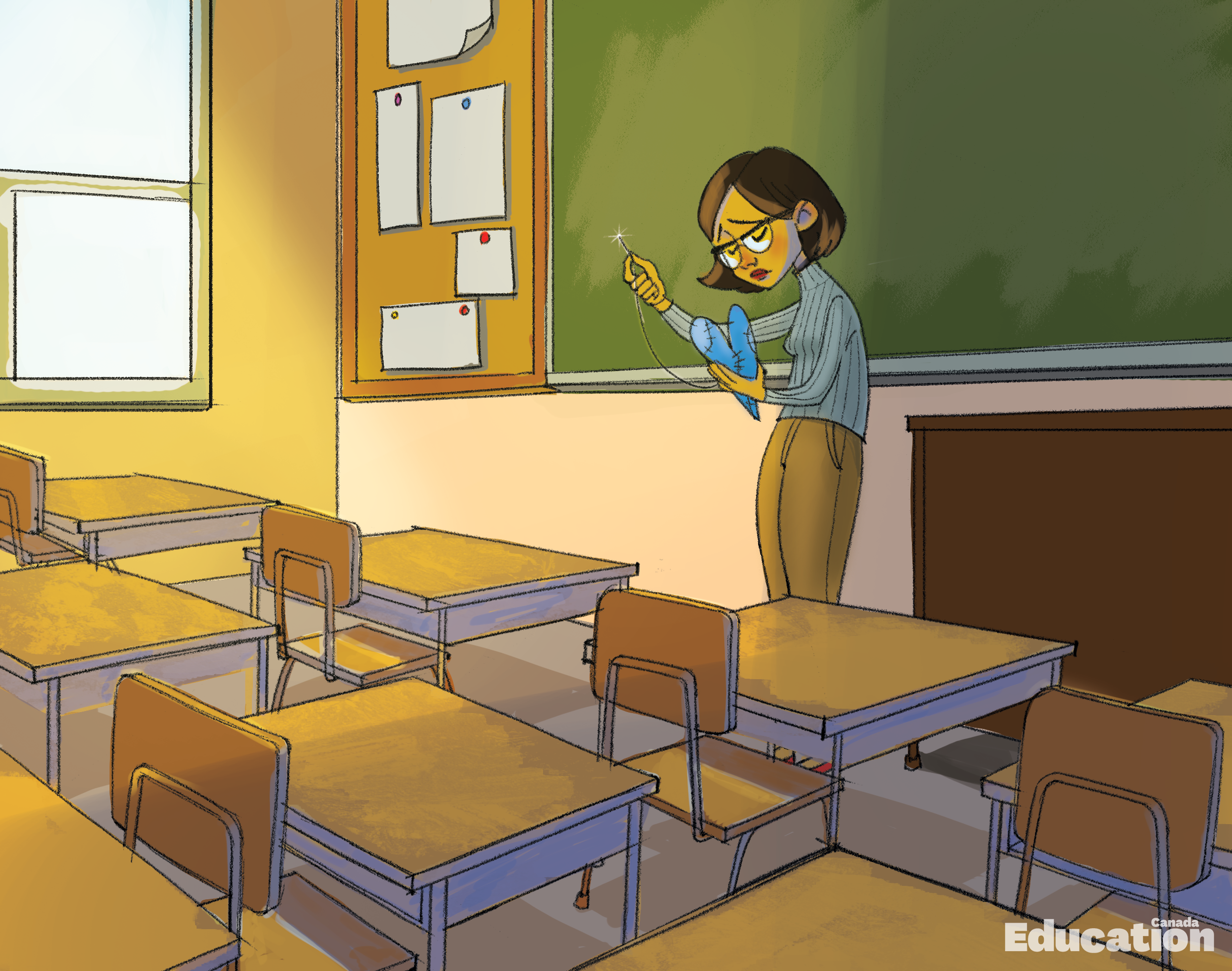
Losing your passion for a calling you once loved is a kind of heartbreak, says Astrick Kendrick: occupational heartbreak. She explores the emotional labour of teaching and its role in teacher burnout and exhaustion. She also suggests steps that can be taken to “to ensure that rather than experiencing occupational heartbreak, educators stay committed to their heart’s work.”
I don’t remember a time when I didn’t want to be a teacher. From the first day of primary school, I looked at my teacher and decided that was what I wanted to be when I grew up. I didn’t explore any other career options, and when it came time to apply for post-secondary education, I applied to one university and one faculty. The only time I dealt with any uncertainty was in deciding between primary or secondary specialization. Thanks to a love for reading and a respect for my high school English teacher, I chose secondary English/Language Arts.
Twenty-four years later, I feel no regrets for following my “calling” even though my understanding of the profession has changed dramatically. Teaching is still my passion, and I have a deep love for engaging with students and connecting them to the language arts. Experiences with teaching a subject area that I didn’t explore in my undergraduate degree (Physical Education) in seven different schools with complex students has sorely tested that passion over time. And on one particularly difficult day, it almost extinguished that fire completely. Nearly losing my love for teaching was devastating and drove me to understand what had happened. Instead of giving up my life’s work, I decided to pursue graduate studies to understand more about teacher emotional well-being.
“Just as a carpenter is expected to provide manual labour as a part of their job description, educators are expected to provide emotional labour to maintain a calm and engaging school culture.”
Emotional labour and education
When I began my research for my Doctor of Education in 2015, I discovered the concept of emotional labour. This organizational construct, first described in The Managed Heart by Arlie Hochschild in 1984, describes the influence of organizational feeling rules on the expression of emotions by individual people as they go about their daily work. Just as a carpenter is expected to provide manual labour as a part of their job description, educators are expected to provide emotional labour to maintain a calm and engaging school culture. Unlike the carpenter who uses their physical body to perform job tasks, a teacher provides their positive emotions – enthusiasm, positivity, and joy – to perform their work. Even in times when a teacher might not feel calm and confident, she will act that way with her students.
Hochschild used the metaphor of acting to describe the portrayal of expected emotions while engaged in paid work. She described two types of organizational performance related to providing emotional labour: superficial and deep acting.
To understand these concepts, first consider the following hypothetical situation:
The date is June 17, and many of the students in a school are writing their Provincial Achievement Exams. Freda, a Physical Education teacher, has been assigned to supervise a group of students as they finish up this two-hour exam. She has spent the school year building positive relationships with these students, but she has struggled to connect with Joshua. All term, Joshua has displayed inattention, interrupted her when she was explaining games in class, and actively distracted other students in inappropriate ways. Her everyday interactions with Joshua are often difficult, but she is committed to building a strong relationship with each student.
The allocated exam time is nearly complete, with about half of the students waiting patiently for the rest to hand in their work. Rather than drawing or reading quietly like his peers, Joshua alternates between hopping onto the class couch, tapping his pencil repeatedly on his desk, and loudly whispering to anyone who is nearby. Freda repeatedly asks him to respect his classmates who are trying to focus on their exam.
Superficial acting would be used to mask the inappropriate emotions felt by the individual. Ongoing superficial acting in a workplace has been associated with emotional burnout and exhaustion. In this scenario, Freda might use superficial acting to cover up her mounting frustration with Joshua. While she might feel like screaming and yelling at him to quiet down, Freda would strive to speak politely and firmly to him. At the end of the exam supervision, Freda might feel fatigue from managing her frustration and might be irritable when interacting with another person.

Deep acting, on the other hand, reflects an alignment between the person’s actual emotions and the expected display of emotions. If Freda, understanding that Joshua’s parents could not afford his medication, felt compassionate rather than frustrated by the displayed behaviour, her emotional display would line up with her actual feelings. This deep acting has been shown to be a protective factor against emotional burnout. In this case, Freda would feel fine after the supervision and would complete her day without any further concern.
Providing emotional labour is an expected part of being a teaching professional, as it should be. Teachers are normally the only adults with impressionable students at any given time, and if they appear frazzled, angry, or frustrated, it will be difficult to create effective pedagogic relationships with their students. Portraying organizationally expected emotions is a necessary part of maintaining professionalism, but if this emotional labour is primarily accomplished through superficial acting, the educator will eventually experience emotional burnout or unexpected outbursts.
Love, heartbreak, and educational turbulence
In my doctoral research, love stood out as an emotion associated with deep acting and was a protective factor for educators dealing with difficult times or situations. Teachers expressed love for students and love for subject area as reasons that they came to, and stayed in, the education field.
One of my participants described this love as “heartwork,” a pun on hard work. As a system level leader, she was responsible for assisting other educators with promoting the health and well-being of students. She poured her heart into the work because she was passionate about the positive academic outcomes associated with improving the health of children and youth. She was devastated when, due to financial cutbacks and restructuring, her job disappeared and all the work she had done along with it.
The change in financial priorities created educational turbulence for my participant. The other participants identified changes to curriculum without corresponding professional development; teaching in subject areas outside of the teacher’s expertise; and unmanageably complex classes of students as all causing educational turbulence leading to their occupational heartbreak. Unlike the sustaining effect of engaging in heartwork, heartbreak resulted in a devastating emotional exhaustion that forced the participants to question staying in the profession that they loved.
What can schools and leadership do?
Since completing my study in 2018, I have been presenting my findings to other teachers to determine if the experience of providing emotional labour is consistent and relatable to other teachers. I have spoken to over 100 teachers about this idea, and they have resoundingly agreed that providing ongoing emotional labour has contributed to their exhaustion and burnout at work.
“Simply recognizing that providing emotional labour is a part of educator professionalism is a first step.”
At the end of my workshop, I ask the question, “What do you need in order to release organizationally inappropriate emotions so that you can effectively work with students?”
The educators had several suggestions that could be implemented in school settings, many of which involve small, cheap tweaks to the work day:
- More breaks, less emails, less demanding extracurriculars: we are spread too thin. We are getting away from actually being present and focused on our students.
- Reduce the workload, increase opportunities for teachers to have calm in their day.
- Class sizes (especially given the increasing diversity of our population) need to be reduced. Special needs students need to be supported.
- Respect teacher transition time… Allow the teacher a few minutes before the next class comes in.
- Ensure each staff member has a defined break period each day. Reduce expectations during break times so that breaks are actually breaks. Don’t organize so many meetings; give teachers the time they need to prep and decompress.
- Offer activity and sport opportunities for staff during the work day and/or on non-instructional days. Create a staff work-out space.
- Increase supports for teachers who are struggling mentally.
- Carefully team up teachers to create support systems.
- Create a Zen room that teachers can go to.
- Say thank you and recognize successes.
- We need a strong champion for teachers in the media.
Stakeholders, such as parents, educational assistants, teachers, school administrators, and system leaders, can all play a role in promoting emotional health within the school system. Simply recognizing that providing emotional labour is a part of educator professionalism is a first step. The ethical next step is to find ways to ensure that when educators have provided intense emotional labour, they are provided with a safe place during their work day – through uninterrupted time, in a physical location, or with a trusted friend – to release their emotions in a healthy manner.

Ultimately, determining what to do in the aftermath of providing emotional labour needs to be addressed by educators and supported by school and system leadership. Having a frank conversation with staff teams about what they need, and then following through with the requested supports and resources, is the best way to ensure that rather than experiencing occupational heartbreak, educators stay committed to their heart’s work.
Study Description
My doctoral research study explored the lived experience with emotional labour of five female Health Champions as they navigated through systemic instability while implementing Comprehensive School Health projects. I aimed to discover the immediate emotional and embodied experiences identified by five change agents in leadership roles who have served as a pre-service student teacher, educational assistant, teacher, school leader, and system leader while undertaking educational reforms introduced between 2009 and 2016 in Alberta. Framed by complex adaptive systems theory, this study uncovered insights into their common understanding of the phenomenon of emotional labour for educators, both in their daily work and while acting in leadership roles. The findings of this study included: insight into the unique nature of the emotional work of educators and the intensification of emotional labour for change agents in educational settings; a phenomenological example of a possible lived experience with emotional labour; and suggestions for areas of future study on emotional labour, implementing Comprehensive School Health reforms, and improving the wellbeing of educators.
Illustration: Diana Pham and Adobe Stock
First published in Education Canada, December 2019
-
We All Have a Stake in Workplace Wellness
Comments Off on We All Have a Stake in Workplace WellnessYou don’t need a pile of research studies to make an educated assumption that healthy employees who feel positive about their jobs will do more effective, productive work. (But the studies exist and some are cited in the pages to come.) And it shouldn’t take much convincing that an enthusiastic and emotionally healthy teacher will have a better impact on students than one that is stressed, exhausted, and/or overwhelmed. As a parent, you can bet I wanted the first teacher for my kids, not the second! Yet when competing priorities jostle for limited resources, staff well-being can get pushed so far to the back that it drops right out of sight.
We have a tendency to see well-being as solely a personal responsibility. If employees are struggling, they should go to the gym, get better organized, become more resilient or adaptable. But several of our authors dispute this assumption. Self-care, while important, only goes so far. Instead, our authors argue that occupational mental health, like physical health and safety, is a shared responsibility.
I’d love to think that all employers would try to protect their employees from toxic levels of occupational stress simply because they care about their staff. But let’s be realistic: staff well-being can too often be shrugged off as a “frill” or a strictly personal problem. That’s why we have to recognize that chronically overstressed educators come with a cost to the system. Sick days, stress leave, even leaving the profession are just the most visible impacts of employees who are unwell. An investment in employee well-being is an investment that pays off in reduced HR costs, increased performance, and ultimately increased student achievement.
All human service professions entail a certain amount of stress. But for those who are passionate about their calling, the work should also be deeply rewarding. That’s what Astrid Kendrick calls the “heartwork” of teaching. It’s what leads teachers and school leaders to go above and beyond, to bring the very best they have to their students (or staff), year after year. When that passion is crushed by relentless stress, she calls the resulting burnout “occupational heartbreak.” The articles in this special issue show some of the ways we can protect our educators’ heartwork, so they can be the committed, energetic, enthusiastic professionals our children need and deserve.
The EdCan Network has recently launched “Well at Work,” a research and public awareness campaign that calls on education leaders to make teacher and staff well-being a top priority. Check out Network Voices to find out more about this exciting initiative.
Photo: Dave Donald
First published in Education Canada, December 2019
-
Well at Work
Comments Off on Well at Work
Despite the fact that stress and burnout are on the rise among staff in Canadian K-12 education systems, investment to support their well-being isn’t keeping pace. As the leading independent national voice in Canadian K-12 education, EdCan is pleased to officially launch “Well at Work” – a new research and public awareness campaign that calls on education leaders to make teacher and staff well-being a top priority.
“The well-being of K-12 staff is a high priority for school districts across Canada. As Director of Education, I look forward to the learning from Well at Work to inform our Board’s focus on staff well-being,” says Denise Andre, Director of Education for the Ottawa Catholic School Board and EdCan Chair.
With 128 years of experience convening stakeholders from across the entire spectrum of Canadian K-12 public education, EdCan is hosting a series of national events to build a common vision for workplace well-being, including:
Webinar: Making the Case for Workplace Well-Being in K-12.
This free one-hour webinar presented insights gathered through a large-scale survey of educators and the general public on how to better frame the issue of teachers’ and principals’ well-being. Replay the webinar here: www.edcan.ca/workplacewebinar
The Case for Investing in K-12 Staff Well-Being: Financial. Legal. Student Achievement.
This exclusive professional learning session brought together ministry and faculty of education representatives, directors of Education/CEOs, and other K-12 leaders from across Canada.
National Summit on Teacher and Staff Well-Being (May 2020)
This gathering will bring together champions, changemakers, and key stakeholders from across the country to learn more about ways to advance workplace well-being in K-12 education.
Well at Work is all about giving schools and school districts the tools they need to improve working conditions for the long term, through amplifying educators’ stories and lived experiences that get to the heart of what well-being actually means and looks like at work.
For educators, schools, school districts, and ministries of education looking to take their first steps towards creating a healthier workplace, a growing collection of free resources are available for download at: www.edcan.ca/wellatwork.
First published in Education Canada, December 2019
-
Teaching Well
Comments Off on Teaching WellFind a quiet place, take a few relaxing breaths, and read Lisa Bush’s new book on how to find balance in your hectic life as a classroom teacher, and get better results from your students.
In our increasingly complex world, we find increasingly complex classrooms. Teachers spend countless hours creating and assessing content, completing paperwork, and organizing extracurricular activities. This is added to their own home life responsibilities as parents, spouses, and children of aging parents. Many teachers, often those in the early part of their career, find the workload (especially the marking) overwhelming.
In Teaching Well, Lisa Bush sets out logical steps to help teachers move from surviving in the classroom to thriving in their career. Bush argues that as workload increases, it is often the things that recharge us that are the first to go: exercising, eating right and enjoying a hobby are dropped because a test needs to be graded or emails have to be answered. Bush offers clear, practical ideas to help teachers find the balance between work and life. Next, she asks the reader to critically look around. Look for teacher allies to collaborate with. Look to change assignments from seatwork to tasks that will empower students to become experts. Finally, look at how preparation and after-school time could be organized and optimized more effectively so that there is less to take home, and a chance to refresh and recharge after the workday.
Teaching Well asks busy teachers to slow down and examine what they are doing. We know that students do better when allowed to reflect. Teachers, too, do better when they can free up time and allow creativity to flourish.
In the end, one question confounded this reviewer. Who will read this book? The teachers who should read it are drowning in their workload and may not recognize the need, and the teachers who have found the secret to teaching well already know many of Bush’s tips. My conclusion is that teacher leaders, such as a principals, should read this book to help them recognize those on staff who need support – then work with Bush’s ideas to help empower them.
Photo: Dave Donald
First published in Education Canada, December 2019
Pembroke Publishers. 2019 ISBN: 978-1-55138-337-8
-
The Idea Readiness Tool
Comments Off on The Idea Readiness ToolWhen great ideas struggle to get off the ground, it may be because people are not ready to adopt them. The Idea Readiness tool helps you take the pulse of your school community to understand how they adopt ideas and tailor your approach accordingly.
Do you have a new idea to promote workplace wellness that you would love to try in your school community, but don’t know where to start? If so, the Idea Readiness Tool may be right for you. The Idea Readiness Tool was developed by a team of researchers at the University of Alberta in partnership with education sector workplace wellness professionals. The tool has the specific purpose of helping to guide the spread of new ideas within a school community.
A new idea might be a new process, practice, initiative or policy – as long as it is new to your group. Some examples of ideas that you could try within your school community to promote workplace wellness include:
At the district level:
- create a district workplace wellness committee
- recruit and support wellness champions to plan collaborative learning events
- implement a district-wide policy to support employee well-being
- create a nutrition policy for food and drink options provided during meetings and staff events.
At the school level:
- set up a collaboration area to promote social connection
- start an after-work yoga class
- promote active transportation by creating a bike storage area
- arrange walking meetings for staff to encourage physical activity.
The Idea Readiness Tool works with any idea, no matter how big or small.

How and why did we develop the Idea Readiness Tool?
The Idea Readiness Tool started with some previous research that we did on the diffusion of smoke-free bylaws. This work looked at how municipalities learned from the policies that other jurisdictions implemented. More specifically, we used the Rogers’ Diffusion of Innovation Theory to examine policy learning. This theory looks at the process of change for innovation. The theory follows a bell curve and suggests that as more people try out an innovation, the rate of adoption continues to build until it reaches a tipping point. At this point, the rate of adoption slows and less people are trying the innovation. Using this theory and our knowledge of smoke-free bylaw diffusion, we developed the Policy Readiness Tool. The Policy Readiness Tool is an evidence-based, validated tool that was created to support policy change specifically in municipal and organizational settings.
After we developed the Policy Readiness Tool, our partners at the Alberta School Employee Benefit Plan (ASEBP) reached out to us. While they liked the Policy Readiness Tool, they found the policy language did not resonate at all levels within a school community audience. They expressed a need for a tool specifically tailored for use in school settings, so together we modified the original Policy Readiness Tool to be more applicable to the unique needs of the school community.

So what is the Idea Readiness Tool and how can it help me?
The Tool involves three simple steps for you to follow.
1. Complete a quick 10-question checklist.
This checklist will help you to identify how ready your school community is for the new idea you are thinking about. The checklist can do this by helping you determine what your group’s adoption style is.
Is your school community an innovator, majority or late adopter? Use the checklist to find out!
A couple of quick highlights about these three adoption styles:
Innovators: Are often the first to try out new ideas. They are adventurous and are not afraid to take risks, even with potential uncertainty.
Majority: Are deliberate as they take time to figure out if they want to try a new idea. They typically like to see other people try an idea before they dive in. They are of the philosophy that it is better to change as a group.
Late Adopters: Are often skeptical of new ideas and like to maintain the status quo. They like to wait for the majority group to adopt a new idea before taking it on themselves. In some cases, they may even require an organization-wide mandate to make the change.
2. Identify strategies to apply in your school community.
Now that you have figured out the level of readiness of your school community (for this idea), it is time to lay out which strategies you want to use. The Tool provides a detailed list, based on level of readiness, of strategies that you can use.
Here are some sample strategies to use based on your school community’s adoption type.
Innovators:
- Present the idea in a way that sparks the school community’s innovative spirit.
- Identify a wellness champion in the school community to help carry the idea forward.
Majority:
- Emphasize that other schools, similar to theirs, are adopting the idea (specific examples are helpful too).
- Look for incentives to help the school community adopt the new idea, such as awards and funding.
Late Adopter:
- Find evidence that shows the positive outcomes the idea can have for a school community.
- Build relationships with school administrators to gain support for your idea.
3. Use the resources to help carry out the strategies.
Accompanying all of the strategies are helpful school-specific resources to help you to move the new idea forward, such as:
- Alberta Health Services’ guide Healthy Eating in Schools: Policy recommendations
- Alberta School Employee Benefit Plan’s blog The Sandbox: Your space for healthy school recommendations
- Pan-Canadian Joint Consortium for School Health’s Positive Mental Health Toolkit.
Whether you are a teacher, support staff, administrator, parent, wellness champion, or anyone else interested in encouraging healthy school community development, the steps in the Idea Readiness Tool will support you in implementing your new idea. Find out how our partners at ASEBP use the Idea Readiness Tool with school districts in Alberta in the sidebar “From Idea to Action.”
What should I keep in mind when using the Idea Readiness Tool?
- There is not a good or bad adopter type. Every adopter type has its own strengths and weaknesses.
- Your school community may be at a different level of readiness for each new idea. It is important to come back to the checklist for each new idea, and identify new strategies and resources to support that idea.
- A new idea can be anything (e.g. a process, practice, policy or initiative) as long as it is considered new by the group thinking about its adoption.
- The checklist can be completed individually or as a group.
From Idea to Action: Bringing the Idea Readiness Tool to life
How does the Idea Readiness Tool stand up to application in the real-world of education? The workplace wellness liaisons at the Alberta School Employee Benefit Plan (ASEBP) shared how they incorporate the Idea Readiness Tool into their work with school districts.
ASEBP’s top three reasons why the Idea Readiness Tool is worthwhile:
1. Moving from Why to How
When we are excited about an idea we can quickly move from idea to action without stopping to assess how the readiness of others should impact our process to move an idea forward. Assessing readiness should happen before you start action planning and inform your action planning.
2. Common Language
When we all use the same terminology and process, we can have a mutual understanding that will lead to success.
3. Staying Motivated
It is easy to lose motivation when we pitch an idea and it falls flat. The Tool has empowered wellness champions to learn that they could have pitched the idea in a way that aligned with their colleagues’ readiness to more effectively gain buy-in.
The Tool in Action
While working with a school district wanting to advance their mental health strategy, ASEBP workplace wellness liaisons facilitated a workshop to guide the district wellness committee through the Idea Readiness Tool in order to explore the idea of offering a training program to increase staff competence around mental health.
The committee completed the Tool’s checklist in two ways – once as if the committee itself was the school community they were bringing this idea back to, and again with the actual school community in mind. This exercise showed the committee that they were Innovators, while their school communities were a mix of Majority and Late Adopters. This was an “ah-ha” moment as they realized in the past, they had moved into action too quickly. With this realization and rise in motivation, the committee then began to explore the strategies outlined in the Tool to support working with a mix of the Majority and Late Adopters. They landed on providing evidence for all those impacted and connecting with leaders throughout the school district to provide more information, before moving forward with the training.
The committee attributed their success in implementing this idea to using the Idea Readiness Tool, developing a common language around readiness and being more deliberate in planning how to communicate their idea. Now, The Idea Readiness Tool has become part of their process from generating ideas to moving them into action.
The Idea Readiness Tool has proven to be a valuable tool to support the challenging yet important task of promoting healthy workplace environments within K-12 education.
Find out more
The full Idea Readiness Tool is available in PDF format and online at www.ideareadinesstool.com. The website includes videos to explain what the Tool is and how it can be applied; the checklist; and the comprehensive list of strategies and resources. Or visit The Sandbox to spark new ideas and connect with other wellness champs!
Photo: iStock and Adobe Stock
First published in Education Canada, December 2019
-
Better Together
Comments Off on Better TogetherWith wellness becoming so mainstream and direct links connecting employee wellness to productivity, why are so many educators experiencing chronic fatigue, stress-related illnesses, feeling overwhelmed or unwell – or even leaving the profession? Roth argues that we cannot expect teachers to implement health and wellness programs without support: everyone, at all levels in the education sector needs to buy in.
Every time I walk into a classroom, I find myself in absolute awe of the teacher. I’m amazed at how they accomplish their long list of daily tasks, manage 25-30 students, deal with student emotions and behaviours, and complete the math lesson they planned the night before. Educators today are faced with ever-expanding To-Do lists and frequently the expectation that they do more with fewer resources. No longer are teachers “just” responsible for instructing academic content. Educators are now required to teach emotional regulation and social skills, while managing the diverse learning needs in classrooms that exceed the optimal number for student achievement of 18 students per teacher. They also work with students from incredibly diverse backgrounds and those with challenges related to socio-economic status, physical challenges and mental health issues.
I can’t help but wonder: Who’s taking care of educators who do so much for others every day? Whose responsibility is it to care for teachers, nurture healthy schools and classrooms and ensure that everyone in the education sector is supported in their health and wellness endeavours?
Like most rewarding challenges in life, I would say it takes a village.
The case for wellness
Workplace wellness has been part of the daily vernacular in every career sector for quite some time. Extensive research on employee health and wellness clearly demonstrates that a healthy workforce is a productive workforce. And honestly, it seems like a fairly simple premise. If we are feeling good and taking care of our own needs, then we’ll be able to provide a quality product or service. With wellness becoming so mainstream and direct links connecting employee wellness to productivity, why are so many educators experiencing chronic fatigue, stress-related illnesses, or lack of job satisfaction? Why are so many feeling overwhelmed or unwell?1 Why are many leaving the profession in search of new careers? It’s easy to find ideas on self-care in this information age, so why aren’t teachers doing a better job of wellness?
We simply cannot expect teachers to implement health and wellness programs without support. When I work with teachers, they easily list what to do in the classroom to meet the needs of their students, but figuring out what they need for their personal well-being is not as simple. Upon asking a teacher what she did for her own self-care routine, she became tearful on the realization that she’d been focused on the needs of others and had completely lost sight of what she needed. Without encouragement and permission to put personal wellness on the agenda, many teachers find themselves in the same situation.
This is why we need a big-picture team approach to teacher wellness. Many of the issues that create stress in the workplace are systemic challenges that educators have very little control over. In order for wellness initiatives to take root and grow, everyone, at all levels in the education sector, needs to buy in.
In business sectors, health and wellness programs have been in place for several years and companies such as Google and Delta Hotels know that investing in these initiatives benefits the bottom line with increased productivity, lower absenteeism, improved employee satisfaction and reduced employee benefit costs. In education, there are unique challenges impacting wellness initiatives. Increasing workloads, funding limitations, insufficient support personnel, population and demographic diversity of school communities, rigid work hours, reduced autonomy, difficulty seeing improvement in one’s teaching abilities and increased pressure to demonstrate improved outcomes are factors leading to burnout.
The most important component for supporting teacher wellness is funding – and not just throwing money into an account labelled “Teacher Wellness” but taking a critical look at class size and composition, support for students with special needs, and ensuring we are implementing best-practice policies at every available opportunity. Best practice policies allow teachers to build a classroom community where students grow, thrive, and learn. Budgets are always tight, but the excuse that there isn’t enough money is hard to justify when extensive research shows that the return on investment can be significant. A 2010 review published by the Harvard Business Review stated that well-run comprehensive wellness programs could offer up to a 6 to 1 return on investment.2 This may seem too good to be true – but even more conservative data illustrates a returned 3.80 dollars in health care savings for every dollar invested.3

Cost reduction is only one of the benefits achieved by implementing wellness initiatives in school divisions. You can measure absenteeism due to stress leaves and sick days, but there are many other factors that are harder to measure. What are the effects of increased stability in the classroom, which would have a positive impact on individual student mental health and learning? Encouraging and supporting mindfulness strategies reduces stress and improves prosocial behaviours, which translates into less time dealing with behaviour management and increased time on instructional learning. In a data-driven world, measuring these outcomes can be challenging, but critical to supporting health initiatives.
Although Occupational Health and Safety measures have historically focused on physical injuries, psychological harm related to the job are included in some provincial and territorial Occupational Health and Safety Acts, which places responsibility on employers to take action to support their employees’ mental health and well-being. Mental health initiatives are in the early stages of development in many divisions, and unfortunately there continue to be individuals at all levels of management who continue to view mental health and wellness programs as “fluff.”
Levels of leadership
Allocating funds and prioritizing employee wellness programs are first steps, but if we truly want wellness initiatives to take hold, involvement at all levels of a school division is critical. A culture of wellness from the top leaders throughout all levels of employees is necessary to promote engagement and commitment. This requires a significant cultural shift, where an organization begins to emphasize employee well-being not just as a standalone program, but in all policies, programs, procedures, and behaviours. I was pleased, for example, to see more focus on the Mental Health Matters campaign and the hiring of a Wellness Consultant by my school division this year, demonstrating a willingness to support their employees’ well-being.
After years of working with many administrative and support teams, I’m often able to tell quite quickly if leaders place emphasis on their own personal wellness and that of their staff. How many principals send out emails to their staff after 6 p.m. at night or on weekends? This one small act sets the expectation that work is always on. Buy-in by the senior leaders is essential. When senior leadership shows that wellness is a priority, they become role models for work-life balance, resulting in more successful wellness programming.4
School administrators, principals and vice principals play a critical role in creating a culture of wellness. They set the tone for the school community and by placing an emphasis on teacher wellness, and they can create opportunities for daily wellness to occur. This can happen by modeling a good work-life balance, setting a wellness goal for the school, encouraging time boundaries for work activities, building wellness strategies into the day-to-day schedules of the school, and collaborating with their staff members to find out what people are needing. A whole-school mindfulness five-minute session each day, walking programs over the lunch hour, and encouragement to have a life outside of work provide options to infuse wellness into the workday.
There is a momentum or trickle-down effect of wellness. When teachers are focused on wellness and supported by funders, employers, administrators and their colleagues, health and wellness spreads to the classroom. Students learn to embrace wellness strategies and to integrate personal wellness earlier in their lives.
Personal responsibility: this is our life
The great Canadian poet and musician Gord Downie wrote “No dress rehearsal, this is our life.” Personal wellness comes from within and we have an individual responsibility to prioritize our own health and well-being. While it’s true that there need to be systemic changes, continuing to point blame at others or the system places us in the role of victim. In reality, you are the CEO of your life. Start by fostering self-awareness of what nourishes you physically and emotionally so you can ensure those activities make it to the top of your To-Do list. Understand Us, a mental health initiative and non-profit organization, created the “Share your Recipe” campaign to encourage individuals to talk openly about their “ingredients” for mental health.5 I like the analogy of creating your own personalized recipe for mental and physical wellness. Think about what might work for you and commit to pursuing those things that bring you nourishment. Consider working with other professionals such as physicians, therapists, and counsellors for additional support. Look to your professional associations and colleagues for ideas. The resources are out there, but the responsibility falls to each of us to prioritize our well-being and get what we need to feel better.

Better together
If we want healthy, happy, and productive teachers who are able to focus on and support the learning needs of their students, make positive gains in literacy, improve on-time graduation rates, and create safe schools and innovative classrooms, we need to work together to mitigate the challenges. It’s a process that requires funding, continuous work and commitment by government, school boards, school divisions, school administrators and teachers.
It’s time for that cultural shift to happen. Embracing wellness and focusing on mental health for teachers will benefit everyone. Let’s work together to give our teachers and our students the support they need for a life full of learning and the pursuit of happiness.
Photo: iStock and Adobe Stock
First published in Education Canada, December 2019
1 Bernie Froese-Germain, Work-Life Balance and the Canadian Teaching Profession (Canadian Teachers Federation: July, 2014).
2 Leonard L. Berry, Ann M. Mirabito, and William B. Baun, “What’s the Hard Return on Employee Wellness Programs,” Harvard Business Review 88, no. 12 (2010): 104-112.
3 Soeren Mattke, H. H. Liu, J. P. Caloyeras, et al., Workplace Wellness Programs Study: Final report (Santa Monica, CA: RAND Corporation, 2013).www.rand.org/pubs/research_reports/RR254.html
4 Berry, Mirabito, and Baun, “What’s the Hard Return on Employee Wellness Programs,” 106.
5 “Share your Recipe,” Understandus.ca. https://understandus.ca/uu-initiatives/syr
-
Teaching and Learning While Grieving: Lifting the curtain on grief to better support educators and students experiencing loss
Comments Off on Teaching and Learning While Grieving: Lifting the curtain on grief to better support educators and students experiencing lossBuilding strong relationships with students is a necessary part of being a good teacher, yet having the strength to be vulnerable and authentic in these teacher-student relationships often requires that educators repress their true emotions — like anger, fatigue, or frustration — in favour of more “workplace appropriate” emotions. When we think about an emotion as complex as grief, which is rarely discussed in schools, it can be easy to understand why it can be so burdening for teachers to constantly keep a smile on while masking how they truly feel.

Nine months ago, my mother was diagnosed with cancer. Because she was generally healthy and active, I was naively convinced that she would live to see her 100th birthday. Even as my mother’s health deteriorated and my family duties piled up, I continued teaching at universities and middle schools all while continuing forth presenting my research on ‘emotional labor’ at various conferences.
I thought I had been doing just fine at handling all of the stress — whether that be from accompanying my mom to radiation treatment appointments and emergency trips to the hospital, or the overall experience of witnessing my mom gradually lose her independence. Then, one day, while teaching a lesson on poetry during one of my summer school classes, my eyes had unexpectedly filled with tears as I presented a metaphor from the song “The Bridge” by Chris de Burgh.
To my horror, I had broken a “workplace appropriate” rule as I silently wept while the song played. Fortunately, the song was over four minutes long, and I could use my long hair to shield my face while I tried to wipe away my tears without anyone noticing. By the time the song had ended, I was able to compose myself and make a silly joke about sad love songs while carrying forward with my discussion on poetry.
My students were clearly uncomfortable during what must have been an awkward moment seeing their teacher cry. They ignored my outburst, kept their heads down, and carried on jotting down notes. I had told them earlier in the week about my mother’s cancer, yet the incident was never discussed and we continued with the lesson like nothing had happened.
Why there’s an emotional silence around grief in the classroom
‘Grief’ is described in the 2012 Encyclopedia of Human Behavior as the emotional response to bereavement — the loss of a significant person. The process of grieving is often described as a series of stages — denial, anger, bargaining, depression, and acceptance — as first defined by Dr. Elisabeth Kubler-Ross in 1969. More recently, grief has been described as being a more complex and nuanced response to loss, rather than merely moving through a series of stages.

The experience of grief can result in many physical and psychological symptoms including sleep deprivation, appetite changes, changes in energy levels, physical pain or discomfort, using prescription or other drugs, and increased risk of illness. While most grieving people experience these to varying degrees, symptoms will ease over time. Nevertheless, depending on the suddenness or severity of the loss, these symptoms can last for weeks, months, or years.
Grief is a taboo subject in western schools that’s rarely discussed openly between educators and students. Grieving is very common in childhood, where it’s been estimated that before the age of sixteen, 1 in 20 students in the United States will experience the loss of a parent.
Discussion on how to help students who are grieving is currently not a priority in pre-service teacher education programs or within school curricula. Classroom lessons about death, dying, grief, and grieving remain a gap in teaching and learning. This silence might stem from a fear of death and dying, or concern that talking about these subjects could trigger unmanageable emotional outbursts from students or staff. Unfortunately, grief continues to be perceived as a private and individual process that doesn’t require school-wide intervention.
How to work towards unsilencing grief in the classroom
There are key ways to surface discussions on supporting children, youth, and adults with the common human experience of grief.
Support for students
Given the probability that one or more students in every classroom is experiencing grief, educators should become more aware of the psychological and physical symptoms that are associated with it. Grieving children and youth can display a variety of behaviours including inattention, self-blame, clinginess to parents or staff, and overreaction or underreaction to emotional triggers, the latter of which could be misdiagnosed as learning problems. Staff in schools should be made aware of a student who has had a significant loss in their life so that they can be better prepared to assist and support them appropriately. Resources such as After a Loved One Dies by the New York Foundation provide caregivers with suggestions on how to support children who are experiencing the loss of someone who has passed away.
Additionally, educators should be aware that this loss of a friend or loved one can have a devastating impact on the student’s home life.

The student is likely surrounded by grieving adults who may be unable to fully support them. Daily mundane tasks, such as getting ready for school, catching the school bus on time, completing homework assignments, and making healthy lunches, can fall by the wayside due to this disruption in the student’s primary care network. Furthermore, the child or youth may not be getting the emotional support that they need and may be afraid to upset the adults around them by speaking of their own distress.
Support for colleagues
As I’ve gone about presenting my research on emotional labor, I’ve heard one dominant comment from educators: “There’s no crying in teaching!” As class sizes become larger and time is spread thinner for teachers, school leaders, educational assistants, and psychologists across more and more students, even less time is available during the school day for grieving adults to express their emotions in their everyday work.
Most adults describe grief as something that they eventually come to tolerate, but they nonetheless carry the memory of their loss with them in their daily work. For educators who have experienced loss, often the unspoken rule is that they should just “get on with it” once the immediate crisis of death has passed. Grieving educators are not given the time, space, or relational support that they need during their workday to be the caring, calm adults that students need in the classroom.
Instead of seeking the end of grief, supportive adults can help fellow colleagues work through it by understanding and adjusting to their expression of the physical and psychological symptoms of grief. Most adults have different ways of expressing their emotions and may do so through physical exercise, writing, speaking, or singing loudly in their car. Rather than moving straight to the common advice of “You need to talk to someone!”, ask “What do you need right now to release how you’re feeling?” or “Do you have the time, space, or relational support that you need to deal with your grief?”

The months-long process of witnessing my mother’s life drain away has opened my eyes to the need for educators to both give and be given space to have conversations about grief in schools. Even as a 47-year old woman, I have felt unprepared to cope with the heavy sadness and broken heart generated by losing my mother, even as I feel gratitude for her long life and legacy of love and support. Schools are a community of support for children, youth, and adults who have lost a significant person in their life. As such, educators have a responsibility to lift the curtain on grief and grieving in the classroom.
References and Additional Information
Kennedy, C., Keeffe, M., Gardner, F., & Farrelly, C. (2017). Making death, compassion and partnership ‘part of life’ in school communities. Pastoral Care in Education, 35(2), 111-123.
Hochschild, A. (2012). The managed heart commercialization of human feeling. Berkeley: University of California Press.
Kendrick, Astrid Helene. (2018). Inspiring Change: A Hermeneutic Phenomenology Exploring the Lived Experience with Emotional Labor by Female Health Champions Implementing Comprehensive School Health Reforms. Werklund School of Education.
Kendrick, A. (2018). Let go of toxic workplace ’emotional labour’ in 2019. The Canadian Press, p. The Canadian Press, Dec 20, 2018.
Kennedy, C., Keeffe, M., Gardner, F., & Farrelly, C. (2017). Making death, compassion and partnership ‘part of life’ in school communities. Pastoral Care in Education, 35(2), 111-123.
Schonfeld D.J. & Demaria T. (2016) Supporting the Grieving Child and Family. Pediatrics 138(3). AAP committee on psychosocial aspects of child and family health, disaster preparedness advisory council.
Strobe, M. & Strobe, W. (2012). Grief and Bereavement. Encyclopedia of Human Behavior. Retrieved from https://www.elsevier.com/books/encyclopedia-of-human-behavior/ramachandran/978-0-12-375000-6
Photo: Adobe Stock
-
Building a Positive Staff Culture
Comments Off on Building a Positive Staff Culture
A positive school culture makes work and school fun, supportive, and purposeful. But how do you get there? This principal shares his learning about building school culture that is strengths-based, collaborative, innovative and focused, and grounded on the values of trust, happiness, curiosity and care.
During my 20 years as an educator, I have been part of school staffs who could not talk, would not talk, and even should not talk to each other. I have also worked and learned alongside school staffs who have embraced a positive school culture – one that makes work and school fun, supportive, and purposeful. So how have some staffs created this positive culture while others struggle to get there? This is a question that I have focused on for the past five years as a school principal.
Culture is hard to see but we can always feel it; it is the vibe of a school – the beliefs, attitudes, and behaviours that exist within a school staff. In any organization, we continually strive to make positive change; however, as Peter Drucker says, “Culture eats strategy for breakfast,” so before we can tackle real change, we need to work as a staff to create a positive school culture. How do we do this?
At the previous school where I worked as principal, our staff focused on building a positive staff culture for four years. Our goal was to achieve this, not through isolated team-building activities, but in the way we actually did our work together as a staff of educators.
In one of our first staff meetings, I introduced a collaborative activity and it flopped miserably. When I attempted to encourage more focused conversation, one of our respected veteran teachers stated, “We don’t know how to do this.” I tried rephrasing the instructions for the activity but he interrupted and said, “No, we don’t really know how to talk like this.”
This was such a turning point in our staff meeting culture, as it was clear we needed to start from there and first build trust, safety, and support. We could not dive into the real work until we established a place where this deeper dialogue could occur.
We started with creating some norms or commitments for our staff meetings and collaborative time (Hat tip to Cale Birk for the idea). The staff came up with the list below:
1. The topics will be relevant to what we do (and what we want to do) at our school.
2. We will be flexible and willing to try new things and ideas.
3. We will share the successes happening at our school.
4. We will create strategies to provide equitable opportunities for each of us to share our voice (and not be dominated by a few).
5. We will acknowledge that a sense of humour is important and will embrace opportunities for light-hearted dialogue.
6. We will stay on topic and stick to the agenda.
7. We will have a clear timeline for implementation of ideas.
8. There will be a clear purpose to the discussion and agenda items.
9. We will encourage others for their ideas and ask others for clarification, comments, ideas and suggestions.
10. We will provide time for grade-level collaboration.
11. We will always make time for getting together and having small group discussions.
12. We will respect that some may prefer to listen and reflect.
This set of commitments guided our behaviours and helped create staff meetings that felt safe enough to have the “real” conversations that often only take place in the parking lots and staff rooms. Prior to a discussion that might have some opposing views, we always reviewed and reminded ourselves of these commitments.
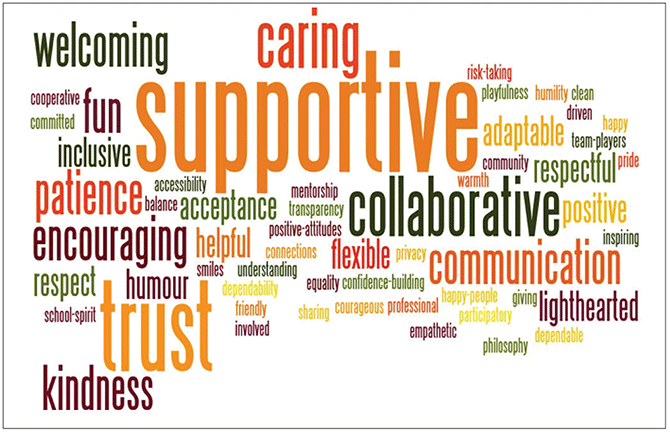
We also discussed the attributes of an effective staff culture. Staff shared their experiences with positive and negative cultures. They then captured words to describe a positive culture and we put them into a Wordle (See Figure 1; thanks to Suzanne Hoffman for the idea).
Figure 1: Staff description of a positive culture
Through our work as a staff, as well as my learning at previous schools, I came up with what I believe are the Four Pillars of a Positive School Staff Culture. They are:
• Strengths-based
• Collaborative
• Innovative
• Focused
I am sure there are other attributes that could be used but these four have been most effective for the schools where I have worked. As you can see in Figure 2, these four pillars are also based on the core values of trust, happiness, curiosity, and care. These values weave their way through the pillars and without them, the pillars can crumble.
Figure 2: A Positive Organizational Culture
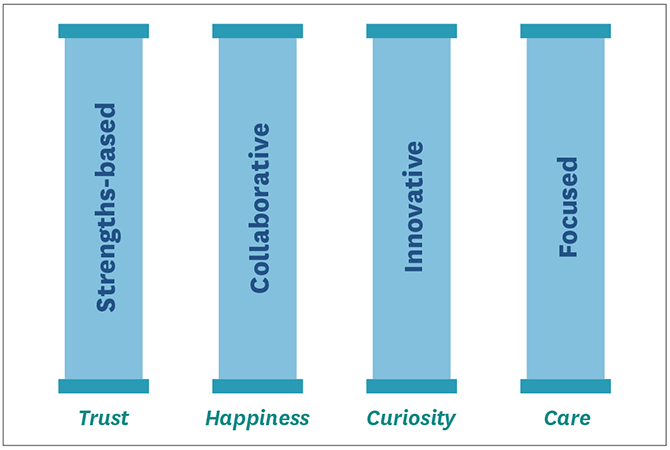
The four pillars
A STRENGTHS-BASED culture is one that believes that every staff member has strengths that can benefit the school as a whole. Feedback with staff always starts with strengths (character and skills), staff members are given the opportunity to determine their strengths (reflections and/or the 1), and each staff member is encouraged to use these strengths in their important work with students. Research from the (CLC) in 20022 shared that one of the most effective ways to bring out the best in your employees is to start with strengths. Performance and engagement is significantly increased when feedback and evaluation focuses on strengths rather than weaknesses. On staff surveys, many staff reported that with the focus on strengths, they felt more motivated, safer to be themselves, happier and healthier overall at school. A healthier, happier staff who feel safe and motivated can accomplish so much more with their students and for the school community.
“As leaders, we often make the mistake of listening to a problem and then jumping to solve it by ourselves.”
A COLLABORATIVE culture believes “the smartest person in the room is the room itself” (David Weinberger). Staff tap into each others’ strengths and engage in respectful, reflective dialogue to drive professional learning and create positive change. Trust is a huge part of a collaborative culture, and truly listening to others is essential to building trust. Polarizing statements and unwillingness to meet people where they are at will create a challenge to collaboration. By avoiding binary thinking, embracing the “grey areas” and listening to others’ perspectives, we grow as individuals and as a collaborative staff.
As leaders, we often make the mistake of listening to a problem and then jumping to solve it by ourselves. As a new principal, I had a teacher share a concern with me. Within minutes, I was busy shifting support schedules and trying to solve the problem. I bounced into her classroom to share what I had done, and she grew quite frustrated. She said, “I came to you so you could understand where I was at and so we could come up with solutions together. These solutions don’t really work for me and they will definitely negatively affect other teachers.” I was caught off guard by this feedback but so thankful, as I learned that my job is not to solve problems, but to work with staff to develop effective solutions together.
An INNOVATIVE culture is one in which educators feel safe to take risks, think critically and creatively, and implement new ideas with support. It moves from the question, “Can we….” to the question, “How can we…” The CLC’s research found that encouraging autonomy and risk-taking is another way to bring out the best in employees. An innovative culture is not necessarily always doing new things; it is one that understands the research around what is effective and is willing to try new ideas to help meet school goals. As Chip and Dan Heath tell us in their book Switch, we need to shrink the change. We need not always aspire for huge risks and changes, rather, we should encourage incremental changes that can be tried for a period of time to see if there is a positive impact. An important role for principals is to find the resources (time, materials, etc.) to support the innovative work of staff, so that good educators can become great educators.
A few years ago, inspired by Daniel Pink’s book Drive, I offered staff a “FedEx Prep,” which meant that I would provide an extra prep period for six weeks so a staff member could take an idea and put it into practice. The only caveat was that they had to “deliver” – sharing with staff the idea they had implemented and observing the results over the school year. We had teachers work individually and collaboratively to implement ideas in areas such as outdoor education (a school garden), technology (blogging with primaries to help with writing skills), and self-regulation (a teacher and a special education assistant redesigned their classroom and introduced tools to help students be in a more effective learning state). By providing a small amount of time and a few resources, we were able to encourage innovation at our school.
A FOCUSED culture is one that knows the key areas of growth that the school is working on, as well as the strategies that can have the largest impact. With so many ideas, policies, and procedures being sent our way, principals and school leaders need to be good filters and keep the staff focused on their vision and mission. There are many “shiny new” ideas out there that look and sound great but they may not help your school on its journey. One question we have used to focus is, “What problem are we trying to solve?” If the new idea is not helping us with the problems (or areas of growth) we are working on, we can set them aside until a later date. By having a laser-like focus on clear goals and clearly defined problems the staff is working on, you can filter and prioritize what’s most important for your school.
The four core values
Four important values guide our behaviours and our journey toward a positive school culture. To embody any of these well, we must slow down. In a fast-paced world, this is even more important!
TRUST: At the heart of trust is communication. It is so important for us all to talk less and listen more. In author Mark Goulston’s words, we need to spend more time being interested and less time trying to be interesting. As formal school leaders, we must also be as transparent as possible to make sure that people understand why decisions are made and/or have all the information they need to make decisions. Another important way to build trust is to walk the talk; if we say we will do something … do it.
Building trust takes time. When I first arrived at my previous school, I posted a sign-up schedule to meet with every staff member to learn more about them and how I could best support them. After a week, not a single staff member had signed up. When I followed up privately with a few people, it was shared that everyone assumed it was an interview and they were nervous to meet with me. This was far from the goal! But the staff didn’t trust me yet. I met with a few individuals informally and then shared that this was the type of conversation I hoped to have in the scheduled times. After that, others started to sign up and they soon realized it was a positive opportunity. Within a few months, I had met with the entire staff.
“We can still work incredibly hard to support students while also encouraging happiness with staff.”
HAPPINESS: I always knew happiness was important but until I moved to my current school at Shortreed Community Elementary, I had no idea the impact that a staff can have on each others’ happiness. By having a sense of humour, taking the time to slow down and be there for each other (in good times and bad), and by showing gratitude, we can create a much more positive school staff culture. Going to work each day where people are happy fuels others and makes the difficult work we do much more enjoyable.
Within my first week at Shortreed, I knew it was a place with a sense of humour. I had worked many hours planning my first assembly to welcome everyone back in September. I wanted to share a bit about me and a slideshow from the first week. Little did I know that the staff had their own plans. Our Youth Care Worker had asked each class to prank me by coming to the assembly and literally sitting wherever they wanted – anywhere and everywhere. As the students entered the gym, my face started to go red at the chaos. Then the whistle blew and all students, with huge grins, quietly moved to their appropriate spots. It was a reminder to not take ourselves so seriously, to have fun and create some happiness in the school. We can still work incredibly hard to support students while also encouraging happiness with staff.
CURIOSITY: We cannot grow as a school unless we are curious. By seeing challenges as opportunities that we can be curious about, we can then collaborate and work together to meet them. By being curious and ensuring we are asking the right questions, we continually grow as educators, learners, leaders, and people.
CARE: People need to feel like they belong and they matter. Small acts of caring can go a long way to building a positive culture and community of care. At my current school, our mantra is, “You BELONG here.” This drive to create a sense of belonging is not only for students but also for our families and staff. We need to lead with an ethic of care and model to our staff that we support and look out for one another.
As an educator, I have come to realize that building (and maintaining) a positive staff culture takes time. By slowing down, focusing on the four values of trust, happiness, curiosity, and care while also keeping the four pillars of strengths-based, collaborative, innovative and focused cultures at the heart of what we do, we can help create a positive school staff culture.
I am thankful to have observed the incredible power of a positive culture. When we all work together to build and maintain this, we feel healthier at school and at home, more motivated and inspired in the important work we do, and because of this, we also see improved results in the achievement and success in our students.
Illustration: Diana Pham
First published in Education Canada, December 2019
-
Self-Reg Isn’t Just for Kids
Comments Off on Self-Reg Isn’t Just for Kids -
IDEAS Partner Research Schools Education Conference
Comments Off on IDEAS Partner Research Schools Education ConferenceTransforming Pedagogies Learn – Design – Innovate
Since the late 20th century, new understandings of learning have continued to emerge. These new understandings arise from the fields of neurology, psychology, sociology, anthropology, and ecology. It is imperative that those responsible for optimum learning in a system understand the transformations to pedagogies that support and promote learning throughout the system. Partner Research Schools and Galileo Educational Network collaborate to bring this event alive. -
PLC+ Institute
Comments Off on PLC+ InstituteCorwin’s PLC+ Institute is designed to support teachers, coaches, school and district leaders in the planning and implementation of collaborative structures in their schools. Join us at sessions that allow your team the space to collaborate, reflect, work through modules together, and walk away with new strategies you can embed into everyday practice to move learning forward.
The institute will feature keynotes from Douglas Fisher and Karen Flories
-
Visible Learning Plus Institute
Comments Off on Visible Learning Plus InstituteSeptember 24, 2020 – September 25, 2020
8:00 AM-3:30 PM PT
Zoom Platform – This Event is in Pacific Standard Time (PST)The Visible Learningplus Institute is a two-day event featuring John Hattie, Jenni Donohoo, and Julie Stern designed to provide you with the tools to identify key takeaways from the Visible Learning research, learn about the five strands of Visible Learning, and identify the difference between influences that impact student learning.


IDEAS TO SUPPORT EDUCATORS : Subscribe to the EdCan e-Newsletter
Quality research, reports, and professional learning opportunities.