Archive
-
Real-Life Learning
Comments Off on Real-Life LearningWhew. We made it through the winter. For many of you it has been, professionally and/or personally, the hardest winter ever. But with vaccination underway and warm weather ahead, we think we see light at the end of the COVID-19 tunnel.
After a year that forced educators to teach, or lead, reactively in response to a mountain of new challenges, we thought it might be a welcome change to look forward to a more aspirational approach to teaching and learning. Yes, there are ongoing and critical COVID issues. But we can also start thinking about how to re-engage students, build school community and make education the best training ground possible for our future leaders and citizens.
Taking on the United Nations’ Sustainable Development Goals (SDGs), whether as a school or as a class, is an exciting way to address all three of these goals. I like to think of this issue as a seed catalogue. The catalogue arrives when it’s still too cold to plant, but it conjures up big dreams for gardening season. We hope this issue will sow lots of ideas, and also lead you to the resources to develop them into a real plan. How great would it be to cover the curriculum in a way that engages students in real-world problems, encourages them to claim a stake in making the world a better place, and develops essential competencies in the process?
The authors in this issue are in the vanguard of integrating the SDGs into Canadian schooling, and part of an international network of educators who are helping to achieve these ambitious Agenda 2030 goals while providing their students with a positive, empowering opportunity to learn about and take action on global issues that are also urgent problems here at home, such as clean drinking water for Indigenous communities, homelessness, climate change, food insecurity, and racial inequities. See how other schools have taken on one or more of the goals in our article on UNESCO Schools, from our partners at CCUNESCO (p. 11). Or dive right into the features to learn about what the UN SDGs are, why they present such a great opportunity for educators, and how to integrate the SDGs into your classroom and school.
I hope this issue inspires educators, schools, and school boards to start planning how they might get involved in this world-changing initiative – and sow the seeds for a sustainable future.
Photo: courtesy MCIC
First published in Education Canada, March 2021
Read other articles from this issue
Write to us!
We want to know what you think. Send your comments and article proposals to editor@edcan.ca – or join the conversation by using #EdCan on Twitter and Facebook.
-
The Colour of Wellbeing: How do we ensure the wellbeing and success of BIPOC students and K-12 staff?
Comments Off on The Colour of Wellbeing: How do we ensure the wellbeing and success of BIPOC students and K-12 staff?BIPOC (Black, Indigenous, and People of Colour) K-12 students and staff experience lower levels of wellbeing. Yet, a growing focus on wellbeing approaches such as mindfulness, social-emotional learning, trauma-informed practices, and self-regulation can have harmful effects on racialized students and educators and may lead to cultural appropriation (i.e. adopting aspects of a culture that’s not your own). These approaches to wellbeing often don’t take into consideration the unique experiences and perspectives of BIPOC students and staff.
Wellbeing is systemic. When wellbeing is understood as one individual’s experience, it fails to account for the harmful effects of systemic racism, White supremacy, and colonialism that create unwelcoming, exclusionary, and unsafe environments for BIPOC students. This approach absolves systems from taking any responsibility in creating and perpetuating harm, which could look like:
- Overlooking the histories, experiences, and positive contributions of BIPOC people within the curriculum
- Disproportionate punishment, suspension, and expulsion of Black and Indigenous students
- Disproportionately greater numbers of Black and Indigenous students, and students marginalized by poverty in lower academic streams and particular special education classes, and disproportionately greater numbers of White, middle-class, or wealthy families in gifted classes, French Immersion, and specialty programs.
- Continuing to hire and promote White employees for leadership positions instead of BIPOC employees with strong understandings of anti-racism (i.e. actively identifying and eliminating racism by changing policies, practices, and attitudes that perpetuate racist ideas and actions).
Here are 4 key tips to support the wellbeing of BIPOC students and staff:
1) There is no one-size-fits-all approach. Place identity – such as race, gender, sexuality, abilities, social class, and faith – at the center of approaches to student and staff wellbeing.
2) Avoid taking individual approaches to wellbeing that place both the source and solution of wellbeing with individuals and instead take a more systemic approach. This includes identifying and disrupting structures and policies that have had disproportionate effects on access, opportunity, and outcomes for BIPOC students and staff.
3) Connect with students, staff, families, and communities in meaningful ways to understand the experiences of institutional harm (e.g. residential schools).
4) Embed multiple understandings and approaches of wellbeing that value the physical, social, emotional, cognitive, and spiritual needs of students and staff.
By not acknowledging the depth and breadth of systemic racism, we end up focusing on symptoms rather than the root causes of achievement and wellbeing, while expecting individual students and staff members to overcome the numerous structural barriers placed before them. When schools take a systemic approach, they instead identify and take action to change the ways in which student and staff wellbeing is impacted by anti-Black, anti-Indigenous, and other forms of racism. Every student and educator deserves to feel safe, valued, and know that they belong at school.
Additional Information and Resources
Anti-racism: the active identification and elimination of racism and intersecting forms of oppression, by changing systems, structures, policies, practices and attitudes, for the equitable redistribution of power and resources.
Streaming means that students are placed into groups defined by their ability levels. Students may be grouped by ability either for a subject (for example for mathematics or reading) or for all or almost all their instruction. Students’ assignment to an ability group may be temporary, changing during the year, or relatively permanent.
White supremacy refers to a political, economic and cultural system in which Whites overwhelmingly control power and material resources, conscious and unconscious ideas of White superiority and entitlement are widespread, and relations of White dominance and non-White subordination are daily re-enacted across a broad array of institutions and social settings (Ansley as cited in Gillborn, 2016, p. 48).
Colonialism: systems and practices that seek to impose the will of one people on another and to use the resources of the imposed people for the benefit of the imposer. Colonialism can operate within political, sociological, economic and cultural values and systems of a place even after occupation by colonizers has ended (Assante, 2006).
- Faculty of Education Summer Institute 2020-21 Webinar Decolonizing Mental Health – https://fesi.blog.yorku.ca/november-25th-2020-webinar/
- VoicEd Equity Podcast Series – https://voiced.ca/project/rsekn-equity-podcast-series/
- Documentary: This is Not a Resilience Story – https://www.youtube.com/watch?v=7wkh1sxKGxI
- https://thunderbirdpf.org/first-nations-mental-wellness-continuum-framework/
- https://smho-smso.ca/wp-content/uploads/2020/09/Understanding-Anti-Black-Racism-For-MHL.pdf
- http://www.ontariodirectors.ca/downloads/Listening_Stone/Dion_LS_Final_Report%20Sept_10-2014-2.pdf
- https://ofifc.org/?research=trauma-informed-schools-in-indigenous-contexts-module
- https://www.raiseyouraq.ca/files/2017/04/Towards-Race-Equity-in-Education-April-2017.pdf?x60002
- https://thelearningexchange.ca/partnering-for-black-student-well-being-a-teachers-journey/
- https://issuu.com/ontarioprincipalscouncil/docs/opc_fall20-aoda-final/s/11099619
- https://www.cbc.ca/player/play/935078979530/
References
Dei, G.J.S. (2008). Schooling as community: Race, schooling, and the education of African youth. Journal of Black Studies, 38(3), 346-366.
Dion, S. (2014). The listening stone: Learning from the Ontario Ministry of Education’s First Nations, Métis and Inuit–focused collaborative inquiry 2013-2014. http://www.ontariodirectors.ca/downloads/Listening_Stone/Dion_LS_Final_Report%20Sept_10-2014-2.pdf
James, C. E. (2012). Students “at risk”: Stereotyping and the schooling of black boys. Urban Education, 47(2), 464-494.
James, C.E. & Turner, T. (2017). Towards race equity in education: The schooling of Black students in the Greater Toronto Area. https://edu.yorku.ca/files/2017/04/Towards-Race-Equity-in-Education-April-2017.pdf?x60002
Thompson, R. (2020, Sept. 29). Addressing trauma in the K-12 workplace: The impact of racial trauma on Black and non-white educators. https://www.edcan.ca/articles/addressing-racism-in-the-k-12-workplace/
-
How can the Sustainable Development Goals (SDGs) support K-12 teaching and learning?
Comments Off on How can the Sustainable Development Goals (SDGs) support K-12 teaching and learning?In 2015, all 193 countries of the United Nations along with scientists and political leaders agreed to partner together to implement the Sustainable Development Goals (SDGs) by the year 2030. The SDGs are a set of 17 goals aimed at achieving peace and prosperity worldwide by addressing pressing issues such as climate change, quality education, and poverty, to name a few. Issues such as these are expected to have devastating impacts on people and the planet if not addressed. For example, climate change is expected to lead to global challenges in this lifetime that no single country alone can resolve. Approximately 42% of the world’s population is currently under 25-years-old, children and youth are at most at risk of experiencing the impacts of these issues, making schools an ideal place for learning about the SDGs.
HERE ARE KEY TIPS FOR K-12 EDUCATORS WHEN TEACHING ABOUT THE SDGs:
1. Start Small
Choose one or a few SDGs to start with when planning class activities and discussions. Each SDG also comes paired with “Global Targets,” which can make them more manageable to address.
2. Learn alongside your students and connect with their interests
Students are often already passionate about global issues, and the SDGs provide a way for them to learn how to become active global citizens. Take the opportunity to learn about what your students are passionate about and build activities, projects, and discussions around these.
3. Find ways to connect the SDGs to the curriculum
The SDGs can enhance the curriculum by making space for learning about global issues and including perspectives from people around the world, which are often left out of national curriculums. There are many resources available for teachers that can be used as content for teaching the SDGs across subject areas.
4. Partner with other classrooms around the world
There are programs where you can partner with other classrooms locally or in other countries to work on projects that address global issues. This gives students an engaging opportunity to learn from other students who have different perspectives and to see how their actions can impact other people – even people halfway across the world.
In an increasingly interconnected world where local and regional decisions can have global impacts on world economies, policies, and societies, it’s evermore important for countries to find ways to collaborate on issues that affect us all. Teaching about the SDGs offers meaningful learning opportunities and encourages students to discover their role in solving local, regional, and global issues. As today’s children and youth will become the next generation of voters and leaders, it is necessary to equip them with the knowledge and skills to make sound decisions in an increasingly complex world – and the SDGs provide a framework to do just that.
Read More
- Creating education goals and activities that help students have a planetary or global view. This moves education beyond merely providing skills for individuals’ future employment but instead, provides the knowledge and skills for living on a shared planet.
- Engaging students around the world in shared research and collaboration to identify different experiences and responses to global issues (see for example, the Global Classroom projects on Global Citizenship and Energy Futures)
- Accessing portals of research and information shared by people around the world as the content for learning. For example, the work of South Korean APCEIU
- Teaching students from an integrated curriculum approach that makes space for learning about global issues from multiple perspectives including from people in locations often left out of national focused curriculums. This will include building a global historical consciousness (see for example https://historicalthinking.ca)
WITH THE GENEROUS FINANCIAL SUPPORT OF:


-
With Education’s Better Future in Mind
Comments Off on With Education’s Better Future in MindPlotting a Post-Pandemic Course for Public Education
COVID-19 shook up our ingrained ways of “doing education” and has pushed educators, students, and parents to their limits. It opened up new possibilities and revealed deep inequities. Now it’s time to get “back on track.” But which track? We asked two prominent Canadian educational thinkers to share their vision, both immediate and longer-term, for education in the post-pandemic. Read also “Shore Up the Foundations for Future-Proof Education,” by Paul W. Bennett.
Two recurring public pronouncements still ring out from the early days of the pandemic: “We’re all in this together,” and “Can’t wait for things to get back to normal.” Simply put, there is no way we should revert to the old normal. More people than ever now know what some already knew before COVID-19. There are deeply embedded obstacles in the way for far too many to participate equitably in what society has to offer. All in this together should be an aspiration, not a false claim of where we’ve been and where we are now. Getting back to normal? Really? When it comes to education, the curtain has been pulled back to clearly reveal that chronic challenges for too many students mean that a vastly new normal is necessary.
The purpose of education
Any discussion about the future of education should begin with the end game, a conversation about its ultimate purpose(s). Any input that I offer is informed by my view that education should ensure that the future is healthier, safer, more just, and prosperous for the many rather than the elite few. We need to start with imagining that better future. How about this superb example:1
“Imagine it’s 2041 and a group of publicly educated 20-year-olds from across Ontario have been asked how they feel about the years they spent in school. The conversation is animated and positive. They say school made them feel like they belonged. It nurtured their compassion for themselves and others. It helped them grow from their mistakes. It welcomed their contributions. And it prepared them for a world of constant change. They say these things regardless of the school they attended, the colour of their skin, their sexual identity, the faith they practice, their physical or intellectual abilities, the teachers they had or the home they grew up in. Though they came from different places, their shared experience of education was one of caring, inclusion and excellence.”
When it comes to most of the complex issues of the day – climate change, health and well-being, racism, our democratic processes, and public communications that seem to divide rather than bring about consensus – education is always noted as the force for improvement. Former head of the Truth and Reconciliation Commission, Murray Sinclair, regarding the devastating and recurring consequences of residential schools, noted that “Education got us into this mess and education will get us out of it.” Let’s make sure it does!
At this point, we need widespread, diverse, and transparent conversations regarding the future of education. As suggested, people and organizations should start with their view of the end game. What follows is informed by mine.
What needs attention?
Given my overarching aspiration for education as the driver for that better future, what should receive priority attention?
- Education must become a truly effective force against racism in all of its forms, and other issues informed by ignorance, including sexism and LGBTQ2+ bias.
- We must ensure our preschool through post-secondary education continuum becomes a platform for mental health and well-being for both students and educators.
- We need to develop a creative problem-solving approach that supports the development of our students into future change-making leaders. A project-based approach in which learners learn to work with others to go deep on the key complex issues facing their futures, applying discipline knowledge as necessary and appropriate.
- There is an obvious need to develop high quality distance/remote learning capabilities for all students and all teachers and professors. Effective and innovative remote learning technology should be considered a universal right and provided for free.
- We need to develop new and more effective collaborative relationships between parents and educators in order to properly support the students they “share.” While there are wonderful examples of truly effective partnerships between teachers and parents, there is a good deal of room for improvement built on reciprocal respect for what each knows about their learners.
- In the digital age, in which we are bombarded with information, we need to ensure education becomes more effective in ensuring that learners of all ages have the evaluative skills to determine fact from fiction so they are sophisticated information consumers.
- There are also structural changes to educational systems that could make a difference to learning success. In Canada, we still hold on to long summer vacations, a throwback to an agrarian economy when kids were needed on the farm. We need to explore a more seamless continuous learning approach. As well, we need to do a total rethink about how we evaluate student progress. We also need to ensure that learners throughout their journeys get credit for what they already know and what they can already do. Outdoor learning needs major consideration, and Indigenous leaders have much to teach us about land-based learning.
- We need to forcefully deal with pandemic learning loss. A collaborative approach that involves educators and other key stakeholders and experts needs to inform the development of systems to support students whose skill and knowledge acquisition is lagging behind. Governments will need to step up and provide the resources required.
- In order to ensure effective implementation of the recommendations I have noted above, major changes to both pre-service and in-service training for educators will be necessary. As well, never before has there been a greater need for more effective leadership selection and development for those with formal authority from preschool through post-secondary education.
Context matters
A big problem with government policymaking, including processes that have an impact on education, is that the lens for change is microscopic rather than telescopic. Put differently, policymaking too often suffers from what I call hardening of the categories. We will not be able to reach the promises of a new normal in education unless we ensure that critical issues such as income distribution and wage policies, sick leave, affordable housing, child care, and parental leave are part of a holistic and integrative approach by governments. We need governments to think and act horizontally when it comes to policy development and program development. Regarding child care, for example, many have advocated for decades that high-quality, developmentally enriching, non-profit and universal child care should be seen, developed, and implemented as an extension of our education systems.
Auspice
The pandemic, by necessity, has loosened the constitutionally driven ownership of educational responsibilities by the provinces and territories with short-term cash infusions by the federal government to assist their local “partners” with COVID-related school health and safety issues. Unfortunately, Canada continues its lonely global existence as a country without a federal department of education. Naturally, education needs to serve local cultural and environmental differences, but shouldn’t it mean the same to be a student in Melville, Sask., St. John’s, Nfld., or Toronto? How is it possible that we do not have federal leadership when it comes to the most important nation-building lever for our better future? It’s time for a Canadian Royal Commission on Learning!
In conclusion…
It is an understatement to acknowledge that educators, and all those who support them, are treasured essential servant leaders who can take us to that better place for the many. Leadership matters. And to all those who have responsibilities in and around our education systems, I will let Alfred Lord Tennyson have the last word:
The lights begin to twinkle from the rocks:
The long day wanes: the slow moon climbs: the deep
Moans round with many voices. Come, my friends,
‘Tis not too late to seek a newer world.Immediate Action Priorities
- Establish task force(s) with all key stakeholders and key experts to ensure an effective multi-pronged approach to learning loss suffered by students as a result of pre-pandemic and pandemic challenges.
- Kickstart collaborative process to develop an effective preschool through post-secondary education platform for the mental health and well-being of students and educators.
- Put in place a thorough and transparent plan to ensure education is a force for anti-racism, eradicating gender and identity discrimination in all forms, and ensuring that the Truth and Reconciliation Commissions education Calls to Action are fully implemented.
- Begin developing high-quality remote learning systems that provide effective educational experience for all students.
The book
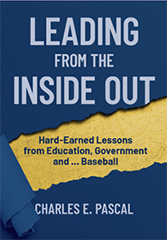
Leading from the Inside Out
Hard-earned lessons from education, government and… baseball
By Charles Pascal
Onyx Publishing, December 2020
Photo: Adobe Stock
Notes
1Hamilton-Wentworth District School Board Bullying Prevention and Intervention Review Panel. (2021).
www.hwdsb.on.ca/about/safe-schools-review-panel -
Shore Up the Foundations for Future-Proof Education
Comments Off on Shore Up the Foundations for Future-Proof EducationPlotting a Post-Pandemic Course for Public Education
COVID-19 shook up our ingrained ways of “doing education” and has pushed educators, students, and parents to their limits. It opened up new possibilities and revealed deep inequities. Now it’s time to get “back on track.” But which track? We asked two prominent Canadian educational thinkers to share their vision, both immediate and longer-term, for education in the post-pandemic. Read also “With Education’s Better Future in Mind,” by Charles E. Pascal.
The global shock of the COVID-19 pandemic turned the K–12 education world upside down and then unleashed a succession of school disruptions. United Nations Secretary-General António Guterres, speaking in August 2020, predicted that the effects of the pandemic were destined to become a “generational catastrophe” in education (UNESCO, 2020). Since then, the full extent of the learning slide affecting all students, and particularly the most disadvantaged, became more visible. Much like earlier studies generated in the Netherlands, the U.K., and the U.S., the first wave of Canadian research reports and surveys testify to the combined academic and psycho-social impacts on children and families (Bennett, 2021).
Seeing the impact of school disruptions first-hand in her home, Nancy Small, a Vancouver mother of two increasingly tuned-out school-age children, cut to the heart of the matter: “Our kids are falling behind.” While the educational damage varies along regional, economic, and racial lines, there has been – until recently— little evidence of a coherent or coordinated plan to close the gaping “learning gap” and get today’s students back on track (Alphonso, 2021).
The COVID-19 pandemic shocks have exposed the fragility of the modern, centralized, top-down bureaucratic education state, identified and analyzed in my book, The State of the System. The massive disruption has also revealed the limitations of system-bound school change theories, conceived as hybrid “pedagogical and political projects,”(Fullan, 2009, 2021), ill-equipped to address the immediate crisis in K–12 education.
Education visionaries, school change theorists, and their academic allies were quick to offer up familiar ideas dipped in COVID-19 and accompanied by a beguiling “build back better” narrative (Chapman & Bell, 2020). The post-pandemic future, in their imagined world, will be a clash of two mutually-exclusive visions: social equality and student well-being versus austerity and academic standards – good versus bad. This is, as you will begin to see, a false dichotomy and a misreading of our current educational predicament.
A far better point of departure is provided in the World Bank’s report, COVID-19 Pandemic Shocks to Education (World Bank, 2020), surveying the collateral damage affecting school systems around the world. The immediate impacts were easier to spot, such as the economic and social costs, greater inequalities in access, and school-level health and safety concerns. Less so is the longer-term impact of “learning loss” and its worst-case mutation, “learning poverty,” marked by the inability to read and understand a simple text by ten years of age.
Shoring up the foundations has become a matter of urgent necessity. If we are facing a “generational catastrophe,” it’s time to reframe the challenges facing K–12 education. Teaching children how to read and to be functional in mathematics are now fundamental to social justice in pandemic times. Well-intentioned trauma-informed educational interventions, such as relaxing grading standards, suspending provincial tests, or reverting to pass-fail summative assessments, run the risk of perpetuating the cycle of diminished expectations, falling unevenly on learning-challenged or marginalized students.
Critical thinking remains the holy grail of K–12 education, but it’s hard to envision without a grounding in domain-specific knowledge. Equipping students with the content knowledge to think critically about a full range of important issues (Willingham, 2019) does not exemplify an “academic obsession” but rather a commitment to seeking deeper understanding. Nor are student well-being and academic success necessarily in conflict. At their best, and in the vast majority of today’s classroom, they are rather mutually reinforcing.
Educators looking for a more effective catch-up strategy would be well advised to challenge the prevailing narrative for two vitally-important reasons: 1) the mistaken assumption that an academic focus and student well-being are somehow incompatible; and 2) the gross underestimation of the realities of the “COVID slide” and learning loss compromising the future success of today’s pandemic generation of students (Engzell et al., 2020).
Immediate responses
Confronting the magnitude of the crisis and solving the puzzle of what to do next can be daunting, so it is better to focus on a few more immediate, practical strategies. Establishing a clear and consistent focus on closing the learning gap does yield a few quick and proven learning recovery strategies. Most of the initial recovery strategies originated in the U.S., driven largely by independent research institutes such as the North West Education Association, Brookings Institution, and McKinsey & Company (Bennett, 2021). Countries with more experience coping with periodic disruptions are faring better and most of the lessons are coming from their school systems (Alphonso, 2021), most notably the Netherlands and Central European nations.
Academically-focused, supportive school environments and strong teacher-student relationships speed recovery from learning loss. Three strategies that have proven more effective (McKinsey & Company, 2021) are:
- High-dosage one-on-one or small group tutoring tied directly to helping students master subject content in math and reading.
- Extended learning time “catch-up” academies, offered over weekends or during student holiday breaks, offered by highly trained teachers, including “double dose” math instruction.
- Positive school culture attuned to early student warning signs, paired with consistent support and routines that help students to recover both academically and emotionally from disrupted periods of learning.
Longer-term responses
Top-down educational leadership has run its course and system-bound solutions will not work. The pandemic shutdown and continuing disruptions exposed what German sociologist Max Weber aptly termed the “Iron Cage” – a bureaucratic structure that traps individuals in an invisible web of order, rationality, conformity, and control (Bennett, 2020). We came to see how dependent students, teachers, and families were on provincial and school district directives. School shutdowns, delayed starts, shifting schedules, and unclear teacher expectations left students and teachers on their own to work out radically different home learning terms of engagement.
Building back the shaken and damaged system will involve confronting squarely the fragility and limitations of top-down, bureaucratic K–12 education. Cage-busting leadership will be required to transform our schools into more autonomous social institutions that, first and foremost, serve students, families, and communities. Challenging the technocratic ethos and language of “learnification” (Biesta, 2019) will be liberating for teachers and reduce the language barrier separating educators from parents. “Learners” will, once again, be students, “learning environments” will be classrooms, and “facilitating learning” recognized as the practice of teaching. Systemic reform will involve undertaking two fundamental structural changes: 1) the restoration of teaching-centred classrooms, and 2) the transition to community-focused, family-centric schools (Bennett, 2020).
Looking ahead: Seize the day
Futuristic visions of technology-driven whole-system reform have always evoked skepticism among regular classroom teachers. Sitting around their kitchen tables helping their children with pandemic home learning has opened the eyes of thousands of parents to the everyday realities of technology-driven “21st century learning” and laid bare student skill deficits in mathematics and literacy. That may well explain why Big Ed Tech, exemplified by Google, Microsoft, and Pearson International, is finally attracting more critical scrutiny (Reich, 2020).
Imagining a better educational future may be inspirational, but what students, teachers, and families really need is “future proof” learning (Kirschner & Stoyanov, 2018). That term, coined by leading cognitive science expert Paul A. Kirschner, provides a viable and much-needed alternative to pursuing holistic, ill-defined “21st century skills” or embracing competency-based student graduation standards. The best way forward in pandemic times is deceptively simple: set aside the “21st century skills” panaceas in favour of “the acquisition of knowledge, skills, and attitudes necessary to continue to learn in a stable and enduring way in a rapidly changing world.”
Future-proof education is soundly based upon the science of learning and evidence-based research rather than sociological change theories. Redesigning schools and professionalizing teachers in 21st century learning strategies look attractive, but they are unlikely to make much difference and may produce heavier teaching workloads without really addressing our current educational crisis.
Cognitive learning specialists provide us with a far more reliable guide to how learning happens and the critical importance of working memory in the whole process. What Kirschner proposes is a three-stage approach:
- Lay the building blocks (i.e. concrete cognitive knowledge and skills).
- Develop higher-order thinking and working skills.
- Tackle Bigger Problems that require metacognitive competencies and skills.
The COVID-19 shocks to education will continue to reverberate in Canada’s K–12 schools in the near future. It’s a rescue mission and one that needs to begin by shoring up the foundations and putting the pandemic generation back on the path to sound education in purposeful schools, and better prepared to lead meaningful, productive lives.
Immediate Action Priorities
- Assess the impact of pandemic school disruptions, particularly the extent of the COVID- 19 slide falling unevenly on disadvantaged students. Start by assessing the collateral damage in terms of academic learning loss and psycho-social impacts.
- Adopt and implement effective and proven Learning Recovery Strategies, closing the learning gap and putting students back on track. Provide a clear academic focus with learning supports for struggling students.
- Embrace “future-proof education” rather than the pursuit of generic and ill-defined “21st century skills” and focus on the acquisition of knowledge, skills, and attitudes necessary to enable students to learn in a stable and enduring way in a rapidly changing, unpredictable world.
The book
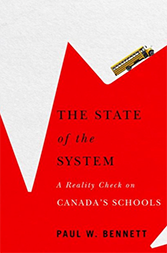
The State of the System
A reality check on Canada’s schools
By Paul W. Bennett
MQUP, September 2020
Photo: Adobe Stock
References
Alphonso, C. (2021, Feb. 16). The COVID-19 grading curve: Schools rethink expectations for students who have lost time. The Globe and Mail.
https://www.theglobeandmail.com/canada/article-the-covid-19-grading-curve-schools-rethink-expectations-for-students/Bennett, P. W. (2021, Feb. 1). How will the education system help students to recover from
learning loss? IRPP Policy Options.
https://policyoptions.irpp.org/magazines/february-2021/how-will-the-education-system-help-students-overcome-covid-learning-loss/Biesta, G. (2019). Should Teaching be (Re)discovered? Studies in Philosophy and Education, 38,549–553.
Chapman, C., & Bell, I. (2020). Building back better education systems: Equity and COVID-19, Journal of Educational Capital and Community, 5(3/4), 227–236.
Engzell, P., Frey, A. & Verhagen, M. (2020, Aug. 28). Pre-analysis plan for: Learning inequality during the COVID-19 pandemic. https://osf.io/download/5f995b4687b7df03233b06fe/
Fullan, M. (2021). The right drivers for whole system success. Centre for Strategic Education.
Hargreaves, A. (2020). Austerity and inequality; or prosperity for all? Educational policy directions beyond the pandemic. Educational Research for Policy and Practice, 20, 3–10.
Kirschner, P. A. & Stoyanov, S. (2018). Educating youth for nonexistent/not yet existing professions. Education Policy, 34(3).
Reich, J. (2020). Failure to disrupt: Why technology alone can’t transform education. Harvard University Press.
Willingham, D. T. (2020). How to teach critical thinking. NSW Department of Education.
World Bank. (2020). The COVID-19 pandemic: Shocks to education and policy responses. World Bank.
UNESCO. (2020, August 5). UN Secretary-General warns of education catastrophe, pointing to UNESCO estimate of 24 million learners at risk of dropping out. Press release No 2020–73.
-
The Escalating Crisis of Violence Against Educators (Part 2)
Comments Off on The Escalating Crisis of Violence Against Educators (Part 2) -
The Escalating Crisis of Violence Against Educators (Part 1)
Comments Off on The Escalating Crisis of Violence Against Educators (Part 1) -
Workplace wellness while busy doing other things
Comments Off on Workplace wellness while busy doing other things -
Global Citizenship and the SDGs
Comments Off on Global Citizenship and the SDGsSeventeen Sustainable Development Goals – also known as the SDGs or the Global Goals – came into effect on January 1, 2016, following a historic United Nations Summit in September 2015. 193 governments from around the world agreed to implement the SDGs within their own countries in order to achieve what has become known as the 2030 Agenda for Sustainable Development. To meet these new SDGs, countries are to mobilize efforts to end all forms of poverty, fight inequalities, and tackle climate change, all while ensuring that no one is left behind. To achieve this global challenge, everyone must take action both here and around the world. We know that these goals highlight issues that affect our students and communities as well as the broader world, and offer powerful points of connection to engage students on global issues in the classroom.
Global citizenship, the idea that the actions we take here can affect lives all over the world, is a compelling lesson for the classroom. Engaging students on global issues, and especially taking action locally, can spark exciting projects and build global awareness in students. Students who understand these local-global connections are building their understanding of issues facing the world today, developing compassion for the world around them, and discovering the power of taking action.
The Manitoba Council for International Cooperation (MCIC) has a long history of engaging students in classroom workshops and student conferences that are focused on educating students about global issues and empowering them to take action. If you need ideas on how to bring the SDGs into your classroom, we’ve developed Sustainable Foundations: A guide for teaching the Sustainable Development Goals, a new bilingual resource for educators that includes multiple lesson plan ideas and action steps for each SDG. The guide includes lesson plans for Grades 2–12, but largely focuses on Grade 5+, where the content around global issues is more relevant to the curriculum.
Taking an inquiry approach, each chapter in the guide offers an overview of a specific goal, including learning objectives, a summary of important international targets, and the ways to tell if we are on track to reach the goals. Each chapter offers inquiry-style questions that connect back to the curriculum, exploring some key questions, such as: Where did this goal begin? Why does this issue matter? Who and what are affected? and What is being done?
The guide explores the interconnected nature of the goals, taking care to highlight, for example, how we can’t reach Goal 1: Zero Poverty, without also reducing inequalities (Goal 10), ensuring decent work and economic growth (Goal 8), protecting life on land (Goal 15), and many others. There are many connections between each goal, and students can quickly begin to see how the success of one goal is tied to another.
Each chapter also highlights the consequences of inaction, sharing what might happen if we do nothing to reach the goal, and offers further reflection questions, inspiring quotes, and more. Of special importance to educators are the sections with resources, including ideas for taking action, lesson plans, activities, and video educational resources for use in the classroom.
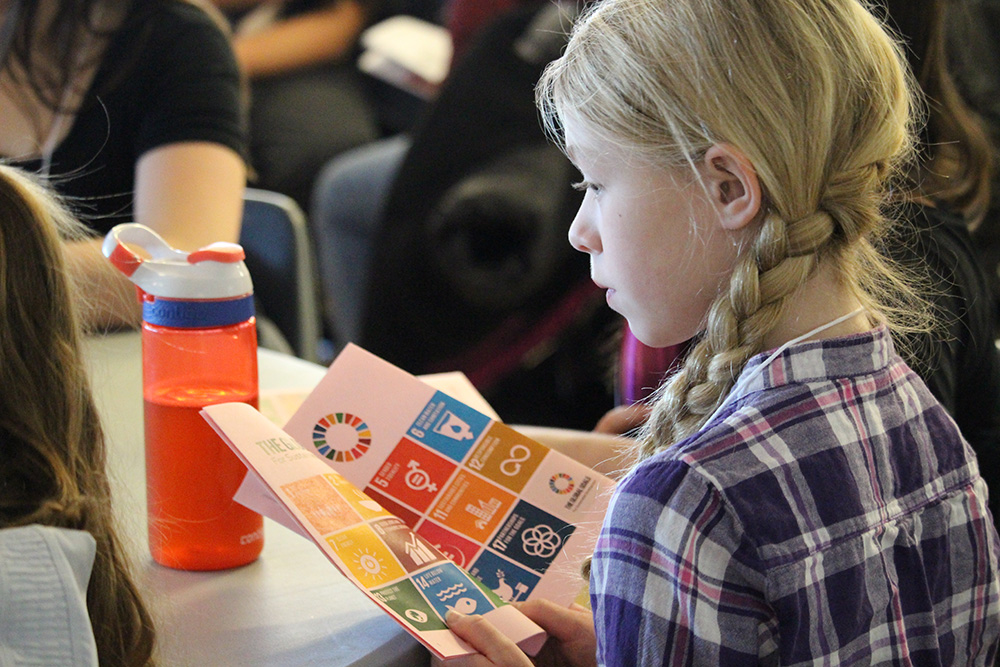
Teaching Goal 1: Zero Poverty
For example, how can you teach your students about Goal 1: Zero Poverty? For students in Grades 5–8, consider the lesson “The World is Not Equal. Is that fair?” from the World’s Largest Lesson website and featured in the guide. This lesson highlights different types of inequality and helps students explore the impact inequality has on the wider society and economy. The lesson starts with students receiving an unequal amount of something (candy, stickers, etc.) and moves from fairness to a discussion on equality.
MCIC has also created lessons you can use in your classroom, now available directly on our website at mcic.ca. First, for students in Grade 5+, considering using the “Building Blocks for a Good Life” lesson, where students order a list of items from most important to least important for a good life. This lesson opens a discussion about poverty and what it means to have a good quality of life. Students will explore poverty as a “lack of opportunities” rather than a “lack of basic needs.” Framing poverty this way allows students to appreciate the complexity of the issue and promotes empathy in lieu of judgment.
Students work in groups to decide which items (a range including access to food, a television, cell phones, shelter, toys, health care and more) are most important and which are least important to a good life. Labels are provided that can be placed on blocks so students can build structures, or you can print a list of the items and cut them into individual squares so students can order them individually on their desks or at home.

This lesson has also been successfully used with high-school students, and we recommend leaving more time for older students to discuss differences of opinion and the debrief questions. Many great discussions can arise with all ages, based on student perspectives of the items on the list. There are several discussion questions and prompts included in the lesson, such as asking students if everyone needs the same things for a good life, a prompt that can be used to expand the conversation and include global perspectives. Do we need the same things as other countries? Use student answers to these prompts and differences in their prioritized lists to spark conversations about basic needs and lack of opportunities in the world.
Another MCIC activity with more global perspectives is “Breaking the Cycle,” for students in Grades 5–8. In this activity, students learn that poverty is not a result of individual choices alone; it is affected by societal systems. Students travel in groups through four different stations, making decisions about health and the environment inside scenarios from around the world, choosing how to spend their resources to survive. Focused on the themes of poverty and the poverty cycle, barriers associated with poverty, and a lack of access to health care and education, this activity brings home the real-world challenges people can face and opens a conversation about inequality around the world.
Putting learning into action
Learning about global issues is a great start, but true impact and passion can be inspired by taking action on the issues. Students who take action in their communities to effect change become engaged global citizens, learning powerful lessons about how their actions can change the world.
To encourage your students to take action, consider the ideas in the “How to Take Action” section included for each chapter of the guide, or the general tips on taking action in the introduction. For example, students could be encouraged to support a local organization through creating a fundraiser, or writing to their local government representative about the issues. Explore dosomething.org to find an issue your students care about and to find ways to take action on the issues. You can also see examples of how other students have taken action on the MCIC Take Action Blog, or consider connecting with an international cooperation organization working around the world. You can find examples of these organizations and their work through the case studies in each chapter of the guide or by contacting MCIC or another Council for International Cooperation in your area.
One school’s journey
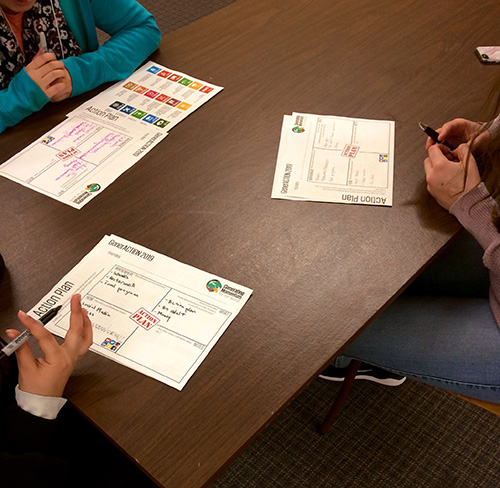
At our Generating Momentum for Our World student conferences, and as we share classroom resources, we encourage educators to let us know how their students take action on global issues. Following a student conference in rural Manitoba where students learned about the SDGs and how to take action on the issues, we heard about an exciting project one school had undertaken in their community.
With the support of their teachers, middle-years students created an “SDG Week” where they connected with their peers on a different goal each day. For example, when they talked about Goal 2: Zero Hunger, students baked and offered everyone in school a muffin. They hosted assemblies, shared information, invited MCIC to lead workshops, and created posters to share. One day they planted fruit trees on the school property, as a way to help reach several goals (no hunger, climate change, life on land, and more). With a new project each day, it was a great way to share what they learned with their fellow students and take action on the SDGs.
It was exciting to see how students took the knowledge gained about the SDGs and turned it into action, while sharing with their schoolmates.
AS EDUCATORS, you know that you hold the power to transform your students’ understanding of the world. As you teach them the universality of the SDGs and the issues facing the world today, we encourage you to also teach your students to be good global citizens who take actions that change the world for the better. Students who understand that they have the power to help reduce inequalities around the world and create a more sustainable future for all, are students who will take knowledge and turn it into action, making a more just world for everyone.
Resources for Teachers
MCIC offers many free classroom resources at mcic.ca:
- Sustainable Foundations: A guide for teaching the Sustainable Development Goals (2018) (English and French versions available)
- Online resources for teaching the SDGs at home (or remotely)
- Lesson plans, classroom posters, reading lists, and more
- Global Citizens, Local Classrooms e-newsletter with monthly resources for educators
- Classroom workshop bookings (currently virtual)
- Take Action Blog showcasing examples from educators and students taking action on global issues: https://takeactionmanitoba.org
See also the World’s Largest Lesson website, with lesson plans and other classroom resources searchable by type of resource, age group, and duration:
Photos: courtesy MCIC
First published in Education Canada, March 2021
-
Much More Than a Bilingual Country
Comments Off on Much More Than a Bilingual CountryCanada is internationally known as a bilingual country. Twelve years ago, when I moved here from Brazil to complete my graduate studies, I thought that most Canadians would speak both English and French, but I quickly realized that that was not the case. I lived in Toronto, Ont., and when I met people who had grown up there, they mainly considered themselves Anglophones, even if they spoke some French. Others who had immigrated to Canada were plurilingual: they spoke two, three, or four languages at different levels of proficiency. Despite having Portuguese, Spanish, English, and Italian in my repertoire, I have never been considered bilingual in Canada because I do not speak French perfectly yet. The popular discourse of being bilingual here places value on the two official languages only, and even if you speak both languages, you need to sound like a native speaker or you will have your bilingual identity stripped away from you. This issue causes language insecurity and anxiety and demotivates people to learn languages. It is time to rethink what bilingualism means, recognize that Canada is a multilingual country, and focus on innovating language education.
Canada: From bilingualism to multilingualism
Canada is no longer a bilingual country. It is multilingual. In fact, it has been multilingual since pre-colonial times. In addition to the two official languages, 60 Indigenous languages and more than 140 immigrant languages are woven into the Canadian landscape. Recently, in a span of only five years, Canada witnessed a 13.3 percent increase in the number of people speaking an immigrant language, and nearly 20 percent of Canadian residents speak more than one language at home (Statistics Canada, 2016). With recent announcements that the federal government plans to welcome more than 1.2 million immigrants by the end of 2023, this multilingual reality will continue to grow (Harris, 2020). In fact, multilingualism is a global phenomenon and is now in the spotlight because of recent trends in mobility, travel, internationalization of education, language revitalization efforts (UNESCO, 2019), and online work demands during the COVID-19 pandemic. All of these factors contribute to people using different languages at home, online, and in their various communities.
The youth in Canada are accustomed to linguistic and cultural diversity, at least outside of the classroom: they can read a book in English, listen to K-pop, mix languages while interacting with others in online role-playing games, and listen to their grandparents speak in their heritage languages. They may not have high proficiency levels in these languages, but they are certainly exposed to them. Multilingualism is on the rise, in Canada and elsewhere, and so we must innovate how we teach languages and how teachers view their students. Indeed, preparing the youth to learn only the two official languages of Canada is not enough. Canada needs to go beyond English/French bilingualism and move toward equipping youth to have plurilingual and pluricultural competence; to encourage students not only to be tolerant of linguistic and cultural diversity, but to be active agents of social change, learn new languages, and be advocates for a world that is more linguistically and culturally inclusive. One of the United Nations’ sustainable development goals for a better future is to provide inclusive, equitable, and quality education for all and in language education, one way to accomplish this is to implement a plurilingual approach in the classroom.
What is a plurilingual approach?
First, what is the difference between multilingualism and plurilingualism? A useful distinction is offered in a 2020 publication by the Council of Europe, which states that multilingualism is the coexistence of different languages in a society, while plurilingualism is the dynamic development of an individual’s linguistic repertoire. In Canada, we have more than 200 languages in our society (multilingualism), while individuals may have several languages in their repertoire (plurilingualism). For example, one person may speak English fluently, understand different Englishes (e.g. from Newfoundland and South Africa), speak some Cree and a little bit of Spanish, and may be currently developing basic French and its different varieties (e.g. French from France, Quebec, and Haiti). In education, a plurilingual approach will encourage the development of this repertoire along with the cultures related to these languages; languages and cultures have long been suggested to be inseparable (Galante, 2020), that is, when learning a language, we also learn about related cultures, traditions, behaviours, beliefs, and how language is used across cultures and contexts.
This approach may sound complicated, but it is not. In fact, some educators may already teach, at least implicitly, through a plurilingual approach, but they may not be exploring its maximum potential. They may still view their students as simply language learners (e.g. English language learner), or bilinguals, but not as plurilingual and pluricultural citizens. So, what can educators do to start? Here are three initial ideas:
- Linguistic portraits Teachers can ask students what languages they speak or understand, even if the proficiency levels are limited. They can also ask them about both their own cultural heritage and other cultures they appreciate. The answers to these questions can lead to a multimodal project such as a linguistic portrait: students draw their portrait and place all of their languages and cultures on it so they can embody their own plurilingualism and pluriculturalism. They can also do a short presentation about what these languages and cultures represent to them. (See Figure 1.)
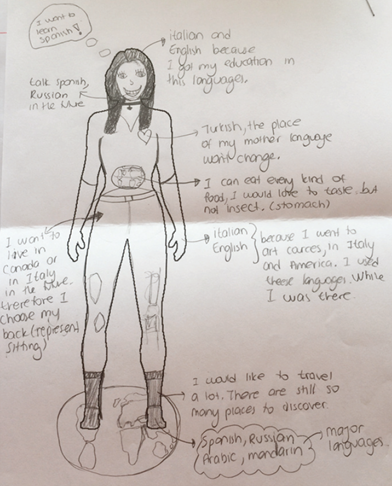
Figure 1. Linguistic Portrait, taken from Galante, 2019
- Translingual mediation Teachers can get students to read or listen to texts in the languages they already know, take notes, and bring them to the language classroom. For example, in a French class with the topic of global warming, the teacher can ask students to do some research at home about the topic in different languages. A student who speaks Mandarin can access information in a Chinese online newspaper, bring the knowledge to the classroom, and present the information in French. By doing this, students are mediating knowledge across languages, learning French, and developing critical thinking by analyzing content produced in texts in different languages and published in different venues.
- Translanguaging buddies If in a language class there are two or more students who share the same languages, the teacher can sometimes have these students help each other in the languages they share. For example, in a French class where there are two students who speak Spanish, the teacher can encourage them to use Spanish to clarify information, understand the content, and even teach their peers some Spanish words. Translanguaging buddies do not necessarily have to speak the same languages. One student who speaks Russian can be paired up with a student who speaks Arabic; they can both discuss the topic in a mix of French, Russian, and Arabic and make sense of the content.
These three examples may already look familiar among some teachers, but others may find them radical. But why should teachers even attempt to use a plurilingual approach? In the first part of this article, I provided a rationale based on the increase of multilingualism in Canada and in the world. Below, I will provide some arguments based on recent research.
What does research say about plurilingual education?
Many studies conducted in different language classrooms (ESL, FSL, immersion, bilingual programs, etc.) and countries suggest several benefits of a plurilingual education, including language development, empathy, self-esteem, cognition, and motivation, among other factors. In my own research (2020), I have investigated teachers’ perceptions of a plurilingual approach in the English-language classroom compared to a monolingual approach (English-only). Seven teachers participated in the study and they taught two classes using two different approaches: plurilingual with one class and English-only with another class, for a period of four months. The content was similar but the approach was different, and the teachers did not have to change their entire curriculum to apply a plurilingual approach. In fact, they introduced one plurilingual task per week, for about 30–40 minutes in one class, while the other class had similar content but used one English-only task per week. After I interviewed the teachers at the end of the program, they unanimously reported preference for a plurilingual approach compared to English-only. For these teachers, a plurilingual approach:
- taps into students’ lived experiences, and develops English based on their personal trajectories rather than on unrealistic scenarios where they need to use the target language
- challenges teachers’ monolingual and monocultural mindset and the idea that students are not plurilingual
- helps students develop agency and feel free to use their linguistic repertoire whenever they want or need for the purposes of learning
- allows students to feel pride in the languages and cultures in their repertoire
- engages students in learning not only the target language but also about the languages and cultures of their peers
- provides a safe space for students to discuss topics about cultural similarities and differences and demystify stereotypes.
The teachers also highlighted that they did not have to speak several languages themselves to use a plurilingual approach, and that even teachers who think of themselves as monolinguals (speaking one language only) can and should try to implement it in the classroom.
Moving forward
Given the current multilingual trends in Canada and recent calls for the provision of inclusive education to all students, innovative pedagogical approaches that prepare them to communicate across languages, cultures, and contexts are now needed. People will continue to communicate face-to-face and online, and being able to use their repertoire to understand how language use and culture may vary across contexts, be open to more language and cultural learning, and advocate for linguistic and cultural inclusiveness in schools and other spaces is paramount for an inclusive society. If we want to better prepare our students for current and future Canadian realities of multilingualism, change needs to happen soon. Canada has a unique opportunity to remain a leader in language education, but it needs to go beyond bilingualism and encourage Canadians to become plurilingual speakers. Supporting plurilingualism will not take away from the languages already existent in Canada; it will add openness to the English/French bilingual dichotomy and the popular discourse that the country is bilingual. Canada is much more than that.
For more research and resources, visit McGill University’s Plurilingual Lab.
Banner Photo : Adobe Stock
First published in Education Canada, March 2021
Read other articles from this issue
References
Council of Europe. (2020). Common European Framework of References for languages: Learning, teaching, Assessment. Companion Volume. Council of Europe Publishing.
www.coe.int/lang-cefrGalante, A. (2020). Plurilingual and pluricultural competence (PPC) scale: The inseparability of language and culture. International Journal of Multilingualism.
https://doi.org/10.1080/14790718.2020.1753747Galante, A. (2019). “The moment I realized I am plurilingual”: Plurilingual tasks for creative representations in EAP at a Canadian university. Applied Linguistics Review, 11(4), 551–580.
Galante, A., Okubo, K., Cole, C., Abd Elkader, N., Wilkinson, C., Carozza, N., Wotton, C., & Vasic, J. (2020). “English-only is not the way to go:” Teachers’ perceptions of plurilingual instruction in an English program at a Canadian university. TESOL Quarterly Journal.
https://doi.org/10.1002/tesq.584Harris, K. (2020, October 30). Federal government plans to bring in more than 1.2M immigrants in next 3 years. CBC News.
Statistics Canada. (2016). Linguistic diversity and multilingualism in Canadian homes.
UNESCO. (2019). International literacy day 2019: Revisiting literacy and multilingualism, background paper.
United World Schools. (n.d.). UN sustainable development goals: Our role.
-
Appreciating biodiversity to better protect it
Comments Off on Appreciating biodiversity to better protect itGlobal climate change and biodiversity loss are major contemporary challenges. To address these challenges, in 2015 the United Nations set 17 Sustainable Development Goals (SDGs), with a timeline to achieve them by the year 2030. Goal 15 reads as follows:
“Protect, restore and promote sustainable use of terrestrial ecosystems, sustainably manage forests, combat desertification, halt and reverse land degradation and halt biodiversity loss.”
The UN’s 2020 report on these goals (page 55) notes that, “The world is falling short on 2020 targets to halt biodiversity loss, despite some progress.”
Discovering life in nearby ecosystems
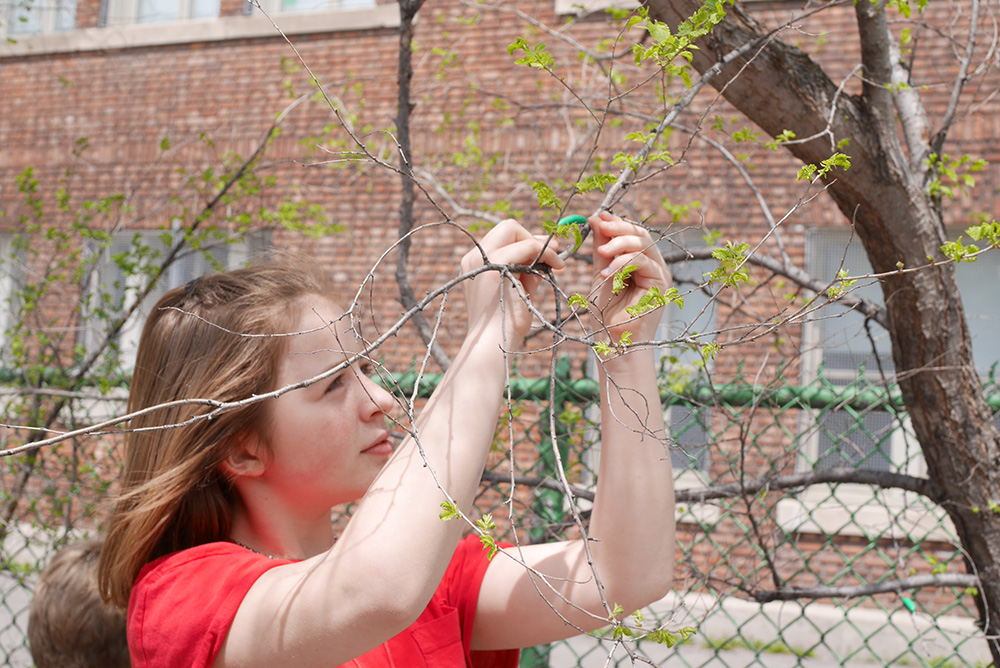
To familiarize students with the important issues facing humanity, school curricula generally present these subjects at the elementary and high-school levels. From a young age, students are introduced to major global problems like pollution, deforestation and extinction, as well as their impact on the planet’s inhabitants. However, perhaps schools should start by helping young people discover the organisms that inhabit the ecosystems around them.
The outdoor spaces surrounding schools are rich learning environments, as both urban and rural areas are always full of life. Every environment is inhabited by a variety of arthropods, plants, birds, and small mammals.
These environments can help children develop scientific skills like curiosity, observation and experimentation from a very young age (Ayotte-Beaudet, 2020a). For example, to teach students about plants often described as weeds, ask them to draw a chalk circle around any plants pushing through a concrete sidewalk near school. Then have them write in the plant’s name to inform passersby (www.sciencesdehors.com).
Nearby areas off school property can also be used to learn about natural phenomena in situ (Ayotte-Beaudet, 2020b). Students can adopt a tree to make systematic observations about it throughout the school year. This will enable them to determine the adaptation and survival mechanisms used by the tree while also discovering the variety of living organisms that interact with it (e.g., lichen and birds). This type of monitoring helps children develop a shared sense of ownership in the tree under study.
Outdoors, students can also carry out field activities just like scientists do. Citizen science projects give schools a well-defined observation framework to follow and provide knowledge about certain local species (Secours et al., 2020). Some examples of citizen science projects are eBird for birding and NatureWatch for environmental monitoring programs.
Learning to appreciate
The findings of a recent research project suggest that we should reflect on how schools teach biodiversity. The goal of the study in question was to better understand the impact on students of contextualized teaching and learning in a nearby ecosystem (Ayotte-Beaudet et al., in press). The participants, elementary-school students (ages 10-12), took part in a citizen science project designed to help them better understand the effects of global change on urban ecosystems (www.chenilles-espionnes.com). For the instructional phase, the researchers had decided to talk about nature in positive terms only, without ever mentioning environmental problems. During interviews conducted at the end of the project, many of the young people expressed the desire to protect living organisms, even though conservation was never explicitly mentioned. In other words, discovering nature in situ and hearing only positive things about it were enough to heighten young people’s awareness of the life around them.
Where to start?
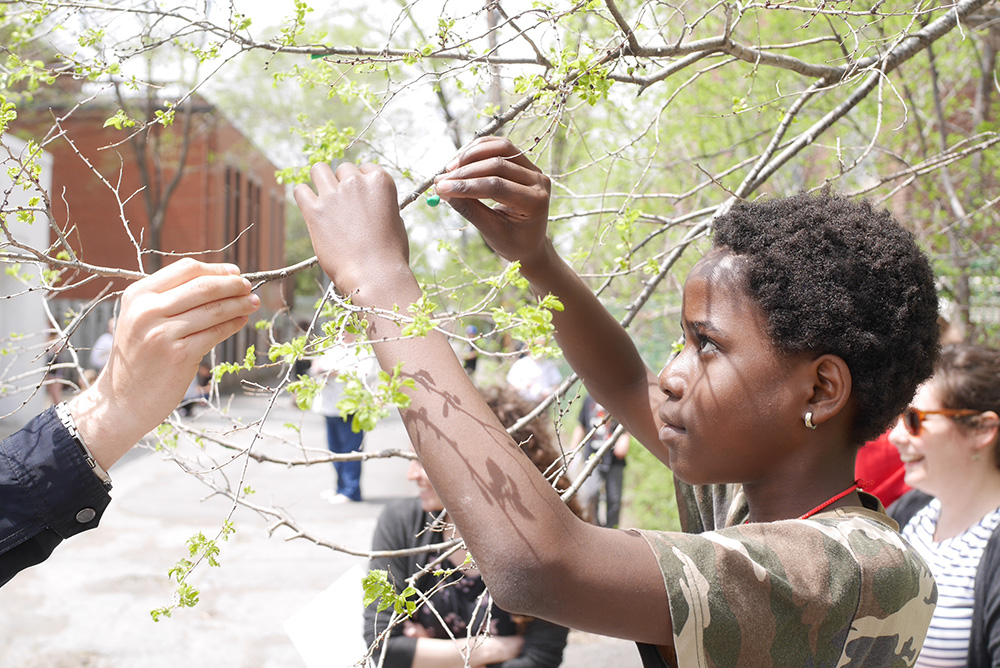
If you are unaccustomed to holding outdoor classes on biodiversity, the first thing you should probably do is think about your motivation and set a clear learning objective for the first outing. This will help you plan the teaching and learning activities and persuade parents and administration to agree to your approach.
The first few times, it is better to go outside for short periods so you and your students can get used to this new learning environment (www.sciencesdehors.com). Research has also shown that it is important to properly prepare students for these outings, get them engaged in activities, and give them an opportunity to make choices (Ayotte-Beaudet & Potvin, 2020; Ayotte-Beaudet et al., 2019). Most importantly, stimulate the children’s curiosity and trust them. Furthermore, if you are a school principal, trust your teaching staff and give them a chance to experiment!
Conclusion
Elementary school curricula often focus on the gravity of environmental issues, but everyone involved in education should reflect on the best ways of making children aware of biodiversity. At what age can we, in good conscience, burden younger generations with the weight of the problems they will inherit? Before asking them to protect and restore terrestrial ecosystems, I believe we have a duty to teach them how to appreciate the diversity of life in the ecosystems around them.
Photos: Courtesy of Jean-Philipe Ayotte-Beaudet
First published in Education Canada, March 2021
Read other articles from this issue
References
Ayotte-Beaudet, J.-P. (2020a). Éveiller aux sciences de la nature à ciel ouvert. Revue préscolaire, 58(4), 36-38. http://aepqkiosk.milibris.com/reader/9d1311ef-ccbb-4df1-af16-ebc7f44582ae?origin=%2Frevue-prescolaire%2Frevue-prescolaire%2Fn584-2020
Ayotte-Beaudet, J.-P. (2020b). Regarder dehors pour apprendre et enseigner les sciences. Vivre le primaire, 33(3), 38-40. https://aqep.org/wp-content/uploads/2020/09/D-Regarder-dehors-pour-apprendre.pdf?fbclid=IwAR248QqdERwurwv755FVeGYMItC61bYxQ9GOjs4hbwxSiUN_-fT45NxlV8k
Ayotte-Beaudet, J.-P., Chastenay, P., Beaudry, M.-C., L’Heureux, K., Giamellaro, M., Smith, J., Desjarlais, E., & Paquette, A. (2021, in press). Exploring the impacts of contextualised outdoor science education on learning: The case of primary school students learning about ecosystem relationships. Journal of Biological Education.
Ayotte-Beaudet, J.-P., & Potvin, P. (2020). Factors related to students’ perception of learning during outdoor science lessons in schools’ immediate surroundings. International Journal of Environmental and Science Education, 16(2), 1-13. https://doi.org/10.29333/ijese/7815
Ayotte-Beaudet, J.-P., Potvin, P. and Riopel, M. (2019). Factors related to middle-school students’ situational interest in science in outdoor lessons in their schools’ immediate surroundings. International Journal of Environmental & Science Education, 14(1), 13-32. http://www.ijese.net/makale/2100.html
Chenilles-espionnes (https://www.chenilles-espionnes.com) is a Website dedicated to a citizen science project developed by a partnership involving Les Clubs 4-H du Québec, Université du Québec à Montréal and Université de Sherbrooke.
Des sciences dehors (https://www.sciencesdehors.com) is a Quebec-based knowledge-sharing website developed by and for people interested in and passionate about teaching and learning science.
United Nations. (2020). The sustainable development goals report 2020. UN. https://unstats.un.org/sdgs/report/2020/The-Sustainable-Development-Goals-Report-2020.pdf
Secours, É., Paquette, A., Ayotte-Beaudet, J.-P., Gignac, A., & Castagneyrol, B. (2020). Chenilles-espionnes, un projet de sciences citoyennes pour sensibiliser les jeunes à la biodiversité. Spectre, 50(1), 27-31. https://fr.calameo.com/aestq/read/00518148392339471f721
-
Implementing Social Emotional Learning During a Pandemic
Comments Off on Implementing Social Emotional Learning During a Pandemic
Join us for a special virtual event focusing on the increasing importance of supporting social-emotional learning (SEL) amidst a global pandemic. This event will feature Avon Maitland District School Board in Ontario, who will be sharing their experience implementing and measuring SEL using Peekapak resources. The flexibility of Peekapak’s SEL in either remote or in-class formats makes it easy for educators to implement. This event is intended to help school administrators support their educators, and it will be recorded and available to all those who register.
-
A Whole-School Approach to Teaching the UN Sustainable Development Goals
Comments Off on A Whole-School Approach to Teaching the UN Sustainable Development GoalsCOVID-19 has put students in a unique situation when it comes to reflecting on our planet’s future. Difficult as it is, the pandemic has been instructive. It shows how we are interdependent, sustained by nature, and that our actions matter. This experience provides a timely opportunity for students and educators to focus on sustainability action, using the United Nations’ Sustainable Development Goals (SDGs).
The UN’s goals, agreed on by Canada and nearly all other countries, are far-reaching and important. They target 17 areas directed toward sustaining life on Earth – human and all other forms – as well as ending poverty and inequity, achieving social justice, and combating climate change.
As sustainability becomes ever more important, strategies are emerging to help schools and educators inspire students to understand that their learning and community action contribute to progress on the Global Goals. These approaches make the goals both real and achievable, as youth begin to see new ideas and progress scale up across nations and regions of the world.
Using strategies to integrate the SDGs within a whole-school approach is a key focus for Learning for a Sustainable Future (LSF). LSF is a Canadian charity whose mission is to promote, through education, the knowledge, skills, values, perspectives, and practices essential to a sustainable future. Working with schools, school policies, and curricula is a core part of LSF’s activities, explains the organization’s President and Chief Executive Officer Pamela Schwartzberg.
LSF began its whole-school approach with support for Belfountain Public School in Ontario in 2005 and continued with the first Education for Sustainable Development (ESD) Lighthouse School project at Stouffville District Secondary School in 2006. In 2007, in partnership with the UNESCO Chair in Reorienting Education for Sustainable Development, York University’s Schulich School of Business, and its Faculty of Education, LSF began Sustainability and Education Academy (SEdA) seminars to engage senior education officials from school boards across Canada in:
- understanding education for sustainable development (ESD)
- envisioning how it could be embedded into school board policy, programs, and culture
- providing a SEdA framework to assess their current sustainability initiatives
- developing action plans for change.
How a whole-school approach can advance the SDGs
The whole-school approach is designed to help students, teachers, principals, staff, parents, and community members integrate the SDGs into school culture, teaching and learning, facilities and operations, and community partnerships. “We get farther, faster if we work as a whole school,” says Pamela Gibson, LSF consultant. A whole-school approach helps reinforce engaging teaching methods and moves schools toward practising sustainability. It optimizes learning in synergistic ways and models 21st century skills – collaboration, innovation, and action.
Global Competencies and the SDGs
In 2016, the Council of Ministers of Education, Canada (CMEC) articulated six broad Pan Canadian Global Competencies to: “provide learners with the abilities to meet the shifting and ongoing demands of life, work, and learning; to be active and responsive in their communities; to understand diverse perspectives; and to act on issues of global significance.” With some variation across the provinces and territories, the attitudes, skills, and knowledge needed for 21st century citizens include:
- critical thinking and problem solving
- collaboration
- innovation, creativity, and entrepreneurship
- learning to learn/self-awareness and self-direction
- communication
- global citizenship and sustainability.
These Global Competencies support SDG 4.7 (Global Citizenship and Sustainable Development) as well as the education component of all of the other 16 SDGs.
By the same token, applying an SDG lens to course content and class work gives students the opportunity to practise all six competencies relevant to school success and their future roles. Any local or school issue embraced by students needs to be supported by specific instruction and guided practice of oral, written, and digital communication skills in order to gain support, design innovations, and find partners for collaboration. Students need to learn methods of collecting, organizing, and critically reflecting on data and research to determine best options for action. Educators have both the curriculum and the instructional strategies to build these competencies and help students practise them on a project that, whatever its size or scope, can contribute to achieving the Sustainable Development Goals.
Greening a school playground with support from a local plant nursery and hardware store? Think about Goal 15: Life on Land; Goal 13: Protect the Planet and Goal 11: Sustainable Cities and Communities. Taking action involves many stages and steps requiring organization, planning, and self-regulation skills when plans don’t go as expected or take more time. The competencies build core functional skills, a big-picture perspective, strong learning skills, and resources for well-being. The SDGs give practice a purpose.
Strategies to engage students with the SDGs
Introduce students to environmental, social, and economic issues. These will vary based on the community, and might include, for example, dealing with single-use plastics, exploring green jobs, understanding food insecurity, etc. Finding community partners is a great first step to making issues relevant and including practical experiences.
Provide context and purpose. Learning is more powerful when it’s applied. For example, data management comes to life when you step outside the classroom and learn to measure and graph the amount of food waste your classmates diverted from landfill and the compost that resulted. Relating this work to specific SDGs (See Goal 12 and Goal 15, for example) helps make abstract ideas real.
Transform teaching strategies and thinking tools. Using inquiry, systems thinking, and other tools for student engagement can link curriculum and local issues, leading to action projects that relate to SDGs. This extends learning, develops hands-on skills, provides valuable life/work experiences, and more. For example, researching and planting native plants can be linked to Goal 13 (Climate Action) and Goal 11 (Sustainable Cities and Communities).
Use SDGs to guide curriculum and practices. Educators can tap into nearby nature and the surrounding built, natural, or cultural community to see how their learning can be used to improve or support innovation right where they live. They can embed this process in curriculum learning – for example, integrating environment-based budgeting into math or working on advocacy skills in writing. This place-based approach to learning is applicable to all grade levels.
Adopt inclusive models of planning and decision-making that consider the SDGs. Students, teachers, parents, and community members are valued voices in making decisions and problem solving. They can strengthen relationships by consulting each other, through interviews, questionnaires, or small focus groups. Other models include a Council of All Beings, where participants take on roles of different stakeholders in a decision including the people, plants, and animals. Important to include are Indigenous community partners or Elders as well as local experts. The SDGs gives discussions a wider context that can help build consensus.
A framework for Sustainable Future Schools in Canada
LSF is now piloting a Sustainable Future Schools program (see Figure 1) promoting a whole-school approach using the SDGs and the global competencies as a foundation.
“The program will be a resource for schools to design their own path for advancing the SDGs. It is not set out as a prescribed journey, but rather as a map and set of planning tools using the SDGs as a lens,” Schwartzberg says.
It provides tools and strategies to monitor and evaluate progress, crucial for support from the board and parents.
Outcomes of a Sustainable Future School
- Enhanced and diverse learning opportunities
- Authentic experiences and action-based learning
- Opportunities for students to engage in sustainability projects
- Improved educational outcomes
- Development of informed citizens for future success
- Development of skills, knowledge, and attitudes necessary to create positive changes in the school and/or community.
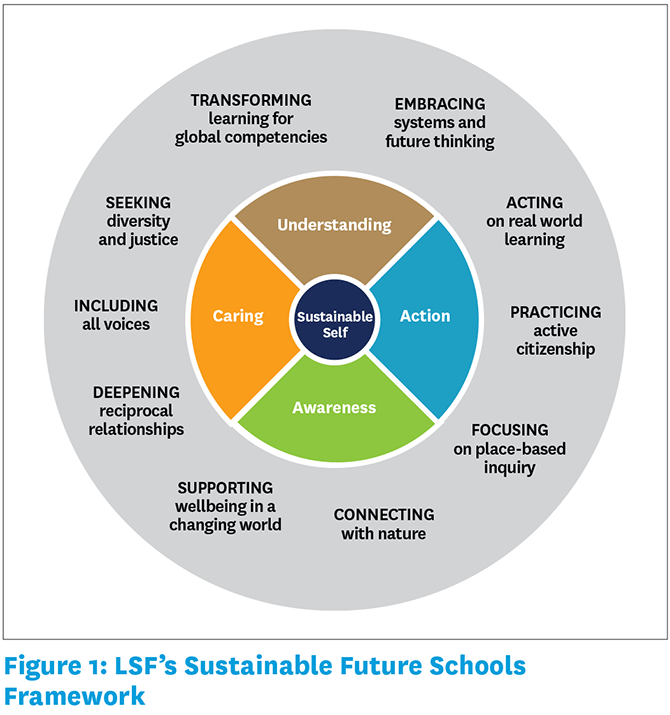
The Sustainable Self and Four Human Attributes
The circular structure of the program framework allows schools and classrooms to start anywhere. The “Sustainable Self” is every individual child in our care at school, putting the student’s growth and well-being at the centre of the learning community. Students build awareness, caring relationships with others and with nature, learn new skills and knowledge – all in support of taking action to better their lives and communities.
Ten Elements of Practice
The ten pedagogical elements are cited by research and practice as transformative tools for change. Educators’ depth of understanding and implementation for each practice may vary. Resources and professional learning on each are available and accessible. Teachers can learn independently, or with a teaching colleague, course, local partner, or faculty as a professional learning community.
- Focusing on place-based inquiry Encourage, through place-based inquiry, a shared respect and responsibility for learning, for each other, and for the land.
- Deepening reciprocal relationships Develop and sustain school and community practices by collaborating with others. Schools model interdependent, complementary relationships that are connected, balanced, and mutually beneficial. The key to creating reciprocal relationships is a respect and appreciation for the common goal.
- Connecting with nature Connect all learners to the wonder of the natural world, our interdependence with it, and the skills needed to protect it.
- Supporting well-being in a changing world Maintain physical and mental well-being to build resilience, emotional strength, and self-care in the face of complex challenges.
- Including all voices Foster inclusive, collaborative, and equity-centred leadership in schools and community partnerships. Everyone – students, teachers, parents, and local citizens – has a voice.
- Seeking diversity and justice Show respect for alternative perspectives and diverse ideas; seek to understand and innovate together in the pursuit of social and environmental justice.
- Embracing systems and future thinking Use systems thinking tools to help students engage with complex questions, leading to sustainable solutions. Including the future as an important voice in all decision-making helps us to “think long” and avoid the problems caused by short-term thinking. This also reflects Indigenous teaching about respect for the land and people, now and in the future.
- Transforming learning for global competencies Build on a strong foundation of numeracy and literacy by incorporating the six global competencies to prepare students for a complex and unpredictable future with rapidly changing political, social, economic, technological, and ecological landscapes (UNESCO, 2020).
- Acting on real-world learning Connect curriculum concepts and knowledge to issues that students have encountered or are likely to encounter in life. This brings relevance, complexity, and motivation to their learning. (Kozak & Elliott, 2012).
- Practising active citizenship Through community experiences connected to their learning, inspire the values and build the skills for active citizenship.
The Sustainable Future Schools pilot
LSF launched the Sustainable Future Schools pilot program in 2020, with support from 3M Canada, at Belfountain Public School. In early 2020, all classes at Belfountain learned about the Sustainable Development Goals. Using reflection time over the year, teachers asked students how their course content, information, or projects could be linked to one of the 17 goals. Noting these connections on a learning wall and in class discussions helped teach the SDG framework. It also provided evidence that students were understanding the goals over time. The connections showed the students the relevance of what they were learning at school. Students could link their own assignment goals to a website about an SDG initiative, showing how their work aligns with positive action taking place around the world.
For the 2020–2021 school year, the Sustainable Development Goals have become more integrated in classes throughout the school. The program began with a virtual school assembly in October, with a call to action on food waste and SDG 2: End hunger and achieve food security. In November each class shared their learnings and actions on the SDGs through videos, songs, and writings.
School culture is key
Starting from a shared understanding of a school’s culture and its unique sense of place ensures that success is not wholly dependent on one principal, teacher, or club for leadership and energy! The next step is to link the local action to one or more of the Sustainable Development Goals. Framing school learning to the wider world of the SDGs in school priorities is critical to the success of a whole-school approach. When the school is connected to local partners and tuned into real-life concerns, students, staff, and parents can work together on actions rooted in what matters to them, making acting on learning motivating and sustained over time.
Belfountain Principal Lynn Bristoll says, “When I was new, I sent out a short questionnaire to parents to find out their priorities and concerns and what they loved about the school. Overwhelmingly important for them was the environment and getting students outside.” For many years, Belfountain staff, students, and parents have connected to nature and the community.
“This is a core value of the school and a foundation to its culture. Students apply their lessons to making a difference, globally and locally,” says Bristoll. “For example, they participate in an annual Garlic Mustard Festival – a program that engages the public to identify and remove invasive garlic mustard from local green spaces. That underscores the importance of integrating the Sustainable Development Goals into our thinking and action.” (See Belfountain Grade 4 Water Inquiry for a class example).
The Sustainable Development Goals also help build awareness and understanding for other important social issues that are school priorities, such as the Black Lives Matter movement and Indigenous knowledge. Bristoll explains, “The goal is that students will leave the school knowing they can act on what they have learned.”
Belfountain Grade 4 Water Inquiry
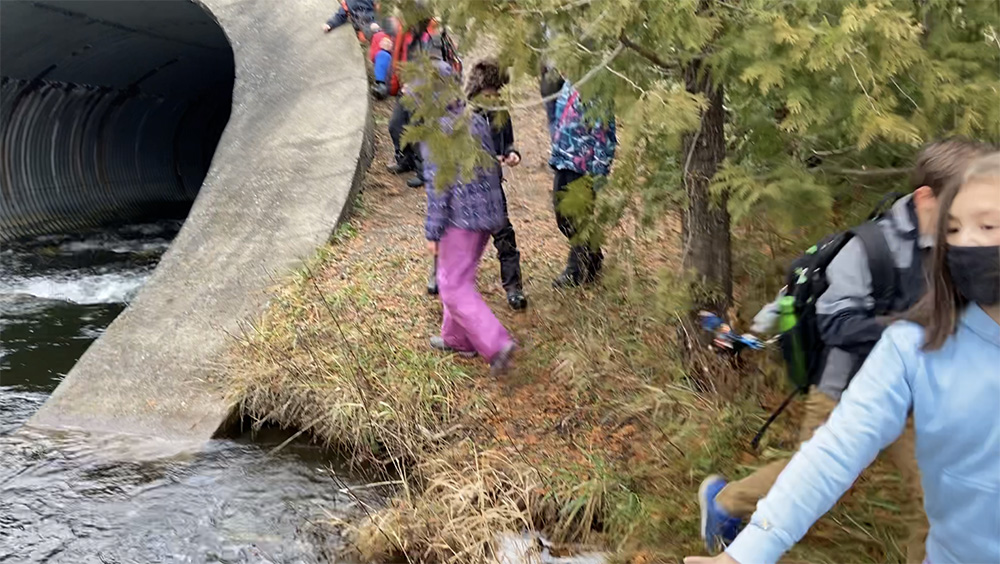
Grade 4 students wanted to learn and do something about water. They live in homes with well water, so potable water is important for them. They are concerned about a possible new development in the area and what might happen. SDG 6 is about Clean Water and Sanitation and SDG 14 is about Life below Water, so making the local relate to the global need was a clear imperative.
“Take them to the river,” LSF consultant Pamela Gibson advised the teacher. “I told her that the students are like investigative journalists, finding out what’s important for them and their community. That way they are attached to what they are learning, dialed in.”
The students observed and collected data on the river near the school. They had many questions from this initial visit. What will happen to the water table? Where is the water coming from and where is it going? Is it clean water? Their questions directed their lessons and research back at school. They learned about artesian wells, surface water, and underground rivers. The students could proceed in many directions with many projects, simply through collecting information and using their learning. The teacher could find many curriculum links through this process across several subject areas. Key to this was the outdoor experience.
It is important that teachers view the process through their curriculum. There were links to Science, Social Studies, Math and Language right from the start. Teachers can see what is possible and can guide learners to the curriculum concepts and the big ideas. Through the river and water experience, the teacher saw how her curriculum, the SDGs, and the integration of new pedagogies could all be linked.
Gibson says, “The idea is to reflect on learning experiences through the SDGs. Ask questions: How does this relate to our own future? To our local community? To global challenges?“
Make it real
Belfountain kindergarten teacher and LSF Consultant Janice Haines has been part of the sustainability culture of the school for many years. “To make the goals understood you have to make them real for children. Big ideas need to be connected to their day-to-day experiences,” Haines explains. “For example, children can grasp a science idea like adaptation when they see the animals outside managing to survive in winter. They really get it.” Finding community partners is especially helpful. “A parent got us working on squirrel conservation a few years ago and we continued with it for five years,” she says.
It’s important to offer context and reassurance to students that what they are doing makes a difference. “We don’t stress them with catastrophes, but instead relate it to what is happening in their school playground,” Haines says. “My ultimate vision is of happy kids who are eager to learn and do more in their community. They know they have a voice.”
Resources
World’s Largest Lesson
https://worldslargestlesson.globalgoals.orgPosters and Lesson Plans https://worldslargestlesson.globalgoals.org/resource/introducing-explorers-for-the-global-goals/
Intro to Goals video: Sustainable Development Goals: Improve life all around the globe
https://www.youtube.com/watch?v=kGcrYkHwE80&feature=youtu.beResources from Learning For a Sustainable Future (http://lsf-lst.ca)
Webinars: http://resources4rethinking.ca/en/outdoor-learning
These webinars introduce teachers to the SDGs and provide opportunities to share ideas and resources for integrating key SDGs into lesson plans and action projects.Resources for Rethinking: www.R4R.ca
A free online database where educators and the general public can search, by the SDGs, for the highest quality, peer-reviewed, curriculum-matched teaching resources, children’s literature, videos, outdoor activities, and apps/games.Our Canada Project: www.ourcanadaproject.ca
Allows schools to share their sustainability action projects with others to inspire youth agency, access resources, and apply for funding. More than 850 projects are currently posted and searchable by SDG.Youth Leadership Forums:
These forums engage students in local sustainability issues, equip them with the knowledge and skills needed to make a change, and empower them to take action.Banner Photo: Adobe Stock
Images courtesy of Learning for Sustainable Futures
First published in Education Canada, March 2021
Read other articles from this issue
References
Council of Ministers of Education, Canada. (2016). Pan-global competencies.
https://www.cmec.ca/682/global_competencies.htmlThe Global Goals. (2015). The Global Goals for Sustainable Development.
www.globalgoals.orgKozak, S., & Elliott, S. (2014). Connecting the Dots: Key strategies that transform learning for environmental education, citizenship and sustainability. Learning for a Sustainable Future.
http://lsf-lst.ca/dotsUnited Nations Department of Economic and Social Affairs. The 17 Goals. United Nations.
https://sdgs.un.org/goalsUNESCO International Bureau of Education. (2020). Canada establishes a Pan Canadian Global Competencies Framework for Education. UNESCO.
www.ibe.unesco.org/en/news/canada-establishes-pan-canadian-global-competencies-framework-education -
Providing a Quality Education in a Multicultural Environment
Comments Off on Providing a Quality Education in a Multicultural EnvironmentThe Marguerite-Bourgeoys School Service Centre (CSSMB) is located in the west end of Montreal. Covering over 100 schools and institutions, it is Quebec’s second largest school service centre (CSS). The territory served is divided into seven networks, each encompassing one or two high schools and their feeder elementary schools. This structure ensures consistency in the interventions for client groups living in relatively homogeneous areas. Administrators and educators from both levels maintain close ties, facilitating the students’ transition from elementary to high school. An example of this is Amène ton parent au théâtre, an initiative in which elementary students, accompanied by their mother or father, are invited to attend a bullying prevention activity presented by high-school students.
In addition, the CSSMB relies on the insights of a small team of statisticians who closely monitor hundreds of indicators, notably those associated with the 17 goals listed in its Plan d’engagement vers la réussite (Commitment to Success Plan). This information is valuable because it helps us quickly identify and address our students’ academic and social vulnerabilities.
The activities carried out in the CSSMB’s 102 institutions interconnect with many of the 17 Sustainable Development Goals (SDGs) adopted by the United Nations. In this article, we will focus primarily on Goal #4: Quality Education.
Access to quality education for all
Quebec’s student population has changed dramatically in the past few decades, especially in Montreal. In the CSSMB’s elementary and high schools, over 80 percent of students are first- or second-generation immigrants. This diversity creates a number of challenges when it comes to organizing educational services. For example, many recently arrived immigrants are unable to speak French, their new language for school and socializing. During the 2019-2020 school year, 4,500 students attended “welcome” classes, which are designed to teach French while fostering the academic and social integration of non-French-speaking young people.
If we are to provide a quality education to all (SGD 4), notably students with diverse cultural backgrounds and life experiences, we must rethink the way in which educational services are delivered. This process requires in-depth reflection, adapted tools and, ultimately, a review of existing practices. We have successfully met this challenge because we have the highest graduation and qualification rates of any Quebec school service centre – not bad for a CSS where students speak over 150 different mother tongues!
Implementing practices supported by research
To efficiently coordinate the activities of all the experts working with our students, we have created reference documents and frameworks to define everyone’s role. These resources are inspired by research in various areas to ensure that best practices are integrated and applied. In 2015, we published Vivre-ensemble en français (Living Together in French). This document offers guidelines for learning how to live together in French, clarifies some key concepts, and provides tools to better focus activities (CSMB, 2015, p. 9), while taking into account the school’s diversity, which is integral to providing all students with access to a quality education.
Together, our reference documents and frameworks have enabled us to implement a shared vision of an organization that supports the school experience of all its students, which is our primary objective. These tools establish a culture of accountability and co-operation among those who work to support the success of all students. In this way, the responsibility for teaching and monitoring learners does not fall to a single individual.
Some of our reference documents are also inspired by the tiered approach to intervention. This model, also known as Response to Intervention (RTI), is a system that prevents problems, identifies necessary interventions and improves the chances of success for all students (Bissonnette et al., 2020).
An applied research centre to support sustainable success
Although educational success includes success in school, it involves more than just obtaining a diploma or qualifications. It means encouraging children to reach their full potential intellectually, emotionally, socially, and physically. It also aims to instil values, attitudes, and obligations to help students become responsible citizens who are prepared to play an active role in society (Government of Québec, 2017).
As mentioned earlier, a majority of our students come from linguistically and ethnoculturally diverse backgrounds; increasingly, our staff reflect this diversity as well. While immensely enriching, this reality generates some everyday issues. To address these issues, the CSSMB created the Centre for Pedagogical Intervention in Diverse Environments (CIPCD, cipcd.ca) in 2012. Initially serving the “living together in French” orientation of our 2014-2018 strategic plan, the CIPCD then shifted its orientation to “provide an inclusive, welcoming environment open to the world and the future” in accordance with the CSSMB’s 2018-2022 Commitment to Success Plan. This innovative initiative is unique because we are the only CSS to have our own applied research centre affiliated with various partners.
The CIPCD has six working groups to study challenges related to ethnocultural and linguistic diversity in schools, each with its own priority focus. A university researcher and CSSMB administrator or educational consultant are assigned to each group, which has three primary mandates: research, transfer of scientific knowledge, and training.
Focus 1: Teaching French in a multi-ethnic and multilingual environment
Since 2012, various projects have been carried out to address issues of diversity at the CSSMB. Working Group 1 was created because of the very linguistically diverse student population. French is not the mother tongue of over 60 percent of our elementary and high-school students. This working group focuses on the overall problem of adapting pedagogical practices when teaching French to bilingual and multilingual learners for whom French is a second, or even third, language.
In 2015, the CSSMB and Université de Montréal launched a continuing education project called Taking Action in Multi-ethnic and Multilingual Environments with Preschool and Daycare Students. One outcome of this initiative was to increase staff awareness of the importance of recognizing and acknowledging the different languages spoken by students (e.g. Festival “Pluri-Pluri”). This project has changed our perceptions of languages of origin and the need for inclusive practices.
Focus 2: Academic success and school-family-community relations
As noted earlier, over 80 percent of our students are first- or second-generation immigrants. For a variety of reasons related to their migratory experience or that of their parents, these students may face numerous social vulnerabilities and/or academic challenges. Working Group 2 concentrates its activities on the twofold challenge of academic success and school-family-community relations.
In the last few years, the group has organized a number of activities. Several CIPCD-affiliated researchers carried out a study entitled Intercultural Climate and Educational Success of Immigrant Students. This research aimed to evaluate the state of the intercultural climate in several multi-ethnic schools in Quebec (including two at the CSSMB) and examine the impact of this climate on the educational success of immigrant students. Ultimately, a diagnostic tool must be developed to help administrators assess their school’s intercultural climate, as it is a key factor in supporting the educational success of immigrant students.
Focus 3: Vulnerable immigrant populations and psychosocial intervention in educational settings
Recent immigrant students entering the Quebec school system sometimes arrive with emotional baggage that includes grief and trauma. Working Group 3 studies the psychological well-being and academic success of these students, particularly those in psychological distress.
During the 2016-2017 school year, an action research project provided insight on the academic and social integration of young Syrian refugees. Discussion groups were formed in welcome classes to help these students develop a sense of well-being and belonging. At the end of the project, a guide on organizing discussion groups in schools, Mener des groupes de parole en contexte scolaire (2017), was published for school practitioners. Professionals in many of our schools now use this guide to organize such groups so students can express themselves on various topics like death and violence. These groups are designed to foster the psychological well-being of young people in school and, consequently, their educational success.
Focus 4: Inclusive education and intercultural understanding
Working Group 4 was created to address the interpersonal relationship challenges generated by the diversity of our CSS. Its work focuses on making the concept of “living together” a reality in our schools, notably by explaining the foundations of the inclusive perspective. It also looks at activities to promote intercultural understanding and seeks to document their impact.
In 2015, this working group developed a pedagogical guide to help school staff who would like to discuss sensitive topics with students: Aborder les sujets sensibles avec les élèves. This practical tool can be used on a daily basis to discuss topics, whether related to diversity or not, that can provoke discomfort or sometimes heated class discussions.
Focus 5: Socio-professional integration of recently immigrated staff and work relationships in a multi-ethnic environment
More and more CSSMB staff members have been educated outside Quebec, a reality that creates challenges with regard to their socio-professional integration and the school climate. In the last few years, teachers have been trained as peer mentors to help welcome their foreign-trained colleagues, and school administrators have been invited to awareness training on the topic. Teachers educated outside the province have also taken part in group discussions to learn more about the profession in Quebec (challenges and advantages). Finally, this work has led to the publication of a guide for school administrators on facilitating the socio-professional integration of foreign-trained teachers: Faciliter l’intégration socioprofessionnelle du personnel enseignant formé à l’étranger (2019).
Focus 6: Vocational training for youths and adults with an immigrant background
Ethnocultural and linguistic diversity is also increasingly present in vocational training (VT), raising a number of issues particular to this educational sector. In addition to studying the pathways of VT students from ethnocultural minority groups, the members of this working group examine the problems these students face when acquiring skills and trying to enter the job market. In the last few years, the group has led projects to raise awareness of the realities experienced by young people from immigrant backgrounds and revisit the practices supporting their occupational integration, for example, in internship settings.
***
The makeup of our student population has been transformed over the past few decades. Children named Bertrand, Roberge and Lauzon now sit alongside those named Traoré, Chang and Hernandez, primarily because the Charter of the French Language dictates that the majority of new immigrants must attend French-speaking schools. These students come from around the world. Upon arrival, many of them spend one or two years in a welcome class, discovering the language of Félix Leclerc, before joining a regular classroom where they will be successful.
This is possible because we have taken measures to ensure their success, notably by creating more partnerships with university academics. We offer these experts a vast testing ground and, in return, they share what they learn with us. The results speak for themselves: at the end of the 2019-2020 school year, the graduation and qualification rate of our students was ten points higher than the average for all French-speaking school service centres in Quebec. We can therefore safely infer that we are on the right track!
Photo : Adobe Stock
First published in Education Canada, March 2021
Read other articles from this issue
References
Bissonnette, S., Bouchard, C., St-Georges, N., Gauthier, C., & Bocquillon, M. (2020). Un modèle de réponse à l’intervention (RàI) comportementale : Le soutien au comportement positif (SCP). Enfance en difficulté, 7, 129–150.
Commission scolaire Marguerite-Bourgeoys (2015). Référentiel d’accompagnement vivre-ensemble en français. Service des ressources éducatives.
www.csmb.qc.ca/~/media/Files/PDF/CSMB/veef/Referentiel_Vivre-ensemble.ashxCommission scolaire Marguerite-Bourgeoys (2018). Plan d’engagement vers la réussite 2018-2022. https://www.csmb.qc.ca/fr-CA/csmb/pevr.aspx
Festival « Pluri-Pluri » à l’école Terre-des-jeunes.
www.elodil.umontreal.ca/videos/presentation/video/eveil-aux-langues-et-aux-cultures-a-lecole-ter/Government of Québec. (2017). Policy on educational success: A love of learning, a chance to succeed. Ministère de l’Éducation et de l’Enseignement supérieur.
www.education.gouv.qc.ca/fileadmin/site_web/documents/PSG/politiques_orientations/politique_reussite_educative_10juillet_A_1.pdfHirsch, S., Audet, G., & Turcotte, M. (2015). Aborder les sujets sensibles avec les élèves — Guide pédagogique. Centre d’intervention pédagogique en contexte de diversité, Commission scolaire Marguerite-Bourgeoys.
https://cipcd.ca/wp-content/uploads/2014/04/CSMB_-Guide_sujets-sensibles_final.-1.pdfAmène ton parent au théâtre.
www.mfa.gouv.qc.ca/fr/intimidation/prix/Pages/Ecoles-secondaires-Saint-Georges-Saint-Laurent-2018.aspxMorrissette, J. (2019). Faciliter l’intégration socioprofessionnelle du personnel enseignant formé à l’étranger. Guide à l’intention des directions d’établissement. Centre d’intervention pédagogique en contexte de diversité, Commission scolaire Marguerite-Bourgeoys.
https://cipcd.ca/wp-content/uploads/2014/04/GuideFaciliterInte%CC%81gration_VF_HauteRe%CC%81so_190708_pagesSimples.pdfPapazian-Zohrabian, G., Lemire, V., Mamprin, C., Turpin-Samson, A., & Aoun, R. (2017). Mener des groupes de parole en contexte scolaire. Guide pour les enseignants et les professionnels. Centre d’intervention pédagogique en contexte de diversité, Commission scolaire Marguerite-Bourgeoys et Université de Montréal.
https://cipcd.ca/wp-content/uploads/2014/04/Mener-des-groupes-de-parole-en-contexte-scolaire-Guide-pour-les-enseignants-et-les-professionnels.pdf -
Amplifying the UN’s Sustainable Development Goals to engage and empower Canadian K-12 students to lead societal change
Comments Off on Amplifying the UN’s Sustainable Development Goals to engage and empower Canadian K-12 students to lead societal changeToronto, February 11, 2021 —The EdCan Network is pleased to launch – in partnership with the Canadian Commission for UNESCO (CCUNESCO), – an awareness campaign highlighting how educators can engage students in meaningful learning using the UN Sustainable Development Goals (SDGs). More teachers and students will discover their role in solving local, regional, and global problems such as poverty, access to quality healthcare, gender equality, and access to inclusive, equitable quality education, to name a few. This extensive focus on how the SDGs can transform learning will include the release of a special issue of Education Canada Magazine dedicated to showcasing the educational importance and transformative impacts the SDGs can have on teaching practice and student learning.
“There’s no more opportune moment than now to showcase a movement of Canadian and international educators and organizations devoted to inspiring students to define their futures and make a difference in our world,” says Denise Andre, EdCan Network Chair, “Our network is delighted with this opportunity to collaborate with CCUNESCO to amplify the SDGs to spark deep learning across the country.”
‘’To build a better future for all, we need to mobilize the education sector, especially teachers and students, in order to achieve the 17 Sustainable Development Goals (SDGs) by 2030. This sector has the unmatched possibility to raise awareness, develop the critical thinking skills of young people and serve as a powerful lever for changing behaviours and lifestyle habits. We are happy to partner with EdCan on this important campaign,’’ says Sébastien Goupil, Secretary-General, Canadian Commission for UNESCO.
From now until April, this campaign will deliver infographics, fact sheets, a professional learning discussion kit, and an online professional learning course that will be available to EdCan members. For educators, schools, and school districts looking to learn more about the SDGs or to share how they’ve successfully integrated the SDGs into their school communities, please visit: https://www.edcan.ca/magazine/spring-2021/ and follow @EdCanNet and @CCUNESCO for latest campaign updates.
About the EdCan Network
The EdCan Network has maintained its 129-year tradition as the only national, nonpartisan, bilingual organization representing 110,000 educators across Canada. Our role as an intermediary connects K-12 education systems across the country by producing and disseminating authoritative and evidence-based, yet accessible content that is trusted by educators, parents, and policymakers alike. EdCan aims to improve education policies that heighten equity and support deeper learning (i.e. a combination of the fundamental knowledge and practical basic skills all students need to succeed), and expanding the reach of educational resources in an effort to bridge the research-implementation gap. Learn more at www.edcan.ca or @EdCanNet.
About the Canadian Commission for UNESCO
The Canadian Commission for UNESCO (CCUNESCO) serves as a bridge between Canadians and the vital work of UNESCO—the United Nations Educational, Scientific and Cultural Organization. Through its networks and partners, the Commission promotes UNESCO values, priorities and programs in Canada and brings the voices of Canadian experts to the international stage. The Commission facilitates cooperation and knowledge mobilization in the fields of education, sciences, culture, communication and information to address some of the most complex challenges facing humanity. Its activities are guided by the United Nations’ 2030 Agenda for Sustainable Development and other UNESCO priorities. CCUNESCO operates under the authority of the Canada Council for the Arts.
For more information contact:
Sarah Ranby
Research Analyst
EdCan Network
sranby@edcan.caIsabelle LeVert-Chiasson
Program Officer, Education and ASPnet National Coordinator
CCUENSCO
isabelle.levert-chiasson@ccunesco.ca -
The UNESCO Schools Network
Comments Off on The UNESCO Schools NetworkThe 17 Sustainable Development Goals – also known as the SDGs or the Global Goals – offer a blueprint for a more just and sustainable future for all. As many as 193 governments from around the world adopted these goals in 2015 and agreed to implement them in their own countries in order to achieve the 2030 Agenda for Sustainable Development. Over the coming decade, these countries will continue to mobilize efforts to end poverty, fight inequalities and tackle climate change. These new, interconnected goals build on the earlier Millennium Development Goals while encompassing new priority areas, such as climate change, economic inequality, innovation, sustainable consumption, peace and justice, and others.
SDGs have a huge part to play in today’s classrooms. As a road map for making the world a better place, these goals can support student engagement and can also inform and influence lesson plans. The Canadian Commission for UNESCO (CCUNESCO) has been supporting students and educators in bringing these global goals to the classroom through the UNESCO Schools Network, a global network of schools contributing to the achievement of the 2030 Agenda for Sustainable Development. Here are a few examples of how members of this network are taking action on the SDGs in their schools across Canada.
Agenda 2030
Elm Creek School – Sustainability in Action At Elm Creek School, a K–12 community school in Elm Creek, Manitoba, their UNESCO team of students and lead teachers launched a school-wide project to bring more awareness to, and take action on, the SDGs. The World’s Largest Lesson, launched in 2015 to bring these global goals to children everywhere, was shared with all students in a special school assembly. At this assembly, students were placed into various multi-graded groups. The school’s UNESCO committee collected various print and electronic resources, and then assigned each of these groups one or two of the goals to research. This research process led to planning that supported the ultimate goal of the entire school working together to implement action projects that could address the SDGs. Action projects that continue to be implemented and sustained include:
- an annual food drive to collect non-perishable food items for children and families in need within the school’s community and surrounding areas (SDG #2: Zero Hunger)
- an annual drive to collect school supplies, personal care items, and small toys for children in developing countries (SDG # 4: Quality Education)
- a school-wide waste composting project using worms to break down food waste into useable compost for the school’s garden, which then raises produce for the school’s canteen (SDG #12: Responsible Consumption and Production).
SDG #4: Inclusive and Equitable Quality Education for All
In 2020, the CCUNESCO and the Global Centre for Pluralism launched online teacher training on “Talking About Racism in the Classroom” in response to racial injustice in Canada and in our schools. More than 1,000 teachers responded and more than 500 participated in online training as it was clear that teachers and school administrators urgently wished to be equipped and supported to have these conversations and to explore systemic racism within their school systems.
In order to continue this important conversation with students, CCUNESCO partnered with TakingItGlobal and the Centre for Global Education to organize an online live video conference for schools across the country titled “#BlackLivesMatter in Canadian Schools.” The two keynote speakers for this video conference were two students from the David Suzuki Secondary School from Brampton, Ontario. As members of the United Souls, a Black student leadership group that shares a common ideal of upholding Black excellence, they were able to share their personal experiences of racism and how we can address systemic racism within our school systems.
SDG #3: Good Health and Well-Being
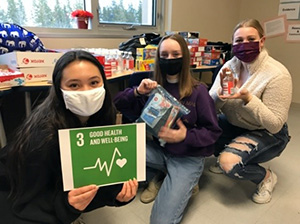
F. H. Collins Secondary – Sharing and Caring To promote health and well-being in their community, some of the students at F.H. Collins Secondary School in Whitehorse, Yukon, organized care packages for people in need this winter. Students purchased arm socks and mitts along with personal-care products and some chocolate to be distributed locally. The students enjoyed working together to spread some holiday cheer and work toward SDG #3: Good Health and Well-Being.
SDG #13: Climate Action
Climate action is essential for sustainable development, which, at heart, is a way for people to benefit from natural resources without using them all up and depriving future generations. For example, reducing carbon emissions is key to living within environmental limits. So is being responsible about excess packaging, waste disposal, and how we treat the world’s oceans. It is increasingly urgent to preserve the world’s ecosystems and natural and cultural heritage, and to protect the Earth from the most devastating effects of weather extremes, such as wildfires, floods, severe storms, and more.
A whole-school approach was implemented by lead UNESCO Schools teacher Terri Munn at Bruce Peninsula District School At Bruce Peninsula District School in rural Ontario, teachers, students, and staff have implemented a comprehensive program driving climate action in every classroom, with monthly challenges and tips. As part of this approach, the entire K–12 school completed ten monthly challenges focused on climate action during the school year. The projects supported what students were learning in class and involved parents and community members. To ensure everyone stayed on track, the school kept tally sheets of climate actions and had one student elected by each class to make sure climate actions were being taken.
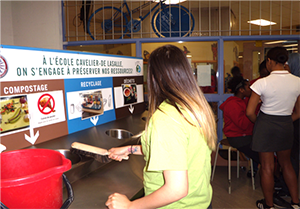
École Sécondaire Cavelier-De LaSalle – Waste Reduction At École secondaire Cavelier-De LaSalle in Quebec, reducing waste is serious business. After installing an industrial composter, the school redirected 176 kg of waste as compost in 2017, and 200 kg of waste in 2018. The school also reduced plastic waste by selling reusable water bottles in the 2017–2018 school year, which are fillable at the school’s bottle fountains.
SDG # 16: Peace, Justice, and Strong Institutions
In order to ensure peace, justice and strong institutions in Canada, Indigenous peoples’ rights must be respected. According to the Truth and Reconciliation Commission of Canada, the United Nations Declaration on the Rights of Indigenous Peoples (UNDRIP) is the framework for reconciliation at all levels and across all sectors of Canadian society. The UNESCO Schools Network supports initiatives that promote reconciliation between Indigenous and non-Indigenous peoples in Canada within UNESCO’s program areas. To facilitate the conversation around reconciliation within the classroom, CCUNESCO partnered with Wapikoni, an organization that works with Indigenous youth through cinema and music to develop their artistic, technical, social, and professional skills, and broadcasts their films to increase public awareness of issues facing Indigenous communities. The result was a teaching guide intended to encourage high-school teachers to engage students in discussions about current issues and to introduce them to the diversity of Indigenous cultures in Canada.
Allison Bernard Memorial High – Celebrating Indigenous culture At Allison Bernard Memorial High School, located in Eskasoni First Nation in Nova Scotia, the school uses music and technology to help students engage with, share, and celebrate their cultural identity. For example, high-school students put Rita Joe’s famous poem, I Lost My Talk, to music. “It’s all about reconciliation through art – that was the overriding idea with this whole project,” says Eskasoni teacher Carter Chiasson. They are also in the process of developing a language app to revive Mi’kmaq.
A global network that supports local action
Imagine more than 11,500 schools in 182 countries connecting and learning from one other, where students reflect on global challenges such as peace, climate action, human rights, cultural diversity, and sustainable development, while taking action to contribute to positive changes in their own communities. This is what the UNESCO Schools Network is all about. Created in 1953, it connects schools across the world to promote quality education for all in the pursuit of peace and development. There are more than 100 UNESCO schools across Canada.
There is a particularly important role for UNESCO schools in Canada to take action on SDGs. A Teacher’s Toolkit was recently created to support all educators and students who are interested in implementing UNESCO values at their schools. While all schools can access UNESCO and CCUNESCO educational resources and publications, those that are part of the network also get to learn from one another with other schools that are committed to tackling local and global issues related to the SDGs, thereby contributing to a better and more sustainable future for all. Learn more about the SDGs, connect with others across Canada and the world, and join the movement!
Photos: CCUNESCO
First published in Education Canada, March 2021
Read other articles from this issue
References
Canadian Commission for UNESCO.
https://en.ccunesco.caCanadian Commission for UNESCO. (March 2020). Teachers toolkit: UNESCO Schools Network in Canada. UNESCO.
https://en.ccunesco.ca/-/media/Files/Unesco/Resources/2020/04/ToolkitUNESCOSchoolsTeachers.pdfRita Joe Song Project. Gentle warrior. National Arts Centre.
https://nac-cna.ca/en/ritajoesong/gentle-warriorGlobal Centre for Pluralism. (2020). Talking about racism in the classroom: Webinar and resources for educators on anti-Black racism.
www.pluralism.ca/talking-racismUNESCO Schools Network.
https://en.ccunesco.ca/networks/unesco-schools-networkWapikoni. (n.d.) Wapikoni teaching guide: An introduction to the diversity of Indigenous cultures in Canada.
www.wapikoni.ca/about/services-offered/wapikoni-teaching-guideWorld’s Largest Lessons.
https://worldslargestlesson.globalgoals.org -
Your SDGs To-Do List
Comments Off on Your SDGs To-Do ListFor years, I thought I was checking all the “global education” boxes. Committed to diversity, building global competencies, and supporting my students to seek out different perspectives and viewpoints, I was set on making sure my young students were preparing for a world that would require them to work and live as global citizens. We placed emphasis on reading about cultures different from our own. We learned about holidays and customs of people in distant lands. Daily language practice included English, Spanish, and Mandarin Chinese. As early adopters with technology, we aimed to make connections to global issues and current events around such topics as the environment and human rights.
Then, around 2010, I realized that though I had been checking boxes, my instructional to-do list as a global educator needed to move students beyond simply learning about the people and issues of our world to a new level of action.
The Four Domains of Global Competence offered by the Asia Society (2005) (See Figure 1) showed me that globally competent students need the knowledge and skills to:
- Investigate the world
- Recognize perspectives
- Communicate ideas
- Take action.
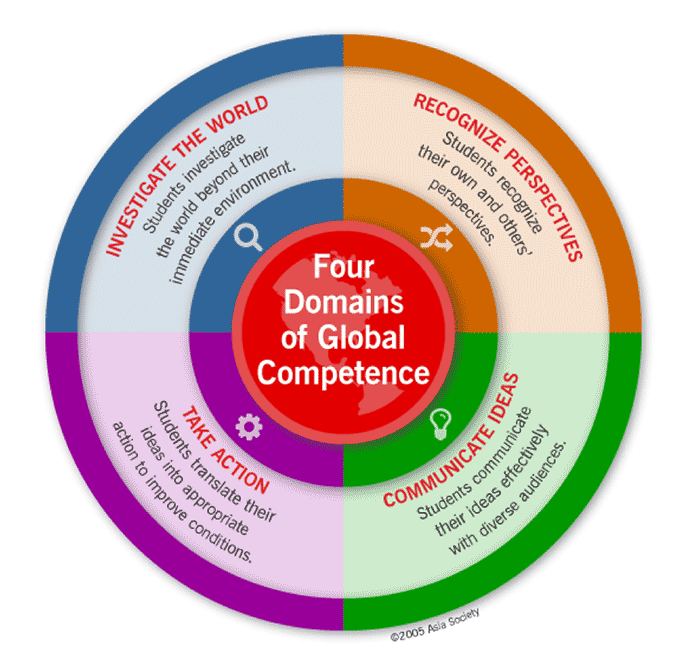
Figure 1 : Four Domains of Global Competence
The first three domains – that was where I was existing. Take action – that was where we needed to go.
Looking back, I would say that was the first defining moment that changed my course as a global educator. The next was in 2015, when I met the United Nations Sustainable Development Goals (SDGs).
“The Sustainable Development Goals are humanity’s to-do list for a sustainable planet, a roadmap for a better future.” – United Nations Office at Geneva
The 17 Global Goals that our world together agreed to reach by 2030 cover critical topics such as life on land, climate action, gender equality, clean water, and food security. We in education even have our very own Global Goal in SDG 4: Quality Education. As I explored the SDGs, I started to see how we as educators can fit into this global conversation and universal call to end poverty, protect the planet, and improve the lives of all people.
Over the years, I have gathered with like-minded educators from all over the world who are also committed to bringing the SDGs to our classrooms and schools. Mobilized as a professional learning network and coming together in collaborative spaces such as Twitter and with projects such as the Goals Project (www.goalsproject.org), we see education as one of the greatest paths to achieving the SDGs, with teachers and students working together in solidarity and with purpose.
The TeachSDGs community
The start of TeachSDGs, now a community of more than 50,000 international educators taking action for the Global Goals, really came from the idea that the goals could be the roadmap for teachers seeking new ways of teaching and learning.
I remember sitting with my global education friends Alice McKim of New Brunswick, and Amy Rosenstein of New York and thinking together that the goals were what we had been searching for – the bridge to connect the work happening in classrooms out to the world and to industry. For us, the goals became the entry point into how we as teachers, along with our students, could join the conversation and have a “seat at the table” – be it in New York City at the UN headquarters or at the level of local policy or projects. The Global Goals, in our minds, laid out the plan and also the pathways into the work.
After being tasked by the UN to organize as a Global Goals Task Force, we knew we needed to move beyond being a handful of North American educators. We set out to invite in our global colleagues, many of whom we had never met and only knew from social media. We did what we knew best – we created a hashtag (#TeachSDGs) and a simple website (TeachSDGs.org), and we got to work. Soon after, we went from being a few educators to 17 to now tens of thousands, all working for this shared purpose – to support and empower students and teachers to take action for people and the planet through the work of the SDGs. And now that we have entered this Decade of Action, with less than ten years left until 2030, we are all operating with urgency and a clear vision of what we can do to help.
Why the SDGs? Why now?
So why the Global Goals? Why now? We seem to be at a pivotal moment in education. We are seeing students rise up as activists to inspire and create needed change based on their viewpoints and the needs of our world; we as citizens of planet Earth are tackling climate change and combating human rights violations and global pandemics; we are seeing new technologies change the way we live and work at just the time when we are also prioritizing the human part of living and working, with emphasis on social-emotional learning, well-being, empathy, and design thinking. We as educators have been on the front lines of the change – seeing the shift as it occurs and pivoting and advancing right along with it.
The Sustainable Development Goals bring opportunity. They bring hope and a guide to get us there. Within classrooms, I see how the goals allow for collaboration and interdisciplinary work. Just as the goals are for everyone, everywhere, they also see no boundaries within curricula, allowing us to cross content areas and work as teams toward a common purpose. The Global Goals are the sciences and the arts; they are language and humanities. They are our history and our future, and for us as teachers, they can be the “today” of our teachings.
Goals Project: One way to jump in
After several years of our work in building awareness of the goals, we started to hear teachers saying, “Now we see the ‘why,’ but what about the ‘how’?” In 2019, I was inspired by one of my former university students, who shared with me a project she did with teachers around the ABCs. If a project around 26 letters of the alphabet could work, I thought, why not build one around the 17 SDGs? I decided to see if teachers from the TeachSDGs community might be interested in joining me for a short project on the goals.
Once again, I created a name (Goals Project), a hashtag (#GoalsProject), and a free website (www.goalsproject.org), and started to share it on Twitter. My original stretch goal was finding 16 other classes. Within weeks, more than 350 people had asked to join, and in that first year of our Goals Project we had nearly 2,000 classrooms participate. The 2021 Goals Project kicked off on January 25, welcoming in nearly 3,000 classrooms from more than 120 countries. Students aged three–20 are joining in to take on the SDGs in a six-week project of solutions. For us, it is a space for exploring of ideas and building hope for a better planet as stewards for the environment and for the goodwill of people.
Create your to-do list for action in the classroom
For educators ready to dive into the Global Goals today, here are five tips and then a listing of top resources designed to help K–12 educators take action on the SDGs in classrooms.
- Clearly identify your own instructional goals and bring the Global Goals in naturally.
- Consider your own interests, skills, and curiosities. Your excitement around specific goals and targets can inspire and motivate students!
- Keep your to-do list short, specific, and manageable. Focus on collective action over time, and build action into your routines and even lesson plans.
- Connect to events and organized projects. Check out the SDG Planning Calendar (listed below), established global collaboration projects, and even local community events, and align with activities happening throughout the year.
- Share with a friend – near or far. As you take on this new challenge, invite a teacher from your school (or find someone from another part of the world) to join with you as you jump in and start checking things off!
RESOURCES
Free printable classroom resources
Print out and post the SDG Poster or the individual Global Goals:
The Lazy Person’s Guide to Saving the World (UN, 2019) suggests SDG actions you and your students can take from your couch, your home, your community, and your work/school:
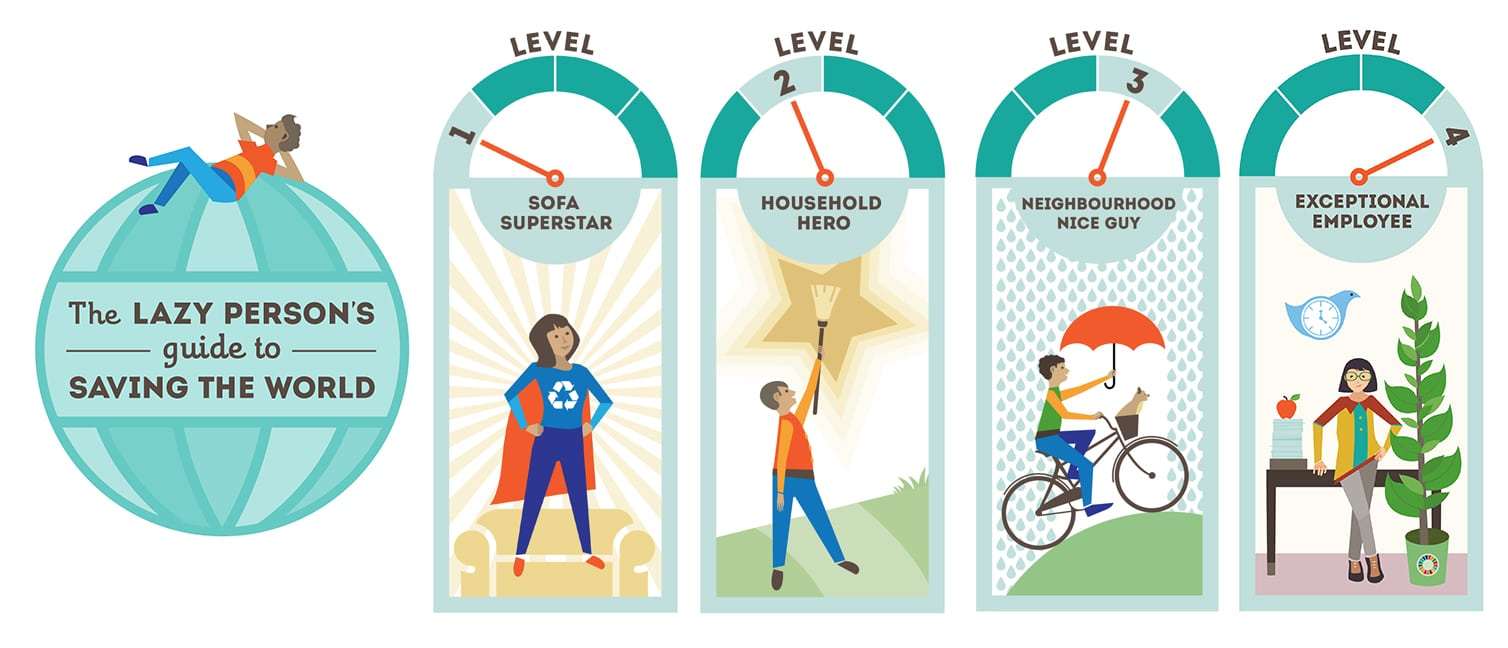
Download and share infographics, GIFs, and translations for inspiring action in your school and community:
Create your deck of action cards with the 170 Daily Actions to Transform our World resource from the UN Office at Geneva:
Activities and lesson plans
Download the annual World’s Largest Lesson and access videos, printables, and other resources from
Do you work with students ages 4–8? The Explorers for the Global Goals lessons are a great place for you to start. Learn more at:
Gamify learning with the Go Goals! SDG Board Game for Children offered in 21 languages. https://go-goals.org
Help end hunger by playing the Freerice online learning game by the World Food Program. For every correct answer, five grains of rice will be donated to people in need of food
Opportunities to connect and collaborate
Connect with thousands of educators from around the world who teach the Global Goals in their classrooms. Visit www.teachsdgs.org and follow the #TeachSDGs conversation on social media.
Join the annual Goals Project to be a part of a six-week online experience to learn about the goals and collaborate with classrooms from more than 120 countries. Visit www.goalsproject.org and follow #GoalsProject on social media.
Check out all the events and international days on the SDGs Planning Calendar:
Banner Photo: Adobe Stock
First published in Education Canada, March 2021
-
UN SDGs in Education
Comments Off on UN SDGs in Education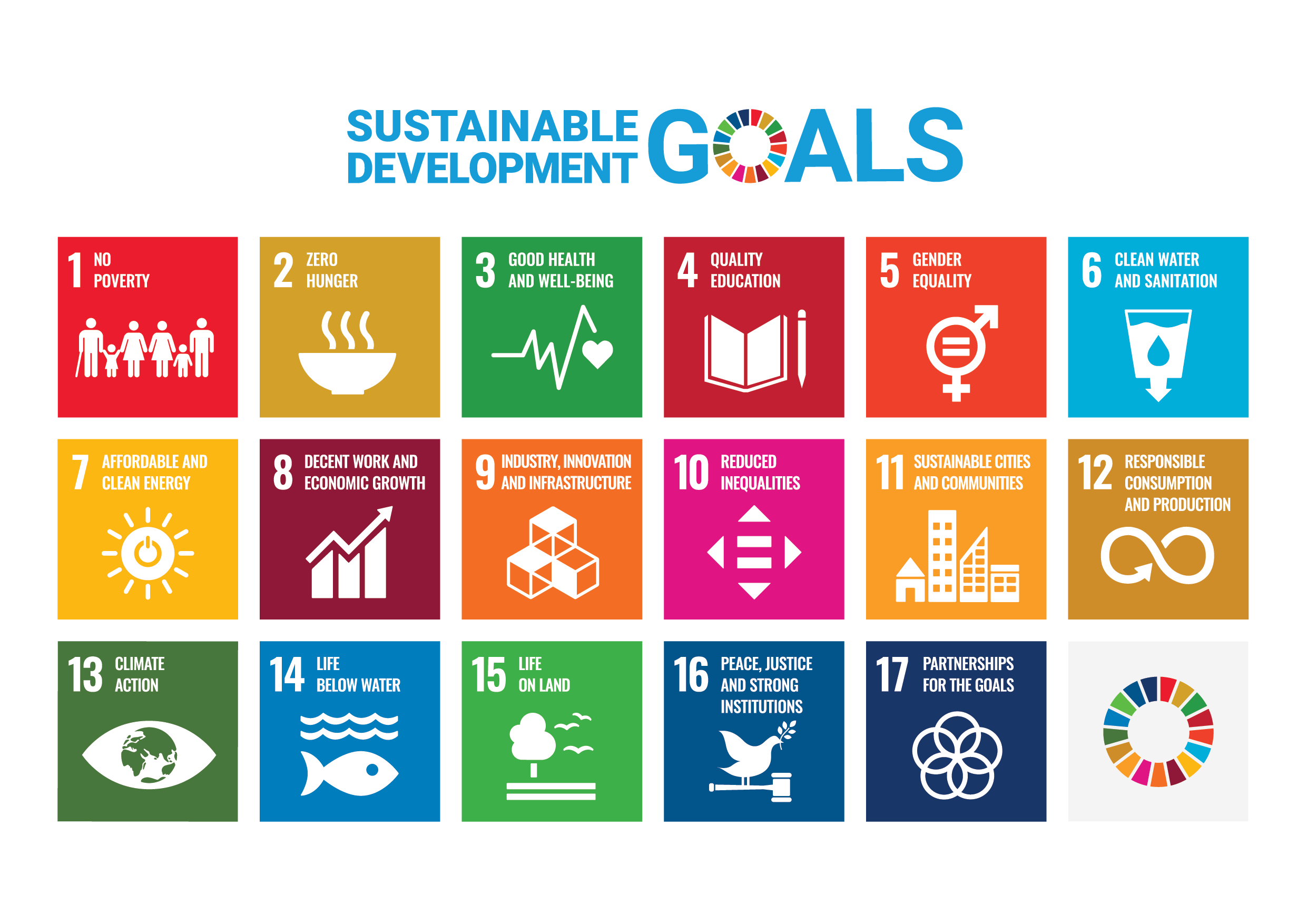
Image: United Nations
Sustainability gives purpose to education.1
THE IDEA of education for sustainable development is not entirely new. My introduction to it began in 2008, with a simple request. A group of students required a staff advisor in order to participate in the Plan International Canada program, Spread the Net. Co-founded by Rick Mercer and Belinda Stronach, Spread the Net was a friendly national fundraising initiative among K–20 institutions to engage communities in international development actions. As a science teacher, it was not lost on me that malaria had been eradicated in Canada for more than 60 years (70+ years today), yet it remained a challenge for some nations globally. Moreover, due to changing global climate systems, there was the potential for Canada to face similar challenges with malaria in the future.
Months later, I learned that the Spread the Net initiative was rooted in one of the United Nations’ eight international development goals, known as the Millennial Development Goals (MDGs). Spread the Net was my introduction to the world of education for sustainable development (ESD) and the work of the United Nations Educational Scientific and Cultural Organisation (UNESCO) for global education. Because of this experience, my philosophy for “why I teach” broadened in scope from subject-specific curriculum expectations to a more global perspective: How will students apply this information to address the complexities of today and of the future?
The What: The Sustainable Development Goals
On September 15, 2015 at the UN General Assembly, global leaders unanimously adopted Transforming Our World: The 2030 Agenda for Sustainable Development, a new set of progressive universal and transformative goals for global development. The new UN framework that superseded the MDGs was created so that nations could continue to reimagine and reshape the future, with one major difference – this framework had global significance and was positioned in a way that all nations could plan, act on, and measure their progress over a 15-year period. The resulting 17 Sustainable Development Goals (SDGs) and 169 targets were developed with the input of people from all over the world to ensure they represented the needs of the global population. That is why the framework has come to be known in education circles as the Global Goals.
Building on the principle of “leaving no one behind,” the new Agenda emphasizes a holistic approach to achieving sustainable development for all. The 17 Global Goals for Sustainable Development are integrated and indivisible.
The Why: What does this have to do with education?
The 2030 Agenda is an ambitious plan in which education is mentioned 28 times across six goals (#1, #3, #5, #8, #12, and #13), in addition to Goal #4, which is dedicated solely to education. Education is positioned as both an enabler and a driver of capacity building toward achieving the SDGs.
But the SDGs also bring to education systems an exciting new model on which to scaffold teaching through the 17 cross-cutting themes that intersect all societies, all grade levels, and all disciplines. Using the 17 SDGs as lenses for teaching presents subject-matter content in a relevant context, helping students to apply what they are learning locally to global conditions and current events.
The appeal of the framework for me is the interconnected, interlinked nature of the goals. At first glance the SDG poster with the 17 tiles, vivid hues of primary colours, and skillfully arranged composite of squares to form a rectangle, looked simple. But it is not. No tile exists in isolation! Once I ventured behind each tile, exploring each indicator (measure of progress) and tangential connection, I realized that in its wholeness these 17 tiles represented life’s challenges and opportunities that could be investigated and discussed in varying magnitudes/scales, e.g. individual, community, region, country, continent, and the world. I had discovered concrete and flexible ways to actively engage learners in critical thinking and systems practice.
Consider the discipline of science, my playground. It is a powerful tool that learners can use to understand natural and social phenomena in their communities. These phenomena, usually distilled into discrete subject areas, are presented in the SDGs with all their beautiful real-world complexities and nuances. Learners are required to mobilize knowledges (from areas other than science) skills, and attitudes – including the pan-Canadian global competencies2 – to identify local problems and action solutions. Since the SDGs serve to spark the problem-finding, the solutions that arise can have global application.
The SDGs position the subject-specific knowledges in their true form: multifaceted, multilayered, and complex. When learners apply subject-specific knowledge in a context that is positioned in local realities, they are empowered to explore, analyze, and engage with their environment, both natural and human-made, and to strengthen skills (global competencies) that will enable them to tackle complex issues that are affecting their communities now and in future.
Strength in purpose
When I agreed to contribute to this publication, I knew that the narrative I would share could not be my story alone. This was an opportunity to serve as a knowledge broker for the SDGs. I decided to provide space for more voices to be heard and posted a call for contributors via a brief survey to the TeachSDGs Ambassador Slack platform. It did not take long for responses to come in – from Greece, Canada, Lebanon, Nigeria, the U.K., the U.S., United Arab Emirates, and France – a global community bound together by their belief in the power of education to transform the world. Formal and informal educators, former teachers, and an administrator responded to the call.
My first question centred on the benefits of membership in a global community of practitioners (Teacher SDGs Ambassadors). Here are just a few responses:
“Sharing of best practices with each other. Networking with like-minded people from across the world. Learning from a global community to help prepare students to think local and act global.” – Anita Singh, teacher at a Farm School, United Arab Emirates
“… collaborating with other educators on ideas to teach the SDGs.” – Doreen N. Myrie, teacher-educator, U.S.
“The main benefits are creating partnerships with each other to increase our implementation efficiency. These partnerships would be in different forms like sharing resources, expertise, affiliation, and all kinds of support.” – Jinan Karameh, school principal, Lebanon
“Access to a community of like-minded practitioners who share the same vision and ultimately the same goal. Sharing best practice. Kept informed with current initiatives and learning development opportunities.” – Tim Black, former teacher, France
Reading these comments, a proverb came to mind: “If you want to go fast, go alone; if you want to go far, go together.” Through the global collaboration and partnership enabled by the TeachSDGs Ambassador program, my voice, my work, and my contribution to education benefits many more individuals than I actually see, and every opportunity to collaborate serves to amplify the actions that support desirable practices in education.
Engaged teachers and learners
In order to engage students, teachers must understand the purpose of learning – the collective why – for themselves and the students. Whether it be social studies, the arts, science, or math, teachers must consider:
- Why do students need to know this?
- How will the material support students’ understanding of themselves and of the world, now and in the future?
The 17 Global Goals offer teachers myriad ways to educate students about global complexities through local contexts. Research on Education for Sustainable Development supports this approach for enhancing student self-esteem, character development, empathy, and empowerment. Framing the learning at the community level also provides students the chance to apply knowledge to authentic contexts. In addition, ESD pedagogies encourage teachers to consider more learner-centred approaches, enabling students to be self-governing in their learning. Schooling must now prioritize the development of competences for sustainability3 that support participatory action of students by identifying alignment between curricula and perspectives that the 17 Goals and 169 targets provide.
Since my induction into ESD, my role in education has shifted from classroom teacher to a curriculum developer working at the ministerial level. To demonstrate the potential for SDGs to positively impact education, I defer once again to the educators from the TeachSDGs community. I asked them to share their insights on how framing subjects through many perspectives of the UN SDGs empowers learners. Here are a few responses:
“When you bring the Global goals to a local level, and the students can make the connection with what you are learning and discussing in class and their life and lived experience, it is a powerful combination. If you can ignite a passion within a student to work to make a positive change in the world, what could be better?” – Mahfuza Rahman, teacher (Science) and technology coach, Canada
“Learners… realize the need for inclusive solutions (Leave No One Behind) and develop their critical thinking, innovation, and creativity trying to help the future of our planet.” – Stavroula Skiada, teacher (ICT), Greece
“Encourages broader thinking. Helps them [students] become global citizens and can inspire them [students] to take action as a global change-maker.” – Kirsten Thompson, former teacher, U.K.
“Learners are empowered to problem solve, to use their voice to teach others to make a change and a difference about issues that they care about. They are empowered to learn about cultures and see the value in learning about other cultures and the world.” – Lynn Thomas, teacher (English Literature), Canada
“Students see and experience the world as an interdependent ecosystem and acknowledge, create, and find their place in it.” – Julia Fliss, teacher (English Language Arts), U.S.
Kristen Thompson summed it up nicely when she reflected that framing subject matter through the many perspectives of the SDGs, “brings education to life for students by focusing on real-world issues.”
The How: Weaving the Global Goals into your practice
Currently, there are many challenges to embedding the Global Goals into our teaching practice – such as communication gaps within ministries and districts/school boards, competing interests and priorities within public education, and a lack of professional development opportunities for interested teachers on SDGs topics. But difficult is not impossible. An important driver for reorienting education is knowledge mobilization, sharing of resources, and professional learning support.
Since the inception of the Global Goals, a flood of resources have been created by ESD champions and developed by teachers to support related work on regional, national, and international levels. Schools that put the Global Goals at the centre of their approach to education are part of a greater whole. There are multiple on-ramps for individual teachers as well as school communities to get involved.
Wondering how you can start weaving the Global Goals into teaching and supporting a sustainability mindset for learning in school communities? Here are a few accessible suggestions:
- Commit to becoming a globally competent educator. Strive to value multiple perspectives and promote equity, keep abreast of local and current events, and cultivate a learning environment that values diversity and global engagement.
- Read A Curriculum Framework for the Sustainable Development Goals (Osman et al., 2017) or Education for Sustainable Development Goals – Learning Objectives to identify areas where you can apply theory to practice.
- Start small – examine how you might map your teaching and learning onto the SDGs.
- Learn from educators proficient with theory of practice rooted in ESD and SDGs.
- Join a community of practice (e.g. TeachSDGs) to share promising ESD practices.
- Scale up when you are ready: involve schoolwide actors, conduct a curriculum audit4, and evaluate the physical facilities using the SDG framework.
- Create opportunities for students to identify the social, economic, and environmental challenges to well-being in their local community and innovate developmentally appropriate solutions.
Call to action for Global Goals knowledge brokers
My discovery of ESD and the 17 Global Goals has led me to bring a more holistic approach to my practice and served as a window to the world by opening my professional community to places and people in ways that I could have never imagined! Good news stories in the education sector (or at least the dissemination of them) are typically in short supply, and I hope that by sharing my story, readers will come to understand the many ways the Global Goals will provide learners – both teachers and students – with on-ramps to meaningful community-based learning that has global significance. Education in 2021 is glocal!
Information about the UN SDGs and their potential to positively impact teaching and learning is sorely required, especially now. September 2020 marked the five-year milestone of the 15-year action-oriented framework and launched the Decade of Action: a call to accelerate sustainable solutions to all the world’s biggest challenges by 2030. The clock is counting down. Let’s continue the good work of making the world a safe, just, and equitable place through education, for everyone.
RESOURCES FOR EDUCATORS
The What
Video: UNESCO: The Lab of Ideas, the Lab for Change!
The Why
Teach SDGs Manifesto: https://drive.google.com/file/d/1CUlNQpAd4YfwC8QjC1MK8qNQV3lUr67U/view
The How
These are my go-to resources that I access regularly.
- A Curriculum Framework for the Sustainable Development Goals, By A. Osman, S. Ladhani, et al. Commonwealth Secretariat (2017). thecommonwealth-educationhub.net/commonwealth-curriculum-framework-for-sdgs
- Climate Action Project climate-action.info
- Global Action Project https://en.unesco.org/globalactionprogrammeoneducation
- Global Goals for Sustainable Development globalgoals.org
- Global Schools Program Resources globalschoolsprogram.org/resources
- MCIC Sustainable Foundations http://mcic.ca/sustainable-foundations
- SDG Academy https://sdgacademy.org
- SDGs Book Club un.org/sustainabledevelopment/sdgbookclub
- Sustainable Development Solutions Network https://resources.unsdsn.org/education
- Teach SDGs teachsdgs.org
- Teaspoons of Change https://teaspoonsofchange.org/index.php/the-global-goals
- The Goals Project goalsproject.org
- The World’s Largest Lesson https://worldslargestlesson.globalgoals.org
- UNESCO Associated Schools Network https://aspnet.unesco.org/en-us/Pages/default.aspx
- Education for Sustainable Development Goals: Learning objectives, UNESCO (2017). https://unesdoc.unesco.org/ark:/48223/pf0000247444
- (2012). Education for Sustainable Development: Source Book. 7. https://sustainabledevelopment.un.org/content/documents/926unesco9.pdf
Banner Photo: Adobe Stock
First published in Education Canada, March 2021
Read other articles from this issue
Notes
1 Source: G. Connelly, former Superintendent of Toronto Board of Education. Education for sustainable development is designed to raise students’ awareness of and encourage them to become actively engaged in working for a sustainable society.
2 Articulated by the Canadian Ministers of Education (CMEC) in 2016:
www.globalcompetencies.cmec.ca/global-competencies3 Competencies for sustainability include systems and future-oriented thinking, normative competency, strategic competency, critical thinking, collaboration, integrated problem-solving, and knowledge about planetary phenomena.
4 A curriculum audit involves surveying courses offered to identify which units/topics currently include sustainability topics and mapping them to the 17 Goals (and 169 targets).
-
Educating for a Sustainable World
Comments Off on Educating for a Sustainable WorldWhen we were offered the opportunity to partner with the EdCan Network on this special issue dedicated to the UN Sustainable Development Goals (SDGs), we did not hesitate for a moment. When we look to translate our high ideals into concrete action, teachers are natural and key allies.
The Canadian Commission for UNESCO is the link between Canadians and the essential work of UNESCO – the United Nations Educational, Scientific and Cultural Organization. Through our members, networks, and partners, many of whom are directly linked to the education community, we play an active role in promoting UNESCO’s values, priorities, and programs in Canada. We also help to ensure that the voice of civil society is heard internationally, so that our good ideas and practices also benefit the rest of the world.
While it is states like Canada that are ultimately responsible for implementing the United Nations’ ambitious Agenda 2030, all of us need to commit to sustainable development. Ensuring that our economy and our society develop in a more sustainable and equitable way, while respecting the environment and the limited capacities of our planet, requires thinking globally and acting locally. And this is the extraordinary strength of the networks gradually built up by UNESCO over the decades: they encourage innovation and new forms of intellectual and moral cooperation among peoples, including the advancement of quality education that leaves no one behind, as called for in SDG 4.
Mobilizing the education sector, especially teachers, is critical to advancing the entire set of SDGs. This sector has the unmatched potential to raise awareness and develop the critical thinking skills of young people in relation to the greatest challenges facing our humanity, including the climate crisis. Indeed, the world of education can serve as a powerful lever for changing behaviours and lifestyle habits. The strength of schools also lies in their capacity to act in a very holistic manner, and even extend their reach beyond staff and students.
It is our wish that this issue will inspire you to learn more about SDGs and how you can help our world achieve them. Present and future generations share an interest in – and the right to – successful implementation of the goals.
Thank you in advance for your commitment, and I hope you enjoy reading these pages.

Sébastien Goupil
Secretary-General, Canadian Commission for UNESCO
Photo: Adobe Stock
First published in Education Canada, March 2021
-
Education Canada, January 2021 – Flipbook Edition
Comments Off on Education Canada, January 2021 – Flipbook EditionEducational Equity in the COVID-19 Era
Extraordinary times call for creative, resourceful solutions. The COVID-19 pandemic has challenged educators, students and parents alike. It has also shone a spotlight on the inequities that made school closures and distance learning especially hard on some students and families, and raised new equity issues that must be addressed as we move forward. Researchers and innovative educators share their evolving knowledge, learnings and insights to create an ongoing conversation about how we can deliver equitable, high-quality education for all students through this pandemic and into the future.
Web Exclusives:
- Threads of Continuity
- School Shutdowns
- Teacher Expertise Is Key
- “Does It Have to Be That Hard?”
- Centring Equity in the COVID-19 Era
- Opportunity Solving
- Lessons Learned
- Back to School: The First 30 Days
- Redoing Gym Class
Related EdCan Fact Sheets:
- How can parents and teachers support elementary students as they learn from home during COVID-19?
- How can Compassionate Systems Leadership embed SEL and well-being across an entire school district?
- How can parents promote student well-being?
Photo : Adobe Stock


IDEAS TO SUPPORT EDUCATORS : Subscribe to the EdCan e-Newsletter
Quality research, reports, and professional learning opportunities.