Archive
-
National gathering reframes barriers to reconciliation in schools
Comments Off on National gathering reframes barriers to reconciliation in schoolsSince the release of the Final Report of the Truth and Reconciliation Commission in 2015, school systems across Canada have been grappling with how best to embed Indigenous perspectives into all grade levels and aspects of schooling, including lessons on the history and legacy of residential schools. This has included diverse approaches to curricular reform and staff professional development plans, which have revealed that schools are progressing at varying paces along their journey towards reconciliation as they work to implement the Commission’s education-related calls to action.
While many educators find themselves at the how-to stage and fearful of committing cultural appropriation in their teaching, numerous more are still asking, “Why should I do this?”, “Why is this my concern?” and “Even if I’m now obligated by curriculum, where would I begin since I know little to nothing about Indigenous histories and cultures?”
On October 12th, in an effort to address this tension, the national EdCan Network organized a professional learning event for over 200 teachers at the University of Lethbridge called “Truth and Reconciliation in Every School: What we know, what we don’t know, and what we need to do to move forward respectfully” – an acknowledgment that the road to reconciliation is not only an ongoing process that everyone is called to take up, but also a challenging personal investment that will unfold differently for each educator. The event catered directly to teachers and teacher candidates – regardless of where they might be along their journeys – and convened authors who had written for the recently-published Education Canada magazine special focus on Truth and Reconciliation in the Schools, which maps the progress Canadian public schools are making on this front.
“It’s not so much about the individual teacher,” explained Dr. Leroy Little Bear, the University of Lethbridge’s Special Assistant to the President. “Rather, it’s about the institutional aspect that teachers are a part of, which has played a large part in history in educating those superintendents, those Indian Agents and those ministers who brought about policies that led to residential schools.”
How can you respectfully incorporate Indigenous perspectives into your classroom? Advice from Dr. Leroy Little Bear and Dr. Michelle HogueDuring the event’s main panel discussion, speakers affirmed the need for educators to assess their intentions and work towards navigating from a place of heart, in lieu of “walking on eggshells” and remaining stagnant out of fear of asking a silly question that could offend someone.
Grounded in the view that not doing anything is likewise wrong, speakers accentuated how no one will ever feel 100 percent ready to take up this challenge – that teachers need to be brave enough to say “I don’t know,” which is critical when working with Indigenous peoples and marginalized communities, according to panellist Dr. Pamela Rose Toulouse.
Beyond those three words follows a willingness to reach out to valuable human resources – school district Indigenous consultants, Elders, Knowledge Keepers and those with authentic expertise – so that teachers can advance their own knowledge, build trust-based relationships, and work collaboratively with Indigenous peoples to teach all students about treaties, residential schools and long-standing issues facing Indigenous communities.
“Our biggest obstacle to reconciliation is ourselves,” emphasized Dr. Pamela Rose Toulouse, Associate Professor at Laurentian University and author of Truth and Reconciliation in Canadian Schools. “On the one hand, educators have their fears, misunderstandings and pride, while on the flipside it could be a question of indifference.”
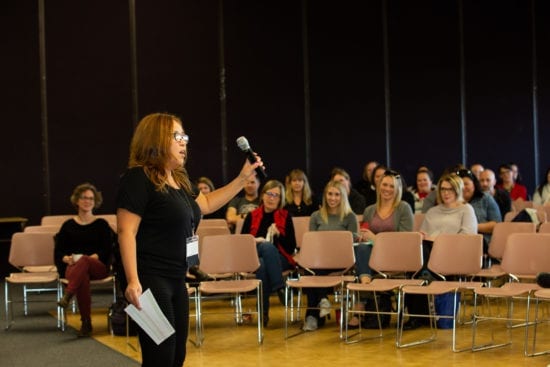
Dr. Pamela Rose Toulouse “But I don’t have Indigenous students in my school” is but one of the common excuses Dr. Toulouse has encountered from educators. Her suggestion is to liken reconciliation as a collective endeavour as are other large-scale challenges such as food security, climate change and equity, which touch anyone who has children, grandchildren, nephews and nieces, family and friends who comprise today’s generation and those to come. Confronting indifference and excuses also entails illuminating the contemporary contributions of Indigenous peoples – giving credit where credit is due for Indigenous inventions and inspirations for the “sport of hockey, medicines, potato chips and Dr. Pepper,” as Dr. Toulouse listed. Whereas curriculum will speak about residential schools and treaties, educators are charged with filling-in gaps by leading conversations about positive Indigenous role models and contributions that have been made by Indigenous peoples.
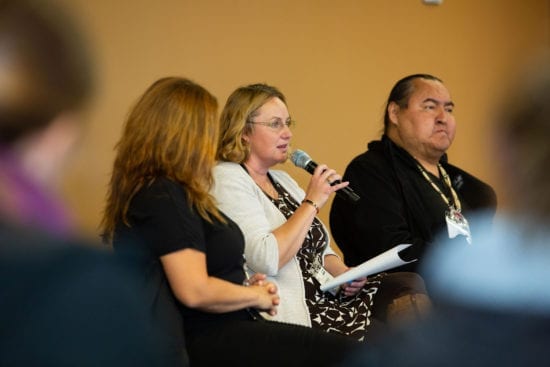
Julaine Guitton Panellist Julaine Guitton is a novel example of a non-Indigenous teacher who has prioritized the resiliency of Indigenous peoples within her classroom over topics of cultural genocide and residential schools. This approach, entrenched in the viewpoint that Indigenous peoples are not victims first, has proven effective among her fifth and sixth-grade students as project lead for Stavely Elementary School’s “Project of Heart.” The project entails general research about residential schools in Canada, followed by more narrowed research into a particular residential school, meeting with a residential school survivor and a culminating artistic act of reconciliation. In a rural township where many students live on farms and ranches, understanding Indigenous peoples’ connection to land and place was cornerstone to these discussions which, as Elder-in-Residence Francis First Charger illustrated, allows students to understand different people, different worldviews and interrelations.
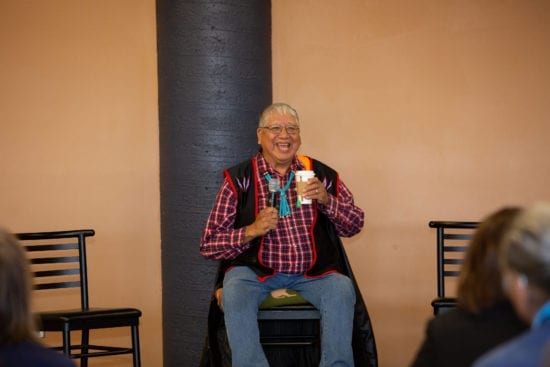
Francis First Charger “I remember where I was when the final report of the Truth and Reconciliation Commission was finally released, and I felt especially compelled as a teacher being in a position where I knew that I could help other people,” Guitton recalled. “I didn’t know how I would accomplish that, so I decided to just wear an orange t-shirt to school one day and begin a discussion with my students about what that meant.”
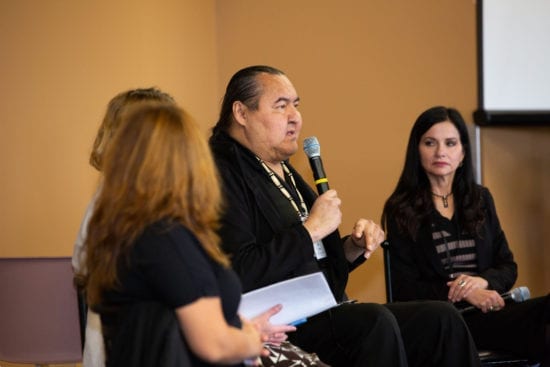
Ira Provost Ira Provost, Manager of the Piikani Nation Consultation, was Ms. Guitton’s community resource person throughout the project. With a career as an Indigenous liaison and cross-cultural educator, Provost found himself astounded by the depth and breadth of learning that had taken place, which transpired through speeches that the students had presented to school board trustees, the superintendent, Stavely’s school principal, FNMI support personnel and Elders from the Indigenous community during a class-organized community event.
All Indigenous peoples want, as Provost highlighted, is meaningful engagement, which forms the derivative of an ongoing commitment to starting early and moving beyond one-off endeavours.
“Reconciliation is about a thousand cups of coffee,” stated panel moderator Dr. Michelle Hogue, Associate Professor and Coordinator of the University of Lethbridge’s First Nations Transition Program, in her recap of the conversation. “It’s about sitting, listening, being present and building relationships.”
more ideas and resources on how to lead reconciliation initiatives with your students
- Education Canada Magazine: Truth and Reconciliation in the Schools
- Infographic for your classrooms and staffrooms: How teachers can integrate Truth and Reconciliation in their classrooms
- Fact Sheet: How can we embed Truth and Reconciliation in every school?
- Report and Research Reports
This event was made possible by the support of our generous partner and sponsors

-
Beyond Rules of Engagement
Comments Off on Beyond Rules of EngagementTo effectively teach with technology, educators have been expected to set boundaries for appropriate use, help establish guidelines for inappropriate content, and guide students in how to take responsibility for their actions in networked environments. If we look at how education has traditionally supported the ability to form, communicate and exchange ideas, we know that opening and engaging in dialogue about sensitive topics is an ideal first step. But in digital citizenship education, we still find headlines, community advocates, school districts and parent groups who are continually sourcing evidence of misuse of emerging technologies to argue for a “ban and limitation” approach when crafting policies for digital citizenship and the online participation of students.
Limitations of our past approach
After almost two decades of evolving Internet and social media education, educators have to recognize that a fear-mongering approach to aspects of digital citizenship is not beneficial for students who are already fully engrossed online. Instead, a practical approach, rooted in classroom experiences with the realities and concerns of Internet communications, can foster students’ understanding of healthy Internet uses.
Ask young adults if their student experiences between 2000 to 2012 included digital citizenship lessons and whether they were invited to have their voices heard, or if they had an educator who was willing to meet them on their level with tech use in the classroom. More often than not, young adults will say that the majority of their digital citizenship lessons involved being told rules of proper use and how to be safe online, with a primary focus on being aware of predators and threats. Few will report discussing consent or the production of online content.
One difficulty with this primary focus on appropriate use is that the Internet does not acknowledge boundaries structured on guidelines for appropriate or inappropriate; it is a free-for-all that students will explore online despite attempts to block content or websites. The norms of technology and Internet use are incredibly malleable. Being open to the online interests of students helps educators identify where students have found their voice through the Internet, and what they have been exposed to. Students bring their online experiences into the classroom. In a paradoxical conflict of “too much, too soon,” educators today are often addressing themes of the Internet with students as they arise. While the themes can range from video gaming, online interactions, accessing pornography, or peer conflict, the experiences of youth online become conversations because of current and emerging Internet trends.
Rewrite the narrative and hear the students’ voice
Educators have an unenviable task of addressing the Internet experiences that their students bring to their attention. An educator who recognizes that in a networked society, controlling the Internet is not about blocking content but about being prepared to address the content experienced and disclosed by students, will be better prepared than the educator who dismisses these experiences as “bad use of the Internet.”
We do need to establish norms of behaviour concerning technology use and Internet participation, and this definition has to work within the evolving classroom. Using technology skills in a social studies class must be approached differently than in a science class, but a similar foundation of participation and responsible sourcing of information is vital for student success. For teachers, the goal of digital citizenship education should be establishing a culture of appropriate use, as defined by the student voice and expanding outward to the networked online communities that students share.
For primary teachers, this means potentially introducing expectations of use of tech that may conflict with what students have experienced at home. In intermediate education, the challenge becomes one of providing learning opportunities that engage students in a different way from the communication app, video game, or meme that is currently popular. We know that students in middle-school experience a variety of Internet content that would make most parents at the parent council meeting cringe. Guidance in class may be the oversight desperately needed and discussing the media themes and content accessed can help guide students towards more appropriate Internet usage as students progress to secondary school.
In secondary education, how can educators support students’ understanding of how appropriate versus inappropriate use of the Internet is defined – especially when the measuring stick continues to move in each micro-generation of use? Secondary students live in a world where they see any number of examples of “inappropriate use”: mainstream celebrities display their excesses online while YouTubers and streamers on Twitch push boundaries. Perhaps most importantly, the world of social media politics is now on the radar of students, who see that elections have become littered with allegations of fake news without context, voters cast votes solely based on information sourced from social media, and even an elected President ignores the barriers of so-called “appropriate use” of social media with total disregard for traditional decorum or consequences.
Preparing students for the realities of the connected world is critically important. The 21st century learner needs educators who are aware of the importance of providing digital citizenship support to students at all grade levels and within all subjects. This includes dialogues on how the Internet influences learning and community participation, and a recognition that the Internet allows us to see one another and connect around the planet. It is imperative that learners think critically about not only how the technology helps to bring us together, but how much it can separate us.
Find positive examples
It is vital to help students recognize the positive opportunities that exist as they demonstrate their online participation as networked citizens, and to see how their online interests fit into their educational experiences. Examples of digital citizenship can be incorporated into many lesson plans.
For an example of positive video game use, check out students in British Columbia who play online video games in an eSports tour. These students, competing professionally playing video games, earn more than a teenager could ever make working at a fast food restaurant. Where health and wellness dialogues may support kids who feel isolated, share the story of a student in Texas who inspires others daily by sharing photographs of their skin without makeup, to increase positive support for those coping with debilitating cystic acne. Imagine a student who wakes in the morning feeling like they are the only person in the world with a skin problem; they only have to turn to their smartphone for an emotional, visual, and community-driven support system that lets them know they are not alone and things are going to be okay.
With hundreds of positive and negative examples of how the Internet and technology use impacts children, digital citizenship lessons have to not only support learners in their online endeavours from classroom to classroom, but expand to the family home, to extra-curricular activities, and everywhere the Internet takes them along their education and communication path. Digital citizenship education should not be just an introductory concept or policy delivered at the beginning of the school year to establish expectations for learning; it should be a continual classroom pedagogy that extends to the home, with students leading the charge.
First published in Education Canada, December 2018
-
Protecting Pollinators Through Experiential Learning
Comments Off on Protecting Pollinators Through Experiential LearningIt started when one teacher saw a TV ad about saving the bees – and grew into a national program, Bee City Schools, integrating outdoor education and technology into school-wide projects focused on saving pollinators.
We would like to introduce educators to the Bee City Canada/Bee City School Program, an important initiative that is quickly making its way through elementary and secondary schools across the country. The original objective of the Bee City School Program was to encourage an inquiry about the bee crisis and the role that pollinators play in our food cycle. Currently, Bee City Schools are expanding this inquiry by integrating outdoor education and technology into school-wide projects while encouraging parents and communities to join students in their learning.
In 2017, the Bee City School Program became a recognized certification from Bee City Canada. The origins of this initiative are modest and began in 2015 as we, two teachers in Scarborough, Ontario, were working on a partnering plan for an upcoming Science unit. It started when Ashleigh White, a Grade 4 French Immersion teacher, saw a CheeriosTM commercial that encouraged consumers to “bring back the bees” and decided to use the ad as an introduction to character education in her classroom. Thinking that this might also be an opportunity to begin working with a colleague on a Science Buddies project, Ashleigh approached Grade 8 teacher Doug Whiteside.
Together, we felt a call to action and were immediately motivated to open an inquiry project that began by asking, “What is happening with the bees?” A true inquiry often requires teachers and students to connect with resources and people outside of the school. Ashleigh began to reach out to organizations in Toronto, and with a little research, she found Bee City Canada, a charitable organization that was in the final stages of becoming officially recognized by Toronto City Council. She thought she might be overreaching, but Ashleigh took a chance and made a call to Bee City Canada. Director Shelly Candel responded within one day and graciously offered to visit the school and help answer some of the students’ questions. This was the first workshop that Bee City presented to students, and the response from both classes was beyond expectations. The seed had been planted and so came the idea to offer more workshops based on new questions stemming from the Bee City Canada classroom visit. The roots of the Bee City School Program sprouted that day.
Our aim with the Bee City Canada Schools initiative is to cultivate a climate that encourages students to ask questions and to be critical thinkers and problem solvers by examining real-world contexts. We strongly believe that our growing network of Bee City Schools has come to realize that through inquiry, experiential learning and “getting our hands dirty,” we can begin to make positive change in our communities. Our program is unique in that it can implement a broad range of current teaching practices into one school-wide initiative that welcomes all learning entry points. We also generate support from parent councils, local government officials, and businesses who are inspired by the team building that is now so evident throughout the hallways of our member schools and in the vibrant pollinator gardens that were established and are now diligently maintained by students ranging from Kindergarten to Grade 8. Our network has come to realize the severity and the implications of the declining bee population in Canada and around the world. We also know, however, that it’s not too late to do something about this problem. By taking action and planting bee-friendly flowers, as well as educating our communities on the dangers of pesticide contamination, we believe that we are helping to create a new culture of students as global citizens of character. We hope they will become the future leaders of collaborative inquiry devoted to reversing the decline of pollinators in Canada.
Bee City Canada, a federally recognized charitable organization, welcomed Toronto as the first Bee City in 2016. In the Spring of 2016, Tredway Woodsworth Public School in Toronto was declared Canada’s First Bee City School. We revamped our STEM program with a project that would offer students a lens into real-world, large-scale problems. This endeavour commanded collaboration among students and teachers in order to achieve our learning objectives.
Students were very eager to develop a strategy that would answer the call to action for citizens to reverse the decline of pollinators. Jeremiah, a Grade 3 student, stated,
“I really want to help the bees because they are important to our world. They spread the pollen that our fruit and vegetables need in order to flower. If the pollen isn’t spread to the flowers, then a lot of our food sources will disappear. Bees are helping our ecosystem to survive.”
This testimonial was one that came about through the exploratory stage of the problem-solving model that is typically used in math, but can and should be applied to early stages of inquiry work in science as well. Through brainstorming and communication, students were able to better understand the problem even if possible solutions were not yet conceptualized.
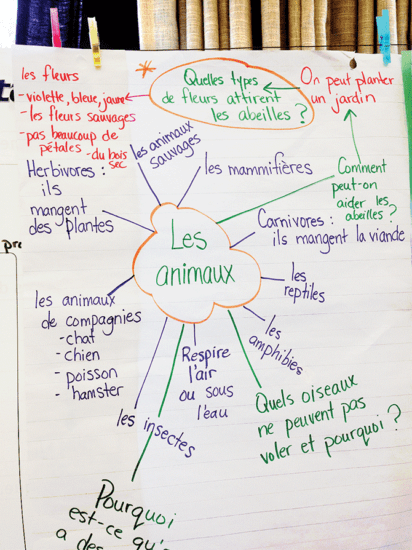
Ashleigh White’s Grade 4 French Immersion class began with a brainstorm chart highlighting some key inquiry questions into the condition and decline of bees and other pollinators. Following the exploratory stage, the inquiry captured the attention of Grade 7 and 8 classes. The older students created an action plan by designating a space for a small pollinator garden that would host indigenous plants, as well as some very creative and visually stimulating bee hotel structures. They discovered that pollinators respond well to colourful and stimulating artifacts and structures that are situated in close proximity to the plants. Vaidehi, a Grade 8 student, captured the class discoveries perfectly, stating,
“When we placed our bee hotels and sowed the seeds for the indigenous plants, we made sure that the hotels were colourful and that the seeds were pesticide free, as this is one of the leading factors causing the decrease in the bee population.”
Students took pride and ownership in preserving and protecting their pollinator garden space. The curiosity spread throughout the school, with questions such as, “What plants attract the bees the most?” and “Do bees communicate with each other?” Discussion and discovery became commonplace as evidence of inspired inquiry work.
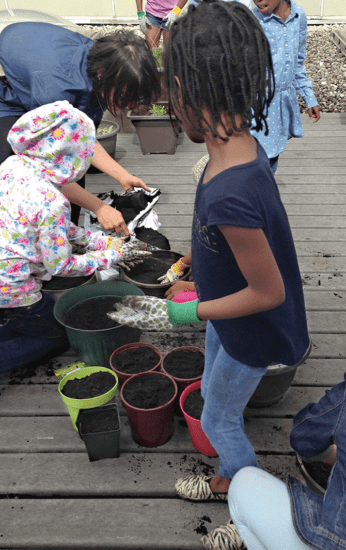
Ashleigh White’s Grade 4 students pot pollinator-friendly plants and flowers for the school’s Pollinator Garden 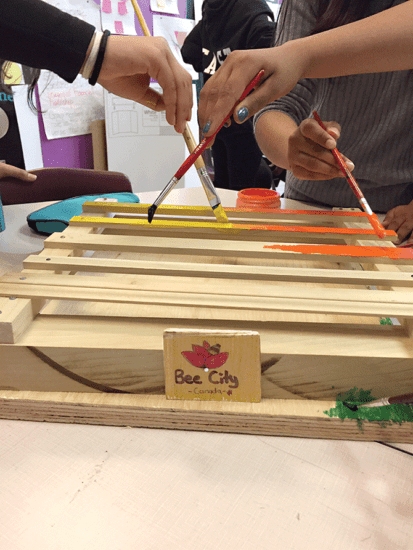
Doug Whiteside’s Grade 7 science students construct and decorate “bee hotels” that offer a temporary rest or pit stop for pollinating native bees and butterflies. Eventually, Bee City Canada invited us to help them develop an application process whereby schools throughout Canada could work on similar initiatives and inquiry. Realizing that our inquiry project could guide other schools to educate students about pollinators and the bee crisis, Bee City Canada relied on our experience to establish this new program. The Bee City School Program was created when Bee City Canada saw the work that was taking place in our school. This rich learning opportunity could not be contained to one school, and our school became the model for Bee City Schools to emulate. Subsequently, Bee City Canada has invited both of us to sit on the board of directors as representatives for the Bee City School Program. In June of 2018, Doug was given the title of Bee Schools Director and he now acts as the liaison for existing and future Bee Schools.
Small classroom projects may grow into school-wide initiatives once the school community becomes more aware of the issues that their inquiry addresses. The thriving pollinator and vegetable garden that was entirely established by students at our school, with support and funding from Bee City Canada, is just one example of the positive work that we are doing to support the community as a whole. Before embarking upon this project, we developed a solid connection with our local city councillor, Glenn De Bearemaeker. He is just one of our great supporters and he was thrilled to join our students at the “2017 Tredway Woodsworth Pollinator Fair.” Mr. De Bearemaeker connected the local community and our school by creating awareness amongst his constituents and engaging in the important conversations necessary to effect change.
Following a cycle of inquiry allowed us to let go of some of the rigidity of conventional teaching and, three years later, students have become independent learners, innovative knowledge builders and creative thinkers. By focusing on the authentic problem of the declining bee population, students are continually empowered to explore the potential of their own school community. Creating and tending to a pollinator-friendly garden has encouraged students to connect with nature as they learn about native plant species and how pollinators help to sustain natural environments. Researching and building structurally sound and visually stimulating bee hotels offers experiential learning and opportunities for students to solve problems using real-world contexts.
As recipients of the EdCan Network’s 2017-2018 Ken Spencer Award for Innovation in Teaching and Learning, we are dedicated to realizing the change that school communities can make by embracing the environment as an authentic outdoor learning space. Ultimately, an initial brainstorming session that was designed to involve students in their Science lesson has grown into a widely successful project that has become an ever-expanding network of shared learning and practice. We have developed a website – www.pollinatorcentral.com – where teachers and communities can blog with us about our experiences and understanding of the world of pollinators. We also launched an e-learning curriculum resource site with the introduction of our first course, called “Pollinator Protector Course,” in partnership with Bee City Canada. On our site, edu.pollinatorcentral.com, we will continue to develop and launch courses about healthy soils and sustainable planting practices.
Through this site, our shared practice continues to develop and offer support to fellow educators, students and communities. We are learning together about the role of pollinators, especially native bees, in our environment and the effect that a continuing decline in their population will have on future generations if action is not taken. Our students are answering the call to make a change, and we are eager to provide them with the tools that they need to successfully implement and expand this project for years to come.
Learn More
All Photos: courtesy Doug Whiteside
First published in Education Canada, December 2018
-
Plus Ça Change…
Comments Off on Plus Ça Change…Does our current digital citizenship education really prepare students for effective citizenship? Digital communications technology offers powerful tools for civic engagement, but too often civic educators focus on “teaching good online behaviour” instead of teaching the skills and knowledge needed to safeguard and strengthen democratic institutions. And these skills are more critical than ever.
This changes everything. In scholarly journals, professional magazines, and popular media, there seems to be widespread agreement that digital media has radically transformed the way youth engage with one another and with the broader society, both socially and civically. Educators and researchers in civic education have understandably sought to adapt. There is little doubt that certain kinds of adaptations are necessary, and potentially transformative if they can harness the capacity for youth and young adults to be connected, to reach large audiences, and to organize others using the right combination of online and brick-and-mortar tools. But I am also concerned that an all-consuming focus on these powerful new tools for civic engagement may distract attention from serious shortcomings that have been widespread for decades. Are there basic principles of citizenship education that are important to maintain, even as we embrace and adapt to the digital era? Or do the bits and bytes of online social, political, and economic life obviate the need to focus on a more timeless set of fundamentals – habits of the heart and mind – that make democratic societies robust and enduring?
A personal story
These questions were on my mind recently, when I stood in the Frankfurt Hauptbahnhof (train station) waiting for my train to Prague. Both of my parents were born in Germany, my father in Karlsruhe in 1927, and my mother in Frankfurt in 1928. My father was displaced by WWII (he moved to Lisbon with his parents and then to Louisville, Kentucky); my mother was less fortunate. Like my father, she left Germany before being sent to a work camp or concentration camp. Unlike my father, she left her hometown without her parents on a kindertransport to Heiden, Switzerland.
As I waited for my train, I realized that 80 years before my mother had stood in this same train station and waved goodbye to her mother and grandmother, who ran next to the train as it left the station. She remembers smiling so that her mother would not be sad. She also remembers giving her favourite doll to the girl seated opposite her, who was disconsolate. They were two of 100 children on the train headed to relative safety in Switzerland. It was the last time my mother would see her family. She was ten years old.
Although my parents – both German Jewish refugees – spoke little about their experiences during the war, I suspect that the profound injustices that informed their childhoods have had an indelible impact on my views about education and citizenship in democratic societies. What went wrong in German society that led to such unthinkable events as those that define the Holocaust? How could such a highly educated, mature democracy descend into such unimaginable cruelty and darkness? Historians have suggested a great number of causes, including Germany’s punishing defeat in World War I, the suffering German economy after the worldwide Great Depression, and the populist appeal of a leader who promised to fix it all.
As an educator, however, I can’t help but wonder what German schools might have done differently. What can we learn from what schools did or didn’t do in Weimar Germany (which was a democracy too)? What, if anything, should schools today teach children about civic participation, courage, and dissent? How can schools help young people acquire the essential knowledge, dispositions, and skills for effective democratic citizenship to flourish?
If we care about robustly democratic societies, we will have to be explicit about the kinds of knowledge, skills and dispositions required of democratic citizens.
Where are we vulnerable?
Tools for engagement have changed, but our social, political and economic vulnerabilities have not. Educators imagine focusing on a kind of teaching and learning that puts democratic community life front and centre at the same time that it uses changes in digital technology to their advantage. These are both worthwhile goals, but they are not one and the same. If we care about robustly democratic societies, we will have to be explicit about the kinds of knowledge, skills, and dispositions required of democratic citizens.
Digital technologies, as the other articles in this special section demonstrate, have tremendous potential to help build a kind of participatory politics that strengthens democratic societies.1Teachers, researchers, and policymakers alike attest to the benefits of these powerful technologies and what they allow students to do, including:
- use the Internet to access information that would otherwise be unreachable or require enormous effort to attain
- develop narratives, both alone and with others, about events and actions
- share opinions and perspectives with a potentially large audience
- provide and receive feedback from others, irrespective of their physical location, age, or social position
- exchange information and ideas directly with other youth without institutional gatekeepers.
These are powerful tools. These same features of digital civic engagement and exchange, however, can be put to use in the service of facile educational goals. As I detail in my recent book, What Kind of Citizen? Educating our children for the common good, when schools across Canada and the U.S. set out to teach democratic citizenship, a vast majority of them end up teaching good behaviour instead: follow the rules; listen to teachers and other authority figures; be respectful and responsible; and manifest a sense of patriotism and loyalty. These can all be admirable traits. But none of them are uniquely essential to democratic citizens. And none of them would have been the kinds of traits needed by German citizens in 1933 in order to alter the course of history. “Good character” is insufficient for safeguarding and strengthening democratic institutions and traditions.
What about today?
I do not mean to imply that another holocaust is imminent or that there is some kind of equivalency between anti-democratic leaders today and Adolf Hitler. I use this example both because it has personal resonance given my family history and also because extreme examples have a way of making visible concerning developments and trends. Currently, in the U.S. notably but also in many other countries, a toxic mix of rising economic inequality and ideological polarization is increasing, leading to waning trust in democratic governance.
Eighty-five years after Germany’s democracy was replaced by a totalitarian Nazi regime, popular support for democratic governance is the lowest it has been in decades. In a widely circulated 2017 report, the Pew Research Center raised considerable alarm among those who had assumed that western democracies enjoy relative stability within an entrenched culture of democratic governance. Although the report was titled “Globally, Broad Support for Representative and Direct Democracy,” commentators, civic educators, and political scientists highlighted a number of findings that challenged the rosier title. In the U.S., for example, 22 percent of respondents thought that a political system in which a strong leader could make decisions without interference from Congress or the courts would be a good way of governing. Close to one in three respondents who identified as Republican and almost half of U.S. millennials thought the same (globally, that figure was 26 percent).2
In another study, Harvard lecturer Yascha Mounk and Australian political scientist Roberto Stefan Foa examined longitudinal data from the World Values Survey and found considerable cause for concern. Between 1995 and 2014, the number of citizens who reported a preference for a government leader who was “strong” and who did not need to bother with elections has increased in almost every developed and developing democracy and, again, the growth has been greatest among youth and young adults.3 Neither Canada nor the U.S. are exceptions. Democracy, it seems, is not self-winding.
Concrete examples now abound of leaders stoking the flames of populist nationalism – the rallying of “the people” against both “foreigners” and a constructed “elite” in the service of right-wing nationalism. Worldwide, politicians can now openly express disdain for hallmarks of democratic society, including the free press, civil liberties, and the courts, while fostering resentment against foreigners and ethnic “others.” These kinds of anti-democratic rhetoric and policies can drive individuals and groups to withdraw from the broader civil society altogether, preferring sub-group identity – what James Banks aptly calls “failed citizenship.”4Recent rhetoric during election campaigns in Canada reveals similarly concerning trends.
A rise in xenophobia and nationalism has resulted in incidents of hate speech, antagonism, and assaults on both newly arrived immigrants and native-born visible minorities in a growing number of western democracies. In the U.S., the Southern Poverty Law Center (SPLC) has documented a precipitous rise in hatred, fear, and alienation among students; and teachers have similarly reported a dramatic increase in hate speech.5 Social media echo chambers further entrench anti-democratic tendencies and pollute genuine social and political discourse.6 Yoichi Funabashi, chairman of the Rebuild Japan Initiative (dedicated to strengthening democratic ideals in Japan) summarizes the risks succinctly: “If society becomes characterized by intolerant divisions, in which people immediately select their allies and dismiss others as foes based on such criteria as race, ethnicity, religion or lifestyle, then democracy’s foundational principles, rooted in careful deliberation and compromise, will be rendered inoperable.”7
What kind of civic education do we need?
Online and offline, we need citizens who can think and act in ethically thoughtful ways. A well-functioning democratic society benefits from classroom practices that teach students to recognize ambiguity and conflict in factual content, to see human conditions and aspirations as complex and contested, and to embrace debate and deliberation as a cornerstone of democratic societies. Here are three strategies that can help shape educational practices in an era of both increasingly powerful digital tools and decreasing support for social democracy:
1. Teach students to ask questions
One hallmark of a totalitarian society is the notion of one single “truth” handed down from a leader or small group of leaders to everyone else. Questioning that truth is not only discouraged, but also often illegal. By contrast, schools in democratic societies must teach students how to ask challenging questions – the kind of uncomfortable queries that challenge tradition. Although most of us would agree that traditions are important, without questioning there can be no progress. Dissent – feared and suppressed in nondemocratic societies – is the engine of progress in free ones. Education reformers, school leaders, and parents should do everything possible to ensure that teachers and students have opportunities to ask these kinds of questions.
2. Expose students to multiple perspectives
Much as Darwin’s theory of natural selection depends on genetic variation, any theory of teaching in a democratic society depends on encouraging a multiplicity of ideas, perspectives, and approaches to exploring solutions to issues of widespread concern. Students need practice in entertaining multiple viewpoints on issues that affect their lives. These issues might be controversial. But improving society requires embracing that kind of controversy so citizens can engage in democratic dialogue and work together toward understanding and enacting sensible policies.
Why would we expect adults, even members of Parliament, to be able to intelligently and compassionately discuss different viewpoints if schoolchildren never or rarely get that opportunity? In schools that further democratic aims, teachers engage young people in deep historical, political, social, economic, and even scientific analysis. They also challenge children to imagine how their lived experiences are not universal and how issues that may seem trivial to them could matter deeply to others. They have students use online tools to examine multiple perspectives not only to know that their (or their parents’) views may not be shared by everyone, but also to engender a kind of critical empathy for those with competing needs. This is the kind of teaching in a digital era that encourages future citizens to leverage their civic skills for the greater social good, rather than their own particular interests, thus working to challenge social inequities.
How should we do this? For example, teachers might present newspaper articles from around the world (easily accessed through the Internet) that examine the same event. Which facts and narratives are consistent? Which are different? Why? Textbooks from several different countries could provide another trove of lessons on multiple viewpoints and the role of argument and evidence in democratic deliberation. Many of these textbooks are now accessible online, allowing the kinds of comparisons that would have been difficult before the advent of communications technology. If textbooks are not available online, teachers can use the power of social media to connect with classes in other countries who are reading different textbooks. Even within English-language textbooks there are many opportunities. Schools in Canada, the U.K., and the U.S., for instance, present strikingly different perspectives on the War of 1812.
Why not ask students to use online and offline sources to research who wrote their textbook? Why were those people chosen? What kind of author was not invited to participate? The idea that a person or group actually wrote a textbook reminds us that the words are not sacrosanct but represent the views of a particular time, place, and group of authors. These approaches help demonstrate to students that “facts” are less stable than is often thought.
Students should also examine controversial contemporary issues. Students are frequently exposed to past historical controversies – such as slavery, Nazism, or laws denying voting rights to women. But those same students are too often shielded from today’s competing ideas (for example, the #MeToo movement, women’s reproductive rights, misinformation campaigns that employ social media as a dangerous and powerful tool, controversies over what should be taught in the school curriculum and how). Engagement with contemporary controversies using a range of perspectives and multiple sources of information – something online tools are uniquely well-suited to promote – is exactly what democratic participation requires.
3. Focus on the local
It is not possible to teach democratic forms of thinking without providing an environment to think about. Schools should encourage students to consider their specific surroundings and circumstances. Here too, social media and other digital tools can be an asset.
One way to provide experiences with democratic participation in civic and political life is to engage students in community-based projects that encourage the development of personal responsibility, participation, and critical analysis. Action civics is a particularly powerful and thoughtful way to foster civic participation that transcends community service to also include a focus on government, policy, and dissent.8 We saw this with the students of Stoneman Douglas High School in Parkland Florida, who, in response to the February 2018 mass shooting in their school, leveraged the power of social media and other digital tools to become key figures in a national dialogue on gun culture in the U.S., while also mobilizing both locally and nationally to agitate for gun control legislation, organize demonstrations, support electoral candidates, and register voters. Their ability to connect a very personal experience with the ways in which government, policy, and social and economic forces shape their lives has allowed them to participate on a national scale, and no doubt prepared them for a life of effective civic engagement. When students have the opportunity to engage with civics education through direct action in their own local context, the impacts of their work are integrated with their lived experience and can teach fundamental lessons about the power of citizen engagement both on and off-line.
Of course, choosing to be explicitly political in the classroom can cause friction for teachers – with students, parents, and administrators – even when teachers avoid expressing their own political views. Encouraging discussion, controversy, and action in the classroom can be daunting. Students may express views that make classmates uncomfortable; they may engage in political acts that concern their parents; or they may choose to challenge their own school’s policies. Democracy can be messy. Rather than let fear of sanction and censorship dictate pedagogical choices, however, teachers should be supported and protected, encouraged to use debates and controversy as “teachable moments” in civic discourse.
Another obstacle to focusing locally is the obsession with provincial (and national and international) standardized testing. The resulting emphasis on memorization and regurgitation of generalized knowledge prevents deeper critical analysis and runs counter to almost everything we know from education research about how to make teaching and learning meaningful and about how to foster engagement and participation in civic life.9
Education in a digital era
The communication technologies of the digital era have enormous potential to bring people together in collective pursuits. Those pursuits, however, must be consistent with democratic values. History demonstrates that just because schools teach children about citizenship and character does not necessarily mean they do it well, or even toward admirable aims. In fact, schools have sometimes engaged in some of the worst forms of citizenship indoctrination. Counted among the many examples of organized “citizenship” education are the hateful lessons learned by members of the Hitler Youth brigades such as racism, antisemitism, the glorification of Nordic and other “Aryan” citizens, and blind obedience to authority; or the Young Pioneers of the USSR who were taught to report any religious activity in their own homes to authorities so their parents could be prosecuted. Had these same youth had access to YouTube, Snapchat, Facebook, Twitter, and Pinterest, would they have been more or less likely to teach one another about democratic ideals and the dangers of authoritarian rule?
Similarly, when we use digital technologies in schools, do we use them to teach children to unquestioningly preserve our social, political, and economic norms and behaviours, or do we use them to imagine and pursue new and better ones? Do we teach them only the importance of following the rules or also to question when the rules are not worth following? Do we teach students to mobilize in support of policies that promote only their own self-interest, or to think more broadly about their ethical obligations to others? I wonder what might have been different in 1941, the year my mother received her last letter from her parents, had children been taught not only compliance but also doubt and the obligation to imagine a better society for all. I think about what civic educators can do now – whether focused on new technologies or on the kinds of critical thinking skills necessary to sustain democratic norms and behaviours – to convey to students the power of community, as well as the pitfalls of blind allegiance to it.
Long before computers or the Internet, John Dewey described schools as miniature communities and noted that the school is not only a preparation for something that comes later, but also a community with values and norms embedded in daily experiences.10 In many ways the question of how to teach citizenship in a digital era is a much broader question about the purpose of schooling writ large. Transforming the way we teaching citizenship is not only the purview of the civics and social studies classroom, but a journey into all classrooms, all subjects, the hallways, and the relationships of the entire school experience. Citizenship education – indeed education of all sorts – is, ultimately, a proxy for the kind of society we seek to create.
Photos: Bundesarchiv_Bild_183-S69279,_London,_Ankunft_jüdische_Flüchtlinge and iStock
First published in Education Canada, December 2018
1 Also see the work of Erica Hodgin, Joseph Kahne, Ellen Middaugh, Ben Bowyer and others at the Civic Engagement Research Group in Riverside, California. www.civicsurvey.org
2 Pew Research Center (PEW), Globally, Broad Support for Representative and Direct Democracy (Washington, D.C.: PEW, 2017).
3 R. Stefan Foa and Y. Mounk, “The Danger of Deconsolidation: The democratic disconnect,” Journal of Democracy 27, no. 3 (2016): 5-17.
4 J. A. Banks, “Failed Citizenship and Transformative Civic Education,” Educational Researcher 46, no. 7 (2017): 366–377.
5 United Nations (UN), Racism, Xenophobia Increasing Globally (New York, UN, 2016), www.un.org/press/en/2016/gashc4182.doc.htm; M. Costello, The Trump Effect: The impact of the presidential campaign on our nation’s schools (Montgomery, AL: The Southern Poverty Law Center, 2016); W. Au, “When Multicultural Education Is not Enough,” Multicultural Perspectives 19, no. 3 (2017): 147–150; J. Rogers, M. Franke, J.E. Yun, et.al, Teaching and Learning in the Age of Trump: Increasing stress and hostility in America’s high schools (Los Angeles, CA: UCLA’s Institute for Democracy, Education, and Access, 2017).
6 For research about media echo chambers, see, for example: J. Kahne & B. Bowyer, “Educating for Democracy in a Partisan Age: Confronting the challenges of motivated reasoning and misinformation,” American Educational Research Journal 54, no. 1 (2017): 3–34.
7 Y. Funabashi, “Trump’s Populist Nationalism,” The Japan Times (2017, January 17). www.japantimes.co.jp/opinion/2017/01/17/commentary/japan-commentary/trumps-populist-nationalism
8 See, for example: B. Blevins, K. LeCompte, and S. Wells, “Innovations in Civic Education: Developing civic agency through action civics,” Theory & Research in Social Education 44, no. 3 (2016): 344-384; M. Levinson, No Citizen Left Behind (Cambridge, MA: Harvard University Press, 2014).
9 D. Koretz, The Testing Charade: Pretending to make schools better (Chicago, IL: University of Chicago Press, 2017); J. Westheimer, “No Child Left Thinking,” Colleagues 12, no. 1 (2015). http://scholarworks.gvsu.edu/colleagues/vol12/iss1/14
10 J. Dewey, Moral Principles in Education (Carbondale, IL: Southern Illinois University Press, 1909/1975).
-
Making Room for Student Voice
Comments Off on Making Room for Student VoiceOver the past two years, I have had the chance to become a student leader and advocate for improvement in the education system. I have also had the opportunity, as a student trustee, to attend school board meetings and professional development opportunities for students.
These experiences have opened my eyes to the work that is being done in the Ontario education system to improve students’ education. I have learned that student voice can be heard on many different levels. Whether it be at a Ministry of Education consultation or a math class, each level is just as important as the others.
I remember in Grade 8, my teacher spoke about the value of getting involved in extra-curricular activities in high school. Grade 9 was a transition year for me. Like many others students, I was learning the ins and outs of high school and how to succeed. Because of this, I did not join many extra-curricular activities. In Grade 10, my journey into student voice began. A teacher who saw my potential invited me to take part in a school-level focus group about increasing student voice in my school board. I felt positively impacted by this opportunity because it made me feel that my voice was valued and that there is need for improvements.
In Grade 11, the same teacher (who had since moved on) came to my school and asked me to be a student representative at the planning level for student voice in my school board. This led to me being able to be a co-facilitator at a two-day student summit that brought together approximately 150 participants, ranging from students to the director of education, to discuss how to improve student voice in their schools. This event gave me insight into some of the issues that are experienced by students.
The two biggest issues that I saw were tokenism and lack of opportunity. By tokenism I mean, students who are lucky enough to be given an opportunity to share their input, often feel that they are simply listened to but no action is taken. I feel that this stems from the attitude we have developed in our society, that sees youth as disengaged, not willing to participate or not having valuable ideas. From my experiences, this is not the case. Youth are one of the groups that are being affected by problems in education; why not involve them in the process of identifying specific issues and coming up with a plan to solve them?
The second issue is connected to the first issue. Youth are often not given an opportunity to voice their opinion at higher levels of discussions. They are often left out from the meaningful conversations that occur at school boards, ministries of education, community stakeholder groups and many more. Because of this, the power of youth to influence change does not reach its full potential due to the lack of opportunities.
The opportunities that I have had in the last two years have greatly influenced my future career choices and the way that I view life. Being able to help facilitate growth in the education system has allowed me to realign my moral compass and realize that I have been blessed with a life of service to others in which I must find a way to improve others’ lives in the most positive way that I can. Expressing my views and others’ views has allowed me to see that there is good in this world and that youth are very powerful. All we must do is, empower possibility.
To conclude, to any educator reading this, come up with ways to meaningfully engage your students in the decision-making process. If you’re not sure how, reach out to others; there are many great people who are paving the way to improve the education system.
To any parent reading this: have a conversation with your child(ren) about what they can do to improve their voice. Help them find the power inside themselves to change the world.
And finally, to any youth reading this: your voice is powerful and can change the world in many ways. Help your friends find their voices and together, you will have even more impact in spreading your hard work for change.
Photo: courtesy Evan Rogers
First published in Education Canada, December 2018
-
The Human Side of Changing Education
Comments Off on The Human Side of Changing EducationWhile calls for education reform have become more frequent and increasingly urgent in recent decades, substantive, large-scale changes to teaching and learning in our schools remains elusive. Many notable reform efforts, driven often by external authorities and influences, have failed to consider and meaningfully engage the education leaders and classroom teachers charged with their implementation. Julie Wilson’s book is a gem of wisdom and common sense that illuminates this often-overlooked human dimension of changing education in ways that can really make a difference for learners in our school systems.
The Human Side of Changing Education offers a thoughtful, experience-informed road map for education leaders grappling with the challenge of education transformation. Based on the premise that when we ask organizations to change, we are really asking the adults working in them to change, the book focuses on the implications of this reality for the K-12 education system. Citing growing consensus about the skills and habits required by students to thrive in a world that is complex, diverse and ever changing, Wilson outlines the pedagogical and cultural shifts necessary in schools to achieve this kind of learning. The book lays out different approaches to change, critical success factors and strategies for leading change through collaborative endeavour across all levels of the education system – school boards, administrators, teachers, parents, students and the community at large. The final chapter speaks to one’s personal journey of learning in the change process and the common path experienced by change leaders, both within or outside of the formal education system. Questions concluding each chapter invite thoughtful reflection and deep conversation about the why, the what and the how of educational change. The book’s companion website provides additional information, resources and stories from the field attesting to the power of human-centred leadership in effecting meaningful and lasting change in schools.
At a time when many past education reform efforts have failed, Wilson’s book provides practical tools, strategies and resources, enriched with real-time examples of field-based educators engaged in leading successful change initiatives. It is an essential read for those with the passion and the heart to engage in the hard work of education change that matters.
Photo: Dave Donald
Corwin , 2018 ISBN-13: 978-1506398532
First published in Education Canada, December 2018
Become a member of the EdCan Network to enjoy a discount on this book and many more.
-
Well-being and Success
Comments Off on Well-being and SuccessWhy should student well-being be part of the education agenda? Reporting on a four-year-study conducted in Ontario, the authors argue, “Get the well-being agenda right, and it will support and be supported by effective learning, so that all our students can be successful and well.”
Canada is a global leader in educational change. It has widely-acclaimed results on student achievement and equity on international assessments.1 Only Finland exceeds Canada in terms of equal opportunity combined with positive outcomes for low-income students. Canada also has stronger democratic self-governance and greater multicultural inclusion than many other high performing systems.
But Canada’s record on student well-being is less impressive. UNICEF places Canada 26th out of 35 nations on a table measuring well-being across four indicators of life satisfaction, health, education, and income.2 On OECD indicators of life satisfaction, Canada’s students are “not significantly different from the OECD average.”3 Like a number of countries in East Asia, its record on student achievement is not matched by its performance in student well-being.
In response, Ontario made well-being one of its four policy priorities in 2014. As anxiety and depression among the young skyrocketed, its educators began giving greater attention to their students’ emotional, physical, and spiritual development. Our new research from interviews with educators in ten Ontario school boards over the past four years shows that educators started teaching students a range of ways to improve their well-being.4 Students are now learning meditation, practicing yoga, and serving on school-based mental health committees. Teachers are providing programs of emotional self-regulation that help students calm down when they are angry or anxious, and they are showing students how to use apps to report to counselors when they are worried about their own or others’ well-being. Educators have also been changing the curriculum to be more inclusive of the identities of all young Canadians (though this is now a point of contention with the province’s new government).
But is well-being just a self-indulgent distraction from the basics of real learning? Conversely, is it being used to compensate for the ill-being that is created by standardized testing and out-of-date approaches to teaching and learning? Do achievement and well-being occupy separate silos that have no connection with each other? Or is there a relationship between well-being and success – and if so, what do Ontario’s educators believe that it is?
Get the well-being agenda wrong and opponents will easily portray it as emotional self-indulgence or trendy identity politics that are distractions from academic basics. Get the well-being agenda right, and it will support and be supported by effective learning, so that all our students can be successful and well. In their 2017 report on student achievement and well-being, the OECD argued that “most educators and parents would agree that a successful student not only performs well academically but is also happy at school. Indeed, schools are not only places where students acquire academic skills; they are also social environments where children can develop the social and emotional competencies they need to thrive.”5 This is the educational policy challenge for Canadians now.
From 2014 to 2018, our research team from Boston College worked collaboratively with a representative sample of 10 of Ontario’s 72 school boards to understand what work they were doing on the ground to implement the province’s four pillars of educational reform at the time. These were: achieving broadly defined excellence; securing equity for all students that also involved how included they felt in their learning and their schools; promoting well-being; and establishing public confidence. Part of this research involved interviewing 222 educators about this implementation and asking them questions concerning their beliefs and reported practices about well-being and achievement.
Our interviews with Ontario’s educators revealed that they find three different kinds of relationships between well-being and achievement.
- Well-being is a crucial prerequisite for achievement.
- Achievement is essential for well-being; failure leads to ill-being.
- Well-being has its own value: it complements academic achievement.
Let’s look at each of these in turn.
1. Improved well-being increases achievement
There are multiple sources of ill-being in many of Ontario’s communities. An assistant principal of one rural school stated, “We have a lot of kids that are high-anxiety, with a lot of developmental trauma. A lot of kids are in [foster] care.”
“We look at our role as addressing the whole student,” a fellow principal said. One of the teachers in this board asked, “How did they sleep? Are they hungry? Are they feeling OK? Are they happy? You are starting bare bones and you work your way up until you they are ready to learn.”
Many educators agreed that before real learning could begin, a minimum threshold of well-being had to be attained. They did everything they could to address issues like poverty or social exclusion to prepare their students for academic achievement. A board in a working-class city with a 24.2 percent youth poverty rate (compared to a provincial rate of 17.3 percent) was grateful for the commitment of trades unions and philanthropy. “It’s a part of the culture here,” one said. “There’s huge care around mental health, huge care around the partnerships, huge care around poverty,” a colleague observed. “There’s this belief in helping others.”
Educators in another board reported that ill-being can affect the affluent as well as the poor. “Some of their anxiety is related to parental pressure,” a teacher commented. One way that schools supported students in this community was by providing a calming space that helped them to settle down and “just go and relax” when they were stressed or upset.
A superintendent summed up the relationship between well-being and achievement when he said, “Take care of people; take care of everything.” But caring for students at risk of ill-being is not sufficient to ensure well-being. Learning requires discipline and zest, the ability to focus, the capacity to empathize with different points of view, the social skills to interact with others, and the stamina to persevere through difficulties and bounce back from disappointment. These dispositions call for positive well-being to support the dynamic learning that leads to widespread success.
2. Academic achievement is crucial for well-being
In a second point of view, well-being is supported by academic success, while failure perpetrates ill-being. Some administrators expressed this idea when they said that they wanted to raise students’ mathematics results “to boost their confidence” and to “make them feel good about being learners.” Here well-being was regarded as an outcome of deliberate efforts by students and their teachers to secure earned achievement.
Clarity of purpose and direction around improving achievement was also important for both students and their teachers. One school board director stated, “I think it’s stressful to waste time and not know where you’re going. In the absence of direction, people do what they want. It isn’t always the most purposeful thing.”
Almost half the boards in our study described projects that put a priority on developing “growth mindsets” among students and their teachers.6 Compared to fixed mindsets where people believe things cannot change, in growth mindsets, people believe that difficulties, including ones that involve their own learning and development, can be overcome.
A growth mindset orientation was used in one board to promote mathematics achievement in the belief that it would, in turn, contribute to students’ self-regulation and resiliency. A special education consultant in this board spoke about “building in mindset activities in every single session” of her coaching with teachers. A teacher in another board gave students the URLs of video clips on growth mindsets to encourage them to work harder to develop a greater sense of accomplishment. By promoting the belief that everyone can achieve, educators treated well-being as a result of hard-won effort, including the effort to achieve academic success.
Having a sense of achievement isn’t or shouldn’t be all about getting good test scores, though. Having meaning and purpose is integral to people’s sense of well-being. Well-being involves far more than happiness, and accomplishments go far beyond test success.
A sense of purpose and accomplishment in this broader sense was behind many learning innovations across the ten boards. These included comparing water quality on First Nations Reserves with that in neighbouring communities, and learning about and raising funds to adopt and accommodate Syrian refugee families, for instance. In cases like these, students deepened their own learning and sense of accomplishment by addressing the well-being of others.
3. Well-being has its own value: It complements academic achievement
Getting back to basics shouldn’t mean moving away from well-being. Many East Asian parents and their governments in Hong Kong, Singapore and South Korea, for example, now realize that excessive emphasis on tested academic achievement has led to anxiety, depression and even suicide among young people. They are easing up on testing requirements now and putting greater emphasis on quality of life.
Almost every board we studied addressed students’ ability to self-regulate when they became angry, anxious or depressed. One widely used program was called Zones of Regulation.7 Here, students learn to identify their emotions with reference to four categories or colours: red, where children are angry or overly exuberant; yellow where they are anxious, nervous or silly; blue where they are sad or depressed; and green when they are calm, alert, and ready to learn.
Educators everywhere were enthusiastic about this program. According to one principal, they were “seeing some gains” because of this approach. Suspension numbers had dropped. “Kids are able to take responsibility for behaviour a little more easily than they used to,” the principal said. “They’re able to articulate what went wrong.” It took less time to calm students down before they could rejoin a class. It was better to give students the time and space they needed to get in the right frame of mind to focus on learning, teachers believed, than to punish them when their minds were racing or their bodies were restless.
Another strategy to support well-being was resiliency. “You build resiliency. You’re not born with it,” one principal said. One elementary school took the idea of “building” resiliency literally. They developed “toolkits” for students and “built a resiliency wall. Every student had a brick and they could [write] on, ‘Who supports me when I’m feeling down?’” Students sometimes searched through these toolkits when they needed help in dealing with a worrying or frustrating issue – from a blockage in their learning to coping with the death of a fellow student.
In Ontario, students have become increasingly engaged in the well-being agenda themselves. For example, one board created student-led well-being groups called Sources of Strength. The group consisted of student “leaders from every part of the school. You get kids who aren’t the jocks, and they are not the artsy kids. You want it to be representative of everybody.” The students received training from mentors at the school. They organized events such as a Walk for Depression awareness day, so that students and community members wouldn’t ignore any student who was struggling. A student mental health committee in another board consisted of students who were acquainted with problems such as experiencing a friend committing suicide, or being treated for a speech impediment. Elsewhere, in a student-designed poster on “50 Ways to Take a Break,” students were encouraged to “sit in nature,” “read a book,” or “pet a furry creature,” for example. In these ways, boards encouraged students to reach out to others with kindness, and make sure that no one was left to suffer alone.
Putting it all together
In testing times, let’s be wary of the cheap shots that are easily made against well-being or achievement. On the one hand, we don’t want a school system that is obsessed with well-being to the point where young people live in a superficial and self-indulgent world of undemanding happiness. That path leads to a nation of narcissistic adults who feel that success and earned expertise are unimportant, and that all that matters is the needs and opinions of themselves and of others who happen to agree with them.
True well-being doesn’t come without sacrifice and struggle, perseverance, and empathy for others.
Equally, achievement shouldn’t be reduced to grades and test scores where students are expected to apply themselves with grim determination even in the face of poor teaching, irrelevant tests, or a curriculum that is so boring that students cannot see what value it has for them. Achievement should be about accomplishing things of purpose and value for oneself and for others. It should bring a sense of lasting fulfillment, not just test-score completion or evanescent fun.
Well-being is needed to support achievement, especially where children come from backgrounds that present them with great challenges. Achievement and accomplishment are also sources of well-being. It’s hard for young people to maintain dignity and self-respect if they feel like they’re failing all the time.
But well-being and achievement shouldn’t exist in two different worlds, with different specialists populating them – mathematics and literacy people on one side; counselors and mental health specialists on the other. Canada could do better at mathematics. But it is also not doing well at being well. We don’t want Canada’s schools to produce a nation of happy, stupid people. But we don’t want Canada to be a land of smart, sick people either.
Well-being is a long-overlooked policy agenda for schools that is now working its way into education around the world. Our work in Ontario points to many different ways in which educators have eagerly seized the opportunities to develop their students’ well-being. But when budget cuts loom, initiatives in yoga or meditation, or support roles in counseling and similar areas, can seem like the easiest options for making economies, compared to literacy or math. To sustain its importance and focus, the emphasis on well-being therefore has to find its proper relationship to the learning mission of schools. Whether we work in times of plenty or in an era of austerity, we shouldn’t have to choose between success on the one hand or well-being on the other. Instead, let’s turn out young adults who are successful and fulfilled at the same time.
Photo: iStock
First published in Education Canada, December 2018
1 C. Campbell, K. Zeichner, A. Lieberman, and P. Osmond-Johnson, Empowered Educators in Canada: How high-performing systems shape teaching quality (Marblehead, MA: John Wiley & Sons, 2017).
2 UNICEF, Fairness for Children: A league table of inequality in well-being in rich countries (Florence, Italy: 2016).
3 OECD, PISA 2015 Results: Students’ well-being (Paris, France: 2017), 39.
4 A. Hargreaves, D. Shirley, S. Wangia, C. Bacon, and M. D’Angelo, Leading from the Middle: Spreading learning, well-being, and identity across Ontario (Toronto: Council of Ontario Directors of Education, 2018).
5 OECD, PISA 2015 results, 232.
6 C. Dweck, Mindset: The new psychology of success (New York: Ballantine, 2007).
7 L. M. Kuypers, The Zones of Regulation: A curriculum designed to foster self-regulation and emotional control. (San Jose, CA: Think Social Publishing, Incorporated, 2011).
-
Digital Civics
Comments Off on Digital CivicsThe potential of digital media to bring about a more equitable democracy won’t be fully realized unless we ensure that all young people have access to high quality digital civic learning opportunities. Teachers can, and should, play a pivotal role in supporting all youth to develop the sense of agency, motivation, and skills to use digital media to participate in democratic life.
In October 2017, Quebec’s National Assembly passed Bill 62, “which bans Muslim women who wear a niqab or burqa from obtaining government services — including [using] public transportation — without showing their faces.”1 In short order, various legal challenges were posed by the Canadian Civil Liberties Union and the National Council of Canadian Muslims. At the same time, Québecois residents who opposed the measure turned to other strategies to demonstrate their solidarity with those affected by the ban – marching in the streets and riding the Metro2 wearing niqabs and face coverings. Another facet of the protest and solidarity movement involved posting selfies3 on Twitter, Instagram, and Facebook with faces fully or partially covered, either with traditional head scarves or with other coverings including motorcycle helmets, sunglasses and winter scarves, and surgical masks. These kinds of online expression show how traditional forms of civic action (like rallies) may be enriched by social media. They also show the potential power that digital tools and platforms have to circulate photos and other content with a civic or political message to a wide audience. Importantly, the potential here doesn’t end with expressing one’s voice; tweets with catchy photos, hashtags or memes can potentially change the conversation. Educators need to pay attention to this landscape as they consider what and how to teach for civic agency in today’s world.
Youth civic participation in the digital age
Online tools and social media platforms have become a central part of civic and political life. A recent study found that eight in ten social media users reported that they feel social media platforms “help users get involved with issues that matter to them” and “helped bring new voices into the political discussion.”4 The digital age has opened up new ways to learn about issues, engage in dialogue, circulate ideas to a wide audience, and mobilize others to get involved. Yet, there are also unique challenges: assessing the credibility of online information, recognizing echo chambers and filter bubbles, learning to handle contentious online exchanges, determining potential risks of online content, reaching unexpected audiences, and considering the digital afterlife of one’s tweets, status updates, or snaps.
This digital landscape creates distinct pathways for youth to participate. Young people use social media as the primary way to communicate about politics.5 Despite perceptions that digital media distract youth from civic and political matters, 48 percent reported social media made them more aware of political issues and over 85 percent disagreed with the idea that social media lessened their awareness and commitments. In fact, one study found that 90 percent of youth who engaged in online civic and political activities report that they also vote or participate in institutional activities like letter writing and volunteering for a campaign.6
Digital media expand opportunities for a set of practices we call participatory politics. These practices differ from institutional politics in that they are peer-based and interactive; they tap into youths’ social networks; and they often draw on popular culture. In digital spaces, youth can participate without deference to adult-led institutions and bureaucratic structures that dictate the what, when, and how of civic and political action. For example, youth are blogging, engaging in online discussions, and creating and circulating clever memes and pointed hashtags. They are also using online petition sites like Change.org in order to influence the conversation and, in some cases, legislation around issues such as immigration, racist policing practices, gun control and climate change.
The changing nature of civic learning
Just as democratic participation is changing in the digital age, so should our approaches to civic education. New knowledge, skills, and dispositions are needed to navigate this changing landscape. And just because young people know how to text or tweet, doesn’t mean they know how to use these tools for civic and political purposes. Data from a 2015 survey suggests that only 10 percent of youth engage at least weekly in such online political activities – meaning that 90 percent are not engaged or only occasionally engaged online.7
Therefore, bringing digital civics into classrooms and schools is essential. While this is already happening in some places, research points to an equity gap: youth who are White, from upper-income families, and high achieving academically receive far more of these learning opportunities than others.8 In addition, exposure to digital learning opportunities appears to be both inequitable and low overall. In a 2013 survey, 33 percent of U.S. high-school-age youth did not report having a single class session focused on how to tell if online information was trustworthy, and only 16 percent reported more than a few sessions.9 Therefore, it is critical to integrate digital civic learning opportunities for all youth across grade levels and content areas.
The core practices of digital civics
As educators consider teaching digital civics, we suggest the following framework that parses online civic engagement into four core practices. We also think it is essential to acknowledge the double-edged nature of digital life – the positive opportunities and genuine challenges connected to each practice.
Investigation
At a time when information flows freely and rapidly from a diverse array of online sources – some credible, some not – it is vital to support youth to be thoughtful and savvy investigators.
Dialogue
Social media provide ample opportunities for youth to share their perspectives on public issues, learn about the views of others, and perhaps even engage in debate. Yet, the risk that conversations will turn toxic may deter youth. Providing youth with strategies and tools for engaging in online dialogue can help them feel prepared.
Voice
Online contexts offer nearly boundless opportunities to express and amplify one’s ideas and perspectives on important issues. As with dialogue, these positive potentials bring risks – including surveillance and backlash. Helping youth make thoughtful decisions about where, when, how, and to what ends to express their voices in networked spaces is essential.
Action
The role of social media in supporting civic action is contested. Some describe e-petitions and mobilization via Twitter as “slacktivism” while others see great promise (if not clear evidence) of positive impact. In our networked age, we must help youth understand the potentials and limitations of tweets, likes, and hashtag activism in social change efforts, as well as the enduring role of face-to-face civic practices.
A classroom example of teaching digital civics
In order to attend to these opportunities and challenges, Nina Portugal and other educators in Oakland Unified School District (OUSD) in Oakland, California integrate civic and digital civic learning experiences into their core curriculum. In one project, Nina engaged her Grade 9 students in learning about various tactics of social change, both face-to-face and online. Students worked in small groups to identify an issue affecting their community and theninvestigate the history, root causes, and effects of that issue. Students then wrote a proposal outlining what they learned, what audience they wanted to reach, and what tactics they would utilize to respond to the issue. Next, students put their plan into action over the course of a week, posting media online using a common hashtag to document their actions. For example, one group of students focused on the negative effects of gentrification on communities of colour in Oakland. They mobilized people to write letters to the mayor and tweeted information about the effects of gentrification at the mayor every day during the action week.
After the week of action, students reflected on the effectiveness of their tactics, what they learned, and what they would do differently in the future. This reflection, along with their proposal and documentation of their action steps, were all posted to their class blog. This enabled students to voice their perspectives and raise awareness about their issues. It also gave other students the chance to read and comment on their classmates’ projects, opening up a dialogue amongst the various groups.
While the project undoubtedly provided students with exciting opportunities to learn about issues they care about, express their perspectives on a public platform, and take action, there is a lot to consider to facilitate such a project. For example, teachers have to navigate a number of concerns – such as juggling all the topics students choose, ensuring students’ work is ready for online publication and circulation, helping students reach an authentic audience, and monitoring the depth and academic tone of students’ comments. However, as Nina describes in a recent blog post, it is all worth it when students have opportunities to express their civic and political views in authentic contexts and to reach an expansive audience.10
Five ways to bring digital civics into the classroom
The Digital Civics Toolkit (DCT) is a new resource that offers educators tools they can implement in the classroom to support their students as they engage with practices linked to participatory politics (see Figure 1). Created by members of the MacArthur Research Network on Youth and Participatory Politics, the DCT contains modules and activities that explore opportunities and tensions associated with participatory politics. It offers five ways to integrate digital civic learning into your classroom.
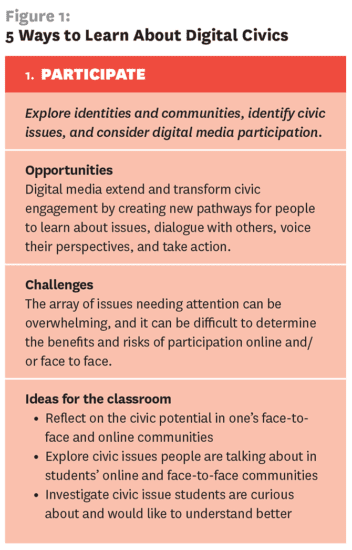
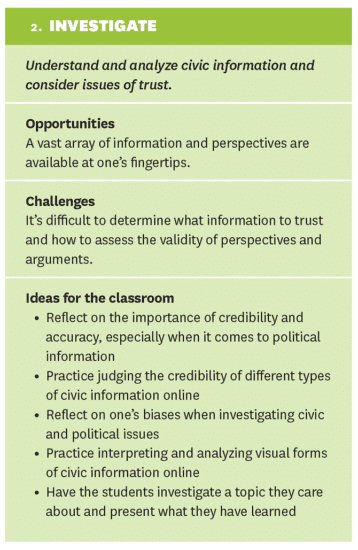
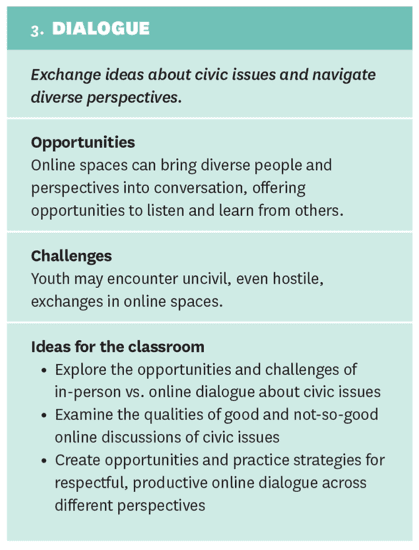
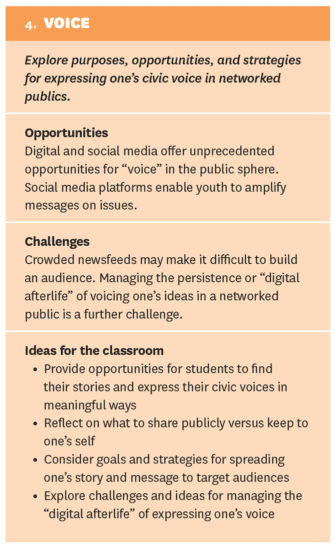
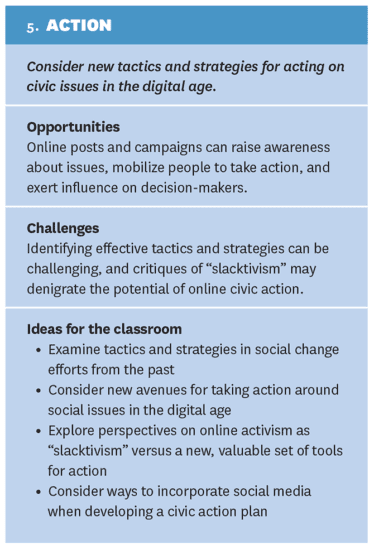
Teaching digital civics: A necessity today
Youth today are growing up in a world in which digital media is not just about socializing with friends. Public issues and social change agendas can be – and are – raised, explored, discussed, and responded to on the Internet. While there are inevitable challenges and tensions, there are also positive opportunities, especially for youth. Further, the networked nature of civic and political life isn’t likely to go away. The potential of digital media to bring about a more equitable democracy won’t be fully realized unless we ensure that all young people have access to high quality digital civic learning opportunities.
Teachers can, and should, play a pivotal role in supporting all youth to develop the sense of agency, motivation, and skills to use digital media to participate in democratic life. And all educators have a role to play regardless of discipline, grade level, and learning context. By teaching digital civics, educators can enable more youth to recognize and, hopefully, seize new opportunities for civic and political engagement that are empowering, equitable, and impactful.
Suggested Resources
Original Illustration: istock
First published in Education Canada, December 2018
1 https://www.huffingtonpost.ca/2017/10/19/women-scarf-selfies-bill-62_a_23249363/?ncid=tweetlnkcahpmg00000002
2 https://www.cbc.ca/news/canada/montreal/bill-62-metro-protest-1.4366483
3 https://www.ctvnews.ca/canada/face-covered-selfies-social-media-protests-over-quebec-s-bill-62-1.3641563
4 M. Duggan and A. Smith, The Political Environment on Social Media (Pew Research Center, 2016). www.pewinternet.org/2016/10/25/the-political-environment-on-social-media
5 P. Mihailidis, Media Literacy and the Emerging Citizen: Youth, engagement and participation in digital culture (New York, NY: Peter Lang Publishing, 2014).
6 C. Cohen, J. Kahne, B. Bowyer et al., Participatory Politics: New media and youth political action (YPPSP Research Report, 2012). http://ypp.dmlcentral.net/publications/107
7 J. Kahne and B. Bowyer, Can Media Literacy Education Impact Digital Engagement in Politics? Manuscript submitted for publication (2018).
8 J. Kahne and E. Middaugh, Democracy for Some: The civic opportunity gap in high school (CIRCLE Working Paper 59, 2008). www.civicyouth.org/PopUps/WorkingPapers/WP59Kahne.pdf
9 J. Kahne, E. Hodgin, and E. Eidman-Aadahl, “Redesigning Civic Education for the Digital Age: Participatory politics and the pursuit of democratic engagement,” Theory and Research in Social Education, no. 1 (2016): 1-35.
10 N. Portugal, “Confronting the Monster Under the Bed: Integrating blogging into the classroom,” Teaching Channel (May 14, 2018). www.teachingchannel.org/blog/2018/05/14/integrating-blogging
-
It’s Time to Walk the (Digital) Talk
Comments Off on It’s Time to Walk the (Digital) TalkIt’s commonly understood that children acquire many behaviours, both good and bad, by watching the adults around them. In this vein, we aim to create school environments where young people are exposed to positive and caring adult role models. Unfortunately, this emphasis on positive modeling appears to fly out the window when implementing digital citizenship programs and curricula.
Take, for instance, the idea that young people should be critical readers online. Certainly, we know that young people struggle to identify fake vs. factual news, but a showed that they are a great deal better at it than older generations.1 We see this deficit playing out in schools when educators continue to use inauthentic examples and outdated checklists when teaching about how to determine the truthfulness of a digital site or article. And outside of school settings, young people need only glance online to see countless examples of adults sharing fake or photoshopped images without stopping to check the source or verify the content.
Another oft-touted digital citizenship narrative is the necessity to keep one’s online presence squeaky clean; this is frequently framed in alarming ways, with adults telling young people that a single digital mistake can cost them future careers or even the chance of a university education. Of course, most of those same adults who warn about the dire consequences of online errors grew up in a pre-Internet world, one in which typical teen behaviours and “missteps” were not constantly being permanently documented, shared, and even glorified online. It seems unfair to hold today’s youth to standards that most of us (if we are being honest) could never have lived up to ourselves. Even the simplest, most basic directive to “be kind” online is problematic when adults regularly criticize, harass, and even threaten each other on social media and in the comments section of articles.
If there is any hope of helping young people to become positive digital citizens, we will first need to step up and model the behaviours we want to see. Our current practices are often hypocritical, and at worst downright counterproductive. As educators, parents, and adults generally, we must begin to practice what we preach and to follow our own instructions to be wise, kind, and positive citizens in the (digital) world.
First published in Education Canada, December 2018
1 https://bit.ly/2Ar4XLQ
-
Educating Kids About Digital Privacy
Comments Off on Educating Kids About Digital PrivacyWith the advent of social media, none of us can take our privacy for granted. The Privacy Commission of Canada says it’s critically important to teach students how to protect their privacy, exercise control over their personal information and respect the privacy of others.
By the time children start school, most have already figured out how to turn on the tablet, find apps on Dad’s smartphone and search the favourites tab for their preferred websites. But they still have a lot to learn about staying safe online.
The risks associated with connecting to the Internet have grown exponentially in recent years. From cyberbullying, sexting and child luring, to tracking, hacking and email scams, the threats can be daunting for many adults, let alone children and teens. At the same time, personal information has become a hot commodity as businesses seek to monetize our data. It has become difficult to discern who is processing our information and for what purposes and everyone, regardless of age, must weigh the benefits and risks of each product and service they use, each time they use it.
This is why it’s important that students become savvy digital citizens who are able to both enjoy the benefits of being online and avoid potential pitfalls. Young people need to be equipped with the knowledge necessary to navigate the online world and participate in the digital domain in a privacy protective manner.
“It’s one thing to know how to use the Internet, it’s quite another to know how to use it safely, securely and appropriately,” says Daniel Therrien, Privacy Commissioner of Canada. “It’s critically important that kids know how to protect their privacy, exercise control over their personal information and have respect for the privacy of others.”
Indeed, the importance of privacy education is something that was recognized internationally in 2016, when participants at the 38th International Conference of Data Protection and Privacy Commissioners passed a Resolution for the Adoption of an International Competency Framework on Privacy Education. The resolution encourages governments, and especially authorities responsible for education and other stakeholders in the education sector, to champion the inclusion of privacy education in schools and to advocate for and develop training opportunities for educators in this area. In addition to the Office of the Privacy Commissioner of Canada (OPC), Canadian provincial and territorial privacy oversight offices attending the conference signed on to the resolution. The framework adopted at the conference, the Personal Data Protection Competency Framework for School Students, serves as a roadmap for teachers around the world, outlining nine foundational privacy principles students ought to know and understand.
Prior to the conference, the OPC, along with provincial and territorial privacy oversight offices across the country, formed a working group aimed at increasing youth awareness of privacy issues and risks, as well as the need to boost privacy education in schools.
“While there is a role for regulators, legislators, the business community and parents to play in protecting kids online, education is fundamental,” says Commissioner Daniel Therrien. “Teachers can help provide children with the tools and confidence they need to operate in the online environment safely and respectfully.”
To that end, the OPC, along with provincial and territorial information and privacy oversight offices, has produced a number of resources to help teachers spark a classroom discussion about online privacy and explore some of the issues and risks Internet users encounter every day. These resources include:
- a graphic novel and classroom discussion guide aimed at tweens and younger teens
- three lesson plans developed by MediaSmarts designed to help educators teach their students about their privacy rights, and to navigate the complex digital environment safely and responsibly
- privacy presentation packages with speaking notes and colourful slide decks that teachers can use in the classroom
- age-appropriate short videos to teach youth about reputation and online privacy
- a colourful poster to teach students about protecting their privacy online
- activity sheets for younger children that explore basic privacy issues through mazes, colouring, connect-the-dots and other fun hands-on activities.
Understanding privacy protection has become an essential life skill. “By better understanding privacy communications, children will be able to make more informed choices about the websites they visit and the apps they use – skills that will benefit them well into adulthood,” says Commissioner Therrien.

Privacy Resources for Teachers
To access and download the Privacy Commissioner of Canada’s privacy resources for classroom use, including the graphic novel, lesson plans, videos, activity sheets and poster, visit www.youthprivacy.ca and click on “Educational resources for teachers.”
Find the Personal Data Protection Competency Framework for School Students (click on Documents, then Adopted Resolutions – 2016).
First published in Education Canada, December 2018
-
21st Century Citizens
Comments Off on 21st Century CitizensRemember when the Internet was so full of promise? There was so much information – on everything! – available at our fingertips. So much more connection possible – with long-lost friends, with people from around the globe who shared our challenges, interests or concerns. Important news, causes, and initiatives could reach so many more people. The world took a giant step closer to becoming a true global village.
That promise is still there, but the dark side of this instant connectivity has become starkly apparent. If we have more information than ever before, we also have more disinformation. If we can recruit more people to save the whales, we can also recruit them to join the neo-Nazis. We can connect with people, and we can also inundate them with brutal hate mail. Extreme polarization seems as likely an outcome as a common understanding.
In this context, democratic countries have never had a greater need for informed, active citizens who can see beyond narrow self-interest and grandiose claims and set their sights on positive change. We need savvy users who can engage online, yet protect their privacy and well-being. We need critical citizens who are able to assess both the value and flaws in our institutions and policies. In this issue, we explore how educators can engage students in civic issues within the shifting landscape of the digital age.
And yes, this is a charge that our schools must take on, alongside so many other requirements. Joel Westheimer points to disturbing signs that globally, democracies are weakening, and warns that civic education is more than teaching good behaviour online or off: “ ‘Good character’ is insufficient for safeguarding and strengthening democratic institutions and traditions.” Erica Hodgin and her colleagues write, “Teachers can, and should, play a pivotal role in supporting all youth to develop the sense of agency, motivation, and skills to use digital media to participate in democratic life.” For one inspiring example of how it can be done, check out Casey Burkholder’s account of how students use cellphilming to engage with and communicate issues that are meaningful to them.
I hope you will find lots to think and talk about in this issue, and in our web-exclusive articles. There’s been a lot of attention paid to the education students need to participate in the workforce of the future. Surely it’s at least as important to prepare students to be effective citizens in a world filled with critical challenges.
Photo: Dave Donald
First published in Education Canada, December 2018
-
Dark Clouds and Silver Linings
Comments Off on Dark Clouds and Silver LiningsTeaching people to write is a bad idea! Writing extinguishes memory, stifles the free flow and development of ideas by freezing them in text, provides the semblance of wisdom without real depth, and, therefore, creates superficial and boring people. In short, writing destroys the discourse necessary for deep learning. This is essentially the argument Socrates made 2500 years ago to his friend Phaedrus, who extolled the virtues of a discourse on friendship written by the orator Lysias. Phaedrus had a copy of the speech with him and testified that Lysias had covered the subject comprehensively and, he believed, “no one could have spoken better or more exhaustively.”1 Socrates, however, disagreed. He had questions about several elements of Lysias’s argument, and without the author present saw no way to explore those. For Socrates, discourse (and therefore learning) was a living thing, a conversation in which participants could ask questions, press for meaning, and make arguments. Writing, he believed, stifled all of that by separating the author from his or her words, and, therefore, was anti-educational. What appeared to Phaedrus to be an educational innovation was, in Socrates’s view, a disaster.
I know just how Socrates felt. Digital media is often touted as a democratizing force and a boon to civic participation, but I have serious doubts. Whether it be reading the nasty comments of trolls at the end of news articles online, learning about the secret appropriation and misuse of digital data to manipulate public opinion and, in particular, electoral politics, or watching a vicious and superficial dispute on Twitter, my observations of civic engagement in the contemporary world leads me to a Socratic view of digital media: it is antithetical to informed civic discourse! And I am not alone. Writing in the Globe and Mail recently, British historian Niall Ferguson argued, “Sadly, over the past two years, it has gradually become apparent that the Internet may pose a bigger threat to democracies than to dictators.”2
While it would be nice to crawl into my curmudgeon’s shell and ignore the innovations of technology, I really can’t and still claim to be a civic educator. Socrates may have hated writing, but we know that, ironically, because Plato preserved his arguments in written from. Writing did not disappear because the Athenian philosopher railed against it; it became pervasive and most of us would agree it has not undermined thought or destroyed education. Similarly, digital media are here to stay and will shape our civic life in important ways.
That is not to say Socrates’s concerns about writing were all wrong. Writers do often treat important concepts superficially, use rhetorical techniques to distort arguments, and make very selective, and often inappropriate, use of evidence. In short, they always privilege a particular view of the world and often descend into propaganda. Furthermore, in many contemporary societies published written works are often imbued with an authority that makes them immune to critique. How many times have we heard the expression, “look it up in the book,” when someone wants to authoritatively end an argument? Socrates was right; all of these things, as well as others, make writing a potentially manipulative and dangerous tool both for education and citizenship.
On the other hand, writing allows us to expand the number of people reached by particular ideas and arguments. It often provokes us to reconsider old ideas and think in new ways. Powerful writing can and does move us, inspire us, and change us. Good writing brings us into contact with new worlds, and enriches our common humanity.
In the same way, digital media has the potential to broaden the human conversation by including more voices over multiple formats and platforms. It can put us in direct touch with people, cultures, and ideas from around the world, and allow us to express ourselves in ways unthinkable just a few years ago. Like writing, digital media also has its downsides. It can be used to invade privacy, provide a megaphone for hate, and reduce complex ideas and arguments to 280 characters. So, what are we as civic educators to make of this innovation? How can we help young citizens use digital technology to enhance their participation in civic life?
The way we have approached writing in education provides important guidance. Virtually all contemporary Language Arts or English curricula in democratic societies promote a critical approach to literacy in general and writing in particular. They take seriously Socrates’s concerns about the power of writing to shape discourse and understandings, often in unexamined ways, and call for students to develop understandings and skills to use the medium both functionally (to read for information, for example), and critically (to understand how the medium works as a social enterprise). The middle level (grades 6-8) curriculum in Atlantic Canada describes critical literacy this way:
Critical literacy is the awareness of language as an integral part of social relations. It is a way of thinking that involves questioning assumptions; investigating how forms of language construct and are constructed by particular social, historical, cultural, political, and economic contexts; and examining power relations embedded in language and communication. It can be a tool for addressing issues of social justice and equity, for critiquing society and attempting to effect positive change.3
Critical literacy then, is not simply the ability to read and write; it is an essential aspect of informed civic engagement.
Critical literacy in digital media
In my view, we should approach digital media platforms in the same way, helping young citizens to use them both receptively and productively in critical ways related to fostering informed democratic deliberation and action. Recently I have been asked to review sets of competencies proposed for digital citizenship and have been quite distressed. I notice that they focus on two areas: online etiquette and Internet safety. The former concentrates on teaching students to be polite in digital environments, the latter on mitigating the dangers of cyberbullying, luring, sexting and the like. While both of these are important, neither is related to civic engagement or takes a particularly critical approach to working with and in digital media.
Ken Osborne made the point years ago in this publication that good citizenship involves much more than being a nice person.4 Below, I suggest two dark clouds and corresponding silver linings for fostering a critical civic work in digital environments.
1. “Filter bubbles”
Our digital platforms know us well. They collect demographic and personal information about us, continually track our online activities, and target our newsfeeds, popups and advertisements to fit with our evolving profile. This can be quite efficient as we are fed news from sites that share what the relevant algorithm calculates we’ll appreciate. I don’t get ads for acne cream and my granddaughters don’t get them for senior living. A few years ago, in a book and TED talk, Eli Pariser warned about this phenomenon which he called “filter bubbles.” They can make life more comfortable and easier, but they are lousy preparation for civic life, which is centred on engaging with others who come from different perspectives and backgrounds. Filter bubbles, whether created by online formulas or our own voluntary sorting of ourselves into groups and neighbourhoods of like-minded people, create barriers to effective associational and civic life, and are often fostered by uncritical engagement with digital media.
The silver lining, though, is that while Google and Facebook think they know us, they do not control us unless we allow them to. Digital media allow for the possibility of hearing from myriad others who do not share our worldviews and perspectives. Young citizens can be helped to cast off their filter bubbles, and both engage with people and ideas from diverse perspectives and cultures as well as use digital platforms to share their own stories. Two of my colleagues in the Faculty of Education at the University of New Brunswick, Casey Burkholder and Matt Rogers, engage students in using film and cellphilms to narrate aspects of their lives.5 These include navigating complex identities as minority individuals in an aggressively monolithic society, as well as struggling to make sense of and handle things like family violence, racism, and sexuality. I am an educated person and have read a lot about all of these phenomena, but watching and hearing these young people tell their stories moves me in ways that are much more visceral. My empathetic understanding is always enhanced, and that is a critical aspect of democratic civic dispositions. Digital media can isolate and insulate us from engaging with difference, but it can also enhance perspective taking and empathy, and make it possible to connect with diverse others more deeply and meaningfully than ever before. Good civic education will foster understanding of the former and facility with the latter.
2. Demagogues, liars, and liberators
In December 2016, Edgar M. Welch charged into a pizza restaurant in Washington, D.C., with several guns.6 He was there to liberate children being held as part of a child abuse ring. Except there were no children there, and the sex abuse ring was a figment of the imagination created by demagogues and widely distributed on the Internet by malevolent or ignorant sycophants. This was a particularly vivid example of the potential impact of so-called “fake news” that permeates the Web. People and “bots” spread false information about politics, social policy, medical treatments, relationships, and just about every other aspect of human life. This information is absorbed, manipulated, and passed on by many others. We know, for example, that in the 2016 U.S. presidential election, fake rallies were advertised as a ploy to bring opponents of particular policies or candidates into the street in droves and exacerbate already simmering tensions.
On the other hand, digital media allows incredible access to the best ideas in the world. In a very simple example, I regularly ask my graduate students to email scholars whose work they are encountering. More often than not, these academics write back and frequently establish an ongoing relationship that takes my students deeper into the research areas they are exploring. They become engaged in cutting-edge conversations in their fields. That is only one of the possibilities digital media has to enhance our engagement with new and evolving ideas and phenomena.
While the dark cloud of “fake news” is exacerbated by digital media, it is not really anything new. Critics of democracy in the days of Plato and Socrates worried that silver-tongued demagogues could manipulate the mob in dangerous ways through distorting reality or presenting falsehoods. Citizens have always had to learn to separate the wheat from the chaff in civic discourse; while the medium might be different in the digital age, the mission isn’t. Students can be taught to ask some of the same kinds of questions long suggested by advocates of critical literacy: Who created this source? What is/are their purposes? What inferences can I draw from this source? What perspective does this source ask me to assume? What viewpoint is presented in this source? What does this source omit or distort? How is my own response related to what is presented by the source?7
From the beginning, liberators and charlatans have been part of the democratic process. It has always been, and will continue to be essential that young citizens develop the critical facilities to separate one from the other and to use digital media and other forms to engage in work for the common good.
Civics education curricula around the world credit Socrates’s fellow citizens in Ancient Athens with establishing the first democracy. The trial and execution of Socrates, grounded, Plato argued, in the manipulation of public opinion, demonstrated it wasn’t perfect. Democracy has evolved considerably since those early manifestations, particularly with regard to who is included in the civic polity. It still isn’t perfect, and many of the challenges it faces are similar to the ones faced in Ancient times. The project of civic education in the 21st century is largely the same as it was in Athens: helping young citizens deal with the complexities, nuances, and shifting nature of power and politics in a world that often prefers simplicity and certainty. The mechanisms citizens use to engage have changed, but the underlying project is the same.
First published in Education Canada, December 2018
Notes
1 Plato. n.d. “Phaedrus.” The Internet Classics Archive. http://classics.mit.edu/Plato/phaedrus.1b.txt.
2 Ferguson, Niall. 2018. “Social Networks Are Creating a Global Crisis of Democracy.” Globe and Mail, 2018. https://www.theglobeandmail.com/opinion/niall-ferguson-social-networks-and-the-global-crisis-of-democracy/article37665172/.
3 New Brunswick Department of Education, English Language Arts: Middle Level. (Fredericton: Educational Program & Services Branch, n.d.), p. 103.
4 Ken Osborne, “Political and Citizenship Education: Teaching for civic engagement.” Education Canada 45, no. 1 (2005): 13–16.
5 For more information about this project, see Casey Burkholder’s article, “The Kids are Alright,” in this issue of Education Canada.
6 Cecilia Kang and Adam Goldman, “In Washington Pizzeria Attack, Fake News Brought Real Guns,” The New York Times (January 20, 2018), sec. Business Day. www.nytimes.com/2016/12/05/business/media/comet-ping-pong-pizza-shooting-fake-news-consequences.html.
7 Adapted from International Reading Association, and National Council of Teachers of English, Standards for the English Language Arts (Newark, Delaware and Urbana Illinois: 1996), p. 15. www.ncte.org/library/NCTEFiles/Resources/Books/Sample/StandardsDoc.pdf?_ga=2.55023531.123604395.1532439582-324293061.1532439582
-
How can we embed Truth and Reconciliation in every school?
Comments Off on How can we embed Truth and Reconciliation in every school?Eleven of the ninety-four Calls to Action of the Truth and Reconciliation Commission of Canada (TRC) final report are specific to education. Call to Action 63, “Building student capacity for intercultural understanding, empathy, and mutual respect,” challenges Canadian education systems to focus on students’ understanding of Indigenous human rights and social justice initiatives. Non-Indigenous students are now beginning to learn about the truth of residential schools, treaties and other long-standing issues facing Indigenous communities such as lack of clean drinking water, housing and food shortages. Truth and reconciliation is a spiritual and emotional journey required of all students and educators – from the head to the heart – that will unfold differently for everyone.
This journey can be undertaken through the following strategies, and It is critical that experiences are brought back into the school and classroom:
- Creating relationships with Indigenous peoples by attending community events (e.g. National Indigenous Peoples Day, Louis Riel Day, Arctic Games, round dances, community meals) and having a critical conversation about relevance and meaning.
- Learning from local Indigenous Knowledge Keepers outside school walls in a culturally relevant space (e.g. medicine walks, living with the land, sharing circles, attending powwows, language camps).
- Engaging in community outreach projects that have compassion and comprehension at their core (e.g. Project of Heart, Orange Shirt Day, I am a witness, Walking With Our Sisters, Shannen’s Dream, Jordan’s Principle, The REDress Project).
- Participating in experiential activities that delve deeper into Indigenous and non-Indigenous relations (e.g. Imagine a Canada – National Centre for Truth and Reconciliation, Indigenous Rights Blanket Exercise Workshop – KAIROS Canada, WE Schools – Indigenous Programming).
- Evaluating individual and collective growth using a holistic model that includes the physical, emotional, intellectual and spiritual aspects of life (e.g. Medicine Wheel, Indigenous Wellness Framework, First Nations Perspective on Health and Wellness).
As active participants in modelling reconciliation with their students, teachers need both professional development (PD) and a support network that provides safe places to share feelings of trauma, joy, anger, resolve, grief, and hope that they may experience along this journey. PD themes can include cultural competency and safety, the First Nations Mental Health First Aid course, holistic arts therapy and other areas that explore emotional and spiritual intelligence. The support network for non-Indigenous school districts includes an Indigenous Lead, who has meaningful awareness and knowledge of learning resources and cultural protocols.
Overall, Call to Action 63 goes beyond curriculum requirements, pedagogy and resources, and it is critical to changing how generations of young people move forward together.
Additional Information Resources
Events and initiatives
- South Slave Arctic Winter Games (2018). Arctic Winter Games.
- Carleton University – Centre for Indigenous Initiatives (2018). Round Dance.
- Orange Shirt Society (2018). The Story of Orange Shirt Day.
- Project of Heart. (2018). Project of Heart – Home.
- Walking With Our Sisters (2017). A Commemorative Art Installation for the Missing and Murdered Indigenous Women of Canada and the United States.
- First Nations Child & Family Caring Society (2018). Shannen’s Dream.
- The REDress Project (2014). About – Artist Statement.
- KAIROS Canada (2018). Reconciliation through Education and Understanding – The KAIROS Blanket Exercise.
- WE Charity. (2018). Indigenous Programming.
Articles
- Bell, Nicole. Teaching by the Medicine Wheel. EdCan Network (2014).
- Toulouse, P. (2018). Truth and Reconciliation in Canadian Schools. Winnipeg, MB: Portage and Main Press.
Resources and history
- Government of Canada (2018). National Indigenous Peoples Day.
- Métis Nation of Ontario (2016). Louis Riel Day.
- First Nations Child & Family Caring Society (2018). I am a witness.
- Government of Canada (2018). Jordan’s Principle.
- National Centre for Truth and Reconciliation. (2018). Residential Schools and Reconciliation Educational Resources.
- First Nations Health Authority. (2018). Indigenous Wellness Framework.
- Mental Health Commission of Canada (2018). Mental Health First Aid First Nations.
References
Czyzewski, Karina. “The Truth and Reconciliation Commission of Canada: Insights into the goal of transformative education.” International Indigenous Policy Journal 2, no. 3 (2011).
McCarty, Teresa, and Tiffany Lee. “Critical culturally sustaining/revitalizing pedagogy and Indigenous education sovereignty.” Harvard Educational Review 84, no. 1 (2014): 101-124.
Nagy, Rosemary. “The Truth and Reconciliation Commission of Canada: Genesis and Design1.” Canadian Journal of Law & Society/La Revue Canadienne Droit et Société 29, no. 2 (2014): 199-217.
Savage, Catherine, Rawiri Hindle, Luanna H. Meyer, Anne Hynds, Wally Penetito, and Christine E. Sleeter. “Culturally responsive pedagogies in the classroom: Indigenous student experiences across the curriculum.” Asia-Pacific Journal of Teacher Education 39, no. 3 (2011): 183-198.
Truth and Reconciliation Commission of Canada. (2015). Honouring the Truth, Reconciling for the Future – Summary of the Final Report of the Truth and Reconciliation of Canada. Winnipeg, MB: Same as Author.
With the generous financial support of:
-
How teachers can integrate Truth and Reconciliation in their classrooms
Comments Off on How teachers can integrate Truth and Reconciliation in their classroomsTruth and Reconciliation in Your Classroom
This infographic aims to empower teachers, principals and administrators across Canada with four key steps to begin implementing truth and reconciliation initiatives immediately into K-12 classrooms.
Developed in collaboration with Dr. Kate Freeman and Dr. Lindsay Morcom from Queen’s University’s Faculty of Education, and Shawn McDonald of the Algonquin & Lakeshore Catholic District School Board, this quick-scan infographic outlines how educators can avoid cultural appropriation, prioritize authentic indigenous expertise, develop relationships with local Indigenous Elders and Knowledge Keepers, and build their own knowledge on the traditional territories that they live on. This infographic was inspired by a feature article that recently appeared in Education Canada Magazine.
The EdCan Network has also released a new Facts on Education fact sheet authored by renowned expert Dr. Pamela Rose Toulouse of Laurentian University, entitled How can we embed truth and reconciliation in every school?, which offers evidence-based strategies for how educators and students can bring this learning into our school communities.
In addition to the downloadable copy of the infographic, which can be posted in staff rooms and classrooms, here are several practical resources available to support teachers in building their knowledge and confidence on this subject matter.
RESOURCES FOR K-12 TEACHERS:
- Online sources like goodminds.com or the Martin Family Initiative feature hundreds of vetted resources by Indigenous authors with clear curriculum connections across many subject areas.
- Universities and other education institutions often have great resources online.
For the prairies, the University of Saskatchewan has an Indigenous Studies research portal.
In the Eastern Woodlands, Queen’s University has an outstanding website with Indigenous content.
On the West Coast, the University of British Columbia has K-12 curriculum resources available online. - Provincial teachers’ federations and other organizations may have resources specifically designed to assist teachers in their work to support truth and reconciliation education in their classrooms. For example, see Joining the Circle: An Educator’s Toolkit to Support First Nations, Métis and Inuit Students, published in hard copy in October 2017 by the Ontario Teachers’ Federation (OTF) and the Centre ontarien de prévention des agressions (COPA).
- For pan-Canadian topics like residential schools, check out the Hundred Years of Losseducation kit developed by the Legacy of Hope Foundation. The “Kairos Blanket Exercise” offers an interactive exploration of Indigenous-Canadian relations with a focus on residential schools and reconciliation. It can be used in any classroom from Grade 4 to adult learners.
FOR ADDITIONAL RESOURCES, SEE: NATIONAL CENTRE FOR TRUTH AND RECONCILIATION, UNIVERSITY OF MANITOBA (WWW.NCTR.CA)
If interested in placing a bulk order (20 or more) of the bilingual infographic please contact publications@edcan.ca for more information.
- Non-member rate: $2.75/each plus shipping and taxes.
- Member rate: $2.00/each plus shipping and taxes.
-
Self-Reg Summer Symposium 2019
Comments Off on Self-Reg Summer Symposium 2019Join Dr. Stuart Shanker and the TMC crew, July 8th – 11th 2019, for our 5th annual Self-Reg Summer Symposium. Our theme this year is Self-Reg and Democracy: The Future lies in the Hands of Self-Reg Parents, Schools, and Communities.
SRSS 2019 will focus on how Self-Reg can help sustain democracy and civil engagement, one community, one classroom, one family, one child at a time. How can Self-Reg help us raise today’s kids in ways that promote the prosocial behaviour and civic engagement that society needs? -
2019 Digital Learning Symposium
Comments Off on 2019 Digital Learning SymposiumThe BC Partners in Online Learning, in partnership with the Canadian eLearning Network (CANeLearn), invite you to the 16th annual Digital Learning Symposium April 7 – 9, 2019 — Fostering Inquiry: Personal Learning in Digital Environments. The focus of the 3-day Symposium is on leading flexible learning models, environments and instructional approaches. The event attracts over 400 educators from BC and across Canada: technology coordinators, curriculum developers, and leaders from K-12 and post-secondary. Network, learn, be challenged and enlightened at this premier CANeLearn event.
-
Get the facts on how schools can best support LGBTQ2 students
Comments Off on Get the facts on how schools can best support LGBTQ2 studentsA newly released fact sheet produced by the national EdCan Network of educators entitled How can schools support LGBTQ2 students? aims to quell the polarizing sex-ed and gender identity curriculum debates raging across Canada by equipping parents, teachers and administrators with four evidence-based tips on how to build safer and more inclusive schools for all students.
Authored by renowned sexual and gender minority youth expert Dr. Kristopher Wells, this hands-on and timely resource sets clear expectations and empowers entire school communities to create respectful, welcoming, inclusive and safe working and learning environments.
As Dr. Wells asserts in this fact sheet, “Recent research indicates that the vast majority of Canadian teachers (85%) now support LGBTQ2-inclusive education,” although he outlines that “many report not yet having the knowledge or training to feel confident in creating safer and more inclusive schools for LGBTQ2 youth.”
“With the ongoing controversies over sexuality, gender identity and sexual orientation-related policies, procedures and curriculum, we’re providing a concise and authoritative source of information to parents, trustees and educators, who are often exposed to conflicting opinions about this issue,” says Max Cooke, EdCan Network Interim CEO.
In addition to the downloadable copy of the fact sheet, available at www.edcan.ca/lgbtq2, also included are several practical resources available to support parents and teachers in building their knowledge and confidence on this subject matter.
This fact sheet was made possible with the generous financial support of the Desjardins Foundation and the Canadian Schools Boards’ Association.
-
How can schools support LGBTQ2 students?
Comments Off on How can schools support LGBTQ2 students?While Canadian society is growing more diverse and inclusive, there is still resistance when it comes to supporting lesbian, gay, bisexual, trans, queer, and two-spirit (LGBTQ2) youth in schools. Although recent research indicates that the vast majority of Canadian teachers (85%) now support LGBTQ2-inclusive education, many report not yet having the knowledge or training to feel confident in creating safer and more inclusive schools for LGBTQ2 youth.
Here are four key factors that can make a positive difference for LGBTQ2 students in K-12 schools:
1. Inclusive Curriculum
Visibility matters. LGBTQ2 students need to see themselves in their textbooks and in the halls and walls of their schools to feel welcome and included. Where appropriate, incorporate sexual orientation, gender identity and gender expression topics into classroom discussions, lesson plans, curricular outcomes, and library collections.
2. Supportive Teachers and Staff
Teachers can be a supportive lifeline to help LGBTQ2 youth move from being at-risk of bullying, discrimination, and violence to developing a resilient mindset to overcome adversity in their lives. Staff can volunteer to serve as a “safe contact” at school – providing valuable sources of support for LGBTQ2 students and families.
3. Comprehensive Policies
School boards that pass comprehensive LGBTQ2 policies set clear expectations and authorize all staff to meet their legal obligations and become proactive in creating respectful, welcoming, inclusive, and safe working and learning environments. These policies need to be supported with high quality professional development and robust implementation plans.
4.Visibility and Inclusion
Gay-straight alliances (GSAs) help break the silence of inaction or indifference that still surrounds LGBTQ2 identities. Given the educational, health, and safety benefits of GSAs, Alberta, Ontario, and Manitoba have passed legislation supporting their start-up in schools. Teachers can become a GSA advisor and display safe space stickers and posters to show that they are allies. Establishing clearly visible all-gender universal washrooms and updating school forms, websites, and communications to become more gender inclusive recognizes that gender exists on a spectrum, not as a male/female binary. Educators have a responsibility to address homophobic and transphobic bullying and derogatory language whenever they see or hear it. LGBTQ2 information nights for families also help to dispel negative myths and stereotypes while creating awareness.
Combined, these actions represent important first steps for all school community members – including teachers, administrators, staff, students, and families – in building safer and more inclusive schools for all students, regardless of how they identify.
Additional Information Resources
- To learn more about LGBTQ2 terms and definitions, please see EGALE Canada’s Glossary
- Canadian Centre for Ethics in Sports – Creating Inclusive Environments for Trans Participants in Canadian Sport: Guidance for Sport Organizations
- Canadian National Trans Youth Health Survey
- Canadian Teachers’ Federation – Diversity and Human Rights
- Egale Canada
- Gay-Straight Alliances
- Gender Creative Kids
- Journal of LGBT Youth
- NoHomophobes.com
- PFLAG Canada (for parents, families, and friends)
- Pride Tape
- RISE: Respect, Inclusion, Safety, Equity
- SOGI 123
- Teaching Sexual Health
Government
- National Apology to LGBTQ2 Canadians
- Federal Government of Canada – Free To Be Me
- Alberta – Guidelines for Best Practices: Creating Learning Environments That Respect Diverse Sexual Orientations, Gender Identities, and Gender Expressions
- Manitoba – Supporting Transgender and Gender Diverse Students in Manitoba Schools
- Newfoundland & Labrador – Guidelines for LGBTQ Inclusive Practices
- Nova Scotia – Guidelines for Supporting Transgender and Gender Non-Conforming Students
- Quebec – Mesures d’ouverture et de soutienenverslesjeunes trans et lesjeunesnonbinaires
- Saskatchewan – Deepening the Discussion: Gender and Sexual Diversity
References
Ahuja, A., Webster, C., Gibson, N., Brewer, A., Toledo, S., & Russell, S. (2015). Bullying and suicide: The mental health crisis of LGBTQ youth and how you can help. Journal of Gay & Lesbian Mental Health, 19, 125-144.
Bartholomaeus, C., & Riggs, D. W. (2017). Transgender people and education. New York: Palgrave Macmillan.
Brill, S., & Kenney, L. (2016). The transgender teen: A handbook for parents and professionals supporting transgender and non-binary teens. San Francisco: Cleis Press.
Brill, S., & Pepper, R. (2008). The transgender child: A handbook for families and professionals. San Francisco: Cleis Press.
Genovese, M., Rousell, D., & The Two Spirit Circle of Edmonton Society. (2011). Safe and caring schools for two-spirit youth: A guide for teachers and students. Edmonton, AB: Society for Safe and Caring Schools and Communities. Retrieved from http://www.safeandcaring.ca/wp-content/uploads/2013/08/Two-Spirited-Web-Booklet.pdf
Grace, A. P., & Wells, K. (2015). Growing into resilience: Sexual and gender minority youth in Canada. Toronto: University of Toronto Press.
Luecke, J. C. (2011). Working with transgender children and their classmates in pre-adolescence: Just be supportive. Journal of LGBT Youth, 8(2), 116-156.
Mayo, C. (2017). Gay-straight alliances and associations among youth in schools. New York: Palgrave Macmillan.
Russell, S. T., & Horn, S. (Eds.). (2017). Sexual orientation, gender identity and schooling. New York: Oxford University Press.
Ryan, C. L., & Hermann-Wilmarth, J. M. (2018). Reading the rainbow: LGBTQ-inclusive literacy instruction in the elementary classroom. New York: Teachers College Press.
Short, D. (2017). Am I safe here? LGBTQ teens and bullying in schools. Vancouver: UBC Press.
Taylor, C. & Peter, T., with McMinn, T. L., Paquin, S., Beldom, S., Ferry, A., Gross, Z., & Schachter, K. (2011). Every class in every school: The first national climate survey on homophobia, biphobia, and transphobia in Canadian schools: Final report. Toronto: Egale Canada Human Rights Trust. Retrieved from https://egale.ca/every-class/
Taylor, C., Peter, T., Campbell, C., Meyer, E., Ristock, J., & Short, D. (2015). The Every Teacher Project on LGBTQ-inclusive education in Canada’s K-12 schools: Final report. Winnipeg, MB: Manitoba Teachers’ Society. Retrieved from http://news-centre.uwinnipeg.ca/wp-content/uploads/2016/01/EveryTeacher_FinalReport_v12.pdf
Travers, A. (2018). The trans generation: How trans kids (and their parents) are creating a gender revolution. New York: New York University Press.
Wells, K. (Ed). (2015). GSAs and QSAs in Alberta schools: A guide for teachers (2nd Edition). Edmonton, AB: Alberta Teachers’ Association. Retrieved from https://www.teachers.ab.ca/SiteCollectionDocuments/ATA/Publications/Human-Rights-Issues/PD-80-6%20GSA-QSA%20Guide%202016.pdf
Wells, K., Roberts, G., & Allan, C. (2012). Supporting transgender and transsexual students in K-12 schools: A guide for educators. Ottawa: ON: Canadian Teachers’ Federation. Retrieved from http://gendercreativekids.ca/wp-content/uploads/2013/10/Supporting-Transgender-and-Transsexual-Students-web.pdf
With the generous financial support of:
-
How do we teach students to identify fake news?
Comments Off on How do we teach students to identify fake news?In a “post-truth” era where people are increasingly influenced by their emotions and beliefs over factual information, fact and fiction can be difficult to distinguish, and fake news can spread rapidly through mainstream media sources and social networks. Moreover, fake news is often meant to do harm, by tricking us into believing a lie or unfairly discrediting a person or political movement.
Given this malicious intent, students must learn to approach news and information with a critical eye in order to identify intentionally misleading sources (although recent studies confirm that this is an uphill battle for both adults and young people). Teachers therefore play a crucial role in ensuring that their students develop the skills to decipher the many streams of information available to them.
The following strategies and ideas can help students identify fake news and become critical readers of the world around them :
- Move beyond traditional – and often ineffective – information evaluation checklists (e.g. RADCAP, CRAAP, and CARS), which fall short when applied to the sophisticated tools and techniques often used to create fake news.
- Prioritize helping students develop investigative techniques where they become familiar with information verification websites (e.g. FactsCan, org, Snopes, and Hoax Slayer) and tools like Google’s “search by image” feature or the VerificationHandbook.com resource. Students can also learn about professional fact checking strategies such as reading laterally, which involves cross-referencing a variety of websites rather than digging further into the website at hand.
- Teach students to identify bias using tools like a media bias chart, which provides a starting point for them to understand that all sources come from a particular perspective.
- Bring real-world fake news examples that we encounter everyday into the classroom so that students can be challenged to apply their skills and techniques to authentic situations, like determining the true origin of a viral image or video and examining potential catfishers, bots, or trolls in order to better understand the hallmarks of fake and malicious social media accounts.
Ultimately, in a world where it is increasingly dangerous to simply trust what we read and see, it is critical that students are taught to approach the world around them with a healthy sense of skepticism to avoid being misled, duped, or scammed.
Additional Information Resources
Information Verification Websites
- FactsCan
- Factcheck.org
- Snopes
- Hoax Slayer
- VerificationHandbook.com
- Google’s “search by image” feature
Sample Media Bias Chart
Other Practical Resources
- Web Literacy for Student Fact-Checkers
- KQED Lesson plans
- 5 Ways to Spot Fake News – Video and article from Common Sense Media
- What’s News: Fake, False, Misleading, Clickbait, Satire, or Carefully Reported?
- The Smell Test: Educators can counter fake news with information literacy. Here’s how.
- Fake News: A Library Resource Round-up
- Dynamic Landscapes – Resources List
- NewseumED unit on media literacy
- The News Literacy Project
References
For definition of “post-truth,” please see: Collins English Dictionary. “Definition of ‘post-truth.’” HarperCollins Publishers. Accessible from www.collinsdictionary.com/dictionary/english/post-truth
Wineburg, Sam and McGrew, Sarah and Breakstone, Joel and Ortega, Teresa. (2016). “Evaluating Information: The Cornerstone of Civic Online Reasoning.” Stanford Digital Repository. Accesible from http://purl.stanford.edu/fv751yt5934
Mitchell, A., Gottfried, J., Barthel, M., Sumida, N. (June 18, 2018). “Distinguishing Between Factual and Opinion Statements in the News.” Pew Research Center. Accessible from www.journalism.org/2018/06/18/distinguishing-between-factual-and-opinion-statements-in-the-news/
National Council of Teachers of English (February 2013). “NCTE Framework for 21st Century Curriculum and Assessment.”. Accessible from www.ncte.org/governance/21stcenturyframework
Domonoske, C. (June 19, 2018). “It’s Easier To Call A Fact A Fact When It’s One You Like, Study Finds.” National Public Radio. Accessible from www.npr.org/2018/06/19/621569425/its-easier-to-call-a-fact-a-fact-when-it-s-a-fact-you-like-study-finds
With the generous financial support of:
-
Beyond Trial and Error
Comments Off on Beyond Trial and ErrorEvidence suggests that new teachers are not confident taking on formative and differentiated approaches to assessment. What supports could help them refine their assessment skills?
TAKE A MOMENT to picture your classroom. Imagine you are planning an upcoming unit for your students. Would you start by designing a summative evaluation, then backward plan your lessons? Or would you first create your formative assessments and let the information you gather from these tasks guide your subsequent lessons, learning activities, and final assignments? Would you perhaps review the curriculum expectations with your students and ask them to design personal learning plans or co-plan an inquiry for the unit? Or maybe none of these approaches would work for you and your students.
While there is considerable latitude in how you implement assessment policies within your own classroom to support teaching and learning, research shows that how you approach your assessment decisions has tremendous impact on the learning culture in your classroom. A teachers’ approach to classroom assessment not only influences what students learn but also how they learn.1
Our aim in this article is to reflect on the experiences that shape teachers’ approaches to classroom assessment, in particular those early in a teacher’s career. teachers become more aware of the classroom assessment practices, but to outline how teacher education and in-service mentorship can support early career teachers in effectively interpreting and implementing assessment policies that meaningfully support student learning.
Approaches to assessment
Previous measures of teachers’ classroom assessment literacy have tended to diminish the influence of classroom context, instead focusing on teachers’ assessment knowledge (e.g. norm vs. criterion assessments) and/or specific skills (e.g. test construction). Through this approach, assessment literacy was understood as a set of learnable skills that teachers were required to know and use. By overlooking the importance of the classroom context, teachers could be scored, compared, and ranked through a multiple-choice test on their classroom assessment knowledge and practices. However, such a de-contextualized measure of teachers’ knowledge and skills does not accurately capture teachers’ preparedness for classroom assessment practices.
In contrast, recognition of the significance of the classroom context deters the scoring and ranking of teachers’ knowledge and skills, as an assessment practice appropriate in one context may not be in another. For instance, the construction of multiple-choice questions may be appropriate for a teacher in one grade or subject, but may not be used by another teacher, yet both could have sound assessment practices for their context. Furthermore, a teacher with multiple classes of the same course may value producing reliable assessments that can be used across sections, while a teacher with a range of dissimilar courses may value producing assessments that reflect the specific learning progress of each class.
Teachers’ classroom assessment practices are also shaped by their own teaching and learning experiences.
Initial classroom experiences
For a new teacher, few things are as daunting as the first days of school. Pre-planned routines can devolve into trial-and-error, and a well-crafted philosophy of education can gravitate towards just trying to get through the day. While these feelings generally dissipate over time, they may profoundly impact early career teachers’ approaches to assessment.2
Compared to teacher candidates, early career teachers with less than five years’ classroom experience are more than three times as likely to focus on adhering to reporting mandates set out by assessment policies. Unlike teacher candidates and later career teachers, who both tend to support differentiated approaches to assessment, early career teachers are more than three times as likely to endorse an equal assessment protocol for all students (in which all students receive the same assessment tasks) and almost four times as likely to value producing consistent assessment tasks (utilizing similar assessments across courses and/or years).
Early career teachers’ orientation toward a more standardized and summative assessment approach may be fuelled by their need to simply survive the first few years of teaching, and is likely further intensified by the current accountability climate of Canadian schools. Importantly, as teachers pass the five-year mark and develop more extensive classroom experience, their approaches to assessment begin to gravitate towards more formative and differentiated approaches. Given that this shift towards standardized and summative approaches appears only within early career teachers, it is important to consider the supports that could be provided to help teachers early in their career enact a more balanced approach to assessment.
Teacher education programs
Teacher education programs play a central role in the development of teachers’ approaches to assessment. These programs are typically the first instance in which teachers are explicitly exposed to theories of teaching, learning, and assessment and are also when they first venture forth into the classroom as a teacher. While there are a plethora of experiences that shape teachers’ approaches to assessment (such as coursework, instructor pedagogy, and practicum experiences), stand-alone assessment courses are the dominant source of assessment education across Canadian teacher education programs.
Within stand-alone assessment courses, teacher candidates are expected to acquire knowledge and skills related to classroom assessment practices. What is rarely addressed is how to utilize their assessment knowledge and skills to navigate the principles of teaching, learning, and assessment that permeate our educational system (e.g. outcome-based accountability, transparent and equitable practices3). While some of these alignment issues are likely addressed in curriculum courses and during practicum placements, the role of assessment education should be to support teachers’ capacity to align their assessment knowledge and skills to their approach to assessment in order to navigate these underlying principles. If this doesn’t occur, teachers may start their careers without a firm understanding of how their approaches to assessment can be used as a bridge between the knowledge and skills they have developed and underlying principles of teaching, learning, and assessment.
Mentorship of early career teachers
For the past 40 years, formal mentorship via teacher candidates’ practicum experiences has dominated our models of teacher education.4 Upon certification and securing a teaching position, depending on school board and province, some teachers have the opportunity for formal early career mentorship, whether from their administrator or more established peer teacher (e.g. the teacher induction program in Ontario), but these opportunities do not necessarily maintain a consistent focus on classroom assessment. However, informal mentorship can provide crucial supports for early career teachers to better equip them to confidently take on a range of assessment strategies.
As teachers move beyond the first five years of teaching, subtle yet important shifts in their approaches to assessment occur. The most apparent is that the prioritization of more standardized summative assessments diminishes in favour of differentiated and formative approaches that support students throughout learning. Furthermore, within their formative assessment practices, experienced teachers are far better able to distinguish and prioritize assessment for and as learning practices, a distinction that appears more ambiguous for teacher candidates and early career teachers. Based on these findings, it appears that experienced teachers are better able to use fluid assessment practices that suit individual students’ needs, rather than being driven by accountability mandates that tend to emphasize summative assessment results.5
Given the changing nature of teachers’ approaches to assessment over their career, more established teachers could play an important role in mentoring beginning teachers as they negotiate current accountability mandates and assessment responsibilities in the service of student learning. For example, more experienced teachers could help early career teachers understand the alignment between the knowledge and skills they developed during teacher education and the expectations set out by classroom assessment policies. This mentorship could equip teachers to effectively interpret and implement assessment policies in ways that are meaningful to teachers’ practice and effective in the service of student learning.
IN PREPARING TEACHERS for the realities of current and future classrooms, there is a need to focus on the drivers of teachers’ classroom assessment decisions. To effectively navigate the pressures of classroom assessment and support student learning, early career teachers need ongoing support tailored to their career stage. With this support, we hope that early career teachers’ pronounced shift towards a standardized and summative approach to classroom assessment could be moderated toward more balanced approach that equally values formative and differentiated approaches aimed at using assessment to support and promote student learning.
Acknowledgements
We would like to thank Dr. Lorraine Godden and Alice Johnston for their feedback throughout the writing process.
Understanding your Approaches to Assessment
It is worthwhile, particularly for teachers new to the profession, to critically reflect on what influences shape their assessment decisions.
The Approaches to Classroom Assessment Inventory is a professional learning tool to help teachers identify and develop their approaches to assessment through scenario-based questions and a personalized assessment profile.
In addition, the following questions offer a good starting place when making an assessment decision:
- What is the purpose of this assessment? Am I trying to measure student learning, guide future lessons, or support students as they navigate their own learning?
- What aspect of the assessment process should I focus on? Do I invest more in the design of assessments, how they are scored, or how I communicate the results to my students and their caregivers?
- How is this assessment fair to all my students? Is it fair because all of my students will complete the same task? Is it fair because I will differentiate this task for all of my students?
- Am I using this assessment because I have used it with previous students and it has proven to be reliable, or have I created a new assessment task that is rooted in the learning experiences of the students I am assessing?
First published in Education Canada, September 2018
1 A. Coombs, C. DeLuca, D. LaPointe-McEwan, and A. Chalas, “Changing Approaches to Classroom Assessment: An empirical study across teacher career stages,” Teaching and Teacher Education 71 (2018): 134-144.
2 Ibid.
3 Ontario Ministry of Education, Growing Success: Assessment, evaluation, and reporting – improving student learning (Toronto, ON: Queen’s Printer for Ontario, 2010); Manitoba Education, Citizenship & Youth, Rethinking Classroom Assessment with Purpose in Mind: Assessment for learning, assessment as learning, and assessment of learning (2006).
4 A. J. Hobson, P. Ashby, A. Malderez, and P. D. Tomlinson, “Mentoring Beginning Teachers: What we know and what we don’t,” Teaching and Teacher Education 25, no. 1 (2009): 207-216.
5 Coombs et al., “Changing Approaches to Classroom Assessment.”


IDEAS TO SUPPORT EDUCATORS : Subscribe to the EdCan e-Newsletter
Quality research, reports, and professional learning opportunities.