
Archive
-
The Case for Investing in K-12 Staff Well-being
Comments Off on The Case for Investing in K-12 Staff Well-beingOn November 22, 2019, ministry and faculty of education representatives, Directors of Education/CEOs, and other K-12 leaders from across Canada attended our EXCLUSIVE professional learning session, where they:
-
Learned the fundamental principles and evidence behind workplace well-being in K-12 education
-
Found out how investing in educator well-being can heighten student achievement and save precious resources
-
Discussed ways to go beyond one-off unsustainable programs to a long-term, system-wide approach
Couldn’t make it? Stay tuned for our Spring National Summit on K-12 Workplace Well-being
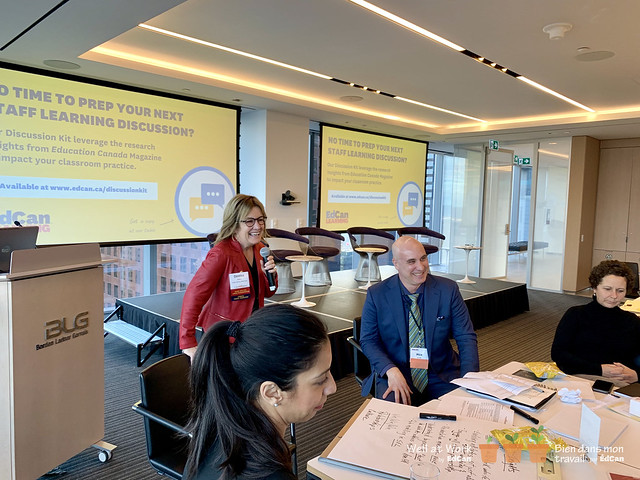
Click on the album to see more photos from our event.
ALL-STAR PROGRAMME AND PRESENTATIONS
Click on the arrows to see the sessions and download the presentations.
-
-
How can we reduce stress and increase support for teachers?
Comments Off on How can we reduce stress and increase support for teachers?Well-being happens by making our physical, emotional, social, and mental health a priority. When this isn’t a priority in the workplace, staff can develop chronic stress that impacts their lives both at work and at home. As teaching is considered one of the most stressful professions, teachers who support the well-being and learning of students are more likely to experience the following types of chronic stress:
- Burnout: High work-related stress piled up over months or years including mental, physical, and emotional exhaustion that leads to not being able to cope with demands (e.g. from parents, students, policies, curriculum)
- Compassion fatigue: Feeling helpless when constantly exposed to students who you can’t help and who are suffering (e.g. from poverty, homelessness, racism, violence)
- Emotional labour: Feeling you must suppress your emotions daily (e.g. by keeping a smile on) when your personal values don’t match up with work expectations (e.g. wanting more time to support every student but needing to meet curriculum demands)
School communities that promote well-being are supportive, allow teachers autonomy, and promote healthy relationships. Part of achieving this means identifying the root causes of teacher stress.
Here are three sources of teacher stress and tips to cope with and reduce it:
1. Job Stress: Job demands (e.g. unrealistic deadlines) and lack of resources (e.g. time, materials to do the job)
Tips for school district leaders:
-
- Ensure long-term, well-resourced PD that allows teachers to continuously learn and be supported in their roles
- Provide autonomy in pedagogy and curriculum decisions to allow teachers to feel respected and in control
- Develop policies and plans to increase self-efficacy and reduce job stress (e.g. shared decision-making, employee benefits, mental health toolkits)
2. Personal Stress: Need for more social-emotional competencies (e.g. self-awareness) and more self-efficacy (confidence in one’s ability to succeed at tasks)
Tips for teachers:-
-
- Develop time management strategies that meet your needs
- Prioritize your own well-being and learn about healthy strategies to cope with stress
- Share with and learn from colleagues and supervisors who can help you cope
- Find ways to live out the values that brought you to teaching (e.g. taking time to get to know your students)
-
3. Workplace Stress: Unclear boundaries between personal and work life (e.g. lack of work-life balance, job insecurity)
Tips for principals:-
- Lead activities that model healthy habits at work (e.g. healthy eating, fitness challenges)
- Promote working “smart,” not working “long,” and limit after hours work
- Ask teachers what they need help with – don’t wait for them to come to you
- Create and share resources to streamline administrative tasks at busy times of the year
While stress is a normal part of everyday life, stress over a long-term period negatively impacts the health and well-being of teachers. Research demonstrates that teacher well-being has a direct impact on student learning; therefore, investing in supports and resources to prevent teachers from burning out creates a healthy and supportive environment where both teachers and students can flourish.
Additional Resource Information
Centre for School Mental Health at Western University
Teacher Stress and health (2016). Robert Wood Foundation.
Friedman, A. & Reynolds, L. (2011). Burned in: Fueling the Fire to Teach. Teachers College Press.
References
Koenig, A., Rodger, S., & Specht, J. (2018). Educator Burnout and Compassion Fatigue: A Pilot Study. Canadian Journal of School Psychology, 33(4), 259–278. https://doi.org/10.1177/0829573516685017
McCallum, F., Price, D., Graham, A. & Morrison, A. (2017). Teacher Wellbeing: A review of the literature . Association of Independent Schools of NSW. Accessed at: https://apo.org.au/node/201816
-
Developing Intercultural Competence
Comments Off on Developing Intercultural CompetenceWhat is intercultural competence and why is it important? Intercultural competence is the ability to communicative effectively and appropriately with students who are linguistically and culturally different from ourselves. It’s an important skill for teachers who want to more deeply support and affirm the diverse students in their classes.
“Two of my students from Somalia are about to be expelled from school for chronic absences, in keeping with our school’s policy. But I believe we need to talk with the families who may be most responsible, not the students themselves. How do I convince the principal that ‘some school’ is better than ‘no school’ for these kids? How do I find out what is really going on in their lives? What can I do to better understand their behaviour and in turn find a more viable solution?”1
The concern above is not uncommon. Indeed, as a long-time instructor and designer of Teaching English Language Learners (ELLs) courses for Ontario K-12 teachers, I have become all too familiar with many such cases. The thing is, they most often involve a lack of communication among teachers, diverse students and their families. Professional challenges commonly relate to our misconceptions, misunderstandings, and culturally ingrained assumptions about teaching, learning and classroom management that are based on our own cultural backgrounds, education, and socialization. This article addresses the fact that to effectively and more deeply support and affirm diverse students and engage in culturally responsive teaching, educators need to develop intercultural competence, that is, the ability to communicative effectively and appropriately with students who are linguistically and culturally different from ourselves. We need to ask ourselves the questions: Do I meet students where they are at, or do I have other expectations of their behaviour based on feelings I have about my own culture? How adaptable am I? How culturally appropriate have I been with my students when I interact with them? What can I do to shift my thinking?
Affirming different cultural orientations through culturally responsive teaching is not just about “show and tell,” the so-called food, festival, folklore and fashion mantra. Teachers take into consideration a variety of school protocols, such as how and what students are learning, styles of communication, assessment practices, and activities related to inclusiveness.2 However, I argue that infusing appropriate cultural material into curriculum and policy is only one component; most importantly, as educators in diverse classrooms, we need to develop effective intercultural competence, which requires the following attributes:
- respect for and appreciation of other cultures, worldviews and communication styles
- an understanding of other people’s behaviours, cultural customs and ways of thinking regardless of how unusual or strange they may appear
- the ability and willingness to acknowledge and accept different behaviours and ideas in a nonjudgmental way, especially opinions and perspectives with which we do not necessarily agree
- awareness of our own biases and behaviours in order to respond in a culturally appropriate manner
- curiosity, flexibility and the willingness to adapt and be open to different ways of thinking and behaving.
Understanding different cultural behaviours begins with knowledge – an awareness of what motivates people to think the way they think and do what they do. We need to recognize that the expectations we have as classroom teachers and those of our diverse students may not always align because our respective beliefs about and attitudes toward family, social life, work and education are shaped by our respective backgrounds. For example, the education system in Canada has primarily been based on a Eurocentric, Western model which affirms individualism. As a guideline, individualistic cultures tend to focus on independence, personal achievement and assertiveness, as opposed to collectivist cultures, which focus on loyalty to the group and allegiance to family.3 Differences in values, such as obedience to authority figures, which in a collectivist culture is often exhibited in teacher-centered forms of instruction, can significantly affect students’ ways of thinking and behaviour. As a result, students from cultures with a predominant collectivist orientation, such as Japan, may find self-guided, discovery-oriented activities more challenging than ones that are more teacher-directed and predictable. They may also seem restrained on the emotional level, avoid eye contact with teachers and be reluctant to volunteer answers in class.
Research has also shown that with regard to seeking social support, let’s say, help from a school counsellor, students from individualistic cultures may be more willing because they share the cultural assumption that people should be proactive and talk openly about stressful events. Conversely, students coming from more collectivistic cultures may be relatively more cautious about getting help and disclosing personal problems because they share the cultural assumption that individuals should not burden others, even close family, with their issues. They feel they might disrupt group harmony and receive criticism from others.4 Considering we have students in our schools who have experienced post-traumatic stress, bullying and acculturation challenges, it important to be aware of the latter attitude toward counselling. They may be reluctant to tell their story.
It is also important to recognize that factors such as context and personality can influence cultural dynamics like individualism/collectivism, so even individuals within a particular culture can exhibit different cultural behaviours. Indeed, as we learn about our students’ cultures, it is best not to make assumptions based on experiences we have had with other students from similar backgrounds. Culturally responsive teaching requires teachers to keep an open, non-judgmental mindset.
In many respects, one of the biggest challenges for teachers in any grade is communicating with parents, some of whom may have minimal ability to communicate in English. Like their children, they too are learning to understand an unfamiliar social and school context, which includes their role in relation to teachers and school administrators. Taking the everyday example of a parent-teacher conference, teachers can use a number of strategies to aid parents’ comprehension.5 Before the conference, a list of educational terms and definitions (e.g. learning centres, hands-on activities, critical thinking, task-based learning, goal setting) can be provided. When answering parents’ questions, paraphrasing and then articulating points in succession helps parents understand what is coming. So in reply to the question, “How is my daughter doing compared to other students in the class?” the teacher can say: “You asked about how your daughter compares to other children in the class. First, I am going to talk about her progress, and then I will talk about how she compares with her classmates.” Teachers can also politely ask parents to summarize important components to make sure they are clear, especially if they need to take action such as scheduling time for homework or nightly reading.
Parents may have culturally rooted perceptions about discipline, standardized testing, and other educational practices as well as their role in their child’s schooling. They may have had little, if any, involvement with their children’s school in their home country. Parents may also view teachers as experts and so may not feel comfortable questioning their authority or offering suggestions. When we send notes or emails home with information, we expect (or at least hope) that parents read all the information and will respond to requests, such as providing permission for their child to attend a field trip. We may also make the assumption that if parents do not understand a note from school, they will contact the teacher and ask for clarification. However, misunderstandings can occur and teachers may never be aware of them because the parents haven’t communicated with the school directly. The signal may be that the child is absent from school, which is an indirect way (albeit possibly culturally acceptable from their perspective) of them showing their disapproval or confusion about an activity or event. Or they might write the school an email or send a note with the child expressing their concerns, as opposed to showing up in person. The concept of saving face comes to play in this regard.6 As a social construct related to preserving dignity and self-respect, saving face plays an important role in many cultures. Threats to face are likely to arise, possibly for both parties, when problems related to school protocols are pointed out too directly. Consequently, it is often a good idea to minimize these threats when confronting parents about the fact that they (and their children) have not understood, for example, homework instructions or, as in the scenario above, informing the school of absences and reasons for them.
Parents often have great respect for teachers; however, it is important to establish trust with the family by, for example, meeting with family members in a place they feel safe, such as home or a local community center. Parents should have the opportunity to ask questions they may have about school culture, and expectations for their involvement. They can also share preferred ways to communicate with teachers. For example, if they are more comfortable writing notes and email messages (and using translators or online translation software), as opposed to meeting in person, then their choices should be acknowledged and utilized. Indeed, and especially for parents of ELLs, affirming their home languages and cultures, and showing respect for what they know and what they can offer, are critical factors in helping them become more involved in their children’s education. What’s more, looking at and valuing different cultural orientations may help to identify ways to foster the kinds of relationships between school personnel and parents that will improve student outcomes.
Developing intercultural competence involves systematically observing and critically reflecting on our own, our students’ (and their parents’) behaviours. Although there are several models of intercultural competence, fundamental components comprise three basic elements: attitudes, knowledge and skills. Based on Deardorff’s (2006) Model of Intercultural Competence,7 we can ask ourselves the following questions:
- Attitudes: Do I pre-judge my students? Am I curious, open and eager to learn from them? How do I react when I don’t understand what my students are doing or saying?
- Knowledge: Am I aware of my own cultural behaviour and why I think and act the way I do? Am I aware of how my students wish to be treated? Which rules, customs and values influence my own and my students’ thinking, actions and communication?
- Skills: How much do I really listen to my students? Do I respond in a culturally appropriate manner? How can I change my mindset to describe behaviours before evaluating them?
The Mindful Reflection Protocol is helpful in providing educators with a method to foster effective intercultural communication.8Teachers are encouraged to distinguish objective descriptions of behaviour from those which are subjective and emotionally laden reactions. The protocol is as follows:
- Describe: What is the student doing or saying?
- Interpret or Analyze: Why is this happening?
- Evaluate: How do I feel about it?
It is grounded in the notion that we often respond to unfamiliar people or situations with subjective evaluations, projecting our judgments onto what we think we see (or hear or feel or perceive). So we reverse the usual order of response by first making observations and withholding our reactions with words such as “weird” or “unacceptable” – and in the process become more aware of how easily and unconsciously we immediately judge a situation according to our own cultural mindset.
Learning about different cultural orientations, along with on-going self-reflection, allows us to develop intercultural competence and effective culturally responsive teaching. Shunnarah, a kindergarten teacher in a culturally and linguistically diverse school, explains that “developing cultural competence is a process of inner growth. In order for me to be as effective as possible with the students I work with, I must continuously engage in a process of self-reflection. To be able to know others, especially diverse others, one must know the self. So, the growth of a culturally competent educator starts there. We must look within for a deeper understanding of who we are before we can adequately address the needs of our students.”9
Developing intercultural competence involves a transformation in thinking; it is an ongoing, highly rewarding process. Indeed, honest and open communication is key and highly relevant to teaching diverse students who need and deserve to be welcomed, supported and heard.
Photo: iStock
First published in Education Canada, September 2019
EXPLORE THE LATEST EDITION OF EDUCATION CANADA, POWERED BY VOICED RADIO (MARCH 2022)
Notes
1 Johanne Myles, Beyond Methodology: English Language Learners K-12. (Charlotte, NC: Information Age Publishing, 2015), vii.
2 Calvin Meyer and Elizabeth Kelley Rhoades, “Multiculturalism: Beyond food, festival, folklore and fashion,” Kappa Delta Pi Record 42, no. 2 (2006): 82-87.
3 Geert Hofstede, Gert Jan Hofstede, and Michael Minkov, Cultures and Organizations: Software of the mind. (New York, NY: McGraw Hill, 2010).
4 Heejung Kim, David Sherman and Shelley Taylor, “Culture and Social Support,” American Psychologist 63, no. 6 (2008): 516-526.
5 Gregory Cheatham and Ellie Yeonsun, “A Linguistic Perspective on Communication with Parents who Speak English as a Second Language: Phonology, morphology and syntax,” Early Child Development and Care 181, no. 9 (2011): 1247-1260.
6 Stella Ting-Toomey, Communicating Across Cultures (New York, NY: Guilford Press, 1999), 38, 120.
7 Darla Deardorff, “Intercultural Competence: A Definition, Model and Implications for Education Abroad,” in Developing Intercultural Competence and Transformation, ed. Victor Savicki (Sterling, Virginia: Stylus, 2008), 32-52.
8 Barbara Dray and Debora Wisneski, “Mindful Reflection as a Process for Developing Culturally Responsive Practices,” Teaching Exceptional Children 44, no. 1 (2011): 28-36.
9 Christina Shunnarah, “The Cross-cultural Classroom,” New York Times (September 25, 2008). https://lessonplans.blogs.nytimes.com/2008/09/25/the-cross-cultural-classroom/?mcubz=0
-
Cannexus, Canada’s National Career Development Conference
Comments Off on Cannexus, Canada’s National Career Development ConferenceCannexus, Canada’s largest bilingual National Career Development Conference, returns to Ottawa, Jan. 27-29, 2020, to help educators prepare students for the future of work.
Bringing together more than 1,200 career development professionals from K-12, post-secondary, community, government and private sectors, the conference will provide insights on:
•Youth career education and career exploration
•Integrating career into curriculum and experiental learningThe 3-day conference is presented by CERIC, a charitable organization advancing career development research and education in Canada.
-
Ottawa Visible Learning plus Institute
Comments Off on Ottawa Visible Learning plus InstituteThis two-day event is the first step that will help educators create Visible Learning Schools that systematically examine effective instructional practice and equip them with practical solutions and proper tools to transform their practice and focus on influences that have the greatest impact on student learning. The Institute features workshops and sessions focused on Visible Learning, Collaborative Leadership, and Visible Learning for Mathematics led by John Hattie, Jenni Donohoo, and Connie Hamilton.
-
2019 Healthy School Communities National Forum
Comments Off on 2019 Healthy School Communities National ForumThis biennial National event is a must-attend for community leaders working in health, education, research, government, and active living sectors to:
– Connect with school health champions, and district and government leaders that have made healthy schools a priority goal in their community;
– Explore best practice that supports the healthy development of all children;
– Be inspired and equipped to affect positive change in your school community.Creating a healthy school community is a shared responsibility. Join us at #HSCForum2019!
-
Creative Caring for Teachers
Comments Off on Creative Caring for Teachers
The wellness of teachers is critical to the education, behaviour and mental health of young people. Teachers who are doing well are able to establish and maintain positive relationships, have an engaging curriculum delivery and contribute to a supportive culture. Wise school leaders who want all students to flourish will find ways to cherish their teachers within a whole-school, well-being framework. When well-being is at the heart of school values and practice, then other things follow in a virtuous cycle – better mental health and resilience, student engagement, academic outcomes and pro-social behaviour.1
The impact of stress
A limited amount of stress can be energizing, stimulate creative responses and improve focus. Chronic ongoing stress, on the other hand, is literally toxic. It can weaken the immune system and cause high blood pressure, fatigue, depression, anxiety and even heart disease. Over time it leads to degradation of the hippocampus – the part of the brain most active in memory.
Students whose behaviour is challenging are often struggling with adversity. These young people at risk need adults in their lives who are able to maintain the relational quality that builds resilience.2 Educators are usually caring individuals, keen to make such a difference, but when they are over-stretched their responses may become self-protective, with little understanding or empathy. School life for vulnerable pupils then becomes a mirror of what is happening for them elsewhere, undermining both learning and mental health.
Teaching can be a stressful occupation but also a meaningful, stimulating and rewarding one. In aiming for the latter, we need to either reduce demands or increase resources. Rather than devote precious energy to things we cannot change, such as student backgrounds or government directives, let’s be creative about what is possible.
Looking after each other
So what does it mean to be doing well and what can schools put in place to make sure this happens? Whole school well-being is not a set of programs, but “how things happen around here.” A culture with high levels of social capital and creativity benefits everyone. So, rather than just remind teachers to look after themselves, here we explore whole-school values, priorities and innovations that put well-being centre stage.
Physical well-being
Most teachers say there isn’t enough time to do everything. For teachers under stress, the first thing to go may be behaviours that maintain good health such as sufficient sleep, regular exercise and healthy eating. Schools can help teachers stay well by ensuring that expectations are manageable and by thinking outside the box to create opportunities within the school day.
Both teachers and students need to keep active – brains slow down when the body stops moving! Having students get out of their seats and move around during lessons makes sense, but how about taking this one step further? Many teachers see lunchtime as an opportunity to finalize lesson planning, mark work or have meetings. But perhaps once or twice a week it could be a space for doing something physical alongside students? Not just traditional sports but aikido, dance, Zumba, kick-boxing or tai chi. Sharing the learning, making mistakes and laughing together also increases connectedness and stimulates positive relationships.
Overworked teachers can be up half the night planning lessons, marking and doing admin. When this happens routinely rather than occasionally, it impacts on all aspects of psycho-social functioning. No one can do everything to the best of their ability all the time and stay sane, especially when they are exhausted. Something has to give. Working “smarter” rather than harder requires school management to be clear about priorities, what constitutes “good enough” and how best to share resources so individuals do not spend time re-inventing the wheel. Encouraging staff to set limits on after-hours emailing can be helpful and school leaders who model good practice give staff permission to also switch off. Another time-saving strategy is to tighten up on meetings. What is a meeting for, who actually needs to be there, is there a more time-efficient way of getting things done?
Most teachers are highly conscientious. They often go to work when unwell and then take much longer to recover. A whole-school agreement about when to call in sick and stay at home can be valuable. One principal actively promoted positivity across his school and his budget for sick cover was always underspent, leaving more funds for other things. He was convinced that his staff stayed well because they were working in a happy school. The evidence suggests he was probably right.
Social well-being
Michie and Cockcroft3 found that more serious dangers to health from toxic stress were moderated by strong social networks and support. How we relate to each other matters a great deal.
I have asked teachers in various educational jurisdictions around the world to identify what others do and say that makes them feel they belong at school – and overwhelmingly they report that it is the simple things that make the difference: “People greet me with a smile, remember my name, show an interest in me as a person and ask follow-up questions. They check how things are going, invite my opinion, show appreciation for my efforts.” They also talk about how good it is to be with people they can share a joke with. If you ask students what they value in teachers, they come up with a very similar list.4
When teachers have opportunities to get to know each other out of role, this facilitates more relational interaction and mutual support. In one large all-age school in Melbourne, a member of staff has been designated “social secretary” and organizes an event once a term where everyone is invited, sometimes including families. This has resulted in fewer cliques, less judgment, more mutual interest, increased cross-departmental support, more willingness to sort out differences and a warmer atmosphere all round. One teacher commented, “I can’t always attend, but what is important is that everyone gets invited, not just a select few – it has made a real impact on the feeling of collegiality in the school.” This teacher had been at home with young children for five years and talked about how everyone was much happier and kinder than before. She put this down to the active development of a more supportive culture throughout the school and said that now “everyone is on the same side, looking out for each other.”
There are schools operating a buddy system, not just for new teachers but for everyone. A large special school in Victoria (Australia) has “secret angels.” Everyone who wants to participate puts their name in a hat and takes another out. They are that person’s secret angel for the term. They keep an eye on their colleague, make the occasional cup of tea, perhaps take a duty for them or organize a small birthday celebration.
The quality of the teacher-student relationship is not only the most critical factor in effective education,5 it also links to feelings of teacher efficacy and well-being. One way to develop stronger relationships is to get to know students as people with ideas, feelings and experiences. Circle Solutions6 is a strengths- and solution-focused framework for social and emotional learning (and whole-school well-being) based on the ASPIRE principles of Agency, Safety, Positivity, Inclusion, Respect and Equity. Teachers join in as equal participants and take part in all the activities. Over the course of the term, everyone interacts with everyone else. This breaks down barriers and changes perspectives. Teachers have been very positive about the difference Circles has made to the atmosphere in their classes. One teacher said, “It will totally change your relationship with your students and their relationships with each other.”
Emotional well-being
Positive emotions underpin creativity, problem-solving and cooperation.7 These include feeling comfortable, safe, interested, joyful, excited, valued, engaged, thankful and loved. By contrast, feelings of fear, anxiety or anger shut down learning and impair relationships, so what can schools do to promote positivity?
Simple recognition goes a long way. In a conference on teacher well-being in Darwin, some educators talked about going over and above for their students, often to the detriment of time spent with their own family. Yet it was only when they stopped working so hard that school leaders noticed and then commented negatively. The teachers’ frustration, despair and fury were palpable. There is no need for fulsome praise, but when efforts are noticed and openly valued this feels good, strengthens motivation and increases well-being. A card or note saying “thank you for…” or “I noticed that… ” takes little time but reaps great benefits, fitting with three of the five ways to well-being8 (Connect, Notice and Give; the others are Stay Active and Keep Learning) that the National Economics Foundation have developed.
In a primary school just outside Sydney, the front page of the weekly newsletter is a thank you – not just for orchestrating major events but for everyday good work. The recipient could be an admin person, support staff or school custodian as well as educators. Teachers told me it was the first thing they looked for every Friday – who had been recognized that week.
Feelings of trust and safety develop when people speak positively about each other, share fairly, demonstrate reliability by only offering what they can deliver, and communicate openly. One primary school in New South Wales has “This is a No Put Down Zone” posters everywhere – classrooms, offices and staffroom. This has proved to be surprisingly powerful. Everyone could tell me what it meant and how it impacted on school climate. One student said, “We don’t have any bullying here because of this no put down thing!” It made overt what is often hidden and brought good practice to the foreground.
A positive school environment is not a Pollyanna place where there is a denial of real-life struggles. Grief, depression and anxiety can be overwhelming at times. Where there is high social capital, teachers are able to have supportive conversations with each other. They will also be better able to respond effectively to students in crisis.
Cognitive well-being
Conversations create culture and culture determines how people think and feel about things. Teacher perspectives on their job, the students and their families are influenced at least to some extent by how people talk about these things in the staffroom.
Culture is best addressed as part of a wider well-being framework for the whole school. A first step is to identify a vision for the school, how far this had already been realized and agree on next steps. Although it is invariably the school executive that initiates whole-school well-being, it needs to be owned by all stakeholders. Once everyone has the bigger picture in mind it is easier to keep the small stuff in perspective.
Focusing on what is going well and how to get more of it also raises appreciation of how much there is to be thankful for. One large independent school in Sydney introduced a “random acts of kindness” board in the staffroom where staff placed post-it notes thanking colleagues for small acts of support. This got people talking – and initiated a different staffroom conversation!
Psychological well-being
Dan Pink summarises the three things that motivate people to do their best. These are autonomy, mastery and purpose. For many educators, psychological well-being is maintained by being able to teach according to their values, having some autonomy and being creative in responding to student interest and need. If they can do this they increase the personal and professional integrity that makes coming to work a joy.
Educating the next generation is a meaningful occupation, but the benefits can evaporate when life gets out of balance and teachers struggle with innovation overload or having to meet endless targets. A leader who is focusing on whole-school well-being will involve staff in developing a clear direction for the school, but will trust teachers to get on with the job and not micro-manage.
A last word about the importance of having fun. Oxytocin is the neurotransmitter critical in reproductive processes, but there is evidence for its involvement in connectedness, trust and cooperation throughout life. Oxytocin can be produced in the body by events taking place in the environment. One head teacher in England organizes head and shoulder massages for staff once a month on a Friday afternoon. This not only raises their oxytocin levels but makes them feel valued. Laughing together does the same thing. Where and when in your school are there opportunities to raise resilience by having fun?
Teachers have a responsibility to do what they can to look after their own well-being, of course, but for every school leader wanting the best for their school, students and staff, making whole-school well-being a core priority is a no-brainer!
For more information about the EdCan Network’s Educator Well-Being: A Key To Student Success Symposium
Photo: Rob Newell, courtesy West Vancouver Schools
First published in Education Canada, September 2017
Notes
1 T. Noble, H. McGrath, S. Roffey, and L. Rowling, A Scoping Study on Student Well-being (Canberra, ACT: Department of Education, Employment & Workplace Relations, 2008).
2 S. Roffey, “Ordinary Magic Needs Ordinary Magicians: The power and practice of positive relationships for building youth resilience and well-being,” Kognition & Paedagogik 103 (2017): 38-57.
3 S. Michie and A. Cockcroft, “Overwork Can Kill,” British Journal of Medicine 312 (1996): 921- 922.
4 B. Johnson, “Teacher-Student Relationships that Enhance Resilience at School: A micro-level analysis of students’ views,” British Journal of Guidance and Counselling 36, No. 4 (2008): 385-398.
5 J. Hattie, Making Learning Visible: A synthesis of over 800 meta-analyses relating to achievement (London: Routledge, 2009).
6 www.circlesolutionsnetwork.com
7 B. Fredrickson, Positivity: Ground-breaking research to release your inner optimist and thrive (Oxford: OneWorld Publications, 2009).
8 www.rcpch.ac.uk/system/files/protected/page/Five_ways_to_well-being-postcards.pdf
-
Overcoming Barriers
Comments Off on Overcoming BarriersThe great majority of Canadian teachers support LGBTQ+ education. Considerably fewer have actually addressed LGBTQ+ issues in their classrooms. The authors explore what is holding teachers back, and what will help them move forward.
Lesbian, gay, bisexual, trans, Two-Spirit, queer, questioning and other sexual and gender minority (LGBTQ2+) youth are steadily gaining visibility in schools. For years, the prevailing wisdom encouraged silence on topics of sexual and gender diversity, but a profound cultural shift is underway that helps to ensure LGBTQ2+ youth receive the support they need to flourish in schools. The silence has broken and there is reason to be hopeful.
We now have good advice and resources about how to help LGBTQ2+ youth. For instance, in his EdCan Network Fact Sheet1 from October 2018, Dr. Kristopher Wells identifies four key factors that can make a positive difference for LGBTQ2+ students: inclusive curriculum, supportive teachers and school staff, comprehensive policies, and increasing visibility and inclusion across school communities.
We’ve come a long way in the ten years since the First National Climate Survey2 found little evidence of LGBTQ2+ education in Canadian schools, but there is still a lot to be done. Even with strong advocates providing research-based evidence and resources that embody best practices about providing safe and accepting schools for LGBTQ2+ students, we find educators are sometimes still hesitant to engage in LGBTQ2+-inclusive practices in schools.
When we surveyed 3,400 K-12 educators for the Every Teacher Project on LGBTQ-Inclusive Education in Canadian Schools in 2013,3 we found that the majority showed strong support personally and professionally for LGBTQ2+ topics and education, but that fewer were actually engaging with them in their classrooms. (See Figure 1.)
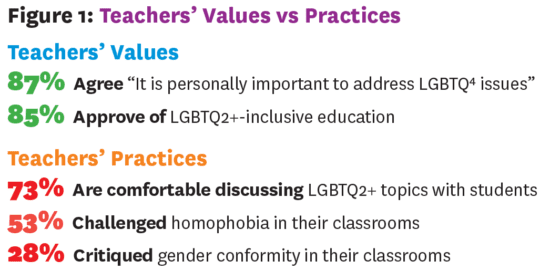
The question is why? Why the difference between educators’ values and their practices?
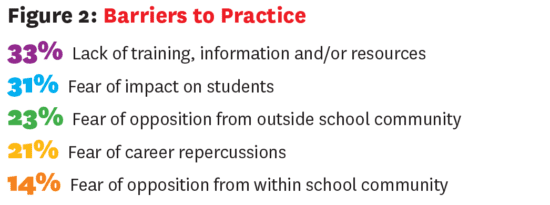
Every Teacher Project participants identified five main types of barriers that kept them from including LGBTQ2+ related content at all, or integrating it more fully into their teaching practice. By naming the misconceptions and fears educators identify, we want to validate that these feelings and thoughts do exist for many of us and are very real barriers inhibiting our practice. Some fears and apprehensions are well founded. In talking through the fears that educators have expressed, we also have an opportunity to develop a way to move forward.
BARRIER 1: Perceived need for more training, information and/or resources
Fearing that they lacked appropriate training, information, or resources was the most common reason educators provided (33% indicated this held them back from addressing LGBTQ2+ issues). In many ways, this is good news, as it is a barrier that can be readily addressed. With administrative support and prioritization, professional development (PD) training opportunities can be provided, curriculum can be adapted to include LGBTQ2+ content, and resources can be developed and integrated into course materials and school culture. Stakeholders from across the school system, from teacher education programs to departments/ministries and teacher organizations, can all take a role in providing training opportunities and resources. Further, administration can support LGBTQ2+-inclusive education by ensuring that all educators and all staff members in their districts/divisions, schools or regions are provided with training.
Providing training, information and resources also clearly communicates to educators and staff that LGBTQ2+-inclusive education is important. This has the potential to address any concerns educators may have that their administration or school community does not support LGBTQ2+-inclusive education – which we discuss in further detail below.
BARRIER 2: Fear of impact on students
One in three educators (31%) identified student-based reasons for not addressing LGBTQ2+ topics, such as “my students are too young” (20%) and “I don’t want to embarrass LGBTQ2+ students” (10%). Again, this is a concern that can be readily addressed through training, information and resources. There is age-appropriate content at all levels, from discussions of different kinds of families in early years to discussions of healthy sexuality and sex education in upper years. Again, PD training opportunities and curriculum resources can clearly address these apprehensions and communicate support for LGBTQ2+-inclusive education.
BARRIER 3: Fear of parent/guardian, community or religious opposition
Many teachers and educators have heard stories about parent/guardian, community, or religious groups staging protests or objecting vocally and publicly about LGBTQ2+ inclusion. While we do not want to deny that these complaints or moments of opposition occur, we do want to provide some perspective. Looking to the research, we see that of those educators who have included LGBTQ2+ content, only one in five (19%) received any complaints, and of those who did receive complaints, 72% reported that they had been supported by their principal or administration. Only about one in 20 educators who included LGBTQ2+ content had received a complaint without experiencing the support of school officials.
Religious school contexts make the situation more challenging, but not dramatically so: educators in Catholic schools were only slightly more likely to receive complaints than those in non-religious schools (22% Catholic vs. 18% secular), and educators were only slightly less likely to support LGBTQ2+-inclusive education (83% Catholic vs. 85% secular). However, educators in Catholic schools were much more likely to report that a lack of training prevented them from practicing LGBTQ2+-inclusive education (29% Catholic vs. 17% secular).
Community opposition can be a very real barrier, and “reading” one’s community climate is important. But there are also supportive individuals, both within the school and outside it. There are allies among students, parents/guardians, community members, colleagues and administration – particularly when backed by legislation, policy, training or clearly communicated messages of support from your school or district/division.
BARRIER 4: Fear of career repercussions
One in five educators (21%) agreed with the statement, “Discussing LGBTQ issues with my students would jeopardize my job.” (This was exacerbated for LGBTQ2+ educators, with 34% agreeing their job would be in jeopardy). Job status also affected educators’ readiness to address LGBTQ2+ topics (e.g. 28% of those on term contracts reported that their lack of a permanent contract prevented them). Fear of career repercussions can be a very real barrier, but it is one that principals, superintendents and policy-makers or legislators can address by clearly communicating support for LGBTQ2+-inclusive education throughout the school system.
For example, legislation exists in some provinces/territories and ministry/department of education policy exists in others that provides guidelines about what is expected of educators regarding LGBTQ2+ protections and inclusions. However, legislation and policy may not be enough to assuage the fears or anxieties of all employees. There is a clear need for school system administration to articulate and endorse LGBTQ2+ inclusion to create a culture of support throughout the system. With the backing of integrated supports, such as clear policies, PD opportunities, and availability of resources, administration can dispel fears that educators may be disciplined for engaging in LGBTQ2+-inclusive practices.
BARRIER 5: Fear of opposition from within the school community
A barrier reported by a smaller number of participants was opposition from within their school community (14%), such as opposition from school administration (6%), school trustees (4%) and/or colleagues (4%). The easiest way for educators and administrators to address these apprehensions among their colleagues is to find opportunities to make their own support for LGBTQ2+ people and LGBTQ2+-inclusive education clear. Some school districts/divisions and some teacher organizations have organized GSA-style support networks or groups for educators. Teacher organizations offer support for all teachers in many ways – from PD opportunities and training to resources and employment protections – not least of which is informational. They can certainly tell educators what legislative supports exist in their province/territory and what policies are in place (either at the local level of your school board/district/division or at the provincial/territorial level), and can offer advice about resources or LGBTQ2+ practices.
Although these fears are sometimes groundless, whether well-founded or not they can act as real barriers to providing the supports that LGBTQ2+ students need. But it is worth reminding ourselves that virtually all LGBTQ2+ youth experience apprehension and fear when they think about coming out or when they enter unsafe spaces: they aren’t sure how their friends, families, classmates and communities will react or how disclosing their identity might change their lives. Despite their fears, many LGBTQ2+ youth make that leap – and we need to support their courage by summoning it in ourselves.
Educators should know that there is more support for this work than they may think. The long history of silence surrounding gender and sexual diversity in schools leaves the impression that many people do not support LGBTQ2+ inclusion in schools. In fact, the actual support for LGBTQ2+-inclusive education is higher than is often assumed. For instance, when asked about how confident they were that colleagues would support them if they wanted to address LGBTQ topics in the classroom, 67% of educators felt their colleagues would support them; comparatively, 85% of educators approved of LGBTQ2+-inclusive education. It is, of course, true that some people do not support it and will object, but they are in the minority. This is also true among students; in the First National Climate Survey, 58% of non-LGBTQ2+ students reported that they too were distressed when they witnessed homophobic harassment.5 These and other findings from our research suggest that there is unrealized and untapped support within the school community, among both colleagues and students.
Getting started
There are some relatively low-risk ways for educators and school officials to build a culture of support for LGBTQ2+-inclusive education.
- Find or create opportunities to find support for and discuss LGBTQ2+-inclusive practices and visibility in schools. Establishing dialogue and finding ways to identify allies who are supportive of LGBTQ2+-inclusive education is an important step and can establish useful connections. Whether these are formal events or informal staff-room conversations, the result can be the same: finding supportive people and those who are interested in developing LGBTQ2+ practices in schools.
- Provide professional development. PD opportunities are vital not only for developing capacity and confidence in LGBTQ2+-inclusive education, practices and advocacy, but to provide opportunities to clearly communicate support. Through PD opportunities, administration and educators working throughout the school system have an opportunity to establish themselves as allies and to identify LGBTQ2+-inclusive education as a priority in their schools. PD provides useful information, but more than this it communicates that LGBTQ2+ inclusion is a priority, authorizing educators to take action on these issues.
- Listen to educators. When asked about what was needed in schools to help them do this work, teachers indicated a range of interventions would be helpful to them – from establishing safe spaces in their schools and identifying allies for LGBTQ2+ students, to having actively supportive administrators, access to training, and strategies for respectful inclusion of LGBTQ2+ topics and persons in curriculum and in school events/activities. (See Figure 3.) Looking back over the barriers that educators identified, we can see that this wish list of supports aligns with teachers’ fears and misconceptions and provides useful paths forward.
- Use the available research. Research helps to tell us about what climate is like in schools and ways to engage effectively in LGBTQ2+-inclusive education. It is extremely helpful to find ways to support research on both a national level – such as in Egale Canada’s Second National Student Climate Survey on Homophobia, Biphobia, and Transphobia (currently in preparation; see https://egale.ca for more details) – and at a local level, such as within one’s own school district/division. Research from students and teachers provides clear evidence that can support advocacy efforts, policy development and legislation, and resource development.
AS LGBTQ2+ STUDENTS gain visibility in schools, educators are increasingly recognizing the importance of providing safe, respectful and accepting schools and classrooms. The Every Teacher Project was conducted with the active support of every teacher organization in the publicly-funded school systems of Canada, which led to participation by thousands of teachers and made it the largest study on teachers’ perspectives on LGBTQ2+-inclusive education to date worldwide. While many teachers expressed apprehensions about how best to do this work, educators clearly support LGBTQ2+-inclusive education and they have identified what they need from their colleagues and administrators to do it well: support for those who are engaged in the work, encouragement through PD and capacity-building training, resources that support LGBTQ2+ inclusion, and clearly communicated support for the work at all levels of the school system.
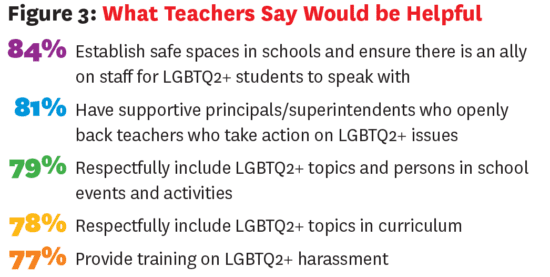
Photo: Dave Donald
First published in Education Canada, May 2019
Notes
1 www.edcan.ca/articles/how-can-schools-support-lgbtq2-students
2 C. Taylor, T. Peter, T., et al., Every Class in Every School: The first national climate survey on homophobia, biphobia, and transphobia in Canadian schools. Final report (Toronto, ON: Egale Canada Human Rights Trust, 2011). www.uwinnipeg.ca/rise
3 C. Taylor, T. Peter, C. Campbell, E. Meyer, J. Ristock, and D. Short, D. The Every Teacher Project on LGBTQ Inclusive Education in Canada’s K-12 Schools: Final report (Winnipeg, MB: Manitoba Teachers’ Society, 2015). www.uwinnipeg.ca/rise
4 While LGBTQ2+ is Education Canada’s “house style,” LGBTQ was used in the survey.
5 Every Class in Every School: The first national climate survey, 2011.
-
5 Common Myths about LGBTQ2 Youth in Schools
Comments Off on 5 Common Myths about LGBTQ2 Youth in SchoolsThis infographic aims to provide the straight facts on LGBTQ2 youth by addressing the 5 most common myths and misconceptions that surround sexual orientation, gender identity, and gender expression in schools.
This infographic was inspired by a feature article by Dr. Kristopher Wells that recently appeared in Education Canada Magazine.
The EdCan Network has also released a new Facts on Education fact sheet authored by renowned expert Dr. Kristopher Wells, entitled How can schools support LGBTQ2 students?, which offers evidence-based strategies on how we can make a positive difference for LGBTQ2 students in K-12 schools.
In addition to the downloadable copy of the infographic, which can be posted in staff rooms and classrooms, here are several practical resources available to support teachers in building their knowledge and confidence on this subject matter.
Education Canada Magazine summer 2019 issue
ADDITIONAL INFORMATION RESOURCES
- To learn more about LGBTQ2 terms and definitions, please see EGALE Canada’s Glossary
- Canadian Centre for Ethics in Sports – Creating Inclusive Environments for Trans Participants in Canadian Sport: Guidance for Sport Organizations
- Canadian National Trans Youth Health Survey
- Canadian Teachers’ Federation – Diversity and Human Rights
- Egale Canada
- Gay-Straight Alliances
- Gender Creative Kids
- Journal of LGBT Youth
- NoHomophobes.com
- PFLAG Canada (for parents, families, and friends)
- Pride Tape
- RISE: Respect, Inclusion, Safety, Equity
- SOGI 123
- Teaching Sexual Health
GOVERNMENT
- National Apology to LGBTQ2 Canadians
- Federal Government of Canada – Free To Be Me
- Alberta – Guidelines for Best Practices: Creating Learning Environments That Respect Diverse Sexual Orientations, Gender Identities, and Gender Expressions
- Manitoba – Supporting Transgender and Gender Diverse Students in Manitoba Schools
- Newfoundland & Labrador – Guidelines for LGBTQ Inclusive Practices
- Nova Scotia – Guidelines for Supporting Transgender and Gender Non-Conforming Students
- Quebec – Mesures d’ouverture et de soutienenverslesjeunes trans et lesjeunesnonbinaires
- Saskatchewan – Deepening the Discussion: Gender and Sexual Diversity
iF INTERESTED IN PLACING A BULK ORDER (20 OR MORE) OF THE BILINGUAL INFOGRAPHIC PLEASE CONTACT PUBLICATIONS@EDCAN.CA FOR MORE INFORMATION.
- Non-member rate: $3.75/each plus shipping and taxes.
- Member rate: $2.75/each plus shipping and taxes.
-
The Gender-Friendly Classroom
Comments Off on The Gender-Friendly ClassroomHow can teachers welcome gender diversity every day? Lee Airton discusses how to establish classrooms where all of the ways that your students “do gender” are welcomed and expected, where no one is called out for their gender expression, and where no one is told by others that they are not who they are.
Among researchers and educators focused on gender diversity in Canadian schools, there is certainly much to celebrate. We have a growing body of Canadian studies on how gender diversity is playing out in our contexts of practice. This is an incredible achievement, and a tool in successful advocacy for policy, curricular and legislative changes that stand to improve the lives of gender-diverse students in K-12 schools.
As someone who is active this area, however, I have noticed that school boards tend to interpret their responsibilities in relation to gender diversity as a set of actions triggered by the presence of an out or openly self-identifying transgender student who is in an exceptional situation, usually either crisis or transition. By crisis, I mean experiencing harassment, violence or other situations in which the student is at risk. By transition, I mean beginning to live publicly as a person of their gender. When I review broadly-titled guideline documents for supporting gender-diverse students in public schools, I often find that they only instruct teachers, administrators and others on how to respond to these exceptional moments in the life of an out transgender student.
Risks of “exceptionalizing” transgender students
Of course, there are compelling reasons to devote time and energy to supporting out and openly self-identifying K-12 transgender students through exceptional situations, and a growing body of research shows what happens when we don’t. But I am concerned about the effects of constructing a school’s responsibility regarding gender diversity as only or mostly responding to exceptional situations. I think that this happens at the school level and filters up to the level of board-wide policymaking because exceptional situations are, by definition, outside of the school’s structures, routines and curricula. Responding to the exceptional doesn’t require changing business as usual or acknowledging that the status quo may contribute to the problems facing transgender and gender-diverse students.
If school responsibility is thought to lie primarily in exceptional situations…
Schools may realize that their climate does not welcome gender diversity only when a transgender student makes their presence known.
I’ve read and heard many moving accounts from teachers about changing their practice once they realized they had a transgender student. These changes are vitally important, but I worry about the transgender and gender-diverse students who are already present in every single school, but whose transness isn’t apparent to the adults entrusted with their care. This is a vicious cycle, because if no visible efforts have been made to make a school climate more welcoming of gender diversity, it is unlikely that these students will voice who they are and access supports that they need in order to be and remain well at school. I’ll return to this problem momentarily.
School administrators might see their responsibility as only applying to “binary” transgender students.
A pathway of beginning to understand one’s self as transgender, pursuing social transition, beginning to live publicly in one’s gender at school and elsewhere, and then pursuing medical transition aligns with only some transgender peoples’ experiences: those who are often referred to as “binary,” i.e., who were assigned to one side of the sex/gender binary at birth but who are actually on the other side. This is a very common transgender pathway, but it is not at all the only one. Many transgender people do not fit neatly into one or the other of the binary boxes, including a growing number of transgender people who are nonbinary. If a school understands its responsibility to kick in only when a student comes out and experiences harassment or begins a gender transition (commonly assumed to bring someone from “one side” of the binary to the “other side”), then gender-diverse students whose experiences don’t fit these familiar patterns are less likely to have their needs recognized and met by school staff.
Transgender-spectrum youth might be presumed to be necessarily at-risk.
There is, in fact, tremendous diversity among transgender-spectrum people, including youth. We know, for example, that the life chances of transgender women of colour and Indigenous transgender women are drastically lower than those of transgender people who are white, middle-class, and masculine and/or men. Schools ought to be sensitive to these different degrees of risk. There is also a world of difference between the experiences of trans youth with family support and material privilege, versus trans youth with neither of these things. Furthermore, presuming trans students to be in crisis can be pathologizing.
If there are no out transgender students at your school, it doesn’t mean they are not there. Rather, it means that they cannot come out and live who they are at school.
For these reasons, I am committed to helping schools shift toward an everyday practice mindset in this area. How can teachers welcome gender diversity every day in classrooms, when there is no situation of crisis or transition? There is, thankfully, an abundance of resources on integrating gender diversity content into your curriculum.1 There is also a wealth of experience in schools and school boards on supporting extracurricular activities like gender and sexuality alliances, or gender-inclusive athletics. In what follows, however, I go beyond the curricular and the extra-curricular to what you can do in the course of your everyday teaching to foster a gender-friendly classroom: where all of the ways that your students “do gender” are welcomed and expected, where no one is called out for their gender expression, and where no one is told by others that they are not who they are (i.e. their gender identity). Gender-friendliness is a practice that I discuss in my recent book, Gender: Your Guide – A gender-friendly primer on what to know, what to say and what to do in the new gender culture.
Two axioms for the gender-friendly classroom
When I work with teachers, I like to offer two axioms to help us get out of an “exceptional situation” mindset and into an everyday practice mindset. These axioms are:
1. Teach like it’s a given that all of your students’ relationships with gender are ambivalent and will change over time.
This axiom is important because gender norms and expectations are a source of anxiety for all students, including cisgender (non-transgender) boys and girls. It is common for young cisgender people to live or express their gender differently from parent or community standards, or to question whether and how they want to participate in their community’s gendered milestones or traditions. Every girl or woman’s degree and experience of femininity will fluctuate across time, and the same is true of boys and men in terms of masculinity. How each of us does gender also changes as we move between the gym, faith-based congregations, formal events, and the workplace, etc. Keeping this first axiom in mind can help teachers to broaden the focus of their gender-inclusive practice in a way that does not predetermine which students need this support and which don’t; if you are teaching as if every student (cisgender and transgender alike) will bump up against rigid expectations, then you are taking care of everyone and also not making assumptions about who a transgender student will be. This is important because the transgender spectrum will continue to expand (reflecting what has always been there but in recent centuries was driven underground), and our transgender-spectrum students’ needs will also continue to change and evolve.
2. Teach like you already have transgender-spectrum students, or students with transgender-spectrum friends, family or loved ones, in your classroom.
This second axiom speaks to a common assumption that if there are transgender students in a school or class, teachers and administrators already know. In reality, not every transgender-spectrum student is out or apparent to others around them as transgender.
If there are no out transgender students at your school, it doesn’t mean they are not there. Rather, it means that they cannot come out and live who they are at school. We know they can’t because they don’t. Not being open in who we are isn’t very liveable for transgender people; if we can come out, we generally do. In fact, when I work with teachers and administrators who have students who have come out as transgender in their schools, I ask them to cultivate a well-deserved feeling of honour and pride: they have been given a tremendous gift of trust because the transgender students there have come out at all. There may also be students who will come to realize that they are somewhere on the transgender spectrum later on, but were questioning or uncomfortable about their assigned gender when they were in your classroom or school.
How can you follow through on these axioms in your classroom? The four practices on the following pages can be integrated into your teaching right away and with minimal preparation. Each practice aims to help transgender and/or gender non-conforming (TG) students – even if you do not know they are there – to feel expected and therefore respected, not invisible.
Four everyday practices
Practice 1: Creating moments of dissonance
By creating moments of dissonance, you are helping all of your students get used to having their gendered expectations countered. This can help them get ready to welcome everyone’s changes in how they do gender over time, including peers who are markedly gender non-conforming or who come out as transgender, but also including their own changes.
• Use questioning and gentle skepticism to disrupt normative claims. For example:
“I don’t understand. Why would that be weird if she did that?”
“Hmm. Can you explain to me why he can’t play with you? I don’t understand.”
• Apply unexpected pronouns to characters in books or images of people in curriculum resources; question students who correct you or who apply a binary gender pronoun (he or she). For example:
“Why are we saying she/her for that person? Couldn’t that person have he/him or they/them pronouns?”
“Why are we saying he/him for someone in that role? Can’t women also be [principals, firefighters, CEOs]?”
“Sometimes our assumptions about a person’s pronouns are incorrect; it can be a better idea to say ‘they’ until we know.”
• Help your students rethink their rigid gender generalizations on the spot by sharing a fact that you know to be real and true for many people. For example:
“I don’t know if getting married in a big frilly wedding dress is for me.”
“I don’t think we can generalize about men’s and women’s parenting roles. When my friend Peter and his wife had their first baby, Peter stayed home when his wife went back to work and he really enjoyed it.”
Practice 2: Making and modeling good mistakes
By publicly correcting your mistakes, you are helping your students learn to expect gender diversity as the norm, not the exception. Don’t let your mistakes go by, as these can contribute to the hidden curriculum of gender – that is, add to all of the messages children and youth receive that gender is necessarily binary and rigid, for everyone. Rather, make your mistakes visible and teach a more accurate lesson about the many different ways people live gender.
- Draw attention to your own assumptions about peoples’ pronouns, in a way that models a gentle correction (not a big deal): “Oops. I shouldn’t have assumed that she/her are this author’s pronouns. Can anyone find a source to help me get it right?”
- If you say the wrong pronoun for someone whose pronoun you do know or who is known to your students, say sorry, re-phrase, and move on, neutrally. Model this on purpose with a character in a book or a public figure.
- Draw attention to when you have put someone in a gender box, and talk about why that wasn’t a good thing to do: “Uh oh! I should have directed that person to all of the different washrooms we have, including the accessible gender-neutral one, and not just the men’s washroom. It’s not my place to assume what other people need.”
Practice 3: Owning your gender-unfriendly content
By owning your own gender-unfriendly content, or drawing attention to your own curriculum resources, etc. that do notwelcome gender diversity, you are helping your students to develop this critical eye. They might even come to correct you! You can introduce a gender-unfriendly resource on purpose to allow this conversation to happen. In my courses at Queen’s, I focus on teaching pre-service teachers not just how to use resources about transgender people or that are explicitly critical of gender stereotypes, but to use any resource to do this work. Here is what gender-unfriendly content can look like:
• Elementary: Your resource shows only gender-conforming girls and boys, or genders characters (like teapots and candles) unnecessarily. Here are examples for read-alouds:
“Why do you think the author wants us to say ‘he/him’ for that monster? I’m not sure it makes sense for a monster to be called ‘him’! Why can’t they use they/them instead?”
“These are good books, but they don’t include everyone. And they make us think that there are only two ways to do gender. I’m going to work hard to find other books that correct this mistake.”
“Did you notice that this book only has the boys carrying heavy boxes on moving day? Hmm. I might not read that again. Let’s see if I can find a book where gender doesn’t stop people from helping out.”
• Secondary: Your subject’s essential content excludes transgender lives and experiences, or you have to share data that makes transgender people invisible or even unthinkable. Here are some ways that a secondary biology teacher might own their gender un-friendly content:
Good: “We’re going to learn about cancer today, focusing on breast and cervical cancers as examples. But the research on this generally isn’t inclusive of transgender people, some of whom have breasts or a cervix but are not women. This means that many people who may be at risk for these cancers aren’t included in this research.”
Better: Say the above, and lead a discussion –“How might excluding transgender people from research in this area put them at risk?” – or add resources: “If you’re interested, I’ve put two studies in our online folder looking at cervical cancer rates in transgender men.”
Best: Re-write your lesson so that it incorporates transgender-related content (including barriers to accessing care) alongside mainstream content, in a tone that says “this is part of learning about this topic” and is not exceptionalizing.
Practice 4: Coming out yourself as a person with a gender
By coming out as a person with a gender, you are helping your students to see gender as something that is a process for everyone across our lives, including someone they respect and look to for guidance: you. Here I am speaking particularly to cisgender (non-transgender) teachers. Transgender teachers are very often objects of learning and discussion for students, whether we choose to leverage our stories or not. If you are cisgender and/or gender-conforming, you can make your own relationship with gender visible and a tool in your gender-friendly teaching toolkit.
- Gently correct students who attribute gendered interests or life choices to you due to your gender identity (e.g. child-raising, sports-liking).
- “Signpost” your own gender pronouns, even if no one has ever gotten them wrong. Don’t force your students to do this, as many school contexts still cannot hold safe a student who makes an unexpected pronoun disclosure. Here is a sample script for the first day of class: “Hi there, I’m [title/name] and my pronouns are [x].” Later you can say, “Earlier today, I shared my pronouns, which are [x]. I want to invite anyone who has questions about that, or who wants to speak to me about their own pronouns, to come see me.”
- Tell your gender story in bits and pieces during everyday conversation. Model gender happiness by sharing what you do like about being your gender, or about expectations for people who share your gender identity. Model ambivalence by sharing what you don’t like so much. Model change, or what you did/liked in the past but less so now, or that you might like/do otherwise in the future.
I’m confident that you can think of other practices to integrate into your ordinary teaching day that do the kind of work these four represent. When you set out to make gender-friendly changes, remember that you are always doing two things. First, you’re letting transgender-spectrum and gender nonconforming students know that you see us, and that you are thinking about the ways in which school can be challenging or even unsafe for us. Second, you are helping all students – transgender and cisgender – develop the capacities they need to help you create and sustain your gender-friendly climate, for everyone.
NEW! Discussion Kit
Download the pro-learning session, Welcoming Gender Diversity in Schools and Classrooms.
Photo: iStock
First published in Education Canada, June 2019
-
The Straight Facts
Comments Off on The Straight FactsThe time has come for educators and concerned parents to start challenging the myths and misinformation circulating about LGBTQ2 youth with facts that are based in evidence and research, to break through the fear and silence that still surrounds LGBTQ2-inclusive education in our schools.
In 2005, Canada became the fourth country in the world to legalize same-sex marriage. Since that time, our nation has taken great strides towards the full inclusion of lesbian, gay, bisexual, transgender, queer, and two-spirit (LGBTQ2) people in Canadian society. Despite these progressive moves forward, students in our K-12 school system still experience significant bullying, harassment, violence, and discrimination. In particular, our transgender, two-spirit, and LGBTQ2 youth of colour often face some of the most hostile and uninviting environments. Much of this discrimination and prejudice is rooted in stereotypes, fear, and misinformation that continues to be perpetuated by those opposed to LGBTQ2 equality.
This article provides the straight facts on LGBTQ2 youth by addressing the eight most common myths and misconceptions that surround sexual orientation, gender identity, and gender expression in schools.
1. It’s just a phase
Being LGBTQ2 is an identity, not a choice, lifestyle, or phase someone grows out of. Nor does someone become LGBTQ2 because they were physically or sexually abused as a child. Much of this misinformation is rooted in the belief that LGBTQ2 people are abnormal, disordered, or mentally ill. No credible medical or psychological association in the world continues to validate these harmful stereotypes. In fact, sexual orientation and gender identity are considered to be so complex that the exact origins are unknown. However, what is widely known is that any attempts to “fix,” “cure,” or “repair” a person’s sexual orientation and gender identity is not only unethical and unprofessional, it can cause great harm and lifelong damage.
Children report being aware of their gender differences at early ages. Research shows that youth who later identified as transgender or gender diverse reported first recognizing their gender identity as different at an average age of 8.5 years old.1 Sexual orientation is also identified early for many young people. On average, lesbian, gay, or bisexual youth become aware of their different sexual orientations around age ten, yet often do not “come out” and share this information until about age 15 or 16.
Unfortunately, prejudice, discrimination, stigma, and fear all contribute to youth feeling they have to hide or deny who they are.
2. You can tell who LGBTQ2 youth are
I once had a school principal say to me, “There are no gay or lesbian youth in my school.” What this principal didn’t realize is that there were no visible LGBTQ2 youth in the school, most likely because it was not a safe place. Visibility and safety are tightly interwoven together, especially in any school-related context.
The belief that you can tell who LGBTQ2 youth are by simply looking at or by listening to them is based in old, unfounded stereotypes and beliefs. Just as not all gay men are hairdressers, and not all lesbians are truck drivers, not all transgender kids are gender non-conforming or cross dress. These stereotypes are rooted in powerful beliefs about gender and how young people should express their gender identity in typically masculine or feminine ways. For example, little boys who like to dance or do ballet are often called “sissies” or “faggots.” Girls who like to play sports or climb trees are frequently called “lesbos” or “dykes.” In these examples, homophobic bullying is used as a weapon of sexism, targeting children who are deemed to be different from the norm. These kinds of stereotypical beliefs often keep young people trapped in “gender boxes,” which serve to regulate and limit the full expression of their identities, hopes, and dreams.
3. LGBTQ2 youth are too flamboyant
“Why can’t you just keep it to yourself? Why do you have to flaunt it? If you didn’t wear those clothes, this bullying wouldn’t happen to you.” These are all-too-common messages that many LGBTQ2 youth hear on a regular basis. This victim-blaming positions LGBTQ2 youth as a problem that needs to be fixed, rather than focusing on the environment of homophobia, transphobia, and heteronormativity that creates a climate where it is OK to discriminate against and target those who are perceived to be different.
A person’s sexual orientation or gender identity is often still thought of as an invisible difference that can or should be hidden. But at what cost? The cost to LGBTQ2 youth when they feel they can’t be out and visible is well documented. Having to hide or deny who you are can lead to depression, self-harm, increased use of drugs and alcohol, and suicide ideation.
Sadly, in Canada, the three most targeted groups for hate crimes are the Black, Jewish, and LGBTQ2 community. Here we can clearly see the impacts of racism, anti-Semitism, and homophobia and transphobia. Of all the hate crimes committed, the ones that are the most violent in nature, and often require serious medical attention, are targeted toward LGBTQ2 people. This illustrates the power of stereotypes and the processes of dehumanization that position some individuals not as people, but as objects to be hated and destroyed.
No one should be targeted or discriminated against because of who they are, how they act, or whom they love.
4. Parents have the right to know
There is no doubt that parents play an extremely critical role in the health and well-being of their children. Research indicates having a supportive family is one of the most important resiliency factors in the lives of all young people. Without strong parental support, many LGBTQ2 youth experience poor psychological well-being, lower self-esteem, increased post-traumatic stress disorder, and much higher rates of suicide.
Recently there has been significant debate about parents having the “right to know” if their child comes out as LGBTQ2 at school. Some parents suggest that they should be immediately notified, for example, if their child attends a gay-straight alliance (GSA). Others maintain that it should always be up to the child to determine who should know about their sexual orientation or gender identity.
LGBTQ2 youth should always have the right to “come out” on their own terms and only when they are ready to share that important part of their identity. In some provinces, it is a breach of privacy legislation to disclose a person’s sexual orientation or gender identity without their direct permission. The consequences of “outing,” or unwanted disclosure, can be life-altering. For example, research indicates that between 20-40 percent of all homeless youth are LGBTQ2. In Edmonton, recent statistics indicate that more than 70 percent of youth at one emergency youth shelter identify as LGBTQ2. Sadly, parental rejection is one of the leading causes of youth homelessness. For some LGBTQ2 youth, places like GSAs may be the only safe spaces that they have in their lives.
Ultimately, if a parent wants to know about their child’s sexual orientation or gender identity, all they have to do is ask them. If they are ready, children will gladly tell their parents. If they are not ready or don’t feel safe doing so, no child should be forced to come out. Likewise, no professional should ever share a student’s sexual orientation or gender identity without their direct permission. In fact, unwanted disclosure could be considered an act of unprofessional conduct with serious repercussions.
5. Gender-neutral bathrooms create unsafe environments
As the visibility of transgender youth has increased rapidly in mainstream culture, conversely, opposition to the inclusion of transgender students in schools has risen dramatically over the past several years. This opposition has been led by parental rights groups, far-right political parties, some conservative religious organizations, and even a few vocal school board trustees. One of the main arguments against trans-inclusive school policies is the creation of a perceived “loophole” for sexual predators to gain access to female-only spaces such as washrooms, locker rooms, and sports teams. The common refrain heard is that “men don’t belong in women’s bathrooms!” These opponents to trans-inclusion often frame their beliefs in opposition to what they perceive as “radical liberal political correctness,” and call for a return to traditional “family values,” which position and privilege cisgender heterosexual families as the moral bedrock of society.
Historical movements once designed to oppress and counter the advancement of lesbian and gay people have now changed tactics to focus on transgender people, especially in schools. While the focus of these oppressive movements has shifted, the tactics remain the same, with an emphasis on the potential harms of LGBTQ-inclusive policies and curriculum on vulnerable and impressionable children. The goal is to create a “gender panic,” largely fed by emotionally fueled stereotypes and sensationalized claims about transgender people. Similar tactics, for example, were used to oppose the legalization of same-sex marriage in Canada with outlandish statements suggesting that legalizing gay marriage would lead to bestiality and the collapse of the family unit – none of which, naturally, have come true.
These arguments lack empirical validity. What research does clearly tell us is that fears of increased safety and privacy violations associated with trans-inclusive laws or policies are not empirically based.2 In other words, the claims of predators in girls’ bathrooms are a myth based more in transphobia and hysteria than any presumed reality.
By not having explicit trans-inclusive policies in schools, the real risk is to transgender students.3 Many who continue to be misgendered and made to feel unsafe in their schools, are scared to go to the bathroom (which can lead to serious health complications), and/or view their schools as spaces that do not support them.
Thankfully, every province and territory in Canada, and over 20 states in the U.S., have now passed non-discrimination laws or ordinances that explicitly include gender identity. Many Canadian provincial ministries of education have also issued best practices to support trans and gender-diverse students in schools.
6. School policies already protect everyone
A common argument is that LGBTQ2-specific policies are unnecessary, because anti-bullying policies already include everyone. Singling out LGBTQ2 students gives them special treatment that is not afforded to other students. This “one size fits all” approach to policy making is popular, but seldom effective in actually reducing risk and improving the safety and educational outcomes of marginalized students. For example, most school districts now have comprehensive standalone policies in place to support Indigenous students. Educators understand that because of colonization, historical trauma, the legacy of residential schools, and ongoing discrimination in society, Indigenous students have unique needs and concerns that ought to be recognized and supported by all members of the school community.
Research demonstrates that generic or “catch all” policies are not effective when it comes to supporting LGBTQ2 youth in schools. Effective policies must be clear and comprehensive if they are going to have the desired impact. For example, how do school trustees and administrators expect policies to work effectively if they can’t even say or use the words LGBTQ2? This form of structural invisibility, or silencing, tells LGBTQ2 students that their identities do not matter.
Thankfully, the vast majority of Canadian educators (85 percent) support LGBTQ2-inclusive education, including 83 percent of Catholic educators.4 However, far fewer educators (37 percent) report knowing how to create LGBTQ2-inclusive classrooms. This policy-to-practice gap shows that policies need to be supported by high-quality professional development and robust implementation plans if they are actually going to be effective in changing school culture and improving student outcomes. This is why many school districts in Canada have adopted the SOGI 123 (www.sogieducation.org) program to help equip educators with the knowledge, tools, and resources necessary to build inclusive school environments for LGBTQ2 students and families.
7. All schools are safe spaces
Ideally, yes, it would be great if all schools were safe spaces and all teachers were allies for LGBTQ2 students. Unfortunately, this is not always the case. The Every Teacher Project (2015) found that almost half of all Canadian educators surveyed (49 percent) heard homonegative comments (e.g. “That’s so gay”) weekly in their school.5 One in five (22 percent) reported that other teachers were using that same homonegative language at school. Likewise, when teachers hear homonegative comments in their classrooms, yet say nothing, their silence can signal consent to the discrimination. This silence sends a powerful message to LGBTQ2 students that their teacher may not be a safe person to reach out to for support.
To help break this silence, some school boards now require each school to appoint a “safe contact” who acts as a public resource person on LGBTQ2 issues. Often these safe contacts serve as advisors to the school’s gay-straight alliance (GSA). Gay-straight alliances are another important way to create safe spaces and to identify trusted teachers who can serve as important allies for LGBTQ2 students. Some provinces, like Ontario, Manitoba, and Alberta, have passed legislation to support a student’s legal right to start a GSA in their school. This legislation has led to a strong and growing GSA movement across Canada, which includes the creation of many new GSAs in private, Catholic, and faith-based schools.
Research demonstrates that in schools with GSAs, students report more supportive teachers and administrators who “made a real difference in their lives.”6 Students also reported increased friendships and fewer physical, psychological, and behavioural health concerns. Conversely, in schools without a GSA, students reported feeling more socially isolated and having fewer friendships.
It is clear that the more supportive practices a school has in place, such as comprehensive LGBTQ2 policies, safe contacts, and GSAs, the less homophobic bullying students experience and the more connected and supported LGBTQ2 students feel.7 GSAs, LGBTQ2-inclusive curriculum, and high-quality professional development all help to create a school culture that welcomes, affirms, and celebrates LGBTQ2 students as an important and valued part of the school community.
8. Sexual health education is inclusive of all students
In many schools, LGBTQ2 issues are completely omitted from sexual health education classes. This often happens because of personal discomfort, embarrassment, lack of training, and fear of parental backlash. There is a common misconception that by talking about sex, youth will have more of it; or that by including LGBTQ2 issues, youth will experiment and become gay. In reality, considerable research has shown that abstinence-based education actually serves to increase pregnancy and rates of sexually transmitted infections (STIs). Likewise, no one becomes gay by talking about LGBTQ2 issues. What we do know is that sexual health education should be comprehensive (which means LGBTQ2 inclusive), age-appropriate (with key concepts and terminology differentiated by grade level), science-based (with evidence-based facts), and non-judgmental (not steeped in one person’s or culture’s beliefs).
Unfortunately, STIs and HIV are on the rise among youth in Canada. These are only some of the critical reasons demonstrating why comprehensive sexual health education is urgently needed in today’s schools. As an example, Quebec now requires all students to take sexual health education classes and offers very few grounds for exemption, while Alberta has the opposite approach and provides parents with the legal right to opt their child out of any sexual health classes without providing any reason.
The reality is that the vast majority of students want inclusive sexual health education, not from their parents but from their teachers. They trust their teachers to provide them with accurate information that is free from bias, prejudice, and stigma. And many schools are now approaching sexual health education as a public health imperative, with the belief that providing students with high quality, non-judgmental information is the best way to reduce risk and promote healthy relationships for all students.
Research demonstrates that hostile school climates and school victimization can have significant negative academic and psychological impacts on LGBTQ2 students – sometimes with lifelong consequences.8 Sadly, suicide is still one of the leading causes of death for LGBTQ2 youth who have been taught to hate themselves or have been bullied to death. No child should have to go to school in fear.
The time has come for all educators and concerned parents to start challenging the myths and misinformation circulating about LGBTQ2 youth with facts that are based in evidence and research. We must use these truths to break through the fear and silence that still surrounds LGBTQ2-inclusive education in our schools. Every child should have the right to be themselves fully and completely. Perhaps the greatest gift we can give our LGBTQ2 children is to tell them: we see you, we love you, and we support you.
Transgender Youth: The stats
Research estimates that between .07% to 2.7% of the youth population identifies as transgender.
The 2015 Canadian Trans Youth Health Survey Report, which included 923 trans-identified youth from across Canada, found that:
- Two-thirds experienced incidents of discrimination because of their gender identity
- More than 70% were victims of sexual harassment
- Nearly half of older transgender youth (18-24) reported cyber bullying
- Nearly two-thirds engaged in self-harming behaviours in the past year
- More than 1 in 3 attempted suicide
- 70% reported their families did not understand them.
LGBTQ2 Terms and Definitions
Language and identities are constantly evolving, especially among youth communities. If you’re unsure what a term means, just ask!
Cisgender: A person whose gender identity and sex assigned at birth are congruent.
GSA (Gay-Straight Alliance or Gender-Sexuality Alliance): Student organizations found in many K-12 schools that create safe and supportive places for LGBTQ2 students and their allies.
Gender Diverse/Gender Non-Conforming/Non-Binary: A person whose gender identity and/or gender expression do not conform to the norms and stereotypes society expects of their assigned sex. Youth may identify with neither or both genders.
Gender Identity: A sense of one’s self as transgender, genderqueer, woman, man, or some other identity, which may or may not correspond with the sex and gender one is assigned at birth.
Heteronormativity: A system or cultural bias that works, often unconsciously, to normalize behaviours and societal expectations that are tied to the presumption of heterosexuality and an adherence to a strict gender binary.
Homonegativity: Negative attitudes towards lesbian, gay, and bisexual people and relationships.
LGBTQ2: An initialism for lesbian, gay, bisexual, transgender, queer, two-spirit. Sexual and gender minorities is a synonymous term. LGBTQ2+ adds a “plus sign” to represent other constellations of identities such as asexual, pansexual, questioning, etc.
Misgendering: Attributing a gender to someone that is incorrect/does not align with their gender identity. Can occur when using pronouns, gendered language (e.g. “Hello ladies!” “Hey guys”), or assigning genders to people without knowing how they identify (“Well, since we’re all women in this room, we understand…”).
Rainbow Flag: An international symbol of the LGBTQ2 movement designed by Gilbert Baker in 1978. Each of the six colours has a unique meaning. Red for life. Orange for healing. Yellow for sunlight. Green for nature. Blue for serenity. Purple for spirit.
Sexual Orientation: Feelings of attraction, behaviour, intimacy, or identification that direct people toward intimacy with others.
Transgender/Trans: A person whose gender identity does not align with their sex assigned at birth.
Two-Spirit: A spiritual identity for some Indigenous people. This term implies the embodiment of both masculine and feminine spiritual qualities within the same body, and has different meanings for different Indigenous communities. Some Indigenous people use this term instead of gay, lesbian, bisexual, transgender, etc.
NEW! Discussion Kit
Download the pro-learning session, Understanding Myths and Misconceptions about LGBTQ2 Youth at School.
Photo: iStock
First published in Education Canada, June 2019
1 J. Rafferty, AAP Committee on Psychosocial Aspects of Child and Family Health, AAP Committee on Adolescence, & AAP Section on Lesbian, Gay, Bisexual, and Transgender Health and Wellness,“Ensuring Comprehensive Care and Support for Transgender and Gender Diverse Children and Adolescents,” Pediatrics 142, no. 4 (2018): 1-14.
2 A. Hasenbush, A. R. Flores, and J. L. Herman, “Gender Identity Nondiscrimination Laws in Public Accommodations: A review of evidence regarding safety and privacy in public restrooms, locker rooms, and changing rooms,” Sexuality Research and Policy Review 16, no. 1 (2018): 70-83.
3 J. Veale, E. Saewyc, H. Frohard-Dourlent, et al., and the Canadian Trans Youth Health Survey Research Group, Being Safe, Being Me: Results of the Canadian Trans Youth Health Survey (Vancouver, BC: Stigma and Resilience Among Vulnerable Youth Centre, School of Nursing, University of British Columbia, 2015).
4 C. Taylor, T. Peter, C. Campbell, et al., The Every Teacher Project on LGBTQ-Inclusive Education in Canada’s K-12 Schools: Final report (Winnipeg, MB: Manitoba Teachers’ Society, 2015).
5 Taylor et. al., 2015.
6 T. Fetner and A. Elafros, “The GSA Difference: LGBTQ and ally experiences in high schools with and without gay-straight alliances,” Social Sciences 4 (2015): 563-581.
7 K. Wells, How Can Schools Support LGBTQ2 Students? (Fact Sheet: EdCan Network, 2018). www.edcan.ca/articles/how-can-schools-support-lgbtq2-students
8 K. Wells, “Generation Queer: Sexual minority youth and Canadian schools,” Education Canada 48, no. 1 (Winter 2008): 18-23.
-
Understanding Myths and Misconceptions about LGBTQ2 Youth at School
Comments Off on Understanding Myths and Misconceptions about LGBTQ2 Youth at SchoolIn reference to the article The Straight Facts: Eight Common Myths and Misconceptions about LGBTQ2 Youth
ASK OUR EXPERTS
AIM: TO ENCOURAGE INTERACTION WITH RESEARCHERS
Does your group still have burning questions or comments? Encourage them to connect with Dr. Kristopher Wells, lead author for the article on which this discussion guide is based.
Email: kristopher.wells@macewan.caOr, send us your message and we’ll make sure one of our experts gets in touch. -
Welcoming Gender Diversity in Schools and Classrooms
Comments Off on Welcoming Gender Diversity in Schools and ClassroomsIn reference to the article The Gender-Friendly Classroom: Practical advice for teachers on welcoming gender diversity every day
Key Definitions from the Ontario Human Rights Commission
Gender identity: each person’s internal and individual experience of gender. It is a person’s sense of being a woman, a man, both, neither, or anywhere along the gender spectrum. A person’s gender identity may be the same as or different from their birth-assigned sex.
For most people, their sex and gender identity align. For some, it does not. A person may be born male but identify as a woman, or born female but identify as a man. Other people may identify outside the categories of woman/man, or may see their gender identity as fluid and moving between different genders at different times in their life.
Gender expression: how a person publicly presents or expresses their gender. This can include behaviour and outward appearance such as dress, hair, make-up, body language and voice. A person’s chosen name and pronoun are also common ways people express their gender. Others perceive a person’s gender through these attributes.
All people, regardless of their gender identity, have a gender expression and they may express it in any number of ways. For trans people, their chosen name, preferred pronoun and apparel are common ways they express their gender. People who are trans may also take medically supportive steps to align their body with their gender identity.
Trans or transgender: an umbrella term that describes people with diverse gender identities and gender expressions that do not conform to stereotypical ideas about what it means to be a girl/woman or boy/man in society. “Trans” can mean transcending beyond, existing between, or crossing over the gender spectrum. It includes but is not limited to people who identify as transgender, transsexual, cross dressers or gender non-conforming (gender variant or gender queer).
“Trans” includes people whose gender identity is different from the gender associated with their birth-assigned sex. Trans people may or may not undergo medically supportive treatments, such as hormone therapy and a range of surgical procedures, to align their bodies with their internally felt gender identity.
People who have transitioned from one gender to another may simply identify as female or male. Others may also identify as trans, as a trans woman or a trans man. Some people may identify as trans and not use the labels “female” or “male.” Others may identify as existing between male and female or in different ways beyond the binary of male/female.
Trans people may identify their gender in many ways. There is no single or universal experience of what it means to be trans. As a result, different trans people face distinct forms of discrimination in society, and this may relate to whether they identify as male, female, a person with a trans history, a person in the process of transitioning, a trans man, trans woman, transsexual, or gender non-conforming.
Source: Ontario Human Rights Commission. “Appendix B: Glossary for understanding gender identity and expression.” Accessible from http://www.ohrc.on.ca/en/
policy-preventing- discrimination-because-gender- identity-and-gender- expression/appendix-b- glossary-understanding-gender- identity-and-expression ASK OUR EXPERTS
AIM: TO ENCOURAGE INTERACTION WITH RESEARCHERS
Does your group still have burning questions or comments? Encourage them to connect with Dr. Lee Airton, lead author for the article on which this discussion guide is based: www.genderyourguide.com
Email: lee.airton@queensu.ca
Or, send us your message and we’ll make sure one of our experts gets in touch. -
Systemic Supports and Small Acts of Kindness
Comments Off on Systemic Supports and Small Acts of KindnessWhen we set out to plan this issue on Gender Identity and Sexual Orientation, I wondered if it might be difficult to find enough authors. Far from it! The people I approached about contributing accepted with enthusiasm, and we had the strongest response to our call for queries I have seen since I began editing this magazine. Clearly, the time is right for us to focus on this important topic.
It’s no secret that updating “sex ed” curricula to include SOGI (sexual orientation and gender identity) has proved controversial in Canada. Significant numbers of parents don’t want their children exposed to these concepts. (Many others do, as a recent poll by the Ontario Ministry of Education survey revealed.) But as Bryan Gidinski points out, children already are exposed. They have classmates with same-sex parents, they see trans people on the street and wonder about them, and they hear the slurs. More crucially, we have students in every school who will be at physical and/or emotional risk if they are not met with understanding and inclusion. And we are not there yet. I recently heard a very upset parent describe how her 11-year-old daughter spoke out against some taunting she observed at school, saying “There’s nothing wrong with being gay.” She has been harassed and bullied ever since, just for voicing her support.
So let’s get down to the how. How do we build a school culture where all students, across the gender and sexuality spectrums, feel (and are) safe, accepted, and free to be themselves?
Our contributors have a wealth of ideas to move us toward that goal. They tackle many of the uncertainties educators face: How to talk about SOGI to very young students; how to handle concerns based on religious and cultural beliefs; how to create gender-friendly classrooms; and the facts to counter common myths about LGTBQ2+ students. In our Voice of Experience column, trans student Kyle George shares how personal gestures of support from teachers made a world of difference to them. Systemic supports are important, but so are the small acts of kindness that tell a student, “I’m on your side.”
For better or worse, school plays a huge role in children’s development. It is not just where they learn; it is their social hub – or crucible. It is where they start to “try on” their adult identities. As Kristopher Wells writes, “Every child should have the right to be themselves fully and completely.” If we can make this the reality in our public schools, that is a big step towards a future where it simply is the reality, and we hope that this issue serves as an important resource to help educators get there.
Photo: Dave Donald
First published in Education Canada, June 2019
-
Supported at School
Comments Off on Supported at SchoolA transgender, non-binary student shares the power of a teacher’s support.
My name is Kile. My pronouns are they/them, and I am transgender non-binary. My gender identity can sometimes be difficult for people to understand, but so far I have been very lucky as practically everyone around me has been supportive.
One of the preeminent sources of support has been my school. I remember my heart pounding hard in my chest, my hands shaking as I typed up an email that simply introduced myself and explained my preferred name and pronouns. I took a deep breath before sending it to my teachers. However, all of my worries about my teachers’ reactions were effectively calmed as I received emails back almost right away, all saying that they understood and were glad I let them know. I was beyond lucky to have that happen to me. To immediately be accepted and cared for as any other student is the best situation for any transgender student. So far, every experience I’ve had with my school has been very supportive and exceptional.
But that’s not always the case. I was extremely lucky to be accepted and met with love, but other trans students aren’t so lucky and face discrimination and mistreatment. School can be a huge factor that helps a trans student access support, but it can also be a factor that contributes to the high rates of transgender youth committing suicide. Statistics don’t have to be that way. Schools are the perfect place for a trans child to get the assistance they need, especially if that child is not receiving any at home.
If a school is trying to support a trans student, this is the way to go about it – working with the student to ensure they are comfortable and, more importantly, safe. It might not be the teachers that a student might worry about, but other students. If a trans student is being harassed or bullied, then school staff should be working with the students involved, because it’s important to make sure that all students are safe.
Of course, there is also the question of washrooms. I really believe that trust needs to be given to students to know which washroom is right for them and which washroom they feel most safe and comfortable using. Using the washrooms can be very stressful for some trans people, so if the school can ensure that the washrooms are a safe place for everyone, and maybe even introduce an “all gender” washroom, then that will contribute to protecting young trans students.
Many other things could help to assist trans and questioning students, from educating staff and students to just letting students know that they are valid. I remember the day after I sent that email to my teachers about my name and pronouns, one of my teachers came up to me and told me that she was proud of me, that she would always be supportive, and that if I ever needed anything she would always be there for me. That small, one-minute interaction with a woman I had not really spoken with before literally gave me a much-needed boost. She absolutely warmed my heart and made me genuinely feel like I was loved and I did matter to others.
There was also a point when my teacher was talking about me to the class and she started to say incorrect pronouns, but then she stopped, and corrected herself with the right pronouns. I’m not sure if she is aware of the fact that I will remember that moment for the rest of my life, because it was the first time I had ever heard my pronouns being respected at school.
These minor gestures are so harmless, but make such a difference for a transgender student because it’s more than just accepting them, it’s letting them know that you are there for them, that you are making that effort to show them that they matter. Supporting a trans student doesn’t need to be a big thing. In my experience, my school supporting me has been made up of essentially little actions and the simplest of efforts. I hope for the day to come where all transgender students receive the same support I did. Ultimately, school is just a place for students to learn and transgender students are just like other students, in the sense that we attend school for our education. Being able to have both education and support would be the ideal situation for every trans student. When trans students feel safe and accepted at school, they can be their best – both as students and as themselves.
Photo: courtesy Kile George
First published in Education Canada, June 2019
-
Let’s Talk about Sex (and Faith)
Comments Off on Let’s Talk about Sex (and Faith)When sexual health education conflicts with socially conservative faiths and worldviews, educators can find themselves caught in the middle. Is there a way for public schools to provide an inclusive, comprehensive, and consent-based sexuality and health curriculum while remaining sensitive to the diverse beliefs and values of families?
When I was a child, my knowledge of health and sex came from my peers, parents, school teachers and faith leaders. Perhaps, like me, you adopted health behaviours from multiple supports in your life. This article invites you to consider the role of sexuality and health education in your classroom and the lives of your students, with strategies to support families and students of faith along the way.
The sexuality and health education of Canadian youth is currently a flashpoint of controversy in public educational systems across Canada. In Ontario this past fall, Progressive Conservative Premier Doug Ford, citing Evangelical Christian leaders’ objections, withdrew the 2015 Health and Physical Education Curriculum for Grades 1-8 (HPE), vowing to prioritize the rights of Ontario parents first.1 Around the same time, nearly 200 pastors from Evangelical Christian communities in British Columbia signed a statement denouncing the province’s Sexual Orientation and Gender Identity curriculum, SOGI 123. On January 10th 2019, Montreal’s Catholic archdiocese faced resistance from Quebec’s Education Minister, after the religious authority endorsed a proposal that Catholic parents who oppose Quebec’s sexual health curriculum receive permission to teach the content at home. At a time of unprecedented visibility and human rights protections for gender and sexual minorities in all provinces and territories, it is clear that public education systems across Canada are encountering the same objection: that an inclusive, comprehensive, and consent-based sexuality and health curriculum may contradict socially conservative faiths and worldviews, and is therefore inappropriate for elementary-aged children being raised in observant families.
Consistent in media coverage on the trans-Canada curriculum controversy is the claim that comprehensive sexuality and health education in public schools usurps the rights of parents to educate their children about sexuality and health. Socially conservative parents and religious communities in Canada have expressed concerns about the age appropriateness of sex education, and the absence of any mentions of love and monogamy in public school curricula. Public school administrators and teachers are pulled in different directions by competing interests, begging the question: how should public schools provide equal access to information and education that is conscious of the needs of today’s youth, while remaining sensitive to the diverse beliefs and values of families, both within and outside of different faiths?
Conversations and strategies
Children and youth, regardless of age, ethnicity or religious background, enter the classroom with knowledge and skills learned from the world around them, and small “e” education about sexuality and health occurs daily in families. This education contributes to how students construct identity, create meaningful relationships, and engage in social interactions where gender identity, gender expression and sexuality are significant. The Public Health Agency of Canada2 maintains that public schools are uniquely positioned to provide children and youth with accessible knowledge they need to make positive health decisions for an improved quality of life. Educators must be prepared to participate in this work in a manner that anticipates the needs and pre-existing awareness of their audience.
Although Canada may be struggling to navigate the controversy within public educational systems, our priority must still be to support the personal health and well-being of all students. While public sexuality and health education has sparked division, a common denominator all can agree on is student health and wellness. Parents across religious and political lines acknowledge the importance of Canadian youth’s sense of health and personal well-being. However, opposition from parents arises from differences in beliefs about the applicability of sexual health education for their children. Effective sexual health education requires educators to understand these social and religious differences and possess the skills to provide inclusive and effective education in spite of them. In what follows, I talk about three strategies for maintaining a healthy and accessible school community that supports students from socially and religiously diverse backgrounds within a sexuality and health program.
1. KNOWLEDGE & UNDERSTANDING
At the heart of the sex-ed controversy are the 3 M’s: misinformation, misconception and myth. Teachers, parents and other stakeholders divided over the content of public sex-ed curricula must wade through claims made in the media and in everyday conversation about curriculum content, often without confirming their accuracy. As a teacher, counselor or school support worker, the first step is having accurate information on hand about what, exactly, is and is not contained in the curriculum document. Ask yourself, “Am I able to answer a question from a parent about lessons in the classroom?” For example, a potential question from a parent may be:
Is the content of the curriculum appropriate? I am worried that my child is too young to learn about gender differences.
Lessons about gender identity and gender expression need to be equitable and accessible to all students and mindful of teachings that may take place in the home. We all have our own beliefs and views— however, when appropriate, they should be presented as such. A potential response to the parent is:
Early discussions about gender identity and gender expression are about supporting your student’s self-identity. Conversations about gender identity and expression focus on a students’ feelings about themselves. Lessons are designed to support students’ personal well-being. The focus is to create an environment where all students are respected and to encourage further discussion within the home.
Note: It may be helpful to outline the specific content being addressed within the class, such as: self-identity, self-expression, how visible differences (clothing, ability, skin, hair and eye colour) and invisible differences (values and beliefs) make a student different.
By familiarizing yourself with the content of your particular curriculum, you can recognize your own comfort level with the subject matter, identify potential gaps in the resources for your students, and address parental concerns about the curriculum using factual information about the document.
As a board member or school administrator, consider what resources your educators may need to effectively deliver sexuality and health education. You may consider inviting school-approved community partners (such as public health professionals) to facilitate a sexuality and health workshop for teachers. Demographic knowledge about the population of your students and their families can help determine the resources educators may need in the classroom. Knowledge of religious and cultural differences in beliefs about sexuality and health in the specific populations served by your school can help you prepare your educators to deliver content that is inclusive and accessible. The development and implementation of a healthy school policy can help facilitate conversations in your school about positive health behaviours for students, staff and teachers.
2. VALUES
Effective, comprehensive sexuality and health education should invite students to engage with their values, beliefs and attitudes toward their own sexual health. Understanding your own values as well as those of your students and their families is an important aspect of sexuality and health education. To this end, educators should be cognizant of their own beliefs and biases about sexuality and sexual behaviour – and prepared to answer questions from parents about subject matter that may conflict with family values. For example, a common concern is that the sexuality and health curriculum could “confuse children” or influence/encourage behaviours or attitudes.
What if the curriculum confuses my child? Do these lessons encourage same-sex attraction?
Often individuals do not consider all the ways in which their children learn and what sources of information have influence, such as media, peer groups, or the family’s church/community (youth group, Sunday school lessons and sermons). Children still have the teachings of the parent/guardian who models a certain worldview. A potential response to the parent is:
-
- Discussions about sexual orientation in class focus on attraction and not behaviours.
- Discussions about sexual orientation is an important part of supporting healthy development.
- How a child self-identifies is individual to their personal development. Lessons are a mirror for all students.
- Discussions about sexual orientation can reduce homophobia, harassment and bullying. Education about diverse identities builds respect for others while encouraging positive personal health.
Many factors (including education) may influence whether or not a student discloses their attraction – but these factors do not change a child’s sexual identity. Classroom lessons offer one teachable moment, but other moments throughout the day also contribute to their knowledge about this topic.
Note: Regardless of curricular content, students are familiar with differences before they enter the classroom. Having conversations with parents about curricular content starts with recognizing what their child may already know. As an educator, you are creating a healthy space for children to learn about their personal development. Discussing diverse depictions of relationships in other subjects outside of sex-ed leaves room for children to explore and express what they know and who they are.
Before your lesson, consider what knowledge your students have about sexuality and health. Do they obtain their knowledge through conversations in the school yard or through the media they consume? Or do they talk about healthy behaviours in their home or religious community? Educators should provide opportunities for students to self-reflect and engage with the subject matter in ways that are personal and attentive to who they are and what they bring with them. Allowing students to ask questions anonymously through journaling or using a question box creates an inclusive environment that encourages children and youth to share with you what they know (or think they know), don’t know, and want to know about sexuality. This practice recognizes that a student’s health needs are personal and a broad framework may not always be the most inclusive. The wide range of student questions can also be evidence that sexual and health education is needed, if you have to speak to the importance of the content you are engaging.
Effective sexuality and health education should invite students to engage with their values, beliefs and attitudes toward their own sexual health.
3. ENGAGING PARENTS
Consider how you can encourage open communication with your students and their families. Inviting parents to ask questions about the curriculum creates the opportunity for fruitful discussion about their (religious) values and beliefs. As an educator, this can help you understand the health goals that are important to the students’ families.
Sending a notification letter to parents prior to instruction provides them with an opportunity to ask questions and review the topics discussed, and can be an effective strategy in reducing parental concern. Further, it clarifies the 3 M’s (misinformation, misconception and myth) while encouraging parents to engage with the curriculum, identify potential cultural or religious sensitivities, and be a support in their child’s learning. A letter may include the following information:
Dear Parent or Guardian,
This year your student will receive sexuality and health education. The Ministry of Education’s curriculum guidelines is designed to support your student’s individual development. The grade [#] sexuality and health curriculum provides students with information on the following topics:
-
- Include a brief summary of topics and key concepts from the curriculum.
- Consider providing a calendar to outline specific dates topics will be addressed.
- You may also provide a list of resources for parents to access to prepare for the topics ahead.
School-based sexuality and health education is one form of positive health promotion. We encourage you to continue to support and teach your student in your home. Prior discussion with your student about the contents outlined in this letter offers the opportunity to discuss your values and beliefs related to sexuality and health development.
We acknowledge that parents/guardians are the primary sexuality and health educators for their student(s). Should you have any questions about the lesson or particular subject matter, or would like additional resources, I encourage you to contact me at ______________________________.
Thank you
When we acknowledge that parents may be an important sexuality and health support for their child(ren), we are saying: together we can promote the development of sexuality and health for all children and youth.
Finally, anticipate the diversity of your students and the unique knowledge they bring into the classroom. When teaching children and youth from faith communities, be supportive of the knowledge they share about sexuality and health that may come from values and attitudes within their home and faith community. Consider the following ways you can support faith-diverse students and parents in your school community:
- Be encouraging, thank the parent for coming to you and sharing their values and beliefs.
- Share with the parent the specific learning goals for their child’s age/grade and ask how you can support their own values about sexuality and health as they continue the conversation in their home – with the proviso that lessons must be equitable and accessible to all students and you must be comfortable with the support you are offering.
- Consider ways parents or families can participate in the instructional design.
- Be open and willing to consider new suggestions and ideas.
- Remember there are multiple ways of knowing and learning for all families. When discussing curricular concerns with parents of faith, maintain an open discussion with the goal of understanding their perspective and how you can continue to be a positive support in their child’s life.
- Design instructional activities that complement the knowledge students bring from home, community, and church. Guide conversations to include students’ values and unique perspectives and help students connect and apply what they learn to their home/community.
- Collaborate with other teachers, administrators, and parents to establish faith-based resources that reflect the needs and expectations of the students and their families.
- The aim of a comprehensive sexuality and health program is to support students in their personal development. For some children and youth, their faith is a factor in their decision making.
These strategies outline a few important steps for teaching sexuality and health across religious and political lines. As educators, administrators and parents we must continue to strive toward a curriculum that leverages the needs and voices of today’s children and youth – regardless of difference.
Photo: shutterstock
First published in Education Canada, June 2019
-
-
How Young Can SOGI Go?
Comments Off on How Young Can SOGI Go?Kids today are already being exposed to information about sexual orientation and gender identity from a young age. It is time to move from the debate about whether or not we should be having these conversations, and consider how we should be having these conversations.
Some of my colleagues who teach primary grades argue that, when it comes to topics like sexual orientation or gender identity (SOGI), their kids are too young for “that.” Though perhaps well intentioned, it’s a frustrating perspective. Some students enter our Kindergarten classes already asserting their gender identity. Some students have some awareness of their own same-sex attraction. Students enrolled in our schools have same-sex parents, or other family members who identify as LGBTQ2+.
I started responding to comments like “they’re too young for that” by asking, “Out of curiosity, when I’m on recess supervision, are you going to keep your kids in your classroom?” The first time I did, I got a confused expression in response. I continued, “When I’m presenting at an assembly, are you going to keep your kids in your classroom?” More confusion prompted the question, “Bryan, what are you talking about?” I replied, “You keep, saying that your kids are too young for ‘that,’ and since I happen to be ‘that,’ I’m just curious how you’re going to ensure that they aren’t exposed to ‘that.’”
People in our families, communities, and in the media who identify as LGBTQ2+ are more visible than ever before. Isn’t it a better use of our time to move from the debate about whether or not we should be having these conversations, and consider how we should be having these conversations? Whether intentionally or not, kids are being exposed to information about sexual orientation and gender identity. So, how do we help them understand what they are seeing and hearing?
How do we have conversations with younger children about SOGI?
Answering questions
When a child poses a question, it’s a good idea to make sure we understand what it is they want to know. A simple response like, “Tell me why you are asking that question” can be really informative in determining how to answer it. As adults, our assumptions about kids’ questions can often be incorrect. Sometimes we give a much more complicated answer than is needed because the question we’ve heard isn’t exactly the question that’s been asked. It’s not that we’ve misinterpreted the words, but because we’ve misinterpreted the intent of the question. Children’s questions tend to be naïve, asked out of genuine curiosity, and for younger children, a simple answer is often satisfactory.
Below are some common questions children ask, and some thoughts on how to respond.
What does gay mean?
Even children who will never identify as LGBTQ2+ can be subjected to homophobic or transphobic harassment. In some cases, it is because of their perceived sexual orientation, and in other cases, it’s because kids use words that they know will provoke a shocked or upset reaction. The child may indicate that someone called them “gay.” Alternatively, the child might explain, “My friend said their uncle is gay.”
In either scenario, a simple statement defining that it refers to a man who is attracted to men instead of women often satisfies the curiosity. Helping students understand the definition of the word and how to use it correctly, and not as an insult, can be practical outcomes of the conversation.
Why are they holding hands?
If a child asks “Why are those two men (or two women) holding hands?” it is important to recognize that this question is not an invitation to explain the sexual behaviour of the parties. Consider how you would answer the question if a child were asking the same question about a heterosexual couple. Most of us would simply smile and respond, “Because they’re in love,” or “That’s how they show their affection for each other.” Surprisingly enough, this answer works just as well in a same-sex scenario.
Are they a boy or a girl?
Sometimes children will ask if someone they observe is a girl or a boy. In determining how to answer this, it is helpful to consider what the child’s connection is to that person is. If it’s a stranger encountered in passing, it might be helpful to start with the question, “Why are you asking that?” This helps determine what the child’s investment in the question is. If the child responds with a response like, “She looks like a girl, but she has short hair and boys’ clothes,” you can simply address the fact that “some girls like to have short hair and choose clothes that are comfortable, whether they are masculine or feminine.”
Another option is to answer, “I’m not sure. Does it matter?” If it really does matter and the child is persistent about understanding, you could elaborate on the conversation. Help students understand that we make assumptions about gender based on appearance and behaviour. Sometimes it can be confusing when we assume someone is a boy but we see them dressed in feminine clothing or engaged in activities that we might perceive as being stereotypically “girl” activities. Help young students understand that, in the same way that they might have questions about another boy or girl, that person might be exploring their gender to confirm their own understanding of whether they are a boy or a girl.
Introducing new vocabulary
One of the reasons for the shift from LGBTQ2+ to the term SOGI is that every person has a sexual orientation and a gender identity. When introducing new vocabulary, it is helpful to use inclusive language. Including the term “cisgender” in conversations to develop understandings about “transgender” is a way of affirming the identity of students. Cisgender (a term used to describe a person whose gender identity is aligned with their biological sex assigned at birth) is relatively new vocabulary in conversations about gender identity, and is regarded as the opposite of transgender. Most students would identify as cisgender, which helps them to understand the definition of transgender.
Transitioning: In some ways, they’ve always been
Currently, one of the most controversial conversations is around transgender identities. Young students are encountering peers who are actively undergoing social transition (where students are typically dressing as the gender with which they identify, despite how they may have been labelled at birth). This process may involve a name change and revised pronouns affirming their gender identity. Some students, supported by their families (and the professionals they’ve consulted), are making this transition in early stages of their school experience. Students are sharing classrooms with students who’ve undergone these adjustments, prompting teachers to facilitate lessons focused around acceptance and the respectful treatment of others. Some teachers (and parents) feel unprepared to respond to the resulting questions.
A common question students ask is, “How did he go from being a boy to being a girl?” I have found that the best way to respond is, “In some ways, she’s always been a girl.” If necessary, there could be a more extended conversation about what transgender means, but I encourage adults to focus more on aspects of gender expression than on genitalia.
From a statistical perspective
The first conversation I had in my classroom about sexual orientation involved a lot of preparation, and a lot of fear. I worried whether students would understand and make connections. I worried whether they had already learned to hate or fear gay people. I worried they would automatically make the assumption that I was gay. I worried there’d be a line-up of angry parents who wanted their child removed from my class.
I began the conversation in my Grade 5/6 classroom by commenting that, as a teacher, I had concerns about messages students might be getting from the conversations that adults were having in their communities, on their local broadcasts, and in their local papers. I explained my concern for students who identified with the gay or transgender students whose protections were being argued about in policies that school boards were considering implementing. I said that the negative messaging could be damaging to a student who was questioning their attraction or their identity. I worried that a student could be sitting in a classroom and feel that they could not talk to anyone about those feelings.
I shared with students that, statistically speaking, approximately ten percent of the population is gay or lesbian. It is difficult to determine precise numbers as the statistics rely on people self-identifying and there are situations, where, even when the measurement tools are anonymous, people do not feel comfortable or safe in revealing this aspect of their identities. It also depends on which populations are surveyed. Younger generations who’ve grown up where attitudes towards the LGBTQ2+ community have been more favourable, appear to be more comfortable claiming and declaring their identities. I settled on ten percent in part because it made for quick and easy mental math calculations.
To put it into context, in a classroom of 30 students, approximately three students might eventually identify as LGBTQ2+. In a school of 600 students, that’s approximately 60 students. I asked my class to avoid speculating as to who those individuals were, because there could be more or less: the number is based on a larger sampling of a population. To continue the conversation, I shared an article that had been in our community paper and asked students to respond.
The first hand that went up in response was a Grade 6 student who stated that she was taught that being gay was a choice and that it was a sin. I paused to reflect on how to respond to her comment, considering how to avoid undermining her faith and to maintain her dignity. Interestingly, in the time in which I paused, one of the boys on the other side of the room responded, “It’s not a choice. They’re just born that way.” He then proceeded to share the story of the son of a friend of his mother’s who had come out and been rejected by his father. He shared that he thought it was unfortunate, because the son was “pretty cool.” This was followed up by another boy stating “My uncle’s gay. It’s not that big a deal.”
Teachers I work alongside who were initially reluctant to raise the topic with their primary students have been similarly surprised by how their students handle these conversations. In a Grade 2/3 classroom, a colleague was facilitating a conversation about diverse families when a young girl volunteered that her aunt had married her girlfriend. In a Kindergarten class, an argument erupted over a kitchen play centre where two students fiercely debated who would play the role of the mother. Not wanting to invest a lot of time in problem solving, the teacher responded, “Why don’t you just have two moms?” to which one of the girls responded, “Oh, like my friend, Philip?”
Kids are already exposed to SOGI and to LGBTQ2+ identities. Skilful adults are creating environments where it’s safe to share anecdotes about families without shame or ridicule. Constructive, respectful, and informative conversations that are SOGI-inclusive expand our understandings of the diverse communities in which we exist. I’d much prefer that kids had these conversations with informed, caring adults in classrooms and in homes, than learning misconceptions about the LGBTQ2+ community from rumours and innuendo on the playground.
Photo: iStock
First published in Education Canada, June 2019
-
It’s Time to Invest in Staff Well-being
Comments Off on It’s Time to Invest in Staff Well-beingShe’d been in the profession for over a year by then. It had been her dream to teach her passion for the language arts since her first Shakespeare class in the ninth grade. She’d devoted her heart and mind to the years of her training, set on inspiring young minds to pursue their own passions and dpk persevere through the challenges of growing up. Until one day she realized that she was over it all – that her passion had been gradually dulled into something else. And though her awareness of this was filled with fond memories of what was supposed to be, up to then, her life’s calling, she now didn’t know how to grapple with how she was feeling.
Stress and burnout syndrome are one of the most frequent negative experiences in the helping professions, and staff within the education sector – including superintendents, principals, teachers, and other teaching and non-teaching staff – are not immune. And while many school districts have invested in stress reduction programs and policies to help staff cope with daily systemic pressures beyond their control, these positive innovations remain a patchwork of success. The influence of working conditions on staff well-being – and the ramifications this can have on student outcomes – is often overlooked, leading to one-off interventions focused on individual cases rather than the systemic approaches that transform entire education systems for the better. It’s a common case of tackling the symptoms rather than the disease.
Evidence demonstrates that healthy workplaces that promote social and mental health are productive, attract and retain top talent, and get the best out of highly engaged employees – which means better outcomes for the organization’s bottom line, whether that be profits, social impact, or student outcomes. But to get there, we’ll need to challenge the persistent mindsets and assumptions that are holding us back – whether that be clarifying the importance of education professionals or boosting awareness that the science of “happiness” is integral to staff engagement and not merely a fluffy concept. One thing’s for sure: a healthy, motivated education workforce means healthy, motivated students – and that’s an investment we can’t compromise on.
That’s why we’re launching a special, year-long focus on workplace well-being. Starting next issue, you’ll see a new regular column on the topic, and Workplace Well-being will be our theme in December. It’s time to make serious investments in the well-being of our K-12 education staff.
The EdCan Network is leading national work mobilizing evidence on workplace well-being in K-12 education. For more information, visit www.edcan.ca/wellatwork
First published in Education Canada, June 2019
Photo: Canva
-
When Autistic Students Are LGBTQ2+
Comments Off on When Autistic Students Are LGBTQ2+People with autism are far more likely than the general population to have non-conventional gender identities and sexual orientations. Here’s how to support them.
Note: This piece uses both person-first and identity-first language to reflect the different ways that autistic people like to be identified.
Educators are more aware than ever of the need for inclusion for students on the autism spectrum. They are also learning how to build LGBTQ2+ inclusive classrooms. But are they aware of the intersection between autism and sexual and gender diversity? Research shows that autistic people are far more likely than the general population to have non-conventional gender identities and sexual orientations.1 Yet most media representations of autistic people fail to reflect this sexual and gender diversity, leaving many service providers, professionals and family members unaware of these intersections. What do teachers need to know about autistic LGBTQ2+ teens, and what can they do?
Like other minorities, LGBTQ2+ and autistic teens face instances of marginalization and misunderstanding in various contexts, including within their own families. Both groups may struggle while negotiating common social situations such as dating and sexuality. The impacts of stereotyping, social exclusion and lack of self-acceptance place them at increased risk of mental health issues. Teens on the spectrum who do not conform to sex and gender norms have an additional set of challenges. Autistic LGBTQ2+ youth are more isolated and have fewer peer connections to discuss, share and ask questions about their sexual orientation and gender identity. They are more likely to have their gender dysphoria or same-sex attractions dismissed or challenged by people close to them. They also have more difficulties navigating systems and getting healthcare and other supports. Missed social and contextual cues can place autistic youth at high risk for victimization, bullying, sexual assault, and risky sexual behaviour. This is especially true for autistic females, who experience three times the rate of sexual victimization as their neurotypical peers.
Understanding Autistic LGBTQ2+ Teens
Autistic teens:
- Are more likely than neurotypical teens to have non-conventional sexuality and gender identities
- May not adopt the kinds of labels that are used by neurotypical heterosexual or LGBTQ2+ teens and may not be recognized or supported as LGBTQ2+
- Have fewer social opportunities to explore their sexuality and may have higher use of online material
- Are at high risk for sexual abuse and exploitation
Autistic LGBTQ2+ teens:
- Are at increased risk of anxiety, depression and suicidality
- Are at increased risk of bullying, victimization, sexual assault and risky sexual behaviour
- Often have their sexual orientation and gender experiences questioned by people close them
- May not feel supported or understood within LGBTQ2+ teen spaces
- Are unlikely to see themselves reflected in popular culture or school curriculums
What can teachers do?
Here are four practical strategies that teachers can use to support autistic LGTBQ+ students.
1. Build awareness and challenge stereotypes
The first and most important step for teachers to take is to build their own awareness of autism and sexual and gender diversity so that they can challenge stereotypes and build supportive, inclusive classrooms. Just knowing that students with autism are less likely to conform to a heterosexual sexual orientation and cissexual gender identity is the first step. The next step is to include diverse representations of autistic people in curriculum materials. Education about the sexual and gender diversity of autistic individuals can help normalize and support their experiences.
2. Teach about consent and social cues
Difficulties reading social cues can mean missed opportunities for social connection for students on the spectrum. Teach students the signs of what it might look like when someone might be attracted to them, and what are the signs that the person is not interested. Consent education is key, where autistic students are empowered to say “yes” or “no” in sexual encounters and learn to notice and respect the boundaries set by others. Proactive strategies can enhance personal safety by informing students of the risk and teaching assertiveness. Some students on the spectrum are not at the same point of readiness as their neurotypical peers to learn explicit details about sexuality. If you notice a student who is uncomfortable about the content, try to provide an adapted individualized curriculum that is focused on basic facts and personal safety.
When Sex Ed is Overwhelming
Kathy noticed that the girls around her were “boy crazy.” She had no interest in romance and wondered what was wrong with her that everyone else was boy obsessed. She was developing increasing anxiety about going to health class. They were talking about sex and other disgusting things but she didn’t want to miss class because she was a conscientious student with a perfect attendance record. She could feel her stomach hurting before health. After a few minutes in class the teacher began demonstrating how to put on a condom, using a banana. She couldn’t stand it much longer. Why were they forced to learn such private and disgusting things at school? She couldn’t bear it anymore. She ran out of the class and vomited in the bathroom.
3. Respect autistic students’ autonomy and capacity
Teachers may need to first alter their own attitudes so that they can see autistic teens as emerging sexual beings who are figuring out who they are and what they want, just like any other teen. By recognizing autistic students’ autonomy and capacity to define and express their sexual orientation and gender identity, teachers can empower autistic teens to understand their own gender and sexuality, social norms around same-sex and opposite-sex dating, sexual consent, and healthy sexual behaviour. Identities may shift and change during adolescence but it is still important to recognize and support the sexual orientation/gender identity and pronoun choices of students with autism.
When Pronouns Aren’t Respected
Stella always felt different from her peers and was bullied throughout elementary and middle school. She had her first crush on a girl in Grade 7 and immediately told the girl, who ridiculed and rejected her publicly in front of another group of girls, and on Instagram. Stella felt even more isolated and hated going to school. Things improved in Grade 9, when she met a group of peers through the LGBTQ2+ club at school and formed friendships for the first time. Many of them were questioning their gender identity. It confused her – if her friends identified as trans, maybe she was too? Although she wasn’t sure, Stella changed her name to Sly and asked her peers and teachers to use “they/them” pronouns. When a favourite English teacher refused to use Sly’s new name and pronouns, they began skipping class and engaging in risky sexual behaviour.
4. Respect autistic student’s confidentiality
Teachers must maintain confidentiality about autistic students’ sexual orientation and gender identity when interacting with family members or health professionals outside of the school. The decision to “come out” or disclose one’s sexual orientation or gender identity belongs to the individual. LGBTQ2+ students who are out at school, may not be out in other contexts. Outing them, whether accidentally or intentionally, may put them at risk.
When Teachers “Out” Their Students
Michael was diagnosed with autism at age two. In middle school, Michael became friends with Jared, who shared his love of science fiction. They watched science fiction movies together, swapped their favourite books and kept up on the latest astronomy research. Their relationship began to change in high school. Michael was ecstatic when Jared expressed feelings for him that were more than just friendship. Michael and Jared began making out every chance they could, including in the classroom and bathroom at school. Their behaviour made the other students uncomfortable and it was brought to the attention of one of Michael’s teachers. In a parent-teacher interview, the teacher told Michael’s parents about the relationship. His parents were surprised and unhappy to learn that Michael might be gay. They had always been very protective of him and questioned his ability to make good decisions about dating and sexuality. They forbade him from seeing Jared anymore and threatened to have him moved to another school. Michael thought that he would die if he couldn’t see Jared.
5. Identify students in need
Teachers are often the first to notice behaviour changes that may indicate that a student is at risk. They may notice changes in students’ hygiene and social behaviour, such as withdrawal or acting out. Reach out and talk to the student to find out if they are struggling and if they need additional support.
Strategies to Support Autistic LGBTQ2+ Teens
1. Build Awareness and Inclusion
- Build awareness and challenge stereotypes about autism, sexual orientation and gender identity.
- Promote autism understanding and acceptance in LGBTQ2+ school organizations (e.g. Gay-Straight Alliances).
- Include representations of LGBTQ2+ autistic people in course materials and specialized programs and workshops.
2. Teach Consent and Social Cues
- Teach students with autism about consent, social cues and boundaries.
- Provide individualized sex-ed curriculum at an individualized pace.
3. Respect Autonomy
- Recognize autistic students’ autonomy and capacity to define and express their sexual orientation and gender identity.
- Recognize and support the sexual orientation/gender identity and pronoun choices of autistic students, even if these shift and change.
4. Respect Confidentiality
- Maintain confidentiality about autistic students’ sexual orientation and gender identity when interacting with family members or health professionals.
5. Identify Students in Need
- Look for changes in your students’ hygiene and social behaviour, such as withdrawal or acting out.
- Tell them you’ve noticed something is different and ask them if there is something bothering them and if they want to talk about it.
Photo: shutterstock
First published in Education Canada, May 2019
Notes
1 K., Simon, “Is There a Link Between Autism and Gender Dysphoria?” Huffpost (Feb. 2, 2016), www.huffingtonpost.com/kyle-simon/is-there-a-link-between-autism-and-gender-dysphoria_b_3896317.html; J. Strang, “Why We Need to Respect Sexual Orientation, Gender Diversity in Autism,” Spectrum (Nov. 27, 2018), www.spectrumnews.org/opinion/viewpoint/need-respect-sexual-orientation-gender-diversity-autism/
-
3 Myths Dispelled about Student Suicide Prevention
Comments Off on 3 Myths Dispelled about Student Suicide PreventionSuicide is an important health concern and prevention at school has increasingly become a focal point for educators and policy makers aiming to decrease the number of youth who die by suicide. Unfortunately, the business of suicide prevention has become a fruitful source of revenue for companies and organizations, even though robust scientific evidence on the effectiveness and safety of school-based suicide prevention products and programs does not exist.
Here are three key considerations prior to deciding which, if any, specific suicide prevention interventions need to be applied in a school:
1. There is no epidemic of youth suicide in Canada.
- Between 1980 and 2005, the national suicide rate in Canada fell by about 30% and has remained fairly stable since then with no substantial input from suicide prevention programs of any kind.
- Between 2012 and 2016, the average number of 10-14-year-olds dying from suicide in Canada was 36 annually and for 15-19-year-olds was 199. During this time, there were about 1.9 million 10-14-year-olds and 2.1 million 15-19-year-olds living in Canada.
2. There is no substantial evidence that school-based suicide prevention programs either prevent suicide or are harmless.
Research cannot conclude what really works in preventing suicide in young people. The first study to demonstrate a positive impact in preventing youth suicide was published in February 2019, which considered youth in a psychiatric hospital and not students at school. Furthermore, some school-based programs that report success actually cause harm. For example, a study showed that the Signs of Suicide (SOS) program increased suicide attempts in the group receiving the intervention, while the SafeTALK program was found to improve self-reported self-confidence in talking about suicide but caused half of the students involved to be sent for professional evaluation. A recent Canadian review also identified a relation between the increased use of suicide prevention programs and increased suicide rates in young girls.
3. Available literature on school-based suicide prevention does not actually measure suicide prevention.
At best, most studies measure students’ self-reported knowledge about suicide, self-confidence in talking about suicide, or self-reported suicide attempts or ideation. None of these are valid measures that can determine whether a program actually prevents suicide.
Student suicide is an emotional topic that demands our considered, rational and best available response based on what the research says.
As schools may be caught between the wish to do something helpful and the sophisticated marketing of products and programs that take advantage of this intent, it is necessary that school staff think critically before they apply any suicide prevention intervention.
Additional Information Resources
Statistics Canada: Suicide rates: An overview
TeenMentalHealth.org:
References
Knightsmith P. Youth suicide prevention research needs a shake-up: lives depend on it. 2018. Accessible from https://www.nationalelfservice.net/mental-health/suicide/youth-suicide-prevention-research-needs-a-shake-up-lives-depend-on-it/
Kutcher S., Wei Y. The vexing challenge of suicide prevention: a research informed perspective on a recent systematic review. 2016. Accessible from https://www.nationalelfservice.net/mental-health/suicide/vexing-challenge-suicide-prevention-research-informed-perspective-recent-systematic-review/
King CA., Arango A., Kramer A., et., al. Association of the Youth-Nominated Support Team Intervention for Suicidal Adolescents With 11- to 14-Year Mortality Outcomes. Secondary Analysis of a Randomized Clinical Trial. JAMA Psychiatry. 2019. doi:10.1001/jamapsychiatry.2018.4358
Schilling EA, Lawless M, Buchanan L, et al. Signs of Suicide shows promise as a middle school suicide prevention program. Suicide Life Threat Behav. 2014; 44(6): 653-67.
Bailey E, et al. Universal Suicide Prevention in Young People: An evaluation of the safeTALK Program in Australian High Schools. Crisis. 2017; 38(5), 300-308.
Kutcher S., et al. School-and Community-Based Youth Suicide Prevention Interventions: Hot Idea, Hot Air, or Sham? The Canadian Journal of Psychiatry. (2016): 1-7.


IDEAS TO SUPPORT EDUCATORS : Subscribe to the EdCan e-Newsletter
Quality research, reports, and professional learning opportunities.