Archive
-
After-School Programs
Comments Off on After-School ProgramsThe lights are low and peaceful in the school gymnasium. Around the floor, tiny pink and purple yoga mats are splayed in a large circle, six feet apart. The Community Schools Partnership facilitator sits in the centre. “This is how you breathe mindfully. Sit with your heart up and take a deep breath in and empty all of the worries from your day.” The students in her program adore her. She is the reason some students come to school each day during a pandemic. They feel the safe, caring space and it shows.
Who are we?
Community Schools Partnership (CSP) is a department that complements educational programs in Surrey Schools. Our work is to provide before-, during-, and after-school programs with a focus on sports, arts, STEM, and social-emotional learning (SEL) opportunities. CSP’s goals are aligned with the district’s goals to ensure equity and access for all children to reach their full potential, expand their learning, and grow socially and emotionally. Our programs are shaped around the needs of the school community. We focus on programs and partnership development in areas like physical literacy, art, music, STEM, coding, yoga, dance, and many other extra activities. It is in these programs that CSP Outreach staff have the opportunity to support children and youth who may not have access to fun physical and emotional supports that help them thrive.
Community Schools Partnership is funded through multiple streams provincially, locally, and federally. Our primary funding is through the Community Link Funding, which is intended to target students with complexities who need the additional supports in schools to thrive. Some of those complexities include financial and accessibilty barriers.
Throughout the pandemic, our small but mighty department pivoted and flexed in ways we never knew were possible to ensure that after-school programs continued. In British Columbia, schools remained open throughout the pandemic. Our team continued to implement programs by following the guidelines from the Provincial Health Authority and our school district’s Health and Safety team. Some of the key measures we put in place included: shortening program time, lowering numbers of students in programs, keeping students in their learning cohorts (not mixing cohorts), and communicating clear guidelines for keeping our students and school communities safe.
Why after-school programs matter
After-school programs have always made a difference for kids. They became even more important during the pandemic, when students were on blended learning programs that limited their ability to see friends face to face. Our CSP Outreach Workers and Facilitators worked hard to continue to meet the needs of our students and bring them back to safety, security, and normalcy. One of our Outreach staff, Vanessa, related that “many kids want to learn friendship skills, especially given the circumstances where they are forced to stay at home for extended periods.”
At a time when the mental health and well-being of young people have been clearly impacted, intentional programming that effectively responds to the needs of students will support their recovery as we move into our “new normal.”
Community Schools Partnership programs foster an atmosphere of safety and wrap-around support. They are not separate from the school culture; rather they echo the values and learning throughout the school day and contribute to a school culture that is healthy and robust. Jordan, one of our outreach workers, says, “In our after-school programs, everyone feels accepted and valued. We create opportunities for team building and bringing everyone closer to our common goals.” CSP’s after-school programs provide an intentional space to extend students’ learning and belonging. Student participants feel more connected to the school because they belong to the programs. Group leader Meghan names additional benefits: “Social-emotional learning, social connections after school, physical literacy, and community empowerment.”
Results of the program evaluation
Through the pandemic, we felt it was increasingly important to know where our students were at, socially and emotionally. We collaborated with our research department to create a survey based on some key pillars that reflect the students’ perception of how they are doing.
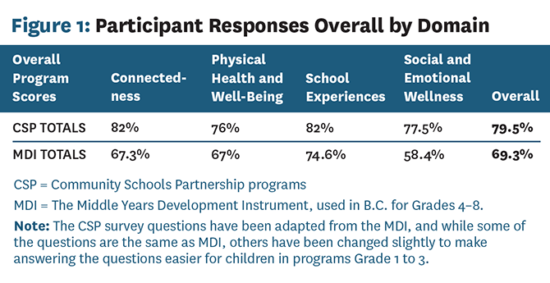
We evaluated students in nine different CSP after-school programs. Data was collected from 617 program participants ages six to 12, attending these programs across Surrey Schools. Program participants were asked to complete a 25-item survey, broadly grouped into five domains using a five-point Likert Scale. Program participants responded to survey items by indicating their level of agreement: 1) Disagree a lot; 2) Disagree a little; 3) Don’t agree or disagree; 4) Agree a little; and 5) Agree a lot. Additional open-ended questions were posed to program participants.
What we learned through this process was that students who attend CSP after-school programs tend to report higher feelings of attachment and after-school involvement, and to feel a deeper sense of awareness of their thoughts and feelings, than is reported by the overall school population of B.C. in the provincial Middle Years Development Instrument (MDI) survey (see Figure 1). These are early findings, but showcase the importance of after-school programming.
Teaching where they are at
We have been fortunate to be able to run after-school programs for students despite the pandemic. The strain that the pandemic has added to the lives of students has amplified the urgency for us to continue to effectively address the areas of mental health and SEL in our youth. Jordynn, one of our outreach staff, says, “Teaching mental health literacy in our after-school programs has been integral… mindfulness, awareness, and fostering social interactions have been lacking throughout this pandemic.” The opportunity for healthy interactions and rediscovering that place of quiet and calm can offer a much-needed respite for our youth, some of whom may find that the only space for them to practise mindfulness is in their after-school programs.
Consistently listening to the voices, opinions, and insights of our students is essential in creating programs that truly meet their needs. The more we listen, hear, and apply their considerations and make any necessary adaptations to our programs, the more we reach students where they are at and build their trust. We are always listening to them.
At the beginning of the article, our students were finding peace in their after-school program. In the final moments of this program, each student takes a long deep breath in and out. Then they roll up their little yoga mats, and the outreach worker checks in with each student as they make their way to the yoga mat bin. One student says casually on the way out, “I can teach this to my mom. Sometimes she gets stressed too, this could help her,” and runs to catch up with her mom waiting outside. This captures why we do what we do. The pressure that the pandemic is placing on our families and society is significant; however with supports and programming, we adapt. CSP after-school programs encourage children to express and accept their feelings, to embrace challenges, and to build up their resiliency toolboxes.
The authors wish to thank: Chadwin Stang, Tanya Parker, Arthur Tiojanco, Mark Elke, Denis Pavlovic, Manjot Badesha, Jordynn Punter, Jordan McDougall, and the Community Schools Partnership Team.
Photo: Courtesy James Speidel
First published in Education Canada, September 2021
-
No New Kids on the Block
Comments Off on No New Kids on the BlockSpring of 2020, mid-COVID lockdown and Canadian youth were planted at their computers for remote learning. Stores were closed, sports on hold, families isolated in their homes, and friends unable to hang out. Most middle- and high-school students spent part of their days creating ways to be interpersonal. Students from a high school in Alberta found an ingenious way to interact: they circled their wagons. Imitating ancestors who moved West almost two centuries ago, the students drove to the empty high-school parking lot and backed up to form a circle with their trunks and hatches open. They sat individually in the back of their own vehicles. Facing one another, between three and five metres apart, they sat, talked, and played music; they were kids doing what kids do. They had a space to be. Administrators still working daily in the school gave a thumbs-up to their creative pupils. I asked one of the Grade 11 students to send me a short video. In it, I observed 12 cars backed into the wagon wheel: one kid per vehicle, all legs dangling from the back and each teen engaged. During the most terrifying global time in a century, there was hope and initiative displayed by the clever youth who figured out how to safely be together, and with the approval from the school leadership team who were glad to create a space for their students to be, and to be well. I was impressed by the good intent and action all around and pitched an idea to make a short film with them. I would interview each participant remotely and ask them to shoot some of their sessions. The youth were thrilled that I was inspired by their collaborative genius, and I began to organize the logistics.
The local police shut it down. With no explanations, one day they came to the parking lot and told the youth to cease and desist. Overruling the school administrators, law enforcement made sure that no wagons would circle.
Having a place “to be,” a public space, creates healthy and positive ways of being. An ad hoc social community emerges in public spaces, where senses are stimulated and the similarities and diversity of those involved are displayed (Mean & Tims, 2005). Wellness is associated with the benefits of public space, which is claimed equally by everyone. The space reinvents itself daily: inhabitants change, the ability to seek an area for body and mind is created and recreated. Public space is not only the product of a developer, city planner, school board, or museum, it is often an unofficial collaboration between those who determine the space is valuable.
Urban public space is often conceived in parks, yet many areas have ceased mapping out new parks. While some public urban spaces for warm weather have been introduced, with shared public gardening, exercise space, meditation paths, biking and roller blading trails, and skateboard ramps and tubes, little consideration or initiative has been established to create winter-friendly public spaces. Canadian youth are left out in the cold.
From child advancement to youth encumbrance
Public space is often unattainable for youth; indeed many towns and cities have no designated space for youth. The last pre-pandemic public space I saw was in a parking lot. Between 25 and 40 high-school kids were hanging out in small groups in front of a Cineplex at the south end of an enormous mall, an early spring day, they were enjoying the weather. As I parked, four police cars pulled up and ordered them to leave. Canadian malls are often a gathering spot for youth. Avoiding inclement weather, Canadian youth visit malls for restrooms, food facilities, and stores, they also contribute to the economy by shopping. Claiming crime instances and theft, many malls have instituted bans for under-18 shoppers unless they are accompanied by a parent. Yet according to a 2016 Government of Quebec report, while youth are accused of shoplifting and vandalism over three times more often than adults, they are less likely to shoplift and vandalize (Lowrie, 2018).
Public space is democratic – not corporately or politically democratic. It is a space where one can feel safe. A place that allows movement, sound, art, quiet, the ability to congregate, the ability for a group of people to make known something important to them. But public space creates a difference between children and youth regarding access. Public space for children, of course, is chaperoned, shepherded. Children are with a teacher or an adult of some sort: a babysitter, a youth, someone who’s helping facilitate their enjoyment of the space. They interact in a place where they can climb on toys, wade, walk; someone is there to ensure little children are safe and nurtured. Adults and caregivers support children to enjoy public space, to run, to feel, to experiment. How important that experimentation becomes. Successes can happen for children in public spaces. The first time a child walks, runs, throws a ball, or rides a bike speaks to enormous growth and success. Public space is special for children, allowing socialization, physical activity, environmental awareness, fresh air, and wellness.
For youth, it can be a different scenario. North American youth are often seen as a population to be feared. My work has focused on the notion that many adults just don’t like youth (Steinberg, 2018). According to many adults, they are a revolutionary group, nonconformists. Along with their clothing, music, art, their way, the fact that they are youth, they become something to fear. Youth are often not allowed to be in a public space without adult supervision. There are dramatic differences in parental attitudes between a baby’s space and the space for a youth to be. With new babies, an obsession with advanced and appropriate development ensues. We watch for babies to roll over at four months, sit up at six months, and walk at one year. Potty training tends to be a milestone, with parents and family applauding as they stand around the toilet. Talking is an enormous concern for parents; expectations for the first word, then sentences haunt most parental minds. From preschool through Grade 1, expectations and hope surround the development of a child. Tying shoes is a stressful hurdle and the first playdate and friendship is a celebration. Riding the first trike and then a two-wheeler become kidhood capstones. Parents wait for their young children to become self-sufficient, independent, and able to entertain themselves. Up until nine or ten, each success is heralded and compared to other children of the same age.
By the time a child is a tween, parents reverse course and fear their child’s independence. No longer do parents push for their progeny to make their own decisions, pick out the day’s clothing, be creative. Parental complaints often barrage teens: their hair is wrong, their clothing is inappropriate, and their language is appalling. North American parents go from finding success in children to finding failure in teens. The same parents who pushed their little ones to make decisions, talk, choose clothes, and ride bikes are now fearful of skateboarding, rollerblading, pink hair, and midriff tops. Such irony in our childrearing. Adding to the nixing comes suspicion, doubt, fear and distrust… for both the teen and the parents. I contend that most adults just don’t understand or like teens; consequently, the rules pile on, adult/youth discord and tumultuous years commence. Along with this discord comes the restriction of places where teens are free “to be” and an adult need to control and surveil youth. To have healthy youth, we must find ways to have healthy public spaces available throughout the year for teens to create communities, hang out, and dangle their legs. Social distancing isn’t the problem; finding a place to safely socially distance is. Safe, public spaces must become a priority for our Canadian youth.
In search of healthy public spaces for youth “to be”
Dislike and fear of youth is uncovered regarding where the youth are, where they hang out, and who they are with. With limited safe spaces to be, our youth seek refuge in social media, online gaming, and smartphone addiction, all resulting in loss of socialization, healthy spaces, and shared communities. Space for youth to gather is limited: cars, homes with oft-gone parents, basements, and barns can become evening spaces to act out, kick back, and engage in exactly the activities the parents are so worried about. Without healthy special alternatives for youth, safe places to be, our teens resort to whatever they can find.
I was recently on a committee with city planners, university professors, and architects. Our charge was to discuss ways to turn a downtown walking mall into a viable and energetic public space. The area is known to be a haven for runaway youth and people who sleep rough, somewhat itinerant in nature, and many citizens avoid the area. I suggested creating a public space to serve youth, both the vulnerable teens who populate the mall and after-school kids in general. I noted that little ones run free in public spaces and are urged to experiment and climb, yet youth are often stopped or given signals that “you can’t be here, this space isn’t for you.” The same public space changes depending on the age of the occupant. I proposed a public theatre space – one that would allow crevices and climbing spots to serve both little ones and teens in physical movement and exercise, with the space also being used for impromptu performances, slam poetry, and improvisational theatre. Using the notion of theatre as public space, participants could mould the area to suit their visions. Possibly this area could offer some sort of wall in the same area that could be designated to create changeable graffiti where youth organizations could sponsor a space for artistic expression in a city where graffiti is completely illegal and has a full-time quasi police force patrolling for it. A small bit of interest was generated, but most of the group was anxious to turn back to exploring pop-up stores, picnic tables, and museum space.
In search of public spaces for wellness
I once found a place in the Highlands of Scotland by following an old sign, “Stone Circle” written with crayon or old paint, it had an arrow pointing to the left. I remember driving up there, just another pretty road. It led me to an enormous meadow of soft, green green moss, in the moss was a stone circle – a sort of Stonehenge, but not really. It didn’t have a name. There was a sense of mystery that I loved. One could walk all over…. there were no ropes, no signs, no poster that told us where we could take a picture. It was just a free space where anyone could run and touch the stones, chase around, or sit, as I chose to, in the very middle of the middle. I was in a space that was private and public at the same time. Low mountains were all around me, magical mountains with moors and the pillow softness of the Earth in all directions.
I’m not a meditator but I was able to do my way of meditating while I was there. Years later, when I want to put myself in a space that gives me peace, I still think of that free, unencumbered public space: a stone circle with no one in charge, no rules or cameras… it was free to the universe, free to the rain, the snow, and the people who touched it. I want our youth to know that they can go to a space, be safe, breathe fresh air, and just be. They need that. They deserve that.
Photo: courtesy Shirley R. Steinberg
First published in Education Canada, September 2021
References
Lowrie, M. (2018, May 2). Quebec shopping mall bans unaccompanied children and teens. The Canadian Press.
Means, M. & Tims, C. (2005). People make places: Growing the public life of cities. Demos.
Steinberg, S. R. (Ed). (2018). Activists Under 30: Global Youth, Social Justice & Good work. Brill/Sense Publishing.
-
Beyond Accommodations
Comments Off on Beyond AccommodationsAt east city high, a large high school in British Columbia’s Lower Mainland, the gymnasium was located in an outbuilding. There were two entrances, one on the east side for girls and one on the west side for boys. These entrances led to gendered washrooms and changerooms and then flowed into the main gymnasium, where all classes met at the start of the period to rendezvous with their teachers. This setup required students to select a binary gender just to get into class.
At the start of the year, Mr. Gonzalez,1 a Physical Education (PE) teacher at East City High, gave Raeyun,2 one of his Grade 10 students, special permission to use the boys’ changeroom. However, Raeyun did not want to use the boys’ changeroom. He was worried that being surrounded by other boys would only serve to underscore the ways he was different from them. Not only did Raeyun never use the boys’ changeroom, but he also never once got changed for PE at school. Instead, Raeyun came to school already in his PE clothes and stayed in them all day, no matter how sweaty he got during class. Raeyun cleverly figured out that he could sneak into the gymnasium through the back entrance by taking a staircase up from the staff parking lot. This tactic allowed Raeyun to avoid choosing a gender at the start of class.
I spent a year at East City High, moving alongside several gender-nonconforming3 youth as they went to class, attended extracurricular activities, fanned out across the campus for lunch, participated in artistic and musical performances, and just generally lived their lives. The youth who participated in the study all had different relationships with gender nonconformity, like Raeyun, whose relationship was complicated. He was a Filipino trans guy and aspired to pass; however, he experienced the world of East City High as a gender-nonconforming person most of the time. Even though he wanted to pass, Raeyun’s gender was not easily understood at East City High. Often people struggled to see Raeyun as he saw himself. Raeyun once described this complexity to me, saying: “I’m not like completely [gender nonconforming], but I’m also not like a cis guy, so, kind of like midway. Like I’m part of the binary but I’m also like part of the binary in a weird way.” Though few adults at the school understood Raeyun’s gender, many people noticed that Raeyun did not “fit in” and responded to his presence in accordance with the accommodation approaches laid out by the district’s trans-inclusive policy. Throughout Raeyun’s time at East City High, teachers pulled him aside and offered individualized workarounds and alternatives, ways for Raeyun to still participate in gendered activities without feeling left out.
As accommodation approaches become more popular in North American schools, it is important to consider which students are welcomed by it (or not), and how a reliance on accommodation neglects to challenge cisheteronormativity. While the current emphasis on inclusive washrooms and changerooms is important, this focus does not address the larger issue of rethinking how pervasively schooling is organized around a system of visible, binary gender. Accommodation as a primary approach relies on gender nonconformity as a visible identity – an identity that sticks out and can be easily categorized as not fitting in at school. Visibility, as scholars have examined, relies on racialized, ableist, and settler colonial norms (Beauchamp, 2018; Gill-Peterson, 2018). For instance, popular ideas about gender nonconformity privilege white, thin, andro-masculine forms of expression. Since people at East City High frequently struggled to understand the complexities of youths’ genders when they did not fit into these normative expectations, most of the youth that I worked with were not seen as gender nonconforming by others at the school.
How do schools’ accommodation practices privilege binary enactments of trans identities? What might it mean for all youth if we, as educators, did not rely on the presumption that we can see our students’ genders? What types of relationships with gender beyond the binary might we be able to welcome into our classrooms and schools if we let go of the need to know youths’ genders? I aim to open up these questions through highlighting the experiences of two of the gender-nonconforming youth I moved alongside during my research.
Accommodations approaches: a brief introduction
Schools across North America have responded to the growing awareness of trans and gender-nonconforming students by implementing trans-inclusive policies and procedures. These policies often rely on creating and providing accommodations. The concept of accommodations has a long history in North America, from race politics to disability law. Currently, educators, activists, and legislators are using the language of accommodations as a framework for including trans students in schools. The basic intention of offering accommodations is to create greater equity of access. One of the main criticisms of accommodation approaches is that they focus on the individuals who encounter obstacles, rather than the systems and institutions that create those obstacles.
At East City High there was a hard-fought trans-inclusive policy that instructed teachers, counsellors, and administrators in responding to trans and gender-nonconforming students. This policy directly named possible accommodations that students could receive at school: the right to access the washroom or changeroom that matched their gender identity, to be addressed by the name and pronoun they “prefer,” to dress in clothing that aligned with their gender expression, and to join athletic activities that corresponded with their gender identity. Though these rights were written for all trans students, including gender-nonconforming and non-binary youth, the material conditions and knowledge of staff largely limited the policy’s reach to binary trans students. For instance, there were only gendered sports teams and gendered changerooms, so a gender-nonconforming student who was not a boy or a girl had no sport team to join or changeroom that matched their gender identity. Also, few teachers at the school were familiar or comfortable with gender-neutral pronouns. As a result, students rarely felt invited into sharing “they/them” pronouns with anyone but close friends. The policy facilitated the experiences of students who knew they wanted to transition from one binary gender to another, but there was little space or understanding for youth who related to their genders as fluid, flexible, and changing.
In listing out specific accommodations, the policy also indicated the presumed points of conflict, concern, and/or challenges for trans students in schools. The policy attempted to highlight when and where trans students would encounter difficulties moving through their days in the same manner as cisgender students, and then offered possible workarounds. There are two main issues with this approach. First, this framework singles out trans students as problems in need of a solution in school. This issue has been covered extensively elsewhere in critiques of accommodation practices generally and specifically in relation to trans youth (Airton, 2013; Loutzenheiser, 2015; Travers, 2018). Second, this approach hinges on the intertwined ideas that trans students are visible to educators and that only visibly gender-nonconforming students will benefit from gender-inclusive schooling. Let’s examine this idea further.
Fitting into PE class
Each term, Mr. Gonzalez led his Grade 10 PE class through fitness testing. Fitness testing is not required by the province and not all PE teachers at East City High incorporated this activity into their curriculum. However, it was a main feature of Mr. Gonzalez’s class. To pass a fitness test, Mr. Gonzalez instructed students that they had to perform according to an index of gendered standards that he maintained at the front of his binder. Though Mr. Gonzalez had elected to use these tests in his classes as forms of assessment, he still worried about how they excluded Raeyun. “What am I supposed to do with my trans students?” Mr. Gonzalez once asked, pointing at his page of gendered standards. Mr. Gonzalez was worried about fairness and safety, and he wanted to protect Raeyun. Therefore, he worked to create modifications for what he viewed as Raeyun’s “unique” situation. The assumption was that Raeyun, as a visibly gender-nonconforming student, was the only one who would benefit from a less binary alternative in class.
However, many of the trans youth that I worked with over my year at East City High were never seen by their teachers, counsellors, or the administrators as gender nonconforming. Since they were not visibly gender nonconforming, like Raeyun, these students were never presented with any options for workarounds at school. For instance, almost no one read Scarecrow Jones, a Grade 9 non-binary student, as gender nonconforming. “In terms of other people, no, I think that they probably do not see me [as gender nonconforming],” Scarecrow Jones explained. “Since I’m not out to many people, I don’t want to give anyone any reason to think that I am not what I appear to be.” Scarecrow Jones’ gender nonconformity did not align with others’ expectations, so they were not offered any special permissions. To others, Scarecrow Jones did not look as if they needed them. Therefore, Scarecrow Jones got ready for PE in the girls’ changeroom, was counted as a girl during activities, and was judged based upon the standards for girls. Even if Scarecrow Jones’ teacher had noticed that they were non-binary, there was nowhere else for Scarecrow Jones to get changed, no other team for them to join, and no other standards by which they could be evaluated. Scarecrow Jones described PE as “this weird heteronormative culture, like heteronormative, cisgender ingrained into everyone’s brain that’s just making it so much more difficult, and so much weirder for everyone every day.” Scarecrow Jones understood the gendered dynamics in PE class as affecting “everyone every day,” not just gender-nonconforming students. Furthermore, they believed that teachers’ strategies of offering individualized alternatives for visibly nonconforming students did not address, let alone disrupt, the cisheteronormative culture and curriculum of PE class that they found so difficult and weird. Scarecrow Jones did not want a third option; they wanted a less gendered experience of PE in general.
Accommodations beyond PE class
While PE class is perhaps more easily understood as a gendered space, these issues transcend subject areas. Though East City High had a reputation for being progressive, diverse, and inclusive, I was never in a class in which an adult created space for the possibility of gender nonconformity without either being asked to by a young person or in response to the presence of a known trans youth. Both Raeyun and Scarecrow Jones were enrolled in French Immersion at East City High. At the start of the year, Madame Blanchet took Raeyun aside and asked him what pronouns he wanted to use in French. His visible gender nonconformity compelled Madame Blanchet to reach out and initiate this conversation. While this act was helpful for Raeyun, it also singled him out as not fitting in and in need of an alternative in class.
The first time I went to Mr. Gallagher’s French drama class, he conducted a mini-lesson on French gender-neutral pronouns. I did not attend his class until the beginning of October, which meant that Mr. Gallagher had not believed it necessary to broach the existence of these pronouns until compelled to do so by the presence of my visibly gender-nonconforming body. However, Scarecrow Jones was in that class. We spoke about this situation months later. Scarecrow Jones told me, “The only time anything (related to trans topics) has ever happened is when you were in Mr. Gallagher’s class and he explained the gender-neutral pronoun.” Mr. Gallagher only brought up pronouns the first time I attended, though he always used them for me. Since he was not able to see Scarecrow Jones as gender nonconforming, Mr. Gallagher never pulled them aside, as Madame Blanchet had with Raeyun. Mr. Gallagher understood accommodating trans people as important, but by waiting until I arrived to tell students about these pronouns, Mr. Gallagher communicated both his belief that knowing this information was only pertinent if it directly affected someone, and that he would be able to tell if that were the case.
Accommodation approaches rely on the assumption that gender nonconformity is a visible identity. There is a presumption that we as educators will be able to tell if our students are trans, which allows us to respond by creating alternatives in our classrooms and schools. I argue that instead of understanding trans-inclusive policies as providing resolutions for gender-nonconforming youth in schools, we look beyond accommodation strategies to our pedagogies. For instance, rather than require our students to make their genders visible to us in ways that we can understand, we can always teach for the possibility of gender nonconformity. Educators do not need policies to create classrooms that reimagine normative expectations about gender; we can cultivate this shift by not only teaching trans topics but also through actively challenging gender roles and heteronormative assumptions in our own teaching and among students. This move means no longer categorizing students by gender, abandoning gendered assumptions that inform how we teach and interact with our students, and integrating material throughout all subjects that likewise invites these complexities.
Welcoming gender nonconformity into our classrooms means we do not need to pull students aside to ask about their pronoun preferences, because those pronouns already exist as possibilities in the classroom. Furthermore, if we approach our classrooms with the idea that students may be gender nonconforming, we no longer have to be on the lookout for signs a youth may be trans and thus in need of an accommodation. What harm would it cause to tell all students about gender-neutral pronouns and use them in our teaching? What relationships with gender might we invite into our schools if we let go of the belief that gender is binary, visible, and that we have a right to know how our students identify on any given day? Instead of asking students to make their genders known to us, we can let go of the idea that knowing students’ genders is the same as knowing them.
Illustration: iStock
First published in Education Canada, September 2021
Notes
1All names are pseudonyms.
2The youth participants chose their own names and pronouns.
3 “Gender nonconforming” is an expansive term that encompasses a multiplicity of gender identities. It underscores how a person either intentionally challenges or is perceived to disrupt normative gender constructions, including not conforming to expectations connected to their gender designated at birth.
References
Airton, L. (2013). Leave “those kids” alone: On the conflation of school homophobia and suffering queers. Curriculum Inquiry, 43(5), 532–562.
Beauchamp, T. (2018). Going stealth: Transgender politics and U.S. surveillance practices. Duke University Press.
Gill-Peterson, J. (2018). Histories of the transgender child. University of Minnesota Press.
Loutzenheiser, L. W. (2015). “Who are you calling a problem?”: Addressing transphobia and homophobia through school policy. Critical Studies in Education, 56(1), 99–115.
Travers, A. (2018). The trans generation: How trans kids (and their parents) are creating a gender revolution. University of Regina Press.
-
Leveraging Pandemic Lessons to Heal
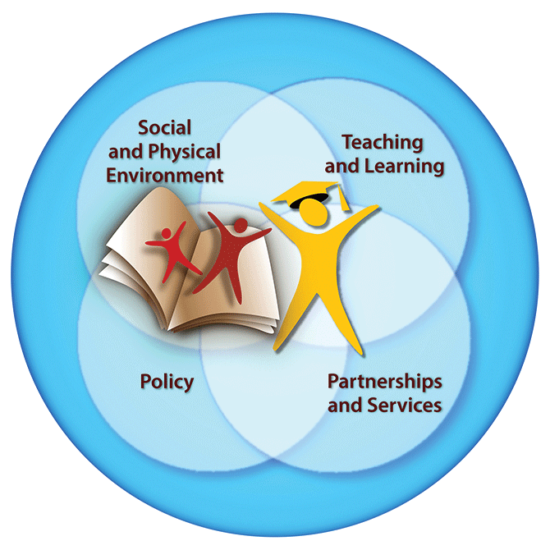
Comments Off on Leveraging Pandemic Lessons to HealIf there is a silver lining to the COVID-19 pandemic, one could argue that it demonstrated the critical role schools play in a functioning society, the interdependence of education and health, and the importance of a whole-school approach to health and well-being. We witnessed schools everywhere do their part in the crisis, going to great lengths to limit viral transmission. Imagine that! Every school in Canada took steps to protect public health that involved home, school, and community, while addressing social and physical environments, policies, teaching and learning, and partnerships and services. This, in essence, is Comprehensive School Health.
Physical health – mask-wearing, sanitizing, and distance between desks – was a dominant educational point for months, but perhaps the school health imperative we now face is the mental well-being of students, teachers, and staff. Can we learn from and leverage the education system’s pandemic response as a template for how to address health in other ways, and not only heal from the impacts of the pandemic, but also promote mental well-being in schools for all stakeholders?
If we ask the right questions now – with intention, compassion, and courage – we can reprioritize the value we place on well-being in school settings. Now more than ever, Comprehensive School Health needs to be on the national education agenda.
Courtesy of the Pan-Canadian Joint Consortium for School Health
Comprehensive School Health: An overview
Wellness is a balance of mind, body, and spirit that results in a feeling of well-being. As part of their social purpose, schools have a fundamental role to play in the well-being of children and youth. It is important to consider the systemic influences and environments in which children and adolescents emerge into adulthood. Young people spend a lot of time in educational contexts. When schools provide health-promoting environments, it creates capacity and opportunity for students to reach their full potential.
Comprehensive School Health (CSH) is gaining recognition among school districts across the globe, and across educational tiers in Canada, for its value in promoting wellness for students, teachers, and other members of the school community (staff, parents, community partners, etc.; Russell-Mayhew & Ireland et al., 2017). The CSH framework, which is based upon the knowledge that health and wellness enhance children’s ability to learn, provides a multifaceted structure for improving wellness within the school community.
Comprehensive School Health is an approach that includes:
- teaching health knowledge and skills both inside and beyond the walls of the classroom
- creating health-enabling social and physical environments
- creating healthy policies
- facilitating links with parents and the wider community to support optimal well-being and learning (Kolbe, 2019).
It is an internationally recognized framework that places students as primary beneficiaries of improved health and learning outcomes through coordinated action with all members of the school community (Koenig & Rodger et al., 2018; Langford & Bonell et al., 2015). This framework is based on evidence that healthy students have increased capacity for learning and that well-being has a positive effect on academic achievement throughout their lifespan (Byrne & Pickett et al., 2016, 2018). Health and education are interdependent. In other words, healthy students are better learners, and better-educated students are healthier (Squires, 2019; Viner & Russell et al., 2020).
A whole-school approach like Comprehensive School Health considers the well-being of the whole student and the whole community. It is not a program or curriculum, it is a process that integrates health promotion into the daily life of the school. The CSH framework takes advantage of a community development approach to enable customization to each unique site and the local context of a school.
Comprehensive School Health across the education system
The CSH framework seeks to harmonize actions across four components:
• teaching and learning
• social and physical environments
• policy and partnerships
• services.
These components guide actions in schools, such as: Ensuring high-quality health education, addressing teacher and staff well-being, revising school development plans to include well-being, and/or increasing social engagement opportunities for students. Ultimately, the CSH framework is intended to foster local autonomy to shift the culture to embrace well-being practices.
Increasingly, teachers are recognized as key agents of socialization, as they occupy positions that allow them to positively influence school wellness and student well-being. Teachers are our most important resource for the well-being of school communities; there is no profession with such profound influence. They influence people, places, and spaces in education. We know that health and education are deeply interconnected and intertwined, so if we want to influence outcomes, we need to focus on the whole person – not just academic outcomes – whether that is faculty, teachers, staff, or students. This includes post-secondary teacher preparation programs, which both serve as a feeder system for, and are an active part of, the education system. Supporting the well-being of pre-service teachers prior to their involvement in K–12 schools is an innovative way to promote transformational systemic change.
The potential cumulative effects of widespread, comprehensive wellness action across educational contexts are exciting to imagine. How might the world be different if every educational space was a place where each student, staff, teacher, and faculty felt a sense of belonging and was able to reach their full potential? What if every school was a healthy school? What if every BEd program was offered in a health-promoting post-secondary context?
So, what now?
We urgently need coordinated strategies that support action at all levels of school governance to address mental health, safety, belonging, and other psychosocial outcomes in schools.
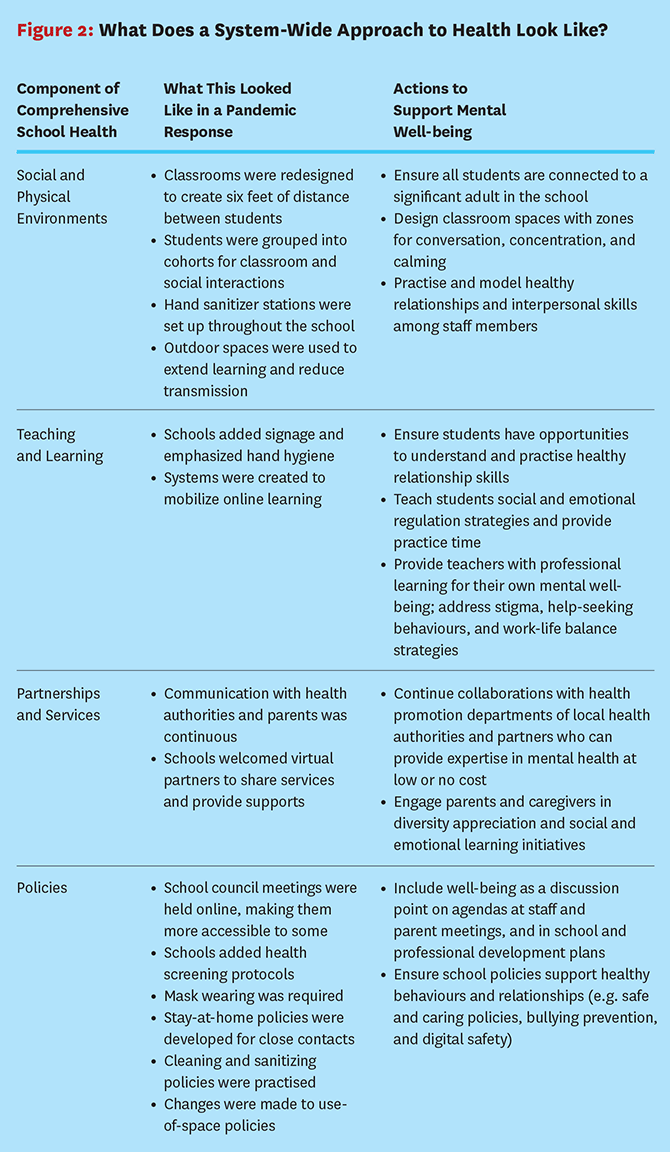
Recasting educational spaces as health-promoting spaces is a systemic change that requires societal support and commitment from across the health and education sectors, as we have recently experienced with the pandemic response. Now we know it is possible, and on a dramatically large scale, too. Comprehensive School Health gives us the framework, and the pandemic gave us the experience. In Figure 2, we explore how schools can leverage their experience of a system-wide approach to health through their pandemic practices into an opportunity for action that supports the mental health and well-being of students, staff, and teachers.
This may seem like a daunting task that is beyond any one individual, and it is. Still, there are small steps we can all take to do our part from both within and outside of the education system to drive change. A good first step is to educate ourselves and others about Comprehensive School Health (see Learn More).
Real and sustainable change is possible if the education system is structured, and supported, to embrace its role in creating health-promoting environments. At their best, education systems can support all children, youth, and young adults to reach their full potential, while ensuring teachers first learn and then work in health-promoting environments to facilitate learning and nurture the well-being of future generations. This type of system-wide embrace of well-being in Canadian education is not just the imaginings of idealists, but was proven possible in the context of the pandemic response.
Education is a human endeavour. In the context of CSH, this means attending to all the ways of wellness – physical, social, emotional, intellectual, spiritual, environmental, and occupational – across educational contexts. The well-being of students, staff, teachers, and faculty is at stake, and we can now better imagine the difference it will make.
Photo: iStock
First published in Education Canada, September 2021
Learn More
For some excellent self-paced learning, check out:
- The Podclass: Conversations on School Health (available on your podcast channel and at https://everactive.org/services/thepodclass)
- Building Healthy School Communities, a free foundational course available online at CSHhub.com
References
Byrne, J., Pickett, K., et al. (2016). A longitudinal study to explore the impact of preservice teacher health training on early career teachers’ roles as health promoters. Pedagogy in Health Promotion, 2(3), 170–183. doi.org/10.1177/2373379916644449
Byrne, J., Pickett, K., & Rietdijk, W. (2018). Teachers as health promoters: Factors that influence early career teachers to engage with health and wellbeing education. Teaching and Teacher Education, 69(1), 289–299. doi.org/10.1016/j.tate.2017.10.020
Koenig, A., Rodger, S., & Specht, J. (2018). Educator burnout and compassion fatigue: A pilot study. Canadian Journal of School Psychology, 33(4), 259–278. doi.org/10.1177/0829573516685017
Kolbe, L. J. (2019). School health as a strategy to improve both public health and education. Annual Review of Public Health, 40(1), 443–463. doi.org/10.1146/annurev-publhealth-040218- 043727
Langford, R., Bonell, C., et al. (2015). The World Health Organization’s Health Promoting Schools framework: a Cochrane systematic review and meta-analysis. BMC Public Health, 15(1), 130–130. doi.org/10.1186/s12889-015-1360-y
Russell-Mayhew, S., Ireland, A., et al. (2017). Reflecting and informing a culture of wellness: The development of a comprehensive school health course in a bachelor of education program. Journal of Educational Thought, 50(2&3), 156-181. www.jstor.org/stable/26372402?seq=5#metadata_info_tab_contents
Squires, V. (2019). The well-being of the early career teacher: A review of the literature on the pivotal role of mentoring. International Journal of Mentoring and Coaching in Education, 8(4), 255-267. doi.org/10.1108/IJMCE-02-2019-0025
Viner, R. M., Russell, S. J., et al. (2020). School closure and management practices during coronavirus outbreaks including COVID-19: a rapid systematic review. The Lancet Child & Adolescent Health. doi.org/10.1016/S2352-4642(20)30095-X
-
Making the Healthy Choice the Easy Choice
Comments Off on Making the Healthy Choice the Easy ChoiceLast May I visited Walnut Park Elementary, which is located on the unceded traditional territories of the Wet’suwet’en in Smithers, B.C. While navigating the halls to get to Mary Neto’s Grade 4 classroom, I passed students and staff decked out in denim, fluorescent headbands, tie-dye masks, scrunchies, and leather jackets. It was ’80s day.
Mrs. Neto welcomed me into her classroom and invited me to make myself at home. Students were quietly reading at their desks, some eating snacks, while others continued to trickle in. One student asked Mrs. Neto if he could tell her something, and when she replied of course, he told her about his dog running away (they found him), and then getting stuck in traffic, almost making him late for school. Mrs. Neto empathized with his hectic morning and said she was glad he made it to school on time in the end.
Looking around, I noticed many objects and displays that were familiar from my childhood Grade 4 classroom. Lined up along the windowsill were Styrofoam cups filled with dirt and the beginnings of tiny green sprouts. On the walls were exhibits of student work. However, there were also differences. Posters on the back bulletin board showed the different “Core Competencies” (Communicating, Collaborating, Creative Thinking, Critical and Reflective Thinking, and Personal and Social Identity). The chairs students were sitting at weren’t all the standard plastic-backed chair I remember either; some were wobble stools and others were on rockers.
A buzzer interrupted my thoughts, announcing the end of individual reading time. Students were instructed to find a partner and read to each other. Two boys reading Calvin and Hobbes comics partnered up and laughed at the antics of the boy and the tiger. Over the murmur of the class I heard a girl exclaim, “Oh, poor dinosaur!” in response to the story her friend was sharing. I hadn’t been in the class for more than 15 minutes and I had already witnessed displays of students practising and strengthening their social and emotional skills.
Walnut Park Elementary is one of seven schools in Bulkley Valley School District 54 (SD 54). It is no surprise that I observed social and emotional learning (SEL) in Mrs. Neto’s class, as SEL is a priority in the district. For those of you who are unfamiliar with SEL, it focuses on five competencies (CASEL, n.d.):
- Self-awareness (ability to understand your emotions, thoughts, and values and how they affect behaviour)
- Self-management (ability to manage emotions, thoughts, and behaviours to reach personal goals)
- Social awareness (ability to take other points of view and empathize with others)
- Relationship skills (ability to establish and maintain supportive relationships)
- Responsible decision making (ability to make caring, constructive choices about behaviour and social interactions).
There are numerous SEL programs designed for the school setting; however SD 54’s approach goes beyond a single program, which is likely one of the reasons it is so successful. SD 54 uses an approach that aligns with Comprehensive School Health (CSH).
CSH is an internationally recognized framework for supporting improvements in students’ educational outcomes while addressing school health in a planned, integrated, and holistic way. It is based upon the proven relationship between health and education: healthy students are better learners and more educated students are healthier.
Schools are often seen as an ideal setting to promote health among children and youth. Most children and youth attend school, and therefore ideas taught at school reach the majority of the population. However, educators already have a lot of material to cover in the short span of ten months. Adding more to their plate can be overwhelming, and in some cases, impossible. If you imagine each subject that educators have to cover as a block, many educators are already carrying their maximum number of blocks. Using a CSH approach to promote health ensures that we aren’t just adding another block to educators’ already towering stacks. Instead, a CSH approach seeks to embed health into the school and district culture so that making the healthy choice is the easy choice. I like to imagine CSH as a wheelbarrow rather than another block. It may take time and energy for educators and schools to figure out how best to use it, and how to organize their other blocks within it, but once they do, the wheelbarrow actually makes carrying all of the other blocks easier.
Specifically, CSH involves planning health-promoting activities in four distinct but interrelated areas:
- Teaching and learning
- Physical and social environment
- Community partnerships
- School policies
Here is more detail about each component:
Teaching and learning
Teaching and learning occurs in the classroom and beyond. It includes any teaching and learning opportunities that build knowledge and skills. Students learn from teachers, other adults in the school and community, and from their peers.
Physical and social environment
The physical environment refers to the physical spaces in the school that support health and well-being. This includes buildings, equipment, and outdoor areas. The social environment includes the quality of relationships and emotional well-being of members of the school community.
Community partnerships
There are many potential community partners that schools can connect with to promote health and well-being. Some examples are parents, other schools or classrooms, community organizations, and health professionals.
School policies
The final component of CSH refers to provincial, district, school, or classroom policies, as well as rules, procedures, and codes of conduct that help shape a caring and safe school environment and promote student health and well-being.
CSH can be used to promote any health topic, but for this article we’re going to take a deeper look at how SD 54’s actions to promote SEL in their schools align with a CSH approach.
Using a CSH approach to promote health ensures that we aren’t just adding another block to educators’ already towering stack.
In 2016, the B.C. Ministry of Education released a revamped K–9 curriculum with the significant new addition of Core Competencies. The Core Competencies closely align with the five SEL competencies. Incorporating the Core Competencies into the provincial curriculum is an example of a policy change that supports SEL in schools. Policy changes such as these are effective, especially when combined with support for implementation. While changes to the curriculum are out of the control of any one school district, the district can provide this support to ensure they are successful.
A case in point: around the same time that the new curriculum was being released, SD 54 created a new position within their district: Elementary Social and Emotional Helping Teacher. It was originally a part-time role and filled by a school counsellor in the district. Over time it developed into a .8 FTE position as demand from educators to work with the Helping Teacher increased. In a short video about the initiative, superintendent Mike McDiarmid explains that the role was spurred by increasing concern about the mental wellness of students in the district and educators feeling like they didn’t have the necessary background to teach the social and emotional curriculum.
This partnership between the district and elementary schools successfully supported implementation of SEL and the Core Competencies. Educators could schedule sessions for the Social and Emotional Helping Teacher to join their classroom to collaborate and co-teach around the social and emotional curriculum. If you think back to my earlier analogy of the teacher holding a towering stack of blocks, you might ask, “How are they supposed to load the wheelbarrow without dropping everything? They don’t have any free hands.” This shows just how important partnerships are when it comes to CSH. In SD 54, educators who had previously felt uncomfortable or unsure about how to approach SEL gained valuable skills and confidence by observing and working alongside the Social and Emotional Helping Teacher. They were then able to more easily incorporate the ideas that they had learned into their regular lesson plans, which laid the groundwork for embedding SEL into the school culture.
In Mrs. Neto’s classroom, the physical environment supported SEL with different seating options that allowed students to self-regulate depending on how they were feeling. Schools and districts can support changes in the physical environment by ensuring there is funding available for classrooms to put toward SEL. There are also strategies educators can use to impact the physical environement that don’t cost any money. Mrs. Neto turned off some of the lights in the classroom when students were high energy and it was time to focus, and had different seating configurations that were associated with different levels of ease to communicate with their classmates.
Modelling behaviour and actions is another form of teaching. By modelling SEL through their words and actions, teachers are directly impacting the social environment. Cultivating an environment of mutual respect and care will support learning and create a space that is more enjoyable for everyone. Sometimes actions speak louder than words; Mrs. Neto’s calm and empathetic demeanor set a precedent that her students followed.
Teaching and learning is part of many of the actions that I’ve already discussed, but SEL was also explicitly addressed while I was in Mrs. Neto’s class. After students each did two laps around the school (an effective way to regulate their energy levels and develop their fitness), they came inside and worked on their daily goals. Mrs. Neto started the class off by reviewing her own goal from the previous day: to read one chapter of her book. She shared that it was difficult because she was tired, but she persevered and managed to finish the chapter. Alongside their goals, students had space to write the steps they would take to achieve them and something they were grateful for. I walked around the room asking students what their goals were, and they varied from being a better listener to eating healthier snacks. In the space asking what they were grateful for, many of the students wrote, “Mrs. Neto.”
Procedures such as daily goal setting and partner reading demonstrate how policy can be established at the classroom level, and that it doesn’t have to come from the district when using a CSH approach.
These collective actions in policy, community partnerships, the environment, and teaching and learning have made SEL an integral part of students’ school days in SD 54. Hopefully you can also see how the approach the district took meant that the weight of it didn’t fall solely on any one person’s lap. And while Mrs. Neto is particularly passionate about SEL, the underlying SEL principles are present in every classroom in the district.
Health and learning are intertwined. Using a CSH approach to make health and well-being part of your school’s culture will inevitably improve student learning and behaviour and contribute to the development of more well-rounded students.
Photo: iStock
First published in Education Canada, September 2021
References
Collaborative for Academic, Social, and Emotional Learning (CASEL) (n.d.). CASEL’s SEL Framework: What are the core competence areas and where are they promoted? https://casel.org/wp-content/uploads/2020/12/CASEL-SEL-Framework-11.2020.pdf
-
Overcoming Reading Deficits
Comments Off on Overcoming Reading DeficitsThe Toronto Catholic District School Board (TCDSB) introduced EmpowerTM Reading (henceforth, Empower) to address the ongoing needs of exceptional students with reading difficulties.
Over 30 years ago, TCDSB partnered with Toronto’s Hospital for Sick Children (SickKids) to introduce Empower in its developmental phase (Lovett & Steinbach, 1997). TCDSB continues to use Empower’s commercial version in up to 100 classes, located in 70+ schools; numbers vary slightly by year.
The TCDSB-SickKids’ partnership occurred when the whole-language approach was influential in shaping educational practice in Ontario. Its opponents, however, presented counter-evidence that basic pre-requisite skills, including phonemic awareness, reading fluency, and vocabulary development (Nathan & Stanovich, 1991), are critical in improving automaticity in decoding and reading, necessary before learning higher-level skills. Persistent deficits in basic word identification skills require direct remediation of phonologically-based reading skills, systematic and explicit instruction in letter-sound and letter cluster-sound mappings, and reinforcement of word identification learning (Rayner, et al., 2001).
TCDSB’s involvement in Empower development began when the identification of learning disabilities was based on the now-defunct model of IQ-achievement discrepancy. Current practice across Ontario school-boards focuses instead on the “psychological processes” underlying a learning disability, of which phonological processing is one. It involves the awareness of phonemes – the alphabetic principle that underlies our system of written language. Specifically, developing readers need an understanding of the internal structure of words to benefit from formal reading instruction (Adams, 1990). Once decoding is efficient, attention and memory processes are freed for comprehension. Phonological awareness therefore assumes a pivotal role in learning to read. It is a strong predictor of a child’s literacy development (Melby‐Lervåg et al., 2012), from Kindergarten throughout school (Perfetti et al., 1987; Calfee et al., 1973).
The Empower program addresses learning problems of struggling readers by remediating core deficits in decoding, spelling, word-reading, vocabulary development, and text comprehension. The program’s initial focus on letter-sound identification and sound-blending training gradually moves to larger sub-syllabic units such as phonograms, vowel clusters and affixes, each with its own metacognitive strategy.
To address reading difficulties confronting special education students, TCDSB deploys Empower as a Tier-3 reading intervention, targeting those with a Learning Disability (LD)/Language Impairment (LI) learning profile for whom previous Tier-1 & 2 interventions (e.g. 5th Block) have been unsuccessful. The main admission criteria are:
- The student is formally identified as LD/LI, or being assessed/tracked for LD/LI difficulties
- The primary presenting concern is difficulty in decoding and/or word identification, or text comprehension, as appropriate for the program being considered
- The student has an Individual Education Plan (IEP)
- Consistent attendance, and ability to participate without disruption
TCDSB implementation model
Select TCDSB elementary schools host Empower program(s), with mandatory training by SickKids-appointed staff, accountability/research tracking, and centralized monitoring/management by the TCDSB Empower Steering Committee. Comprised of interdisciplinary representatives, the Empower Steering Committee oversees program implementation.
With authorization from SickKids, highly experienced TCDSB-appointed special education teachers monitor the fidelity of implementation by serving as internal mentors/trainers. There are two initial training days for teachers, further training during the year, and subsequent refreshers. The mentor provides scheduled classroom visits and consultation via phone/e-mail. Training focuses on instructional methods, Empower lesson components and materials, student monitoring and assessment.
When interviewed, teachers were very pleased with the initial training (despite its intensity) and support/feedback from mentors’ classroom visits.
About half of the 70+ participating schools were selected as Empower “Hubs,” receiving additional staffing allocation. Eligible students from non-Empower schools could transfer to a nearby “Hub” for one year and receive instruction in Empower and all other subjects. Teachers consistently reported that transferred students made academic and social progress similar to other Empower students.
We focus on Empower Decoding/Spelling for Grades 2 to 5. More than 100 60-minute lessons are taught to about 500 students in small classes of 4–7. In addition, the Board recently implemented Decoding/Spelling for Grades 6 to 8, and Comprehension for Grades 3 to 7.
To address core deficits in decoding and spelling, students receive instruction in five decoding strategies in sequence:
- Sounding Out (a phonological letter-sound decoding strategy)
- Rhyming (word identification using known keywords to decode unknown words with the same spelling patterns)
- Peeling Off (stripping prefixes and suffixes from multisyllabic words to get a smaller root, which then can be decoded using one of the other strategies)
- Vowel Alert (trying variable vowel pronunciations according to their frequency
- Spy (seeking familiar parts of unfamiliar words).
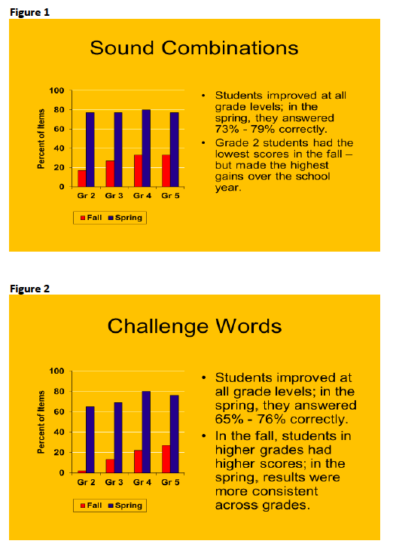
On several letter-sound and word-identification tests, most students made substantial gains in decoding (see examples in sidebar). Students read more in class or at home and were positive about their reading ability. Students admitted to Empower while waiting for assessment for LD/LI difficulties made good progress with Empower. Often they ended up not meeting the requirements of a formal identification, or no longer required a formal IEP. Some formally identified LD students and most LI students made progress, but less so than other students. Others made limited progress because of poor attendance and behaviour, reinforcing the requirement to address these issues before Empower. The behaviour of some students improved after success in decoding.
Teachers recommended that 20–40 percent (depending on the measure/report) of students receive additional reinforcement after Empower to help them cope with reading in higher grades.
Empower teacher feedback
Empower teachers were interviewed/surveyed every year on implementation of Empower. Often, they reported successful implementation. Some problems were often resolved in the first year; others persisted and required central intervention.
When Empower classes first rolled out, staff were pressured to place English-as-a-Second-Language (ESL) and Mild-Intellectual-Disability (MID) students in their classes, as well as students with behavioural and attendance issues. Some teachers had classes of students with varying grade levels and needs. By the following year, however, school administrators corroborated with teachers to adhere to admission criteria, but problems around behaviour and attendance persisted. In response, the Empower Committee provided written instructions to principals, followed by specific procedures to centralize annual screening.
Initially, about 40 percent of classes did not finish the program in one school year, often delaying the class that followed. The Empower Committee therefore required all new classes to begin in September. As a result, classes now finish on time, except under exceptional circumstances (e.g. long-term teacher illness).
At the outset, first-year teachers reported needing 70+ minutes per class. More experienced teachers generally completed instruction in 60 minutes or less.
As the program progressed, most Empower teachers met with regular/special education teachers, often informally, to discuss Empower lessons and students’ needs/progress. Classroom teachers were encouraged to have Empower students read in class and at home. Teachers discussed collaboration on assessment and sharing results, especially when Empower teachers were not familiar with Primary assessment. Support from the principal was essential, especially in addressing scheduling and collaboration. Sometimes, diplomatic negotiation was needed to schedule Empower, mandatory classes taught by itinerant teachers (Gym, French), and major subjects like Math. Empower is fast-paced, requiring uninterrupted class time without announcements, school activities or professional obligations. After the first year of Empower, such interruptions were rare.
Parents were expected to meet the Empower teacher as part of the admission process. Students were encouraged to read at home and discuss passages with parents. On interview night, about half of parents met with teachers who provided them with information on Empower and homework. Some parents were highly cooperative; others less so.
The Empower program requires a strong commitment to implement effectively. However, we feel the results attest to the program’s worth. This success is not only determined by assessment, but by continuing positive feedback obtained from stakeholders that Empower has indeed changed students’ lives and positively impacted their learning. As one Grade 3 student put it: “Thank you for making Empower. I couldn’t even read a book that was easy. I can read books that are chapter books AND 24 pages long!” Parents are equally enthused, as one described her experience: “This program has not only helped my son to learn how to read but also improved his self-esteem. He doesn’t have to pretend to know how to read anymore; he knows that he can actually do it.” Teacher and school administrators are similarly highly motivated to host Empower, as in one principal’s feedback: “The Empower program has made a profound difference to the lives of many students. Students become strategic and successful readers. Over 12 years, I have witnessed the transformative power of the Empower program.” Perhaps what is most rewarding to teachers, frontline staff and the interdisciplinary professionals running Empower is the affirmation that scientifically-based and well-executed remediation programs have a key role to play in the eradication of illiteracy in our 21st century learning, to forever change the lives of children and their families for the better.
References
Adams, M. J. (1990). Beginning to read: Thinking and learning about print. Bolt, Beranek, and Newman, Inc.
Calfee R.C., Lindamood, P., & Lindamood, C. (1973). Acoustic-phonetic skills and reading–kindergarten through twelfth grade. J Educ Psychol. 1973 Jun, 64(3):293–298.
Lovett, M. W., & Steinbach, K. A. (1997). The effectiveness of remedial programs for reading disabled children of different ages: Does the benefit decrease for older children? Learning Disability Quarterly, 20(3), 189–210.
Melby-Lervåg, M., Lyster, S.-A. H., & Hulme, C. (2012). Phonological skills and their role in learning to read: A meta-analytic review. Psychological Bulletin, 138(2), 322–352. doi.org/10.1037/a0026744
Nathan, R. G., & Stanovich, K. E. (1991). The Causes and Consequences of Differences in Reading Fluency. Theory into Practice, 30(3), 176–183.
Perfetti, C. A., Beck, I., Bell, L. C., & Hughes, C. (1987). Phonemic knowledge and learning to read are reciprocal: A longitudinal study of first grade children. Merrill-Palmer Quarterly, 33(3), 283–319.
Rayner, K., Foorman, B., Perfetti, C. A., Pesetsky, D., & Seidenberg, M. S. (2001). How psychological science informs the teaching of reading. Psychological Science in the Public Interest, 2, 31–74.
Acknowledgments:
The research described in this article has previously been reported to various TCDSB committees. The views expressed in this article are those of the authors and do not necessarily reflect the opinions/policy of the TCDSB.
The authors wish to express their gratitude to Dr. Maria Kokai (TCDSB), Dr. Marina Vanayan (TCDSB), and the SickKids’ LDRP Team for their guidance and advice. The successful implementation of Empower was only made possible by the vision and firm support of the TCDSB Superintendents of Special Services, past and present, as well as the professionalism and hard work of the many Empower teachers, the Empower Steering Committee, mentors/trainers, and Special Services staff who dedicate their time and career to better the lives of children under our care.
-
Top Tech Skills for Educators
Comments Off on Top Tech Skills for EducatorsDigital technologies have taken a more prominent role in Canadian classrooms in recent years, but COVID-19 has pushed technology centre stage, requiring educators and students to strengthen their digital skills and potentially reconsider their traditional roles.
In April of 2021, the Information and Communications Technology Council (ICTC) released a new study, 21st Century Digital Skills: Competencies, innovations and curriculum in Canada, which examines, among other things, the top technical and human skills (or “soft skills”) required by educators and students.
A rapidly changing landscape
As the 2020/21 school year winds down and planning for the fall begins, uncertainty remains around the vaccine rollout and the coming term. What will the coming school year like? A return to in-class instruction, remote learning, or a mixture of both (hybrid learning)? What is certain is that the demand for digital skills will continue to grow.
When used skillfully as part of an educator’s toolkit, edtech possesses the ability to strengthen student engagement while encouraging academic success. The rise of technology in classrooms is surfacing new pedagogical best practices that encourage better collaboration, improved interactivity, and greater flexibility for educators and their students. These methods and their accompanying skills are likely to have long-lasting implications for educators who have adopted both in-class and online teaching responsibilities.
The 21st Century Digital Skills report, which draws on a series of interviews from subject matter experts across Canada, highlights the changing role of the K–12 educator to that of a “facilitator” of learning, which is a fundamental departure from the long-standing “sage on the stage” paradigm. As indicated by interview respondents, educational technologies have quickened the pace of this transition while also challenging outdated policies surrounding the use of cell phones and other technologies in the classroom.
This shift calls on educators to cultivate new technical skills, but it also requires strong “human skills.” Study interviewees also noted that human skills (which was preferred to the term “soft skills,” and includes critical thinking, creativity, and adaptability) are not vulnerable to the impacts of automation, artificial intelligence, or technology obsolescence.
These skills and competencies are reaching new and more nuanced levels as technology deepens considerations around, for example, critical thinking and media literacy. As one educator in the study stated:
“Media literacy now incorporates issues of fake news and how a student participates in a networked world. It’s how a student understands that they’re engaging and exploring new content, thinking critically and leveraging a wide variety of inclusive texts, tools and modalities. So it’s really going beyond simply reading and consuming. Media literacy provides the space to recognize culturally sustaining communication methods and how to recognize bias and privilege. Examining the rights, responsibilities and ethical implications of media in the creation of information and how, and to what extent, texts and tools amplify another’s narrative… it’s the understanding that technology enables all of this.”
– K–12 educator, Ontario
With summer approaching, teachers who are interested in improving their technical skills can take advantage of a wide array of online courses in digital technologies, which include media literacy.
Top technical skills for educators
An analysis of study interviews identified the following list of both technical and human skills, ranked in descending order by frequency of mentions:
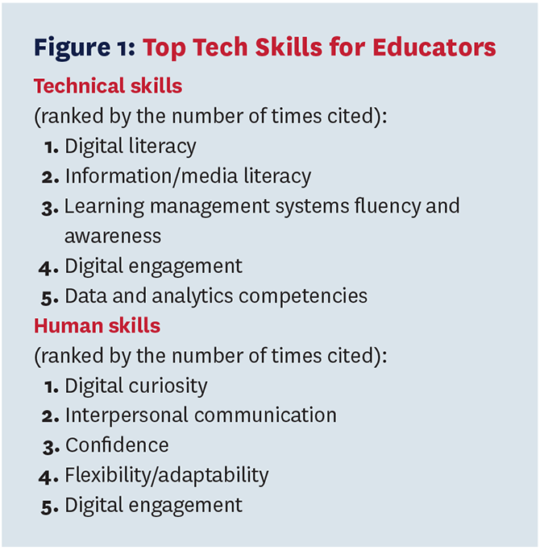
Digital literacy Typically refers to competency in using core technologies (this can range from the use of search engines, office productivity software, basic operating system functions, up to database usage, coding, and computational thinking) and involves the ability to find, evaluate, create, and share content online. As the world increasingly adopts digital technologies, higher standards of digital literacy are needed to fully participate. Educators can work to improve their digital literacy through various available online training resources, by participating on various platforms, and as part of professional learning communities.
Information/media literacy This involves understanding how and why a media message is constructed – as well as its impact. In addition to accessing media and information, there is also the need to be able to analyze it critically, evaluate different media, and to ultimately be able to use it effectively. Educators can find a variety of media literacy resources, curriculum guides, lesson plans, and video tutorials through provincial teaching accreditation bodies (e.g. Ontario College of Teachers) teacher associations, individual school boards or online at places such as mediasmarts.ca.
The rise of technology in classrooms is surfacing new pedagogical best practices. This shift calls on educators to cultivate new technical skills, but also requires strong “human skills.”
Learning Management Systems (LMS) fluency and awareness As teachers are increasingly required to use LMS environments such as Moodle and D2L to deliver teaching materials, receive assignments, and communicate with students and parents, it is crucial they feel comfortable navigating this software. In addition to training provided by school districts, there are professional development conferences, web tutorials, and online courses through Coursera or edX.
Digital engagement Although “engagement” is typically understood to be linked to interpersonal communication, this term was often used by the educators we interviewed in discussing retention rates and maintaining student attention while using learning management systems or social media platforms such as Tik Tok, Snapchat, etc. It is not necessary for educators to become avid users of these social media platforms, but it is helpful for them to have an awareness of these growing trends and how they fit into the larger digital ecosystem.
Data and analytics competencies Digitization has greatly increased the amount of data available to decision makers, and this leads to increased interest in the use of analytics to make better “evidence-based decisions” and identify patterns that were not previously apparent. This is definitely the case in business and government, but it is also increasingly relevant in education. Increasingly, learning management systems are integrating data analytics for personalized learning insights as well as data dashboards (Gunawardena, 2017). There is a growing field of data analytics training at postsecondary institutions as well as online courses for classroom teachers.1
Best practices
Technology use in the classroom today varies greatly among educators, their schools, regions, and even provinces, but best practices have emerged. Study interviewees and education experts have highlighted the following:
- Exercise professional judgment as an educator to determine how best to support the individual learning needs of a student in both in-class and remote learning environments (technology is only a tool; the expertise of the teacher and the needs of their students are paramount).
- Appropriately identify essential learning priorities in curriculum and base assessments (formative, summative, or a mix of both).
- Emphasize learner self-assessment but also provide virtual and telephone conferences for descriptive feedback and discussion of next steps; this may include parent participation where appropriate. Ideally, provide several different options (with or without digital technology) to maximize accessibility.
- Consider and find ways to accommodate the unique needs or circumstances of individual students. This can include the use of digital accessibility features, like text-to-speech tools, text magnification options, and closed captioning.
- Find new and creative ways for learners to share what they are doing at home and generate ideas to demonstrate learning. These projects or demonstrated learning experiences can be shared through videoconferencing or LMS tools to enable peer-to-peer learning.
- Provide continual feedback on literacy and numeracy-related learning standards.
- Consider more formalized evaluation of prioritized learning standards for Grade 10–12 students (appropriate assessment measures should ensure students are familiar with testing and understand the requirements).
Looking to the future
While digital skills and new technology tools are important – and teachers need to receive both training and support to effectively work with these technologies – the subject experts consulted for ICTC’s 21st Century Digital Skills study noted that digital tools are part of a much larger educational transition. In this evolution, educators facilitate student development based on their individual needs and interests to help keep pace with a rapidly changing world.
Photo: iStock
First published in Education Canada, June 2021
The ICTC Study
The 21st Century Digital Skills report also includes a focus on educator training and support, an exploration of the top technical, academic, and human skills required of K–12 students, and examples of innovative technologies being leveraged in Canadian classrooms.
Note
1 See, for example, www.edx.org/course/analytics-for-the-classroom-teacher
References
Gunawardena, A. (2017). Brief survey of analytics in K12 and higher education. International Journal on Innovations in Online Education. doi: 10.1615/IntJInnovOnlineEdu.v1.i1.80
This department is generously sponsored by IPEVO
www.ipevo.com
-
Gathering Community in the New Normal
Comments Off on Gathering Community in the New NormalIt seems the one thing we can be certain of is uncertainty; COVID-19 has been a stark reminder that change is part of our lives. It’s difficult to predict what our formal education system will look like post-pandemic. Nevertheless, we can say that in this new normal there will certainly be a need for open exchange of views among all stakeholders in education. This article describes a model of school and community engagement, the Gathering Model, that may prove useful. In presenting this model, we share a set of equitable best practices that teachers, schools, and school boards can use as a template for parent and community outreach initiatives and to offer a resource for addressing the new normal.
Toronto’s York Region is one of Canada’s most diverse school districts. While 90 percent of its residents are Canadian citizens, one in two were born outside Canada. The languages spoken at home include Chinese (Cantonese and Mandarin), Russian, Farsi, Italian, Tamil, Korean, Urdu, Spanish, Punjabi, and Gujarati. When we consider these changes, it becomes clear that we need to think differently when talking about community building. Community building based on goals and principles of sameness does not achieve inclusion. Community building has to be fostered through inclusive practices and processes. This applies in all our school communities, as populations across Canada are increasingly more diverse.
The Gathering Model
The Gathering Model is based on an ongoing, 15-year collaboration between the York Region District School Board (YRDSB) and the Faculty of Education at York University. In 2005, they partnered to pilot a new model of community engagement. Scott Milne, Manager of School and Community Projects at YRDSB, and Dr. John Ippolito, Associate Professor at York, were invited to serve as leads. Armadale Public School was selected as the pilot site because it was the largest and most linguistically diverse school in the YRDSB, in a neighbourhood experiencing pronounced demographic shifts. The thinking was that the initiative could both capitalize on emerging assets within the changing population and respond to new challenges. Since this time, multiple versions of the model have been implemented in over a dozen YRDSB schools.
This model goes beyond community engagement to explore the potential for family voices – including the voices of marginalized parents – to support school and community improvement. The model responds both to recent patterns of migration and to extensive research on the positive impacts of parents taking an active role in their children’s education.1
A cycle of community dialogue
The Gathering Model supports a cycle of community dialogue. This dialogue centres on after-school/evening events involving parents, administrators, teachers, students, researchers, and community service agencies. In most of our sites, the role of community agencies has been limited, but in some schools their role has been more significant, even if only to highlight the services they offer. These events (anywhere from one to four per year at participating schools) address issues parents think are important to their families’ experience of public schooling. At some schools, the event now includes a separate student dialogue.
Clearly, the pandemic has put these in-person events on hold. As with education more generally, our participating schools have experienced a fracturing of community, leaving students and families feeling disconnected from their schools. However, this forced time-out is being put to good use in revisiting initiatives the model has piloted over the years, such as parent-driven research, parent and teacher research groups, and online discussion forums (Ippolito, 2012, 2018), and in exploring more recent online conversation platforms such as ThoughtExchange. We look forward to making innovative links between these online platforms and in-person events, which will, at some future point, become possible. This interplay of in-person and online resources will remain defined by the cycle of community dialogue outlined below (see Figure 1).
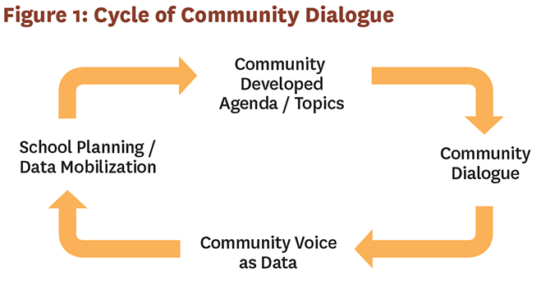
Community-developed agenda
A fundamental component of the Gathering Model is a formalized planning team consisting of staff, families, and community partners. While everyone is invited to the planning team, a deliberate effort is made to engage individuals, community members, and organizations that represent marginalized voices. The aim is to have at least three community members present for each meeting, though the community members do not have to be the same at each meeting. In these instances, new members are welcomed into the planning discussion with a brief synopsis of previous work. Rotating membership for community members and flexibility in the timing of meetings encourages community engagement. This planning team is involved in every stage of the cycle, from pre-event planning, to event design, to post-event data analysis, to data mobilization in school, and system planning. Through this process, the model becomes a regular and ongoing formalized process.
Unlike traditional parent involvement approaches, where families are encouraged to participate in their children’s schools but where the agenda and decisions lie in the hands of the school, this is a model of community engagement where schools evolve in relation to family needs and where the community shares responsibility and power in determining agendas (Ippolito, 2010). In developing an agenda and topics for the discussion forums, the goal is to have at least half of each event’s agenda determined by students, families, and community partners on the planning team. The questions used to collect data for school and system improvement must be generated with community input, as with the following:
- What is bullying, and how do we make sure it doesn’t happen in our school?
- What strategies and approaches can we use to communicate with children about their learning?
- What kind of peer relationships and friends help support our children’s healthy development into young adults?
The structure and frequency of planning meetings are flexible and depend on the context and availability at each school. However, planning teams meet twice per month in the three months preceding an event. Some timelines to consider include when to send out invitations to the community to provide sufficient time to RSVP and when to contact local food vendors.
Community dialogue
Community dialogue events begin with a shared meal. Schools have held this event in school gymnasiums and libraries/learning commons. Some schools have organized the event in local community spaces, such as a neighbourhood mosque. When planning the menu and selecting vendors for a shared meal, it is important to be culturally responsive and to consider dietary needs of the community. Since childminding is also provided, schools consider opportunities to partner with community organizations to provide students and families greater awareness of local resources. In addition, planning the physical space requires consideration of religious accommodations, including prayer spaces. The shared meal, childminding, and any other expenses are funded through the school, removing barriers for families wanting to take part in the community dialogue.
Tables are set up and all stakeholders are invited to sit with each other, regardless of their roles. This encourages community building by removing the barriers of formal titles like administrator, school staff member, community organization leader, parent, or student. The purpose of the shared meal is to provide time and space for people to get to know each other through conversation. At the end of the meal, children are directed to various childminding spaces and activities. Some schools have encouraged student performances of dance, poetry, and music to open and close the shared meal and bring families together in celebration of students. Student performances are welcomed, but care is taken so they don’t take up too much time. The goal is to ensure that table-based discussions of the agenda items constitute roughly three-quarters of the time of each event.
The community dialogue engages stakeholders in open-ended conversations while removing potential barriers for participation. One such barrier for many families is language. Intentional steps are made to lessen this by providing translation technology and on-site translators reflecting the home languages of families. In addition, designated tables are assigned for conversations in preferred languages, with additional support of translators as needed. Another barrier is posed by power differentials between various stakeholders within education. These differentials can influence what gets shared and what is kept silent. To disrupt this, the event is set up to encourage discussion of agenda items between stakeholders in the same role, rather than across stakeholder groups. This provides each group an opportunity to speak openly about their thoughts and experiences.
Community voice as data
A defining feature of the Gathering Model is a commitment to collect and mobilize data generated through various forms of community engagement. This research work is done by the formalized planning team consisting of staff, families, and community partners. Planning teams also have access to research expertise from the Faculty of Education at York University.
At the community dialogue events, data is recorded at each discussion table with Chromebooks equipped with multilingual software. Having the data digitized enables translation into English for the purposes of data analysis. The digitized data is prepared for analysis following qualitative methods for text-based responses (e.g. Glesne, 2015; Lichtman, 2013). Focusing on the core questions that shape the agenda for a community dialogue event, data is coded to summarize and condense key themes or issues. This search for patterns in the data moves from the level of codes to categories to themes and, potentially, to theory generation. The overarching aim of data analysis is to measure the impact of community engagement, which can include student engagement through participation in co-curricular activities, and to generate recommendations for school planning and further mobilization of findings.
School planning/data mobilization
The school must update the community in a timely fashion on how data have been used to improve school and/or system operations. Community members must see and hear evidence that their efforts are moving the school’s culture and practices forward. These updates often take place at subsequent community dialogue events and serve to link a previous event to a current one. The school, school board departments, and senior management may present information of benefit to the community, or data may generate key questions for gathering further data to help the school and system serve students and families better. This is also an opportunity for the community to ask follow-up questions about school and system priorities and how to better support student learning and community development.
Core challenge
A core challenge in mobilizing this process is sustaining the involvement of community throughout various stages of the process. Currently, families and community partners are mostly engaged as participants in the community dialogue. Community participation is substantially reduced or absent during data analysis, mobilization of data, and decision making. This highlights a mindset prevalent among system staff that community is not an integral partner. While schools welcome community voice, they continue to hold decision-making power in how narratives are shaped and what is prioritized and acted upon.
This lack of full involvement by community members means that realizing the model’s potential for change lies disproportionately in the hands of staff. In many cases, staff have neither the skills nor knowledge to seize upon this opportunity, so schools often choose to take action on items that are easiest to address rather than on what is identified by the community as most urgent and needed.
Additionally, school responses can sometimes be surface-level actions (such as inviting a one-time guest speaker, without further follow through or commitment to looking at implications of their own school policies and programs) that lack depth or sustainability. In this way, a checklist mentality becomes a barrier to the model’s potential for change. This way of thinking is reinforced by the system’s emphasis on timing and accountability that pressures schools to sacrifice the quality of the process in exchange for completion.
Community voice and agency
Addressing this core challenge requires full focus on the key determinant of success within the Gathering Model, namely, inclusion of community voice and agency. This input must occur in a formal way through participation on the planning and research team, and not through ad-hoc, informal conversations with school and/or system staff. Having said this, participating schools are encouraged to seek out partnerships with internal system departments such as Research Services, Planning, or Special Education, and with external community-based agencies.
Schools wanting to implement the Gathering Model effectively must ensure this level of community input. Community is more than just a physical and geographic similarity. It is also a feeling of safety and belonging. Identity and community cannot be separate and belonging must be defined through a lens of equity and justice. These priorities are well-served by the open exchange enabled by the Gathering Model and will prove useful to us in the new normal.
Illustration: iStock
First published in Education Canada, June 2021
A Parent Reflects
By Hirosh Abeywardane
The Gathering Model has made an impact on our community in ways beyond what I can explain in words. It has given a voice to marginalized parents and caregivers and helped bridge a communication gap between school and home. It eliminated the language barriers for many parents and caregivers and allowed them to express their concerns freely. It has helped build relationships, not just between school and the community, but also among parents and caregivers. The gathering has made it possible to transform ideas and suggestions into implementable solutions because the end result is a collective perspective of students, staff, and the community.
The gathering has become a tool to help parents and caregivers understand the importance of engagement and the impact it will have on their child’s well-being and education. Most importantly, it taught the school community to think beyond just their own child’s experience in the school and aim to improve every child’s experience in the school.
The gathering event has allowed the school community to trust that the school staff and administration will listen to their concerns, ideas, and suggestions because they know that, unlike a typical survey where you will never see a visible result, those concerns, ideas, and suggestions will be converted into solutions, and those solutions will be implemented as visible actions.
My various involvement with the school and the school board has given me a unique perspective of the event. As a parent, a school council co-chair, and as a PEAC (PIC) Co-chair, I am truly humbled to be part of the planning process of the gathering event at my school. It was amazing to see the students, parents, caregivers, school council, and staff building partnerships and working together for a common goal. It would be almost impossible to organize a successful event like the gathering without those partnerships. During the data mining process, it was unbelievable to see the same reaction and expressions from different groups of individuals who are reading the same feedback forms. It is truly remarkable to see an event like this connecting students, teachers, and the community.
Note
1 Included here is stronger academic achievement, more consistent attendance at school, higher rates of graduation, a strengthened sense of self-worth, and a more positive outlook on education (Henderson & Mapp, 2002). More recently, these positive indicators are reiterated at primary levels (Wong et al., 2018); secondary levels (Gordon & Cui, 2012); and post-secondary levels (Palbusa & Gauvain, 2017).
References
Glesne, C. (2015). Becoming qualitative researchers: An introduction (5th ed.). Pearson.
Gordon, M., & Cui, M. (2012). The effect of school-specific parenting processes on academic achievement in adolescence and young adulthood. Family Relations, 61(5): 728–741.
Henderson, A., & Mapp, K. (2002). A new wave of evidence: The impact of school, family, and community connections on student achievement. National Center for Family and Community Connections with Schools.
www.sedl.org/connections/resources/evidence.pdfIppolito, J. (2018). Learning in schools and homes: Successes and complications in bringing minority parents into conversation with their children’s school. In Y. Guo (Ed.), Home-school relations: International perspectives (pp. 57–71). Springer.
Ippolito, J. (2012). Bringing marginalized parents and caregivers into their children’s schooling. What works? Research into practice. Literacy and Numeracy Secretariat, Ontario Ministry of Education. www.edu.gov.on.ca/eng/literacynumeracy/inspire/research/WW_MarginParents.pdf
Lichtman, M. (2013). Qualitative research in education: A user’s guide (3rd ed.). Sage.
Ippolito, J. (2010). Minority parents as researchers: Beyond a dichotomy in parent involvement in schooling. Canadian Journal of Educational Administration and Policy, 114, 47-68.
Palbusa, J. A., & Gauvain, M. (2017). Parent-student communication about college and freshman grades in first-generation and non-first generation students. Journal of College Student Development, 58(1), 107–112. https://eric.ed.gov/?id=EJ1127388
Wong, R., Ho, F., Wong, W., et al. (2018). Parental involvement in primary school education: Its relationship with children’s academic performance and psychosocial competence through engaging children with school. Journal of Child and Family Studies, 27(5), 1544–1555.
-
The Mental-Health Risks of Pandemic Teaching
Comments Off on The Mental-Health Risks of Pandemic Teaching“What’s wrong with me? Why can’t I manage? I feel like a failure. I can’t go on like this.”
If only one teacher had said this to me – or even just a handful – I would not be writing this article. However, over the course of the past 12 months, and especially the last six, I have heard these statements from teachers so consistently and with such frequency that I cannot help but see a bigger pattern emerging.
As a psychotherapist, I have been privileged to support many educators in finding ways to maintain their mental health amid personal struggles, strikes, resource management issues, and changes in job expectations. Prior to the beginning of the COVID-19 pandemic, many reported feeling an understandable sense of burnout and frustration, but always present in each session was a very palpable love and devotion to their occupation as teacher.
Things are different now.
In the clients I see, the educators and administrators I speak with, and the articles I search through for a sign I might be wrong, the evidence is everywhere… teachers and school leaders are not OK.
This isn’t the kind of “not OK” that gets restored after a summer break. Nor is it the kind that is resolved by a politically stale “We appreciate all that you do.” This is the kind of not OK that does lasting and long-term damage to one’s view of the world and one’s self. This is the kind of not OK that results in trauma.
Informed consent
Educators, like other front-line workers, have been asked to face the challenges and changes brought on by the pandemic while helping others do the same. But at what cost? Is there more that can be done to shine a light on the potential risks for teachers? While the COVID-19 pandemic is a new obstacle for the world, research on the mental health impact on front-line workers during crisis situations is plentiful and clearly details the hazards of prolonged exposure to heightened stress. With such risks landing on the shoulders of those who care for our children, it is imperative that educators are provided with the information and supports needed to protect their mental well-being. Without a true understanding of the risks they face, educators cannot protect themselves against the long-term consequences of pandemic teaching.
Mental-health risks to teachers
My intention is not to encourage teachers to abandon their post, but instead to renew their commitment to their craft in a way that is informed and intentional. It is also to provide a look at the very real risks of continuing to ignore their mental health as they try to meet the ever-changing demands of pandemic learning.
Here are the top three psychological risks teachers currently face:
- Compassion fatigue If you ask anyone about a teacher they remember fondly, they tell you how they felt cared for. It is a hallmark of some of the world’s greatest teachers. The ability to connect with children, be present to their needs (not always academic in nature), and leave them feeling seen and valued every single day takes an incredible amount of patience and energy. Patience and energy come from a rested, well nourished (physically and emotionally), healthy human being.
The pandemic restricted access to many resilience-enhancing factors that help teachers stay healthy, such as social connection, supportive routines, and a sense of safety and security. As the demands on educators increased, the opportunities for reset and restoration quickly dried up. The result: compassion fatigue.
Compassion fatigue is a psychological response to existing in a continual state of burnout for an extended period. The act of caring and connecting is costly to a nervous system that is running out of energy, so to protect us, our brain creates emotional distance from those in our charge. This is well documented in health-care professions, but discussed less in reference to our educational system.
Compassion fatigue will not only compromise the connection between teacher and student, it will also compromise other connections, such as relationships with the teacher’s own child(ren), spouse, family members or friends. One of the most prevalent increases in my clinical practice after March 2020 was in front-line workers navigating relational conflict at home. - Trauma Psychological trauma occurs when a threat to our safety and well-being overwhelms our capacity to cope. As educators faced the risk to their own health (amplified by a 24-hour news cycle of death and tragedy), worried about their children and families, and faced working in ways never before imagined, they became (and have remained) incredibly vulnerable to the risk of trauma and PTSD.
Post-traumatic stress disorder can result in an individual living in a constant state of alert known as hypervigilance. With a nervous system in overdrive, those with PTSD struggle with heightened and uncontrollable anxiety, depression, and difficulty managing emotional responses. They often develop distorted thinking, marked with a persistent worry about their own safety or the safety of their loved ones. Every problem becomes amplified and filtered through a constant sense of personal insecurity.
These symptoms, left untreated, can disrupt an individual’s ability to function in the long term, compromising their overall health, careers and relationships. - Anxiety and depression Anxiety and depression are best understood as the brain’s natural responses to cope with being overwhelmed. Through this lens, we can understand how, as teachers become more and more overwhelmed by the demands of the pandemic, we will see a correlated increase in anxiety and depression.
With limited ability to change the level of output (energy and focus required to navigate the demands of work and life), and restricted access to restorative inputs, it is understandable that an increasing number of teachers have reported struggles with anxiety and depression,1 with a significant portion seeking pharmaceutical or psychotherapeutic intervention for the first time. Left unresolved, anxiety and depression increase in intensity over time, putting educators at risk for panic attacks, persistent low mood, and many other harmful outcomes including self-harm and suicide.
Teacher-centered reform?
To assume that all of the risks stated above are solely the result of this pandemic is to overlook the conditions that educators faced prior to March 2020. The demands on teachers to provide the best learning experience (often with limited or insufficient resources), manage the weight of public opinion (which is not always compassionate and appreciative), and provide for the intricate and diverse emotional, cultural and sociological needs of their students has grown steadily over time. For decades, some of the best minds have explored how the education system can better meet the needs of the students – but what of the needs of teachers? How can any model of improvement not include those who are on the front lines for any change we wish to make?
I do not presume to know what a system needs to look to like support both students and teachers alike, but I do know that the risks educators face during these challenging times are real. I also know that these risks are not limited to a few months of disruption or challenge but, instead, have the ability to tragically impact their health, careers and relationships well into the future.
The first step toward change is informed consent. Teachers, and all front-line workers, need to be aware of the risks of the work they do and the conditions in which they do them. Secondly, the mental health risks to educators need to be considered a primary occupational hazard and treated as such. Resources should be mobilized and allocated in a way that reflects the system’s commitment to protecting educators through and beyond the pandemic. Where time, funding or other resources are limited, the potential for community support should be considered. This might include inviting local mental-health professionals or community-based social organizations to partner in providing information or supports. Restructuring or re-allocating professional development opportunities may also be an option. Supporting teachers may require innovative new methods, but the pandemic has provided many examples of how communities can come together to meet the needs of our most vulnerable.
The care of our children – and those who support them – is not a government issue or a union issue. It is a public-health issue. Effectively supporting our educators as front-line workers is well within our capacity as a community and as a nation. To begin this important work we only need to acknowledge and accept that educators are facing a mental-health crisis and refuse to minimize the very real hazards of pandemic teaching any longer.
Survival Tips for Teachers
There are steps teachers can also take to build resilience and fortify their mental health. These include:
- Modify expectations: “Doing your best” will not look the same each day, and striving for perfect is the path to poor mental health. Each day, check in with yourself and consider what doing your best means to you, today. Your circumstances and stress levels can change day to day, so being able to recalibrate your own expectations will help you to work in a satisfying and sustainable way.
- Self-Advocate: It is important to consistently advocate for yourself and your mental health. The more educators share their experiences, the more information the education system has on which to develop and implement supports. You don’t have to disclose every aspect of your mental health experience or sacrifice your privacy. Just know that every voice added to the growing call for support can matter significantly.
- Practice Self-Care: Self-care isn’t spa visits and golf trips. Taking care of yourself can include daily steps such as taking your breaks diligently, eating well, sharing a laugh with a loved one, or disconnecting through engagement in the arts or time outside. Find a practice that is restorative for you and make it a priority and a non-negotiable part of each day.
- Reconnect with your Why: Do you remember why you decided to become a teacher? If not, take some time to reconnect with what you loved about being an educator. Consider ways you can recapture that love in the current climate. I have encouraged all of my teacher clients to start a daily “Win Diary” where they can capture at least one moment each day that felt positive and reconnected them with their craft. It can be a student’s breakthrough or a shared moment of laughter with your colleagues.
- Finally, understand that the public (including parents) may not always appreciate the selfless commitment you have to your work and to our children. Do not let this convince you that your work is unimportant or undeserving of recognition. You must set your own standard of excellence and let it – and the impact you will have on an entire generation of future adults – be your guiding light.
Photo: iStock
First published in Education Canada, June 2021
Note
1 In a poll conducted by Dr. David Dozois, teachers were five times more likely to report experiencing heightened anxiety.
- Compassion fatigue If you ask anyone about a teacher they remember fondly, they tell you how they felt cared for. It is a hallmark of some of the world’s greatest teachers. The ability to connect with children, be present to their needs (not always academic in nature), and leave them feeling seen and valued every single day takes an incredible amount of patience and energy. Patience and energy come from a rested, well nourished (physically and emotionally), healthy human being.
-
Learning Our Way Out of the Pandemic
Comments Off on Learning Our Way Out of the PandemicLIKE SO MANY FAMILIES and children around the world, Canadians are looking with relief to a more open, carefree summer and normal return to school later this year. But after 18 months of profound disruption, will “normal” be good enough? Are we on track to set all children up for success in a world that often seems more uncertain – and unequal – than ever before?
This article begins by examining how Canadian schools have fared during COVID-19 compared to those in other jurisdictions. We then turn to evidence-based ways that educators can ensure a better, stronger, and more equitable start in September 2021.
Educational equity is COVID-19’s shadow crisis
While students are less likely to contract or die from COVID, around the world their lives have been deeply disrupted by the pandemic. At its peak, schools serving 1.6 billion students were closed. Today, UNESCO’s global tracker shows that, a year into the crisis, “partial opening” is the norm. Overall, North American schools were closed in whole or in part for online learning for longer durations than experienced in most other parts of the world.
A sobering reality of the COVID-19 schooling experience is that even the best-resourced and highest-performing education systems in the world have heightened their tendency to privilege better-off children (UN Secretary General, 2020; OECD, 2020). Students from households with greater levels of connectivity, higher levels of parental education, greater availability of parental time for engagement, and in-home availability of books and materials have much better ability to access and benefit from distance learning.
In Canada as elsewhere, responses to COVID-19 have led to a patchwork of educational offerings. While students in Atlantic Canada and British Columbia have largely enjoyed face-to-face instruction, in other parts of Canada, students continue to experience periods of full-time or blended online learning from home. “Virtual schools” – intended as an emergency response – are a new feature of the landscape in Ontario and Alberta. Across the country, sports and extracurricular activities that build engagement and keep kids active have been paused.
Connectivity has not saved us. Access to broadband is not considered an essential service in Canada; coverage is both expensive and sometimes unavailable, especially in rural areas. Schools in some jurisdictions are still struggling to deliver appropriate devices to students. Stories abound of Canadian children who, one year into the pandemic, have limited bandwidth, are using old technologies, and are functioning without microphones or earphones. It is common to hear of kids whose attendance has dropped, who are disengaged, or who are missing from school altogether.
A growing body of large-scale international evidence shows that educational disruptions today and during other periods have caused impacts both on students’ academic achievement, and on their social and emotional well-being. Virtually all large-scale studies in OECD countries during COVID-19 (including from Belgium, the Netherlands, England, and the U.S.), have shown that students’ learning has fallen behind where it would have been for their age and grade levels in previous years. Overall, math scores have declined more than scores in literacy-related assessments and the youngest learners seem to have lost the most ground (Bailey, 2021; Education Endowment Foundation, n.d.).
For example, one U.S. study of over 400,000 students showed that the proportion of students starting Grade 1 two years or more behind grade level had risen from 27 percent to 40 percent. “As a result, a hypothetical school that needed to offer intensive intervention to 100 students in the fall of 2019 is faced with making up for the lost instruction for 148 students in 2020.”(mClass/Amplify, 2020).
Other studies from past crises and disruptions are even more concerning. These show that learning gaps can continue to grow even after schools return to normal (Andrabi et al., 2020). Further, school disruptions can have harsh cumulative effects, lowering chances of secondary completion and reducing labour market earnings of affected children many years later (Jaume & Willlen, 2019).
Perhaps most importantly, COVID-19 will not impact students equally. Recent studies show larger average gaps for relatively disadvantaged students, such as those living in low-income households or where parents have less education, or additional language learners. In the U.S., which tracks measures of racial inequality, Black and Hispanic students are also, on average, further behind. When surveyed during COVID-19, these are the same populations of learners who report facing a larger number of barriers and disruptions to their learning; who have lower access to technology; and who report fewer opportunities to get support from an adult at home or in the school (Chu & Lake, 2021).
In Canada, we know that all our kids are under strain. But we have little empirical evidence, beyond immediate experience, to tell us how our kids are doing overall, much less to spotlight where equity gaps are most severe. For the most part, large-scale provincial assessments and high-quality comparable surveys of student well-being are not available. Small-scale studies – such as one conducted recently in Alberta, and a recent report from the Toronto District School Board – show significant year-on-year gaps in early reading proficiency (Johnson, 2021; Alphonso, 2021). Education budgets and plans for the 2021 school year are being settled now, before school boards and higher educational institutions have begun to release data on school attendance, graduation, and applications to post-secondary education. Already, we can see that this lack of data on equity and other vulnerabilities is leading to a limited focus on educational recovery in planning and budget processes for 2021/2022. In this sense, Canadian educational systems may be flying blind.
Yet even before COVID-19, we knew that Canadian students from households in the bottom income quintile across Canada achieved the equivalent of one year less of schooling than students from households in the top income quintile. A recent study suggests that in many Canadian jurisdictions, the average student from a low-income household does not leave compulsory school with the skills needed to proceed to post-secondary education (Haek & Lefebvre, 2020).
In summary: International evidence and recent trends in Canada suggest that harms from COVID-19 will almost certainly exacerbate educational inequality. COVID-19 has disrupted learning and wellbeing for most students in Canada – but its impacts are unlikely to be evenly distributed.
In other countries, efforts to redress inequity have already begun
Around the world, countries have responded to the educational needs created by COVID-19-related disruptions with programs and initiatives that aim to jump-start learning and support social and emotional well-being for those students most disadvantaged by the pandemic. For example:
- As early as June 2020, the government of the Netherlands committed $278 million US for students who need extra academic support due to COVID-19 school disruptions.
- In November 2020, Britain announced a £1-billion commitment to help students “catch up” after school closures, including £350 million for tutoring, targeted at the disadvantaged students who were most affected.
- Most recently, the American stimulus package passed into law in March 2021 included a commitment of $129 billion for K–12 education. While most of those funds were to support safe re-opening, it also contained a commitment of $22 billion – equivalent to twenty days of extra schooling – to support learning recovery through tutoring, summer school, and extended hours programs alongside targeted support for students with disabilities and young people facing homelessness.
These examples suggest a strong focus internationally on academic catch-up programs. We know less about what governments are doing to ensure that schools adjust to meet the social and emotional needs of kids, an area that research suggests is of great importance after the widespread trauma of the past year (Hough & Witte, 2021).
Apart from a few small or failed initiatives, it appears that Canadian policymakers are just beginning to think about how to redress the impacts of COVID-19 on student learning and well-being. Quebec recently announced a program to hire online tutors to support struggling students; while B.C. has announced a $23-million supplement for vulnerable learners that could cover tutoring, mental health support, or additional staff hiring.
Connectivity has not saved us… It is common to hear of kids whose attendance has dropped, who are disengaged, or who are missing from school altogether.
In many parts of the country, community organizations have stepped in with academic and other kinds of support. But a federal program that promised to provide funding for university-level volunteers, with enormous potential for serving the needs of disadvantaged students, fell apart in the shadow of scandal, leaving the energies of tens of thousands of registered volunteers untapped.
Canadian students will need more – and there is a wealth of evidence to guide us
It will take a whole-of-society effort to ensure Canadian students make a successful return to school in September 2021. We already know that the economic challenges faced by some households are intensifying, and that national and provincial budgets are likely to contract. Policymakers will need to focus on a few cost-effective ideas to guide their actions. Research points us in three main directions:
- Don’t act like it’s business as usual.
Much recent research suggests that schools will need to start where kids are this fall. Slimming back the curriculum to ensure a balance between mastery of the essentials and in-depth opportunity for social and emotional learning is an approach that has been widely used during recovery from different types of crises around the world (Winthrop, 2020; Srivastava et al., 2020). Students’ connection to school – perhaps jeopardized through repeated interruptions – is reinforced with opportunities for creativity, play, and collective action. - Engage parents and communities, early and often.
COVID-19 has reminded many educators that education is a partnership between home and school (Winthrop, 2020). It also led to many experiments for improving the link between parents and schools – from SMS messaging to parents in Botswana, which improved student’s math learning; to parent hotlines and weekly meetings with school-based community liaisons. Partnerships between schools and community organizations were essential during COVID-19. A recent OECD study suggests that interactions between parents and schools were not very prominent in some Canadian jurisdictions prior to the pandemic (OECD, 2021). Postpandemic, we should be aiming for more – not less – community and parental engagement in schools, including through models that allow community organizations to provide wrap-around academic and non-academic supports to kids (Murray et al., 2021). - Provide extra opportunities for kids to catch up.
A strong body of evidence suggests two key ways to support a strong start to the 2021 school year for all kids, especially those most disadvantaged during the pandemic.
Summer learning programs – especially those that utilize trained teachers, structured pedagogy, enrichment experiences, and high levels of teacher-student engagement – have been shown to provide strong gains in learning (Alexander et al., 2016). Even modest efforts to promote learning over the summer months can be effective. For example, Harvard’s summer learning program mailed ten books to students over the summer, matched to students’ reading interests, with email/texts to parents. This simple program was shown to promote more than one month of gains in reading skills.
Tutoring – through one to one or small group instruction – is also highly effective, especially when based on sustained relationships between a tutor and student, and when using good-quality materials aligned to classroom instruction. Even programs offered by volunteers, peers, or family members, when trained, produce surprisingly strong outcomes for kids ranging from stronger academic performance to increased confidence and self-efficacy. Such programs need to be designed with equity in mind – but can also benefit from inclusion of all students in a grade level to reduce any negative stigma and ensure broader organizational commitment (Robinson et al., 2021).
Much more can be done to tilt our education systems toward greater equity post-COVID. We need our education leaders to plan beyond a return to the normal in September 2021. Promising strategies include: starting where kids are, rather than where they are supposed to be; leveraging the engagement of parents and communities; and providing new opportunities for kids to get up to grade level. Each of these holds a key to a successful return to school for Canadian students, regardless of social advantage.
Watch the full webinar related to this article:
REFERENCES
Alexander, K., Pitcock, S., & Boulay, M. (Eds.). (2016). The summer slide: What we know and can do about summer learning loss. Teachers College Press.
Alphonso, C. (2021, March 26). Early years literacy has suffered: Signs of pandemic consequences from Canada’s largest school board. Globe and Mail. www.theglobeandmail.com/canada/toronto/article-early-years-literacy-has-suffered-signs-of-pandemic-consequences-from/
Andrabi, T., Daniels, B., & Das, J. (2020). Human capital accumulation and disasters: Evidence from the Pakistan earthquake of 2005. RISE Working Paper Series 20/039.
https://doi.org/10.35489/BSG-RISE-WP_2020/039Bailey, J. (2021). Is it safe to re-open schools? An extensive review of the research. Center on Reinventing Public Education.
www.crpe.org/publications/it-safe-reopen-schoolsChu, L., & Lake, R. (2021). The kids are really (not) alright: A synthesis of COVID-19 student surveys. Center on Reinventing Public Education. www.crpe.org/sites/default/files/final_ep_student_survey_synthesis.pdf
Education Endowment Foundation. (n.d.). Best evidence on the impact of COVID on learning.
https://educationendowmentfoundation.org.uk/covid-19-resources/best-evidence-on-impact-of-school-closures-on-the-attainment-gap/Jaume, D., & Willén, A. (2019, October). The long-run effects of teacher strikes: Evidence from Argentina. Journal of Labor Economics, 37(4), 1097–1139.
Haeck, C., & Lefebvre, P. (2020). Trends in cognitive skill inequalities by socioeconomic status across Canada.
https://grch.esg.uqam.ca/wp-content/uploads/sites/82/Haeck_Lefebvre_GRCH_WP20-04_1-1.pdfHough, H., & Witte, J. (2021). Evidence-based practices for assessing students’ social and emotional well-being. EdResearch for Recovery Brief No. 13. https://annenberg.brown.edu/sites/default/files/EdResearch_for_Recovery_Brief_13.pdf
Johnson, L. (2021, March 12.) Alberta Education research aims to track learning loss during COVID-19. Edmonton Journal.
https://edmontonjournal.com/news/politics/alberta-education-research-aims-to-track-learning-loss-during-covid-19.Murray, V., Jacobson, R., & Gross, B. (2021). Leveraging community partnerships for integrated student support, Ed Research for Recovery Brief 14. Brown University Annenberg Center.
mClass/Amplify. (2020). Instructional loss due to COVID-19 disruptions. Amplify Education.
https://amplify.com/wp-content/uploads/2020/12/mCLASS_Flyer_CovidBrief-LearningLoss_v8.pdfOECD. (2020). Lessons for education from COVID-19.
www.oecd.org/education/lessons-for-education-from-covid-19-0a530888-en.htmOECD. (2021). Canada coronavirus education country note.
http://www.oecd.org/education/Canada-coronavirus-education-country-note.pdf.Robinson, C., Kraft, M., & Loeb, S. (2021). Accelerating student learning with high-dosage tutoring. EdResearch for Recovery, Brown University Annenberg Center. https://annenberg.brown.edu/sites/default/files/EdResearch_for_Recovery_Design_Principles_1.pdf
Srivastava, P., Cardini, A. et al. (2020). COVID-19 and the global education emergency: Planning systems for recovery and resilience [Policy brief] G-20 Insights.
www.g20-insights.org/policy_briefs/covid-19-and-the-global-education-emergency-planning-systems-for-recovery-and-resilience/UN Secretary General. (2020). Policy brief: Education during COVID-19 and beyond [Policy brief]. United Nations.
www.un.org/sites/un2.un.org/files/sg_policy_brief_covid-19_and_education_august_2020.pdfWinthrop, R. (2020). Can new forms of parent engagement be an education game changer post-COVID-19? The Brookings Institution.
www.brookings.edu/blog/education-plus-development/2020/10/21/can-new-forms-of-parent-engagement-be-an-education-game-changer-post-covid-19Winthrop, R. (2020). COVID-19 and school closures: What can countries learn from past emergencies? The Brookings Institution.
https://www.brookings.edu/research/covid-19-and-school-closures-what-can-countries-learn-from-past-emergencies/ -
Webinar: Learning our Way out of the Pandemic: Beyond “back to normal” for students
Comments Off on Webinar: Learning our Way out of the Pandemic: Beyond “back to normal” for students
Wednesday, May 19 at 1pm ET on Zoom | One-hour webinar
Presented by Karen Mundy and Kelly Gallagher-Mackay
Like so many families and children around the world, Canadians are looking with relief to a more open, carefree summer and normal return to school later this year. But after 18 months of profound disruption – will ‘normal’ be good enough? Are we on track to set all children up for success in a world that often seems more uncertain – and unequal – than ever before?
This webinar, sponsored by online learning toolmaker IPEVO, will examine how Canadian schools have fared during COVID19 compared to those in other jurisdictions. We then turn to evidence-based ways that educators can ensure a better, stronger, and more equitable start in September 2021.
don’t miss our SPECIAL GIVEAWAY!
If you sign up to receive special offers by email from both the EdCan Network and IPEVO, your name will be added into a draw at the end of this webinar to get one of two IPEVO Document Cameras!
Biographies
Karen Mundy is a Professor of Education Leadership and Policy at the Ontario Institute for Studies in Education, University of Toronto (OISE/UT). An expert on educational reform in lower-income countries, she is also an advocate and parent committed to improving educational equity in Canadian schools. She recently launched an academic support program that partners OISE volunteers with underserved students in the Toronto District School Board.

Kelly Gallagher-Mackay is an Assistant Professor at Wilfrid Laurier University. Past roles include Research Director at the Future Skills Centre and at People for Education, and Northern Director of Akitsiraq Law school in Nunavut. She has two kids in public school.

IPEVO is a design-driven company dedicated to creating teaching, learning, presentation, and communication tools for the connected world, with a focus on Document Cameras. IPEVO has been leading the communication and visual transmission industry for more than 10 years and it is the number one choice for educators across the globe.
-
Education Canada, March 2021 – Flipbook Edition
Comments Off on Education Canada, March 2021 – Flipbook EditionTeaching with the UN Sustainable Development Goals
Published by the EdCan Network in partnership with
On a global scale, we’re faced with complex societal and environmental challenges such as climate change, poverty, inequality and environmental degradation that we must address in order to achieve a more sustainable future for all. The United Nations’ Sustainable Development Goals (SDGs) lay out 17 action areas aimed at sustaining life (both human and non-human), ending poverty, and achieving social justice. These are the building blocks of global well-being.
For educators, the SDGs have enormous educational importance and potential. They offer cross-curricular relevancy and invaluable learning opportunities for students to discover their crucial role in solving local, regional, and global problems, starting in their own community. Simultaneously, education ministries, school districts and school communities will discover that engaging with the SDGs can support students in the important goal of acquiring the six pan-Canadian Global Competencies identified by the Council of Ministers of Education, Canada (CMEC), to equip them to thrive in and shape their world.
In this issue, we explore how educators can engage students to become active global citizens and authentically address global issues in empowering and hopeful ways.
Cover photo: courtesy MCIC
WEB EXCLUSIVES
- Much More Than a Bilingual Country
- Active citizenship education to empower young people
- Appreciating biodiversity to better protect it
- Providing a Quality Education in a Multicultural Environment
- Design Thinking
RELATED EDCAN FACT SHEETS
-
Real-Life Learning
Comments Off on Real-Life LearningWhew. We made it through the winter. For many of you it has been, professionally and/or personally, the hardest winter ever. But with vaccination underway and warm weather ahead, we think we see light at the end of the COVID-19 tunnel.
After a year that forced educators to teach, or lead, reactively in response to a mountain of new challenges, we thought it might be a welcome change to look forward to a more aspirational approach to teaching and learning. Yes, there are ongoing and critical COVID issues. But we can also start thinking about how to re-engage students, build school community and make education the best training ground possible for our future leaders and citizens.
Taking on the United Nations’ Sustainable Development Goals (SDGs), whether as a school or as a class, is an exciting way to address all three of these goals. I like to think of this issue as a seed catalogue. The catalogue arrives when it’s still too cold to plant, but it conjures up big dreams for gardening season. We hope this issue will sow lots of ideas, and also lead you to the resources to develop them into a real plan. How great would it be to cover the curriculum in a way that engages students in real-world problems, encourages them to claim a stake in making the world a better place, and develops essential competencies in the process?
The authors in this issue are in the vanguard of integrating the SDGs into Canadian schooling, and part of an international network of educators who are helping to achieve these ambitious Agenda 2030 goals while providing their students with a positive, empowering opportunity to learn about and take action on global issues that are also urgent problems here at home, such as clean drinking water for Indigenous communities, homelessness, climate change, food insecurity, and racial inequities. See how other schools have taken on one or more of the goals in our article on UNESCO Schools, from our partners at CCUNESCO (p. 11). Or dive right into the features to learn about what the UN SDGs are, why they present such a great opportunity for educators, and how to integrate the SDGs into your classroom and school.
I hope this issue inspires educators, schools, and school boards to start planning how they might get involved in this world-changing initiative – and sow the seeds for a sustainable future.
Photo: courtesy MCIC
First published in Education Canada, March 2021
Read other articles from this issue
Write to us!
We want to know what you think. Send your comments and article proposals to editor@edcan.ca – or join the conversation by using #EdCan on Twitter and Facebook.
-
The Colour of Wellbeing: How do we ensure the wellbeing and success of BIPOC students and K-12 staff?
Comments Off on The Colour of Wellbeing: How do we ensure the wellbeing and success of BIPOC students and K-12 staff?BIPOC (Black, Indigenous, and People of Colour) K-12 students and staff experience lower levels of wellbeing. Yet, a growing focus on wellbeing approaches such as mindfulness, social-emotional learning, trauma-informed practices, and self-regulation can have harmful effects on racialized students and educators and may lead to cultural appropriation (i.e. adopting aspects of a culture that’s not your own). These approaches to wellbeing often don’t take into consideration the unique experiences and perspectives of BIPOC students and staff.
Wellbeing is systemic. When wellbeing is understood as one individual’s experience, it fails to account for the harmful effects of systemic racism, White supremacy, and colonialism that create unwelcoming, exclusionary, and unsafe environments for BIPOC students. This approach absolves systems from taking any responsibility in creating and perpetuating harm, which could look like:
- Overlooking the histories, experiences, and positive contributions of BIPOC people within the curriculum
- Disproportionate punishment, suspension, and expulsion of Black and Indigenous students
- Disproportionately greater numbers of Black and Indigenous students, and students marginalized by poverty in lower academic streams and particular special education classes, and disproportionately greater numbers of White, middle-class, or wealthy families in gifted classes, French Immersion, and specialty programs.
- Continuing to hire and promote White employees for leadership positions instead of BIPOC employees with strong understandings of anti-racism (i.e. actively identifying and eliminating racism by changing policies, practices, and attitudes that perpetuate racist ideas and actions).
Here are 4 key tips to support the wellbeing of BIPOC students and staff:
1) There is no one-size-fits-all approach. Place identity – such as race, gender, sexuality, abilities, social class, and faith – at the center of approaches to student and staff wellbeing.
2) Avoid taking individual approaches to wellbeing that place both the source and solution of wellbeing with individuals and instead take a more systemic approach. This includes identifying and disrupting structures and policies that have had disproportionate effects on access, opportunity, and outcomes for BIPOC students and staff.
3) Connect with students, staff, families, and communities in meaningful ways to understand the experiences of institutional harm (e.g. residential schools).
4) Embed multiple understandings and approaches of wellbeing that value the physical, social, emotional, cognitive, and spiritual needs of students and staff.
By not acknowledging the depth and breadth of systemic racism, we end up focusing on symptoms rather than the root causes of achievement and wellbeing, while expecting individual students and staff members to overcome the numerous structural barriers placed before them. When schools take a systemic approach, they instead identify and take action to change the ways in which student and staff wellbeing is impacted by anti-Black, anti-Indigenous, and other forms of racism. Every student and educator deserves to feel safe, valued, and know that they belong at school.
Additional Information and Resources
Anti-racism: the active identification and elimination of racism and intersecting forms of oppression, by changing systems, structures, policies, practices and attitudes, for the equitable redistribution of power and resources.
Streaming means that students are placed into groups defined by their ability levels. Students may be grouped by ability either for a subject (for example for mathematics or reading) or for all or almost all their instruction. Students’ assignment to an ability group may be temporary, changing during the year, or relatively permanent.
White supremacy refers to a political, economic and cultural system in which Whites overwhelmingly control power and material resources, conscious and unconscious ideas of White superiority and entitlement are widespread, and relations of White dominance and non-White subordination are daily re-enacted across a broad array of institutions and social settings (Ansley as cited in Gillborn, 2016, p. 48).
Colonialism: systems and practices that seek to impose the will of one people on another and to use the resources of the imposed people for the benefit of the imposer. Colonialism can operate within political, sociological, economic and cultural values and systems of a place even after occupation by colonizers has ended (Assante, 2006).
- Faculty of Education Summer Institute 2020-21 Webinar Decolonizing Mental Health – https://fesi.blog.yorku.ca/november-25th-2020-webinar/
- VoicEd Equity Podcast Series – https://voiced.ca/project/rsekn-equity-podcast-series/
- Documentary: This is Not a Resilience Story – https://www.youtube.com/watch?v=7wkh1sxKGxI
- https://thunderbirdpf.org/first-nations-mental-wellness-continuum-framework/
- https://smho-smso.ca/wp-content/uploads/2020/09/Understanding-Anti-Black-Racism-For-MHL.pdf
- http://www.ontariodirectors.ca/downloads/Listening_Stone/Dion_LS_Final_Report%20Sept_10-2014-2.pdf
- https://ofifc.org/?research=trauma-informed-schools-in-indigenous-contexts-module
- https://www.raiseyouraq.ca/files/2017/04/Towards-Race-Equity-in-Education-April-2017.pdf?x60002
- https://thelearningexchange.ca/partnering-for-black-student-well-being-a-teachers-journey/
- https://issuu.com/ontarioprincipalscouncil/docs/opc_fall20-aoda-final/s/11099619
- https://www.cbc.ca/player/play/935078979530/
References
Dei, G.J.S. (2008). Schooling as community: Race, schooling, and the education of African youth. Journal of Black Studies, 38(3), 346-366.
Dion, S. (2014). The listening stone: Learning from the Ontario Ministry of Education’s First Nations, Métis and Inuit–focused collaborative inquiry 2013-2014. http://www.ontariodirectors.ca/downloads/Listening_Stone/Dion_LS_Final_Report%20Sept_10-2014-2.pdf
James, C. E. (2012). Students “at risk”: Stereotyping and the schooling of black boys. Urban Education, 47(2), 464-494.
James, C.E. & Turner, T. (2017). Towards race equity in education: The schooling of Black students in the Greater Toronto Area. https://edu.yorku.ca/files/2017/04/Towards-Race-Equity-in-Education-April-2017.pdf?x60002
Thompson, R. (2020, Sept. 29). Addressing trauma in the K-12 workplace: The impact of racial trauma on Black and non-white educators. https://www.edcan.ca/articles/addressing-racism-in-the-k-12-workplace/
-
With Education’s Better Future in Mind
Comments Off on With Education’s Better Future in MindPlotting a Post-Pandemic Course for Public Education
COVID-19 shook up our ingrained ways of “doing education” and has pushed educators, students, and parents to their limits. It opened up new possibilities and revealed deep inequities. Now it’s time to get “back on track.” But which track? We asked two prominent Canadian educational thinkers to share their vision, both immediate and longer-term, for education in the post-pandemic. Read also “Shore Up the Foundations for Future-Proof Education,” by Paul W. Bennett.
Two recurring public pronouncements still ring out from the early days of the pandemic: “We’re all in this together,” and “Can’t wait for things to get back to normal.” Simply put, there is no way we should revert to the old normal. More people than ever now know what some already knew before COVID-19. There are deeply embedded obstacles in the way for far too many to participate equitably in what society has to offer. All in this together should be an aspiration, not a false claim of where we’ve been and where we are now. Getting back to normal? Really? When it comes to education, the curtain has been pulled back to clearly reveal that chronic challenges for too many students mean that a vastly new normal is necessary.
The purpose of education
Any discussion about the future of education should begin with the end game, a conversation about its ultimate purpose(s). Any input that I offer is informed by my view that education should ensure that the future is healthier, safer, more just, and prosperous for the many rather than the elite few. We need to start with imagining that better future. How about this superb example:1
“Imagine it’s 2041 and a group of publicly educated 20-year-olds from across Ontario have been asked how they feel about the years they spent in school. The conversation is animated and positive. They say school made them feel like they belonged. It nurtured their compassion for themselves and others. It helped them grow from their mistakes. It welcomed their contributions. And it prepared them for a world of constant change. They say these things regardless of the school they attended, the colour of their skin, their sexual identity, the faith they practice, their physical or intellectual abilities, the teachers they had or the home they grew up in. Though they came from different places, their shared experience of education was one of caring, inclusion and excellence.”
When it comes to most of the complex issues of the day – climate change, health and well-being, racism, our democratic processes, and public communications that seem to divide rather than bring about consensus – education is always noted as the force for improvement. Former head of the Truth and Reconciliation Commission, Murray Sinclair, regarding the devastating and recurring consequences of residential schools, noted that “Education got us into this mess and education will get us out of it.” Let’s make sure it does!
At this point, we need widespread, diverse, and transparent conversations regarding the future of education. As suggested, people and organizations should start with their view of the end game. What follows is informed by mine.
What needs attention?
Given my overarching aspiration for education as the driver for that better future, what should receive priority attention?
- Education must become a truly effective force against racism in all of its forms, and other issues informed by ignorance, including sexism and LGBTQ2+ bias.
- We must ensure our preschool through post-secondary education continuum becomes a platform for mental health and well-being for both students and educators.
- We need to develop a creative problem-solving approach that supports the development of our students into future change-making leaders. A project-based approach in which learners learn to work with others to go deep on the key complex issues facing their futures, applying discipline knowledge as necessary and appropriate.
- There is an obvious need to develop high quality distance/remote learning capabilities for all students and all teachers and professors. Effective and innovative remote learning technology should be considered a universal right and provided for free.
- We need to develop new and more effective collaborative relationships between parents and educators in order to properly support the students they “share.” While there are wonderful examples of truly effective partnerships between teachers and parents, there is a good deal of room for improvement built on reciprocal respect for what each knows about their learners.
- In the digital age, in which we are bombarded with information, we need to ensure education becomes more effective in ensuring that learners of all ages have the evaluative skills to determine fact from fiction so they are sophisticated information consumers.
- There are also structural changes to educational systems that could make a difference to learning success. In Canada, we still hold on to long summer vacations, a throwback to an agrarian economy when kids were needed on the farm. We need to explore a more seamless continuous learning approach. As well, we need to do a total rethink about how we evaluate student progress. We also need to ensure that learners throughout their journeys get credit for what they already know and what they can already do. Outdoor learning needs major consideration, and Indigenous leaders have much to teach us about land-based learning.
- We need to forcefully deal with pandemic learning loss. A collaborative approach that involves educators and other key stakeholders and experts needs to inform the development of systems to support students whose skill and knowledge acquisition is lagging behind. Governments will need to step up and provide the resources required.
- In order to ensure effective implementation of the recommendations I have noted above, major changes to both pre-service and in-service training for educators will be necessary. As well, never before has there been a greater need for more effective leadership selection and development for those with formal authority from preschool through post-secondary education.
Context matters
A big problem with government policymaking, including processes that have an impact on education, is that the lens for change is microscopic rather than telescopic. Put differently, policymaking too often suffers from what I call hardening of the categories. We will not be able to reach the promises of a new normal in education unless we ensure that critical issues such as income distribution and wage policies, sick leave, affordable housing, child care, and parental leave are part of a holistic and integrative approach by governments. We need governments to think and act horizontally when it comes to policy development and program development. Regarding child care, for example, many have advocated for decades that high-quality, developmentally enriching, non-profit and universal child care should be seen, developed, and implemented as an extension of our education systems.
Auspice
The pandemic, by necessity, has loosened the constitutionally driven ownership of educational responsibilities by the provinces and territories with short-term cash infusions by the federal government to assist their local “partners” with COVID-related school health and safety issues. Unfortunately, Canada continues its lonely global existence as a country without a federal department of education. Naturally, education needs to serve local cultural and environmental differences, but shouldn’t it mean the same to be a student in Melville, Sask., St. John’s, Nfld., or Toronto? How is it possible that we do not have federal leadership when it comes to the most important nation-building lever for our better future? It’s time for a Canadian Royal Commission on Learning!
In conclusion…
It is an understatement to acknowledge that educators, and all those who support them, are treasured essential servant leaders who can take us to that better place for the many. Leadership matters. And to all those who have responsibilities in and around our education systems, I will let Alfred Lord Tennyson have the last word:
The lights begin to twinkle from the rocks:
The long day wanes: the slow moon climbs: the deep
Moans round with many voices. Come, my friends,
‘Tis not too late to seek a newer world.Immediate Action Priorities
- Establish task force(s) with all key stakeholders and key experts to ensure an effective multi-pronged approach to learning loss suffered by students as a result of pre-pandemic and pandemic challenges.
- Kickstart collaborative process to develop an effective preschool through post-secondary education platform for the mental health and well-being of students and educators.
- Put in place a thorough and transparent plan to ensure education is a force for anti-racism, eradicating gender and identity discrimination in all forms, and ensuring that the Truth and Reconciliation Commissions education Calls to Action are fully implemented.
- Begin developing high-quality remote learning systems that provide effective educational experience for all students.
The book
Leading from the Inside Out
Hard-earned lessons from education, government and… baseball
By Charles Pascal
Onyx Publishing, December 2020
Photo: Adobe Stock
Notes
1Hamilton-Wentworth District School Board Bullying Prevention and Intervention Review Panel. (2021).
www.hwdsb.on.ca/about/safe-schools-review-panel -
Shore Up the Foundations for Future-Proof Education
Comments Off on Shore Up the Foundations for Future-Proof EducationPlotting a Post-Pandemic Course for Public Education
COVID-19 shook up our ingrained ways of “doing education” and has pushed educators, students, and parents to their limits. It opened up new possibilities and revealed deep inequities. Now it’s time to get “back on track.” But which track? We asked two prominent Canadian educational thinkers to share their vision, both immediate and longer-term, for education in the post-pandemic. Read also “With Education’s Better Future in Mind,” by Charles E. Pascal.
The global shock of the COVID-19 pandemic turned the K–12 education world upside down and then unleashed a succession of school disruptions. United Nations Secretary-General António Guterres, speaking in August 2020, predicted that the effects of the pandemic were destined to become a “generational catastrophe” in education (UNESCO, 2020). Since then, the full extent of the learning slide affecting all students, and particularly the most disadvantaged, became more visible. Much like earlier studies generated in the Netherlands, the U.K., and the U.S., the first wave of Canadian research reports and surveys testify to the combined academic and psycho-social impacts on children and families (Bennett, 2021).
Seeing the impact of school disruptions first-hand in her home, Nancy Small, a Vancouver mother of two increasingly tuned-out school-age children, cut to the heart of the matter: “Our kids are falling behind.” While the educational damage varies along regional, economic, and racial lines, there has been – until recently— little evidence of a coherent or coordinated plan to close the gaping “learning gap” and get today’s students back on track (Alphonso, 2021).
The COVID-19 pandemic shocks have exposed the fragility of the modern, centralized, top-down bureaucratic education state, identified and analyzed in my book, The State of the System. The massive disruption has also revealed the limitations of system-bound school change theories, conceived as hybrid “pedagogical and political projects,”(Fullan, 2009, 2021), ill-equipped to address the immediate crisis in K–12 education.
Education visionaries, school change theorists, and their academic allies were quick to offer up familiar ideas dipped in COVID-19 and accompanied by a beguiling “build back better” narrative (Chapman & Bell, 2020). The post-pandemic future, in their imagined world, will be a clash of two mutually-exclusive visions: social equality and student well-being versus austerity and academic standards – good versus bad. This is, as you will begin to see, a false dichotomy and a misreading of our current educational predicament.
A far better point of departure is provided in the World Bank’s report, COVID-19 Pandemic Shocks to Education (World Bank, 2020), surveying the collateral damage affecting school systems around the world. The immediate impacts were easier to spot, such as the economic and social costs, greater inequalities in access, and school-level health and safety concerns. Less so is the longer-term impact of “learning loss” and its worst-case mutation, “learning poverty,” marked by the inability to read and understand a simple text by ten years of age.
Shoring up the foundations has become a matter of urgent necessity. If we are facing a “generational catastrophe,” it’s time to reframe the challenges facing K–12 education. Teaching children how to read and to be functional in mathematics are now fundamental to social justice in pandemic times. Well-intentioned trauma-informed educational interventions, such as relaxing grading standards, suspending provincial tests, or reverting to pass-fail summative assessments, run the risk of perpetuating the cycle of diminished expectations, falling unevenly on learning-challenged or marginalized students.
Critical thinking remains the holy grail of K–12 education, but it’s hard to envision without a grounding in domain-specific knowledge. Equipping students with the content knowledge to think critically about a full range of important issues (Willingham, 2019) does not exemplify an “academic obsession” but rather a commitment to seeking deeper understanding. Nor are student well-being and academic success necessarily in conflict. At their best, and in the vast majority of today’s classroom, they are rather mutually reinforcing.
Educators looking for a more effective catch-up strategy would be well advised to challenge the prevailing narrative for two vitally-important reasons: 1) the mistaken assumption that an academic focus and student well-being are somehow incompatible; and 2) the gross underestimation of the realities of the “COVID slide” and learning loss compromising the future success of today’s pandemic generation of students (Engzell et al., 2020).
Immediate responses
Confronting the magnitude of the crisis and solving the puzzle of what to do next can be daunting, so it is better to focus on a few more immediate, practical strategies. Establishing a clear and consistent focus on closing the learning gap does yield a few quick and proven learning recovery strategies. Most of the initial recovery strategies originated in the U.S., driven largely by independent research institutes such as the North West Education Association, Brookings Institution, and McKinsey & Company (Bennett, 2021). Countries with more experience coping with periodic disruptions are faring better and most of the lessons are coming from their school systems (Alphonso, 2021), most notably the Netherlands and Central European nations.
Academically-focused, supportive school environments and strong teacher-student relationships speed recovery from learning loss. Three strategies that have proven more effective (McKinsey & Company, 2021) are:
- High-dosage one-on-one or small group tutoring tied directly to helping students master subject content in math and reading.
- Extended learning time “catch-up” academies, offered over weekends or during student holiday breaks, offered by highly trained teachers, including “double dose” math instruction.
- Positive school culture attuned to early student warning signs, paired with consistent support and routines that help students to recover both academically and emotionally from disrupted periods of learning.
Longer-term responses
Top-down educational leadership has run its course and system-bound solutions will not work. The pandemic shutdown and continuing disruptions exposed what German sociologist Max Weber aptly termed the “Iron Cage” – a bureaucratic structure that traps individuals in an invisible web of order, rationality, conformity, and control (Bennett, 2020). We came to see how dependent students, teachers, and families were on provincial and school district directives. School shutdowns, delayed starts, shifting schedules, and unclear teacher expectations left students and teachers on their own to work out radically different home learning terms of engagement.
Building back the shaken and damaged system will involve confronting squarely the fragility and limitations of top-down, bureaucratic K–12 education. Cage-busting leadership will be required to transform our schools into more autonomous social institutions that, first and foremost, serve students, families, and communities. Challenging the technocratic ethos and language of “learnification” (Biesta, 2019) will be liberating for teachers and reduce the language barrier separating educators from parents. “Learners” will, once again, be students, “learning environments” will be classrooms, and “facilitating learning” recognized as the practice of teaching. Systemic reform will involve undertaking two fundamental structural changes: 1) the restoration of teaching-centred classrooms, and 2) the transition to community-focused, family-centric schools (Bennett, 2020).
Looking ahead: Seize the day
Futuristic visions of technology-driven whole-system reform have always evoked skepticism among regular classroom teachers. Sitting around their kitchen tables helping their children with pandemic home learning has opened the eyes of thousands of parents to the everyday realities of technology-driven “21st century learning” and laid bare student skill deficits in mathematics and literacy. That may well explain why Big Ed Tech, exemplified by Google, Microsoft, and Pearson International, is finally attracting more critical scrutiny (Reich, 2020).
Imagining a better educational future may be inspirational, but what students, teachers, and families really need is “future proof” learning (Kirschner & Stoyanov, 2018). That term, coined by leading cognitive science expert Paul A. Kirschner, provides a viable and much-needed alternative to pursuing holistic, ill-defined “21st century skills” or embracing competency-based student graduation standards. The best way forward in pandemic times is deceptively simple: set aside the “21st century skills” panaceas in favour of “the acquisition of knowledge, skills, and attitudes necessary to continue to learn in a stable and enduring way in a rapidly changing world.”
Future-proof education is soundly based upon the science of learning and evidence-based research rather than sociological change theories. Redesigning schools and professionalizing teachers in 21st century learning strategies look attractive, but they are unlikely to make much difference and may produce heavier teaching workloads without really addressing our current educational crisis.
Cognitive learning specialists provide us with a far more reliable guide to how learning happens and the critical importance of working memory in the whole process. What Kirschner proposes is a three-stage approach:
- Lay the building blocks (i.e. concrete cognitive knowledge and skills).
- Develop higher-order thinking and working skills.
- Tackle Bigger Problems that require metacognitive competencies and skills.
The COVID-19 shocks to education will continue to reverberate in Canada’s K–12 schools in the near future. It’s a rescue mission and one that needs to begin by shoring up the foundations and putting the pandemic generation back on the path to sound education in purposeful schools, and better prepared to lead meaningful, productive lives.
Immediate Action Priorities
- Assess the impact of pandemic school disruptions, particularly the extent of the COVID- 19 slide falling unevenly on disadvantaged students. Start by assessing the collateral damage in terms of academic learning loss and psycho-social impacts.
- Adopt and implement effective and proven Learning Recovery Strategies, closing the learning gap and putting students back on track. Provide a clear academic focus with learning supports for struggling students.
- Embrace “future-proof education” rather than the pursuit of generic and ill-defined “21st century skills” and focus on the acquisition of knowledge, skills, and attitudes necessary to enable students to learn in a stable and enduring way in a rapidly changing, unpredictable world.
The book
The State of the System
A reality check on Canada’s schools
By Paul W. Bennett
MQUP, September 2020
Photo: Adobe Stock
References
Alphonso, C. (2021, Feb. 16). The COVID-19 grading curve: Schools rethink expectations for students who have lost time. The Globe and Mail.
https://www.theglobeandmail.com/canada/article-the-covid-19-grading-curve-schools-rethink-expectations-for-students/Bennett, P. W. (2021, Feb. 1). How will the education system help students to recover from
learning loss? IRPP Policy Options.
https://policyoptions.irpp.org/magazines/february-2021/how-will-the-education-system-help-students-overcome-covid-learning-loss/Biesta, G. (2019). Should Teaching be (Re)discovered? Studies in Philosophy and Education, 38,549–553.
Chapman, C., & Bell, I. (2020). Building back better education systems: Equity and COVID-19, Journal of Educational Capital and Community, 5(3/4), 227–236.
Engzell, P., Frey, A. & Verhagen, M. (2020, Aug. 28). Pre-analysis plan for: Learning inequality during the COVID-19 pandemic. https://osf.io/download/5f995b4687b7df03233b06fe/
Fullan, M. (2021). The right drivers for whole system success. Centre for Strategic Education.
Hargreaves, A. (2020). Austerity and inequality; or prosperity for all? Educational policy directions beyond the pandemic. Educational Research for Policy and Practice, 20, 3–10.
Kirschner, P. A. & Stoyanov, S. (2018). Educating youth for nonexistent/not yet existing professions. Education Policy, 34(3).
Reich, J. (2020). Failure to disrupt: Why technology alone can’t transform education. Harvard University Press.
Willingham, D. T. (2020). How to teach critical thinking. NSW Department of Education.
World Bank. (2020). The COVID-19 pandemic: Shocks to education and policy responses. World Bank.
UNESCO. (2020, August 5). UN Secretary-General warns of education catastrophe, pointing to UNESCO estimate of 24 million learners at risk of dropping out. Press release No 2020–73.
-
The Escalating Crisis of Violence Against Educators (Part 2)
Comments Off on The Escalating Crisis of Violence Against Educators (Part 2) -
The Escalating Crisis of Violence Against Educators (Part 1)
Comments Off on The Escalating Crisis of Violence Against Educators (Part 1) -
Appreciating biodiversity to better protect it
Comments Off on Appreciating biodiversity to better protect itGlobal climate change and biodiversity loss are major contemporary challenges. To address these challenges, in 2015 the United Nations set 17 Sustainable Development Goals (SDGs), with a timeline to achieve them by the year 2030. Goal 15 reads as follows:
“Protect, restore and promote sustainable use of terrestrial ecosystems, sustainably manage forests, combat desertification, halt and reverse land degradation and halt biodiversity loss.”
The UN’s 2020 report on these goals (page 55) notes that, “The world is falling short on 2020 targets to halt biodiversity loss, despite some progress.”
Discovering life in nearby ecosystems
To familiarize students with the important issues facing humanity, school curricula generally present these subjects at the elementary and high-school levels. From a young age, students are introduced to major global problems like pollution, deforestation and extinction, as well as their impact on the planet’s inhabitants. However, perhaps schools should start by helping young people discover the organisms that inhabit the ecosystems around them.
The outdoor spaces surrounding schools are rich learning environments, as both urban and rural areas are always full of life. Every environment is inhabited by a variety of arthropods, plants, birds, and small mammals.
These environments can help children develop scientific skills like curiosity, observation and experimentation from a very young age (Ayotte-Beaudet, 2020a). For example, to teach students about plants often described as weeds, ask them to draw a chalk circle around any plants pushing through a concrete sidewalk near school. Then have them write in the plant’s name to inform passersby (www.sciencesdehors.com).
Nearby areas off school property can also be used to learn about natural phenomena in situ (Ayotte-Beaudet, 2020b). Students can adopt a tree to make systematic observations about it throughout the school year. This will enable them to determine the adaptation and survival mechanisms used by the tree while also discovering the variety of living organisms that interact with it (e.g., lichen and birds). This type of monitoring helps children develop a shared sense of ownership in the tree under study.
Outdoors, students can also carry out field activities just like scientists do. Citizen science projects give schools a well-defined observation framework to follow and provide knowledge about certain local species (Secours et al., 2020). Some examples of citizen science projects are eBird for birding and NatureWatch for environmental monitoring programs.
Learning to appreciate
The findings of a recent research project suggest that we should reflect on how schools teach biodiversity. The goal of the study in question was to better understand the impact on students of contextualized teaching and learning in a nearby ecosystem (Ayotte-Beaudet et al., in press). The participants, elementary-school students (ages 10-12), took part in a citizen science project designed to help them better understand the effects of global change on urban ecosystems (www.chenilles-espionnes.com). For the instructional phase, the researchers had decided to talk about nature in positive terms only, without ever mentioning environmental problems. During interviews conducted at the end of the project, many of the young people expressed the desire to protect living organisms, even though conservation was never explicitly mentioned. In other words, discovering nature in situ and hearing only positive things about it were enough to heighten young people’s awareness of the life around them.
Where to start?
If you are unaccustomed to holding outdoor classes on biodiversity, the first thing you should probably do is think about your motivation and set a clear learning objective for the first outing. This will help you plan the teaching and learning activities and persuade parents and administration to agree to your approach.
The first few times, it is better to go outside for short periods so you and your students can get used to this new learning environment (www.sciencesdehors.com). Research has also shown that it is important to properly prepare students for these outings, get them engaged in activities, and give them an opportunity to make choices (Ayotte-Beaudet & Potvin, 2020; Ayotte-Beaudet et al., 2019). Most importantly, stimulate the children’s curiosity and trust them. Furthermore, if you are a school principal, trust your teaching staff and give them a chance to experiment!
Conclusion
Elementary school curricula often focus on the gravity of environmental issues, but everyone involved in education should reflect on the best ways of making children aware of biodiversity. At what age can we, in good conscience, burden younger generations with the weight of the problems they will inherit? Before asking them to protect and restore terrestrial ecosystems, I believe we have a duty to teach them how to appreciate the diversity of life in the ecosystems around them.
Photos: Courtesy of Jean-Philipe Ayotte-Beaudet
First published in Education Canada, March 2021
Read other articles from this issue
References
Ayotte-Beaudet, J.-P. (2020a). Éveiller aux sciences de la nature à ciel ouvert. Revue préscolaire, 58(4), 36-38. http://aepqkiosk.milibris.com/reader/9d1311ef-ccbb-4df1-af16-ebc7f44582ae?origin=%2Frevue-prescolaire%2Frevue-prescolaire%2Fn584-2020
Ayotte-Beaudet, J.-P. (2020b). Regarder dehors pour apprendre et enseigner les sciences. Vivre le primaire, 33(3), 38-40. https://aqep.org/wp-content/uploads/2020/09/D-Regarder-dehors-pour-apprendre.pdf?fbclid=IwAR248QqdERwurwv755FVeGYMItC61bYxQ9GOjs4hbwxSiUN_-fT45NxlV8k
Ayotte-Beaudet, J.-P., Chastenay, P., Beaudry, M.-C., L’Heureux, K., Giamellaro, M., Smith, J., Desjarlais, E., & Paquette, A. (2021, in press). Exploring the impacts of contextualised outdoor science education on learning: The case of primary school students learning about ecosystem relationships. Journal of Biological Education.
Ayotte-Beaudet, J.-P., & Potvin, P. (2020). Factors related to students’ perception of learning during outdoor science lessons in schools’ immediate surroundings. International Journal of Environmental and Science Education, 16(2), 1-13. https://doi.org/10.29333/ijese/7815
Ayotte-Beaudet, J.-P., Potvin, P. and Riopel, M. (2019). Factors related to middle-school students’ situational interest in science in outdoor lessons in their schools’ immediate surroundings. International Journal of Environmental & Science Education, 14(1), 13-32. http://www.ijese.net/makale/2100.html
Chenilles-espionnes (https://www.chenilles-espionnes.com) is a Website dedicated to a citizen science project developed by a partnership involving Les Clubs 4-H du Québec, Université du Québec à Montréal and Université de Sherbrooke.
Des sciences dehors (https://www.sciencesdehors.com) is a Quebec-based knowledge-sharing website developed by and for people interested in and passionate about teaching and learning science.
United Nations. (2020). The sustainable development goals report 2020. UN. https://unstats.un.org/sdgs/report/2020/The-Sustainable-Development-Goals-Report-2020.pdf
Secours, É., Paquette, A., Ayotte-Beaudet, J.-P., Gignac, A., & Castagneyrol, B. (2020). Chenilles-espionnes, un projet de sciences citoyennes pour sensibiliser les jeunes à la biodiversité. Spectre, 50(1), 27-31. https://fr.calameo.com/aestq/read/00518148392339471f721
-
Implementing Social Emotional Learning During a Pandemic
Comments Off on Implementing Social Emotional Learning During a Pandemic
Join us for a special virtual event focusing on the increasing importance of supporting social-emotional learning (SEL) amidst a global pandemic. This event will feature Avon Maitland District School Board in Ontario, who will be sharing their experience implementing and measuring SEL using Peekapak resources. The flexibility of Peekapak’s SEL in either remote or in-class formats makes it easy for educators to implement. This event is intended to help school administrators support their educators, and it will be recorded and available to all those who register.


IDEAS TO SUPPORT EDUCATORS : Subscribe to the EdCan e-Newsletter
Quality research, reports, and professional learning opportunities.