Archive
-
Learning in Flocks, Hives and Swarms
Comments Off on Learning in Flocks, Hives and Swarms -
I Got Schooled
Comments Off on I Got SchooledI got schooled yesterday. A team of behaviourial specialists and a learning assistance teacher descended into my room yesterday to elementary-ify me.
A few months ago I brought up one of my learners to school-based team (a meeting where we discuss children who need more support) because of a huge lack of organization skills and behaviours that were interfering with learning in the classroom – that of this learner’s and the others in the room.
The support team walked through my classroom, observed the student, and interviewed me about the management systems I have set in place. It was then resolved that a make-over was in order.
Now, I do not claim to be an expert at teaching but in my old life I was a fairly good secondary school teacher. My Advanced Placement Literature students and I got along great. We’d sit in a circle and discuss the ins and outs of character development, metaphor, and imagery for the whole hour while sipping our tea, hot chocolates or coffees. We’d revise paragraphs for entertainment. High school is my comfort zone.
By contrast, I am writing this blog from a desk in my new context: a grade six / seven classroom at a neighbouring elementary school.
The contrasts between then and now strike me often – to my amusement and sometimes to my slack-jawed astonishment.
For example, at the elementary school when a fire drill announces itself with a shrill screech the children line up in silence. Then, they follow the teachers in single file out of the building – still in silence – and line up on the field – still in silence – where they wait – in silence – for further instructions. At the high school 900 or so people follow their teachers in formations that do not resemble lines to the nearest exit then burst from the building and move en mass in a cacophonic roar to the field where teachers and students find one another again and chat until the “all-clear” bell rings.
I look up from the list of changes I need to make and consider my classroom. I have bulletin boards decorated with borders and a variety of tools to make learning visible. Prior to this year I had no idea how to design a bulletin board.
I have a “flow of the day” chart that a student or I update every day so as to make it clear what each period will hold – in addition to the agenda on the board to announce what will happen within each period.
This is as elementary as I have gotten. But, this learner that I brought up to school-based team makes me realize that this is not enough.
I need to teach organization, which means…
- I am going to make friends with something I have avoided thus far: a label maker – and label each child’s cubby.
- I am going to make a strategy board, something that the behavioural specialist introduced me today. Based on the work of Sarah Ward, my strategy board will boast a photo of my classroom set up perfectly. Then, when it’s time to clean up at the end of the day or a period, I will point to the picture and my learners will scuttle around to make the room match the image. The board will feature other visual expectations like what the cloakroom should look like (I have a cloakroom in my class! Gone are the days of lockers to keep student paraphernalia out of sight and out of mind).
- I will acquire bins – then label them – so each child can have a place to keep all their learning tools.
- I will require each student to have a binder with colour coded dividers: red for art, green for math, yellow for out units of inquiry, etc.
- If I want to get really good at this elementary school thing I should photocopy handouts on coloured sheets to match the corresponding binder section. I don’t think I am ready for that.
- I will stop class early at the end of each period, wait until all 28 or so children have their agendas in hand then circulate to ensure that each student has written the homework into his or her agenda – and double check that they have written it onto the correct page. It is not enough to say, “okay everyone, take out your calendars and write down what is due for next class.”
- And, perhaps the biggest difference, I will create and use a marble jar so I can drop a marble into it to reward good behavior. Once the marbles reach certain markers on the jar, I will reward the class in some way which we all agree upon and are excited about.
Oh my.
I feel affronted by this list where each item points to a weakness I hadn’t known I had, weaknesses that would have passed unnoticed, perhaps, save for this student who needs something different. The result, of course, will be that all the students benefit.
I waver between being thankful that this student is providing me with such a well-supported opportunity to learn and bemused that I am constantly putting myself in these situations where I am vulnerable and taking a risk – and doing so in such a public way! It’s humbling.
Moving from high school to elementary school requires a growth mindset. Time to practice what I preach, roll up my sleeves and make a strategy board.
-
Teachers in Crisis: A Crisis in Teaching?
Comments Off on Teachers in Crisis: A Crisis in Teaching?Whenever I meet folks for the first time and they ask me what I do for a living, I always respond “I’m a school teacher”. Then I either get one of two responses. Response a) sounds something like “Nice! Summers off. Steady pay. Good pension.” while response b) is often more along the lines of “Wow! I do not know how you put up with those little (insert expletive of your choice here) all day. I couldn’t do it.”
Regardless of which comment I am facing, my response is usually pretty much the same for either. For a), I nod and smile and reply with “Yup! Best job in the world”. For b), I nod and smile and reply with“Bah! Best job in the world.”
Now, the mimicry here is not only because I truly believe teaching is the best job in the world, but rather because it is the best way to attend to the penchant people have for oversimplifying what I do. Yes, I do have summers off, steady pay and a fair pension, but even taken together, those three things are not what keeps me in teaching. They may, at one point, have drawn me into the profession, but they are miles away from representing the best of what I get out of it. Similarly, the kids can sometimes be a challenge, pushing buttons that I didn’t even know I had, but unless you have gotten into the wrong career, the kids should never drive you out. They can anger you, yes, frustrate you, certainly, and sometimes make choices or suffer fates that can devastate you in a way few outside the profession can comprehend. The kids, however, are not what makes teaching so difficult. What often makes teaching so difficult, in the name of oversimplification, is all the other “stuff” that is associated with the job.
And, according to a variety of sources, this “stuff” is starting to take its toll.
In November of 2014, a British educational organization called The Association of School and College Leaders (ASCL) released results of a survey which indicated that country is having a hard time finding teachers to fill positions. According to one BBC report, despite offering top B.Ed graduates bursaries of £25,000 (about $45,000 Canadian), teacher trainee programs have fallen some 6,000 teachers short of targets over the past three years. In some subjects, such as physics, recruitment targets were 67% below expectations.
Another report, carried by TES magazine, looked further into the survey results and found that a full two-thirds of head masters had been unable to recruit enough math teachers, and half reported not being able to fill science and even English positions, an area in which a lack of graduates has not traditionally been an issue. One expert predicted that, if this trend continues, many students will start courses in September of 2015 with an untrained teacher at the front of the room, or perhaps no teacher at all.
When asked to explain this sudden lack of interest in teaching, headmasters were quick to point out that increased workload, high pressure accountability, and “teacher bashing”, (read “stuff”) were exacerbating the problem. Add to that an increase in population in students and an improving economy where more careers are vying for university graduates, and you have a recipe for what some consider a potential educational “catastrophe”. The issue caused British Prime Minister David Cameron to launch a £67 million campaign partially dedicated to encouraging university graduates to enter into the teaching profession.
Alarm bells have not just been isolated to the UK. In July of 2014, a group called the Alliance for Excellent Education released a report on teacher attrition in the US which determined that in that country, “Roughly half a million U.S. teachers either move or leave the profession each year”, citing lack of support and poor working conditions as contibuting factors. In December of 2014, an article appeared on Forbes.com, fittingly entitled “It’s The Constant Criticism That’s Putting Teachers off Teaching”, which referred to the ASCL survey, and offered similar reasons for the high attrition rates. This trend is starting to have a huge impact on the already beleaguered American education system. In Arizona, for instance, there were over 500 vacant teaching positions still unfilled in September of 2014.
It is not only drawing teachers into the profession that is proving challenging, but keeping them as well. In 2013, a magazine called The Epoch Times carried a story in which McGill associate professor Jon G. Bradley came out in public with some fairly staggering statistics around Canadian teacher attrition rates. Speaking to The Montreal Gazette on the issue, Bradley estimated that nearly half of all new teachers are leaving the profession in this country within the first five years. According the Bradley, similar results are coming out of the US and Australia. University of Ottawa professor Joel Westheimer, also speaking to the Gazette, summed up the issue rather nicely when he said “Any other profession that had that kind of turn over would look at working conditions…and other things surrounding the teaching environment.” Westheimer also asked what a corporation like Microsoft would do if they were facing a recruitment shortage and high turnover rates in programmers, and speculated that they would look to improve working conditions, not test the programmers.
Westheimer is not far off the mark in his analysis. Large companies like Microsoft and Facebook are indeed facing an impending shortage of programmers and have responded very aggressively by developing something called The Hour of Code. An international initiative by major players in the communications world, The Hour of Code tries to interest students in programming as a viable career option by engaging them in fun, free coding exercises. The initiative also comes complete with promotional videos that show how good the working conditions are for programmers in some companies. Shots of open-space offices where folks zip around on skateboards and Segways abound, as do testimonials from fulfilled-by-their-career programmers.
Ironically, the Hour of Code is aimed at schools and designed to be delivered by teachers.
Teaching has never been an easy profession. Over the past ten years or so of my career, it has certainly gotten progressively harder for me. Like so many in my profession, I blame myself for that. I never feel like I am doing enough for the kids in my classroom. And, as I have commented many times, there seems to be no shortage of folks happy to tell me that I am right in that view. But even as some jurisdictions across the country and, indeed, around the world struggle with the issue of recruiting and retaining teachers, others seem content to ignore it. Content to continue to criticize and berate the system based on test scores, to dismiss concerns around working conditions as idle, unionist whining, and to remain somehow convinced that attacking teachers will improve education for students.
However, a word of caution.
Teaching is one of the few professions to which almost everyone has extensive exposure throughout their lives. As such, it is one of the few professions that kids get to see in action everyday. I think that it is this exposure and the impressions that are formed in the classroom that get young people thinking about teaching as a viable career option.
One wonders, however, what sort of impression about the joys of teaching the overburdened and undervalued educators of today are making on the graduates of tomorrow.
I love what I do. I love it despite the fact that it is something at which I will never be good enough. I also have little doubt that I, at least, will remain in the profession for the remainder of my career. However, if we continue to demand more and more from our teachers in the name of accountability and offer them less and less in the name of restraint, we run the risk of making the profession less and less attractive to the next generation.
A generation who may decide that summers off, a steady pay and a fair pension are not nearly enough to warrant putting up with all the other “stuff”.
-
How to Build a District-wide Community of Inquiry
Comments Off on How to Build a District-wide Community of InquiryA superintendent shares this case study on how her district built a community of inquiry throughout their schools.
http://vimeo.com/113926511
-
Stories of Student Success – Lessons About Change
Comments Off on Stories of Student Success – Lessons About ChangeTwo students representing the Ontario Student Trustees’ Association shared their inspirational stories.
http://vimeo.com/113926510
-
How Change in Education Happens
Comments Off on How Change in Education HappensOntario student success teacher Rodd Lucier shares this case study story on how to make change in schools.
http://vimeo.com/113926512
-
Teaching People Skills
Comments Off on Teaching People SkillsI work in an alternative school setting with students whose lives are complicated by emotional turmoil, substance abuse, anxiety and other mental health issues. They are typically referred to as “at-risk” students. They do not do well in school partly because their desires do not comply with the primary mandate of schooling, which is the development of a capable workforce able to participate successfully in society as economically productive citizens.1 Yet many of them desire an education, because a high school diploma has become an essential prerequisite to basic survival in a consumer society.
The development of healthy beings capable of contending with the emotional vagaries of living is peripheral to the primary goal of schooling. Yet in discussions with my colleagues, we agreed that one of the most outstanding difficulties our students have is in dealing with human relationships, particularly when in conflict. They tend to lack the interpersonal skills that are essential for success in school, in work and in life.
Typically, in our classrooms, students work independently on the different credits they need to accumulate toward graduation. We decided that we could enrol the entire class of students in a single course which had, in its curriculum, components of ontological development. In doing so we would be able to have students work as a communal group on various problems that fulfilled other curriculum goals. More important to our purpose was the ability to create an environment in which the students would feel safe in confronting previously uncomfortable social development issues.
Recognizing the human need while respecting our duty to the social mandate and credit integrity created complications. There are very few courses in the standard curriculum that encompass aspects of human development that include communication and dealing with conflict, or that address the process of learning, with all its psychological and emotional influences. Further, students typically do not want to spend time on programs of a more developmental nature. Such programs are not given social value within school culture, even though the skills they develop are recognized as essential to social success. Within this paradoxical dynamic, we searched for courses that had ontologically developmental aspects as core learning. Through these courses, students would be able to move toward graduation while discovering who they were and how to relate to others.
The three courses that offered the best fit were: General Learning Strategies, Managing Personal Resources, and Managing Personal and Family Resources. These courses have some ontologically developmental aspects embedded within their curricula, offering the opportunity to further develop these aspects without threatening their integrity within the system.
These courses are not recognized by most students as essential to their future goals.
However, many of our students don’t care what credits they get: they just want to accumulate enough credits to get out of school. They accept that getting their high school education is important, but they are not engaged in the process of schooling. Ironically, this is one of the conditions that made it possible to offer the courses we used in this study. For students motivated by the “snatch and grab” mentality of credit accumulation, they would work while allowing us to explore the value of meeting ontologically developmental needs.
Methodology
We ran separate courses each semester, as some students continued with us from one semester to the next. We all used Tribes – an approach to the classroom as a learning community developed by Jeanne Gibbs and Teri Ushijima2 – to develop an environment in which students felt safe about sharing and reflecting on learning. Students learn how to work with the topics of their courses in an environment that respects them as individual learners. Being newer to the Tribes model, and at the suggestion of a colleague, I invited a program called Peer Power to lead group sessions so that I could learn through observation and participation.
Peer Power, provided through Saint Leonard’s Community Services of London (Ont.) and Region, uses a model exactly like Tribes. Saint Leonard’s supports schools implementing Restorative Justice. Peer Power engages students through an experiential and activity-based model. The activities raise issues of communication and conflict in a safe communal environment. The representative who ran our sessions had a calm, easy way with our students. She addressed issues as they arose. If two students had an issue with each other she would calmly acknowledge the tension and ask if there was something we needed to talk about before we continued. She was always ready to listen. When students said things that were questionable, they were responded to in a non-judgmental way: “We don’t do things that way, but everyone handles things differently.”
The content was central to the courses we were working on, so it was possible to assess students on their interactions in the Peer Power circle connected with topics we had been learning in class. The Peer Power experience gave the students an expert model of the kinds of things we were hoping to achieve in the course. It also offered me information on how better to run my own sessions, as what I was trying was out of my comfort zone.
In my class, the desk arrangement was changed so that the students formed an inward-facing shape around an open central area. My colleagues, working in separate classrooms across our board, used similar “community circles.” We also sometimes used a boardroom formation for meetings in which students made decisions about the direction of the course. The boardroom formation provided a glimpse at another social situation in which communication and respect was essential.
Students were given curriculum documents to determine what they had to know and do to meet curriculum expectations. Assignments had some aspect of group participation within them. Each assignment had to do with self-knowledge and how to interact with others. Communication and self-discovery were important to earning these credits.
Discussion of results
Our students, for the most part, enjoyed the activities included in the group courses. Those who did not – because they were made more uncomfortable by having to interact with a group – were the very students in whom we saw the greatest amount of positive change. That they learned the material was evidenced in their marks on assessments. Those who did poorly overall did not attend or did not complete all of the work. We believe the more important indicator was in students’ attitude to being in class and their demeanour. At our site we saw two very self-conscious boys bravely get up and do a presentation when they might just as easily have skipped that day. Another student opened up about the things that were going on in his life and agreed to meet with a psychologist, but only in our space. Previous attempts at the school to get this boy to speak with someone had not been successful.
There is obvious value to including interpersonal communication and personal self-awareness in the educational curriculum. I have witnessed the value of providing a learning environment where students can explore their doubts and assertions and have their opinions respected, even if we don’t all agree. Granted, the structures we put in place this year nowhere near met our vision. I had hoped, for example, to have students have more responsibility in planning learning experiences. However, our experience in using these courses has demonstrated some real success with some truly hard-to-serve students.
Disciplines can act as anchor points from which to explore more poignant issues. We have seen that when we link learning with personal growth, students increase their capacity to reflect and therefore to learn.
EN BREF – Travailler avec des élèves qui ne réussissent pas bien dans un environnement scolaire typique pose d’authentiques problèmes. Après avoir constaté que des facteurs développementaux de nature ontologique étaient courants dans une population d’élèves à risque, un groupe d’enseignants a élaboré des programmes pour répondre aux besoins de communication interpersonnelle des élèves tout en leur permettant d’accumuler les crédits requis. Bien que le curriculum normalisé n’inclue que quelques cours comportant des éléments développementaux de nature ontologique, les enseignants ont cerné trois cours qui pouvaient légitimement servir à rehausser la capacité de connaissance de soi et de communication personnelle des élèves. En utilisant des stratégies pour créer des communautés d’apprentissage fortes et respectueuses, les enseignants ont constaté que le fait d’acquérir des habiletés pour la vie est fondamental pour favoriser la réussite personnelle et scolaire.
Photo: Courtesy Sam Oh Neill
First published in Education Canada, November 2014
1 The language here is paraphrased from the Ontario Ministry Of Education’s mission statement in Achieving Excellence: A renewed vision for education in Ontario (Queen’s Printer for Ontario, 2014).
2 J. Gibbs and T. Ushijima, Engaging All by Creating High School Learning Communities (Windsor, CA: CenterSource Systems, 2002). See also www.tribes.com.
-
The Problem with Physics
Comments Off on The Problem with PhysicsEach year, frustration with my Senior Physics students’ expectations grew. Students entered my classroom expecting to encounter contrived problems, watch me solve sample problems using rigorous mathematics, and reproduce repetitive steps to solve similar problems on an exam. While many of my students excelled in these mathematics-based problems, they struggled with physics. They were unable to apply or explain physical principles to the world, despite being able to mathematically calculate the result. At some point, scientific learning had lost its exploration-based roots for these students.
My pedagogical philosophy has always centered on exploration, but it was not met with such enthusiasm from students. For years, I attempted to implement various activities designed to have students think about physics beyond basic word problems, including inquiry-based lab experiments, brainteasers, and student-led discussion. Unfortunately, students were resistant to this change in learning styles to say the least; they had grown accustomed to a certain type of science instruction and were not easily dissuaded.
Given the demands of content, time and testing, I had reluctantly conformed to the desired, lecture-based classroom, but I grew increasingly unfulfilled. Science seeks to explain and predict the world around us; why were we focusing on pencil-and-paper problem solving in class when we could be using physics to explore our world? My physics classroom no longer focused on explaining and predicting, but simply applied mathematics to artificial problems. This lack of true science went unrecognized and students understood physics as merely mathematically challenging problems.
This tension between my beliefs and practice sparked a semester-long action research project investigating exploration-based physics. The process of action research drove immense change within my pedagogy, helping me decipher this problem and paving the way for immeasurable growth.
The action research path
Action research forces the investigator to be an active participant throughout action implementation, the analysis of academic resources, and the interpretation of data as well as experience. Action research is extremely conducive to education, since it connects knowledge, observation, and reflection.1 All teachers have educational experiences; action research allows these experiences to be considered when reflecting on new data. Action research allows collected evidence to move beyond the empirical into a realm unifying academic knowledge, classroom practice, and experience.
To solve the disconnect between my classroom practice and desired experiences, I needed action research. I began by reflecting on my experiences leading to this tension, which then led me to academic research. Ultimately, this reconnaissance resulted in an intensive action research project involving two major actions.
First, students were removed from the traditional, mathematics-based physics classroom they expected. Science is much more than doctrine and facts and it needs to be presented as such.2 I developed reflection problems to encourage my students to ponder physics away from mathematics. Students reflected on questions such as “What would happen if the moon were larger than the earth?” and “How would our world be different if the sun were blue?” While these thought-provoking questions were first met with resistance and uncertainty, soon students began asking their own questions about the universe, deviating from assigned questions, such as “Why do we need glasses?” and “What is the fate of the universe?” Many of these questions were based on information encountered in students’ daily lives. Physics was starting to become more than calculation.
Scientific reflection requires viewing physics from new angles, exposing and revising students’ conditioned expectations. This first action gave students a glimpse of physics beyond mathematics, but I wanted to take them further. Several students shared that exploring physics was easier in this class since they felt more confident after thinking within their reflections. Over time, students recognized physics as an exploration-based, not lecture-based, subject. This type of thinking had been integral to our daily learning right from the start of the semester, and this made it easier to drive my students further into exploratory science.
Action research forced me to evolve beyond my direct-instruction based methods. Students flourished when given ownership of their learning.
After reflecting on data collected through interviews, surveys, written work, and personal experiences, it was clear my students craved more than simply word-problem-based physics. Through further academic reading and consideration, I decided my next action should involve physics-based investigation. What better way to achieve this than solving a real-world problem?
My second action evolved into problem-based learning projects designed to utilize real-world physics. Students developed common areas of interest through surveys and three projects were created: crime scene investigation, building an off-ramp, and investigating food irradiation. Students were placed into interest-based groups and asked to develop a solution to one of these problems using research, their experiences, and a connection to an expert in their field. Finally, we were investigating real-world physics. While I had anticipated this change in my classroom, I did not expect the immense amount of personal and professional growth action research would provide me.
How action research changed everything
Action research was meant to create a classroom fitting my desired practice; however, I neglected to realize the self-transformation this required. Action research helps teachers become the educator they aspire to be by facilitating change.3 The integral role of the educator as researcher enables personal and professional evolution along with the immense classroom changes. This holistic involvement paves the way for growth.
Action research forced me to evolve beyond my direct-instruction-based methods, which were discouraging the successful implementation of non-traditional activities. For years, I watched students despair while attempting non-traditional learning and immediately reverted to lecturing to help students learn the concepts they were meant to explore. Distaste is a normal symptom of problem-based learning,4 but that made it no less difficult to handle. However, this project forced me to allow students to explore without teacher-centered instruction. Students flourished when given ownership of their learning.
Changing a previously used exploration activity on waves showed me the true impact of giving up control. Although this activity was not part of my action research project, I decided to alter it to focus on student exploration, with guided questions similar to those in our reflections. At first, students experienced the same frustrations as classes before them; I maintained my role as guide and avoided jumping in to “save” my students. As a result, new and better explanations of wave motion emerged. For example, one student easily compared wave refraction to the entire school attempting to pass through one door at the same time. She clearly identified that wave refraction occurs because of a necessary change in speed when a new medium is encountered. Given the freedom to explore, these students came to brilliant physics-based conclusions. It was obvious that action research had altered my teaching, even beyond my project.
Once I had removed my need for material management, I began fully involving students in my pedagogy. Previously, I had neglected to realize the teacher-centered nature of my pedagogical decisions, even the exploratory activities I deployed sporadically. Action research taught me to keenly watch my students and analyze their enjoyment, interest, thoughts and discussions. I found more time to collect both formal and informal data using individual conversation, surveys, focus groups, and written work. For the first time, I was confident I had an understanding of how each of my 30 students felt in class.
Action research gave me the tools to recognize student comprehension beyond percentages. Many high school teachers will relate to “losing a few students” each year because of the vast number of learners we teach each day; action research enabled me to spend time reviewing each students’ grasp of (and comfort with) the material on a consistent basis. As the course progressed, students were more likely to share their ideas on how they would like to learn. I received emails from shy students and had many students drop in with ideas throughout the school day. Since students were comfortable expressing how they would like to learn, we were able to develop a better environment for everyone. My role grew to be a guide for learning; no longer was I simply the person in charge of the classroom.
Concluding thoughts
Action researched eternally changed me. I wish this experience for every educator. Not only did I gain knowledge of problem-based learning, but was able to see its impact on my students and the classroom environment. Consequently, problem-based learning has permeated into several of my other courses. Secondly, action research forced me to guide learning rather than control content. No longer the educational dictator, I allow my students to discover science in its natural context. Finally, I am a far more reflective educator. I am constantly reflecting on my classroom experiences, my students, and academia to revise my educational tactics. This allows me to differentiate each classroom environment to best suit that particular group of students. Action research gave me the skills to effectively change, experience, and reflect on my classroom, while honing my pedagogical intuition to be keener than ever.
EN BREF – Cet article examine l’emploi de principes de conception comme méthodologie de réforme scolaire, en se basant sur l’expérience de la Lakeshore School Division à Interlake, au Manitoba. Cette division utilise des principes de conception pour guider son processus d’amélioration scolaire. L’article explique les cinq étapes du processus de conception (comprendre, poser le problème, proposer des idées, expérimenter et modéliser) et en décrit l’instauration avec des enseignants de toute la division. Il porte aussi sur les répercussions du processus de conception, sur le travail de la division et sur la culture d’apprentissage professionnel dans les écoles.
Photo: Dave Donald
First published in Education Canada, November 2014
NOTES
1 J. Arhar, M. Holly, and W. Kasten, Action Research for Teachers: Traveling the yellow brick road (Upper Saddle River, NJ: Prentice-Hall, 2009).
2 J. McPeck, “Stalking Beasts, but Swatting Flies: The teaching of critical thinking,” Canadian Journal of Education 9, no. 1 (1984): 28-44.
3 J. Launius and W. Saul, “Making the Case for Action Research,” Science Scope 34, no.1 (2010): 24-29.
4 W. Hung, “The 9-step Problem Design Process for Problem-based Learning: Application of the 3C3R model,” Educational Research Review 4 (2009): 118-141.
-
The Challenge to Change: From Vision to Action in Canadian Education
Comments Off on The Challenge to Change: From Vision to Action in Canadian EducationThis report shares the anecdotal research based on feedback collected from over 700 educators, students, and education stakeholders – from across Canada – on their visions for what school should be, the barriers that stand in the way of achieving those visions, and some actions that could overcome these barriers.
Close to 1,000 individual vision statements, over 3,500 Post-it® notes and references to almost 100 change projects were collected between October 2013 and August of 2014, representing an excellent opportunity to develop themes, trends and a strong sense of where Canadians stand with regard to the process of change in our schools.
Using a qualitative approach, practically every word written in each of the workshops was entered, coded and analyzed. The following report presents some of the major results from the What’s Standing in the Way of Change in Education? initiative. It is not intended to provide detailed analysis of regional results but, instead, offers a way of feeding back the viewpoints of Canadian shareholders right across the country; and to use what has been heard to help frame a strategy for moving forward in local settings, regional levels and, indeed, on a pan-Canadian scale.
-
A Vision for Canadian Education
Comments Off on A Vision for Canadian EducationA variety of education stakeholders share their visions for what school could be like.
https://vimeo.com/109283558
-
CEA: The Honest Broker for Change
Comments Off on CEA: The Honest Broker for ChangeParticipants of CEA’s ‘What’s standing in the way of change in education?’ workshops explain the value of these events.
https://vimeo.com/109283553
-
Innovative Practice: Creating Dynamic Collaborations Involving Schools, Communities and Universities
Comments Off on Innovative Practice: Creating Dynamic Collaborations Involving Schools, Communities and Universities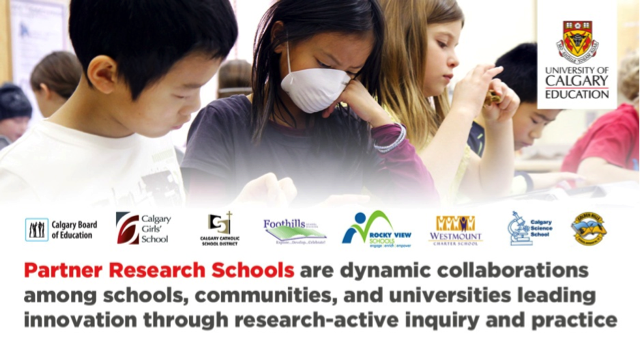
A little over two years ago I was asked to become the Director of Partner Research Schools, a new initiative in our Werklund School of Education. Delighted at the challenge, I immediately said yes and then wondered, what exactly does this mean? As time passed and people asked me what my role was and what were Partner Research Schools, I found myself stumbling for a response.
-
Creating Supportive Environments for Students with Disabilities
Comments Off on Creating Supportive Environments for Students with DisabilitiesOften when “to do” lists are presented, people think that they are doing what they should to create supportive environments for students with disabilities. I have seen far too many examples of what very well intentioned people think is participation and inclusion, but could not be farther from the truth. As long as we continue to see people with disabilities as separate in any way, they will never be included. We need to fundamentally change our mindsets in schools in order to truly welcome all students and create environments that are safe and inclusive. I use just a few examples of events that I have witnessed over my years of involvement in the inclusion movement and ask why?
Why do we create “best buddies” programs that involve the “kind” students coming to a room with students with disabilities to play games or going to the movie with them one Friday afternoon a month? There are many clubs and activities that already exist in schools. Why not find the student’s passion and interest and include him/her in activities that already exist? That is how we create opportunities for real friendships. When we do include students with disabilities in their school activities, why do we feel the need for them to travel together as a pack with the EAs attached? The number one barrier to successful inclusion is that an adult is hanging out with a kid. Think back to when you were younger. Would you want to hang out with a kid who was always with an adult? What about high school graduations? Why do we have separate ceremonies or worse yet, parade a couple of students from a segregated class across the stage at the beginning of the ceremony to receive an award and then dismiss those students and their families that are sitting in the auditorium to head back to the segregated class to continue the ceremony. We allowed special access to the “real graduation” for few minutes and then dismissed them like we have their whole school career. Think of the messages given to these families, their children, and all of the student body about the place of students with disabilities in that school.
Carol Tashie, author and public speaker, talks of creating friendships in school. Friendship is not just about people with disabilities, but often this is the group that we overlook as needing genuine friendships. We think that if we create places for kids with disabilities to have a few people without disabilities drop in, we are creating friendships. What we are doing is more like peer support. Tashie very eloquently indicates the difference between peer support and friendship. Friendship occurs when two or more people discover common interests and develop a mutually satisfying relationship. Peer support is the kind of help one student may give to another student, sometimes via an adult’s request. She also indicates that it is true that friends often provide support, and peer support can sometimes develop into friendship. However, they remain very different kinds of relationships.
There are so many opportunities that exist in our schools. We do not need to create separate or special events for people with disabilities. We need to stop the charitable notion that we are doing something “nice” for students with disabilities because we include them. Students with disabilities need to have the same experiences for growth as all students. They need to be with their same age peers learning the curriculum that is provided by the school systems. Literacy and numeracy are life skills. Friendship is a life need.
I met a boy once who changed my whole philosophy for inclusion. I used to think “how can you include kids who are nonverbal with mobility needs?” Then I looked in to his eyes and thought “how can you not include him?”. Value the dignity of the human person. Support genuine opportunities. That is how we create supportive and inclusive school communities for ALL.
This blog post is part of CEA’s focus on The New School Community, which is also connected to Education Canada Magazine’s The New School Community theme issue and a Facts on Education fact sheet How does parent involvement in education affect children’s learning? Please contact info@cea-ace.ca if you would like to contribute a blog post to this series.
-
Creating Strong, Vibrant, Supportive and Expansive School Communities
Comments Off on Creating Strong, Vibrant, Supportive and Expansive School Communities
-
The Salmon Forest of Education
Comments Off on The Salmon Forest of EducationEarly on in my career in education, I had one of those transformative, paradigm-shifting, change-the-way-I-view the world moments while reading David Suzuki and Holly Dressel’s book From Naked Ape to Superspecies. What really stuck out for me was their explanation of how scientists had discovered that the health of many forests in British Columbia was directly dependent upon the health of salmon populations, and vice versa.
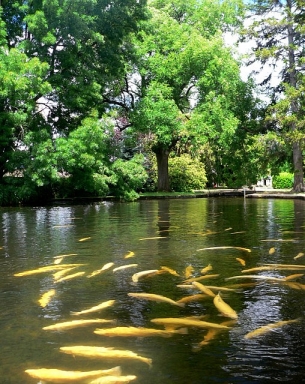
The salmon depend upon the trees to shade the streams and control water temperature, to provide nutrients, and to prevent soil erosion into the spawning beds. At the same time, the nitrogen from salmon remnants scattered across the forest floor by bears, wolves, eagles and ravens is an important source of fertilizer to help the trees’ growth. As trees disappeared, so too did the salmon. And as salmon disappeared, the health of the trees diminished. I was surprised and humbled to realize how interdependent these two seemingly unrelated and very different things, salmon and trees, were upon each other’s well-being.
While the Salmon Forest is a story of major ecological import, I think it is also a story of great social import, and a reminder that the ecological and social can’t be so easily separated. I share this story here in the context of education because it helped me realize that the health of a community is so dependent upon the health of all of its members. Each individual’s well-being is so deeply interwoven with the well-being of the community that it is impossible to create clear divisions.
The importance of biodiversity to the health of an ecosystem is now widely accepted, but I don’t think we’ve quite reached the point where social diversity is considered as essential to the health of communities. We hear much about the importance of “tolerance” or “accommodation” of differences, or about the “problems” posed by increasing diversity, but less about how integral social diversity is to fostering the growth of strong, resilient, supportive communities.
We can’t have healthy, safe communities if students continue to fear bullying and harassment based on parts of their identity, or if they lack access to the same resources that others enjoy. Or if teachers feel unsafe at work or parents and caregivers feel unwelcomed or judged at school.
We know that social, political and economic inequities continue to exist on many levels. We know that racialized groups, especially immigrants and First Nations, Métis and Inuit communities, continue to experience poverty and underemployment at much higher rates than others. We know that students with disabilities, mental health challenges, English as an additional language, or who identify as racialized, a religious minority, or LGBTQ are at greater risk of early school leaving. While males no longer excel at a higher rate than females within the education system, we know that income disparities continue to disadvantage women disproportionately. Knowing this, how do we build communities that are vibrant, strong and poised to succeed in a rapidly changing world?
If the Salmon Forest provides any indication, our success lies in recognizing our interdependency and nurturing the diversity of our communities. While some groups temporarily thrive on inequity at the expense of others, at the end of the day, we all lose, though some certainly experience greater harm than others. We can’t have healthy, safe communities if students continue to fear bullying and harassment based on parts of their identity, or if they lack access to the same resources that others enjoy. Or if teachers feel unsafe at work or parents and caregivers feel unwelcomed or judged at school.
Building vibrant communities requires fostering equity and inclusion, and not just accepting but leveraging the benefits of diverse abilities, ethnicities, cultures, faiths, sizes, genders, sexual orientations, languages and family structures, while working to reduce socioeconomic disparities. It means cultivating in all students and staff a sense of pride in their identity. It means drawing upon the knowledge, skills and resources that all students, parents and community members have to contribute to education. And it means fostering a sense of power to succeed and effect change.
Realizing these goals begins with the self. It begins with examining our own identities and the filters through which we interpret the world. What assumptions might we be making about particular students, staff, or caregivers? How do our own experiences shape our perceptions? How can we challenge ourselves to see things from a different perspective? What other possibilities might exist? Focusing our equity lens enables us to perceive the world in a different way, to notice the ways in which stereotypes and power imbalances might negatively impact some individuals and groups while advantaging others.
A supportive, inclusive and equitable school works together with students, staff, parents/caregivers and community members to create a space in which all participants are provided meaningful opportunities to contribute to and shape the educational experience. It is a place where everyone feels that their identity is not just represented but normalized, where they feel a sense of belonging and are valued as an integral member of the community. A school that fosters the health and well-being of all students anticipates and integrates diversity into the curriculum, instructional and assessment practices, the physical environment, extracurricular activities, outreach to parents and caregivers, resource materials and support services. Healthy schools mean equitable schools, where all students feel set up to succeed to the same extent as their peers.
-
Fostering Vibrant School Communities: An Asset Oriented Endeavour
Comments Off on Fostering Vibrant School Communities: An Asset Oriented EndeavourAs a result of my experiences as an elementary school teacher, an educational researcher and a professor of education, it has become clear that fostering school communities requires a paradigm shift in our collective thinking about students, parents/guardians and the community context in which schools are located.
All stakeholders involved in education need to understand and position people connected and engaged in schools in ways that are asset rather than deficit-oriented. There are many factors that currently ensure that deficit constructions of communities engaged in and with schools remain intact. These problematic and limiting ways of seeing and responding to people require that we re-think what we understand about and what we do in education. An asset-oriented focused approach to creating and sustaining vibrant school communities requires that we conceptualize what students, parents and the school community context possess in the way of diversity (e.g.: learning, cultural, linguistic, physical, socioeconomic, gender, sexual, religious, etc.) as valued and valuable capitol that needs to be brought into the school and drawn on in ways that help to create co-constructed, negotiated and contextually specific curriculum.
All stakeholders involved in education need to understand and position people connected and engaged in schools in ways that are asset rather than deficit-oriented.
Curriculum therefore needs to be understood as something that is not just simply written, officiated and given to school communities to deliver, but rather what occurs through reciprocal interactions or transactions between teachers, students, parents and the larger community within a particular context. Curriculum is comprised of or shaped by the activities, events, practices, materials and decisions made within a particular space negotiated between everyone who has a stake in and is part of the school community in relation to its contextual specificities. The culture created in classrooms and the school at large by all of these factors constitutes the development of a curriculum that fosters vibrancy, inclusivity, and support through a responsiveness to the diversity of assets located within that school community.
It is therefore essential for asset-oriented ways of creating curriculum to be aligned with an asset-oriented assessment and evaluation paradigm and its practices.
This necessary shift in thinking and doing is in line with basic human rights that have been identified in various documents that are legally binding. It is therefore essential that curriculum, and therefore assessment and evaluation practices begin to be shaped by a vehement belief in – and a focused gaze on – the plethora of resources that a variety of people interacting with schools possess. Curriculum and assessment and evaluation are inextricably linked to how well educators are able to understand, come to know and draw on students, their parents and the larger context. It is therefore essential for asset-oriented ways of creating curriculum to be aligned with an asset-oriented assessment and evaluation paradigm and its practices.
Educational systems that discursively herald community building and diversity cannot simultaneously insist on and require tools and procedures that cast entire school communities as deficient, broken and pathological. The structural continuance and subsequent understanding of curriculum and assessment and evaluation as mandated (standardized and fossilized instruments of normalization) does not allow for the professional and personal autonomy required of school communities to create a culture that allows for multiple ways of knowing and being to be tapped into. This is in order to ensure that personhood and not politics remains at the forefront of collective thoughts and efforts to create vibrant, human rights focused school communities that help foster critical autonomous citizens who see their worth reflected in schools.
Reference
Heydon, R. & Iannacci, L. (2008). Early childhood curricula and the de-pathologizing of childhood. University of Toronto Press.
This blog post is part of CEA’s focus on The New School Community, which is also connected to Education Canada Magazine’s The New School Community theme issue and a Facts on Education fact sheet How does parent involvement in education affect children’s learning? Please contact info@cea-ace.ca if you would like to contribute a blog post to this series.
-
Building Community
Comments Off on Building CommunityAround the world, our sense of community is changing. Technology and social media have made the world smaller than ever, and people are building their own communities, regardless of geographic boundaries. School communities are, inevitably, changing too. A more expansive concept of school seems to be emerging, with connections and relationships extending well beyond the school walls to encompass families, community partners and mentors, and “virtual” classmates from schools around the world. Within the school walls, an increasingly diverse student population and shifts in the roles of teachers and learners are also changing the dynamic. In this issue, we wanted to explore how educators can create and support vibrant, positive, creative school communities.
The articles that were contributed in response are a wide-ranging and inspiring look at what is possible. Chris Wejr (p.12) shares his experience using social media to include parents into the school community and reinforce positive school culture. Ray Derkson (p. 20) describes Manitoba’s innovative approach to ensuring strong community input and participation across a huge and widely diverse school division. And Thomas Arnett (p. 16) presents models of “blended learning” that change the structure of the school day and the relationship between student and teacher.
One of the inspirations for this issue was a two-day workshop CEA held in October 2013, titled, “What’s Standing in the Way of Change in Education?” As part of the process, participants were asked to share their personal vision of “the school of their dreams.” Person after person described schools rich in authentic, meaningful, and personalized learning experiences. But another strong thread had to do with community, as described in the summary report:
“The schools of their dreams are welcoming, collaborative environments, respectful of the many layers of diversity that now define the Canadian social fabric. They are places where a strong sense of community participation and contribution adds to the rich set of resources that can bring learning to life.”[1]
There may be a long way to go to fully achieve the “dream schools” described to us in the CEA workshop. But exciting changes are being made right now to create richer, stronger, more responsive school communities, as the examples in this issue demonstrate. Whether at the classroom, school or regional level, there is no lack of exciting ideas. To paraphrase Ray Derkson in his article, “Let’s try them and see what happens.”
This blog post is part of CEA’s focus on The New School Community, which is also connected to Education Canada Magazine’s The New School Community theme issue and a Facts on Education fact sheet How does parent involvement in education affect children’s learning? Please contact info@cea-ace.ca if you would like to contribute a blog post to this series.
[1] Read the whole report at: http://cea-ace.s3.amazonaws.com/media/CEA-2013-2014-AR-Annual-Performance.pdf
-
Futures Start Here
Comments Off on Futures Start HereEducators are in constant competition with the ever-increasing wireless and communicative world of students. Outside of juggling fire, performing illusions, and donning a duck costume, teachers are constantly working on engaging students in learning.
The fact is, students who are not engaged do not achieve. This fact is not lost on the professionals within Regina Public Schools.
With graduation rates between 68 and 72 percent, the senior administration at Regina Public Schools – one of the largest school divisions in the province of Saskatchewan – empowered students and professionals to challenge the norm. This empowerment has led to the creation of a new learning community in Regina: Campus Regina Public. Campus Regina Public is an interest-based career-pathway option for Grade 11 or 12 students to study within a unique educational community.
In 2009, the senior administration of Regina Public Schools tasked a group of superintendents, administrators, consultants, and teachers to research new ways to engage students. This task continued through 2014, and is continually evolving. The initial process employed a very traditional model of inquiry involving research, site visits (throughout North America), concept and implementation plans. While this model of inquiry was the needed first step, the professional group realized that a traditional research model would only recreate a traditional learning community.
The solution, while not necessarily new or innovative, was to focus primarily on the wants, needs and advice of students, in consultation with the advice of industry leaders in the community. Each high school was asked to select 40 to 45 students from various demographic backgrounds to give feedback on the current state of education. There were many themes reported, but overwhelmingly, certain themes were central at all schools:
- Students believed that teachers were working extremely hard and that teachers cared immensely about their students.
- Students were bored at school. The term “dying in my desk” was used by numerous students. School needed to be more activity based and less theoretical in nature.
- Students expressed that the skills they were learning did not meet the needs of ever-changing industry.
- Students were tired of being asked for input and then having their input ignored because it did not fit into the traditional model each school employed.
- Students wanted to be challenged to show what they have been taught in a practical sense rather than through a written test.
Additional focus groups were held with members of various industries in Regina and surrounding areas. Industry participants reported the following:
- Students need to be taught basic Math and English skills in order to meet the needs of industry. But equally important was the ability to problem-solve and work as a member of a team.
- Schools need to provide real-world opportunity for students to develop the soft skills necessary to function in every industry.
- Industry partnerships should be developed with schools directly in the classrooms rather than the traditional corporate sponsor relationships that currently exist.
- The massive need for skilled employees was not being met within the current education system.
The next phase was to take these ideas formulated at the division level and implement them at the school level. The findings of the traditional research combined with the use of student and industry feedback became the foundation of Campus Regina Public.
The challenge was to ensure that the feedback of students and industry would drive the development of the learning environment that Campus Regina Public would become.
The Campus Regina program
Campus Regina Public explicitly answers the question every educator has heard: “When will I ever use this in real life?” Students become a part of an educational community that brings together elements of secondary education, post-secondary and industry. Courses are designed to integrate a core credit (Math, English, Science, Social Studies) and an elective credit into a cohesive, relevant and in-depth learning community. Carefully designed industry partnerships and direct industry involvement provide a relevant and authentic environment for student learning. Many of the courses provide students with the opportunity to achieve certifications necessary for industry; for example, WHIMIS, First Aid, CPR, and Scott Safety Training. The learning environment at Campus Regina Public has industry standard equipment and lab spaces.
Essentially, Campus Regina Public gives students the opportunity to discover if they would be suited to be employed in certain areas. Students are given the opportunity to explore and take risks, while achieving credits toward graduation and learning specific career skills.
Campus Regina Public offers 20 different career pathway courses, selected to meet student interest and industry need, with such varied options as:
- Construction Technology (Math and Construction)
- Financial Services (Math and Accounting)
- Graphic Design (English and Graphic Arts)
- Application and Video Game Design (Computer Science and Communication Media)
- Fire Sciences (Chemistry and Physical Education)
- Performing Arts (English and Theatre)
- Oil & Gas Production (Social Studies and Mining)
Campus Regina Public does not specifically target students; students of all abilities and skills who feel this approach is more conducive to their learning style are welcome.
Core competencies for curriculum are evaluated based more on performance than on theory.
Sample courses
Electrical and Electronics: Students apply mathematical formulas and measurements while connecting basic circuit panels. Students eventually will apply the knowledge gained to perform the wiring of multiple rooms, thus fulfilling components of both the Electrical and Math curricula. Finally, students will be sent out into the field with our industry partner, SaskTel, to learn from actual industry members in the field.
Cosmetology and Health Sciences: Students collaborate on real-world accident scenarios. The Cosmetology students create the scenarios, fulfilling the English curriculum components of writing and speaking, and apply make-up and prosthetics to actors, thus fulfilling the Cosmetology curriculum components. Health Science students evaluate the scene, diagnose injuries and apply first responder skills, fulfilling both Biology/Health Science and Work Experience requirements.
One unique aspect of Campus Regina Public is the industry partnerships that have been developed for almost every course. This practice has allowed for a relevant and current industry reality in an educational environment.
For example, our Law, Public Safety and Security course (LPSS) is a partnership between Campus Regina Public and the Regina Police Service. The Regina Police Service provides a member of the service (who also holds a valid teaching degree) to collaborate with another teacher on a daily basis. The LPSS course is designed to emulate Police College. Students are required to wear uniforms and follow an agreed-upon moral code.
Another example is a newly developed partnership with Capital Auto Group. Senior management staff from Capital Auto Group have been instrumental in the design of a new lab and in the acquisition of tools and supplies. However the partnership, as with all our partnerships, is based on reciprocation. For example, the automotive facilities will be available for use by Capital Auto Group for their own training when not being used by the school. The Capital Auto Group team has agreed in principal to provide training for our teachers, to provide work experience for our students and ultimately, to interview and possibly hire some students.
Student response
In just two years, Campus Regina Public student enrolment has doubled. In the first year over 300 students registered and this year we had over 600 hundred students. The projections for the 2014-15 school year anticipate close to 900 students enrolled.
Feedback from students has been positive. In a speech to a chapter of the Regina Rotary Club, Riley Wood described her experience:
“By taking both these classes I was able to explore two careers that were of interest to me, which were Social Work and Nursing. Getting the chance to explore these career paths in detail, while attaining two credit courses as well, was very beneficial to me, especially while approaching my graduating year.”
Does Campus Regina Public improve outcomes? Ultimately, the program’s success will be measured by students who graduate and acquire employment. Our first two years indicate that the new educational community created at Campus Regina Public is improving outcomes. In our first year, students successfully completed 89 percent of all credits. First Nations and Métis students successfully completed over 65 percent of all credits. In this year, overall successful first semester completion was 91 percent, and 73 percent for First Nations and Métis students; second semester was 92 percent, and 80 percent for First Nations and Métis students.
Our slogan says Futures Begin Here. At Campus Regina Public, we truly believe that futures do begin here!
For more information: http://campusreginapublic.rbe.sk.ca
Photo: courtesy Jason Coleman
First published in Education Canada, September 2014
EN BREF – Le programme axé sur les carrières Campus Regina Public s’adresse à tous les élèves de 11e et de 12e année fréquentant actuellement les écoles secondaires publiques de Regina. Offrant des cours spécialisés de deux crédits portant sur des carrières et donnés par des professionnels sectoriels chevronnés utilisant du matériel de pointe, le programme fonctionne en partenariat avec des entreprises et des industries locales afin que tous les programmes de formation procurent aux élèves les compétences professionnelles requises pour travailler. Par la planification de carrières, l’enseignement de compétences, les cours magistraux, l’accréditation et l’expérience de travail pertinente, les étudiants sont prêts à accéder directement à la population active ou à entreprendre des études postsecondaires.
Le processus de création d’une nouvelle communauté d’apprentissage, qui repose sur la pertinence et l’authenticité, a été déterminé par les élèves et documenté par l’industrie locale. L’article traite de la création de ce programme expérientiel conçu pour aider les étudiants à trouver leur voie professionnelle.
-
Teaching and Learning Beyond the Classroom
Comments Off on Teaching and Learning Beyond the ClassroomBreaking the mould of K-12 classroom-based teaching and learning is what the University of British Columbia’s Teacher Education Community Field Experience is all about. Increasingly, educators are pursuing opportunities that take them beyond familiar school contexts into alternative, rural, international and non-school-based contexts. The focus on beginning a teaching career in a classroom similar to the one in which one was educated has expanded to a much broader view of where teaching and learning take place and also where a Bachelor of Education can lead.
In UBC’s recently reimagined BEd program, teacher candidates spend more time than ever in schools, with three practica (weekly day-long visits, two-week fall practicum, ten-week spring practicum). They also undertake a three-week community field experience (CFE) to broaden their concept of educational spaces and opportunities. In most cases, the CFE occurs outside of schools in placements hosted by community partners, while some take place in a school context that is very different from the practicum site (e.g. a secondary level candidate might spend three weeks in a Grade 1 classroom, library or resource room), in rural locations, or internationally.
The K-12 classroom is a crucially important educational context that provides the backbone of experience for preparing to teach, but there are other sites where education also takes place. The purpose of the community field experience is to expand and enrich the notion of where and how education occurs. Teacher candidates:
- spend time observing and working in a variety of educational settings;
- imagine aspects of non-formal, alternative or international education that might inform their classroom practice;
- recognize and articulate educational community and/or international links to local schools;
- develop questions to frame an inquiry into places of learning outside schools;
- collaborate with peers to share observations and develop questions;
- demonstrate their inquiry and learning through a blog, journal or brief presentation.
Mwebi and Brigham posit that “preservice teachers, teachers, and others in schools, teacher education programs, and elsewhere have a collective responsibility to ensure that knowledge systems in teacher education are expanded.”1 Teacher candidates who have practicum experiences in alternative settings are likely to broaden their understanding of formal education and enhance their educational competencies and philosophies. Anderson, Lawson, and Mayer-Smith2 conducted a study of teacher candidates in a pilot community field experience in an aquarium setting. The researchers’ intent was to equip the candidates with skills that could be easily transferred across a variety of educational contexts. They concluded that teaching in unfamiliar or non-traditional environments can help educators develop a more holistic view of education. Benefits to the new teachers were both pragmatic – in developing new teaching skills as a consequence of adapting to the new context – and philosophical – in coming to know how individual and collective understandings are constructed.
Community-based contexts
UBC’s community partners welcome teacher candidates who have completed their final practicum to assist in co-creating and delivering educational programs and curriculum resources for school-age students, pre-school children, seniors, community members or others. The skills and dispositions that teacher candidates bring to these activities are appreciated by community partners, and the benefits to candidates include expanding their vision of learning and teaching in the wider world. Some examples of UBC/community partnerships include:
- Arts-based settings, such as galleries, arts and music programs in schools, film study;
- Community service organizations, such as neighbourhood houses, animal shelters, youth detention centres;
- Early childhood education sites, such as daycare centres, pre-schools;
- Health and wellness centres, such as Dalai Lama Centre, health authority, kids’ cooking programs;
- Indigenous education centres, such as Aboriginal health initiative, First Nations band schools;
- Independent, private and faith-based schools, learning centres and academies;
- Museums and cultural centres, archives, halls of fame, historical sites;
- Recreation and outdoor education sites, such as parks, gardens, camps;
- Science education sites, such as science or ecological centres, space centre, aquarium, marine centre;
- Special education programs and centres;
- Sustainability and environmental education sites, schools, and projects, wilderness programs.
“I learned that I have a passion for teaching students in an outdoor setting and I gained several valuable hard skills that will hopefully assist me in one day constructing an outdoor classroom for future students… I felt reinvigorated as an educator by my CFE experiences.” – Teacher Candidate, Abbotsford Outdoor Education Program
“Your students are shining stars! They are a great addition to our team. They have jumped right into the program and have already created resources and materials to support our English Language learners! I feel so fortunate to be working with them and learning from them.” – Coordinator, Engaged Immigrant Youth Program
Rural contexts
Rural teacher education is an important focus of UBC’s BEd program. Our program in the West Kootenays stresses place-based learning, a connection to community, and sustainability. Rural placements for the CFE are selected by 40 percent of UBC’s teacher candidates. As McMurdo emphasizes when explaining his commitment to teaching in remote communities, it is important to prepare students “who can advocate for their communities and the planet, are capable of critical thinking, understand the social and economic contexts around them, and have the skills and creativity to help their communities grow.”3
While the rural CFEs are largely school-based experiences, the connections to community organizations are strong, meaning that candidates have opportunities that extend well beyond the classroom walls for their own and their students’ learning. Placements are situated in eight rural school districts, from northern BC to western Vancouver Island to Haida Gwaii. As well, there are three camp locations associated with urban districts that provide place-based learning paralleling a rural context.
“My rural field experience was terrific for many different reasons. One reason is that it gave me the ability to compare and contrast two different educational systems. It wasn’t that one school or district was better than another but, rather, that the new experience allowed me to reflect on education in much more complex and useful ways.” – Teacher candidate, rural school
Alternative school programs
Teacher candidates may spend three weeks in school settings that are different from the regular practicum context, such as a learning resource room, school library, adult basic education program or online distance-learning centre. These CFE placements provide a glimpse into contexts outside the regular classroom where students receive support and where different teacher-mentors can share their wisdom. Candidates who speak French may choose placements in Montreal or Quebec City, or in French immersion or Francophone schools in B.C. or Yukon.
“Participating in UBC’s community field experience was an extremely rewarding experience for me as a teacher candidate. To branch out and learn about different areas of education dramatically changed some of the ways I view pedagogy.” – Teacher candidate, alternative school
International contexts
Opportunities abound for teacher candidates able and willing to travel to Australia, Cuba, France, Germany, Hong Kong, Kenya, Mexico, Philippines, Singapore, Sri Lanka, Swaziland, Uganda, the United Kingdom or Switzerland. Research indicates that for teacher candidates, international experiences “increase their self-awareness, and enhance their personal efficacy and understanding of cross-cultural, diversity, and globalization issues, which informs their subsequent teaching practice.”4
“The Ugandan people taught me the power of teaching in a local community with limited resources but the heart to persevere and overcome obstacles with undeniable faith and commitment! It was truly one of the best experiences that I have participated in.” – Teacher candidate, international vocational centre
Finally, UBC’s International Baccalaureate (IB) Educator5 stream within the Teacher Education Program opens up even more possibilities, in Canada and internationally, both during and after the BEd program. Teacher candidates in the IB stream engage with an international view of education in which the world serves as a broad context for inquiry, for learning and for action.
“It was amazing to see how dedicated these kids were to their craft. I taught band and found that they were really excited to be there. They were so interested in the material. They got a chance to inquire about the things they were curious about. ” – Teacher candidate in an IB school
UBC’S Teacher Education program’s mission is to prepare local and global educators for a future where flexible educational programming and varied contexts will likely become more and more commonplace. As CFE coordinator Keith McPherson points out, the CFE provides a flexible learning model that encourages teacher candidates to take a leadership role by collaborating with their community partner to design engaging learning experiences for themselves and their students.
With the opportunities afforded by the community field experience, preservice teachers can increase their conception of how and where children, youth and others learn within and beyond the classroom as they develop their capacity to be responsive, adaptable educators.
More information: www.cfe.educ.ubc.ca
Photo: courtesy Wendy Carr
First published in Education Canada, September 2014
EN BREF – Pendant le programme de trois semaines intitulé Community Field Experience (CFE) de l’Université de la Colombie-Britannique, des candidats à l’enseignement découvrent de nouveaux lieux d’enseignement et d’apprentissage qui sont très différents de leurs stages. Ces contextes comprennent des écoles alternatives, des galeries, des musées, des centres de la petite enfance, des centres d’éducation autochtone, des écoles indépendantes, des centres culturels, des centres de loisirs et de plein air, des centres de détention pour jeunes, des organismes de santé et de bien-être, etc. Le CFE est particulièrement axé sur les sites ruraux en Colombie-Britannique et sur des endroits à l’étranger. Il procure aux candidats à l’enseignement des possibilités d’élargir leur conception des lieux pédagogiques potentiels et indique comment ils peuvent s’engager à titre d’éducateurs dans différents contextes.
[1] B. M. Mwebi and S. Brigham, “Preparing North American Preservice Teachers for Global Perspectives: An international teaching practicum experience in Africa,” Alberta Journal of Educational Research 55, no. 3 (2009): 416.
[2] D. Anderson, B. Lawson and J. Mayer-Smith, “Investigating the Impact of a Practicum Experience in an Aquarium on Pre-Service Teachers,” Teaching Education 17, no. 4 (2006): 341-353.
[3] S. McMurdo, “A Guide for New Teachers and Teacher Candidates in Rural Communities (Vancouver, BC: Office of the Eleanor Rix Professor of Rural Teacher Education, 2012), 3.
[4] Mwebi and Brigham, “Preparing North American Preservice Teachers for Global Perspectives,” 414.
[5] UBC offers Canada’s only International Baccalaureate Organization-recognized teacher education program.
-
Manitoba’s Frontier Division
Comments Off on Manitoba’s Frontier DivisionAs the chief superintendent of Frontier School Division, I love to tell people about the work our division is doing across Manitoba in the area of community development. To understand our efforts to develop the leadership capacity of residents in the communities Frontier School Division serves, it is important to gain some insight into the nature of the Frontier School Division.
A common term used to describe our division is “unique,” defined as “being one of, being distinctive and being without a like.” This certainly fits Frontier.
While we share similarities with other school divisions, our unique characteristics are clearly apparent. Our geography covers over 440,000 square kilometers and we are mandated to provide educational services to all children wherever they live, no matter how remote.
We encompass 40 communities spread out across Manitoba. Each of the communities we serve has unique characteristics. While most are populated with peoples of Aboriginal ancestry, there are vast differences between the aspirations, cultural identities and often the languages of each community. For example, our division encompasses the Cree, Dene, Oji-Cree, Saulteaux/Ojibway, Dakota and Metis people.
I can say with some certainty that we are the only division in Manitoba that operates a formal bus route with a snowmobile and sleigh (Stevenson Island). In Disbrowe, Ministic and Stevenson, community residents are hired as boatbus drivers to transport our students. Frontier is often perceived as a northern division and we do gain a great deal of our identity from the North. What surprises those unfamiliar with our geography is that we have schools as far southeast as Falcon Beach in the Whiteshell and the Birdtail Sioux Dakota Nation in southwest Manitoba.
Our 42 schools range in size from five students in Disbrowe (Red Sucker Lake) to 1,100 students in Helen Betty Osborne Ininiw Education Resource Centre (Norway House). We provide housing in many communities, operating over 300 housing units, as well as water and sewage treatment plants.
Frontier provides educational services to 14 First Nations, with each partnership governed by an Education Agreement reflecting the First Nation’s aspirations. Our services require the participation of both the federal and provincial governments because many of our communities include children who fall within both funding jurisdictions. Approximately 54 percent of the division’s revenue comes from the federal government, while school taxes provide around 2.5 percent. We employ approximately 600 education staff (teachers, principals, vice-principals and consultants) and 900 support staff.
Home-grown staffing
Historically, our division has faced the challenge of attracting the necessary staff to maintain educational services and in some instances, our teacher turnover rate was as high as 25 percent. For many years we received minimal interest in advertised positions.
Another challenge facing Frontier is building a teaching population that is reflective of the people we serve. Thirty years ago, only a few teachers of Aboriginal ancestry worked in our division. The communities demanded more teachers who were reflective of their population. Responding to this imperative, in cooperation with Brandon University, we pioneered the Program for the Education of Native Teachers (PENT) program.
PENT students work in divisional schools from September to April, then attend Brandon University from May to July, in a repeating cycle lasting six to seven years. To date, more than 400 local community members from across Manitoba have graduated as teachers. The PENT program, which is ongoing, has made our teaching population much more reflective of the makeup of the people we serve, significantly reduced teacher turnover and has built leadership capacity within our communities.
Our school division also faced the challenge of finding qualified support staff from within our communities for a whole range of positions. It became apparent that if we wanted staff with particular qualifications we would have to take on the responsibility of providing the training.
As the need for counselors grew within our schools we established a counselor training program, with the result that the school division now has fully credentialed counselors. We followed a similar model for librarians, bus drivers, and to some extent, educational assistants.
In all of our training programs, our focus has been on identifying community members who have the desire and raw potential to be successful. We support and enhance applicants’ initial educational levels and concentrate more on their desire, character and potential to do the job. Critical to the success of our job training model is that once an individual is hired, the division continues to give as much support as possible to ensure their success. Our expectation is that, in a reasonable period of time, candidates will gain the full academic qualifications for the job. We call our approach to hiring “building our own.”
Frontier is the main employer in many of our communities. Our division can take a great deal of the credit for training hundreds of people to become certified teachers, counselors, librarians and administrators. We have “shared our wealth,” contributing significantly to many other organizations and school divisions that have hired people in whom we have invested. For the most part, we do not begrudge providing this service and sharing with the rest of the province!
Frontier School Division covers most of Manitoba and serves 42 schools ranging in size from five to 1,100 students. The question for Frontier is: how do we ensure the unique voice of each community is heard?
Ensuring community voice
In addition to adding enormously to the training levels of people within our communities, we have had a significant influence on developing the leadership capacity in thousands of individuals throughout the division. To a large extent, this has been the result of our three-tiered model of governance.
Respect for the aspirations of each community lies at the heart of our school division. The question for Frontier is: Within our vast geography, how do we ensure the unique voice of each community is heard and the wishes of the people are respected?
The answer lies in the three-tiered governance model established in The Public School Act (PSA). Being founded in legislation gives the school committee real authority, real responsibility and a strong voice of local control from the community. It also lies in our continual emphasis on building the leadership capacity of the hundreds of community members elected to provide community leadership for the local education system.
Every four years, while divisions hold school board elections for, on average, 10 trustees, Frontier conducts an official election for approximately 229 school committee positions throughout all of our communities.
Tier One: The Local School Committee of Trustees
At the heart of our model of governance is a group of five to seven elected members in each of our communities, called the Local School Committee. Approximately 229 individuals serve on 40 school committees across the division. Their role is established in the PSA, which gives the committee authority and responsibility for their mandate. Each committee operates under an approved constitution, terms of reference and code of conduct.
The elected members of the school committee provide direction and advice to the principal in six main areas. School committees are involved in all staff hiring and evaluation, recommending capital projects and facility improvements, and budgets. Committees also help develop policies, procedures, programs, and activities at the local and divisional levels.
As a school division, we have complete commitment to the local committees and expend significant time and resources strengthening this system. School committees are trained on interviewing, school assessment instruments, record keeping, basic accounting and the legislation that governs the school system. Committees are required to conduct business with formal meeting procedures. We employ four governance support officers (GSOs) to provide necessary training to support committee members in fulfilling their responsibilities effectively. GSOs are an important resource to help school committees resolve internal issues and to support their crucial relationship with school administration.
Through committee participation, thousands have discovered their leadership potential while influencing the education of children and adults within their communities.
Tier Two: The Area Advisory Committee
The Frontier School Division is divided into five regions based largely on geography. Once a school committee is elected for each school within a region, a member is elected to represent the community on their Area Advisory Committee (AAC). The Division has five AACs made up of 50 members.
Area Advisory Committees meet three or four times yearly, helping to provide communication with the Frontier School Board of Trustees. Similar to school committees, AACs operate under a legislative framework, an approved constitution, terms of reference and code of conduct. AACs play a major role in the development of policies, procedures and programs, and are responsible for regular reports about their local schools and communities. They are forums for important regional issues to be identified.
Tier Three: The Central School Board of Trustees
Once school committees have elected representatives for the Area Advisory Committees, each AAC elects two members to sit on the Frontier School Board. The Board is comprised of ten members and operates under the same legislation as all other provincial school boards.
Expectations for the individuals who sit on the Frontier School Board in terms of their personal commitment are very high. In addition to two days of board meetings per month and committee work, trustees actively participate on the AAC and their local school committee. Given the geographic location of many of our trustees, attending a one-day meeting often involves two or more days of travel. Participation on the Frontier School Board has been a life-changing experience for many of the trustees who have served our division.
Each February, the Frontier School Division Board hosts a School Committee Conference. Local school committees participate in a range of sessions and professional development activities to support them in their governance responsibilities at the local level. The conference also showcases programs taking place across our division. Here, our hundreds of committee volunteers can meet and be inspired by colleagues doing the same kinds of work throughout the province.
“Let’s do it and see what happens”
In the many conversations I have had explaining the importance of our governance system, a common comment is, “How do you accomplish anything?” Despite the complexities of carrying out our mandate, our experience has not been of paralysis but one of innovation, community commitment and loyalty to the division.
As a division, we believe the individuals who have the biggest stake in the local schools and communities are the people who reside there. The legislated requirement that the system be responsive to local input has enabled us to be highly active in community development, because that is what the local communities have demanded.
Local communities have wanted training programs for local people. They were not content to see outsiders being brought in to take away jobs when jobs were scarce. The division responded to the demands of the communities by shaping programs reflective of the aspirations of each community. Many of the division’s flagship programs, such as our student fiddling program, started because one community wanted something done and their requests were respected.
When ideas come forth, our response as administrators is, “Let’s do it and see what happens.” Is everything successful? Of course not – but we have been successful enough to receive recognition from the United Nations for our gardening program, to have had our student fiddlers play for Her Majesty the Queen of England, to have trained hundreds of teachers of Aboriginal ancestry, to have given thousands of our community members opportunities to realize their leadership capacities, to have enabled communities to develop local community histories used in the school curriculums and most importantly, through our collective engagement with the communities, to have generated hope where hope had been in short supply.
As I lie awake at night, I weigh the challenges our system presents and agonize over mistakes made. I ask myself, is it worth it? Does the system deliver what we promise?
I then have to put our many successes on the other side of the scale: I have to put the Elders there, who never thought they could have a meaningful role in their school; I have to add the individual who left school in tenth grade and is now a qualified teacher; I have to put the single parents who became professionally trained counsellors.
I have only to remember the look in the eyes of the hundreds of local governance volunteers who have enormous pride in the contributions they are making to their community, and then I can feel at peace with the work we do. Once I weigh all these things, I can sleep at least for a few more hours… until my phone rings again!
This article was first published in the Manitoba Association of School Superintendents Journal 14, No. 2 (Fall 2013). It has been edited to fit Education Canada’s editorial requirements.
Illustration: Dave Donald
First published in Education Canada, September 2014
EN BREF – Couvrant plus de 440 000 kilomètres carrés, la Frontier School Division du Manitoba est chargée d’assurer des services éducatifs à tous les enfants, où qu’ils vivent, même dans les lieux les plus éloignés. Administrant des écoles d’entre 5 et 1 100 élèves et desservant des collectivités comprenant six peuples autochtones distincts, Frontier a mis au point une structure de gouvernance unique en son genre et des programmes d’apprentissage locaux grâce auxquels chaque collectivité peut exprimer ses aspirations, les écoles peuvent répondre aux besoins des collectivités locales et les membres des collectivités peuvent obtenir la formation et le soutien requis pour exceller comme dirigeants et membres du personnel. Tant par l’offre d’hébergement que d’usines de traitement des eaux usées en passant par l’établissement d’un parcours d’« autobus scolaire » par motoneiges et traîneaux, Frontier a suscité un modèle créatif et localement adapté de ce que peut être une communauté d’éducation.



IDEAS TO SUPPORT EDUCATORS : Subscribe to the EdCan e-Newsletter
Quality research, reports, and professional learning opportunities.