Archive
-
Building bridges, not walls: Leveraging student diversity in the classroom
Comments Off on Building bridges, not walls: Leveraging student diversity in the classroomA new fact sheet by the national EdCan Network of educators entitled How Can Teachers Maximize Engagement among Multilingual Students? outlines practical ways that Canadian teachers can implement inclusive learning strategies and programs that heighten engagement among students from immigrant backgrounds.
Authored by Dr. Jim Cummins, professor emeritus at the University of Toronto’s Ontario Institute for Studies in Education (OISE/UT), this timely resource reveals that students who are encouraged to use their home languages alongside the language of the classroom will come to view themselves as talented and accomplished speakers of multiple languages who are more likely to engage academically.
“With ever-increasing racial, linguistic and religious student diversity, we’d like to provide concrete support to educators and education leaders who are grappling with how they should create more culturally and linguistically inclusive spaces despite having limited knowledge of students’ home languages or experiences,” says Max Cooke, EdCan Network Interim CEO.
In addition to the downloadable copy of the fact sheet, available at www.edcan.ca/multilingual, also included are several examples of teacher-driven projects that leverage students’ multiple languages as enrichment opportunities for all students.
This fact sheet was made possible with the generous financial support of the Desjardins Foundation and the Canadian Schools Boards’ Association.
-
Protecting Pollinators Through Experiential Learning
Comments Off on Protecting Pollinators Through Experiential LearningIt started when one teacher saw a TV ad about saving the bees – and grew into a national program, Bee City Schools, integrating outdoor education and technology into school-wide projects focused on saving pollinators.
We would like to introduce educators to the Bee City Canada/Bee City School Program, an important initiative that is quickly making its way through elementary and secondary schools across the country. The original objective of the Bee City School Program was to encourage an inquiry about the bee crisis and the role that pollinators play in our food cycle. Currently, Bee City Schools are expanding this inquiry by integrating outdoor education and technology into school-wide projects while encouraging parents and communities to join students in their learning.
In 2017, the Bee City School Program became a recognized certification from Bee City Canada. The origins of this initiative are modest and began in 2015 as we, two teachers in Scarborough, Ontario, were working on a partnering plan for an upcoming Science unit. It started when Ashleigh White, a Grade 4 French Immersion teacher, saw a CheeriosTM commercial that encouraged consumers to “bring back the bees” and decided to use the ad as an introduction to character education in her classroom. Thinking that this might also be an opportunity to begin working with a colleague on a Science Buddies project, Ashleigh approached Grade 8 teacher Doug Whiteside.
Together, we felt a call to action and were immediately motivated to open an inquiry project that began by asking, “What is happening with the bees?” A true inquiry often requires teachers and students to connect with resources and people outside of the school. Ashleigh began to reach out to organizations in Toronto, and with a little research, she found Bee City Canada, a charitable organization that was in the final stages of becoming officially recognized by Toronto City Council. She thought she might be overreaching, but Ashleigh took a chance and made a call to Bee City Canada. Director Shelly Candel responded within one day and graciously offered to visit the school and help answer some of the students’ questions. This was the first workshop that Bee City presented to students, and the response from both classes was beyond expectations. The seed had been planted and so came the idea to offer more workshops based on new questions stemming from the Bee City Canada classroom visit. The roots of the Bee City School Program sprouted that day.
Our aim with the Bee City Canada Schools initiative is to cultivate a climate that encourages students to ask questions and to be critical thinkers and problem solvers by examining real-world contexts. We strongly believe that our growing network of Bee City Schools has come to realize that through inquiry, experiential learning and “getting our hands dirty,” we can begin to make positive change in our communities. Our program is unique in that it can implement a broad range of current teaching practices into one school-wide initiative that welcomes all learning entry points. We also generate support from parent councils, local government officials, and businesses who are inspired by the team building that is now so evident throughout the hallways of our member schools and in the vibrant pollinator gardens that were established and are now diligently maintained by students ranging from Kindergarten to Grade 8. Our network has come to realize the severity and the implications of the declining bee population in Canada and around the world. We also know, however, that it’s not too late to do something about this problem. By taking action and planting bee-friendly flowers, as well as educating our communities on the dangers of pesticide contamination, we believe that we are helping to create a new culture of students as global citizens of character. We hope they will become the future leaders of collaborative inquiry devoted to reversing the decline of pollinators in Canada.
Bee City Canada, a federally recognized charitable organization, welcomed Toronto as the first Bee City in 2016. In the Spring of 2016, Tredway Woodsworth Public School in Toronto was declared Canada’s First Bee City School. We revamped our STEM program with a project that would offer students a lens into real-world, large-scale problems. This endeavour commanded collaboration among students and teachers in order to achieve our learning objectives.
Students were very eager to develop a strategy that would answer the call to action for citizens to reverse the decline of pollinators. Jeremiah, a Grade 3 student, stated,
“I really want to help the bees because they are important to our world. They spread the pollen that our fruit and vegetables need in order to flower. If the pollen isn’t spread to the flowers, then a lot of our food sources will disappear. Bees are helping our ecosystem to survive.”
This testimonial was one that came about through the exploratory stage of the problem-solving model that is typically used in math, but can and should be applied to early stages of inquiry work in science as well. Through brainstorming and communication, students were able to better understand the problem even if possible solutions were not yet conceptualized.
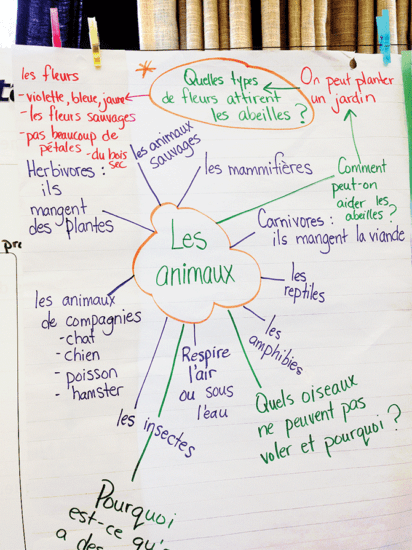
Ashleigh White’s Grade 4 French Immersion class began with a brainstorm chart highlighting some key inquiry questions into the condition and decline of bees and other pollinators. Following the exploratory stage, the inquiry captured the attention of Grade 7 and 8 classes. The older students created an action plan by designating a space for a small pollinator garden that would host indigenous plants, as well as some very creative and visually stimulating bee hotel structures. They discovered that pollinators respond well to colourful and stimulating artifacts and structures that are situated in close proximity to the plants. Vaidehi, a Grade 8 student, captured the class discoveries perfectly, stating,
“When we placed our bee hotels and sowed the seeds for the indigenous plants, we made sure that the hotels were colourful and that the seeds were pesticide free, as this is one of the leading factors causing the decrease in the bee population.”
Students took pride and ownership in preserving and protecting their pollinator garden space. The curiosity spread throughout the school, with questions such as, “What plants attract the bees the most?” and “Do bees communicate with each other?” Discussion and discovery became commonplace as evidence of inspired inquiry work.
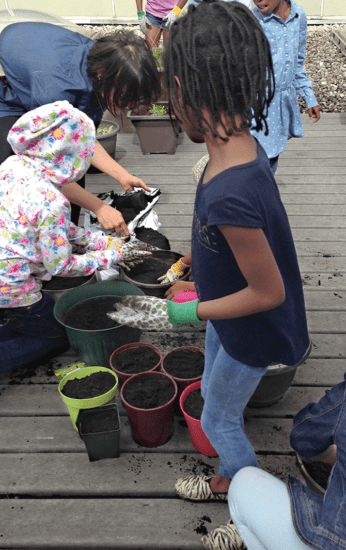
Ashleigh White’s Grade 4 students pot pollinator-friendly plants and flowers for the school’s Pollinator Garden 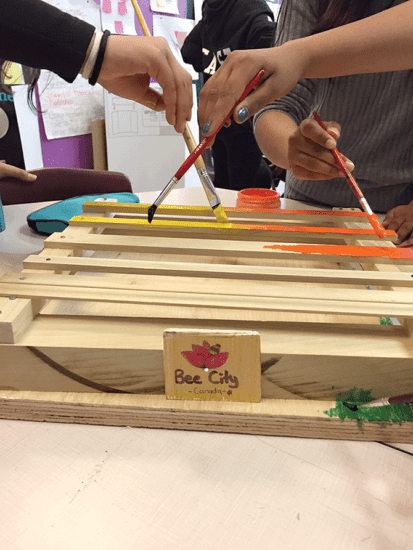
Doug Whiteside’s Grade 7 science students construct and decorate “bee hotels” that offer a temporary rest or pit stop for pollinating native bees and butterflies. Eventually, Bee City Canada invited us to help them develop an application process whereby schools throughout Canada could work on similar initiatives and inquiry. Realizing that our inquiry project could guide other schools to educate students about pollinators and the bee crisis, Bee City Canada relied on our experience to establish this new program. The Bee City School Program was created when Bee City Canada saw the work that was taking place in our school. This rich learning opportunity could not be contained to one school, and our school became the model for Bee City Schools to emulate. Subsequently, Bee City Canada has invited both of us to sit on the board of directors as representatives for the Bee City School Program. In June of 2018, Doug was given the title of Bee Schools Director and he now acts as the liaison for existing and future Bee Schools.
Small classroom projects may grow into school-wide initiatives once the school community becomes more aware of the issues that their inquiry addresses. The thriving pollinator and vegetable garden that was entirely established by students at our school, with support and funding from Bee City Canada, is just one example of the positive work that we are doing to support the community as a whole. Before embarking upon this project, we developed a solid connection with our local city councillor, Glenn De Bearemaeker. He is just one of our great supporters and he was thrilled to join our students at the “2017 Tredway Woodsworth Pollinator Fair.” Mr. De Bearemaeker connected the local community and our school by creating awareness amongst his constituents and engaging in the important conversations necessary to effect change.
Following a cycle of inquiry allowed us to let go of some of the rigidity of conventional teaching and, three years later, students have become independent learners, innovative knowledge builders and creative thinkers. By focusing on the authentic problem of the declining bee population, students are continually empowered to explore the potential of their own school community. Creating and tending to a pollinator-friendly garden has encouraged students to connect with nature as they learn about native plant species and how pollinators help to sustain natural environments. Researching and building structurally sound and visually stimulating bee hotels offers experiential learning and opportunities for students to solve problems using real-world contexts.
As recipients of the EdCan Network’s 2017-2018 Ken Spencer Award for Innovation in Teaching and Learning, we are dedicated to realizing the change that school communities can make by embracing the environment as an authentic outdoor learning space. Ultimately, an initial brainstorming session that was designed to involve students in their Science lesson has grown into a widely successful project that has become an ever-expanding network of shared learning and practice. We have developed a website – www.pollinatorcentral.com – where teachers and communities can blog with us about our experiences and understanding of the world of pollinators. We also launched an e-learning curriculum resource site with the introduction of our first course, called “Pollinator Protector Course,” in partnership with Bee City Canada. On our site, edu.pollinatorcentral.com, we will continue to develop and launch courses about healthy soils and sustainable planting practices.
Through this site, our shared practice continues to develop and offer support to fellow educators, students and communities. We are learning together about the role of pollinators, especially native bees, in our environment and the effect that a continuing decline in their population will have on future generations if action is not taken. Our students are answering the call to make a change, and we are eager to provide them with the tools that they need to successfully implement and expand this project for years to come.
Learn More
All Photos: courtesy Doug Whiteside
First published in Education Canada, December 2018
-
BrainReach/Mission Cerveau
Comments Off on BrainReach/Mission CerveauBrainReach, a volunteer program based in McGill University, sends graduate neuroscience students into classrooms across Montreal to lead hands-on science lessons about the brain.
When you ask a child to draw a picture of a scientist, what is the result? Many might think of an Einstein look-alike with wild hair, dressed in a while lab coat and mixing colourful, bubbling chemicals. But those perceptions can change dramatically when someone who doesn’t fit that image comes into a classroom, identifies herself as a researcher, and begins to make science tangible and accessible to young thinkers. Personal connection can break the traditional barriers that separate academia from the general public and circumvent the media-as-gatekeeper pattern that we see so often. It transforms science from “something that other people do” into “something I can interact with.” Here is the story of one graduate program in Montreal that is making just such a connection with kids throughout their province.
Beginnings
BrainReach was spearheaded in 2011 by Dr. Josephine Nalbantoglu, then-director of the Integrated Program in Neuroscience at McGill University. (See “Resources” for links to this and other programs mentioned in the text.) Ian Mahar, a graduate student presenter and coordinator at the program’s inception, remembers: “Josephine called a meeting and asked if anyone wanted to help build this initiative known as BrainReach, and a number of us raised our hands to get involved. We had no idea how it would build from there, though I’m sure we would have been surprised to know.”
BrainReach sends graduate student volunteer educators into classrooms across Montreal to lead hands-on science lessons about the brain. The key to BrainReach was having the same presenters come back to one classroom multiple times, to build a rapport with the students and field their questions as they grew in curiosity and comfort. According to Jenea Bin, another of the first BrainReach coordinators: “We decided to target underserved schools in Montreal, as these students do not always have the same access to science learning materials. At the high school level, these schools also tend to have higher dropout rates.”
Another approach that has distinguished BrainReach since the beginning is its emphasis on developing a curriculum that is coherent with the current research about learning – we are a neuroscience program, after all! Each presentation has to have a few interactive activities to help kids experience the material (not just hear it). We help the students observe brain cells through microscopes, touch a real brain, record electrical signals from their muscles, and learn about perception with prism goggles. Reviews are built in at the end of each session, as well as the beginning of the next one, to help with learning retention. The initial curriculum was developed over the course of a year, and from then on we have been updating it constantly, since neuroscience is a field under rapid development.
The BrainReach North branch was developed in 2013-14 to serve kids in the north of Quebec. “I have a family branch in a small community on Baffin Island called Cape Dorset,” explains Emily Coffey, who laid the groundwork for the new branch. “In those small communities up north, many children have even less access to science. They can’t be taken to museum trips, and may never meet a scientist.” This required a re-imagining of BrainReach, leading to online guides for teachers and videos to explain concepts and take advantage of the same hands-on activities in places we couldn’t send graduate students in person.
Responses to the program
“I enjoyed it immensely from the first presentation, and was hooked; I remember wanting to work with as many classrooms as I could,” recalls Ian. He and many volunteers after him were motivated to bring in the newest research, cultivate a hunger for learning in their students, and challenge neuroscience myths (Do you really use only ten percent of your brain? No!).
Nowadays, we also hear from parents asking for the BrainReach program to come to their son or daughter’s school. This is heartening, and we are thrilled that parents are willing to act as liaisons for us – but it is imperative that the teacher is also on board. Teachers have limited classroom time, and even in elementary school they have a curriculum to get through. In order for a teacher to feel that it is worthwhile for them to give us hours of classroom time, we have to address the ways in which BrainReach covers parts of Quebec’s standardized curriculum; we also have to adequately communicate the benefits of the program to their students. For example, students need to learn about the scientific method and its associated terminology. So, in our session about brain cells, we ask students to make a hypothesis (or “educated guess”) about what a neuron will look like before they take a look in the microscope, recording their predictions in the form of a drawing. Then, we have the children look and draw what they see, just like the great scientists who first observed these amazing cells.
BrainReach sessions are also used to inform students about the neuroscience behind relevant social issues. In the high school curriculum, a full session is devoted to mechanisms of drugs and addiction, and in elementary school, we talk about how sleep affects our attention, mood, and memory.
Once a solid contact is made, it is a “win-win-win” situation – teachers get help preparing their science class, the kids get to develop relationships with people currently involved in neuroscience research, and the graduate volunteers gain crucial presentation skills and a connection to the world outside academia. “The children are always excited to know that the BrainReach presenters are coming,” one teacher commented. Ben Gold, who has been a presenter with the program for four years straight, remarked that he has also learned a lot about neuroscience by returning to the basics, thinking about things from the students’ perspectives, and working with teaching partners who have different areas of expertise. Another volunteer, Cindy Hovington, was so inspired by her experience that she went on to found Curious Neuron, an organization dedicated to translating research into accessible content for the public.
Challenges
As the organization became bigger, we had to systematize and structure the program. This is a challenge for neuroscience graduate students, who are used to more solitary work in their own labs, and are contributing to BrainReach entirely on a volunteer basis. In fact, it was (and continues to be) a crash course in project management.
We formed subcommittees for Elementary, High School, and North, each with about ten people. While some recruited and matched volunteers with schools, others focused on refining the curriculum and translating it into French. Still others inventoried and distributed supplies for our interactive activities on a weekly basis. We streamlined our work using online tools such as Google Drive, Wikispaces, and Slack.
At each turn, we were supported by the boundless enthusiasm and energy of our program’s graduate students, but we also depended upon the consistent backing of program administrators. In addition to the Integrated Program in Neuroscience’s structural support, we partnered with Montreal’s Centre for Research in Brain, Language and Music for extra funding, an extended pool of potential volunteers, and the ability to give one-time workshops as a part of the 24 Hours of Science initiative. We even began taking on interns from Concordia University’s John Molson School of Business to help us develop a more professional presence and seek funding.
Kelly Smart, BrainReach North’s current president, has the additional task of communicating cross-culturally and establishing working relationships at a distance. “We approach this by collaborating whenever we can. We seek out people and groups who already have the connections and expertise we need, and we try to work with them and learn from them. It takes a lot of persistence and a willingness to listen and adapt constantly,” says Kelly.
Finally, as with any volunteer-based organization, resources are an issue. BrainReach does not have a fully sustainable funding model, and for the most part we have worked with donated equipment and temporary office spaces. However, the program has received some important boosts, including a Telus grant, as well as a recent crowdfunding campaign that brought in over $12,000! These funds will help us to plan better for the future, and invest in key infrastructure elements such as a website, as well as allowing us to send volunteers into Indigenous communities to give science camps as part of BrainReach North.
School engagement
We are still developing and refining the program based on feedback from volunteers and teachers, but the most reliable measure of success is whether schools continue to sign up. And they do! This year, we have sent 100 volunteers to over 30 schools in the Montreal area, and have sent volunteers on teaching trips to three remote northern communities. Under the leadership of Marisa Cressati as high school coordinator, we saw a spike in the number of registered high schools and non-traditional classes (like homeschool co-ops and classes for kids with special needs). We hope to see other university groups learn from our experience and establish similar programs, especially in an age where media trends can obscure the difference between good and bad science. Giving science a “face” can change the way people interact with it, at any age.
Resources
Brainreach: Come say hi to us on social media!
Facebook @BrainReachMissionCerveau
or follow the BrainReach North Blog
Integrated Program in Neuroscience
Photo: courtesy Anastasia Sares
First published in Education Canada, September 2018
-
CALL FOR APPLICATIONS: 2018 Ken Spencer Award
Comments Off on CALL FOR APPLICATIONS: 2018 Ken Spencer AwardHas your learning program made a positive impact on previously disengaged and disadvantaged students so that they connect with local and global cultural and environmental issues to develop a strong sense of ownership in their learning?
For ten years, the Ken Spencer Award has discovered and profiled courageous classroom innovators who have made learning relevant and exciting by providing students with the autonomy and flexibility to think critically and solve real-world problems.
Seven cash awards totalling $15,000 are available to be won for your school.
Check out our award-winning programs from last year for inspiration and apply today!
TELL US ABOUT YOUR PROGRAM IN 250 WORDS OR LESS
This could be your year to receive the recognition and validation that you and your colleagues deserve to honour your courage and perseverance.
Winning entries will be profiled nationally – to encourage peer-to-peer learning – in Education Canada Magazine (articles, Podcast interviews and opinion pieces). For ten years, we’ve seen the lasting positive impact that this award can bring to educators and their schools.
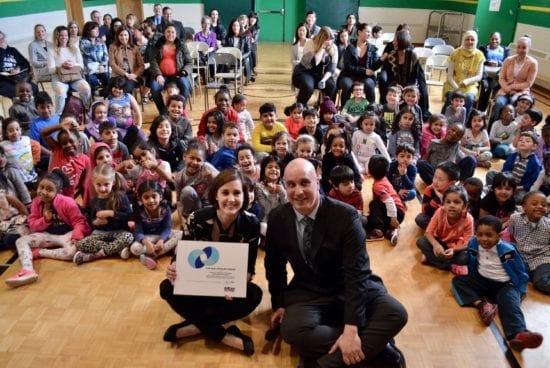
2017 Ken Spencer Award ceremony for Wexford Public School’s Deaf/Hard of Hearing Co-Enrollment Program, Toronto District School Board, Toronto, Ont. The deadline to submit your Stage 1 online application form – which will include a summary of your program in 250 words or less – is 5pm (Pacific Time) November 5, 2018.
For details on how you can apply, please visit: www.edcan.ca/kenspenceraward
-
New guidebook on early school leaving
Comments Off on New guidebook on early school leavingNew EdCan Network case study research report entitled The Rural Advantage: Rallying Communities Around Our Students calls on school-community leaders to consider a made-in-Canada approach that raises literacy rates, prevents early school leaving and breathes life back into small towns.
It’s an all-too-common scenario in Canada’s rural communities. Parents who struggle to read and write. Household incomes and unemployment rates that fall below the national average. Students with special needs who require a speech pathologist or a teaching assistant, but don’t get one. Schools at risk for closure and dwindling community services as young people dropout of school or opt for brighter opportunities in the big city. But these trends can be reversed with a “community ecosystem approach”: a Canadian-developed, step-by-step process for developing school-community partnerships that can reduce student dropout rates in rural and disadvantaged schools and municipalities.
“Our grade-four French-language success scores have risen from 50% to 98% in only five years,” says Sylvain Tremblay, principal of both an elementary school and a high school in Saint-Paul-de-Montminy, Quebec. “Instead of working in silos, we engaged parents, kids, teachers and community partners to collectively lead activities that increase the language skills of toddlers and encourage the academic and social success of our children and young adults.”
This guidebook was originally developed with the support of CTREQ – a Quebec-based research and knowledge mobilization centre – and provides a practical toolkit and worksheets for school and community leaders to create their own unique program, including guidance on how to engage hard-to-reach families, classrooms, schools, and whole communities.
“Schools can’t afford to work in isolation from the families and communities where their students live and grow up,” says Darren Googoo, Chair of the EdCan Network, a pan-Canadian collective of education leaders. “This approach isn’t about overloading busy educators; rather, it’s about community leaders rallying around a literacy action plan that leverages existing resources and strengthens existing efforts.”
Download the full report for free, including how-to videos and a practical toolkit, at: www.edcan.ca/ecoreussite-report.
SUPPORTED BY

This initiative is generously sponsored by State Farm Canada, which shares EdCan Network’s commitment to supporting leaders who are transforming Canada’s public education system.
-
Guided Physical Play in Kindergarten
Comments Off on Guided Physical Play in KindergartenFive-year-old Nancy is busy with clay. At first the chunk she pulls off is too hard to shape, but she’s learned to warm and knead it until it’s softer. She rolls it into a long cylinder and coils the tapering “bug” to attach to her leaf. Then she pulls off two larger bits of green clay to make more leaves for her growing tree. “Too big,” she mutters, and pulls them off again. She cuts one of the balls in half and tries again, this time using her fingers to spread the clay into a thin leaf shape perfect for her imaginary tree.
Play is often described as “the work of childhood.” While the idea of play eludes any single definition, the thread that unites various types of childhood play is pure and simple pleasure. It is its own reward and is self-reinforcing.
In this short article, we make a pitch for a greater focus on fine motor control through guided exploratory play in the Kindergarten program, emphasizing the importance of direct tactile experiences – handling and manipulating objects or materials in the real world in real time. This type of play fulfills several important goals of early childhood learning. First, body-object interaction (BOI) supports the development of stable, internalized models for learning the world: its shape, size, speed, distance, texture, structure, and whole-part relationships, for example. Concepts of shape and size are key to alphabet recognition and the type of reasoning that is foundational for early numeracy understandings in Grades 1 and 2.
Second, guided physical play promotes fine motor control. The Kindergarten years are the time to afford opportunities for play with tweezers, popsicle sticks, crayons, markers, and clothes pegs to strengthen the muscles and the neuropathways for the demands of written literacy, beginning just around the corner!
Finally, BOI develops the associated vocabulary as children learn to name and describe their interactions with the material world.1 Children with nimble fingers are found to have a larger developed lexicon of concrete objects, and interestingly, of more abstract concepts, too. Suggate and Stoeger suggest that “embodied cognition” enjoys a processing advantage, and that the connections between cognition, language and physical contact with the material world provide distinct benefits to youngsters who have had rich opportunities for these types of experiences in early life.

Figure 1: Writing Sample
We find plenty of evidence, however, that Canada’s young children are generally not sufficiently engaged in this type of play prior to their arrival in Kindergarten. The Early Development Instrument (EDI) analyzes Pan Canadian data on five-year-old children on five domains.2Outcomes indicate fewer than 50 percent of Canada’s young children are developing as they should along all five domains of early development. The ParticipACTION 2016 Report Card reports that only nine percent of Canada’s young children are getting the recommended amount of daily exercise, and increased numbers are not getting enough sleep.3 Our own work with Grade 2 children who are gifted revealed their overall lack of readiness for the demands of early written literacy learning, as noted in their distinct, belaboured printing efforts.4 (See Figure 1: Writing Sample.) Our intervention of explicit printing instruction using a programmatic, developmentally progressive approach can, we found, change the slope of the educational trajectory. However, remedial or “catch up” teaching is more difficult and time consuming than “just right teaching” might have been in the sensitive window of time in Kindergarten and Grade 1. Hence our motivation to focus on guided physical play at a much earlier stage in the educational experiences of young students.
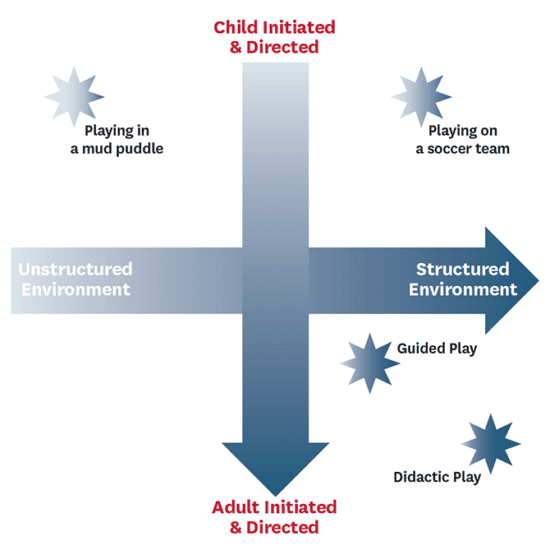
Figure 2: Matrix of Types of Play
We position various types of play by way of a framework we have organized around two continua: from child-initiated and directed to adult-initiated and directed; and from unstructured to structured play. (See Figure 2: Matrix of Types of Play.) We locate guided play in the mid-zone of the lower right quadrant, and define it as:
Purposefully designed activities and tasks that we think will be engaging and fun, are directed to some learning goal, and reflect a sense of pedagogical intent. Children’s motivation, curiosity, desire for mastery and their choices for how they interact with the materials are elements of the design. Children are actively involved in advancing embodied cognition and neuro-motor skills relevant and necessary to early language and literacy learning.
The research literature on play-based learning places a much heavier emphasis on inquiry, pretend, imaginative, discovery, fantasy, creative, and socio-dramatic play that is child driven, all types of play that would be located in the upper left quadrant. We advocate for a more balanced approach in the Kindergarten program.
Inspired by Montessori’s5 ideas about the role of the prepared environment and the importance of the materials children play and work with, we suggest the following 11 activities as a starting point to our colleagues in the field who might also be thinking of re-aligning their Kindergarten program. The possibilities are limited only by a teacher’s imagination, though!
- Blocks, bricks: Play with blocks and bricks promotes spatial reasoning as children develop concepts of size and shape, stability and structure.
- Lego pieces: Shapes that fit together and can be taken apart to create something new help to develop the concept of parts to a whole. Meanwhile, all that pushing together and pulling apart of little pieces develops fine motor skills and strong fingers. My friends who are architects and civil engineers say Lego was their favourite toy as children.
- Bits and pieces: Something as simple as a jar of buttons and a tray are enough for children to handle and sort for size, shape, colour, and then create sequences and patterns. As mentioned earlier, these foundational concepts developed through nimble fingers are crucial for numeracy and literacy learning.
- String and beads: Make a necklace! This can include making a pattern or sequence of coloured beads.
- Paper, scissors, crayons, markers, glue sticks, collage materials: Fold, cut, decorate, and print a simple message to make a card for Grandma’s birthday.
- Real-life objects: Using tweezers, clothes pegs, and chopsticks, children develop a good pincer grip through guided experiential play that simulates everyday tasks.
- Shared storybook reading: Books such as Rosie’s Walk (Hutchins, 1971) promote “languaging” around directional words, and imagining and drawing objects in space. Henry’s Map (Elliott, 2013) and Lucy in the City: A story about developing spatial thinking skills (Dillemuth, 2015) may serve as a bridge to learning activities that promote spatial reasoning through finger tracing and drawing maps.
- Play with clay: Kneading, molding and manipulating plasticine clay gives little fingers a great workout! Can they shape their ball of plasticine into an object that will float in a tub of water? Children delight in trying various shapes, with those “ahead of the curve” figuring out that weight and shape both play a role in whether the object will float.
- Origami for kids: folding and creasing, concepts of pattern, symmetry, sequence. There are dozens of simple projects for children to do: flowers, frogs, airplanes… the list is extensive.
- What’s in the bag? Fill a bag with “mystery” objects. Children take turns reaching in, focusing on one object, and describing the object by size, shape, structure, texture, what it might be used for, etc. for the class. Who’s the first to get it right?
- Slime! A current craze among kids is making and playing with magic slime. It is made with just a few easy-to-obtain ingredients, such as glitter glue and powdered fibre supplement. This strengthens small fingers. It also teaches procedural language and provides a simple chemistry lesson.
The human hand is complex and versatile – elegantly and exquisitely unparalleled in design to do the work of gripping, grabbing, holding, folding, pushing, pulling, punching, kneading, threading, stacking, rolling, throwing, squeezing and squishing.6Through our sense of touch and our tactile connection to the world, we learn the world and engage with it, constructing the stable internal models that are necessary for numeracy and literacy development. These experiences need to be mediated through elaborative and collaborative talk between adult and children. As educators, we are responsible for preparing children for literacy and numeracy learning by engaging little fingers in guided play that lies at the intersection of cognitive, linguistic and neuro-motor integration: embodied cognition. Guided play can make this mandate fun, exciting and productive.
We want to know what you think. Join the conversation @EdCanPub #EdCan!
Photo: iStock
First published in Education Canada, March 2018
1 Sebastian Suggate and Heidrun Stoeger, “Do Nimble Hands Make for Nimble Lexicons? Fine motor skills predict vocabulary of embodied vocabulary items,” First Language 34, no. 3 (2014): 244-261. http://journals.sagepub.com/doi/abs/10.1177/0142723714535768
2 Magdalena Janus and Caroline Reid-Westoby, “Monitoring the Development of all Children: The Early Development Instrument,” Early Childhood Matters 125 (2016): 40-46.
3 ParticipACTION Canada, “Are Canadian Kids too Tired to Move?” The ParticipACTION Report Card on Physical Activity for Children and Youth (2016). https://www.participaction.com/sites/default/files/downloads/2016%20ParticipACTION%20Report%20Card%20-%20Full%20Report.pdf
4 Hetty Roessingh and Michelle Bence, “Intervening in Early Written Literacy Development for Gifted Children in Grade 2: Insights from an action research project,” Journal for the Education of the Gifted 40, no. 2 (2017): 168-196. http://journals.sagepub.com/eprint/Qh7ZS5zKKStQgesK4ibZ/full
5 Angeline Lillard, “Playful Learning and Montessori Education,” American Journal of Play 5, no.2 (2013): 157-186. www.journalofplay.org/sites/www.journalofplay.org/files/pdf-articles/5-2-article-play-learning-and-montessori-education_0.pdf
6 Jerry Bergman, “The Human Hand: Perfectly designed,” Creation Research Society Quarterly 50 (2013): 25-30. www.creationresearch.org/members-only/crsq/50/50_1/CRSQ%20Summer%202013%20Bergman.pdf
-
The Signal: Multi-Grading iGen-ers and Alpha Geners
Comments Off on The Signal: Multi-Grading iGen-ers and Alpha GenersWhat?
Multi-grading – combining two grade levels in one classroom – may not appear to be a signal of change at first glance. After all, it’s been around for generations; some might say since one-room schools. However, in Canada more than 20 percent of students were registered in multi-grade classes in 2015, with the number continuing to grow – an educational trend being experienced worldwide.1 And yet, what do we know about our current students’ (iGen-ers) and future students’ (Alpha Geners) experiences with multi-grading? Do we know how to meet their multi-grading needs?
So what?
This worldwide educational trend is based on research that shows students in combined classes performing as well and better than peers in single grade classes.2 Greg has seen first-hand how students benefit from some aspects of multi-grading, especially in the context of smaller class sizes. He has found that pedagogical practices such as differentiated instruction and heterogeneous groupings are proving (anecdotally) more effective in supporting student growth, development, and learning in a multi-grading context.
However, there is a gap in our knowledge about how best to educate iGen-ers and Alpha Geners in multi-grading classrooms. In a time when multi-grading is showing unprecedented growth, we need current research supporting best practice. And although teachers like Greg, relatively new to multi-grading, have been provided professional learning on multi-grading, it has not always been best suited to the needs of the multi-grade teacher. To compensate for this, Greg has had to create his own online/email groups and set up meetings and opportunities to connect with his multi-grade peers on the weekends and evenings. Since research on current best practice can be difficult to locate, there is an overreliance on teacher trial and error to determine what will best serve these new generations of learners, the increased diversity of student learning and developmental needs within one classroom, and also departmental/ministry expectations.
What next?
Supporting student success is the ultimate goal of quality teachers and quality educational programming. With multi-grading gaining momentum in Canada and internationally, we need to capitalize on its strengths. This requires systematic implementation and investigation of multi-grading in today’s educational contexts, with and for current iGen’ers and future Alpha Gen’ers, as well as a community within which to share this information with and between practitioners.
Participant reflections on signals of change
Participants at the 2016 EdCan Network Regional Exchanges discussed more signals of change than we could possibly cover — but we wanted to share a sense of their range and significance. We invited a number of participants to write a short piece reflecting on one of the signals they brought to the Exchange.
Discover more signals at: www.edcan.ca/RegExReport
We want to know what you think. Join the conversation @EdCanPub #EdCan!
Photos: Max Cooke and Yolande Nantel
First published in Education Canada, March 2018
1 Globe and Mail (September 17, 2015). https://beta.theglobeandmail.com/news/national/education/are-split-grades-something-to-worry-about/article26390439/?ref=http://www.theglobeandmail.com&
2 E.g. Gajadharsingh, 1991; Goodland, 1987; Veenman, 1995.
-
The Signal: The demand to build adaptive expertise
Comments Off on The Signal: The demand to build adaptive expertiseWhat?
The demand to build adaptive expertise in educators is a powerful signal of change. Recently, I sat in on several sessions at an educational technology conference, where seven local school districts collaborated to share knowledge. As I watched teachers at all stages of their careers gather in classrooms to learn and exchange ideas in areas ranging from apps for teaching math to online portfolios for student assessment, it reminded me that the goals we share go beyond simply keeping pace with the latest tech tools. The premise of a peer-led conference is illustrative of how we must approach education’s most profound shift in a century.
So what?
The demand to develop adaptive expertise matters because educators must prepare learners for a world that few can imagine: a world where technology often outpaces our understanding of its implications, where the global village demands collaborative solutions, and where critical thinking is our only life vest in a swelling tide of information. Educators and learners alike need to build their skill set for adaptive expertise: critical and creative thinking, collaboration, and the willingness to engage with others.
Now what?
Teachers need to model the change in practice that allows these skills to become habits or attributes in the lives of learners. This is how we develop resilient learning communities. As Stephen Downes of Canada’s National Research Council wrote, “We need to move beyond the idea that an education is something that is provided for us, and toward the idea that an education is something that we create for us.” We demonstrate a willingness to adapt as we create space and opportunities for personalized learning, build understanding of shared histories, and use technology for deeper learning. Even learning spaces must transform – rows of desks and the hierarchies they underline are often incongruous with the collaboration required to propel real innovation. As educators, if we can recognize our own inter-dependence, we can build resilient, lifelong learners who understand their power to both adapt to and shape the world around them.
Participant reflections on signals of change
Participants at the 2016 EdCan Network Regional Exchanges discussed more signals of change than we could possibly cover — but we wanted to share a sense of their range and significance. We invited a number of participants to write a short piece reflecting on one of the signals they brought to the Exchange.
Discover more signals at: www.edcan.ca/RegExReport
We want to know what you think. Join the conversation @EdCanPub #EdCan!
Photos: Max Cooke and Yolande Nantel
First published in Education Canada, March 2018
-
The Signal: A curriculum shift from content to connections
Comments Off on The Signal: A curriculum shift from content to connectionsWhat?
In response to an evolving global landscape, and to better equip students with the skills and abilities needed for the future, British Columbia is in the process of integrating a new curriculum for Grades K-12.
So What?
B.C.’s new curriculum provides greater flexibility to teachers, focusing on depth of understanding rather than simply recalling and regurgitating “Google-able” facts. This increased flexibility allows students to explore the curriculum through the lens of their individual passions and interests. By extension, the relevancy of curriculum is increased for both teachers and students. Exploring curriculum through the lens of a student’s interests allows for a more strength-based approach to education, providing increased opportunities for students to succeed based on their unique skills and abilities. Ultimately, it should result in greater engagement and ownership, creating a framework for meaningful learning experiences.
As well, by encouraging the development of a broader and more diverse range of skills, students will be better equipped for the challenges and opportunities that they will face in the future.
Now What?
This shift from content to connections necessitates a renewed focus on relationships between teachers and students. A culture in which relationships are valued as an essential component for student success requires an investment of time. In the midst of busy days, teachers must be provided with the time to learn the stories and context of their students, allowing them to facilitate meaningful connections between the curriculum and individual student interests. As such, districts and schools much invest in both informal and formal structures, providing a necessary framework in which to grow and sustain meaningful relationships.
The Advisory Model is one such example of a formal structure. This model provides a sustained, intentional and focused block of time, built into the school day, that allows teachers to connect with their students without the pressure to deliver specific content or curriculum. In an Advisory Model, connections are privileged over content. Research clearly indicates that students who feel like they belong, who are understood and supported by the adults in their school community, are more likely to achieve social and academic success.
Participant reflections on signals of change
Participants at the 2016 EdCan Network Regional Exchanges discussed more signals of change than we could possibly cover — but we wanted to share a sense of their range and significance. We invited a number of participants to write a short piece reflecting on one of the signals they brought to the Exchange.
Discover more signals at: www.edcan.ca/RegExReport
We want to know what you think. Join the conversation @EdCanPub #EdCan!
Photos: Max Cooke and Yolande Nantel
First published in Education Canada, March 2018
-
The Signal: Increased focus on closing the gaps for students with learning disabilities
Comments Off on The Signal: Increased focus on closing the gaps for students with learning disabilitiesParticipant reflections on signals of change
Participants at the 2016 EdCan Network Regional Exchanges discussed more signals of change than we could possibly cover — but we wanted to share a sense of their range and significance. We invited a number of participants to write a short piece reflecting on one of the signals they brought to the Exchange. Some appear below; others are published on the EdCan Network website.
What?
In 2016, the Ontario Ministry of Education launched the Learning Disabilities Pilot Projects. The goal of these projects is to provide better support for students with Learning Disabilities. Working with eight publicly funded school boards, the Ministry is running three-year intensive reading pilot projects. All eight school boards are using the Empower Reading Program, an evidence-based reading remediation program developed by the Hospital for Sick Children. In addition to addressing reading, school boards are also tasked with looking at ways to support the social-emotional functioning of students with learning disabilities and access to assistive technology.
So what?
Focused reading instruction takes place in the primary grades. As the system moves from “learn to read” to “read to learn,” students who struggle with reading after Grade 3 often receive little support or remediation to improve their skills. While some reading remediation programming does exist for older students, it is not widely available across the province, and varies greatly from school board to school board. As students get older, and fall farther behind their peers, positive academic and social-emotional outcomes become harder to achieve.
During the 2015-2016 school year, the Ontario Ministry of Education conducted a Consultation into the Provincial and Demonstration Schools, which are run by the Ministry and support students who are Deaf or hard of hearing, blind, Deaf/blind or have severe learning disabilities. At the time of the Consultation, many feared that the government was looking to close these schools. As a result of the findings, these schools remain open, and this pilot project was created to take some of the best practices of the demonstration schools, and reach more students through implementation at the school board level. As an educator who was working at a Demonstration School at the time of the Consultations, and who believes ardently that we must do what we can to find a way to support all students, the pilot projects represent a recognition that change is needed if we are to truly commit to teaching all students.
What now?
Moving forward, school boards can build upon the proven success of research-based reading remediation programs, such as Empower, and begin to implement them widely. We can recognize the emotional toll that learning challenges can place on a student, and develop social-emotional supports. All educators can refuse to accept the premise that a student with a learning disability may never learn to read well, and seek out ways to support all students to achieve success.
Discover more signals at: www.edcan.ca/RegExReport
We want to know what you think. Join the conversation @EdCanPub #EdCan!
Photos: Max Cooke and Yolande Nantel
First published in Education Canada, March 2018
-
The Signal: New media, new literacies
Comments Off on The Signal: New media, new literaciesWhat?
Whether it’s news, social media or classroom learning resources, images and video are gaining primacy over print. Many teens use Snapchat to share spontaneous images and video and many use it as their news source. Most classrooms have a projector connected to a computer, making it easy for teachers to use many kinds of media to teach.
If you want to learn how to repair something, learn a computer program, play the piano, or even how to write, search YouTube. You can share what you know, what you can do or the strange thing your cat did, on Youtube, Vimeo, Daily Motion, Twitter, Instagram or Imgur. If you’re interested in ideas or stories, you can listen to or create a podcast. Gamers can live stream their own game play or watch others play on Twitch. Audience size? Try 100,000,000 visitors a month. There are also many sites where you can take a course or create a course for free or a fee.
So what?
We need to prepare students to make sense and meaning with these new media texts that are increasingly a huge part of what we consume and create. And that means we will have to give up some old practices and attitudes.
As schools have been print-based, many in education continue to privilege print texts and to narrowly define literacy as the ability to read and write print texts. Rarely are we even teaching how print texts are written, presented and read differently online.
We talk about multiple intelligences in education, yet how prevalent are tests or exams that use multiple intelligences and multiple literacies?
Now what?
We need to invest our resources into teaching students how to critically analyze images and video and other new media. We need to teach our students the persuasive and expository techniques used in images and video and how to use them effectively. We can have students create video essays and post them online.
Traditional reading and writing texts are still important and won’t be going away. It is now a necessity, though, that schools teach students how to “read” and “write” with new media with the same urgency for creating literate students as before.
Rather than dragging past literacy definitions into the present, we need to bring present literacies into the future.
Participant reflections on signals of change
Participants at the 2016 EdCan Network Regional Exchanges discussed more signals of change than we could possibly cover — but we wanted to share a sense of their range and significance. We invited a number of participants to write a short piece reflecting on one of the signals they brought to the Exchange.
Discover more signals at: www.edcan.ca/RegExReport
We want to know what you think. Join the conversation @EdCanPub #EdCan!
Photos: Max Cooke and Yolande Nantel
First published in Education Canada, March 2018
-
The Signal: The average is nobody
Comments Off on The Signal: The average is nobodyWhat?
We are leaving out the majority when we design and implement curricula to meet the needs of the average student and the average teacher. This is the opposite of what most people believe about being average. We use the phrase “average Joe” to mean just about anybody but it actually describes virtually nobody. As Lori Hough wrote,
Schools were designed during the industrial age by people who were ‘absolutely obsessed’ with averages because averages worked so well in managing factories. The goal wasn’t to nurture creativity and develop individuality. The system mostly accomplished what it set out to do: prepare students for standardized jobs in an industrial economy. Since then, we have continued to think that the average — a human invention — represents everyone or that any deviation from the average is what defines you.2
So what?
If we are truly going to design education to meet the needs of all students, we need to start thinking about individuals. Who is our audience? Who are the primary benefactors of teachers’ work? In answering this question, we need to consider a paradigm shift in our thinking about what we are teaching and how we teach it. This is important to our work in developing an education system to support universal design for learning. The word “universal” might make some of us leery, thinking that it’s just another way of describing average. But it really means recognizing and celebrating diversity in our schools and in our curricula.
Now what?
To quote Bernie Sanders, “Change happens from the bottom up.” So it starts in the classroom with teachers and students. We need to ask: Is the way I’m teaching in the best interests of the students or in my own best interests? The answer to this question may lead us to advocate for more flexibility and autonomy. And this means we need to be prepared to be flexible, which is much easier said than done. It is much easier to keep doing things the way we have always done them. Change is hard but once there is evidence of a few individuals engaged in open, safe, collaborative dialogue about what we are doing in the classroom, momentum will grow. We can prepare for the challenges of change by inviting these classroom leaders to share their experiences at school board and government levels. Check out Shelley Moore’s bowling analogy3 about teaching for a great perspective: “We have to change our aim.”
Participant reflections on signals of change
Participants at the 2016 EdCan Network Regional Exchanges discussed more signals of change than we could possibly cover — but we wanted to share a sense of their range and significance. We invited a number of participants to write a short piece reflecting on one of the signals they brought to the Exchange.
Discover more signals at: www.edcan.ca/RegExReport
We want to know what you think. Join the conversation @EdCanPub #EdCan!
Photos: Max Cooke and Yolande Nantel
First published in Education Canada, March 2018
2 L. Hough, “Beyond Average” (2015). www.gse.harvard.edu/news/ed/15/08/beyond-average
3 S. Moore, “Transforming Inclusive Education” (2014). www.youtube.com/watch?v=RYtUlU8MjlY
-
The Signal: Understanding neuroplasticity
Comments Off on The Signal: Understanding neuroplasticityWhat?
Neuroscience evidence now proves that our brains are malleable, constantly creating new neural pathways and disrupting others. This means, in essence, that the pathways to create the patterns that we use to make decisions, which affect our learning behaviours, can be influenced by our teaching strategies.
So what?
This signal has the potential to be a serious game changer in education. The growing understanding of the neuroplasticity of the brain will have a tremendous impact on our ability to teach students and ultimately on student learning.
In my 27 years in education, it has been my observation that previous initiatives aimed at optimizing student learning, although well intended, were rarely successful. Until recently, the neurological science to support why a learning directive should be effective has not been available. With MRI diagnostic information, we are now able to have a clearer and more accurate understanding of how we learn, both physiologically and psychologically, and neuroscience is at the forefront of this revolution.
It is critically important for educators to understand the concept and implications of neuroplasticity, and how it can influence our teaching and the learning environment we provide for our students. We, and our students, need to view our brains as a muscle – one that, when exposed to the right environment, gets stronger. A growth mindset is our belief that intelligence can be developed, and that we, as educators, need to adopt the right strategies, effort and modeling to effectively assist students to learn and adapt.
Now what?
As school leaders, we need to ask ourselves, “What would the outcome be for our students if we developed a growth mindset with our staff?”
Research indicates a number of ways to promote a growth mindset:
• Model a growth mindset via professional development opportunities.
• Create a culture where failure is viewed as a learning opportunity, and where people feel safe to challenge themselves.
• Advance the importance of self-reflection and provide consistent opportunities to do so.
• Design a feedback system that is formative and responsive for staff, in which staff are active participants.
Developing a growth mindset is a long journey that requires sustained attention and focus. The desired outcome for our students – that they become more resilient, more intelligent and more prepared for effort – is a goal worth caring about.
Participant reflections on signals of change
Participants at the 2016 EdCan Network Regional Exchanges discussed more signals of change than we could possibly cover — but we wanted to share a sense of their range and significance. We invited a number of participants to write a short piece reflecting on one of the signals they brought to the Exchange.
Discover more signals at: www.edcan.ca/RegExReport
We want to know what you think. Join the conversation @EdCanPub #EdCan!
Photos: Max Cooke and Yolande Nantel
First published in Education Canada, March 2018
-
The Signal: Mapping language acquisition
Comments Off on The Signal: Mapping language acquisitionWhat?
MIT professor Deb Roy1 wanted to understand how his infant son learned language, so he wired his house with video cameras and parsed 90,000 hours of video to interpret how his son turned the sound “gaaa” into “water.” Roy used visual manipulations of data to create space and time “hotspots” that provided clues around language acquisition. These “hotspots” or data worms led to insights around how language develops in the very young.
So what?
Observing the work of academics, statisticians, program evaluators and data specialists clues us in to how our world is evolving and changing. These professionals are modeling new ways to combine perspectives, methods, information and technologies. Researcher Deb Roy maps data across the space and time continuum. Big data parses data for causality and evidence. Social network mapping organizes complex data into relational maps. New mapping technologies combine population data with geospatial innovation across disciplinary data sets. A data revolution is underway.
Now what?
Educators need to respond to this signal of change through evolving practice and a nimble interaction with information and technology. New data approaches offer incredible opportunities to leverage data to address important social issues. Amplifying innovative thought and preparing students to respond to multiple ways of thinking becomes a 21st century imperative.
Participant reflections on signals of change
Participants at the 2016 EdCan Network Regional Exchanges discussed more signals of change than we could possibly cover — but we wanted to share a sense of their range and significance. We invited a number of participants to write a short piece reflecting on one of the signals they brought to the Exchange.
Discover more signals at: www.edcan.ca/RegExReport
We want to know what you think. Join the conversation @EdCanPub #EdCan!
Photos: Max Cooke and Yolande Nantel
First published in Education Canada, March 2018
1 www.ted.com/talks/deb_roy_the_birth_of_a_word
-
The Signal: Questioning pedagogy
Comments Off on The Signal: Questioning pedagogyWhat?
Traditionally, students would “take blame” or ownership for what they know and don’t know. This mindset is shifting. The tables have turned. Students are starting to ask good questions about assessment practices and pedagogy, and to look critically at the teacher’s professional practice with a good sense of what’s fair and reasonable. However, schools are not a safe place for students to express their questions about how they’re being taught and assessed. They remain silent. They find their voice, however, on social media. With photos and quick comments, students express their concerns and feelings of injustice online with peers and possibly the world.
So what?
Students want to be active participants in their learning. They want a voice and have a strong desire for student agency and autonomy. The school system needs to respond. Students feel powerless and disengaged when they are expected to be complacent and compliant. Why should students wait for high school to end before figuring out what they want and love to do? K-12 is the time to play, experiment, and explore oneself and one’s strengths. The teacher or school leader should not be a barrier to this learning process. Fear-based learning comes from fear-based leadership. Students should feel safe providing formative feedback to teachers as advocates of their learning to enhance their learning experience in K-12 schools.
Now what?
Listen to students. Be responsive. Take action. This goes beyond the annual student forum or student council meeting. It’s about taking appropriate pedagogical action based on student feedback. This is an opportunity for teachers and school leaders to reflect on practice, policy, and doing what’s best for students and student learning. Ask, “Would you want to buy a ticket to attend your class or school?” Self-reflection, student feedback, and taking action must be visible, restorative, and responsive.
We need to pay attention to what students are saying and not get burdened or blinded by the grind or rigour of our work. Going beyond the ego and into a place that’s vulnerable, kind, and receptive, will help us become true partners in our students’ learning.
Participant reflections on signals of change
Participants at the 2016 EdCan Network Regional Exchanges discussed more signals of change than we could possibly cover — but we wanted to share a sense of their range and significance. We invited a number of participants to write a short piece reflecting on one of the signals they brought to the Exchange.
Discover more signals at: www.edcan.ca/RegExReport
We want to know what you think. Join the conversation @EdCanPub #EdCan!
Photos: Max Cooke and Yolande Nantel
First published in Education Canada, March 2018
-
Deep Learning
Comments Off on Deep LearningHow do we create the needed change to move from a system focus on content acquisition to a mindset that helps develop and grow this content knowledge in a deeper, more meaningful manner and helps all students to excel? Michael Fullan, Joanne Quinn and Joanne McEachen share some strategies and answers in their new book, Deep Learning: Engage the world change the world.
This book does not attempt to sell a pre-packaged program, nor does it encourage teachers to make subtle shifts in practice. Deep Learning shares an effective mix of the why and the how of Deep Learning through theory, strategies, and successful examples to create a cultural shift to “attack inequity with excellence.” Educators can tap into the strengths and talents of teachers and learners to better engage, make learning more meaningful, and “help all young people to flourish.” The authors describe a “fusion of the most effective pedagogical practices with emerging innovative practices that together foster the creation and application of new ideas and knowledge in real life.”
The authors do not simply share what is wrong with education; rather, they choose a strengths-based model by identifying effective pedagogies that occur in pockets within schools. They build on these examples to create system-wide change. By focusing on their 6 C’s (character, citizenship, communication, collaboration, creativity, and critical thinking – which align very well with the focus on Core Competencies in the redesigned curriculum here in British Columbia), conditions are created for deep learning and students gain the knowledge and skills they need to flourish in school and beyond.
As a principal, I thoroughly enjoyed the balance of research, examples, and ideas to move learning deeper in schools. The book is a fantastic entry point to deep learning and educators can go on to use the New Pedagogies for Deep Learning website (http://npdl.global) to watch videos, read additional resources, and connect with other educators from around the world who are working to shift their mindset and create this change. Educators can use this book as a resource to start the conversation or continue the dialogue to help create the needed shift in pedagogies and culture to move to deeper learning in schools.
We want to know what you think. Join the conversation @EdCanPub #EdCan!
Corwin, 2017 ISBN: 978-1506368580
Photo: Dave Donald
First published in Education Canada, March 2018
-
Micro-credentially
Comments Off on Micro-credentiallyTHE BACKGROUND
Tell us about your current role in education.
I work at the secondary level with students who have been suspended or expelled from regular programming. These are students who have been moved from their home school and assigned to me, for either the short- or long-term. In doing so they sometimes get to continue the courses that they started, but in other cases those courses have to be shifted because of the resources of our classroom.
So, in a sense, both you and your students are situated on the edge of the traditional high school context. How has that impacted your vision and the work that you do?
One of the things that I learned early on is that you have to make friends with everyone. Before I went into Alternative Education (Alt Ed), I taught hospitality and special education, and both of those had very specific departments and very specific support systems. So I didn’t have to look too far beyond the next desk to borrow resources and get help. When I made the shift to Alt Ed, it was like we needed running shoes! The students bring the courses with them and part of my focus is on finding the resources to help them get through those courses. So we had to move around to different departments, sit in on classes, learn how to teach new concepts.
I now have to pay attention to a lot of little moving pieces in the board. There are different initiatives, policies, resources and people to learn about and understand. I have had to develop a knowledge of community liaisons, law enforcement officials, superintendents, principals… and then there’s the home school and whatever their rules of engagement are. So I’ve become Chris Cluff, the connector of dots!
This is really important, because when students are shifting between the home school and my site, some of them may feel that the system has forgotten them entirely. So when we’re working through that transition process, I’m watching and listening to see whether or not they understand fully the circumstances that have brought them to me, but also what opportunities are still on the horizon for them.
I also find that I’m far more focused on helping the families behind the student. I’ve gotten closer and closer to really honest, wholehearted conversations with families. And that communication continues after the student has transitioned away from us. It’s an open communication process that goes beyond the intake table.
It becomes portable, so that the student and their family can leave us and have pretty cool conversations back at their school. We spend a lot of time preparing them: Who are you going to talk to? What’s the next resource you need? What are the courses you should be set up for? Do you have your volunteer hours? Have you written your literacy test? Someone mentioned it’s like they’re showing up with some source code because they can speak in an informed way toward the next move. They don’t have to spend a lot of time describing what they want. They can say what they want.
So, you’ve been forced to learn a whole lot more about the system, not because there’s a test for you to take, but because there are human beings that need you to have that knowledge.
There’s not a test, but there is a cost!
WHY MICRO-CREDENTIALING?
We’re talking in this issue of Education Canada about signals of change – those ideas and initiatives that are beating on the edges of our current contexts and offer us some insight into what the future might could hold for education. In our recent Regional Exchanges, you spent some time talking about micro-credentialing as a signal to which you are particularly attuned. What is micro-credentialing and where do you see it in play right now?
We can come at the concept of micro-credentialing from three directions. One way is through the world of business. In business and large corporations, micro-credentialing is a kind of upgrading of your skills once you get hired in a place. So, you could develop other skillsets, take other training opportunities and, in many cases, that type of micro-credentialing affords you better pay or a better position.
When you swing it more towards education, then you start to see the use of something called a badge system. You’re not necessarily making any more money for what you’re learning, but you’re getting some sort of emblem or some sort of notation that you’ve achieved a next level in something. It can create a kind of a “buzz” in someone to keep learning. It’s very much based on gamification.
And the third space – and this is where my particular interest lies – is where, instead of talking about a badge, we talk about school accreditation. Currently in Ontario, secondary school students need to earn 30 credits – 18 compulsory and 12 elective – in order to graduate, and they’re set within a pretty rigid operating system, mainly defined by the number of hours spent in a course.
So I start to think of what might be possible if we looked at smaller pieces of credits in the education system, specifically at secondary. What would it be like if you could earn a half-credit in something, not because you only achieved half of the expectations but because that’s the actual size of the course?
So that’s a really manageable and accessible idea and a great way to lead people into this concept. How would this approach to earning credentials impact the particular students that you’re working with?
Here’s something that I’ve asked students in the alternative education context in which I teach. “If you could achieve a credit in something that you’ve done outside of class, what would be ‘accreditable?’” One of the first things that comes up is sports: “Well, I’ve been playing sports forever. I’m on a rep hockey team…” And that leads me to think about “opportunizing” that type of credit. For example, I had a student who had participated in three levels of Scouts and had transitioned into a leadership position. Could that be worth a partial credit in Civics or Leadership?
The reason it becomes interesting to me is that when I look at the full list of the credits that have been earned by a student, it’s often elective credits that are missing. The compulsory credits tend to get picked up pretty quick but when I’m trying to get those elective credits rolling, its strikes me that if credits could be obtained in an alternative fashion it would benefit these students. And if they could be tied to things that they are already feeling success in, then why don’t we go there?
Do you think that the system is ready for this conversation?
Curriculum doesn’t have to be bound by periods or semesters. It doesn’t even have to be bound by existing course offerings.
There is precedence to start this conversation. Right now, there is something called High Performance Athletics where students can get co-op credits for basically being on a rep team. There are conditions there, in that you have to have a certain number of practice and performance hours within a semester but, ostensibly, you’re getting credit for playing a sport.
You know, I remember in my own schooling, getting a Grade 13 credit for completing a Grade 8 Royal Conservatory piano exam and a corresponding theory exam.
So, we’re comfortable there. We understand this. I’ll go back to your question about some of the things that I see by being in my current context and I mentioned being able to step back and observe the education ecosystem. So when I go into the conversations, I like to talk about the High Performance Athletic programs. I like to talk about tech courses and how they might be able to do fractional credits. I’ll jump into the fact that Civics and Career courses are already half-credits. Before I get into the logistics of what this change would mean, I’m still trying to find the spaces where this conversation can land and have a few people feel comfortable enough to have it.
And I think that’s important. It’s not totally “off-the-wall.” There is already a sensibility for it.
But, you know, I’m not sure if you can notice that from within your department and so, even though there is precedence, it still becomes a fairly big paradigm challenge. It’s interesting, when you go out to the edges – to the fringe – like I have and you look back, it is sometimes hard to share that view with other people. The existing operating system of education has such gravitas – it offers a very persuasive and intoxicating point of view. It is hard to get outside that bubble.
You’re talking about being open to the learning that can take place outside of the parameters of a school day and offering students a chance to earn credentials as the result of that learning. What is necessary in order for us to start to go down this road more intentionally? How do we begin to see and value the learning that takes place outside of the schoolhouse?
For me, it has been beginning to see the system of education as something other than a rigid structure. It’s a LEGO house. It has strength and stability if you leave it exactly how it is. You can put it on a shelf and leave it there. But the great thing about a LEGO house is that you can pull it apart and reconfigure it. So this understanding has put me on the path of thinking about curriculum in a very different fashion. It doesn’t have to be bound by periods or semesters. It doesn’t even have to be bound by existing course offerings. And if you can account for the student learning and for the fulfillment of the expectations, it can cross years and modalities.
Chris, this signal challenges some of the assumptions that we make about what it means to be in school and what it means to be operating a school. You’ve just mentioned a couple of important assumptions, but are there others that this seemingly simple idea serves to challenge?
One of the really big assumptions that this challenges is that every student is the same, every course is the same and that there is a way to make it more “the same” – both students and curriculum. Instead, the idea of micro-credentialing leads towards truly personalized education.
So, your ideas around micro-credentialing point to that bigger process of creating more personalized learning.
There’s a ceiling that it would crash through; I think it would be transformational if it were given serious resources and time! You seem to be pegging the idea of signals to the present in terms of what we need to be paying attention to. But, I’m taking this as a communication from the future that is saying, “How did they not know that they should have taken one step forward? How did they not see that, despite the logistical challenges, students were screaming out for something more individualized, more responsive and they wanted ownership over their learning?”
I think that all of the pieces are, in a way, laid out right now. And there’s a dissonance to them – they’re creating quite a bit of tension. In the same school, you have International Baccalaureate and Advanced Placement programs, enrichment and co-op programs and, more recently, these conversations about personalized education. What is it being said here that we’re not paying attention to?
We want to know what you think. Join the conversation @EdCanPub #EdCan!
Illustration: Dave Donald
First published in Education Canada, March 2018
-
From Signals to Seas of Change
Comments Off on From Signals to Seas of ChangeA signal is a ping that connotes that something interesting and unknown is in the vicinity. Chances are it is deep and will require some uncovering. Maybe it will lead to new discoveries and even new systems—a sea change if you will. This is how I feel about technology and learning. In this article I want to report on recent developments in both Ontario and Quebec. I hasten to add that these are only a few examples from a much larger array in our own deep learning initiative, New Pedagogies for Deep Learning, which involves over 1,000 schools in seven countries, and that of many others across the country – multiple pings at work. The point is that there are deeper changes underway, that these represent the beginnings of a sea change, and that many of these changes will be led by those within the public education system (although forces external to the system will also be required for transformation). In any case deep system change in public education is inevitable over the next decade, and Canada is in a position to help lead the way.
The twin pings that have different sounds – although both can be rambunctious – are boredom and excitement. Conventional schooling is unequivocally disengaging as you move up the grade levels. To put it most dramatically, let’s ask the rhetorical question: Is it possible for a student to get good grades at school and at graduation, and still not be good at life? Not to mention all those who drop out or tune out? The other ping – the one with most potential – is the sound of deep learning when technology, pedagogy and new cultures interact to produce individual and collective learning that goes beyond the limits of anything we have ever seen on scale. This is the sea change that I write about here.
This change is at the early stage but predictably will take off at rate never before seen. It changes outcomes (namely toward global competencies); it changes pedagogy (by focusing on personally and collectively meaningful matters); and it alters context (where people pursue learning, and with whom). In fact, it changes the very foundation and epistemology of learning. The sea change in question is making Brazilian educator Paulo Freire look like a prophet: the role of education, he proposed some 50 years ago, “is to act upon and transform the world [in order] to move towards ever new possibilities of a fuller and richer life individually and collectively.”
This potentially radical change in education can be characterized as a “social movement of grand proportions.” We have captured the early stages (the first three years) of this movement in a book just published: Deep Learning: Engage the world change the world. In a more informal sense I want to talk about these developments using four quick vignettes: three from different districts in Ottawa, and then a province-wide example from Quebec. Not all of these examples are highly advanced, but they are on the way. One reminder: deep learning is quality learning that “sticks” much beyond the time it was learned.
ONTARIO
Ottawa Catholic School Board (OCSB)
The OCSB has 84 schools and about 41,000 students. They joined our Deep Learning initiative three years ago, immediately developing a plan for system-wide change. They moved from seven schools to 21 to all 83 schools. I don’t have the space to describe the multiple strands of communication and involvement that characterized the change, but let’s just say it was systematic and two-way within the district in its deliberations. The essence of the model is displayed in Figure 1, which is essentially our model from Deep Learning, but I use OCSB’s version here.
Figure 1
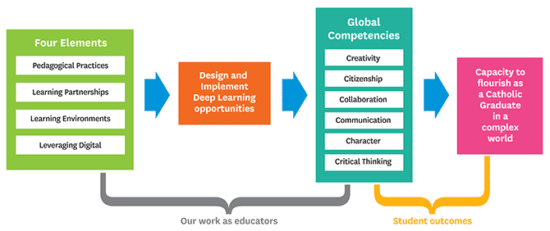
Here is an example of the strategy: “Each month the board has a common focus that is shared across all 83 schools at the monthly staff meetings. Over the ten-month school year, all four learning elements and all six global competencies will be explored in every school” (interview with district leaders). Multiple overlapping ideas are used and reinforced through interaction and digital devices. The district continues to perform above provincial levels (although it should be noted that good outcome measures of the global competencies are not yet available).
Conseil des écoles catholiques du Centre-Est (CECCE)
The CECCE has 55 schools and has been a highly performing district in Ontario for several years. The district has used multiple reinforcing elements to move deep learning forward, including the development of teacher leaders, renewal of vision and mission to engage students and transform learning, and student exit outcomes that integrate the six global competencies. In one subset, the CECCE has focused on developing and measuring critical thinking and its ramifications. Notably through the growth mindset of leaders and teachers, CECCE shared the following:
What we’ve learned along the way:
- increased evidence of students thinking critically and of transformed instructional practice
- teams are more aligned and mobilized when the principal is on board and champions the initiative
- increase in students creating knowledge (e.g. Grade 2 student inquiring about pollution levels in the winter because there are no leaves on trees without being prompted by their teacher)
- increased student ability in problem solving when collaborating with peers
- increased collaboration and communication skills amongst students
- shared planning and problem solving amongst teachers
- improvement of teaching quality at scale
- increased creativity levels for students with learning disabilities (peer problem solving)
- easier implementation of technological shifts: critical thinking is the basis for change, thus avoiding superficial implementation of technology.
In its efforts to create deep learning contexts, the CECCE also supports professional practice that transforms learning through peer coaching strategies of well defined “look fors” in the fields of new emerging pedagogies, technology, learning spaces and environments, student leadership and well-being.
Ottawa Carleton District School Board (Glashan Public School)
Glashan is a Grade 7-8 senior public school. Starting in 2014, the school began to explore the 6Cs and quickly embraced the idea of calling themselves a 6C school. Jim Tayler, school principal, talked about early developments in the following way:
“As the project progressed in the first two years, many teachers began to look at the 6Cs as a framework that could be incorporated into their instructional practice. But it became more than that. A number of teachers believed in the importance of their role in modelling the 6Cs to their students. The 6Cs came to be seen by some teachers as a powerful lens in which to consider curriculum and content. For example, students and teachers alike explored ideas around how certain characters in a novel or a short story demonstrated (or didn’t demonstrate) the 6Cs. Teachers also began to ask questions such as how did historical figures demonstrate the 6CS. Many also began to make reference to the 6Cs in the provincial report card Learning Skills section.
The use of the 6Cs took a giant leap when they were used as the basis of the submission requirements for Glashan’s first international Grade 8 student trip to China. Using a format of their choice, the students were asked to provide evidence of how they use the 6Cs in school, at home, and in the community. With student creativity unleashed, remarkable submissions have been received for each of the subsequent international trips.”
QUEBEC
Francophone school boards and boards in other provinces have not worked much together in the past due to cultural language differences. Apparently the ping of sea change travels well these days, as the General Directorate of school boards, with support from the Chagnon Foundation, approached me in 2014 to help them develop the role of what we call “leadership from the middle.” This approach essentially places school districts at the center of a system change strategy. The idea is that they develop individually and together as agents of system-wide improvement. This represents a big change and so far 56 of the 70 or so boards have joined.
The CAR “Collaborer Apprendre Réussir” project is founded on the following principles:
- Pedagogical leadership by districts
- Collaborative practices
- Reflective practices in action
- Network learning
- Monitoring success on three levels (province, district, school)
- Utilization of effective and emergent practices.
The Chagnon Foundation has committed to funding the initiative at least until 2022. Some school boards are now moving into the 6Cs and related deep learning. CAR is a very strong system-wide movement that will only get deeper in the next four years. With the support of the Foundation they have translated our books Motion Leadership and Coherence into French, and are about to start translating Deep Learning.
SOMEWHERE BEYOND THE SEA
There is much, much more happening across Canada than I am able to capture in this brief article. There are also indicators that First Nations, Métis, and Inuit values and cultures are especially congruent with understanding learning as a seamless interaction with the universe and the people who inhabit it.
The “push forces” – the weak attraction of traditional schooling—are no longer the main point. Now that the new movement is underway it is the “pull factors” – ever younger, immersed change agents; relentless technology; radically different pedagogy, ubiquitous kindred spirits – that will represent the sea change. The promising point is that the examples I portrayed are coming from within the system. For me this represents a golden opportunity to help lead transformation of public schools from within!
It is best to join in as a learner and creator, than to be swept away by the good and bad of sea change. Mind the ping!
We want to know what you think. Join the conversation @EdCanPub #EdCan!
Photo: Max Pixel
First published in Education Canada, March 2018
-
This Is Not a Simulation!
Comments Off on This Is Not a Simulation!An engaging buzz begins to move throughout the building as the narrow hallways fill with people. Familiar music played over the public address system signals a change of energy and the smell of homemade grilled cheese sandwiches and popcorn begins to waft through the air. Strategically placed members of the local constabulary ensure a sense of order and safety, while elected officials seize the opportunity to connect with their constituents. The local bank opens for the day as merchants make final preparations before opening their doors to eagerly waiting customers.
A scene from the local shopping mall? You might think so. In this case, however, as surprising as it might sound, it’s Market Day at Aspen Heights Elementary School in Red Deer, Alberta. It’s the day of the week when student-run enterprises, not-for-profits and services open their doors to the public. And it’s the day when members of the community – students, staff, parents and sponsors – come to support and participate in Canada’s only MicroSociety school.
Nearly ten years ago, two Aspen Heights teachers, Milt Williams and Allan Baile, were concerned about the level of apathy that seemed to be building among students, as well as a sense that more could be done to engage the parent community. After researching programs that might help address these challenges, they landed on MicroSociety, a U.S-based not-for-profit founded on the belief that, if we want to educate today’s children to be able to run the world, we have to give them a world to run. And that’s exactly what the Aspen Heights MicroSociety does.
A MicroSociety is a living, breathing, fully-functioning community, facilitated by adults but organized and run by young people. An annually-elected government allows students to create the laws and ordinances that will govern the community, while the Royal Aspen Mounted Police have the authority to issue tickets and fines and, in more serious cases, move grievances through an internal court system.
At Aspen Heights, students are free to develop their own ideas for new initiatives, learning how to create the business models, not-for-profits and social services to bring those ideas to life. In the context of their enterprises, they develop new products, hire staff, learn to maintain financial records, pay taxes and even buy and sell stocks.
At the start of each year, all students are required to attend MicroUniversity, where they learn the business skills that they will need to carry on their work throughout the year. Business and service owners hold job fairs, accept resumes and conduct interviews with prospective workers.
For students, half of the six hours per week dedicated to MicroSociety is spent developing products, meeting with their employees and taking care of any enterprise-related issues. The other half is spent participating in Market Day, either as shoppers or business operators.
A look down the main corridor of Aspen Heights reveals that these students have considered much of what is needed to ensure that their community is thriving. The bank converts Canadian dollars to Stingers, the official currency of Aspen Heights. The smoothie bar is always busy, as is the Penguin Ave. Café. The Ace Theatre offers students a chance to relax, enjoy some popcorn and take in an episode of their favourite TV program. There’s a wellness centre, a bottle recycling depot and Helping Hands – a charitable outreach program. On the sustainability side, some students spend their time learning about hydroponic gardening, while others raise the urban chickens that provide fresh eggs for the school’s breakfast program.
Some may look at what is happening at Aspen Heights as an impressive and engaging simulation, while others may wonder how it’s possible to find time in a busy schedule to make this work.
For the students, staff and parents at Aspen Heights, it is clear that this is not preparation for some life beyond graduation. This is life – very real life! It’s what draws them to this place every morning and it’s what captures their imagination when away from school. Business owners think about how to improve their products and services. Employees consider how they might strengthen their skillset.
And teachers look at what is happening in the MicroSociety to help inform their curriculum. Amanda Williams, a Grade 2 teacher at Aspen Heights, appreciates how the model connects the entire school, regardless of age, grade and ability. But, like her colleagues, she also watches for opportunities to ensure that her classroom program resonates with what students are doing in the MicroSociety community. “You work with it, you plan with it, you get involved,” says Williams as she warns against seeing MicroSociety as an extra-curricular initiative. Instead, it becomes a powerful context for learning both inside and outside the classroom.
Current coordinator Allan Baille passionately underlines the point that this is not a simulation. For Baille, MicroSociety begins with a very engaging invitation and challenge: “Let’s bring the community to us and not have these walls be the limit of the education of our students.” And that invitation has become a game changer for Aspen Heights. Students who, in the past, may have been apathetic about coming to school are voting with their feet, leading to some of the highest attendance numbers in the entire division. Parents, once reluctant to come into the school, are now seeing Aspen Heights as part of their identity and their life.
A parent satisfaction rating of 97 percent speaks volumes about how MicroSociety has transformed this community. And the willingness of outside businesses and organizations to support what is happening at the school brings the idea of partnership to a whole new level.
There is no doubt that students graduating from Aspen Heights after six years of life in this MicroSociety will have an enviable array of business skills and competencies. They will have a keen sense of what it means to live in the world as creative thinkers, risk takers and problem solvers. They will have the capacity to communicate their ideas more effectively and with greater confidence. But they will also have experienced the learning that begins when you get out from behind your desk and get involved in something that really matters.
We want to know what you think. Join the conversation @EdCanPub #EdCan!
Photo: EdCan Network
First published in Education Canada, December 2017
-
Differentiated Stations
Comments Off on Differentiated StationsIt’s the end of the period, and as the clock strikes noon you can hear students from other classrooms running down the halls, excited for class to be over. In my classroom, the students are so focused that most of them haven’t noticed it’s time for lunch. One of my colleagues walks past my class and stops in the doorway, surprised to see students still in the room. “How do you do it?” she asks in shock.
As teachers, we have two main responsibilities. First, to make sure students are happy and safe, and second, to accommodate students to the best of our ability so that they can succeed to their fullest potential. For the latter to occur, students must be engaged in the learning process, but this can be a challenging feat with a class of unique individuals. The philosophy of differentiation suggests that “the same classroom experience often affects different learners in different ways depending on their gender, culture, interests, life experiences, learning preferences etc.”[1] Consequently, I have adapted my teaching strategy to accommodate my diverse class of adult literacy level English students.
The strategy that has worked best for me is learning stations and differentiation. The goal of differentiated instruction is to provide opportunities for more students to succeed, compared to the one-size-fits-all approach to teaching and learning. The station rotation model, when used effectively, can help to facilitate differentiated instruction based on interest, readiness and students’ learning needs. In addition, stations allow students to learn in a non-threatening environment while engaged in activities of speaking, writing and collaborating, which consequently stimulate higher order thinking.[2] I have found learning stations to be an exceptional strategy, which not only helps to accommodate for large class sizes, but also allows me the time to work closely with smaller groups of students.
Differentiated groups based on readiness
In the first two weeks of the session, I get to know my students. I observe and collect samples of their reading, writing, speaking and comprehension abilities, which allows me to assess their strengths and weaknesses. Based on these observations, I divide my class into three groups.
The red students are the most advanced group, followed by the intermediate green group, and the yellow group, which make up the students with the lowest literacy levels. These levels are not fixed; I can make changes throughout the session. Also, there are a few students who have two colour groups. For example, a student who is advanced in oral language could be intermediate in written production. In that case, the student will be part of a different group depending on the activity of that day.
While the planning for three levels may seem time consuming, it’s actually not that much extra work. Although the skill level or method of production (listening, reading, writing, speaking) may be slightly different for each group, the topic and essential knowledge remain the same.
I usually start by creating a lesson plan for my intermediate group (green). Then I use that same base lesson plan and make minor alterations to make it more challenging for my advanced students (red) and less challenging for my lower level group (yellow). These alterations are based on Bloom’s Taxonomy, which take into account the complexity of higher order thinking.[3] I have found that my lower-level group requires the most attention and scaffolding, especially at the beginning when they are trying to understand the activity or task. However, the other groups still require an explanation. By providing clear written instructions, my intermediate and advanced groups are usually capable of beginning the task on their own. The intermediate students often want validation in the middle of the task to make sure they are on the right track, while the advanced group usually requires my attention for further explanations and questions at the end. The main advantages of teaching in stations is that it helps me to meet each student’s unique learning needs by personalizing instruction, circulating through the class, and helping each group while the other groups work together on different tasks.[4]
The station rotation model
In the station rotation model, students engage in several 20-minute activities in small groups. When the timer goes off, they get up and move to a new station. The stations offer engaging hands-on activities while promoting oral interaction and can be adapted for all subjects and levels.
In my class, I organize stations while paying particular attention to grouping. Depending on the activities, sometimes I group my students based on levels of readiness (red, green, yellow), and other times I mix them up, grouping students of multiple levels together using my “groups” board. Using this method, “Teachers are able to match the right student with the right content at the right time.”[5]
When setting up my classroom for stations, each table has the necessary materials prepared in advance, as well as clear, short, step-by-step instructions. Many teachers in all grade levels have found they have to repeat instructions multiple times. In my experience, written instruction sheets are extremely helpful and have made a huge difference in the success and fluidity of the stations. I then prepare a Google timer that goes off every 20-25 minutes. When the timer goes off, everyone rotates clockwise to the next station.
Example of stations for language learning
Listening station: Students listen to a short audio or video clip on iPads. They can listen as many times as they want and pause whenever necessary. Then, based on their colour groups (level of readiness), they have different tasks to complete. Red will listen and take note of key information on a blank chart (“application” level of Bloom’s), Green will listen and classify specific key information outlined in a chart (“comprehension” level of Bloom’s), and Yellow will recognize and fill in missing words from the written transcript (“knowledge” level of Bloom’s).
Conversation station: In groups, students discuss different conversation questions based on the topic or grammar point we are learning about. Red group students are encouraged to ask follow-up questions to keep the conversation going (application). Green level students are given speaking prompts or vocabulary lists to assist them and Yellow students are asked to answer questions verbally with short answers. It is very simple to differentiate by interest, simply by providing students with a series of questions and allowing them to choose the ones that interest them.
Writing station: Students are given pictures of different scenes, again differentiated by interest. Red students are asked to write a short story together on chart paper about the picture while focusing on a specific verb tense (synthesis). Green will be writing sentences (application). Yellow students will be asked to brainstorm a list of vocabulary words they see in the picture (knowledge).
Teacher station: For this station, my students come with questions of their own. It gives me the opportunity to focus on any difficulties they may have and provide formative assessment. While I’m working with a group, the rest of the class helps each other since I am unavailable to answer any questions. For that reason, I think this station should only be introduced once students are comfortable with the station rotation model.
Extension station: I put a small collection of short stories at this station for any early finishers. Students who need practice reading can choose a levelled reader on a topic of their choice, and those who need practice listening can listen to short audio stories on iPads by choosing a story according to their colour level and scanning the QR code. This station is extremely valuable because not only is it differentiated by interest, readiness and learning needs, it also helps keep the flow of the classroom and occupies students until the next rotation.
Overall, the differentiated station rotation model has helped me maintain a structured but student-centered classroom that accommodates students with a variety of learning styles. While all are engaged in activities matched to their interest and level, I am able to work with small groups of students and give them more individualized attention. For these reasons, I have definitely noticed significant progress in my students’ learning.
Best of all, I have had a lot of positive feedback from my students. One student told me, “I like working in stations because we can hear many people’s opinions about different subjects. There is better interaction between small groups with the teacher, more opportunity to talk, ask questions and improve our pronunciation.” My students enjoy the activities and often don’t even realize how much they are learning in the process.
Learn more on video
Watch a video to find out more about Lindsay’s use of stations and to see her classroom in action
https://www.youtube.com/watch?v=OczPdXerMfUWe want to know what you think. Join the conversation @EdCanPub #EdCan!
Photo: original courtesy Lindsay Harrar
First published in Education Canada, December 2017
[1] C. A. Tomlinson and M. B. Imbeau, Leading and Managing a Differentiated Classroom (Alexandria, Virginia: Association for Supervision & Curriculum Development, 2010).
[2] E. Dolan and J. Collins, “We Must Teach More Effectively: Here are four ways to get started,” Molecular Biology of the Cell 26, no. 12 (2015): 2151-2155.
[3] Dolan and Collins, “We Must Teach More Effectively.”
[4] J. Watson, Blending Learning: The evolution of online and face-to-face education from 2008–2015 (The International Association for K–12 Online Learning, 2015).
[5] Watson, Blending Learning.


IDEAS TO SUPPORT EDUCATORS : Subscribe to the EdCan e-Newsletter
Quality research, reports, and professional learning opportunities.