Archive
-
Good to Great? Who Knew?
Comments Off on Good to Great? Who Knew?There is a strong correlation between a school system’s improvement journey stage and the tightness of central control over the individual schools activities and performance. Systems on the poor to fair journey, in general characterized by lower skill educators, exercise tight, central control over teaching and learning processes in order to minimize the degree of variation between individual classes and across schools.
In contrast, systems moving from good to great, characterized by higher skill educators, provide only loose, central guidelines for teaching and learning processes, in order to encourage peer-led creativity and innovation inside schools, the core driver for raising performance at this stage.
—“How the World’s Most Improved School Systems Keep Getting Better” (p. 26)It’s been almost a week since Spring Break 2011 ended and I’m still unpacking, but not in the way that you think! Instead of heading south this year, I headed to the Web and spent a good portion of my school break journeying through the McKinsey & Company report, “How the World’s Most Improved School Systems Keep Getting Better”. Now before you roll your eyes or begin playing mournful melodies on the violin, please understand that I usually enjoy reading this type of material. For me, it represents a powerful form of professional development and, in this particular case, an opportunity to hone my critical thinking skills.
The McKinsey report tracks the improvement journeys of 20 school systems around the world, systems that have realized steady gains on a variety of national and international assessments over an extended period of time. But it’s not a report to be taken at face value. There are a good deal of ideas, approaches and claims in the 126 pages of the report that require careful thought and, yes, some unpacking.
In previous reflections, I focused on the lack of stories connecting the data with the lives of real teachers and students, as well as the counter-narrative suggested by the choice of photographs for the report.
But there is one aspect of the report with which I’ve struggled right from my first reading. It’s a struggle that has to do with the amount of central control necessary at each of the performance stages described in the report: poor, fair, good, great, and excellent. It’s a struggle that is most concisely expressed in the excerpt from the report quoted in at the beginning of this reflection.
Part of my difficulty has to do with the fact that the McKinsey report traces the improvement journey of Ontario, the province in which I have spent my entire career, from being a good system ten years ago to its current standing as one of the world’s great school systems. Hmmm. If you were to ask any Ontario teacher who was part of a publicly funded system in the year 2000 about the messaging that they received from the government of the day, and from their own school districts, I’m pretty confident that you would get quite the opposite sense. After all, provincial testing of elementary students was just a few years old, the Secondary School Literacy Test was due to be piloted that year and the establishment of a provincial Literacy and Numeracy Secretariat was still a few years off.
If we were a good school system in 2000, someone failed to pass on the message! Instead, our lives as teachers began to be de-professionalized in many respects. In fact, many of the intervention strategies that the McKinsey report describes as being appropriate for a poor system on the road to becoming fair would likely resonate more with many teachers in Ontario. From the report, a the proper way to deal with a school system moving from poor to fair:
- Scripted teaching materials
- Coaching on curriculum
- Instructional time on task
- School visits by center
- Incentives for high performance
- Outcome targets
- Additional support for low performing schools
- School infrastructure improvement
- Provision of textbooks
Hmmm. Sound familiar? I would argue that this has been the reality on the ground in Ontario for many teachers, for many years. Oh, there may be some schools where performance scores have allowed for more innovative collaboration and relatively loose central control, but for many, my own included, loose central control is a concept that stands as a distant memory from my early days of teaching.
So my first difficulty in unpacking the McKinsey report has been the apparent disconnect between the story we’re telling the world—those on the outside, and the story that we’re telling our own people, especially those who work within the system.
Looking forward, my second concern can be expressed most simply as a question: Is it really possible to rebuild a sense of professionalism in a group that has had, over a period of time, been systematically de-professionalized?
According to the McKinsey report, many of the strategies that have been used with teachers over the past decade or so have been based on a set of false assumptions. Ontario teachers are very highly skilled, carry with them a great deal of both explicit and tacit knowledge about their work and, as a group, have been capable of establishing a very highly developed professional development culture. Yet, the strategies that have been used seem to have assumed that we come with low skills, would benefit from tight control and surveillance, and are in need of a centrally-organized training regimen.
So, as I continue to unpack from my journey through the McKinsey report, my main questions look to the future of the profession that I love: As we move forward, how do we give back to our teachers that professional space to develop a strong sense of purpose and efficacy? How do we as teachers work to reclaim our identities as highly trained and highly competent professionals?
Still some unpacking to do here! Perhaps you’re willing to jump in to the conversation and help me do that. Is this an experience that is unique to Ontario? Can educators from other Canadian jurisdictions find any resonance in the Ontario experience? Am I mis-reading something here?
-
Technology in Education: Research Says!!
Comments Off on Technology in Education: Research Says!!“Where’s the supportive research to demonstrate that technology increases student achievement?”
“Why do you pursue providing a 1:1 laptop environment for your students and teachers when you get the same results without technology? Where’s the evidence that it works?”
“Research in this field says that there is little to no positive impact on learning. So, why are you continuing the initiative?”
In 2003, when I was the Director General for the Eastern Townships School Board, my team had anticipated such queries and comments about our decision to provide a free, wireless Apple laptop computer to all students from Grades 3-11, as well as to all teachers. It was my first real introduction to the “techno-critiques”. In particular, media and policymakers raised the question of supportive research. At first, I was pleased by the implication that school and classroom practices were research- and evidence-based. But I knew that this was not the predominant reality in public education.
In contrast to this reality, our team had done its homework and investigated research into technology in the classroom. A large amount of research existed in this field; however, almost all was focused on the impact of desktop computers and the infamous “school computer room”. Such research did not address our concerns, since the provision of technology in an anytime-anywhere, one-to-one (1:1) context was unique.
Since then, research has begun to focus on 1:1 initiatives, as well as on the growing use of mobile devices, iPads, and other related products. The results have been mixed – but in my numerous discussions with credible educational researchers, one prevailing theme has emerged: it is almost impossible to isolate one specific approach or tool in a classroom and determine its effectiveness. So how do we know what we’re measuring? 20th century skills? 21st Century skills as defined by The International Society for Technology in Education (ISTE)? Changes in teaching practice with the use of technology? Or are we really measuring the effects of increased student motivation and an inquiry-based curriculum?
In other words, the activities in a classroom represent a multitude of behaviours and interventions, including personal dynamics, classroom management and size, classroom ergonomics, students’ academic and socio-economic profile, etc. When technology is introduced into the classroom, it becomes one of the many classroom instruments within the grasp of educators and students, and credible researchers have indicated that isolating the impact of technology from the “human factor” in the classroom is a formidable challenge.
In January 2010, The Journal of Technology, Learning and Assessment (JTLA) published “The End of Techno-Critique: The Naked Truth about 1:1 Initiatives and Educational Change.” I cite this research since it was the first time in my experience that researchers attempted to fully understand precisely what the real expectation was of technology use in the classroom. In a society that has become focused on accountability and results, technology used in a traditional manner or context will simply generate traditional results, and it could easily be argued that it has failed to live up to expectations. Larry Cuban best described this issue when he wrote that the use of technology was “oversold” and “underutilized”.[1]
The JTLA article suggested that researchers are focusing on the trees rather than the forest. It reviewed a number of research studies on technology in the classroom, including a meta-analysis of previous research, and concluded that perhaps their greatest potential is “the creation of new-paradigm schools that are self organizing.” As this article describes, creating a change “dynamic” in the classroom, where students become increasingly engaged in their learning, participating in the design of teaching strategies and assessments, does generate the elusive increase in student achievement. Further research into how this change occurs needs to focus on the outcomes that best serve the needs of students and on how classrooms can be best designed to support this endeavour.
Once again, citing the JTLA, “By missing the forest, techno-critics have diverted attention from the real problem of improving the totality of education for all students. So when a 1:1 initiative fails to deliver the much-hyped results, it is much simpler to start sawing on a tree than it is to cut down the forest and start replanting. But then, like so many problems in changing venerable institutions, it too often is easier simply to protect the status quo and blame the innovation or the innovator.”
The children of our world are significantly engaged in the use of technology, especially outside the school. If education is meant to prepare these children for their world, use of technology must become the norm in our classrooms and schools.
[1] Larry Cuban, Oversold and Underused: Computers in the Classroom (Harvard Univeristy Press, 2001).
-
Reel Reform: Documentaries Spur Debate About Educational Reform
Comments Off on Reel Reform: Documentaries Spur Debate About Educational ReformThere’s a rather uncomplicated story that we’ve been telling ourselves for decades now, a story that draws a fairly straight line between success in school and success in life. One thread of this story centers specifically on students and has consistently assured them that most any barrier to school success can be overcome by hard work and dedication. Poor performance in school, the story goes, can usually be attributed to laziness, lack of motivation or simply not caring enough. It’s a story that was told to me by my own parents, and by my grandparents. It is a story that was repeated by my teachers throughout my elementary and secondary years, and it’s a story that is still part of the many back-to-school rituals each autumn. On September 8, 2009, U.S. President Barak Obama told the story again to all American youth in his publicly broadcast speech to a group of students at the Mann Elementary School in Boone, Kentucky. His message was clear and familiar: success will come from hard work, setting goals, and taking responsibility for your own learning.
At the same time, Hollywood has been very good at inspiring us with a parallel thread in our inherited school story, this one with a focus on teachers. It tells us that a passionate and dedicated teacher can make a huge difference in the lives of students, especially those who are struggling to get on the right track. Films as seemingly different as To Sir With Love, Mr. Holland’s Opus, Dead Poet’s Society, Dangerous Minds, Stand and Deliver and The Freedom Writer’s Diary all share a basic and well-known story line: a newly minted, and as yet unaffected, teacher is placed in a challenging and seemingly undesirable context, usually with a group of students who lack the motivation, energy, insight, or socio-economic means to achieve success in school. The teacher-hero slowly recognizes this and, after an initial refusal of the call to act, jumps in, faces a series of personal and institutional demons but, in the end, successfully transforms a once-barren and uninspiring classroom space into a virtual educational oasis, full of confident, enthusiastic, critically-thinking kids ready to – you guessed it – work hard, set goals, and take responsibility for their own lives. A classic hero’s journey narrative, this thread continues to inspire and motivate existing educators, and even draw new ones to pursue a career in the field.
We’ve been pretty comfortable with these rather simple, uncluttered storylines. They are familiar to us and have gone relatively unchallenged in the larger public narrative for nearly 50 years—unchallenged, that is, until recently. Some film critics have dubbed 2010 as the year of the documentary and, in particular, the year of the educational documentary. Three new American offerings including Waiting for Superman, The Lottery, Race to Nowhere and one British entry, We are the People We’ve Been Waiting For, have attempted to push their way into the school reform debates by pulling at the threads of our existing school narrative.
And there is good reason to believe that their efforts couldn’t have been more perfectly timed. The films have been introduced in a year when the American public, in particular, has been struggling to come to terms with a socio-political context shaped by major economic recession, increased foreign competition for both jobs and market share, poor student performance on national and international assessments, as well as the stubborn and confounding problem of the gap in school success that still exists between the poor and the wealthy. All of this has created a perfect storm, pushing Americans to look for answers, search for scapegoats, and demand quick and effective solutions. In its own way, each of these documentaries seeks to disturb the rather entrenched and stubborn thinking that exists around public schools, by claiming that our educational institutions are suffering from a malaise that is preventing them from adequately preparing students for life in a 21st century society, let alone a 21st century economy. For each of these films, there is a clear source of the problem and a relatively simple solution.
Although Davis Guggenheim’s Waiting for Superman was the last of the four films to hit theatres, it certainly carried with it the most advance publicity, media coverage, and blogospheric buzz. In fact, in the two weeks prior to its general release, Superman premiered at the Toronto International Film Festival, inspired a full week of special education coverage from a major American television network, and was promoted on not just one, but two episodes of Oprah. A combination of savvy marketing and the credibility banked by An Inconvenient Truth, Guggenheim’s earlier work, guaranteed that Waiting for Superman would catch the attention of an American public at the start of a new school year. In doing so, it managed to carry the other educational documentaries along in its wake.
Now that several months have passed since the release of the documentaries, and now that the media hype and furor has subsided somewhat, it may be time to take a more objective look at the narrative threads.
Now that several months have passed since the release of the documentaries, and now that the media hype and furor has subsided somewhat, it may be time to take a more objective look at the narrative threads that these films sought to weave into our story of school and the degree to which they were successful in doing so.
In a sense, Guggenheim’s Waiting for Superman and Madeline Sackler’s The Lottery set out to tell the same story. Both films follow the lives of several American children and their families as they attempt to escape a dysfunctional and broken public school system. It is a system that spends more on its students than most other countries, yet falls far behind when it comes to basic proficiencies in math, science, and literacy. It is a system that is divided along socio-economic lines, to the point where zip code and school zone can really determine the quality of education that a child receives. And it is a system that, in many ways, stands in the way of improvement by allowing unions to protect the jobs of underperforming teachers. In both films, there is an underlying sense that most public schools, especially those caught in “Inner City, U.S.A.”, are beyond repair and beyond salvation. In this story thread, it’s not the lack of effort that children are putting in that accounts for poor performance; instead, it’s the lack of effort being put in by the adults at all levels of the system that is the real smoking gun!
Both films tell the story of a school system that has become so overburdened with poor quality teaching, bureaucratic mismanagement, and lack of ability to deal with the inequitable access to quality education caused by a wide gap between rich and poor that the only hope for many students is to somehow opt out and pursue an alternative form of schooling. Enter the charter school option – schools that operate with public money, but stand outside of many of the rules and regulations that impede traditional public schools from offering quality education. The charter schools featured in both films are able to craft rigorous curriculum designed to lead to college acceptance, set high expectations for all students, and extend the number of hours that both teachers and students spend in school each day and each week. For many charter schools, an implicit guarantee of success attracts many who feel disadvantaged by their local public schools.
Although Waiting for Superman and The Lottery support their storylines with a collage of talking heads and sobering statistics, the real power of both films lies in the compelling connection that the audience makes with the families around which the narratives turn. For the most part, the parents and children followed throughout both documentaries are placing all of their hope for a quality education in winning a lottery that will determine who will be admitted to a successful charter school. This becomes the question on which the both films ultimately rest their case, “Should a quality education be left to the luck of the draw?”
While the stories told in Superman and The Lottery focus mainly on a economically and culturally disadvantaged sector of the population, Vicki Abeles’ Race to Nowhere shines a light on school life in middle class America. This is a world characterized by private education, well-resourced public schools, and financially successful families. At first glance, in fact, one would question whether there was a story here at all.
But, as Abeles looks deeper into the lives of students and their families, she reveals a world where the race towards higher levels of achievement is really having an opposite and rather ironic effect. In an effort to increase test scores, graduation rates, and college admission numbers, students are being subjected to tremendous amounts of undue and unnecessary pressure. Instead of demanding schools that nurture a passion for learning and a curiosity about the world, we are accepting schools that foster the belief that education – and, indeed, childhood – is all about developing a robust resume, inscribed with high academic standing, a full slate of extracurricular activities, and little evidence of failure.
In Race To Nowhere, the pressure under which students operate doesn’t stop when the bell rings at the end of the day. Instead, as Abeles illustrates, the pressure that young people are facing inside the schoolhouse is a reflection of the same pressure to be great in the rest of their lives. The student voices that are heard throughout the film reflect on the need to be beautiful, athletic, and socially active. Abeles does not have to go beyond the boundaries of her own family to find evidence for this. In one rather poignant statement, her own daughter, who was diagnosed with a stress-related disease when she was in Grade 8, muses, “I can’t remember the last time I had a chance to go in the backyard and just run around.”
The larger storyline told in Race To Nowhere represents a type of counter-narrative to Superman and The Lottery. It hearkens back to our original thread about hard work and dedication resulting in school success but, for Abeles, the plea is for society to carefully examine the criteria with which we judge success. In Abeles’ view students are being forced to be their own superheroes in a world that judges them more on the symptoms of success then on what lies beneath the surface. In Abeles’ story, this is not a school problem but a social problem, and it needs to be addressed as such.
The British film, We Are The People We’ve Been Waiting For, goes one step further than Race to Nowhere by challenging the ideological roots of modern schooling. Arguing that we are labouring under a model of education designed for a historical period that has long passed, We Are The People also challenges our understandings of success and happiness and calls for a major redesign of our education systems to reflect these values. It questions the deeper purpose of school, claiming that education that fails to ignite a sense of passion, curiosity and interest in the world will not be able to keep up with 21st century demands for a passionate, curious, and interested citizenry. Academic learning, literacy, and numeracy are important, but insufficient on their own to meet the demands of modern society. We Are The People attempts to shift the narrative away from costly efforts to retrofit an old model and calls on us to develop a whole new way of thinking about school and large-scale public education.
Each of these four films has attempted to frame the story we tell about school in a different way. None of the filmmakers has tried to downplay the importance of school. If anything, each serves to revitalize the importance of change in order to make schools even more central to the social fabric. Each film does, however, offer a different perspective on what is most important in that change process.
If there is a common element that runs through all of the films, it would be that it is no longer helpful to talk about students who fail school without also talking about schools that fail students.
If there is a common element that runs through all of the films, it would be that it is no longer helpful to talk about students who fail school without also talking about schools that fail students. The main question with which all modern societies need to wrestle becomes how to deal with that sense of institutional failure.
If it truly is a matter of providing better trained, more dedicated teachers who are willing to do whatever it takes to ensure that all children have a shot at academic success, then the voices of Guggenheim and Sackler become prophetic and their films provide a legitimate call to action. If, however, it is true that there is a strong need to redefine what success means, both academically and in the context of broader society, then we should heed Abeles’ plea to carefully examine where precisely the race to the top is taking us.. Finally, if we attend to the strongly presented message in We Are The People, then our priorities will shift from trying to reform what may, in fact, be beyond any kind of positive reformation.
Some Canadians will admit to watching the firestorm caused in the U.S. around the release of Waiting for Superman with a touch of voyeuristic envy. To be sure, online interactions over the past several months have been marked by passion and vitriol, rational conversation and visceral response.
At the same time, one wonders whether a similar intensity of discourse would be possible in Canada. By international standards, this country’s education is deemed one of the finest in the world. Even though Canada faces serious challenges when it comes to equity, the gap between rich and poor, and connections between culture, race, and school success, these are not part of the everyday water cooler conversations that Canadians have about school.
There is evidence, however, of opportunities emerging that could help draw attention to the story we are telling our citizens about schools and education in this country. In fact, as the final sentences of this article are being written, it seems that at least two of the main issues from the Waiting for Superman narrative are drifting north across the border. In B.C., a liberal leadership candidate is proposing that his province look at merit pay for teachers. At the same time, the province of Alberta is receiving visitors from abroad interested in borrowing some of Edmonton’s thinking around charter schools.
The story that we tell about school, its role and its place in any modern society, is well-established and firmly rooted in the lives of the citizenry. Waiting for Superman and its companions have helped to animate an American public at a time when complacency and inaction are not real options. They have worked to place education in the “worry pool” of the American people, and the people have responded. The threads involving teacher effectiveness and charter schools that have been introduced by Guggenheim and Sackler appear to have gained the most traction and seem poised to find a home within the larger school narrative. It is unfortunate that the equally important and admittedly more ideological messages of both Race to Nowhere and We Are The People may be overshadowed in the process.
While it remains to be seen whether the conversation in the United States will have any lasting impact on the Canadian discourse, it is clear that our efforts to work for deep educational transformation would be energized greatly by the introduction of some new narrative threads of our own. Lights? Camera? Documentary anyone?
EN BREF – Trois nouveaux documentaires américains – Waiting for Superman, The Lottery, Race to Nowhere – et un film britannique, We are the People We’ve Been Waiting For, ont animé les débats sur la réforme scolaire. Chacun de ces documentaires remet en question les idées reçues en affirmant que nos établissements d’éducation souffrent d’un malaise qui les empêche de préparer adéquatement les élèves au 21e siècle. L’un des éléments communs des quatre films, c’est le message selon lequel il n’est plus utile de parler des élèves qui échouent à l’école sans parler aussi des écoles qui ne sont pas à la hauteur pour les élèves. Ces films ont contribué à secouer le public américain alors même qu’une attitude de laissez-faire et d’inaction ne suffit pas. La situation canadienne diffère grandement de celle des États-Unis. D’après les normes internationales, nous avons l’un des meilleurs systèmes d’éducation du monde. Il reste à voir si le débat américain se répercutera durablement sur celui qui, au Canada, porte sur la transformation en profondeur de l’éducation.
-
Necessary Disruption (Part 3: Preserving Relationships As The Core Benefit)
Comments Off on Necessary Disruption (Part 3: Preserving Relationships As The Core Benefit)Canadian schools have increased graduation rates over the past two decades at the same time that they have become more inclusive. By international standards our public schools score very highly. However, the world outside of school continues to change rapidly and fundamentally. To maintain, and ideally increase, their effectiveness, schools need to keep pace, but teachers are, for the most part, working as hard and as smart as they can, and taxpayers, for the most part, seem disinclined to any increases. Since there is no more to be had on either front, what we need is different.
So what could change and, just as importantly, what is it that must not? In considering this question one must focus on the core benefit that schools provide rather than the services they deliver.
Let’s start with what is not the core benefit. It is not providing content knowledge. And it is not even developing technical skills such as writing, mathematics or scientific inquiry. Ways to acquire knowledge and develop skills are now, or soon will be, freely available via the internet. Of course one can argue that not all students have equal access to, or are equally able to benefit from, such instruction, but that is also true of traditional classroom practices. Internet instruction is expanding rapidly and access is becoming ubiquitous, so at a minimum one can foresee large numbers of students obtaining a significant degree of their learning quite independently of schools in the near future. Of course they still have to come to school to write the test and get their credentials, but that is easily changed and it may well happen if schools stand pat and let competing avenues and technologies for learning pass them by.
What then is the core benefit that schools provide? I believe this rests in human relationships, particularly in the student-teacher relationship but also in the social fabric of the school community. This is the wellspring of the safety, support, stimulation, challenge and example that students require in order to thrive in their academic, intellectual and human development.
You can get a great lecture on the internet, probably better than any to be had in most schools, but technology cannot provide a caring, purposeful relationship with someone who encourages, probes, extends and acknowledges learning. It is within such a relationship that assessment occurs and guidance is provided. I am not talking about testing. There is nothing core about that. Summative evaluation is simple. It can be done easily, and probably better, by a computer, but formative assessment is a different matter altogether. That is a teacher’s domain. Computer algorithms cannot replicate the dynamic observation, inquiry, feedback, direction and nurturing support that a teacher can provide. Some students may be able to succeed academically, and even intellectually, without that, but most will not and none will do as well in its absence.
In addition to the teacher’s vital role in facilitation and support, the school community as a whole provides an essential foundation for both learning and growth. Within a school there is not only friendship but also membership, and that membership – school spirit if you like – provides an important anchor for young people. It is in public schools that society is forged, its values and behaviours inculcated. In communion with others, students grow beyond their family and out of their childhood to become independent adults and citizens. It is the experience of community that bonds students to their school, not the curriculum.
The relationships from which the core benefits of schooling arise must be preserved but many of the traditional practices could just as easily be done in other, perhaps better, ways. Specifically, methods of instruction and evaluation need to be deconstructed and reconsidered. Lectures, assignments and tests can come from many sources. It need not be done the way it is today and changing that may create the different conditions within which the essential benefits of schools can be preserved while the outer trappings evolve along with society as a whole.
There are, of course, significant implications for the daily duties and professional identity of teachers if the means of content delivery, skill development and evaluation change, but they are not the fundamental processes that require a teacher. My Masters Degree in Physics prepared me well to be a Physics teacher, but eventually I realized that what my students needed was a Teacher of physics. The former can be done by a computer but the latter requires a professional and it is this professional essence that must be preserved as the techniques and processes of schooling change.
-
Inclusive Education: Lessons from Quebec’s English Sector
Comments Off on Inclusive Education: Lessons from Quebec’s English SectorThe English sector school boards in Quebec have had a long experience in the education of students with special needs in a variety of settings – from the early days of closed classes in special schools to inclusion in a regular class within a neighbourhood school. This evolution has occurred as a result of the experiences that many of us had in the early years of special education. To those of us who started teaching in special education classes, this process of change reflected the fact that – more often than not – the closed class structure did not meet the needs of the students for whom the experience was designed. This is borne out by other educators in Canada.
Gordon Porter, a long-time advocate for inclusive education, states that “ traditional special education, typically carried out by specialist teachers and in isolation from
other children in special classes or special schools, has failed in several ways. First, it has failed to produce results. Students who experience segregated special education are not prepared for fulfilling lives in their communities when their education is finished. Research in Canada has indicated that they do less well than similar children who go to regular schools.…A segregated school program does not prepare young people to be part of the community and society when they become adults. Growing up and interacting with their peers does that.”[1]
That is not to say, however, that every student can make the most of an integrated setting all the time; depending on the specific situation, some students require a second option at some point in their education. But those of us who began teaching in the early 70s know what it was like when students were taken out of their home schools and placed in special schools or special classes with inexperienced and untrained teachers. We were those teachers.
In order to understand this evolution, it is important to go back the 40 years it took us to reach the place where we find ourselves in 2011.
Connecting to Our Students
In 1971, I was assigned to teach in a special education class for students with a variety of learning and behaviour difficulties – students who had been removed from their classes in regular high schools and placed in a high school for those identified with special needs.
All of these students had been placed in the school because they did not “fit” into a regular high school program, mostly for social reasons. Many came from impossible home situations. Some came with severe mental health problems. For some, this was the first educational placement following long-term hospitalization in a psychiatric ward. At the beginning, daily crises were the rule of the school, as students clashed with each other and with us, over any request or instruction they received.
We worked hard at trying to connect with our students. But they had failed in the regular school system and were removed from the general population to be placed in a special school, and they resented it far more than we realized.
This point was driven home to me by one of my students when we were on an overnight field trip. While she was a very difficult student in the school, she was particularly well behaved on this trip. At one point, I asked her, “Why is your behaviour so different here from what it is at school?” Without even thinking, she said, “The school is a mental school, we’re supposed to act mental there.”
It was a turning point in my thinking—we had been treating our students as special needs students, instead of thinking of them as students with needs. We were dealing with their individual behaviours and forgetting to look at them as, first and foremost, needy children. Their needs, we were learning, were far greater than the need for academic achievement.
Dewey writes about placing a strong emphasis on the subjective quality of students’ experiences and the necessity for the teacher to understand their past in order to design an effective sequence of liberating educational experiences to allow them to fulfill their potential as members of society.[2] From our students we learned that their pasts had been traumatic and that many lived in marginal situations on a daily basis. To many, school was their safe haven for a few hours a day.
These students taught me that no matter what their challenges were, they were people first – with fears and issues like any other student. They needed to be listened to and we needed to care for them, because when they felt secure and they trusted us, they would learn. Interestingly enough, we did not know the theoretical basis for our actions at the time, but today we know that the development of a relationship with a student is one of the most powerful educational building blocks.[3]
Heller argues that, “Education should be about helping students become humane, caring individuals, capable of dealing with complex issues that the world presents. We can model humane behaviour for our students without sacrificing standards of learning or behaviour.”[4]
Many of my colleagues, in those early years of special education, began their careers as I did, in closed special education classes. We soon learned that somehow this organizational approach did not really meet the needs of the majority of our students; there had to be a better way. We learned intuitively that attachment to our students was important. We had to help them feel secure and gain their trust before we could teach them.[5]
Why Engagement Works
What we sensed intuitively then is backed by evidence now. We have a lot more information available to us today than we had in 1971, or even in 1991, about how students learn. Brain-based research has shown us much about how the brain learns and what we can do to engage students in their learning.[6] Often students who are thought to have some learning difficulty or a behaviour issue are simply disconnected from learning in school. We have learned since then that not all needy students have special needs; many are simply turned off by schools and either act out, or opt out of learning.
We know that when students’ learning styles and preferences are taken into account – when we ask not “How smart are they?” but “How are they smart?” – they learn. When we teach to their strengths, they learn.[7]
We understand that between 35 and 50 percent of the population learns best by doing, as tactile-kinesthetic learners, and only 18 percent of the student population learns best by listening.[8]Why then do we continue to teach in an auditory style, when we know that our classroom lectures have little carry-over to long-term learning?
Schools and classes that have experienced success have taken into account current research into learning styles and preferences. They have understood that students learn best when they are actively discussing, practicing by doing, and teaching others. They learn least when they are sitting passively in a classroom hearing about new concepts.[9]
If we were to implement learning situations that engaged all students, that showed them the purpose of their efforts and captured their interest in understanding the world a little better, then many of the so-called behaviour problems would be non-existent. Students with identified special needs, as well as those who opt out for other reasons, would learn well along with their peers. Many of our schools and teachers now understand this, and their exemplary practices reflect a commitment to both engagement and integration.
Witness examples of teaching and learning in the robotics program at the English Montreal School Board’s (EMSB) Coronation School, where inner city students took their inventions to the world stage and won recognition in Germany and Japan; where a principal and the staff focused on a vision of inclusion and brought the behaviour issues down in the school from multiple episodes to none in eight years; where a principal refused to let anyone “trash talk” about students in the staff room; where a former graduate, now in a public high school at EMSB, has been courted by the greatest minds in oncology in Montreal, because he, at the age of 16, may be onto a cure for cancer.[10]
Witness Grade 5 and 6 classes at St. Mary’s School in Longueuil (Riverside School Board) where the teachers and students have embraced project-based learning through the ArtsSmarts approach, where the curriculum is taught through the arts with the support of local artists, and all students in this inclusive setting are engaged in creating a classroom from recycled materials that will serve their needs as learners in the 21st century; where it is difficult to identify the students who have special needs because they are all actively engaged in creating a new learning environment for learning their languages and their mathematics.[11]
Witness a school project at Métis Beach School in Métis-sur-Mer (Eastern Shores School Board) where the Grade 5 to Grade 11 students are involved in creating their own social videos, with their teachers and a young film company, exploring issues that they confront in adolescence – bullying, divorce, stalking, etc.[12]
Witness a secondary school extra-curricular program, “The Flat”, at Centennial Regional High School in Greenfield Park (Riverside School Board) – based on the discovered talents of the students in visual arts, hip-hop, and rap – that grew out of a graffiti project to bring the arts legitimately onto the inside walls of the school. This project has been singularly responsible for keeping the marginal students in school and helping showcase their talents to the rest of the school and school board.[13]
Witness Western Quebec School Board’s Environmental Awareness and Outdoor Skills Program, which takes students beyond the four walls of the classroom and keeps them in school because they want to learn, all the while developing stewardship and a future generation of responsible and informed citizens who not only value the environment, but also will take action to conserve and protect it.[14]
Why Engagement Works:
Conditions for Success in the English-Sector Schools
Quebec’s Education Act and its special education policy[15] have supported the integration of the student into the regular class, given certain conditions. Ten years later, a period of reflection is underway, looking back on the successes and the challenges that have arisen.
Within the English-sector school boards, about 85 percent of the student population is integrated into regular classes, and schools are continually searching for means to provide greater success for their students.
Professional development for teachers and staff is critical to this success. In Quebec’s English sector, there is an understanding that the following elements are crucial:
- a culture of professional learning for administrators, teachers, and other educational personnel
- an understanding of learning styles and differentiated instruction when working with diverse learners
- an acceptance that life-long learning applies as much to educational professionals as it does to students
- an understanding that every student is an individual with needs that must be addressed in the best way possible
- an understanding that education is a team sport and that it takes a group of committed educators to figure out what will work for a student
- an understanding that there is no magic in working with students who have special needs, that it takes hard work, frustrating moments, and successes in little steps
- an understanding that the option of letting a student go without trying everything within our power is unacceptable
The improvement of the graduation rate to over 80 percent in most English sector school boards has grown out of a culture committed to providing whatever it takes to keep students in school and to help them achieve their full potential, of school administrators taking their lunch hours to circulate in the hallways to connect with students, of teachers – in addition to their heavy classroom teaching loads – volunteering extra hours to coach teams and to help students in extracurricular activities, of parents volunteering to help wherever they can in schools, and of students feeling that school is a place for them to be because it has meaning to them.
There is still much to learn and much to be done to address the 20 to 30 percent of the student population not succeeding, particularly among the boys, whose graduation rate lags behind that of the girls in most Quebec school boards by about 10 percent. Things are not perfect by any stretch of the imagination. Some classrooms are still relying on the lecture method as the sole means of transmitting knowledge. But more often than not, administrators and teachers are focusing in on what needs to change in order for all students to achieve success.
Inclusion is for life, not just for a class or a term or a year. In order to prepare our students with special needs to live within society as contributing adults, and in order to prepare society to accept them as an integral part of the community, we need to structure our educational organization to best serve all students.
Those of us who have been around long enough can see the majority of our students from the closed classes of the 70s reaching middle age without much connection to their communities – sitting at home as 50-year-olds, dependent on society for their support. We see our students from the last two decades, who were included in regular schools for most of their education, as young adults able to function within society, holding down jobs, working as volunteers, taking public transportation, and contributing to their communities. They are an integral part of their communities and accepted as such by the peers with whom they went to school.
We continuously strive to meet the needs of all of our students where they are best served, and where they can become contributing members of society. The best place for this to happen is in the mainstream – of school and of life. Other options are a poor second choice.
EN BREF – Si nous instaurions des situations d’apprentissage qui intéressent tous les élèves, qui leur indiquent le but de leurs efforts et qui les incitent à comprendre un peu mieux le monde, beaucoup de problèmes de comportement et d’apprentissage disparaîtraient. Les élèves qui ont des besoins particuliers déterminés pourraient bien apprendre parmi leurs pairs. Un grand nombre de nos écoles et enseignants le comprennent maintenant. Pour préparer nos élèves ayant des besoins particuliers à évoluer dans notre société en tant qu’adultes à part entière, et pour préparer la société à les accepter comme faisant partie intégrante de la collectivité, nous devons structurer nos organisations d’éducation de façon à encadrer optimalement tous les élèves. Dans les commissions scolaires anglophones du Québec, environ 85 pour cent des élèves ayant des besoins particuliers sont intégrés dans les classes ordinaires et deviennent des membres à part entière de leurs collectivités, contrairement aux élèves des classes séparées des années 1970, qui sont maintenant d’âge moyen et qui demeurent socialement isolés.
[1] G. Porter, “Making Canadian Schools Inclusive: A Call to Action,” Education Canada 48, no. 2: 64.
[2] J. Dewey, Experience and Education: Sixtieth Anniversary Edition. (West Lafayette, Indiana: Kappa Delta Pi, 1998). From the original 1938 text.
[3] M. Fullan, “The Change Leader,” Educational Leadership: Beyond Instructional Leadership 59, no. 8 (2002): 16–20; D. Goleman, Leadership: Social Intelligence Is Essential, 2008. Retrieved April 22, 2008, from http://www.danielgoleman. info/blog/2008/02/28/leadership-social intelligence-is-essential.
[4] D. Heller, “The Power of Gentleness,” Leadership: Beyond Instructional Leadership 59, no. 8 (2002): 76–79; 77.
[5] G. Neufeld and Gabor Mate, Hold onto your Kids: Why Parents Need to Matter More than Peers (Toronto: Knopf Canada, 2004).
[6] D. A. Sousa, How the Brain Learns, 3rd ed. (Thousand Oaks, CA: Corwin Press, 2006).
[7] H. Gardner, Frames of Mind: The Theory of Multiple Intelligences (New York, NY: Basic Books, 1983).
[8] A. M. Beninghof, Engage ALL Students Through Differentiation (Peterborough, N.H.: Crystal Springs, 2006).
[9] Sousa.
[10] D. Wood, Six Steps to Student Success. Presentation with Carol Marriott and Julie Hobbs for New Frontiers School Board Administrators, Howick, QC, November 16, 2009.
[11] J. Hobbs, Class visit to St. Mary’s Cycle 3 Immersion class. February 3, 2010.
[12] J. Hobbs, C. Marriott, D. Wood. School visit to Métis Beach School. April 30, 2010.
[13] C. Marriott, Presentation to ArtsSmarts Exchange Symposium, Toronto, ON. Dec. 1, 2009 (In absentia).
[14] A. Earwaker, Environmental Awareness and Outdoor Skills Program. (Western Quebec School Board, Aylmer, QC, 2009; DVD format).
[15] Adapting Our Schools to the Needs of All Students, Policy on Special Education, Ministère de l’Éducation, 1999.
-
Hands On vs. Hands Up: Technology-Enabled Knowledge Building in High School
Comments Off on Hands On vs. Hands Up: Technology-Enabled Knowledge Building in High SchoolIn a landscape in which learners can be creators of ideas, it is vital for high schools to become technology-enabled learning environments that are sharply focused on knowledge building, idea improvement, and collaboratively creating community knowledge. Most students use personal connectivity for socializing and play, not for knowledge building, exploring problems, or building on each other’s ideas.
To learn well in a participatory, digital world, students need to be academically and intellectually engaged in rigorous and complex work – work that is meaningful enough for them to give their hearts over to it, work that motivates them to explore ideas and persist in developing explanations and solutions. Today’s youth deserve to be engaged in technology-enabled learning environments and intellectually demanding school experiences that prepare them to move into ever-changing and complex social, economic, political, and cultural contexts.
Shifting from Interactive to Participatory Learning Designs
Our world has seen huge changes in the media and technology landscape in the last 50 years. Broadcast media was a one-way street; early interactive media supported one-to-one, and increasingly, many-to-many conversations; later interactive technologies, such as the Internet, offered support for groups, for simultaneous conversations, for media and information sharing, and for knowledge building in community; today, advancements in digital technology and social media have led to the largest increase in connective and expressive capability in human history.
Participatory learning designs begin with the premise that these digital and social technologies have changed how people of all ages learn, collaborate, play, socialize, access resources and services, and connect. They enable learners to participate in local and online communities to share ideas, peer review each other’s expressions and creations, build on each other’s work, work collaboratively to improve ideas, and design, develop, implement, assess, and discuss their strategies, solutions, goals, and ideas.
The technological infrastructure and network designs used in most high schools – built on broadcast media and information delivery assumptions about knowledge flow – are not serving students well. Professionals and outside experts create a firewall by selecting information and ideas, and metering out content in small, manageable, and simplified chunks. Participatory technologies, social media and knowledge building pedagogy disrupt that firewall.
- Audience/learners can talk to each other, build and share information together, and publish ideas and expressions online to a global community.
- Knowledge is created and shared by learners and by teachers.
- Information comes from many diverse sources, cultures, and locations.
- There is immediate access to current information and knowledge.
- An already huge knowledge base grows at an exponential rate.
The widely-held perception that students know more than teachers about current technology is both true and false. It is true that creating original content and publishing information on wikis, blogs, and social media sites is empowering many young people, and some learners do highly complex things with computers, networks, and gaming systems. But most students use personal connectivity for socializing and play, not for knowledge building, exploring compelling science or mathematics problems, improving and building on each other’s ideas, or writing persuasive arguments. Young people need engaged teachers more than ever to make the leap from digital technology as play to digital technology as a tool for knowledge creation.
Learning Environments in the 21st Century
Knowledge building is arguably the most important skill requirement for the 21st century. The ability to work collaboratively to improve ideas is essential, and pervasive technology makes collaborative knowledge building increasingly possible. In a landscape in which learners can be creators rather than mere consumers of messages and ideas, it is vital for high schools to become technology-enabled learning environments that are sharply focused on knowledge building, or idea improvement, and collaboratively creating community knowledge to share and improve ideas that matter to the world. 1
In other words, high schools should be less and less about crafting a single message for individuals to consume, and more and more about convening groups of learners with diverse strengths, expertise, and skills around shared interests, to work on common goals, to create ideas, and to build and cultivate community knowledge. The challenge is to reconcile current teacher-driven content delivery approaches with knowledge building requirements and the expectations of today’s high school learners.
The question is not whether this is the technology and media environment we want; it is the environment we have – global, social, ubiquitous, and inexpensive. The question, instead, is how can we change the way we do high school to make best use of this technology landscape? Mentoring and preparing students for the world in which they live is the role of high school, and today’s students live in a participatory digital world.
The abundance of resources, networks, and relationships easily accessible online is challenging us to revisit our roles as educators in sense-making, coaching, and credentialing.2 Lecturing and testing must give way to collaborative and challenging knowledge building, work that leverages technology for critical thinking, disciplined inquiry, and global participation. Collaborative online social learning offers more opportunities for students to find and join diverse communities where they can benefit from culture-building and distributed cognitive apprenticeship. It goes beyond providing access to traditional course materials to creating participatory learning environments that develop competencies like visual literacy and scientific reasoning. In a participatory digital world, the ability to assess the credibility of information and integrity of connections is vital.
Technology and Student Engagement in High School
A team of researchers (including the authors) recently completed a two-year, Alberta-wide study of the relationship between technology and high school success in 23 school jurisdictions.3 While we observed some innovative and engaged teaching and learning practices, student engagement in learning and knowledge building was low. In most of the classrooms, we found little evidence of students completing authentic tasks or of rigorous and complex work being designed for and required of high school students. The predominant use of technology we saw in these classrooms was watching or listening to the teacher present material to the entire class.
A disconnect existed between teachers, who reported high confidence with the technology and enthusiasm about its use, and students, who reported that the bulk of classroom time is spent at their own desks, silently watching the teacher use presentation technology to deliver content. We know that the use of computers is more effective when the students are in “control” of the learning; yet, it is fairly evident that the technology is not in the hands of students in many secondary school classrooms. Why is the majority of classroom time in high school devoted to teacher-directed, whole group instruction rather than the student-directed, interactive, peer-to-peer interaction associated with higher levels of student engagement? Educational researchers focusing on the connections among student engagement, the learning environment, and teaching practices have identified a number of factors that impact student engagement: (i) the types of instructional practices teachers enact; (ii) the authenticity and complexity of work students are invited to do; (iii) the types of technologies utilized in learning; and (iv) the amount and type of feedback students receive while they are learning.4 We observed academic engagement, active participation in information play (i.e. answering questions, paying attention, doing seat work), in less than 50 percent of the classrooms visited, and the percentage dropped as the lesson proceeded. Intellectual engagement, a serious, passionate commitment to investigate complex problems, issues, questions and ideas within a collaborative knowledge building environment, was observed in very few high school classrooms.
Best Practice: Hands On Versus Hands Up
We saw technology being used by a Social Studies teacher to engage high school students in lively debate and the exchange of ideas, to support the active social construction of knowledge, and to democratize the classroom.
During the first half of the class, students were engaged in discussion and debate about historical and modern engagements in war. The teacher used a handful of online videos, interactive models, and graphic resources displayed on an interactive whiteboard to engage students with historical events and modern interpretations. Links between lives lost in past wars and casualties in the present war in Afghanistan spurred active debate about Canada’s role in the international community. While the students sat at their desks, the teacher kept the momentum up with his interactive and engaging rapport, using a dozen good questions to engage every student in discussion and in providing feedback using clickers. Students were encouraged to explore concepts and defend their answers using historical sources and a clear rationale. At least 90 percent of students were engaged via interactive discussion with peers, asking questions, contributing to group activities using clickers, discussing key concepts, and helping peers use the technology. The teacher held the class in the palm of his hand – the students clearly trusted their teacher and knew that their ideas, opinions, and contributions mattered.
During the second half of the class, the teacher shifted from whole class discussion to an inquiry project. He digitally displayed the project description, relevant online sources and videos, and used an interactive, online Prezi (concept map) as part of his invitation to explore topics. Several online examples of student work from previous years were available to students. He outlined a clear set of steps and group roles and reviewed expectations and standards for completing work using a prepared assessment rubric. He made clear connections to curriculum and identified a range of physical, analog, and digital resources to support research and interpretation of historical events.
An active class discussion arose about the range of technology to use, preferred topics and group configurations based on shared interests, and the time students had to complete the task. The teacher encouraged students to use a range of technologies, from online research, to various presentation and graphical design tools for presentation and peer review, to online publishing and sharing completed projects.
In four teams, students started to discuss and research over 50 historical and modern day events related to war in order to analyze, synthesize, and evaluate possible causes and implications, relationships, and combinations of events. The goal was to create new knowledge and understandings related to winning strategies in war.
During the final third of class, 100 percent of students were engaged in collaborative peer groups bent on determining who holds the winning hand in war.
The Design of Great Learning Tasks
It is unsurprising that high school teaching is not significantly changed or improved by merely dropping technology into classrooms. We observed few examples like the one described above. Teachers need support to design inquiry-based tasks and assessments that integrate digital technology into one or more disciplines of study. They need to harness their enthusiasm about technology to the design and support of knowledge building work that cultivates genuine engagement with learning.
Great inquiry-based learning tasks – with or without technology – are authentic to the discipline; involve active and participatory student groupings and interactions; are academically rigorous; connect learners to resources and communities beyond the school; provide for elaborated communication and expression; and use assessment of and for learning. Rigorous, technology-enabled learning experiences contain all the components necessary for a strong inquiry: rich, authentic problems/issues/questions to investigate; clear learning outcomes; curricular integration; learning tasks; appropriate use of technology; ways of working and knowing that experts within the disciplines use to build knowledge; and timely assessments with clear criteria to make students’ thinking visible to both students and teachers. In inquiry-based, technology rich learning environments, assessment makes up a large part of the high school day.
Leadership for Inquiry With Technology
In “Inspiring Education”, Alberta Education asks important questions about the role of publicly funded education in the 21st century. How do we help youth make successful transitions to adulthood? How do we help them to become life-long learners who contribute to healthy, inclusive communities and thriving economies?5 Ramping up teaching with an interactive whiteboard won’t motivate students to use their minds well or to stay in school – especially if all they are expected to do is sit still, watch, and listen. Interesting and challenging knowledge building work will engage both students and teachers in technology-enabled learning environments.
If we really want our children to face the challenges of the future with confidence and skill, we must teach them not only that they can acquire current knowledge, but also that they can help shape what their society comes to accept as knowledge.6 Participatory digital technologies and new social media landscapes, combined with engaged teaching and designs for learning, offer new opportunities for knowledge building and interconnected relationships.
Today’s youth will inherit a global, socially connected, and media rich world. The competencies they require to live well differ from those even ten years ago. As our participatory digital world accelerates, high schools cannot afford to stand still.
EN BREF – Dans un contexte où les apprenants peuvent être des créateurs d’idées, il est vital que les écoles secondaires deviennent des environnements d’apprentissage technohabilités privilégiant la constitution de savoirs, l’amélioration d’idées et la création en collaboration de connaissances communautaires. La plupart des élèves utilisent la connectivité personnelle pour socialiser et se divertir, et non pour obtenir des connaissances, explorer des problèmes ou s’enrichir les idées les uns des autres. Ils ont plus que jamais besoin de solides enseignants pour passer de la technologie numérique ludique à la technologie numérique comme source de création de savoirs. Pour que nos enfants puissent vraiment relever avec assurance et compétence les défis de l’avenir, nous devons leur enseigner qu’ils peuvent non seulement acquérir des connaissances courantes, mais aussi contribuer à déterminer ce que leur société viendra à accepter comme étant des savoirs. Les technologies numériques participatives et les nouveaux médias sociaux, conjugués à un enseignement mobilisé et à des conceptions d’apprentissage, offrent de nouvelles possibilités de constitution de connaissances et de relations interconnectées.
1 M. Jacobsen, “A Special Issue of the Canadian Journal of Learning and Technology on Knowledge Building,” Editorial, Canadian Journal of Learning and Technology 36, no. 1 (2010). www.cjlt.ca/index.php/cjlt/issue/view/70
2 L. Johnson, A. Levine, R. Smith, and S. Stone, The 2010 Horizon Report (Austin, Texas: The New Media Consortium, 2010). www.nmc.org/publications/horizon
3 J. Daniels, S. Friesen, M. Jacobsen, and S. Varnhagen, Technology and High School Success Research: Final Report (A Research Report for Alberta Education, 2010).
4 M. Jacobsen, S. Friesen, and C. Saar, “Teaching and Learning in a One‐to‐One Mobile Computing Environment: A Research Report on the Personalized Learning Initiative At Calgary Science School.” Report delivered to the Board of the Calgary Science School, March 2010; J. D. Willms, S. Friesen, and P. Milton, What Did You Do in School Today? Transforming Classrooms through Social, Academic and Intellectual engagement, First National Report (Toronto, ON: Canadian Education Association, 2009). www.cea-ace.ca/publication/what-did-you-do-school-today-transforming-classrooms-through-social-academic-and-intelle
5 Alberta Education, “Inspiring Education: A Dialogue With Albertans,” Steering Committee Report, 2010. www.inspiringeducation.alberta.ca/
6 P. Clifford and S. Friesen, “A Curious Plan: Managing on the Twelfth,” Harvard Educational Review, 63, no, 3 (1993): 339-358.
-
Necessary Disruption (Part 2: Preparing Engaged Citizens)
Comments Off on Necessary Disruption (Part 2: Preparing Engaged Citizens)In my last blog I argued that because there is an explosive rate of scientific discovery and technological innovation outside of schools but only incremental adaptation inside, the need for more abrupt (aka disruptive) change is growing. In this installment I want to add another reason for urgent innovation: escalating social and political complexity.
Citizenship demands more of us these days. Our communities have become more diverse than ever before along any dimension you care to mention – ethnicity, language, religious belief or lack thereof, family structure and so on. Much of what we took to be common is now clearly pluralistic. In part this is because we acknowledge differences that have always existed but were once denied, and in part it is because increased global mobility and Canada’s dependence on immigration have brought many new citizens to all parts of the country. The result is a much richer mosaic with increased potential for both synergy and conflict.
Both the positive and negative potential of diversity in our communities is exacerbated by increased global interdependence along any dimension you care to mention – economics, politics, environment, health, security and so on. Our fate is inextricably interwoven with many others, arguably all others, and that makes the issues that we face as citizens, both local and global, more complex than ever before – calling not only for greater knowledge, but also for greater wisdom.
Enabling students to thrive in and contribute to this diverse and densely connected socio-political environment requires much more than traditional academic knowledge. Students also need the communication skill, creativity and critical thinking to apply their ‘book learning’ and evaluate new information they receive in order to solve unique problems in the world. Moreover, this problem solving increasingly occurs in multidisciplinary teams so collaborative ability and inclinations are essential. And the problems themselves are set in, or at least linked to, a global context of competing interests and thus require inter-cultural understanding and ethical decision-making.
These “soft skills,” which animate the “hard skills,” have been termed 21st Century Skills, not because they are new but because in the new millennium they have changed from being desirable to being essential. Employers require them of course because they are fundamental to the knowledge work that is now the primary generator of wealth, but these same skills are also critical foundations for democracy and global harmony. Thus, both the private and public ends of education require that schools complement the academic learning and intellectual development which has been their traditional focus with renewed attention to ‘higher order thinking’ ( in reference to Bloom’s taxonomy).
Of course, this has always been a stated goal. To quote the School Act in BC, for example, the purpose of public schools is to enable all students “to contribute to a healthy, democratic and pluralistic society and a prosperous and sustainable economy.” However, the reality is that the focus of public attention has been almost exclusively placed on academics – the so-called 3 R’s – and individual benefits as they pertain to employment. Moreover, assessment and the standards that are applied to them have been largely confined to knowledge acquisition and some algorithmic skill sets. Now, however – not in an imagined future, but right now in our lived reality – this has to change in order to sustain economic vitality and, more importantly, to sustain a “healthy, democratic and pluralistic society.”
So, like rapid technological innovation, escalating social and political complexity requires schools to change in order to keep pace with, and adequately prepare students for, a future which is already upon us. This is a reflection not of schools‘ failures but of the highly dynamic nature of modern life. Standing pat is not an option in schools any more than it is in other spheres, so once again one must ask: What is it about current structures and processes that needs to be disrupted in order for schools to free themselves from some of their current limitations and keep pace with the change that is occurring all around them? … to be continued
-
A non-classroom day?
Comments Off on A non-classroom day?It’s the first Saturday of Spring Break, and I’ve just spent the past couple of hours catching up on some reading and writing that has been stored in the favourites section of my twitter account. (Twitter favourites are now the virtual equivalent to my bedside table!)
One blog post that caught my eye was written by Dwight Carter, principal of a 2400 student secondary school in the U.S. Carter had heard about the idea of a no-office day for administrators–a day where principals and vice-principals unchain themselves from their desks and their computers and have time to get out into the halls and classrooms of their schools. I love the email that Carter sent his staff to announce his intentions:
NO OFFICE DAY- In order to visit more classrooms, I am having a NO OFFICE DAY on Friday, February 4. I will not be in my office the entire day (unless there is an emergency). I’ll see you around!
Throughout the day, Carter used his mobile phone to communicate with his Twitter followers about what he was seeing and experiencing. A positive and eye-opening experience!
Beyond wishing for this experience for the administrators at my own school, Carter’s post got me thinking about a time in our own district where, as teachers, we were encouraged to visit other teachers. There was an infrastructure of coverage in place where we could have a substitute come in to cover our day while we spent time either in our own school, or at another school in the district.
It was an experience of collegiality before the time where we needed to talk a whole lot about collegiality. If I knew of a teacher that had a dynamite writing program or an innovative arts approach, I could arrange to spend time observing, chatting and learning. If I knew about an engaging social studies program across the district, I could go and see it.
Dwight Carter’s commitment to the idea of a non-office day got my imaginative juices flowing to the point where I’m wondering whether there are any school districts around the country that have this type of option built into their professional development plan for administrators or for teachers. If so, I would love to hear about it!
Here’s a brief and rather modest proposal that might act as a placeholder for some more robust conversation about a non-classroom day for teachers.
What if teachers were to negotiate a clause in our teaching contracts that would allow us to dedicate one day per term for a non-classroom day? The day could be jointly funded by professional development monies maintained by the teachers’ association/district and the teacher’s own sick day allotment. Participating teachers could make use of a variety of methods for reflecting on the experience (written reflection, blog entry, podcast) in order that the learning is recorded for use in teacher portfolios and group P.D. archives.
I’m not sure if my experience is similar to that of other educators across the country, but I have found that much of what is currently done in the name of teacher professional development at the district level and beyond is governed and controlled by an agenda that sees better test results as a key indicator of success. There are plenty of experts available to come into our schools to tell us what we should be doing in terms of best practice but this is seldom accompanied by opportunities to go and see it working in real classrooms with real teachers and real students!
Watching beautifully-edited video clips of guided reading, critical thinking and mathematical problem solving may be enough to inspire some teachers to go out and learn more. Polished books and articles may contain important insights about certain approaches, but they are a poor cousin to actually spending extended periods of time in environments where colleagues are working—sometimes struggling– to implement a particular approach, method or strategy.
I’m wondering whether a non-classroom day might be one way to build a renewed sense of self-directed collegiality back into the profession.
If you already have access to this type of opportunity, I would love to know how it works. If not, would this be something that you would find helpful?
A non-classroom day! Could a change of scenery be as good as—professional development?
-
Necessary Disruption (Part 1: Keeping Pace With Technical Innovation)
Comments Off on Necessary Disruption (Part 1: Keeping Pace With Technical Innovation)Surely there is no more oft-used or ill-defined slogan than “21st Century Learning.” I suppose it evoked the notion of learning for the world as it was becoming when used in the 1990’s but now that we have traversed Y2K without incident and are 10% through the new century I am not sure why we still say it or what it is supposed to mean. I do know, however, that there is good reason to feel some urgency about innovation in schooling practices.
Yes, Canada’s public schools are demonstrably excellent by international standards, and generally far removed from the sorry state of much of the American system, but the world is changing very rapidly and if schools don’t match that rate of evolution they will inevitably lose both relevance and effectiveness. Outside of school we see things like robotics, artificial intelligence, nanotechnology and genetic engineering that are true game changers. Inside of school we see incremental improvements at best in curriculum, instruction and organization. This won’t do. Its not only that good can be the enemy of great, but that complacency can kill you in a rapidly evolving context.
The world’s best typewriters became antiques overnight when keyboards arrived and every draughtsman has had to go digital. You can’t keep up with the kinds of changes that abound in society just by improving what you are already doing. Sometimes you have to change in order to survive. Henry Ford is reported to have said, “If I had asked what people wanted, they would have said faster horses.”
Abrupt change, which Clayton Christensen has termed “disruptive innovation,” is challenging for many reasons, not the least of which is that initially the innovation is more work and often less productive, and also because it upsets the prevalent social order in an organization, but unless one makes the change and suffers through the ensuing implementation dip in order to learn a new way, there is no possibility of significant improvement from the current plateau. Eventually even “sharpening the saw” is not good enough – you have to trade the thing in for a chain saw.
So where might such disruptive innovation be necessary in public education? The popular response, of course, is technology – and for good reason because there is a lot of potential there. However, while a technology-infused future seems promising, a technologically-focussed future is not the answer. Technology is the horse, not the cart – or perhaps I should say the booster not the payload – or, to be thoroughly modern, the codec not the video. So, “technology” does not really answer the question since that conversation is primarily about means rather than ends.
What is it about current structures and processes that needs to be disrupted in order for schools to free themselves from some of their current limitations and keep pace with the change that is occurring all around them? … to be continued
-
Learning Beyond Schooling
Comments Off on Learning Beyond SchoolingSchooling is an effective way to promote learning and personal growth, but its not the only means to this end and sometimes its not the best means. Even when schooling is an effective way to achieve the private and public outcomes that society intends through its education system, connections beyond the classroom provide significant additional benefit. Unfortunately, they are often only an occasional afterthought. Perhaps its time that they moved from optional extras to core components of public education.
As long ago as 1971 (in the previous millenium), Ivan Illich commented in Deschooling Society that, “The current search for new educational funnels must be reversed into the search for their institutional inverse: educational webs which heighten the opportunity for each one to transform each moment of his living into one of learning, sharing, and caring.” Today computer technology makes such a change not only possible but inevitable. The question is not whether the change will occur but when and under whose guidance.
Web 2.0 applications like social networks and wikis do not, in my opinion, yet fully represent the sort of ‘educational webs’ that Illich suggested so long ago, but they certainly do illustrate the potential for such enabling and democratizing mechanisms. Indeed, we are seeing the emergence of private and commercial webs of variable quality – which may eventually lead, through some Darwinian process, to useful educational applications but may equally well produce a plethora of drivel that confuses, and even malicious networks that misinform and mislead.
It would be much better for the school system to develop new educational webs, or utilize existing webs in purposeful ways, that expand its reach and improve its effectiveness rather than wait for others to develop networks that displace or overwhelm it. This would be in addition to the instructional applications of ICT within the regular school structure, which can also be powerful and which I presume will continue to emerge, and would be distinguished by students’ independent use of such networks to connect to, communicate with and participate in the world beyond the school.
One function of such webs might be to expand on the “pen pal” connections that now exist between schools and classes by enabling individual students with particular passions to find and converse with others more independently. Such webs might also include non-students with similar interests, whether professionals or hobbyists. This, of course, raises issues of credibility and safety but let’s just put such legitimate questions in the parking lot for the moment while we try to peer outside the box.
Structured and supported, but autonomous, connections beyond the classroom could benefit not only ‘learning’ but also the ‘caring’ and ‘sharing’ that Illich mentions. Personal engagement with others on issues of common interest would, of course, inevitably fuel traditional learning but the primary benefit might not be academic. To thrive in the richly interconnected and rapidly changing world in which our children already live, they need “soft” skills such as communication, collaboration, creativity and critical thinking that cannot be developed as effectively within the classroom as beyond it. They also need to transcend egocentricity and cultural embeddedness to appreciate their interdependence with the rest of humanity.
Perhaps the many social networking mechanisms that already exist make it unnecessary to reinvent the wheel in the form of ‘educational webs’ if we take responsibility for helping student learn to use them constructively and effectively in ways that promote learning and growth. Perhaps, but at a minimum schools then need to seize on these mechanisms and take charge of their use as core learning strategies for connection, communication and collaboration in relation to learning objectives and not just for information retrieval. The potential should not be left to chance and while it may be driven by student interest and energy it should be steered by educators to maximize its intentional benefits and minimize the distraction of unfocussed busyness.
The purpose of schooling is not to be good at schooling but to be enabled as a constructive participant in the world beyond and after the school. We only stayed inside previously because we had no alternative. Now we do but our habits continue to confine us. Or perhaps its fear, or confusion, or complacency. Funding is a real constraint, but it does not prevent significant change, as many educators are demonstrating, and too often its simply an excuse. The future is now and the future is learning, not schooling.
-
The Spirit of Innovation in Education
Comments Off on The Spirit of Innovation in EducationI guess I’ve always enjoyed looking for different ways of doing things. One day when I was eight, my parents sent me outside to play. Later, they found me in the backyard trying to build a rocket ship. When I was nine, I tried to design a system that would transport mail from our kitchen safely to an office desk that I had claimed in the basement. By the time I was eleven and twelve, I could often be found in my bedroom working on my own “television” programs using a reel-to-reel tape recorder and a magnajector unit.
Even my dating life reflected a desire to be creative and innovative. Once, in an effort to make an interesting impression on one particular young lady, I sat down and created a brochure of “date” possibilities. All that Leanne needed to do was choose one option, and call me with her decision. The phone rang the next day, and we were off to the city that Friday night for dinner and a horse-drawn buggy ride through the streets of Toronto!
In a sense it was a spirit of innovation that drew me to the teaching profession. I had always remembered those teachers that tried to make learning come alive by taking different approaches, and I thought that I might be able to do the same. For close to thirty years now, I’ve taken that spirit with me into the professional roles to which I’ve been assigned. I’ve always believed that innovation was at the heart of good teaching; in order for me to be effective, I needed to be constantly looking at things from the perspective of an innovator.
But this view is currently being challenged in many jurisdictions these days, and it’s being challenged in my own practice. Ben Levin, among others, argues that if we’re serious about the issues of equity in public education, then it’s not innovation that needs to drive our work, but improvement. Levin argues that, while discovery and research continue to be important, we have an excellent body of “best practices”—things we know work. Real improvement—across the board—will come, he argues, if we put our efforts and resources into the effective implementation of these practices.
Initially, this came as a blow to my own spirit, but I’ve spent a good deal of time thinking about the argument and the point is a fair one. A good deal of time and money have been put into pilot projects that never seemed to go anywhere. I know that I have worked on teams for months to create documents and resources for teachers that are, alas, sitting on shelves in schools and classrooms across the district. You may have had similar experiences.
So, I wanted to spend some time exploring the question of innovation and its role in public education a little more. Can innovation and improvement exist side-by-side, or do we need to dedicate ourselves to one or the other? I hope that you will participate in that exploration!
The next two Teaching Out Loud podcasts are dedicated to the theme of innovation. In The Spirit of Innovation in Canadian Classrooms, you’ll meet three Canadian educators who are passionate about the innovations in which they are currently involved.
David Wees lives in British Columbia and teaches at Stratford Hall in Vancouver. I call David an unRaveller because he is dedicated to taking apart this complex place we call school one thread at a time, challenging many of our assumptions and beliefs along the way. Currently, David is involved in organizing an edcamp unConference—a concept that is beginning to gain some momentum throughout North America. David talks about how he hopes to change the way we do Professional Development with teachers.
John Knotten is an artist and teacher at Toronto’s Mary Ward Secondary School. One of just a handful of Canadian schools dedicated to student self-directed learning, John has spent most of his career living in the heart of this fairly large-scale innovation. I dare you to listen to John talk about Mary Ward’s vision without getting excited!
Finally, Peter Fujiwara teaches at St. Roch School in Brampton, Ontario. Peter has always taken his love and passion for communication technology and has built a very robust and enviable program for students enrolled in his Pathways program. But for Peter, the real innovation has come through a discovery of what this program has meant for the rest of the school community. Somewhat unexpected, but very inspiring.
Have a listen to the latest episode of Teaching Out Loud, and let us know what you think. In the next week, the second in the Teaching Out Loud Innovation Series will be posted. Here I had the opportunity to talk with David, John and Peter in greater depth about their work and their view on the importance of innovation in our schools.
As always, your comments are important and welcome.
Where do you stand on the issues of innovation and improvement? Are you currently part of an innovation that is making a difference in the success of your students? Should we be spending more time nurturing the “best practices” that we know about, rather than heading out to find new ways of doing things?
Is there a difference between creativity and innovation? Is there more to learn about the best way to do school?
There’s always lots to talk about when you’re Teaching Out Loud!
-
Prudence L. Carter: Want to Achieve Educational Equity?
Comments Off on Prudence L. Carter: Want to Achieve Educational Equity?A presentation by Prudence L. Carter of Stanford University at CEA’s 2010 colloquium on equity.
-
How Children Learn to Read
Comments Off on How Children Learn to ReadThe foundation of language and literacy skills is laid during early childhood. Early learning is important to lifelong development. Researchers have identified some of the most important factors that help children learn to read. While there are some definite skills children need to develop, it is also vital that children read things they enjoy, and enjoy what they read.
- Phonemic Awareness: helps the child to hear, identify and manipulate individual sounds (phonemes) into words (e.g. /g/ = get and /u/ =too). Children need to know these skills.
- Fluency Instruction: Reading accurately and quickly can be assisted by modeling fluency (reading aloud to children), providing books at the child’s level, repeated oral reading, increasing practice through audiotapes, tutors and peer guidance.
- Vocabulary: Ways to teach vocabulary include teaching specific words before reading, providing activities involving those words (mental images/acting out definitions), repeating vocabulary in different contexts, and learning high frequency words
- Text Comprehension: Strategies to help children understand what they are reading include: reading comprehension questions, understanding the story structure (e.g. plot, setting), summarizing, reflecting on their prior knowledge to make connections and using graphic organizers (e.g. bubble charts) to organize thinking.
- Motivation: Children are motivated to read if they find the text interesting and have background knowledge on the topic. Young children are often drawn to illustrations, graphics and display features. Praise and recognition may also be motivating.
Research suggests that children learn to read in different ways. There is recent evidence that computer technology is an effective tool in teaching reading for children.
CEA and the Ontario Institute in Studies in Education (OISE) have teamed up to provide you with relevant and timely information based on current empirical educational research. The primary goal of this project is to get relevant and needed research into the hands of parents and other interested people. They are written in plain language on topics of interest to parents, such as homework and class size.
Additional Resources For Parents
Foundations for Literacy: An Evidence Based Toolkit for the Effective Reading and Writing Teacher: eyeonkids.ca/
- Although this was written for teachers, there are many useful strategies that may easily be implemented at home.
Ministry of Education, Government of Ontario: The Government of Ontario provides tips for parents on helping children learn to read. http://www.edu.gov.on.ca/abc123/eng/index.html
Peel District School Board, Literacy and Numeracy Tip Sheets: This site provides 16 tip sheets on helping children improve their literacy skills. http://www.peel.edu.on.ca/parents/tips/num-index.htm
Reading and Language: Building Literacy Skills Everyday:
This website provides practical tips on how parents can support literacy skills through daily activities (i.e. going to the doctor’s office or grocery shopping) http://www.pbs.org/parents/readinglanguage/quicktips/main.html
The Government of Alberta: This website provides information for parents and teachers on literacy the range of essential literacy skills and strategies. This site is available in French as well.
http://education.alberta.ca/teachers/program/literacy.aspx
Toronto District School Board, Parenting and Family Literacy Centres: This website provides free school based programs to support children’s early literacy through play. There are translations available on the program’s key features in 16 languages. http://www.tdsb.on.ca/_site/ViewItem.asp?siteid=201&menuid=1001&pageid=732
TVO Website for Parents: Parents will find videos and related links about how children learn to read on this website.
Quebec English Literacy Alliance: A list of literacy resources can be found on this website for children and families.
Research References Informing this Issue
Armbruster, B. B., Lehr, F., Osborn, J., Adler, R., & Noonis, L., (2001) The research building blocks for teaching children to read: Put reading first. Retrieved September 28, 2010, from National Reading Panel Web site: http://www.nifl.gov/
Early Years Education Ontario Network. (2010). Early Literacy. In Eye on Early Years Education and Ontario Network. Retrieved Oct. 15, 2010, from http://eyeonkids.ca/early-literacy
McCardle, P., & Chhabra, V. (Eds.). (2004). The voice of evidence in reading research. Baltimore: Paul H. Brookes Publishing Co.
Pelletier, J., Reeve R., Halewood, C., (2006). Young children’s knowledge building and literacy development through knowledge forum. Early Education and Development, 17(3), 323-346.
- Key finding is that “Children who participated in the online Knowledge Forum learning environment made greater gains in early reading over the course of the year.” (p. 341)
Torgesen, K. Joseph., Wagner, K. R., Rashotte, A. C., Herron, & J., Lindamood, P. (2010). Computer-assisted instruction to prevent early reading difficulties in students at risk for dyslexia: Outcomes from two instructional approaches. Annals of Dyslexia, 60(4) 40-56
- In this study, students who received interventions through two computer programs showed stronger outcomes in phonological awareness, rapid naming, phonemic decoding, word reading accuracy/fluency, spelling, and reading comprehension at the end of first grade.
-
2010 Ken Spencer Award Winner – The Met School Program
Comments Off on 2010 Ken Spencer Award Winner – The Met School ProgramA video by Seven Oaks School Division (Winnipeg, MB), first place winner of the 2010 Ken Spencer Award.
-
Merit Pay for Canadian Teachers
Comments Off on Merit Pay for Canadian TeachersI’m not opposed to merit pay for teachers on the grounds that I am looking to protect the jobs of incompetent colleagues, or my own job, for that matter. I’m not opposed to it because, as a teacher, I’m afraid of being publicly judged. And I’m certainly not opposed to a system of merit pay because I’m resistant to change. No, the reason I’m opposed to concept of merit pay for teachers—at least the models of merit pay as they are generally being debated in the United States and, most recently, here in Canada—is that they are ill-conceived, simplistic and are very unlikely to have any lasting impact on the success of students in our schools.
When B.C. leadership hopeful Kevin Falcon indicated a few weeks ago that he was willing to include merit pay for his province’s teachers as a plank in his political campaign, the reaction was predictable, polarized and protective. I don’t know about you, but I wasn’t too surprised by this. If we’re serious about revamping the model we use to compensate and value teachers, all of the parties involved need to be at the table throughout the entire process. Thoughtful, respectful conversation on this issue will always trump media storms and political manoeuvrings. We have to think more carefully about our motivations for introducing these ideas as well as our long-term goals for our schools and our students. I’m not confident that this is being done to an adequate degree.
We also need to think clearly about the long term costs of implementing a new compensation model. With teacher salaries and benefits taking up the lion’s share of any education budget, it is important to consider what would happen if a teacher merit plan actually worked! Teacher merit pay is often lumped into conversations about teacher accountability. Financial accountability cannot be ignored in the process.
The idea of paying educators based on student performance fails to acknowledge the complexity of the teaching enterprise. The use of some narrowly devised value-added metrics to assign bonuses to teachers represents, not only a misapplication of this type of assessment tool, but it tries to bypass the need to recognize that student performance on the standardized evaluations that would be necessary under such a scheme cannot possibly capture the complexity involved. Basing teacher performance solely on student performance assumes a simplicity about the work of teaching that is simply not there.
Finally, the idea of merit pay for teachers may yield some short-term gains, but both the model and the gains are likely to have a limited shelf life. Again, on the one hand, the cost of ensuring that the scheme is both scalable and sustainable would be, by all accounts, prohibitive. On the other hand, we already know that, while high stakes testing can actually draw attention to areas on which focus is required, they can also sideline other valuable aspects of the school experience. In the end, the implementation of a merit pay scheme based on student performance runs the serious risk of narrowing the scope of classroom practice even more. In effect, a model designed to improve student achievement may, in fact, serve to have the opposite effect.
That said, I’m all for having a discussion about how to restructure the way that we compensate teachers for the work that they do. I don’t know many people who would argue that the current experience-education matrix of determining teacher value represents a type of international gold standard. But let’s be a little more creative, respectful and intelligent about it.
I don’t know about my colleagues, but I feel that I’m pretty well-compensated as a teacher. I recognize the value of my benefits package, the freedom provided by the structure of the school year in terms of vacation time and the fact that I have been paying into a pretty enviable pension plan. While I’m not adverse to higher levels of pay (I do have a family and a mortgage), I don’t think that the prospect of remuneration for student results is going to make me approach my job in a different way. I’m not going to spend additional hours preparing lessons. I’m not necessarily going to teach more effectively. I won’t be more dedicated to the students that I teach. I like to think that, while there is always room for improvement, monetary incentives are not going to bring me to a new plateau of excellence.
Similarly, for teachers who should likely be considering another profession (and there are some), a whole new model of compensation is unlikely to provide the motivation that they need to work harder or perform better.
So, there you have a sense (admittedly brief) of why I can’t take seriously the argument that teacher merit pay is going to improve teacher quality and student achievement in this country.
But, I’m not done. I do have a modest proposal for a performance incentive program of my own, based on what I know motivates me as a teacher and, as Daniel Pink suggests in his book, Drive, motivates most people involved in work that is both complicated and complex.
That will be the topic of my next posting.
Until then, do you believe that a system of merit pay is what is needed to improve teacher quality in this country? Do you think that teachers need incentives to do better work? What would your system look like? Feel free to take issue with anything that I’ve said so far. Feel free to offer your own thoughts and ideas!
-
Does Teaching Quality Make a Difference?
Comments Off on Does Teaching Quality Make a Difference?There is growing consensus that good teaching makes a big difference to students’ learning. Many studies show that the quality of teaching is a key determinant of student schooling experience and attainment, regardless of race, gender or socio-economic background.
Researchers have tried to determine which factors seem to have the largest effect on teaching quality. Among the most important:
- Teacher knowledge about good teaching and learning practices appears to have the strongest and most consistent positive effect on student outcomes.
- A degree in the subject taught is significantly and positively correlated with student attainment and with staying in teaching, particularly at the secondary school level.
- Teachers’ verbal ability and literacy level have shown some association with higher student attainment.
- Continuing professional development is necessary for improvements in teaching quality, especially when there are changes in curriculum, teaching methods, and the student population.
Other factors seem to have less association with student outcomes:
- Some studies find that teaching experience has a positive effect on effectiveness, especially experience gained in the first year of teaching, but the results are not always significant.
- Studies of teacher behaviour and personality have yielded inconsistent findings, although in some studies there appears to be a positive relationship between student learning and teachers’ ‘flexibility,’ ‘creativity,’ and ‘adaptability.’
- The relationship between teachers with master’s degree and student outcomes is weak to non-existent.
These findings suggest the following:
- Teaching requires multiple skills
- The most important single element that distinguishes more effective teachers is their deeper knowledge about pedagogy, that is, how best to support and foster students’ learning.
CEA and the Ontario Institute in Studies in Education (OISE) have teamed up to provide you with relevant and timely information based on current empirical educational research. The primary goal of this project is to get relevant and needed research into the hands of parents and other interested people. They are written in plain language on topics of interest to parents, such as homework and class size.
Additional Resources
- Teacher Quality Resources: The Teacher Quality Digest is a publication that provides practical information on specific areas related to qualities of effective teachers. [Website]
- Teacher Quality Research: TQR is a partnership between researchers at Florida State University and the University of Wisconsin at Madison. The purpose of TQR is to provide research evidence on the characteristics and education of effective teachers. [Website]
- Take Part: TakePart.com is an independent online community that provides information on social, environmental, political and cultural issues in the United States. There are 19 educational issues published in this website, including one on Teacher Quality. [Website]
Research References Informing this Issue
Darling-Hammond, L. (1999) Teacher Quality and Student Achievement: A Review of State Policy Evidence. Center for the Study of Teaching and Policy, University of Washington. Available: [pdf file]
- Studies have found a somewhat stronger and more consistently positive influence of education coursework on teachers’ effectiveness.
- Other studies of the effects of teacher experience on student learning have found a relationship between teachers’ effectiveness and their years of experience, but not always a significant one or an entirely linear one.
- A number of studies suggest that the typical problems of beginning teachers are lessened for those who have had adequate preparation prior to entry.
- Research on teachers’ personality traits and behaviours has produced few consistent findings, with the exception of studies finding a recurring positive relationship between student learning and teachers’ ‘flexibility,’ ‘creativity,’ or ‘adaptability.’
Day, C. and Leitch, R. (2007). The Continuing Professional Development of Teachers: Issues of
Coherence, Cohesion and Effectiveness. International Handbook of School Effectiveness and Improvement. Springer Netherlands: 707-726.
Hanushek, E. and Welch, F. (2006). Teacher Quality. Handbook of the Economics of Education, Volume 2. North Holland.
- Perhaps most remarkable is the finding that a master’s degree has no systematic relationship to teacher quality as measured by student outcomes.
Ingvarson, L. and Rowe, K. (2007). Conceptualising and Evaluating Teacher Quality: Substantive and Methodological Issues. The Economics of Teacher Quality Conference, 2007. Available: [pdf file]
Rowe, K. (2003). The Importance of Teacher Quality as a Key Determinant of Students’ Experiences and Outcomes of Schooling. ACER Research Conference 2003. Available: [pdf file]
- What matters most? Certainly NOT the ‘pimple’ of gender and socio-economic differences, nor school structural arrangements of interest to ‘school effectiveness’ researchers, but the ‘pumpkin’ of quality teaching and learning provision, supported by strategic teacher professional development!
Rowe, K. (2007). School and Teacher Effectiveness: Implications of Findings from Evidence-Based Research on Teacher and Teacher Quality. International Handbook of School Effectiveness and Improvement. Springer Netherlands: 767-786.
-
High Touch for High Tech
Comments Off on High Touch for High TechHave you noticed that nobody advocates for 21st Century Knowledge? Well of course not. Much of what our students will need to know 20 years from now, which is when the educational chickens really come home to roost, is not yet known and much of what we think we know now will be irrelevant or wrong within their lifetime. So, knowledge is not the key to the future. That is not to say it is unimportant, but only that it is not the determining factor in a strong education or a successful future, and it is not what separates the economic winners from the also rans or what creates a healthy society.
So everyone turns to skills. Surely “know how” will be more important as “know what” becomes both more universally accessible and more volatile. Well, skills are more durable than knowledge but they are still not stable, particularly when skills are seen as specific scripts that can be trained – such as knowing how to use computer software efficiently or even to program computer applications directly. This stuff is changing so fast that what one really needs to understand is not the specific procedures for doing things but the principles behind those procedures so that one is better equipped to keep up as they rapidly evolve. Fortran was essential when I was a graduate student but it doesn’t do me much good now. So even specific skills are not sufficient to carry you into the future.
Unless, of course, we are talking about social skills. These are changing as the world becomes more diverse and multicultural but they are still far more stable than technical skills and increasingly essential for employment success, just as they have always been critical to social engagement, citizenship, personal fulfillment and happiness – the seldom mentioned ‘other half’ of educational purposes.
21st Century Skills should include technical prowess for obvious practical reasons but the truly essential skills are not the ‘hard’ technical ones; they are the ‘soft’ human ones – communication, collaboration, creativity and critical thinking for example. These have always been important to us, and they have always been buried somewhere in the nether regions of educational mission statements, but as the pace of change accelerates, diversity increases, and interconnection and interdependence intensify in our ‘shrinking’ global village, the soft human skills must be brought into the foreground and given the full attention they deserve.
And underlying skills there are attitudes, which may be an even stronger determinant of success – curiosity, confidence and courage for example – and dispositions like empathy and ethics. These too need to be taken out of the closet and put into the middle of the classroom.
Now there are some problems in doing so. We know how to present students with knowledge and figure out with reasonable accuracy if they have absorbed it. We can also determine if they have understood it, although that is a bit harder. And we are fairly good at skill development – at least technical skill development – but its much harder to evaluate. However, when it comes to social skills and attitudes, not only are we poor at teaching them – if “teaching” is the term – but we are flat out lousy at assessing them and we have no agreed upon standards that would allow us to evaluate them even if we could assess effectively.
This is the real challenge of 21st Century Learning. How do we inculcate in our students the soft skills and personal attitudes that will empower them to thrive in the future that is already upon us, and how do we assess, evaluate and report them? Yes, students also need knowledge and technical skills, but if we allow ourselves to focus on these easier tasks we will fail to understand or address the real need.
Developing social skills and personal attitudes starts to sound like character development – a term that inevitably raises some hackles and concerns. This kind of character development, however, should not be confused with moral development because to the extent that it is concerned with values they are the common core values that underlie a democratic society and are central to all moral systems – things like honesty, respect and responsibility for example.
So, IMHO we should reframe the 21st Century Skills discourse in terms of character development for a diverse and dynamic world rather than as a simple matter of technological mastery. Now what sort of schooling would it take to accomplish that – or should we be talking about schooling at all?
-
Propelling Beyond Boundaries
Comments Off on Propelling Beyond BoundariesAn Exemplary Classroom at Work
Paige Fisher
As a teacher educator at Vancouver Island University, I take my student teachers on an assessment field trip so they can witness the ways that inquiry and formative assessment can be embedded in instructional practice. We go to a local elementary school to visit an exemplary classroom. Mary-Lynn Epps and Kerry Armstrong share this Grade 7 classroom – Mary-Lynn as the enrolling teacher, and Kerry in the role of learning and technology support and science instruction.
These teachers have developed a small network of inquiring teachers within their school and at other schools in their district, and they are collaborating to develop powerful learning environments for their students and to inquire into their own instructional practices. They have reflected deeply on what has been working in their classrooms and created a metaphor for their practice, which they call the Propeller Model (see diagram). Their work is having a significant impact on their learners as well as on their own understanding of teaching/learning processes. I am hopeful that exposure to this classroom will deepen my students’ understanding of powerful learning environments as they move forward in their teacher education.
I have informed my students that, although it may not be apparent at first glance, some of the students in this classroom have profound and diverse learning needs. When we arrive, we file into a fairly typical classroom. There are posters and criteria sheets covering the walls, desks arranged in small groups, a bank of four computers, and a large meeting table at the back of the room. Mary-Lynn is in the process of organizing the group for the upcoming work period. We are asked to observe while she gives the students their instructions, then we are invited to listen to student and teacher conversations, or to interact with the students.
“Ok everyone,” Mary-Lynn says, “the student teachers are here to observe, and they might want to ask you questions, but this is a working period, so try to stay focused on your responsibilities. We have information circle meetings today, and you need to be prepared with your notes before you come to the meeting. Get together with someone else in your working group and share your notes with each other. That way you can add to your own sheet and you can help make sure your partner is prepared. Remember the inquiry question is ” One well, one wish. Water has the power to change everything. What will you do to transform yourself and others to ensure there is a well for the future?”
“Use the posted criteria to make sure you’re on the right track”, she says, “and I would like you to use the A-P-E strategy to give each other feedback. Could someone please tell the student teachers what this means?”
Megan puts up her hand. “It’s, um, it’s the thing where each of us has a job, like Adviser, Presenter, and Encourager. We have to take turns being each one and give each other feedback using the criteria.”
“Thank you Megan. While each group meets with me, the rest of you will do A-P-E with your working groups. If you finish that, please begin to add more details to your Mind Maps. We should be able to get through at least three group meetings this period.”
One group of students moves to the meeting space at the back of the room while the rest of the students settle in and a productive buzz pervades the room. I can hear students sharing information and giving each other feedback on their work in progress. I follow one of my teacher education students, who is moving to join a working group. “I never did this kind of thing when I was in school,” she says to one of them. “How do you like working together like this?”
“Well, the best thing about working with other people is how they have other ideas and how that makes my ideas bigger and better,” replies a boy in the group. “I feel like I learn a lot from the other kids and it helps me see all the different ways there are to do things.”
One of the other boys in the group is sharing notes that are stored on his laptop. “Wow, you’re allowed to use a computer?” my student asks.
“Yeah, anyone can use the computer if they want to, but I really need it. This graphic organizer I’m using helps me to organize my thinking. The computer helps me put my thinking on paper, and that is a good thing because I can come back to it, then I have something to share with the rest of my group. I have a hard time with reading and writing and I used to fall behind. Mrs. Armstrong showed me how to get the same textbooks as the other kids from files on the computer, and I use read-aloud programs like ‘Wordtalk’ and ‘Kurzweil’. Now I can copy and paste important words and ideas and even the pictures from the textbook into my graphic organizer so that when I go to Information circles, my notes are complete.”
My students and I are shaking our heads in amazement. We are struck by the environment of collaborative productivity and purposeful focus that seems to pervade the room.
Another one of my students ventures over to the group. “Can I ask you a question?” she says to one of the girls. “How does this inquiry question thing work?”
“Oh that,” she says. “It’s kind of like the main idea of what we’re doing. So, when you’re reading fiction or nonfiction, you know the idea is important if it can relate back to the inquiry question.”
“Yeah,” chimes in another girl. “Inquiry in this class helps you know what you are looking for so you don’t write down just random information. We get all this information in our groups and we share it at the information circle meeting. Then we get to come up with our own question and we have a showcase where we invite other kids and our parents and we show all the work we’ve done and what we learned. For our last unit on Healthy Living, I did this cool inquiry about whether computer games were making people more or less healthy. I really believe I was able to change other people’s opinions on health.”
My students and I are shaking our heads in amazement. We are struck by the environment of collaborative productivity and purposeful focus that seems to pervade the room. The students are eager to talk about their work, and to show us the things that are supporting their learning. We are especially impressed by the sense of ownership they express through their responses – not just ownership over their learning processes, but ownership of the learning of their peers as well. I know that Mary-Lynn and Kerry have worked hard to establish a Community of Learners culture in this room, and the evidence of this facilitation is playing out in the interactions my students and I are observing.
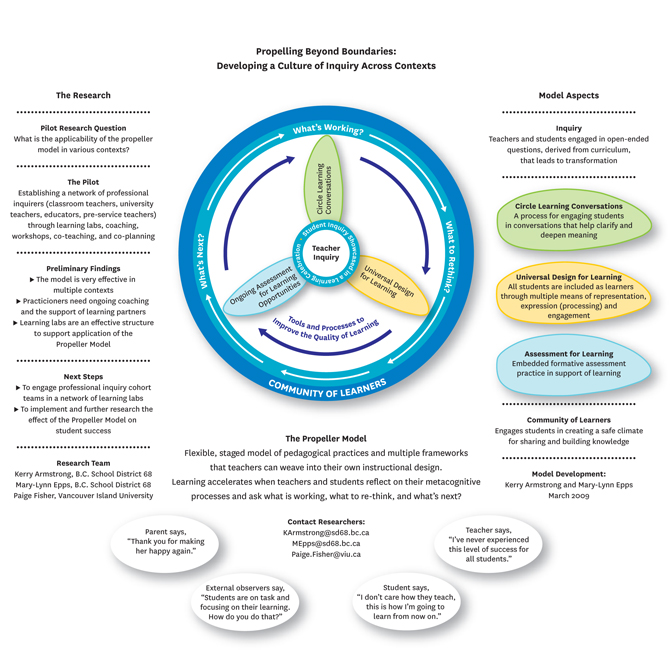
At the back of the room the first group gathers around a large table with Mary-Lynn and the information circle meeting begins. Students have been asked to share the information they have gathered so far about water. “Would someone please volunteer to start by sharing the key points you’ve brought to the meeting? As you share, be sure to summarize how the information is meaningful to the overall inquiry. Think about your connections and how they help you to transform your thinking and beliefs about water. The rest of you remember that your job as a listener is to ask questions to help you understand and to jot down ideas that you think will help you to answer the inquiry question.” We hover at the edges of the meeting and listen in. Throughout the meeting, Mary-Lynn facilitates the discussion by providing descriptive feedback, asking probing questions, and inviting responses from each member of the group.
“Great work, everyone” I hear Mary-Lynn say as the meeting concludes. “I’ve been really impressed with what you’re bringing to the circle, and the way you’re adding to all of our learning. Make sure you complete the self-assessment of your group participation before you go back to your desks please. Once you get there, remember your first job is to do a reflective write on what you learned during the meeting. Then you can move on to your Mind Maps.
I quickly follow some of the students back to their desks so that I can ask them about the meeting. “Could you please tell me a little bit about your circle meetings?” I ask. “What are they like for you?”
“It helps me,” says Christopher, “Because when there is a part of the book that you don’t understand you can just ask someone in the group or bring it up and it will make it easier to understand and they’ll like describe it to you so you get a better grasp of the idea.”
“I really like it too,” says Tran. “Information circles help me with my learning and on my tests because every time I go to a meeting I always get a good idea back. Like if other people talk about things that I don’t have on my paper I can write it down, and when I have a test I can use the things I wrote down on my paper to get a full score.”
I shift my attention to a group that is working on their Mind Maps. One of the student teachers is asking what they are and how they work. The group is eager to respond. “They’re kind of like a word web, but we use pictures and symbols to help make sense of ideas, and then we look for connections between them.”
“How do they support your learning?” she asks.
Blake replies, “They help me because you don’t have to go through the tedeism of writing down a huge list of words on paper and then forgetting what half of them mean by the end of the day. They let you write pictures down and to organize your words and your pictures in a convenient way so you can remember them all.”
Other students in the group comment on how they are able to use their Mind Map to help them study for tests. “I can look at a picture or symbol and it helps me make connections to other facts about the inquiry. It’s an easier way to remember ideas without trying to memorize a list of notes.”
“How do you know what to put on them?”
“We look at lots of examples and we set criteria with the teacher. We get lots of chances to share our ideas, and we get lots of feedback when we do peer and self-assessment and from our teacher.”
“This is so cool!” one of my students comments. “What happens if you go to Grade 8 next year and none of your teachers does stuff like this?”
“I don’t care how they teach me next year, this is how I’m going to learn from now on,” one of the girls responds vehemently. “This totally works for me!”
I am astonished at these students’ ability to talk about their own learning processes and I am consistently impressed by their enthusiasm and the ownership they seem to feel. They convey a real sense of pride when we show interest in their learning.
The bell rings for the lunch break, and we all move to a debriefing session. The teachers show us their Propeller Model of Learning, and they relate each component back to the classroom experience we have just had. The student teachers are bursting with questions and full of enthusiasm for the possibilities they have witnessed in this classroom. For the next several weeks we will refer back to this classroom visit as we explore the possibilities inherent in classrooms that embrace formative assessment and inquiry.
The Propeller Model
Kerry Armstrong and Mary-Lynn Epps
The Propeller Model of Learning is built upon the concept of the Community of Learners. At the beginning of each year we take the time to develop a vision with the students that outlines the attributes we would need to ensure the success of everyone in the class. The students can then begin to develop the metacognitive skills to help them take responsibility for their own learning. This classroom culture is necessary for the group to continue evolving in their ability to use the learning processes outlined throughout the entire model.
Propeller Model processes revolve around inquiry questions that guide the momentum of learning throughout each inquiry. We begin by designing an overarching question based on concepts derived from provincial learning outcomes. Our goal is to transform students’ thoughts, actions, and beliefs related to the overall topic. Once students have enough background knowledge, they begin to create their own inquiry questions that align to the larger question by focusing on a specific area that is relevant and meaningful for them.
Surrounding the centre of the model are three frameworks that support learning (see diagram above): Circle Learning, Universal Design for Learning, and Formative Assessment.
The formative assessment used in these classrooms is built around six strategies: learning intentions, criteria, peer and self-assessment, descriptive feedback, questioning, and ownership. Each of these elements is woven as much as possible throughout each learning opportunity.
Circle learning has become a process for teachers to engage students in conversations that help them clarify meaning through the sharing of ideas and questioning. When teachers facilitate and coach those conversations by asking probing questions, students are able to make the connections that enable them to apply their thinking as they seek to answer the inquiry question. The concept is based on Faye Brownlie’s work with Literature Circles, and has expanded to include Information Circles and Numeracy Circles.
The formative assessment used in these classrooms is built around the Six Big Assessment for Learning (AFL) Strategies and B.C. Ministry of Education Performance Standards that are promoted through the Network of Performance Based Schools and the B.C. Ministry of Education. Based on the original work of Black & Wiliam, the strategies are: learning intentions, criteria, peer and self-assessment, descriptive feedback, questioning, and ownership. Each of these elements is woven as much as possible throughout each learning opportunity.
Our approach to Universal Design for Learning (Rose & Meyer) is derived from the implementation of UDL work by CAST (Center for Applied Special Technology) and David Edyburn. The principles of UDL remind us that our students have diverse learning needs, and help make it possible to value and support these differences. We use UDL guidelines to ensure that we have multiple ways to engage learners, to process learning, and to represent learning. Technology is used to support learning whenever possible and all students are respected as learners with potential.
Surrounding the model are three driving questions that teachers and students use to fuel their reflection: What’s working? What do we need to rethink? What’s next? These questions help teachers and students to engage in ongoing reflection that moves learning forward.
The Showcase
Paige Fisher
Several weeks later, the Grade 7 students come to the University to visit us. They bring along their completed inquiry projects so that we can host their learning showcase. All of the teacher education students are invited and they eagerly interact with the Grade 7 students as they talk about their completed inquiries. The celebration of learning that we witness is an example of the showcases that culminate each inquiry project. It is an opportunity for students to share their best examples of work and provides an authentic audience for their perspectives on how the inquiry has transformed their thoughts, actions, and beliefs. My hope is that there has also been a transformation of the thoughts and beliefs my students hold about what is possible in their future classrooms.
EN BREF – « C’est comme ça que j’apprendrai à partir de maintenant… Ça fonctionne vraiment pour moi! » – Le modèle de propulsion de l’apprentissage est fondé sur le concept de la communauté d’apprenants. Au début de l’année scolaire, les enseignants développent avec les élèves une vision des attributs requis pour assurer la réussite de chaque personne de la classe. Les élèves peuvent alors commencer à acquérir les compétences métacognitives qui les aideront à prendre en charge leur propre apprentissage. Cette culture de classe est nécessaire pour que le groupe puisse continuer d’utiliser les processus d’apprentissage énoncés tout au long du modèle – tournant autour de questions guidant l’élan d’apprentissage de chaque sujet. Ils commencent par l’élaboration d’une question globale fondée sur des concepts dérivés des résultats d’apprentissage provinciaux. Le but consiste à transformer la réflexion, les actions et les croyances des élèves à propos du sujet général. Une fois que les élèves ont acquis suffisamment de connaissances de base, chacun peut créer ses propres questions, alignées avec la question globale, en approfondissant un aspect précis qui lui est pertinent et significatif.
-
Technology and Student Engagement
Comments Off on Technology and Student EngagementKids are connected all day – except in school. Therefore, we should get them connected in school as well and this will naturally result in greater engagement and improved learning. Right? Wrong! No doubt, the novelty of using cell phones or iPods in Science class would get rave reviews from many student, but that does not necessarily mean that they would be more deeply engaged or that they would learn more, particularly once the novelty had worn off.
Teachers have long used curiosity as an entry point for learning and stimulating student interest can be an effective strategy, but the attention that results from heightened interest is only a way station on the road to intellectual engagement. Moreover, a constant focus on finding ways to stimulate interest can divert teachers from pedagogy to performance and create the need for escalating entertainment in order to capture students’ attention, which wears teachers out while distracting them from more important and effective work. What is needed is a way of moving from external motivation that has to be constantly refreshed to internal motivation that fuels itself.
The transition from external to internal motivation, and thus the kind of deep engagement that creates understanding which can be applied in novel situations, comes when curiosity is amplified by connection. That is, only when a student finds an inquiry not only interesting but also meaningful does it become truly engaging.
Making studies meaningful requires much more than simply making them interesting. It requires well-conceived curriculum and expert instruction designed for the specific interests and abilities of particular students. It requires enough, but not too much, challenge, carefully calibrated levels of support, choice that affords an appropriate level of control to the student and immediate descriptive feedback that enables and develops self-regulation in learning. In short, it requires skillful teaching.
Skillful teaching can be enriched and leveraged using technology, but it doesn’t work the other way around. Technology cannot compensate for poor curriculum or weak instructional practices. It is the craftsman and not the tool that determines the quality of the work.
However, good tools give a craftsman much greater power. So what is it that technology could give us? It could enhance students’ ability to access, process and share information. It could provide practical support for a “universal design for learning” (see http://www.cast.org or http://www.udlcenter.org). It could help teachers to keep students within their individual “proximal zone” so that they experience an absorbing “flow” that brings out the best in their learning. It could allow teachers to provide choice that differentiates instruction and personalizes learning without requiring individualization. It could provide tools for immediate personalized feedback to students and thus support the “assessment for learning” that research has shown to be so beneficial. It might even finally allow educators to shatter the industrial age batch-processing model of lock-step instruction and enable students to learn at their own pace in their own way.
There is a great deal that technology could do, and doubtless most of it is already being done somewhere, but not by accident. Technology delivers on its promise only when educators harness its potential in service of well-conceived curriculum and effective instruction that is tailored to the needs, interests and abilities of their particular students. Otherwise, it is sound and fury signifying nothing – a lot of ‘heat’ perhaps, but probably not much ‘light.’
-
Let’s Get It Started
Comments Off on Let’s Get It StartedWell, its taken a few months, but some of the issues that emerged from the Waiting for Superman conversations in the United States have started to slowly drift north of the border.
This week, many news services picked up the trial balloon surrounding merit pay for teachers floated by B.C. leadership hopeful Kevin Falcon. At the same time, the National Post carried a commentary by Kevin Libin pointing out that some international jurisdictions appear to be enamoured with Alberta’s policy allowing for charter schools and voucher programs–despite the fact that the rest of Canada has appeared to take very little notice.
Both of these articles have drawn, and will continue to draw the expected responses from the usual suspects and advocacy organizations on both sides of the debates, and that’s OK. That’s their job.
At the same time, I’m hoping that the emergence of these issues in the popular press might finally begin to animate a set of conversations at tables around the country–boardroom, kitchen and staffroom–about education in this country. As many involved in educational data and research are quick to point out, Canada does pretty well on many international assessments. But there are still major issues of quality, equity and vision that need to be addressed.
This is not a time to hope that debates around teacher quality, testing, funding and school choice will simply go away. Instead, this is a time to try to keep these issues on our radar and in front of Canadian citizens. Let’s begin to tackle these questions head on in passionate but rational ways. Let’s move the important conversations about the future of Canadian education and Canadian schools out of the dark corners of relatively obscure blogsites and into the open light.
We have a great deal of work to do if we are going to claim that all Canadians have access to an excellent public education system in this country. But we need to carry on that work in a spirit of full disclosure, shared vision and evidence-based decision making. This is not a time for partisan politics, unexamined assumptions or timidity. Instead, this is the perfect time to accept the challenge to open up conversations that will ultimately result in sound policy and a system that meets the needs of all Canadians as we move further into the 21st century.
Bring on the controversy. Let’s get it started!


IDEAS TO SUPPORT EDUCATORS : Subscribe to the EdCan e-Newsletter
Quality research, reports, and professional learning opportunities.