
Archive
-
Everyone has an excuse for not wanting to change
Comments Off on Everyone has an excuse for not wanting to changeWhen thinking of the challenges to change in education, I’m reminded of a recent story about the CEO of Myers, one of Australia’s largest and oldest department stores. It’s comparable to the Bay, or Macy’s in the U.S. He has a problem. For the past five years, his profit has been dropping, yet each year his rationalization of that has been different.
(more…) -
What’s standing in the way of educational change?
Comments Off on What’s standing in the way of educational change?You know who is one of my favourite teachers of all time?
Jamie Sommers.
That’s right. Jamie Sommers. The Bionic Woman.
Now, that’s not because she could write notes on the board at super-sonic speeds with her bionic arm, nor because she could hear the whispers at the back of the class with her bionic hearing. But because she was the first educator to show me the potential and simplicity of educational change.
Perhaps I should backtrack for those of you who may either be too young to remember or who came from populated enough centers to have had more than one channel to choose from and missed this particular televised gem. The Bionic Woman was a show that ran in the 70’s about a former tennis star who had several parts of her body replaced by robotics after a sky diving accident. It was a spin-off of the earlier TV series “The Bionic Man”, which followed a similar premise. And although the main character of that series, Steve Austin, was a full-time agent for the covert O.S.I. (The Office of Strategic Intelligence) Jamie Sommers had a much less glorious career.
In between tackling top-secret missions, she worked as a grade school teacher.
To this day, I can not remember one single “Bad Guy” The Bionic Woman defeated. Nor can I remember the plot of a single, solitary episode. However, I distinctly remember the way she changed my view of education forever.
In one of the episodes she arranged the desks in her class in a circle.
A small change, arguably. And granted, one instituted in an imaginary classroom surrounded by a ridiculous premise. However, I recall thinking, as a student at the time, that this was radical teaching, a new approach to the old standard. It represented a newer, younger, hipper way of schooling.
And I also remember very clearly how the next day everybody in my school wanted their classroom desks arranged in a circle too.
Change is an ever-present topic in the field of education. People are seemingly always a) calling for change, b) implementing change or c) resisting change. Conversely, people are seemingly always asking a) why so many others are calling for change, b) why so much change is being implemented or c) why so many are resisting change. The very topic of change, it seems, is probably one of very few constants in our field.
But there is a tension within change. Teachers, as a whole, are often blamed for being anti change, mired in their chalk and talk routines, rolling their eyes at “the next new thing”. However, it’s not that we are anti-change. Teachers, are, on the whole, some of the most innovative and creative people I have ever met. It is not the change that is the issue, it is the ownership and implementation of that change that remains the sticking point.
Consider the past twenty years of educational activism that originated anywhere but in the classroom. From whole language to standardization, from “No Child Left Behind” to Obama’s “Race to the Top”, time after time, initiative after initiative has failed to “get it right”. Not because they were necessarily bad ideas, (although if NCLB was not idea I have never seen one), or underfunded, or under-resourced. They failed to “fix” education because their approach was all wrong. Education can not be “gotten right” from outside of the classroom. Getting education “right” is inherently an inside the classroom event.
And every single classroom is different. As is every educator. There is no “right”. There is no “fixed”. There is only different.
Recently, I came across a piece in the Leader-Post out of Regina. The headline read “Changes on Backburner: Focus Needed” and it was all about how the government of Saskatchewan was “putting the brakes on curriculum and programming changes” for the time being. Instead of continuing to implement new initiatives around such important issues as anti-bullying and student achievement, Deputy education minister Dan Florizone has decided to take a moment and discuss with the school districts exactly what is working for schools and what is not. Florizone states that he recognizes far too many of these changes are coming from the top down. After all, he stated “If everything is a priority, then nothing is a priority.”
This is the type of statement which makes classroom teachers stand up and cheer.
True educational change is happening. It is happening daily. It is happening in ways both high-tech and low-tech, both obvious and subtle. It can not be canned, it can not be forced. It can not be brought down from on high. But change is happening in our classrooms. In technology integration, in engagement, in assessment. Change is occurring. And as long as teachers feel that they are the ones in control, as long as they are given the freedom to adopt what works for them, and as long as they are supported when they try what does not, then positive change will continue to happen for students.
There are no actual barriers to educational change unless you consider barriers thrown up by a system that insists change must happen in a very limited, very specific, and very systemic way.
Speaking of how education is changing, I was actually interrupted in the middle of writing this piece by the ringing of my home phone. It was my daughter’s 3rd grade teacher calling to introduce herself and ask if I had any questions about the upcoming year.
At 9:00pm.
On a Sunday night.
I find myself wondering if the desks in her classroom are arranged in a circle, too.
This blog post is part of a series of thoughtful responses to the question: What’s standing in the way of change in education? to help inform CEA’s Calgary Conference on Oct 21-22, (#CEACalgary2013) where education leaders from across Canada will be answering the same question. If you would like to answer this question, please tweet us at: @cea_ace
-
So, what’s standing in the way of change in education?
Comments Off on So, what’s standing in the way of change in education?As we usher in the back-to-school season, a growing number of parents will have already begun to ask why we still have chalkboards, and desks in rows with the ‘sage on the stage’. Are we able to agree on how we would answer their concerns? Our responses may contain conflicting myths and misconceptions – an indication that no matter what the research says about 21st century learning, many educators still rely on the longstanding assumptions in public education to justify maintaining the status quo – simply because this is how we have always ‘done school’.
In my work, I have the opportunity to meet with many educators developing exciting pilot projects – with tremendous transformative potential – that are sadly never brought to scale as district-wide initiatives. There are thousands of brilliant well-intentioned leaders in Canada pushing the edges of innovation in their schools, but they are working within a system that continues to value conformity, compliance, and control over creativity, risk-taking, and critical thinking. Collectively, we should be forging ahead, but our eyes are too often fixated on the rear-view mirror.
[ibimage==5063==Original_size==none==self==null]
Think back ten years ago… even five years ago. Are you using the same tools to work and to learn now as you were then? I used textbooks and a pencil when I grew up, as do most students in 2013! Why aren’t we providing our teachers and students across-the-board with the tools they need for 21st century learning?
Is the actual structure of education an impediment to innovation? Does the educational system demonstrate signs of organizational wisdom? Does it allow for innovation and risk-taking to occur systemically?
Throughout its history, the Canadian Education Association has served an important role as pan-Canadian convener of education leaders and our conference title/key question – What’s standing in the way of change in education? (#CEACalgary2013) – has clearly struck a chord based on our growing attendee list of teachers, administrators, Ministry of education representatives, and other stakeholders. The unprecedented response has forced us to move to the larger venue to accommodate demand.
CEA wants to build a plan moving forward on how you, in your work, can eliminate the barriers to change in education. How do we collectively transcend old-school thinking? What is really getting in the way of the change that we need to see in Canadian public education? What are the barriers that limit us to change our mindsets about the way we deliver education? What assumptions about teaching and learning are we holding on to? CEA doesn’t have the answers for you. You do though, and we will be collecting your ideas on our blog and on our Twitter feed (@cea_ace) in the next few weeks, which will serve to kickstart conversations leading up to our Oct 21-22 Calgary Conference.
So let’s get the conversation started. Share your perspective from where you sit in the education spectrum about what’s standing in the way of change. And remember; start first by looking at your basic assumptions about education!
-
‘Twas the Night Before School Starts and All Through the House
Comments Off on ‘Twas the Night Before School Starts and All Through the HouseFor most Canadian students, teachers and parents, the Labour Day weekend is a mix of emotions. As the calendar is—reluctantly, for some— flipped from August to September, this three-day weekend is often filled with attempts to tie together the experiences of the preceding couple of months: family trips together, that summer romance, that summer job, playing outside until after dark, those special adventures that are made possible by the extended hours of relative leisure. All of this suddenly bumps up against the reality that, on the other side of the weekend, lies the First Day of School. In many households, the Night Before School Starts has all the markings of a religious vigil. There may be a special meal, special clothes laid out for the next day, some special storytelling and even a special bed time. And accompanying these external signs that mark the occasion, there are often internal cues as well. For many students excitement, anxiety, fear, hope, and anticipation are combined in various ratios to create a soup of emotion that is hard to explain but very easy to recognize. And if you happen to be part of a household led by one or more teachers, then the wonder of this weekend is even richer!
Labour Day has always reminded me of the highest elevation on a roller coaster—that point where everything seems to stop for a very brief time. It’s a moment of anticipatory exhilaration. Although in that tiny moment in time, you’re able to get a brief glimpse of some of the ups and downs, the curves and the loops that lie ahead, you also know that there is so much about what is going to take place that is out of your control. Physicists will tell you that this brief pause occurs just before the potential energy that has been stored during the coaster’s long climb up the hill is tranlated into the kinetic energy that drives the thrilling descent that is about to occur! There’s a rather ironic sense in which Labour Day represents that mystical transition between building energy and putting it to work!
For the Hurley family, we try to keep as much of our Labour Day to ourselves, resisting those invitations for dinner, a swim or a visit that were so freely extended and accepted during the rest of the summer. We have a special breakfast, try to get out into the woods for a walk, go and see a movie (it’s Planes, this year) and head home for a simple dinner and a bath before heading for an early bed. The early bed is important because we know that at least one of us will be awake during the week with the First Day Jitters. (In the past, that has usually been me!)
But just like you rarely look behind you on a roller coaster, Labour Day is mostly a time of hopeful anticipation. As I drag my body to bed, after a day of trying to squeeze that make the most of the last remnants of summer, and as my head finally hits the pillow, the sugarplums that dance through my head are almost always sweet. Tonight, they will be thoughts of the many educators that I have met over the past year in my travels across the country. They will be dreams of renewed conversations about transformation and change in our schools, of more powerful forms of engagement for both students and teachers. They will be hopes for strong connections between community and school. They will be inspired by SIr Ken Robinson’s continued plea for imagination and creativity and Ron Canuel’s consistent message of courage and conviction.
And just before I nod off to sleep, my final thoughts will likely be of Merrill Mathews, Mary Marshall and the staff of Irma Coulson Public School in Milton, Ontario. They have been working tirelessly all summer to get a brand new school ready for tomorrow’s opening. And they’ve spent their entire Labour Day weekend putting the final touches on the place where my family and I will be living, learning and growing for the next several years! On the one hand, it’s a rather personal example, but it’s also a metaphor for what I have come to understand about Labour Day: a time to think about brand new starts, new hopes and new challenges.
‘Twas the Night Before School Starts and All Through the House…
I would love to hear about your Labour Day rituals and some of the things that may be going through your mind as you and your family begin another school year? What are your hopes and dreams for 2013/2014? As an educator, are you using any new approaches or strategies this year? As a parent, is there a new program or initiative that you’re interested in tackling? As a student, is there a new challenge that you’re planning on taking on?
-
What is a Teacher’s Expertise?
Comments Off on What is a Teacher’s Expertise?What exactly do teachers do that justifies the claim to be a professional? What is the body of unique expertise that defines a teacher? If you ask that question of most teachers—or parents or students—you are liable to get a rambling response that makes reference to training or experience, and perhaps to some specific disciplinary expertise or personal charisma, but never really answers the question.
-
What Leads to Engagement?
Comments Off on What Leads to Engagement?In my last post I noted that student learning depends upon intellectual engagement and that a teacher’s task was to evoke that engagement. This begs the question of what it is that causes students to be engaged.
By this I mean not what a teacher does towards this end—that is the subject of my next blog—but rather what thoughts and feelings within the student lead to engagement in learning. How to get there is, of course, an important question, but first we need to clear about what response we aim to create within the student that will result in engagement.
The big message from the CEA research on the topic of engagement (What Did You Do In School Today? or WDYIST and the various subsequent reports) is that student engagement depends upon their perception of meaning. The first report on this research, in 2009, comments that:
… the work students undertake also needs to be relevant, meaningful and authentic—in other words, it needs to be worthy of their time and attention. Too frequently, the work students are asked to do does not allow them to use their minds well or to experience the life and vitality of real, intellectually rigorous work. Once fragmented, school work loses its intrinsic, disciplinary and intellectual meaning. In this form, the work cannot have any meaning or value to students beyond the achievement of high marks. (p. 34)
When students find what they are learning to be “worthy of their time” they are much more likely to have a genuine intellectual and emotional commitment to the process. Thus, the first aspect of student response that is liable to lead to engagement is Connection—the sense that the questions being explored and the understandings being developed are relevant and meaningful for them. Curiosity is useful, but not sufficient; without a sense that the topic is also significant, curiosity wanes quickly. This, of course, is entirely a matter of personal perception. The teacher can, and should, present material in ways that invite students to appreciate its relevance, but you can’t argue them into that perception.
Connection is a good, probably necessary, beginning but it is not sufficient. In addition, engagement requires the student to have the perception of Self-Efficacy–the belief that s/he is capable of success in the tasks at hand. This doesn’t mean it has to be easy, just that it has to be within potential reach. In fact, the WDYDIST research suggests that challenging tasks are more engaging, but the level of challenge must be consistent with the level of skill. Students should as often as possible be asked to work at the limits of their ability, where they are not yet quite capable of independent work but require some guidance and assistance (aka scaffolding) and yet not frustrated by inability. If they have the sense that what they are asked to do is meaningful and, with effort and support, achievable, students are more likely to find it engaging.
The potential for engagement increases further if students have the perception of Agency—the sense that they can exercise some control over their learning and thus are able to shape it to their interests to at least a reasonable degree. This does not mean that they can simply do what they like and learn what they wish—there is, after all, a curriculum—but within the scope of the learning task and consistent with its design, students should have as much control as is practically possible over how to focus their efforts and what means to use in completing the task.
The experienced curriculum is never the same as the intended curriculum, and there is always more going on in student’s minds than we know—which can be good or bad. When students can influence the focus and the means of their learning, this inescapable variation in student experience can serve to increase alignment with individual interests, needs and abilities. It becomes a means of “personalization” that deepens engagement and thus enriches learning.
If students have the perception of Connection to a learning task, Self-Efficacy in relation to it successful completion, and Agency in regards to how it is conducted there is a good likelihood that they will choose to engage with it in a genuinely committed manner rather than merely completing it to invite praise and/or avoid criticism from the teacher.
Students can motivated externally through various combinations of carrots and sticks but such a behaviourist approach to the teacher-student relationship does not lead to engagement, only compliance at best. Engagement must be internally motivated, and that depends upon student perceptions that ignite the desire to learn and the willingness to undertake the struggle that learning requires. In the end, teachers cannot engage students, they must engage themselves, but the teacher is responsible for creating the conditions under which this is liable to occur.
In my next blog, I will consider the expertise that teachers bring to bear in order to evoke these generative perceptions in their students.
Previous Blog – What is Good Teaching?Next Blog – What is a Teacher’s Expertise? -
What is Good Teaching?
Comments Off on What is Good Teaching?As the New Year approaches, every teacher intends to excel and every student hopes to get a “good teacher,” but how will either know if they are successful? This depends upon what is meant by “good teaching,” and that in turn depends on what one means by “teaching.”
Too often, of course, teaching is taken to mean telling; that is, explaining things, and perhaps demonstrating them, so as to impart one’s own knowledge and skill to others. This is, indeed, an important aspect of teaching, but it is entirely insufficient as a description of the act. It is hard to succeed at teaching if you can’t explain things clearly, but it is very easy to fail if that is the sum total of your skill and the extent of your understanding of the process.
Teaching is a form of communication and communication, as is often said, occurs in the listener. What is perceived is what has been communicated, not what was said. A good communicator must be not only eloquent but also able to connect with the audience and to express things in ways that its members will understand and to which they can relate. Similarly, a good teacher needs not only to understand the subject matter being taught but also to connect with students so as to elicit within them a similar understanding and appreciation. A good orator can be a poor communicator and a good lecturer can be a poor teacher; in both cases their success depends on audience response, not simply their own skill.
This is what makes teaching an Art as well as a Science. It is student response that determines if you are successful, and that response is beyond your control. So, a teacher is responsible for student learning, but s/he has no direct control over it. Teaching consists of persistent invitation, provocation, scaffolding, reinforcement, redirection and extension to elicit a desired response that is entirely controlled and determined by the student. To make things even more complex, each student is unique and thus will respond differently.
This is why there is no such thing as “best practice.” What is best depends upon the student and the situation. No universals exist. A teacher must select from amongst practices that have been shown to be effective those that seem most likely to succeed in a particular context with particular students, but there is no guarantee they will work as intended. Thus, teaching is an iterative process of trial and error, guided by careful observation of student response (aka formative assessment). The teacher adapts instructional technique depending upon student response until the desired responses are achieved. When that happens, teaching has occurred. Until that happens, no matter how skillful and dedicated the teacher, and no matter how sincere and committed the effort, there can be no claim to have taught. Instruction may have been given, but there is no teaching until there is learning.
And what is the desired response? Ultimately, of course, it is demonstration of learning, but before that occurs there must be engagement—not just diligent compliance with assigned tasks but genuine thinking that arises from an intellectual and emotional commitment to learning. A flame must be lit. When that happens, deep learning inevitably results and “good teaching” can be said to have occurred. Without it, not so much.
In my next blog I will consider what student responses lead to engagement and in the one following that I will look at the professional expertise that teachers bring to bear in order to evoke those responses.
-
Bill H.R. 5: Another Blow a Brewin’ for Standardization?
Comments Off on Bill H.R. 5: Another Blow a Brewin’ for Standardization?Amidst the craziness of waiting for a royal baby, (Welcome, George, by the way), and halfway through a well deserved summer break, many educationally interested individuals like myself can be forgiven for missing a fairly quiet announcement out of the U.S. House of Representatives on July 19th about the passage of a bill entitled H.R. 5 : Student Success Act. However, if this bill gets through senate and ends up signed by President Obama, it may well be another major blow to those in this country who support the increasing of standardization practices and high stakes testing for students.
Now, I must confess, I did not stumble across this development through studious monitoring of American politics. The recent layoffs of hundreds of teachers in the Chicago area and the impact the bankruptcy of Detroit will have on that city’s education system have been my areas of focus these past few weeks. It wasn’t until I received a message from a fellow blogger stateside that I took note of the issue. And it is, I have to tell you, a welcome bit of fresh air in what has been an otherwise educationally oppressive summer.
Although not garnering a great deal of Canadian mid-summer press, Bill H.R.5 carries within its 500 odd pages a fairly hefty series of changes to educational practice in the US. The one that caught my eye and perhaps one of the most significant changes is its intent to remove the Adequate Yearly Progress (A.Y.P.) requirement for American schools and the accompanying, federally prescribed, school improvement and turnaround intervention programs.
For those who may not know, the A.Y.P. is the mechanism by which schools, districts and states are held “accountable” in the US for their students’ “achievement”. This is one of the key instruments from the “No Child Left Behind” era , and it is an instrument that has left American education in shambles. Essentially, schools have been made to administer high stakes, externally created standardized tests to their students. If schools fail to meet the prescribed A.Y.P. marker two years in a row, they could be deemed a school for “improvement”. If a school receives this denomination, then a series of sanctions could be levied, including such things as notifying parents, offering students a chance to transfer to a different school in the district, and sometimes a “restructuring” in the school itself. The A.Y.P. has also been directly tied to school funding.
High stakes indeed.
Now, I’m no expert on the American Education system, nor do I pretend to be. But, as someone who follows trends in education, the abolition of this practice seems good news. As Canada tends to follow the US, there has been a very real concern that this style of “get results or get out” education would soon flood our schools. Standardizationists have long touted this type of testing as a means of providing “accountability” in education. Peter Crowley, director of school performance studies at the Fraser Institute, appears as one such advocate. He told the Canadian Press in early June that kids should do well on these types of tests if teachers are doing their jobs. If this is so, then it would hold true that if kids do not do well on these tests, teachers are not doing their jobs. In such a system, excellence in education becomes about the test results, not the students.
It is somewhat telling of the motivations driving this system that the authors of Bill H.R.5 saw the need to include an amendment that forbids testing company lobbyists from serving on certain US state advisory boards that deal with, of all things, testing.
Thankfully, Canada’s education system has managed to survive ten odd years of pressure to adopt some sort of A.Y.R. model for our schools. Nova Scotia has made some recent changes to its large-scale assessment practices, and even Alberta seems to be softening its stance on the issue. If our luck holds, this model may indeed wither away to a well deserved and long overdue demise.
We are not out of the woods yet, however. My American counterpart seemed doubtful that the Bill would actually make it through The Senate, its final stop, I believe, before getting signed by the President. Still, I take heart. It seems that the standards craze may finally be running its course, and maybe, just maybe, we will begin to see a return to the days of true teacher autonomy.
That is one trend that I would gladly welcome across the border with open arms.
-
Pulling It Together: The People Puzzle
Comments Off on Pulling It Together: The People PuzzleThere are many fine people in education, contrary to what media pundits with dubious expertise and experience might say. My colleagues in schools and in faculties of education with whom I collaborate work hard, are busy, and try to be thoughtful within the seeming chaos of education policy. Yet not every great classroom teacher or education researcher is cut out for the bridging that is teacher education.
So what sorts of people best fit teacher education and how can we help them?
- They must be skilled in either research or practice + have an interest in the other side as well as the educators who represent the best of research and/or practice.
- They must have a mindset to avoid the schylla of cynicism or the Charybdis of faddism.
- They really want to mentor younger teachers; this should be a requirement for anyone wishing to move into an enhanced role such as grade or department chair, consultant, teacher educator, or administrative role.
- They must be open, fair, and critically minded to resist the “curse of knowledge” or the “confirmation bias”.
I first came across this through the work of Chip and Dan Heath who define it thus. “The problem is that once we know something—say, the melody of a song—we find it hard to imagine not knowing it. Our knowledge has “cursed” us. We have difficulty sharing it with others, because we can’t readily re-create their state of mind.”
We often do this in senior high school or college teaching. It is one reason why great coaches usually come from the ranks of athletes who had to think through things to keep up with the “stars” who seemed to do it automatically. Good coaches and mentors are more like Batman who needs discipline and tools to work well rather than Superman who does it “naturally” without having to think about it.
“Confirmation bias is a phenomenon wherein decision makers have been shown to actively seek out and assign more weight to evidence that confirms their hypothesis, and ignore or underweight evidence that could disconfirm their hypothesis.”
Even scientist and teachers and researchers in education do this—automatically seek out articles and people who agree with them rather than struggle with ideas that are different. We need to think these things through do determine their veracity. We are all too familiar with “magic bullets” in education!
How can we resist the thinking flaws above?
Collaborate with lots of folk, listen more and talk less (that’s why we have two ears and one mouth). Working with teachers outside of our subject area is one way to do this. I went to grad school nearly 30 years ago and connected with science teachers looking at the same learning issues as I did. I learned a great deal from them and still do.
So teacher education reform as I have tried to articulate in the four posts in this series needs to be thoughtful and rigorous with a dash of humility: humility for those of us with experience who think we know it all, including me.
Teaching is much too complex.
-
Nova Scotia Report Cards make an odd bit of summer reading
Comments Off on Nova Scotia Report Cards make an odd bit of summer readingI have spent the better part of my first two weeks of summer vacation actually vacationing away from my home in Halifax this year. And although I promised to unplug, I could not refuse myself the guilty pleasure of checking the papers late at night by the campfire to see what might be trending educationally. And I was surprised to find the comment columns of Nova Scotia’s largest daily publication fairly awash in gripings, groanings and complaints about, of all things, report cards.
The entire kafuffle began on July 2nd when a piece appeared in The Chronicle Herald entitled “Parent’s Weary of Report Card ‘Mumbo Jumbo'”. The article was an attack on jargon filled report cards whose comments on student achievement left parents baffled. The next day, the CBC’s Nova Scotia office also ran a piece on how many parents were confused by the comments that were written on their students’ report cards, and how this complaint was widespread. As is often the case in this neck of the woods, criticism in the media was followed the very next day, July 4th, by an announcement from our Minister of Education that she would be looking at the way report cards are written in the province. The final word went to the papers, as it always does, this time in a scathing, wrap-it-up editorial on July 8th. The piece questioned Minister Jennex for claiming that these were the first complaints she had heard on the matter, Deputy Minister of Education Carole Olsen for suggesting that parents who were confused should call the school for clarification, and provided an overall berating of the Nova Scotia Department of Education for using an assessment software program called PowerSchool for this purpose in the first place.
Apparently, I should have delayed my vacation.
This issue, unfortunately, can not be faulted to any one individual or organization. It is actually the assessment experts who lie at the base of this ugly and unlikeable tree. You see, a few years back, the Province of Nova Scotia decided that it would begin to institute outcomes based education, or O.B.E., to standardize what was taught in schools.
And that’s when the trouble began.
As OBE took hold through the late nineties and early oughts, the idea began to develop that outcomes were carved in stone and were the only thing that could be assessed in the classroom. Curriculum guides were no longer guides as much as they were commandments. Teachers were told that they could no longer reduce points because a child submitted work late. Lateness was not an outcome. They were told that marks could not be reduced for work that was messy. Neatness was not an outcome. Teachers were told that they must not reduce points for things like homework, or class work, or behaviour. Because as important as these things might be, they were not outcomes.
There was research to support these ideas. Names like O’Connor and Guskey became well known around staff rooms. And as these ideas grew in popularity, the next logical step was reporting on student achievement using only the outcomes. If I could not give a student a mark on something that was not an outcome, how could I address it in a report card?
Now, all might have been right in the world if that had been a simple instruction to teachers. “Hey, folks. Let’s lay off the ‘Johnny is a good kid’ comments for awhile and tell parents what the kid needs to do to improve in the outcomes.” But, alas, many jurisdictions here in Nova Scotia took it one step further, instructing teachers that comments needed 1) an anchor statement explaining the student’s achievement of the outcomes followed by 2) an area of strength, 3) an area of required improvement, and 4) a strategy for making those improvements. These comments were to be solely outcomes based, less than 400 characters and approved by administrators. Comments deemed as not following the guidelines were sent back to be redone, often under exceptionally tight timelines.
So here was the dilemma of the classroom teacher. Create purposeful comments about student achievement following a rigorous standardized format using only references to the outcomes and wording that parents can understand and, oh, by the way, do not change the intent of the outcomes when messing with the wording. Got it?
Yeah, me neither.
The result, of course, was a recent series of report cards that have been aptly referred to as “robo-cards”. As more and more administrators concerned themselves with following assessment trends, more and more teachers were asked to redo, reword and recreate report card comments. It has finally reached a point where the only safe approach for many has been a “give ’em what they want” capitulation. This essentially boils down to an edu-jargon based report that, although satisfying the criteria, does almost nothing to tell parents how their kids are doing in schools.
The maddening thing for us teachers is that we have seen this coming. We knew the “outcomes only” approach would, if practiced chapter and verse, result in chaos. Because at the end of the day, we know that the outcomes are not important. It is not the destination, it is the journey that creates brilliant education.
We have learned many good things from the last few years of the standardization movement. But it is time to recognize that educating teachers in good practice then refusing them autonomy in the application of that practice is counterproductive at best, and counter-education at its worse.
Oh, and one last thing. I’ve done up a little report card for the CEA. They scored an “A”. My comment reads “The CEA had a great year in my class. Enjoy your summer!”
Mr. Frost
-
Positive Practicum Experiences
Comments Off on Positive Practicum ExperiencesLengthening teacher education programs means lengthening the clinical experiences of teachers in school. But how can we match the quality of these experiences with the quantity? Programs vary throughout Canada in both length and design. I have worked in some, observed others, and talked to teachers and teacher educators in Canada, the U.S, and beyond. A year ago I did a survey of practicum practices for OISE as we were considering changes in the way we supervise in the secondary grades. I also owe Linda Darling Hammond (Stanford University) for her insights and research. As I noted in an earlier post on program, clinical experiences MUST align with course work.
I offer the following suggestions whatever the length of practice teaching.
- Teacher educators and mentor teachers in schools should both play a role in the supervision experience. Given their roles in education in general—and I shall expand on this in my final post in this series— mentor teachers are best positioned to help student teachers work with the complexities of classroom and school life as they work with students and colleagues and looking at the challenges of executing those “brilliant” teaching strategies and ideas they get in teaching faculties.
- Teacher educators can help students look at the big picture and the challenges of dealing with classroom complexities.
- Ideally teacher educators and school mentors can establish a relationship so they can in fact work together. Some of this work might even spill over into school professional learning over time.
- There should be time after the practicum experience for student teachers to reflect on their experiences in the faculty classroom.
- Some programs attempt to match the assessment of student teacher performance with provincial or state standards for regular teachers.
- If teacher educators are to have any “meaningful” supervision role they must observe students several times in order to observe growth and to work the feedback process as it is meant to work. In addition they need to make deeper connections with the schools and teacher mentors with whom they work. Some possibilities include:
- playing a professional development / learning role
- regular communication through visits and emails; I send out an online newsletter ClassNotes, highlighting ideas used in my faculty classes and applied by teachers throughout my area, including teacher mentors who contribute to this work
- in some programs mentor teachers have an opportunity to take a course on “clinical supervision” in order to feel more confident in working with student teachers; I took such as course decades ago and those insights still help me and my student teachers
- if teacher mentors, especially in senior elementary and secondary schools, have expertise in the “content”, then university faculty can organize their visits geographically, thus seeing more students more often since their supportive role requires roles not tied to subject expertise.
The use of technology from email consulting to video observations is growing and I hope both schools and education faculties can take full advantage of the possibilities.
-
Programming in Teacher Education
Comments Off on Programming in Teacher EducationMany have written about the nature of programs in teacher education: too varied, too theoretical, too much reliance on craft knowledge rather than based on elements of research, too little research on the effects of teacher preparation programs, a lack of attention to determining their effects on student achievement, and so on. For John Hattie, to whom I referred in my earlier post, teacher training is “the most bankrupt institution I know”, with too much time debating “things that don’t matter” or wasting time on fads looking for the “magic bullet” .
Surprisingly little research has been done to determine how teacher preparation programs actually influence student achievement. So if we are to do such research here are some questions to consider.
I suggest that we need better alignment between research and practice, between coursework and practicum, and between initial teacher education and the early years of teaching. I know of no one who was at the peak of teaching effectiveness out of the gate. Programs in teacher education need to be complementary with professional learning in school districts. I shall say more about this in subsequent posts.
What should this alignment look like in the faculty of education program area?
- The primary goal of ALL programs, workshops, institutes, and courses should be improving student learning. This should include the ability to demonstrate evidence that it does. One way to do this in a teacher education course is to use “purposeful reflection”. For example, there are many contextual factors in every classroom that influence the successful use of a teaching strategy. Student teachers should be able to identify these during practicum and share with colleagues their insights in debriefing. “Colleagues” include faculty course teachers, fellow student teachers, and school mentors / supervisors.
- Teacher programs and all profession learning MUST have lots of dialogue. The day of planning and teaching in isolation ought to be over. Society has changed; so must teacher education from pre-service to in-service.
- “Powerpointless” (thanks to Jamie Mackenzie for the word) presentations about teaching strategies, even good ones is a waste of time since any transfer of such potentially useful ideas to classroom reality is wasted. A large part of program work should be experiential with structured observation and debriefing on its effects in the faculty course class so that effects on student engagement and student learning can be anticipated and debriefed following practicum (see #1). The use of “guest speakers” parachuted into classes without attention to program context lessens a course’s coherence and viability or does it make up by providing interest? In a future post in this series I shall share an experiment that shaped my thinking.
- Courses that are “foundational” such as those connected to the sociology or philosophy of education should have an application component: perhaps teaching or observing teaching. Theory is important as far as it connects to practice through providing context for understanding how learning does or does not occur. Research has its power and its limits.
- Technology is increasingly touted as a magic bullet. Is it? For an overview written a decade ago see http://www.fno.org/mar01/howlearn.html. I ask, “Does this set a standard to strive for in teacher education programs?”
-
Getting No Respect: Teacher Education Programs
Comments Off on Getting No Respect: Teacher Education ProgramsAmong the things teachers should have when they enter the field are
- a competent knowledge of subject matter
- a desire to find out about the students and the community in their school
- a sound grasp of instructional methods
- a knowledge of the many factors that will influence how they actually teach
- a firm intention to reflect on their actions and those of their students, or as researcher John Hattie puts it, “Know thy impact.”
As I near the end of my career as teacher and teacher educator I have been reminded of these competencies new teachers need with the announcement that teacher education programs in Ontario are to be extended to two years. While there are many details to be worked out before the new system begins in 2015-16 the simple assumption is that more work in initial teacher education involving university /faculty of education courses and practicum placements in schools will result in more qualified new teachers and ultimately better teaching.
Is the “quantity equals quality” equation warranted?
Historically teachers colleges often get no respect. Hilda Neatby’s So Little for the Mind set the tone sixty years ago in her accusations of too much mushy “progressive” work and not enough rigor. While university arts and science faculties criticize us for a lack of intellectual rigor with practice too seldom grounded in theory, teachers in the field often accuse us of being too theoretical and “out there”, forgetting the complexities of life in real classrooms and real kids. In Ontario one perception we have is that our Ministry of Education puts up with us: we are seldom consulted and often assumed that we know nothing and have therefore little to contribute to curriculum policy. Sometimes our grads complain about the program: too much busy work, not practical enough, and so on. When I was seconded from my school district to contribute to teacher education, the reactions I got included
– “nice retirement gig, John”
– “teach them how to teach and what classrooms are like”
– “don’t get sucked in by all the fads posing as good teaching”
While I believe our programs are more grounded in the realities of schools and their communities than they were when I was a student teacher in 1970, the standards for an “adequate” education are much higher now than back then.
I offer a series of posts in which I suggest directions for us to go in teacher education so that we more effectively deliver on the goals introducing this post. Each post shall focus on an element of such reform: programs within the university setting, practicum placements, and the necessary qualities of people responsible for making both components of initial teacher education work.
Expect to be engaged to inquire further. This is not a defense of what is but suggestions for what could be.
-
So What’s On Your Summer Reading List?
Comments Off on So What’s On Your Summer Reading List?As June melts into July, one can almost hear the anticipation as teachers and students across the country listen for the final school bell that signals the start of Summer 2013. And while many prepare to head off to vacation spots, splash pads and backyard sprinklers to unwind from what has been a busy and, in some cases, contentious school year, there are a great number of Canadian educators for whom professional learning, planning and dreaming about ways to improve their programs are a natural part of their summer lives!
For me, I always go to my bookshelf during this last week of June and pull down a few volumes—books that I may not have had the opportunity to get to during the school year, or ones that I may feel an urge to revisit. I thought that I would tell you briefly about the four that have made it to this year’s reading table. The interesting thing about the list is that, with one exception, these are not books directly related to education and schooling. Instead they center on the wider social context in which we live our lives. They may resonate with you, but you may have others that you have selected for your summer reading list.
Getting To Maybe: How the World is Changed by Francis Westley, Brenda Zimmerman and Michael Quinn Patton. I picked up this book at the very first Canadian Education Association I attended several years ago and have gone back to parts of it a couple of times. Grounded in complexity theory, Getting To Maybe challenges and inspires readers to look at the world around them from the perspective of social change, possibility and the relationshipis that are woven throughout each of our lives. For me, the book jarred me out of a mindset that had me looking at things from a linear, rational, problem-solving stance and opened up whole set of possibilities that emerge when the world is rendered complex as opposed to merely complicated.
Intimately connected with my first choice, How to Change the World: Social Entrepreneurs and the Power of New Ideas by David Bornstein taps into the growing energy around social innovation by dcoumenting the lives of people whose passion and ideas for change are transforming villages, towns and cities around the world. The thing that drew me to purchase this book in the first place was the promise that those featured in Bornstein’s narrative are not really all that famous. They are ordinary people doing extraordinary things—people who are cutting into the social, political and economic fabric of their local contexts to make a difference!
Inquiry as Stance by Marilyn Chocharn-Smith and Susan L. Lytle is an exciting addition to my library. The two authors, well-known for their work in connecting educators’ knowledge to the work that they do, have here tried to widen the circle around what counts as practitioner research and have sought to place the act of education-based inquiry in the context of other social change, innovation and justice conversations. This promises to be more than a book about teacher research. Instead, it could be just what the doctor ordered in terms of expanding the conversation around what counts as inquiry and the depth of insights and possibility that can come from adopting an attitude of Inquiry As Stance.
Finally, the most recent addition to my library, and a book that now sits on the top of my stack of summer reading is Human Dynamics: A New Framework for Understanding People and Realizing the Potential in Our Organizations by Sandra Seagal and David Thorne. I was drawn to this book a few weeks ago through a conversation with my new colleagues Don Simpson and Dawn Ralph. We were talking about how strong communities, teams and relationships are built by recognizing the diversity among us. Seagal and Thorne’s work outlines in vivid detail five of the most predominant personality profiles operating in Western societies and provides insights on leveraging those personalities to enhance communication, connectivity and learning in organizations. I’m very excited to discover how the principles of Human Dynamics might be able to inform our conversations about student diversity, but also how efforts to transform our systems of education might be inspired, not by policy mandates, but by stronger connections between the people at the center of our sites of practice.
Now I realize that this may seem like heavy reading for the dog days of summer, but with the appropriate pairing of text and refreshment, you never know what might happen! But, I present these here really as an invitation for you to share some of what is on your summer reading list. You may have things in mind that are directly related to education, but perhaps they resonate with other interests or passions that you may have. Feel free to share a couple of items on your reading table. Who knows, your suggestions may be just what one of us may be looking for as June melts into July!
-
So, These Three Strings Walking Into A Classroom
Comments Off on So, These Three Strings Walking Into A Classroom[ibimage==4951==Original_size==none==self==null]
CC photo by: horizontal integration
From my earliest years, I’ve always been known as someone who loved comedy. On days when the bookmobile came to our elementary school, I remember gravitating towards joke and riddle books before the more sought after “chapter books” that my peers were reading. In 1966, the year I was in grade two, our family received our first record player for Christmas, along with two LP’s: a Perry Como Christmas album and Bill Cosby’s “Why is There Air?”. The latter was my first experience with stand-up comedy and I remember listening to that album until it wore out. Someone was speaking my language.
By the time I entered grade eight, my love of laughter and comedy was pretty well-established and pretty well-known. In fact, my classmates—and my teacher—were all aware of the fact that, if Hurley really started to laugh, there would be no way that any work was going to get done until I stopped. The fact I could find humour in the smallest details of life actually turned into a strategy that other kids—and my teacher— would use to get out of having to do work. Get him laughing and we might miss Math!
On Sunday nights, I used to sleep with the radio under my pillow so that I could listen to the “Sunday Night Funnies” on a local rock station. An hour of stand-up comedy just before having to return to school on a Monday morning was just what the doctor ordered. To this day, my favourite radio station is a 24/7 comedy station that has started to broadcast locally. In fact, it was during yesterday’s four hour feast of stand-up during a long drive to supervise a teacher candidate that I began to think about the role that the intentional use of comedy could play in the life of our schools. What might happen if both the study and experience of comedy and laughter became part of the culture of our classrooms?
Brain science is now beginning to affirm what the folks at Reader’s Digest have sensed for many years: Laughter is a great form of medicine. We are, for example, learning that laughter can help reduce stress, boost our immune systems and help people connect. Emerging studies looking at brain activity during periods of laughter are indicating that some of the things that we find funny actually cause us to use a large portion of our brain. This could be owing to the fact that jokes, riddles and other forms of comedy are structured so that deeper cognitive connections need to be made in order to find something funny.
Consider your favourite comedy bit. We are drawn into some sort of connection with the scenario being described, it resonates with us, we’re following along and BAM—there’s a comedic turn that totally surprises us and we begin laughing. It’s more complicated than that, I’m sure, but you get the point. Good comedy is well-crafted with much of the same narrative structure as an engaging story. We are hooked by the familiarity and delighted by the twist that comes in the punchline.
Now I’m not suggesting that schools install “Now Appearing” marquees on the front lawn. Nor am I suggesting that we add Comedy to our list of curriculum responsibilities. But I am suggesting that we start to take seriously the importance of laughter and the power of comedy in the lives of our students and our teachers.
On a very basic level, more opportunities to laugh can only help to relieve the stress that often builds up in our learning environments. In my own classroom, I used to put on classic comedy tracks at various points in the day, just to lighten things up a little. I wonder what might happen if we allowed students to listen to appropriate comedy just before provincial assessment periods or final exams.
Many teachers find the use of humour in the presentation of lessons to be a wonderful tool for engagement. Hooking people with a joke or a story is a well-used strategy for public speakers.
Socially, the experience of sharing of a humourous experience together can bind groups together. People that hang out at comedy clubs know this. In fact, there may be some room here for exploring the effect that the intentional use of humour and comedy can affect social tensions that can lead to things like bullying. You may have stories of that student that surprised everyone at the annual talent show by getting up and performing a 5 minute comedy sketch that she had written.
On a deeper level, looking at the structure of comedy—the way that jokes are constructed, the way that comic stories are written—can prove to be a wonderful tool for literacy development. Comedy as text that students learn to read and write could be effective on so many levels.
As you can see, I’m just starting to explore the idea, but I think that it has more legs than we might first imagine. On so many levels, I can see the use of laughter, humour and comedy becoming much more than something that is relegated to the schoolyard.
What is your experience of laughter and comedy in your life as a student, an educator or a parent? Could we be missing an important way to connect with our students and our colleagues? What ideas do you have for integrating comedy and laughter into the life of your school? A comedy festival? A lunch hour comedy club? A comedy writing workshop?
So, these three strings walk into a classroom…
-
STEMming the tide of creativity in schools
Comments Off on STEMming the tide of creativity in schoolsThis time of year, I find myself having the same conversations with students with what seems like increasing frequency.
Me: “Hey Janice! I see you are doing your course selections for next year. Coming back to drama?
Janice: (With a pained, embarrassed and somewhat apologetic expression) “Sorry, Mr. Frost. I can’t take Drama in grade 11. I have to get my (*Insert Science class here) next year. I will be a) too busy or b) have no room in my schedule.”
If I had a nickel for every time I heard that, I might actually be able to retire at a reasonable age. Whether it be Advanced Placement this or High Academic that, students in our public schools, it seems, are often forced to choose. And for many, the choice is not really a choice. As a society, many Canadians seem to think of Arts education as a quaint little endeavour, meant to serve no greater purpose than to “round out” a course load. A nice little diversion from the rigors of academia. Not to be dismissed, mind you, unless of course, it gets in the way of true educational pursuits.
It seems that even here in Nova Scotia, where we tend to be fairly Art centered, we are not immune to the view of Arts education as secondary subjects. We like to say that we consider the Arts as valuable as the core sciences, but proof to the contrary can be found in the latest move by our Province towards a full year math program in grade 10. One day, the media is reporting that our math scores are low and the next day, BAM!, a brand new full year math course and a brand new curriculum. This may mean better math students, but it may also means students with fewer course options. I would love to see what sort of media storm could bring about a similar result for, say, dance.
There is a large body of research that points to the retention of math skills being inversely related to time away from the classroom, so I certainly see the value in a full year math credit. But why must there be a trade-off? Why must the pursuit of one academic path so often eliminate the exploration of another?
For many students in our schools, this is the reality that is their high school experience. In school after school, year after year, this conversation is repeated. Students must choose between courses which they feel, (and are often told), are valuable and those which are self enriching. The recent rabid “slash and burn” approach to cutting public education funding certainly has not helped the matter. I have always considered this constant, often one-sided battle for students as a fundamental structural flaw in the system. And the more I read about education, the more I see people who are agreeing with me.
All over the world, from Canada, to the US, to the U.K., people are recognizing that in order to remain vibrant and innovative, economies need to embrace areas of development outside what has been referred to as the STEM core (Science, Technology, Engineering, Math). Just this past week, the Globe and Mail carried two such stories, one talking about how educator’s in Oklahoma are working toward focussing more on the Art , and one from the UK, which had an expert exclaiming that “creative types…are key figures who have the potential to push stagnant economies back into growth.”
It is interesting to note that both these articles appeared in the paper’s business section.
I am not anti STEM. I am simply pragmatic. We want innovation and creativity in our villages, towns and cities. We want vibrant, engaged next generations. We want new ways of approaching old problems. If this is what Canadians truly want, then we need to see the value in a wide based approach to public education which equally foots Chemistry and Drama, Physics and Dance. Yes, it will cost. But to not encourage creativity and innovation among our youth will ultimately prove much more expensive.
-
Children Should Be Seen and Not Heard!
Comments Off on Children Should Be Seen and Not Heard!It’s not uncommon to hear those advocating for deep and resounding change in education to introduce their position by reminding us that our current way of designing, organizing and “doing” school is based on principles inspired by the industrial revolution: a time when mass production, factory-based assembly lines and a whole culture of efficiency began to replace home-based, hand-crafted and time-intensive approaches to the creation of goods. Our attempts to create a new vision for schools, and for the type of education that occurs there, are constantly bumping up against the deeply rooted assumptions and beliefs that are part of this industrial-age thinking.
But there’s another equally stubborn set of assumptions that runs alongside this industrial mindset—a set of assumptions that is currently being challenged by some of the work being done on student engagement.
Isn’t it just a little ironic that so many initiatives are emerging that seek to raise the voices of students when, in fact, schools were designed to do just the opposite.
Consider for a moment how the very familiar proverb, children should be seen and not heard has had a profound influence on the practice of schooling. From the assumption that a quiet classroom is a well-run classroom to the image of groups of students walking silently through the halls. From the requirement that students raise their hands in order to speak, to the expectation that tests and evaluations, in order to be legitimate, must be completed in silence. From the familiar warning, “Shh…the teacher’s coming!” to the admonition, “Boys and Girls, please keep your voices down!”
Isn’t it just a little ironic that so many initiatives are emerging that seek to raise the voices of students when, in fact, schools were designed to do just the opposite. Take a good look at the physical structure of school buildings, the way that students are gathered into physical spaces, the rules governing movement from place to place, the way that curriculum and programs are designed and delivered, and you’re likely to realize that there isn’t a great deal of room for the honest and authentic voices of our students. These very familiar and recognizable aspects of the school experience may have been fine for a time when the authority of the teacher was central, but they quickly become curiosities when we attempt to make room for other voices.
Yet we know that deep levels engagement are intimately connected with real and meaningful opportunities for student participation through both voice and choice. And at both local and regional levels, the valiant and innovative energies of educators are starting to capture some imaginations and inspire further action. Some are looking to redesign traditional school spaces in order to encourage and facilitate more conversation, dialogue and collaboration among students. (For some great resources on thinking about this on an “elemental” level, see the DesignShare Project: The Language of School Design).
Many educators are beginning to work with colleagues to redesign school timetables, curriculum relationships and pedagogical approaches to create more open spaces for student voice. (See this year’s Ken Spencer Award Recipient project descriptions.
On February 28th, Clarence Fisher (@glassbead), Heather Durnin (@hdurnin) and Andy Forgrave (@aforgrave) had the courage and ingenuity to begin the Hive105, and internet-based radio station that has as a mission and vision to provide students with a motivating opportunity to develop comfort sharing their voices
And on May 13, 2013, Canadian educator Darren Kuropatwa (@dkuropatwa) tweeted from a student led unconference held at the Winnipeg Technical College.
All of this is hopeful, inspirational forward-thinking and inspirational. It really is! It is, however, just the beginning. Despite what we know about school design I would venture to suggest that most new schools are still erected using the same basic architectural blueprint that has been used for the many years, without being informed by current learning research or serious consultation with educators, students and the community. (I would be very happy to be proven wrong on this. Despite what we know about the effect that powerful conversation can have on learning, schools that I visit are still pretty quiet places—still a definite division between indoor and outdoor voices!
I’m thinking that the way many of us think about school is still very much influenced by the snippet of wisdom: children should be seen and not heard.
So two different items to place before you.
First, tell us about the initiatives in which you’ve participated (or ones that you know of) that have aimed to raise the voices of our students in meaningful and effective ways.
Second, what would you change about your school design (physical, or otherwise) that would help you to raise the voices of your students on a more authentic level.
In collecting instances of people working on the edges of school design, and imagining how that energy can become part of the way that we think about our own environments, we may be able to begin to challenge some of those assumptions that still hold us firmly grounded in our traditional practices and approaches.
-
Drama Festival Proof of Value of Arts in the Schools
Comments Off on Drama Festival Proof of Value of Arts in the SchoolsAs the Rehtaeh Parsons tragedy moves slowly, sadly and inevitably off the front page of the country’s newspapers, there can be little doubt that her death has had an impact beyond the massive hole it has left in the hearts of those who knew and loved her. In the fervor that immediately followed her death, politicals from Prime Ministers to Premiers took to the soap box to decry the incident. Thumping their chests soundly, they railed that more needed to be done. More by government, more by the police, and, of course, more by the schools. As a result, promises have been made, consultants have been hired, and policy will be written.
And all that effort won’t make one damn bit of difference.
This is not an issue that can be fixed by policy, or by governments, or even by schools. No, this issue can only be fixed by the kids themselves. This very sentiment was echoed last week in Toronto where experts gathered at a conference hosted by the Promoting Relationships and Eliminating Violence Network (PREVnet). According to a Canadian Press article on May 8th, the focus of the conference, the 7th of its kind to be held, was on developing tools and strategies to combat bullying. And whether it was Rehtaeh Parsons or Amanda Todd, British Columbia or Nova Scotia, speakers were of the opinion that the focus needs not be on the policies. The focus, rather, needs to be on helping kids deal with the issue and step up to confront bullying when they see it happen.
Well, last weekend, quietly and out of the limelight, I saw that exact mode of thinking validated when I attended the 41st Nova Scotia High School Drama Festival, at Dalhousie University in Halifax.
For those who may not know, this festival brings high school students and their drama teachers from all across the province to a three-day gathering to celebrate all things dramatic. During the day the kids take workshops in everything from lighting to make-up, stage combat to musical theatre. In the evenings, they have a chance to perform dramatic pieces they have written for an appreciative audience of peers. And every year it is a celebration of all the things that make drama great for kids, characterized by a buzz of positive energy that can, at times, make your hair stand on end.
This year, however, was different. This year was…well…subdued.
Oh there was excitement of course, particularly on the first day when the kids arrived in the early hours of Thursday morning to start attending classes and workshops. But as the evening rolled around it became clear that, for many of our students, the tragedy of Rehtaeh Parsons was still very raw. For show after show after show dealt with the topic of bullying and its horrific effects.
These are truly rare moments for educators, for the student production gives us a glimpse of how the world appears through the students’ eyes. It is a world that can be harsh, a world where words like “policy” have little impact, and a world where the fumbling attempts of adult interventions are often greeted with tolerant disdain. “I know you want to help, teacher, but you just don’t understand”.
You could see the kids struggling through their emotions, wrestling with their own behaviours as well as the way they have been treated by others. Trying to craft pieces on stage that would provide some hope, some glimmer of an answer as to how to stop this sort of thing from happening again. Shows performed without cameras flashing or media paparazzi looking for some kind of an angle. Shows performed without fear of recrimination or judgment. Performed in front of the most trusted of adults, and the most trusted of peers.
And it was a thing of beauty.
You see, in many cases, drama classes and clubs are filled with the outsiders, kids on the periphery. The geeks. The bullied. And they understand the pain that can be caused by an errant word or an inopportune comment. But drama also draws in the cool kids. The jocks. The beauty queens. And as their shows played out on stage, one thing became very apparent.
All the kids get it.
They don’t need a policy. They don’t need procedure. They understand the power of bullying. They have bullied. They have been bullied.
And they struggle with what to do about it.
By the final day of the festival, the kids were back to their normal “love of life” form, and the Dalhousie Arts center was abuzz with time-honoured shouts of “Kumquat!” and “I lost!”. It almost seemed as if they had, collectively, healed somewhat. None of them, I am sure, actually believed they had stomped out bullying, nor had they forgotten Rehtaeh’s death. But surrounded by caring teachers and accepting peers, they were able to, at least for a weekend, address the issue head on in a form that they have come to trust.
And I am humbled to have been a part of it.
-
Not Reformation…Not Transformation, but Restoration
Comments Off on Not Reformation…Not Transformation, but RestorationI have a bucket list, but it’s not the one derived from the movie of the same name. No, my bucket list is a compilation of all the household chores that I’m unable to complete in a cursory manner. The things on my bucket list, generally speaking, require a bucket—as well as warm soapy water, scouring pads and a lot of elbow grease. Like many of you, these are things that, while not necessarily appealing at the moment, end up leaving us with a feeling of deep satisfaction and pride.
Late last week, inspired by weather that far exceeded my expectations and accompanied by a brand new bucket, a selection of cleaning supplies, my iPad and an afternoon beverage, I headed to the backyard to tackle one of the dirtiest jobs on my list. I know, I really should have done this late last fall, but I assured myself that I would continue to cook outside during the winter months!
I purchased a new grill last year, justifying the extra cost by making a firm (!) commitment to its maintenance and care, so this was an important task. After watching a YouTube video produced by the manufacturer, I began the task of dismantling the appliance, piece by piece, and laying it carefully out on the patio. As expected, I was initially overwhelmed by the enormity of the task ahead of me.
But as I examined the various pieces of cast iron and stainless steel that lay before me, it suddenly struck me that this wasn’t just a cleaning job but a project in restoration.
The layers of grease that had collected in the various nooks and crannies could not simply be wiped away with a damp cloth or dissolved with some caustic chemical. They needed to be loosened and scraped away—layer by layer, bit by bit. The igniter tubes could not just be dusted off. The particles of residue that can clog the fine openings in each tube required some very careful brushwork, with the appropriate tool, and in the proper direction. The stainless steel coverings and shelves couldn’t be quickly wiped down. Instead, the degreaser that I used needed some time to work before being shone back to their original lustre.
Whether we’re talking about an outdoor grill, a piece of antique furniture, a system or a human life, restoration is something that takes time, attentiveness and effort. It’s not for those in a hurry, or those without a belief that something worthwhile lies in wait beneath the accumulated layers of stuff. In a culture that, increasingly, appears to favour quantity over quality, fast over slow, information over knowledge and disposablity over longevity, it is difficult to begin a conversation about restoration.
But it’s an idea that has lingered with me throughout this past week, and its an idea that I would like to dedicate some time to in the weeks to come.
What if we were to shift some of our discourse about school reformation—even transformation—to one of restoration? Instead of adding more and more layers to our systems of education, what would it look like if we started to strip away some of what has built up over the decades? What might we discover if we took the time to look at what lies beneath the surface? What might we learn about our core values and purpose if we adopted a restorative perspective towards education? What might we discover about the people who enter our schools everyday?
What if we were to add restoration of our systems of education to our bucket list?
-
Drama teaching experience NOT going to help Trudeau
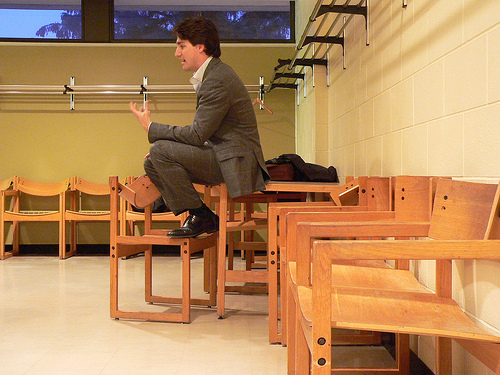
Comments Off on Drama teaching experience NOT going to help TrudeauRecently, a great deal of concern has been expressed around the Tory ad campaign attacking Justin Trudeau as “too inexperienced” to tackle the complexities of being Prime Minister. As well, a great deal has been made about the slant the Tories have taken in this campaign, which points to Trudeau’s past work experience as a detriment to true leadership. In particular, his experience as, of all things, a drama teacher, has caused his leadership ability to be questioned.


IDEAS TO SUPPORT EDUCATORS : Subscribe to the EdCan e-Newsletter
Quality research, reports, and professional learning opportunities.