Archive
-
Students Ask: Why So Few of Us at CEA’s Calgary Conference?
Comments Off on Students Ask: Why So Few of Us at CEA’s Calgary Conference?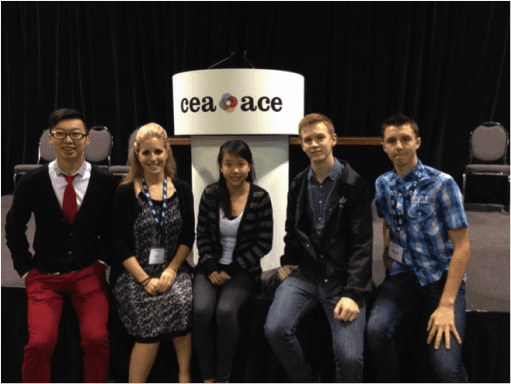
(from left to right) Student George W., CBE Learning Leader Deborah Bradbury and students Cynthia H, Matt N and Wyatt C at the CEA Conference in Calgary.
-
A Shared History, Present and Future
Comments Off on A Shared History, Present and FutureThe library smelled of salmon and berries. Student volunteers moved through the crowd of guests seated at the linen draped tables serving coffee and tea, refilling water glasses. All of us were adorned with beaded necklaces strung with carved canoe paddle pendants engraved with a wolf and our school’s name, West Bay.
-
Stop the Madness of Blindly Dumping Technology into Classrooms
Comments Off on Stop the Madness of Blindly Dumping Technology into ClassroomsPlease, let’s get passed the useless debate about whether or not we should have technology in school. It must become the norm. No question. Kids are extremely plugged-in and engaged outside the classroom while increasingly, they’re tuning out in the classroom. If the purpose of education is to prepare these children for today’s world, we’re already behind the eight ball.
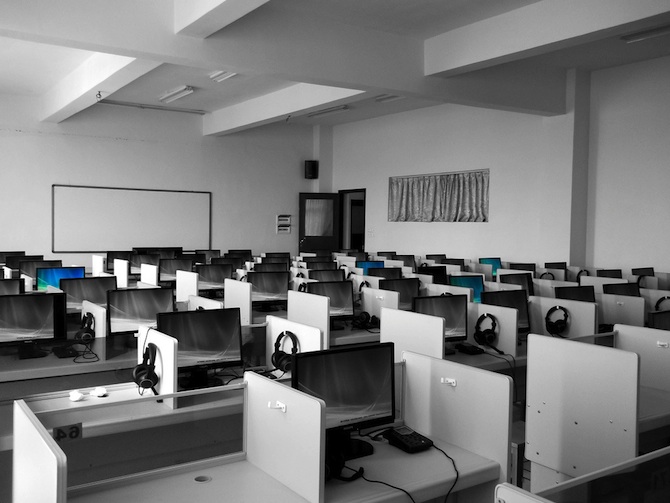
If you’re facing the challenge of making significant and sound technology investments for your schools, but to simply replicate old practice, don’t do it. It’s a monumental waste of money. I’ve referred before to Seymour Papert’s drawing of a stagecoach equipped with rocket boosters to illustrate the point that “Technology being applied to an old model of learning and teaching simply doesn’t work.” There are too many educators who still think that if we keep refurbishing the stagecoach, we’ll prepare students for what they need to learn to thrive in this world. No more tweaking please! Let’s just stop the tweaking.
If you’re investing in technology to transform learning, there is an international group of educators converging on Atlanta in a couple of weeks this Dec 2-3 that can help you to truly make a difference for your students. Those of us who will be sharing our stories in Atlanta wear the battle scars of lessons learned from a legacy of classroom technology integration initiatives riddled with failure – because we worked in isolation without the benefit of learning from the successes and challenges of like-minded trailblazers. Don’t repeat the mistakes of the past and don’t think that you can do it alone. A community is waiting.
This event provides an opportunity for you to learn from an internationally renowned group of tech integration specialists such as Argentinean author and entrepreneur Alicia Banuelos (@aliciabanuelos) who will share her story of how she carried out her master plan to put all of the kids of San Luis online; Gary Stager (@garystager) is a tireless innovator and provocative speaker who will share his stories of working with hundreds of 1:1 schools around the world; the One-to-One Institute’s Leslie Wilson (@leslieawilson) and Mike Gleniak (@mgielniak) are the driving force behind the Project Red Signature Districts throughout the U.S. and have a wealth of insights and expertise to share.
Join a strong contingent of Canadian educators who will be showcasing how they’re pushing the boundaries of classroom change, such as Pierre Poulin from Montreal’s Commission scolaire de la Pointe-de-l’Île (@ppoulin), Mark Carbone from the Waterloo Region District School Board (@markwcarbone), Peter Katsionis from the Vancouver School Board (@pkatsblended), and many more.
This is inspirational learning that is worth clearing your calendar for on Dec 2-3. View the impressive program here.
We have the privilege of working with educators from all over the world who are developing exciting programs – with tremendous transformative potential – that are rarely scaled up. Brilliant well-intentioned leaders are pushing the edges of innovation in their schools by leveraging the potential of technology to enhance learning, but they are isolated from one another in a system that steadfastly values conformity, compliance, and control over creativity, risk-taking, and critical thinking.
Collectively, we must forge ahead, but those of us who are striving to transform classroom learning by effectively deploying technology are still butting heads with many pundits who argue that there is too much financial risk associated with district-wide technology integration. The real risk is continuing to prepare our students for a rapidly changing world using pen and paper. It is 2013. We’re well into an established call to action for ‘21st century learning’, but we’re still paying more lip service to the term than delivering concrete results. We can’t keep preparing our kids for 1991. It is nothing less than malpractice.
Please note that CEA’s Atlanta event partners (One-to-One Institute and Lausanne Learning Institute) have previously distributed portions of this blog post -
Neuromyths are a Barrier to Changing Education
Comments Off on Neuromyths are a Barrier to Changing EducationWhat’s standing in the way of change in education? I believe that one of many other barriers is related to the fact that teachers often have misconceptions about how their students’ brains work. I think that these misconceptions (often called neuromyths) represent a barrier to changing and improving education, because when a change is opposed to a misconception, there is always a natural and expected tendency to resist that change. I also believe that one way to overcome this barrier is to include, in teacher training, a course about neuroeducation, which is an emerging field that tries to improve teaching by knowing more about the brain.
One of the Barriers to Changing Education: Neuromyths
First, let’s talk about misconceptions. You certainly have some ideas or intuitions about how the brain works. Maybe you believe that students learn better when they receive information in their preferred learning style (such as auditory, visual, or kinaesthetic); or that students are either “right-brained” or “left-brained”; or perhaps you think that we only use 10% of our brain; or that there are critical periods in childhood after which certain things can no longer be learned.
 As you may have guessed, all these claims are, in fact, neuromyths. If you believe in some of these ideas, don’t worry because you are not the only one. A study published last year showed that a majority of teachers believes in these neuromyths and others. For example, more than ninety percent of teachers in the UK and Netherlands believe in the learning style theory, although there is empirical proof that teaching according to learning style of students doesn’t lead to better learning (see, for example, Pashler, H., McDaniel, M., Rohrer, D., & Bjork, R. (2008). Learning styles: Concepts and evidence. Psychological Science in the Public Interest, 9(3), 105-119.).
One Possible Solution: Offering Neuroeducation Courses
To combat these neuromyths and overcome one of the barriers to changing education, I believe that we should include, in the training of our teachers, a neuroeducation course. Not only would this course help dispel the most common neuromyths but it would also enable teachers to understand a little more about what is going on in the brain of their students.
Some years ago, there was limited significance to focusing on the brain in education. However, in the past several years, knowledge about the brain has greatly advanced thanks to brain imaging. Up to 90 % of our current knowledge about the brain comes from the past 15 or 20 years of research. Three significant discoveries reinforce the relevance of focusing on the brain in education.
 The first discovery: learning changes the brain. More specifically, learning changes the connections between neurons in the brain. When a student learns to read or count, his or her brain changes. With the help of brain imaging, it is now possible to observe the effects of academic learning on the brain.
The second discovery: the brain’s structure influences learning. In fact, the configuration of the brain prior to learning influences how new learning becomes established in the brain. Thus, gaining a better understanding of the brains of your students means gaining a better understanding of the cerebral constraints inherent to learning and better understanding the difficulties that your students may encounter.
The third discovery, possibly the most significant and certainly the most recent: how someone is taught has an impact on the changes that result from learning. Two different types of teaching do not necessarily bring about the same changes in a student’s brain. Research has demonstrated that teaching reading according to a syllabic or a global approch has a significant impact on how the brain functions. Not only does the brain of a student a change when he or she learns, but teachers can play a key role in the development of their students’ brains.
To summarize, I have tried to highlight the fact that neuromyths can be a barrier to changing and improving education. I also suggested that, to combat these neuromyths, a neuroeducation course should be incorporated into the initial training and professional development of teachers and others working in education. But the interest in including a neuroeducation class as part of teacher training extends beyond overcoming neuromyths. There is now knowledge about the brain that can have concrete pedagogical implications. This knowledge is still widely unknown by teachers, a fact that should be addressed in the coming years since, today, and even more so in the future, a better understanding of the brain will likely help us improve how we learn and how we teach.
Dr. Steve Masson is the co-winner of the 2013 CEA Pat Clifford Award for Early Career Research. For more information about his research, please visit: www.cea-ace.ca/cliffordaward
Photos courtesy of Steve Masson
-
We Must Help Education Grow Forwards
Comments Off on We Must Help Education Grow ForwardsThis content has been re-posted from Janet Lauman’s Blog at: http://jmlauman.wordpress.com/2013/10/29/whats-standing-in-the-way-of-change-in-education/
I was fortunate enough to attend the recent CEA (Canadian Education Association) conference in Calgary Alberta last week, with a team from my district (Delta – in British Columbia, Canada). I say fortunate because the question we were being asked to ponder/interrogate/delve into (What’s standing in the way of change in education?) is one of interest to many of us in education who are looking to help education “grow forwards in a positive direction”… and I am particularly interested in larger and broader educational system change.
A quote by John C. Maxwell comes to mind in regard to this, “Change is inevitable. Growth is optional.” The key here is, as a society we are undergoing vast changes, yet in education, while there are pockets of positive forward growth, these pockets are not widespread or systemic. This perception comes to us from a variety of sources (for example the What Did You Do In School Today? data – see http://www.cea-ace.ca/programs-initiatives/wdydist)
Some of the following ideas were discussed/presented at the conference: the explosion of technology in mainstream society and how this impacts society generally and therefore meaningful experiences in schools as well (see thoughts of Charles Fadel here http://www.youtube.com/watch?v=rHCliGPByf4), how the brain works, the importance of ethics and social/emotional learning, the impact of student engagement on the success of learning….to name a few).
Alma Harris, a leading education writer and international researcher from the UK recently wrote the following (http://t.co/AcRkExwN16). In a nutshell, she recommends that we consolidate rather than innovate in order to have successful educational reform at scale. She has a point in that educators have been engaged in the “change” conversation for a while.
At the conference there was time devoted to examining and discussing the desire to move forwards and the barriers in place making it difficult to do so. This information is being collated and will then be the focus of further discussions and hopefully action as well. I humbly suggest that a more living systems (http://summit.sfu.ca/item/11268) way of moving forwards (developing interconnected learning communities that involve individual educators, students, parents, schools, broader communities in which schools are embedded, districts, provinces…in an iterative process – more inquiry focused in nature) will be more helpful than a mandated way of moving forwards. This would allow those who are part of the education process to consolidate as needed (Harris) as well as to move forward in a way that makes sense within the particular system….to encourage continuous positive growth. (Halbert & Kaiser’s Spirals of Inquiry For equity and quality [2013] is a good Canadian source in regard to positive growth using an inquiry stance.)
In moving forwards, it is important to not destroy those patterns that are helpful (life giving). The following words from Capra are illustrative of this notion within a living systems lens.
I shall argue that the key to a comprehensive theory of living systems lies in the synthesis of two very different approaches, the study of substance (or structure) and the study of form (or pattern). In the study of structure we measure and weigh things. Patterns, however, cannot be measured or weighed; they must be mapped. To understand a pattern we must map a configuration of relationships. In other words, structure involves quantities, while pattern involves qualities. The study of pattern is crucial to the understanding of living systems because systemic properties, as we have seen, arise from a configuration of ordered relationships. Systemic properties are properties of a pattern. What is destroyed when a living organism is dissected is its pattern. The components are still there, but the configuration of relationships among them–the pattern–is destroyed, and thus the organism dies. (p. 81, 1996)
While my words above do not explore all that was discussed at the conference, this is what is resonating with me at this point in time. I look forward to continuing to be a part of helping education systems to move forwards in a positive, growth oriented way, and welcome the thoughts of others on this topic as well.
-
My Story of Change in Education
Comments Off on My Story of Change in EducationThis content has been re-posted from Deirdre Bailey’s Blog at: http://savouringtheish.blogspot.ca/2013/10/my-story-of-change-in-education-student.html. Photos courtesy of Deirdre Bailey.
-
Greystone Teachers Get Fired Up After CEA Calgary Conference
Comments Off on Greystone Teachers Get Fired Up After CEA Calgary ConferenceThis content has been re-posted from Carolyn Cameron’s Blog at: http://www.psdblogs.ca/greystone/2013/10/26/whats-standing-in-the-way-of-change-in-education/
I love this question! I love it when a great question like this gets me thinking. I am assuming that many other educators from around the country likely feel the same way and perhaps, that’s what drew so many of us to the Canadian Education Association’s“What’s Standing in the Way of Change in Education?” Conference in Calgary last week.
What inspired me from the day and a half that I spent with a number of stakeholders from the Education community (educational researchers, professors, superintendents, school board trustees, administrators, teachers and most importantly – students) was the opportunity that the teachers from Greystone had to share practical examples of what change in Education looks like based on their experiences in our school. These teachers were empowered to share their stories of looping, team teaching, collaborative inquiry, assessment as learning and innovation. Their stories are a reminder of what’s possible in Education when we remove barriers and have the courage to “do school” differently in order to get it right for today’s learners.
Another highlight from this conference, for me, was hearing a teacher from the Calgary Science School, Deidre Bailey, share her story of change with all of us. Recognizing that it is the teacher, in the classroom, who has the power to make a difference in student learning, was a message I shared with my entire staff during our Professional Development Day – which took place a few days after our Greystone team of nine returned from the conference in Calgary. I read Deidre’s story to the Greystone staff – here is part of her message:
This change in our classroom environment was a product of co-designing learning tasks in which student voice had space and validity. Kids are so innately curious and creative. All that is left to us, is to foster an awareness of the possibilities that surround them, to let them ask questions, make decisions and make things different.
Following up from Deidre’s story, I asked staff to reflect privately on their own practice and in particular, what was the evidence they had that they were getting it right for our learners and what could they do to grow? I encouraged staff to share their reflections with each other. They blew me away with their willingness to engage in thoughtful, honest conversation. The staff did not want to stop talking! Several teachers openly admitted to taking a step backward this year in their instructional practice due to some challenges they are experiencing (including a “boxed up” schedule that was implemented to deal with additional homeroom classrooms that were added at each grade level).
So, I asked them this great question from the CEA Conference: “What’s standing in the way of changing this?” They were fired up! The dialogue and debate created more questions, more ideas and a commitment to find a better way to provide our students with more time for deeper learning through cross-curricular inquiry.
We haven’t got this all figured out yet, but I know one thing for sure…our Greystone teachers feel empowered, supported and capable of removing anything that’s standing in the way of doing what’s best for our students. I am looking forward to seeing where this takes us. In the meantime, thank you Canadian Education Association, for the great question which is going to continue to keep our school moving forward in the way we “do school”.
-
Educating Our Schools
Comments Off on Educating Our SchoolsThe following is the first in a series of entries inspired by CEA’s What’s Standing in the Way of Change in Education event, held October 21-22 in Calgary. As a member of the facilitation team, I did not have the opportunity to fully participate in all of the rich and engaging conversations that took place around the room, but I am looking forward to using the vision statements, table reports and artifacts collected from the event to offer one perspective on the question that inspired so many to participate.
JEAN BRODIE: To me, education is a leading out. The word education comes from the root “ex,” meaning “out,”and “duco…”I lead.”
To me, education is simply a…a leading out…of what is already there in the pupil’s soul.HEADMISTRESS: I had hoped there might also be a certain amount of putting in.
JEAN BRODIE: That would not be education, but intrusion…from the root prefix “in,” meaning “in,” and the stem “trudo…” “I thrust.”
Ergo, to thrust a lot of information into a pupil’s headThere’s an important nugget of truth in this bit of dialogue between the young, creative heroine and her principal in Muriel Spark’s 1961 novel, The Prime of Miss Jean Brodie. It’s a truth that, no doubt, resonates with many of us who actively participate in conversations about school change. And it’s a truth that was certainly winding its way through many of the table group discussions that took place this week when the Canadian Education Association convened over 300 educators, students, parents, political leaders, system administrators and members of both related profit and not-for-profit groups from across the country in Calgary. For me, it’s a truth that directs our attention to one of the most essential points around which the question that inspired the event turns: What’s Standing in the Way of Change in Education?”
I”m not suggesting that we need to take a this or that approach to the conversation about the purpose of schools, but I do think that Miss Jean is right in pointing out that we need to be careful about how and when we use the term education. I would go even further by predicting that, if Miss Brodie were to visit a typical Canadian public school next week, she would be forced to observe that much of what is happening there is more intrusive than it is educational. In fact, I would argue that our schools aren’t designed to honour the fact that students—and, increasingly, teachers, bring much of anything to the table.
Consider, for example, the way that curriculum is designed and organized. The lock-step set of expectations that become the law of the classroom for most Canadian educators doesn’t leave a whole lot of space for drawing out the interests, talents and passions that lie deep within the souls of students or teachers. Think about the way that physical space is arranged. The one-teacher-to-many-students classroom, complete with standard seating, relatively small space allocations are accompanied by the underlying belief that real teaching should be centered on instruction rather than construction. It becomes a challenge to imagine many alternatives. Oh, some have been successful in accepting that challenge, (Read the story of change that Calgary teacher, Deirdre Bailey shared at the CEA event) but, to a large extent, they are considered outliers.
The reality is that practically every aspect of schooling has been designed for putting in rather than leading out. And that is why I think that this could very well be where our conversations about change need to turn. The most basic assumption that we make about the educational quality of our schools is not one that we’re accustomed to having. But I would be willing to bet my pension on the fact that, unless we’re willing to grapple with it in all of its depth and thorniness, we’re not going to get very far.
What would it look like if a school were deeply committed to valuing what its students and teachers brought into the building every day? What would it sound like? What would it feel like? How might it be organized in terms of time and space? What new roles and relationships would be necessary if this commitment were going be supported? What assessment practices might find a home in this place of leading out? How would long- and short-term planning be different? What new alliances might be formed with the community? What would the role of parents be?
These are all questions that you’ve likely heard before, but how might the responses be different if we turned our attention away from the strategies and processes designed to filling minds rather than divining what might already be there in the lives, minds and, as Miss Jean suggests, the souls of all learners, both young and old(er)? What might the results be if our schools became more…well…educated? Instead of thinking of what additional things we can put into the system, how can we build a vision for our schools that somehow enabled what is there in terms of human capital and capacity to be drawn out in a way that enlivened learning?
Over the past several years, the Canadian Education Association has joined others in pointing to strong evidence that we need to think about schools differently. We heard from students in Imagine a School and What Did You Do in School Today? We heard from teachers in the Teaching the Way We Aspire to Teach initiative, and we’re beginning to hear from school administrators in Leading the Way You Aspire to Lead. This past week, over 300 passionate and informed Canadians gathered in Calgary to begin moving to take what we’ve learned to the next level.
It is relatively easy to identify the things that stand in the way of change in education. It is more difficult to zero in on the reasons why these barriers seem to be so stubborn. The opening snippet of dialogue from Muriel Sparks points to one way to deepen the conversation even more. For me, it represents that central core of the discussion around which everything else turns!
I have a feeling that we’re about to move closer to that centre!
-
Let’s Ban the Binder
Comments Off on Let’s Ban the BinderHas your hand ever cramped up while copying notes into a binder? Do you remember the days when you had to create title pages? Did it matter whether you neatly underlined the date on each page? Can you recall having to study from handwritten notes in preparation for an exam? While binders, refill paper, and writing utensils have comprised the standard learning toolkit for many decades now, these very tools are among the most significant barriers to the change that will one day modernize our schools.
Has your hand ever cramped up while copying notes into a binder? Do you remember the days when you had to create title pages? Did it matter whether you neatly underlined the date on each page? Can you recall having to study from handwritten notes in preparation for an exam? While binders, refill paper, and writing utensils have comprised the standard learning toolkit for many decades now, these very tools are among the most significant barriers to the change that will one day modernize our schools.
Nothing says 20th century learning like the 3-ring binder. For decades, this tool has been the cornerstone of learning. Even dressed up as a cross-curricular ‘Trapper-Keeper’, the purpose of a notebook has been to collect and organize the static knowledge and information deemed most important by the teacher. Whether used to maintain notes, to organize photocopied handouts, or to collect assignments, the state of one’s binder has commonly mirrored a learner’s eventual academic achievement.

In the 1960’s and 70’s the essential aspects of a course were copied from the chalkboard; in the 1980’s and 90’s critical points were copied from the overhead projector; since the turn of the century, keynotes have been copied from slideshow presentations. Primarily meant as an aid to learners preparing for the written test, the act of recording notes on paper by each student in a classroom is a time vacuum that anchors us to arcane paradigms of learning. It’s time to take such past practices to task. (Can you say that five times fast?)
If we value design thinking, project-based learning, and co-construction, then an investment in multimedia portfolios should replace the act of recording notes.
If we care about rich tasks, multimedia products, and digital footprints, then the exploration of modern tools ought be emphasized beyond time spent reviewing notes in preparation for unit tests.
It we wish to honour students with a curriculum guided by choice, challenge, and collaboration, then we need to abandon the practice of recording identical notes into each student’s three-ring binder.
If we believe that creativity is more important than regurgitation, that inventiveness is of greater value than memorization, that learning is more experiential than observational, then we must engage students in thinking beyond pen, ruler and paper.
The future of education is unbound. Modern learning cannot be captured on a page, between the covers of a binder, or within the walls of a classroom. If teaching and learning are to reflect the shared, open, hyper-connected nature of learning, then the retirement of the binder could be the first brave step towards modernizing our practice.
While the removal of traditional tools like notebooks, binders and pencils might be seen as disruptive, I see the replacement of these tools with collaborative practices and digital tools as ‘eruptive’. By leveraging handheld devices, cloud tools, and collaborative learning practices, the modern ‘wiki-fied’ notebook has the potential to change school-based learning as we know it.
It is our comfort with the past is that delays us from making advances in learning. Older siblings, parents, grandparents, and practically every teacher on the planet will recognize the school binder as the prime artifact of learning. Because of that, it will be the intrepid among us who will are the first to retire the binder. The experiences of contemporary learners in newly unbound learning spaces will be remarkable – unrecognizable to past generations of learners. The time has come. Let’s ban the binder.
This blog post is part of a series of thoughtful responses to the question: What’s standing in the way of change in education? to help inform CEA’s Calgary Conference on Oct 21-22, (#CEACalgary2013) where education leaders from across Canada will be answering the same question. If you would like to answer this question, please tweet us at: @cea_ace
-
Let’s Be Honest: One Maguire Moment and 26 Teacher Voices
Comments Off on Let’s Be Honest: One Maguire Moment and 26 Teacher VoicesFor educational change theory, you can open a book and read up on the theorists, but to accomplish change, you really need to be comfortable taking risks individually as a teacher or collectively as a class or school community (students and parents included). Adrenaline junkies are okay not touching something solid. They like to skydive, catch air skiing or boarding, or feel the vibration of a bicycle wheel going down a mountain. The majority, however, like to touch something solid.
teacher-made assessments, I was told, had a reliability of 0.4 which meant … throw it out. Why selectively ignore that? It was comfort and solid and worked for me… until I had children… and now, daily, I ask why there are grades given in schools? If measurement doesn’t support it in the classroom… if the grades can cause anxiety, create competition, and make students feel depressed or lack confidence when they have pure potential?
In systems, solid can be the rules or policies we build to keep order, but in creating these, we create solid walls around ourselves. This has created familiarity and order for some, but it has also boxed us in and given us false comfort. I recently had my Jerry Maguire moment (“The things we think and do not say… Let’s be honest”) when I gave a keynote at the TLT Conference held at the University of Saskatchewan on The Four Movements in Education. In it, I admitted to my atrocious attendance record in high school, the suffering of my brother with learning disabilities during the 70s and 80s, and how I walked out of a Biology class with the teacher yelling at me that it was not my prerogative to suggest an alternate assignment for inquiry during a dissection for a course that I was required to take.
Somehow, I crossed over into ‘system-ville’ though during my university studies. I admit to drinking the test theory kool-aid from the CRAME group during my doctoral degree, working for the 9 GPA, and the scholarships, but forgetting throughout that much of my grades weren’t reliable scores given the assessment practices used… teacher-made assessments, I was told, had a reliability of 0.4 which meant … throw it out. Why selectively ignore that? It was comfort and solid and worked for me… until I had children… and now, daily, I ask why there are grades given in schools? If measurement doesn’t support it in the classroom… if the grades can cause anxiety, create competition, and make students feel depressed or lack confidence when they have pure potential?
We need to face the reality that our job in education is to SUPPORT the learner. These are CHILDREN and should be honoured as such. Their job is to play, be happy, and learn in ways that inspire them. We know they learn better that way anyway. I was told by a senior Ministry of Education official that there was no curriculum police. I have seen new schools that have started learning at the student’s personalized interest level and mapped outcomes UPWARD to curriculum and not the other way. I have seen professional development go viral when it moves UPWARD and not down. I have heard innovative teachers and an entire district say they weren’t following curriculum and were applauded for supporting their learners… by the Ministry. I have heard of science teachers covering Grade 12 curriculum ask for permission to go into the more time-intensive inquiry approaches, which meant they were not going to be able to cover all of the curriculum, and they were approved. If there was ever a time for change in Education, IT IS *NOW.*
I have had the privilege of working with many great educators over the years and this term. I would like to share some amazing blog posts on this very topic. I have to admit that I spend much of my career in the higher education classroom as opposed to the K-12 classroom, although I feel connected in every way. I learn from the teachers I meet and especially from those who share publicly via social media tools like blogging and Twitter. I would like to draw your attention to 26 amazing teacher voices and you can read their syndicated blog posts here.
I have seen professional development go viral when it moves UPWARD and not down. I have heard innovative teachers and an entire district say they weren’t following curriculum and were applauded for supporting their learners… by the Ministry. I have heard of science teachers covering Grade 12 curriculum ask for permission to go into the more time-intensive inquiry approaches, which meant they were not going to be able to cover all of the curriculum, and they were approved. If there was ever a time for change in Education, IT IS *NOW.*
I heard someone say how we are fish in water and cannot see the water around us unless we’re out of it. Time for everyone to go get a towel to dry off. While at it, grab a device to tweet, take pics or video, and blog about it in the open to make sure the movement spreads faster and so we build up a community to support each other through this change. We have lots of aquariums to drain! I look forward to the conversation at #CEACalgary2013. Bring a towel!
This blog post is part of a series of thoughtful responses to the question: What’s standing in the way of change in education? to help inform CEA’s Calgary Conference on Oct 21-22, (#CEACalgary2013) where education leaders from across Canada will be answering the same question. If you would like to answer this question, please tweet us at: @cea_ace
-
As Past Students, We Think We’re ‘Experts’ in Changing Education
Comments Off on As Past Students, We Think We’re ‘Experts’ in Changing EducationOne little discussed obstacle to changing the public education system in this country is that most Canadians feel they are experts in the field.
-
Academics. What’s it good for?
Comments Off on Academics. What’s it good for?Academics. Most of our current school system revolves around it, and yet, I think it falls miserably short of what our kids need. To be honest, I think our academic system of education is highly overrated, at best. At worst, it destroys a number of our kids. Now hear me out. I’m not saying that our kids shouldn’t learn to read, or do math, or even a number of other valuable skills. But too often, the focus of our kid’s school day is on content with little connection to why it matters or even with each other. Instead, many of our students spend hours filling in worksheets or copying down lecture notes that they could Google in 30 seconds. Too often what they listen to is boring and irrelevant to their lives. And from my experience, most of this content is simply memorized, spewed out for an exam and then quickly forgotten. But beyond this, there’s often only one right answer, which frequently cultivates in our students a fear of failure.
For the most part, kids who we consider “academic” tend to be good hoop jumpers. They’ve figured out the system and can jump through the hoops. But rarely are they engaged. Rarely are they transformed by their learning. They’re going through the motions. Research shows that some of the least engaged students are the high achievers. They do well because they know how to “do school”. Is this really the best we have to offer them? Or worse, what if you’re not “academic”? Most of these kids live too many years of their young lives feeling like they don’t measure up. Feeling stupid. And for some, it radically alters their trajectory of their lives. Unfortunately, too many students have to recover from school once they graduate. Is this really the best we have to offer them?
In all honesty, I have to admit that I used to believe in this system. For too many years my students sat in straight rows. I asked the questions. I had the answers. I controlled the learning. But the truth is I did this because it’s what I knew. It’s how I’d been taught. It’s what I saw replicated in university and in other teacher’s classrooms. I sincerely believed that good grades mattered. I’m an English teacher, and I subscribed wholeheartedly to the belief that the pinnacle of success in English was the ability to write “the essay”. But I’ve radically changed my position. To be honest, I’ve come to believe it’s one of the most useless things we teach our students. Recently, I’ve started to ask people I know, “Do you ever write an essay?” I’ve never had one person say yes. I wonder how many teachers, except those who are taking university classes, ever write essays. If I may be so bold, I wonder how many English teachers frequently write essays.
In all honesty, I have to admit that I used to believe in this system. For too many years my students sat in straight rows. I asked the questions. I had the answers. I controlled the learning. But the truth is I did this because it’s what I knew. It’s how I’d been taught.
I’m not saying our kids shouldn’t be able to write. On the contrary, I think our students should be able to argue gracefully, and persuade powerfully. And know what they believe and why. I simply think the essay is a medium that has outlived its usefulness, at least in high school.
I’ve come to realize that being academic doesn’t tell you much. It tells you you’re good at school, which is fine if you plan to spend your life in academia, but very few of our students do. It doesn’t indicate whether or not you’ll be successful in your marriage, raising your kids, managing your money, or giving back to your community. Things that matter much more than being good at school.
Instead, school should be a place where kids can discover what they love. They should be able to ask the questions that matter to them and pursue the answers. They should discover what they are passionate about, what truly sets their hearts and souls on fire. They should discover they can make a difference now. But above all, they should leave school knowing what they are good at. And at this point, I think most kids graduate only knowing if they’re good at school or not. Often our students have many talents; they just don’t fit in our current curriculum because they’re likely not considered “real knowledge”.
Yet, oddly, in the Biology curriculum that I’ve taught for the past several years, one of the objectives that my students need to know is earthworm reproduction. Really? Out of all the things we could be teaching a 17-year-old about biology, someone decided earthworm reproduction was essential?
I’ve come to realize that being academic doesn’t tell you much. It tells you you’re good at school, which is fine if you plan to spend your life in academia, but very few of our students do. It doesn’t indicate whether or not you’ll be successful in your marriage, raising your kids, managing your money, or giving back to your community. Things that matter much more than being good at school.
We are born curious. Babies explore their environments to learn; they do it naturally without being told. Three-year-olds constantly, at times annoyingly, ask, “why?” And yet, by the time I get my students in Grade 10, my students have all but lost their curiosity. Consequently, when I get a new class of students, we start by unlearning. We need to begin to imagine what school could be, instead of what they’ve known for ten years. Only then can we begin to do the work that will help them become lifelong learners who truly enjoy the search for answers, rather than the mark on the top of their exam.
Recently I’ve been reading Amanda Lang’s The Power of Why. In it she states:
Curious kids learn how to learn, and how to enjoy it – and that, more than any specific body of knowledge, is what they will need to have in the future. The world is changing so rapidly that by the time a student graduates from university, everything he or she learned may already be headed toward obsolescence. The main thing that students need to know is not what to think but how to think in order to face new challenges and solve new problems (p.14).
Our school system doesn’t need to create kids who are good at school. Instead, we need to create an environment that engages learners, fosters creativity, and puts responsibility for learning where it belongs – with our students. Instead of rote learning, teachers need to use content to teach skills. We need to build environments that allow our students to get messy and build things. Where students learn how to learn, and know how they learn best. Where students engage in significant research, and learn how to identify credible resources amidst a plethora of information that, at times, may seem overwhelming. Furthermore, our students need to be able to problem-solve, innovate and fail over and over again. Throughout all of this, our kids should be collaborating with each other, as well as virtually with students across the globe. They need to be able to communicate powerfully using the mediums of print, photography and video.
As I’ve worked with my students, we’ve come to realize they need to be able to answer three questions, regardless of what we’re researching: What are you going to learn? How are you going to learn it? How are you going to show me you’re learning? How they get there is often their decision. And what they come up with never fails to surprise me.
Our school system doesn’t need to create kids who are good at school. Instead, we need to create an environment that engages learners, fosters creativity, and puts responsibility for learning where it belongs – with our students.
My classroom hasn’t always looked like this. But over the past three years we’ve shifted to a constructivist pedagogy that has transformed not only my thinking, but my students as well. Now we learn in an inquiry, PBL, tech-embedded classroom. The journey at times has been painful and messy, but well worth the work. The biggest lesson I’ve learned is that my students will often exceed my expectations, if only they’re given the chance.
This blog post is part of a series of thoughtful responses to the question: What’s standing in the way of change in education? to help inform CEA’s Calgary Conference on Oct 21-22, (#CEACalgary2013) where education leaders from across Canada will be answering the same question. If you would like to answer this question, please tweet us at: @cea_ace
-
Brave Educators Possess an Inquisitive Nature to Pursue Change
Comments Off on Brave Educators Possess an Inquisitive Nature to Pursue ChangeOur traditions characterize our lives with meaning and structure, providing a foundation on which we can depend. We treasure the security they provide because we know what to expect. They also provide opportunities to build memories that begin to define us and bring us closer to others. Of course, this is an ideal situation; some traditions make us cringe when we anticipate certain gatherings and the memories that are just waiting to be made.
When we think of our childhood and adolescent years, where are most of our memories made? I would challenge you to think back to your own experiences of school, your day-to-day lessons, your difficulties and successes. I would also challenge you to think of the advice you received from your parents before you went to school. Was their advice based on their own experiences? Do you now have children, and is your advice based on your memories at school?
Technology is captivating the attention of many brave educators, and is beginning to upset the balance in the world of school. Our established tradition is starting to become unsettled as it begins to evolve, as small pockets of ‘teacher learners’ take a second look at the system in which they nurture young minds each day.
Have our memories and expectations of school begun to define it as a tradition? If so, the tradition of school has achieved a status that is difficult to question simply because of its hallowed perception within our society. So many people have experienced the very same lessons year after year, resulting in a mass understanding of what school should be.
Most people don’t change unless they have to. If we’re not given a reason why we have to disrupt our daily routine, sometimes we’ll put it off until it’s absolutely necessary. To counter this, I want to be sure to mention those who don’t wait – those who are curious. Curiosity is distracted from normality and is captivated by something new. Brave people not only possess an inquisitive nature, but they also pursue new possibilities with a fervour that may upset the balance of what is ordinary and expected.
Technology is captivating the attention of many brave educators, and is beginning to upset the balance in the world of school. Our established tradition is starting to become unsettled as it begins to evolve, as small pockets of ‘teacher learners’ take a second look at the system in which they nurture young minds each day.
To allow for this change to continue, support must be provided to those who are willing to follow their curious nature. It is difficult for a teacher to explore new possibilities in education without having a team to provide guidance and reassurance. In fact, an educator who questions the norm may feel like they’re sticking their neck out, risking their pride for the sake of their questions, experiments and attempts to work in a new way.
Change is well within reach if enough support is provided for those who search for new possibilities in education. Bit by bit, they will be driven to share their discoveries with others, building on new knowledge, making new memories, and challenging the traditions and expectations of the past.
This blog post is part of a series of thoughtful responses to the question: What’s standing in the way of change in education? to help inform CEA’s Calgary Conference on Oct 21-22, (#CEACalgary2013) where education leaders from across Canada will be answering the same question. If you would like to answer this question, please tweet us at: @cea_ace
-
Another Brick in the Wall
Comments Off on Another Brick in the Wall
It is not a simple answer. Nor is it a simple question!
-
Avoiding the Parable of the Boiled Frog
Comments Off on Avoiding the Parable of the Boiled FrogI think that I have lost count of how many school closure consultations I have been involved in. Not all schools closed during these contentious events, but the processes unfold in similar ways: The “system” presents its case; a small, passionate segment of the public listens, voices their discontent, and then, over time, final decisions are made. I would say that meaningful dialogue gave way to divisive debates from staunchly held and well-fortified positions.
-
Stop Asking For Permission to Change
Comments Off on Stop Asking For Permission to ChangeOften the things that we believe to be obstacles before us actually lie within us. This is an idea I’ve wrestled with for much of my career in public education and rests at the core of my belief about why change is such a difficult process in our field.
(more…) -
Change in the Trenches
Comments Off on Change in the Trenches“You were great, you treated us with respect!” a colleague told me a few months after I had participated in a professional development day. I had been the last presenter in a series and had to change the mood since the previous speakers talked AT the audience and were called on it.
“Thanks so much.” I said. “Do you remember what my portion of the day was about”?
“No.” she said somewhat sheepishly. (It was about the power of formative assessment).
-
Sharing Shouldn’t Seem Scary
Comments Off on Sharing Shouldn’t Seem ScaryNowadays in education, we hear a lot of encouragement to share our ideas. In general, there is quite a bit of support for educators to belong to professional learning communities (PLNs), for schools to create some sort of mechanism that affords teachers the time to collaborate and more recently, for educators to build PLNs through social media. We all know that some of our best learning comes from speaking, exchanging and working through ideas with our colleagues.
(more…) -
Placing Value on Citizenship Education in a Dog-Eat-Dog World
Comments Off on Placing Value on Citizenship Education in a Dog-Eat-Dog WorldMy prejudice on the question: What’s standing in the way of change in education? can be plainly stated. When all is said and done, good citizenship amounts to the Golden Rule: “Do unto others as you would be done by”. That’s foolproof, I think, though it’s too preachy for some, too self-congratulatory for others, too idealistic, and too impractical in a dog-eat-dog world.
I believe that public education here and throughout much of the industrialized West has never come to grips with schooling for good citizenship as a prime value. Most folks think that good parenting and good teaching of skills are sufficient unto the need thereof. That’s not good enough.
Education for citizenship should be education for living in a democratic society – where cooperation and good will are just as important as numeracy and literacy. The typical counter argument is that it’s a hard world out there and schooling to please taxpayers should not be compromised by soft-headed semi-socialist twaddle. Old-timers still argue that the Hall-Dennis experiment in soft education of the 1970s is a warning never to go that way again.
I believe that public education here and throughout much of the industrialized West has never come to grips with schooling for good citizenship as a prime value. Most folks think that good parenting and good teaching of skills are sufficient unto the need thereof. That’s not good enough.
Let me refer to Finland. The educators of that country steer kids away from dog-eat-dog competition in the classroom – unlike Canadian educators. How do they do it? I Googled “Finnish Education” for a partial answer. First and above all, they select superior persons for teacher certification. Second, the government gives teachers and municipalities a lot of independence in running the schools (within national guidelines). For instance, teachers have freedom to select textbooks! Can you imagine the cries of Chicken Little if that were the case in Canada?
Finnish early childhood educators encourage the little ones to pay attention to other people’s needs and interests, to care about others. Older students are taught to participate in society as active citizens. By contrast, the record of voter participation by Canadian youth (approximately 25%) is a disgrace. There are no standardized tests in Finland by which schools and students are measured as they are in Canada and the U.S. The testing habit to which we are addicted is called high stakes testing, which means that above average schools by test results get the best teachers while ambitious real estate agents roam the neighbourhood.
The Education Index published recently as part of the United Nation’s Human Development Index lists Finland among the highest in the world, tied for first with Denmark, Australia and New Zealand. Furthermore, the highly respected PISA tests (Programme for International Student Assessment) conducted every three years in 40 countries with the participation of half a million 15-year-olds world-wide show Canada near the top in literacy and science, trailing somewhat in math, but behind Finland in all three.
The Finns are exceptionally high achievers in education whilst teaching their children the arts and science of living peacefully and democratically. They have rejected the autocratic tendencies of educators in Canada and more broadly across North America.
Let me repeat my main point. The Finns are exceptionally high achievers in education whilst teaching their children the arts and science of living peacefully and democratically. They have rejected the autocratic tendencies of educators in Canada and more broadly across North America. They understand, it seems, that there is a lot more to democracy than voting every four or five years, having well trained judges on the bench, obeying regulations based on public statutes, paying taxes to maintain essential services. Most of those same benefits are enjoyed by the citizens of authoritarian states like China. Going the extra mile to full blown democracy calls for a school system operating by democratic principles from the opening bell in the morning till dismissal time in the afternoon.
Achieving such a goal calls for a lot of hard work. It will be necessary to start with teacher training founded on principles of democratic citizenship – contentious but worth the effort. A world without war is a potential reward.
This blog post is part of a series of thoughtful responses to the question: What’s standing in the way of change in education? to help inform CEA’s Calgary Conference on Oct 21-22, (#CEACalgary2013) where education leaders from across Canada will be answering the same question. If you would like to answer this question, please tweet us at: @cea_ace


IDEAS TO SUPPORT EDUCATORS : Subscribe to the EdCan e-Newsletter
Quality research, reports, and professional learning opportunities.