Archive
-
Stormy weather for standardization may be on the horizon
Comments Off on Stormy weather for standardization may be on the horizonWell, folks, we may be in for some rain.
Much as we here in Nova Scotia tend to get our weather from the West, so too do we often inherit educational practices and policies. Much of what we “create” in education here at home is borrowed from other jurisdictions, such as Alberta, BC and Saskatchewan. Although we do often get to put our own colloquial spin on things, many times the price we pay for being a have-not province is that we must clad ourselves, to the best of our ability, in the educational hand me downs of our more well to do cousins.
Now, I for one have always been against this trend. I hate the thinking among some policy makers that ideas must come from somewhere else to be any good. Our province is full of top-notch educators, right from the Department of Education on down, and I often wish that we would tap that particular resource a bit more often to find educational leadership. I recognize that there is a good case to be made for not re-inventing the wheel each time we would like to look at educational change, but I also recognize that, just like cars, not all educational systems are created equally. A wheel from a Chevy may never perfectly fit a Ford, no matter how much you hammer on it.
However, there currently is a rather interesting educational storm a brewin’ out across the prairies that has me, quite frankly, praying for rain.
It looks like Alberta has written the “No Zero” policy out of existence and is reducing the amount of standardized testing in public schools.
Now before those of us who dream of such occurrences go running through the fields shouting “Hallelujah!”, a word of caution. The Edmonton Public School trustees have not completed reviewing their policy on “student assessment, achievement and growth”, but the signs are good. Board chair Sarah Hoffman said in a statement released on April 10th that they were pleased with proposed changes, which reportedly may include allowing teachers to give students a zero for non-submitted work and removing the grade three provincial assessment.
Certainly not everyone is pleased. Some folks, in fact, are down right grumpy. In a recent article in the Edmonton Journal, writer David Staples decries the idea, stating that abandoning these tests will “leave parents in the dark”. He worries that without parents being able to see these test scores and compare them to the provincial norms, parents will be unable to see how their student is actually “doing”. They might even be robbed of the ability to pull their kids out of schools that are underperforming (collective gasps of horror abound).
Well sir, let me tip back my straw hat for a second and tell you a few of my thoughts on that.
You see, there are several issues with standardized tests, not the least of which is the nasty effect they have on programming. They force schools and teachers to focus on that certain aspect of the curriculum which is to be tested. For example, if it is revealed that 80 percent of this year’s math test will be looking at long division, there is a huge amount of pressure on boards, principals and teachers to make sure the kids can do long division. All that extra focus is probably going to cost you in double-digit multiplication.
And what if, as Staples suggests, parents start making decisions on where to send their kids based on these results? The school with the higher mark may not be any better at anything, other than, presumably, teaching long division. But once the trend starts, the school with the more rounded education actually gets labelled as a bad school, and kids are pulled out in droves.
You want to know how a school is doing? Visit it. Ask the kids. Talk to the teachers. Go to the school concert. Attend the musical. Volunteer. The measure of excellence in schools should not be what the students score on a test, but on the quality of overall education being offered within its walls. It is excellence in innovation, in creative thinking, in creativity which we must strive for, not patterning and practice. It is an excellence that can not be measured. It can not be counted. It can not be put into a chart to be displayed behind some crooning politician.
Belief in that form of excellence, true excellence, in education, must come from faith in the system.
I am not sure if we will ever see the death of standardization. But as I metaphorically sit on my back porch and look out over educational fields, parched of creative teaching practices by years of data collection, I believe that maybe, just maybe, we might be in for some rain.
And to my mind, that particular storm from the West can not arrive soon enough.
-
Our Roots Are Showing
Comments Off on Our Roots Are Showing“Sir, why are we learning this?”
“Miss, when am I ever going to use this?”All of us will likely recall asking similar questions ourselves at some point along our journey through school. Those of us who are teachers, especially those involved with students older than, say, TEN, will likely have memories of that uncomfortable silence that hangs between, “I don’t know what to tell you” and “I should know what to tell you”. As a grade eight teacher, when all else failed, there was always an easy—but less than satisfying—default position. “You’ll need to know this for high school,” I would say, a little bit of an edge to my voice.
It is always a little discomforting when the context for learning is expressed as preparation for the next stage of learning. While there is no denying the fact that there are many aspects of learning that, necessarily, build on accumulated skills and knowledge, when it comes to creating a context for learning, the storage for future reference argument is never that inspiring.
The parochial roots of our education systems are showing and they are holding us back from taking seriously the renewed conversations about widened contexts for learning that we so desperately need to be having. Oh, we’ve done a fine job of imagining what transformed schools could look like if we opened up the doors of the schoolhouse to new technologies. We’ve dreamed of learning spaces that both reflect and encourage a focus on skills like collaboration, creativity and communication. We’ve talked about forging new types of relationships between schools and the wider communities that surround them. This is all important stuff but, to borrow from Simon Sinek’s now famous TED Talk , it is the stuff of the what and not the why.
Yet, when we talk about creating a context for learning that is, at once, compelling and inspiring for all involved, we need to hold the why firmly in front of us. Perhaps the best way to reconnect with the why of schooling is by looking closely at the curriculum structures that currently form the foundations of modern schooling. Instead of asking how we can make history more interesting, science more relevant and mathematics more accessible, let’s start to take a deeper look at why these disciplines are important to our sense of quality education in the first place. Curriculum reform movements, including the ones that are happening across the country, and south of the border, all seem to begin with questions about what is important to know and be able to do at various stages of the educational process. But what might happen if our energies were first spent on coming to a clearer understanding of the purpose behind studying particular disciplines and what that study can do to nurture our vision of the educated person?
Why is it so important that we learn history? What is it that science can do for our individual and collective consciousness? What is it about mathematics that contributes to our image of a civil society? Why continue to study the great literature of both the past and present? These are questions that are often glossed over when we talk about new approaches to curriculum and pedagogy.
But they are the very questions that will help us to engage in deeper, albeit more philosophical, conversations about deeper and richer contexts for learning.
In his brief, yet powerful, essay, The Reform of Thinking and Education in the Twenty-First Century, philosopher/sociologist Edgar Morin suggests four foundational aims of education:
1) A brain well-formed rather than a brain well-filled
2) Learning about the human condition
3) Learning how to live
4) Citizenship training
In Morin’s view, curriculum needs to placed in the service of our aims, and not the other way around. And he starts to provide some engaging thinking around how our thinking about existing curriculum approaches might begin to change.
For example, when science is seen as a way of helping us place human existence within the cosmic story, a powerful and compelling context is created. When the study of history takes on a similar narrative purpose by helping learners to better understand the creation of communities, nations and cultures, then the discrete facts that we associate with the discipline take on a a richer and more meaningful purpose.
But, Morin argues, education is also about the subjectivity that can be realized and understood through the study of literature, poetry, art and media. These are the places where the human condition is brought home and placed in the context of personal and interpersonal relationship. It is here where the art of living is explored and connections among individuals and cultures are made manifest. And what’s more exciting, possibilities for connections between traditional disciplines become much more apparent and realistic
In a sense, curriculum is the place where the dance between the objective and subjective, between the global and personal contexts, takes place—an important and necessary dynamic! For me, the exciting part of this type of thinking is that it brings us face-to-face with the why of our work as educators. It doesn’t in any way discount the importance of learning content but it forces us to make our intentions very clear around how it fits into the wider context of our work.
How might our response to the why are we learning this questions change if these types of these deeply-rooted conversations began to take place at all levels of our education systems, throughout our communities, and in the public square?
-
Students determine the classroom rules
Comments Off on Students determine the classroom rulesEvery year at this time, right when the cherry blossoms are reminding us that the grey days of winter are almost gone, my Grade 8 students go crazy. They start taking a really long time to settle down into the silent reading period that starts most of our classes. They can’t help but talk to a buddy across the room. They squirm around in their desks and look to their groups for conversation, until I remind them to open their books and start reading. And then I remind them again. And again.
A couple week ago I realized that I had turned into a nag: I do Not. Like. Nagging.
-
CEA Launches Call for Submissions for the 2013 Whitworth and Pat Clifford Awards
Comments Off on CEA Launches Call for Submissions for the 2013 Whitworth and Pat Clifford AwardsCEA has a long track record for celebrating the incredible potential within Canadian research communities to contribute new perspectives on engaged leadership, engaged teaching and engaged learning. With the Whitworth and Pat Clifford Awards, CEA recognizes the work of innovative researchers from across the country for their scholarly contributions, their promise, and their commitment to breaking new ground, challenging existing ideas and revisiting commonly held assumptions in educational policy, practice or theory in Canada. It is my privilege to serve as Chair of the CEA Awards Selection Committee and to announce the 2013 call for submissions for our two awards that recognize researchers.
The Whitworth Award For Educational Research
CEA’s Whitworth Award, first presented in 1967 and held by 49 researchers thus far, recognizes the impact of innovative and experienced Canadian researchers who have made a sustained and substantive contribution to educational research and practice over a period of time. The Whitworth Award was last presented in 2010 to Dr. Philip C. Abrami, Professor, Research Chair, and Director of the Centre for the Study of Learning and Performance (CSLP) at Concordia University, for his sustained contribution to improving educational research and practice in schools. Canadian researchers who have made sustained, substantive and significant contributions to research, education and leadership over time in Canada are encouraged to apply for this award. The Whitworth Award is formal recognition of a researcher’s scholarly work and contributions, it provides additional networking opportunities with CEA, and comes with an invitation to submit a feature article about their program of research to Education Canada magazine.
The Pat Clifford Award for Early Career Research in Education
The Pat Clifford Award, first presented in 2009 and held by five researchers thus far, recognizes the high quality work achieved by emerging researchers in Canada. The CEA Awards Selection Committee seeks applicants who demonstrate early career research and teaching promise, scholarly contributions and achievements, and commitment to charting new territory in education policy, practice or theory in Canada. As a classroom teacher and faculty researcher, Dr. Pat Clifford blurred the boundaries between pedagogy and research. Pat strongly believed that teaching was at the heart of research, and that research was at the heart of teaching. The Pat Clifford Award is an enduring commitment to sponsoring and mobilizing the work of new researchers whose ideas and scholarship will change education. In 2012, the CEA recognized the research contributions of Dr. Michelle Hogue, Assistant Professor and Coordinator of the First Nations Transition Program at the University of Lethbridge. New researchers are encouraged to apply for this award, for the formal recognition and promotion of your scholarly work, for the networking opportunities and mobilization strategies with CEA, to maximize the impact of your work in practice, and for the invitation to submit a feature article about your research to Education Canada magazine. If you are in the process of completing a Masters or PhD OR have completed a Masters or PhD in the last 2 years, then you may qualify for this award.
Please note that the deadline for submissions for both awards is Thursday May 30, 2013 by 5:00pm EDT.
-
Putting 21st Century Learning in Context
Comments Off on Putting 21st Century Learning in ContextGrowing up, I knew a whole lot about Anteaters, Aardvarks and Africa.
Walla Walla and Zanzibar? Not so much.
You see, beyond the walls of my school, the only consistently accessible sources of information were the 3 sets of encyclopedias that graced our living room bookcase. The challenge was that they were somewhat incomplete. We owned four volumes of the Columbia Encyclopedia; the first volume of Funk & Wagnall’s New Encyclopedia, 1968 and 1969 and, curiously, Volume ‘M’ of the World Book. My best explanation is that the latter was spirited away from our elementary school library during a project on either Magellan or Madagascar! The only inspiring thing about our little collection was the spine of one of the Columbia editions: Volume 4—DARE to DREAM. (Admittedly, that may only resonate with those steeped in encyclopedia culture!) I kept that one close to me.
It seems that in the 1960’s, grocery stores had forged occasional partnerships with major publishing houses to provide the opportunity for shoppers to combine their weekly shopping trips with the purchase of a reputable source of knowledge for their family. The first few volumes were offered for $0.99 each, and after that, the price increased to the point where my parents eventually stopped purchasing—at least until the next offer came along. As a result, much of the knowable world beyond the first few letters of the alphabet was pretty much a mystery to me during those early years of my life.
In an interview earlier this year with TVOntario’s Steve Paikin, educator and author, Douglas Thomas, suggested that technology is helping to shift the role of teacher from a provider of content to a framer of context. But, what does that mean, and what implications does that shift have for the way we think about schools: how they are designed, organized and even staffed?
Despite the caricatures of “traditional” schooling that are often carted out in conversations about education reform, I’m not sure that there was ever really a time when teachers saw their role as simply pouring discrete pieces of information into the minds of students. The challenge of making content meaningful and relevant—the heart of context—has always been on the minds of good teachers, and one of the goals of quality education.
But technology has substantially changed the game, hasn’t it?
The advent of complex and more accessible information networks has done three important things—each of which supports the case for a major redesign in the way we approach schooling and education.
First, the boundaries between information acquisition and information creation have been considerably blurred. Not only can we now access great vast stores of data, facts, figures and thinking about the world, but it is now possible for more of us to actually contribute to those volumes!
Second—and I think that there’s lots of room for conversation here—technology has not only opened up greater stores of information to a greater number of people, but it has also introduced us to multiple conversations and interpretations of what all of that information means. No longer is the traditional and fairly homogenous family-(religion)-state-school dynamic the only game in town. Quite the opposite! Within a couple of hours of any major news event occurring, it’s quite likely that we’ll be able to access several different versions of the facts, as well as several different contextualizations. This is both exciting and challenging and clearly calls on different ways for us to “make sense”.
Connected to this is the realization that the task of helping students make meaning of information has become much more complex of late. The job of creating rich contexts that will help students weave strong connections among and between knowledge domains has been made more challenging by the variety of perspectives that live in our classrooms and pulse through our information networks. But the very complexity that makes this challenging also makes it important and extremely worthwhile.
So, there is plenty of real estate to walk around here, but I’m finding that using the context argument as both a frame and a filter for thinking about transformation is proving useful.
To what degree do the innovations suggested by those excited about changes in education actually help educators and students build stronger contexts through which they might view and participate in the world? How does the familiar list of 21st century skills relate to the shift from becoming experts in content to masters of context? What new approaches to teacher education begin to emerge when this transition becomes the focus? What types of people should we be trying to attract to the teaching profession in light of the content-context shift?
-
Mixed Martial Arts and Life-Long-Learning
Comments Off on Mixed Martial Arts and Life-Long-Learning
Henry is training to fight in a cage for a living. This new piece of knowledge sits in front of me disconnected from everything I know.
“Don’t you get hurt?” I ask in total incomprehension. What I want to ask is, how can you take pleasure in hurting others? How can you feel the crunch of bone on bone and feel anything but horrified?
“Yeah, you get hurt,” he answers. Obviously, he and I feel differently about pain.
-
One One Condition: Time is of the Essence
Comments Off on One One Condition: Time is of the EssenceI entered school as one of the youngest kids in my class. Born at the beginning of October, I began my kindergarten year standing a little shorter, arriving a little less seasoned in the ways of the world, and a little less able to do some of the basic things that many others in my class seemed to do rather effortlessly. Although I eventually caught up with my grade level peers (I can now tie my own shoe laces!), it was clear from reading some of my early report cards that I was being measured against an external standard of what children at various ages should be able to do by the end of the school year. Unfortunately, when you talk about catching up, I really didn’t start to excel at school until it was almost time to leave the system. My high school marks were barely high enough to gain acceptance into the Ontario university system, and my first year results at the University of Toronto were really nothing to write home about.
Something happened, however, in my second and third years of post-secondary schooling. First, I found the campus pub and I started to have a good time, fitting into a social scene that was more determined by interest than it was by age. Second, I started to earn consistently higher marks and this encouraged me to take a deeper look at what I was studying, spend more time in the library and consider extending my educational journey.
Interestingly enough, other people appeared to have more confidence in my intellectual abilities than I did, myself. In fact, when I asked one of my philosphy professors for a letter of reference in support of my application to theology school, he took the opportunity to express his disappointment that I wasn’t considering grad school in his particular discipline. He felt that I was selling myself short and that I could definitely handle the greater intellectual demands involved in being a philosopher, as opposed to a priest. I remember leaving his office on a late winter afternoon thinking to myself, “Wow, after all these years of being in school, this is the first time that I heard someone say that I could actually do more than I had learned to assume.”
As Sir Ken Robinson points out, one of the beliefs around which our current systems of education are organized is that kids enter school stamped with a best before date. Parents and teachers are made keenly aware of how children are doing in relation to others in the class, even though a student born in January may differ in “real development age” by an entire year when compared to the student born at the end of December. Convenient for registration and processing purposes, but questionable for many aspects of learning and development.
Notwithstanding my personal story, it wasn’t until many years later that I became aware of the advantage afforded to children who are born earlier in the calendar year. From school admission to registration in a hockey program, birth date matters a whole lot, and according to folks like Malcolm Gladwell, creates a playing field that is, from the very beginning, uneven.
To be sure, schools can have a mitigating effect on many of the factors that are at play in the life of a child as they enter formal schooling. The seemingly universal movement of students based primarily on date of birth, however, is a factor that is almost completely within our locus of control.
Although I have some ideas regarding how we might re-imagine our current approach to student progress, I would first like to hear about your stories and ideas.
How was your own experience of school affected by your birthdate? Are you aware of being advantaged/disadvantaged by your age? Has your school district found creative ways to rethink the way that schools move through the system? As a parent, teacher or administrator, do you think about birthdate as a factor in school success? Are there other questions or thoughts you have about the issue of the age-grade dimension of our current schooling practices?
-
On One Condition: Time Is Limited (and limiting)
Comments Off on On One Condition: Time Is Limited (and limiting)You’re walking along the beach—possibly on your spring break—and you happen upon a rather odd-looking object that was left behind by the receding tide. As you pull the object from the moist sand, releasing it from its net of seaweed and shells, you begin to recognize that the object is not that odd-looking after all. In fact, what you are holding in your hand is a ceramic model of a one-room schoolhouse, complete with bell tower, separate entrances for girls and boys, and a picket fence in need of a little white paint. As you rub away the last grains of sand, the puff of smoke that emanates from the school’s brick chimney transmutes into a rather overbearing, stern-looking schoolmarm who, looking over her spectacles demands, “What is that you want?”
“What do you mean,” you ask, confused as to the nature of the question.
“Because you have rescued me from my watery prison, you have been granted one wish—a wish that will allow you to change one aspect of this place we both know as school.” She gestures toward the ceramic model.
“Only one wish? I thought that the standard allocation was three,” you timidly suggest.
“Cutbacks!” comes the sharp reply, accentuated by two short, violent swipes of the figure’s yellow-tipped pointer.
“Ok, let me think.” You cower slightly and she notices and purses her lips.
“Time is limited.”
“Yes,” you say, “Alright then, I think if I were able to change just one thing about schools, it would have to be the way we…”
My own response to the invitation would come rather quickly and would follow directly from our schoolmarm’s own admonition, “time is limited.” If I were able to change just one thing about schools, it would have to be the way we deal with time.
You know, we talk a great deal about encouraging an attitude of life-long learning, but schools are set up to give a very different message. In most schools, there is a very real sense in which learning is time-bound along both the X and Y axes.
On the one hand, grade level expectations define what counts as the acceptable package of knowledge and skills when you are six, eight, twelve, etc. Formal schooling pushes us along a horizontal plane from Kindergarten to Graduation and measures success based on a student’s ability to meet these arbitrary requirements within the time allotted. Time is limited, indeed, and the self-perceptions that we develop as learners (and as teachers) are tied up with staying on track, and on schedule.
I’m convinced that a major part of our school transformation conversation needs to address the “X-axis”. Imagine what might happen if, right from the beginning, we were to untether our students from their date of birth and, instead, were to allow them to develop personal paths based on something other than age.
When we look along the “Y-axis”, we’re faced with a model of schooling that separates knowledge and skills, divides them up into neat little packages and places them on a daily schedule with strict guidelines around how much time is devoted to each package. And the model does exactly what it is designed to do, allowing for discrete and focused attention, time management and a division of labour across a school staff. But as more and more teachers are insisting, the model does little to promote really deep learning, integrated curriculum, project-based opportunities, collaborative teaching or the type of critical thinking that can lead to connected understanding. Many educators will vociferously attest to the fact that this approach to time has led to curriculum—and learning—that is a mile wide and an inch deep.
So what might happen if we were to give educators the freedom to play with the way in which daily allotment of time is imagined? What if talking about learning time took the place of tracking seat time, and our schedules became just a little more porous and a lot more flexible? What could be drawn into the learning experience that currently sits on the sidelines? What could be drawn out of the experience?
I realize that these are broad and somewhat familiar strokes related to the concept of time within our schools. It is my hope that you might help me fill in some of the details, bring your own experience to the conversation and even push back on some of what is here.
Or, as I toss the ceramic schoolhouse back into the sea, you might wish to retrieve it and answer the “What is it that you want?” question in a totally different way.”
-
Transformation in Education: On One Condition
Comments Off on Transformation in Education: On One ConditionMost of the work on educational transformation that I’ve read over the past 20 years has, normally by way of introduction, hurried to point out the fact that our schools would be one of the few places in 21st century culture that would still be recognizable by our parents and grandparents. This observation is rarely offered as a type of glorious testament to the power and value of tradition; most often, it is meant to jolt us out of our complacency and into a state of awakened action.
Notwithstanding the tremendous amount of energy that educators, policy-makers, parents and other thought-leaders are exerting to drag the modern schoolhouse into the 21st century, there are many times when the challenge seems almost Herculean! In my work here and elsewhere, I have met many, many enthusiastic, inspirational and forward-thinking groups and individuals who continue to work with dogged commitment to hold open that critical space between what is and what could be. It’s an important democratic tension to both maintain and explore.
These days, I continue to be inspired by the statement most often attributed to Marshall McLuhan, “I’m not sure who discovered water, but I’m pretty sure it wasn’t a fish.”
Stepping outside the familiar and taking a very close look at the waters in which many of us are so immersed might allow us see that an alternative starting point for transformation may be a focus on the the assumptions of the past as opposed to the demands of the present, or the promises of the future. And although there is a real sense in which assumptions are not readily visible to the naked eye, we can rest assured that, in the case of school, they are deeply embodied in our language, our practices and, most important, in the institutional conditions that define both the boundaries and the horizons of formal education.
You’re likely very familiar with what these structural conditions are: age-based progression through the system, compartmentalized schedules and calendars, one-to-many classroom configurations, the classroom as the locus for learning, hierarchical leadership models, linear approaches to initial teacher preparation, individualized workspaces, individualized approaches to evaluation and reporting for both students and educators. There are more, but when you think about it, these are some of the most resilient conditions that surround educators, students, parents and policy-makers. These are the things that assure us that, in fact, we are in a school. In fact, try to alter even one of these conditions and you’ll most always get the response, “Hey, this doesn’t feel (look, sound, smell) like school!”
Stepping out of the water and identifying these conditions is one thing. That’s the all important what of the conversation. Even more important, however, is the why? Why do these conditions exist? In what assumptions about teaching, learning, knowing and understanding are they rooted? Do we still accept the validity of these assumptions?
Over the next few weeks, I’d like to open up a dialogue that pokes and prods some of these conditions. In doing so, it’s my hope that we might be able to loosen up the ground that holds our ways of thinking about school rather firmly in place.
If you’ve already done some writing yourself, or have encountered other reflections on any of these, feel free to share them. If you have insights on the origin, purpose or rationale for any of these conditions, you are very welcome to participate. If you’ve come across resources—books, articles, websites or videos—that might deepen our thinking, share away! And if you have any other conditions that might engage us in thinking more critically about the why of our current model of schooling, the floor is yours!
So, with apologies to Dylan Thomas, I plunge my hands into this complex and knotty place called school and bring out whatever I can find. In goes my hand, into that chalk-white ball of school days, both past and present, and out comes TIME.
So we’ll start next entry with a conversation about time and how it is viewed and organized in our current version of the schoolhouse. Stay tuned!
-
Building relationships between Canadian and International Students
Comments Off on Building relationships between Canadian and International StudentsEvery year, dozens and dozens of students make the decision to leave their homes, leave everything familiar and comfortable, get on a plane and enter our school. They come for broader horizons, opportunity and quality learning. They come to increase their life chances for success, their own and their families’.
They are lucky if they land in Leonie Plunkett’s classroom.
Leonie cares about these kids and she brings this ethos into her social studies classroom.
Recently Leonie and her international students worked their way through the Great Migration unit but they also worked their way into the consciousness and even hearts, of our Canadian students.
Some of our Canadians students have no idea what it’s like to place themselves in a foreign routine. They have no idea how easily humour and personality can dissipate when living in a foreign place. Knowing this about her Canadian students and knowing the real strength and struggles of her international students, Leonie used her unit on the Great Migration to teach her students a contemporary lesson.
“What would it take to make you leave everything you know for the promise of something different and the potential of something better?” Leonie asked this question of her grade 10 socials students.
They met her question with blank stares and she resolved to go deeper.
Over the course of their unit, students gained perspective on the experience of those who left Europe to travel to a land they’d only heard about, the New World. Many of these immigrants arrived mid-winter to a frozen land without supplies or understanding of how to sustain themselves. They navigated hostile politics and immersed themselves in unexpected physical labour. They fought to survive and to find themselves anew. This, our Canadian students discovered, remains the experience of many immigrants today.
Leonie gave her Canadian students the task of seeking out international students and interviewing them about their personal “great migration”. What did it require of them to leave their homes and families? What got them through the first big transitions? Who did they rely on? Who did they confide in? What gave them joy in this place? What caused them to struggle? Was it worth it? What do they miss? What have they gained? Individually, Canadian students asked around the hallways and cafeteria to find their international “twin” and interview him or her about this most profound experience.
After studying some political cartoons of the era, cartoons which communicate the difficulties of the immigrant experience in sharp and sometimes acerbic tones, Leonie had asked her international students to create political cartoons to represent their experience. Here is one:
“You know what would be great next year, if I get to teach this course again?” Leonie reflects one afternoon. “I’d give the Canadian students the political cartoons the internationals created. I’d ask them to think about the images and to articulate the messages. Then, maybe, I’d invite the internationals in and have them get into a discussion about immigrant experiences.” Leonie hopes that students would learn how much they have in common, how similar their worries and emotional lives are.
We talk about how having the conversation anchored by these political cartoons would ground the conversation in a much deeper place than the types of food they miss from their home countries or what they think about Canada’s climate.
We talk about brave it was for her 15 year old Canadian students, many who have never left their comfortable neighbourhoods, to approach someone whom they don’t know and extend themselves in conversation about things they know nothing of. We talk about how brave it was for her international students, also 15, to speak up and own the difficulties inherent in living and learning in a different culture.
Mostly though, I notice how Leonie’s eyes glow and her voice gets raspy as she talks about how the other day, one of her Canadian students came by her classroom, his arm draped casually around an international student’s shoulders: “Hey Ms Plunkett! This is Henry – the guy I interviewed for that assignment in socials!”
Henry had the goofiest grin on his face.
-
How Blogging and Tweeting Reinvigorated my Passion for Teaching
Comments Off on How Blogging and Tweeting Reinvigorated my Passion for TeachingI remember a certain teacher in high school whose reputation was built upon years of making students work extremely hard in order to achieve good grades in his course. He was tough. His course was tough. You had to be tough to make it through… or at least it felt that way. In retrospect, I’m fairly sure that his reputation intimidated his students more than he did. There was one year, though, that seemed different. His entire character seemed to change, and even he admitted that he could identify a bit more with his students. What happened? He took a course. The teacher who was known to push his classes to their limits suddenly had an awakening and learned what it was like to be a student.
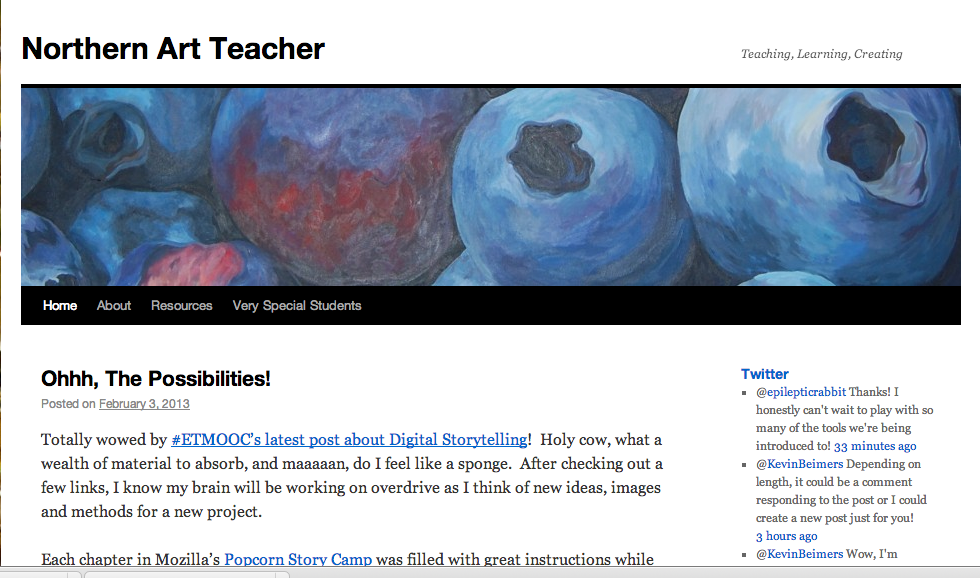
One year ago, I began blogging. It was my first attempt to try something new in quite a while; to share some ideas with the world and to learn for the sake of the students who learn from me. Here are my thoughts from that first post:
The worst thing that anyone can do is to get stuck in a rut. This is especially true ifyou are a teacher! This blog is the beginning of a challenge that I have made for myself (and for any other teachers): try something new!
We are forever telling our students to experiment and take chances, but many timeswe don’t follow our own advice. What is the result? Fuddy-Duddy Teachers. Don’t tell me you don’t know what I mean. You remember them from your own days in high school… the teachers that relied on the same old assignments like they relied on their same old wardrobe. Change is necessary. Clean out your binders and see your classroom with a new set of eyes. Who knows what we’ve been missing.
http://northernartteacher.wordpress.com/2012/01/21/hello-world/
What seemed like such a huge step soon became a stepping-stone as I cautiously explored different ways to connect with teachers online. Thanks to my principal, I was introduced to Twitter and managed to begin following many other educators who were more than willing to share wonderful resources.
There was no way to anticipate the extent to which blogging and tweeting would change my understanding of education, but these simple steps allowed me to enhance my practice and provide a richer learning environment for my students. Reaching beyond our classroom walls has meant so much for our school, and we’ve been rewarded with learning experiences worth remembering.
Exploration and risk-taking have become the norm for teachers who want to invite the world into the classroom – these new experiences don’t have instruction manuals that explain the steps to success. Students become co-learners on many projects that haven’t been tried before, and have often taken a teaching role as they have shared resources and knowledge.
We now have a class blog where projects and pictures are shared, and a class hash tag on Twitter that we use to share notes, questions and links. Often, students will send me a tweet while they’re working on an assignment just to make sure they’re on the right track. Who knew social media could be used to provide useful feedback?

Our experimentation with student blogging has also added a different dimension to learning activities, as each post automatically becomes globally accessible. Projects that used to be shared on our class bulletin board are now available online to anyone, anywhere. Our audience has changed, making it that much more important to become responsible for what we share. I say ‘we’, because my students and I are exposing our words and our thinking. This transparency urges us to be accountable to our school, our district, and anyone else who might happen upon our work.
As I celebrate the anniversary of my first blog post, I’m happy to be able to reflect on the changes that have occurred in my classroom. My students have found more relevance in their learning endeavors, and their teacher is excited to share new possibilities with them. Who knows what this next year will bring?
Please click here to listen to a full Teaching Out Loud Podcast featuring Colleen Rose
-
Honouring Student Voice and Experience
Comments Off on Honouring Student Voice and ExperienceAlex and I are sitting in her nook, a softly lit corner of the school she has made her own with lamps, a colourful throw rug, coffee machine and a laptop. It is a creative space – a place to design learning of a most powerful sort: personalized.
A few months ago she invited me into this space to talk about an idea that had been peculating.
“I want them to use poetry to explore their lives – all the stages of life,” she said, her hands moving in an arc to demonstrate the enormity of life’s ebb and flow.
I nodded, happy that other people get excited about poetry too, but not yet totally understanding her idea.
“We’ll start with toddlerhood – and then move through childhood, teenagedom, adulthood, and aging – the whole circle of life,” she said.
Now we are sitting in her nook reflecting on her unit thus far. She has collaborated on it with our colleague Greg Elliott and as a result of her idea and their creativity, students have written poems and studied poetry while studying themselves.
This unit reminds me of an English professor who I once asked a question that had been frustrating me throughout the reading of what I found to be confoundingly boring 17th century literature: “What is the point of studying literature?” I had demanded. “We aren’t doing anything important with this – we aren’t curing cancer or anything – we read books and analyze them.”
He turned to me, book in hand and, I kid you not, moved his black rimmed glasses so they perched at the end of his nose, raised his eyebrows just a titch, and said, “Brooke, we don’t analyze the good books – the good ones analyze us.”
Oh.
Now, here I sit with his words made real in Alex’s classroom. Alex is using poetry to ask her students about their lives. In her classroom, poetry humanizes each student to the other, the teacher to her students, the students to the teacher.
“The texts have created a safe space for us to look at ourselves and each other,” Alex reflects. “You learn that you’re all learning how to get through life – with some literary devices thrown in.”
If you’d like to talk with Alex about her unit or have any questions, she’d be happy to hear from you at athureau@sd45.bc.ca.
-
Changing Our Minds About Innovation in Education
Comments Off on Changing Our Minds About Innovation in EducationBack in November, Ron Canuel kicked off the CEA Blog Campaign on Innovation with a rather simple question, “Why Do We Need Innovation in Education?” My immediate (and, admittedly, somewhat glib) response was “Well, why not?” After all, I thought, we’re living in a 21st century culture that has presented us with a parade of immersive technologies that have profoundly transformed the way that we work, learn, play and connect with each other. And we’ve stood in line to buy into pretty well every one of them, haven’t we? So, on the one hand, the “why” question sounds a little odd—a little out of touch with the innovative energy that surrounds us.
On the other hand, Ron Canuel is intimately familiar with the way that systems and organizations work. In fact, he’s led one or two of them himself. And I’m confident that he knew that, in order to get to the heart of both the challenges and opportunities presented to us by life in the 21st century, a simple question would cut more quickly and more deeply.
As voices from across Canada and around the world have converged here over the past few weeks, it is clear that there is both a heart and an energy for innovation in our education systems. Each of the stories that have been told—even the ones grounded in a sense of caution—have emerged from a deep sense of caring about and commitment to this place we call school. They have reminded me of the observation made by many who write about change—that imagination, creativity and innovation are embodied traits, enacted by human participants and not necessarily by (and, at times, in spite of) organizations themselves.
I recently encountered the work of creativity and change thinker, George Land, who has spent a good deal of his life thinking about patterns of growth in both natural and human systems and organizations. In his 1992 collaboration with Beth Jarman, Breakpoint and Beyond, Land makes several points that could offer a way of moving our conversations about innovation in education forward in a different way.
Breakpoint and Beyond is based on the idea that the technologies that will move our organizations and institutions to the next phase of development are already among us. We have the resources we need to transform our personal, social and institutional lives.
The key to successful transformation is the way we think—our worldview—our mindset. For Land, much of our culture is still immersed in a logical, linear, cause and effect view of the world. Problems are “fixed” by accurately finding the cause, isolating it, and dealing with it. Energy is spent trying to improve upon our existing services, resisting the move towards large-scale change but, instead, tinkering to make what exists “better”.
But, Land and Jarman point out, the whole mindset that still grounds our thinking is a remnant of a time when particle theory provided the most accurate understanding of the way the world works. It’s a mindset that has failed to allow the “newer” scientific notions captured in quantum physics and wave theory to influence our thinking. Early in the 20th century, physicists began to realize that there was an energy that ran through the universe at a sub-atomic level—an energy that is dynamically creative and tends towards connectivity and interdependence. In this mindset, change is not driven by what has happened in the past, but is drawn into the future by a vibrant sense of possibility (and apparently unpredictability)
It is a view of transformation that is energized not by what has been, but by a compelling vision about what could be.
According to Breakpoint thinking, innovation—true and effective innovation—is predicated on a shift of mindset that moves us from thinking about the world as fixed, ordered and, in a sense, pre-determined to one that is creative, connected and future-oriented.
So, I present this way of thinking as one way to continue the dialogue. Its a way of thinking that has taken up residence in my own imagination over the past couple of weeks, and its a way of thinking that I carry with me as I head back to re-read the blog entries that have made for a very interesting, diverse and engaging few weeks.
Could it be that this talk about innovation is really all in our minds?
-
My Secrets for Innovating Classroom Practice – Part 2
Comments Off on My Secrets for Innovating Classroom Practice – Part 2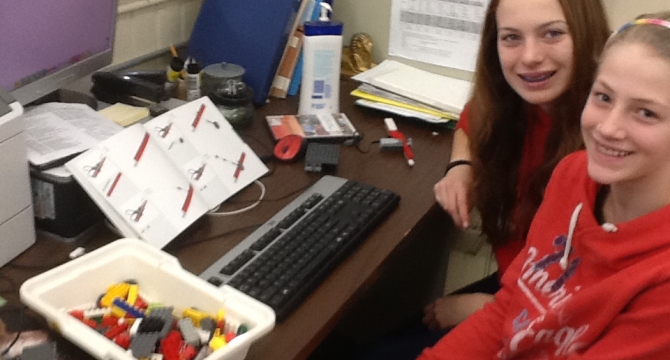
What does all of this innovative practice look like in action?
My Grade 7 class’s current project began by accident through social media.
Clive Thompson (@pomeranian99) shared a link to an article from The New Yorker that I found interesting and shared with my class, which caused my students to explode into conversation.
This led me to show students how I use Twitter to connect with interesting people and ideas rather than following someone like Charlie Sheen.
Students were not intimidated by the level of language. They read what they could understand, skipped what they couldn’t and pursued paths based on their own interests. The material was rich!
I shared my class’s response to the article on Twitter with Clive and the author @garymarcus, which drew them into following our work more closely. (Clive writes for Wired Magazine and the New York Times and has visited our classroom in the past). Discussions extended into a second day and students wrote reflections, which prompted me to introduce blogging as we now needed a platform for our writing. A few students set up their own Twitter accounts and connected directly with Clive and Gary.
Jarred Bennett shared a post about why we need to teach Twitter, which allowed me the opportunity to focus on digital citizenship and personal vs. professional Twitter accounts.
Gary then shared what was happening with Class 71 with someone he knows from National Public Radio (NPR) and my students received an invitation to appear on American public radio, which immediately bumped up the level of discourse in the classroom.
Seeing that much of my students’ reaction to the article is fear-based, I saw the need for a better understanding of robotics.
Students worked in collaborative groups and were given two topics:
1. What do you actually know about robots?
2. What questions do you have?
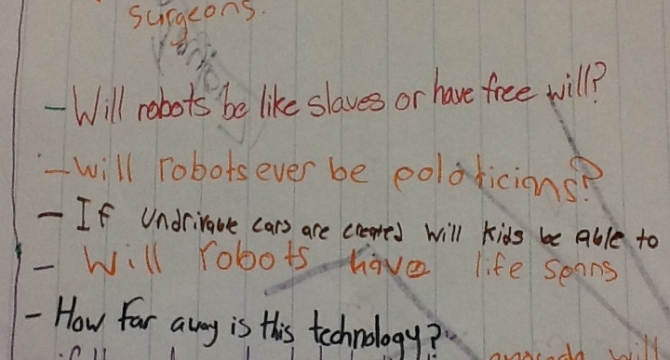
This was followed by an intense 25-minute discussion and sharing of ideas many of which were highly insightful.
I then introduced students to the MIT MediaLab, which led to a fascinating exploration of robotics on the iPads, and more questions, comments and sharing. {My learning at that point: I should have had Twitter accounts on so students could share links as they went}.
Students explored their thinking on ethics, society, morality, points of view … and engaged in one of the most sophisticated discussions that I’ve witnessed among Grade 7 students. I am so sorry I didn’t record it.
Students were not intimidated by the level of language. They read what they could understand, skipped what they couldn’t and pursued paths based on their own interests. The material was rich! I then saw a need for students to consider the moral decision making of programmers, so this became our next day’s exploration. We began with a Strongly Agree/Disagree line. Students placed themselves somewhere on the line in response to this statement: Robots that can make decisions on behalf of humans are a good idea. Students explained their positions on the line and could change their positions in response to what they heard. (Teachers must have an array of strategies for getting students to engage in conversation and share their points or view).
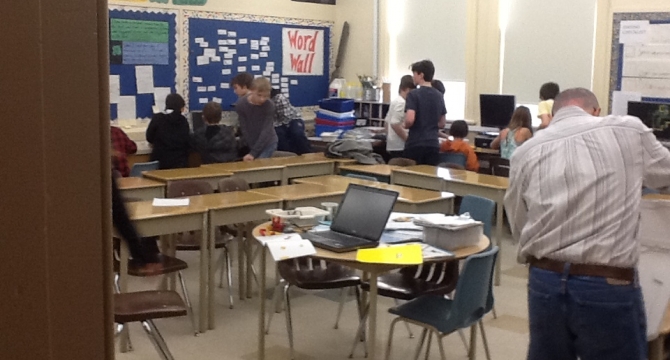
Students then went back to collaborative groups to wrestle with this question: What would the programmer have to value to allow the driver to survive rather than the kids? This allowed me to reintroduce the idea of assumptions. “Let’s assume that a car that makes decisions on behalf of humans exists and that the accident between the bus and the car is going to happen”. Students explored their thinking on ethics, society, morality, points of view … and engaged in one of the most sophisticated discussions that I’ve witnessed among Grade 7 students. I am so sorry I didn’t record it.
We are also making use of talents and opportunities within the school. I have arranged a switch with the Grade 4 teacher, Mr. Bell, who uses Lego Robotics with his students. I will take his class for a half day to work with the iPads and he will take mine. Having colleagues who are flexible is key to innovation in any school.
This experience left students with many unanswered questions and a desire to speak directly with people who work in robotics. This led me to show students how to use a network to access information and people. Noah contacted Clive through Twitter and asked if he knew anyone at Google Car. Clive offered to contact someone but told us that people at Google were very busy. We continued to seek contacts and I was referred to Marcel at Carnegie Mellon who pointed me towards Illah and a whole new field of learning. We are waiting to hear back from Illah.
We are also making use of talents and opportunities within the school. I have arranged a switch with the Grade 4 teacher, Mr. Bell, who uses Lego Robotics with his students. I will take his class for a half day to work with the iPads and he will take mine. Having colleagues who are flexible is key to innovation in any school.
Reflective practice and blogging are essential to the evolution of my practice. Through writing this post, I realize that our next step will be an introduction to Design Thinking, Challenge-Based Learning and Class 71 devising solutions to the problems they’ve identified with moral machines.
http://en.wikipedia.org/wiki/Challenge-Based_Learning
http://en.wikipedia.org/wiki/Design_thinking
That’s my secret to innovative practice so far.
-
My Secrets for Innovating Classroom Practice – Part 1
Comments Off on My Secrets for Innovating Classroom Practice – Part 1Looking back, I would have to say my transformation was mandated. It began with the provincial overhaul of education during which teachers were obliged to abandon old practices and develop new ones based on “highly effective practices” (TLCP, flexible groups, accountable talk, and student feedback).
This was followed by my introduction to The Thinking Matrix and a light bulb moment where I realized that my job wasn’t to teach students how to write stories, articles, or persuasive letters, but to provide opportunities for students to think deeply, ask questions and use the tools of communication to express their thoughts in writing in ways meaningful to them and to engage in creative problem solving.
…I realized that my job wasn’t to teach students how to write stories, articles, or persuasive letters, but to provide opportunities for students to think deeply, ask questions and use the tools of communication to express their thoughts in writing in ways meaningful to them and to engage in creative problem solving.
With my focus now on providing experiences where learners have the opportunity to think deeply, things began to change.
Tied to this was my discovery of the power of social media. The work we did with the App project and Hannah’s Suitcase was highly experimental. As an educator, I discovered that social media allowed us to approach learning in new ways. We connected with a diverse global community. I now had quick and easy access to cutting-edge research and practices that I could implement immediately. My students could suddenly engage with expertise in any field and we found ourselves with an audience for our work. We began to make strategic use of social media to access exceptional learning opportunities that have impact on the world outside the classroom.
My professional learning focused on project-based learning, inquiry, design-thinking, Web 2.0 tools, critical thinking, solution-based and game-based learning, skills for collaboration and rethinking the use of classroom space.
What I didn’t do was wait for permission. I used my professional judgment as an educator and my personal desire for growth to develop innovative practices.
Based on what happens in the classroom on a particular day, the direction for the next day is determined. My students and I co-create the learning.
If I were to identify the single biggest change in my practice, I would have to say that when we begin an inquiry, we have no idea where we were headed or what final demonstrations of learning will look like. So much depends on what we learn along the way. My students engage in meaningful work that hasn’t been done previously, which makes it interesting for everyone. I would describe my work as responsive teaching.
Based on what happens in the classroom on a particular day, the direction for the next day is determined. My students and I co-create the learning.
Winning the Ken Spencer Award, the Mindshare Learning Video Challenge Award, and receiving recognition from the Globe and Mail as well as coverage in other media has certainly made what we do easier. Dundas Central Elementary has become known for its innovative work and our administration has become more responsive, accepting and most of all encouraging when we wish to try something new.
Please note that Part 2 of Heidi’s blog post will be shared in the near future.
-
Is school actually meeting the current and future needs of our learners?
Comments Off on Is school actually meeting the current and future needs of our learners?I walk the hallways at breaks and lunchtime and I overhear many students’ conversations. ‘… is so boring’, ‘I don’t see the point in …’, ‘I don’t want to go to …’. I observe students desperately asking their friends for answers to worksheets and textbook questions. Are they interested in learning or motivated by the threat of losing marks? I see tired and stressed faces. Did they stay up late at night engrossed in their learning? Or were they going through the drudgery of homework and cramming for a test?
I walk into classrooms and see students quietly gazing out the window, secretly glancing at their phones and mindlessly doodling on paper. Are they distracted or disengaged? I bump into regular ‘hall wandering’ students while classes are in session. Some tell me they are ‘going to the bathroom’; while others say they’re ‘getting supplies from their locker’. Are they being truthful or do they simply require a break from class where they can get up and move around? I meet with students in my office. Some of them display such lifeless, apathetic expressions. Why are their spirits so defeated? Why are they simply going through the motions of school? Others demonstrate frustration and negativity towards school. Why has school become a source of their frustration? Why are they so ‘anti-school’?
Our schools must equip learners with the skills necessary to not only adapt to but also influence this rapidly changing world they are growing up in. We need to move away from a system where subjects are taught in isolation of each of other, where content delivery is the focus, and where the teacher is seen as the expert and is the one who asks most of the questions.
Now don’t get me wrong. I know these examples don’t describe all students. But it does describe the norm for some of the students whom I work closely with. It’s clear that school just isn’t meeting the needs of ‘these’ kids.
Which brings me to a larger question. Is school actually meeting the current and future needs of our learners?
When I look at today’s high schools, I still recognize them as the same basic model as the one I went through over 20 years ago. And then I consider the world in which we live in. It’s a faster and more automated world, where knowledge is at our fingertips and information can travel across the globe at the push of a button. We are blessed with luxuries all around us. Smartphones, sports cars, online shopping and banking just to name a few. But this rapid progress and advancement have created changes in the workplace and society that demand new skills and competencies. Routine, assembly line type work that requires learning simple repetitive skills and memorizing basic information has become a thing of the past. The application of knowledge, critical thinking and creative problem solving is now more important as the world of work shifts to non-routine tasks.
This places new demands on education. Our schools must equip learners with the skills necessary to not only adapt to but also influence this rapidly changing world they are growing up in. We need to move away from a system where subjects are taught in isolation of each of other, where content delivery is the focus, and where the teacher is seen as the expert and is the one who asks most of the questions.
Rather than asking learners to work towards one ‘right’ answer, we must grow comfortable with there being many answers to students’ questions. And, our practices must support the idea that learning is a process, often one that is messy, non-linear, and will likely include unlearning and relearning.
We need to create a system that encourages students to pursue personally meaningful challenges and initiatives that are relevant to their lives, values students asking big questions to which the teacher doesn’t have the answer, provides students some autonomy to follow their own inquiries and enables students to amplify and share their learning through the use of technology. Similar to real life, learning at school should integrate the many traditional disciplines, allowing students to shift naturally and apply knowledge and skills from different disciplines in order to answer their questions. Rather than asking learners to work towards one ‘right’ answer, we must grow comfortable with there being many answers to students’ questions. And, our practices must support the idea that learning is a process, often one that is messy, non-linear, and will likely include unlearning and relearning.
To put it bluntly, the pressure is now on us to collaborate on new designs for learning that will engage both students and teachers!
We need to stop worrying about what others think school should look like and start imagining what it could look like. We mustn’t shy away from big steps or our bold vision. Now, more than ever, we need innovation in education!
-
The Future is Here: Ready or Not
Comments Off on The Future is Here: Ready or NotThere is a biblical saying about no man being a prophet in his own land (Matthew 13:57) that I like. It would seem that people have been thinking about resistance to change for thousands of years. Why do we resist change? This has been one of my central questions, or obsession, for some time. Popular wisdom would explain fear, threatened egos and a desire to protect the status quo as the reasons for resisting change. Rob Evans, clinical psychologist and consultant to stakeholders in education told the audience at Building Learning Communities conference in Boston two years ago that teachers experience change as a sort of grief process. Before change can happen, they have to let go of ‘old’ ways and cope with loss. My own answers to the question of why we resist change currently lay in brain research but the source or veracity of the answer is not as important as hearing the loud voice of the evolutionary imperative admonishing educators, schools, administrators, governments and those who have the power shape the learning experience of students to “adapt or die”.
Pedagogy needs to serve the student, not the teacher or the textbook
Read any of the popular books on innovation in business, for example Phil McKinney’s Beyond the Obvious. As you read, substitute ‘client’ for student and ‘product’ for pedagogy. If you can endure some internal discomfort created by superimposing a business model onto education, the idea that pedagogy and instructional design needs to fit the needs of our students (clients) becomes a useful metaphor. Continue reading further to understand that successful businesses pay very close attention to the needs of their customers. When the customer loses faith in the product, the business is in danger. “Yes, but school is not a business” you say? “Wait and watch what happens when students understand that they can access learning anywhere, anytime and on demand”, I say. The digital age has released information and knowledge from the prison of the page (David Weinberger “Too Big to Know”) and that is changing everything.
When the customer loses faith in the product, the business is in danger. “Yes, but school is not a business” you say? “Wait and watch what happens when students understand that they can access learning anywhere, anytime and on demand”, I say.
I remember the day when I realized that everything had changed. I was introducing some ideas about sociology to a Grade 11 class and referred to a famous study of behaviour in public restrooms when I faltered and was unsure of the author’s name. Mason, my ever-eager student said, “Wait Miss. Let me check that for you!” At that very instant, as I looked out over the 21 students behind 21 laptops screens, I realized that I had become accountable to the truth and learning in a radical new way. When fact checking and information recall is one click away, teachers need to rethink how and what they teach. In the ‘Land of Google’ where students drink from the fire hose of information, teachers must ask the ‘killer questions’: Why is this important? How is this relevant? And what will they remember about this in five years hence?
When fact checking and information recall is one click away, teachers need to rethink how and what they teach. In the ‘Land of Google’ where students drink from the fire hose of information, teachers must ask the ‘killer questions’: Why is this important? How is this relevant? And what will they remember about this in five years hence?
Students in higher education have new choices today in how they learn. MOOCs and open courseware, online universities and blended classrooms were not on the learning landscape horizon only a few short years ago. The student (the consumer, the client) can access learning anywhere and personalize it. This fundamental shift in the availability of information made possible by the digital age is changing education. Schools, teachers and all stakeholders of the educational process need to see that the ground is shifting. Just as the music industry and the traditional paper press has had to reinvent themselves, so do schools and teachers.
Moore’s Law and Education
Intel’s co-founder, Gordon Moore, observed that our energy efficiency for computer processing speed doubles every eighteen to twenty four months. His 1965 observation has remained true. In 1971, the Intel processor held 2,300 transistors and today holds approximately 560 million. This exponential growth of computational capacity has made our time in history unlike any other. Never before has technological change been so rapid. Today we speak of interactive technologies (such as Luidia’s e-Beam that turns a white board, a wall or even a floor into an interactive space) but it is very probable that within two years we will be speaking about immersive technologies, such as the Muse from Interaxon. This simple headband with sensors reads your brainwaves (EEG technology) and allows to see into their minds. It can interact with apps on an iPhone or iPad and even move physical objects using only thoughts. Imagine this in the hands of a child with ADHD who would benefit from learning cognitive control. This self-observation of mind states has incredible potential for transformation much like any meditative mindful technique (such as Kiran Bedi’s controversial and successful rehabilitation of Indian prisoners using Vipassana meditation).
So why would schools not want to harness new technology in the service of education? Change is not enough to meet the demands of this rapidly morphing learning environment where classrooms do not have to be physical spaces and teachers are not always adults with degrees. Innovation needs creativity, courage and vision. Innovation is disruptive and does not encourage compliance or uniformity. The future has arrived and adaptation might help you survive but innovation will ensure that you thrive.
-
My Guitar Class is More than a Class
Comments Off on My Guitar Class is More than a Class
The best advice about pedagogy I ever received came from one of my teacher-idols on the day he retired. Richard Dixon was the drama teacher at our school for more than a decade, taught in English classrooms before that, and was a jack-of-all-trades-and-grades teacher in B.C.’s north as a younger man. He was resolutely revered by his students and peers at every turn throughout his career; his retirement gala lasted over an entire June weekend in our school’s theater, and included songs, skits, speeches and one-act plays presented by students he had taught and people he had worked with going back thirty years and more than a thousand kilometers.
As a drama teacher, Richard employed the ‘black box’ theatre mode – sparse props and tech support, black backdrops and minimalism throughout – to bring life to his productions. He also wrote multiple original works for his classes to perform every semester.
Every. Semester. New plays, with roles and conflicts tailored to the individuals in his classes. They would rehearse for a few weeks, and then perform the plays, sprawling ensemble-monsters that spanned genres and themes from sci-fi to fantasy to slapstick to realism and back again, dealing with young love, fitting in, drugs and alcohol and the spectre of the future for parents and peers in matinees and evening shows where the students shone.
As a mode of teaching, Richard transcended innovationand went about continually inventing his classroom environment out of blank space and the unique personalities that filled it. And while many of these plays were banged out on a typewriter, and others were written into formatted word documents to be printed out and memorized, I always come back to believing that it is this type of invention and innovation our classrooms so badly need today, just as they always have.
What this process taught the students in his classes about themselves and one another, and their individual and shared roles in the world is something I doubt I have ever seen approached in other classrooms. As a mode of teaching, Richard transcended innovation and went about continually inventing his classroom environment out of blank space and the unique personalities that filled it. And while many of these plays were banged out on a typewriter, and others were written into formatted word documents to be printed out and memorized, I always come back to believing that it is this type of invention and innovation our classrooms so badly need today, just as they always have.
On his last day of school, Richard and I were talking about the new guitar class I was going to be teaching the following September, just down the hall from what would no longer be his classroom’s black box. I told him that aside from being excited at the prospect of the course, I didn’t know where I wanted to take it just yet.
“The important thing to remember,” he said, “is that every class you teach is just another opportunity for students to practice forming communities.”
And I think that this is what the best teachers have always done for their students: invent the possibility for communities of trust, of empathy and learning to be formed in their classrooms. They create the environment for action, collaboration, and innovation to take place, and for this innovation to be owned by the individuals and groups that fill these spaces.
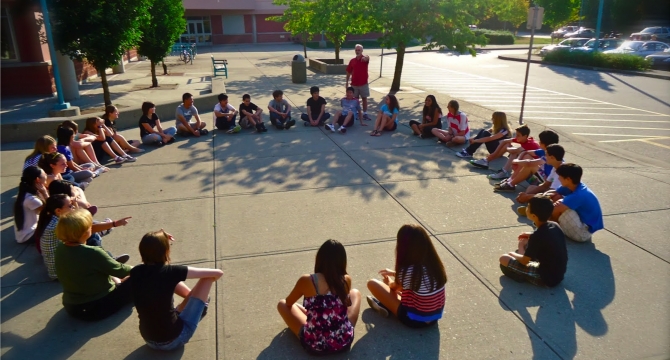
And I think that this is what the best teachers have always done for their students: invent the possibility for communities of trust, of empathy and learning to be formed in their classrooms. They create the environment for action, collaboration, and innovation to take place, and for this innovation to be owned by the individuals and groups that fill these spaces. It took two years of teaching the guitar course after Richard retired, but I eventually stumbled into a project that allowed me to see the thin edge of the wedge to establish just this sort of collaborative inquiry and problem solving in our school’s Introduction to Guitar course.
With the idea having hatched on the morning’s drive to work, I proposed to my students that we transform the classroom itself, the time we would have each day while the class met, and the nature of the tasks the group undertook together to centre around the age old teenage compulsion to create and express a personal culture and community in rock and roll. As a music teacher by experiential training only (I don’t read music, have never played in a band, and have conducted the entirety of my musical studies as a self-trained adult), I would focus my attention as a teacher on structuring the early phases of the project, and use my tools as a group leader to help the various Committee Chairpeople and elected Project Managers accomplish their goals.
Over the course of the last eight weeks of school – including a glorious month of June for the graduating seniors in the class – the group went about seeing what it might take, consulted with the people who might show us the way, and before our eyes brought The Bears into being. Various groups and individuals brainstormed prospective band names and logos, while others organized class votes and solicited songs and riffs that were brought to the wider group for rehearsal.

A tech crew learned to run our school’s PA system and made notes for how to rig the band’s lead guitars (such that they could be heard above the twenty-odd acoustics in the group). There was a group taking video of all of it, a group screening T-shirts and drafting up flyers to promote the gig the Bears planned to deliver following locker cleanout in the school’s foyer on the last day of school.
After the dust had settled and we were storing the gear back in the class, many of the Bears made a point of hanging around for a few minutes to take pictures with one another, shake their friends’ hands and otherwise just linger in the magical atmosphere the guitar classroom had been transformed into by their efforts.
“This class was more than a class,” one of the young men who was graduating told me on his way out the door. “Just what it was, I’m not sure. But it was pretty great.”
I’m beginning to figure out to how to do what Richard did in his theatre class, and how to provide my own students with an environment where they might become the innovators and inventors of themselves and their own worlds, breathe life into their own ideas, and figure out how to take their communities beyond the sum of their individual parts.
And even while I might have my own suspicions about just what it was that happened that semester, knowing that some of those students will spend months trying to put their finger on just what it was, or that some of them might spend years reflecting on how they contributed to its success, and that a few might even spend their lives figuring out how they might do it again is an inspiring thought.
It’s a thought that makes me realize that I’m beginning to figure out to how to do what Richard did in his theatre class, and how to provide my own students with an environment where they might become the innovators and inventors of themselves and their own worlds, breathe life into their own ideas, and figure out how to take their communities beyond the sum of their individual parts.
Because it’s innovation like this that’s been at the heart of our story as a species since it began, and one that should never be far from our classrooms as we go about preparing tomorrow’s minds
-
The Classroom Might Remain Relevant
Comments Off on The Classroom Might Remain RelevantAs an early career teacher in a tight job market, I’ve struggled to find consistent job opportunities. I‘ve had to be enterprising in the five years since I received my teaching certificate, moving from a fringe private school to an outdoor leadership camp, from a foreign language school to daily substituting, and to my current role as a long term occasional. I’ve worked in three school districts, dozens of high schools, and shared face-time with thousands of teenagers.
Walk around any public high school. You’ll see kids in class, thumbs tapping out texts, heads down on desks, raising their hands when they have the answer right.
While every classroom is its own unique space, I’ve noticed three recurring trends:
- Kids are either bored or institutionalized
- Teachers are either tired or ambivalent
- Administrative incentives maintain the status quo
Meanwhile, there’s a lot of talk about engagement. Engaged students. Engaged teachers. Engaged classrooms. Daniel Pink does a terrific job explaining why top-down management systems are ineffective at fostering engagement. In short, it’s useful when there are clear destinations to target. People will chase the carrot and avoid the stick. Engagement, however, is most likely when efforts are autonomous, relevant, and allow for mastery. These are dynamic circumstances with unclear destinations. Public schools are entrenched in prescriptive models of success, offering little chance to embrace the process of discovery.
None of this is new. So why is this the time for innovation? I can think of two reasons:
- Future generations require different skills sets
- Barriers to entry are falling
School has maintained its authority because diplomas have remained a gateway to prosperous adulthood. That’s becoming less and less the case. Capacity to follow directions and maintain responsibility remains useful, but it’s a less likely path to success. Instead, the requisite capacity is being able to manage complexity and make decisions in the face of uncertainty. Thriving adulthood has more to do with soft skills and autonomous living than it does with getting the gold star.
Of course, parents look to school because they want to keep their kids safe, put them in position to succeed as adults, offer them a chance to socialize, and assure their personal development. And there are things that kids want from school, including to have fun with friends and to experience success.
The barriers to satisfy these interests are falling. Increases in online curriculum, pathways to diploma certification, legitimacy of distance education, and illegitimacy of institutional authority are resulting in innovations that threaten to disrupt the status quo.
Can you imagine earning your high school diploma from the local karate club? Or an urban explorers’ club? Or a flexible network of edupreneurs? It’s become less and less costly to develop alternatives that serve more localized needs. While the institution incentivizes control and predictability, the irony is that relevant skills result from autonomy and self-direction.
School has maintained its authority because diplomas have remained a gateway to prosperous adulthood. That’s becoming less and less the case. Capacity to follow directions and maintain responsibility remains useful, but it’s a less likely path to success. Instead, the requisite capacity is being able to manage complexity and make decisions in the face of uncertainty. Thriving adulthood has more to do with soft skills and autonomous living than it does with getting the gold star.
My view is that the classroom can remain relevant. Many organizations have already transitioned away from prescriptive success towards intrinsic success because those are the qualities that the future requires. For me, that means supporting students to commit to goals of their own choosing, document their efforts as they go, and make connections between what they’re doing and the requirements of their course credits. As their teacher, I thrive in transitioning away from the role of director and administrator towards that of auditor and mentor.
The question to be asked is not ‘is innovation is required’, but ‘to what extent are you participating’?



IDEAS TO SUPPORT EDUCATORS : Subscribe to the EdCan e-Newsletter
Quality research, reports, and professional learning opportunities.