Archive
-
The Red Worn Runners
Comments Off on The Red Worn RunnersSometimes five, sometimes 18, one time 30, but every day through August the Red Worn Runners have been inspiring me as we shuffle, sprint, and navigate our way down the dusty roads of Enoch Cree Nation, always wearing red – red T-shirts that is. It is a beautiful thing to experience. We always start at the local school in the town site, stretching, slowly getting ready for a run. Sometimes I love this daily ritual, other times I loathe it; it depends how my body is feeling. But we stick together through this, one day at a time. Girls, boys, young people, and older people like myself make this trek daily throughout July and August. Sometimes we run four kilometers in a day and we make sure to always jog by the community health centre and the band office.
It is interesting because now people wave at us when we jog. They used to look at us with mistrust. There was doubt in their glances. They quietly shook their heads as they saw youth move in a different way. I like visiting with the youth about the run and how it feels. They say they love it and now I am starting to believe it, as they log their kilometers and check the poster we’ve made to see how far they are going, to see how far they have been. Did I tell you… you should see these kids run. It is beautiful – no training, no fancy gyms – just the town site, bumpy dirt roads with truck imprints embedded in the earth… then the sandy gravel of the back roads towards the potato plantation, our target turnaround always.
Wheat fields and canola fields are on each side. They seem to be our only fans some days and they seem to wave us on when we move. No judgments there. We run and the youth tell me they have never done this before, never seen the fields as I describe them, never seen the beauty in them like I describe. I am hoping and thinking they see it now. I am hoping they see something different within themselves.
We are all in a line, a long red line, staying as close together as possible. And when the Red Worn Runners take off into the distance, it is magical. It takes me home every time we run; home to the gravel roads and the farms of my youth, to the wheat fields and barley fields, and the beautiful sounds and smells that I cannot imagine in the city. We talk about treaties, families, relationships, and the beauty of creation on the morning jogs. We are simply moving knowledge, as Basso[1] might say. This is the living curriculum[2] they talk about, the familial curriculum[3] acknowledged. I did not think that the kids would continue but it goes to show you how much I don’t know. They showed up every day and even run on their own these days.
The Red Worn Runners will continue to be on my mind as the leaves get ready to turn and the farmer swaths down the majesty to the left and the flowering yellow to the right. It is indeed a beautiful thing, one I won’t soon forget. I hope we keep running. Sometimes five, sometimes 18, one time 30, today just me. The Red Worn Runners inspired me to shuffle, sprint, and navigate my way down the dusty roads of Enoch Cree Nation, always wearing red – a red T-shirt, that is.
Many years later I continue to go back to this opening narrative, at times reading it, at times sharing it with different audiences, but always pausing somewhere in the middle and thinking with these earlier moments of teaching. I reread this narrative today, letting my words call those youth back to mind. Letting the words take me back to their words, their stories, their voices and the images of moving in a different way alongside one another. Letting the words take me back to the dreams of what might be possible if we listen carefully and attend to the voices of Indigenous youth. These words stay with me as I think of who I am and who I am becoming as an Indigenous writer and educator. They remind me to always return to the early experiences, sometimes physically, sometimes metaphorically, for it is in that return home that I am sustained.
Creating conversational spaces[4]
Seven years ago I was teaching Social Studies at a large urban high school in a prairie city. I was given an opportunity by school leadership, particularly the principal, to create and lead an initiative aimed at meeting district and provincial goals of increasing high school completion and retention for Indigenous students. Through this process I was given one spare period to start meeting individually with the 250 self-identified First Nation, Métis and Inuit (FMNI) students who were enrolled in this school.
“I want to graduate.”
“The fact that I am Aboriginal tells me that most people won’t think I will make it, but I know I will.”
“I want to be as highly respected as my late grandfather someday.”
“We want to make our grandmother proud.”
Their words reverberate in my thoughts, even now, as I sift through vision statements we created many years ago. Through those intentional conversations, the youth and I co-created spaces within a high school in which I came to better understand, and respond to, what mattered in the lives of Indigenous youth attending this school.
Moving with intention
The youth taught me, through this work and through this in-between space of intentional conversation on a school landscape, to move with intention, both metaphorically and physically. To move with intention in this way means to be responsive in the ways in which I am trying to understand the experiences of youth within the context of school. It is expressed through my actions and responses to the voices of youth and the calls that they were making – both directly and indirectly – to engage in something different. More broadly, it is a call to move beyond rhetoric in student voice, and in particular Indigenous student voice within the institution of school.
The title of the opening narrative, “The Red Worn Runners,” was a name the youth chose for themselves. These young Indigenous people wanted to engage in education differently. They were determined to graduate from high school with their classmates. However, they were unable to participate in summer school courses in the high school due to transportation and jurisdictional issues between federal and provincial school systems.
As I created a conversational space and invited each of those 250 students, one by one, into conversation with me, they began to feel that their voices were being heard and honoured with a response. In these conversations the youth shared their hopes and dreams for their futures. They shared their hopes of graduating with their peers, which required taking specific summer courses to fulfill their dreams. As I heard their voices and recalled my own experiences as a youth, I began to imagine how this might be possible. As I talked with the students, initially there were four or five students interested in summer school studies. By the time summer school started that July, there were over 30. “We are all in a line, a long red line, staying as close together as possible.”
Embracing uncertainty
I quickly recruited teacher colleagues who were open, flexible, and willing to try something different. We proposed to teach Math, Social Studies, Aboriginal Studies and Career and Life Management during the summer months. No longer would we as teachers be living within the comfort of classroom subjects and the familiarity of our classroom and school environment in the city. The classroom would be located in the youths’ home-place of Enoch Cree Nation, a community with distinct protocols and teachings that are layered in the history of the land and people. This summer school experience would be markedly different for the teachers and for the students, their families and their community. The students would be our guides and in many ways our teachers. Their voices would lead the way and their everyday actions and movements would shape daily programming.
All along they were teaching us, as teachers, new steps, new rhythms to our knowing of teaching.
As teachers we had to learn to let go of the certainty of what we knew from teaching within school. We would learn through this experience to improvise and let go of what we could no longer guarantee as certain or comfortable.
As we began to plan with the students and to travel to the community, we, students and teachers, were learning and imagining school differently. We were learning and imagining alongside one another in this work. Time looked different in the company of trees and through “the wheat fields and barley fields, and the beautiful sounds and smells that I(we) cannot imagine in the city.”
Looking backwards and forward
Our school colour was red, and as we met each morning during the summer months, the youth wanted to begin each day with a run. They chose the colour red as it was a noticeable colour when we were running on the gravel roads of Enoch Cree Nation. The youth spoke of the importance of being visible through their actions. All along they were teaching us, as teachers, new steps, new rhythms to our knowing of teaching.
Now, many years later, I reflect on how time has moved quickly and now the Red Worn Runners have moved on in different directions and trajectories in their lives. Many of the youth have now graduated from college and university. Some are teachers while others are excelling in various professions and careers. I too have moved on to a different position at a university, but those days of learning alongside the Red Worn Runners stay with me in the present. They taught me. They took me home to what it means to be a youth, an Indigenous youth, in high school and what might happen if teachers and others listened carefully to students and together imagined what might be possible within schools.
I chose to highlight various threads in this article – creating conversational spaces, moving with intention and embracing uncertainty – as examples of what stood out to me as I reflected on the experience and what I have learned about the importance of student voice and response to student voice. I recognize that it would not be appropriate or realistic that every classroom and school participate in a similar way to the one I shared; that would be a misreading of my intentions. However, to me the sharing of this narrative was never about the specific programming details of a summer school experience alongside Indigenous youth.
I tell this story now to show how much the young people within the Red Worn Runners pushed me as well as my colleagues to move differently, to think differently, and to embrace what might happen when youth lead, not only with their voices but through their actions… through their movements.
Sometimes five (youth), sometimes 18 (youth), one time 30 (youth), today just me. The Red Worn Runners inspired me to shuffle, sprint, and navigate my way down the dusty roads of Enoch Cree Nation, always wearing red – a red T-shirt, that is.
En Bref: Sean Lessard examine comment son travail antérieur auprès de jeunes dans des collectivités (les Red Worn Runners) continue de modeler sa façon de percevoir le curriculum comme un processus fluide, transactionnel et truffé de possibilités. Lessard tire parti de ces expériences narratives, sur les plans philosophiques et pragmatiques, dans le cadre de ses recherches explorant l’identité, la voix des jeunes et la conception du curriculum à l’intérieur comme à l’extérieur des lieux scolaires; ces lieux comprennent les collectivités dans l’Ouest canadien où les jeunes et leurs familles continuent de guider ses travaux.
Illustration: Melanie Luther
First published in Education Canada, December 2016
1 Keith Basso, Wisdom Sits in Places: Landscape and language among the Western Apache (New Mexico: University of New Mexico Press, 1996).
2 Jean D. Clandinin and Michael F. Connelly, Teacher as Curriculum Maker (New York: Macmillan, 1992).
3 Janice Huber, Shaun M. Murphy, and Jean D. Clandinin, Places of Curriculum Making: Narrative inquiries into children’s lives in motion (London: Emerald, 2011).
4 Jean D. Clandinin and Michael F. Connelly, Shaping a Professional Identity: Stories of educational practice (New York, NY: Teachers College Press, 1990).
-
Raising Their Voices
Comments Off on Raising Their VoicesDakota McGovern
Main Activism Focus: B.C. Student AllianceDakota McGovern, a 17-year-old graduate of Windsor House School in North Vancouver, has been involved in activism since the age of 11. His work is all about claiming a place for student voice, within schools and beyond.
McGovern credits the student-led learning environment of Windsor House School with giving him the confidence to chair the resistance group he co-founded, called the B.C. Student Alliance.
Windsor House School is the only publicly funded democratic school in Canada. The school runs on the concept that each person within the school is equal. Each week every student and teacher in the school has the opportunity to cast a ballot on school issues. For example, McGovern cast a ballot to teach a Comparative Civilizations class in his 12th year and was voted in. Responsibilities like this are encouraged at Windsor House.
McGovern entered the school in Grade 5. His parents enrolled him after noticing his learning difficulty at his previous schools. McGovern would eventually be diagnosed with dysgraphia and dyslexia.
He thrived at Windsor House, but his parents thought it was not academic enough and encouraged McGovern to switch to a more conventional high school. He did, but for his own reasons: “I didn’t want to be the kid who just went to Windsor House without knowing what other schools were like.” When he switched back to Windsor House for Grade 10, he had a new respect for himself and his disability: “I didn’t say, I go to Windsor house because I have dyslexia, dysgraphia and ADHD. I said, I go to Windsor house because I genuinely believe in what the school is trying to do.”
McGovern’s activism work started in 2010, when the North Vancouver School Board stated that they would amalgamate its five alternative schools into one. This is when the B.C. Student Alliance was born. A group of Windsor House students wrote letters to the Ministry of Education opposing the amalgamation. Luckily, the school was able to leave the North Vancouver School Board and join the Gulf Island School District – but the B.C. Student Alliance, co-founded by McGovern during the protest, remained active and has grown far beyond the boundaries of the school.
McGovern has been president of the B.C. Student Alliance since the fall of 2014. The group is no longer based in Windsor House and is truly provincial, with members from many different schools. Their focus is on educating youth about their power and influencing youth to stand up for what they believe in.
The group has been successful with their work, specifically with their education budget cut protest in May of 2016. The group presented a panel of speakers, including a student environmentalist, an Indigenous student and an elementary student. Each student gave a speech about the importance of education as well as their own thoughts on the school system. Over 100 people showed up in support of the protest. The event gained media attention and a number of politicians attended. Three days after the protest, the government announced that they would be putting $25 million into the education system. While not claiming that decision was directly influenced by the protest, McGovern notes the timing was interesting.
McGovern is now studying Environmental Biology at the University of Victoria. Though he can continue to run as acting president of the B.C. Student Alliance until he’s 19, he hopes that someone else will be inspired to take the lead.
Anna Yehia
Main Activism Focus: International AidAnna Yehia, 18, served as co-president of her school’s World Action Awareness Club (WAAC) and helped mobilize students throughout the school to raise $6,000 for Doctors Without Borders at a benefit they organized.
Yehia, a recent graduate of Mayfield Secondary School in Caledon, Ont., joined WAAC in Grade 9 and became treasurer in Grade 10, continuing in this position in Grade 11. In her final year she was elected co-president with fellow student Alexandria Wilson. She says she continued her work with WAAC all through high school because “it feels good. We are all so privileged. When you start to give back to your community you start to appreciate it so much more.”
WAAC is an extracurricular group run by students and faculty. The group raises money and awareness for charities they choose at the beginning of the year, and for the 2015/16 academic year, they decided to support Doctors Without Borders.
In September, the planning for their big benefit night began. The premise was that participants would pay for a handmade bowl and to fill it with soup. Fittingly, the benefit name became Bowls Without Borders.
Mayfield is a regional arts school and the group tapped into the talent and resources of the students. They asked the visual art students if they would be willing to make pottery bowls and create a ticket design for the event. Music students provided live entertainment. The culinary club cooked soups from countries where Doctors Without Borders work. Yehia and the group was able to engage their student body in a way that they had never seen before. In the end, over 200 guests attended the benefit. With 450 tickets sold and proceeds from a silent auction, they made a profit of $6,000.
Yehia is now studying Life Sciences at the University of Toronto. She hopes to continue working for causes she believes in: “I’m from Lebanon. Doctors Without Borders doesn’t serve there so I’m going to try to bring it over. I’m hoping that with my life sciences background I will be able to do that.”
Nik Sutherland
Main Activism Focus: Student HealthMillwood High School, located just outside of Halifax, N.S., is one lucky school to have Nik Sutherland as part of its student body. While the 17-year-old is nearing the end of his time at Millwood, he has been a large part of Millwood’s community, chairing three groups and sharing presidency of the student council.
Sutherland says that his passion for activism began in Grade 9, when he participated in Guys’ Group – a club for the male student body to talk about health problems specific to men, facilitated by faculty. “That got me talking and made me realize what you can do with the power of your voice and your opinion.” Since then the group’s discussions, which range from sex and relationships to distracted driving, have become part of the Grade 9 curriculum and is led by Sutherland and a friend.
Student health has become one of Sutherland’s main priorities for Millwood High. He joined the United for Health program in Grade 10 and chaired it the following year. This group works to educate the student population on all aspects of health. The group has collected data using a health-focused census to identify the students’ needs. They then focused their attention on these specific issues. The group has introduced de-stressing tactics such as playing music during class changes as well as providing healthy fruit snacks to hungry students. During exam time, United for Health hosts exam prep for students who may be stressing over their upcoming examinations.
Most notably, the group ran the first-ever Health Leaders Forum in 2016. The United For Health program organized a day for Millwood and other high schools in the area. The 30 students who participated listened to three reputable speakers: Dan Steez, the local CMHA representative; Sarah Dobson, former newscaster and local mental health ambassador; and journalist/entrepreneur Ross Simmonds, better known as @TheCoolestCool on Twitter. The students brainstormed how they could better their own student body’s health and finished the day with personal letters written about the goals they made during the day, to be mailed out to them as a reminder the following September.
What’s next for this passion-filled activist? Sutherland hopes to expand the program: “I want to take what we have learned in our school and spread a program like that into other schools. I feel like a United Health program in every school would be greatly beneficial for student body health, because I have seen how it has changed how health is viewed in our school.”
In the future, he hopes to become a teacher, saying, “I want to teach high school because I feel like my high school years have given the most to me. I feel like if I go in and help create that experience for other students, that would be a very positive change I could make.
Q&A with Dakota McGovern
In conversation, Dakota McGovern is confident and friendly, with much to say:
Do you believe that people are unhappy with the regular school system?
It’s a gradual feeling of discontentment, and I think the solution to the problem is to give students a larger voice. It’s the role of students to speak out on that and realize that they do have a unique platform that is not being utilized to its maximum.
What is your goal for the B.C. Student Alliance?
I want to foster a culture in which resistance against the status quo is more mainstream, and where students who don’t like certain things know how to address the issues they find as problems, and therefore actually foster youth activists to their full potential much earlier. By doing so you can have large impact on social justice issues. I think our social justice movements are lacking the youth voice. I think you can’t change the world without respecting the voice of the youth, because those are the people that you are trying to represent. You wouldn’t necessarily care too much about the earth if no one were going to inherit it. So that’s why it is so important to really foster and grow that voice right away… to pass on what you have learned to younger people so they can fulfill that role.
It’s about changing the paradigm of teaching across British Columbia. It’s about teaching people that they actually have power and that they should use it to speak out about things they view as wrong. Children are trained to be quiet; they show up at school and they are told not to be loud and to sit still and to stare at a chalkboard. After five, six or seven years of that it can be really hard to find enough self-confidence to take on initiative in your life. We want to give the maximum amount of tools possible to foster that growth.
I’m sure it wasn’t easy at first. Were there any lessons you had to learn while leading this group?
I think the first lesson you have to learn in any form of change making is the fact that it is more about people than about policy. For example, in the education system right now, we do not have a lot of restrictions – in comparison to other countries – on what students can and can’t do. Students can drop out of high school when they are 16, which is a very big tool that not a lot of people really understand. If you can choose whether or not you want to participate in the school system, you can effectively amplify your voice. I think that if students realized how much power they really had, they would understand that they could organize a rally, or host various public speaking events. It’s not about the laws that we’re trying to change, it’s about giving people that baseline experience of empowerment. Simply put, if you are going into activism in the future, as a young person, what you need to understand is that the most important thing you can do is change other people. We already have so much power that just needs to be uncapped.
What would you say to students who want to get involved but don’t know how?
You shouldn’t spend a lot of time worrying about what you should do. You should do what you can, and perhaps you will accomplish what you should. The biggest obstacle to hurdle over is to actually decide you want to start.
What would you say to teachers or faculty?
That they do need to listen a lot more; that in general students are not contented and that the school system is not going in the direction it should. A lot of that is because of government policy and solidarity, and not how teachers do their job. However, they should keep in mind that in order for humanity to reach its full potential, in order for us to become a just society that repairs people to become functional members of our culture, teaching is an important job. And the most essential key to that is respect and freedom for the students.
And is that what you would say to the government?
What I’d say to the government is that they should lower the voting age if they would actually like the youth vote.
En Bref: Certains étudiants sont tout à fait capables de se faire entendre. Les grandes manifestations étudiantes récentes au Québec en sont sans doute l’exemple canadien le plus éloquent, mais partout au pays, des activistes étudiants s’emploient à mobiliser leurs condisciples et à changer le statu quo, préconisant un rôle plus important en gouvernance scolaire, le bien-être des élèves ou la justice sociale. Dans cet article, l’étudiante en journalisme Madeleine Villa présente trois élèves du secondaire qui ont eu un impact sur leur école, leur région ou leur province.
Photos: Courtesy Madeleine Villa
First published in Education Canada, December 2016
-
A Different Kind of CHAT Room
Comments Off on A Different Kind of CHAT RoomHigh school can be challenging for any student. For some, the stress is unmanageable; just entering the crowded hallways each day causes enough anxiety to avoid school altogether. Imagine having a space within a traditional school setting, where students can walk in at their own choosing, hear peaceful music, smell the aroma of essential oils, and find a calm, safe and caring place to work. At Cochrane High School (CHS) in Cochrane, Alta., this is an option for students like Christy.
-
Voices from the Margins
Comments Off on Voices from the Margins“There is so much we don’t know, and to write truthfully about a life, your own or your mother’s or a celebrated figure’s, an event, a crisis, another culture is to engage repeatedly with those patches of darkness, those nights of history, those places of unknowing.” – Rebecca Solnit
IN MY YOUNG LIVES Research Laboratory,1 we design research projects that place the voices of youth at the core, so as to hear and see young lives in new ways. Doing so does not provide an easy recipe for the complete story or truth. Singular and collective youth voices always defy a complete picture, but we continue to invite, hear, interpret and share them. Voiced research opens up possibilities for educative experiences as youth actively write and tell their life stories. It makes for fascinating, imaginative and deep social analysis. But youth voice alone holds no guarantee of liberation. Our hearing does not end debates about how to fix education or how to better support young people. Rather, it could simply make us care.2 It is then up to everyone to act.
Our research focus on young lives means that the experiences, joys and struggles of young people are placed into holistic frames, surrounded by families, friends, schools, communities, society, and the natural world. Authentic voice does not fracture or reduce lives into small pieces, but rather invites open-ended and imaginative ways to frame, develop and respond to research questions. It invites participation, a critical aspect of the development of citizenship, empowerment and well-being of youth.
Most of the young people we work with and for are those who have been made marginal to society, their voices never heard or carelessly erased or ignored. Many struggle in school due to poverty and/or discrimination and/or mental health issues. Our goal is to design research with them that helps to hear what these young people are up against and what they dream for themselves. We employ the research process as an educative space, so that youth can learn while making their lives more knowable to those who teach and support them.
What follows are two examples of projects that invited and activated youth voice through conversation and artistic productions. These young people have created and shared powerful voiced artifacts that have affected the way we develop research and curriculum. Equally valuable are the discussions and relationships that evolved (and continue to evolve) through these creative processes.3
“Keyboard Warriors” as Film Makers4
In 2015 we were honoured with an invitation to an after-school youth program on Lennox Island First Nation by the Mi’kmaq Confederacy of Prince Edward Island (MCPEI), which promotes and protects Mi’kmaq rights, culture, traditions and the development and well-being of P.E.I.’s Mi’kmaq people. We worked with them in designing a youth-centered participatory project about youth, wellbeing, mental health and technology.5 While the scientific literature tends to frame these concepts in terms of medical and psychological insights to develop digital applications (apps), there is a small but interesting literature on the challenges that digital media is creating for young people (e.g. Facebook depression, sexting, ringxiety).6 We wanted to know how young First Nations people would illustrate these concepts if they were given the space to do so. Was digital media helping or hindering? What does wellbeing mean?
One good way to frame a problem is to do it literally, in the frame of a photograph, video or painting. MCPEI immediately saw value in a filmmaking project as an opportunity for youth to a) have expressive outlets for cultural history storytelling, b) learn skills in filmmaking to preserve stories of Mi’kmaq elders, and c) take responsibility, rights and power in storytelling. Thus, we co-developed a decolonized and ethical project with the youth worker, Brent Chaisson, as an instrumental and supportive guide. Over one year and through six talking circles, four workshops, visual concept mapping, snacks, meals, chatter, and music, eleven young people worked with filmmakers and researchers to learn and apply digital storytelling and filmmaking.
Space does not permit the details, but suffice to say, it was a joyful, intense, creative cultural process. We considered and debated concepts, developed storyboards, learned to use GoPro and video cameras, workshopped the editing process, held critique sessions, and screened the films in the community. We worked with a talented filmmaker, Brian Sharp, who volunteered his time to workshop filmmaking and editing techniques with the youth. “Like any other artist, you are creating something and putting yourself out there; because this medium can be so difficult, [filmmakers] can receive positive feedback and accolades… for just getting it done,” he says. “Self-esteem can be boosted by just knowing you finished it, even if you’re not entirely happy with the finished product… Even if it is just a positive comment on Facebook you think: Yay, somebody liked it!”
The three digital stories provided (see box for links) are some of the final fruits; these short films speak for themselves. But the journey itself was as meaningful and rich in developing relationships, critical thinking, educative experiences, artistic skill, and contemplation of the paradoxes of digital media. Consider two of the youth voices from a talking circle:
Well, if I’ve had a horrible time and everything that can go wrong has gone wrong, I would first try to laugh it off… But if it so happens that it did get my spirits down then… jump on thegame, or jump on YouTube… it can always cheer you up. You can just, like, watch a funny video when you’re having a bad day. Get a good couple of laughs in… [or] make a video of yourself fooling around and trying to make other people laugh, brighten up their day… It brightens up my mood and helps me forget.
“Heavy use, like six to 12 hours a day… that’s like you’re pretty much ruining yourself… like that could be six to 12 hours learning how to draw, learning how to paint, to be a musician, going out and visiting an elder around your community, and being more in with the traditions of your community… instead of going on Facebook and being a keyboard warrior and just, friggin’ like, dissing someone’s life… Why not just get the hell out of the house… and be more of yourself instead of something that you’re not really?”
The young filmmakers described being in constant communication with peers via texting, instant messaging or video chatting – even when in the same room together! They described a daily routine where digital media is perpetual and ubiquitous, seamlessly intertwined with their day unless prevented or deliberately “unplugged.” Yet from within this “glass cage”7 an imaginative critical reflection was heard. The space to think, discuss, and reflect led to critical debates and developing important distinctions and concepts such as “keyboard warriors.” These insightful voices have informed the direction of our ongoing research.
Watch the Films
Three of the digital stories created by Lennox Island youth can be seen here:
http://katetilleczek.ca/youth-technology/
Young Anthropologists as School Designers
I took my first 9,900 km journey to southern Chile in 2012, to meet a group of profound Indigenous people. I was invited by the Williche Council of Chiefs (WCC), who represent many Williche people of the province of Chiloe’s islands. We met to discuss and plan our new collaborative project: a unique intercultural school and curriculum that could re-engage the most marginalized youth and open new pathways to wellbeing and livelihoods. Most of the Williche youth with whom we work live on remote islands in the archipelago of Chiloe and have no access to suitable public schools in their communities. They had been learning informally through other traditional and modern experiences. Youth and elders were ready to re-ignite the fires of a new kind of formal education. Wekimün means “new knowledge” in Mapudungun, the traditional Williche language. It refers to the integration of traditional and modern ways of knowing in a respectful, collaborative and critical dialogue about what is best for youth from each culture and perspective. Thus, Wekimün Chilkatuwe is the official name of the new school we built and designed. To date, over 350 students have been offered a unique intercultural education embedded in the holistic lives, hopes and dreams of Williche youth and communities.8
A core goal of our shared vision is to incite, animate and value the participation of youth and the cosmo-vision of the Williche people. We began our school development with a collaborative inquiry in the five communities from which most students would come. Sixteen young people volunteered to come to the main island and work together for three days in the Chafun (the traditional sacred building with central fire pit that has now become the central heart of the school buildings) to attend workshops on anthropology and educational research. They debated ideas for the school and curriculum, and they learned to interview, audiotape, observe, write field notes, invite storytelling, and engage community. They returned to their communities after these three days, armed with a new sense of purpose, friendships, packsacks, notebooks and tape recorders to inquire about how elders, families and friends viewed education, well-being and Wekimün Chilkatuwe.
When they returned to the Chafun the following month, they shared many gifts with the group: feelings of a new and valued role in their community, feeling “like a journalist and someone with a job,” experiencing the joys and challenges of research, and the powerful and thoughtful stories from over one hundred of their youth, elders, families and community members.
The curriculum for Wekimün Chilkatuwe has been carefully designed around these voices, stories, hopes and fears, melding the knowledge gained through this process with that of official statistics and trends. Three teaching areas emerged as crucial:
- traditional language (Mapudungun) through history, culture and human rights
- sustainable community and environmental development
- traditional health and medicine.
In addition to suggested courses, the stories and observations provided in our youth-led community research emphasized the importance of the lives of youth, and the insistence on vast community input, support and collaboration in education. It also gave us two more lessons for school design:
1. It matters what you teach!
Two programs of study have evolved from these voices: Intercultural Health and Sustainable Development, and Intercultural Education and Sustainable Development. Classes in each program include the three subject areas listed above. Each is based in traditional practice with integrated lessons in modern “western” knowledge. Curriculum design is supported by Canadian university faculty10 with input from Wekimun educators, students and elders, who teach and provide traditional knowledge.
2. It matters how you teach it!
Our inquiry- and project-based pedagogy holds youth and the cosmo-vision of the Williche people at its heart. Ours is a school without walls. The school operates both on-site and in the community, so that when the students go home they continue to learn through educational projects to support their livelihoods. Our classrooms are a Chafun, an old growth forest, the seashore, an ancient tribal archeological site, the UNESCO award-winning Mapu Ñuke (Mother Earth) Health Centre – all on our near the school property – and the five interconnected communities.
In classes, we strive to teach in ways that use practices of care, practices of relevance, and practices of Wekimun as described to us by the community, elders and youth. The aim is to reclaim education and school as a joyful, sacred, caring space where new and old wisdom is integrated.
Four years later we are still building upon these early teachings, finding new and better ways to engage youth and communities in what we teach and how we teach it. Manuel Munoz Millalonko, a Williche lonko, anthropologist and Academic Director who co-leads the project with me, says it best:
“Wekimün Chilkatuwe is a space in which our identity as Indigenous people is strengthened, where students are re-enchanted by life. They look again toward the territory where Williche life and culture has developed for thousands of years… It is exciting to learn from Wekimün. The construction of new kinds of knowledge comes true every day. And a significant intercultural development is happening here that helps all Indigenous people, a dynamic model where the Williche worldview harmoniously interacts with other worldviews from a place of dignity and deep honouring of our Mapu Ñuke (Mother Earth). Our elders and the Canadian faculty support our community and students in a virtuous circle of knowledge that impacts our work in very distant places on the planet.”
THE MARVEL, HONOUR AND HUMILITY of intercultural and international collaboration in youth-voiced education has changed me. I have come to hear, see and care in different ways that are difficult to articulate in text alone. Young voices remind me that hope and lament are constant companions, while naiveté is always to be tested.
Education is at a crossroads when it comes to responding to contemporary youth problems; it needs to acquire more authentic ways to hear and respond. No quantity of video, story or film can alone alter the educational and political structures that daily reproduce social inequalities for young people. That is where journey, imagination and action comes in. It is from this place that we can care to make a difference.
En Bref : Le Laboratoire de recherche sur la vie des jeunes place la voix des jeunes au cœur même de son travail. Utilisant un processus de recherche mené avec, pour et par des jeunes, le laboratoire invite des jeunes qui, souvent, ont été marginalisés et réduits au silence dans la société, à apprendre tout en aidant ceux qui leur enseignent et qui les soutiennent à mieux connaître leur vie. Cet article décrit deux projets, entrepris en collaboration avec des collectivités autochtones, qui ont invité et activé la voix des jeunes au moyen de la conversation et de productions artistiques.
Photo: Courtesy Kate Tilleczek
First published in Education Canada, December 2016
1 http://katetilleczek.ca
2 From Solnit, cited in Tilleczek and Loebach, 2015
3 I concur with Gaztambide-Fernandez in “Why the Arts Don’t Do Anything: Toward a new vision for cultural production in education,” Harvard Educational Review 83 (2013): 211-236, and hope that these examples illustrate the power of both process and product.
4 The author wishes to thank and acknowledge the young people, scholars, artists, and funding bodies who make the Young Lives Research Laboratory possible. See http://katetilleczek.ca for details.
5 I would like to acknowledge the leadership of Dr. Janet Loebach on this project. See K. Tilleczek and J. Loebach, “Research Goes to the Cinema: The veracity of videography with, for and by youth,” Journal of Research in Comparative and International Education 10, no. 3 (2015): 354-366; J. Loebach, K. Tilleczek, B. Chiasson, and B. Sharp, “Keyboard Warriors? Visualizing technology and mental health with, for and by Aboriginal youth through digital stories (submitted to Visual Methodology).
6 K. Tilleczek, and R. Srigley, “Young Cyborgs? Youth and the digital age,” in The Handbook of Youth and Young Adulthood A. Furlong (Abington, Oxon: Routledge, 2017).
7 Nicholas Carr, The Glass Cage: Automation and us (New York: Norton, 2014).
8 Wekimun School Project is funded by Global Affairs Canada and made possible by an incredible Chilean and Canadian team. See website for project details, team, video, photos, etc.:
9 http://wekimun.cl/index.php/en/
10 See above website for listing of Canadian Faculty, Project Management team and volunteers. It is a collaborative project that could not succeed without all.
-
The Conservation and Engineering Corps
Comments Off on The Conservation and Engineering CorpsYou never know when or where a good idea will present itself. But many such ideas never materialize. They get jotted down on a piece of scrap paper or in the margin of our lesson planners, and that’s where they stay, left to wither away as we deal with the myriad routines that make up the teaching day.
In late 2013, one of these ideas happened across our path, but this time it would actually bear fruit. We had the opportunity to present at the International 1:1 Computing Conference held in Atlanta, Georgia in December. Of the many interesting sessions, one stood out to both of us. During Dr. Alicia Banuelos’ keynote address, she mentioned a smaller project within her bigger constitutional free Wi-Fi program in San Luis, Argentina that caught our imagination.
For this project, students collected data about their carbon footprint and calculated the number of trees needed to reduce it. After they had completed the work, and with the help of various partners, they started to plant trees in their community. The idea was intriguing, and we added another note to the margin of our conference agenda. While many of the ideas we gathered during those two days did indeed wither away, the embers of this one continued to smolder in our minds as we returned to our intermediate school, Amalgamated Academy.
Several months later, circumstance allowed the ember of this idea to be rekindled into a full-blown fervour. Each spring, the Newfoundland and Labrador department of Business, Tourism, Culture and Rural Development requests proposals for Youth Innovation Grants. These grants are for projects that put the youth of our province in control of creative and innovative initiatives. With the support of our school administration and community partners, we submitted a proposal in May 2014 that had at its core that seed of an idea planted in our minds by Dr. Banuelos.
Amalgamated Academy’s proposal focused on energy conservation, climate change, and the application of science, technology, engineering and math to solve practical problems that affect the daily lives of our students. We were successful in our grant application, and in September 2014, a group of about 15 curious and energetic students in Grades 8 and 9 came together to create Amalgamated Academy’s Conservation and Engineering Corps.
The work commenced that new school year with weekly extracurricular meetings. From the beginning this was a student-driven project. We challenged the group to become informed on their environmental impact through research, and more importantly experimentation, design, and the development of a plan to reduce their impact. The group’s work would end up including the design and development of multiple experiments, a community garden, and a personal solar mobile device charger – all attempts to take some personal and local proactive action regarding the bigger problem of climate change.
The value of partnerships
In order for students to have a genuine real-world learning experience, we had to allow them to engage with partners beyond the school. Amalgamated Academy has a great school community that extends beyond the walls of the building, and support for the project was easy to find. Partnership agreements were secured from the Town of Bay Roberts, O’Neill’s Gardenland, Memorial University’s Faculty of Engineering and Applied Science, and the Electrical Engineering department of the College of the North Atlantic. Each group’s contribution was essential, supporting the students’ efforts with community space, equipment and resources, horticultural expertise, scientific and engineering knowledge, and a practical electronics workshop. Each of these partnerships not only broadened the scope of the project, but allowed our students to experience the interconnectedness of the world around them. We wanted to give our students the opportunity to understand that the subjects they learn in school are not simply isolated knowledge domains, and that complex real-world problems require multiple perspectives and expertise for the development and application of successful solutions.
Conservation science
As we started the year-long project, students quickly recognized a connection between their energy consumption and the creation of carbon dioxide at our local oil-burning power generation facility, and how this is linked to climate change. To solidify this connection, the group devised a data collection method whereby they used a plug-in power meter to observe the electricity consumption of a number of household appliances and devices over time. The data collected by multiple students was analyzed and extrapolated to assess their impact on a larger scale. The next natural step in the project was to formulate a plan to reduce this impact. From their prior science background, our students recognized that plants utilize carbon dioxide during photosynthesis and would be part of a viable solution. They undertook extensive experimenting to determine the amount of carbon dioxide and oxygen present during photosynthesis. During the experimental design process, students used a variety of plants, materials, and apparatus before successfully collecting valid data. This part of the project allowed for growth in their ability to problem solve, work collaboratively, innovate, and gain an understanding of the work of scientists and engineers.
Once confident in their results, the group discussed multiple courses of action that could help on a local level. As this lively discussion unfolded over several sessions, the group decided on two courses of action. For the first part of their project they would undertake the design and creation of a community garden, with the support of the Town of Bay Roberts and O’Neill’s Gardenland. The second part of the project would focus on an avenue to reduce the use of fossil fuels for energy consumption. The exploration of alternative energy sources eventually led to a consensus on developing a device that would harness enough solar energy to charge a smartphone. This endeavour would be supported by the College of the North Atlantic.
Research into action
As spring approached, we were making good progress on the garden design. Students consulted with a local horticulturist from O’Neill’s Gardenland to design a low-maintenance diverse ecosystem. They created both computerized and physical 3D models that they presented to municipal officials for approval – a very proud moment for all students involved. As the snow receded, the group made multiple trips to the designated garden site to select the best location, make measurements, stake out their garden’s boundaries, and mark the location of their trees and shrubs. With the garden laid out, municipal workers moved in to clear the small plot of land and dig the bigger holes for the trees and shrubs – a gesture that was greatly appreciated by the group. Then the group returned with our local horticulturist for a lesson on proper planting techniques, and they spent the rest of the day carefully placing the trees, shrubs, and perennials into their new homes. But the work didn’t stop that day. The continued development of this garden has become one of the cornerstones of the group and extended into the next school year.
The students also had the opportunity to delve into the world of engineering. Almost everyone has a mobile device and no matter the brand, make or model, they all have a single common flaw. They all run out of energy. From this premise and the idea of alternative energy as a means of reducing their individual carbon footprints, the students decided to create a solar charger. We researched many different kits and components and in the end decided on a kit from Adafruit that would give the students a good balance of hands-on making and success. With the help of two instructors in the Electrical Engineering department of the College of the North Atlantic, our students participated in a beginner’s electronics workshop before tackling their own chargers. This process allowed for the development of many skills. The group became versed in basic circuit construction, soldering, troubleshooting, problem solving, and creating and printing 3D models – all within a collaborative and cooperative environment. In the end, everyone had a working charger that didn’t just come off the shelf and that met their goal of reducing their reliance on carbon-emitting energy.
While you can plan and have a rough idea of where you’ll end up with this type of experiential learning project, you never know exactly what will happen when you share a leadership role with your students. In our case, working on the garden extended into the next school year but students did not lose their motivation. This is a clear demonstration of how students respond when engaged in learning opportunities that connect them to their world. From a teacher’s perspective it has been, and continues to be, very satisfying to watch our students lead and learn, and to see the boundaries between the classroom and outside world blur into something more – something meaningful.
So it might be worth your while to take a minute and thumb through some of those old idea notes scribbled on the margins of your planner. You never know where they may lead!
En Bref: L’établissement de liens entre l’apprentissage des élèves et leur expérience vécue peut poser tout un défi. Les enseignants doivent parfois aller au-delà de l’enseignement en classe traditionnelle pour vraiment éveiller l’intérêt de leurs élèves. Cet article traite d’un projet d’un an réalisé par un groupe d’élèves et d’enseignants de l’Amalgamated Academy à Bay Roberts, parrainé par le ministère des Affaires, du Tourisme, de la Culture et du Développement rural de Terre-Neuve-et-Labrador. Ce projet visait à guider les élèves dans un processus d’enquête qui les a amenés à élaborer des solutions personnelles et locales à de vrais problèmes mondiaux liés au changement climatique. La participation au projet a permis aux élèves d’acquérir une foule de compétences en sciences, en génie, en technologies et en mathématiques.
Photo: David Gill
First published in Education Canada, September 2016
-
Please Don’t Let Me Disappear!
Comments Off on Please Don’t Let Me Disappear!The teacher didn’t read my name on the first day of Kindergarten. Well, not right away.
We were all seated on the floor in front of Mrs. McCreath who was trying to maintain a sense of calm while she worked her way through the class roster that she had been provided. For most of us, this would have been the first time in our rather short lives that we had heard our full names spoken by an adult other than our parents. (It was only when I was in trouble at home that my mother took the time to attach a surname to her “becks” or “calls”)
We all listened intently, waiting to respond, “HERE“, when our names were called. At that point, we didn’t really having much familiarity with alphabetical lists. Heck, we were still learning the alphabet! I recall taking a small breath of anticipation each time Mrs. C. moved from one name to the next until that fateful moment when she looked up from her page and asked, “Have I forgotten anyone?”
At first, I was afraid to say anything, but then Paul, my friend from down the street, piped up and announced, “You missed Stephen!” I didn’t move but looked straight at Mrs. C. who, a little flustered, looked at me, looked at her list and then looked back at me.
“Stephen Hurley?” she asked.
“Yes,” I said, in my five year-old voice. (I really do remember this.)
“Oh, yes, here you are!”, as if I had been lost and suddenly found.
(That first experience of school has had a lasting effect on me; to this day, I’m still secretly afraid that my name won’t be on the list. Whether I’m at an airport, attending a conference or showing up for a dinner reservation, there’s always this tiny moment of anxiety when I approach the counter or registration desk. )
Fast forward several years and I’m having a tough time keeping up with life in Grade 8. At the time, I was attending a junior highschool that had been inspired by a stroke of insight: “Let’s gather all of Grade 7 and 8 students from right across the District into a single building.”
It was the early ’70’s and, at 12 years of age, I was looking desperately for a way to fit in. Coming from a rather conservative family, I wasn’t permitted to wear long hair or blue jeans. I didn’t play sports, but I did play the piano—rather well. There was nothing that set me apart academically; I was an average student with a tendency to struggle in Math class. I didn’t have a dirt bike, but I did have a paper route!
You get the picture!
In January of my grade eight year, I decided that it would be better if I took a little time away from school. I managed to get my parents to believe that the brief flu bug that kept me home for a couple of days was a little more serious than we first thought. It only took a little imagination and the occasional groan to get my mom to buy into the fact that I wasn’t well enough to go to school. Miraculously, I started feeling better on the weekends, only to have the aches and pains return Sunday night, usually near the end of Mutual of Omaha’s Wild Kingdom.
For two and half weeks, I managed to stay at home, read books, watch TV, drink flat ginger ale and eat dry toast. On the Wednesday of the third week, my teacher finally called to see how I was doing. She told my mom that she would be sending work home for me that evening.
Guess what? I was back at school the next day! It had taken a couple of weeks, but someone finally noticed that I wasn’t there.
In a few days, children and adolescents from all over the country will be heading to school, some for the very first time and others for their final year. I have come to believe that, regardless of their age, their academic or their social standing, each and every student who walks through the doors of our schools and classrooms makes one fundamental request:
“Please recognize me.”
Recognition. It’s about more than noticing the things that they are good at, or even the things that they are not so good at. It’s about more than looking at the way that they behave, their test scores or their extra-curricular accomplishments. It’s about more than qualifying for an Award of Recognition.
The recognition that they are seeking is more fundamental than that. It comes before curriculum, and it comes way before marks. It precedes things that we normally consider noteworthy and of importance. It is rooted in the fact that they are human beings.
In requesting, if not demanding of us, “Please recognize me,” our children are really saying, “Please don’t allow me to be ignored. Please don’t let me disappear. Please, let me come to life before your very eyes!”
Anyone familiar with today’s classrooms will be aware of how the demands of the job can, at times, cloud our vision, preventing us from responding to this basic call for recognition. Add to that the increasing tendency to want to reduce and simplify things, resulting in rather monolithic conceptions, if not ideals, of Student, Teacher—even Parent.
For a large number of us, answering the call for recognition is what brought us to this work in the first place. Many who leave the profession early cite being frustrated and discouraged by their inability to adequately respond to that same call. To be sure, it is what grounds the sense that a life in education is a vocation.
Ensuring that every child hears their full name called on the first day of school, or is noticed when they are absent, are really just my own proxies for recognition—based on my own personal story. I know that many of you have experiences of your own. I also know that I’m not the only one thinking about this as we approach the first day of another school year.
The request to be recgonized is an essential part of what it means to be human, as is the desire to respond. I would love to hear your own stories of recognition and the deeper ways that you struggle to answer the call that your students will present to you in the days and weeks to come.
Recognition: “Yes, here you are!” “Yes, here I am!”
-
Michel Foucault, my son, and the EQAO
Comments Off on Michel Foucault, my son, and the EQAOI’m a parent of two children in Toronto, Ont., an administrator at the University of Toronto and a graduate student in higher education, also at U of T. I was taking a graduate course on the theories of Michel Foucault, the French philosopher, and for a fall-term assignment was asked by my teacher to “make strange” with something around me. He explained to us the idea of “making strange” by using the example of Bertolt Brecht. Brecht would design theatrical productions that exposed to the audience the lights and the ropes that were needed to put on the play. We were asked to deliberately look at something in a new way, to “expose the lights and the ropes,” make strange with something and challenge our taken-for-granted assumptions. That assignment not only made me “make strange,” it made me unsettled.
Earlier in the year, my son, then a Grade 3 student, wrote the Education Quality and Accountability Office Assessment, the EQAO. About a week before the EQAO began, my son was a bit nervous, and I told him that it wasn’t a test about him, but a test of the school and his teachers, adding that it would be good practice. He wrote the EQAO over the course of a few days and as usual, when asked how it went, his response to us was, “Okay, I guess.”
While I was starting my “making strange” assignment, my son had progressed to Grade 4 and we were waiting for his EQAO scores to come back. In the morning, I would drop my kids off at their before-school daycare, get on the streetcar to head to work, and read about torture and the formation of prisons in Foucault’s Discipline and Punish. I came across the chapter on docile bodies and thought of my ever-active eight-year-old son sitting down to write a standardized test over the course of a week. I read about manufacturing spaces, partitioning and enclosure and I remembered how happy my son was at the start of the school year when he got his own desk. Foucault writes, “In the eighteenth century, ‘rank’ begins to define the great form of distribution of individuals in the educational order… rank attributed to each pupil at the end of each task and each examination.”[1] I was starting to see connections. I would read about timetables and structure in Foucault and think about my own kids in their own structured environments like school and daycare. I read through the chapter titled “The Means of Correct Training” and I began to feel a bit uneasy.
My reading of Foucault continued that fall, venturing into surveillance and disciplinary spaces, efficiency, normalizing judgement, correction and hierarchy. Meanwhile, my friends were indicating that their own kids had received their EQAO scores back, but my son still had not. Finally, I emailed his teacher to ask about the results, and the next day my son said that he’d received them; then he told us that at some point between getting the form handed to him at the end of class and leaving his daycare, he had lost it.
What followed was not my finest parenting moment: “What do you mean, you lost your scores? We’ve been waiting for them since May! Are you telling me your private test scores are sitting somewhere in the school for anyone to see? How could you lose them – they’re important!” This went on. After the kids went to sleep, I purposefully reread parts of Foucault. “The examination,” he writes, “combines the techniques of an observing hierarchy and those of a normalizing judgement. It is a normalizing gaze, a surveillance that makes it possible to qualify, to classify and to punish. It establishes over individuals a visibility through which one differentiates them and judges them.”[2] This bewildering categorization to which the standardized test subjects my son to is a form of power: a form of power that schools exercise upon their students and that mothers exercise upon their sons.
My son eventually did bring home his EQAO assessment. His individuality had been reduced to a graphic, three grey bars and black squares set against four levels ranked against a provincial standard that is not even explained. I can only describe my feeling of reading the assessment as a combination of relief and utter disappointment: relief that he did okay – and disappointment that it mattered so much to me.
Illustration: Dave Donald
First published in Education Canada, June 2016
1 Michel Foucault. Discipline and Punish: The birth of the prison, trans. M. Sheridan (New York: Vintage Books 1995), p. 146.
2 Foucault, Discipline and Punish, p. 184.
-
A Different Kind of Choice
Comments Off on A Different Kind of ChoiceWyatt sat uncomfortably in his chair, squirming as I looked over his transcript and file. Five different grade schools, two middle schools, not back to back. “What happened in the intervening year?” I thought, but deeper down, I understood. I’d seen it all too often before.
For over five years, I worked as a therapist in private practice, leaving my home office to my employees three days each week as I travelled to five separate First Nations. On the days I hadn’t scheduled myself to work in the community health centres, I would arrive at the local school, just as the tired students were filing in for another day of classes.
First, I would speak with the principal or office personnel and lay out the slate of clients I was to see that day. Frequently I would be told, “Oh, she’s not here anymore; they’ve moved to the city. John is back again, though. Things didn’t work out so well down in Toronto.”
The movement of many families from First Nations to the cities and back again is well documented. Some theorists point to the effort to find meaningful employment as the motivation for these transitions, but in my experience, many parents are also seeking to provide a strong education for their children. It’s a different kind of school choice that leads families from First Nations to move to the city in order to enrol in public provincial schools.
After moving from private practice into a public school setting, I continued to see these students. The difference was that I now encountered them as they entered public high school. I looked again at Wyatt’s file. One… two… we were the third high school that he had attended, including the one back in his home community. He had credits at the Grade 9, 10, and 11 levels, but he hadn’t fully completed the core courses in any one of these grades.
“How was it, going to school in the city?” I asked.
“Okay,” he said. He didn’t need to say more. The tone of his voice told it all. Like a fish pulled from the water, First Nations students who arrive in provincial schools from rural communities find themselves surrounded by a culture and educative process that feels unfamiliar, foreign and even threatening. To a lesser extent, but still in a very real sense, those whose families have lived away from their home communities for generations still sense this disconnection. Schools incorporate token nods to Indigenous content, but they seem to be unaware that, to those coming from Indigenous communities, this is very different from the local traditions.
Furthermore, some federally operated schools on reserves may stand decade after decade as counter-cultural institutions, chronically failing to acquire any affinity with the community around them. To be fair to those working in these schools, it should also be noted that, in many communities, acquiring an education from governmental schools is seen as “selling out,” and the pressure not to succeed can be great. At times it is this very dynamic that compels families to make the choice to move to cities and towns, where they sense a greater freedom to achieve.
“I think you’ll find things different here,” I said. Wyatt looked around my office, his eyes fixing briefly on the painting of an eagle soaring over sunlit clouds and then on the traditional cedar bough hanging above the door. His shoulders relaxed, but just a little.
It wasn’t until the bell rang that Wyatt’s eyes began to show a glint, a sparkle of hope. We hadn’t finished crafting his schedule, but one by one First Nations students began to fill my small office. They all knew that they didn’t need to knock – this was their space.
“Hey, are you the new guy from up north?” asked Tyrell.
“That’s my home community where you’re from,” Talia joined in. “But I haven’t been there since I was a baby.”
Wyatt looked at me questioningly. “Can’t keep a secret around here,” I smiled back at him.
“Wyatt, right?” Tyrell continued. “Hey, you want to come with us to the caff? I’ll show you around.”
Wyatt looked again at me. “Go ahead; I’ll be here when you get back.”
Choices weighed in the balance
Parents considering the move from their First Nation are confronted with the dilemma of weighing the benefits and trade-offs of such a move. To stay in the community will ensure a connection to the local culture, to family and to traditional values. In traditional cultures, success is defined in much broader terms than mere economic security and advancement, in that individuals are only considered to be successful when they take their places well in the circles of community and creation.
On the other hand, federal schools are, in most cases, funded far below the per capita allotments seen in off-reserve schools. School facilities are often not as desirable, a large percentage of teachers do not remain for extended periods of time, and most who are parachuted in from elsewhere bring with them an unfamiliarity with the local culture and a promotion of value systems based in non-Indigenous thought.
Those who leave, however, are not just moving away from that which they perceive to be negative; they are also attracted by certain aspects of off-reserve schooling. Students at provincial schools frequently demonstrate stronger academic achievement and better preparation for post-secondary education. Furthermore, school facilities, in many cases, demonstrate state-of-the-art innovations and technology.
In leaving, parents are aware that their children will be losing intimate contact with their home communities. Other costs are not as immediately obvious. The often-hidden realities of education off-reserve include subtle alienation, which is felt by students who don’t see themselves or their Indigenous heritage reflected in the curriculum, in the teaching staff or in the school’s physical environment. This marginalization inevitably creates a sense of isolation and disconnection that is only heightened by instances of overt racism. When families choose to access the benefits of provincial schools by sending their children to be billeted or to live with relatives, while they themselves remain in the home community, an even greater sense of isolation ensues.
Clearly, parents seek the best for their children, but the trade-offs are real, and many of the negative factors are unforeseen. At the same time, it is within the power of provincial educators to mitigate and even eliminate the factors that cause marginalization.
Countering the ghettoization of Indigenous philosophies
In June 2015, the Council of Ministers of Education, Canada (CMEC) convened a symposium in Yellowknife, NT, inviting delegates from across Canada. The concern being addressed was simple: How do the Indigenous peoples of Canada gain equitable employment as teachers in the classrooms of the nation? In Manitoba, for example, 17 percent of the population identifies as Indigenous,1 while only 10 percent of the teachers in the province do so.2 Furthermore, those teachers who are Indigenous typically gravitate to specific communities, leaving others with an even greater disproportion in representation.
Delegates to the CMEC conference sought to address the central issues, but repeatedly they were confronted with the inescapable fact that education in Canada does not reflect Indigenous values, mores and beliefs.3 Indigenous students feel alienated from the educative process. This more pressing reality underlies the reluctance of Indigenous students to enter careers in education.
Near the close of the conference, working groups were tasked with addressing one of eight key questions focused on bringing more credentialed Indigenous teachers into the system. However, of the eight working groups, fully three returned to report that their primary suggestion would, instead, confront the greater challenge of the ghettoization of Indigenous philosophies and perspectives in the public schools themselves. These three sub-committees each, in turn, made the recommendation that, across all jurisdictions in Canada, a requirement be set in place whereby completion of a minimum of one credit in Indigenous studies would be required for graduation from secondary school, regardless of school or program specializations. Thus, without exception, students graduating from high school in Canada would have some background in Indigenous thought and culture. Thus dual-diploma and technical education programs (i.e. those offering the standard diploma coupled with a second diploma in specialties such as business or the trades), university preparatory programs, and even secondary programs as diverse as those serving Hutterite colonies would all require exposure to Indigenous philosophy and thought.
Informing this recommendation, which was later affirmed by the conference as a whole, is the understanding that Indigenous thought (diverse as it is in its manifestations and nuances) is beneficial to all learners. Moreover, it was noted that simplifying Indigenous philosophical perspectives for sporadic integration into pre-existent course content creates the impression that Indigenous understandings of the world are substandard, crude and unsophisticated – none of which is accurate.
Conference delegates noted that students in the Northwest Territories are already required to complete such a credit before graduating (Northern Studies 10) and those in British Columbia are able to take an English Language Arts course with Indigenous focus at any grade level from 9 through 12. In Manitoba, students are able to select option courses such as The Consequences and Triumphs of Indigenous Philosophy and Current Topics in First Nations, Métis and Inuit Studies.
For the recommendations of the conference to take effect, each jurisdiction would be required to bring forth legislation, changing the graduation requirements. Whether or not this transpires remains to be seen, but the underlying concern should not be dismissed: Indigenous perspectives are, at best, marginalized in public schools and are often absent entirely from the curricula of specialized, secondary schooling. This leaves non-Indigenous students uninformed and intellectually impoverished and Indigenous students feeling alienated from the educative process.
What’s wrong with the status quo?
“Not again.” The teacher in the corner of the staff room was looking over the agenda for our upcoming professional development day and obviously did not notice that I had entered the room. “Why do we always have to talk about Aboriginal education, as if they are the only special interest group? Why not Dutch education or Filipino education?”
That question is not uncommon, though perhaps it is not commonly voiced so insensitively. Furthermore, it can and ought to be answered on a number of levels. First, it should be noted that the treaties of Canada provide for the education of First Nations students, and this has implications for the educative process wherever Indigenous students attend for schooling. The graduation rate for Indigenous students is significantly lower than that of others, often hovering just above 50 percent. One of the most significant reasons for this is the alienation and marginalization Indigenous students feel in Canadian schools. As long ago as 2003, Schissel and Wortherspoon conducted groundbreaking research that found that Indigenous students perform best when immersed in curricular programming that thoroughly reflects Indigenous thought and worldviews. Perhaps counterintuitively, the second-best performance for Indigenous students was found when no attempt at all was made to integrate Indigenous perspectives into the curriculum. The least conducive environment for Indigenous students was that where a sprinkling approach was taken with regard to the inclusion of Indigenous perspectives. Although there may be numerous factors that bring about this dynamic, one of the most plausible explanations would be that students in this third group are experiencing Indigenous content as that which is the other, or worse yet, that which is inferior.4 As a result, they are estranged from the institutions that are ostensibly attempting to promote their success.
A second response to the question of why Canadian educators should feel compelled to incorporate and value Indigenous worldviews in curricula has to do with an ethical obligation. This can best be stated in light of history. The displacement of Indigenous peoples in Canada transpired through the dynamics of interaction between sovereign entities. As such, the sovereign rights of Indigenous people were not extinguished by military subjugation. By contrast, immigrants to Canada come to our shores knowing that, among the many changes that they will encounter, is the need to accommodate Canadian forms of pedagogy. This is a choice that they willingly make; whereas Indigenous peoples never were given that option. Instead, the current pedagogical system has been forcibly imposed over the course of history with devastating consequences.
The third reply to questions concerning the need for Indigenous education in Canadian schools is simply the enrichment that exists when Indigenous thought and worldviews are embraced. While Indigenous philosophy around the world does manifest unique aspects from one location to another, there is a striking commonality to Indigenous thought whether it is in Northeast India, Japan, Zambia or Western Canada. Although anthropologists have been baffled by these undeniable commonalities of thought in populations around the globe that had little if any contact with one another, Indigenous people can easily provide the answer. Regardless of where one may live, common teachers among the four-footed, the finned and the winged races can teach us about the world, what exists, how things work and how we should be in the world. These lessons inform all Indigenous wisdom and understanding. Therefore, an education that includes the perspectives of, for example, the Cree of Saskatchewan will, to some degree or another, also reflect the wisdom of the Ainu of Japan, the Nenets of Russia and other Indigenous people of the world.
At present, the Canadian educational landscape demonstrates an all-too-frequent marginalization of Indigenous worldviews. Students opting into specialized schools through “schools of choice” policies quite often leave any vestige of Indigenous philosophy behind. At the same time, students from Inuit, First Nations and Métis territories who relocate in order to attend provincial and territorial schools also frequently encounter a dearth of authentic Indigenous content.
Only when a conscious effort is made to embrace and value Indigenous thought on an equal footing with those worldviews and perspectives that have their genesis in Europe do Indigenous students perform at rates on par with others. In speaking of the Waadookodaading School in Hayward, Wisconsin, Dr. Anton Treuer points out that this Anishinaabemowin immersion school consistently outperforms other schools on state standards exams, which are taken in English. Waadookodaading School has a student population that is over 95 percent Ojibwe, employs Indigenous teachers and incorporates traditional Anishinaabe understandings of the world in the educative process.
The challenge for educators in Canada is to bring this degree of success into both the mainstream of our educational institutions and the disparate corners created by schools of choice policies. This will occur only when we incorporate and thoroughly value Indigenous philosophy and perspectives. I would like to say that Wyatt found this inclusive curricula in the school where I was on staff. Perhaps he did, on some days and in some classes. The reality, however, is that this school was struggling to adjust its pedagogical practice in the same way that most are across the nation. For Wyatt, it was the support of caring instructors and the friendship of fellow students that helped him to navigate his three years with us and to graduate with honours.
En Bref : Chaque année, un grand nombre de familles autochtones optent de quitter leurs collectivités pour profiter des avantages des écoles publiques provinciales établies dans des villes et villages. Bien que les nouvelles écoles choisies par ces élèves transplantés puissent comporter des avantages d’ordre scolaire, il y a aussi lieu de tenir compte des compromis qui sont faits. La richesse de la philosophie et de la pensée autochtones est, dans une large mesure, marginalisée dans les écoles publiques, de sorte que les élèves autochtones se sentent souvent déconnectés de l’école et les autres élèves sont privés de perspectives élargies qui pourraient enrichir leur expérience éducative. D’ores et déjà, il revient aux établissements d’enseignement canadiens d’apporter les importants correctifs nécessaires pour corriger cette dynamique et établir ainsi l’équilibre que méritent tous les élèves canadiens.
Original Photo: courtesy National Reading Campaign
First published in Education Canada, June 2016
1 “National Aboriginal Populations,” Employment and Social Development Canada. http://well-being.esdc.gc.ca/misme-iowb/.3ndic.1t.4r@-eng.jsp?iid=36
2 Aboriginal Education Directorate, “Aboriginal Teachers Questionnaire Report, 2009” (Winnipeg, MB: Manitoba Education, Citizenship and Youth).www.edu.gov.mb.ca/aed/publications/pdf/teachers_questionnaire09.pdf.
3 J. Tim Goddard and Rosemary Y. Foster, “Adapting to Diversity: Where cultures collide – Education issues in Northern Alberta,” Canadian Journal of Education 27 (2002): 9.
4 Bernard Schissel and Terry Wotherspoon, The Legacy of School for Aboriginal People: Education, oppression and emancipation (Toronto: Oxford University Press, 2003), 92-95.
-
Creating Thinking Classrooms – Leading Educational Change for a 21st Century World
Comments Off on Creating Thinking Classrooms – Leading Educational Change for a 21st Century WorldDisaffected students and ill-prepared graduates are two growing areas of concern that are driving the call for 21st century educational reform. In this engaging book, Gini-Newman and Case build a convincing argument for the creation of “thinking classrooms” as a practical approach to 21st century learning. Thinking classrooms, as opposed to didactic or discovery models, are those that provide ongoing opportunities for students to think creatively, collaboratively and critically. Further, a thinking classroom “involves orchestrating a rich sequence of thinking activities for students to undertake, while developing the conditions that enable learners to succeed at these tasks.” (p.41)
The authors suggest a conceptual framework as an approach to implementing a thinking classroom, which they also use to organize key concepts in the book. The framework includes: shaping the climate, creating opportunity, building capacity and providing guidance.
The authors argue we must refocus our goals in order to move from knowledge about a concept toward deep understanding, from skill development toward the development of real-life competency, and from verbal acknowledgments of the importance of 21st century competencies toward genuine commitment. As well, they discuss how teachers can:
- increase student engagement
- provide opportunities for sustained inquiry
- foster self-regulation in learners
- create assessment-rich learning
- enhance learning through digital technologies
As a classroom-based teacher, I most appreciate the authors’ approach to educational change as a renovation rather than a revolution. They suggest that educational practice is not transformed overnight; rather, meaningful change is incremental and long-term. While the title might suggest that this book is meant specifically for educational leaders, all teachers can also benefit from the richness and breadth of the conversation in the book, which includes examples, vignettes, suggested practices and opportunities for leadership throughout.
Creating Thinking Classrooms will likely be reread many times to invigorate daily practices and continually move toward true 21st century learning.
Photo: Dave Donald
First published in Education Canada, March 2016
ISBN: 978-0-86491-379-1
-
In Search of the Middle School Principal
Comments Off on In Search of the Middle School PrincipalAt the Australian Curriculum Studies Association Conference in 2009, Rumble and Aspland presented a paper entitled In Search of the Middle School Teacher: What differentiates the middle school teacher from other teachers.[1] Rumble and Aspland’s findings clearly point out the need for middle years teachers to have expertise in adolescent learning and development, along with a true passion for working with students aged ten to 14.
Through my career – as a middle years teacher, a district specialist for middle years teaching and learning, and an assistant principal of two different middle schools – I have worked with hundreds of teachers and school principals. Only a handful of those educators have taken part in teacher training programs focused on working with adolescents in middle level learning environments. None have been part of leadership development programs aimed at aspiring middle school principals. Many carry with them the belief – a misguided belief, based on my own research – that “good teaching is good teaching,” and “good leadership is good leadership,” regardless of the developmental stage of their students. While there may be key tenets of basic pedagogy that cross the developmental spectrum of students, foundational middle years research[2] has demonstrated there are far more pedagogical considerations specific to the age, and more importantly, the developmental readiness of the student.
As a teacher with particular expertise working with early adolescent learners, I am very aware of my strengths as a teacher. While I might be able to “survive” as a teacher in a classroom of 22 Kindergarten students, it would not be the very best learning experience for them. If the filter, “What is best for students?” is used for everything we endeavour to in the field of education, then logic would dictate that we place people with specific expertise in leading, teaching and learning at the various developmental levels in those specific contexts. As a mother of an early adolescent son, this is what I want for him to experience in middle school: expert teachers and expert instructional leaders, who have dedicated their careers to creating the best learning environments for middle years students.
Rumble and Aspland outline four core attributes of the middle years teacher:
- a capacity to forge a middle school identity
- a designer of wholesome curriculum
- a specialization in adolescence
- a capacity to sustain middle school reform and support systems for the middle school teacher
These attributes, I suggest, should be applied more broadly to include the search for middle school principals. The practice of many education systems to hire school-based principals and assistant/vice-principals who have little to no background in working with teachers, students and their families in middle level learning environments is puzzling to me. A search of recent job postings for middle school principals uncovered postings that made no mention of specific expertise in middle level learning or a passion for working with early adolescents and their teachers. It is troubling that so much is left to chance when it comes to creating the conditions for early adolescent learners to experience success in their growth and development as learners and as individuals within our school systems.
An abundance of current research points to the middle years of learning as being key to putting early adolescents on the path to success in subsequent grades, high school graduation, post-secondary acceptance and completion, career futures and overall well-being.[3] CEA’s multi-year, cross-Canada What did you do in school today? study from 2009 presented findings that should have been cause for concern for those leading and teaching in Canada’s middle schools.[4] Responses elicited from over 63,000 Canadian adolescents revealed only 37 percent of them to be intellectually engaged in their learning. With this percentage decreasing throughout the middle years of learning, one must ask why a more widespread, intentional look at the processes, policies and people supporting our nation’s middle years learning environments has not been called for.
The middle school leader
My own doctoral research study, “Leading, Teaching and Learning ‘In the Middle’: An international case study narrative examining the leadership dimensions, instructional practices and contextual philosophies that have transformed teaching and learning in the middle years,”[5] revealed the importance of connecting early adolescent learners with instructional leaders and teachers who have the expertise, experience and passion to work with middle years students, along with the courage to commit to creating the best possible learning environments for these particular learners.
Interviews conducted with Canadian participants in my study revealed that many middle school principals have no prior experience with middle school. Some start as a high school assistant principal, only to move “down” to the middle school for their first principalship; others have been principal of an elementary school and then move “up” to a larger middle school. A lack of awareness of how the adolescent development period impacts all aspects of leading, teaching and learning has created a situation where it is often believed that any kind of instructional leadership experience makes you qualified to be a Canadian middle school principal.
Study participants in Finland and Germany had very different paths to their current positions as middle years teachers or principals. The incessant movement of teachers and instructional leaders up and across the human resources ladder that seems to plague many urban education systems in North America, is not seen in these European countries. The principals with whom I worked had, in most cases, begun their careers as a teacher in one school and had, through demonstration of sound understanding of early adolescent teaching and learning, been asked to put their names forward for the principalship of that same school. Most of these middle level principals had earned doctorate degrees and were part of ongoing principal development programs designed for their middle level learning context. These principals had no intention of moving elsewhere, ensuring their own professional learning and development as instructional leaders was contextualized to one school environment. Any reform efforts they sought to pursue were based on an intimate understanding of the needs and capabilities of their teachers, their early adolescent learners and their school communities. This perspective takes time to develop and cannot be attained when one is always looking at other schools as opportunities for personal and professional advancement.
In her book, Student-Centered Leadership, Viviane Robinson presented five leadership dimensions that were found to have the most significant impact on student achievement outcomes.[6] These dimensions (establishing goals and expectations, resourcing strategically, ensuring quality teaching, leading teacher learning and development, and ensuring an orderly and safe environment) can only be pursued when instructional leaders understand the context of teaching and learning in their school. Creating the conditions for teaching and learning to unfold is the central task of the student-centered leader. This happens when principals have the necessary skills, knowledge, expertise and experience to act in the capacity of the instructional leader for the middle years teachers and students they serve.
These research findings reinforce the central message I am trying to convey – the importance of searching for the “right fit” instructional leader in Canada’s middle schools. In the analysis of data collected during my study, the principal as instructional leader emerged as one of the most significant factors influencing early adolescents’ experience in middle school. I used the concept “principal as synergist” to capture the essential qualities of the principal highlighted in my study. A synergist is “something that enhances the effectiveness of an active agent.”[7] Thus the instructional leader, by creating optimal conditions, acts as a synergist for the work of teaching and learning to unfold in the classroom.
With the clear evidence that early adolescents are becoming increasingly disengaged from schooling, there is an undeniable need for the “principal as synergist” who can bring together, transform and lead extraordinary middle years learning environments. Other, more systemic factors also emerged in my research as essential to transforming teaching and learning in the middle years: commitment to supporting and resourcing effective teachers and leaders, along with viewing adolescent learners as a system priority. These issues have been left out of many provincial and territorial education agendas. At what point will it be realized that if the middle years of learning are not approached in a more intentional way, we may never be able to create the learning environments necessary for the healthy development of early adolescents? The importance of searching for the “right” instructional leaders for middle level schools must not be underestimated. Newly emerging images of teaching and learning in the middle years must form the basis for developing and selecting those who will lead the schools that serve our early adolescent learners.
EN BREF: Au Canada, peu de programmes de leadership préparent les directions d’école potentielles à travailler avec des adolescents et avec le personnel enseignant dans le contexte complexe et dynamique d’une école intermédiaire. Il semble que l’intentionnalité mise de l’avant pour chercher des enseignants possédant une expérience et des compétences précises ne s’étende pas toujours aux personnes chargées de diriger les écoles intermédiaires du pays. Pourtant, de nombreuses recherches soulignent l’importance des années à l’école intermédiaire pour la réussite des adolescents au cours des années suivantes, des études postsecondaires ou de leurs carrières futures. Selon les statistiques mondiales, les élèves se désengagent et se désintéressent de plus en plus de leurs apprentissages pendant la période développementale de l’adolescence. Par ailleurs, la recherche sur le leadership en éducation souligne l’évolution du rôle des directions d’école qui n’ont plus que des fonctions d’administration, mais aussi de leadership pédagogique nécessitant des compétences, des connaissances et la compréhension des apprenants adolescents pour favoriser un enseignement et un apprentissage de qualité. L’intentionnalité moindre caractérisant la recherche et le développement de directions d’école qualifiées pour diriger nos écoles intermédiaires est donc à la fois curieuse et inquiétante.
Photo: Susan Chiang (iStock)
First published in Education Canada, March 2016
1 Paul Rumble and Tania Aspland, In Search of the Middle School Teacher: What differentiates the middle school teacher from other teachers. Conference presentation, Australian Curriculum Studies Association, Canberra, October 3, 2009.
2 See, for example, This We Believe: Keys to the education of young adolescents (Westerville, OH: Association for Middle Level Education, 2010); Turning Points: At the turning point, the young adolescent learner (Boston, MA: Centre for Collaborative Education, 2003); Breaking Ranks in the Middle: Strategies for leading middle level reform (National Association of Secondary School Principals, 2006); Engaging Middle Years Students in Learning: Transforming middle years education in Manitoba (Winnipeg, MB: Manitoba Education School Programs Division, 2010).
3 This We Believe.
4 Doug Willms, Sharon Friesen and Penny Milton, What did you do in school today? Transforming classrooms through social, academic, and intellectual engagement: First National Report(Toronto, ON: Canadian Education Association, 2009).
5 Brandy Yee, “Leading, Teaching and Learning ‘In the Middle’: An international case study narrative examining the leadership dimensions, instructional practices and contextual philosophies that have transformed teaching and learning in the middle years,” (doctoral thesis, Universität Heidelberg, July 2015).
6 Viviane Robinson, Student-Centered Leadership (San Francisco, CA: Jossey-Bass, 2011).
7 “synergist,” Merriam-Webster (2014). www.merriam-webster.com/dictionary/synergist
-
Science Learning With and In Communities
Comments Off on Science Learning With and In CommunitiesPhoto Caption: This Grade 12 student (middle) was able, through the Brock University Science Mentorship Program, to work with Professor Craig Tokuno (left) on his research into the neurophysiological and biomechanical control of human movement.
I never teach my pupils; I only attempt to provide the conditions in which they can learn.
–Albert Einstein
Most would agree that students need to become more scientifically literate. However, science-literate students are not necessarily equipped to confront the complex societal issues that they will encounter as citizens. Students require knowledge, skills, and dispositions that enable them to critically and responsibly deal with an increasingly scientific and technological society. One way forward is to engage students in authentic, relevant and meaningful learning activities nested in their communities. This important educational innovation can help students become more engaged in learning science, help them connect their science learning to other subjects, strengthen their understanding of science, and improve their capabilities for responsible citizenship in their community. Nevertheless, the role of science teachers, schools and communities in terms of developing effective partnerships along with appropriate curriculum and pedagogy is not fully understood. This commentary begins the dialogue regarding science teaching and learning in relation to school communities.
Scientific literacy and citizenship
Historically, the conceptualizing of scientific literacy has been an esoteric endeavour. Nevertheless, pundits agree that increased scientific literacy of students and citizens will have broad societal benefits.[1] While science career goals are always part of any statements for scientific literacy, democratic and responsible science citizenship goals are just as important. For instance, there is agreement that proficiency in the areas of science, technology, engineering and mathematics (STEM) is closely related to a country’s capacity in important sectors of the economy.[2] Without question, society is strengthened when all students, regardless of their career path, are equipped to learn, evaluate and respond to scientific and technological issues in their community.[3]
Community-based education
Schools are a part of their local communities. These schools interact in myriad ways with families and the general public, but also with governmental, non-profit, and business organizations, to support students and teachers. These connections can bring a wide range of resources, including additional funding and staffing, into schools.[4]
A growing number of schools and community partners are adopting programs that allow students to learn in their communities. These partnerships provide students with more authentic ways to develop necessary knowledge and skills, aiming to engage students in curricular topics that explicitly relate to where they live, and to use their own community as a source and location for learning. This is an important feature, as failing to contextualize science learning can lead to students’ alienation from science. While there are many ways to organize community-based education, advocates have focused on models that engage students in meaningful experiential learning through problem- or project-based approaches. Collectively referred to as community-based learning, these models include: academic partnerships, civic education, environmental education, place-based learning, service learning, and career-based learning.[5]
Community-based science learning
Community-based science education is an approach to teaching and learning that connects disciplinary learning to the local context. Figure 1 illustrates how schools and science can be seen as a focal point for a network of locations consisting of material and human resources for science learning within a community.
Figure 1: Community-based science education
Below are a few Canadian examples that highlight community-based science learning opportunities for students:
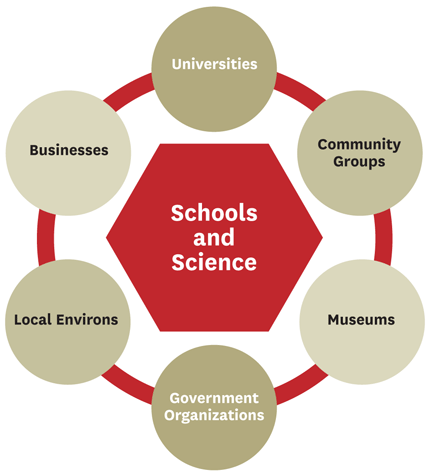
Academic science-community partnership
The Science Ambassador Program pairs senior university science, engineering and health science students with rural and remote Aboriginal community K-12 schools to support creative and culturally-relevant science teaching and learning. University students work alongside teachers to present hands-on science activities, facilitate class discussions, and mentor students.
www.artsandscience.usask.ca/scienceoutreach/ambassador
Environmental education and communities
The EcoLeague program is a youth initiative that provides resource kits for elementary and secondary students across Canada to encourage them to help the environment through community- and school-based sustainability action projects.
http://resources4rethinking.ca/en/ecoleague/about-us
Career-based science learning
The Brock University Science Mentorship Program links secondary school science students from local schools in Ontario’s Niagara Region to university faculty mentors from various disciplines including Biological Sciences, Biotechnology, Chemistry, Health Sciences, Neuroscience, and Physics. Working on site with university researchers, students are encouraged to consider a career in the sciences while engaging in science research programs carried out at the university.
www.brocku.ca/mathematics-science/outreach-to-schools/science-mentorship-program
While these initiatives are meaningful opportunities for students, student engagement in science education – particularly at the secondary school level – can be further enhanced when learning environments:
- are designed to utilize complex science topics
- give students authority to address community problems
- hold students accountable to others and disciplinary norms
- provide students with local resources that support authentic science learning[6]
One example of an initiative that incorporates some of the above characteristics is EcoSpark’s Changing Currents program. Based in the Greater Toronto Area, the program aims to allow students to identify and monitor a watershed close to their school community. Not only do students have access to community resources while engaging in authentic ecological science practices related to water quality and biodiversity; they also have the opportunity to conduct future study on issues or challenges they discover based on their data collection, as they contribute to a regional water monitoring program. Additionally, teachers are provided with resources and training to help their science students carry out the watershed science.
www.ecospark.ca/changingcurrents
Cultivating community-based science education
Community-based science education provides a way for students and teachers to become local problem-solvers who can deal with scientific and technological challenges that are of consequence. But programs such as Changing Currents are not common.
These partnerships are challenging to develop due to the need for specific science materials and equipment, along with science and educational expertise – all necessities not available in many Canadian communities. Further, partnerships can have multiple and sometimes competing goals. Outcomes for students, teachers, and community partners need to be clearly articulated, and resources and relationships need to be sufficient and workable. Overall, there has been an increase in school-community initiatives in school science, typically focused on environmental science topics (e.g. biodiversity, air, and water projects). However, these represent only a small sample of potential partnership opportunities available in many communities across Canada.
While there have been some efforts to research and develop community-based science programs with schools,7 additional efforts are required to develop science curriculum and support professional learning that emphasize school science and community partnerships. The potential benefits to science students are important.
Using a communities of practice framework8 can help address the elements required for a successful science-community partnership. These include:
- having all stakeholders share understanding of the science topic
- fostering ongoing and trustworthy relationships among the members
- identifying practices and resources required to make these endeavours successful and sustainable
Needless to say, government policies and incentives for initiating and sustaining partnerships are critical for community-based learning in science. Emergent technologies (e.g. social/collaborative online tools) can also play a critical role in facilitating the participation of science experts, educators, parents and volunteers.
We are entering an era where schools and communities are forming more and more partnerships, and cultivating these relationships is becoming ever more important. In order to establish beneficial community relationships, teachers and school administrators must be at the nexus of these relations. Thus, continued efforts are necessary to support important outcomes beneficial to all participants with/in communities across Canada.
En bref: La plupart des gens conviendraient que les élèves doivent accroître leurs connaissances scientifiques. Cependant, les élèves possédant des notions scientifiques ne sont pas nécessairement outillés pour confronter les questions sociétales complexes auxquelles ils feront face en tant que citoyens. Une solution consiste à engager les élèves dans des activités d’apprentissage authentiques, pertinentes et significatives intégrées à leur communauté scolaire. Cette importante innovation éducative peut aider les élèves à se consacrer davantage à l’apprentissage des sciences et à faire le lien entre leurs connaissances en sciences et d’autres matières, ainsi qu’accroître leur compréhension de la science et leurs capacités civiques dans leur collectivité. Néanmoins, le rôle des enseignants en sciences, des écoles et des collectivités dans l’établissement de partenariats efficaces n’est pas entièrement compris. Ce commentaire suscite un débat concernant le lien entre l’enseignement des sciences et les communautés scolaires.
Photo: courtesy Photo courtesy Brock University Science Mentorship Program
First published in Education Canada, March 2016
1 Douglas A. Roberts, “Scientific literacy/science literacy,” Handbook of Research on Science Education (NY: Routledge, 2007), 729-780.
2 Graham W. F. Orpwood, Bonnie Ann Schmidt, and Jun Hu. Competing in the 21st Century Skills Race (Canadian Council of Chief Executives, 2012).
3 Glen S. Aikenhead, “Towards Decolonizing the Pan-Canadian Science Framework,” Canadian Journal of Science, Mathematics & Technology Education 10, no. 4 (2006): 387-399.
4 Carolyn Gregoric, School-Community Involvement (UNESCO-APNIEVE Australia publications, 2013); Catherine M. Hands, “Why Collaborate? The differing reasons for secondary school educators’ establishment of school-community partnerships,” School Effectiveness and School Improvement 21, No. 2 (2010): 189-207.
5 Atelia Melaville, Amy C. Berg, and Martin J. Blank, Community-Based Learning: Engaging students for success and citizenship (Washington, DC: Coalition for Community Schools, 2006).
6 Randi A. Engle and Faith R. Conant. “Guiding Principles for Fostering Productive Disciplinary Engagement: Explaining an emergent argument in a community of learners classroom,”Cognition and Instruction 20, No. 4 (2002): 399-483.
7 Lisa M. Bouillion and Louis M. Gomez, “Connecting School and Community with Science Learning: Real world problems and school-community partnerships as contextual scaffolds,”Journal of Research in Science Teaching 38, No. 8 (2001): 878-898; Douglas D. Karrow and Xavier Fazio, “NatureWatch, Schools and Environmental Education Practice,” Canadian Journal of Science, Mathematics and Technology Education 10, No. 2 (2010): 160-172.
8 Etienne Wenger, Richard Arnold McDermott, and William Snyder, Cultivating Communities of Practice: A guide to managing knowledge (Boston: Harvard Business Press, 2002).
-
The Coffee House, Liquid Networks and The Challenge to Change
Comments Off on The Coffee House, Liquid Networks and The Challenge to ChangeI’m not sure if Steven Johnson loves coffee as much as I do, but he certainly has a great deal of appreciation for the coffee house! In his 2015 TEDTalk, Where Good Ideas Come From, Johnson points out that, in addition to the coffee being consumed:
-
The “Basics” and Inquiry Teaching
Comments Off on The “Basics” and Inquiry TeachingThere is concern in some circles that scores on standardized mathematics and literacy tests are declining.1 This fear has raised questions about the importance of teaching the basics and the impact of inquiry learning. Some critics attribute the perceived dip in test results to the recent emphasis on “inquiry teaching.”2 Media reports frequently present a polarized debate between two camps: “back to basics” versus “inquiry or discovery learning.”3 The resulting impression that educators must choose between one or the other is the kind of exaggerated position that often propels the educational policy pendulum to oversimplify and overreact. In this article, we seek to explain how learning the basics and inquiry teaching can be reconciled, and to document the effects of doing so.
Clarifying options
In education, we frequently get ourselves into difficulty by treating complicated concepts as though they are “black or white” labels.4 Certainly this has been true of the basics versus inquiry debate. But there is nothing inherently contradictory about these two concepts.
Before looking for the diversity within these notions, let’s agree on the defining features of each of these terms:
- Teaching the basics: a belief that there are core ideas and facts that every student needs to master.
- Inquiry: “to inquire” is essentially to pursue an answer to a question that is not already known by the individual. In other words, students’ answers to an inquiry question will require some examination or investigation on their part.
With the rote practice method, students repeat an action time after time exactly as before, without necessarily understanding why each step must be done as directed. Instructions are offered as recipes to follow verbatim. This is how many of us may have learned the standard algorithms for most mathematical operations. A teacher we work with recently recounted that she was taught to divide fractions by memorizing the phrase “This not for me to question why, just invert and multiply.” With an inquiry approach, instruction and repetition may still feature. Instruction, however, is intended to provide a platform from which students can explore options and variations. The repetition is mindful in that students are imagining possibilities, observing the effects of each trial and making further critical adjustments as needed. In mathematics and other highly skill-based subjects, we have found this a more effective way to empower students with the “basics” for a 21st century arena where conditions are changing and unpredictable, where creativity and innovation are key to success, and where high levels of complex performance are needed. Properly implemented, inquiry is a powerful method to deepen student understanding of the curriculum, increase student engagement and develop competency in critical, creative and collaborative thinking.
One of our earliest documented experiences with these two approaches occurred while working with mathematics teachers in India. By Grade 6, students in one of the schools we were assisting had had two previous years of memorizing the formula for calculating profit and loss, and applying the formula as prescribed in countless problems. Despite repeated drill, many students were unsuccessful with the problems and most didn’t really understand what they were doing as they applied the formula. With support from our team, teachers created several scenarios of simple commercial operations where the profit or loss was to be calculated. Working in groups, students were asked to figure out the answers as best they could, and then to formulate a sentence using as few words as possible (or only symbols if they were able) to represent all of the elements they needed to consider and the relationship among the variables. Students tested their draft formulae with various problems to see if they worked in each case, and shopped their version around to the other groups to see if they could arrive at more complete, reliable and concise formulations. In reflecting on this experience in a learning log, one student remarked that while this was the third time he had been exposed to the topic, for the first time he understood what he was doing. He wasn’t worried that he would forget the formula at exam time, because now that he understood it, the formula was more memorable to him. He went on to explain that even if he did happen to forget the formula, he was confident he could reconstruct it because of the recent learning experiences.
Criticisms of inquiry approaches
While the previous example suggests that students can figure out some formulae on their own, critics will counter that students can’t possibly discover everything we want them to learn. We agree that expecting students to invent everything for themselves is inefficient and unrealistic. In fact, this is where our approach differs from “discovery learning.” If the teachers in the situation described above thought that solving the profit and loss problems and generating original formulae would be too difficult or time-consuming for their students, they could have shifted the focus of the inquiry by providing students with possible formulae to consider. In this case, the inquiry would be to determine which version of the supplied formulae would be the best to recommend for use by students at this particular grade level. As this modification suggests, inquiring into a topic does not require that students re-invent everything for and by themselves. On the other hand, inquiry learning does require some investigation; students can’t simply be expected to accept answers.
A second criticism leveled against inquiry approaches is the suggestion that many of the basics can be acquired only through drill and memorization. While we agree that students should be expected to master and remember many basic facts, it is important to recognize that drill is one form of practice, and memorization is one way to remember something. In our view, the issue is not whether students need to remember and master basic facts, but how best to help them satisfy this need. It is well known that students are more likely to remember something if they understand what they are being asked to learn. Consider the following sentences:
- My best friend is Peter Pan.
- Gy hepl gfiern iv Qelef Qaw.
Most will agree that the first sentence would be easy to remember, whereas the second sentence would be very difficult. This is true even though all the vowels are identical and there is the same number of words and letters in both sentences. The point being made here is the same one that the student from India was making about remembering the formula for profit and loss. He had struggled to remember the formula that he had been taught (and expected to memorize) over the two previous years because he didn’t understand what he was learning. Yet, as soon as he understood the formula, he became more confident in his ability to remember it. The more we help students comprehend what we want them to remember, the less students need to learn by memorization.5 Before expecting students to memorize number facts such as “5 + 5 = 10” we should ask them to visualize this fact, manipulate objects to demonstrate it and predict the result to help them understand its meaning.
The more we help students comprehend what we want them to remember, the less students need to learn by memorization.
Not only must students remember many basic facts; there is much that students need to learn that can be mastered only by repetition. But what is the best way to structure repetition? Recognizing that drill is but one form of practice helps to address this question. Some drill may be useful from time to time, but without meaning, repetition is unlikely to increase understanding and fluency. On the other hand, mindful practice guided by ongoing questioning and testing is a more effective and engaging form of repetition. Instead of “drill” worksheets where students use rote memory to solve multiple problems involving a basic operation, a more productive strategy is to ask students to detect the various kinds of problem types present in the worksheet (for example, distinguishing subtraction problems involving regrouping of none, one or more placeholders) and to solve one example of each type. Students would repeat this process with other worksheets until they could quickly identify a wide range of problem types across all of the four basic arithmetic operations. This kind of mindful practice conducted in a spirit of inquiry is more likely to develop genuine mastery in mathematics.
As we hope these examples make clear, “learning the basics” and “inquiry,” properly understood, can be complementary components of a successful educational program.
Documenting effectiveness
Adopting robust inquiry that nurtures and builds from the basics (what some call moving “forward with the basics”) can lead to improved and often spectacular results. We base these conclusions on 20 years of experience working with approximately 80 districts and 200 schools involving over 125,000 teachers worldwide.
Our work with teachers ranges from a few face-to-face sessions over the course of a year to ongoing sustained professional learning programs. We focus on helping teachers problematize the content of the curriculum using a critical inquiry approach. We support teachers in embedding critical thinking questions into every aspect of their teaching, and then model how to systematically introduce and practice the “tools” needed to successfully complete each task.
Qualitative data and anecdotal evidence repeatedly suggest positive results. As well, a number of schools with improved results on standardized tests in areas such as literacy, mathematics and student engagement have attributed these results, in large measure, to our work with them. Typically they credit our approach with deepening student understanding and increasing student engagement. The extent of improvement is often significant. For instance, one Ontario school reported a 54 percent increase in combined Grade 3 Reading and Writing scores on EQAO tests.6 The same school saw a 75 percent increase in Grade 6 Mathematics in procedural and conceptual understanding. A group of four elementary schools in a partner district reported increases of 15 percent in the number of Grade 3 students and an increase of 36 percent in the number of Grade 6 students achieving levels 3 (grades B or B+) or 4 (grades A- to A+) in Mathematics.
Our approach has shown positive results with students from across the spectrum of ability. For example, a school with students considered to be at high social risk reported a 168 percent increase in the number of Grade 6 students reporting that they liked math most of the time. Not surprisingly, the number of those students achieving at or above the provincial standard on EQAO tests increased from 15 percent to 50 percent during the same period. In another school with a challenging student population, 85 percent of Grade 6 students were performing at or above standard in Mathematics after working with our team. In the previous year, only 49 percent of the Grade 6 students had reached this level.
Our results are consistent with a larger study involving 5,000 students in 117 Chicago-area schools.7 Newmann and his team found that providing Grades 3, 6 and 8 students with “challenging intellectual work” resulted in greater-than-average scores on standardized measures of basic numeracy and literacy skills. These researchers found that students in disadvantaged as well as mainstream classrooms benefited from these challenging tasks. In fact, students with low prior achievement levels in Mathematics experienced greater gains from this approach than did students with high prior achievement levels.
Concluding comments
It would be unfortunate if the idea of inquiry per se were discredited merely because some interpretations of the concept are ineffective. This regrettable situation would be further compounded if support for inquiry were replaced by the very approach to teaching the basics that was dismissed in the past because it was ineffective in preparing students for an increasingly complex world. We believe that a rigorous critical inquiry that moves “forward with the basics” offers a fruitful middle ground that draws on the best of both approaches and steers clear of the less desirable extremes. While this article may raise as many questions as it resolves, we hope it will foster thoughtful debate about the role of the basics and inquiry in 21st century classrooms.
En Bref: Les préoccupations concernant les résultats aux épreuves normalisées ont soulevé des questions concernant l’importance d’enseigner les éléments de base et l’impact de l’apprentissage par l’enquête. Souvent, l’impression que les éducateurs doivent choisir entre « le retour aux savoirs de base » et « l’enseignement par l’enquête ou la découverte » entraîne le pendule des politiques éducatives vers des simplifications et des actions extrêmes. Cet article clarifie les interprétations contradictoires possibles de l’enseignement des éléments de base et l’enquête. Il examine comment il peut s’agir de composantes complémentaires d’un programme éducatif fructueux. Les auteurs documentent l’efficacité de cette approche par les résultats favorables des mesures normalisées de réussite et d’engagement des élèves de diverses écoles où le TC2 (Critical Thinking Consortium) a travaillé. Les preuves démontrent clairement la valeur d’une enquête critique rigoureuse qui progresse avec les savoirs de base.
Photos: iStock
First published in Education Canada, December 2015
1 According to the 2012 PISA results, mathematics scores are declining in several Canadian jurisdictions. However, results from the Pan-Canadian Assessment Program for 2013 indicate that scores for Grade 8 students in math and reading are on the rise across the country.
2 Caroline Alphonso, “Why Discovery-Based Learning Doesn’t Add Up,” Globe and Mail, September 20, 2013: L3; “New Math Equals Trouble, Education Expert Says,” CBC News, September 21, 2011. www.cbc.ca/news/canada/new-math-equals-trouble-education-expert-says-1.1058161
3 David Staples, “The Top Nine Reasons Why Education Minister Jeff Johnson Is in Such Hot Water,” Edmonton Journal, May 16, 2014.http://blogs.edmontonjournal.com/2014/05/16/the-top-nine-reasons-that-education-minister-jeff-johnson-is-in-such-hot-water/
4 See Roland Case, “Our Crude Handling of Educational Reforms: The case of curricular integration,“ Canadian Journal of Education 19, no. 1 (1994): 80-93; and Roland Case, “Educational Reform in British Columbia: Bold vision/flawed design,” Journal of Curriculum Studies 24, no. 4 (1992): 381-387.
5 Robert Sternberg, “Assessing What Matters,” Informative Assessment 65, no. 4 (2008): 23.
6 EQAO (Ontario Education Quality and Accountability Office) reports on province-wide literacy and mathematics achievement tests and questionnaires, administered yearly.
7 Fred Newmann, Anthony Bryk and Jennny Nagaoka. Authentic Intellectual Work and Standardized Tests: Conflict or coexistence? (Chicago: Consortium on Chicago School Research, 2001).
-
What is the influence of teacher-student relationships on learning?
Comments Off on What is the influence of teacher-student relationships on learning?The influence of teacher-student relationships on learning is clear: learning is enhanced when teacher-student relationships are strong. Research overwhelmingly suggests that students of varied ages, experiences, and backgrounds who perceive their teachers to be supportive of their needs and interests are more engaged, more motivated, more self-directed, and more socially connected at school than their peers.
How can teachers best foster positive relationships with students? What kinds of learning outcomes can teachers expect as a result? Several key facts emerge from the research:
Being kind matters. Learning is enhanced when teachers demonstrate a variety of behaviours associated with kindness: interpersonal warmth, care, empathy, support, safety, and intellectual encouragement. Research suggests that these behaviours increase a learner’s creativity, criticality, autonomy, and satisfaction; and result in better student attendance and grades.
Positive teacher-student relationships are socially contagious. Students who experience positive relationships with teachers are more likely to try to develop similar bonds with others in their school community.
Positive teacher-student relationships benefit vulnerable students most. Students who are racially, socially and economically marginalized, have learning exceptionalities, or who are otherwise deemed at risk are more strongly influenced than others by the quality of relationships they form with teachers.
Teacher responsiveness to student differences is crucial to relationship building. Students tend to be most receptive to teachers who convey an understanding of them as distinct individuals. This proves to be especially true in culturally mixed classrooms.
Teacher-student relationships matter regardless of grade level. While it is often assumed that younger learners are more dependent for their academic adjustment on their teachers than are older ones, research suggests that the importance of teacher-student relationships remain consistent no matter a student’s age.
Consensus among educational researchers can be rare, yet here there is little dispute: positive teacher-student relations are integral to young people’s learning.
ADDITIONAL INFORMATION RESOURCES
Building Positive Teacher-Child Relationships
Center on the Social and Emotional Foundations for Early Learning
U.S. Department of Health and Human Services
http://csefel.vanderbilt.edu/briefs/wwb12.pdfVideos
Rita Pierson: Every kid needs a champion
https://www.youtube.com/watch?v=SFnMTHhKdkwPrincipal Kafele says, “You can’t teach them if you don’t know them!”
https://www.youtube.com/watch?v=GTCrhnGiWXINational Summit on Student Engagement, Learning and Behaviour: Positive Relationships
https://www.youtube.com/watch?v=Kwt4HZZieUIBuilding Relationships With Your Students | AmeriCorps Insights
https://www.youtube.com/watch?v=OFEZePD1ZkYReferences
Cornelius-White, J. (2007). Learner-Centered Teacher-Student Relationships Are Effective: A Meta-Analysis. Review of Educational Research 77(1), 113-143.
Davis, H. A. (2013). Teacher-Student Relationships. In J. Hattie & E.M. Anderman (Eds.), International Guide to Student Achievement (pp. 221-223). New York: Routledge.
Murray, C. & Pianta, R.C. (2009). The Importance of Teacher-Student Relationships for Adolescents with High Incidence Disabilities. Theory Into Practice 46(2), 105-112.
Roorda, D.L., Koomen, H.M.Y., Spilt, J.L., & Oort, F.J. (2011). The Influence of Affective Teacher-Student Relationships on Students’ School Engagement and Achievement: A Meta-Analytic Approach. Review of Educational Research, 81(4), 493-529.
Wentzel, K.R. (2012). Teacher-Student Relationships and Adolescent Competence at School. In T. Wubbels, P. den Brok, J. van Tartwijk (Eds.), Interpersonal Relationships in Education (pp. 19-36). Boston: Sense Publishers.
Wubbels, T. & Brekelmans, M. (2005). Two Decades of Research on Teacher-Student Relationships in Class. International Journal of Educational Research 43, 6-24.
-
The Student Led Learning Walk
Comments Off on The Student Led Learning WalkThe Student Led Learning Walk (SLLW) is a highly interactive and social approach to learning in schools. At our school, where we have now held seven SLLWs, it has had a positive influence on many aspects of our learning and teaching, especially with respect to instructional strategies, the integration of technology, student achievement and well-being, parent/community engagement and leadership practices.
The process of the Student Led Learning Walk challenges educators to:
- Analyze pertinent school district data to set school improvement goals;
- Commit to working toward goals using 21st century competencies and high-yield strategies;
- Contribute relevant learning on a continuum in community;
- Communicate as a learning community; and
- Learn from and with one another.
How it works
The process begins with an area of focus or “big idea” that can engage the whole school, in our case from Kindergarten to Grade 8. Teachers are encouraged to scaffold inquiry-based learning tasks for students that include 21st century competencies such as collaboration, creativity, use of technology, and skilled communication, while strategically interconnecting curriculum. They are also asked to exchange ideas, collaborate, and share strategies and instructional practices related to the focus of the SLLW with their colleagues. Ideally, the learning community comes alive as teachers and students engage in rich, relevant and meaningful conversations.
A visible continuum of learning: Student artifacts of learning from each class are posted on a continuum through all the grades in a community space such as a hallway, gymnasium, community centre, etc. Learning trajectories are made visible through this community knowledge building. Everyone – students, teachers, support staff, administrators, parents, family members, friends and community partners – is invited to participate in varying capacities. In doing so, all participants have the potential to benefit from the discourses that arise from the displays. It is important to note that the SLLW is designed to be an iterative practice representing a snapshot of the learning process at a particular point in time.
Once all the artifacts of learning are posted, teachers walk with their students through the displays, partaking in deeper conversations about the learning. All participants have an opportunity to see their own work on a continuum and in the context of the school community. They also see what others have contributed and make relevant connections to their own knowledge and understanding of the ideas being shared. Reich argues that learners need authentic opportunities to construct knowledge by communicating with others, mindful of cultural contexts and their interrelated roles as agents, participants and observers.1 Inevitably, students learn from the work of other students, colleagues learn from colleagues and learning is de-privatized.
Descriptive feedback: “Decades of education research support the idea that by teaching less and providing more feedback, we can produce greater learning.”2 As students narrate and navigate through SLLWs, they are well-positioned to provide descriptive feedback, discuss next steps or provide suggestions for extending their learning. They have multiple chances to communicate, exemplify, refine, challenge or revise thinking. In our SLLWs students have consistently demonstrated genuine enthusiasm and interest in one another’s work.
As Wiggins notes, to be valuable, feedback must be “stable, accurate, and trustworthy.”3 The consistent use and application of exemplars and rubrics at the classroom level characterize a sound pedagogical approach. SLLWs provide school-wide contexts that allow teachers to look at student work together and become more consistent in their judgements. They also provide opportunities for students to be trained in providing, receiving and responding to descriptive feedback.
Students lead the learning: Once students have had an opportunity to “read the walls” and talk about their learning, they are encouraged to lead their families through the SLLW at their own pace, communicating their knowledge and understanding in their language of preference. Communicating to authentic audiences is not only an important element of knowledge building; it also builds parent engagement and familiarity with the work of the whole school. Learning goals and related success criteria are presented in a family-friendly manner as children talk about what they are learning and its relevance to their lives.
One of the SLLW’s greatest benefits is the manner in which parents, grandparents and families are able to delve into the curriculum with their children. Part of the procedure in developing an SLLW involves creating a brochure to give parents as they enter the SLLW space. This brochure describes the area(s) of focus and Ontario curriculum expectations (e.g. “measurement in the math curriculum”) throughout the grades. As well, the brochure suggests home tips for parents to extend the learning. The SLLW process respects parents as their child’s primary educators.
Participation and interaction: During SLLWs students are routinely seen adjusting their participation depending on their audience. Learners interact with peers, teachers, community members and subject matter in meaningful and relevant ways. A recent example included two students from a large urban school board in Grade 3, who demonstrated ownership of their learning by confidently sharing their knowledge and understanding from Kindergarten through to Grade 8 while leading the Director and Associate Directors of Education through the school’s Student Led Learning Walk. Students with exceptionalities are also invited to dialogue with other participants about their perspectives; patience and understanding of different-minded and differently abled individuals was evident. The SLLW space is owned by the participant-actors and their audience and their discourses emerge as a result of their relationship.
There’s a strong element of trust involved in this kind of learning experience. In this social context, participants must feel that they have a place in the community and must feel at liberty to talk about their learning. All participants must be open to accepting, responding, disputing or advancing the ideas and views of others. The SLLW creates a social context for teachers and students to see first-hand that their contributions truly matter, both in their own lives and in the lives of others. With each iteration, students also begin to take ownership of their learning in new ways. This is evident when students are seen engaging in exciting learning conversations with authentic audiences.
A new culture is emerging, a culture that places student voice, engagement and understanding at the heart of learning. Student Led Learning Walks strive to embrace students, educators, parents and community partners as active, integral and valuable participants in the learning experience at classroom and school levels, resulting in exponential benefits to all.
What participants have to say about SLLWs
“The biggest advantage I witnessed during our first SLLW was the cohesiveness and the collaboration among staff, students and parents… I was really impressed with the quality of work from all grades and the way the students interacted with one another, giving natural, relevant and helpful feedback.” – Kelly Cascone Brown, school principal
“One of our challenges has been to bring the parent community into our academic conversations since the majority of our parents speak little or no English. The Student Led Learning Walks were an amazing way for our students to speak to their parents in their first language to describe and share the learning we have done… For our Grade 6 student leaders who volunteered to host special guests, this was such a confidence-boosting and exhilarating experience! Our own staff marvelled at the obvious connections along the trajectory of learning.” – Debby Culotta, school principal
“We worked together and were able to connect with the thoughts and ideas of others. From Kindergarten to Grade 8, we shared our understandings of similar ideas.” – Gielene, student
“It is nice to show our community the work we did. It’s not just about tests and assignments, it’s about our real work.” – Joshua, student
“The beauty of this practice is the depth of learning and connections that students make to ideas and curriculum content. The benefits are twofold: firstly, students deepen personal learning, secondly, students work toward a common goal of sharing their knowledge, ideas and wonderings.” – Laura Monaco, teacher
“The authenticity with which children engage in an SLLW is remarkable. They speak with passion and purpose, but even more impressively, they speak with understanding…The Student Led Learning Walk is a practice that brings the curriculum to life and reinvigorates the values behind conversations.” – Jan Murphy, School Effectiveness Lead
“The Student Led Learning Walk was a terrific addition to the parent-teacher interview night in February this year. It provided a very visual representation of the learning continuum with respect to Data Management across all the grades from Kindergarten to Grade 8.… It was exciting to see the students’ enthusiasm for the work and hear their personal perspectives on the experience.” – Janet Ainslie, parent
En Bref – Le programme Student Led Learning Walk (SLLW) constitue une approche collaborative, innovante, sociale et pédagogique très visible favorisant l’engagement à l’échelle de l’école. Par sa structure organique, le programme s’adapte à la vie éducative des communautés d’apprentissage ainsi qu’aux objectifs spécifiques des plans d’amélioration scolaire. Le SLLW situe stratégiquement l’apprentissage des élèves en contexte, permettant aux éducateurs, aux familles et aux partenaires communautaires d’interagir dans un contexte où ils comprennent et soutiennent un continuum d’attentes d’apprentissage pour tous les élèves. La collaboration, un curriculum intégré, l’enquête, la créativité, les compétences de communication, la participation des élèves, la différenciation et l’utilisation des TIC sont intégrés à l’expérience d’apprentissage. Ce programme vise à inspirer une éthique d’excellence active ancrée dans une vision communautaire qui place l’opinion, l’engagement et la compréhension des élèves au cœur de l’apprentissage.
Photo: Courtesy Mirella Rossi
First published in Education Canada, September 2015
1 K. Reich, “Interactive Constructivism in Education,” Education and Culture 23, no.1 (2007): 19.
2 G. Wiggins, “7 Keys to Effective Feedback,” Educational Leadership 70, no. 1 (2012): 12-13.
3 Wiggins, 15.
-
School is a Risky Place
Comments Off on School is a Risky PlaceBeing at school asks us to take risks and be vulnerable – show what we don’t know and risk failure in the finding out.
It’s hard to believe that people send their children to school – their wee little beautiful children – to experience the pain of “not”, of not knowing and not achieving and not enough. Many adults aren’t courageous enough to put ourselves in such a vulnerable position. Of course, those experiences help us develop the much talked about “grit” and resilience. But not for all; for some those experiences debilitate and alienate.
I am deeply grateful that this was not my experience of school. I failed at things, for sure. My work didn’t always meet the standard in the classroom and I wasn’t always comfortable on the playground. However, I was born into a family that (and had some teachers who) raised me to be, what Brene Brown would call, shame-resilient. I could face failure and exclusion because I didn’t often feel like my self worth was on the line. This shame-resilience enabled me to be vulnerable to the process of learning.
As a child, I managed to navigate a system which sought to rank and define me: the grading system that we all know so well.
I could survive putting out my best efforts and the potential of “not meeting” the standard because I had people who believed I was enough regardless of my achievement. I took on that belief as my own – even when my school work, my creativity, my ideas, my problem solving, my effort and my determination were not enough.
For children who are not shame-resilient, school structures like marking (read: ranking) place children’s self-worth on the line every, single day. When our self worth is on the line we cannot afford to be vulnerable. If we cannot afford to be vulnerable, we won’t engage in the effort and persistence learning requires.
“Shame-resilient cultures nurture folks who are much more open to soliciting, accepting, and incorporating feedback” says Brown in her bestseller Daring Greatly.
Soliciting, accepting and incorporating feedback? Sounds like a formula for learning.
If we want our schools to be shame-resilient cultures we teachers and school leaders must model ourselves as learners first and foremost – being as vulnerable as we ask our students to be. We must look at our systems critically and build in the supports necessary to nurture “engaged, tenacious people who expect to have to try and try again to get it right” (Brown, pg 64).
What supports have you built into your school or classroom to create a shame-resilient culture? What practices should we renounce? What supports should we create?
-
“Homeschool It Is”
Comments Off on “Homeschool It Is”The sun is low in Calgary and winter has set in. Despite frigid temperatures and snow-piled streets, the school buses are running. My eight-year-old daughter is rushing around trying to find the “right” pair of pants to wear. She needs to get dressed quickly and to be out at the bus stop before 8:35 a.m.
Rubbing her eyes, Mara takes a deep breath to calm herself down. She didn’t get enough sleep last night – again. Mara has always had trouble sleeping. These days, she can’t sleep without the television on and sometimes it takes too long to drift off. She feels lonely without the comfort and stimulation of the television to help her through the night, when it’s dark and the air is deathly quiet.
Never happy with her clothes, Mara is continually distressed with the feeling of all but her most comfortable favourites. She wants to wear the same pair of shorts all winter; too short for the season, but just the right fit and feel for her. Although we are hesitant to define her as abnormal and have not yet confirmed the label for Mara’s concerns, sensory issues and emotional sensitivity have made it difficult for us to get Mara to school on time, willingly. After discussing and exhausting all of the options with two different elementary schools, we have – reluctantly and at the same time enthusiastically – decided to exercise the homeschooling option.
“Mara is her own person, with her own mind,” we say, reinforcing ourselves. The truth is, the options are not available to us within the traditional educational system to meet Mara’s individual needs and wants. I would love to be working on my work instead of teaching her, but at the same time I want to do the best for my daughter and make her life as happy as possible. We are motivated to resolve the troubling distress Mara experienced at school, and in order to accomplish both work and learning, I have undertaken to provide education to my Grade 3 student, while focusing on my writing in the evenings and on weekends. It isn’t perfect, but we get to spend time with each other, no longer distanced by the two kilometres to the neighbourhood school.
Mara’s brother George, on the other hand, is asking to start school now. George is a different child than Mara. He is happy with structure and less bothered by his sensations. The next few years are going to be an experiment with George. He will see his sister learning at home, but he may crave the company of others and enjoy the routine of the day-to day in a typical elementary school. Not wanting to apply a template to George, we as parents need to give him his own chance with elementary school. Ultimately, we will support what he chooses for himself and what is best for him.
Given our experience, if someone were to ask what we would want as a family from the educational system for our children, I would say flexibility and funding. We need the flexibility to participate when we can without being hampered by the threat of legal measures to enforce attendance. On the other hand, funding for tutoring would help us at the homeschool to bridge the financial hardship that comes with meeting educational expectations when we can’t meet regular attendance requirements, despite our best efforts.
Like all parents, we want the best for our children. Our approach with Mara is based on this, so “homeschool it is” for us, and that’s the way it’s going to be.
We will wait for an education system that can better adapt to the individual needs of students and that offers students more choices and opportunities for independence – and maybe by high school we can find a happy medium for Mara in the school system.
Perhaps someday the school system will become more accepting and supportive of parents who need the flexibility to fulfill their parental roles, while attempting to meet their family’s needs as a whole. We can work together when parents, students and teachers are all included in developing and encouraging student achievement and growth, and families are recognized as central to academic success.
Photo: Scott Dunlop (istock)
First published in Education Canada, May 2015
-
Going Beyond Caring to Mentorship
Comments Off on Going Beyond Caring to MentorshipOver the course of the past twenty years that I have worked with at-risk students, I have heard countless times from colleagues and professionals in the field that “it’s all about relationships”. This advice is usually passed on as requisite insight that everyone who works with at-risk youth either understands or will come to understand as a truism. I agree that it’s all about relationships, yet what does this actually tell you? How does it help? Does your relationship or empathy lead to students’ resilience?
(more…) -
Attending to the Agency of the Learner
Comments Off on Attending to the Agency of the LearnerEven though graduation rates have stabilized in the province of Quebec, failure to graduate remains an acknowledged problem for provincial educators. Here at Concordia’s Department of Art Education in Montreal, we focus on questions of how the visual arts and digital media can engage youth who are at-risk of dropping out. We have studied existing programs, such as Maison Kekpart and have developed and researched a mobile media curriculum. Though these projects are presently focused on the impact that visual arts and digital media can have on a student, we have identified a number of outcomes that suggest student engagement need not be limited to the arts.
Agency to Move
We are currently working on a long-term research study investigating the use of visual arts and civic engagement curriculum delivered through mobile media (smartphones and tablets). We are using this curriculum and digital technology with youth who are at risk of dropping out of high school or who have just returned to school to complete their diploma. Our intention was to engage students with learning outside of school through mobile media and art making. Participants shared images, made comments, and responded to the curricular missions posted by the researchers and educators involved. while the study was ongoing, Each week or so we would host after-school meetings to discuss the project. As the project evolved, participants wanted to increase the number of afterschool meetings. Students also used the mobile social network to coordinate the times and places they would meet in order to go on field trips together. When we asked participants why they wanted to come to the afterschool meetings and to go on field trips together, they enthusiastically contrasted these student-initiated activities with their former more teacher-directed experiences of schooling. Most of these students had spent their time in schools under constant surveillance and with restricted mobility. While we had hypothesized that the mobile media devices would enable participants to learn on their own, what we did not foresee was that their use prompted a sense of agency mobility, self-organization, and informal learning among our participants. What we found was that students who feel in control of their learning also feel more connected to it. This effect promises to make school as a whole, less alienating for at-risk youth.
Real World Relevancy: Learning Professional Skills
From our studies, we found that curricula incorporating professional skills and tools engage students in learning. In the above-mentioned mobile media curriculum, we started by asking students to engage critically with their civic environments by asking them what would they like to change to make their community better. For the most part participants were more interested in learning how to make beautiful images and felt they had no power to change things in their neighbourhoods. We noted that before students responded to the challenge of engaging critically with the world around them, they need and want to develop their visual voice and to master the grammar of their visual culture. In other words, they wanted to make images like professionals. Only then did they feel empowered to think about change in their neighborhoods. At Maison Kekpart outside of Montreal in Longueuil, media professionals taught students professional skills in media production. Many of the students when interviewed described how learning professional tools and techniques gave them a sense of accomplishment and the authority to voice their ideas. Students are savvy enough to identify learning that will empower them in the future. Given that students are immersed in visual culture every day, they implicitly know what an authoritative image looks like. They want to know how to make such effective images. Curricula that connect to their everyday experiences and instruction on how to participate as equals with media professionals (adult teachers and instructors) contributed to the highly engaging learning environment at Maison Kekpart.
Incorporating Youth Cultural Practices into Curricula
At Maison Kekpart, we observed how instructors incorporated into their curricula what students did with social media in their personal lives. For example, one media arts instructor noticed that one of his students was an avid YouTube user who posted new videos on an almost daily basis. Recognizing the social currency that is developed through an online presence as a professional himself, he began to model his social media practices by inviting students to follow and friend him online. This practice stands in stark contrast to how many schools approach social media. Instead, Maison Kekpart and their instructors use social media to connect with youth and to model professional practices. What instructors are doing is helping to transform the online cultural practices of youth into professional practices by engaging with them as professionals in the media arts.
While there is no easy fix for engaging youth with their education, we have found that the approaches presented here nurture the sense of agency in the learner. A large part of student engagement in education is based on the student feeling empowered to make choices about how and when that student will engage in learning. The knowledge that students acquire under these conditions makes them feel confident and competent. The knowledge that what they are learning is valued outside of the classroom but is of wide enough application to be used in the conventional classroom.
n.b. David Pariser and Martin Lalonde are affiliated researchers on this project.
Related Reading
Youth Practices in Digital Arts and New Media: Learning in Formal and Informal Settings
This blog post is connected to Education Canada Magazine’s Towards Fewer Dropouts theme issue and The Facts on Education fact sheet, How Can We Prevent High School Dropouts? Please contact info@cea-ace.ca if you would like to contribute a blog post to this series.
-
Dropout Prevention: Finding a Compelling Answer to “Why stay in?”
Comments Off on Dropout Prevention: Finding a Compelling Answer to “Why stay in?”Dropping out is typically triggered by innumerable events, choices and experiences over years, so there is no magic remedy. Nonetheless, supportive adult relationships and a compelling answer to the question “Why stay in?” are key.
I have dedicated my professional life to developing programs to help educators help students plan their learning and career journeys. I believe the ultimate goal of education is to prepare students for successful lives beyond school. While adult life is much more than work, most of us spend more time on the job than anything other than sleeping for most of our lives. As adults, we know our career choices profoundly impact every aspect of our lives. Yet, we graduate students unprepared to make employment choices.
Roughly 1 in 2 young people, from dropouts to those with degrees, fail to “launch” smoothly from school to work. Many begin their careers in low wage jobs unrelated to their studies and interests, unsure how, or if, they will ever land a “good” job. “Many young people find out who they are and where they belong by bouncing off things (experiences) for several years until they eventually commit or settle.” [1] Their prospects for early student loan repayment (average $30,000), buying a car, home, and building a life and family may seem bleak to them, and to their parents.
Given the exodus of high-end “boomer” talent already underway, ensuring young people launch successfully from school to good jobs is critical. Today’s school leavers will carry the primary burden of taxation for the next 40 years. We all need them to be successful. Young people in good jobs are happier, healthier, and more productive, they pay higher taxes, and they contribute more to their families and communities. Those that lose their early adult years drifting between underemployment and unemployment may never recover lost ground. Rather than contributing to prosperity for all, they diminish it for all. From every perspective, dropouts and failed launches are simply too costly in human and economic terms to tolerate.
Young people are in school from Kindergarten until they enter the workforce. Preparing them to make good choices as they enter and navigate the complex, constantly changing maze that is today’s labour market isn’t in the curriculum. Most educators feel unprepared and unequipped to help students prepare for the working world. So, whose job is it?
To answer this question, I helped organize Thoughtexchanges[2] at the Harvard Graduate School of Education’s Pathways to Prosperity Conference in March, 2013, the National Career Development Conference in July, 2013 and The Association of Career and Technical Educators’ CareerTech Vision 2013. Over 500 eminent education, government, business, community and career leaders reflected for two weeks – one month prior to each conference – then submitted their ideas. They then had two weeks to read others’ responses and vote for the ideas they considered best of all. The results were shared at the conferences.
Of the hundreds of ideas generated, the following rose to the top:
- Educators and employers must collaborate to provide real-world, work- and project-based learning (learning by doing) opportunities for students.
- Career and labour market information and guidance provision must be enhanced so students can make informed decisions based on their interests and their employment prospects.
- All learning pathways to in-demand careers deserve priority and respect. The “university for all” mentality does a disservice to many students and yields too few graduates with the skills and experience employers need.
- Preparing students to transition from school to success requires collaboration among educators, parents, employers, and community agencies. It’s everyone’s job!
Like most jobs, this one requires training and tools. I believe the following, all of which are available, are essential:
- Engaging, experiential career learning programs and activities for teachers for students in Kindergarten, primary, middle, secondary, and post-secondary schools.
- Comprehensive and current online career, learning and labour market information for students, teachers, and parents.
- Online graduation planning systems linked to Student Information Systems to enable students, with help from teachers and parents, to choose learning pathways based on informed career goals.
- Online systems that safely connect students and employers, mediated by educators and parents, for experiential learning opportunities such as mentoring, coaching, workplace tours, classroom speakers, job shadowing, co-op placements, internships, apprenticeships, volunteering, community service, and part-time or summer jobs.
- Training for students, teachers, parents, employers and community agencies so all can effectively help students stay in school and prepare to transition from school to success.
To illustrate, here’s a true story from North Carolina, where the “tools” above are in place. Interestingly, they are from Canada.
A Grade 9 student hated school. He seldom completed assignments and was disruptive in class. The only thing he looked forward to each day was getting to his uncle’s garage to work on motors. He was a magician at this! He planned to drop out of school on his 16th birthday (in 3 months) and work on his passion full-time.
Then he received a message in his ePortfolio from John Deere saying “You might be the kind of person we are looking for. Would you like to come and see our facilities and meet some of our people?” When he got there his eyes lit up. Surrounded by tractors, lawn mowers, and off-road vehicles, this looked like heaven to him.
John Deere told him if he dropped out of school they wouldn’t consider hiring him. They said he needed to do well in his academics, particularly Math and Science, and work on his people skills and character. They didn’t promise him a job, but they offered him a mentor and the possibility of experiential learning (job-shadowing, internships, part-time job).
He was different person in school the next day. He now saw high school as a bridge he wanted to cross. His teachers and parents couldn’t believe his transformation. When he graduated with above average marks, John Deere paid his tuition for a 2-year community college small engine repair course. When he finished the course they hired him at $50,000, loan-free.
John Deere found this student because he had expressed his passion for and experience with motor repair in his ePortfolio. They found him, and he found a compelling reason to stay in school, and new supporting relationships with adults beyond school or home. It takes a community.
This can happen with any student, whether at-risk of dropping out or on the honour roll, when new connections between school and the “real world” occur and students with dreams meet employers seeking talented young candidates.
[1] Career Crafting the Decade after High School, Cathy Campbell and Peggy Dutton, CERIC 2015.
[2] Thoughtexchange (https://thoughtexchange.com/) is a British Columbia-based company that has developed a unique group inquiry software platform used by many school districts across Canada and the United States.
This blog post is connected to Education Canada Magazine’s Towards Fewer Dropouts theme issue and The Facts on Education fact sheet, How Can We Prevent High School Dropouts? Please contact info@cea-ace.ca if you would like to contribute a blog post to this series.


IDEAS TO SUPPORT EDUCATORS : Subscribe to the EdCan e-Newsletter
Quality research, reports, and professional learning opportunities.