Archive
-
How Can We Prevent High School Dropouts?
Comments Off on How Can We Prevent High School Dropouts?How do we help students stay in school?
For most people, completing secondary school has become a basic requirement to be able to live satisfying and productive lives. Much has been learned about the factors that keep young people on track to successful high school graduation.
The most important single factor is students’ feeling of connection to the school and in particular, the belief by every student that there is at least one adult in the school who knows and cares about that student. Schools can do many things to promote this, such as assigning teacher advisors, and taking action early when a student shows signs of being in difficulty, both personally and academically. Schools can reach out to struggling students to offer extra support; sometimes only a small amount of such support is enough to make a big difference.
Also important are an engaging curriculum and effective teaching practices. Many students do not find their lessons intellectually stimulating. Students want and need work that challenges their abilities but that also provides the opportunity to be successful. This is only partly a matter of the content; it is also a matter of effective teaching and of fair assessment practices. Students do better when they feel they have some input into the kind of work they do, opportunities to improve their work, and teaching that pays attention to their background knowledge and interests.
The fourth key factor is a respectful environment, where staff and students treat one another with consideration and thoughtfulness, where students have a voice in how the school operates, and where rules show consideration for students’ individual needs and circumstances.
High schools that embody these features will have better outcomes and better graduation rates.
Additional Resources For Parents
GLOBAL VOICES IN CANADA: What Did You Do in School Today?: This article looks at the importance of student engagement in high schools. http://webspace.oise.utoronto.ca/~levinben/Kappan1002levWDYDIST.pdf
In Canada: 20 minutes to change a life?: The article discusses the positive impact of supportive adult attention on students facing challenges in high school.
http://www.cea-ace.ca/education-canada/article/20-minutes-change-life
National Center on Secondary Education and Transition: This website provides tips for parents on strategies that promote graduation and school achievement.
http://www.ncset.org/publications/viewdesc.asp?id=3135
Ontario Ministry of Education: This website provides options for parents to help children graduate from secondary school.
http://www.edu.gov.on.ca/studentsuccess/index.html
School Leavers: Understanding the Lived Reality of Student Disengagement from Secondary School: This report was prepared by Resource Group The Hospital for Sick Children For the Ontario Ministry of Education and Training, Special Education Branch, Toronto, Canada
http://www.edu.gov.on.ca/eng/parents/schoolleavers.pdf
What Did You Do in School Today?: This report discusses the need for social, academic and intellectual engagement for adolescents learners.
http://www.cea-ace.ca/sites/default/files/cea-2009-wdydist.pdf
Research References Informing this Issue
Balfanz, R. et al. (2007), “Preventing Student Disengagement and Keeping Students on the Gradation Path in Urban Middle-Grades Schools: Early Identification and Effective Interventions” in Educational Psychologist, Vol. 42, No. 4, pp. 223-235.
Hammond, C., Linton, D., Smink, J., & Drew, S. (2007). Dropout risk factors and exemplary programs. Clemson, SC: National Dropout Prevention Center, Communities In Schools, Inc.
Jerald, C. D. (2006). Identifying potential dropouts: Key lessons for building an early warning system. Washington, DC: American Diploma Project Network, Achieve, Inc.
Lyche, C.S. (2010). Taking on the completion challenge: A literature review on policies to prevent drop out and early school leaving. Paris: OECD
Mac Iver, D.J. and M. A. Mac Iver (2009), Beyond the Indicators: An Integrated School-level Approach to Dropout Prevention, The George Washington University Center for Equity and Excellence in Education, Arlington
Rumberger, R.W. and Lim, S.A. (2008), Why Students Drop Out of School: A Review of 25 Years of Research, California Dropout Research Project, Santa Barbara.
-
Inclusive Education: Lessons from Quebec’s English Sector
Comments Off on Inclusive Education: Lessons from Quebec’s English SectorThe English sector school boards in Quebec have had a long experience in the education of students with special needs in a variety of settings – from the early days of closed classes in special schools to inclusion in a regular class within a neighbourhood school. This evolution has occurred as a result of the experiences that many of us had in the early years of special education. To those of us who started teaching in special education classes, this process of change reflected the fact that – more often than not – the closed class structure did not meet the needs of the students for whom the experience was designed. This is borne out by other educators in Canada.
Gordon Porter, a long-time advocate for inclusive education, states that “ traditional special education, typically carried out by specialist teachers and in isolation from
other children in special classes or special schools, has failed in several ways. First, it has failed to produce results. Students who experience segregated special education are not prepared for fulfilling lives in their communities when their education is finished. Research in Canada has indicated that they do less well than similar children who go to regular schools.…A segregated school program does not prepare young people to be part of the community and society when they become adults. Growing up and interacting with their peers does that.”[1]
That is not to say, however, that every student can make the most of an integrated setting all the time; depending on the specific situation, some students require a second option at some point in their education. But those of us who began teaching in the early 70s know what it was like when students were taken out of their home schools and placed in special schools or special classes with inexperienced and untrained teachers. We were those teachers.
In order to understand this evolution, it is important to go back the 40 years it took us to reach the place where we find ourselves in 2011.
Connecting to Our Students
In 1971, I was assigned to teach in a special education class for students with a variety of learning and behaviour difficulties – students who had been removed from their classes in regular high schools and placed in a high school for those identified with special needs.
All of these students had been placed in the school because they did not “fit” into a regular high school program, mostly for social reasons. Many came from impossible home situations. Some came with severe mental health problems. For some, this was the first educational placement following long-term hospitalization in a psychiatric ward. At the beginning, daily crises were the rule of the school, as students clashed with each other and with us, over any request or instruction they received.
We worked hard at trying to connect with our students. But they had failed in the regular school system and were removed from the general population to be placed in a special school, and they resented it far more than we realized.
This point was driven home to me by one of my students when we were on an overnight field trip. While she was a very difficult student in the school, she was particularly well behaved on this trip. At one point, I asked her, “Why is your behaviour so different here from what it is at school?” Without even thinking, she said, “The school is a mental school, we’re supposed to act mental there.”
It was a turning point in my thinking—we had been treating our students as special needs students, instead of thinking of them as students with needs. We were dealing with their individual behaviours and forgetting to look at them as, first and foremost, needy children. Their needs, we were learning, were far greater than the need for academic achievement.
Dewey writes about placing a strong emphasis on the subjective quality of students’ experiences and the necessity for the teacher to understand their past in order to design an effective sequence of liberating educational experiences to allow them to fulfill their potential as members of society.[2] From our students we learned that their pasts had been traumatic and that many lived in marginal situations on a daily basis. To many, school was their safe haven for a few hours a day.
These students taught me that no matter what their challenges were, they were people first – with fears and issues like any other student. They needed to be listened to and we needed to care for them, because when they felt secure and they trusted us, they would learn. Interestingly enough, we did not know the theoretical basis for our actions at the time, but today we know that the development of a relationship with a student is one of the most powerful educational building blocks.[3]
Heller argues that, “Education should be about helping students become humane, caring individuals, capable of dealing with complex issues that the world presents. We can model humane behaviour for our students without sacrificing standards of learning or behaviour.”[4]
Many of my colleagues, in those early years of special education, began their careers as I did, in closed special education classes. We soon learned that somehow this organizational approach did not really meet the needs of the majority of our students; there had to be a better way. We learned intuitively that attachment to our students was important. We had to help them feel secure and gain their trust before we could teach them.[5]
Why Engagement Works
What we sensed intuitively then is backed by evidence now. We have a lot more information available to us today than we had in 1971, or even in 1991, about how students learn. Brain-based research has shown us much about how the brain learns and what we can do to engage students in their learning.[6] Often students who are thought to have some learning difficulty or a behaviour issue are simply disconnected from learning in school. We have learned since then that not all needy students have special needs; many are simply turned off by schools and either act out, or opt out of learning.
We know that when students’ learning styles and preferences are taken into account – when we ask not “How smart are they?” but “How are they smart?” – they learn. When we teach to their strengths, they learn.[7]
We understand that between 35 and 50 percent of the population learns best by doing, as tactile-kinesthetic learners, and only 18 percent of the student population learns best by listening.[8]Why then do we continue to teach in an auditory style, when we know that our classroom lectures have little carry-over to long-term learning?
Schools and classes that have experienced success have taken into account current research into learning styles and preferences. They have understood that students learn best when they are actively discussing, practicing by doing, and teaching others. They learn least when they are sitting passively in a classroom hearing about new concepts.[9]
If we were to implement learning situations that engaged all students, that showed them the purpose of their efforts and captured their interest in understanding the world a little better, then many of the so-called behaviour problems would be non-existent. Students with identified special needs, as well as those who opt out for other reasons, would learn well along with their peers. Many of our schools and teachers now understand this, and their exemplary practices reflect a commitment to both engagement and integration.
Witness examples of teaching and learning in the robotics program at the English Montreal School Board’s (EMSB) Coronation School, where inner city students took their inventions to the world stage and won recognition in Germany and Japan; where a principal and the staff focused on a vision of inclusion and brought the behaviour issues down in the school from multiple episodes to none in eight years; where a principal refused to let anyone “trash talk” about students in the staff room; where a former graduate, now in a public high school at EMSB, has been courted by the greatest minds in oncology in Montreal, because he, at the age of 16, may be onto a cure for cancer.[10]
Witness Grade 5 and 6 classes at St. Mary’s School in Longueuil (Riverside School Board) where the teachers and students have embraced project-based learning through the ArtsSmarts approach, where the curriculum is taught through the arts with the support of local artists, and all students in this inclusive setting are engaged in creating a classroom from recycled materials that will serve their needs as learners in the 21st century; where it is difficult to identify the students who have special needs because they are all actively engaged in creating a new learning environment for learning their languages and their mathematics.[11]
Witness a school project at Métis Beach School in Métis-sur-Mer (Eastern Shores School Board) where the Grade 5 to Grade 11 students are involved in creating their own social videos, with their teachers and a young film company, exploring issues that they confront in adolescence – bullying, divorce, stalking, etc.[12]
Witness a secondary school extra-curricular program, “The Flat”, at Centennial Regional High School in Greenfield Park (Riverside School Board) – based on the discovered talents of the students in visual arts, hip-hop, and rap – that grew out of a graffiti project to bring the arts legitimately onto the inside walls of the school. This project has been singularly responsible for keeping the marginal students in school and helping showcase their talents to the rest of the school and school board.[13]
Witness Western Quebec School Board’s Environmental Awareness and Outdoor Skills Program, which takes students beyond the four walls of the classroom and keeps them in school because they want to learn, all the while developing stewardship and a future generation of responsible and informed citizens who not only value the environment, but also will take action to conserve and protect it.[14]
Why Engagement Works:
Conditions for Success in the English-Sector Schools
Quebec’s Education Act and its special education policy[15] have supported the integration of the student into the regular class, given certain conditions. Ten years later, a period of reflection is underway, looking back on the successes and the challenges that have arisen.
Within the English-sector school boards, about 85 percent of the student population is integrated into regular classes, and schools are continually searching for means to provide greater success for their students.
Professional development for teachers and staff is critical to this success. In Quebec’s English sector, there is an understanding that the following elements are crucial:
- a culture of professional learning for administrators, teachers, and other educational personnel
- an understanding of learning styles and differentiated instruction when working with diverse learners
- an acceptance that life-long learning applies as much to educational professionals as it does to students
- an understanding that every student is an individual with needs that must be addressed in the best way possible
- an understanding that education is a team sport and that it takes a group of committed educators to figure out what will work for a student
- an understanding that there is no magic in working with students who have special needs, that it takes hard work, frustrating moments, and successes in little steps
- an understanding that the option of letting a student go without trying everything within our power is unacceptable
The improvement of the graduation rate to over 80 percent in most English sector school boards has grown out of a culture committed to providing whatever it takes to keep students in school and to help them achieve their full potential, of school administrators taking their lunch hours to circulate in the hallways to connect with students, of teachers – in addition to their heavy classroom teaching loads – volunteering extra hours to coach teams and to help students in extracurricular activities, of parents volunteering to help wherever they can in schools, and of students feeling that school is a place for them to be because it has meaning to them.
There is still much to learn and much to be done to address the 20 to 30 percent of the student population not succeeding, particularly among the boys, whose graduation rate lags behind that of the girls in most Quebec school boards by about 10 percent. Things are not perfect by any stretch of the imagination. Some classrooms are still relying on the lecture method as the sole means of transmitting knowledge. But more often than not, administrators and teachers are focusing in on what needs to change in order for all students to achieve success.
Inclusion is for life, not just for a class or a term or a year. In order to prepare our students with special needs to live within society as contributing adults, and in order to prepare society to accept them as an integral part of the community, we need to structure our educational organization to best serve all students.
Those of us who have been around long enough can see the majority of our students from the closed classes of the 70s reaching middle age without much connection to their communities – sitting at home as 50-year-olds, dependent on society for their support. We see our students from the last two decades, who were included in regular schools for most of their education, as young adults able to function within society, holding down jobs, working as volunteers, taking public transportation, and contributing to their communities. They are an integral part of their communities and accepted as such by the peers with whom they went to school.
We continuously strive to meet the needs of all of our students where they are best served, and where they can become contributing members of society. The best place for this to happen is in the mainstream – of school and of life. Other options are a poor second choice.
EN BREF – Si nous instaurions des situations d’apprentissage qui intéressent tous les élèves, qui leur indiquent le but de leurs efforts et qui les incitent à comprendre un peu mieux le monde, beaucoup de problèmes de comportement et d’apprentissage disparaîtraient. Les élèves qui ont des besoins particuliers déterminés pourraient bien apprendre parmi leurs pairs. Un grand nombre de nos écoles et enseignants le comprennent maintenant. Pour préparer nos élèves ayant des besoins particuliers à évoluer dans notre société en tant qu’adultes à part entière, et pour préparer la société à les accepter comme faisant partie intégrante de la collectivité, nous devons structurer nos organisations d’éducation de façon à encadrer optimalement tous les élèves. Dans les commissions scolaires anglophones du Québec, environ 85 pour cent des élèves ayant des besoins particuliers sont intégrés dans les classes ordinaires et deviennent des membres à part entière de leurs collectivités, contrairement aux élèves des classes séparées des années 1970, qui sont maintenant d’âge moyen et qui demeurent socialement isolés.
[1] G. Porter, “Making Canadian Schools Inclusive: A Call to Action,” Education Canada 48, no. 2: 64.
[2] J. Dewey, Experience and Education: Sixtieth Anniversary Edition. (West Lafayette, Indiana: Kappa Delta Pi, 1998). From the original 1938 text.
[3] M. Fullan, “The Change Leader,” Educational Leadership: Beyond Instructional Leadership 59, no. 8 (2002): 16–20; D. Goleman, Leadership: Social Intelligence Is Essential, 2008. Retrieved April 22, 2008, from http://www.danielgoleman. info/blog/2008/02/28/leadership-social intelligence-is-essential.
[4] D. Heller, “The Power of Gentleness,” Leadership: Beyond Instructional Leadership 59, no. 8 (2002): 76–79; 77.
[5] G. Neufeld and Gabor Mate, Hold onto your Kids: Why Parents Need to Matter More than Peers (Toronto: Knopf Canada, 2004).
[6] D. A. Sousa, How the Brain Learns, 3rd ed. (Thousand Oaks, CA: Corwin Press, 2006).
[7] H. Gardner, Frames of Mind: The Theory of Multiple Intelligences (New York, NY: Basic Books, 1983).
[8] A. M. Beninghof, Engage ALL Students Through Differentiation (Peterborough, N.H.: Crystal Springs, 2006).
[9] Sousa.
[10] D. Wood, Six Steps to Student Success. Presentation with Carol Marriott and Julie Hobbs for New Frontiers School Board Administrators, Howick, QC, November 16, 2009.
[11] J. Hobbs, Class visit to St. Mary’s Cycle 3 Immersion class. February 3, 2010.
[12] J. Hobbs, C. Marriott, D. Wood. School visit to Métis Beach School. April 30, 2010.
[13] C. Marriott, Presentation to ArtsSmarts Exchange Symposium, Toronto, ON. Dec. 1, 2009 (In absentia).
[14] A. Earwaker, Environmental Awareness and Outdoor Skills Program. (Western Quebec School Board, Aylmer, QC, 2009; DVD format).
[15] Adapting Our Schools to the Needs of All Students, Policy on Special Education, Ministère de l’Éducation, 1999.
-
Hands On vs. Hands Up: Technology-Enabled Knowledge Building in High School
Comments Off on Hands On vs. Hands Up: Technology-Enabled Knowledge Building in High SchoolIn a landscape in which learners can be creators of ideas, it is vital for high schools to become technology-enabled learning environments that are sharply focused on knowledge building, idea improvement, and collaboratively creating community knowledge. Most students use personal connectivity for socializing and play, not for knowledge building, exploring problems, or building on each other’s ideas.
To learn well in a participatory, digital world, students need to be academically and intellectually engaged in rigorous and complex work – work that is meaningful enough for them to give their hearts over to it, work that motivates them to explore ideas and persist in developing explanations and solutions. Today’s youth deserve to be engaged in technology-enabled learning environments and intellectually demanding school experiences that prepare them to move into ever-changing and complex social, economic, political, and cultural contexts.
Shifting from Interactive to Participatory Learning Designs
Our world has seen huge changes in the media and technology landscape in the last 50 years. Broadcast media was a one-way street; early interactive media supported one-to-one, and increasingly, many-to-many conversations; later interactive technologies, such as the Internet, offered support for groups, for simultaneous conversations, for media and information sharing, and for knowledge building in community; today, advancements in digital technology and social media have led to the largest increase in connective and expressive capability in human history.
Participatory learning designs begin with the premise that these digital and social technologies have changed how people of all ages learn, collaborate, play, socialize, access resources and services, and connect. They enable learners to participate in local and online communities to share ideas, peer review each other’s expressions and creations, build on each other’s work, work collaboratively to improve ideas, and design, develop, implement, assess, and discuss their strategies, solutions, goals, and ideas.
The technological infrastructure and network designs used in most high schools – built on broadcast media and information delivery assumptions about knowledge flow – are not serving students well. Professionals and outside experts create a firewall by selecting information and ideas, and metering out content in small, manageable, and simplified chunks. Participatory technologies, social media and knowledge building pedagogy disrupt that firewall.
- Audience/learners can talk to each other, build and share information together, and publish ideas and expressions online to a global community.
- Knowledge is created and shared by learners and by teachers.
- Information comes from many diverse sources, cultures, and locations.
- There is immediate access to current information and knowledge.
- An already huge knowledge base grows at an exponential rate.
The widely-held perception that students know more than teachers about current technology is both true and false. It is true that creating original content and publishing information on wikis, blogs, and social media sites is empowering many young people, and some learners do highly complex things with computers, networks, and gaming systems. But most students use personal connectivity for socializing and play, not for knowledge building, exploring compelling science or mathematics problems, improving and building on each other’s ideas, or writing persuasive arguments. Young people need engaged teachers more than ever to make the leap from digital technology as play to digital technology as a tool for knowledge creation.
Learning Environments in the 21st Century
Knowledge building is arguably the most important skill requirement for the 21st century. The ability to work collaboratively to improve ideas is essential, and pervasive technology makes collaborative knowledge building increasingly possible. In a landscape in which learners can be creators rather than mere consumers of messages and ideas, it is vital for high schools to become technology-enabled learning environments that are sharply focused on knowledge building, or idea improvement, and collaboratively creating community knowledge to share and improve ideas that matter to the world. 1
In other words, high schools should be less and less about crafting a single message for individuals to consume, and more and more about convening groups of learners with diverse strengths, expertise, and skills around shared interests, to work on common goals, to create ideas, and to build and cultivate community knowledge. The challenge is to reconcile current teacher-driven content delivery approaches with knowledge building requirements and the expectations of today’s high school learners.
The question is not whether this is the technology and media environment we want; it is the environment we have – global, social, ubiquitous, and inexpensive. The question, instead, is how can we change the way we do high school to make best use of this technology landscape? Mentoring and preparing students for the world in which they live is the role of high school, and today’s students live in a participatory digital world.
The abundance of resources, networks, and relationships easily accessible online is challenging us to revisit our roles as educators in sense-making, coaching, and credentialing.2 Lecturing and testing must give way to collaborative and challenging knowledge building, work that leverages technology for critical thinking, disciplined inquiry, and global participation. Collaborative online social learning offers more opportunities for students to find and join diverse communities where they can benefit from culture-building and distributed cognitive apprenticeship. It goes beyond providing access to traditional course materials to creating participatory learning environments that develop competencies like visual literacy and scientific reasoning. In a participatory digital world, the ability to assess the credibility of information and integrity of connections is vital.
Technology and Student Engagement in High School
A team of researchers (including the authors) recently completed a two-year, Alberta-wide study of the relationship between technology and high school success in 23 school jurisdictions.3 While we observed some innovative and engaged teaching and learning practices, student engagement in learning and knowledge building was low. In most of the classrooms, we found little evidence of students completing authentic tasks or of rigorous and complex work being designed for and required of high school students. The predominant use of technology we saw in these classrooms was watching or listening to the teacher present material to the entire class.
A disconnect existed between teachers, who reported high confidence with the technology and enthusiasm about its use, and students, who reported that the bulk of classroom time is spent at their own desks, silently watching the teacher use presentation technology to deliver content. We know that the use of computers is more effective when the students are in “control” of the learning; yet, it is fairly evident that the technology is not in the hands of students in many secondary school classrooms. Why is the majority of classroom time in high school devoted to teacher-directed, whole group instruction rather than the student-directed, interactive, peer-to-peer interaction associated with higher levels of student engagement? Educational researchers focusing on the connections among student engagement, the learning environment, and teaching practices have identified a number of factors that impact student engagement: (i) the types of instructional practices teachers enact; (ii) the authenticity and complexity of work students are invited to do; (iii) the types of technologies utilized in learning; and (iv) the amount and type of feedback students receive while they are learning.4 We observed academic engagement, active participation in information play (i.e. answering questions, paying attention, doing seat work), in less than 50 percent of the classrooms visited, and the percentage dropped as the lesson proceeded. Intellectual engagement, a serious, passionate commitment to investigate complex problems, issues, questions and ideas within a collaborative knowledge building environment, was observed in very few high school classrooms.
Best Practice: Hands On Versus Hands Up
We saw technology being used by a Social Studies teacher to engage high school students in lively debate and the exchange of ideas, to support the active social construction of knowledge, and to democratize the classroom.
During the first half of the class, students were engaged in discussion and debate about historical and modern engagements in war. The teacher used a handful of online videos, interactive models, and graphic resources displayed on an interactive whiteboard to engage students with historical events and modern interpretations. Links between lives lost in past wars and casualties in the present war in Afghanistan spurred active debate about Canada’s role in the international community. While the students sat at their desks, the teacher kept the momentum up with his interactive and engaging rapport, using a dozen good questions to engage every student in discussion and in providing feedback using clickers. Students were encouraged to explore concepts and defend their answers using historical sources and a clear rationale. At least 90 percent of students were engaged via interactive discussion with peers, asking questions, contributing to group activities using clickers, discussing key concepts, and helping peers use the technology. The teacher held the class in the palm of his hand – the students clearly trusted their teacher and knew that their ideas, opinions, and contributions mattered.
During the second half of the class, the teacher shifted from whole class discussion to an inquiry project. He digitally displayed the project description, relevant online sources and videos, and used an interactive, online Prezi (concept map) as part of his invitation to explore topics. Several online examples of student work from previous years were available to students. He outlined a clear set of steps and group roles and reviewed expectations and standards for completing work using a prepared assessment rubric. He made clear connections to curriculum and identified a range of physical, analog, and digital resources to support research and interpretation of historical events.
An active class discussion arose about the range of technology to use, preferred topics and group configurations based on shared interests, and the time students had to complete the task. The teacher encouraged students to use a range of technologies, from online research, to various presentation and graphical design tools for presentation and peer review, to online publishing and sharing completed projects.
In four teams, students started to discuss and research over 50 historical and modern day events related to war in order to analyze, synthesize, and evaluate possible causes and implications, relationships, and combinations of events. The goal was to create new knowledge and understandings related to winning strategies in war.
During the final third of class, 100 percent of students were engaged in collaborative peer groups bent on determining who holds the winning hand in war.
The Design of Great Learning Tasks
It is unsurprising that high school teaching is not significantly changed or improved by merely dropping technology into classrooms. We observed few examples like the one described above. Teachers need support to design inquiry-based tasks and assessments that integrate digital technology into one or more disciplines of study. They need to harness their enthusiasm about technology to the design and support of knowledge building work that cultivates genuine engagement with learning.
Great inquiry-based learning tasks – with or without technology – are authentic to the discipline; involve active and participatory student groupings and interactions; are academically rigorous; connect learners to resources and communities beyond the school; provide for elaborated communication and expression; and use assessment of and for learning. Rigorous, technology-enabled learning experiences contain all the components necessary for a strong inquiry: rich, authentic problems/issues/questions to investigate; clear learning outcomes; curricular integration; learning tasks; appropriate use of technology; ways of working and knowing that experts within the disciplines use to build knowledge; and timely assessments with clear criteria to make students’ thinking visible to both students and teachers. In inquiry-based, technology rich learning environments, assessment makes up a large part of the high school day.
Leadership for Inquiry With Technology
In “Inspiring Education”, Alberta Education asks important questions about the role of publicly funded education in the 21st century. How do we help youth make successful transitions to adulthood? How do we help them to become life-long learners who contribute to healthy, inclusive communities and thriving economies?5 Ramping up teaching with an interactive whiteboard won’t motivate students to use their minds well or to stay in school – especially if all they are expected to do is sit still, watch, and listen. Interesting and challenging knowledge building work will engage both students and teachers in technology-enabled learning environments.
If we really want our children to face the challenges of the future with confidence and skill, we must teach them not only that they can acquire current knowledge, but also that they can help shape what their society comes to accept as knowledge.6 Participatory digital technologies and new social media landscapes, combined with engaged teaching and designs for learning, offer new opportunities for knowledge building and interconnected relationships.
Today’s youth will inherit a global, socially connected, and media rich world. The competencies they require to live well differ from those even ten years ago. As our participatory digital world accelerates, high schools cannot afford to stand still.
EN BREF – Dans un contexte où les apprenants peuvent être des créateurs d’idées, il est vital que les écoles secondaires deviennent des environnements d’apprentissage technohabilités privilégiant la constitution de savoirs, l’amélioration d’idées et la création en collaboration de connaissances communautaires. La plupart des élèves utilisent la connectivité personnelle pour socialiser et se divertir, et non pour obtenir des connaissances, explorer des problèmes ou s’enrichir les idées les uns des autres. Ils ont plus que jamais besoin de solides enseignants pour passer de la technologie numérique ludique à la technologie numérique comme source de création de savoirs. Pour que nos enfants puissent vraiment relever avec assurance et compétence les défis de l’avenir, nous devons leur enseigner qu’ils peuvent non seulement acquérir des connaissances courantes, mais aussi contribuer à déterminer ce que leur société viendra à accepter comme étant des savoirs. Les technologies numériques participatives et les nouveaux médias sociaux, conjugués à un enseignement mobilisé et à des conceptions d’apprentissage, offrent de nouvelles possibilités de constitution de connaissances et de relations interconnectées.
1 M. Jacobsen, “A Special Issue of the Canadian Journal of Learning and Technology on Knowledge Building,” Editorial, Canadian Journal of Learning and Technology 36, no. 1 (2010). www.cjlt.ca/index.php/cjlt/issue/view/70
2 L. Johnson, A. Levine, R. Smith, and S. Stone, The 2010 Horizon Report (Austin, Texas: The New Media Consortium, 2010). www.nmc.org/publications/horizon
3 J. Daniels, S. Friesen, M. Jacobsen, and S. Varnhagen, Technology and High School Success Research: Final Report (A Research Report for Alberta Education, 2010).
4 M. Jacobsen, S. Friesen, and C. Saar, “Teaching and Learning in a One‐to‐One Mobile Computing Environment: A Research Report on the Personalized Learning Initiative At Calgary Science School.” Report delivered to the Board of the Calgary Science School, March 2010; J. D. Willms, S. Friesen, and P. Milton, What Did You Do in School Today? Transforming Classrooms through Social, Academic and Intellectual engagement, First National Report (Toronto, ON: Canadian Education Association, 2009). www.cea-ace.ca/publication/what-did-you-do-school-today-transforming-classrooms-through-social-academic-and-intelle
5 Alberta Education, “Inspiring Education: A Dialogue With Albertans,” Steering Committee Report, 2010. www.inspiringeducation.alberta.ca/
6 P. Clifford and S. Friesen, “A Curious Plan: Managing on the Twelfth,” Harvard Educational Review, 63, no, 3 (1993): 339-358.
-
Michele Jacobsen: Hands On vs. Hands Up: Technology-Enabled Knowledge Building in High School
Comments Off on Michele Jacobsen: Hands On vs. Hands Up: Technology-Enabled Knowledge Building in High SchoolA presentation by Michele Jacobsen of the University of Calgary at CEA’s 2010 colloquium on equity.
-
Learning Beyond Schooling
Comments Off on Learning Beyond SchoolingSchooling is an effective way to promote learning and personal growth, but its not the only means to this end and sometimes its not the best means. Even when schooling is an effective way to achieve the private and public outcomes that society intends through its education system, connections beyond the classroom provide significant additional benefit. Unfortunately, they are often only an occasional afterthought. Perhaps its time that they moved from optional extras to core components of public education.
As long ago as 1971 (in the previous millenium), Ivan Illich commented in Deschooling Society that, “The current search for new educational funnels must be reversed into the search for their institutional inverse: educational webs which heighten the opportunity for each one to transform each moment of his living into one of learning, sharing, and caring.” Today computer technology makes such a change not only possible but inevitable. The question is not whether the change will occur but when and under whose guidance.
Web 2.0 applications like social networks and wikis do not, in my opinion, yet fully represent the sort of ‘educational webs’ that Illich suggested so long ago, but they certainly do illustrate the potential for such enabling and democratizing mechanisms. Indeed, we are seeing the emergence of private and commercial webs of variable quality – which may eventually lead, through some Darwinian process, to useful educational applications but may equally well produce a plethora of drivel that confuses, and even malicious networks that misinform and mislead.
It would be much better for the school system to develop new educational webs, or utilize existing webs in purposeful ways, that expand its reach and improve its effectiveness rather than wait for others to develop networks that displace or overwhelm it. This would be in addition to the instructional applications of ICT within the regular school structure, which can also be powerful and which I presume will continue to emerge, and would be distinguished by students’ independent use of such networks to connect to, communicate with and participate in the world beyond the school.
One function of such webs might be to expand on the “pen pal” connections that now exist between schools and classes by enabling individual students with particular passions to find and converse with others more independently. Such webs might also include non-students with similar interests, whether professionals or hobbyists. This, of course, raises issues of credibility and safety but let’s just put such legitimate questions in the parking lot for the moment while we try to peer outside the box.
Structured and supported, but autonomous, connections beyond the classroom could benefit not only ‘learning’ but also the ‘caring’ and ‘sharing’ that Illich mentions. Personal engagement with others on issues of common interest would, of course, inevitably fuel traditional learning but the primary benefit might not be academic. To thrive in the richly interconnected and rapidly changing world in which our children already live, they need “soft” skills such as communication, collaboration, creativity and critical thinking that cannot be developed as effectively within the classroom as beyond it. They also need to transcend egocentricity and cultural embeddedness to appreciate their interdependence with the rest of humanity.
Perhaps the many social networking mechanisms that already exist make it unnecessary to reinvent the wheel in the form of ‘educational webs’ if we take responsibility for helping student learn to use them constructively and effectively in ways that promote learning and growth. Perhaps, but at a minimum schools then need to seize on these mechanisms and take charge of their use as core learning strategies for connection, communication and collaboration in relation to learning objectives and not just for information retrieval. The potential should not be left to chance and while it may be driven by student interest and energy it should be steered by educators to maximize its intentional benefits and minimize the distraction of unfocussed busyness.
The purpose of schooling is not to be good at schooling but to be enabled as a constructive participant in the world beyond and after the school. We only stayed inside previously because we had no alternative. Now we do but our habits continue to confine us. Or perhaps its fear, or confusion, or complacency. Funding is a real constraint, but it does not prevent significant change, as many educators are demonstrating, and too often its simply an excuse. The future is now and the future is learning, not schooling.
-
How Children Learn to Read
Comments Off on How Children Learn to ReadThe foundation of language and literacy skills is laid during early childhood. Early learning is important to lifelong development. Researchers have identified some of the most important factors that help children learn to read. While there are some definite skills children need to develop, it is also vital that children read things they enjoy, and enjoy what they read.
- Phonemic Awareness: helps the child to hear, identify and manipulate individual sounds (phonemes) into words (e.g. /g/ = get and /u/ =too). Children need to know these skills.
- Fluency Instruction: Reading accurately and quickly can be assisted by modeling fluency (reading aloud to children), providing books at the child’s level, repeated oral reading, increasing practice through audiotapes, tutors and peer guidance.
- Vocabulary: Ways to teach vocabulary include teaching specific words before reading, providing activities involving those words (mental images/acting out definitions), repeating vocabulary in different contexts, and learning high frequency words
- Text Comprehension: Strategies to help children understand what they are reading include: reading comprehension questions, understanding the story structure (e.g. plot, setting), summarizing, reflecting on their prior knowledge to make connections and using graphic organizers (e.g. bubble charts) to organize thinking.
- Motivation: Children are motivated to read if they find the text interesting and have background knowledge on the topic. Young children are often drawn to illustrations, graphics and display features. Praise and recognition may also be motivating.
Research suggests that children learn to read in different ways. There is recent evidence that computer technology is an effective tool in teaching reading for children.
CEA and the Ontario Institute in Studies in Education (OISE) have teamed up to provide you with relevant and timely information based on current empirical educational research. The primary goal of this project is to get relevant and needed research into the hands of parents and other interested people. They are written in plain language on topics of interest to parents, such as homework and class size.
Additional Resources For Parents
Foundations for Literacy: An Evidence Based Toolkit for the Effective Reading and Writing Teacher: eyeonkids.ca/
- Although this was written for teachers, there are many useful strategies that may easily be implemented at home.
Ministry of Education, Government of Ontario: The Government of Ontario provides tips for parents on helping children learn to read. http://www.edu.gov.on.ca/abc123/eng/index.html
Peel District School Board, Literacy and Numeracy Tip Sheets: This site provides 16 tip sheets on helping children improve their literacy skills. http://www.peel.edu.on.ca/parents/tips/num-index.htm
Reading and Language: Building Literacy Skills Everyday:
This website provides practical tips on how parents can support literacy skills through daily activities (i.e. going to the doctor’s office or grocery shopping) http://www.pbs.org/parents/readinglanguage/quicktips/main.html
The Government of Alberta: This website provides information for parents and teachers on literacy the range of essential literacy skills and strategies. This site is available in French as well.
http://education.alberta.ca/teachers/program/literacy.aspx
Toronto District School Board, Parenting and Family Literacy Centres: This website provides free school based programs to support children’s early literacy through play. There are translations available on the program’s key features in 16 languages. http://www.tdsb.on.ca/_site/ViewItem.asp?siteid=201&menuid=1001&pageid=732
TVO Website for Parents: Parents will find videos and related links about how children learn to read on this website.
Quebec English Literacy Alliance: A list of literacy resources can be found on this website for children and families.
Research References Informing this Issue
Armbruster, B. B., Lehr, F., Osborn, J., Adler, R., & Noonis, L., (2001) The research building blocks for teaching children to read: Put reading first. Retrieved September 28, 2010, from National Reading Panel Web site: http://www.nifl.gov/
Early Years Education Ontario Network. (2010). Early Literacy. In Eye on Early Years Education and Ontario Network. Retrieved Oct. 15, 2010, from http://eyeonkids.ca/early-literacy
McCardle, P., & Chhabra, V. (Eds.). (2004). The voice of evidence in reading research. Baltimore: Paul H. Brookes Publishing Co.
Pelletier, J., Reeve R., Halewood, C., (2006). Young children’s knowledge building and literacy development through knowledge forum. Early Education and Development, 17(3), 323-346.
- Key finding is that “Children who participated in the online Knowledge Forum learning environment made greater gains in early reading over the course of the year.” (p. 341)
Torgesen, K. Joseph., Wagner, K. R., Rashotte, A. C., Herron, & J., Lindamood, P. (2010). Computer-assisted instruction to prevent early reading difficulties in students at risk for dyslexia: Outcomes from two instructional approaches. Annals of Dyslexia, 60(4) 40-56
- In this study, students who received interventions through two computer programs showed stronger outcomes in phonological awareness, rapid naming, phonemic decoding, word reading accuracy/fluency, spelling, and reading comprehension at the end of first grade.
-
What did you do in school today?
Comments Off on What did you do in school today?Today most students are accustomed to completing surveys at school, especially in school districts and provinces that have developed their own satisfaction or effective school surveys. Students take the time to complete the surveys, but schools are not always confident that students are answering honestly or taking the surveys seriously and students sometimes feel tired of completing surveys without having a sense that their feedback is making a difference.
CEA recently had an opportunity to hold focus groups with students who have completed the What did you do in school today? (WDYDIST) – Tell Them From Me (TTFM) survey for two or three years. At each meeting we asked students what they thought about the survey. As we listened to different groups’ responses we learned that students are most likely to see the survey as a meaningful opportunity to share their experiences of school and learning when they:
- Understand who is asking the questions.
- Understand the purpose of the survey.
- See survey results and changes being made that respond to them.
- Are invited to collaborate with staff in using survey data as a tool for improvement.
-
What did you do in school today?
Comments Off on What did you do in school today?Schools often invite students to share their experiences and ideas, but how often do they invite them to become an integral part of school and classroom change? Effective learning environments see students as a diverse community of learners who are both willing to and highly capable of shaping decisions about their learning and school improvement.
CEA recently held focus groups with students at schools participating in What did you do in school today? Many students told us that they complete the survey each year, but do not see the results. When we asked if they would be interested in seeing them they responded with an enthusiastic, “yes!”
-
Research Use and Its Impact in Secondary Schools
Comments Off on Research Use and Its Impact in Secondary SchoolsThe purpose of this collaborative research is to learn about the ways research is encountered and used to shape policy and practice in Canadian secondary schools.
-
Research Use and Its Impact in Secondary Schools: Exploring Knowledge Mobilization in Education – Executive Summary
Comments Off on Research Use and Its Impact in Secondary Schools: Exploring Knowledge Mobilization in Education – Executive SummaryThe purpose of this collaborative research is to learn about the ways research is encountered and used to shape policy and practice in Canadian secondary schools.
-
Engaging Students Through Effective Questions
Comments Off on Engaging Students Through Effective QuestionsGood teaching is more a giving of right questions than a giving of right answers. – Josef Albers (1888-1976)
My youngest son Robbie, aged 12, often asks thought-provoking questions. Every few days he surprises me with a topic that seems to come out of the blue. Responding appropriately and respectfully can be a real challenge for me. Here are some examples of questions he has posed recently:
- Who invented the alphabet?
- Do dogs have feelings like we do?
- How do people measure the height of a mountain?
- Why do we use the same word (“love”) to describe what we feel for family members and also to describe romantic feelings?
- If you were alone in the house, and the phone was disconnected, and a robber was coming in, what would you do?
- Which way will my paper airplane fly farther – if I point it up or if I point it sideways?
- How do painkillers work?
- What would you do if you knew you only had two days to live?
and many, many more, often beginning with “What would happen if …?”
There are no easy answers to any of the above questions, and they are great conversation-starters. What I like about Robbie’s questions is that they open up ways to explore what other people might think, not just about the question itself, but also about related topics. Thanks to Robbie’s open-ended questioning technique, he and I have discussed ancient Egypt, the nature of emotions, the scientific process, the use of drugs, personal values, slide-rules, mathematical principles, safety procedures, and many other assorted subjects. Often I respond to Robbie’s query with another question, such as “What do you think?” He is quick to divulge his opinion, and the great debate begins.
One of the reasons I am so intrigued by Robbie’s questions is that, somewhere along the way to adulthood, I began to forget how to ask wide-open questions. When I was a student in school, I was so busy learning the answers, I forgot how to ask the really deep questions. As a teacher, I had to re-learn questioning techniques in order to engage students in their learning. That’s because I couldn’t help noticing the students’ eyes glaze over when I went off on a long-winded tangent. A thought-provoking question could bring them back to the subject, though, and that’s when I saw the wheels start turning. The right questions can get learners talking, discussing, reflecting, and writing their thoughts. That’s when they really begin to “own” their learning.
In what ways might questioning techniques improve student learning? What kinds of questions enable educators to tap into different parts of the cognitive domain? How can questions engage students when their attention begins to wander?
Student Engagement
Like many teachers, I have seen my students begin to doodle or show signs of boredom as I explained a point or waxed eloquent about the subject under discussion. When I first saw this happen during the early years of my teaching career, my initial response was to talk faster or louder, gesticulate, write on the board, or otherwise enliven my performance. But I’ve changed. Now, when I notice the students’ attention waning, I immediately reconnect with them in a very different way. How? Instead of trying to keep the focus on my message, I reverse the focus so it is squarely with the students. I stop talking and start asking questions.
For example, I was recently teaching communications students about the changes that have taken place in the English language over the past hundred years. When I detected some of the students losing interest, I stopped right in the middle of a sentence. I waited a moment, and then I asked them: “Turn to the person next to you and, together, make a list of ten words that you think are recent additions to the English language. You have five minutes for this exercise. Then we will compare your ideas. Go!”
The students looked at each other and started talking. Those who had been daydreaming immediately got down to work because of the immediate attention from their “shoulder partners.”
Asking secondary students insightful questions has many benefits for professional teaching practice. Whether the response is intended to be written, spoken, dramatized, or conveyed in some other manner, it will provide feedback on how successful the lesson was in stimulating their thought processes. The students will reflect on their learning through higher-level thinking processes such as analysis, synthesis, comparison, or summation. Finally, students are more likely to remember what they have learned when they explore the implications of their learning.
Benjamin Bloom is credited with developing a way to categorize levels of reasoning skills in the 1950s. His taxonomy of questions is a widely-accepted framework that many teachers use to guide their students through the learning process. Though not necessarily sequential, the hierarchy of Bloom’s Taxonomy is often depicted as a pyramid, with simple knowledge-based recall questions at the base. Questions higher on the pyramid are more complex and demand higher cognitive skills from the students.
Bloom’s Taxonomy provides a structure for developing questions that encourage students to think on different levels. In order, the levels are:
- Knowledge (facts, recall, recognition)
- Comprehension (translation, interpretation, extrapolation)
- Application (to new or unfamiliar situations)
- Analysis (break into parts)
- Synthesis (combine elements into a new pattern)
- Evaluation (apply criteria to defend the conclusion)
Within each level, closed-ended and open-ended questions can be constructed to engage students in different kinds of cognition.
Closed-ended and Open-ended Questions
Let’s consider two common forms of questions: closed-ended and open-ended. A closed-ended question (sometimes called a convergent question) is a way to find a specific answer. These questions can usually be answered with one or two words. Closed questions work well for simple recall, to determine whether students understand a concept or for review.
Closed-ended questions are common in everyday communication situations. We use them when we need specific information quickly:
- What time is dinner?
- How much did that cost?
- Have you finished your work?
- Who won the soccer game?
Closed-ended questions and statements are appropriate on a pop quiz, to check for understanding, or to determine whether students completed their homework. However, for other purposes, their effectiveness is limited. For example, they are not effective when you want students to open up and freely express feelings or ideas. Closed questions do not usually encourage reflective dialogue or creative thinking. Faced with a barrage of closed-ended questions, students sometimes feel that they are being interrogated. Similarly, they may interpret a series of closed questions as an attempt by the teacher to control the direction of the discussion.
Another often-overlooked danger in closed-ended questions is that the question itself could be misleading. For example, young children will ask, “Is Santa Claus real?” Phrasing the question in this manner suggests that Santa Claus has physical characteristics; taken as a closed-ended question, it precludes discussion of the spirit of Christmas or the nature of contemporary Christmas traditions. Indeed, most children who ask this question are just becoming aware of symbols and metaphors, so I prefer to interpret the query as a child’s effort to begin a discussion about Christmas and gift-giving. It is an opportunity to enter into an open-ended dialogue about who or what Santa Claus represents, the reason(s) that people give gifts, whether a true gift needs recognition of the giver, our own roles in our families and communities, and other related ideas as the conversation unfolds.
Many questions at the lower levels of Bloom’s Taxonomy – particularly knowledge and comprehension – are closed-ended questions. Higher order reasoning such as synthesis and evaluation is stimulated through the use of open-ended questions.
Asking an open-ended question (sometimes called a divergent question) is a way to elicit discussion, brainstorm solutions to a problem, or create opportunities for thinking outside the box. The highest-order open-ended questions engage students in dynamic thinking and learning, where they must synthesize information, analyze ideas and draw their own conclusions. Some examples are:
- Why did the Vietnam War take place?
- How did you solve the numbers problem?
- What do you think will happen in this experiment?
Open-ended questions can also be phrased as commands or statements:
- Describe how photosynthesis works.
- Please explain the main character’s motives.
- Discuss the fairness of Canada’s judicial system.
When students believe that you have a “correct answer” in mind, they are slow to respond. On the other hand, a true open-ended question sincerely invites authentic reflection and discussion.
Questions such as the above invite the students to elaborate on their thoughts without limiting the direction of the discussion. That’s because, like the response to Robbie’s questions, a respectful answer will be longer than a word or phrase. Instead, an appropriate response requires at least a few sentences or paragraphs. Beware! Answers to open-ended questions can surprise and baffle even the most experienced educators.
Engaging Students at a Deeper Level
For the purpose of student engagement, an open-ended question is a powerful tool that any teacher can employ. I am not talking about an occasional question thrown out to the class. Nor do I mean a rhetorical question, to which the teacher has a pre-conceived answer. When students believe that you have a “correct answer” in mind, they are slow to respond. On the other hand, a true open-ended question sincerely invites authentic reflection and discussion.
In the larger community outside the classroom walls, few issues are black-and-white. That’s why, in order to become fully contributing members of our society, adolescents need to become critical thinkers, find their own voice, and be recognized for having opinions that matter. Innovative thinking is valued in our fast-changing society, and our classroom questioning techniques can help prepare young adults for what lies ahead.
Formulating open-ended questions is often more difficult than designing closed-ended questions. Open-ended questions or statements are most appropriate when you want to:
- Brainstorm ideas
- Problem-solve
- Look for lots of information
- Encourage thinking “outside the box”
- Resolve conflict
- Negotiate agreement
- Elicit higher-level thinking such as application, analysis, synthesis and evaluation
Effective teachers use a combination of open and closed questions, depending on their purpose. In designing lesson plans, we keep in mind learning outcomes. As our lesson plan becomes more specific and detailed, we ask ourselves, “What is my objective?” or “What kind of question will help achieve the learning outcome?”
Let’s say that you are teaching a lesson on poetry. You have already motivated the students by linking poetry with music. Perhaps you have discussed how the lyrics and melody of a song reinforce the theme. Now it’s time to see if the learners understand a poem that was assigned for homework. Whether you ask the initial questions orally or in writing, you want to “warm up” your students with some relatively straightforward, closed questions (simple recall) such as:
- What is the name of the poem you read last night?
- Who is the author?
- What is the subject of the poem?
- Did you understand it? Did you like it?
After three or four such closed questions, students are ready to think about and respond to some open-ended, higher-level questions, such as:
- Why do you think the author wrote this poem?
- What mood did he intend to convey?
- What did you like or dislike about this poem?
A similar technique can be utilized in designing quizzes. In setting the questions, I usually begin the quiz with relatively straight-forward recall or recognition questions before moving to more complex, open-ended questions.
Once students are familiar with different questioning styles, they can be asked to design their own questions. For example, students who are dissecting a frog might be required to compose three closed-ended questions and three open-ended questions about that activity. The nature and depth of their questions will often surprise even the most experienced educators. They might be ready to explore the concept of metacognition and/or Bloom’s taxonomy of questions.
Since the term “metacognition” was coined by John Flavell in the 1970s, the concept has become an important part of the ongoing dialogue about student learning. Metacognition – i.e., an individual’s awareness of his or her thought processes – requires an ability to stand back and observe oneself. Most adolescent learners are mature enough to review their progress, identify their achievements, and chart their direction.
Inside and outside the classroom, we all need to be mindful of open-ended questions that masquerade as closed questions. When a student asks me, “Should I go to college?” he has phrased his question as if it is closed-ended. In reality, this is an example of an open-ended question disguised as a closed question. The person asking the question does not want a one-word answer “Yes” or “No.” The underlying message I take from this question is that the student wants to talk about the implications of pursuing a post-secondary education, whether making the commitment is a good idea, how much it will cost, and who knows what else.
Parent-Teacher Communication
Meeting parents in person is an ideal time to ask open-ended questions. The purpose? To learn something unique about each student from the parent’s perspective. On Parent-Teacher night, parents sometimes have to wait in line to meet their child’s teacher. Those few minutes are precious. How can they best be utilized? I have engaged parents and learned more about my students by having paper and pens handy, with open-ended questions or statements that will provide insight into my students’ needs and abilities, or parental expectations – questions such as:
- What would you like me to know about your son/daughter?
- What are your thoughts about homework?
- What do you hope your son/daughter will achieve in this class this year?
Of course, questions should be tailored to meet different objectives or to reach out to specific communities of learners.
Conclusion
When we ask open-ended questions of ourselves and our students, the answers sometimes surprise us. Here are some sample questions you might ask of yourself or your students to explore your thoughts:
If I were not in school right now, I would be ….
The most amazing thing that happened to me …
I think school could be …
I wish people would …
My idea of happiness is …
In five years, I want to …
In moments of weakness I …
My worst fear is …
My greatest hope is …
I’m good at …
I’m not good at …
I live by this principle:So, go ahead. Ask an open-ended question and explore the cognitive domain. You never know what you might learn.
EN BREF – Comment les techniques de questionnement peuvent-elles améliorer l’apprentissage des élèves? Quels types de questions permettent aux éducateurs d’accéder aux différentes parties du domaine cognitif? Comment les questions peuvent-elles accrocher les élèves quand leur attention vagabonde? Souvent, les questions situées aux niveaux inférieurs de la taxonomie de Bloom – en particulier les connaissances et la compréhension – sont des questions fermées. Les questions ouvertes stimulent le raisonnement d’ordre supérieur, comme la synthèse et l’évaluation. Poser une question ouverte constitue une façon d’aiguillonner la discussion, de chercher des solutions à un problème ou de créer des occasions de penser autrement. Les questions ouvertes d’ordre supérieur entraînent les élèves dans une réflexion et un apprentissage dynamiques, où ils doivent synthétiser de l’information, analyser des idées et tirer leurs propres conclusions, ce qui les prépare à une communauté élargie, où les sujets sont rarement tout l’un ou tout l’autre. Les adolescents doivent apprendre la réflexion critique, trouver leur propre voix et être reconnus pour tenir des opinions qui comptent.
-
Propelling Beyond Boundaries
Comments Off on Propelling Beyond BoundariesAn Exemplary Classroom at Work
Paige Fisher
As a teacher educator at Vancouver Island University, I take my student teachers on an assessment field trip so they can witness the ways that inquiry and formative assessment can be embedded in instructional practice. We go to a local elementary school to visit an exemplary classroom. Mary-Lynn Epps and Kerry Armstrong share this Grade 7 classroom – Mary-Lynn as the enrolling teacher, and Kerry in the role of learning and technology support and science instruction.
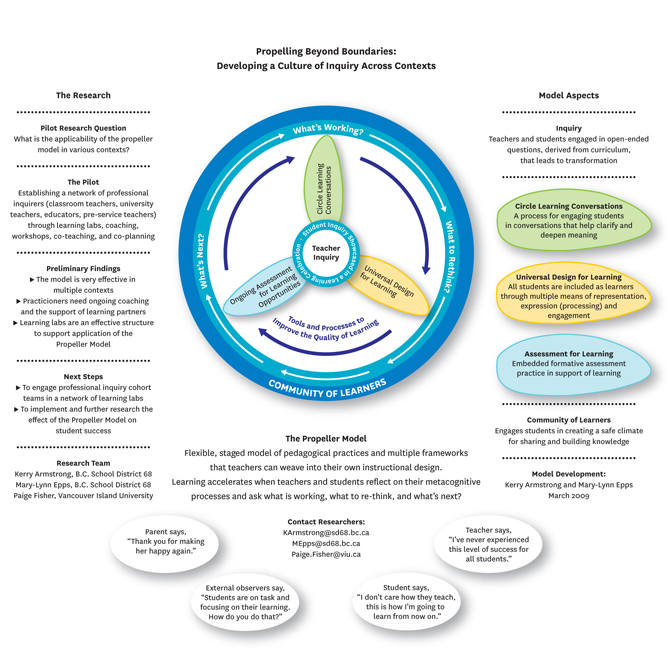
These teachers have developed a small network of inquiring teachers within their school and at other schools in their district, and they are collaborating to develop powerful learning environments for their students and to inquire into their own instructional practices. They have reflected deeply on what has been working in their classrooms and created a metaphor for their practice, which they call the Propeller Model (see diagram). Their work is having a significant impact on their learners as well as on their own understanding of teaching/learning processes. I am hopeful that exposure to this classroom will deepen my students’ understanding of powerful learning environments as they move forward in their teacher education.
I have informed my students that, although it may not be apparent at first glance, some of the students in this classroom have profound and diverse learning needs. When we arrive, we file into a fairly typical classroom. There are posters and criteria sheets covering the walls, desks arranged in small groups, a bank of four computers, and a large meeting table at the back of the room. Mary-Lynn is in the process of organizing the group for the upcoming work period. We are asked to observe while she gives the students their instructions, then we are invited to listen to student and teacher conversations, or to interact with the students.
“Ok everyone,” Mary-Lynn says, “the student teachers are here to observe, and they might want to ask you questions, but this is a working period, so try to stay focused on your responsibilities. We have information circle meetings today, and you need to be prepared with your notes before you come to the meeting. Get together with someone else in your working group and share your notes with each other. That way you can add to your own sheet and you can help make sure your partner is prepared. Remember the inquiry question is ” One well, one wish. Water has the power to change everything. What will you do to transform yourself and others to ensure there is a well for the future?”
“Use the posted criteria to make sure you’re on the right track”, she says, “and I would like you to use the A-P-E strategy to give each other feedback. Could someone please tell the student teachers what this means?”
Megan puts up her hand. “It’s, um, it’s the thing where each of us has a job, like Adviser, Presenter, and Encourager. We have to take turns being each one and give each other feedback using the criteria.”
“Thank you Megan. While each group meets with me, the rest of you will do A-P-E with your working groups. If you finish that, please begin to add more details to your Mind Maps. We should be able to get through at least three group meetings this period.”
One group of students moves to the meeting space at the back of the room while the rest of the students settle in and a productive buzz pervades the room. I can hear students sharing information and giving each other feedback on their work in progress. I follow one of my teacher education students, who is moving to join a working group. “I never did this kind of thing when I was in school,” she says to one of them. “How do you like working together like this?”
“Well, the best thing about working with other people is how they have other ideas and how that makes my ideas bigger and better,” replies a boy in the group. “I feel like I learn a lot from the other kids and it helps me see all the different ways there are to do things.”
One of the other boys in the group is sharing notes that are stored on his laptop. “Wow, you’re allowed to use a computer?” my student asks.
“Yeah, anyone can use the computer if they want to, but I really need it. This graphic organizer I’m using helps me to organize my thinking. The computer helps me put my thinking on paper, and that is a good thing because I can come back to it, then I have something to share with the rest of my group. I have a hard time with reading and writing and I used to fall behind. Mrs. Armstrong showed me how to get the same textbooks as the other kids from files on the computer, and I use read-aloud programs like ‘Wordtalk’ and ‘Kurzweil’. Now I can copy and paste important words and ideas and even the pictures from the textbook into my graphic organizer so that when I go to Information circles, my notes are complete.”
My students and I are shaking our heads in amazement. We are struck by the environment of collaborative productivity and purposeful focus that seems to pervade the room.
Another one of my students ventures over to the group. “Can I ask you a question?” she says to one of the girls. “How does this inquiry question thing work?”
“Oh that,” she says. “It’s kind of like the main idea of what we’re doing. So, when you’re reading fiction or nonfiction, you know the idea is important if it can relate back to the inquiry question.”
“Yeah,” chimes in another girl. “Inquiry in this class helps you know what you are looking for so you don’t write down just random information. We get all this information in our groups and we share it at the information circle meeting. Then we get to come up with our own question and we have a showcase where we invite other kids and our parents and we show all the work we’ve done and what we learned. For our last unit on Healthy Living, I did this cool inquiry about whether computer games were making people more or less healthy. I really believe I was able to change other people’s opinions on health.”
My students and I are shaking our heads in amazement. We are struck by the environment of collaborative productivity and purposeful focus that seems to pervade the room. The students are eager to talk about their work, and to show us the things that are supporting their learning. We are especially impressed by the sense of ownership they express through their responses – not just ownership over their learning processes, but ownership of the learning of their peers as well. I know that Mary-Lynn and Kerry have worked hard to establish a Community of Learners culture in this room, and the evidence of this facilitation is playing out in the interactions my students and I are observing.
At the back of the room the first group gathers around a large table with Mary-Lynn and the information circle meeting begins. Students have been asked to share the information they have gathered so far about water. “Would someone please volunteer to start by sharing the key points you’ve brought to the meeting? As you share, be sure to summarize how the information is meaningful to the overall inquiry. Think about your connections and how they help you to transform your thinking and beliefs about water. The rest of you remember that your job as a listener is to ask questions to help you understand and to jot down ideas that you think will help you to answer the inquiry question.” We hover at the edges of the meeting and listen in. Throughout the meeting, Mary-Lynn facilitates the discussion by providing descriptive feedback, asking probing questions, and inviting responses from each member of the group.
“Great work, everyone” I hear Mary-Lynn say as the meeting concludes. “I’ve been really impressed with what you’re bringing to the circle, and the way you’re adding to all of our learning. Make sure you complete the self-assessment of your group participation before you go back to your desks please. Once you get there, remember your first job is to do a reflective write on what you learned during the meeting. Then you can move on to your Mind Maps.
I quickly follow some of the students back to their desks so that I can ask them about the meeting. “Could you please tell me a little bit about your circle meetings?” I ask. “What are they like for you?”
“It helps me,” says Christopher, “Because when there is a part of the book that you don’t understand you can just ask someone in the group or bring it up and it will make it easier to understand and they’ll like describe it to you so you get a better grasp of the idea.”
“I really like it too,” says Tran. “Information circles help me with my learning and on my tests because every time I go to a meeting I always get a good idea back. Like if other people talk about things that I don’t have on my paper I can write it down, and when I have a test I can use the things I wrote down on my paper to get a full score.”
I shift my attention to a group that is working on their Mind Maps. One of the student teachers is asking what they are and how they work. The group is eager to respond. “They’re kind of like a word web, but we use pictures and symbols to help make sense of ideas, and then we look for connections between them.”
“How do they support your learning?” she asks.
Blake replies, “They help me because you don’t have to go through the tedeism of writing down a huge list of words on paper and then forgetting what half of them mean by the end of the day. They let you write pictures down and to organize your words and your pictures in a convenient way so you can remember them all.”
Other students in the group comment on how they are able to use their Mind Map to help them study for tests. “I can look at a picture or symbol and it helps me make connections to other facts about the inquiry. It’s an easier way to remember ideas without trying to memorize a list of notes.”
“How do you know what to put on them?”
“We look at lots of examples and we set criteria with the teacher. We get lots of chances to share our ideas, and we get lots of feedback when we do peer and self-assessment and from our teacher.”
“This is so cool!” one of my students comments. “What happens if you go to Grade 8 next year and none of your teachers does stuff like this?”
“I don’t care how they teach me next year, this is how I’m going to learn from now on,” one of the girls responds vehemently. “This totally works for me!”
I am astonished at these students’ ability to talk about their own learning processes and I am consistently impressed by their enthusiasm and the ownership they seem to feel. They convey a real sense of pride when we show interest in their learning.
The bell rings for the lunch break, and we all move to a debriefing session. The teachers show us their Propeller Model of Learning, and they relate each component back to the classroom experience we have just had. The student teachers are bursting with questions and full of enthusiasm for the possibilities they have witnessed in this classroom. For the next several weeks we will refer back to this classroom visit as we explore the possibilities inherent in classrooms that embrace formative assessment and inquiry.
The Propeller Model
Kerry Armstrong and Mary-Lynn Epps
The Propeller Model of Learning is built upon the concept of the Community of Learners. At the beginning of each year we take the time to develop a vision with the students that outlines the attributes we would need to ensure the success of everyone in the class. The students can then begin to develop the metacognitive skills to help them take responsibility for their own learning. This classroom culture is necessary for the group to continue evolving in their ability to use the learning processes outlined throughout the entire model.
Propeller Model processes revolve around inquiry questions that guide the momentum of learning throughout each inquiry. We begin by designing an overarching question based on concepts derived from provincial learning outcomes. Our goal is to transform students’ thoughts, actions, and beliefs related to the overall topic. Once students have enough background knowledge, they begin to create their own inquiry questions that align to the larger question by focusing on a specific area that is relevant and meaningful for them.
Surrounding the centre of the model are three frameworks that support learning (see diagram above): Circle Learning, Universal Design for Learning, and Formative Assessment.
The formative assessment used in these classrooms is built around six strategies: learning intentions, criteria, peer and self-assessment, descriptive feedback, questioning, and ownership. Each of these elements is woven as much as possible throughout each learning opportunity.
Circle learning has become a process for teachers to engage students in conversations that help them clarify meaning through the sharing of ideas and questioning. When teachers facilitate and coach those conversations by asking probing questions, students are able to make the connections that enable them to apply their thinking as they seek to answer the inquiry question. The concept is based on Faye Brownlie’s work with Literature Circles, and has expanded to include Information Circles and Numeracy Circles.
The formative assessment used in these classrooms is built around the Six Big Assessment for Learning (AFL) Strategies and B.C. Ministry of Education Performance Standards that are promoted through the Network of Performance Based Schools and the B.C. Ministry of Education. Based on the original work of Black & Wiliam, the strategies are: learning intentions, criteria, peer and self-assessment, descriptive feedback, questioning, and ownership. Each of these elements is woven as much as possible throughout each learning opportunity.
Our approach to Universal Design for Learning (Rose & Meyer) is derived from the implementation of UDL work by CAST (Center for Applied Special Technology) and David Edyburn. The principles of UDL remind us that our students have diverse learning needs, and help make it possible to value and support these differences. We use UDL guidelines to ensure that we have multiple ways to engage learners, to process learning, and to represent learning. Technology is used to support learning whenever possible and all students are respected as learners with potential.
Surrounding the model are three driving questions that teachers and students use to fuel their reflection: What’s working? What do we need to rethink? What’s next? These questions help teachers and students to engage in ongoing reflection that moves learning forward.
The Showcase
Paige Fisher
Several weeks later, the Grade 7 students come to the University to visit us. They bring along their completed inquiry projects so that we can host their learning showcase. All of the teacher education students are invited and they eagerly interact with the Grade 7 students as they talk about their completed inquiries. The celebration of learning that we witness is an example of the showcases that culminate each inquiry project. It is an opportunity for students to share their best examples of work and provides an authentic audience for their perspectives on how the inquiry has transformed their thoughts, actions, and beliefs. My hope is that there has also been a transformation of the thoughts and beliefs my students hold about what is possible in their future classrooms.
EN BREF – « C’est comme ça que j’apprendrai à partir de maintenant… Ça fonctionne vraiment pour moi! » – Le modèle de propulsion de l’apprentissage est fondé sur le concept de la communauté d’apprenants. Au début de l’année scolaire, les enseignants développent avec les élèves une vision des attributs requis pour assurer la réussite de chaque personne de la classe. Les élèves peuvent alors commencer à acquérir les compétences métacognitives qui les aideront à prendre en charge leur propre apprentissage. Cette culture de classe est nécessaire pour que le groupe puisse continuer d’utiliser les processus d’apprentissage énoncés tout au long du modèle – tournant autour de questions guidant l’élan d’apprentissage de chaque sujet. Ils commencent par l’élaboration d’une question globale fondée sur des concepts dérivés des résultats d’apprentissage provinciaux. Le but consiste à transformer la réflexion, les actions et les croyances des élèves à propos du sujet général. Une fois que les élèves ont acquis suffisamment de connaissances de base, chacun peut créer ses propres questions, alignées avec la question globale, en approfondissant un aspect précis qui lui est pertinent et significatif.
-
Technology and Student Engagement
Comments Off on Technology and Student EngagementKids are connected all day – except in school. Therefore, we should get them connected in school as well and this will naturally result in greater engagement and improved learning. Right? Wrong! No doubt, the novelty of using cell phones or iPods in Science class would get rave reviews from many student, but that does not necessarily mean that they would be more deeply engaged or that they would learn more, particularly once the novelty had worn off.
Teachers have long used curiosity as an entry point for learning and stimulating student interest can be an effective strategy, but the attention that results from heightened interest is only a way station on the road to intellectual engagement. Moreover, a constant focus on finding ways to stimulate interest can divert teachers from pedagogy to performance and create the need for escalating entertainment in order to capture students’ attention, which wears teachers out while distracting them from more important and effective work. What is needed is a way of moving from external motivation that has to be constantly refreshed to internal motivation that fuels itself.
The transition from external to internal motivation, and thus the kind of deep engagement that creates understanding which can be applied in novel situations, comes when curiosity is amplified by connection. That is, only when a student finds an inquiry not only interesting but also meaningful does it become truly engaging.
Making studies meaningful requires much more than simply making them interesting. It requires well-conceived curriculum and expert instruction designed for the specific interests and abilities of particular students. It requires enough, but not too much, challenge, carefully calibrated levels of support, choice that affords an appropriate level of control to the student and immediate descriptive feedback that enables and develops self-regulation in learning. In short, it requires skillful teaching.
Skillful teaching can be enriched and leveraged using technology, but it doesn’t work the other way around. Technology cannot compensate for poor curriculum or weak instructional practices. It is the craftsman and not the tool that determines the quality of the work.
However, good tools give a craftsman much greater power. So what is it that technology could give us? It could enhance students’ ability to access, process and share information. It could provide practical support for a “universal design for learning” (see http://www.cast.org or http://www.udlcenter.org). It could help teachers to keep students within their individual “proximal zone” so that they experience an absorbing “flow” that brings out the best in their learning. It could allow teachers to provide choice that differentiates instruction and personalizes learning without requiring individualization. It could provide tools for immediate personalized feedback to students and thus support the “assessment for learning” that research has shown to be so beneficial. It might even finally allow educators to shatter the industrial age batch-processing model of lock-step instruction and enable students to learn at their own pace in their own way.
There is a great deal that technology could do, and doubtless most of it is already being done somewhere, but not by accident. Technology delivers on its promise only when educators harness its potential in service of well-conceived curriculum and effective instruction that is tailored to the needs, interests and abilities of their particular students. Otherwise, it is sound and fury signifying nothing – a lot of ‘heat’ perhaps, but probably not much ‘light.’
-
Deans Speak Out
Comments Off on Deans Speak OutNew Century, New Game
Dennis Sumara
Professor and Dean, Faculty of Education, University of CalgaryRather than starting with assertions about 21st-century teaching, I’ll begin with a question about 21st-century knowing. What is it? I’ll frame my response by looking to popular culture from “then” and “now” – that is, in terms of a cultural shift that I believe is manifest in a contrast between two era-defining genres: the quiz-based game shows of the 20th century and performance-based reality TV of the 21st century.
In the 1980s and 90s shows such as Jeopardy and Who Wants to be a Millionaire? were among the most-watched game shows. In these and others popularized during this time, knowing is represented through the imperative to provide quick-draw responses to prompts that span the breadth of current knowledge. Every question has an unambiguous, preset answer. The judge is the host with answers in hand. By contrast, in more recent shows such as So You Think You Can Dance and Canadian Idol, knowing is represented by inviting contestants to create innovative and demanding performances, often with unfamiliar material that requires an extension of expertise from a related domain. The judges are both industry experts and the public at large.
How are these two types of TV shows evaluated? In the quiz-based shows, feedback comes with clinical precision. Contestants are right, wrong, or not fast enough. In the performance-based shows, feedback arrives in the form of expert critique, highlighting strengths and weaknesses, and always geared toward improved future performances of participants. It is the popular cultural genre of reality TV that, I argue, exemplifies 21st-century knowing – where knowing is associated with deep specialization and the capacity to generalize to other domains out of the depth of that expertise. In these settings, to know is to adapt flexibly, rapidly, and creatively in the face of always-changing circumstances.
The qualities demonstrated through the evolution of quiz-based to performance-based shows begin to paint a picture of 21st-century learning – which is about something different than preparing people to do well on timed achievement tests. Among the qualities of emerging importance, as a culture we seem to be paying much more attention to deep specialization and well-honed skills that are most powerfully developed by starting young, practicing intensively, having expert teaching, and regularly pressing one’s efforts past the edges of current mastery.
It is the popular cultural genre of reality TV that, I argue, exemplifies 21st-century knowing… In these settings, to know is to adapt flexibly, rapidly, and creatively in the face of always-changing circumstances.
If these are what 21st-century knowing and learning are about, then 21st-century teaching would seem about something other than imparting, communicating, or mediating knowledge. Nor is it principally about directing, guiding, or preparing learners – all of which, it bears mention, are well suited to preparing contestants on Jeopardy and Millionaire. Temporally appropriate teaching seems to be more about challenging – that is, challenging knowledge/knowing and challenging learners/learning. More specifically, it appears to be about setting the sorts of challenges that come from deep familiarities with what it is possible to know and the complex processes involved with coming to know.
One further lesson from reality TV can be found in a shift in the status of “contestants”. While it’s true that someone still comes out on top on Idol, etc., the record shows that there are always multiple winners through the exposure and tutelage gained through the experience. That is, it’s probably more appropriate to speak of “co-participants” than “contestants”.
What might these shifts mean for teacher education? At the very least they point to the need for nimble programs that can adapt to emergent circumstances. In the Faculty of Education at the University of Calgary, among the new programmatic changes informed by and responsive to evolutions in knowing and learning, we are implementing a specialization requirement for elementary as well as secondary candidates; we are articulating relationships with schools not in terms of “host” institutions but as full partners in research-informed and active practice; we are framing teacher education not in terms of pre-service preparation but as initial and ongoing components in career-long trajectories of learning.
Most important, University of Calgary teacher education students are considered active co-participants in the project of formal education. While they are not contestants in the same way as those who participate in reality TV, we are challenging them to engage in similar forms of knowing and learning. Why? Because like many others, we’ve noticed that with the new century, we now have a new game – one that demands expert participation within challenging and collaborative ever-changing worlds of knowing.
Human Flourishing in the 21st Century
John R. Wiens
Dean, Faculty of Education, University of ManitobaAn intriguing question: how does the 21st century affect why and how we educate? I would claim that why we educate, in the broadest terms, does not change because of where we are in the history of humankind. On the other hand teaching, or how we educate, is profoundly affected by the ethos and cultures of the times, very dependent upon the human material and intellectual resources available. Teacher education, which has as its aim understanding and promulgating the relationship between education and teaching, must respond to the demands of both simultaneously. Faculties of Education, in thinking about and acting on education and teaching, play an essential role at any and all times in the advancement of human flourishing.
Since ancient times, even in oral histories, education has held a particularly important role in the enhancement of human life. Kieran Egan, a world-renowned educational theorist at Simon Fraser University, paraphrases earlier philosophers, when he states that “education is simply about learning to live better.” He means this the same way as did the Greeks: learning to live a more ethical personal life and, in that way, contributing to a worthwhile world or society because living well also carries the connotation of living well with others. In the 21st century, this is a lot more complex than it was in ancient times. Our world is not the Athenian city-state but the whole world of humanity, a fact that challenges significantly our ethical and political imperatives. To live a meaningful and worthwhile life today means to critique, challenge, and confront the arrangements and relationships that undergird the unconscionable material disparities, the seemingly insurmountable cultural and religious differences, and the provocative technological changes that mark our age, and that seem to account for unprecedented uncertainty and anxiety.
To teach in such times presents a host of challenges which, informed by our imaginations, can be considered opportunities. We have the everyday technological media to allow us to imagine communicating with anyone and everyone else in the world almost instantaneously. We have examples of political leaders, like Mandela, who have demonstrated how to embrace humanity above difference at the same time as celebrating diversity. We have thousands of examples of how small investments have emancipated people from life-threatening poverty, and we have virtually eradicated some life-ending diseases. More importantly we now recognize how inextricably connected all of humanity is, and how fragile the natural world we inhabit has become. We have unprecedented understanding of previously unforeseen circumstances. The “teaching trick” is to enlarge our moral imaginations and political wills, and those of our young, to see how we might flourish in such a situation.
We have unprecedented understanding of previously unforeseen circumstances. The “teaching trick” is to enlarge our moral imaginations and political wills, and those of our young, to see how we might flourish in such a situation.
For teacher education and Faculties of Education, this is an exciting but difficult time. It is exciting because the task has never seemed more critical. It is challenging because predetermined methodology and prescribed process have limited access to questions about the appropriate amount of compassion, reasonable levels of scepticism, or contestable notions of the personal, interpersonal, and public good. Yet we live in a world enthralled by economic ends and technological means for judging the value and consequences of educational acts. Lesson plans, school curricula, and classroom management must be put in a more appropriate relationship to larger human issues like human freedom writ large – freedom from material deprivation, cultural intolerance and other sources of social injustice, and freedom from environmental degradation. Simply put, faculties of education have a civic responsibility to continuously bring large human questions to the fore, and engage in never-ending meaningful, democratic dialogue about the human “good”, and in the process not succumbing to 21st-century notions that undermine who we have become and can become as people.
21st Century Education: Developing Capacious Minds and Generous Hearts
Alice Pitt
Dean, Faculty of Education, York UniversityDiscussions about 21st-century education tend to be headline grabbers. Whether the focus is on learners, the curriculum, school design, economic forces, or global issues, one is left with the impression that, like poor old Rip Van Winkle, we’ve all been in a deep slumber only to have awakened to the utter strangeness of a brave and hostile new world. The glare of the new – a dizzying array of digital media capabilities; global migrations within and between nations towards urban areas and away from rural and village roots; the rise and collapse of whole economies; and the growing realization that our natural environment can’t bear our weight – threatens to blind us to the fact that educators have been tireless advocates of the very kinds of competencies now declared to be the signposts of our future.
John Dewey, for example, did not anticipate the iPad, the search engine, or YouTube, much less the wide range of biographies of the families whose children become classmates. Yet we think with Dewey when we argue for creating conditions to address learners just as and who they are; when we identify critical and media literacies as necessary companions to our encounters with culture, knowledge, and “information”; and when we construct project-based and discipline-rich curricula as the supports for the development of curiosity, imagination, generic problem-solving skills, and the will and ability to think alone and with others. In some ways, 21st-century teaching means pressing even harder against the strong tides of tradition that painstakingly built the schools where our future teachers formed their own understanding of what school is like.
The dilemma for pre-service programs is to prepare future teachers for schools as they currently exist while also enlarging their vision about what schools and public education might, should, or will become.
The dilemma for pre-service programs is to prepare future teachers for schools as they currently exist while also enlarging their vision about what schools and public education might, should, or will become. We currently imagine pre-service education as providing beginners with the skills and knowledge to be successful in their first few years of teaching. We know, from research and experience, that such immediate success is elusive. Classrooms are complex sites of practice. However, the old problems and the new (old) urgencies collide when we fix our gaze on immediate success.
Twenty-first-century competencies suggest that children and youth must be able to relate their schoolwork to their everyday lives as they formulate possible futures. If our youth must claim a stake in their self-understanding as learners and develop the capacity and courage to generate solutions to current as well as future dilemmas (social, cultural, environmental, ethical, technical), then their teachers must be eager, equipped, and empowered to engage on all of these levels.
Pre-service education must create more diversity in the opportunities for future teachers to grapple with exigency as a condition of life and a force that reaches into civic belonging, emerging economic landscapes, knowledge creation, and community development. Such opportunities invite new ways of organizing time and space, of relating knowledge and knowing, and of combining newcomers of all kinds with those already here. Comprehensive lists of skills and competencies will be developed as sets that overlap, compete, and interact with each other. Bearing attractive assumptions of efficiency, sufficiency, and urgency, such lists can too easily swamp the more delicate and difficult work of developing capacious minds and generous hearts. Twenty-first-century education for the public good needs teacher education that prepares teachers for the complexity of their work in a complex world.
Developing New Competencies, New Skills, and an Essential Curriculum
David Dibbon
Dean, Faculty of Education, Memorial University of NewfoundlandThere is little doubt that the nature of schooling has undergone a rapid transformation in the past few decades. Once expected to prepare a small minority of students for intellectual work, today’s schools must prepare virtually all students for higher order thinking and performance skills and find ways to support diverse learners’ needs and ensure success for all. Toward this end, education systems around the world have engaged in major curriculum and structural reform, and established stronger mechanisms for measuring and reporting educational outcomes and accountability of progress. Reflecting broader changes in society at large, schools are required to involve parents and community in their decision-making processes and make provision for gender equality, cultural sensitivity, and the integration of students with special needs. Technology has revolutionized or replaced many traditional methods of instruction, and a significant body of new research has emerged around the brain, human development, and how people learn.
As a consequence of these and other changes to the school ecology, teachers’ work has intensified and the demands upon the profession have increased dramatically. For schools to carry out their mission, all educators must possess the necessary knowledge, skills, attitudes, and dispositions to deal with the complexities of the contemporary classroom. Beyond a basic knowledge of pedagogy and curriculum, they are called upon to demonstrate many additional new competencies, such as teaching a diverse population of students, teaching literacy across the curriculum, using data effectively, engaging in action research, collaborating in school teams, and integrating technology effectively.
Our research shows that school practitioners expect new teacher graduates to possess and skilfully practice these skills and abilities at the very onset of their teaching experience.[1] There is little doubt that initial teacher education is expected to accomplish a great deal in a limited period of time, and this creates serious implications both for what gets included in and what gets omitted from the curriculum, and for how it gets presented.
In recent years an argument has emerged for the development of an “essential teacher education curriculum”,[2] focusing on developmentally appropriate practices, learning theories, language development, social context of education, subject matter expertise and pedagogical content knowledge, student diversity, appropriate assessment practices, and classroom management. We found evidence in our research to support this notion.
By all accounts, teacher education candidates view the practica as the most relevant, exciting, and useful learning they encounter in their teacher education program. In Canada, the practicum experience is a major source of the variation among teacher education programs; they vary in total length of time, the number and duration of placements, the timing of the placements, how and by whom they are supervised, and how they are evaluated. I agree with those who argue that this opportunity for deliberate practices is a key element in acquiring instructional expertise, and there is merit to increasing the length of time allocated to the practica.[3] However, increasing the practica will only be effective if there are well-defined standards of practice and performance for use in guiding and evaluating clinical work, if there is close supervision and monitoring of the practicum, and if the clinical experience is closely interwoven with coursework.
Where this occurs, students are better prepared to make sense of the ideas, theories, and concepts addressed in their academic work, and as student teachers they are better able to see the interface between theory and practice. This approach reduces the practice-theory gap that has haunted teacher education programs for years.
EN BREF – Les éducateurs et les responsables de politiques préconisent de plus en plus l’acquisition de compétences du 21e siècle, car plusieurs facteurs militent en ce sens : la recherche sur l’apprentissage, l’omniprésence des technologies de l’information et des communications et la mondialisation dans toutes ses formes. Que signifie enseigner au 21e siècle pour les personnes qui préparent les jeunes à faire carrière en enseignement? Comment la profession d’enseignant change-t-elle? Comment les facultés d’éducation devraient-elles adapter leurs programmes préparatoires à l’emploi? Nous avons demandé à quatre doyens en éducation du pays de commenter les changements actuels et à venir, ainsi que le rôle qu’ils attribuent à la formation des enseignants en fonction des exigences du nouveau siècle.
[1]R. Crocker and D. Dibbon, Teacher Education in Canada: A Baseline Study (Kelowna, BC: Society for the Advancement of Excellence in Education, 2008).
[2]J. Bransford, S. Derry, D. Berliner, K. Hammerness, and K. L. Beckett, “Theories of Learning and their Roles in Teaching in Preparing Teachers for a Changing World, eds. L. Darling-Hammond and J. Bransford (San Francisco: Jossey-Bass, 2005).
[3]L. Darling-Hammond, K. Hammerness, and J. Bransford, (with D. Berliner, M. Cochran-Smith, M. McDonald, and K. Zeicher, ), “How Teachers Learn and Develop” in Teaching in Preparing Teachers for a Changing World, eds. L. Darling-Hammond and J. Bransford (San Francisco: Jossey-Bass, 2005).
-
False Accusations: A Growing Fear in the Classroom
Comments Off on False Accusations: A Growing Fear in the Classroom“Where are the male teachers?” Male role models are becoming increasingly scarce in Canadian classrooms, and the demographics indicate that the current low numbers will continue to decline. While general statistics are open to flux and are often several years behind reality, it is clear that male teachers in elementary and middle schools will soon be a thing of the past. Secondary schools fair a tad better, but males are an increasing minority within the teaching ranks at all levels. Generally speaking, the male-to-female ratio in elementary schools is 20-to-80; in secondary schools, 35-to-65. Whatever data one teases out, there is no question: our classrooms are increasingly dominated by female teachers.
Recent Narrative
Henri Fournier, a teacher with the Commission scolaire Grandes-Seigneurs in Quebec who has an impeccable 30-year employment history, has had his life turned upside down by a set of circumstances straight out of a B-grade movie. Several students (all girls between 8 and 12) accused Mr. Fournier of inappropriate touching. Acting with dispatch so as to protect the children, Mr. Fournier’s school board placed him on unpaid leave. He was investigated by the local police, charged by the Crown Prosecutor, and sent to trial.
As part of this shrinking minority myself, I watch with concern the declining numbers of males who select elementary education as a career path.
Almost two years would elapse between the laying of the charges (ready for this – 34 separate charges!) and the commencement of the court trial. During this time, one can imagine the chatter on the Internet and the emails that winged back and forth. The climate in the school was tense and – notwithstanding overt attempts at privacy – everyone knew the identity of the girls and what Mr. Fournier was alleged to have done. Throughout this ordeal, while proclaiming his innocence, Mr. Fournier was supported by his union; but at the same time he was the object of all manner of scurrilous innuendo and talk within his community.
There are those who may look at this situation and be pleased with the swiftness of the action. A predator had been caught, and the lives of so many girls saved from eternal harm. Even though a couple of the girls recanted their stories prior to formal court proceedings, and the justice system was grinding slowly, Mr. Fournier was going to get his just rewards.
One small difficulty: Madame Justice Odette Perron threw out every charge! Further, in a somewhat scathing rebuttal, she noted that all of the accusations were without foundation, many of the so-called statements were contradictory, and she could find no fault at all with Mr. Fournier.
Then, in what can only be described as educational decision-making run amuck, Mr. Fournier was reinstated by his school board (no back pay, by the way) and assigned as a teacher to the same school where many of the accusing girls were still students.
Whatever the formal ruling, Mr. Fournier is branded. No charges were ever laid against the minors who made false police reports, no disciplinary action was meted out to overzealous officers or educational administrators, and the insult of reassigning Mr. Fournier to an environment where his former accusers have free and unfettered reign to continue the gossip borders on harassment. In a final irony, a labour arbitrator recently ruled that Mr. Fournier is entitled to no back salary or benefits, and there will be no compensation for his additional legal expenses.
Status of Male Teachers
Such stories concern my students. As a teacher of teachers, I have a special interest in the status of male elementary teachers. As part of this shrinking minority myself, I watch with concern the declining numbers of males who select elementary education as a career path, and I view with sadness the kind of impact cases such as Mr. Fournier’s have on my education students.
At McGill’s Faculty of Education, the percentage of males opting for elementary teacher training rests, now, around five percent. This number has been slowly declining – from about 20 percent over my tenure with the Faculty. Within the broad Anglophone school network, many elementary schools are now places of a single gender. Many factors contribute to falling numbers of male teachers (lack of merit pay, stifling administrative regulations, double standards, and the like), but the sad reality is that the committed male classroom practitioner is slowly becoming a thing of the past. From the principal to the custodian, it is often the case that all in-school staff are female. To highlight this issue, it is not at all unusual for school administrators to call our Student Teaching Office and plead for a male student teacher.
There is no question that classroom teaching today is extremely challenging. Internal educational pressures are mounting as more and more special needs students are integrated into regular classrooms, and instructional materials are found wanting as increasing numbers of immigrant students bring diverse cultural histories into play within the close confines of the classroom environment. It is also fraught with danger. On a regular basis, as aptly documented in a CTV/W5 report “Unsafe to Teach” released in 2005, teachers are being verbally and physically assaulted, and increasingly subjected to false accusations of inappropriate behaviour. More and more teachers are leaving the classroom for other careers.
My students – both male and female – are quite prepared to take up the pedagogical issues raised by changing standards and a changing demographic; however, the spectre of violence and false accusations adds a level of danger that is truly frightening – the former to female student teachers, the latter primarily to males.
False Accusations
As there is no central database documenting false accusations, and as many cases are reported only at a local level without receiving any kind of national attention, attempts to accurately appraise the number, degree, and kind of false (and real) accusations of inappropriate behaviour against male teachers has been a daunting task. Internet organisations, such as “menteach.org”, have tried to report such cases, and random searches of various news databases do tease out interesting human interest cases. However, formal attempts to quantify the issue have been frustrated by a lack of information.
However, thanks to a ground-breaking study by researchers from the Northern Canadian Centre for Education & the Arts (NORCCREA) at Nipissing University entitled “A Report on the Professional Journey of Male Primary-Junior teachers in Ontario (Gosse, Parr, & Kristolaitis, 2010), we have an initial benchmark figure. Approximately 13 percent of the male teachers in their study – one in seven – reported that they had been falsely suspected of inappropriate contact with pupils. This is a significant number and, for the first time, quantifies the reality faced by male teachers.*
Despite the lack of national data, it is clear that classroom teachers across Canada are being falsely accused in growing numbers. Local teacher unions and other educational authorities are struggling to identify such incidents and, at the same time, appear ill-equipped to develop realistic procedures and plans that safeguard due process and the reputations of those falsely accused. Since we are not tracking the increasing level of violence (both verbal and physical) against teachers, it is likely that these incidents are under-reported, and we tend to ignore the extremely high dropout rate of teachers who leave the career path after less than a decade of experience. We don’t know how many leave because they have been falsely accused, or because they see others losing their reputations and careers because of lies, rumours, and innuendo.
There is no question that the children must be protected; any adult who does indeed act in an inappropriate way must be drummed out of the school system. But here comes the conundrum: how are the rights of innocent teachers protected?
Although schools, school boards, unions, and other educational stakeholders are scrambling to develop and implement policies, this is a complex issue on many levels. There is a general assumption that any student accusation simply must be true (kids don’t lie), and this is especially true if the accusation is made by a female student against a male teacher. The rights of children (often couched in the phrase “we must protect the students”) appear to take precedence over the rights of teachers. There is no question that the children must be protected; any adult who does indeed act in an inappropriate way must be drummed out of the school system. But here comes the conundrum: how are the rights of innocent teachers protected? And what action is taken against students and their parents who are shown to lie? In far too many cases, there is no “right to privacy” or “right to innocence before judgment”; rather, there appears to be a rush to judgment with little regard for the impact on the falsely accused individual or the collateral impact upon the school and other professionals within that environment.
False accusations are being made against both male and female teachers. These reports often take one of two broad avenues. In the first, and less severe, the teacher is accused by one or more students of being “unfair” or “picking on” a student. These accusations are usually wrapped around words such as “harassment” or “culture”. The second set of false accusations levelled against teachers is far more serious and might be broadly termed “sexual”. In these cases, students accuse a teacher of various forms of touching and/or other inappropriate communication.
Now, let’s be very clear on two fronts; some students lie, and some teachers act inappropriately. With millions of pupils in schools and tens of thousands of teachers in classrooms, inappropriate and questionable speech and actions are bound to occur. In many cases, such actions can be easily explained by the close quarters and natural connectedness between teacher and pupil. On the other hand, teachers do cross the line. Similarly, not every story out of the mouths of adolescents rings true. Incidents can be stretched and expanded and, in a growing number of cases, simply made up.
To help my male students prepare for an environment in which the usual student-teacher interactions can be misconstrued – intentionally or unintentionally – I have developed a list I call the “Six Nevers”. They illustrate how the threat of false accusations can interfere with the development of a warm, caring relationship between students and teachers, and why males considering teaching as a profession might have second thoughts.
- Never touch a student!
- Never be alone with a student, and never in a closed classroom!
- Never use language/tone that can be interpreted as anything but professional.
- Never use Facebook/Internet to chat or communicate with students!
- Never maintain an outside school association with a student/family.
- Never allow your guard to falter!
Another Narrative
A senior administrator characterized Ron Mayfield as an energetic and experienced teacher who related well to his students; his death was tragic. Mr. Mayfield was accused by one of his students of a physical assault. In line with school policy, he was immediately suspended (with pay) and police and youth services were notified.
While various investigations were carried out by many agencies, Mr. Mayfield was left on the sidelines. He was not kept abreast of actions and was left open to the rumour mill that swirled about in the school and the community. Unlike many such investigations, this one moved quickly and, within two weeks, it was clear that there was no substance to the charges. Further, the 13-year-old student had recanted his accusation.
Unfortunately, no one in any of the agencies thought to inform Mr. Mayfield. Sadly, he committed suicide. While it may never be proven, his family (and many colleagues) share the view that Mr. Mayfield sought this drastic release because he could not bear the stain of a false accusation and the thought that his whole career was on the line.
Accountability
What is the punishment for students who lie about teachers? In today’s Canada, little is done in a systematic manner to hold youth accountable for their false narratives. In case after case, parents leap to the defence of apparently “abused” children and, when the dust has settled, offer no compensation to the aggrieved teacher. This skewed arrangement puts more emphasis on unsupported adolescent narratives than on verifiable facts.
In some isolated cases, individual teachers are fighting back. Teachers, both male and female, are personally resorting to the courts to seek redress from parents and school officials. In a small number of U.S. cases, the teachers have prevailed and been awarded significant amounts. Closer to home, falsely accused Quebec teacher David Fletcher, in a precedent setting case, was awarded damages in the $70,000 range. Nonetheless, far too many falsely accused teachers are on their own as they attempt to deal with legal and educational systems that do not have procedures in place to deal swiftly and fairly with student accusations.
The history of school-based abuse is a clouded one. The mainstream press is filled with recollections of religious transgressions and sexual abuses committed by teachers in First Nation and elite private schools. There is no question that children were abused in the past, and many reports of abuse were ignored (as evidenced by the Residential School situations). Yes, the reports of these abused children were discounted, and those in authority sometimes acted criminally. However, the common contemporary assumption – that any and all accusations against teachers (specifically male teachers) are true – flies in the face of data.
Many of the accusations made against teachers are false. They are stories – lies made up by students who find support in parents and friends who are far too quick to point fingers. Careers are ruined and families lost, and those who make such false accusations often face no consequences. Along with those who support them, these students are being allowed to undermine a pillar of the Canadian justice system: guilt must be proven in a court of law, and innocence is something that cannot be given back when falsely wrenched away.
EN BREF – Les modèles masculins deviennent de plus en plus rares dans les classes canadiennes et les facteurs démographiques indiquent que leur faible nombre continuera de diminuer. Le nouveau personnel enseignant est bien préparé aux questions pédagogiques soulevées par les nouvelles normes et par une nouvelle composition démographique des classes, mais le spectre de la violence et des fausses accusations ajoute des dangers qui font vraiment peur – aux étudiantes-maîtres dans le premier cas et aux étudiants-maîtres dans le deuxième. Un enseignant masculin sur sept est faussement soupçonné de contact inapproprié avec des élèves et les systèmes scolaires canadiens ne disposent pas de procédures pour réagir rapidement et pour protéger la réputation des innocents faussement accusés. Bien que la sécurité des élèves soit primordiale, les droits du personnel enseignant doivent également être protégés.
* Please note that on April 29, 2011 a correction was made online to this paragraph, clarifying the results of the research cited.
-
Penny Milton, Cailey Crawford, and Ron Canuel on What did you do in school today?
Comments Off on Penny Milton, Cailey Crawford, and Ron Canuel on What did you do in school today?Penny Milton, Cailey Crawford, and Ron Canuel talk about the What did you do in school today? project.
-
An innovative pilot project in Alberta asks …“Do credit hours equal learning?”
Comments Off on An innovative pilot project in Alberta asks …“Do credit hours equal learning?”Since reading Westley, Zimmerman and Quinn-Patton’s Getting to Maybe: How the World is Changed (2006), I’ve found myself looking at educational change in a lot of new ways. The authors ask a lot of compelling questions, but one in particular really stuck with me: “What is holding the system in its status quo?”
All organizations have a tendency to hold on to some things even if after they’ve stopped serving their original purpose. Could the way we organize time in schools be one of the things we’re holding onto in education? Might the relationships between time and teaching and learning be holding the status quo in place in school systems despite years of educational change efforts?
Since the early days of public schooling the school day has been driven by time. Many years ago we might have been able to argue that schools were organized in ways that fit with conventional knowledge about how young people learn. Our knowledge about learning has grown immensely since the turn of the twentieth century and yet the school day, especially in high schools, looks very much the same as it did 100 years ago.
In November I had the pleasure of working with staff from 16 high schools participating in Alberta’s High School Flexibility Enhancement Pilot. This innovative project was designed to address tensions between contemporary beliefs about learning expressed in Alberta’s curriculum and the practice of funding all credits on the basis of the Carnegie Unit of 25 hours of face-to-face instructional time per credit. Carnegie Units took hold across North America as a system for accrediting and funding high school credits in the early 1900s. By releasing 16 high schools from policy requirements built around this unit, Alberta Education will discover, among other things, if they continue to hold educational value in the 21st century.
Through the pilot project, a diverse group of high schools (large and small, urban and rural, French and English-language) are exploring the relationship between hours of face-to-face instruction and student success (e.g. achievement, engagement, school completion) and the merits of various innovative high school designs for teaching and learning. Over the course of the three-year pilots (2011-2013) students, parents and staff at each school will work together closely to develop an approach to school organization that does not necessarily equate time with credit.
The project’s leader – Gerry Fijal – and participating schools are currently finalizing an evaluation plan for the project that will include What did you do in school today? measures of social, institutional and intellectual engagement. Outcomes of the project will likely be available in 2013, but regular updates will be posted on the project website where you can also find a copy of the literature review written to stimulate thinking about innovative practices for high school redesign including,
- Increasing learning opportunities for students;
- Enhancing engagement of students in their learning;
- Addressing diverse learning needs of students;
- Enhancing relationships in the school community; and,
- Enhancing teacher collaboration.
What do you think might be holding up the status quo in our school systems? Are you exploring innovative ideas to disrupt policies or practices that might not be working anymore in your district or region? If you are, share your ideas here and look back here in a few weeks to see others that I’m learning about through What did you do in school today?
-
Is the iPad the Answer?
Comments Off on Is the iPad the Answer?Federal “Race to the Top” funding in the US is supporting new iPad initiatives from New York to California in the latest rendition of one-to-one laptop programs. Will this cheaper, smaller, simpler device finally bring computer technology into the educational mainstream? The advocates predict big things, but the New York Times quotes Larry Cuban as saying that “There is very little evidence that kids learn more, faster or better by using these machines.”
If the idea is that technology will engage and motivate students, this will be a costly flash in the pan that fades and fails as the novelty wears off. However, the iPad (and the parade of rivals that will soon be introduced at the Consumer Electronics Show in Las Vegas this week) clearly represents an new threshold and not just a smaller laptop like the netbook so perhaps this really is the time that technology finally takes hold and goes to scale in education. What will it take (other than money) for that to happen?
Whatever the technology horse, the educational cart remains the same. What it is carrying (the content) and the destination (the intended outcomes) may change but the task of engaging students and supporting learning remains the same. Research done by CEA (see the What Did You Do In School Today report on this web site) indicates that student engagement is generally low and that it drops off after elementary school with only a minor recovery in the last year of schooling.
Unless students are intellectually engaged, which is a purely voluntary matter over which they have complete control, their learning will at most be superficial. Once engaged, they will learn but they will learn in different ways and at different rates, and they will be developmentally ready to learn various things at different times.
A teacher’s most fundamental task is to meet the challenges of engagement for a diverse group of students within the batch-processing model of education that arose as a factory analog within the Industrial Age, and thus to enable and energize students’ learning. Computer technology, and the iPad in particular, have great potential for meeting these challenges, but only if used within curricular conceptions, and to support instructional approaches, that directly and intentionally address the challenge of engagement within diversity. Technological titillation alone will not do the job.
IPad projects, and the laptop initiatives that preceded them, face other challenges of course – for example, teacher training, technological infrastructure and sustainable funding to keep technology functioning and up to date – but how to engage students in ways that respond to and support their diverse interests, styles and abilities remains the fundamental issue. This is the question that the iPad must answer if it is to deliver its enormous promise.
-
Students Speak About the Benefits of Student Voice and Involvement
Comments Off on Students Speak About the Benefits of Student Voice and InvolvementStudents at Sir Robert Borden Junior High School speak about participating in What did you do in school today?
-
We’re Changing Our School
Comments Off on We’re Changing Our SchoolA few months ago Max Cooke and I had a chance to discuss student voice in the education sector. It is an idea that’s swept across the country, but maybe without us fully noticing its potential as a “game changer” in our school systems. We shared our thoughts in the latest edition of Education Canada and I was excited to see Carmen Meyett’s comments about our article and the work the student council at Quinte Secondary School is doing to become leaders in listening to and responding to what is important to their peers.
In her comments Carmen asks an important question: How are you making sure the student voice is heard? I’d like to take Carmen’s question a few steps further: What are you going to do with students’ ideas and opinions once you’ve heard them? Are we sure we’re not missing a critical part of the puzzle of change if we consult with students and leave all of the decision-making to educators?
CEA recently had a chance to bring these questions to students and educators at the York Region District School Board’s annual Quest for Student Achievement Conference. In our presentation – Students: Agents of Change – we talked about the differences between student voice and student involvement and with help from nine students at Sir Robert Borden Junior High School in Dartmouth, Nova Scotia we got to the important question: What difference does it make when students and teachers both have meaningful roles in decision making?
This short video – created from an hour-long focus group with the school’s student leadership team – illustrates how thoughtful leadership from staff and students at a school can have an impact on school culture and learning environments. This is a video that needs little introduction because the students say it all and as you’ll see at the end leave us to think about our role in creating meaningful opportunities not just for voice, but involvement and leadership.
Students Speak About the Benefits of Student Voice and Involvement from Jodene Dunleavy on Vimeo.


IDEAS TO SUPPORT EDUCATORS : Subscribe to the EdCan e-Newsletter
Quality research, reports, and professional learning opportunities.