Archive
-
Liberated Spaces: Purposeful School Design Says Goodbye to Cells and Bells
Comments Off on Liberated Spaces: Purposeful School Design Says Goodbye to Cells and BellsAfter a 30-year career as a design consultant, Ron Christie joined Regina Public Schools in 2004 as the manager of planning and maintenance. His first impressions of the system’s schools took him back in time.
“As soon as you walk in the door you think my god, nothing has changed since I went to elementary school and that was a long time ago,” says Mr. Christie, now general manager of educational facilities for the district.
Since his first impressions, Regina and other school districts in Canada have joined a growing international movement on school design for 21st century learners. “If you want to have students come to school and feel pleased about being there, then don’t put them in a junky old school from the 1950s that really hasn’t had any significant upgrade in 50 or 60 years,” says Mr. Christie.
In Regina, the impetus to change came with plans to merge or close schools in some neighbourhoods and build new ones elsewhere. “It [the discussion] was interwoven in a very positive way from the beginning in terms of looking at the learning agenda and the management of facilities,” says Regina Director of Education Julie MacRae, of the strategy adopted by her predecessors before her appointment last year.
This September, the board opened Douglas Park Elementary, a 50,000-square foot building that replaces an existing facility on the same suburban site and epitomizes current thinking about architecture’s role in learning.
Gone is the traditional layout of long corridors with classrooms on either side – the so-called “cells and bells” model of the traditional school, replaced with flexible spaces for individual and group learning activities and plenty of natural light. A “school within a school” format divides 400 students into learning communities (K-2, grades 3-5 and 6-8), each with separate entrances to the playground and all connected to the building’s central learning commons.
The open layout is a far cry from the unstructured space of “open-concept” schools in the 1960s. Douglas Park has 33 distinct learning spaces, including 11 classrooms known as “learning studios” with flexible seating and mobile carts for books and specialty rooms for special-needs children (connected to the classroom). With the school positioned on an east-west axis, sun pours through a large-windowed south wall to the central atrium. One of the most intriguing spaces is a 133-square-metre “DaVinci Studio” for science labs, fine arts, or interdisciplinary projects. The $19.5-million project came in on budget and met Saskatchewan ministry guidelines for a Leadership in Energy and Environmental Design silver rating for sustainable construction.
No wonder, according to the Regina Leader- Post, that school board chairwoman Katherine Gagne told the opening-day audience “this is a place of innovation, creativity, expression and learning.”
The reimagined school design fits today’s economy, says Randall Fielding, chairman of Fielding Nair International, the educational facility planner and design architect for Douglas Park. (Regina-based Number TEN Architectural Group was the executive architect on the project.)
“In addition to the reality of collaboration, there is the reality today of what modern, successful companies are like,” he says. “If we look at Apple and Google, their offices are not just a series of enclosed rooms with doors anymore.”
He cites two recent peer-reviewed studies that report increased learning retention with inquiry-based teaching methods – the kind of pedagogy supported by progressive school design.
While fluid spaces at Douglas Park encourage cross-disciplinary activities, Mr. Fielding says young learners also need time to work alone.
“Good creative work is done by an individual often stimulated by interaction with others and they often work together in a team to create things,” he says. “But you really need to support individual learning as much as collaborative learning.”
That view is shared by Ontario-based architect Paul Sapounzi, a partner in +VG Architects, whose schools designs feature flexible classroom spaces, natural light and fewer corridors.
“We are starting to implement elements in our school so that the building itself becomes a tool for learning,” says Mr. Sapounzi. At some schools, his firm has made the mechanical systems visible so students see what accounts for 30 percent of a building’s costs. Like Mr. Fielding, he encourages schools to imagine space for different uses: the “work-horse” classroom, tutorial spaces for group learning and quiet places for students to work alone.
“Doing the stuff in between [formal classroom activities] is where some of the most important learning takes place,” says Mr. Sapounzi. “That means we need to create spaces in the lobby, atrium, the library and even in the classroom at times where students go off on their own.”
Of half a dozen obstacles to modern school design, Mr. Fielding ranks teacher professional development at the top of his list. Without it, he warns, school will not reap the full benefits from learning-friendly architecture.
EN BREF – Les conseils et commissions scolaires du Canada font partie d’un mouvement international grandissant mettant l’emphase sur la conception d’écoles qui comblent mieux les différents besoins et styles d’apprentissage des élèves au 21e siècle. Des espaces diversifiés et adaptés aux activités individuelles et collectives, des « écoles dans des écoles », le soutien de la collaboration interdisciplinaire des élèves et du personnel enseignant et l’utilisation généreuse de la lumière naturelle comptent parmi les caractéristiques distinguant la nouvelle approche de construction d’écoles. Le perfectionnement professionnel des enseignants sera nécessaire pour profiter à fond de ce type d’architecture propice à l’apprentissage.
-
The Skateboard Factory: Curriculum By Design
Comments Off on The Skateboard Factory: Curriculum By DesignSince its opening three years ago, Oasis Skateboard Factory (OSF), founded by teacher Craig Morrison, has attracted considerable media exposure and received a Ken Spencer Award from the Canadian Education Association (CEA) for its innovative program. OSF is one of three programs offered by Oasis Alternative Secondary School, one of 22 alternative secondary schools of the Toronto District School Board (TDSB). Students design, build and market skateboards, along with paraphernalia for the skateboard culture, and earn academic credit. Students may enrol for as many as three semesters.
Students who fared poorly in their previous schools re-engage through their OSF experience. Nearly all OSF students graduate from high school. What goes on at the Skateboard Factory that makes this happen? Here is what Mr. Morrison told Education Canada:
What gave you the idea to start the Oasis Skateboard Factory?
When I was curriculum leader at Oasis Alternative Secondary School, I was the onsite principal’s representative. So I had a great experience at how to run a whole school. At the same time, I was also the arts teacher and I ran a street-art program.
I started a skateboard design class with the help of Roarockit Skateboard Company and its co-owner, Ted Hunter, who had adapted a method of pressing skateboards. He’s a professor at the Ontario College of Art and Design (OCAD). Prior to that, the whole skateboard industry was constantly telling kids: you can’t make your own skateboards or that a real skateboard had to be bought from a company in California. And the irony of that is all the wood is Canadian – hard- rock maple – which gets shipped to China, then sent to a skateboard company in California, to put their logo on it and ship it back to us.
People had been doing skateboard building in shop classes. I was interested in this as a vehicle for graphics originally, the really funky street-art graphics that we were doing, until I realized that it could be a vehicle for so much more. Early on in that program, I started a blog. I’d take a picture of a kid who’d finished a board, just simply that. If there’s anything that has made this explode, it’s people’s responses to a picture of a kid holding that skateboard. The look on their faces … that really helped me convince people why they should support this. So we have a kid who never comes to school, never gets credits, and all of a sudden they’re engaged in their education. I had good attendance in that class and good achievement.
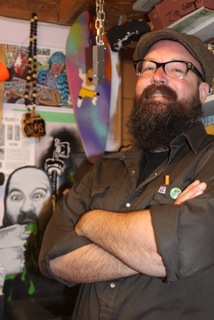
Caption: Oasis Skateboard Factory teacher Craig Morrison
Credit: Photo courtesy of Jennifer LewingtonI ran the skateboard art class for three years. The kids were selling their boards. I thought if I had a whole school, I could teach the whole curriculum through this, through the experience of running it as an entrepreneurial business. So three years ago I pitched to my school and then to the principal the idea that I would step down from my position to do a satellite program, because my skateboard class was super-successful.
I have to say, that was a huge leap of faith, although I did have resources. I had a gallery I had done shows with before; my skateboard class did an art show in a coffee shop; and I had the Roarockit Skateboard Company and all the people I knew in the arts community. It also arose from my frustration of wanting things to happen.
You see these students, who are superstars, just no one has given them the spotlight or the focus, or no one has put the wedge in the door before it slams shut. I wanted to do this thing with these kids. Right now we have a 100 per cent success rate; for the previous two years, I had like 97 percent last year, it was in the 90s in the first year of the program. That’s a huge success rate for any kind of alternative school, let alone school.
What happens at the Oasis Skateboard Factory?
Students go to school 10:30am to 3:30pm. It’s a workshop for five hours a day in order to get the four credits…So we’re probably one of the latest-starting schools. You know, many kids are always late in the morning. Let’s get them in and engage them and then keep them the whole day. So I don’t really do breaks and they’re with me all day. And it means they’re really productive, like kids don’t go out and smoke pot and come back late. I have hardly any classroom management issues. We have breakfast and lunch here. We eat together. We don’t have a lunch hour but we eat while we’ll have a business meeting. Or if it’s a workshop day like today, they’ll just eat at their own pace when they need to. They know their projects. They get assessed and given feedback every day; being on task, being on time, being respectful (laughs), being a good advocate for our program – the leadership part of this, the outreach part.
How is the course structured?
It’s a semester school; students receive four credits per semester. I’ve got students here now who have been here for three semesters – it’s usually a semester then students do a leadership program with me and our community partners.
What is your teaching background?
I went to teachers college at Queen’s University in the artists-in-community-education program. I’d done a lot of activism with youth and I’m an artist and designer. So I did the community-artists-in- education program in which you got to design your own practicums. I made sure I did one of them at an alternative school in Toronto. There I started an arts and social change program, and this is back in the old days in alternative schools where they were called catalyst teachers and it was just people in the community who were experts in their field, so me being really tapped into street art, I’d teach a bunch of classes to kids who were interested. My first job was at Lakeshore Collegiate in Etobicoke. Then I took my daughter to Alpha (opened in 1972, the first alternative elementary school in the TDSB), one of the freest alternative schools and I walked upstairs to Oasis and I said, hey, I’m a teacher and I love alternative schools. I started the next day!
How do OSF students earn credits?
I’m probably running 20 different courses. And that’s just something alternative schools teachers do. You have classes that are Grade 9, 10, 11 and it’s up to me to differentiate that. We have four groupings of courses: English and leadership; business and entrepreneurship; art; design.
I do an English grouping: English Grade 10 and 11, English Media then leadership. A lot of what we do is writing, for promotion, non-fiction, a focus on business writing. They’re writing about their products – how do you write technical specs, advertising, that kind of stuff.
We do a skateboard “zine” [a small-circulation self-published magazine], which is a hugely popular form of alternative media, so they can promote what they’re interested in. Our theme is always around street art or skateboard culture. We do interviews with bands and skateboard makers in our local community. We distribute the zines and sell them at art shows.
Every semester we write for Concrete Wave Magazine, which is the professional skateboard magazine. This year we get four glossy pages. You know, it’s funny how kids who don’t want to write or would never check their spelling or grammar do awesome work when they know it’s going to be read…The last one we did was really interesting: the emotions of skateboarding, the stoke you feel when you’re skateboarding.
The next step is a leadership course and we do a lot of outreach in that. Our students become teachers. Last semester we did a workshop series at an elementary school, a workshop series at a Montessori school and another through a youth arts program at the Art Gallery of Ontario (AGO).
Business credits include a grouping of courses like Business 9 and 10, Grade 11 Entrepreneurship and Grade 11 Marketing. That grouping of courses we run in partnership with The Baitshop in Parkdale. We’re taking kids through the experience of building their own company, branding that company and making the products that surround those skateboards: buttons, skateboard stickers, and other merchandise…We make really professional t-shirts, which we sell.
Then it’s double art. It’s visual art, street-art class. We’re doing street art, legally, of course. We deal with people’s businesses for space. It makes kids realize the legalities and how to negotiate, because some of these kids do this on their own outside of school whether adults like it or not. It’s helping them to see they can actually connect to something bigger – a mural, for example.
And the last course is the skateboard design class. People a lot of times think of the school as a skateboard school. Actually it’s a skateboard design program. It’s a design school. Usually schools don’t encourage kids to take more than one credit in art in high school. Here I connect art to the central skills that are the most valuable skills, and make connections to transferable entrepreneurship and business skills.
How do you assess students?
We don’t do exams. But students are evaluated. I’m seeing curriculum through the lens of skateboard culture. There’s boring stuff, like in the business textbooks. Characteristics of an entrepreneur – you know how boring that is to read to a kid? But you show them Big Daddy Roth, grandfather of custom cars. Let’s look at how he embodies that. What can we learn about that with our skateboards? All of a sudden it’s wild and exciting. Or we’re talking about design. Why are we looking at famous artists? What about the graffiti right on the corner? You build from their experience.
I completely cover the curriculum. These kids do more than the curriculum, because they’re connecting the curriculum to the world in a real physical way. We’re out in the community. We’re doing projects. This semester they’ve taught workshops to OCAD students. It’s this great inversion. There’s this person who’s a designer and artist, who’s an authority on teaching others. He said our kids are better behaved, better engaged than kids from university. They’re superstars. It’s amazing.
How are OSF students benefiting beyond the credits they’re earning?
We like to work independently. At the same time, we’re part of a team. When we get into jams and deadlines, we’re working together. There is no acceptable late here, because late doesn’t cut it in the world. Like that board over there has to be finished on Friday to go to a client.
There’s no pre-existing economy for student-made skateboards. So these kids are creating that economy. We’re not just about making a profit. It’s about working with good people we want to work with. They share our values.
Then there’s the embedded learning, how we look at a board as being about a lot of things. It’s not just a design project or a business project. It’s everything all together. It’s project-based learning. The projects go out into the world. That board when it’s done will have been shown in an art show. It will probably have been bought by someone in a shop. It will have been written about. The kid will have learned to market their business.
We’ve got boards right now in Longboard Living in Kensington Market, which are sold alongside professional skateboard brands, and people buy our stuff. So we’re not making toys, we’re making professional-level stuff using technology and methods developed by Roarockit Skateboard Company. We don’t do just passing-level work. I have high expectations of them, and they thrive on that. They see the real stuff they’re capable of. So when they experience that, it’s powerful. So it’s high expectations, which is hard for some kids. But we offer support for them. This is something alternative schools are really good at, because we’re not authoritarian; we know as much as possible the individual needs of our students.
Why does OSF work for kids who had been disengaged from school?
Because of the engagement with art. You show me a better engagement tool; I don’t think it exists. Every project we do here is art or design in a way, even in business class or English class. Everything we do gets shown in public. I have a really strong negative feeling about projects that a teacher marks and puts in a file folder and that’s the end of it.
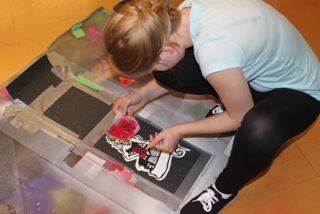
Caption: Oasis Skateboard Factory student applies stencil art to skateboard
Credit: Photo courtesy of Jennifer LewingtonWe’re a re-engagement program and we are reconnecting kids with something that got them in trouble: graffiti and skateboards, things that adults don’t like. Half the books in the art section of a bookstore are on graffiti and street art now. Graffiti is not a marginal activity. Young folks who work in advertising agencies have backgrounds in street art, appreciation of graffiti. You see it all around us. So I hook kids with the things that get them in trouble to a productive outlet. And we reconnect them to adults. So they have adult mentors in the community, and their parents actually start to reconnect with them because these kids do art shows – we show everything. The parents show up to the art shows, our events, our sales, our pop-up shop [classroom]. All of a sudden they’re proud of their kids. That’s a nice feeling to feel proud of your teenager.
What is the selection process for new students?
We do hour-long info sessions, which is my advertising for this program. At the end of that I give them an information package. I ask them to design a skateboard – just a rough thing. I’m not looking for art skills; I’m looking for something I can use to engage them in conversation. Then we invite them in for a group interview. We run them through an experience with our students. I get to see how they work as a team. I take kids who I think will benefit from this experience. Here a kid doesn’t need to be good at art, but they have to want to do it. It’s for that kid who’s into skateboarding but also likes art or likes computer or visual culture or graphics.
What happens to students when they leave OSF?
Students are here for a semester. Then, if they have success, which they all do, they can move on to the leadership program. And the kids want to do that because they do all this stuff that’s really cool. And some kids have been here for three semesters because they just don’t want to leave. For some girls who are in that situation this year, we wrote a grant. They work with middle school girls. The girls got materials to start their own companies. So when they’re done with this, they can just do it themselves.
I often counsel students to go to another kind of alternative school because they still get that arm around the shoulder, someone is there for them. Some kids want to go back to a regular school because of the program, like a shop or music program. They come in needing so many credits to graduate. I help them get over the hump. I had a girl who wouldn’t talk to anyone when she started, wouldn’t pick up a pen. Last year she was valedictorian at her school and graduated.
How does your location benefit the program?
The Toronto District School Board has always had a classroom here [in the Scadding Court Community Centre]. Oasis Skateboard Factory is one of three components of Oasis Alternative Secondary School. The other two are The Triangle Program [LGBTQ] and The Arts and Social Change Program. I saw the opportunity here because we have a skate park right here – an infamous skate spot. You have all these other official skate spots built of concrete. This is a real infamous skate spot right here. Kids built their own ramps. It’s a real great location. For an entrepreneurial business like ours, what better spot to be than across from Kensington Market? New Canadians are opening businesses, young people are opening things like vintage clothing stores and screen printing studios, and you have young fashion designers. The arts district has spread up here. We have a gallery show coming up near here. So it’s really an amazing, rich-in-resources area in terms of visual culture. Then we have the more corporate kind of art, which is the advertising and marketing all down King Street with all the design firms. So we’re in a perfect location to capitalize on the resources the community brings to us. We work with community partners all the time.
How is the community involved in the OSF program?
Ted’s [Ted Hunter, Roarockit] really my partner that started this. We have many partners, but he’s really the core of what we do. He teaches at OCAD and these kids get to work with him on advanced projects like this one right here (shows a student’s skateboard). It looks like a boom-box, sort of a radio thing with a handle. Ted helped that kid figure that out. No one’s ever done something like that in the world of skateboards. That’s why we get a lot of attention from the skateboard community. Here are these high school kids doing stuff that no one’s thought of. It’s amazing. And we’re bending wood like that drop-deck (shows another board). That’s a saleable shape in longboards right now. We’re figuring out how to bend wood like that. We’re getting expert mentorship. A lot of resources are in-kind, like working with people who believe in our mission. Our mission this year is to be doing professional work. We want no one to ever say, ‘oh that’s a student product.’ Some of our designs this year would sell on the spot. Skateboard shirts. Kids wear those things.
If you go on our website and look at the clients we have and have built boards for, we do almost every independent coffee company. Most are owned by young people who probably skateboarded when they were in high school or have that value about supporting their local community. They support us. So I put these kids in relationship with other young people who are next up the path: graduated high school, maybe from an alternative high school, and are now young business persons. When kids sell a board it’s really about a relationship they’re building with the client.
Could OFS be a prototype for other alternative schools?
People talk to me all the time: how do you expand on this? Don’t just expand this. Take the model we’re doing here and just apply it to something else, because it doesn’t have to be skateboards. Take that auto shop that no one is doing something with, and instead of just repairing motors all the time, start painting those cars with pinstripes and flames and stuff, like “Pimp My Ride.” Engage them in visual culture, which they’re experts in and consumers of; they just don’t experience being makers of it. I’m trying to turn that around, making stuff with your own hands, making your own culture.
Oasis Skateboard Factory, a program of the Oasis Alternative Secondary School and the Toronto District School Board, opened in 2009 at Scadding Court Community Centre in Toronto. Craig Morrison is the creator and teacher of OSF.
EN BREF – Fondée il y a trois ans par l’enseignant Craig Morrison, la Oasis Skateboard Factory (OSF) (l’usine de planches à roulettes Oasis) a fait l’objet de nombreux reportages et son programme innovateur lui a valu le prix Ken Spencer de l’ACE. L’OSF compte parmi les trois programmes de l’école Oasis Alternative Secondary School, l’une des 22 écoles secondaires alternatives du Toronto District Board of Education. Les élèves, qui peuvent s’inscrire à l’OSF pendant trois sessions, dessinent, fabriquent et commercialisent des planches à roulettes et des accessoires connexes, obtenant ainsi des crédits scolaires. Grâce à l’expérience OSF, des élèves autrefois désengagés ont raccroché aux études. Presque tous les élèves de l’OSF obtiennent leur diplôme d’études secondaires.
-
5 Psychologists, One Philosopher and the Conversations That Could Emerge
Comments Off on 5 Psychologists, One Philosopher and the Conversations That Could EmergeThe elevator door opened on the third floor of our board office last Monday and I stepped aside to allow an enthusiastic group of binder-toting, suitcase-dragging, coffee-carrying folks to clear the car. I recognized some of the group and quickly determined that everyone on the elevator was part of our district psychology team, obviously gathering for a day of work together. After unsuccessfully trying to come up with a witty comment that might be appropriate to frame the scene, I simply said, “Have fun”, and boarded the elevator.
(more…) -
Evidence of Teaching, Evidence of Learning
Comments Off on Evidence of Teaching, Evidence of LearningAs the school year began, I ordered two books with the intent of learning and implementing practices designed to Enhance Professional Practice. Charlotte Danielson has written a couple of editions of The Handbook for Enhancing Professional Practice and these were the books I would guide my learning with.

As I started into the the first book, it began with Evidence of Teaching. Danielson believes three sources of information comprise evidence of teaching: observation, conversation, and artifacts. She goes on to describe each of these sources and how they contribute to evidence of teaching,
As I read the chapter, I could not help but think about using this framework in a different way;
… as Evidence of Learning
Over the past year, as a school staff we have worked to understand Formative Assessment. We have looked at the components and values and worked on ways to use Formative Assessment in the classroom.
Using the framework created by Danielson, it was clear that evidence of teaching, could also be used to describe evidence of learning through formative assessment.
That is,
Evidence of Learning is comprised of Observation, Conversation, and Artifacts.
Together with the amazing staff at Erin Woods School and AISI Learning Leader Angie F., we then worked to understand each of these sources. We sat together as a staff and talked about each of these sources of evidence and what they looked like in the elementary classroom.
OBSERVATION – while observing students engaged in meaningful tasks, look for:
- Are they staying on topic?
- Is re-teaching required?
- Do you often re-direct?
- Can they extend further? Or in a different way?
- Should you provide resources?
- Are they using prev. learned skills? Or personal connections?
- Do they demonstrate understanding?
CONVERSATION – as you talk to students about there learning, listen for:
- Do they use specific content vocabulary?
- Are the students asking relevant questions?
- Can they explain why?
- Expressions/language demonstrates understanding.
- Can they express connections to previous or personal knowledge?
- Are they expressing additional interests or viewpoints about the topic?
ARTIFACTS – as you collect documents or student work, look for:
- Compare to rubrics.
- Did they know and meet criteria?
- Demonstrate understanding
- Is re-teaching required? for who? for what?
- Did they edit/fix up based on feedback?
To support our thinking, a visual was created with the above information.

As we developed our understanding of the three sources of data, it became evident that in order to make a thorough, well-rounded assessment of a students progress all three sources or data are required. Simply using one or two of the sources is not truly sufficient to fully understand the learner and assess progress.
As we move along in our professional development in this area remains:
What will we do with all of this data we have collected?
What do you do with all the data you collect?
-
Flip This Class!
Comments Off on Flip This Class!Supporters applaud the space that the Flipped Classroom provides for deeper and more engaged learning. Critics express concern that the concept de-values the importance of the act of teaching, and puts too much pressure on students to learn required material outside of the classroom–the very place where it should be taking place. After talking to Carolyn Durley and Quinn Barreth, two Canadian teachers that are working with the idea of the Flipped Classroom in their own schools, I was most excited by the fact that these teachers were being given both the permission and the space to engage in the innovative play that, I believe, is going to move schools out of the conceptual and practical ruts that prevent real change and transformation.
The version of the Flipped Classroom that is now capturing the imaginations of educators across the continent and around the world began about 5 years ago when two Colorado teachers were looking for a way to ensure that students who physically missed their science classes didn’t “miss the learning”. By creating a series of lesson videos that could be accessed outside class time, Jonathan Bergmann and Aaron Sams enabled absent students to, in essence, be in class while at home, albeit after the fact. Although taping lectures and lessons has been going on for years in post-secondary institutions, excitement for what this could mean for elementary and secondary education has grown, amplified by advances in access to and quality of technology.
Discussion around the Flipped Classroom has forced us to think about and challenge many of the assumptions that we make about school, about teaching and learning, and about the relationship between teacher, student and the content being learned. The conversation is not without controversy or objections. We’ll talk about some of these in future posts, not only in the context of the Flip, but in terms of what these points of contention can mean for the transformation discourse that is starting to gain some traction.
In listening back to the Teaching Out Loud Podcast featuring the voices of Carolyn and Quinn, however, I couldn’t help but smile at the enthusiasm and energy with which they talked about what they were doing. Although their Flip initiatives are substantially different in terms of age of students and the way that the Flip works in their classroom, one can’t help but pick up on the pioneering spirit that flows through their conversation. They know that they are entering new territory here, and they know that they are in a time where they, themselves, are playing with new ideas, working them, reworking them and redesigning their practice along the way.
This is not a case of adopting a best practice that everyone in their district is now expected to use. This is not a case of blindly jumping on a bandwagon and hoping for the best. Nor is it a case of one teacher flying solo on something that they think might work. Instead, the collective of teachers that are part of the Flipped Classroom movement, from what I can tell, are trying to bring an idea that makes sense to them to life in their own teaching practice. They are massaging it, changing it, talking to others about it and, in the process, exciting the imaginations of other educators.
There’s no telling where the Flipped Classroom movement will be ten years from now, but the spirit of educational entrepreneurship that I see bubbling up in the places where it’s being tried is hopeful. It’s a spirit of adventure that leverages creativity and innovation to bring the principles of differentiation and success for all students to life.
And, for me, that’s precisely what we need to happening in the 21st century schoolhouse!
You can hear Carolyn Durley and Quinn Barreth discussing how they are flipping their classrooms in the latest Teaching Out Loud podcast.
-
Undoing School
Comments Off on Undoing SchoolIt was a chilly and very windy day in May, 1994 when I first began to become aware of the difference between schooling and education. I had taken my grade 6/7 class to the Canada’s Wonderland amusement park for their annual “Math and Physics” Day, hoping to somehow get them excited about something more than just being at Canada’s Wonderland! My friend, Roger Kenyon, and I were huddled in one of the very busy eateries on site, trying to warm ourselves with a morning cup of coffee. We had settled down at a table with a group of Grade 12 math students who were busy manipulating numbers on one of the many pages in the official Math and Physics Day student guide. I was fascinated by the intensity and speed at which they were performing their calculations. Being someone that was never very successful in my high school math and science courses, I’ve always held in awe those that demonstrate a sense of ease with formulae, number-crunching and abstract proofs.
“You guys are good pretty good at that,” I commented.
“We’re all “A” students,” one of the students offered.
“Oh, so you really know what you’re doing.”
“No,” another student said, “We’ve just learned the formulas (sic)!”
Well, that began a brief but powerful conversation with the students about their math classes and how, after being shown the formulae, they simply had to figure out how to “fill in the blanks.”
Now, I’m not naive enough to believe that you can get an A in an upper level math class without some level of understanding—likely more understanding than these particular students were willing to admit—but perhaps this was my first encounter with the idea of doing school.
A new series of reports has just been released by the CEA, based on their widely recognized initiative, What Did you Do In School Today?. The first of these, which examines the relationship between various dimensions of student engagement and academic success, poses some sobering questions about the connection between institutional engagement and school marks.
The research indicates that, despite best efforts of many jurisdictions to recognize that behaviours like attendance, effort and homework (p.7) don’t actually reveal a whole lot about understanding or depth of knowledge, review of actual practice indicates that use of these to determine academic success (at least in terms of marks) is still quite common. Although effort is a strong indicator of intellectual engagement, it seems to be overshadowed by evidence that institutional compliance trumps a whole lot of other things when it comes to school success.
Despite the rallying cries that have emerged over the past decade—cries for more authentic assessment and more focus on depth of understanding—it appears that the practice of following the rules of school may still be the most effective way to get good marks.
In my opening story, the students I met had learned that they could do well in math if they learned how to plug in the numbers. Doing math was different than understanding math. And, although my Canada’s Wonderland experience took place nearly 20 years ago, the WDYDIST research suggests to me that things may not be changing at the pace that we would want.
Traditional thinking and the actions that go along with that thinking are both very stubborn things, requiring critical examination of current practice and the sometimes invisible assumptions that hold them in place. That said, we know that there are efforts being made across the country to challenge and change both policy and practice, allowing us to move from doing school to, in a sense, undoing school.
So, in your experience, how are traditional ways of getting marks being supplemented, if not replaced, by other measures of success? How are the marks that we’re assigning to students becoming more authentic reflections of what they know and are able to do?
Is the idea of marks too closely attached to the idea of doing school to affect any sort of realistic change?
Will our desire to have students go beyond merely doing school require that, as educators, parents and policy-makers we first undo school, taking it apart in ways that allow us to examine, challenge, critique and rebuild?
The new reports from the WDYDIST project are important explorations of one of the key dimensions of school transformation. I look forward to further conversation and perspectives!
-
Young People’s Confidence in School, Community, and the Future: Why It Matters and What We Can Do About It
Comments Off on Young People’s Confidence in School, Community, and the Future: Why It Matters and What We Can Do About ItPublic confidence and trust in institutions matter. A recent Statistics Canada report points out that, “Public institutions, such as the health care system, the education system and the federal parliament, play an important role in shaping the lives of Canadians. Institutions often are considered the basic pillars of society so if people begin to lose confidence in them, there may be cause for concern….particularly in a global and increasingly impersonal world”[1]
Governments, the private sector, and think tanks all regularly measure confidence because it serves as a barometer of the social and economic health of a country by providing important information about people’s intentions and future actions that may have an impact on the rest of society. Consumer confidence signals people’s intentions to save or spend and is thus linked to the health of the economy. Citizen confidence in government contributes to democratic participation and social cohesion. And public confidence in education is critical if we want people – both parents and non-parents – to support public schooling through their taxes and loyalty to the public system. In the U.S., declining public confidence in public education has resulted in an exodus to private schools and even further deterioration of the public system.
From research studies, we know that students’ future trust in institutions is significantly shaped by their school experiences, in particular by whether there is an open climate for classroom discussion and how much their school values student participation in school affairs.[2] Similarly, research into young people’s optimism about the future can provide clues about their interest and capacity to make a difference in the world. Young people who believe in and are able to imagine a better future are more willing and have greater capacity to respond to issues such as social and ecological survival.[3] Therefore, if we want to know what kind of society we are likely to have in the future, we need to understand young people’s confidence in their schools, their communities, and their future.
Youth Confidence in Learning and the Future
Commenting on a recent public opinion poll, Frank Graves of EKOS Research Associates cautioned, “Western societies have long believed in the promise of a better future for the next generations…In recent years though, there has been a growing recognition that the next generation can’t count on this ever-improving quality of life.”[4]
Today’s generation of youth is the first in recent memory that will have lower incomes and less upward mobility than their parents. At the same time, young people are inheriting global scale economic, environmental, and social challenges unlike those of any generation before them.
The Canadian Education Association (CEA) completed a research project that looked at young people’s confidence in their learning environments and their future. With funding from the Ontario Trillium Foundation, CEA collaborated with social planning councils[5] and school boards in five Ontario cities on a community engagement and research initiative that involved young people in a variety of ways.[6]
The Youth Confidence in Learning and the Future initiative engaged over 1,000 Ontario high school students (Grades 9 to 12) who completed an online survey in school. An additional 75 young people participated in facilitated sessions organized by the social planning councils either early in the process to inform the development of the survey or later on to give feedback on the research findings.
The research focused on these dimensions of youth confidence:
- sense of trust;
- level of engagement;
- feelings of empowerment or efficacy;
- degree of “fit” or connection between in-school learning and lives and learning outside of school;
- confidence in the future – future orientation, confidence in their personal future, confidence in the future of their community/country, aspirations.
Research highlights: What students told us
Young people’s confidence varies considerably by dimension. As the table below shows, students were most positive with respect to future orientation and aspirations and least positive about the future of their community/country and the “fit” or connection between school and their life/learning outside of school.[7]
Students were most positive with respect to future orientation and aspirations and least positive about the future of their community/country and the “fit” or connection between school and their life/learning outside of school.
Youth are very future-oriented, with high aspirations. Almost all students (95 percent) reported that they intend to graduate from high school, with somewhat fewer (88 percent) indicating that they intend to graduate from college or university. Close to 90 percent of students said they think a lot about their lives, with 84 percent reporting that they have dreams for the future, although a smaller proportion (72 percent) said they know what to do to make those dreams come true.
Young people are far more confident in their personal futures than in the future of their community or country. Only 35 percent of students agreed that “in the next five years, my town or city (or Canada) will be a better place to live” compared with 73 percent who believed that “in the next five years, opportunities will open up in my life” and “I expect to achieve more than my parents did” in terms of career and income. Even in the face of a labour market and an economy that are failing them, young people continue to be optimistic about their personal futures. Some think this means that today’s youth are better equipped to deal with uncertainty than previous generations. Young people are hopeful and hope has transformative powers.[8]
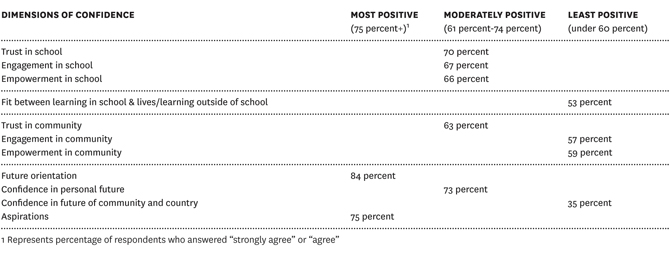
There is a significant disconnect between students’ in-school learning and their lives and learning outside of school. As the above table shows, only 53 percent of students were positive about statements related to “fit”. For example, only 58 percent could see connections between their courses and their lives outside of school, with even fewer (52 percent) reporting that what they do or learn outside of school is relevant to school courses and only 44 percent believing that their teachers are interested in what they are learning or doing outside of school.
Ontario high school students are required to do 40 hours of community service as a requirement for their high school diplomas. Only 57 percent of students found this a useful learning experience, although 71 percent felt that the program makes a useful contribution to the community.
Although moderate overall, students’ level of trust is low with respect to the mainstream media and people in their communities. Only 38 percent of students thought that most of the news in the mainstream media was true. Fewer than half, 48 percent, reported that they trusted “most of the people in my community,” even though 62 percent felt that young people were welcome and respected in their community, and 70 percent said their rights were usually respected.
With respect to trust in school, 49 percent of students said they had someone to discuss personal problems with in school, while 73 percent reported having at least one adult they could discuss school problems with.
While a low level of trust in the mainstream media can be interpreted as healthy skepticism, a low sense of trust in others may signal that community cohesion and social networks are becoming weak.
While a low level of trust in the mainstream media can be interpreted as healthy skepticism, a low sense of trust in others may signal that community cohesion and social networks are becoming weak.
Students feel empowered to stand up for themselves, but most do not think they can make a difference in their schools and communities. Over three quarters of students said they felt comfortable standing up for themselves both in and outside of school, with almost as many, 70 percent, reporting that they “sometimes stand up for others who are being put down or bullied.” On the other hand, only 51 percent said they had opportunities to make their school a better place and even fewer, 47 percent, believed they had opportunities to make their community a better place. Between a quarter to a third of students responded that they were “uncertain” about some of these questions, suggesting that they may not know about opportunities that exist to improve their schools and communities.
Students are more positive about their engagement in school (67 percent) than in their community (57 percent), although neither is high. Over 70 percent of students said they were interested in most of the courses they are taking in school, and 72 percent reported that, in their school, students were encouraged to discuss and question things. However, only 45 percent said they often learn something so interesting that they can’t stop thinking about it. This is consistent with CEA’s research initiative, What did you do in school today?, which found that only 43 percent of students were intellectually engaged, despite much higher levels of social and academic engagement.[9]
With respect to community engagement, only 51 percent of students reported that there were enough interesting things for young people to do in their community; a somewhat higher proportion, 55 percent, said they participated in at least one program or activity. Two-thirds of students indicated that they would vote in elections when they were old enough. Interestingly, while not a particularly strong indicator of engagement, the response to this question was more positive than any of the others related to engagement, suggesting again that lack of opportunities or knowledge of opportunities may be an obstacle for young people’s community participation.
How to Strengthen Young People’s Confidence and Prospects
In May 2012, CEA and the Hamilton Social Planning and Research Council sponsored a community forum and youth consultation on Searching for Certainty in Uncertain Times: Youth Confidence in School, Community and the Future. Close to 100 people, about a quarter of them youth, participated to discuss the research findings. Three panelists were asked to suggest some strategies for improving youth confidence.
Using the example of the Quebec students’ strike, Ron Canuel, the CEO of CEA, observed, “youth are beginning to recognize that if they take a stand, it will make a difference.” He went on to say that the two most important things that need to happen to strengthen engagement in school are introducing and allowing more use of technology in the classroom and greater flexibility in schools (e.g. later starting times for high school students, more flexible timetabling, and year round schooling). Such changes are now being piloted in some jurisdictions in Canada. The B.C. government, for example, is looking at year round schooling, a strategy that would mitigate against “summer learning loss” that affects many vulnerable students. These recommendations reflect what students themselves told us through the survey and informal sessions.
Shadya Yasin, coordinator of the York Youth Coalition in Toronto, emphasized the importance of building trust with both students and their parents, so that students do not feel “pushed out”. Recognizing that many administrators seem to be afraid of community organizations, Shadya argued that the school cannot exist without the community, making reference to the Somali saying, “You cannot wash your face with one finger.” Greater involvement of community agencies in the work of the school and the lives of students is needed to address the disconnect between students’ learning and their lives outside of school. Shadya argued that schools should not be providing mental health and social work services; instead, they should make better use of the services that exist in the community so they can focus on their central goals – teaching and learning.
“Connect schools deeply to their local and broader community” is one of the four core ways to improve high school outcomes that Ben Levin discusses in his 2012 book, More High School Graduates: How Schools Can Save Students From Dropping Out (see review on page 45). Included in this useful and highly accessible book are strategies for breaking down barriers and handling conflict with communities, as well as examples and concrete ideas for “Programming in and With Communities”:
Bring interesting adults into the school in various capacities such as mentors, role models;
Recruit adults who can share information about themselves, their community and their careers with students;
Work with community groups to provide important learning settings for students which can, in the future, open up career opportunities;
Enlist the help of community groups that can enrich school programs by providing opportunities that schools cannot, such as foreign languages, art or sports from a particular ethnic community.[10]
Marvyn Novick, the third panelist, is a policy consultant for Poverty-Free Ontario and former professor at Ryerson University. He noted that young people seem to have more confidence in themselves than in “us” – the community of adults who control their learning environments and the economy. This may be because we have placed today’s generation of young people in high levels of debt, precarious employment, under-employment, and declining public services. Marvyn contrasted this situation with the post-war period when people felt very close to each other and governments invested in collective initiatives – such as affordable housing, family allowances, a good job for everyone – to make sure that young people had a decent future.
To improve young people’s confidence in the future of their communities and their country, he argued, we need to shift the culture in schools and make sure that students understand how important these collective initiatives are. Ultimately, schools are public places where young people can learn that there is another kind of future. For example, instead of teaching about and preparing students for entrepreneurship, which provides jobs for only 15 percent of the population, why not teach students about unionship which contributes to the kind of good jobs that can support a family? Confidence grows with collective solidarity. Young people, schools and communities need to connect with each other and begin to say: there is another kind of future.
Conclusion
The results of this survey tell a good-news, bad-news story. While young people approach adulthood with a confidence in their own ability to succeed – a critical ingredient for success – they appear to have waning faith in social institutions or their ability to influence them. The resulting disconnect between personal and collective futures threatens to turn the optimistic exuberance of youth into a troubling cynicism about the society they will inherit. These results are a call for sustained government investments in ensuring decent jobs, as well as greater empowerment and inclusion of young people in the schools, communities, and social institutions that provide the backbone for democratic, civil society.
The concept paper on which this initiative is based can be found at http://www.cea-ace.ca/publication/youth-confidence-learning-and-future-concept-paper
EN BREF – L’Association canadienne d’éducation (ACE) vient de terminer un projet de recherche évaluant la confiance dont font preuve les jeunes à l’égard de leur environnement d’apprentissage et de leur avenir. Nous savons que l’expérience scolaire des jeunes, en particulier l’ouverture manifestée lors des discussions en classe et la participation des élèves à la vie scolaire, influe considérablement sur la confiance qu’ils accorderont plus tard aux institutions. La recherche portant sur l’optimisme des jeunes face à l’avenir peut nous éclairer sur leur volonté et leur capacité de changer le monde. L’enquête a dévoilé des résultats à la fois positifs et négatifs. Bien que les jeunes évoluent vers la vie adulte avec assurance quant à leur propre capacité de réussir – un ingrédient critique du succès – ceux-ci font moins confiance aux institutions sociales et doutent de leur capacité à les influencer. Les élèves se disaient plus positifs à l’égard des orientations futures et des aspirations, mais plus négatifs en ce qui concerne l’avenir de leur collectivité ou pays et l’intégration des apprentissages à l’école et à la maison.
[1] Grant Schellenberg, “The Perceptions of Canadians: Belonging, Confidence and Trust,” Canadian Social Trends (Winter 2004): Statistics Canada.
http://www.statcan.gc.ca/kits-trousses/pdf/social/edu04_0115a-eng.pdf
[2] J. Torney-Purta, W. K. Richardson, and C. H. Barber, Trust in Government-Related Institutions and Civic Engagement among Adolescents: Analysis of Five Countries from the IEA Civic Education Study. CIRCLE Working Paper 17 (The Center for Information & Research on Civic Learning and Engagement: August 2004).
[3] Carmen Stewart, “Re-Imagining Your Neighbourhood: A Model of Futures Education in Youth Futures. Comparative Research and Transformative Visions, eds. J. Gidley and S. Inayatullah (Westport Connecticut: Greenwood Publishing Group, 2002).
[4] “Frank Graves Poll: The Beginning of the End of Progress”. IPolitics Insight, March 9, 2012.
http://www.ipolitics.ca/2012/03/09/frank-graves-poll-the-beginning-of-the-end-of-progress
[5] Social planning councils are non-profit organizations across Canada working on a range of community development, community building and social justice issues.
[6] Hamilton, Milton, Peterborough, Sudbury, and Toronto
[7] The table does not show how students answered individual questions.
[8] R. Bibby, S. Russell, and R. Rolheiser, The Emerging Millennials: How Canada’s Newest Generation Is Responding to Challenge and Change (Project Canada Books, 2009).
[9] J. D. Willms, S. Friesen, and P. Milton. 2009. What did you do in school today? Transforming Classrooms Through Social, Academic and Intellectual Engagement (Toronto: CEA, 2009).
http://www.ccl-cca.ca/pdfs/otherreports/WDYDIST_National_Report_EN.pdf
[10] Ben Levin, More High School Graduates: How Schools Can Save Students from Dropping Out (Thousand Oaks, California: Corwin, 2012).
-
Mixing It Up: Bringing Young People’s Digital Creativity to Class
Comments Off on Mixing It Up: Bringing Young People’s Digital Creativity to ClassWhen you hear the name Mary Poppins, you probably think of Disney’s lighthearted musical movie. Mary Poppins descends from the sky to care for Jane and Michael Banks, taking them on magical adventures through the countryside. When the wind changes, the charming nanny disappears, though not before the Banks have been transformed into a happy, loving family. But in Chris Rules’ remixed trailer, “Scary Mary,” Mary Poppins is recut as an eerie horror film. Mary is an ominous figure, and when she arrives on the scene, strange things begin to happen. Objects become horrifically animated, heads spin, small children are sucked up chimneys. The cheerful lyrics to “A Spoonful of Sugar” are replaced with a haunting instrumental soundtrack. The mood is dark as the last frame of the video warns its audience, “Hide your children.”
The surprisingly chilling “Scary Mary” is just one of countless remixes of film and television to appear on video-sharing sites like YouTube. Such remixes are hardly an obscure phenomenon. Since it was posted by the young video artist in 2006, “Scary Mary” has been viewed over 12 million times. In fact, this sophisticated little video is an excellent example of the popular practice of remix, in which pop culture texts are re-edited, rewritten, and wholly re-imagined by enthusiastic audiences. Remix is a practice at which young, media-savvy creators excel. It is also, in the eyes of many literacy researchers, an important new way of composing texts and the sign of an emerging “remix literacy.”[1]
As a media educator and researcher, I have become increasingly aware of the role that remixed images, sounds, and words play in young people’s lives. Beyond being an outlet for digital skill and creativity, remix highlights some of the most important cultural issues of the moment, including debates over intellectual property and media representation. Remix should be taken seriously by those interested in understanding the role that digital media play in shaping adolescent identities and worldviews – and also in appreciating the influence that young people, themselves, now exert on digital culture. What we learn from studying young people’s remix activities can be incorporated into the classroom as the starting place for a creative and critical media education.
What is Remix?
Remix is defined as the practice of recombining cultural artifacts into new kinds of creative blends.[2] Of course, practices of remix are not entirely new. Making a quilt or a collage, for example, is a type of remix. Avant garde painters and writers have long experimented with remix techniques, creating works like beat poet William Burroughs’ famous “cut-up” films or the surrealists’ strange, dream-like collages. Still, within digital culture, remix has become easier, faster, and more relevant than ever before, especially among young people. Currently, we might think of it as including the recombination of music, sound, images, and words from sources such as film, television, video, online games, advertising, and novels.
In video remixes like “Scary Mary”, young creators use digital editing software to re-edit film and television programs. “Scary Mary” follows the popular practice of changing a film’s genre. These days, it’s not surprising to find Pulp Fiction recut as a romantic comedy, or The Lion King as a horror film. What is surprising, though, is the way in which relatively simple edits and the addition of new soundtracks can utterly transform iconic and seemingly fixed narratives – perhaps one reason that video remixers call their work “transformative art”. Another form of audiovisual remix can be found in machinima (pronounced mah-SHIN-eh-mah), in which video games are reworked into unique cinematic productions. These 3-D animations demonstrate not only sophisticated technical skills and profound visual knowledge, but also a striking convergence of media forms, as video games, animation, and film merge into a single genre.
Like video remix, fan fiction involves young people in re-imagining popular narratives. Fans of novels such as the Harry Potter, Twilight, or Percy Jackson series rewrite their favourite stories and post them online for readers around the world. Perhaps one of the most remarkable things about fan fiction writers is their ability to create highly supportive digital communities. Many adolescents use fan fiction as a way of exploring sexual identities away from the gaze of adults. Fan fiction circles, then, often provide spaces that are both creatively and emotionally sustaining, and that tell stories radically different from those written inside the institutional boundaries of young adult literature.
The musical mash-up is an equally significant form of remix. Indeed, it might be considered one of its very first forms, as young DJs began experimenting with sampling and sound collage in the 1970s. With the advent of digital media, musical remixing has become important for both young audiences and young musicians, particularly those from racialized groups. The musician Paul Miller (also known as DJ Spooky) notes that remix has often been used by those pushed to the margins of cultural production as a way to rewrite the dominant culture’s narratives.[3]
Finally, while acknowledging the technical complexity of many remix practices, I want to suggest that much simpler processes of selection could be considered remix. Even the act of maintaining a Facebook page involves elements of remix as a user recombines words, photos, images, links, and video from personal, political, artistic, and corporate sources in order to create a multimodal and highly personal text. If we take remix in this broad sense – as processes of re-assembling, recontextualizing, and creating new meanings – then we begin to see remix practices not only on YouTube, fan fiction sites, or at the DJ table, but as an important part of young people’s everyday media lives.
If we take remix in this broad sense – as processes of re-assembling, recontextualizing, and creating new meanings – then we begin to see remix practices … as an important part of young people’s everyday media lives.
Why Does Remix Matter?
Beyond being an interesting new form of creativity, do young peoples’ remixes really matter? Based on my research into adolescents’ online activities, I would argue that they most definitely do.
To begin with, remix often demonstrates the kind of critical thinking we associate with media literacy. Remixers are quick to point out problems in media representations of gender, sexuality, and race. In her critique of the lack of female characters in the latest Star Trek movie, for example, the young digital artist Sloane created a video collage of scenes featuring the mostly male cast, set to the song “Too Many Dicks on the Dance Floor”. Jonathan McIntosh’s wildly popular and very funny remix, “Buffy vs. Edward”, similarly addresses questions of gender representation in the mainstream media. In it, McIntosh splices together video from the television program Buffy the Vampire Slayer with clips from the Twilight films. According to McIntosh, the remix is intended to expose both Edward Cullen’s “generally creepy behavior” and the Twilight saga’s patriarchal undertones.[4] Through their work, digital creators like Sloane and McIntosh perform significant acts of cultural critique that are viewed by literally millions of people online.
Remix also demonstrates new collaborative approaches to digital production. During my own research, I have spent a great deal of time on young women’s video remix sites. The young female creators on these sites provide each other with a constant stream of praise, feedback, and advice. In response to a request for how to create split screens, for example, a young video-maker replies: “Use the pan/crop thing on the drop-down menu on the left. Good luck! I know you can do it! Let me know if you need more help! :)” By providing feedback, rating one another’s work, and inviting collaboration, young remixers not only improve their skills, but also work to create supportive learning environments.
Remix raises one of the most contentious questions of our time: Who owns culture?
While remix can be a site of community, it is equally significant as a site of conflict. Indeed, remix raises one of the most contentious questions of our time: Who owns culture? Remixers regularly clash with corporate media over the use of copyrighted material. Outspoken legal scholars like Lawrence Lessig argue that current corporate practices and laws are stifling young people’s creativity and criminalizing their modes of expression.[5] In fact, even the most conservative legal observers would argue that many of young people’s remixes fall within the legal parameters of “fair dealing”. Despite this, young people’s work is still removed from the Internet with startling frequency. During my own research, I often saw remixes that would be considered fair use taken down from popular websites. Young creators themselves engage in heated online dialogue about intellectual property and have developed numerous strategies to keep their work from being removed.[6]
It is also becoming increasingly apparent that youth are using remix as a powerful tool for bringing their concerns into the public domain. We can see this, for example, in the circulation of remixed images as part of the Occupy Movement. When a group of protesting students was pepper sprayed by a campus police officer at the University of California in November 2011, images of the officer were “photoshopped” into famous paintings and photographs (including Picasso’s Guernica and the Beatles’ Abbey Road album cover). The remixed images rapidly became an Internet phenomenon and the subject of comment by major newspapers like The New York Times and The Manchester Guardian. The images also sparked an international debate on the use of pepper spray, demonstrating the students’ ability to use digital remix to get their voices heard.
What Can We Learn From Remix?
So what does remix’s potential to create community, stir up debate, and give voice to critique mean for educators? I don’t want to suggest that bringing remix into an already crowded curriculum is a simple, additive measure. Still, I do think there is much that we can gain by recognizing this popular practice – and its relation to new kinds of literacy – within our classrooms.
In my past practice as an English teacher, I attempted to tap into the pedagogical possibilities of remix. In a unit on fan fiction, for example, students reimagined and rewrote our class novels, sharing their new stories with their peers through blogs. Together, they created a vibrant digital community that provided valuable feedback and a broad and authentic audience. Through this exercise, it became clear to both me and the students that remixing texts – whether video, music or fiction – involves the careful application of skills and knowledge. Before remixing a text, a young person needs to have a thorough understanding of its form, content, and genre. And in the process of creating the remix, the young creator must also make multiple intellectual, creative, and technical decisions. Producing remix, then, gives students the chance to act simultaneously as readers and writers, consumers and producers, a stance many media scholars say is indicative of today’s new media environments.
This kind of media production has the potential to promote greater conditions of educational equality. British media education scholar, David Buckingham, argues that schools must create access not simply to digital technology, but to digital cultural capital – “the cultural skills and competencies that are needed to use technology creatively and productively.”[7] In an age in which the ability to participate in creating, critiquing, and manipulating digital texts is a means of belonging and social power, schools committed to equity need to educate students in the practical aspects of symbolic meaning-making.
Remix also opens the door to valuable discussions of issues such as intellectual property, corporate media power, and the ethics of digital creativity. Media educators have long been interested in helping young people to analyze media texts, but in an age of interactive media, we must now consider what young people do with such texts. One of the greatest benefits of a discussion of media practices like remix is the possibility for students to critically analyze their everyday media experiences. Beginning from their own media use, students and teachers can analyze the emerging relationships between audiences and media industries, opening up a curricular space for young people to recognize and consider their own practices of creativity and consumption.
A growing number of resources are available to begin just these kinds of conversations. In his provocative National Film Board (NFB) documentary “RIP: A Remix Manifesto” (itself available online for anyone to remix), director Brett Gaylor creates a compelling case for citizens’ rights to share and re-use popular culture.[8] And in his online series “Everything is Remix”, independent filmmaker Kirby Ferguson traces the history of remix through film and music while examining modern attitudes to intellectual property.[9] Both documentaries signal a growing interest in exploring the meaning of creativity in an age in which reproduction, borrowing, and appropriation are easier than ever before.
Finally, the analysis and use of remix techniques in class has the potential to bridge the divide between young people’s experiences of media and technology inside and outside of school. As numerous media and education scholars have argued, the gap between students’ digital media experiences in school and out of school is significant. This gap may heighten the perception that adults are disconnected, unavailable, and largely uninterested in the complex role that digital media play in the lives of young people. Recognizing young people’s creative digital practices, and their centrality to communication, community-building, and public expression, is one way to begin to bridge that gap, and to move towards classrooms that embrace a range of contemporary literacies.
EN BREF – Le « remixage » consiste à réaliser une combinaison originale de musique, de sons, d’images et de mots provenant de sources diverses – cinéma, télévision, vidéo, jeux en ligne, publicité, romans, etc. – pour obtenir des amalgames inédits. Les jeunes créateurs habiles en médias excellent dans ce processus de réassemblage, de recontextualisation et de création de sens. De plus en plus, les jeunes en font un puissant outil pour faire passer leurs préoccupations dans le domaine public. Dans un contexte éducatif, une telle production procure aux élèves l’occasion d’être simultanément lecteurs et rédacteurs, consommateurs et producteurs – un rôle qui, selon de nombreux spécialistes en médias, reflète bien l’environnement des nouveaux médias. En cette époque où la capacité de participer à la création, à la critique et à la manipulation de documents numériques devient un moyen d’appartenance, de pouvoir social, les écoles qui privilégient l’équité doivent enseigner à leurs élèves les aspects pratiques de la construction d’un sens symbolique.
[1] See Gunther Kress, Multimodality: A Social Semiotic Approach to Contemporary Communication (London: Routledge, 2010) and Kyle Stedman, “Remix Literacy and Fan Compositions,” Computers and Composition 29 (2012): 107-123.
[2] Michele Knobel and Colin Lankshear, “Remix: The Art and Craft of Endless Hybridization,” Journal of Adolescent and Adult Literacy, 52, no. 1 (2008): 22.
[3] Paul Miller, “Notes on Media Remix,” Institute for Distributed Creativity listserv, April 21 2006. https://lists.thing.net/pipermail/idc/2006-April/001499.html
[4] Jonathan McIntosh, “Buffy vs. Edward: Twilight Remixed,” YouTube, June 19 2009, http://www.youtube.com/watch?v=RZwM3GvaTRM
[5] Lawrence Lessig, Remix: Making Art and Commerce Thrive in the Hybrid Economy (New York: Penguin Press, 2008).
[6] See Catherine Burwell, “Rewriting the Script: Towards a Politics of Young People’s Digital Participation,” Review of Education, Pedagogy and Cultural Studies, 32, no. 4 (2010)382-402.
[7] David Buckingham, Media Education: Literacy, Learning and Contemporary Culture. (Cambridge: Polity, 2003), 18.
[8] Brett Gaylor, “RIP: A Remix Manifesto,” National Film Board of Canada, 2008, http://www.nfb.ca/film/rip_a_remix_manifesto
[9] Kirby Ferguson, “Everything is a Remix: Parts 1-4,” Vimeo. http://vimeo.com/kirbyferguson
-
If I Didn’t Laugh I’d Cry: An Essay on Happiness, Productivity, and the Death of Humanities Education
Comments Off on If I Didn’t Laugh I’d Cry: An Essay on Happiness, Productivity, and the Death of Humanities EducationI am not happy these days. I teach in the humanities at a Canadian University. And – unlike my more Protestant-minded, less eudemonistical colleagues – I think persistent, intractable unhappiness is a clear sign that something is wrong. The following remarks are therefore a hybrid of personal therapy and scholarly analysis. My suspicion is that the state of post-secondary humanities education is the source of my unhappiness. Curing myself, or less ambitiously, simply understanding the cause of my malaise, will require a little self-reflection and a little rummaging around in the potpourri of modern higher education.
Twenty years ago I enjoyed my job and looked forward to teaching classes. I do not mean to suggest that all was well in those days; it wasn’t – not by a long shot. As early as 1969, George Grant argued that a fundamental shift in the university – away from study of the liberal arts and sciences toward the creation of research institutions animated by the spirit of technology and aimed at mastery of human and non-human nature – had been underway for decades and was already nearing completion.[1] If Grant was right, then the pleasant experiences I remember as a young scholar were merely the residual influence of a tradition that had, in fact, capitulated decades earlier and in whose glory I was basking naively, like an amateur astronomer delighting in the light of a star that has been dark for centuries.
By turns sobering and discouraging, this awareness makes me wonder what in the world I am doing. I am trying to make an argument my betters made over forty years ago without having any appreciable influence on their institutions; and I am making it in a context so far removed from theirs that the voice of that small residue of tradition is growing fainter by the day and can no longer be appealed to without soliciting looks of incredulity. So thin is the living, experiential core of that traditional world that even shame can no longer be counted on as a means of getting people to pause and reflect before jumping into the humanities curriculum with both entrepreneurial feet.
It won’t do therefore merely to defend the university as it was in my day. That might satisfy my nostalgia and make me happier for a time, but it won’t address the problem at its source. If we are going to learn once again what a genuine and robust education in the humanities is about, we’re going to have to question our nostalgia and memory as vigorously as our immediate circumstances. And in order to do that we will need to explore that strange thing on which humanities education ultimately rests – our humanity.
Of course, that sounds like the simplest thing in the world. We’re all human. But it turns out our humanity is a moving target and much more slippery and open to abuse than we might imagine. Indeed there are days when I feel so far removed from my humanity that I wonder whether our condition is so different from that of Winston Smith in Orwell’s Nineteen Eighty-Four. I don’t mean that we live under a totalitarian regime that actively prohibits us from thinking beyond its dehumanizing agenda – though there are days. I am thinking rather of the difficulty Winston has discovering a true measure by which to judge the unreality of his condition, an unreality he senses but has no words to describe. When an old clipping from the Times “inadvertently” crosses his desk and “proves” the earlier confessions of three Party members were pure fabrications, Winston is first shocked and then elated; he thinks the clipping so powerful that it alone could “blow the Party to atoms” – much like today’s journalistic exposés. However, what Winston fails to realize is that the clipping itself is just another Party lie. In the end Winston recognizes his dilemma and describes it with stunning clarity in the following formula: “I understand HOW: I do not understand WHY.” [2]
It is the “why” question that promises real freedom – for Winston and for us. Why am I unhappy? Why is it that everything that seems meaningfully to me is disregarded as irrelevant? Such questions are the natural expression of our disaffection with our world. What is more human than that experience, even in this strange age of compulsory happiness? Doubting, questioning, and wondering – if we would only follow these promptings, our humanity itself would lead us back to the humanities proper and teach us what we lose through their neglect.
Doubting, questioning, and wondering – if we would only follow these promptings, our humanity itself would lead us back to the humanities proper and teach us what we lose through their neglect.
* * *
Asking hard, unpopular questions is never easy. But it is particularly difficult if you are alone or if doing so exposes or calls into question the interests of an institution that has little financial or ideological reason to encourage public audit and discussion. I would argue that universities have become such institutions.
To begin, they are everywhere tied to business interests, whether small or large, and in many instances are actually in business with private companies, frequently with faculty members having roles on both sides of the commercial arrangement. This is new. To indicate how new it is, I remember in my student days that you could not even buy a decent cup of coffee on campus, not because students and faculty members had lower culinary standards back then but because they still believed that academic independence would be compromised by being tied to commercial interests. This idea now seems quaint to us in an age in which many universities have their own malls. And like all malls and the businesses they house, universities are run by bosses – administrative elites like Presidents, Vice Presidents, and their minions – who are responsible for many things, among them “compelling” a recalcitrant mass known as The Faculty to perform in a way that mirrors the productive ethos of the administrative caste itself.
Productivity is the raison d’être of Western capitalist societies. Malls retail domestically the fruits of productivity. Universities do R & D and create “ideas” that support the manufacturing sector which supplies retail markets with their goods. Ken Auletta describes succinctly the nature of this new relationship between universities and business in his recent article in The New Yorker, “Get Rich U”: “Stanford is the farm system for Silicon Valley.”[3]
The productive ethos works well enough so long as you are producing widgets to sell to widget lovers. But it proves disastrous when applied to humanities education, though it is much more tolerated by faculty members today than it was in the past. This toleration is likely due to a combination of exhaustion, corruption, and a shift in values. You can fight only so many losing battles before you say to hell with it, the devil take them, and run for your pension. The depletion of the old guard through attrition coupled with the addition of new faculty members schooled from birth in the new ethos explains the decline in large part. After all, university professors too share the productive ethos. We live in a productive society, animated by productive people, which profits immeasurably from productive practices. Why wouldn’t we share that ethos?
Consider one of the fundamental principles of the productive ethos – the quantitative principle. Though it may be possible to argue that an academic whose pile of publications at the end of a stipulated period – say the period covered by the annual report – weighs ten pounds is more productive than an academic whose publications over the course of the same period weighs only five pounds, still we might wonder what we actually know about either person’s work as a result of the application of the quantitative principle. For instance, if Hamlet is one of the documents tucked into that five pound package while the ten-pounder includes two recent volumes by John Grisham, surely we would want to revise our judgment. In any event, if an unvarnished application of the quantitative principle seems unlikely and insufficiently nuanced to be a legitimate measure of performance in the context of an annual academic report (though I would caution anyone about underestimating the proclivities of the administrative caste when it comes to the ethos of productivity), we might add the matter of the work’s “impact” to the calculation to arrive at a better metric. Impact too is a quantitative measure, though a more complex one. It asks concerning the effect of one’s work on other things – institutions, political and social events, people – both within and without the university, though today preference is given to the latter in keeping with the business ethic underlying the productive ethos.
The impact test is one that Stephan Collini has analyzed in his recent book What Are Universities For? Collini teaches us that the most problematic aspect of the impact test derives from the term itself. To impact something is to strike or bang into it – in my experience never a good measure of anything except perhaps in war and at those demolition derbies my father used to take me to. But setting aside the silliness of the term, a more troubling picture emerges regarding its actual consequences when tied to funding formulas. As Collini demonstrates, you can have an absolutely first-rate piece of scholarship that illuminates, say, the transition from a feudal to a capitalist economy, that ranks as completely worthless when measured by its impact and when compared to the impacts of “products” issuing from other faculties within the university.[4] Placed alongside a new gadget for collecting pennies, the impact of which would be staggering, this little corner of the human experience seems trivial at best. But what an odd inversion of things that judgement entails. A gadget which, beyond its economic potential, could not hold your attention for more than a few moments trumps an intrinsically interesting field of study whose complexity alone offers the mind a rich, expansive field in which to explore the human condition. No wonder humanities professors are unhappy. How could they possibly compete with penny rolls? And why would they want to?
No wonder humanities professors are unhappy. How could they possibly compete with penny rolls? And why would they want to?
Collini wishes to defend humanities education, but like all of us today he has trouble knowing how when all the measures of intellectual worth seem to guarantee the irrelevance of our teaching and research from the outset. In other words, the game is rigged, and Collini knows it. This is the thing I find most refreshing about his book – he is not taken in by the old lines and strategies.
During an earlier dispensation of the game, humanities professors naively thought they could beat the odds by playing the game on its own terms. What they did was to concede the fundamental point of the defenders of the productive ethos – namely, that humanities education was intrinsically worthless. However, they argued that the matter of its intrinsic worth being settled, its practical value as a cultivator and provider of intellectual “skills” was considerable. The argument worked well enough for a time, if by “worked” we mean kept the wolves at bay and the reformer’s axe away from the root of the tree. But two can play at that game. Once the concession was made, administrators and fellow-travelling faculty members argued that these skills could be much more effectively cultivated by completely different pedagogical strategies and curricula.
The old argument said: medieval history might be an awful waste of time, but at least it produces people who can think analytically and write clear and penetrating memos once they find themselves in the corporate world. [5] As Collini says, this argument amounts to the assertion that “what is valuable about leaning to play the violin well is that it helps us develop the manual dexterity that will be useful for typing.” The new model says: if it is a waste of time, then it is a waste of time. Let’s get rid of the curriculum and those expensive curriculum delivery units (faculty) and just teach memo writing and critical thinking. That is a parody, to be sure, but not much of one. Every humanities professor feels its contempt somewhere deep down in her bones. (Let me quickly add that this contempt is felt equally by my colleagues in the sciences and social sciences. In the former case, it is present in the denial of funding for “discovery-based” research in favour of short term projects with obvious financial potential and technological applications.)
* * *
An old professor of mine used to say that there is living and there is living well. The productive ethos that guides our society has created a civilization that lives more comfortably, more affluently, and longer than any other in history. As to living well, early supporters of the ethos still had enough culture (pardon the word) and sense to leave a few places untouched by its demands. These were, again according to my professor, sacred spaces – churches, theatres, museums, and universities. But the ethos has grown in our time and has spread around the globe. Now we are told that our mere survival is predicated not only on its acceptance but on a single-minded pursuit of its goods in all aspects of our lives. So, we adjust the curriculum, eliminate a couple more departments, and erase yet another body of images of humankind’s long effort to live well. We will survive, as a result, and live, at least for a time. But in those moments when the lights go out and the TV goes dark, I fear we will no longer understand our unhappiness or what we have lost.
EN BREF – La productivité est devenue la raison d’être des sociétés occidentales capitalistes, soutenue par des principes fondamentaux : la quantité et l’impact. Ces deux principes bien connus des universités placent les connaissances utilitaires au-dessus des préoccupations relatives à la condition humaine, au doute, au questionnement et à la curiosité. La prédominance de cette forme d’éthique place les facultés de sciences humaines devant un dilemme : soit reformuler leurs programmes en fonction de l’éthique de la productivité, soit en conserver l’intégrité, au risque d’être taxées de manquer de pertinence. Quoique la stratégie laisse entendre qu’un choix existe, les deux options mènent à la même issue : l’élimination d’une éducation authentique en sciences humaines. Le mécontentement des professeurs de sciences humaines n’étonne donc pas. Pour réapprendre ce qu’est une éducation véritable et solide en sciences humaines, nous devrons explorer cette chose étrange sur laquelle elle repose ultimement : notre humanité.
[1] George Grant, Technology and Empire: Perspectives on North America (Toronto: House of Anansi, 1969), 113-133.
[2] George Orwell, Nineteen Eighty-Four (London: Penguin, 1990), 78-80.
[3] Ken Auletta, “Get Rich U,” The New Yorker, April 30, 2012. Accessed at http://www.newyorker.com/reporting
/2012/04/30/120430fa_fact_auletta
[4] Stephan Collini, What Are Universities For? (London: Penguin, 2012), 168-177.
[5] Ibid., 91.
-
Understanding the Heartbeat
Comments Off on Understanding the HeartbeatEven though we walk on lands rich in history, we non-Aboriginal Canadians often fail to hear its stories due to a cultural deafness – a state of unknowing.
This state of unknowing is something school districts in British Columbia are trying to address with curriculum and enhancement agreements. For example, School District 44 has created a senior level humanities course that studies First Nations culture and history, as well as Squamish Language classes. Alberta has introduced an initiative for First Nations Education called “Our Words, Our Ways”, a pedagogical style that links cooperative learning and community to the expression of traditional values.
However, none of these structures or materials will be meaningful until teachers from all backgrounds find the courage to explore First Nations culture. The timidity many of us feel when teaching Aboriginal studies may come from a sincere place – a place of not wanting to offend or further colonize or intrude – but it can do damage nonetheless.
Rather than speak from a place of authoritative knowing on Aboriginal matters, why not work from a place of wondering and invite our students to learn with us in gaining a deeper understanding of First Nations perspective? What follows is an account from two teachers who did just that.
Rockridge Secondary School serves about 900 students in West Vancouver, and while it is located on Squamish land, until recently it has had little contact with the Squamish people themselves.
Jessica Selzer’s Story
Last year, when I was teaching at Sentinel Secondary School, a colleague, Glenn Johnson, asked if I wanted my Social Studies 9 class to make drums as part of their Explorers and Aboriginal Peoples of Canada unit. For many years, his students had made drums; his program was showcased for the 2010 Vancouver Winter Olympics. Glenn organized almost everything for my class project and offered to teach my students how to string a drum. With a sense of excitement, I watched them string and paint drums, research aboriginal symbols and stories, and start asking about the culture they were holding in their hands.
This year, new to Rockridge Secondary, I wanted to expand the Aboriginal drum-making project to help students understand a culture and worldview in their own backyard and to help them reflect on their learning and on themselves. If they were to make drums, they were going to understand the heartbeat and meaning of drums and drumming to the Coast Salish people.
I began the unit by sitting with my students and playing the drum I had made last year while telling them the story of the Europeans’ drive to find the Northwest Passage, the world travels of Captain Cook, how the Yuquot greeted him in Nootka Sound, and of Vancouver’s continued exploration of the B.C. coast until he landed close to where we sat that day.
Over the next few classes we discussed Salish culture, stories, and worldview in which we focused on the equal, interconnected relationships between all living things in the spiritual and physical realms. For one whole class we shared and reflected on personal totems. As an introduction I read them “I am Raven” by David Bouchard. Then my students read in silence about the animals and creatures from the Salish culture while thinking about which animal matched their core: not who they wanted to be, but who they really were. Once chosen, they would paint this totem on their drums.
In small groups they shared which animal they thought best suited them and why. They took this task very seriously, offering sincere reflections on who they are and what they do.
In small groups they shared which animal they thought best suited them and why. They took this task very seriously, offering sincere reflections on who they are and what they do. One girl felt that her love and loyalty to family, combined with her ability to be on her own, defined her, and so chose a wolf. She wrote about her leadership qualities, and how adults see her as mature and give her responsibility, like caring for small children. Another boy felt that, because of his expressive, outgoing personality and his willingness to take risks, he was more like a Thunderbird. He wrote that his ability to find new friends every time he moved around the world was like the Thunderbird with its transformative capabilities and bravery. He ended up painting his bird in the colours of Poland’s flag – his homeland, of which he was fiercely proud.
Stringing a drum is fairly easy once you know what you are doing, and my students caught on fast, helping each other.
At the suggestion of school administrators, I invited the Squamish community to be involved through a drum circle. Squamish elder Bob Baker taught my class a canoe song while they were painting drums in the cafeteria. Initially they were a bit self-conscious, but soon they started to have fun with it. As they were singing, students from other classes started sneaking out of classrooms and peering over the railings to see what was going on. It’s tricky to pay attention in trigonometry when you can hear drums and laughter!
Jennifer Olson’s Story
As I approached the Socials 9 First Nations unit, I knew it was important to study First Nations culture in a meaningful way. I wanted the unit to be personalized, inquiry-based, and experiential: all strong values of indigenous education.
Currently in B.C., First Nations are increasingly celebrating their culture through the medium of fine arts, so I figured an inquiry into First Nations culture through art analysis would be intriguing, non-intimidating, and allow them to focus on aspects of culture they found most intriguing.
Building an entirely inquiry-based unit felt like a huge risk. I had never done a true inquiry project and was afraid that giving the students so much responsibility and freedom in what they learned would leave us with nothing really meaningful in the end. I spent many afternoons collaborating with our school librarians to find resources for the students to start with. My Middle Years Program Coordinator also guided me in preparing an inquiry process that would encourage students to take ownership of their learning and deepen their analysis.
“When I look at art can I see the artist?” This question made the students look for hints of the artist’s identity … wonder how art is a reflection of one’s self.
The unit began with students taking an “art walk,” moving from station to station in 10-minute intervals, browsing the artwork of First Nations artists from across Canada. They studied the art being mindful of the question, “When I look at art can I see the artist?” This question made the students look for hints of the artist’s identity within the art and begin to wonder how art is a reflection of one’s self and what led these artists to create these images. After the art walk, the students began developing their personal inquiry questions – and that’s when my doubts fell by the wayside! They engaged in their learning because they were empowered to choose the focus of their work. Students began researching artists’ cultures and histories in attempts to answer their own questions, a journey they would share with the class at the end of the unit.
When that time came, we sat in an informal “sharing circle”; students were not bound by scripts but instead spoke passionately about the knowledge they had uncovered. Many students studied the artist’s spirituality, which they had uncovered through studying the use of animals in the art. They found another common theme: the First Nations traditional ways of life, depicted in the art through Sun Dances, Pow Wows, and Potlatches. While the art celebrated the First Nations culture, the students also perceived a sense of remorse and rebirth in many pieces of art. The mood of these pieces led many students to study how the artists’ community was affected by the signing of the treaties and the residential school system. Each presentation was unique in content and reflectiveness, making it a collaborative learning experience. Much like the traditional style of First Nations education, each student had developed a different area of expertise and was excited to share it. It was clear these young people had developed a deep appreciation and understanding of First Nations history and culture.
What the students did not realize in the beginning, was that Jessica Selzer had offered to share her knowledge of drum-making with the class, enabling them to create their own art, a traditional Squamish drum. Seeing their art in action brought an even deeper level of learning and understanding. They were able to appreciate that who they are as individuals shaped the art they were creating, just as they saw in the art they had analyzed.
Conclusion
One afternoon later in the year, that deeper understanding shone in their faces as our classes came together to sing and drum at a blessing ceremony for a cedar raven carving that Squamish artist Rick Harry would begin at our school. The raven is our school mascot and also a spiritual symbol for the Squamish nation. Although the two classes had focused on different elements of First Nations culture, together they participated in a living ceremony that spoke of spirit and creation as they had come to understand it through their separate inquiries. As one boy announced after the ceremony, “That’s awesome! Stuff we learned about in class happened in front of us! It was real!”
When asked to reflect on the entire unit, our students said they felt that they learned something important, and they were surprised to learn that there was such a rich culture right in their neighbourhood. All students felt that the act of making a deerskin drum while learning about its spiritual and cultural significance – and then actually “doing history and culture” – was a much fuller experience than simply being taught about it.
EN BREF – Plutôt que de parler en connaissance de cause de sujets autochtones, pourquoi n’adopterions-nous pas une attitude de curiosité, en invitant les élèves à acquérir en même temps que nous une meilleure connaissance de la perspective des Premières Nations? Deux membres du personnel enseignant de l’école secondaire Rockridge de Vancouver Ouest l’ont justement fait. Les visages des élèves rayonnaient lors d’un après-midi où ils ont appris à mieux connaître la culture et la spiritualité des Squamish, les deux classes s’étant rassemblées pour chanter et tambouriner lors d’une cérémonie de bénédiction d’une sculpture de corbeau en cèdre. Le corbeau est une mascotte de l’école ainsi qu’un symbole spirituel de la nation Squamish. Quoique les deux classes aient examiné divers éléments de la culture des Premières Nations, elles ont participé ensemble à une cérémonie vivante évoquant l’esprit et la création et sont parvenues à mieux les comprendre grâce à différents questionnements.
-
Searching for Certainty in Uncertain Times – Youth Confidence in School, Community, and the Future
Comments Off on Searching for Certainty in Uncertain Times – Youth Confidence in School, Community, and the FutureForum Highlights: Searching for Certainty in Uncertain Times – Youth Confidence in School, Community, and the Future.
-
What did you do in school today?
Comments Off on What did you do in school today?Are students just ‘doing’ school or are they engaged with their studies? How does a student’s level of engagement influence learning, achievement, and teaching? Since 2007, the Canadian Education Association’s (CEA) initiative on student engagement, entitled What did you do in school today?, has shed light on such questions through survey results from over 60,000 students. The latest series of What did you do in school today? reports focus on student engagement, academic outcomes, instructional challenge, and intellectual engagement.
-
2012 WDYDIST Research Series Report One
Comments Off on 2012 WDYDIST Research Series Report OneWhat did you do in school today? is a national initiative of the Canadian Education Association (CEA) designed to capture, assess and inspire new ideas for enhancing the learning experiences of adolescents in classrooms and schools. What did you do in school today? is one of the few initiatives in Canada that focus specifically on the experiences of adolescent students. And it is the only initiative that focuses on the powerful concept of intellectual engagement.
In this report — the first in our series — we explore the relationship between student engagement and academic outcomes, with a particular focus on the relationship between intellectual engagement and our measure of academic outcomes — students’ marks. Following a discussion of recent results, we reflect on what these findings tell us about marks as measures of academic success. The relationship between institutional engagement (e.g., attending class, completing homework) and higher course marks revealed in our findings is striking. On the other hand, many students do well in their classes without being intellectually engaged. We explore the implications of these findings for policy and practice by highlighting how the most basic of structures in schools — such as marking practices and definitions of academic success — can often block the emergence of practices that support higher levels of achievement and intellectual engagement among larger numbers of students.
-
2012 WDYDIST Research Series Report Two
Comments Off on 2012 WDYDIST Research Series Report TwoWhat did you do in school today? is a national initiative of the Canadian Education Association (CEA) designed to capture, assess and inspire new ideas for enhancing the learning experiences of adolescents in classrooms and schools. What did you do in school today? is one of the few initiatives in Canada that focus specifically on the experiences of adolescent students. And it is the only initiative that focuses on the powerful concept of intellectual engagement.
Here, we are pleased to introduce the second report in this series. This report explores the relationship between instructional challenge (the balance between students’ skill levels and the challenge of their school work) and student engagement. Findings show that many students in Canada find their school work in Language Arts, Math and Science too easy or too hard because the learning is not synchronized with their skills. The implications of this imbalance have significant implications for student engagement. For example, students with low skills are less likely to feel socially, institutionally and intellectually engaged; but students with high skills who feel under-challenged in class are also prone to disengagement. Shifting the relationship between instructional challenge and student engagement requires a reorientation in the way we think about the qualities of effective learning and a commitment to supporting the organizational, pedagogical and curricular changes required for all students to experience intellectually engaging learning environments.
-
2012 WDYDIST Research Series Report Three
Comments Off on 2012 WDYDIST Research Series Report ThreeWhat did you do in school today? is a national initiative of the Canadian Education Association (CEA) designed to capture, assess and inspire new ideas for enhancing the learning experiences of adolescents in classrooms and schools. What did you do in school today? is one of the few initiatives in Canada that focus specifically on the experiences of adolescent students. And it is the only initiative that focuses on the powerful concept of intellectual engagement.
We are pleased to introduce Report Number Three, where we revisit research questions and findings about intellectual engagement from our First National Report (Willms, Friesen, & Milton, 2009). We use three years of data from 83 schools participating in What did you do in school today? to see if levels of intellectual engagement have changed, for better or worse, and to see if classroom practices have continued to affect these levels. In the context of educational change, three years is a short period to see measurable school-level change. Our three-year findings are encouraging: the efforts of principals, teachers and students at schools participating in What did you do in school today? are leading to increases in intellectual engagement, especially in middle schools. The strength of these positive trends varies quite dramatically among schools, providing us with a unique opportunity to understand district, school and classroom structures and practices that may be enabling or making it difficult for schools to create intellectually engaging learning environments.
-
Embedded Inquiry
Comments Off on Embedded InquiryYou know how when you have an epiphany and then wonder how you could have ever not known that thing you just realized? That happened to me today while I was speaking with Chris Pedersen, a colleague at Rockridge. He had just told me about his lesson when it hit me: embedded inquiry – that’s what works.
-
Changing the Conversations about Education
Comments Off on Changing the Conversations about EducationIt’s back-to-school time across Canada, that annual phenomenon that signals the transition from a more relaxed sense of time and routine, to something a little more disciplined, regular and, in most Canadian locales, a little cooler. Even if you don’t have children in the formal school system, media coverage of the usual back-to-school issues remind us of the approaching change of season: dressing your children for the first day of school, healthy lunches, first day anxiety, transitions between various levels of system and how best to communicate with your child’s teacher. Recently, new threads have been woven into the back-to-school narrative: the use of social media, online learning and managing the stress of overscheduled parents and children.
But, once the annual flurry of media attention to schools during this highly energized season of return settles down, I always find myself being more than a little disappointed when I realize that these public conversations about school change haven’t appeared to have broken any new ground. To be sure, the blogosphere and the expanding social media landscape is growing in terms of the number of teachers, administrators, parents and community members who have become dedicated to pushing the edges on the educational discourse in this country, but many of these conversations remain hidden from wide public view. I can’t help but think that the time is ripe for a spirit of convergence between traditional media and the growing world of web-based publishing!
Could it be time for mainstream to meet Twitter stream?
Imagine what might happen if:
- our local and national newspapers included a permanent Education link on their front page menu banners;
- in addition to articles written by staff reporters and feature authors, a blogroll of web-based content was available in the sidebars of online newspapers;
- selected blog content were regularly aggregated into the body of online news sites;
- a live Twitter feed of education-related content became part of mainstream news sources;
- a portal to relevant educational research was available in traditional online news sources;
- a bookshelf of education-related books were included and discussed on a regular basis.
In short, imagine what might happen if we were able to create a type of discursive confluence where the main stream” of educational narrative across Canada could be fed and refreshed by the newer social media streams (and tributaries) that are forming in other places on the web.
I believe that gradually (albeit, slowly) we might begin to see a change in the types of conversations that take place in the public spaces around the country about schooling, education, teaching and learning.
You know something? If we got started now, we might be able to see some of that change in time for next year’s back-to-school season!
Next: Just what might those deeper questions be?
-
Schools as A Place of Relationship
Comments Off on Schools as A Place of RelationshipIf you were to ask young people preparing to return to school over the next couple of weeks what they were looking forward to the most about “going back”, I suspect that the number one answer would be, “I’m looking forward to seeing my friends.” A close second might be, “I’m anxious to see my teachers”. There is no more energetic place to be than on a schoolyard or in a cafeteria on that first day back to school! And you know something? It’s not only the students that anticipate this time of reconnection. It didn’t take long for me to realize that those first days where teachers wandered back into school in order to prepare for the coming year were not very productive from a “getting things done” perspective. Instead, they were filled with hallway conversations, sharing of summer stories and photos and general catching up on things. A time of connection and reconnection.
Schools are many things to many people but I think that it’s important to remind ourselves (frequently) that schools are primarily a place of relationship. I know that might sound odd to the 21st century ear, but it’s something that I have come to believe.
Relationship is at the heart of the teaching/learning dynamic; it’s at the heart of the engagement puzzle and it is situated right at the heart of most of the other issues that schools are called upon to address. Acknowledging the importance of relationship is the first step; actively nurturing it is another.
One of the threads that was woven through the recently released CEA/CTF study, Teaching the Way We Aspire to Teach: Now and in the Future, was, in fact, relationship and just how important it was to the visions that teachers had for the work that they do. Relationship was seen to cut across many of the other dimensions addressed in the study’s findings including the way that teachers worked with colleagues, parents, school leadership, the students within their class and the wider community.
And when we asked teachers to tell stories of when they felt they were at their best, almost all of what we heard was grounded in a sense of strong, positive relationship. One teacher talked about getting down on his hands and knees, crawling under a desk and sitting with a student who tended to spend a good deal of his day in that position. Another spoke of how making a phone call to each parent at the beginning of the school year set such a positive tone, not only among the parent community, but among the students as well. Yet another recalled how students would return to her classroom at the end of the day, “just to talk”.
At the same time, teachers told us of the things that they believed would help them to be able to teach the way that they aspire to teach more often, many of which could be seen through the relationship lens: being able to have time and space to develop strong and positive relationships with colleagues, time to plan together, freedom to develop learning environments that were more responsive to the needs of students, flexibility to craft schedules and timetables that allowed for richer and more robust learning experiences, the ability to take the time to “be” with students and colleagues without feeling that something is “not being covered”!
Schools are places designed for learning; there is no disputing that. But I sense that we may be losing sight of one of the prime mediators of learning: relationship.
As we move back into our schools over the next couple of weeks, and as labour negotiations take a more central place in the conversations around board room, staff room and family dinner tables in many Canadian jurisdictions, I’m hoping that the very positive stories that we encountered in the Teaching the Way We Aspire work might serve to both temper and inspire the conversations—and the relationships!
-
Teaching and Type Two Ignorance
Comments Off on Teaching and Type Two IgnoranceI am a bit worried about the popular assertion that students should be allowed to follow their passions, because if they do that too much they may never know what they don’t know. Deepening your understanding in areas of personal interest is constructive and rewarding, but it can become a downward spiral of diminished horizons unless someone or something disrupts this self-referencing process from time to time. For this reason, adults, and educators in particular, have a responsibility to expand students’ thinking as well as respond to their interests.
Although I strongly believe that students can and should take a more active role in their own education, it would be the proverbial ‘throwing the baby out with the bathwater’ error if we were to decide that students will take the lead.
As they get older they can take more of the lead, but at all ages students need teachers to challenge them, figuratively speaking, “to explore strange new worlds, to seek out new life and new civilizations, to boldly go where no man has gone before.”1 Sometimes this means insisting that they do things they don’t want to do. Otherwise, how will they ever grow beyond the bounds of the comfortable and familiar?
Moreover, there is the matter of the curriculum. Society sets certain expectations for what students will learn and neither they nor their teachers are free to ignore that mandate. Students can neither opt out of parts of the curriculum that don’t seem to interest them nor focus exclusively on the ones that do. No matter how passionate they may be about, or how much they may detest, Art or Athletics or Technology or Poetry, the curriculum requires them to participate in a broad liberal arts program until the last couple of years of high school, at which time there is more individual choice. This is in the best interests of both the individual and society; it serves both the private good and the public good.
Student-centered learning does not mean letting the student decide what s/he wants to do. It means starting with the student’s circumstances and characteristics in order to build towards the outcomes that society has decreed through the curriculum. The teacher’s job is neither merely to impose the curriculum uniformly nor to accede to individual student preferences, but to mediate between the two so that students both deepen and broaden their understanding within the framework of the mandated curriculum.
The goal is to increase understanding and to diminish ignorance.2 One way to do that is to expand the boundaries of what students know and can do; that is, their competence. Another is to expand their awareness of the existence of that which they do not (yet) know and cannot (yet) do; that is, their awareness. Both increased competence and increased awareness represent learning. Lacking competence in some area is unfortunate but potentially remediable, whereas lacking awareness in some area is tragic because students are then blind to what is possible and dangerously presumptuous about their prowess. If we don’t shine a light in unfamiliar corners and lead them out of their comfort along surprising pathways then we are not truly educating them, we are merely indulging their interests. Ultimately, of course, we hope students will develop the curiosity and the courage to forge new pathways into the unknown, perhaps discovering new passions that they had not previously imagined.
Students should be given much more choice in how they learn and how they demonstrate their learning, and they should also have some more choice in what they learn – they should definitely have opportunity and support to discover and develop personal passions – but teachers and parents also need to exercise their responsibility for expanding the boundaries of students’ inclination and shining a light as far as possible into the infinite ignorance that surrounds their, and humanity’s, current knowledge.
Sometimes what students don’t know they don’t know is what they most need to know in order to enable them.
1 This was the mission of the Starship Enterprise in Star Trek TV series, which was intended to capture the pioneering spirit, not only physically but also intellectually.
2 Type One Ignorance is what I don’t know. Type Two Ignorance is what I don’t know I don’t know. The former is finite and the latter is infinite.
-
Improving School Climate to Reduce Bullying
Comments Off on Improving School Climate to Reduce BullyingThere seems to be no shortage of bad news about bullying in Canada these days. In the fall of 2011, for example, two suicides – one in Montreal and the other in Ottawa – were attributed to incessant bullying endured by the two high school students.[1] These extreme effects of bullying are only the tip of a very large iceberg. We know, for example, that nearly all children and youth witness bullying at one time or another, and many – about half– are directly involved in bullying sometime during a given school year. Most worrisome, however, are the children and youth who are involved in bullying – as a bully, a victim, or both – regularly and frequently, meaning once or more times a week. This group includes nearly 20 percent of students – one in every five kids in nearly every school. This means that many kids’ lives are being disrupted and scarred by bullying.
Bullying harms kids in nearly every way imaginable. Minimally, it disrupts their learning, as kids who are victimized tend to avoid school through absence in order to avoid the bullying. The stress of bullying causes them to suffer anxiety and depression, and it undermines their feelings of safety and connection to school, both of which are foundational to the learning process. Because many kids who bully other children are also victimized themselves, these effects are often found in all of the children involved, victimized and bullying alike. Additionally, some recent research indicates that children who witness bullying are also at risk for serious negative effects, including school disengagement, school avoidance, and, consequently, lower academic achievement.
While this portrait seems bleak, and bullying remains a serious and intractable problem in our schools, there are nonetheless reasons to be optimistic for the future. Many educators now feel a strong professional obligation to stop bullying, and schools, school boards, and education ministries are using resources and policy to begin to address the problem.
We are fortunate in Canada to have PREVNet (Promoting Relationships and Preventing Violence Network; see www.prevnet.ca), an organization that brings together leading bullying researchers with community and professional organizations devoted to the cause of bullying prevention. One of PREVNet’s goals is to change the way Canadians think about bullying. When the idea of bullying as a social problem first started to seep into the public consciousness in the 1980s, there was considerable focus on questions like, “What makes a bully or victim, and what do we need to do to change them?” Consequently, responses often were aimed at the kids directly involved, typically in the form of support for victims and punishment for bullies. PREVNet has pushed our thinking forward by arguing that bullying “is a relationship problem that requires relationship solutions.”[2] This new way of thinking about bullying highlights the complex and powerful relationship dynamics that underpin bullying. It also helps explain why children and youth can get trapped into relationship roles (as a victim and/or bully) from which they have much difficulty extricating themselves. And it provides a compelling rationale for the important role that adults – educators, parents, and community leaders – have in intervening in bullying situations and helping all of the children involved to learn better ways of relating to each other.
A relational understanding of bullying also connects directly to the growing appreciation of the role of the social climate within schools and its connection to bullying. School climate is a complex concept that has been researched for many decades but still remains widely misunderstood. Jonathan Cohen and his colleagues (2009) provide a comprehensive review of the school climate concept, defining it at the most general level as the “quality and character of school life”.[3] They break the concept down into four broad dimensions:
- Safety: physical, social, and emotional safety
- Teaching and learning: quality instruction; social, ethical, and academic learning; leadership; professional development
- Relationships: positive relationships across the school community; respect for diversity; open communication and collaboration; engagement in and connectedness to school
- Environment: clean, well-maintained school; adequate space and resources
Research over many decades has confirmed that these aspects of school climate exert a strong influence on the experiences of students, teachers, and staff within the school. For example, positive school climate promotes positive self-esteem and self-concept in students. It is also vital to their academic learning. Students in schools with positive climates are absent less frequently, feel a strong connection to their school, and consequently get better grades. Not surprisingly, teachers also benefit from a positive climate. The collaborative and engaging intellectual environment that is part of a positive climate improves teachers’ practice. Teachers in positive schools are more satisfied with their careers and likely to remain longer in the same schools than teachers in schools with negative climates.
Researchers have examined the link between school climate and bullying, and the trend in the findings is quite clear. Schools with negative climates tend to have more bullying problems than schools with positive climates.
In recent years, researchers have examined the link between school climate and bullying, and the trend in the findings is quite clear. Schools with negative climates tend to have more bullying problems than schools with positive climates. Researchers have not yet determined exactly why this occurs, but it is safe to say that some sequences of events ultimately leading to bullying originate in the school climate. For example, studies suggest that positive climate fosters in children an attachment to their school. Children who are strongly attached to their school feel, essentially, that their teachers help, support, and protect them as needed. When these students get messages that discourage bullying and promote positive values from the staff, they are inclined to listen and accept them. Students with a weak attachment to their school, on the other hand, are inclined to reject these messages. Ultimately this trickles down to the kids’ behaviour in the playground, corridor, and school bus; those who have internalized the school’s messages are less likely to bully and more likely to do something constructive to stop bullying when they see it happening.
A recent study from the U.S. points to another explanation for the link between climate and bullying.[4] This study discovered that students in schools with poor climates were less likely to tell a teacher or principal if they knew a peer was planning something dangerous that would hurt others because they feared that telling would get them into trouble. In short, they did not trust their teachers to effectively resolve the situation while looking out for them at the same time. These findings have important implications for schools wanting to improve their climates and reduce bullying. Students who lack trust in their teachers and principals will not confide in them and not report bullying incidents to them. Consequently, the bullying will grow and fester beneath a cloak of silence, and the adults and many bystanders who should be acting to end bullying will never be mobilized to do so. (It must be said that there are likely more explanations for the link between climate and bullying than I cover here.)
How to avert this downward spiral? I have argued elsewhere about the value of using the principles of restorative justice to inform teachers’ responses to bullying incidents, and I will summarize them here.[5] I believe this approach is not only effective in dealing with specific incidents when they arise, but can go a long way in fostering the development of a positive climate within a classroom and a school. A restorative approach is based on the premise that social order (i.e., good behaviour) is an important goal. But unlike punitive approaches, restorative practices achieve this goal by supporting children who act out, bully, and otherwise harm their peers. In a restorative approach, relationships – more than individuals’ behaviours – are the main foci of concern, and discussions revolve around how relationships are harmed through bullying rather than who broke what rules. Ultimately, restorative practices aim to hold children who hurt others accountable for their actions through meaningful consequences that restore damaged relationships, repair hurt feelings, and re-integrate these children into the social group. There are formal procedures in the restorative approach that I do not cover here; these require training, and many schools and school boards across Canada have sought or are seeking this training. Instead, I provide an informal procedure – a list of questions – that can guide educators in the process of working through incidents with students.
Restorative practices aim to hold children who hurt others accountable for their actions through meaningful consequences that restore damaged relationships, repair hurt feelings, and re-integrate these children into the social group.
1. What has happened? The teacher should ask those involved what happened, fleshing out the details of the events and seeking clarification when necessary with each of the students. Differing perspectives lead children (and teachers, as well) to perceive the same events in different ways, so teachers should not be put off or unduly suspicious when they get different stories from the children involved. When all accounts have been offered, the teacher can negotiate with the children a reasonable account of the events. It is critical that the teacher listen with curiosity to all sides of the story and work hard to understand what the students are telling her.
2. What were you thinking and feeling when this occurred? This question is useful in exploring the circumstances surrounding the bullying. While we are often (and correctly) compelled to focus on the bullying child’s behaviour and the victimized child’s feelings, it is important to also explore the bullying child’s feelings and the victimized child’s behaviour in the incident. This can create opportunities for promoting personal accountability and responsibility, so that children learn that others do not “make them do it.” This line of dialogue will also illuminate more appropriate ways for children to express the feelings that may be played out in the bullying behaviour.
3. Who has been affected and how has it affected them? This question encourages teachers to consider the impacts of the bullying on other children and even the teacher herself. Direct effects of bullying are relatively easy to observe or to uncover with appropriate questioning: who was involved and how were they hurt? There may also be indirect effects of bullying on witnesses. For example, some may become uncomfortable in the classroom with the bullying child present or nearby. These effects are usually less obvious and only emerge with additional probing. A complete understanding of these impacts is essential for deciding the most effective ways for the bullying child to make amends. Additionally, by exploring these effects, the teacher helps bullying children learn the true impact of their hurtful behaviour.
4. How can the harm be rectified? One of the key elements of restorative justice is the necessity to set right the wrongs that have been committed. This is a critical step to restoring relationships and re-integrating bullying children into the social group of the class. This necessarily requires input from those hurt in the incident. Amends can be made in any number of ways, and the key consideration is that the perpetrator and victims concur that the consequences will facilitate healing. These could involve writing a letter of apology to the victimized children, replacing stolen or broken possessions, providing a service to the classroom or school community, among many other possible options. The key considerations are that the consequences be meaningful to the children and that they have their intended effect: to promote accountability without further marginalizing any of the children involved.
There is little doubt that the public’s expectations of teachers and school officials regarding bullying have increased substantially in recent years, a fact reflected in recent legislative and regulatory changes across Canada. Today’s schools are undoubtedly complex systems to navigate. I would submit, though, that underneath these changes the bedrock on which great teaching is founded has not changed. That bedrock is relationships. Great teachers build trusting, warm, and caring relationships with all of their students, notwithstanding the challenges this can sometimes pose, and lead them toward academic and social success. And if there is a world without bullying in our future, it will mostly likely reflect those kinds of relationships.
EN BREF – L’intimidation fait du tort aux enfants de presque toutes les façons imaginables, perturbant leur apprentissage, causant de l’anxiété et des dépressions et minant leur sentiment de sécurité et leur rapport à l’école. Fondées sur les relations, les nouvelles connaissances à propos de l’intimidation découlent directement d’une conscience croissante du rôle du climat social à l’école et de ses liens avec l’intimidation. Lorsque les réactions du personnel enseignant aux incidents d’intimidation sont guidées par des principes de justice réparatrice, elles sont non seulement efficaces pour les régler, mais elles peuvent faire beaucoup pour engendrer un climat positif dans une classe et dans une école. Contrairement aux approches punitives, les pratiques réparatrices réalisent l’objectif de soutenir les enfants qui se comportent mal, qui intimident ou qui font du tort à leurs pairs. Elles visent à responsabiliser les enfants qui font du mal à d’autres en leur donnant des conséquences signifiantes qui restaurent des liens endommagés, réparent les blessures morales, tout en favorisant la réintégration des élèves au groupe social.
[1] CBC News, Bullying Blamed for Quebec Teen’s Suicide (2011). Retrieved on April 5, 2012 from http://www.cbc.ca/news/canada/montreal/story/2011/11/30/teen-suicide-bullying.html; CBC News, Gay Ottawa Teen who Killed Himself was Bullied (2011). Retrieved on April 5, 2012 from http://www.cbc.ca/news/canada/ottawa/story/2011/10/18/ottawa-teen-suicide-father.html
[2] PREVNet, Bullying: Definitions (2011). Retrieved on April 5, 2012 from http://www. prevnet.ca/BullyingResources/ResourcesForEveryone/tabid/392/Default.aspx
[3] J. Cohen, E. M. McCabe, N. M. Michelli, and T. Pickeral, “School Climate: Research, Policy, Practice, and Education,” Teachers College Record 111 (2009): 180-213.
[4] A. K. Syvertsen, C. A. Flanagan, and M. D. Stout, “Code of Silence: Students’ Perceptions of School Climate and Willingness to Intervene in a Peer’s Dangerous Plan,” Journal of Educational Psychology 101 (2009): 219–232.
[5] J. D. Smith, “Promoting a Positive School Climate: Restorative Practices for the Classroom,” in An International Perspective on Understanding and Addressing Bullying (PREVNet Series, Vol. 1), eds. D. Pepler, and W. Craig (Toronto: PREVNet, 2008).


IDEAS TO SUPPORT EDUCATORS : Subscribe to the EdCan e-Newsletter
Quality research, reports, and professional learning opportunities.