Archive
-
Lighting the Learning Spark
Comments Off on Lighting the Learning SparkLast autumn, during my first weeks as editor of Education Canada, there were many discussions – with staff and with our Editorial Board – about what this magazine should be. One goal that stood out was to involve all educators, from researchers and academics to teachers and school administrators, in the all-important discussion of what education can and should be. To do that, we felt we needed to broaden the magazine’s appeal, and the redesign you see here, with more readable print and a less formal design, is one step in that direction. We also decided to devote the bulk of each issue to a specific theme, so that we can address important issues with greater variety and depth.
This year’s first theme, student engagement, gets at the heart of education’s goal, and CEA’s mission.
Over dinner one night, I mentioned one of the disturbing findings of CEA’s What did you do at school today? research: that many successful students who appear to be engaged in school say they are not engaged intellectually. Rather, they say they’ve learned how to “do school” in order to get good grades.
“That’s exactly what it is!” my son Aaron (now 20, and a highly engaged college jazz student) exclaimed. “There was hardly anything in high school I was actually interested in or cared about. I just learned to figure out the minimum I would have to do to get 80 percent, and that’s all I did.”
What a waste, if so many of our kids are just “going through the motions” at school. As a parent, I think making education a more compelling, passionate and enjoyable learning experience for kids is a worthy goal in itself. But innovation experts like Charles Leadbeater (p. 11) argue that it’s also a necessary goal, if we are to equip today’s students to solve the global challenges they will face as adults.
Of course, with any learning task there are tedious parts and stages where frustration rules. But if we want today’s students to be the curious, creative, lifelong learners our world needs, we have to figure out how to light that intellectual spark more often. In this issue, we grapple with how to do just that.
First published in Education Canada, January 2013
WRITE TO US! We want to know what you think. Send your letters or article proposals to editor@cea-ace.ca, or post your comments about individual articles on the online version of Education Canada at www.cea-ace.ca/educationcanada. Letters may be printed in a future issue of Education Canada.
-
Changing Our Minds About Innovation in Education
Comments Off on Changing Our Minds About Innovation in EducationBack in November, Ron Canuel kicked off the CEA Blog Campaign on Innovation with a rather simple question, “Why Do We Need Innovation in Education?” My immediate (and, admittedly, somewhat glib) response was “Well, why not?” After all, I thought, we’re living in a 21st century culture that has presented us with a parade of immersive technologies that have profoundly transformed the way that we work, learn, play and connect with each other. And we’ve stood in line to buy into pretty well every one of them, haven’t we? So, on the one hand, the “why” question sounds a little odd—a little out of touch with the innovative energy that surrounds us.
On the other hand, Ron Canuel is intimately familiar with the way that systems and organizations work. In fact, he’s led one or two of them himself. And I’m confident that he knew that, in order to get to the heart of both the challenges and opportunities presented to us by life in the 21st century, a simple question would cut more quickly and more deeply.
As voices from across Canada and around the world have converged here over the past few weeks, it is clear that there is both a heart and an energy for innovation in our education systems. Each of the stories that have been told—even the ones grounded in a sense of caution—have emerged from a deep sense of caring about and commitment to this place we call school. They have reminded me of the observation made by many who write about change—that imagination, creativity and innovation are embodied traits, enacted by human participants and not necessarily by (and, at times, in spite of) organizations themselves.
I recently encountered the work of creativity and change thinker, George Land, who has spent a good deal of his life thinking about patterns of growth in both natural and human systems and organizations. In his 1992 collaboration with Beth Jarman, Breakpoint and Beyond, Land makes several points that could offer a way of moving our conversations about innovation in education forward in a different way.
Breakpoint and Beyond is based on the idea that the technologies that will move our organizations and institutions to the next phase of development are already among us. We have the resources we need to transform our personal, social and institutional lives.
The key to successful transformation is the way we think—our worldview—our mindset. For Land, much of our culture is still immersed in a logical, linear, cause and effect view of the world. Problems are “fixed” by accurately finding the cause, isolating it, and dealing with it. Energy is spent trying to improve upon our existing services, resisting the move towards large-scale change but, instead, tinkering to make what exists “better”.
But, Land and Jarman point out, the whole mindset that still grounds our thinking is a remnant of a time when particle theory provided the most accurate understanding of the way the world works. It’s a mindset that has failed to allow the “newer” scientific notions captured in quantum physics and wave theory to influence our thinking. Early in the 20th century, physicists began to realize that there was an energy that ran through the universe at a sub-atomic level—an energy that is dynamically creative and tends towards connectivity and interdependence. In this mindset, change is not driven by what has happened in the past, but is drawn into the future by a vibrant sense of possibility (and apparently unpredictability)
It is a view of transformation that is energized not by what has been, but by a compelling vision about what could be.
According to Breakpoint thinking, innovation—true and effective innovation—is predicated on a shift of mindset that moves us from thinking about the world as fixed, ordered and, in a sense, pre-determined to one that is creative, connected and future-oriented.
So, I present this way of thinking as one way to continue the dialogue. Its a way of thinking that has taken up residence in my own imagination over the past couple of weeks, and its a way of thinking that I carry with me as I head back to re-read the blog entries that have made for a very interesting, diverse and engaging few weeks.
Could it be that this talk about innovation is really all in our minds?
-
My Secrets for Innovating Classroom Practice – Part 2
Comments Off on My Secrets for Innovating Classroom Practice – Part 2
What does all of this innovative practice look like in action?
My Grade 7 class’s current project began by accident through social media.
Clive Thompson (@pomeranian99) shared a link to an article from The New Yorker that I found interesting and shared with my class, which caused my students to explode into conversation.
This led me to show students how I use Twitter to connect with interesting people and ideas rather than following someone like Charlie Sheen.
Students were not intimidated by the level of language. They read what they could understand, skipped what they couldn’t and pursued paths based on their own interests. The material was rich!
I shared my class’s response to the article on Twitter with Clive and the author @garymarcus, which drew them into following our work more closely. (Clive writes for Wired Magazine and the New York Times and has visited our classroom in the past). Discussions extended into a second day and students wrote reflections, which prompted me to introduce blogging as we now needed a platform for our writing. A few students set up their own Twitter accounts and connected directly with Clive and Gary.
Jarred Bennett shared a post about why we need to teach Twitter, which allowed me the opportunity to focus on digital citizenship and personal vs. professional Twitter accounts.
Gary then shared what was happening with Class 71 with someone he knows from National Public Radio (NPR) and my students received an invitation to appear on American public radio, which immediately bumped up the level of discourse in the classroom.
Seeing that much of my students’ reaction to the article is fear-based, I saw the need for a better understanding of robotics.
Students worked in collaborative groups and were given two topics:
1. What do you actually know about robots?
2. What questions do you have?
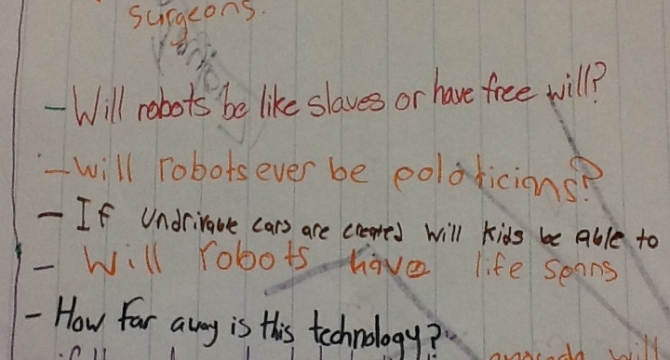
This was followed by an intense 25-minute discussion and sharing of ideas many of which were highly insightful.
I then introduced students to the MIT MediaLab, which led to a fascinating exploration of robotics on the iPads, and more questions, comments and sharing. {My learning at that point: I should have had Twitter accounts on so students could share links as they went}.
Students explored their thinking on ethics, society, morality, points of view … and engaged in one of the most sophisticated discussions that I’ve witnessed among Grade 7 students. I am so sorry I didn’t record it.
Students were not intimidated by the level of language. They read what they could understand, skipped what they couldn’t and pursued paths based on their own interests. The material was rich! I then saw a need for students to consider the moral decision making of programmers, so this became our next day’s exploration. We began with a Strongly Agree/Disagree line. Students placed themselves somewhere on the line in response to this statement: Robots that can make decisions on behalf of humans are a good idea. Students explained their positions on the line and could change their positions in response to what they heard. (Teachers must have an array of strategies for getting students to engage in conversation and share their points or view).

Students then went back to collaborative groups to wrestle with this question: What would the programmer have to value to allow the driver to survive rather than the kids? This allowed me to reintroduce the idea of assumptions. “Let’s assume that a car that makes decisions on behalf of humans exists and that the accident between the bus and the car is going to happen”. Students explored their thinking on ethics, society, morality, points of view … and engaged in one of the most sophisticated discussions that I’ve witnessed among Grade 7 students. I am so sorry I didn’t record it.
We are also making use of talents and opportunities within the school. I have arranged a switch with the Grade 4 teacher, Mr. Bell, who uses Lego Robotics with his students. I will take his class for a half day to work with the iPads and he will take mine. Having colleagues who are flexible is key to innovation in any school.
This experience left students with many unanswered questions and a desire to speak directly with people who work in robotics. This led me to show students how to use a network to access information and people. Noah contacted Clive through Twitter and asked if he knew anyone at Google Car. Clive offered to contact someone but told us that people at Google were very busy. We continued to seek contacts and I was referred to Marcel at Carnegie Mellon who pointed me towards Illah and a whole new field of learning. We are waiting to hear back from Illah.
We are also making use of talents and opportunities within the school. I have arranged a switch with the Grade 4 teacher, Mr. Bell, who uses Lego Robotics with his students. I will take his class for a half day to work with the iPads and he will take mine. Having colleagues who are flexible is key to innovation in any school.
Reflective practice and blogging are essential to the evolution of my practice. Through writing this post, I realize that our next step will be an introduction to Design Thinking, Challenge-Based Learning and Class 71 devising solutions to the problems they’ve identified with moral machines.
http://en.wikipedia.org/wiki/Challenge-Based_Learning
http://en.wikipedia.org/wiki/Design_thinking
That’s my secret to innovative practice so far.
-
My Secrets for Innovating Classroom Practice – Part 1
Comments Off on My Secrets for Innovating Classroom Practice – Part 1Looking back, I would have to say my transformation was mandated. It began with the provincial overhaul of education during which teachers were obliged to abandon old practices and develop new ones based on “highly effective practices” (TLCP, flexible groups, accountable talk, and student feedback).
This was followed by my introduction to The Thinking Matrix and a light bulb moment where I realized that my job wasn’t to teach students how to write stories, articles, or persuasive letters, but to provide opportunities for students to think deeply, ask questions and use the tools of communication to express their thoughts in writing in ways meaningful to them and to engage in creative problem solving.
…I realized that my job wasn’t to teach students how to write stories, articles, or persuasive letters, but to provide opportunities for students to think deeply, ask questions and use the tools of communication to express their thoughts in writing in ways meaningful to them and to engage in creative problem solving.
With my focus now on providing experiences where learners have the opportunity to think deeply, things began to change.
Tied to this was my discovery of the power of social media. The work we did with the App project and Hannah’s Suitcase was highly experimental. As an educator, I discovered that social media allowed us to approach learning in new ways. We connected with a diverse global community. I now had quick and easy access to cutting-edge research and practices that I could implement immediately. My students could suddenly engage with expertise in any field and we found ourselves with an audience for our work. We began to make strategic use of social media to access exceptional learning opportunities that have impact on the world outside the classroom.
My professional learning focused on project-based learning, inquiry, design-thinking, Web 2.0 tools, critical thinking, solution-based and game-based learning, skills for collaboration and rethinking the use of classroom space.
What I didn’t do was wait for permission. I used my professional judgment as an educator and my personal desire for growth to develop innovative practices.
Based on what happens in the classroom on a particular day, the direction for the next day is determined. My students and I co-create the learning.
If I were to identify the single biggest change in my practice, I would have to say that when we begin an inquiry, we have no idea where we were headed or what final demonstrations of learning will look like. So much depends on what we learn along the way. My students engage in meaningful work that hasn’t been done previously, which makes it interesting for everyone. I would describe my work as responsive teaching.
Based on what happens in the classroom on a particular day, the direction for the next day is determined. My students and I co-create the learning.
Winning the Ken Spencer Award, the Mindshare Learning Video Challenge Award, and receiving recognition from the Globe and Mail as well as coverage in other media has certainly made what we do easier. Dundas Central Elementary has become known for its innovative work and our administration has become more responsive, accepting and most of all encouraging when we wish to try something new.
Please note that Part 2 of Heidi’s blog post will be shared in the near future.
-
Is school actually meeting the current and future needs of our learners?
Comments Off on Is school actually meeting the current and future needs of our learners?I walk the hallways at breaks and lunchtime and I overhear many students’ conversations. ‘… is so boring’, ‘I don’t see the point in …’, ‘I don’t want to go to …’. I observe students desperately asking their friends for answers to worksheets and textbook questions. Are they interested in learning or motivated by the threat of losing marks? I see tired and stressed faces. Did they stay up late at night engrossed in their learning? Or were they going through the drudgery of homework and cramming for a test?
I walk into classrooms and see students quietly gazing out the window, secretly glancing at their phones and mindlessly doodling on paper. Are they distracted or disengaged? I bump into regular ‘hall wandering’ students while classes are in session. Some tell me they are ‘going to the bathroom’; while others say they’re ‘getting supplies from their locker’. Are they being truthful or do they simply require a break from class where they can get up and move around? I meet with students in my office. Some of them display such lifeless, apathetic expressions. Why are their spirits so defeated? Why are they simply going through the motions of school? Others demonstrate frustration and negativity towards school. Why has school become a source of their frustration? Why are they so ‘anti-school’?
Our schools must equip learners with the skills necessary to not only adapt to but also influence this rapidly changing world they are growing up in. We need to move away from a system where subjects are taught in isolation of each of other, where content delivery is the focus, and where the teacher is seen as the expert and is the one who asks most of the questions.
Now don’t get me wrong. I know these examples don’t describe all students. But it does describe the norm for some of the students whom I work closely with. It’s clear that school just isn’t meeting the needs of ‘these’ kids.
Which brings me to a larger question. Is school actually meeting the current and future needs of our learners?
When I look at today’s high schools, I still recognize them as the same basic model as the one I went through over 20 years ago. And then I consider the world in which we live in. It’s a faster and more automated world, where knowledge is at our fingertips and information can travel across the globe at the push of a button. We are blessed with luxuries all around us. Smartphones, sports cars, online shopping and banking just to name a few. But this rapid progress and advancement have created changes in the workplace and society that demand new skills and competencies. Routine, assembly line type work that requires learning simple repetitive skills and memorizing basic information has become a thing of the past. The application of knowledge, critical thinking and creative problem solving is now more important as the world of work shifts to non-routine tasks.
This places new demands on education. Our schools must equip learners with the skills necessary to not only adapt to but also influence this rapidly changing world they are growing up in. We need to move away from a system where subjects are taught in isolation of each of other, where content delivery is the focus, and where the teacher is seen as the expert and is the one who asks most of the questions.
Rather than asking learners to work towards one ‘right’ answer, we must grow comfortable with there being many answers to students’ questions. And, our practices must support the idea that learning is a process, often one that is messy, non-linear, and will likely include unlearning and relearning.
We need to create a system that encourages students to pursue personally meaningful challenges and initiatives that are relevant to their lives, values students asking big questions to which the teacher doesn’t have the answer, provides students some autonomy to follow their own inquiries and enables students to amplify and share their learning through the use of technology. Similar to real life, learning at school should integrate the many traditional disciplines, allowing students to shift naturally and apply knowledge and skills from different disciplines in order to answer their questions. Rather than asking learners to work towards one ‘right’ answer, we must grow comfortable with there being many answers to students’ questions. And, our practices must support the idea that learning is a process, often one that is messy, non-linear, and will likely include unlearning and relearning.
To put it bluntly, the pressure is now on us to collaborate on new designs for learning that will engage both students and teachers!
We need to stop worrying about what others think school should look like and start imagining what it could look like. We mustn’t shy away from big steps or our bold vision. Now, more than ever, we need innovation in education!
-
The Future is Here: Ready or Not
Comments Off on The Future is Here: Ready or NotThere is a biblical saying about no man being a prophet in his own land (Matthew 13:57) that I like. It would seem that people have been thinking about resistance to change for thousands of years. Why do we resist change? This has been one of my central questions, or obsession, for some time. Popular wisdom would explain fear, threatened egos and a desire to protect the status quo as the reasons for resisting change. Rob Evans, clinical psychologist and consultant to stakeholders in education told the audience at Building Learning Communities conference in Boston two years ago that teachers experience change as a sort of grief process. Before change can happen, they have to let go of ‘old’ ways and cope with loss. My own answers to the question of why we resist change currently lay in brain research but the source or veracity of the answer is not as important as hearing the loud voice of the evolutionary imperative admonishing educators, schools, administrators, governments and those who have the power shape the learning experience of students to “adapt or die”.
Pedagogy needs to serve the student, not the teacher or the textbook
Read any of the popular books on innovation in business, for example Phil McKinney’s Beyond the Obvious. As you read, substitute ‘client’ for student and ‘product’ for pedagogy. If you can endure some internal discomfort created by superimposing a business model onto education, the idea that pedagogy and instructional design needs to fit the needs of our students (clients) becomes a useful metaphor. Continue reading further to understand that successful businesses pay very close attention to the needs of their customers. When the customer loses faith in the product, the business is in danger. “Yes, but school is not a business” you say? “Wait and watch what happens when students understand that they can access learning anywhere, anytime and on demand”, I say. The digital age has released information and knowledge from the prison of the page (David Weinberger “Too Big to Know”) and that is changing everything.
When the customer loses faith in the product, the business is in danger. “Yes, but school is not a business” you say? “Wait and watch what happens when students understand that they can access learning anywhere, anytime and on demand”, I say.
I remember the day when I realized that everything had changed. I was introducing some ideas about sociology to a Grade 11 class and referred to a famous study of behaviour in public restrooms when I faltered and was unsure of the author’s name. Mason, my ever-eager student said, “Wait Miss. Let me check that for you!” At that very instant, as I looked out over the 21 students behind 21 laptops screens, I realized that I had become accountable to the truth and learning in a radical new way. When fact checking and information recall is one click away, teachers need to rethink how and what they teach. In the ‘Land of Google’ where students drink from the fire hose of information, teachers must ask the ‘killer questions’: Why is this important? How is this relevant? And what will they remember about this in five years hence?
When fact checking and information recall is one click away, teachers need to rethink how and what they teach. In the ‘Land of Google’ where students drink from the fire hose of information, teachers must ask the ‘killer questions’: Why is this important? How is this relevant? And what will they remember about this in five years hence?
Students in higher education have new choices today in how they learn. MOOCs and open courseware, online universities and blended classrooms were not on the learning landscape horizon only a few short years ago. The student (the consumer, the client) can access learning anywhere and personalize it. This fundamental shift in the availability of information made possible by the digital age is changing education. Schools, teachers and all stakeholders of the educational process need to see that the ground is shifting. Just as the music industry and the traditional paper press has had to reinvent themselves, so do schools and teachers.
Moore’s Law and Education
Intel’s co-founder, Gordon Moore, observed that our energy efficiency for computer processing speed doubles every eighteen to twenty four months. His 1965 observation has remained true. In 1971, the Intel processor held 2,300 transistors and today holds approximately 560 million. This exponential growth of computational capacity has made our time in history unlike any other. Never before has technological change been so rapid. Today we speak of interactive technologies (such as Luidia’s e-Beam that turns a white board, a wall or even a floor into an interactive space) but it is very probable that within two years we will be speaking about immersive technologies, such as the Muse from Interaxon. This simple headband with sensors reads your brainwaves (EEG technology) and allows to see into their minds. It can interact with apps on an iPhone or iPad and even move physical objects using only thoughts. Imagine this in the hands of a child with ADHD who would benefit from learning cognitive control. This self-observation of mind states has incredible potential for transformation much like any meditative mindful technique (such as Kiran Bedi’s controversial and successful rehabilitation of Indian prisoners using Vipassana meditation).
So why would schools not want to harness new technology in the service of education? Change is not enough to meet the demands of this rapidly morphing learning environment where classrooms do not have to be physical spaces and teachers are not always adults with degrees. Innovation needs creativity, courage and vision. Innovation is disruptive and does not encourage compliance or uniformity. The future has arrived and adaptation might help you survive but innovation will ensure that you thrive.
-
My Guitar Class is More than a Class
Comments Off on My Guitar Class is More than a Class
The best advice about pedagogy I ever received came from one of my teacher-idols on the day he retired. Richard Dixon was the drama teacher at our school for more than a decade, taught in English classrooms before that, and was a jack-of-all-trades-and-grades teacher in B.C.’s north as a younger man. He was resolutely revered by his students and peers at every turn throughout his career; his retirement gala lasted over an entire June weekend in our school’s theater, and included songs, skits, speeches and one-act plays presented by students he had taught and people he had worked with going back thirty years and more than a thousand kilometers.
As a drama teacher, Richard employed the ‘black box’ theatre mode – sparse props and tech support, black backdrops and minimalism throughout – to bring life to his productions. He also wrote multiple original works for his classes to perform every semester.
Every. Semester. New plays, with roles and conflicts tailored to the individuals in his classes. They would rehearse for a few weeks, and then perform the plays, sprawling ensemble-monsters that spanned genres and themes from sci-fi to fantasy to slapstick to realism and back again, dealing with young love, fitting in, drugs and alcohol and the spectre of the future for parents and peers in matinees and evening shows where the students shone.
As a mode of teaching, Richard transcended innovationand went about continually inventing his classroom environment out of blank space and the unique personalities that filled it. And while many of these plays were banged out on a typewriter, and others were written into formatted word documents to be printed out and memorized, I always come back to believing that it is this type of invention and innovation our classrooms so badly need today, just as they always have.
What this process taught the students in his classes about themselves and one another, and their individual and shared roles in the world is something I doubt I have ever seen approached in other classrooms. As a mode of teaching, Richard transcended innovation and went about continually inventing his classroom environment out of blank space and the unique personalities that filled it. And while many of these plays were banged out on a typewriter, and others were written into formatted word documents to be printed out and memorized, I always come back to believing that it is this type of invention and innovation our classrooms so badly need today, just as they always have.
On his last day of school, Richard and I were talking about the new guitar class I was going to be teaching the following September, just down the hall from what would no longer be his classroom’s black box. I told him that aside from being excited at the prospect of the course, I didn’t know where I wanted to take it just yet.
“The important thing to remember,” he said, “is that every class you teach is just another opportunity for students to practice forming communities.”
And I think that this is what the best teachers have always done for their students: invent the possibility for communities of trust, of empathy and learning to be formed in their classrooms. They create the environment for action, collaboration, and innovation to take place, and for this innovation to be owned by the individuals and groups that fill these spaces.
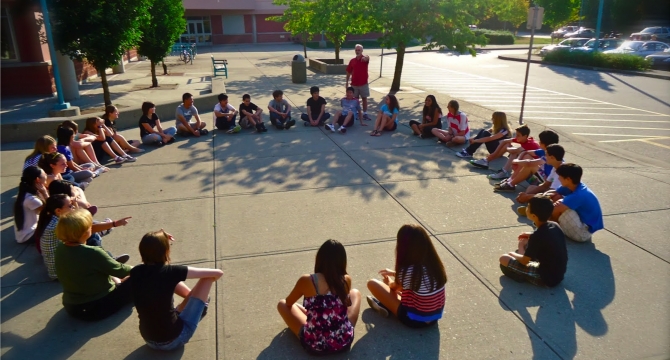
And I think that this is what the best teachers have always done for their students: invent the possibility for communities of trust, of empathy and learning to be formed in their classrooms. They create the environment for action, collaboration, and innovation to take place, and for this innovation to be owned by the individuals and groups that fill these spaces. It took two years of teaching the guitar course after Richard retired, but I eventually stumbled into a project that allowed me to see the thin edge of the wedge to establish just this sort of collaborative inquiry and problem solving in our school’s Introduction to Guitar course.
With the idea having hatched on the morning’s drive to work, I proposed to my students that we transform the classroom itself, the time we would have each day while the class met, and the nature of the tasks the group undertook together to centre around the age old teenage compulsion to create and express a personal culture and community in rock and roll. As a music teacher by experiential training only (I don’t read music, have never played in a band, and have conducted the entirety of my musical studies as a self-trained adult), I would focus my attention as a teacher on structuring the early phases of the project, and use my tools as a group leader to help the various Committee Chairpeople and elected Project Managers accomplish their goals.
Over the course of the last eight weeks of school – including a glorious month of June for the graduating seniors in the class – the group went about seeing what it might take, consulted with the people who might show us the way, and before our eyes brought The Bears into being. Various groups and individuals brainstormed prospective band names and logos, while others organized class votes and solicited songs and riffs that were brought to the wider group for rehearsal.

A tech crew learned to run our school’s PA system and made notes for how to rig the band’s lead guitars (such that they could be heard above the twenty-odd acoustics in the group). There was a group taking video of all of it, a group screening T-shirts and drafting up flyers to promote the gig the Bears planned to deliver following locker cleanout in the school’s foyer on the last day of school.
After the dust had settled and we were storing the gear back in the class, many of the Bears made a point of hanging around for a few minutes to take pictures with one another, shake their friends’ hands and otherwise just linger in the magical atmosphere the guitar classroom had been transformed into by their efforts.
“This class was more than a class,” one of the young men who was graduating told me on his way out the door. “Just what it was, I’m not sure. But it was pretty great.”
I’m beginning to figure out to how to do what Richard did in his theatre class, and how to provide my own students with an environment where they might become the innovators and inventors of themselves and their own worlds, breathe life into their own ideas, and figure out how to take their communities beyond the sum of their individual parts.
And even while I might have my own suspicions about just what it was that happened that semester, knowing that some of those students will spend months trying to put their finger on just what it was, or that some of them might spend years reflecting on how they contributed to its success, and that a few might even spend their lives figuring out how they might do it again is an inspiring thought.
It’s a thought that makes me realize that I’m beginning to figure out to how to do what Richard did in his theatre class, and how to provide my own students with an environment where they might become the innovators and inventors of themselves and their own worlds, breathe life into their own ideas, and figure out how to take their communities beyond the sum of their individual parts.
Because it’s innovation like this that’s been at the heart of our story as a species since it began, and one that should never be far from our classrooms as we go about preparing tomorrow’s minds
-
The Classroom Might Remain Relevant
Comments Off on The Classroom Might Remain RelevantAs an early career teacher in a tight job market, I’ve struggled to find consistent job opportunities. I‘ve had to be enterprising in the five years since I received my teaching certificate, moving from a fringe private school to an outdoor leadership camp, from a foreign language school to daily substituting, and to my current role as a long term occasional. I’ve worked in three school districts, dozens of high schools, and shared face-time with thousands of teenagers.
Walk around any public high school. You’ll see kids in class, thumbs tapping out texts, heads down on desks, raising their hands when they have the answer right.
While every classroom is its own unique space, I’ve noticed three recurring trends:
- Kids are either bored or institutionalized
- Teachers are either tired or ambivalent
- Administrative incentives maintain the status quo
Meanwhile, there’s a lot of talk about engagement. Engaged students. Engaged teachers. Engaged classrooms. Daniel Pink does a terrific job explaining why top-down management systems are ineffective at fostering engagement. In short, it’s useful when there are clear destinations to target. People will chase the carrot and avoid the stick. Engagement, however, is most likely when efforts are autonomous, relevant, and allow for mastery. These are dynamic circumstances with unclear destinations. Public schools are entrenched in prescriptive models of success, offering little chance to embrace the process of discovery.
None of this is new. So why is this the time for innovation? I can think of two reasons:
- Future generations require different skills sets
- Barriers to entry are falling
School has maintained its authority because diplomas have remained a gateway to prosperous adulthood. That’s becoming less and less the case. Capacity to follow directions and maintain responsibility remains useful, but it’s a less likely path to success. Instead, the requisite capacity is being able to manage complexity and make decisions in the face of uncertainty. Thriving adulthood has more to do with soft skills and autonomous living than it does with getting the gold star.
Of course, parents look to school because they want to keep their kids safe, put them in position to succeed as adults, offer them a chance to socialize, and assure their personal development. And there are things that kids want from school, including to have fun with friends and to experience success.
The barriers to satisfy these interests are falling. Increases in online curriculum, pathways to diploma certification, legitimacy of distance education, and illegitimacy of institutional authority are resulting in innovations that threaten to disrupt the status quo.
Can you imagine earning your high school diploma from the local karate club? Or an urban explorers’ club? Or a flexible network of edupreneurs? It’s become less and less costly to develop alternatives that serve more localized needs. While the institution incentivizes control and predictability, the irony is that relevant skills result from autonomy and self-direction.
School has maintained its authority because diplomas have remained a gateway to prosperous adulthood. That’s becoming less and less the case. Capacity to follow directions and maintain responsibility remains useful, but it’s a less likely path to success. Instead, the requisite capacity is being able to manage complexity and make decisions in the face of uncertainty. Thriving adulthood has more to do with soft skills and autonomous living than it does with getting the gold star.
My view is that the classroom can remain relevant. Many organizations have already transitioned away from prescriptive success towards intrinsic success because those are the qualities that the future requires. For me, that means supporting students to commit to goals of their own choosing, document their efforts as they go, and make connections between what they’re doing and the requirements of their course credits. As their teacher, I thrive in transitioning away from the role of director and administrator towards that of auditor and mentor.
The question to be asked is not ‘is innovation is required’, but ‘to what extent are you participating’?
-
A District Wide Blueprint for Change
Comments Off on A District Wide Blueprint for ChangeFour years ago, our district focused on “TechEd”, or Technology in Education. Today our focus has shifted to “EdTech”, Education enhanced by Technology.
This strategic movement meant that the focus was no longer on equipment – gone was the tech plan, gone was the laptop implementation plan, and gone was the focus on computer to student ratios. The Tech Plan was replaced with an interdepartmental discussion paper – BluePrint for Change – “Towards 2020 Connecting with our Students”. Symbolically, gone was the Information Technology Department and replaced by the Learning Technologies Department, where the focus would remain on learning, not on equipment. The title, Superintendent of IT, was replaced by Superintendent of Student Success – Learning Technologies. The term ‘21st Century Learning’ was replaced in our Board Priorities with ‘Learning in the 21st Century’.
We believe that the most important factor in student success is the classroom teacher and the professional relationship with each student in the classroom. As Michael Fullan points out in his book “Stratosphere”, the essential combination of: changes in pedagogy, knowledge of the change process, and technology, will help move an entire district rather than just having a few technology stars staggered across the district. True innovation means doing things differently and not just adding SmartBoards and Wireless infrastructure to an existing instructional model. We don’t want to use 21st Century tools with a 20th Century pedagogy. Content posted on a SmartBoard for students to take notes on their iPad – is not the type of change that we proposed for our Board.
Content posted on a SmartBoard for students to take notes on their iPad – is not the type of change that we proposed for our Board.
Our innovative practice included transitioning a traditional central library, to a web 2.0 library management system, and revamping the libraries from quiet locations that focused on the storage of books, to vibrant learning commons that focused on inquiry and student learning with flexible furniture and the availability of high interest print resources and rich digital media via mobile devices.
Changing practice also meant cancelling projects that were not aligned with our key Board priorities of Success for Students, Success for Staff, and Stewardship of Resources. Cancelled was the award winning robotics program, cancelled was the LeadIT laptop cart project, cancelled was the traditional refresh of computer labs. When we opened a new elementary school this past year, innovation meant that we ordered no desks, no reference books, no TVs, no VCR/DVDs, and no blackboards. In their place instead you will find, flexible modular furniture grouped for collaboration, digital resources, SmartBoards, iPads and Netbooks, and most importantly, a staff involved in a professional learning network to improve their teaching practice. Staff use web 2.0 tools to co-construct rubrics and to display exemplars, mobile devices to record student voice and to provide feedback, Google Docs to allow for collaborative writing, Google hangouts and Skype to connect with others around the Board and around the World. The result is a high level of engagement for both staff and students.
Our District transformation included changing policies to allow the use of social media by staff and students. Significantly decreased filtering practices occurred to allow the use of rich teaching sites including YouTube. Policies were changed to allow students to bring their own devices to school to assist with their learning. Inquiry learning for principals, superintendents, and teachers, focused on areas such as assessment, numeracy, or literacy. Within each of the inquiry questions there was a role for technology to support the change in teacher practice.
Our district of 37,000 students has over 28,000 mobile devices connecting to the wireless network each day. This statistic on its own is meaningless; however, a learning walk through classrooms will witness students using a variety of devices to focus on collaboration, to communicate, and to creatively problem solve.
Our district of 37,000 students has over 28,000 mobile devices connecting to the wireless network each day. This statistic on its own is meaningless; however, a learning walk through classrooms will witness students using a variety of devices to focus on collaboration, to communicate, and to creatively problem solve. Learning in the 21st Century is a vibrant and engaging process – one that requires much more than the investment in equipment.
-
Designing Creative Confidence
Comments Off on Designing Creative ConfidenceSo whenever I am asked a question, my response is to ask several questions back. Why do we need innovation in education NOW? What is innovation in education? What is the purpose of innovation in education? What is innovation?
At this point, with the knowledge I have, I would describe innovation as the use of insights to create ideas to implement systemic change. Let me go even deeper into what I mean about that. There are many ways in which you could activate on innovation, and I will describe just one of the ways.
As a designer and social entrepreneur, it is my job to be a multi-disciplinary thinker; I thrive on finding intersections from alternative spaces to start to explore opportunities, generate connections, and facilitate the process of taking ideas to action. I am a huge advocate for how design thinking for educators is the way forward. Design thinking understands the process of how we make decisions, collaborate across sectors, survey the true landscape of what is going on, view things from other perspectives, prototype ideas, learn from mistakes and build confidence in creativity. If schools kill creativity, let’s look at why? It is time to reclaim your creative confidence and get over the four fears that are stopping us, “fear of the messy unknown, fear of being judged, fear of the first step, and fear of losing control”, Tom and David Kelley, of IDEO.
The number one thing stopping innovation from happening is; ideas are nothing without execution.
I bet you are thinking, first you need an idea before there can be execution. You are right. Ideas in innovation in education have been floating around for a long time. Did you know that Sir Ken Robinson’s first report “Learning Through Drama: Report of The Schools Council Drama Teaching Project” was produced in 1977? How did I know that? Well, Wikipedia of course! There is more information accessible now then there ever has been before. Ideas are simply everywhere. But who is taking those ideas to action? Who is going to make that big jump?
I am going to take a stance; the ideas are out there and we are being asked for a revolution, according to Sir Ken, but I think the revolution is going to come in small waves; from the ground up, from the corners of the system, from the fringes, from the Islands of Excellence. It is the swell of good stuff that pushes the edges, that inspires more, and lets us learn!
I am going to take a stance; the ideas are out there and we are being asked for a revolution, according to Sir Ken, but I think the revolution is going to come in small waves; from the ground up, from the corners of the system, from the fringes, from the Islands of Excellence. It is the swell of good stuff that pushes the edges, that inspires more, and lets us learn!
Innovation is going to feel uncomfortable. It is entering the unknown, testing out an assumption, relying on the tingly senses deep in your intuition, asking for help, sometimes making a fool of yourself but then persevering through the trenches of nerves and finally being able to look back and say “Wow!”
That “Wow!” means so much. It means you did it, it means you put yourself out there just a bit more, you experienced the thrill of the unknown, imagined a different future, and most importantly put an idea into action.
We are all part of the future of education,. We have to rise above the fear and challenge our relationship with failure. Not only is it time to reclaim our creative confidence, it is time to reclaim failure too. For too long, failure has had a bad reputation and it is time for a comeback. Admitting failure is the first step to embracing all that can be learned from mistakes.
Innovation in education is going to come from every level of the system. It is not going to be easy. It is going to take time and it will be substantially worth it.
Call to Action: Go out there and try out an idea you have been thinking about for a long time or even a short time, find people to help you out, talk about your idea, make a plan of attack, don’t worry about failing – it will be great! And don’t forget to share on #IOE2012
-
Striking the Right Balance Between Innovation and Improvement
Comments Off on Striking the Right Balance Between Innovation and ImprovementWriting in Education Canada last year, Ben Levin made an interesting distinction between innovation and improvement as they relate to education. Noting that “too much focus on innovation could distract us from what is both possible and desirable in order to pursue goals that may be desirable but are not very possible”, he suggested a balance between the two, erring on the side of exploiting what we know (improvement) versus exploring what we don’t know (innovation).
Striking the right balance between innovation and improvement is important for a host of reasons – advances in the science of learning with corresponding implications for pedagogy; finding ways to meet varied and complex student needs, and adapting teaching to the learning styles of an increasingly diverse student population; preparing students to meet the challenges of a complex, diverse, uncertain global world.
Many factors can hinder education innovation. For example, compliance with externally imposed data-driven accountability mandates favouring short-term gains on narrow measures of performance is not conducive to allowing teachers to explore different pedagogical approaches in their classrooms.
In general, being innovative is equated with new technology in the business world – designing a new application for the growing number of digital devices on the market. It seems that innovation today is all about the quest for the next big App.
Similarly, innovation in education, tied to vague notions of 21st century learning, is often viewed as the use of technology in schools. As innovations go, technology in schools does not have a stellar track record.
Many factors can hinder education innovation. For example, compliance with externally imposed data-driven accountability mandates favouring short-term gains on narrow measures of performance is not conducive to allowing teachers to explore different pedagogical approaches in their classrooms.
This may be because, as Ron Canuel observes in his blog post, efforts to use new technologies in the classroom have focused on equipment and infrastructure at the expense of the inter-relationship among pedagogy, curriculum and technology. For example, since 1998, Alberta has spent nearly $2 billion on technology for schools, mostly for hardware with a small percentage of these investments allocated for teacher professional development.
Ensuring optimal conditions of professional practice are in place to allow teachers to effectively use new technologies to truly enhance teaching and learning is critically important. This includes providing access to up-to-date equipment and other technological resources, ensuring equitable student access to technology, increased technical support, and provision of appropriate, ongoing and timely professional development and training to enable teachers to keep up with the rapid pace of technological change and utilize new technology to effectively support learning.
Teachers also need time to experiment with technology, and they must be supported in using their professional autonomy and judgment to determine the best use of new technology to support learning. And as Hargreaves and Fullan put it in Professional Capital, we need to focus on curriculum and pedagogy as the “drivers” for learning, with technology as the “accelerator”.
Teachers also need time to experiment with technology, and they must be supported in using their professional autonomy and judgment to determine the best use of new technology to support learning. And as Hargreaves and Fullan put it in Professional Capital, we need to focus on curriculum and pedagogy as the “drivers” for learning, with technology as the “accelerator”.
All of this needs to be grounded in a bold vision of the future of public education in Canada – what kind of Canada do we want, and what kind of education system will get us there?
I recently heard Stephen Murgatroyd speak on the subject of technology in the classroom. He summed up the challenges we face in this way: How do we leverage current and rapidly emerging technologies to increase the quality, depth and meaning of adult-student interactions in education, and to increase student engagement with learning, knowledge and understanding so as to encourage their passion for learning?
Perhaps it’s time the debate about how we create the conditions for educational success for all students – through both innovation and improvement – became itself a little more innovative.
-
Innovation is the Beautiful Chaos that 28 Young Learners Create
Comments Off on Innovation is the Beautiful Chaos that 28 Young Learners Create“When we are no longer to change a situation; we are challenged to change ourselves.” Victor Frankl
Imagine the beautiful chaos that a class full of 4- and 5-year-old learners can create as they hypothesize, inquire and explore their way through a full day of learning. In early October, I was talking about that very thing with the teacher and early childhood educator from one of our Full Day Kindergarten teams. They articulated the challenges of capturing this learning and expressed how the tools that they had believed they would be using in their classrooms were not quite up to the task. Together we wondered how to document, share and connect this rich, varied and deep learning?
That’s the thing about learning when it happens in an authentic context that is driven by the learner; it’s difficult to capture, synthesize and share the magic – so difficult that we tend to manage the chaos by regulating the learning and confining it to tasks and tools that are easier for us to control and measure. It’s not done with malice; after all, how many of us were trained to lead classrooms where individual learners are asking their own questions and engaging in their own inquiries? Or, how many schools or systems are designed to provide the resources and support for teachers use their own questions to guide their professional inquiries?
That’s the thing about learning when it happens in an authentic context that is driven by the learner; it’s difficult to capture, synthesize and share the magic – so difficult that we tend to manage the chaos by regulating the learning and confining it to tasks and tools that are easier for us to control and measure.
Innovation involves assessing the current reality and changing aspects of that reality so improvement and efficiency can occur. That is why, for me, innovation in education is so important. Our children are challenging us to think and act differently about learning; the ways we design learning spaces, the tools we use and how we mobilize our professional knowledge. They are inviting us to join them and shift our beliefs on how we plan for learning, how we document learning and how we connect this learning with the world of ‘school’ and beyond.
Let’s return to the classroom. The beautiful chaos of our 28 young learners has opened an inquiry for the two young educators who posed the problem of practice back in the fall. They are exploring the ways they can use iPads to document the learning process in the classroom; through video, photos and audio they share this learning with each other, the students and their families. They are watching more and talking less, asking more questions and giving fewer directions; there is less whole group teaching time on the carpet and more small-group and one-on-one instruction at the learning centres – still beautiful, but with less chaos.
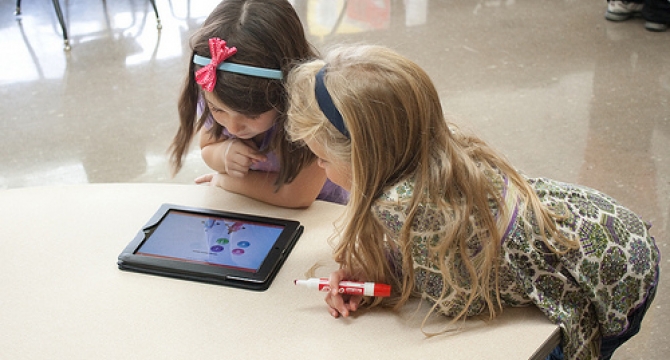
CC photo courtesy of: MikeOliveri
Public schools must be places of inclusion where each child’s talents and assets are known and acted upon and where the questions of the learner are the starting point for inquiry. These are ideas that challenge each of us involved in public education to change and innovate. It is the most important work we need to do and many of us have already begun – have you?
-
Classroom Innovation Means Giving Up Control
Comments Off on Classroom Innovation Means Giving Up ControlNewton’s First Law of Motion:
An object at rest will remain at rest unless acted on by an unbalanced force. An object in motion continues in motion with the same speed and in the same direction unless acted upon by an unbalanced force.
This law is often called “the law of inertia”.
-
Innovation in Education Through Failing
Comments Off on Innovation in Education Through FailingWe are indeed living in interesting times. Never before have we seen such widespread agreement across countries around the globe that the key lever for their economic futures is education; just not the type of education we currently have. Such a paradox must surely challenge our long held beliefs in upholding the status quo. Indeed it would seem the question is no longer should we change the education our young people are currently receiving, to rather, by how much should the change happen.
Indeed it would seem the question is no longer should we change the education our young people are currently receiving, to rather, by how much should the change happen.
To date, it’s fair to suggest incremental would be the most optimistic way of describing the change that has taken place in a limited number of schools to date, rather than anything fundamental, radical or disruptive. Yet as we let the years go by, debating the nature of change, its virtue and the possibilities, legions of young people continue to march their way through our schools, tolerating traditions that have long lost both their meaning and purpose.
So now we see a new entry point to the dilemma, called Innovation. While it is largely semantics to review to what extent change, innovation, reimagining, rethinking et al are targeting similar end points, though taking different journeys, it seems that innovation is the most palatable to educators and educational leaders.
I recently asked a global audience of teachers, ‘when was your last failure?’, and was met with largely blank stares. At the recent New York Maker Fair, Seth Godin referred to the value of ‘learning by doing things wrong’…which after all is the way that most of us learn, most of the time? Not just in an academic sense but even more so in physical sports or crafts, cooking or trades we are continually learning by doing things wrong, because…we take risks; we try something out to see if it works; to see if we can do it well…yet how often do we see that practice encouraged within our schools?
So now we see a new entry point to the dilemma, called Innovation. While it is largely semantics to review to what extent change, innovation, reimagining, rethinking et al are targeting similar end points, though taking different journeys, it seems that innovation is the most palatable to educators and educational leaders.
In such presentations I like to talk about one of our best-known ‘failers’, James Dyson. While vacuuming his home, he became frustrated with the lousy suction of his vacuum cleaner. The bag and filter clogged too quickly, reducing the suction to the point where it didn’t work. Over 15 years, he built 5,126 prototypes before he found the one that worked – 15 years and 5,126 failures. How did he find the solution? “Wrong doing.” His mantra… fail fast, and iterate to another possibility; be agile, don’t spend all your time planning something that might be based on wrong design assumptions; develop a Minimum Viable Product and try it out. Do we ever think that way about innovation in our schools?… because that is the way large companies today develop new ideas, new products and new services. I wonder if Dyson had reflected on his school experience as being lousy, would he have innovated for a better solution 5,000+ times until he found one ‘that worked’? No he wouldn’t, and none of us ever do… not 5,000 times, but sadly for most, not even once… and yet we generally agree too much of what we offer is lousy.
If you work at Valve, one of the largest online gaming companies in the world, they state very clearly in their New Employees Manual…”No-one has ever been fired at Valve for making mistakes. It wouldn’t make sense for us to operate that way. Providing the freedom to fail is an important trait within the company. We couldn’t expect so much of our individuals if we penalized people for errors. “ Could it be that our loathing of failure within schools results not so much in high standards, but rather low ones?
You see, I think any discussion around innovation in our schools, across any dimension, within the projects, pedagogy, or whole school reform, but first embrace the concept of learning from failure, from doing things wrong. Building a culture that supports risk-taking – an anathema to many school leaders. Until we can do that, we will continue to be limited to marginal instrumentalism, which will aggravate the problem rather than solve it
-
Maybe I’m In an Innovation Echo Chamber
Comments Off on Maybe I’m In an Innovation Echo ChamberA confession: I get really excited when I read about innovation in education and innovative teachers. I get excited about things like the CEA’s What Did You Do in School Today? initiative.
Some people turn cartwheels when the latest real estate stats come out. Not me – I’m an education innovation junkie and I can stand up and shout it from the rooftops.
Ron Canuel’s question, “Why Do We Need Innovation in Education” is just the sort of thing that gets me pacing the floorboards.
When I thought about writing this post, I also thought a lot about definitions, and how mine might be different than yours. What is innovation??
MAYBE innovation is using and experimenting with new tools that can improve the education experience for students, teachers and parents. The new tools might be technologies – like blogging platforms as a way to promote literacy, communicate with the world outside the classroom, and build a digital profile in a world where that online footprint is a critical piece. The new tools might be better-designed spaces that respect learners’ physical and psychological needs, their safety, and environmental considerations. The new tools might be platforms for collaboration & self-improvement; for establishing real-time/anytime Personal Learning Networks beyond the standard monthly meeting format so that learning happens when we’re ready and when we have time, and with people beyond our usual geographical reach. These platforms are open and available whether you are a parent, teacher, or student. They are available whether you’re in rural B.C., inner city Regina, or suburban Montreal.
MAYBE innovation is putting new, good research into practice. Taking what we now know, and reflecting it in the way we perform our jobs, treat professionals, and design programming for our learners. Things like emerging neuroscience that begins to unlock the mysteries of the teenage brain, and reveals the specific needs of learners at that critical age. The impact of exercise on the brain, and how that relates to the amount of time that students spend moving vs. sitting in a day. New thinking on creativity, and how to encourage it. Language acquisition. Careers and guidance support that opens up futures rather than closing doors and building silos.
MAYBE innovation is being open to hear important new voices. I think about the student voice – the actual “user” who sits through the day of classes, uses the resources provided, and is ultimately accountable for his/her performance. The community voice – where there may be a goldmine of perspectives, skills, and services that can support schools and teachers and students when resources are scant, and when they have something important to contribute. Integrating the voice of new creators beyond the established school network of publishing giants, where board resource decisions can be cemented during yearly golf tournaments. And last but not least, the voice of the new teachers who come out of their training fresh, ready, and keen, and are then quashed by stubborn school structures and superiors who feel threatened, resistant, and unwilling to listen.
If we know that the current standardized testing methods don’t lead to student achievement and engagement, then why can’t we change it? Why can’t we knock tired, old paradigms off their lofty pillars and try something new?
MAYBE innovation is planting the seeds for the future and setting up systems that push the status quo, that force questioning, and that intend to disrupt the things that we know don’t work because they aren’t working, aren’t meeting the needs of students, and we need to do something better. If we know that the current standardized testing methods don’t lead to student achievement and engagement, then why can’t we change it? Why can’t we knock tired, old paradigms off their lofty pillars and try something new? We don’t have to accept what we have the power to change, if we think in terms of innovation and openness. Why do we feel that we are locked down? If we really take a look at the world and how our learners will make a place in it, we can’t resist change to protect our egos and our jobs and to avoid feeling uncomfortable because the change is really hard.
I like shiny things. I like change, movement, innovation, being uncomfortable and doing something about it. A good friend of mine recently changed jobs, surprisingly, because he wanted to feel that discomfort that comes with new learning, like an itch that can actually be scratched by inserting oneself in a totally new environment.
I spend a lot of time on Twitter, looking for information and connecting with people. I am in an echo chamber, but that’s how I like it, because I see such good stuff and I feel part of a movement that takes innovation in education seriously. I see my colleagues and connections wax extremely elegantly in blogs, in presentations, and in conversations.
However, it takes me away from reality and what is actually happening, and then I get frustrated when the new, the change, the movement isn’t happening where I am. As a parent I am involved, and as a child, sister, niece, and friend of teachers I feel like I have some inside information, but I have deeply invested myself in education and in dedicating my work to pushing the agenda.
We ask students to approach a math problem from a variety of positions, to explore, to estimate, to talk it out, to work together, and to use new strategies. Can we, as parents, teachers, and school leaders, tackle what needs to change in our school system in the same way?
We ask students to approach a math problem from a variety of positions, to explore, to estimate, to talk it out, to work together, and to use new strategies. Can we, as parents, teachers, and school leaders, tackle what needs to change in our school system in the same way?
So in my real life, my own kid brings home homework like writing a sentence a day. Memorizing a list of spelling words – a giant project that will require me to spend $50 in supplies from the art store and the hardware store. Things that suspiciously look like busy work.
In my digital life, I see teachers setting up Minecraft servers, or writing about their students’ digital portfolios. Connecting globally on collaboration projects.
In my real life, I have an agenda book to sign every day. In the past, I’ve been unable to email a teacher because that teacher has decided not to learn how to use email.
In my digital life, I see systems that bring together schools, students, and parents in communication portals. I see teachers who participate in weekly Twitter chats to enhance their knowledge of their subject areas.
How do I support innovation in my own backyard without being a nag, and a thorn in someone’s side? Do I have the right to push as I do? To call people out? To ask why, and why not? Why do I have to keep asking, and asking again why Alfie Kohn’s research on homework doesn’t manage to trickle down into the practices in schools, and not get an answer, and home come the worksheets?
Why can schools and teachers opt out of innovation?
When will we see an end to the disparity?
-
CEA Blog Focus on Innovation: Week One
Comments Off on CEA Blog Focus on Innovation: Week OneAs expected, the first week of CEA’s blog campaign related to innovation in public education presented an interesting mix of voices, with each author offering a perspective steeped in their own set of unique experiences, values and passions. Although each this contributor admitted an awareness of the systemic challenges inherent in attempting to build an innovative spirit within Canada’s public schools, each entry presented a different angle and a unique opportunity to view this moment in time a little differently.
Bruce Beairsto started things off with a recognition that, while the freedom to innovate has always been part of the individual life of teaching professionals, systemic barriers often prevent these ideas and approaches from spilling out of individual classrooms to affect a whole lot beyond the local school. Beairsto calls for a disruption of some of what makes school practices so comfortable, so familiar and so resistant to substantial change. The support of stronger cultures of collaborative practice, coupled with a systemic recognition that professionals need time built in to their work—time for professional reflection and learning, and grounded in a stronger, more dynamic connection between the classroom and the university are three important structural changes that, according to Beairsto, would result in greater support for an innovative spirit.
The call for systemic change was echoed later in the week by Sandi Urban-Hall, current President of the Canadian School Boards Association. Urban-Hall shoots an arrow directly into the heart of the conversation by grounding her call for systemic change in the demand that educational opportunities not be a function of geography or social standing, but the right of all students. Ultimately, this is going to require that elected school boards be given the resources and authority necessary to respond courageously to the needs of their individual communities and contexts. Only then will our school systems be able to match the type of innovation that is occurring in most other arenas of the Canadian social life.
David Price has a proven track record as a persistent and radical innovator, and believes strongly that the moral imperative to discover and offer the best to each of our students is too strong to be diminished by systemic resistance. In Price’s mind (and experience) innovation provides an important source of engagement for both students and educators, involving participants in something compelling and exciting. It is clear to him that current models of education are lacking in this regard, and are quickly being overshadowed by resources, approaches and technologies now readily available beyond the schoolhouse. For David Price, the fact that innovation does not appear to be well-supported in public education should not serve as an excuse or a reason not to pursue it!
Finally, Ben Levin admits that, while all organizations need a certain degree of innovation, the number of failed initiatives scattered across the history public education demand of us a greater sense of caution and thoughtfulness when considering what should be supported by our systems. In particular, there needs to be a reasonable expectation that an innovation will be likely to succeed before jumping in with both feet. Research-based evidence, professional wisdom and good theoretical grounding are presented as three of the prime criteria for evaluating potential initiatives. Just as important for Levin, however, (and this will resonate with many) is the idea that, once the effectiveness of an idea has been proven, it should be adopted and supported system-wide.
There is a great deal of wisdom in each of these responses. From the tempered and somewhat cautious approach of Ben Levin to the spirited and dogged attitude of David Price, the week’s contributions lay some important groundwork for the conversations that will follow during the month of December. For me, some of the essential questions that need to be asked have to do with the type of system that is going to provide the best chance of attaining the ideals of equitable opportunity expressed by both Sandi and David.
And while talk of structural change is important what ends are being best served by this change? Higher achievement scores? Increased graduation rates? Greater levels of engagement? A more democratic society? Happier citizens?
So, as we move into week two of the discussion, I invite you to consider a few questions that might act as a way of connecting some of the threads presented by our authors over the past week. You may feel compelled to jump in with some responses, or you may have your own emerging questions that could be even more helpful in moving the conversation forward.
Here are some of the ideas going through my own mind:
- What “modern” examples of educational innovation-that-has-taken-root are you able to identify? What has enabled these to find a home?
- What have been some of the most promising innovations with which you have been involved? As an educator, a parent, a student, an administrator?
- What one change to the structure/organization of schools would have the most impact on encouraging the type of innovation that you might like to see?
- What is standing in the way of that one change being made?
- In your mind, what is the essential difference between innovation and improvement? Is it an important distinction to make?
-
Innovation requires the understanding that learning takes place every day; everywhere.
Comments Off on Innovation requires the understanding that learning takes place every day; everywhere.Depending on whom you ask, innovation will mean drastically different things. When discussing “education innovation” you will elicit, at minimum, a public debate if not one rooted in longstanding organizational or political “positions”. There lies the rub. We, collectively, need to get past our territorial positions and examine the purpose of public education and how we ensure that students will aspire to reach high standards. Starting with the belief that “all students feel safe and are safe; that they have similar opportunities to dream; to learn and to achieve regardless of where the live or their personal circumstance” – demonstrates that the publically funded education system must look at how education is delivered. By accepting that belief, you accept that we cannot deliver education in the “same old way”. Reflect on the education system when you were a student – how many students dropped out; how many students requiring intensive supports were in your classroom? It was acceptable for the education system to forget about the students who didn’t fit the model of instruction.
When you walk into a classroom, does it look or feel much different than when you attended? Now look around your home, what has changed? How have you embraced innovation in your home and lifestyle? What has changed since you were a kid? I’m forty-something and the changes within my lifetime are staggering. Yet, over the same period, what systematic changes have we seen in the classroom?
When you walk into a classroom, does it look or feel much different than when you attended? Now look around your home, what has changed? How have you embraced innovation in your home and lifestyle? What has changed since you were a kid? I’m forty-something and the changes within my lifetime are staggering. Yet, over the same period, what systematic changes have we seen in the classroom?
There are individuals who are very innovative in their teaching practices – but why hasn’t there been systematic change? When I ask my colleagues and other educational leaders, I hear the litany of constraints. Disagreements surrounding assessment practices; organizational positions; public expectations; dependency on provincial governments for funding; media “shock and awe”; fear of change and the “when I went to school” mentality ties the system in knots and throws the brakes on real change .
Innovation is more than technology. Innovation includes the teaching of the 3 R’s and embraces the 7 C’s (Creativity, Innovation & Entrepreneurship; Critical Thinking, Collaboration, Communication, Character, Culture & Ethical Citizenship, and Computer & Digital Technologies). It requires the understanding that learning takes place every day; everywhere. It is the acceptance that we all grow and learn in our own way in our own time. It is the acceptance that what served us well in 1950, 1980 or 2000 may not serve us well today. Innovation is the ability to wrap kids in a safe learning environment that inspires and challenges them; a learning environment that prepares them for a future we can’t imagine. Innovation is happening in individual classrooms and in small geographic pockets throughout our country. For real change – dramatic change – systemic change – change has to happen at the policy level – with the elected – at all levels.
I have witnessed Boards of Education demonstrating courageous leadership and making foundational changes within their system only to be pulled through the courts of public opinion and forced back to the traditional education model.
I have witnessed Boards of Education demonstrating courageous leadership and making foundational changes within their system only to be pulled through the courts of public opinion and forced back to the traditional education model. Education needs the help of community and business leaders to press government to allow education to evolve to meet today and tomorrow’s needs. Governments must return the reigns of education back to boards of education rather than continue the slow and methodical strangulation that increasing centralization is imposing. Boards require the ability to build a climate that encourages and supports innovation; a system that responds to the needs of individual students and communities. Incremental tweaking of the current system will not work.
Boards of Education cannot wait for Government; we must do what we were elected to do – to Lead. So how do we kick start this level of change? By Embracing It! Through Advocacy! Through Leadership! By defining outcomes not outputs. Student engagement and success depends on it.
n.b. The opinions expressed in this blog post are those of Sandi Urban-Hall and not of the CSBA.
-
Innovation in Education: Why Don’t The Game Changers Change The Game?
Comments Off on Innovation in Education: Why Don’t The Game Changers Change The Game?Ron Canuel recently asked ‘why do we need innovation in education?’ I’m an Editorial Board Member of CEA’s flagship publication, Education Canada, so I have to declare an interest in blogging about this. But it’s a perfectly valid, if surprising, question to ask. Surprising, because it’s hard to imagine captains of industry asking themselves ‘do we need more innovation in (say) manufacturing? Or medicine, or technology? But it’s valid to ask, because so few education innovations seem to stick, and scale-up. The ‘game changers’ rarely seem to change the game.
Ron, himself, gives one good reason for the comparative lack of innovation: that accountability frameworks don’t recognize innovation as a yardstick to be measured. So, education systems tend to value compliance , conformity, even complacency, above experimentation.
He’s right, of course, though just because we’re not being rewarded for innovation, is insufficient reason not to do it. Educators have a moral purpose – to strive to find the best learning for each individual in their care – and that should always trump keeping governments off our backs. That takes courage, of course, and school leaders, especially the less experienced ones, need time to build their courage. A Head Teacher of a highly innovative school in England, was taking a bunch of visitors around the school this week. He was asked ‘what progress have you made this year against the targets from the last OFSTED (our national inspections agency) visit?’ ‘None’, came the reply to a confused silence. ‘We haven’t tried to – it’s not important’. If only we had more school leaders who showed such determination not to be blown off-course by the constantly shifting winds of government. School leaders have a lot more autonomy than they often claim to have. But because it’s such a tough job, it’s sometimes frankly easier to work to the targets and priorities someone else has set for you, and blame them when it doesn’t work.
There are, however, another couple of explanations for the lack of innovation.
First, there’s the dreaded ‘guinea-pig’ syndrome, where any attempt to try something new is met with ‘so you’re going to use these children as guinea-pigs in your experiment, are you?’ I’m baffled by this reaction (and parents and politicians are equally guilty here) for two reasons: First, how many medical breakthroughs would we have missed if people had refused to take part in clinical trials? More accurately, it’s not the patients who are refusing the clinical trial. Kids generally enjoy being part of a new initiative. It’s the guardians of their interests who resist.
Second, there’s the ‘not-invented here-syndrome’ . Most of the truly exciting innovations in education are trialled on the ‘terminally ill’: the students for whom nothing seems to be working. But the treatment would work just as well on other students. The CEA have recently rewarded one such initiative: The Oasis Skateboard Factory. This is an alternative school in Toronto for kids for whom mainstream schooling just doesn’t work. I urge you to take a little time to watch it. Listen to Craig, the founder of the school, and listen to the students. And then tell me, what is it about this innovation that wouldn’t work in mainstream schooling?
It’s such a compelling argument for offering some kids (if not most) a more authentic, project and enterprise-based approach to learning. My experience of showing new models of learning to educators, or policy makers, usually gets the same reaction Ron Canuel refers to: ‘that’s interesting, but it wouldn’t work in our school’. When the Musical Futures model I helped develop was drawing attention from schools in other countries, I did the politically correct thing by saying that cultural contexts would need different approaches, and that student outcomes would probably be different. But, inside I was thinking, ‘kids are not that different all over the world, so this should work just the same, wherever you are’. The reality has been just that. In seven countries the impact on kids is pretty much the same, wherever you go, for the reasons stated so elequently in the Oasis video.
I’ve been researching business models of innovation for the book I’m writing, and it’s fascinating to observe the ‘innovation gap’ which blocks change. Sometimes it’s structural/cultural – disciplinary silos, circling the waggons with’professional standards’ (most innovations come from outside), specialists viewing attempts to change their established ways as implied criticism). Sometimes it’s managerial – CEOs of innovative companies (think Steve Jobs) spend twice as much time personally involved in innovation, than their counterparts in less innovative companies. You have to model the change you wish to see.
So, there are some long-standing reasons why innovation gets blocked, or fails to transfer. But these aren’t as insurmountable as we often proclaim, and we can’t let them get in the way. As to the orginal question being posed, here are my five top reasons why we need innovation in education:
1. Because student outcomes are flatlining in countries where the ‘do more, work harder’ dictat, combined with market-driven approaches from governments, drove innovation out of the sector and replaced it with fear. We need some new ideas.
2. Because, as educators, we’re in direct competition with the learning young people access socially, informally – and, right now, we’re coming off second best.
3. Because we need to constantly engage in respectful, challenging, professional discourse about our practice (and we need to spend rather less time providing pointless information to satisfy demands for accountability)
4. Because children, far from considering themselves ‘guinea pigs’ actually enjoy being part of something new. They well understand that being part of an innovation that doesn’t ultimately work isn’t going to have a critical effect on their education – not least because of (2) above. But the critical point is ‘being part of’, being active co-designers of learning innovations.
5. Because the one-size model of schooling never did fit all students, and it certainly won’t now. The school of the future needs to be an amalgamation of many different learning models, which students and teachers can try out to find what works best for them.
But what are yours? Please let me know your reasons for demanding more innovation in education.
Please note that this is a slightly edited version of David’s original blog post that can be accessed here.
-
Do Schools Have the Appetite to Innovate?
Comments Off on Do Schools Have the Appetite to Innovate?Rapid, pervasive change is the current and future norm, whether it be the ongoing explosion in technology, the stunning disruption of the Arab Spring or the relentless multicultural transition in communities. So what about schools? Can they innovate fast enough keep up with the world around them or will they be outpaced and replaced by alternative learning modes?
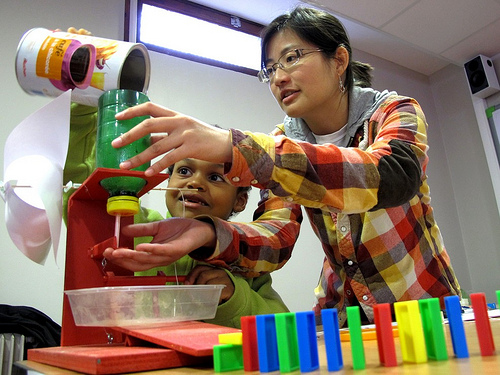



IDEAS TO SUPPORT EDUCATORS : Subscribe to the EdCan e-Newsletter
Quality research, reports, and professional learning opportunities.