Archive
-
Ranking Our Responses to PISA 2009
Comments Off on Ranking Our Responses to PISA 2009In 1997 the Organization for Economic Cooperation and Development (OECD) partnered with countries around the world to design the ambitious and innovative Programme for International Student Assessment (PISA). Beginning in 2000, and every three years since, OECD/PISA has assessed 15-year-old students in participating countries to gauge the extent “to which youth have acquired some of the knowledge and skills essential for full participation in modern societies.”[1]
PISA results have been an important part of my career. I am not positioned to do much with them, but I value the perspectives they contribute to my understanding of education, within Canada and abroad. And so I looked forward to the new round of reports; but when they arrived, I was more captivated by the public response that unfolded around them than by the results themselves.
As we all chimed in with our interpretations, I couldn’t help wondering if we were clear about what the results were (or were not) telling us.
I’d like to put some of the blame for public reaction to PISA scores on the OECD, itself. It’s easy to feel intimidated by the volume of figures and explanations that flow from each assessment. But this alone cannot explain the overwhelming amount of attention paid to a single, league-style table ranking the 65 participating countries on combined reading, mathematic, and scientific literacy scores. Witnessing how results get taken up in the public domain, it is hard not to feel that the PISA country rankings have become the Olympics of the education world.
These international comparisons can be valuable, of course. Within policy circles, PISA has provided a context for new learning about factors that may contribute to successful school systems. This year, authors of the report profiled a number of countries whose results show notable improvements, including Germany, which was “jolted into action when PISA 2000 revealed a below-average performance and large social disparities in results.” Since then, they have made significant gains on both fronts.[2]
As often seems to happen with the release of any rankings, however, comparisons slip into competition. Public discussion of rankings becomes particularly alarming when it is played out to the detriment of young people (e.g., “our country’s ranking would be higher if only we had the ‘right’ type of students”) or when nations endure weeks of stereotypical comments serving to diminish high rankings or justify low ones.
Public fascination with international rankings also overshadows other important comparative results presented in PISA reports. Take, for example, the fact that differences between countries represent only a fraction of overall variation in student performance when compared to differences within countries, which can represent gaps equivalent of multiple years of schooling between the lowest and highest performing students.[3]
Often also left out of the dialogue is the fact that countries vary in the extent to which high performance is accompanied by equity of educational outcomes for all young people. Writing about Canada’s performance in PISA 2009, Christa Freiler (Director of Research and Strategic Initiatives for the Canadian Education Association) notes that the equity factor is, “arguably, more important to the social and economic future of young people and Canada as a whole than small changes in overall standing (i.e. whether we are 3rd, 4th or 5th).”[4]
Finally, as PISA becomes a trusted source of information on educational quality, the public needs to understand an important qualification: PISA does not assess students’ knowledge or understanding of school subjects. Its results are, in fact, a measure of the cumulative impact of a young person’s formal and informal learning and the extent to which this can be demonstrated through the application to “real life” reading, math, and science scenarios. PISA does not assess students’ achievement of curriculum outcomes, and results cannot be attributed to schools alone.
This important qualification does not limit the value of PISA; there is much to learn from data designed to tell us how well young people are prepared to “fully participate in modern society.” However, as Sjoberg reminds us, we need to “discuss and use the results with some insight…we need to know what we might learn from the study, as well as what we cannot learn. Moreover we need to raise a critical (not necessarily a negative) voice in public [and] professional debates over the uses and misuses of the results.”[5]
[1] T. Knighton, P. Brochu, and T. Gluszynski, Measuring Up: Canadian Results of the OECD PISA Study (Ottawa: Statistics Canada, Council of Ministers of Education Canada, and Human Resources and Skills Development Canada, 2010), 39.
www.statcan.gc.ca/pub/81-590-x/81-590-x2010001-eng.pdf
[2] PISA 2009 Results: Overcoming Social Background – Equity in Learning Opportunities and Outcomes, vol. 2 (OECD, 2010): 4.
[3] Knighton, Brochu, and Gluszynski, 157.
[4] C. Freiler, PISA 2009: Let’s Not Underestimate the Importance of Equity in Education.
[5] S. Sjoberg, “PISA and ‘Real Life Challenges’: Mission Impossible?” in PISA According to PISA, eds., Hopmann and Brinek (University of Vienna: Wien Lit-Verlag, October, 2007), 2.
-
Engaging and Challenging Teachers – Engaging and Challenging Students
Comments Off on Engaging and Challenging Teachers – Engaging and Challenging StudentsKids just know that they don’t have an option to not do their work… I always had successful students, but now everybody is successful… It’s not that the kid doesn’t want to do it. It’s that the kid is unable to do it the way we are asking them to… It doesn’t make sense to factor in zeros. That is not a true reflection of what kids know; they don’t know nothing… A lot of the mystery of where marks come from is gone now… If they haven’t learned then I haven’t taught them and I am the one who needs to do things differently… It really makes me look at how far we’ve come, really, in everything… I think the kids here recognize that they have something special.
– Excerpts from a video of teachers talking about their work and their growth over the last few years.
As part of our ongoing school improvement at Cornwallis Junior High in Halifax, we included the full school community – families, staff, and students – in a comprehensive process to identify our strengths and challenges. We questioned our core beliefs, practices, and purpose, and we sought out ways to offer the best possible learning opportunities.
Our conclusion: Yes, we were a good place, but not equally good for everyone. Some students were not engaged or successful. It was time for meaningful focused change.
We decided to dig deep into our own beliefs and practices, excavate those that were not learning supportive, and focus on developing a strong foundation on which to base improvement strategies. We prepared to make a shift in our way of seeing assessment, and in turn student learning, with carefully targeted, research-based professional development.
We used the works of diverse educational researchers. Rachel Kessler’s The Soul of Education and Parker Palmer’s Courage to Teach led us to deep reflection, trust, and honesty; the work of Rick Stiggins and Ken O’Connor on authentic assessment practices informed our own learning and that of our students; and the broad research related to effective schools and professional learning communities informed our design of an effective student support structure.
In the past, struggling students were encouraged to attend extra help sessions – but the choice was theirs…We were leaving the choice of whether to succeed or fail in the hands of 12-14-year-olds!
We identified two key strategies that could move us forward: 1) targeted and consistent student support; and 2) a focus on outcomes based assessment that supports learning. These strategies are embedded in our processes of reflection and analysis, and in our willingness to embrace change.
Core Strategies
Student Success Support Pyramid
Our original data indicated that only 55 percent of our students were meeting most of the outcomes in every subject. When we looked at report card data, we saw that the comments for students not achieving outcomes were limited to three areas: not handing in work they had completed, not completing homework, and not taking advantage of extra help. We were leaving the choice of whether to succeed or fail in the hands of 12-to-14-year-olds!
In the past, struggling students were encouraged to attend extra help sessions – but the choice was theirs. The majority of those who chose to attend succeeded; those who opted out did not. We realized that students need interventions that are directive, not invitational, and that occur within the school day. So we implemented a Student Success Support Pyramid (SSSP) of interventions that included mandatory extra help and work completion support.
It took two years (2007-09) for us to fine tune our lunchtime mandatory Guided Study Hall (GSH) program, but it is now accepted as an integral part of our academic culture. When a student is assigned to GSH, the teacher notifies the Vice Principal, who informs the parents/guardians that their child will be attending GSH and asks them to make sure that their child brings a lunch the next day. The teacher e-mails the GSH teacher with the work that needs to be completed. After each session the GSH teacher e-mails assigning teachers and the VP, detailing the work that has been completed. The process has been so effective that students now self-assign because they recognize the benefits to their learning.
Assessment
We believe that effective assessment is central to providing students, and their teachers, with a clear understanding of their learning. This understanding allows students to develop self-advocacy skills that will benefit them throughout their lives. Our school-based in-services have focused on classroom assessment of, for, and as student learning. To support this shift, individual teachers have attended conferences and sessions related to differentiated instruction, formative assessment, mentoring and co-teaching, curriculum alignment, effective schools, the What did you do in school today? initiative, and data collection analysis.
We have moved well beyond the assessment processes that resulted more in sorting students than assessing learning. Our assessment, teaching, and learning practices now focus on supporting every student in successfully achieving the outcomes. We have made great strides toward closing the achievement gap and are working to raise the bar for those students who would benefit from more finely tuned challenges. Establishing and articulating this “right level of challenge” is an important goal as we seek to make our junior high school a place where all students succeed.
Challenges Met
These are some of the challenges that we encountered, and how we met them:
Cultural Shift
- Developing the level of trust required for deep reflection on our own practice and the naming of our own challenges and strengths so that we can each find our entry point into the process.
It takes time to build enough trust to realize our challenges and show vulnerability with our colleagues.
- Working through our individual philosophical struggles with forms of assessment that moved us away from punitive assessment practices to true outcomes-based assessment; that eliminated the grading of behaviour; and that allowed for multiple opportunities and multiple ways of representing learning.
- Shifting from a culture of seeing students as “lazy” or “not caring” to one that sees them as needing more targeted support.
One of the unpredicted benefits from our shift to a true learning culture is the ability to more readily identify students with learning challenges. Once the appropriate learning supports are put in place (often forms of assistive technology or environmental strategies), these students are able to shine.
Student Success Support Pyramid
- Including the Guided Study Hall as part of the teachers’ regular teaching schedule.
Previously, teachers volunteered extra help, so making GSH a part of a teacher’s timetable created a timetabling challenge. It also signified a commitment to this process of student support. Teachers continue to offer extra help before and after school.
- Shifting from a sense of “punishment” to “support” for lunchtime interventions.
Lunchtime had been used for detentions, so when we shifted to lunchtime GSH and lunchtime Resource, it took time for students and families to see it as support rather than punishment.
- Developing a central referral system that kept communication clear among teachers, students, and families.
Initially teachers called home to inform families of the student’s referral to GSH. This became so cumbersome for teachers that they were reluctant to assign students to GSH. When this communication became part of the Vice Principal’s assignment, it worked more smoothly and efficiently.
Assessment
- Shifting from assessment that sorts to assessment that informs learning.
Shifting to assessment that not only allows for, but encourages, multiple opportunities for demonstrating achievement and does not punish students for taking more time to learn has been difficult for some to accept. We use the “driver’s licence” analogy to explain our learning model to new staff and to families. We give students multiple opportunities to demonstrate their learning, and we do not average those assessments. When they get it, they’ve got it, just like a drivers licence.
- Targeting professional development to meet teachers where they were in their assessment practice, while ensuring that we continued to move forward as a group.
- Developing flexible timetabling that allowed time for teachers to support each other.
There can be great resistance to changing old habits, traditions, and ways of seeing. We believe that all teachers want to be good teachers – the best that they can be – and once they see the benefits of these shifts in beliefs about learning they will move forward with a passion. It comes down to this: once we know something, we are faced with the question “What do we do with what we know?” And there are some ‘knowings’ that are so elemental that they will not allow us to not act. Just as the students know that the supports are in place and they “do not have the option of not doing the work”, teachers need to know that the supports they require will be in place as they proceed on this change journey.
Cultural Shift
As a result of these strategies and meeting these challenges, there has been a shift in the academic culture of our school. We are now engaging students and teachers in what matters most: teachers feeling successful with all students and students feeling successful in their learning. Students recognize that they are expected to succeed and that there are supports in place to help them. They are beginning to understand how to take responsibility for their own learning.
As a staff, our conversations are related to how we can support each child’s learning because we believe each child wants to and can learn. Teachers can name the changes they have made and how these changes have gone to a deep level that causes them to question, even beyond the school setting. We ask ourselves, what are we missing and how can we best serve the students’ needs? We then act collectively to support each student. Our student achievement data indicate that we have made great gains in closing the achievement gap. Currently 89 percent of our students are meeting outcomes in all subjects; our goal is 100 percent.
We are now engaging students and teachers in what matters most: teachers feeling successful with all students and students feeling successful in their learning.
Another result of this shift in the learning culture is that students now realize that “not doing the work” is no longer an option. Supports are in place for students who need them, and we review both student progress and supports on an ongoing basis. As a result, we are now more successful at engaging students where they are as individuals.
Conclusion
There is something special about the way we have learned together and how we now see ourselves as learners. This intimate process has moved us forward with passion and skill, both collectively and individually. We have created the expectation that everyone will succeed. In a true learning culture, students lose the feeling of self-consciousness – lose the fear of being judged. They are comfortable as themselves and as learners. They are able to take risks, and teachers are able to meet them where they are. When we break through the barriers that hold young adolescents back, they can be successful and proud of who they are. They can become the best they can be.
EN BREF – La communauté d’apprentissage de l’école Cornwallis Junior High à Halifax a suivi un processus de réflexion et d’analyse, établissant deux stratégies clés pour appuyer l’apprentissage de tous les élèves : un soutien ciblé et constant des élèves et un accent sur l’évaluation axée sur les résultats. En intégrant à la journée scolaire et en rendant obligatoires l’aide supplémentaire et l’achèvement des travaux pour les élèves en difficulté, on a supprimé l’option de « ne pas faire le travail », réduisant considérablement le taux d’échec. En évaluant en fonction de l’apprentissage acquis, l’école a beaucoup progressé pour combler l’écart de réussite et travaille maintenant à relever la barre pour les élèves susceptibles de profiter de défis plus adaptés.
-
Unleashing the Promise of Assessment for Learning
Comments Off on Unleashing the Promise of Assessment for LearningSince the Assessment Reform Group in England coined the term Assessment for Learning (AfL) in 1998, it has become ubiquitous in educational systems around the world. A quick Google search yields over 11 million hits; countless books have been written about it; and it has become a stalwart of assessment policy statements and professional development sessions. Virtually every Canadian province and territory has a policy directive and/or has developed resources and offered professional development that supports AfL. For example, Ontario’s The Growing Success policy document (2010) explicitly notes its importance by actively encouraging teachers to “provide students with descriptive feedback and coaching for improvement.”1 Similarly, British Columbia’s Accountability Framework “promotes evidence-based, data-driven decision making with a focus on AfL.2 Some jurisdictions such as Saskatchewan have gone so far as to develop AfL units.3 Collectively, a broad scan of the Canadian landscape suggests a growing recognition of the central importance of policies that support AfL practices in 21st century schools.
The Promise of Assessment for Learning
The idea of AfL arose out of a 1998 landmark research paper by Black and Wiliam in which they synthesized over 250 studies linking assessment and learning and found that the intentional use of assessment in the classroom to promote learning improved student achievement.4This meta-analysis supported previous research showing that classroom assessment had both short- and long-term effects on learning.5
In the short term, it showed that classroom assessment could:
- focus attention on important aspects of the subject;
- give students opportunities to practice skills and consolidate learning;
- guide further instructional or learning activities.
In the medium and long term, assessment held the possibility of:
- influencing students’ motivation as learners and their perceptions of their capabilities;
- communicating and reinforcing teaching goals, including performance criteria and desired standards of performance;
- influencing students’ choice of and development of learning strategies, skills, and study patterns;
- influencing students’ subsequent choice of courses, activities, and careers.
Since that time, it has become obvious that assessment can be a powerful catalyst for learning. Over and over again, research studies have demonstrated that, if learning is the goal, assessment for learning is very powerful.
Recent reviews of more than 4,000 research investigations show clearly that when [formative assessment] is well implemented in the classroom, it can essentially double the speed of student learning…it is clear that the process works, it can produce whopping gains in students’ achievement, and it is sufficiently robust so that different teachers can use it in diverse ways, yet still get great results with their students.6
From Promise to Reality (or not)
We have all spent much of our professional lives thinking about and studying classroom assessment – the kind of assessment that is carried out by teachers every day. In recent years, we have had the pleasure and privilege of participating in international invitational assessment seminars focused on AfL. This group is made up of researchers, policymakers, professional development providers, and educational leaders from Australia, Canada, continental Europe, New Zealand, the United Kingdom, and the United States. One of the recurring themes for the group is the same issue that we have been pondering in our own research. We know that formative assessment, done well, is very powerful. But we find repeatedly that AfL is not evident or is only superficial in most classrooms. So, why, after several decades of evidence, is it not a fundamental part of classrooms in Canada and around the world?
We know that formative assessment, done well, is very powerful…So, why, after several decades of evidence, is it not a fundamental part of classrooms in Canada and around the world?
The Learning How to Learn (LHTL) Project in England has provided the international seminar group with a major source of evidence and fuelled our deliberations.7 In its work, the LHTL team found that teachers implementing AfL in their classrooms often reflected what they called the “letter” of formative assessment, focusing on the surface techniques, rather than the “spirit”, based on a deep understanding of the principles underlying the practices. Only about 20 percent of the teachers in their LHTL study were using formative assessment in ways that were designed to help students develop as learners.8
Through our ongoing conversations and research, we have identified several key issues that can interfere with AfL fulfilling its promise: misunderstanding of what AfL means and requires; superficial professional learning; and competing policy expectations.9 Here, we focus on the first issue, with reference to the importance of the others in creating a positive context for teacher learning.
What Is Unique About AfL?
Although many teachers would say that they do “assessment for learning” there is considerable evidence that their assessment practice does not really reflect the intentions and principles that make AfL powerful. At the international assessment seminars, we have talked about how the ways in which the words have been interpreted and translated into practice reveal both a misunderstanding of the principles and a distortion of the practices that the original ideals sought to promote. For example, “deciding where the learners are in their learning, where they need to go and how best to get there”, has sometimes been (mis)interpreted as an exhortation to test students frequently, using prescribed national/state scales, in order to fix their failings and target the next level. In this scenario, scores – which are intended to be indicators of, or proxies for, learning – become the goals themselves. Real and sustained learning is sacrificed to performance on a test. In contrast, the primary aim of AfL is to contribute to learning itself. Although true learning will manifest itself in performance, the converse does not hold. Performance on a test does not necessarily mean that learning has occurred. Learners can be taught how to score well on tests without much underlying learning.
In the LHTL project, the researchers found many teachers who were attempting to engage in AfL by adding strategies to their existing assessment repertoire without shifting the purpose towards enhanced learning. This finding echoed a finding from a Canadian study in which we used the metaphor of creating an audio recording to describe the different ways in which teachers incorporate ideas of assessment for learning into their practices.10 For some teachers, the process of incorporating new assessment strategies was like laying new sound tracks onto an existing audiotape. Their original approach to teaching and assessment remained intact, but some additional material was superimposed upon it. The other end of the spectrum was like working with a sophisticated digitized recording system. This was rare in our study. These teachers had a sense of the components of the work and the mood they wanted to create, but operated using an open and changeable approach, skipping to anywhere in the work, adding little flourishes, and maneuvering all the bits to keep the whole production flowing. The teachers who used this digital approach were able not only to use a variety of techniques every day but also to move beyond them to circumnavigate what other teachers had experienced as obstacles. The third and most prevalent production style was a mixed one – some of it audiotape, some digitized – where teachers played with the digitized approach but kept coming back to the original tape. The transitions back and forth weren’t always smooth, and these teachers frequently expressed frustration and uncertainty about their practice.
As a result of common misunderstandings about how AfL works, teachers often engage in practical implementation based on limited understanding and superficial adoption of the ideas.11 Over and over, teachers incorporate the techniques associated with AfL, including peer and self-assessment and routine assessments throughout a course to track students’ progress. But just adding these bits is not AfL. Certainly the tools or techniques are useful, but teachers implementing the “letter” of AfL are in the early stages of understanding and embedding the concept into their practice; they still depend on rules and embed the new ideas as add-ons.
Becoming more proficient means developing a deep understanding of the underlying theory and learning to use the ideas to solve problems and make ongoing adaptations automatically. Teachers with this “spirit” of assessment for learning do not just add strategies to their existing assessment repertoire; they internalize the underlying principles, have a strong belief in the importance of promoting student autonomy, articulate a clear conviction that they are responsible for ensuring that this takes place, and take this empowering philosophy into the classroom and communicate it to students.12 The LHTL project demonstrated that:
although advice on specific techniques is useful in the short term, longer-term development and sustainability depends on re-evaluating beliefs about learning, reviewing the way learning activities are structured, and rethinking classroom roles and relationships.13
AfL is a way of thinking and a set of beliefs about the nature of learning and the rhythm of interactions in classrooms. Its primary aim is to contribute to learning by identifying aspects of learning as it develops, using both informal and formal processes, so that learning itself can be enhanced. This focuses directly on the learner’s capabilities as they are developing.
AfL means seeking out, analyzing, and reflecting on information from students themselves, from teachers, and from the learner’s peers as it is expressed in dialogue, learner responses to tasks and questions, and observation. AfL is part of everyday teaching, in everyday classrooms. A great deal of it occurs in real time, but some of it is derived through more formal assessment events or episodes. What is distinctive about it is not the form of the information or the circumstances in which it is generated, but the positive effect it has for the learner. And therein lies the dilemma: How to move from techniques and activities to genuine new learning by teachers?
Moving from the “Letter” to the “Spirit”
AfL depends on the knowledge and expertise of teachers – their knowledge of students, of unlocking students’ thinking, of feedback, of curriculum, of teaching, of pedagogical content knowledge, and of learning theory. Why? Because AfL is not a tool; it is a shift in thinking about what matters in schools. It moves the focus from categorizing students to learning for students. And it often involves conceptual change on the part of teachers as they rethink what assessment is for and how to do it.
Becoming an expert in AfL is hard work, as teachers come to understand the theory behind it and examine how these ideas are both similar to and different from their current beliefs and practices. It requires teachers to engage in high quality professional learning that helps them explicate their preconceptions about assessment and internalize an approach to assessment – and even to learning – that may run counter to current expectations in their schools.
This kind of change will not happen without policy expectations that honour the essential role of teachers’ expertise and opportunities for serious job-embedded professional learning.
Teachers with the “spirit” of AfL are continually building their expertise so that they are in a position to carefully and intentionally apply their professional knowledge on a moment-by-moment basis. They, and their students, are routinely engaged in seeking, reflecting upon, and responding to information from dialogue, demonstration, and observation, with ideas and feedback that are immediate and directed at learning, in real time. They need policy support, organizational structures, and professional learning that gives them deep engagement with the new ideas associated with AfL, so that they can use this knowledge and its application in practice to enhance learning for all students.
EN BREF – Beaucoup d’enseignantes et d’enseignants affirment effectuer une « évaluation au service de l’apprentissage », mais souvent, leurs pratiques ne reflètent pas les intentions et les principes qui rendent ce type d’évaluation efficace. Le personnel enseignant qui comprend l’« esprit » et la « lettre » de l’évaluation au service de l’apprentissage rehausse constamment ses compétences afin de mieux utiliser ses connaissances professionnelles à tous les instants. Les renseignements obtenus de dialogues, de démonstrations et de l’observation stimulent sans cesse leurs réflexions et leurs réactions, engendrant des idées et une rétroaction immédiates qui sont axées sur l’apprentissage, en temps réel. Ces enseignantes et ces enseignants ont besoin de politiques claires, de structures organisationnelles et de perfectionnement professionnel afin que ces connaissances et leurs applications améliore l’apprentissage de tous les élèves.
1 www.edu.gov.on.ca/eng/policyfunding/growSuccess.pdf, 28.
2 See www.bced.gov.bc.ca/policy/policies/accountability_framework.htm
3 See www.education.gov.sk.ca/Assessment-for-Learning
4 P. Black and D. Wiliam, “Inside the Black Box: Raising Standards through Classroom Assessment,” Phi Delta Kappan 80, no. 2 (1998).
5 T. Crooks, “The Impact of Classroom Evaluation Practices on Students,” Review of Educational Research 58, no. 4 (1998): 438-481.
6 J. Popham, “Formative Assessment – A Process, Not a Test,” Education Week, February 2011.
www.edweek.org/ew/articles/2011/02/23/21popham.h30.html
7 M. James, Learning How To Learn – in Classrooms, Schools and Networks (Teaching and Learning Research Brief. Teaching and Learning Research Programme., 2006). Downloaded March 20, 2010 from www.tlrp.org
8 M. James and D. Pedder, “Beyond Method: Assessment and Learning Practices and Values,” The Curriculum Journal 17 (2006): 109-138.
9 L. Volante, “Assessment of, for, and as Learning Within Schools: Implications for Transforming Classroom Practice,” Action in Teacher Education 31, no. 4 (2010): 66-75.
10 L. Earl and S. Katz, “Changing Classroom Assessment: Teachers’ Struggles,” in The Sharp Edge of Educational Change, eds. N. Bascia, and A. Hargreaves (London: Falmer Press, 2003).
11 P. Black, “Formative Assessment: Promises or Problems?” Unpublished paper, 2007. Downloaded March 14, 2010. www.mantleoftheexpert.com/studying/articles/Paul%20Black2007.pdf
12 James and Pedder.
13 M. James, and A. Pollard, TLRP’s Ten Principles for Effective Pedagogy: Rationale, Development, Evidence, Argument and Impact (London: Research Papers in Education, 2011 in press).
-
Can We Accurately Predict a Student’s Future Success?
Comments Off on Can We Accurately Predict a Student’s Future Success?Educators often feel that they can predict students’ academic futures. For instance, they may think that they can tell how students will perform in Grade 8 or Grade 9 as early as Grades 1 or 2. There is research evidence to show that predictions about students’ futures are often wrong.
There are strong links between characteristics of students, such as their socio-economic status or their school readiness, and their later achievement but these relationships do not hold for all individuals. Many studies show that these predictions turn out to be wrong much more often than most people think. Canadian data shows that more than 40 percent of students scoring at the bottom reading level at age 15 were in post- secondary education at age 21. Research also shows that the accuracy of predictions about students declines over time; that is, one year’s achievement predicts the following year’’s quite well, but is less accurate in predicting achievement 3 or 4 years later.
The key thing that the research tells us is that students can and do change. With the right supports, students can achieve far more than anyone thought they could. Encouragement and support from both schools and families can also make those negative predictions less likely to be true.
Parents and educators should be cautious in assuming that the future of their child may be predicted based on their current performance. Secondly, parents should be actively involved in supporting and advocating for their child rather than accepting a negative future. This might include being optimistic with the child about the future, or the child’s teacher to identifying areas where home and school can work together
Additional Resources For Parents
Promoting Parental Involvement, Improving Student Outcomes by Gina Gianzero: This paper discusses how different forms of parental involvement increases student success in school.
http://www.sandiegodialogue.org/pdfs/Parental%20Involvement%20doc.pdf
Ontario Ministry of Education: This site provides tips on a variety of ways to help parents may help their struggling children.
http://www.edu.gov.on.ca/abc123/eng/tips/
Special Needs Opportunity Window: This link provides web based resources and community organizations that support parents whose children may have special needs.
http://snow.idrc.ocad.ca/content/view/242/132/
People for Education: This site provides tip sheets to parents on various ways that they can help support their child in school. The tip sheets are offered in 19 different languages.
http://www.peopleforeducation.com/resources/tips.html
Research References Informing this Issue
Badian, N. (1988). The Prediction of Good and Poor Reading Before Kindergarten Entry: A Nine-Year Follow-Up. Journal of Learning Disabilities, 21(2), 98-103.
Brownell M., Roos, N., Fransoo, R., Guevrèmont, A., MacWilliam, L., Derksen, S., Dik, N., Bogdanovic, B., & Sirski, M. (2004). How do educational outcomes vary with socioeconomic status? Key findings from the Manitoba Child Health Atlas 2004. Winnipeg, MB. Manitoba Centre for Health Policy.
Bowers, A. (2007). Grades and graduation: Using K-12 longitudinal cohort data to predict on-time graduation. Paper presented to the American Educational research Association, Chicago.
Gleason, P., and Dynarski, M. (2002). Do we know whom to serve? Issues in using risk factors to identify dropouts. Journal of Education for Students Placed at Risk, 7(1), 25-41.
Morgan, P., Farkas, G. and Wu, Q. (2009). Five-Year Growth Trajectories of Kindergarten Children with Learning Difficulties in Mathematics. Journal of Learning Disabilities, 42(4), 306.
OECD (2010). Pathways to success: How knowledge and skills at age 15 shape future lives in Canada. Paris: OECD.
-
Canadian Education Wire – Thinking About a New Way to Rate School Performance
Comments Off on Canadian Education Wire – Thinking About a New Way to Rate School PerformanceHow Good Is My Kid’s School? – The Tyee
David Chudnovsky feels for the parents who wonder, “How good is my kid’s school?”“We in education often answer, ‘The Fraser Institute sucks, and standardized testing doesn’t tell you much about how the school’s doing.’ And that’s true, we’re right about both of those things, but we haven’t answered [their] question,” says Chudnovsky, a public education advocate and former New Democratic Party MLA.Related publication:
The Great Schools Project – How good is our school? How can we know?
Canadian Centre for Policy AlternativesWhat news am I missing? Can you recommend some education blogs for me to follow? Please tweet me at @max_cooke, e-mail me at mcooke@cea-ace.ca or better yet, use the comment box below to suggest additional articles happening in your region so that others can check it out.
OTHER EDUCATION NEWS
The job of principal is becoming too focused on paperwork, report says
Globe and MailRelated report:
People for Education’s Annual Report on Ontario’s Publicly Funded SchoolsHistory suggests all-boys schools don’t help with academics: study – National Post
Don’t sweat teacher strikes: The kids are alright – Globe and Mail
Wait lists for special education double for low-income students – Toronto Star
Looking for solutions in the classroom – Chilliwack Progress
Parents start campaign for more school funding – CBC Calgary
Mental health top issue facing schools, coalition says – Toronto StarSuit opposes Quebec ban on teaching religion at subsidized daycares – Montreal Gazette
Teachers bargaining for some respect – Similkameen SpotlightINTERNATIONAL NEWS
When should you teach children, and when should you let them explore? – The Economist
EDUCATION BLOG HIGHLIGHTSSo what is it about Finland’s schools? – 2 Cents Worth
Big question — and it’s probably a big answer. But several days ago, Swiss educator, Vicky Loras started a conversation with Finnish School Principal Esa Kukkasniemi. You can read the entire interview here in her blog as well as opportunities for you to talk with educators in Finland. But here are some statements from Esa that I highlighted in Diigo, as he ticked off major important points that have led to success in Finland’s education system.CEA Video: Pasi Sahlberg – What is next for Finland?
Pasi Sahlberg, Director General of the Centre for International Mobility and Cooperation in Helsinki, Finland, shares seven things that you need to know about Finland’s exceptional education performance and what the future holds for this country’s education system in the ongoing pursuit of social fairness and equality.New Documentary: The Finland Phenomenon – Inside the World’s Most Surprising School System
Teaching to the test is malpractice – Joe Bower
Testing is not teaching. If you want proof of why, you need not look any further than this: Learning is messy. Real learning is really messy. Testing is, if nothing else, orderly. See the problem? Talk to any test-maker or psychometrician, and they’ll tell you the tests were never devised to make large sweeping, all-encompassing inferences. Even those who speak in favor of using test scores in moderation in low-stakes contexts understand that tests are merely a small sample of a much larger domain that we want to know about, and that great caution must be made in making inferences based on these tests.
The Fabric of Community- The Key to Transforming Education – 21st Century Learning
I have been thinking a lot about how to manage the needed change process in education. Looks like a lot of folks have been playing with that idea as well. ISTE released their new NETS for ADMIN framing it as having the potential forTransforming Education– Administrators play a pivotal role in determining how well technology is used in our schools. The NETS for Administrators enable us to define what administrators need to know and be able to do in order to discharge their responsibility as leaders in the effective use of technology in our schools.
And take a look they are NOT too shabby when thinking about the characteristics leaders need to reform education in today’s fast changing world. The rub for me comes in when I try and look at these and other efforts to “transform” education and wonder if we aren’t really just talking about reform- small principled changes that look at change as we always have – through the lens of problem solving. -
“Reforming Education”
Comments Off on “Reforming Education”My last blog ended with the cri de coeur “How To Do It?” i.e., how to bring about fundamental reform of public education. Despite a minor flood of books, articles, and speeches over the past 40 years addressed to the reform question, the system, like an ocean liner under moonlight, sailed serenely along, its 19th century design largely immune to progressive forces.
Nevertheless, there are reform termites deep within the woodwork. In Ontario, the Emmett Hall/Lloyd Dennis Report of 1968, Living and Learning, challenged many of the basic assumptions about traditional schooling. For instance, the Report stated “The fixed position of student and teacher … must give way to a more relaxed relationship which will encourage discussion, inquiry, and experimentation and will enhance the dignity of the individual.”, and a little later “… we must relate the learning experiences in our schools to the real needs of young people.”
No surprise, there was a strong right wing reaction against Hall/Dennis and all that it stood for across Canada and the United States exemplified by standardized testing at four or more points in the child’s school career. The companion pieces of government testing – more explicit government control of curriculum and textbooks, system-wide codes of conduct and standard report cards; such reactions cast a pall over teacher professional independence and parental pleasure with the schools. In the process, many school boards sunk to the level of handmaidens of the central authority. In New Brunswick they disappeared altogether.
But the reform train had left the station and could not be stopped. Typically, a school system under pressure to reform itself would gain approval for an experimental school or set of schools where innovation would be the order of the day, – without losing public funding. A few examples: The Calgary Girls School where the teachers are exempted from compulsory membership in the Alberta Teachers Association and where they are evaluated for merit pay. The Seven Oaks Met School in Winnipeg features “advisors” rather than teachers. It may not sound like much but can have a huge impact on teacher-student relations in a society ready for some democracy in the schoolhouse. In the Greystone School near Edmonton, standardized test results are treated as a necessary evil with little relationship to the higher values of the school. Finland, leading the world in international student achievement tests, has abandoned standardized testing at home!
These random recollections encourage me to believe that school reform is seriously underway and, like termites in the woodwork, cannot be easily stopped.
-
A Toolkit for Learning: Using Technology to Close the Gap
Comments Off on A Toolkit for Learning: Using Technology to Close the GapWe Canadians can be proud of many things. Among them is the quality of the education we provide to our children. On international examinations, Canada regularly scores among the best countries in the industrialized world, implying that virtually all our youth must be leaving school well prepared for life in the Knowledge Age.
No large system can ever be perfect and our education system is no different. It is not surprising, therefore, to learn that there are still youngsters leaving school early and children who, by the time of secondary school graduation, do not meet accepted standards for essential competencies including literacy, numeracy, and scientific reasoning.
The State of Learning In Canada
How well, then, is Canada really doing in terms of preparing our children? The Programme for International Student Assessment (PISA) is a triennial international survey of the knowledge and skills of 15-year-olds, and the product of collaboration among participating countries and economies through the Organization for Economic Co-operation and Development (OECD). Approximately 470,000 students from 65 countries, making up close to 90 percent of the world economy, took part in PISA 2009. The average performance of Canadian students was in the upper quartile on the PISA measures of reading.[1] By itself, this result seems encouraging.
Nevertheless the same report noted that about 10 percent of the Canadian students tested performed at or below Level 2, the baseline level “at which students begin to demonstrate the reading skills that will enable them to participate effectively and productively in life.”[2] About 30 percent of Canadian students could not perform at Level 3, the level that involves comprehension and interpretation of moderately complex text. Such basic difficulties, played out across the nation, have a significant impact on the economic well-being of all Canadians. Statistics Canada estimates that a one percent increase in the Canadian literacy rate would drive a sustainable growth in Gross Domestic product of $18.4 billion annually.[3]
In Canada, the school dropout rate has declined slightly over the last decade.[4] This is laudable but not a cause for complacency. Indeed in some areas of the country, there is cause for alarm. In my hometown of Montreal, citizens were shocked to learn that, among francophone males, the dropout rate was over 60 percent.[5] Think about the implications of that for a moment. School dropouts make up 43 percent of welfare recipients;[6] and it is well documented that adults without a high school diploma earn substantially less over their lifetimes than other Canadians.
In a report on the state of learning in Canada, the Canadian Council on Learning elaborated on the importance of essential competencies and the challenges of dramatically improving our nation’s literacy skills.[7] These skills are particularly important in the increasingly multicultural, multilingual context of present-day Canadian classrooms. Furthermore, research has documented the importance of children developing solid literacy skills early and succeeding at school from the outset. Students who are not reading at grade level by Grade 3 are especially at risk of failure in a variety of subject areas. Instructional approaches need to focus on early prevention and continuous support rather than later remediation. Later remediation, no matter how extensive and costly – because it is initiated after years of student frustration and failure – cannot succeed as well as early intervention.
It has never been the case that money alone solves problems unless it is invested in equal amounts in human and physical resources
Improving the State of Learning in Canada
It is clear what needs to be done, why it needs to be done, and when it needs to be done. The last pieces of the puzzle are by whom and how. This is where the research, development, and dissemination activities my colleagues and I are engaged in at the Centre for the Study of Learning and Performance (CSLP) come in.
The CSLP is a provincially funded and internationally recognized research centre of excellence composed of academics, staff, and students from eight post-secondary institutions in Quebec and with administrative headquarters at Concordia University. The mission of the CSLP includes not only the generation of new knowledge about education through research but also the mobilization of knowledge in partnership with educational practitioners by collaborating around the tools, techniques, and strategies for effective teaching and learning. At the CSLP, we take seriously the concept of evidence-based practice as an important means to improve the teaching and learning of essential competencies, with literacy skills at the top of the list. Finally, we look towards the development of educational software as the means by which teachers might improve their instructional practices and students might acquire the essential competencies for learning throughout school and beyond.
My colleagues and I have studied the state of e-learning in Canada and noted the strong provincial and federal interest in e-learning as a means to address educational challenges of all types and at all levels.[8] Yet we also know that there is neither uniform nor substantial evidence of the effectiveness of e-learning, especially without careful attention to the importance of pedagogical features in the design of educational software.
In 2006, we cautioned that:
In education, there is the mistaken view, repeated over the generations: 1) that technology represents a “magical solution” to the range of problems affecting schools and learners; and 2) that money for technology alone, thrown in large enough quantities at the problems of education, will affect the kinds of changes that are required to produce a well-informed, literate and numerate citizenry. It is probably true that the wide range of electronic technologies (including those that provide access to the Internet) that are now, and will remain available stand a better chance of affecting educational change than the technologies of film, television, learning machines, intelligent tutoring systems, etc. However, it has never been the case that money alone solves problems unless it is invested in equal amounts in human and physical resources….It is arguable that the education of Canadians would be better served by more emphasis on preparing and training practitioners to use technology effectively than rushing to adopt the “technology du jour”.[9]
About a decade ago, my CSLP colleagues and I accepted the challenge of tackling the performance gaps in the development of schoolchildren’s essential competencies. We began by developing an early literacy tool, progressed to developing an electronic portfolio tool that teaches students self-regulation learning strategies, built the foundation for an inquiry tool that develops information literacy, and have now begun work on a numeracy tool. Design and development remain guided by several core principles. Each tool must:
- be based on the best available theory and research;
- require input from educators, pedagogical consultants, and IT professionals;
- be engaging for teachers and students and technically easy to use;
- use embedded pedagogical support;
- be flexible and adaptable in different instructional contexts and for different learners;
- be validated for learning and other outcomes using the best research designs; and
- be available to the educational community without charge.
At the same time, we also realized that training and follow-up in the use of these tools was essential if we hoped for wide-scale adoption and effective use.
The Learning Toolkit
Technology is not a magic elixir that can cure learning ills on application. There are no quick or effortless technological panaceas for learning, but educational technology can be a powerful tool when it is well designed, carefully validated, and properly implemented.
At the CSLP, we have developed an initial set of state-of-the art knowledge tools as part of the Learning Toolkit (LTK), which promote the development of essential educational competencies, including literacy, numeracy, inquiry, and self-regulation.[10] They are powerful and flexible tools, each with a unique focus and strength, which both supplement and support classroom instruction. To see demonstration videos and to explore the tools please go to http://doe.concordia.ca/cslp/ under Knowledge Mobilization.
ABRACADABRA, or ABRA, promotes the teaching and learning of English reading and writing skills among youngsters, especially those at risk of school failure. It consists of 32 instructional activities and 17 stories that combine to create hundreds of challenging and engaging tasks for learners at a broad range of difficulty levels. A French prototype of ABRA has recently been released, and instructional and assessment modules are continually being expanded and refined. ABRA has been the subject of numerous validation studies including a large-scale pan-Canadian randomized controlled trial.[11] ABRA has documented positive and substantial impacts on alphabetics, fluency, comprehension, and writing.
In ABRA, choices abound in terms of the story genre selected, the literacy sub-skill to be learned, and the difficulty level of an activity. These choices afford great flexibility to teachers and learners; the game-like interactive activities ensure a high degree of engagement, turning the hard work of learning how to read into an enjoyable time of learning success. Teachers may focus on whole-class instructional activities, small group work, or individual remedial or enrichment activities. They may elect to focus on contextualizing activities by emphasizing the ABRA stories first since there is no prescribed order for engaging in activities. See the screen capture to have a glimpse at ABRA’s engaging environment.
ePEARL is a web-based, bilingual (French, English) electronic portfolio designed to scaffold and support student self-regulation – including planning, doing, and reflecting – as a key learning strategy for knowledge acquisition. It also serves as a multimedia container for student work, whether that work is text, audio, video, images, or some combination thereof.
Its four levels of sophistication make ePEARL age-appropriate for students from early elementary school through post-secondary education. The subject of two longitudinal, pan-Canadian studies, ePEARL is the only electronic portfolio in the world that has documented learning gains as well as changes in students’ learning habits.[12]
ePEARL features include personalizing the portfolio; setting general or task-specific goals; creating new work via a text editor and/or audio recorder or linking to work created elsewhere; reflecting on work; sharing work; obtaining feedback from teachers, peers and parents; evaluating personal motivation; editing work and saving revisions as a new version; and sending work to a presentation portfolio for archiving and exporting. ePEARL also contains a rich collection of video vignettes to assist students and teachers to understand and use both the tool and the self-regulated learning processes it is designed to strengthen. ePEARL is intended for use in all school subjects; we are currently trialing a version for use by The Royal Conservatory of Music as part of piano studio teaching.
Inquiry Strategies for the Information Society in the Twenty-First Century (ISIS-21) is designed to develop lifelong inquiry skills by helping teachers, students, and librarians refine their abilities to undertake successfully the meaningful and critical exploration of important topics. The key phases of inquiry supported by ISIS-21 include developing and refining a guiding question; identifying evidence from a multiplicity of sources; evaluating the evidence for quality, credibility, and scope; and critically synthesizing the relevant, best quality evidence. The latest addition to ISIS-21 is an interactive game designed to help students learn more about the tool and the steps in the inquiry process. Teachers and their students in several schools in Quebec are piloting ISIS-21 for the completion of term-long projects during the winter 2011 term.
MATHKNOW, a numeracy tool, is currently in the initial stages of design.
All the tools are improved and expanded bi-annually. For example, future plans for ABRA include greater focus on second-language learners, older students, and adults who are experiencing reading difficulties.
Finally, all the tools in The Learning Toolkit are in the service of research as well as application. They can and do help develop a deeper understanding of the processes and techniques they are designed to support.
Scalability and sustainability
We do not want the LTK to be our best-kept secret. My CSLP colleagues and I want to expand it, refine it, and make it much more widely used. Developing evidence-based software is only the beginning of improving the educational performance of Canadian youth. Working with teachers, administrators, and policymakers, we want to turn the fruits of our research and development into wide-scale practice. There is no cost in doing thia but great cost in not doing it.
EN BREF – Le Centre d’études sur l’apprentissage et la performance (CEAP) est un centre montréalais d’excellence de la recherche qui se consacre à générer de nouvelles connaissances en éducation au moyen de la recherche et de la mobilisation de savoirs, en partenariat avec des praticiens en éducation qui collaborent relativement à des outils, des techniques et des stratégies visant l’efficacité de l’enseignement et de l’apprentissage. Malgré l’intérêt provincial et fédéral manifeste pour l’apprentissage électronique, il n’existe pas de preuves uniformes ou substantielles de son efficacité – en particulier sans que soit portée une attention étroite à l’importance des caractéristiques pédagogiques de l’élaboration des didacticiels. L’apprentissage ne comporte pas de panacées technologiques rapides ou faciles, mais la technologie d’éducation peut constituer un puissant outil lorsqu’elle est bien conçue, attentivement validée et bien instaurée. Les chercheurs du CEAP ont élaboré un premier ensemble d’outils cognitifs de pointe faisant partie de la boîte à outils de l’apprentissage, lequel privilégie l’acquisition de compétences essentielles, dont la littératie, la numératie, le questionnement et l’autocontrôle. Ces outils sont offerts sans frais pour compléter et appuyer l’enseignement en classe.
[1] Organization for Economic Co-Operation and Development, PISA 2009: Science Competencies for Tomorrow’s World (Paris: OECD Publications, 2010).
[2] Ibid., 13.
[3] P. Bussière, F. Cartwright, T. Knighton, and T. Rogers, Measuring up: Canadian Results of the OECD PISA Study. The Performance of Canada’s Youth in Mathematics, Reading, Science and Problem Solving: 2003 First Findings for Canadians Aged 15 (No.81-590-XPE — No. 2, 2004). Retrieved from www.statcan.gc.ca/pub/81-590-x/81-590-x2004001-eng.pdf
[4] J. Gilmore, Education Matters: Insights on Education, Learning and Training in Canada (Report No.81-004-X, 2010). Retrieved from www.statcan.gc.ca/pub/81-004-x/2010004/article/11339-eng.htm
[5] B. Branswell, “Graduation Rates Stuck in Low 70s,” Montreal Gazette (2 Nov. 2010), p. 3.
[6] Canadian Council on Learning, No “Drop” in the Bucket: The High Costs of Dropping Out. Lessons in Learning (2009). retrieved from www.ccl-cca.ca/CCL/Reports/LessonsInLearning/LinL20090204CostofDroppingout.html
[7] Canadian Council on Learning. State of Learning in Canada: No Time for Complacency (2007). Retrieved from www.ccl-cca.ca/pdfs/SOLR/2007/NewSOLR_Report.pdf
[8] P. C. Abrami, R. M. Bernard, A. Wade, R. F. Schmid, E. Borokhovski, R. Tamim, et al. “A Review of e-Learning in Canada: A Rough Sketch of the Evidence, Gaps and Promising Directions,” Canadian Journal of Learning and Technology 32, no. 3 (2006): 1-70.; R. M. Bernard, E. Borokhovski, E. Mills, P. C. Abrami, W. Wade, D. Pickup, et al., An Extended Systematic Review of Canadian Policy Documents on e-Learning (2000-2010). Final Report — SSHRC Presidential Grant on the Digital Economy. (Ottawa, ON: Social Sciences and Humanities Research Council, 2010).
[9] P. C. Abrami, R. M. Bernard, A. Wade, R. F. Schmid, E. Borokhovski, R. Tamim, et al.
[10] P. C. Abrami, R. S. Savage, G. Deleveaux, A. Wade, E. Meyer, and C. Lebel, “The Learning Toolkit: The Design, Development, Testing and Dissemination of Evidence-based Educational Software,” in Design and Implementation of Educational Games: Theoretical and Practical Perspectives, eds. P. Zemliansky and D. M. Wilcox (Hershey, PA: IGI Global, 2010), 168-187.
[11] R. Savage, P. C. Abrami, G. Hipps, and L. Deault, “A Randomized Control Trial Study of the ABRACADABRA Reading Intervention Program in Grade 1,” Journal of Educational Psychology 101(2009): 590-604.
[12] E. Meyer, A. Wade, V. Pillay, E. Idan, and P. C. Abrami, “Using Electronic Portfolios to Foster Communication in K-12 Classrooms, in The Dynamic Classroom: Engaging Students in Higher Education, ed. C. Black (Madison, WI: Atwood Publishing, 2010), 125-133.
-
The University of Winnipeg and Community Learning
Comments Off on The University of Winnipeg and Community LearningIt is hard to believe that my tenure as the President of the University of Winnipeg began six years ago already. When I think back to that beginning, I remember that while the University of Winnipeg had always held its own as an excellent provider of post-secondary education, at the time it found itself in a dire financial situation and had lost its direction. In search of a remedy, we set about conducting an intensive consultation both within and outside of our university community with a view to changing the strategic application of our mission to include our role and responsibility in the community. That consultation revealed that in the downtown neighbourhood of inner city Winnipeg, where we are located, many residents face barriers to higher education. It turned out that for many in our community the university was an unknown, strange, and unwelcoming territory. It became clear to us that there was a disconnect between the changing realities of the communities around us, and our vision for a sustainable, prosperous city.
Aboriginal peoples strongly believe in the importance of education and its transformational effect as one of the biggest drivers for empowerment.
Take, for example, the influx of New Canadians and Aboriginal peoples into urban centres. Winnipeg itself is home to the largest urban population of Aboriginal peoples in Canada, nearly 70,000. It is a distinctly young population, and one whose growth will only be surpassed by those who immigrate to Winnipeg from outside of Canada. These shifting demographics, which are not unique to Winnipeg, represent changes of great importance across the country as a growing pool of learners emerges from the rich and diverse cultural backgrounds in our cities. They also put enormous pressure on our institutions to ensure that the transitions are successful ones.
So far the pressures are not being met. As the latest census figures show, the educational attainment of Aboriginal peoples is far lower than that of the non-Aboriginal population. This achievement gap is undermining the future of the economic and social health of the broader community. If Aboriginal Canadians were able to achieve the same level of education by 2017 that non-Aboriginal Canadians achieved in 2001, Canada’s gross domestic product would increase by more than $70 billion over those 16 years. If the education gap were closed completely and educational parity achieved by 2017, Canada’s gross domestic product would increase by more than $160 billion.[1]
At the same time, there is a great appetite for education among the Aboriginal community. In our many conversations with residents of our inner city neighbourhood, one of the most important findings has been that Aboriginal peoples strongly believe in the importance of education and its transformational effect as one of the biggest drivers for empowerment, for securing a job, and for financial stability. Yet they report financial obstacles, curricula that are not reflective of their history and culture, and a lack of moral and emotional support for those pursuing a post-secondary degree.
These obstacles are undermining both the future of the University – by reducing the pool of potential students – and the future of the economic and social health of the broader community – by denying the potential of a highly talented young workforce to replace those who are retiring. To quote Phil Fontaine, the former National Chief of the Assembly of First Nations, speaking about the education of Aboriginal peoples: “We see education as a way out of poverty for our people … education is our future. Education is about making it possible for us to be contributors to Canada’s future.”
Ultimately, what we saw in Winnipeg was an opportunity to fill a role within the community that was obviously lacking. And so we developed a strategy and a plan – for the future of the University, but also for the city. It will be as the ancient Greeks prophesied, first we shape our cities, then they shape us. We realized that the fundamentals of how we live – our prosperity, our security, our sustainability – will be largely determined by what we do in our cities. With our strategic location in Winnipeg’s downtown, we wanted to position ourselves as an anchor for renewal. We were already a well-established educational institution with a good reputation. We were already producing the future leaders and business people who would shape the future of our city. We were well positioned to make a difference. We were supported by the understanding that education can be a catalyst for positive change, but it was going to take some strong leadership.
We started with a series of internal changes of people and practices and enlisted the help of Aboriginal organizations and other community groups to show the way. We are teaching institutions, but we recognized that we had a lot of learning to do as well. As part of building this vision, we involved ourselves in a major strategic effort to re-define ourselves and to enhance our role in the rapidly transforming local and global community. We called it our Community Learning Strategy.
What is Community Learning? It describes the active integration of the university into the social, cultural, and educational life of the community. It recognizes the responsibility of the university to function in an accessible manner and to open itself up to the wide diversity of knowledge and experience represented within society.
Broadly speaking, community learning, as applied at The University of Winnipeg, consists of:
1) the provision of innovative learning opportunities for various populations currently under-represented in the University population;
2) the use of the resources of the University to analyze and address social, economic, cultural, and environmental issues in partnership with community organizations and other groups;
3) the cultivation of dynamic and reciprocal relationships between the campus and the surrounding community in which University resources are used to facilitate community-university learning development in ways that are sustainable in social, economic, cultural, and environmental terms; and
4) the understanding that these initiatives serve as learning opportunities for our students and others from within a broad range of local and global communities.
What does Community Learning actually look like? We have developed a number of programs targeting various members of the community around us. Our goal is to bring them into the University fold, to make them feel welcome on our campus, and to get them excited about learning. We have realized that for some, the benefits of a university education may not be obvious. But through appropriate intervention and the active engagement of students, starting as early as possible, we can show them that the possibilities are limitless.
Funding for our community learning programs is not part of the University of Winnipeg’s present public funding structure. The programs we’ve initiated and the successes we’ve achieved are all dependent on private sources of funding.
ILC programming serves as a “tap on the shoulder” for these children and youth so that they can begin at an early age to see that a post-secondary education is indeed possible for them.
The Innovative Learning Centre
In recognition of the importance of early intervention, we have created an Innovative Learning Centre (ILC) that brings a host of young students from across the city into the University to participate in a series of unique learning initiatives designed to close the graduation gap for inner city, Aboriginal, and new Canadian youth.
Since it was established three years ago, the ILC has served over 5,000 students aged 7-21 through programming both during and after school hours, on weekends, and in the summer months. The ILC develops strong partnerships with school superintendents, principals, and teachers from inner city schools and with the families of the children and youth involved. Using the resources and the infrastructure of the University, ILC programming serves as what Coordinator Kevin Chief calls a “tap on the shoulder” for these children and youth so that they can begin at an early age to see that a post-secondary education is indeed possible for them.
During the regular school year, students from local elementary and high schools are engaged in our Eco-Kids and Enviro Techs programs, which provide on-campus learning experiences in science, sustainability, human rights, and community engagement.
Over the past three years, 2,400 children have participated in the ILC’s Eco-U Summer Camp initiative – one of the largest day camps in the city for inner city and Aboriginal youth in Winnipeg. Campers are engaged in a full slate of activities from traditional dance, to tending a community garden, to participating in smudging ceremonies and traditional Aboriginal storytelling, to environmental science and sustainability experiments. Eco-U Summer Camp employees, drawn from high schools and the University, are often participants in other ILC programming.
Model School
These direct community learning activities have been augmented with what is perhaps our most innovative and complex program: a Model School set up in cooperation with the University’s Collegiate High School and based on successful models developed in Chicago and several other jurisdictions in the United States. The idea was to re-engage students of potentially high achievement who were at high risk of dropping out of the regular school system or who were running into behavioural problems, addictions, or criminal activity. The Model School offers an individualized style of education that helps students achieve success by drawing on their individual strengths, talents, and interests while integrating them into the mainstream programs of the University of Winnipeg’s well-regarded Collegiate High School. Its location on campus has been extremely beneficial to the students as they have been able to utilize all of the resources and materials of the Collegiate while developing a sense of identity as members of the University of Winnipeg community.
In April, we celebrated the first three graduates of the Model School. It was a powerful experience to see these students cross the stage to receive their diplomas. All three students have now returned to the Model School to upgrade their courses and prepare for eventual studies at the post-secondary level. Students and their families have said that this University-based programming has removed a stigma that they have felt with some other programs targeted at low-income students; they feel that the University is a place for them and not an exclusive, closed institution situated within their neighbourhood.
Opportunity Fund
To deal with the fundamental issue of financial need, we created an Opportunity Fund to enable us to establish tuition credit accounts for participating students in which the University will register credit for specific academic or community achievement. Children earning these credits can apply them toward a post-secondary education when they graduate from high school. They are an example of earning by learning and appear to be a positive way of attracting family support.
A secondary component of the Opportunity Fund resulted from recognition that the conventional way of awarding bursaries was creating a number of handicaps for low-income students, such as the initial cost of registration at the University, and the waiting period while financial need and income capacity were assessed. As a result, we incorporated a fast-track bursary option into the Opportunity Fund that offers students financial support through a relatively quick and simple process when they are endorsed by a community group. The values of these bursaries vary for each student depending on need, but can be given to a maximum of $5,000. There was initial concern that this approach would not yield a high retention rate. However, during the two years in which we have given fast track assistance to over 300 students in need, the retention rate has been equal to the average for the student body as a whole.
Wii Chiiwaakanak Learning Centre
To supplement these initiatives the University maintains, on an ongoing basis, the Wii Chiiwaakanak Learning Centre, a drop-in center for inner city residents managed by our Aboriginal Student Services Centre. Wii Chiiwaakanak offers free computer access along with complementary academic programs, traditional language programs, Elders’ circles, and a homework club located directly across the street from the University’s main campus. The centre plays an important role in redressing what is sometimes called the “digital divide”, a gap in effective access to digital and information technology. The demand for such access is dramatically demonstrated by the fact that an average of 2,500 students per month use the computers and services of the centre.
The Global Welcome Centre
We have established a mirror program to help meet the needs of newcomers. The Global Welcome Centre, (GWC) which is directly supported by the Manitoba Department of Labour and Immigration, assists new Canadians in preparation for learning activities and other transitional issues. The GWC offers a university preparation course, mentorship and tutoring programs, computer skills classes, and an Immigrant Access Advisor to provide academic advice and support tailored to the needs of newcomers and refugees.
These efforts at community learning have convinced us that impacts on both the community and the University are positive and that these initiatives have added a new dimension to our role as an urban University with a mandate to tackle the unique challenges of our times.
It has also taught us a great deal about how to make more effective use of the resources and infrastructures of the University, and about how to form community partnerships. It has suggested that partnerships involving a combination of various techniques of intervention can make a difference in outlook and achievement.
Engaging with the Community
We continue to find new and innovative ways to draw the residents of the inner city onto our campus. In 2009, we completed a new student residence with a mixed-use housing model made up of both University of Winnipeg students and other neighbourhood residents seeking additional education. The same year we were able to open a new day care centre, with spaces for the children of both University and community families. For the 2009/2010 school year, the University moved away from contracting out to traditional food service providers and established its own. Under the name “Diversity”, the new food service provider is committed to hiring and training local inner city residents who will ultimately be eligible to own 25 percent of the stock in the company. Its mandate is to supply locally grown, diverse menus that fit the contemporary needs of our multi-ethnic campus.
As the city’s only downtown university, we have accepted the responsibility for addressing the important issues that are affecting the communities that make up the City of Winnipeg. We have worked on the basis of partnership, and we have achieved some success. But there is still much work to do. We must promote community learning as the best way to engage people from all walks of life, ages, and interests and use our combination of resources to build seamless, connected learning systems that ensure everyone has a chance. In doing so, we will enlist the schools, the community organizations, and the universities and colleges in a comprehensive learning partnership in our downtown neighbourhood, both to build skills and enhance talents and to build bridges and integrate our efforts so that we become a community of learners – learning about each other and learning what our duties and responsibilities are as citizens. Does it cost money? Yes, but far less than we have to pay if the fragmentation of lives and communities continues to grow.
It is encouraging to witness the progress we’ve made since those first consultations six years ago. Out of it all, we’ve learned some very significant lessons. We’ve demonstrated that the University has the capacity to listen to and share with the community and to move beyond the conventional orbit of University programming. Even as an institution dependent on public funding, we have succeeded in setting new paradigms for public policy as well as starting conversations around what we can achieve in the revitalization of Winnipeg’s downtown. We’ve endeavoured to dream big – responding to and encouraging a thirst for innovation and leadership in downtown renewal. We’ve learned that supporters will come forward with financial contributions. Finally, aiming at the very heart of the matter, we have learned that community learning can make a real difference. Just ask the most recent graduates from our Model School.
EN BREF – D’après une consultation intensive entreprise par l’Université de Winnipeg, de nombreux résidents – en particulier les nouveaux Canadiens et les Autochtones vivant dans les centres-villes – font face à des entraves aux études supérieures et, pour beaucoup d’entre eux, l’université est un territoire inconnu et inhospitalier. Winnipeg comprend la plus nombreuse population urbaine d’Autochtones au Canada – soit près de 70 000 membres d’une population distinctement jeune et croissante. Cette démographie changeante représente un groupe grandissant d’apprenants, exerçant d’énormes pressions sur nos institutions chargées d’assurer le succès de leurs transitions. Consciente de sa responsabilité de fonctionner de manière accessible et de s’ouvrir au large éventail de savoirs et d’expériences au sein de la société, l’Université de Winnipeg a lancé plusieurs initiatives pour s’engager dans la collectivité environnante : un centre d’apprentissage innovateur, une école pilote, un fonds de possibilités et le Centre d’apprentissage Wii Chiiwaakanak offrant de l’aide scolaire aux résidents du centre-ville.
[1] Andrew Sharp, Jean-Francois Arsenault and Simon Lapointe, “The Potential Contribution of Aboriginal Canadians to Labour Force, Employment, Productivity and Output Growth in Canada, 2001-2017,” Centre for the Study of Living Standards, CSLS Research Report No. 2007-04, 6.
-
Prudence L. Carter: Want to Achieve Educational Equity?
Comments Off on Prudence L. Carter: Want to Achieve Educational Equity?A presentation by Prudence L. Carter of Stanford University at CEA’s 2010 colloquium on equity.
-
Merit Pay for Canadian Teachers
Comments Off on Merit Pay for Canadian TeachersI’m not opposed to merit pay for teachers on the grounds that I am looking to protect the jobs of incompetent colleagues, or my own job, for that matter. I’m not opposed to it because, as a teacher, I’m afraid of being publicly judged. And I’m certainly not opposed to a system of merit pay because I’m resistant to change. No, the reason I’m opposed to concept of merit pay for teachers—at least the models of merit pay as they are generally being debated in the United States and, most recently, here in Canada—is that they are ill-conceived, simplistic and are very unlikely to have any lasting impact on the success of students in our schools.
When B.C. leadership hopeful Kevin Falcon indicated a few weeks ago that he was willing to include merit pay for his province’s teachers as a plank in his political campaign, the reaction was predictable, polarized and protective. I don’t know about you, but I wasn’t too surprised by this. If we’re serious about revamping the model we use to compensate and value teachers, all of the parties involved need to be at the table throughout the entire process. Thoughtful, respectful conversation on this issue will always trump media storms and political manoeuvrings. We have to think more carefully about our motivations for introducing these ideas as well as our long-term goals for our schools and our students. I’m not confident that this is being done to an adequate degree.
We also need to think clearly about the long term costs of implementing a new compensation model. With teacher salaries and benefits taking up the lion’s share of any education budget, it is important to consider what would happen if a teacher merit plan actually worked! Teacher merit pay is often lumped into conversations about teacher accountability. Financial accountability cannot be ignored in the process.
The idea of paying educators based on student performance fails to acknowledge the complexity of the teaching enterprise. The use of some narrowly devised value-added metrics to assign bonuses to teachers represents, not only a misapplication of this type of assessment tool, but it tries to bypass the need to recognize that student performance on the standardized evaluations that would be necessary under such a scheme cannot possibly capture the complexity involved. Basing teacher performance solely on student performance assumes a simplicity about the work of teaching that is simply not there.
Finally, the idea of merit pay for teachers may yield some short-term gains, but both the model and the gains are likely to have a limited shelf life. Again, on the one hand, the cost of ensuring that the scheme is both scalable and sustainable would be, by all accounts, prohibitive. On the other hand, we already know that, while high stakes testing can actually draw attention to areas on which focus is required, they can also sideline other valuable aspects of the school experience. In the end, the implementation of a merit pay scheme based on student performance runs the serious risk of narrowing the scope of classroom practice even more. In effect, a model designed to improve student achievement may, in fact, serve to have the opposite effect.
That said, I’m all for having a discussion about how to restructure the way that we compensate teachers for the work that they do. I don’t know many people who would argue that the current experience-education matrix of determining teacher value represents a type of international gold standard. But let’s be a little more creative, respectful and intelligent about it.
I don’t know about my colleagues, but I feel that I’m pretty well-compensated as a teacher. I recognize the value of my benefits package, the freedom provided by the structure of the school year in terms of vacation time and the fact that I have been paying into a pretty enviable pension plan. While I’m not adverse to higher levels of pay (I do have a family and a mortgage), I don’t think that the prospect of remuneration for student results is going to make me approach my job in a different way. I’m not going to spend additional hours preparing lessons. I’m not necessarily going to teach more effectively. I won’t be more dedicated to the students that I teach. I like to think that, while there is always room for improvement, monetary incentives are not going to bring me to a new plateau of excellence.
Similarly, for teachers who should likely be considering another profession (and there are some), a whole new model of compensation is unlikely to provide the motivation that they need to work harder or perform better.
So, there you have a sense (admittedly brief) of why I can’t take seriously the argument that teacher merit pay is going to improve teacher quality and student achievement in this country.
But, I’m not done. I do have a modest proposal for a performance incentive program of my own, based on what I know motivates me as a teacher and, as Daniel Pink suggests in his book, Drive, motivates most people involved in work that is both complicated and complex.
That will be the topic of my next posting.
Until then, do you believe that a system of merit pay is what is needed to improve teacher quality in this country? Do you think that teachers need incentives to do better work? What would your system look like? Feel free to take issue with anything that I’ve said so far. Feel free to offer your own thoughts and ideas!
-
Should Students Be Allowed to Fail Grades?
Comments Off on Should Students Be Allowed to Fail Grades?Grade retention, also called ‘failing’, means that a student is required to repeat the same grade due to lack of achievement.
Research over the past 100 years has shown that grade retention does not benefit students having academic or social adjustment difficulties compared to similar students who are not held back to repeat a grade. In fact, grade retention has consistently been associated with negative outcomes:
- Students who are required to repeat a grade are more likely to drop out of high school and less likely to attend post-secondary education. Grade retention is one of the most powerful predictors of dropping out of high school, regardless of when retention occurs.
- Grade retention is associated with increased behavioural problems.
- Grade retention can have a negative impact on achievement and social and emotional adjustment.
- Retained students are more likely to have lower educational and employment outcomes during late adolescence and early adulthood.
- Retained students experience lower self-esteem and lower rates of school attendance.
Some parents and teachers believe that grade retention may be a good practice in certain circumstances, e.g. if instruction has been inconsistent due to family relocation, or if a student had serious illnesses or emotional trauma. However, no studies have been able to predict accurately which students will benefit from being retained, and the overall evidence is strongly against retention.
Researchers advocate alternatives to grade retention, such as early intervention when students experience difficulties; reading programs, summer school, and tutoring while working closely with parents. Grade retention is not a remedy for poor academic performance; specific remedial strategies are needed to support the individual student.
L’ACE et l’Institut d’études pédagogiques de l’Ontario (IÉPO) se sont associés pour vous fournir de l’information pertinente et opportune portant sur la recherche empirique actuelle en éducation. Ce projet vise principalement à procurer des résultats pertinents et utiles de recherche aux parents et autres intéressés. Les bulletins rédigés en texte clair portent sur des sujets intéressant les parents, comme les devoirs et l’effectif des classes.
Ressources additionnelles
- The Association of Chief Psychologists with Ontario School Boards : Ce site Web donne une liste de facteurs dont devraient tenir compte les parents et les enseignants lorsqu’ils prennent une décision à propos du redoublement. [site Web]
- Site Web d’Alfie Kohn : Les publications de Kohn portent sur différents sujets en éducation et le rôle des parents aux États-Unis. Bien qu’aucune de ses recherches ne soit directement reliée au redoublement, certains de ses travaux (p. ex. notes et évaluations) peuvent y être associés. La liste de ses livres et articles figure dans son site Web. [site Web]
- Hot Topics: In-Grade Retention : Ce site Web américain propose une liste de sites Web portant sur le redoublement, par exemple, quand le redoublement est recommandé, que devraient faire les parents? [site Web]
Références de recherche à ce sujet
Jacob, B. et Lefgren, L. (2007). « The Effect of Grade Retention on High School Completion. », NBER Working Paper Series.
- Le redoublement donne lieu à une hausse modeste de la probabilité de décrochage des élèves plus vieux, mais n’a pas d’effet marqué sur les élèves plus jeunes.
Jimerson, S.R. (2009). « Meta-analysis of Grade Retention Research: Implications for Practice in the 21st Century », School Psychology Review, 30(3), p. 420-437.
- Les études examinant l’efficacité du redoublement sur les plans de la réussite scolaire et de l’adaptation socioémotionnelle qui ont été publiées au cours de la dernière décennie présentent des résultats qui s’harmonisent avec la convergence des données probantes et des conclusions des recherches menées plus tôt au cours du siècle qui ne démontrent pas que le redoublement procure des avantages supérieurs aux élèves qui connaissent des difficultés scolaires ou d’ajustement, par rapport à la promotion à l’année suivante.
- Isolément, ni la promotion sociale ni le redoublement ne résoudra nos problèmes nationaux d’éducation ou ne facilitera la réussite scolaire des enfants. L’attention devrait plutôt être consacrée à des stratégies de rechange.
Jimerson, S.R., Carlson, E., Rotert, M., Egeland, B., et Sroufe, L.A. (1997). « A Prospective Longitudinal Study of the Correlates and Consequences of Early Grade Retention », Journal of School Psychology, 35(1), p. 3-25.
Jimerson, S.R., Anderson, G.E., et Whipple, A.D. (2002). « Winning the Battle and Losing the War: Examining the Relation Between Grade Retention and Dropping Out of High School », Psychology in the Schools, 39(4), p. 441-457.
Manacorda, M. (2008). « The Cost of Grade Retention. CEP Discussion Paper No 878 », Centre for Economic Performance.
McCoy, A.R. et Reynolds, A.J. (1999). « Grade Retention and School Performance: An Extended Investigation », Journal of School Psychology, 37(3), p. 273-298.
Roderick, M. (1994). « Grade Retention and School Dropout: Investigating the Association », American Educational Research Journal, 31(4), p. 729-759.
Roderick, M. (1995). « Grade Retention and School Dropout: Policy Debate and Research Questions », Phi Delta Kappa, 15, p. 1-6.
Westbury, M. (1994). « The Effect of Elementary Grade Retention on Subsequent School Achievement and Ability », Revue canadienne de l’éducation, 19(3), p. 241-250
-
Improving the Quality of Teaching in Australia
Comments Off on Improving the Quality of Teaching in AustraliaIn the 1960s the prevailing view was that schools and teachers made little difference to student achievement, which was largely predetermined by socio-economic status (SES), family circumstances, and innate ability. However, research has powerfully refuted that view.
While SES and family background do exert strong influences on student achievement, they are not life sentences. SES is about the opportunity and support, resources, role models, and encouragement available to a student. It’s not about innate ability, potential, or social-biological determinism. The fact is that, while there is a relationship between SES (and family background) and student achievement, poor achievement is spread across the SES spectrum. We have many high achievers in low SES schools. Many low SES students also have strong and supportive family backgrounds.
Extensive meta-analytic work has shown that what each student “brings to the table” accounts for about 50 percent of the variance in student achievement, and a large contributor to this is what students already know and can do, i.e., their prior achievement. Of the school-based factors influencing student learning, the most important is the classroom teacher, accounting for about 30 percent of the variance in achievement.[1] This finding has led to a major international emphasis on improving the quality of teachers and teaching, especially since the 1980s.
A quality teacher in every classroom is the ultimate aim, but how to achieve this is the big question and challenge.
We now have a good understanding of how teacher expertise develops, and we know what effective teaching looks like. However, we also know that teacher quality can vary widely within and across schools. A quality teacher in every classroom is the ultimate aim, but how to achieve this is the big question and challenge.
Developments in Australian Education
Recently in Australia we have seen some significant developments focused on improving the quality of teaching and lifting student achievement. However, in raising student achievement, it is important that we close, not widen, existing gaps between our best and lowest performers. While Australia performs well on international measures of student achievement such as the Programme for International Student Assessment (PISA) and The Trends in International Mathematics and Science Study (TIMSS), we have a larger achievement gap than other similar nations, with low SES and Indigenous students clustered towards the bottom; i.e., Australian education is characterised by high quality, low equity, and high social segregation.[2]
Recent and current developments are intended to lift teacher effectiveness and student achievement, and close the achievement gap.
National testing and associated reporting.
In 2008, the National Assessment Program – Literacy and Numeracy (NAPLAN) commenced in Australian schools. Every year, all students in Years 3, 5, 7 and 9 are assessed in Reading, Writing, Language Conventions (Spelling, Grammar, and Punctuation), and Numeracy.[3] For up to two decades prior to this, some states and territories had been conducting their own testing, but these tests varied and didn’t cover all schools and schooling systems.
For the first time we have a common, national testing regime, which has already highlighted pockets of under (and over) performance and more sharply revealed the landscape of student achievement. This has given schools, educational systems, and parents the ability to compare student achievements against national standards and with other jurisdictions, and teachers and schools are becoming more adept at using achievement data diagnostically. The NAPLAN results for 2010 will enable student growth to be measured and reported; that is, the first cohorts in 2008 will have taken their second series of tests.
Initial resistance to NAPLAN centred on the possible construction of “league tables” (rankings of schools) and the fact that schools might be “named and shamed” because of poor relative performance, leading to an exodus of more able students. Another concern was narrowing students’ experiences through “teaching to the test”. While some opposition remains (see My School, below), a pleasing feature to date has been the targeting of support for lower performing schools such as the appointment of “teaching and learning coaches” to work with teachers in lifting literacy and numeracy in struggling schools.
The development of a national curriculum.
In Australia education is largely funded through the federal tax system, yet schooling is a state and territorial responsibility – although unlike Canada, we have a federal minister and department for education. While many have pressed for a common national curriculum for decades, it has been difficult to gain agreement across the eight states and territories and the federal government. However, with the election of the Rudd Labor government in 2007, a K-12 national curriculum was announced for introduction beginning in 2011. States and territories – all Labor at the time – “signed on” for this and other initiatives under new financial arrangements noted below. The national curriculum is being developed by a new body, the Australian Curriculum, Assessment and Reporting Authority (ACARA).[4] (The keen reader will notice that NAPLAN testing was introduced prior to the new national curriculum.)
New financial relationships.
New relationships have been struck between the federal and state and territory governments through various “partnership” agreements, including Early Childhood Education, Improving Teacher Quality, and Literacy and Numeracy. These commit the state and territory governments to addressing agreed national priorities and targets but also to provide “facilitation” and “reward” payments to fund the process.[5] Significant federal funding has also been provided for school infrastructure and ICT in schools.[6]
The “My School” website.[7]
This website reports NAPLAN results and other school data for every primary and secondary school in Australia.
This has been the most contentious of the recent developments – with strong opposition, particularly from teachers’ unions, but also with strong support from many stakeholders. The main fear from unions has been about school rankings. While ACARA, which manages My School, does not produce rankings of schools, some in the media have been quick to do so using the data on My School. As a result, teacher unions threatened to ban NAPLAN testing in May 2010, although in the end the tests were held.
Schools and school systems have been active in highlighting the importance of gaining good NAPLAN results. While some have decried such “teaching to the test”, others have seen it as positive if it results in enhanced literacy and numeracy.
National standards for teachers.
For the first time, national standards have been formulated and released for consultation at Graduate, Proficient, Highly Accomplished, and Lead levels. The federal government has announced national certification of teachers against these standards and national accreditation of teacher education courses. This initiative goes to the heart of improving the quality of teaching in Australian schools. Some backgrounding is necessary.
In 2008, Lawrence Ingvarson, Elizabeth Kleinhenz, and I, from the Australian Council for Educational Research (ACER),[8] completed a report for the Business Council of Australia (BCA) entitled Teaching Talent – The Best Teachers for Australia’s Classrooms.[9] In that report, we argued that previous attempts to drive improvement in teacher quality and to attract, retain, recognize, and reward accomplished teachers had largely failed. We also said that popular, seemingly simplistic measures such as paying teachers on “merit” or by “results” were also problematic. Pressure and rewards needed to be applied across the key points of leverage in the teacher career cycle.
Present salary and career structures for Australia’s teachers are 19th century artefacts that see teachers’ salaries peak too soon and at too low a level. While salaries for beginning teachers are comparable to other professionals such as dentists, lawyers, and accountants, most teachers proceed along annual incremental salary scales for eight to ten years. Their salaries then plateau at a time when salaries in other professions are rising steeply for the most able practitioners. More than three-quarters of Australia’s teachers are at the top of such scales, earning Aus $70-75,000 per year. This is about 1.5 times the salary of a beginning teacher, a differential that is low compared with other professions. Teachers who continue their professional learning and strive to improve their practice receive no financial reward. Teachers who wish to gain higher salaries are forced to leave the classroom and seek promotion.
Since the 1970s Australian educational systems have tried, unsuccessfully, to devise measures to recognize and reward more able teachers, to induce them to continue their professional learning and stay in the classroom. However the rewards for such schemes have never been sufficient and the measures have never been mainstreamed nor gained much traction.[10]
There has also been activity around developing teaching standards going back several decades, variously involving professional associations of teachers, university academics, educational systems, and state- and territory-based teacher registration authorities. In the main, these standards have lacked suitable assessment and certification procedures and have not been fully integrated into teacher salary and career structures.
We argued for a new, integrated national approach involving national teaching standards and levels of voluntary certification, above the common and mandatory “registration” level, with commensurate financial rewards.
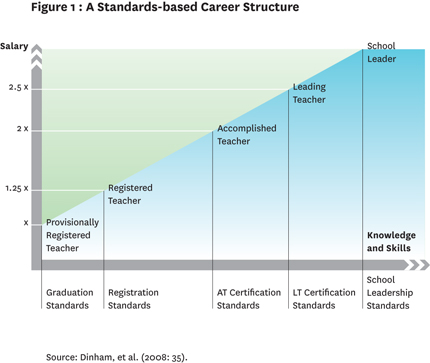
The main features of the approach we advocated include (see Figure 1):
- Common national standards for graduates of teacher education courses with courses accredited against these standards.
- Required national certification of Provisionally Registered teachers in the first year of teaching or equivalent.
- The ability of Registered Teachers to practice anywhere in Australia and earn a salary approximately 1.25 times that of a beginning teacher, rising to 2.00.
- Registered teachers would retain registration for a period of, say, five years during which time they would need to demonstrate professional learning against the national standards and meet employers’ requirements for appraisal and salary progression.
- Optional certification at both the Accomplished and Leading Teacher levels, with candidates meeting national standards for each designation. An Accomplished Teacher could earn a salary up to 2.5 that of a beginning teacher, with Leading Teachers earning beyond that. While Accomplished and Leading Teachers could hold a formal promotion position, such as head of faculty or assistant principal, the standards for these designations would articulate a high level of teaching expertise and strong involvement in working with other teachers through professional learning, mentoring, curriculum development, and so forth.
Once “equilibrium” had been reached in, say, ten years, approximately 60 percent of Australia’s teachers would be Provisionally Registered or Registered. Approximately 30 percent might be Accomplished, and 10 percent could have Leading Teacher status.
Other recommendations arising from our report included:
- Teachers to be drawn from the top quartile of secondary school graduates and from highly performing people entering teaching from other fields
- Beginning teachers to receive high quality support and guidance to prepare them for national certification/registration
- Nationally accredited professional development programs for teachers and school leaders to support a national curriculum and testing regime
- Salary and career structures to be restructured along the lines above through individual employing authority industrial awards agreed between employers and teachers’ unions to drive and reward higher levels of teacher accomplishment against national standards
What Progress Has Been Made to Date?
Our BCA report and the template represented in Figure 1 have been largely endorsed by subsequent announcements and developments.
A mapping of existing teaching standards has been undertaken and consolidated draft national standards at the Graduate, Proficient (i.e. Registered), Highly Accomplished, and Lead Teacher levels have been released for consultation (note the variations on our original suggested wording).
A new national body, the Australian Institute for Teaching and School Leadership (AITSL, arising out of a previous body called Teaching Australia) has been given responsibility for establishing “rigorous” national professional standards, fostering high quality professional development for teachers and school leaders, and working collaboratively across jurisdictions and with key professional bodies.[11]
Once the consultation stage for the standards has been completed and the standards modified as necessary, attention will turn to the development of the assessment and certification processes for Australia’s 300,000 teachers and accreditation for teacher education courses. To ensure consistency, a truly national approach is advocated – particularly for the optional, higher levels, rather than leaving this to existing state and territory jurisdictions or to employers.
Since there is no common industrial salary agreement for Australia’s teachers, a key issue is whether these national levels of certification will be integrated into teachers’ union agreements in the various jurisdictions and sectors. There is some progress on this front, with the largest employer of teachers, the New South Wales (NSW) Department of Education and Training, introducing a trial of 100 Highly Accomplished teachers in 2010.[12] These teachers are currently receiving a salary “bonus” of $8,000 per year.
Processes for certification need to be rigorous as well as valid and reliable, to prevent the sort of “rubber stamping” that has occurred with prior teacher appraisal systems.
Education systems and employers are naturally nervous about these developments. While all appear to support accreditation of teacher education courses and the certification of teachers at the mandatory Proficient level, some are concerned about the financial effects of a potentially large number of Highly Accomplished and Lead teachers being granted salary increases on achieving certification. Processes for certification need to be rigorous as well as valid and reliable, to prevent the sort of “rubber stamping” that has occurred with prior teacher appraisal systems.
An issue best left to employers is how levels of certification – including for leadership, which are currently being formulated – will mesh with appointment and promotion processes. It is not feasible to introduce blanket requirements in this regard; for example, some school principals in Australia supervise three teachers, others 200 or more. Requiring Principal Leadership certification in each case might be inappropriate and counterproductive. Employers will wish to retain flexibility in how they staff their schools.
The role of professional learning in these processes is also important. National testing, curricula, teaching standards, and teacher certification will make it possible to develop and introduce high quality and possibly nationally accredited professional learning courses and resources, to replace the present duplication of effort and uneven quality that results from uneven population density and ability to pay.
A final issue is the perennial question of “who pays?” Full development and implementation of the sort of system we outlined in our report for the BCA will be costly. However there are no cost-neutral solutions to the challenges of lifting teacher quality.
Conclusion
The bottom line is that Australia needs to more effectively attract, train, support, retain, recognize, and reward quality teachers throughout their careers. After a slow start and decades of debate, the pieces of the quality teaching puzzle are now quickly coming together. Increased federal government intervention and financial support, along with state and territory support and compliance, is driving educational change at a scope and pace not seen previously.
The biggest equity issue in Australian education today isn’t computers, new buildings or equipment. It’s the need for each student to have quality teachers and quality teaching in schools supported by effective leadership and professional learning in mutually respectful community contexts
The biggest equity issue in Australian education today isn’t computers, new buildings or equipment. It’s the need for each student to have quality teachers and quality teaching in schools supported by effective leadership and professional learning in mutually respectful community contexts.[13]
Life isn’t fair, but good teaching and good schools are the best means we have of overcoming disadvantage and opening the doors of opportunity for young people.
This paper is based on presentations he made in February 2010 in Vancouver, Winnipeg, Halifax, and Toronto on behalf of the Canadian Council on Learning, whose support is gratefully acknowledged.
EN BREF – L’Australie doit attirer, former, soutenir, retenir, reconnaître et récompenser plus efficacement les enseignantes et les enseignants de qualité pendant toute leur carrière. Après un lent départ et des années de débat, les pièces du casse-tête de l’enseignement de qualité s’assemblent. L’accroissement de l’intervention et du soutien financier du gouvernement fédéral se conjugue à l’appui et à la conformité des états et des territoires pour propulser le changement en éducation à un rythme et une envergure sans précédent. Des examens nationaux communs font déjà ressortir les zones sous-performantes (et surperformantes), traçant plus clairement la carte de réussite des élèves. Après des décennies de discussions et de débats, un programme d’études national de la maternelle à la 12e année sera lancé en 2011. Un site Web baptisé « My School » présente les résultats aux examens et d’autres données pour chaque école primaire et secondaire du pays. Et – au cœur même de l’amélioration de la qualité d’enseignement en Australie – des normes nationales d’enseignement, liées aux niveaux de rémunération, ont été instaurées, incluant plusieurs paliers d’agrément et le perfectionnement professionnel continu obligatoire.
[1] J. Hattie, Visible Learning (London: Routledge, 2009).
[2] www.aihw.gov.au/closingthegap
[3] www.naplan.edu.au
[4] www.acara.edu.au/default.asp
[5]www.federalfinancialrelations.gov.au/content/national_partnership_agreements/default.aspx
[6] www.deewr.gov.au/schooling/buildingtheeducationrevolution/Pages/default.aspx; www.deewr.gov.au/schooling/digitaleducationrevolution/Pages/default.aspx
[7] www.myschool.edu.au
[8] www.acer.edu.au
[9] S. Dinham, L. Ingvarson, and E. Kleinhenz, “Investing in Teacher Quality: Doing What Matters Most,” in Teaching Talent: The Best Teachers for Australia’s Classrooms (Melbourne: Business Council of Australia, 2008). Available at: www.bca.com.au/Content/99520.aspx
[10] L. Ingvarson, “Recognising Accomplished Teachers in Australia: Where Have We Been? Where Are We Heading?” Australian Journal of Education 54, no. 1 (2010): 46-71.
[12] www.nswteachers.nsw.edu.au/content.aspx?PageID=218&ItemID=76
[13] S. Dinham, How to Get Your School Moving and Improving: An Evidence-based Approach (Camberwell, Victoria: ACER Press, 2008).
-
Improving Assessment and Reporting with Performance Standards
Comments Off on Improving Assessment and Reporting with Performance StandardsDescriptive assessment that helps learners and their parents understand what they can do and what they are aspiring to be able to do is a powerful lever for learning.
In British Columbia, teacher-developed tools that serve just this purpose are available from the Ministry for optional use in reading, writing, numeracy, social responsibility, ICT integration and Healthy Living (http://www.bced.gov.bc.ca/perf_stands/) and an ad hoc task force formed by a consortium of school districts is in the late stages of developing similar standards for science (). (If you know of other similar resources that are available to teachers in Canada, I would love to hear about them.)
These standards are descriptions of the stages of intended learning outcomes that have been developed so that teachers do not each have to develop assessment criteria themselves. They are most effective when shared with students and parents as the basis for assessment and reporting, which improves communication and enables self-assessment.
Criterion-referenced assessment, as it is called, measures student learning against expectations rather than by comparing students to each other (which is known as norm-referenced assessment, or ‘grading on the curve’). Explicit expectations stated in advance make learning goals clear and assessment more transparent and understandable.
If resources such as those I have mentioned do not pertain to the specific learning activities being undertaken, teachers can develop criteria themselves, or collaboratively with their class, in advance. This helps students know what they are trying to achieve and ensures that they will understand the assessment provided by the teacher during and after the activity. It also helps them to take more responsibility for and assess their own learning.
Criterion-referenced assessment does not eliminate the subjectivity that is inherent in all grading (including those with the illusion of objectivity like math and science exams), but it goes a long way towards making assessment consistent, transparent and meaningful for students and parents.
And it certainly makes more sense that just totaling up the quiz scores and turning them into a percentage. This produces a grade alright but it doesn’t help the student know what they are doing well or where they are expected to improve – which is the primary purpose of assessment.
-
The Children Left Behind
Comments Off on The Children Left BehindThe research is fairly clear and consistent regarding the effect of socio-economic status (SES) on educational achievement, especially in the early years of a child’s life. In education circles, the generally accepted notion that SES is the strongest influence on a child’s academic achievement is usually followed by the reminder that schools play a vital role in helping to mitigate the inequity caused by poverty.
Unicef’s recently released Innocenti Report Card 9: The Children Left Behind asks a very critical question as it examines the inequalities and, indeed, inequities in the area of child well-being in 24 of the world’s richest countries: How far behind are children being allowed to fall? Admitting that when you set out to measure any demographic domain, there will always be groups that fall on either side of the normal range, Innocenti #9 probes the gap between the lower end of the distribution and the median.
And when that measurement approach is applied to the three major areas of child well-being examined in the report—material, educational and health—Canada lands pretty well in the middle of the pack.
There are two subdomains that are particularly disturbing, and ones that we need to take seriously when we’re talking about school performance, academic achievement and the idea of success for all.
When it comes to the indicators for material well-being, Canada scored 20 out of 24 countries when it came to the household income and overall living space in families living with children. In terms of household income, this means that families in the bottom 10th percentile had a household income that was 56% of the national median.
When you begin to look at the research on SES and student success in school more closely, it becomes apparent that there are many factors associated with lower SES that contribute to low school performance: amount of time working parent(s) have to spend with children, access to educational resources, parents’ own level of schooling, support networks, and home structure. So, the SES problem is really a complex set of problems that are intimately connected with each other.
Complexity aside (for a moment, at least), I think that there is a fairly straight line that can be drawn between what is revealed in the UNICEF report about the gap between our poorest families and what is considered to be normal in terms of the income necessary to raise and nurture children that are able to participate effectively in our society. If schools are one of the primary gatekeepers for that participation, and if equity is a real priority for us, then this gap needs to foster some serious questions on a number of different levels.
You know, we’ve spent a great deal of time talking about student achievement, mostly in terms of test scores and educational attainment statistics. But these are measures of output, aren’t they? For me, the UNICEF report forces us to ask questions about what we’re providing on the other end of the process that will ensure greater success for all participants. If we know that SES is a major factor in reaching our provincial and national goals around achievement, and if we know that this is a an area of equity in which Canada is falling behind, then we need to turn some of our energy away from the hand-wringing that we experience everytime a set of achievement data is released, and get down to the real work of closing the gaps that children in a country of our standing should not be experiencing.
One of the recommendations made by UNICEF Canada in response to the Innocenti Report Card #9 is the establishment of a Children’s Commissioner to ensure the best interests of children are considered in policy decisions that affect them, and services and policies affecting children are coordinated across government so all Canadian children have equitable access to and benefit from them.
In my mind, this would be a positive step in addressing the complexity aat the levels of both policy and practice.
UNICEF Canada has invited supporters to sign an electronic petition demanding that this recommendation becomes a reality.
I’ve just signed my name!
-
Should We Be Streaming Students?
Comments Off on Should We Be Streaming Students?‘Grouping’ by ability, or ‘tracking’, or ‘streaming’ means that students are placed into groups defined by their ability levels. Students may be grouped by ability either for a subject (for example for mathematics or reading) or for all or almost all their instruction. Students’ assignment to an ability group may be temporary, changing during the year, or relatively permanent.
Advocates of grouping by ability claim that it can raise achievement standards since teachers can target their instruction and use resources more effectively. However, researchers have shown that grouping by ability can have adverse effects on students’ attitudes towards schooling and their self-esteem. Studies on ability grouping show inequitable outcomes and social consequences:
- It is very difficult to distinguish ‘ability’ from ‘prior achievement’.
- Use of grouping by ability is associated with worse overall student performance.
- Students placed in higher ability groups may perform better but students placed in lower ability groups typically perform worse than in mixed ability groups.
- There is a tendency for lower teacher expectation and lower quality of instruction in lower ability groups.
- For students assigned to low-ability groups, there are negative effects on their self-esteem, motivation and attitudes towards schooling.
Research suggests that students in non-grouped settings, especially for those with lower achievement, have more healthy and positive attitudes towards school than students in grouped settings.
Researchers advocate using mixed grouping and reducing ability grouping in schools, but more important is to focus on improving instruction and curriculum for students of all achievement levels.
CEA and the Ontario Institute in Studies in Education (OISE) have teamed up to provide you with relevant and timely information based on current empirical educational research. The primary goal of this project is to get relevant and needed research into the hands of parents and other interested people. Five blurbs will be posted to our website throughout the 2009-2010 academic year. They will be written in plain language on topics of interest to parents, such as homework and class size.
Additional Resources
- Ministry of Education, Government of British Columbia: The Government of British Columbia provides tips for teachers and parents on career advice and planning for students taking Applied courses in high school. [Website]
- The Disadvantage of Tracking and Ability Grouping – A Look at Cooperative Learning as an Alternative: This article provides an alternative approach to ability grouping. [Available for Download]
- Duke University, Talent Identification Program: The Expert’s Forum on the discussion of ability grouping provides answers to the following questions: What is Ability Grouping? How does ability grouping compare to tracking? Why has ability grouping been so controversial over the years? [Website]
- Settlement.Org: This website provides Ontario parents with advice and information on high school courses and choices for their children. The information gives an insight to parents on whether their children should take Academic or Applied courses, and where it leads them in career choices. [Website]
Research References Informing this Issue
Boaler, J., William, D., and Brown, M. (2000). Students’ Experiences of Ability Grouping: Disaffection, Polarisation and the Construction of Failure. British Educational Research Journal, 26(5): 631-648.
Eder, D. (1981). Ability Grouping as a Self-Fulfilling Prophecy: A Micro-Analysis of Teacher-Student Interaction. Sociology of Education, 54(3): 151-162.
- In general, the results of this study indicate that the common practice of ability grouping should be questioned. (pg. 160)
- The results of this student clearly indicate that homogeneous grouping compounds initial learning problems by placing those children who have learning problems in the same groups. (pg. 160)
Gamoran, A. (1993). Alternative Uses of Ability Grouping in Secondary Schools: Can We Bring High-Quality Instruction to Low-Ability Classes? American Journal of Education, 102(1): 1-22.
Gamoran, A. (1992). Synthesis of Research: Is Ability Grouping Equitable? Educational Leadership, 50(2): 11-17.
- Given poor instruction, neither heterogeneous nor homogeneous grouping can be effective; with excellent instruction, either may succeed. (pg. 11)
- Little evidence supports the claim that tracking or grouping by ability produces higher overal achievement than heterogeneous grouping. (pg. 12)
Hoffer, T.B. (1992). Middle School Ability Grouping and Student Achievement in Science and Mathematics. Educational Evaluation and Policy Analysis, 14(3): 205-227.
- This analysis has shown grouping has no significant overall benefits in either science or mathematics. (pg. 221)
- In both subjects, students in the high groups learn somewhat more and students in the low groups learn less than comparable students in non-grouped schools.
Ireson, J. and Hallam, S. (1999). Raising Standards: Is Ability Grouping the Answer? Oxford Review of Education, 25(3): 343-358.
- Streaming, it is argued, can play a major role in polarizing students’ attitudes into pro- and anti-school camps. (pg. 348)
- At the primary level, the research suggests that children in unstreamed classes have healthier and more positive attitudes towards school than children in streamed classes and that this is particularly true for those in lower ability. (pg. 348)
- There is clear evidence that low ability groups tend to include disproportionate numbers of pupils in low-socio-economic status, ethnic minorities, boys, and those born in the summer. (pg. 349)
- School effectiveness studies have no identified pupil grouping as a key characteristic of effective schools. (pg. 349)
-
PISA 2009: Let’s not underestimate the importance of equity in education
Comments Off on PISA 2009: Let’s not underestimate the importance of equity in educationA major ‘good news’ story behind the latest PISA results is that Canada continues to be marked by high achievement and high equity in education. This means that the impact of socio-economic status is relatively small, and the gap between the high achievers and low achievers is also small, compared to most other countries. This is the distinguishing feature of Canada’s education system and, arguably, more important to the social and economic future of young people and Canada as a whole than small changes in overall standing (i.e. whether we are 3rd, 4th or 5th).
Why is equity in education so important? First, because it means that, generally-speaking, all children in Canada benefit from good schools and good educations, regardless of their family’s socio-economic status or immigration status. Why this is important for children is obvious since it affects their current educational experiences and their future prospects.
Second, and perhaps less obvious, educational equity is important because it relates to the overall equality in a society. We now know that equality benefits everyone in a society, not just those at the bottom. In their book, “The Spirit Level: Why Equality Is Better For Everyone”, Richard Wilkinson and Kate Pickett demonstrate that health and social outcomes are considerably worse in more unequal countries. They found that this is true for physical health, mental health, drug abuse, education, imprisonment, obesity, social mobility, trust and community life, violence, teenage pregnancies, and child well-being. They conclude that, the smaller the social and economic inequality between people, the better it is for everyone.
How do we explain Canada’s high level of educational equity? A common answer, particularly when contrasting Canada with the United States, is that it is a combination of factors, perhaps most importantly because we have better income programs, social safety net, and health care system. Last week UNICEF released a report that shed some new light on this explanation. “The Children Left Behind” looked at inequality in child well-being in three areas: material well being (includes family income and housing); educational achievement; and physical health. The results were mixed. In material well-being, Canada ranked 17th out of 24; in health, 9th out of 24; and in education, 3rd out of 24. The educational finding prompted the UNICEF spokesperson to observe ”we are doing something right”. Significantly, it is our education system and our schools that are doing something right, since Canada’s record when it comes to income, health and housing inequality, as well as child and family poverty rates, is considerably less stellar.
So, what ARE we doing right?
The Spirit Level: Why More Equal Societies Almost Always Do Better
-
Up With Reporting
Comments Off on Up With ReportingIf students, or their parents, wait anxiously for their first report card each year to know how they are doing, there is something seriously wrong. Report cards should simply be a formal confirmation of what everyone already knows because they have been getting informative feedback from their teacher and self-assessing throughout the term.
Assessment and evaluation are not synonyms. Assessment is the gathering of information about what students know and are learning, and how and what they are thinking. It is descriptive, not judgmental, and is intended to provide feedback to the teacher and the student. Assessment should be continuous and interwoven with instruction. Evaluation is a judgment, based on the comparison of assessment information to an expected standard, about the quality of a student’s demonstrated learning. It occurs periodically for the purposes of formal reporting. Evaluation serves a purpose but it does little to benefit learning.
Assessment takes many forms, beginning with the moment to moment observations that a teacher makes about student thinking as they interact with them and also includes review of assignments and marking of quizzes and tests. The things that teachers notice in day-to-day interaction with students provide the richest source of information and the most useful one for purposes of feedback that the teacher can use to adjust the pace and content of instruction, and that the student can use to better understand his or her learning and how to improve it. Planning for instruction should include frequent opportunities for teachers to informally assess student thinking and for students to self-assess. Quizzes and tests have a role to play but are inadequate on their own.
Embedded assessment and feedback is an essential part of instruction. If instruction were simply one-way it could be done using a video by a skilled lecturer. The professionalism of teaching comes in creating interactive learning activities that adapt to student responses and thus serve the unique learning abilities and needs of the particular learners in the class. Computers can deliver great lectures, but they are not yet capable of the keen observation, informed intuition and tactful guidance that a skilled teacher can provide in interaction with students.
Continuous descriptive, constructive and encouraging feedback to students, both formal and informal, is the reporting that really benefits learning, not the report card. That should be merely a consolidation and confirmation of what has already been said.
The change from assessment of learning to assessment for learning is happening across Canada. If you are making this change, or if your child’s teacher is making this change, tell me how its going and what you find works. Or perhaps you don’t agree with this change. If not, tell me why.
-
Down With Letter Grades
Comments Off on Down With Letter GradesStudent report cards as commonly written do far more harm than good. We would all be better off without them. Students would be more focussed on learning, parents would be better informed and educators would be more appropriately accountable.
Letter grades are at the root of the disservice that report cards do because meaningful information about learning cannot be reduced to a letter grade. (Don’t even get me started on the ridiculous idea that anyone’s learning can be assessed to an accuracy of 1%.) Nonetheless, policy requires that teachers produce them, and then parents and students attribute unintended meanings according to their own assumptions. Many believe that letter grades indicate a student’s position in the class relative to the average – “A” being well above average and therefore a matter of pride, whereas anything less than “C” is cause for concern – despite the fact that comparative assessment is contrary to best practice and grading policies across Canada.
Consider a student who writes a cogent and convincing expository essay but is careless with conventions such as spelling and sentence structure. S/he might be given a “B” due to those shortcomings, and a student whose writing adheres strictly to the conventions but whose thoughts are not as well organized and expressed might also get a “B.” These students are as different as chalk and cheese, but the letter grade make them look similar.
What should a student do in order to improve his or her letter grade? Just try harder? A letter grade conveys no information at all about current strengths or learning needs, and thus leaves enormous room for both student and parent to make misleading interpretations. Letter grades sort but they don’t report.
There are clearly superior ways of reporting on student learning. They are well-known and widely – but not commonly – practiced. Student-led reporting based on portfolios of student work, for example, can be a richly informative process. If a formal written report is required, including the intended learning outcomes and providing descriptive feedback based on those outcomes is far more informative than just a letter grade and yet even when such information is provided students and parents tend to skip right over it to get to the letter grade in the mistaken belief that tells the real story.
There are, of course, logistical challenges to anecdotal reporting and educators need to learn how to use plain language for it to be effective, but when the current approach is clearly inadequate surely it is worth tackling those challenges. So why don’t we?
Or perhaps you are making changes to improve report cards, or you are receiving effective report cards. If so, let me know what is working for you.
-
Viewpoint: Changing Academic Standards, One Community Centre at a Time
Comments Off on Viewpoint: Changing Academic Standards, One Community Centre at a TimeAcross Canada there exist pockets of “high-risk” communities that share certain characteristics, most of which experts and researchers correlate to poverty. These communities are normally portrayed in the media as hubs for violence, troubled youth, and drug saturation. While it is true that there are some pervasive issues directly related to lack of resources, one may need to take a second glance before siding with the media’s portrayal and/or one’s very own predetermined perceptions of what environments set the precedent for academic success. If you have ever thought that youth living in lower-income neighbourhoods were destined for lower academic success due to lack of opportunity, resources and/or desire, I urge you to keep reading and discover, as I have, a very different world than the salacious world of gun-slingers and drug traffickers typically portrayed in the media as the prime activity in low-income housing communities.
The Alexandra Park Community, also known as the Atkinson Co-op, is nestled unassumingly in the downtown core of Toronto. There are 806 residential units serving approximately 2,000 residents, most of whom live on a fixed income. There is a burgeoning contrast between the Atkinson Co-op, which visibly lacks in resources, and the trendy overflow of splendour that surrounds it. During my exploration I was able to uncover this community’s best kept secret. While visiting the Alexandra Park Community Centre, I discovered that it housed and kept safe the most valuable treasures and ostentatious investments of this community: the youth.
Contrary to the reflection of how undervalued community centres may be to greater society (i.e. decreased presence in communities and lack of financial support for programming), “out of school programs serve as critical partners in assisting schools to fill […] gaps, especially those serving low-income and working-class children of immigrants of colour.”[1] Research done by Irby, Pittman and Tolman emphasises that schools are only “one of a range of learning environments that share responsibility for helping students learn and achieve mastery… Community-based organizations, museums, parks, libraries, families, etc., are also themselves settings for learning and engagement.”[2] Community centres offer a range of learning opportunities and educational support not otherwise accessible in the schools. According to Lee and Hawkins, “community-based after-school programs have the potential to utilize resources and connect with children in different ways than school.”[3] Irby et al highlight that “because they are not necessarily associated with the expectations of school or other major institutions, students may feel more at home in intermediary spaces.”[4] Community centres offering after school programs create a space of belonging, and familial and academic support, which ultimately serves to enrich the student’s educational life through academic achievement and greater potential for success.
Mr. Olu Quamina, Child and Youth Program Coordinator at the Alexandra Park Community Centre, would attest that the community centre “is the nucleus of the community.” The roster of various programs catering to the residents of this richly diverse community has the ability to transport the youth past any stereotype to a point well beyond notions of social responsibility and program participation. Exchanges happen here. Ideas are born here. In many contexts, lives are saved here. Youth who would not otherwise have had an interest in school have traded in their long-standing ideas pertaining to the unimportance of academia for new ones geared toward goal attainment and academic success.
Executive Director Donna Harrow, Atkinson Outreach Worker Donnohue Grant, and Quamina work to implement specific program initiatives that propagate and ensure self-sufficiency while partnering with schools for visible continued support. S.E.R.V.E. (also known as Social. Emotional. Recreational. Vocational. Economic.-Opportunities for Youth, named after the five areas Quamina believes will make a difference in the lives of youth) and Concrete Roses are a few of Quamina’s recently designed programs geared toward the enhancement of youth’s lives through creating bridges of awareness between the relevance of skill development, academic success, and all other aspects of life. “We have changed the standard here. It is no longer ‘cool’ for youth to drop out of school,” says Quamina.
This sentiment is echoed by Patrick, who largely credits Quamina and the Alexandra Park Community Centre staff for supporting him in the successful pursuit of the Co-operative Housing Federation of Toronto (CHFT) scholarship. Although Patrick is aware that those unfamiliar with the Alexandra Park Community perceive his neighbourhood to be “a criminally-based environment”, the environment that he has come to know and love is much different. For Patrick, much of his environment is guarded safely between the walls of the community centre. “The Dexler Johnson program, movie nights, homework club… all of the centre’s activities helped to keep us out of trouble” explains Patrick. He has participated in these programs for several years and has had the opportunity to assume leadership roles. “The centre is where I learn how to become a better person while being an example for others.” When asked where he sees himself in a couple of years, Patrick answered with a smile, “I want to be in a position where I am able to give back to my community and pay tribute to all those who have helped and taught me along the way – furthering my education will help me to do just that”.
Ellie also largely attributes the tenacity of her academic second wind to Quamina and the support she felt throughout the community centre. “Prior to moving to this area, I was going to drop out [of school].” At that time, Ellie had just lost her mother. She was also recovering from an eye operation. Although she had been born visually impaired, the operation had rendered her completely blind. “The centre was incredibly welcoming and was definitely an instrument of change.” Not only is Ellie one of the beneficiaries of the centre’s initiatives, but she has also assumed a role as an imparter of those same initiatives. Ellie is a role model for the youth at the centre. She helps and supports children who are not visually impaired to learn how to read. “I felt that I had a greater purpose.” Ellie has since switched schools, career paths, and with the support and resources of the community centre, has also been successful in the attainment of the CHFT diversity scholarship. “These programs help to spotlight a group of people that most would glance over,” says Ellie glowing with appreciation. “We are here, we have voices, and we are beating the odds.”
Community centres may be seen as an oasis that refreshes and rejuvenates the spirit of academia. The youth who frequent the Alexandra Community Centre strongly vocalised how important the centre was to them. So on their behalf, and on the behalf of youth from communities across Canada who may not have the opportunity for their stories to be heard, a special thanks goes out to those whom Ellie refers to as “the unsung heroes”: community centres responsible for joining the Quamina’s, the Harrow’s, the Grant’s, the CHFT diversity scholarships, and schools of the world, whose collaboration has resulted in changing the academic standards in marginalized and non-marginalized neighbourhoods alike, one youth at a time.
EN BREF – Les médias représentent généralement les collectivités à faibles revenus comme des plaques tournantes de violence, de jeunes en difficulté et de toxicomanies. Mais les jeunes vivant dans des quartiers défavorisés ne sont pas nécessairement condamnés à une réussite scolaire moins brillante par suite d’un manque de possibilités, de ressources ou de volonté. Des centres communautaires comme l’Alexandria Park Community Centre à Toronto offrent un éventail de possibilités d’apprentissage et de soutien éducatif dont ils ne disposeraient pas ordinairement à l’école, suscitant un lieu d’appartenance et un soutien familial et scolaire qui enrichit la vie éducative des élèves en leur ouvrant la porte à la réussite scolaire et à un potentiel plus élevé de succès. On doit à ces centres, répartis à travers le pays, de changer les normes scolaires dans des quartiers marginalisés ou non, un jeune à la fois.
[1] A. Wong, “’They See Us as Resource’: The Role of a Community-Based Youth Center in Supporting the Academic Lives of Low-Income Chinese American Youth,” Anthropology & Education Quarterly 39, no. 2 (2008): 184.
[2] M. Irby, K. Pittman, and J. Tolman, “Blurring the Lines: Expanding Learning Opportunities for Children and Youth,” New Directions for Youth Development 97 (2003): 18-19.
[3] S. Lee and M. Hawkins, M. (2008) “’Family Is Here’: Learning in Community-Based After School Programs,” Theory Into Practice 47, no. 1 (2008): 53.
[4] Irby, Pittman, and Tolman, 18-19.
-
Think Twice, Measure Once
Comments Off on Think Twice, Measure OnceCarpenters are well advised to measure twice and cut once because premature cuts can waste time and valuable materials. Similarly, educators should think twice and measure once because ill-conceived measurements can both distract and distort.
What one chooses to measure generally becomes the focus of time and attention, often to the exclusion of other topics. Thus, if one chooses to measure achievement in literacy and numeracy other subjects such as science, social studies, the Arts and Technology tend to take a back seat, let alone the more subtle issues of social-emotional learning and character development that are critical to a quality education.
The distraction caused by a narrow focus for measurement may also distort outcomes if what is measured does not represent the full array of literacy and numeracy objectives. For example, literacy tests usually include impromptu writing but not planned and edited writing, which is arguably a more important skill. They also generally omit oral communication which is critical for employment, citizenship and life in general.
Although no responsible educator would “teach to the test,” it is virtually guaranteed that the things that are measured and reported will become the focus of attention and that other things will be relegated to the margins. This unintended consequence within schools is compounded in the community when the available data is misused to generate supposed quality indices of limited scope and questionable meaning. A prime example of this disservice is the “Report Card” published by the Fraser Institute in many provinces, which is granted far too much attention and credibility, thus misinforming the public and confusing the important discussion about improving educational quality.
The decision to measure some outcome must be made with full recognition of the potential for distraction and distortion. This is not a reason to forego measurement of outcomes, but it is a reason to employ an array of indicators that span the full range of important outcomes and to ensure responsible, representative reporting and use of the data. Simply proceeding with what is easiest to measure is counterproductive because of ‘collateral damage’ due to the distraction and distortion this causes.
Educational assessment is a complex business and it is expensive to do it well. However, it is also essential. Since it is impossible to imagine funding a census assessment (i.e., all aspects for all students) that adequately represents the full range of important educational outcomes, a sampling approach that delves more deeply by using subtle and sophisticated measures (including qualitative techniques such as case studies and direct classroom observations) is the only credible way to monitor system performance and provide data that is useful for improvement. Unfortunately, while this is the most productive approach for educational purposes, it does not serve the perceived need in some quarters to provide all parents with an independent measure of their child’s learning.
Educational discourse and school improvement clearly requires an evidential foundation, but it is important that the evidence be collected in ways that adequately reflect outcomes. A good assessment program begins with well-understood questions and intentions, which are the foundation for a sophisticated program of evidence gathering, interpretation and constructive use. It does not simply measure what is easiest or draw excessive inferences from what happens to be available.


IDEAS TO SUPPORT EDUCATORS : Subscribe to the EdCan e-Newsletter
Quality research, reports, and professional learning opportunities.