Archive
-
“First, We’re a School”
Comments Off on “First, We’re a School”The call to all Canadians to reconcile relationships with Indigenous peoples offers opportunity to heal old wounds and build a nation that aspires to equitable benefits of citizenship. The why of advancing reconciliation through schools is easy. We have the opportunity to shape the hearts and minds of the children and youth who will advance a vision of equity. The how is more difficult, as competing visions and interests precipitate countless priorities for educators to consider in fostering reconciliation.
I am convinced that as educators, our value proposition is captured in one of my principal’s frequent attestations that “first, we’re a school.” This principal leads a core neighbourhood community school in Saskatoon, serving 400 primarily First Nations students. She invokes this proclamation when considering priorities and initiatives, as the social and learning needs of students place a premium on instructional time.
This principal routinely defers to community to assist in the transmission of Indigenous knowledges, while ensuring that she maintains her commitment to instructional leadership. The “first we’re a school” disclaimer could just as easily be used to limit Indigenous influence, but when claimed by this principal, it is a commitment to ensuring that we assume our responsibility as educators. I, too, subscribe to the belief that when everyone with a role in the educational continuum does their part, then student success is attainable. We have a role that is unique and informed by our training and experience. No one else in the support network is as attuned to individual student learning needs by virtue of our assessment literacy and knowledge of diverse instructional practices.
As educators re-orient to the belief that they are potentially the greatest contributors to Indigenous student success, policymakers in Canada must confront the reality that learning is differentially resourced for on-reserve First Nations learners in Canada. First Nations communities have the desire and capacity to improve their schools, but professional educators – Indigenous and non-Indigenous, on and off-reserve – need to be resourced for success. Untying educators’ hands by appropriately resourcing the technical and relational work of teachers is paramount.
“First we’re a school” implores educators to maintain a laser focus on learning outcomes. Of course, if we recycle the same unwelcoming and unresponsive environments that alienated generations of Indigenous people from Western education, then we yield our potential to contribute to reconciliation through education. We need to integrate relational and Indigenous pedagogies to ensure that we are not perpetuating exclusion and stratification. Engagement, wellness, culture, and language are all vital aspects of a responsive and effective learning program.
The problem is that educators experience inertia by fixating on student deficits, their own knowledge gaps, or their belief that they have to be the expert. These distractions erode the primacy of responsive instruction. Teacher leaders must promote one year’s growth in one year’s time as the primary narrative associated with educating Indigenous students. The short-term actions of effective teachers accumulate to realize the long-term vision of equity of outcome for Indigenous students.
Through the many trends and innovations that punctuate the profession, the enduring truth is that, when students acquire core competencies, most notably literacy, then belonging and transitions are enhanced. Our commitment must be the provision of equity of opportunity to ensure equity of promise. Indigenous students come from resilient families with brilliant histories in intellectual traditions and complex languages. Their communities have contributed medicines, systems of governance, conservation practices and critical philosophies to the global context. Indigenous children will continue to advance and contribute Indigenous knowledges as they learn and grow. The question is whether Indigenous students will have to endure school and succeed in spite of it, or experience school as an endorsing part of their growth continuum?
In an era informed by the Truth and Reconciliation Commission of Canada’s Calls to Action, school jurisdictions are increasingly stating their commitments. It is my hope that their first commitment is to equity of opportunity and outcome. The role of the professional educator is instrumental in reconciliation. We need to adopt an epistemology of promise: know your students, understand their learning needs, believe in their trajectory of greatness, and do your part to ensure growth. I encourage professional educators across the country take the advice of a principal of an innovative and effective school in Treaty Six territory and, when discerning how to contribute to reconciliation with Indigenous peoples, consider that “first, we’re a school.”
We want to know what you think. Join the conversation @EdCanPub #EdCan!
Photo: Courtesy Saskatchewan School Boards Association
First published in Education Canada, June 2018
-
Speaking Our Truth
Comments Off on Speaking Our TruthAll Canadians are called to action by the Truth and Reconciliation Commission Report, but it is educators who have a particular responsibility. Most teachers though, don’t know how or where to begin and are nervous about making mistakes. In Speaking Our Truth: A Journey of Reconciliation, award-winning Indigenous author Monique Gray Smith invites educators to follow her on a journey to understand the impacts of colonialism and the Residential School system for Indigenous peoples. For concerned teachers, Smith offers a solution or a “call to teaching”; one that suggests educators learn with students and have them shape the outcomes rather than try to “teach” a particular curriculum. This is particularly important, as Dr. Marie Wilson says in chapter 4, because it will be “the children who will lead the way” forward.
Throughout the book, Smith provides ways to hold an open space in the classroom that enables students to ask the difficult questions and encourages them to “think with their heart” – the pedagogy of her book. Chapter one welcomes educators, provides the history of Residential Schools, and sets the landscape with the Seven Sacred Teachings. Smith uses the narratives of those on their journey towards reconciliation throughout Speaking Our Truth, to illustrate how we can “hold each other up” (the theme of her book for young readers, You Hold Me Up) and develop an understanding of what Indigenous and non-Indigenous relationships can look like moving forward. The questions asked throughout the four chapters, and the multitude of resources she provides, serve as a “curriculum” guide for educators and students to work together collaboratively to imagine a different society not tainted by racism and discrimination, where all ways of knowing are considered valuable. Her Cree philosophy of tawâw – “there is always room” – sets the tone for this book that welcomes us all on the path to reconciliation. Speaking Our Truth: A Journey of Reconciliation is a critical guide for all educators, at all levels.
First published in Education Canada, June 2018
Orca Book Publishers, 2017 ISBN: 978-1459815834
-
Education’s Call to Action
Comments Off on Education’s Call to Action“Education is the key to reconciliation.” – Justice Murray Sinclair, Chair, Truth and Reconciliation Commission
Canada’s Truth and Reconciliation Commission illuminated a history that has been ignored or glossed over for far too long: the suffering and damage caused to Indigenous children and their families by residential schools, and the ongoing impact and legacy of colonialism.
The challenge before us is to acknowledge these truths and work toward a just and respectful relationship with this land’s Original Peoples. It remains to be seen how well we as a country will meet this challenge, but one thing is clear: educators have a critical role to play. Through the education system, we can ensure that the next generation of Canadians grows up with some understanding of the histories and cultures of First Nations, Métis and Inuit (FNMI) peoples, and that FNMI students receive an equitable and culturally relevant education.
But how to begin? We know that many teachers feel daunted by their own lack of knowledge and fear of “getting it wrong.” There is great work being done, however, that can inspire and guide us – addressing both the specific needs of Indigenous students and the need to better educate all students.
I’m very excited that this special issue is entirely devoted to Truth and Reconciliation in education. It showcases inspiring models and practical ideas for educators who wish to take steps towards reconciliation in their schools. The articles we received were truly outstanding, and I am very grateful for the generosity and enthusiasm of our contributors.
I’d specifically like to thank two people. Michelle Hogue, our Guest Editor, sits on Education Canada’s Editorial Board and is a Métis scholar teaching at the University of Lethbridge. She was not only an invaluable guide and advisor but also took on nitty-gritty work like moderating our Youth Talking Circle (and please do read what these extraordinary young adults have to say – they blew us away with their openness, wisdom, and determination to contribute to a better world). I also want to thank Mi’kmaw Elder Albert Marshall, who set us on the right path with his introduction to this issue on.
Elder Albert says we are on “an ongoing journey of co-learning” from and with each other. Educators don’t need to know it all. We simply need to be ready to seek out the knowledge of those who do know, and to learn alongside our students.
We want to know what you think. Join the conversation @EdCanPub #EdCan!
Send your comments and article proposals to editor@edcan.ca
Photo: Dave Donald
First published in Education Canada, June 2018
-
Truth and Reconciliation in Canadian Schools
Comments Off on Truth and Reconciliation in Canadian SchoolsEvery educator in Canada needs to know what is in this book. In our national and global call to truth and reconciliation action, Toulouse has written an essential resource to teaching and learning about Indigenous history, knowledge, culture, and contributions. Her text moves “beyond acknowledgements and apologies” to restorative education about, and with, Indigenous peoples. In well-organized, clear language, Toulouse maps, scaffolds, and guides important First Nations concepts and methods for meaningful teaching and learning.
Part 1 provides five compelling chapters describing Indigenous information, values, and contexts. Beginning with residential schools, and moving on to contributions, values, and treaties, Toulouse connects the TRC calls to action and curriculum requirements with personal relationships, concepts, and stories from her own experiences, ancestors, and mentors as a bridge to wider Indigenous knowledges.
Part 2 presents direct lessons, grade by grade from K-12, and uses literature, language arts, science, physical education, arts, and social studies to teach the intellect, emotions, and spirit. Toulouse guides educators and students moving forward toward healthier, informed, respectful communities, who learn, live, and laugh together in a difficult world.
This user-friendly, teacher-ready book begins a wave of new, important education to reconnect people and communities across our country. Toulouse tackles the reasons educators have feared to take this on, and then shows us how to wade in and start. We open ourselves to old and new stories and Indigenous knowledge. We restore the fundamental importance of every human being. You will be surprised by light, inspired by heart, and intellectually challenged to integrate what you read into your own teaching. The Sacred Circle teachings and “projects of heart” alone give bedrock foundation for teaching for life in this country. A well-conceived macro (big-picture) view of greater good shapes the direction and range, along with great suggestions for studying core concepts and micro-details with literature and materials already available.
This book is a remarkable map, guide, and companion for educators about how, when, and where to take the restorative education actions we need. Let’s get together and have some important conversations to change things for the better.
We want to know what you think. Join the conversation @EdCanPub #EdCan!
Photo: Dave Donald
First published in Education Canada, June 2018
Portage and Main Press, 2018-03-05 ISBN: 978-1553797456
-
The Best of Both Worlds
Comments Off on The Best of Both WorldsThe transformative changes coming to schools across Canada in the wake of the Truth and Reconciliation Commission’s (TRC) “calls to action” bring lots of opportunity for discussion around key issues. For example, what structural changes need to be implemented? What innovative frameworks have already proven useful? What are some of the pathways educators and educational authorities are following to work with communities, nurture the Learning Spirit for youth, and create curricula that “bring together” different cultural ways of being, knowing, and doing? What ways might be helpful to bring diverse energies into balance such that the inevitable negatives are meaningfully heard, consensus reached, and positive educational changes fostered?
In this article, we share a few such understandings. Our three voices are woven as a conversational discussion, plus we’ve included some of Elder Murdena’s understandings (unfortunately, her health precludes active involvement). We hope our discussion will help encourage many more both in and outside the classroom, given that learning is a lifelong journey with both formal and informal educational opportunities.
ALBERT: My strong intact Mi’kmaw Spirit enabled me to endure fierce, pervasive cruelty at residential school. Today, our school environments are profoundly different but our Indigenous youth still need to know who they are, where they come from, and how to speak their Ancestors’ language. Why? Because when you force someone to abandon their ways of knowing, their ways of seeing the world, you literally destroy their Spirit and once that Spirit is destroyed it is very, very difficult to embrace anything – academically or through sports or through arts or through anything – because that person is never whole. To have a whole person, their Spirit, their physical being, their emotions, and their intellectual being… all have to be intact and work in a very harmonious way.
CAROLA: At Mi’kmaw Kina’matnewey (MK),1 the Mi’kmaw educational authority in Nova Scotia, we understand this and are using Elder Albert’s guiding principle of Etuaptmumk / Two-Eyed Seeing (E/TES, see definition in this issue’s Network Voices, p. 6). It’s a co-learning journey for all because it’s a new approach. My role on the team is to develop and implement literacy programming while supporting teachers as they continue building their instructional strategies in literacy. I do this in a way that’s consistent with MK’s goal of “ensuring that our students see themselves reflected in the curriculum as essential to creating a strong literacy foundation.” There are so many different dimensions we need to consider, such as creating culturally safe environments, revisiting policies on a regular basis and in inclusive ways to ensure reconnecting with authentic cultural understandings, providing genuine cultural resources, renewing curricular content to address current (student) needs, and creating meaningful networking opportunities for everyone.
CHERYL: Here in Unama’ki – Cape Breton Island – Murdena Marshall had early understandings of these critical dimensions for post-secondary science. In the 1990s, she pushed for an E/TES-guided approach for post-secondary science education and thus we created the then-unique pathway, namely the Toqwa’tu’kl Kjijitaqnn / Integrative Science (TK/IS) program within a four-year undergraduate degree at Cape Breton University. The intent was to make post-secondary science more relevant and attractive for Mi’kmaw students. It functioned from 1999 to the late 2000s; there’s lots of information on the website2 and Carola was one of our early students.
CAROLA: Because of that program and the many traditional teachings I learned from Elders such as the late Gwen Bear, from Tobique First Nation in New Brunswick, and from my mom, Serena Francis, who is a retired language teacher in Elsipogtog First Nation in N.B., I know first-hand that the educational approach of Etuaptmumk / Two-Eyed Seeing can be truly empowering. At MK we are working with community Elders and educators to create foundational understandings for developing curricula whereby we will centre our Mi’kmaw ways of being and doing, and for which Elder Jane Meader from Membertou First Nation in N.S. has provided written understandings.3
Our team recognizes the need to change the way science stories are told and an excellent example in this regard is Muin and the Seven Bird Hunters. It’s an inspiring piece of Two-Eyed Seeing, where collaboration and co-learning are exemplified. This almost forgotten Mi’kmaw story of the north night sky was revived by Elder Lillian Marshall of Potlotek First Nation. Among many things, her work revealed rich Mi’kmaw Knowledge about patterns in the sky, showed the congruency of Western science with this Mi’kmaw Knowledge, and then went further by showing how the holistic Mi’kmaw science interconnects sky knowledge with the behaviour of birds and the actions of the L’nu’k (Mi’kmaw people). The project is an excellent example of what happens when respect for two knowledge systems occurs. Elder Lillian had been working for years to revive the story. But it was the UNESCO-designated International Year of Astronomy in 2009 that finally enabled completion of the work as her energies came together with those of Elder Murdena and other Mi’kmaw Elders, plus knowledgeable and supportive individuals in the Royal Astronomical Society of Canada and creative individuals on Cheryl’s Integrative Science research team at Cape Breton University. Their collaborative work resulted in a video and a children’s storybook4 and clearly showed how we can change the way we tell our science knowledge stories so that they are culturally inclusive, accurate, authentic, and respectful. This is exactly what the guiding principle of E/TES encourages.
CHERYL: Having taught in the TK/IS program, I am convinced its approach to teaching science by “bringing together Indigenous and Western scientific knowledges and ways of knowing” could benefit all science students, from all communities and ethnicities. Yet I know negative energies abound: some critics are racist, others poorly-informed or fearful. An excellent learning example for us came in February 2014, when the new federal legislation “Bill C-33 First Nations Control of First Nations Education” was under consideration and, in its regard, The Globe and Mail columnist Jeffrey Simpson commented that “… the big loser will be students, whose knowledge of basic science, math and other subjects will be so infused with cultural appropriateness by these theorists as to handicap them, rather than assist them, in wider Canadian society.”5 Elder Albert responded with a letter to the editor.
ALBERT: My letter emphasized that E/TES is not easy and that we need to embark on a co-learning journey in which our two paradigms will be put on the table to be scrutinized. We need to honestly be able to say that the essence, the S/spirit of our two ways, has been respected as we work to balance the energies of those ways; we need to put the two together. My letter had to be short. More recently, we have started pondering how we might better deal with negative energies and disagreements. And thus, we now emphasize that co-learning needs to embed capacity for i’l’oqaptmu’k, meaning “to revisit to renew, to maintain movement in the direction Spirit intended.” Differences of opinion or conflict are inevitable, so we need ways for the energies of the various parties to reach consensus. I asked my friend, artist Gerald Gloade from the Mi’kmaw community of Millbrook, to create an image of a Two Bowl Peace Pipe (see picture) to help us ponder how, within a sacred coming together, the negative energies could be burned off as they go through the pipe for purification towards consensus and our energies find balance. Our Mi’kmaw language also provides insights: Kisutmajikmeans “they decided to talk.” Kisutmauk means “we come to consensus so we can move forward because we have taken in these natural energies” (from the land, water, air, and Spirit). And Kisutasik means “consensus has been reached.” This is really the essence of co-learning because we can’t work on the basis of assumptions or hearsay. We need to take time to listen to each other rather than merely talking about each other. Lots of deep dialogue, deep co-learning, and hard work are required for E/TES and all four domains of being human, namely the physical, emotional, intellectual, and Spiritual, have to be involved.
A co-learning journey is necessary for this ‘together approach’ to be successful because, as in every journey, challenges exist: in our mindsets, points of view and perspectives, and approaches to teaching.
CAROLA: “Putting our knowledges together” most definitely needs to be done in appropriate ways. For example, within a typical mainstream framework there will generally be a focus on cognitive or intellectual development. As a Mi’kmaw person, however, I would begin with Spiritual development at the heart, interconnected with the emotional domain in ways that follow our Elders’ teachings and guidance. A co-learning journey is necessary for this “together approach” to be successful because, as in every journey, challenges exist: in our mindsets, points of view and perspectives, and approaches to teaching. Also and very importantly, what is called “Indigenous” has to come from genuine Indigenous voice, community, Spirit, and knowledge.
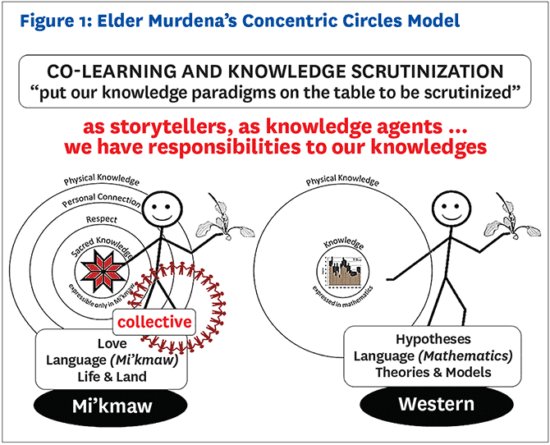 CHERYL: Years ago, Murdena created a model to emphasize the system nature of Mi’kmaw Knowledge and we’ve adapted it to help serve co-learning and knowledge scrutinization (see Figure 1). Murdena’s model has four concentric circles although, she says, traditionally there would be no intentional layering because stories were used to transmit knowledge in a holistic way. She indicates Mi’kmaw Knowledge and Western Science can share empirical observations of the physical attributes of, for example, a plant and its habitat (see outermost circles for both models in the diagram). In Mi’kmaw Knowledge, the middle circles of personal connection and respect are reciprocal, plus all four circles are interconnective. Sacred knowledge is innermost, can only truly be understood within the Mi’kmaw language, and generally cannot and should not be translated. Western Science relies on mathematical language and our model for it lacks middle circles because subjectivity is intentionally diminished. For Mi’kmaw Knowledge, “the Knowledge Holder / the knower” is an integral participant within the knowledge. In the Western science model, “the knower” stands outside the circles to emphasize objectivity.
ALBERT: These simple models are worth thousands more words… here I want to highlight that Mi’kmaw Knowledge is collective and thus any one Knowledge Holder has only a small piece, and also that our knowledge is alive and thus both physical and Spiritual with our language continually reminding us of our responsibilities.
CHERYL: In the Toqwa’tu’kl Kjijitaqnn / Integrative Science program, we worked within the broadened view of science as “dynamic, pattern-based knowledge shared through stories about our interactions with and within nature” for the Indigenous and Western sciences. Curricula evolved as we explored common ground (outermost circles in the knowledge models) while acknowledging and respecting differences (remaining circles). TK/IS eventually collapsed in the face of financial and political stresses. Nonetheless, it saw considerable student success and I will always say that community facilitators and tutors6 along with Elders and educators working together with mainstream allies were key… a “we together” approach.
CAROLA: At Mi’kmaw Kina’matnewey, we are learning with and from Elders in the many Traditional Districts in Mi’kma’ki. We are listening to their stories and envisioning how to put these into curricula woven within our Mi’kmaw Principles of Learning. We are at the beginning of this exciting journey to reconnect with our collective understandings as to how young people can best learn and to try to begin to grow these understandings within formal educational settings. In early elementary programming, Elders identified the importance of outdoor and experiential learning. The MK Board of Directors recognized the value of play and inquiry in learning. This administrative /community support is critical to successfully implementing change. This approach to learning, of framing learning experiences in real-life contexts through exploration via play, is one excellent way to teach our students. Teachers from Preschool to Grade 2 are receiving intensive training on ways to incorporate play-based, inquiry-based learning in their teaching. As we move forward our goal has to be: Toqikutimk / Together We Are Growing.
ALBERT: Again, I wish to say: E/TES is not easy. And so, we need to understand that sometimes our most important job is to plant seeds for the future, for the youth, knowing seeds germinate when the time is right. We must also accept that Indigenous communities need to generate their own understandings around re-awakening their own Indigenous Knowledge – this is what MK’s project through Carola and others is doing – and this takes time. We are entering an era in which what we once had and then came to consider as obsolete, is now coming back. This is especially true in regards to our traditional understandings that richly woven kinship relationships and interconnectivity are what make our natural world. The remembering and relearning will require much transformation of understanding – we will need to invite our Tribal Consciousness back into our daily lives so we are guided as to the way we initially were, and we will need to do a lot of inner reflection. We have for too long been in a period of disconnect from our natural world and from our traditional ways. We have lost a lot of the stories that would normally flow as to our responsibilities in sustaining ourselves as part and parcel of the whole. Education is key, for all of us.
I also want to emphasize that there are words in our language that would be more appropriate to use in place of the English phrases “Indigenous Knowledge” or “Traditional Knowledge.” For “Mi’kmaw Knowledge,” Murdena and I have suggested Ta’ntelo’lti’k meaning “the way we L’nu’k are.”7All Indigenous Nations have their own languages, their own words.
CAROLA: Nurturing the Learning Spirit of our students has to be central to everything we do and many of us firmly believe language is one key. For example, we can look to the community of Eskasoni, which has had an immersion program at the elementary school for at least 18 years. A research project that examined their program revealed the trend towards better educational success for Mi’kmaw students whose formal educational years began with immersion in our Mi’kmaw language.8
CHERYL: Murdena has always said, “We must bring Ta’ntelo’lti’k / Mi’kmaw Knowledge into the present so that everything becomes meaningful in our lives and communities. Our Mi’kmaw Knowledge was not meant to stay in the past; it is not static.9Like all things alive, it grows and changes… it is dynamic.”
CAROLA: We know that MK educational support helps foster our Mi’kmaw communities. In working with our communities and schools, we have seen high rates of graduation from high school.10Young people who know who they are and where they come from and who are connected with their Ancestors’ language, with Elders, with Ta’ntelo’lti’k / Mi’kmaw Knowledge, and with their community and Nation… find themselves woven into a multi-dimensional network of understandings that will help them find success in their chosen careers. This, in turn, helps to enrich our communities in ways that we can only begin to imagine. Our communities will grow. We all benefit.
ALBERT: Elders want to work with projects such as MK’s through Carola and others to ensure the accuracy, authenticity, and sacredness of the Mi’kmaw Knowledge being included. This is the validation by peer-review that we Elders insist must be an integral part of all efforts today involving Indigenous Knowledges. In 2009-2011, Elders from across Atlantic Canada worked together to provide formal recommendations in this regard. These are known as the “Elders Eight Recommendations for Honouring Traditional Knowledge”11and were supported by the Atlantic Chiefs in September 2011. I have great hope these recommendations will soon begin to be acknowledged and acted upon as the Elders intended… especially within educational institutions.
ALBERT, CAROLA AND CHERYL: We need to work together to do this. Indigenous Elders and Knowledge Holders are as interested in knowledge integrity as are mainstream academics and researchers. We need to do this in and for our classrooms, institutions, organizations, communities, Nations… across Canada. The educational need is deep and it is broad. Msit No’kmaq.
We want to know what you think. Join the conversation @EdCanPub #EdCan!
Illustration: Gerald Gloade
First published in Education Canada, June 2018
1 http://kinu.ca/introducing-mikmaw-kinamatnewey
2 www.integrativescience.ca
3 http://kinu.ca/document/mikmaw-ways-being-and-knowing
4 www.integrativescience.ca/uploads/activities/BACKGROUND-making-video-Muin-Seven-Bird-Hunters-IYA-binder.pdf
5 Jeffrey Simpson, “Money Alone Can’t Fix Aboriginal Education,” The Globe and Mail (Feb. 21, 2014). www.theglobeandmail.com/opinion/aboriginal-education-needs-money-and-more/article17008070
6 Student support was provided by the Mi’kmaw Science Advantage Program, better known as MSAP. This included tutors during 1999-2002 and recruitment facilitation in 1999-2002 plus 2003-2005.
7 www.integrativescience.ca/uploads/articles/2010June-Marshall-Bartlett-Integrative-Science-Two-Eyed-Seeing-environment-Mi’kmaq.pdf
8 www.apcfnc.ca/images/uploads/FinalReport-BestPracticesandChallengesinMikmaqandMaliseet-WolastoqiLanguageImmersionProgramsFinal.pdf
9 C. Bartlett, M. Marshall, and A. Marshall, “Two-Eyed Seeing and other Lessons Learned Within a Co-learning Journey of Bringing Together Indigenous and Mainstream Knowledges and Ways of Knowing,” Journal of Environmental Studies and Sciences 2, no. 4 (2012): 331-340.
10 http://kinu.ca/introducing-mikmaw-kinamatnewey
11 www.apcfnc.ca/images/uploads/ResearchSummary-HonouringTraditionalKnowledgeResearchSummary.pdf
-
Stavely Elementary School’s Project of Heart
Comments Off on Stavely Elementary School’s Project of HeartOki, Niisokowa. Nistoakoak Piikanikoan. Greetings, all my relations. My name is Ira Provost. I am a member of the Piikani Nation, who are members of the Blackfoot Confederacy of what is now known as Southern Alberta in Canada and the Northern State of Montana in the United States of America. I participate and am extensively involved in my Blackfoot culture.
I am an Indigenous educator. My career has granted me a decade-long experience in Indigenous education and educational programming as the Program Coordinator or Administrator of First Nations, Métis and Inuit (FNMI) Education Programs for a Southern Alberta school district. Although I have moved on from schools, my entire professional career has been, and continues to encompass, the role of educating non-Indigenous people about my Blackfoot Culture. It is a role and responsibility that I carry with astute honor and integrity.
Project of Heart
I returned to my First Nation as Manager of the Piikani Traditional Knowledge Services, my community’s on-reserve cultural centre. The local school districts often reach out to our organization to provide cultural awareness lessons and instruction to staff and students. On once such occasion, I got a call from the Livingstone Range FNMI Success Coordinator, Georgina Henderson, who invited me to a classroom presentation in Stavely, Alberta. Stavely is a small town in Alberta that would typically not have any Indigenous population in their community. It was not unusual to get a call from small towns in the area to come and present; as a centre, we’ve been to nearly all of them. But this time it was different.
The event was entitled the “Project of Heart Launch.” Invited guests included school board trustees, the superintendent, Stavely’s school principal, FNMI support personnel, and Elders from the Indigenous community. The teacher and project lead, Julaine Guitton, began the presentation by explaining that the students were engaged in a year-long project to learn about the Canadian residential school system. At this event the students had already had frequent lessons and teachings on residential schools, beginning with Orange Shirt Day in September. Each student had prepared a short speech about what they had learned, how they felt about it, and what they hoped they could learn from this point on. The speeches and presentations were absolutely amazing! The students were genuinely interested in their studies and the Indigenous people in attendance were deeply moved by the presentations. They concluded their day with a small feast and conversation with all staff and students.
I was greatly impressed and, like the other invited FNMI guests, was blown away by what was presented and what we had heard! In my view, and by all accounts, meaningful exchange and understanding of Indigenous people took place.
Based upon my experience, qualifications, and background, I believe Project of Heart was a great example of Indigenous learning because of the following:
Indigenous Education = Universal Education
One of the first impressions I had of the students and the project was that Julaine, the teacher, showed that learning about Indigenous people can take place regardless of your location.Many times in my career I have I heard teachers and school districts debate whether or not learning about Indigenous people or programs should take place as there were no identified First Nations, Métis, or Inuit students in the school. Stavely’s Project of Heart showed this was not the case.
In North America, whether you are near a First Nation reserve or Métis settlement or not, you are in someone’s Indigenous traditional territory. It is therefore important that you know and support who those nations are, as this leads to meaningful engagement with Indigenous communities. You can find out which nation’s traditional territory you are in by contacting the nearest First Nation administration office.
What does “meaningful” mean?
Meaningful engagement with the Indigenous community means taking the time to develop a relationship and nurturing that relationship for mutually beneficial success.
According to many anecdotal comments from the local Indigenous parents I’ve heard from over the years in schools, and from being a parent myself, school personnel do not take enough time to get to know the Indigenous community. I’ve witnessed many occasions where the school staff and students could not identify who their Indigenous neighbours are. Often school communities off reserves do not understand the Indigenous community norms, values and beliefs. Most times these norms and beliefs are quite contradictory to regular school policies and procedures. However, these differences do not mean that the Indigenous community does not value education – quite the contrary. Elders from the many communities I’ve worked with in multiple traditional territories give the same message – that education is important – and encourage their youth to value and attain their education.
Julaine and her students took time before and after their launch to keep the relationship going through local visits and exchanges with the Blackfoot community throughout their school year.
Beyond the provincial program of studies
Indigenous education is most effective when the learning goes beyond what is recommended or taught in the provincially mandated Program of Studies. This means that when teachers develop relationships with the Indigenous community, they must nurture that relationship and take measures to ensure it grows. There are many possibilities for utilizing Indigenous knowledge in the classroom to teach and benefit all students.
The primary reason that I believe the project has worked, and will continue to work in the education of these students, is that the learning was organic, interwoven into the continuum of their academic program over a long period of time. The teachings will continue to be a significant part of the Stavely students’ education going forward because the lessons were not structured or confined into a “one-time” or “one and done” unit/thematic lesson approach. Like Indigenous knowledge itself, the teaching of Indigenous knowledge needs “flow” and time to take root.
Indigenous generosity
This Project of Heart stands out for me in the fact that Julaine didn’t wait for training or learning experiences to be provided or for the curriculum to be revamped – she saw the need and she and her class took responsibility for educating themselves.
Generally speaking, non-Indigenous people tend to not take the first step to learn more about Indigenous people. When non-Indigenous people/educators reach out to understand Indigenous cultures, the Indigenous embrace the learners any way they can, as many Indigenous Nations refer to the value of generosity and compassion. When one is willing to learn and place their “Heart” into it, the best learnings come, and yes, Indigenous communities share.
The best advice I have for readers is that there are no quick solutions, lesson plans or instructional keys to creating great teaching moments in Truth and Reconciliation.
Truth and Reconciliation
In 2015, Canada’s Truth and Reconciliation Commission released the 94 Calls to Action. There are a number of the Calls to Action that address education and our need as a Canadian society to correct the gaps that continue to exist in education as one step to “reconciling” with Indigenous communities. In my graduate studies I looked at the life cycle of a teacher: post-secondary student, pre-service teacher, new teacher, and existing classroom teacher. I found that, at the present time, there is very little requirement for teachers to have Indigenous Studies as a significant part of their education to attain their teaching degree, to begin or to continue teaching in classrooms. As a result, there exist many gaps still evident in today’s education system regarding appropriate education for and about, and created with, the local Indigenous community and why these particular Calls to Action exist.
The important step in understanding how to realize the potential in the Calls to Action is to not take action without an Indigenous person to guide your curricular/program development. There is a myriad of possibilities as to how to create meaningful programming and they are quite easy to implement. But educators cannot possibly create educational programming without understanding what their Indigenous communities need and what their values are. Although fascinating, learning about the Haudenosaunee and Iroquois Confederacy is not as valuable as learning about the Blackfoot Confederacy when in Blackfoot Traditional Territory.
The best advice I have for readers is that there are no quick solutions, lesson plans or instructional keys to creating great teaching moments in Truth and Reconciliation. Julaine and her students showed that their learning took a lot of work and time and they achieved so much more at the end of their year by doing so.
Paths forward
As an Indigenous educator, Blackfoot knowledge keeper and ceremonialist, I will always look back and continually reference this Project of Heart as one that should and could be modelled in classrooms and schools across the country. I, as an Indigenous parent, strive to have my Indigenous heritage respected and appropriately represented and taught in my child’s school. For me, the Project of Heart attained what I hoped Indigenous education could be, an equal and balanced relationship between a teacher and her Indigenous community. Throughout the students’ journey, several of them came forward and acknowledged they were of Indigenous heritage and felt comfort in doing so. I believe it was a first time for the school.
I wish Staveley school and students and all readers a happy journey through Canada’s reconciliation. It really is a new dawn for a better next 150 years.
Katamustin (Blackfoot: Until we speak/meet again).
We want to know what you think. Join the conversation @EdCanPub #EdCan!
Photo: Courtesy Julaine Guitton
First published in Education Canada, June 2018
-
Reconciling with a Flawed Education System
Comments Off on Reconciling with a Flawed Education SystemAs Canada moves to reconciliation, we find ourselves at a crossroads – a crossroads between identifying the problem and finding its solution. And as this country’s perspective on Indigenous issues is rapidly changing, so should our education system. The problem is that we are still stuck in the past. From uninterested teachers to poor, outdated resources, we as students deserve better. Our approach to teaching Canadian history must change.
From Grades 4 to 7 we’ve learned the same progression of Canadian history. It starts when European explorers come to Canada. We’ve moved on from them “discovering” Canada but it’s still in no way a fair account of history. They’re treated as heroes — the French and English explorers who established the European-Canadian society as we know it. What this narrative fails at is both teaching what happened before settlers arrived and how their arrival hurt Indigenous peoples.
History textbooks that are so unjust shouldn’t be permitted today.
Updating our resources is never a priority for school administrations. Students, donors and staff all prefer more tangible investments: new technology, trips or artists/scientists in the school, not a new outlook on our history. Yet history textbooks and other resources should be a number one priority, as the difference between what is and should be taught is drastic. History faces unique problems that are unlike any other subject, as our society’s outlook on its complex issues have changed since our textbook’s publication in 2001. That inaction is leaving people behind.
History textbooks that are so unjust shouldn’t be permitted today. Books that have one page on the more than 10,000 years of history before settlers came. Books that seldom give the view of Indigenous people. And books whose writers thought it was acceptable to write one short chapter on the traditions of Indigenous peoples and throw their hands up in the air. All these flaws create a textbook that chooses whose voices should be heard by the students, instead of letting all sides share their stories and the students make that judgment for themselves.
As Canada comes closer to a turning point, one would think that the time to act is now. Yet no action is being taken. So being tired of that inaction and the same flawed narrative, I proposed a solution.
I presented my teacher with a few pages of the Manitoba curriculum, which went further in depth about Indigenous peoples, and proposed that this could fill some of what was missing in the textbook. It built on what the Ontario curriculum lacked, highlighting the wide range of Indigenous societies and the traditions of pre-contact Indigenous peoples.
I was shut down and told that I could refer students to the resource and they could access it in their own time. A fellow classmate told me afterwards that no other student was going to go to that resource. I agreed with him. If we don’t challenge our students to think differently, nothing will change. And this burden falls on educators. Students shouldn’t be begging to further their education, teachers should be inviting it.
Every Toronto school teaches empathy – putting oneself is someone else’s shoes. Yet the schools’ actions don’t follow through. As non-Indigenous people we need to put ourselves in the shoes of the Indigenous people from across the country whose stories, culture and voice are being left out. We will never be able to repair our relations with Indigenous peoples if we’re being taught that they don’t matter. If our government and our society are so keen on changing those relations, they must start changing our education.
Note: The Ontario government plans to introduce a revised curriculum in Fall 2018 that will include or strengthen Indigenous content in several subject areas.
We want to know what you think. Join the conversation @EdCanPub #EdCan!
Photo: courtesy Jed Sears
First published in Education Canada, June 2018
-
Truth & Reconciliation in Every School
Comments Off on Truth & Reconciliation in Every SchoolYou could not attend our event in Lethbridge? stream our panel discussion live into your staffroom.
Watch our panel discussion
This important and timely professional learning session will identify how we can respectfully and accurately incorporate Indigenous perspectives into all aspects of our schools and classrooms, including lessons on the history and legacy of residential schools. Our goal is to begin a dialogue to learn together and build relationships among Blackfoot First Nation Knowledge Keepers, community leaders, and non-Indigenous educators and teaching candidates who are striving to “get this right.”
Key questions that will be explored at this event include:
- Why should educators change their practices, how do we achieve “truth,” and how do we work towards reconciliation? What’s stalling the development of learning objectives that would incorporate all Canadians in the reconciliation process, and how should the TRC’s recommendations evolve education policy?
- How can we develop approaches that are community-specific and respectful of local protocols and practices? How can educators build trusting relationships with Indigenous communities?
- How can schools and post-secondary institutions commit to co-learning about reconciliation throughout the entire school year? How can post-secondary teacher trainers prepare the next generation of educators to value and feel confident in embedding Indigenous perspectives into all grade levels and subject areas?
No matter where you are on your learning journey, this event will equip you with valuable insights that can help you contribute to preparing the next generation of learners who will work collaboratively with Indigenous peoples to advance reconciliation.
Proudly supported by

-
New guidebook on early school leaving
Comments Off on New guidebook on early school leavingNew EdCan Network case study research report entitled The Rural Advantage: Rallying Communities Around Our Students calls on school-community leaders to consider a made-in-Canada approach that raises literacy rates, prevents early school leaving and breathes life back into small towns.
It’s an all-too-common scenario in Canada’s rural communities. Parents who struggle to read and write. Household incomes and unemployment rates that fall below the national average. Students with special needs who require a speech pathologist or a teaching assistant, but don’t get one. Schools at risk for closure and dwindling community services as young people dropout of school or opt for brighter opportunities in the big city. But these trends can be reversed with a “community ecosystem approach”: a Canadian-developed, step-by-step process for developing school-community partnerships that can reduce student dropout rates in rural and disadvantaged schools and municipalities.
“Our grade-four French-language success scores have risen from 50% to 98% in only five years,” says Sylvain Tremblay, principal of both an elementary school and a high school in Saint-Paul-de-Montminy, Quebec. “Instead of working in silos, we engaged parents, kids, teachers and community partners to collectively lead activities that increase the language skills of toddlers and encourage the academic and social success of our children and young adults.”
This guidebook was originally developed with the support of CTREQ – a Quebec-based research and knowledge mobilization centre – and provides a practical toolkit and worksheets for school and community leaders to create their own unique program, including guidance on how to engage hard-to-reach families, classrooms, schools, and whole communities.
“Schools can’t afford to work in isolation from the families and communities where their students live and grow up,” says Darren Googoo, Chair of the EdCan Network, a pan-Canadian collective of education leaders. “This approach isn’t about overloading busy educators; rather, it’s about community leaders rallying around a literacy action plan that leverages existing resources and strengthens existing efforts.”
Download the full report for free, including how-to videos and a practical toolkit, at: www.edcan.ca/ecoreussite-report.
SUPPORTED BY

This initiative is generously sponsored by State Farm Canada, which shares EdCan Network’s commitment to supporting leaders who are transforming Canada’s public education system.
-
A guide for leading dropout prevention in your small town
Comments Off on A guide for leading dropout prevention in your small townThis case study report calls on school-community leaders to consider a made-in-Canada approach that raises literacy rates, prevents early school leaving and breathes life back into small towns.
This step-by-step guidebook provides a practical toolkit and worksheets based on the concrete experiences of the “L’ÉcoRéussite” program, which has developed a “community ecosystem” action plan in collaboration with the CTREQ: a Quebec-based research and knowledge mobilization centre. This “community ecosystem” approach provides guidance on how to engage hard-to-reach families, classrooms, schools, and whole communities in order to collectively create and lead activities that increase the language skills of toddlers and encourage the academic and social success of children and young adults ages 0-24 years-old.
Schools, school districts and community organizations can leverage this guidebook to create their own unique programs adapted to their particular needs and situation.
The Ecosystem Toolkit
This toolkit contains worksheet templates, sample community surveys and model action plans that have been carefully developed by the “L’ÉcoRéussite” program. These hands-on tools can be used as exemplars for filling-in the blank templates below, which were developed by the CTREQ.
Phase 1: Explore
This phase consists in collecting qualitative and quantitative data to develop a community portrait, engaging community stakeholders and hosting your first community consultation meeting. (Refer to Phase 1 of the report).
PHASE 2: INITIATE THE PROCESS
understanding the protective factors of student retention and success, versus the risk factors of dropping out of school
Survey to evaluate current initiatives and gaps in community service offerings
developing a community portrait
determining community needs and objectives based on Key findings and Protective factors
PHASE 3: THE PLANNING STAGE – CREATING AN ECOSYSTEM ACTION PLAN
developing a community Action Plan
PHASE 4: IMPLEMENT AND EVALUATE
survey to ASSESS PARTNER SATISFACTION
Widening the scope to target individuals ages 0–24 years-old
survey to ASSESS COMMUNITY PRIORITy issues
sample results from the survey to ASSESS community PRIORITY ISSUES
Practical how-to videos for community organizations, schools, school districts and parents’ associations (in French only)
This video series on the “L’ÉcoRéussite” program will allow you to dive deeper into the winning conditions, challenges and key steps undertaken by this school-community team in creating a “community ecosystem” action plan.
How to Create a Community Action Plan in Support of Student Retention (in French only)
Building Upon Student success to Spur Parent Engagement (in French only)
The “L’ÉcoRéussite” Program: Supporting Student Success in Disadvantaged Rural Communities (in French only)
SUPPORTED BY
This initiative is generously sponsored by State Farm Canada, which shares EdCan Network’s commitment to supporting leaders who are transforming Canada’s public education system.
-
Truth and Reconciliation in YOUR Classroom
Comments Off on Truth and Reconciliation in YOUR ClassroomThis is an exciting time to be a teacher. Teachers have amazing potential to help make Truth and Reconciliation a reality, and to move the next generation forward in creating a fairer, more just, and more inclusive Canada. It’s a big job, and one that many teachers approach with a bit of fear and more than a few questions.
The teachers in our schools want to do a great job. In addition, they often feel an overwhelming responsibility to right the wrongs of the past and inspire their students to seek equity and social justice. They recognize that infusing Indigenous histories, cultures and perspectives into educational curriculum is a way to contribute towards the goal of reconciliation by providing students with an opportunity to learn about the Indigenous people with whom they share the land, and on whose ancestral territories all Canadians currently reside. Unfortunately, these same teachers also know that they are being asked to inform students about an Indigenous people whom they themselves have learned little about. As well, many teachers have had little, if any, cultural sharing or first-hand experience with Indigenous people. It is not surprising then, that many teachers’ feelings range from nervous and unprepared to woefully inadequate when asked to bring these topics into their classrooms.
Developing pedagogy for reconciliation
To get started, we would like to explore some fundamental approaches to fostering reconciliation in your classroom. It’s very important that teachers realize that the education system has been used to rob Indigenous people of their languages, their cultures, and their communities through the residential school system. This is why teachers have a responsibility to work with Indigenous people, families, and communities, rather than continuing to work in a system that speaks for Indigenous people, families, and communities – that is, don’t do for, do with. It is also vital that teachers understand that doing nothing adds to the problem. When teachers do nothing, Indigenous children don’t see themselves in their classrooms, and non-Indigenous children do not learn about this land’s first – and continuing – inhabitants. Then, students implicitly learn that Indigenous people, knowledge, and perspectives are worth less, and they may continue to pass on the systemic injustices that have gotten us into this situation.
The challenge for teachers is that many don’t know how, or where, to begin. There are more than 50 First Nations in Canada, in addition to the distinct Métis and Inuit groups. If teachers are required to be experts on all these groups before teaching their students, then the teaching and the learning will never happen. Fortunately, teaching is not about having all the answers and teachers are not being asked to be experts on all of Canada’s Indigenous people.
However, the question then becomes: “How can teachers indigenize their classrooms well?” Many teachers are understandably afraid of teaching Indigenous material poorly, perpetuating stereotypes or overstepping their bounds and engaging in cultural appropriation. Cultural appropriation can take on many forms. It can be the adoption of elements of one culture into another without fully understanding or acknowledging their meaning. It can mean making use of sacred objects, like headdresses at Hallowe’en for example, without learning about why they are sacred or important. It can mean presenting Indigenous peoples as caricatures or as existing only in the past. It can mean speaking on behalf of Indigenous people or taking on elements of Indigenous spirituality without getting permission from qualified Indigenous knowledge keepers. Basically, cultural appropriation is taking and using important cultural elements that do not belong to you without learning about them first. It is setting yourself up as an expert on a culture you are not a part of, or not respecting the living existence of Indigenous people, the sophistication of Indigenous knowledge and spirituality, or the capability of Indigenous experts, Elders, and knowledge keepers.
Practically, there are steps you can take to avoid cultural appropriation but still incorporate Indigenous content in your classroom.
- Never dress, act or do activities that reduce a group into a caricature or stereotype. If it’s not accurate and respectful, it’s not OK.
- Don’t misuse anything of religious significance or cultural meaning, even if you don’t understand exactly why. If you’re not sure if something is sacred, it is important to ask or do your research.
- Don’t practice culture in your classroom, teach about culture in your classroom.
- Never appropriate someone else’s culture as your own – not even as a demonstration for students.
- Ask yourself: “If I were a member of the group in question, could I be offended?” Take history into account, and show empathy.
The task may seem daunting, but teachers across the country are reading the Truth and Reconciliation Commission’s “calls to action” and embracing the responsibility to teach for Truth and Reconciliation. They’re finding that there are many tools out there to help them succeed. Many teachers utilize a pedagogy rooted in student inquiry to facilitate this learning. The inquiry approach is a wonderful opportunity for teachers to move metaphorically from the position of all-knowing sage in front of their students, to co-learning partner sitting beside their students. In addition, recent and ongoing changes to curriculum in all provinces means not only that teachers are required to teach Indigenous topics, but that ministries of education are required to provide resources and supports for those teachers. Realistically however, it will take more than resources or a change in pedagogy to facilitate the change that is needed in education. It will take some time and some dedicated work.
If the truth comes before the reconciliation, then Canadian teachers are at the forefront of this country’s future.
The truth is that reconciliation is about relationships, and you can’t have a relationship with someone you don’t know. A good place to start is to learn something about the Indigenous people with whom you share your land. It would be disappointing if students in Canadian classrooms learned more about the Maya and the Maori than they learned about the Salish and the Haudenosaunee. Every teacher in every classroom in Canada is teaching in a school that is physically connected to land that tells the story of the relationship between Indigenous and non-Indigenous people in Canada. Every day our students walk and play on land that has a history and a significance to Indigenous people. Imagine what our relationship would look like if everyone understood that significance, that history, and better understood the people whose enduring presence demands reconciliation. If the truth comes before the reconciliation, then Canadian teachers are at the forefront of this country’s future. It’s not about teaching everything, it’s about having the integrity and humility to teach something – and to teach it in a good way.
- Do, whenever possible, allow Indigenous people to speak for themselves. Inviting local Indigenous knowledge keepers into your classroom is an opportunity to forge new and ongoing relationships. If an Indigenous person cannot be present, there are excellent and well-vetted videos available.
- Don’t start with cultural genocide and residential schools. Indigenous people are not victims first. Take the time to learn about the many proud and resilient people who were impacted by Canada’s residential school system.
- Do learn about contemporary Indigenous people. Not only do they still exist, they are the fastest growing population in Canada.1
Preparedness
Investing time to prepare yourself to teach Indigenous content is crucial to success and helps to build confidence. There are many opportunities available. For example, to better prepare yourself to teach Indigenous content, the Assembly of First Nations (AFN) offers a great online resource called It’s Our Time: The AFN Tool Kit, available at www.afn.ca/education/toolkit. The tool kit has many classroom resources, as well as “Plain Talks” available on iTunes, or as PDFs, that will provide you with information on a wide variety of Indigenous topics, from treaties to languages.
Other ways to better prepare yourself include completing an online course, attending Indigenous events, participating in professional development activities offered through the school board or elsewhere, and engaging with Elders or knowledge keepers.
Resources for reconciliation
The best resources are human resources. Indigenous people have time-tested knowledge systems, education, governance, and ways of raising children that are sophisticated and beautiful; you won’t regret taking the time to have conversations with Indigenous people in your community and learning about them. In some places, that isn’t easy and there is much healing to do. Some places where you can find experts on these matters include friendship centres, Indigenous Studies departments and Indigenous student services at universities, and most importantly, the Indigenous education experts that many school boards employ.
There are also many print and multimedia resources. The number of Indigenous authors is on the rise, and you can find classroom resources by Indigenous authors, including kits, books, and digital tools. When choosing resources, think about your students and their interests. Choosing resources that are relevant to your area will also make the content more meaningful to your students and teach them about the diversity of Indigenous Nations.
When you are vetting resources, look for these four things:
- Content and accuracy: Make sure that the content makes sense and portrays Indigenous people in a whole-person, fair way.
- Authorship: Try to privilege Indigenous authors. There are also many non-Indigenous people with expertise in Indigenous studies, but it is important to make sure that they do have authentic expertise. Do Internet searches to check authors’ biographies and credentials.
- Approachability: Choose resources that reflect where you are and who your students are. You can also connect students’ interests to Indigenous content. Choose a subject of interest and go from there.
- Diversity: Indigenous people have knowledge of content that touches on all subject areas, so teachers can integrate Indigenous content into any classroom. Including Indigenous content in every subject underlines the sophistication of Indigenous knowledge. You can also use Indigenous content to share diverse perspectives and compare mainstream and Indigenous views on historical and current events.
You can be a part of the move to teach for Truth and Reconciliation. As Truth and Reconciliation Commission Chair Justice Murray Sinclair said, “…education, or what passed for it, got us into this situation, and education is what will lead us out.”2 Teachers have great responsibility to move our society forward. But we are teachers. We love learning. We love our students. We shape minds and societies. We are up to the challenge.
Resources for K-12 Teachers:
- Online sources like goodminds.com or the Martin Family Initiative feature hundreds of vetted resources by Indigenous authors with clear curriculum connections across many subject areas.
- Universities and other education institutions often have great resources online.
For the prairies, the University of Saskatchewan has an Indigenous Studies research portal you can find here: http://iportal.usask.ca/index.php?sid=134064592&t=index.
In the Eastern Woodlands, Queen’s University has an outstanding website with Indigenous content that you can access here: http://guides.library.queensu.ca/aboriginal-curriculum-resources/native-studies-resources/websites.
On the West Coast, the University of British Columbia has K-12 curriculum resources available online here: http://guides.library.ubc.ca/indigenous_ed_k12. - Provincial teachers’ federations and other organizations may have resources specifically designed to assist teachers in their work to support truth and reconciliation education in their classrooms. For example, see Joining the Circle: An Educator’s Toolkit to Support First Nations, Métis and Inuit Students, published in hard copy in October 2017 by the Ontario Teachers’ Federation (OTF) and the Centre ontarien de prévention des agressions (COPA), and available at
http://copahabitat.ca/en/toolkits/joining-the-circle/guide-and-resources. - For pan-Canadian topics like residential schools, check out the Hundred Years of Loss education kit developed by the Legacy of Hope Foundation. The “Kairos Blanket Exercise” offers an interactive exploration of Indigenous-Canadian relations with a focus on residential schools and reconciliation. It can be used in any classroom from Grade 4 to adult learners.
For additional resources, see: National Centre for Truth and Reconciliation, University of Manitoba (www.nctr.ca)
First published in Education Canada, May 2018
NOTES
1 Statistics Canada, Census of Population, 2016.
2 Excerpt from presentation by the Honourable Justice Murray Sinclair to the Senate Committee on Aboriginal Peoples, September 28, 2010, p.6. www.trc.ca/websites/trcinstitution/File/pdfs/senate%20speech_handout_copy_E_Final.pdf
-
How do Makerspaces heighten student engagement?
Comments Off on How do Makerspaces heighten student engagement?Makerspaces are informal community or in-school learning spaces that offer tools and resources for community members and students to tinker with a mix of traditional technologies – such as cardboard, wood, recycled plastic, or fabric – and more cutting-edge technologies – such as 3D printers and scanners, robotics, laser cutters, open-source computers, microcontrollers, and sensors. Makerspaces can be found in community centres, libraries, schools, and other public spaces, including pop-up Makerspaces setup for single day events and mobile Makerspaces that reach remote populations. While definitions vary, there were an estimated 1,400 Makerspaces worldwide in 2016: 14 times as many as there were in 2006.
Makerspaces engage students to learn in and out of school, by providing opportunities to:
- Develop 21st century employment skills through solving problems and thinking creatively.
- Learn through play at their own pace by developing self-confidence through designing objects and creating them with 3D printers or through programming a robot.
- Deepen what is learned in Science, Technology, Engineering, Art and Mathematics (STEAM) classes, by making connections with real-life tasks and problems. Makerspaces are especially useful for engaging students who have not thrived in a traditional school setting, since these subjects are often taught in separate classes without practical applications.
- Explore their interests and develop creative solutions to real-world problems, showing that solving complex social issues often requires multiple skills and people.
- Develop intergenerational relationships and build communities through activities that draw from community expertise and build shared goals with community members. This allows knowledge and skills to be shared and personal connections to be created between people of all ages, including strengthening teacher-student relationships.
- Develop collaboration skills and teach others what they learn, so that children understand that they can take on a variety of roles, such as being a leader, a builder, an organizer, a planner, a technician, an engineer or a designer.
- Develop fine motor skills through using manual tools. This includes connecting circuits, assembling small parts together, and cutting, gluing, polishing or sanding objects.
- Learn by trial and error, take risks, and persevere in challenging situations where they feel supported in “getting their hands dirty.”
Evidence suggests that Makerspaces help develop practical skills that increase student engagement and prepare children for the 21st century job market. Whether repairing an old radio, knitting with embedded wearables, or building a robot, Makerspaces allow students to explore their interests, develop their passions, and thrive in the classroom and beyond.
Additional Information Resources
Davidson, A.-L. (2017). You too can experience the “maker scream. Concordia University. Retrieved from www.concordia.ca/cunews/main/stories/2017/05/03/maker-scream-education-professor-saltise-winner-ann-louise-davidson.html
Davidson, A.-L. (2017). On Focus. Retrieved from www.linkedin.com/pulse/focus-ann-louise-davidson/
Davidson, A.-L. (2017). This Easter, Conquer the Impossible with Your Kids. Retrieved from www.linkedin.com/pulse/easter-conquer-impossible-your-kids-ann-louise-davidson/
References
Andersson, P. (2015). Digital fabrication and open concepts: An emergent paradigm of consumer electronics production. (Bachelor thesis, Umeå University). Retrieved from www.diva-portal.org/smash/get/diva2:822484/FULLTEXT0
Davidson, A.-L., Price, D. (2018). Does Your School Have the Maker Fever? An Experiential Learning Approach to Developing Maker Competencies. Learning Landscapes, 11(1), 103-120. Retrieved from www.learninglandscapes.ca/index.php/learnland/article/view/926/918
Lou, N., & Peek, K. (2016). “By The Numbers: The Rise of the Makerspace.” Popular Science. Retrieved from www.popsci.com/rise-makerspace-by-numbers
Fleming, L. (2015). World of making: Best practices for establishing a makerspace for your school. Thousand Oaks, CA: Corwin.
Peppler, K., Halverson, E., & Kafai, Y. (Eds.). (2016). Makeology: Makerspaces as learning environments (Volume 1). New York, NY: Routledge.
Peppler, K., Halverson, E., & Kafai, Y. (Eds.). (2016). Makeology: Makers as learners (Volume 2). New York, NY: Routledge.
Sheridan, K., Halverson, E. R., Litts, B., Brahms, L., Jacobs-Priebe, L., & Owens, T. (2014). Learning in the making: A comparative case study of three makerspaces. Harvard Educational Review, 84, 505–531.
-
5th Canadian Assessment for Learning Network (CAfLN) Conference and Symposium
Comments Off on 5th Canadian Assessment for Learning Network (CAfLN) Conference and SymposiumThe conference is an opportunity to share, learn and network with educators from K-12 and post secondary settings. It will include presentations and break-out sessions with leaders in assessment and opportunities to connect your learning with your own teaching context. Guest speakers will include CAfLN’s founding members – Ken O’Connor, Lorna Earl and Damian Cooper.
-
Guided Physical Play in Kindergarten
Comments Off on Guided Physical Play in KindergartenFive-year-old Nancy is busy with clay. At first the chunk she pulls off is too hard to shape, but she’s learned to warm and knead it until it’s softer. She rolls it into a long cylinder and coils the tapering “bug” to attach to her leaf. Then she pulls off two larger bits of green clay to make more leaves for her growing tree. “Too big,” she mutters, and pulls them off again. She cuts one of the balls in half and tries again, this time using her fingers to spread the clay into a thin leaf shape perfect for her imaginary tree.
Play is often described as “the work of childhood.” While the idea of play eludes any single definition, the thread that unites various types of childhood play is pure and simple pleasure. It is its own reward and is self-reinforcing.
In this short article, we make a pitch for a greater focus on fine motor control through guided exploratory play in the Kindergarten program, emphasizing the importance of direct tactile experiences – handling and manipulating objects or materials in the real world in real time. This type of play fulfills several important goals of early childhood learning. First, body-object interaction (BOI) supports the development of stable, internalized models for learning the world: its shape, size, speed, distance, texture, structure, and whole-part relationships, for example. Concepts of shape and size are key to alphabet recognition and the type of reasoning that is foundational for early numeracy understandings in Grades 1 and 2.
Second, guided physical play promotes fine motor control. The Kindergarten years are the time to afford opportunities for play with tweezers, popsicle sticks, crayons, markers, and clothes pegs to strengthen the muscles and the neuropathways for the demands of written literacy, beginning just around the corner!
Finally, BOI develops the associated vocabulary as children learn to name and describe their interactions with the material world.1 Children with nimble fingers are found to have a larger developed lexicon of concrete objects, and interestingly, of more abstract concepts, too. Suggate and Stoeger suggest that “embodied cognition” enjoys a processing advantage, and that the connections between cognition, language and physical contact with the material world provide distinct benefits to youngsters who have had rich opportunities for these types of experiences in early life.
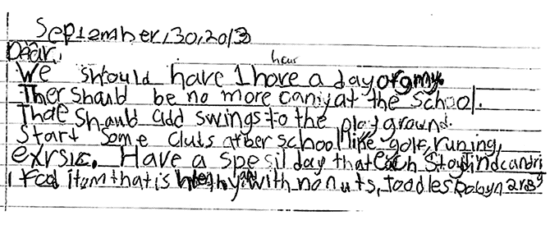
Figure 1: Writing Sample
We find plenty of evidence, however, that Canada’s young children are generally not sufficiently engaged in this type of play prior to their arrival in Kindergarten. The Early Development Instrument (EDI) analyzes Pan Canadian data on five-year-old children on five domains.2Outcomes indicate fewer than 50 percent of Canada’s young children are developing as they should along all five domains of early development. The ParticipACTION 2016 Report Card reports that only nine percent of Canada’s young children are getting the recommended amount of daily exercise, and increased numbers are not getting enough sleep.3 Our own work with Grade 2 children who are gifted revealed their overall lack of readiness for the demands of early written literacy learning, as noted in their distinct, belaboured printing efforts.4 (See Figure 1: Writing Sample.) Our intervention of explicit printing instruction using a programmatic, developmentally progressive approach can, we found, change the slope of the educational trajectory. However, remedial or “catch up” teaching is more difficult and time consuming than “just right teaching” might have been in the sensitive window of time in Kindergarten and Grade 1. Hence our motivation to focus on guided physical play at a much earlier stage in the educational experiences of young students.
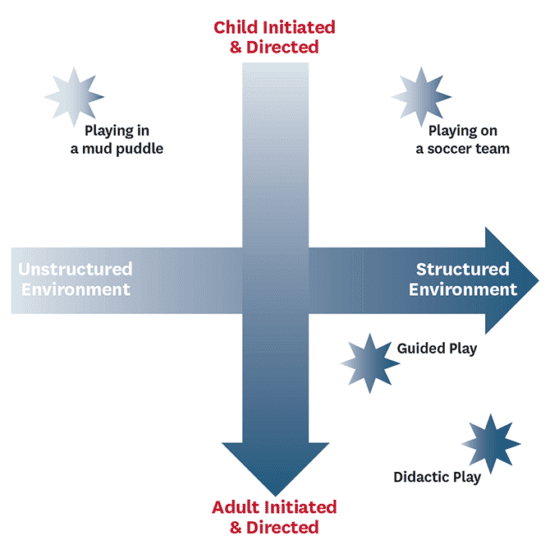
Figure 2: Matrix of Types of Play
We position various types of play by way of a framework we have organized around two continua: from child-initiated and directed to adult-initiated and directed; and from unstructured to structured play. (See Figure 2: Matrix of Types of Play.) We locate guided play in the mid-zone of the lower right quadrant, and define it as:
Purposefully designed activities and tasks that we think will be engaging and fun, are directed to some learning goal, and reflect a sense of pedagogical intent. Children’s motivation, curiosity, desire for mastery and their choices for how they interact with the materials are elements of the design. Children are actively involved in advancing embodied cognition and neuro-motor skills relevant and necessary to early language and literacy learning.
The research literature on play-based learning places a much heavier emphasis on inquiry, pretend, imaginative, discovery, fantasy, creative, and socio-dramatic play that is child driven, all types of play that would be located in the upper left quadrant. We advocate for a more balanced approach in the Kindergarten program.
Inspired by Montessori’s5 ideas about the role of the prepared environment and the importance of the materials children play and work with, we suggest the following 11 activities as a starting point to our colleagues in the field who might also be thinking of re-aligning their Kindergarten program. The possibilities are limited only by a teacher’s imagination, though!
- Blocks, bricks: Play with blocks and bricks promotes spatial reasoning as children develop concepts of size and shape, stability and structure.
- Lego pieces: Shapes that fit together and can be taken apart to create something new help to develop the concept of parts to a whole. Meanwhile, all that pushing together and pulling apart of little pieces develops fine motor skills and strong fingers. My friends who are architects and civil engineers say Lego was their favourite toy as children.
- Bits and pieces: Something as simple as a jar of buttons and a tray are enough for children to handle and sort for size, shape, colour, and then create sequences and patterns. As mentioned earlier, these foundational concepts developed through nimble fingers are crucial for numeracy and literacy learning.
- String and beads: Make a necklace! This can include making a pattern or sequence of coloured beads.
- Paper, scissors, crayons, markers, glue sticks, collage materials: Fold, cut, decorate, and print a simple message to make a card for Grandma’s birthday.
- Real-life objects: Using tweezers, clothes pegs, and chopsticks, children develop a good pincer grip through guided experiential play that simulates everyday tasks.
- Shared storybook reading: Books such as Rosie’s Walk (Hutchins, 1971) promote “languaging” around directional words, and imagining and drawing objects in space. Henry’s Map (Elliott, 2013) and Lucy in the City: A story about developing spatial thinking skills (Dillemuth, 2015) may serve as a bridge to learning activities that promote spatial reasoning through finger tracing and drawing maps.
- Play with clay: Kneading, molding and manipulating plasticine clay gives little fingers a great workout! Can they shape their ball of plasticine into an object that will float in a tub of water? Children delight in trying various shapes, with those “ahead of the curve” figuring out that weight and shape both play a role in whether the object will float.
- Origami for kids: folding and creasing, concepts of pattern, symmetry, sequence. There are dozens of simple projects for children to do: flowers, frogs, airplanes… the list is extensive.
- What’s in the bag? Fill a bag with “mystery” objects. Children take turns reaching in, focusing on one object, and describing the object by size, shape, structure, texture, what it might be used for, etc. for the class. Who’s the first to get it right?
- Slime! A current craze among kids is making and playing with magic slime. It is made with just a few easy-to-obtain ingredients, such as glitter glue and powdered fibre supplement. This strengthens small fingers. It also teaches procedural language and provides a simple chemistry lesson.
The human hand is complex and versatile – elegantly and exquisitely unparalleled in design to do the work of gripping, grabbing, holding, folding, pushing, pulling, punching, kneading, threading, stacking, rolling, throwing, squeezing and squishing.6Through our sense of touch and our tactile connection to the world, we learn the world and engage with it, constructing the stable internal models that are necessary for numeracy and literacy development. These experiences need to be mediated through elaborative and collaborative talk between adult and children. As educators, we are responsible for preparing children for literacy and numeracy learning by engaging little fingers in guided play that lies at the intersection of cognitive, linguistic and neuro-motor integration: embodied cognition. Guided play can make this mandate fun, exciting and productive.
We want to know what you think. Join the conversation @EdCanPub #EdCan!
Photo: iStock
First published in Education Canada, March 2018
1 Sebastian Suggate and Heidrun Stoeger, “Do Nimble Hands Make for Nimble Lexicons? Fine motor skills predict vocabulary of embodied vocabulary items,” First Language 34, no. 3 (2014): 244-261. http://journals.sagepub.com/doi/abs/10.1177/0142723714535768
2 Magdalena Janus and Caroline Reid-Westoby, “Monitoring the Development of all Children: The Early Development Instrument,” Early Childhood Matters 125 (2016): 40-46.
3 ParticipACTION Canada, “Are Canadian Kids too Tired to Move?” The ParticipACTION Report Card on Physical Activity for Children and Youth (2016). https://www.participaction.com/sites/default/files/downloads/2016%20ParticipACTION%20Report%20Card%20-%20Full%20Report.pdf
4 Hetty Roessingh and Michelle Bence, “Intervening in Early Written Literacy Development for Gifted Children in Grade 2: Insights from an action research project,” Journal for the Education of the Gifted 40, no. 2 (2017): 168-196. http://journals.sagepub.com/eprint/Qh7ZS5zKKStQgesK4ibZ/full
5 Angeline Lillard, “Playful Learning and Montessori Education,” American Journal of Play 5, no.2 (2013): 157-186. www.journalofplay.org/sites/www.journalofplay.org/files/pdf-articles/5-2-article-play-learning-and-montessori-education_0.pdf
6 Jerry Bergman, “The Human Hand: Perfectly designed,” Creation Research Society Quarterly 50 (2013): 25-30. www.creationresearch.org/members-only/crsq/50/50_1/CRSQ%20Summer%202013%20Bergman.pdf
-
The Signal: Multi-Grading iGen-ers and Alpha Geners
Comments Off on The Signal: Multi-Grading iGen-ers and Alpha GenersWhat?
Multi-grading – combining two grade levels in one classroom – may not appear to be a signal of change at first glance. After all, it’s been around for generations; some might say since one-room schools. However, in Canada more than 20 percent of students were registered in multi-grade classes in 2015, with the number continuing to grow – an educational trend being experienced worldwide.1 And yet, what do we know about our current students’ (iGen-ers) and future students’ (Alpha Geners) experiences with multi-grading? Do we know how to meet their multi-grading needs?
So what?
This worldwide educational trend is based on research that shows students in combined classes performing as well and better than peers in single grade classes.2 Greg has seen first-hand how students benefit from some aspects of multi-grading, especially in the context of smaller class sizes. He has found that pedagogical practices such as differentiated instruction and heterogeneous groupings are proving (anecdotally) more effective in supporting student growth, development, and learning in a multi-grading context.
However, there is a gap in our knowledge about how best to educate iGen-ers and Alpha Geners in multi-grading classrooms. In a time when multi-grading is showing unprecedented growth, we need current research supporting best practice. And although teachers like Greg, relatively new to multi-grading, have been provided professional learning on multi-grading, it has not always been best suited to the needs of the multi-grade teacher. To compensate for this, Greg has had to create his own online/email groups and set up meetings and opportunities to connect with his multi-grade peers on the weekends and evenings. Since research on current best practice can be difficult to locate, there is an overreliance on teacher trial and error to determine what will best serve these new generations of learners, the increased diversity of student learning and developmental needs within one classroom, and also departmental/ministry expectations.
What next?
Supporting student success is the ultimate goal of quality teachers and quality educational programming. With multi-grading gaining momentum in Canada and internationally, we need to capitalize on its strengths. This requires systematic implementation and investigation of multi-grading in today’s educational contexts, with and for current iGen’ers and future Alpha Gen’ers, as well as a community within which to share this information with and between practitioners.
Participant reflections on signals of change
Participants at the 2016 EdCan Network Regional Exchanges discussed more signals of change than we could possibly cover — but we wanted to share a sense of their range and significance. We invited a number of participants to write a short piece reflecting on one of the signals they brought to the Exchange.
Discover more signals at: www.edcan.ca/RegExReport
We want to know what you think. Join the conversation @EdCanPub #EdCan!
Photos: Max Cooke and Yolande Nantel
First published in Education Canada, March 2018
1 Globe and Mail (September 17, 2015). https://beta.theglobeandmail.com/news/national/education/are-split-grades-something-to-worry-about/article26390439/?ref=http://www.theglobeandmail.com&
2 E.g. Gajadharsingh, 1991; Goodland, 1987; Veenman, 1995.
-
The Signal: The demand to build adaptive expertise
Comments Off on The Signal: The demand to build adaptive expertiseWhat?
The demand to build adaptive expertise in educators is a powerful signal of change. Recently, I sat in on several sessions at an educational technology conference, where seven local school districts collaborated to share knowledge. As I watched teachers at all stages of their careers gather in classrooms to learn and exchange ideas in areas ranging from apps for teaching math to online portfolios for student assessment, it reminded me that the goals we share go beyond simply keeping pace with the latest tech tools. The premise of a peer-led conference is illustrative of how we must approach education’s most profound shift in a century.
So what?
The demand to develop adaptive expertise matters because educators must prepare learners for a world that few can imagine: a world where technology often outpaces our understanding of its implications, where the global village demands collaborative solutions, and where critical thinking is our only life vest in a swelling tide of information. Educators and learners alike need to build their skill set for adaptive expertise: critical and creative thinking, collaboration, and the willingness to engage with others.
Now what?
Teachers need to model the change in practice that allows these skills to become habits or attributes in the lives of learners. This is how we develop resilient learning communities. As Stephen Downes of Canada’s National Research Council wrote, “We need to move beyond the idea that an education is something that is provided for us, and toward the idea that an education is something that we create for us.” We demonstrate a willingness to adapt as we create space and opportunities for personalized learning, build understanding of shared histories, and use technology for deeper learning. Even learning spaces must transform – rows of desks and the hierarchies they underline are often incongruous with the collaboration required to propel real innovation. As educators, if we can recognize our own inter-dependence, we can build resilient, lifelong learners who understand their power to both adapt to and shape the world around them.
Participant reflections on signals of change
Participants at the 2016 EdCan Network Regional Exchanges discussed more signals of change than we could possibly cover — but we wanted to share a sense of their range and significance. We invited a number of participants to write a short piece reflecting on one of the signals they brought to the Exchange.
Discover more signals at: www.edcan.ca/RegExReport
We want to know what you think. Join the conversation @EdCanPub #EdCan!
Photos: Max Cooke and Yolande Nantel
First published in Education Canada, March 2018
-
The Signal: A curriculum shift from content to connections
Comments Off on The Signal: A curriculum shift from content to connectionsWhat?
In response to an evolving global landscape, and to better equip students with the skills and abilities needed for the future, British Columbia is in the process of integrating a new curriculum for Grades K-12.
So What?
B.C.’s new curriculum provides greater flexibility to teachers, focusing on depth of understanding rather than simply recalling and regurgitating “Google-able” facts. This increased flexibility allows students to explore the curriculum through the lens of their individual passions and interests. By extension, the relevancy of curriculum is increased for both teachers and students. Exploring curriculum through the lens of a student’s interests allows for a more strength-based approach to education, providing increased opportunities for students to succeed based on their unique skills and abilities. Ultimately, it should result in greater engagement and ownership, creating a framework for meaningful learning experiences.
As well, by encouraging the development of a broader and more diverse range of skills, students will be better equipped for the challenges and opportunities that they will face in the future.
Now What?
This shift from content to connections necessitates a renewed focus on relationships between teachers and students. A culture in which relationships are valued as an essential component for student success requires an investment of time. In the midst of busy days, teachers must be provided with the time to learn the stories and context of their students, allowing them to facilitate meaningful connections between the curriculum and individual student interests. As such, districts and schools much invest in both informal and formal structures, providing a necessary framework in which to grow and sustain meaningful relationships.
The Advisory Model is one such example of a formal structure. This model provides a sustained, intentional and focused block of time, built into the school day, that allows teachers to connect with their students without the pressure to deliver specific content or curriculum. In an Advisory Model, connections are privileged over content. Research clearly indicates that students who feel like they belong, who are understood and supported by the adults in their school community, are more likely to achieve social and academic success.
Participant reflections on signals of change
Participants at the 2016 EdCan Network Regional Exchanges discussed more signals of change than we could possibly cover — but we wanted to share a sense of their range and significance. We invited a number of participants to write a short piece reflecting on one of the signals they brought to the Exchange.
Discover more signals at: www.edcan.ca/RegExReport
We want to know what you think. Join the conversation @EdCanPub #EdCan!
Photos: Max Cooke and Yolande Nantel
First published in Education Canada, March 2018
-
The Signal: Increased focus on closing the gaps for students with learning disabilities
Comments Off on The Signal: Increased focus on closing the gaps for students with learning disabilitiesParticipant reflections on signals of change
Participants at the 2016 EdCan Network Regional Exchanges discussed more signals of change than we could possibly cover — but we wanted to share a sense of their range and significance. We invited a number of participants to write a short piece reflecting on one of the signals they brought to the Exchange. Some appear below; others are published on the EdCan Network website.
What?
In 2016, the Ontario Ministry of Education launched the Learning Disabilities Pilot Projects. The goal of these projects is to provide better support for students with Learning Disabilities. Working with eight publicly funded school boards, the Ministry is running three-year intensive reading pilot projects. All eight school boards are using the Empower Reading Program, an evidence-based reading remediation program developed by the Hospital for Sick Children. In addition to addressing reading, school boards are also tasked with looking at ways to support the social-emotional functioning of students with learning disabilities and access to assistive technology.
So what?
Focused reading instruction takes place in the primary grades. As the system moves from “learn to read” to “read to learn,” students who struggle with reading after Grade 3 often receive little support or remediation to improve their skills. While some reading remediation programming does exist for older students, it is not widely available across the province, and varies greatly from school board to school board. As students get older, and fall farther behind their peers, positive academic and social-emotional outcomes become harder to achieve.
During the 2015-2016 school year, the Ontario Ministry of Education conducted a Consultation into the Provincial and Demonstration Schools, which are run by the Ministry and support students who are Deaf or hard of hearing, blind, Deaf/blind or have severe learning disabilities. At the time of the Consultation, many feared that the government was looking to close these schools. As a result of the findings, these schools remain open, and this pilot project was created to take some of the best practices of the demonstration schools, and reach more students through implementation at the school board level. As an educator who was working at a Demonstration School at the time of the Consultations, and who believes ardently that we must do what we can to find a way to support all students, the pilot projects represent a recognition that change is needed if we are to truly commit to teaching all students.
What now?
Moving forward, school boards can build upon the proven success of research-based reading remediation programs, such as Empower, and begin to implement them widely. We can recognize the emotional toll that learning challenges can place on a student, and develop social-emotional supports. All educators can refuse to accept the premise that a student with a learning disability may never learn to read well, and seek out ways to support all students to achieve success.
Discover more signals at: www.edcan.ca/RegExReport
We want to know what you think. Join the conversation @EdCanPub #EdCan!
Photos: Max Cooke and Yolande Nantel
First published in Education Canada, March 2018
-
The Signal: New media, new literacies
Comments Off on The Signal: New media, new literaciesWhat?
Whether it’s news, social media or classroom learning resources, images and video are gaining primacy over print. Many teens use Snapchat to share spontaneous images and video and many use it as their news source. Most classrooms have a projector connected to a computer, making it easy for teachers to use many kinds of media to teach.
If you want to learn how to repair something, learn a computer program, play the piano, or even how to write, search YouTube. You can share what you know, what you can do or the strange thing your cat did, on Youtube, Vimeo, Daily Motion, Twitter, Instagram or Imgur. If you’re interested in ideas or stories, you can listen to or create a podcast. Gamers can live stream their own game play or watch others play on Twitch. Audience size? Try 100,000,000 visitors a month. There are also many sites where you can take a course or create a course for free or a fee.
So what?
We need to prepare students to make sense and meaning with these new media texts that are increasingly a huge part of what we consume and create. And that means we will have to give up some old practices and attitudes.
As schools have been print-based, many in education continue to privilege print texts and to narrowly define literacy as the ability to read and write print texts. Rarely are we even teaching how print texts are written, presented and read differently online.
We talk about multiple intelligences in education, yet how prevalent are tests or exams that use multiple intelligences and multiple literacies?
Now what?
We need to invest our resources into teaching students how to critically analyze images and video and other new media. We need to teach our students the persuasive and expository techniques used in images and video and how to use them effectively. We can have students create video essays and post them online.
Traditional reading and writing texts are still important and won’t be going away. It is now a necessity, though, that schools teach students how to “read” and “write” with new media with the same urgency for creating literate students as before.
Rather than dragging past literacy definitions into the present, we need to bring present literacies into the future.
Participant reflections on signals of change
Participants at the 2016 EdCan Network Regional Exchanges discussed more signals of change than we could possibly cover — but we wanted to share a sense of their range and significance. We invited a number of participants to write a short piece reflecting on one of the signals they brought to the Exchange.
Discover more signals at: www.edcan.ca/RegExReport
We want to know what you think. Join the conversation @EdCanPub #EdCan!
Photos: Max Cooke and Yolande Nantel
First published in Education Canada, March 2018
-
The Signal: The average is nobody
Comments Off on The Signal: The average is nobodyWhat?
We are leaving out the majority when we design and implement curricula to meet the needs of the average student and the average teacher. This is the opposite of what most people believe about being average. We use the phrase “average Joe” to mean just about anybody but it actually describes virtually nobody. As Lori Hough wrote,
Schools were designed during the industrial age by people who were ‘absolutely obsessed’ with averages because averages worked so well in managing factories. The goal wasn’t to nurture creativity and develop individuality. The system mostly accomplished what it set out to do: prepare students for standardized jobs in an industrial economy. Since then, we have continued to think that the average — a human invention — represents everyone or that any deviation from the average is what defines you.2
So what?
If we are truly going to design education to meet the needs of all students, we need to start thinking about individuals. Who is our audience? Who are the primary benefactors of teachers’ work? In answering this question, we need to consider a paradigm shift in our thinking about what we are teaching and how we teach it. This is important to our work in developing an education system to support universal design for learning. The word “universal” might make some of us leery, thinking that it’s just another way of describing average. But it really means recognizing and celebrating diversity in our schools and in our curricula.
Now what?
To quote Bernie Sanders, “Change happens from the bottom up.” So it starts in the classroom with teachers and students. We need to ask: Is the way I’m teaching in the best interests of the students or in my own best interests? The answer to this question may lead us to advocate for more flexibility and autonomy. And this means we need to be prepared to be flexible, which is much easier said than done. It is much easier to keep doing things the way we have always done them. Change is hard but once there is evidence of a few individuals engaged in open, safe, collaborative dialogue about what we are doing in the classroom, momentum will grow. We can prepare for the challenges of change by inviting these classroom leaders to share their experiences at school board and government levels. Check out Shelley Moore’s bowling analogy3 about teaching for a great perspective: “We have to change our aim.”
Participant reflections on signals of change
Participants at the 2016 EdCan Network Regional Exchanges discussed more signals of change than we could possibly cover — but we wanted to share a sense of their range and significance. We invited a number of participants to write a short piece reflecting on one of the signals they brought to the Exchange.
Discover more signals at: www.edcan.ca/RegExReport
We want to know what you think. Join the conversation @EdCanPub #EdCan!
Photos: Max Cooke and Yolande Nantel
First published in Education Canada, March 2018
2 L. Hough, “Beyond Average” (2015). www.gse.harvard.edu/news/ed/15/08/beyond-average
3 S. Moore, “Transforming Inclusive Education” (2014). www.youtube.com/watch?v=RYtUlU8MjlY


IDEAS TO SUPPORT EDUCATORS : Subscribe to the EdCan e-Newsletter
Quality research, reports, and professional learning opportunities.