Archive
-
Dark Clouds and Silver Linings
Comments Off on Dark Clouds and Silver LiningsTeaching people to write is a bad idea! Writing extinguishes memory, stifles the free flow and development of ideas by freezing them in text, provides the semblance of wisdom without real depth, and, therefore, creates superficial and boring people. In short, writing destroys the discourse necessary for deep learning. This is essentially the argument Socrates made 2500 years ago to his friend Phaedrus, who extolled the virtues of a discourse on friendship written by the orator Lysias. Phaedrus had a copy of the speech with him and testified that Lysias had covered the subject comprehensively and, he believed, “no one could have spoken better or more exhaustively.”1 Socrates, however, disagreed. He had questions about several elements of Lysias’s argument, and without the author present saw no way to explore those. For Socrates, discourse (and therefore learning) was a living thing, a conversation in which participants could ask questions, press for meaning, and make arguments. Writing, he believed, stifled all of that by separating the author from his or her words, and, therefore, was anti-educational. What appeared to Phaedrus to be an educational innovation was, in Socrates’s view, a disaster.
I know just how Socrates felt. Digital media is often touted as a democratizing force and a boon to civic participation, but I have serious doubts. Whether it be reading the nasty comments of trolls at the end of news articles online, learning about the secret appropriation and misuse of digital data to manipulate public opinion and, in particular, electoral politics, or watching a vicious and superficial dispute on Twitter, my observations of civic engagement in the contemporary world leads me to a Socratic view of digital media: it is antithetical to informed civic discourse! And I am not alone. Writing in the Globe and Mail recently, British historian Niall Ferguson argued, “Sadly, over the past two years, it has gradually become apparent that the Internet may pose a bigger threat to democracies than to dictators.”2
While it would be nice to crawl into my curmudgeon’s shell and ignore the innovations of technology, I really can’t and still claim to be a civic educator. Socrates may have hated writing, but we know that, ironically, because Plato preserved his arguments in written from. Writing did not disappear because the Athenian philosopher railed against it; it became pervasive and most of us would agree it has not undermined thought or destroyed education. Similarly, digital media are here to stay and will shape our civic life in important ways.
That is not to say Socrates’s concerns about writing were all wrong. Writers do often treat important concepts superficially, use rhetorical techniques to distort arguments, and make very selective, and often inappropriate, use of evidence. In short, they always privilege a particular view of the world and often descend into propaganda. Furthermore, in many contemporary societies published written works are often imbued with an authority that makes them immune to critique. How many times have we heard the expression, “look it up in the book,” when someone wants to authoritatively end an argument? Socrates was right; all of these things, as well as others, make writing a potentially manipulative and dangerous tool both for education and citizenship.
On the other hand, writing allows us to expand the number of people reached by particular ideas and arguments. It often provokes us to reconsider old ideas and think in new ways. Powerful writing can and does move us, inspire us, and change us. Good writing brings us into contact with new worlds, and enriches our common humanity.
In the same way, digital media has the potential to broaden the human conversation by including more voices over multiple formats and platforms. It can put us in direct touch with people, cultures, and ideas from around the world, and allow us to express ourselves in ways unthinkable just a few years ago. Like writing, digital media also has its downsides. It can be used to invade privacy, provide a megaphone for hate, and reduce complex ideas and arguments to 280 characters. So, what are we as civic educators to make of this innovation? How can we help young citizens use digital technology to enhance their participation in civic life?
The way we have approached writing in education provides important guidance. Virtually all contemporary Language Arts or English curricula in democratic societies promote a critical approach to literacy in general and writing in particular. They take seriously Socrates’s concerns about the power of writing to shape discourse and understandings, often in unexamined ways, and call for students to develop understandings and skills to use the medium both functionally (to read for information, for example), and critically (to understand how the medium works as a social enterprise). The middle level (grades 6-8) curriculum in Atlantic Canada describes critical literacy this way:
Critical literacy is the awareness of language as an integral part of social relations. It is a way of thinking that involves questioning assumptions; investigating how forms of language construct and are constructed by particular social, historical, cultural, political, and economic contexts; and examining power relations embedded in language and communication. It can be a tool for addressing issues of social justice and equity, for critiquing society and attempting to effect positive change.3
Critical literacy then, is not simply the ability to read and write; it is an essential aspect of informed civic engagement.
Critical literacy in digital media
In my view, we should approach digital media platforms in the same way, helping young citizens to use them both receptively and productively in critical ways related to fostering informed democratic deliberation and action. Recently I have been asked to review sets of competencies proposed for digital citizenship and have been quite distressed. I notice that they focus on two areas: online etiquette and Internet safety. The former concentrates on teaching students to be polite in digital environments, the latter on mitigating the dangers of cyberbullying, luring, sexting and the like. While both of these are important, neither is related to civic engagement or takes a particularly critical approach to working with and in digital media.
Ken Osborne made the point years ago in this publication that good citizenship involves much more than being a nice person.4 Below, I suggest two dark clouds and corresponding silver linings for fostering a critical civic work in digital environments.
1. “Filter bubbles”
Our digital platforms know us well. They collect demographic and personal information about us, continually track our online activities, and target our newsfeeds, popups and advertisements to fit with our evolving profile. This can be quite efficient as we are fed news from sites that share what the relevant algorithm calculates we’ll appreciate. I don’t get ads for acne cream and my granddaughters don’t get them for senior living. A few years ago, in a book and TED talk, Eli Pariser warned about this phenomenon which he called “filter bubbles.” They can make life more comfortable and easier, but they are lousy preparation for civic life, which is centred on engaging with others who come from different perspectives and backgrounds. Filter bubbles, whether created by online formulas or our own voluntary sorting of ourselves into groups and neighbourhoods of like-minded people, create barriers to effective associational and civic life, and are often fostered by uncritical engagement with digital media.
The silver lining, though, is that while Google and Facebook think they know us, they do not control us unless we allow them to. Digital media allow for the possibility of hearing from myriad others who do not share our worldviews and perspectives. Young citizens can be helped to cast off their filter bubbles, and both engage with people and ideas from diverse perspectives and cultures as well as use digital platforms to share their own stories. Two of my colleagues in the Faculty of Education at the University of New Brunswick, Casey Burkholder and Matt Rogers, engage students in using film and cellphilms to narrate aspects of their lives.5 These include navigating complex identities as minority individuals in an aggressively monolithic society, as well as struggling to make sense of and handle things like family violence, racism, and sexuality. I am an educated person and have read a lot about all of these phenomena, but watching and hearing these young people tell their stories moves me in ways that are much more visceral. My empathetic understanding is always enhanced, and that is a critical aspect of democratic civic dispositions. Digital media can isolate and insulate us from engaging with difference, but it can also enhance perspective taking and empathy, and make it possible to connect with diverse others more deeply and meaningfully than ever before. Good civic education will foster understanding of the former and facility with the latter.
2. Demagogues, liars, and liberators
In December 2016, Edgar M. Welch charged into a pizza restaurant in Washington, D.C., with several guns.6 He was there to liberate children being held as part of a child abuse ring. Except there were no children there, and the sex abuse ring was a figment of the imagination created by demagogues and widely distributed on the Internet by malevolent or ignorant sycophants. This was a particularly vivid example of the potential impact of so-called “fake news” that permeates the Web. People and “bots” spread false information about politics, social policy, medical treatments, relationships, and just about every other aspect of human life. This information is absorbed, manipulated, and passed on by many others. We know, for example, that in the 2016 U.S. presidential election, fake rallies were advertised as a ploy to bring opponents of particular policies or candidates into the street in droves and exacerbate already simmering tensions.
On the other hand, digital media allows incredible access to the best ideas in the world. In a very simple example, I regularly ask my graduate students to email scholars whose work they are encountering. More often than not, these academics write back and frequently establish an ongoing relationship that takes my students deeper into the research areas they are exploring. They become engaged in cutting-edge conversations in their fields. That is only one of the possibilities digital media has to enhance our engagement with new and evolving ideas and phenomena.
While the dark cloud of “fake news” is exacerbated by digital media, it is not really anything new. Critics of democracy in the days of Plato and Socrates worried that silver-tongued demagogues could manipulate the mob in dangerous ways through distorting reality or presenting falsehoods. Citizens have always had to learn to separate the wheat from the chaff in civic discourse; while the medium might be different in the digital age, the mission isn’t. Students can be taught to ask some of the same kinds of questions long suggested by advocates of critical literacy: Who created this source? What is/are their purposes? What inferences can I draw from this source? What perspective does this source ask me to assume? What viewpoint is presented in this source? What does this source omit or distort? How is my own response related to what is presented by the source?7
From the beginning, liberators and charlatans have been part of the democratic process. It has always been, and will continue to be essential that young citizens develop the critical facilities to separate one from the other and to use digital media and other forms to engage in work for the common good.
Civics education curricula around the world credit Socrates’s fellow citizens in Ancient Athens with establishing the first democracy. The trial and execution of Socrates, grounded, Plato argued, in the manipulation of public opinion, demonstrated it wasn’t perfect. Democracy has evolved considerably since those early manifestations, particularly with regard to who is included in the civic polity. It still isn’t perfect, and many of the challenges it faces are similar to the ones faced in Ancient times. The project of civic education in the 21st century is largely the same as it was in Athens: helping young citizens deal with the complexities, nuances, and shifting nature of power and politics in a world that often prefers simplicity and certainty. The mechanisms citizens use to engage have changed, but the underlying project is the same.
First published in Education Canada, December 2018
Notes
1 Plato. n.d. “Phaedrus.” The Internet Classics Archive. http://classics.mit.edu/Plato/phaedrus.1b.txt.
2 Ferguson, Niall. 2018. “Social Networks Are Creating a Global Crisis of Democracy.” Globe and Mail, 2018. https://www.theglobeandmail.com/opinion/niall-ferguson-social-networks-and-the-global-crisis-of-democracy/article37665172/.
3 New Brunswick Department of Education, English Language Arts: Middle Level. (Fredericton: Educational Program & Services Branch, n.d.), p. 103.
4 Ken Osborne, “Political and Citizenship Education: Teaching for civic engagement.” Education Canada 45, no. 1 (2005): 13–16.
5 For more information about this project, see Casey Burkholder’s article, “The Kids are Alright,” in this issue of Education Canada.
6 Cecilia Kang and Adam Goldman, “In Washington Pizzeria Attack, Fake News Brought Real Guns,” The New York Times (January 20, 2018), sec. Business Day. www.nytimes.com/2016/12/05/business/media/comet-ping-pong-pizza-shooting-fake-news-consequences.html.
7 Adapted from International Reading Association, and National Council of Teachers of English, Standards for the English Language Arts (Newark, Delaware and Urbana Illinois: 1996), p. 15. www.ncte.org/library/NCTEFiles/Resources/Books/Sample/StandardsDoc.pdf?_ga=2.55023531.123604395.1532439582-324293061.1532439582
-
How can we embed Truth and Reconciliation in every school?
Comments Off on How can we embed Truth and Reconciliation in every school?Eleven of the ninety-four Calls to Action of the Truth and Reconciliation Commission of Canada (TRC) final report are specific to education. Call to Action 63, “Building student capacity for intercultural understanding, empathy, and mutual respect,” challenges Canadian education systems to focus on students’ understanding of Indigenous human rights and social justice initiatives. Non-Indigenous students are now beginning to learn about the truth of residential schools, treaties and other long-standing issues facing Indigenous communities such as lack of clean drinking water, housing and food shortages. Truth and reconciliation is a spiritual and emotional journey required of all students and educators – from the head to the heart – that will unfold differently for everyone.
This journey can be undertaken through the following strategies, and It is critical that experiences are brought back into the school and classroom:
- Creating relationships with Indigenous peoples by attending community events (e.g. National Indigenous Peoples Day, Louis Riel Day, Arctic Games, round dances, community meals) and having a critical conversation about relevance and meaning.
- Learning from local Indigenous Knowledge Keepers outside school walls in a culturally relevant space (e.g. medicine walks, living with the land, sharing circles, attending powwows, language camps).
- Engaging in community outreach projects that have compassion and comprehension at their core (e.g. Project of Heart, Orange Shirt Day, I am a witness, Walking With Our Sisters, Shannen’s Dream, Jordan’s Principle, The REDress Project).
- Participating in experiential activities that delve deeper into Indigenous and non-Indigenous relations (e.g. Imagine a Canada – National Centre for Truth and Reconciliation, Indigenous Rights Blanket Exercise Workshop – KAIROS Canada, WE Schools – Indigenous Programming).
- Evaluating individual and collective growth using a holistic model that includes the physical, emotional, intellectual and spiritual aspects of life (e.g. Medicine Wheel, Indigenous Wellness Framework, First Nations Perspective on Health and Wellness).
As active participants in modelling reconciliation with their students, teachers need both professional development (PD) and a support network that provides safe places to share feelings of trauma, joy, anger, resolve, grief, and hope that they may experience along this journey. PD themes can include cultural competency and safety, the First Nations Mental Health First Aid course, holistic arts therapy and other areas that explore emotional and spiritual intelligence. The support network for non-Indigenous school districts includes an Indigenous Lead, who has meaningful awareness and knowledge of learning resources and cultural protocols.
Overall, Call to Action 63 goes beyond curriculum requirements, pedagogy and resources, and it is critical to changing how generations of young people move forward together.
Additional Information Resources
Events and initiatives
- South Slave Arctic Winter Games (2018). Arctic Winter Games.
- Carleton University – Centre for Indigenous Initiatives (2018). Round Dance.
- Orange Shirt Society (2018). The Story of Orange Shirt Day.
- Project of Heart. (2018). Project of Heart – Home.
- Walking With Our Sisters (2017). A Commemorative Art Installation for the Missing and Murdered Indigenous Women of Canada and the United States.
- First Nations Child & Family Caring Society (2018). Shannen’s Dream.
- The REDress Project (2014). About – Artist Statement.
- KAIROS Canada (2018). Reconciliation through Education and Understanding – The KAIROS Blanket Exercise.
- WE Charity. (2018). Indigenous Programming.
Articles
- Bell, Nicole. Teaching by the Medicine Wheel. EdCan Network (2014).
- Toulouse, P. (2018). Truth and Reconciliation in Canadian Schools. Winnipeg, MB: Portage and Main Press.
Resources and history
- Government of Canada (2018). National Indigenous Peoples Day.
- Métis Nation of Ontario (2016). Louis Riel Day.
- First Nations Child & Family Caring Society (2018). I am a witness.
- Government of Canada (2018). Jordan’s Principle.
- National Centre for Truth and Reconciliation. (2018). Residential Schools and Reconciliation Educational Resources.
- First Nations Health Authority. (2018). Indigenous Wellness Framework.
- Mental Health Commission of Canada (2018). Mental Health First Aid First Nations.
References
Czyzewski, Karina. “The Truth and Reconciliation Commission of Canada: Insights into the goal of transformative education.” International Indigenous Policy Journal 2, no. 3 (2011).
McCarty, Teresa, and Tiffany Lee. “Critical culturally sustaining/revitalizing pedagogy and Indigenous education sovereignty.” Harvard Educational Review 84, no. 1 (2014): 101-124.
Nagy, Rosemary. “The Truth and Reconciliation Commission of Canada: Genesis and Design1.” Canadian Journal of Law & Society/La Revue Canadienne Droit et Société 29, no. 2 (2014): 199-217.
Savage, Catherine, Rawiri Hindle, Luanna H. Meyer, Anne Hynds, Wally Penetito, and Christine E. Sleeter. “Culturally responsive pedagogies in the classroom: Indigenous student experiences across the curriculum.” Asia-Pacific Journal of Teacher Education 39, no. 3 (2011): 183-198.
Truth and Reconciliation Commission of Canada. (2015). Honouring the Truth, Reconciling for the Future – Summary of the Final Report of the Truth and Reconciliation of Canada. Winnipeg, MB: Same as Author.
With the generous financial support of:

-
How teachers can integrate Truth and Reconciliation in their classrooms
Comments Off on How teachers can integrate Truth and Reconciliation in their classroomsTruth and Reconciliation in Your Classroom
This infographic aims to empower teachers, principals and administrators across Canada with four key steps to begin implementing truth and reconciliation initiatives immediately into K-12 classrooms.
Developed in collaboration with Dr. Kate Freeman and Dr. Lindsay Morcom from Queen’s University’s Faculty of Education, and Shawn McDonald of the Algonquin & Lakeshore Catholic District School Board, this quick-scan infographic outlines how educators can avoid cultural appropriation, prioritize authentic indigenous expertise, develop relationships with local Indigenous Elders and Knowledge Keepers, and build their own knowledge on the traditional territories that they live on. This infographic was inspired by a feature article that recently appeared in Education Canada Magazine.
The EdCan Network has also released a new Facts on Education fact sheet authored by renowned expert Dr. Pamela Rose Toulouse of Laurentian University, entitled How can we embed truth and reconciliation in every school?, which offers evidence-based strategies for how educators and students can bring this learning into our school communities.
In addition to the downloadable copy of the infographic, which can be posted in staff rooms and classrooms, here are several practical resources available to support teachers in building their knowledge and confidence on this subject matter.
RESOURCES FOR K-12 TEACHERS:
- Online sources like goodminds.com or the Martin Family Initiative feature hundreds of vetted resources by Indigenous authors with clear curriculum connections across many subject areas.
- Universities and other education institutions often have great resources online.
For the prairies, the University of Saskatchewan has an Indigenous Studies research portal.
In the Eastern Woodlands, Queen’s University has an outstanding website with Indigenous content.
On the West Coast, the University of British Columbia has K-12 curriculum resources available online. - Provincial teachers’ federations and other organizations may have resources specifically designed to assist teachers in their work to support truth and reconciliation education in their classrooms. For example, see Joining the Circle: An Educator’s Toolkit to Support First Nations, Métis and Inuit Students, published in hard copy in October 2017 by the Ontario Teachers’ Federation (OTF) and the Centre ontarien de prévention des agressions (COPA).
- For pan-Canadian topics like residential schools, check out the Hundred Years of Losseducation kit developed by the Legacy of Hope Foundation. The “Kairos Blanket Exercise” offers an interactive exploration of Indigenous-Canadian relations with a focus on residential schools and reconciliation. It can be used in any classroom from Grade 4 to adult learners.
FOR ADDITIONAL RESOURCES, SEE: NATIONAL CENTRE FOR TRUTH AND RECONCILIATION, UNIVERSITY OF MANITOBA (WWW.NCTR.CA)
If interested in placing a bulk order (20 or more) of the bilingual infographic please contact publications@edcan.ca for more information.
- Non-member rate: $2.75/each plus shipping and taxes.
- Member rate: $2.00/each plus shipping and taxes.
-
Self-Reg Summer Symposium 2019
Comments Off on Self-Reg Summer Symposium 2019Join Dr. Stuart Shanker and the TMC crew, July 8th – 11th 2019, for our 5th annual Self-Reg Summer Symposium. Our theme this year is Self-Reg and Democracy: The Future lies in the Hands of Self-Reg Parents, Schools, and Communities.
SRSS 2019 will focus on how Self-Reg can help sustain democracy and civil engagement, one community, one classroom, one family, one child at a time. How can Self-Reg help us raise today’s kids in ways that promote the prosocial behaviour and civic engagement that society needs? -
2019 Digital Learning Symposium
Comments Off on 2019 Digital Learning SymposiumThe BC Partners in Online Learning, in partnership with the Canadian eLearning Network (CANeLearn), invite you to the 16th annual Digital Learning Symposium April 7 – 9, 2019 — Fostering Inquiry: Personal Learning in Digital Environments. The focus of the 3-day Symposium is on leading flexible learning models, environments and instructional approaches. The event attracts over 400 educators from BC and across Canada: technology coordinators, curriculum developers, and leaders from K-12 and post-secondary. Network, learn, be challenged and enlightened at this premier CANeLearn event.
-
Get the facts on how schools can best support LGBTQ2 students
Comments Off on Get the facts on how schools can best support LGBTQ2 studentsA newly released fact sheet produced by the national EdCan Network of educators entitled How can schools support LGBTQ2 students? aims to quell the polarizing sex-ed and gender identity curriculum debates raging across Canada by equipping parents, teachers and administrators with four evidence-based tips on how to build safer and more inclusive schools for all students.
Authored by renowned sexual and gender minority youth expert Dr. Kristopher Wells, this hands-on and timely resource sets clear expectations and empowers entire school communities to create respectful, welcoming, inclusive and safe working and learning environments.
As Dr. Wells asserts in this fact sheet, “Recent research indicates that the vast majority of Canadian teachers (85%) now support LGBTQ2-inclusive education,” although he outlines that “many report not yet having the knowledge or training to feel confident in creating safer and more inclusive schools for LGBTQ2 youth.”
“With the ongoing controversies over sexuality, gender identity and sexual orientation-related policies, procedures and curriculum, we’re providing a concise and authoritative source of information to parents, trustees and educators, who are often exposed to conflicting opinions about this issue,” says Max Cooke, EdCan Network Interim CEO.
In addition to the downloadable copy of the fact sheet, available at www.edcan.ca/lgbtq2, also included are several practical resources available to support parents and teachers in building their knowledge and confidence on this subject matter.
This fact sheet was made possible with the generous financial support of the Desjardins Foundation and the Canadian Schools Boards’ Association.
-
Viewpoint from a fresh teaching grad: BEd programs need to focus more on modelling best teaching practices
Comments Off on Viewpoint from a fresh teaching grad: BEd programs need to focus more on modelling best teaching practicesA new teacher provides insights on the limitations of his Bachelor of Education training – too much traditional work and not enough preparation for entering today’s classrooms.
READ THE ARTICLE THAT INSPIRED THIS CONVERSATION:
Reflections on My BEd Program -
How can schools support LGBTQ2 students?
Comments Off on How can schools support LGBTQ2 students?While Canadian society is growing more diverse and inclusive, there is still resistance when it comes to supporting lesbian, gay, bisexual, trans, queer, and two-spirit (LGBTQ2) youth in schools. Although recent research indicates that the vast majority of Canadian teachers (85%) now support LGBTQ2-inclusive education, many report not yet having the knowledge or training to feel confident in creating safer and more inclusive schools for LGBTQ2 youth.
Here are four key factors that can make a positive difference for LGBTQ2 students in K-12 schools:
1. Inclusive Curriculum
Visibility matters. LGBTQ2 students need to see themselves in their textbooks and in the halls and walls of their schools to feel welcome and included. Where appropriate, incorporate sexual orientation, gender identity and gender expression topics into classroom discussions, lesson plans, curricular outcomes, and library collections.
2. Supportive Teachers and Staff
Teachers can be a supportive lifeline to help LGBTQ2 youth move from being at-risk of bullying, discrimination, and violence to developing a resilient mindset to overcome adversity in their lives. Staff can volunteer to serve as a “safe contact” at school – providing valuable sources of support for LGBTQ2 students and families.
3. Comprehensive Policies
School boards that pass comprehensive LGBTQ2 policies set clear expectations and authorize all staff to meet their legal obligations and become proactive in creating respectful, welcoming, inclusive, and safe working and learning environments. These policies need to be supported with high quality professional development and robust implementation plans.
4.Visibility and Inclusion
Gay-straight alliances (GSAs) help break the silence of inaction or indifference that still surrounds LGBTQ2 identities. Given the educational, health, and safety benefits of GSAs, Alberta, Ontario, and Manitoba have passed legislation supporting their start-up in schools. Teachers can become a GSA advisor and display safe space stickers and posters to show that they are allies. Establishing clearly visible all-gender universal washrooms and updating school forms, websites, and communications to become more gender inclusive recognizes that gender exists on a spectrum, not as a male/female binary. Educators have a responsibility to address homophobic and transphobic bullying and derogatory language whenever they see or hear it. LGBTQ2 information nights for families also help to dispel negative myths and stereotypes while creating awareness.
Combined, these actions represent important first steps for all school community members – including teachers, administrators, staff, students, and families – in building safer and more inclusive schools for all students, regardless of how they identify.
Additional Information Resources
- To learn more about LGBTQ2 terms and definitions, please see EGALE Canada’s Glossary
- Canadian Centre for Ethics in Sports – Creating Inclusive Environments for Trans Participants in Canadian Sport: Guidance for Sport Organizations
- Canadian National Trans Youth Health Survey
- Canadian Teachers’ Federation – Diversity and Human Rights
- Egale Canada
- Gay-Straight Alliances
- Gender Creative Kids
- Journal of LGBT Youth
- NoHomophobes.com
- PFLAG Canada (for parents, families, and friends)
- Pride Tape
- RISE: Respect, Inclusion, Safety, Equity
- SOGI 123
- Teaching Sexual Health
Government
- National Apology to LGBTQ2 Canadians
- Federal Government of Canada – Free To Be Me
- Alberta – Guidelines for Best Practices: Creating Learning Environments That Respect Diverse Sexual Orientations, Gender Identities, and Gender Expressions
- Manitoba – Supporting Transgender and Gender Diverse Students in Manitoba Schools
- Newfoundland & Labrador – Guidelines for LGBTQ Inclusive Practices
- Nova Scotia – Guidelines for Supporting Transgender and Gender Non-Conforming Students
- Quebec – Mesures d’ouverture et de soutienenverslesjeunes trans et lesjeunesnonbinaires
- Saskatchewan – Deepening the Discussion: Gender and Sexual Diversity
References
Ahuja, A., Webster, C., Gibson, N., Brewer, A., Toledo, S., & Russell, S. (2015). Bullying and suicide: The mental health crisis of LGBTQ youth and how you can help. Journal of Gay & Lesbian Mental Health, 19, 125-144.
Bartholomaeus, C., & Riggs, D. W. (2017). Transgender people and education. New York: Palgrave Macmillan.
Brill, S., & Kenney, L. (2016). The transgender teen: A handbook for parents and professionals supporting transgender and non-binary teens. San Francisco: Cleis Press.
Brill, S., & Pepper, R. (2008). The transgender child: A handbook for families and professionals. San Francisco: Cleis Press.
Genovese, M., Rousell, D., & The Two Spirit Circle of Edmonton Society. (2011). Safe and caring schools for two-spirit youth: A guide for teachers and students. Edmonton, AB: Society for Safe and Caring Schools and Communities. Retrieved from http://www.safeandcaring.ca/wp-content/uploads/2013/08/Two-Spirited-Web-Booklet.pdf
Grace, A. P., & Wells, K. (2015). Growing into resilience: Sexual and gender minority youth in Canada. Toronto: University of Toronto Press.
Luecke, J. C. (2011). Working with transgender children and their classmates in pre-adolescence: Just be supportive. Journal of LGBT Youth, 8(2), 116-156.
Mayo, C. (2017). Gay-straight alliances and associations among youth in schools. New York: Palgrave Macmillan.
Russell, S. T., & Horn, S. (Eds.). (2017). Sexual orientation, gender identity and schooling. New York: Oxford University Press.
Ryan, C. L., & Hermann-Wilmarth, J. M. (2018). Reading the rainbow: LGBTQ-inclusive literacy instruction in the elementary classroom. New York: Teachers College Press.
Short, D. (2017). Am I safe here? LGBTQ teens and bullying in schools. Vancouver: UBC Press.
Taylor, C. & Peter, T., with McMinn, T. L., Paquin, S., Beldom, S., Ferry, A., Gross, Z., & Schachter, K. (2011). Every class in every school: The first national climate survey on homophobia, biphobia, and transphobia in Canadian schools: Final report. Toronto: Egale Canada Human Rights Trust. Retrieved from https://egale.ca/every-class/
Taylor, C., Peter, T., Campbell, C., Meyer, E., Ristock, J., & Short, D. (2015). The Every Teacher Project on LGBTQ-inclusive education in Canada’s K-12 schools: Final report. Winnipeg, MB: Manitoba Teachers’ Society. Retrieved from http://news-centre.uwinnipeg.ca/wp-content/uploads/2016/01/EveryTeacher_FinalReport_v12.pdf
Travers, A. (2018). The trans generation: How trans kids (and their parents) are creating a gender revolution. New York: New York University Press.
Wells, K. (Ed). (2015). GSAs and QSAs in Alberta schools: A guide for teachers (2nd Edition). Edmonton, AB: Alberta Teachers’ Association. Retrieved from https://www.teachers.ab.ca/SiteCollectionDocuments/ATA/Publications/Human-Rights-Issues/PD-80-6%20GSA-QSA%20Guide%202016.pdf
Wells, K., Roberts, G., & Allan, C. (2012). Supporting transgender and transsexual students in K-12 schools: A guide for educators. Ottawa: ON: Canadian Teachers’ Federation. Retrieved from http://gendercreativekids.ca/wp-content/uploads/2013/10/Supporting-Transgender-and-Transsexual-Students-web.pdf
With the generous financial support of:
-
How do we teach students to identify fake news?
Comments Off on How do we teach students to identify fake news?In a “post-truth” era where people are increasingly influenced by their emotions and beliefs over factual information, fact and fiction can be difficult to distinguish, and fake news can spread rapidly through mainstream media sources and social networks. Moreover, fake news is often meant to do harm, by tricking us into believing a lie or unfairly discrediting a person or political movement.
Given this malicious intent, students must learn to approach news and information with a critical eye in order to identify intentionally misleading sources (although recent studies confirm that this is an uphill battle for both adults and young people). Teachers therefore play a crucial role in ensuring that their students develop the skills to decipher the many streams of information available to them.
The following strategies and ideas can help students identify fake news and become critical readers of the world around them :
- Move beyond traditional – and often ineffective – information evaluation checklists (e.g. RADCAP, CRAAP, and CARS), which fall short when applied to the sophisticated tools and techniques often used to create fake news.
- Prioritize helping students develop investigative techniques where they become familiar with information verification websites (e.g. FactsCan, org, Snopes, and Hoax Slayer) and tools like Google’s “search by image” feature or the VerificationHandbook.com resource. Students can also learn about professional fact checking strategies such as reading laterally, which involves cross-referencing a variety of websites rather than digging further into the website at hand.
- Teach students to identify bias using tools like a media bias chart, which provides a starting point for them to understand that all sources come from a particular perspective.
- Bring real-world fake news examples that we encounter everyday into the classroom so that students can be challenged to apply their skills and techniques to authentic situations, like determining the true origin of a viral image or video and examining potential catfishers, bots, or trolls in order to better understand the hallmarks of fake and malicious social media accounts.
Ultimately, in a world where it is increasingly dangerous to simply trust what we read and see, it is critical that students are taught to approach the world around them with a healthy sense of skepticism to avoid being misled, duped, or scammed.
Additional Information Resources
Information Verification Websites
- FactsCan
- Factcheck.org
- Snopes
- Hoax Slayer
- VerificationHandbook.com
- Google’s “search by image” feature
Sample Media Bias Chart
Other Practical Resources
- Web Literacy for Student Fact-Checkers
- KQED Lesson plans
- 5 Ways to Spot Fake News – Video and article from Common Sense Media
- What’s News: Fake, False, Misleading, Clickbait, Satire, or Carefully Reported?
- The Smell Test: Educators can counter fake news with information literacy. Here’s how.
- Fake News: A Library Resource Round-up
- Dynamic Landscapes – Resources List
- NewseumED unit on media literacy
- The News Literacy Project
References
For definition of “post-truth,” please see: Collins English Dictionary. “Definition of ‘post-truth.’” HarperCollins Publishers. Accessible from www.collinsdictionary.com/dictionary/english/post-truth
Wineburg, Sam and McGrew, Sarah and Breakstone, Joel and Ortega, Teresa. (2016). “Evaluating Information: The Cornerstone of Civic Online Reasoning.” Stanford Digital Repository. Accesible from http://purl.stanford.edu/fv751yt5934
Mitchell, A., Gottfried, J., Barthel, M., Sumida, N. (June 18, 2018). “Distinguishing Between Factual and Opinion Statements in the News.” Pew Research Center. Accessible from www.journalism.org/2018/06/18/distinguishing-between-factual-and-opinion-statements-in-the-news/
National Council of Teachers of English (February 2013). “NCTE Framework for 21st Century Curriculum and Assessment.”. Accessible from www.ncte.org/governance/21stcenturyframework
Domonoske, C. (June 19, 2018). “It’s Easier To Call A Fact A Fact When It’s One You Like, Study Finds.” National Public Radio. Accessible from www.npr.org/2018/06/19/621569425/its-easier-to-call-a-fact-a-fact-when-it-s-a-fact-you-like-study-finds
With the generous financial support of:
-
Beyond Trial and Error
Comments Off on Beyond Trial and ErrorEvidence suggests that new teachers are not confident taking on formative and differentiated approaches to assessment. What supports could help them refine their assessment skills?
TAKE A MOMENT to picture your classroom. Imagine you are planning an upcoming unit for your students. Would you start by designing a summative evaluation, then backward plan your lessons? Or would you first create your formative assessments and let the information you gather from these tasks guide your subsequent lessons, learning activities, and final assignments? Would you perhaps review the curriculum expectations with your students and ask them to design personal learning plans or co-plan an inquiry for the unit? Or maybe none of these approaches would work for you and your students.
While there is considerable latitude in how you implement assessment policies within your own classroom to support teaching and learning, research shows that how you approach your assessment decisions has tremendous impact on the learning culture in your classroom. A teachers’ approach to classroom assessment not only influences what students learn but also how they learn.1
Our aim in this article is to reflect on the experiences that shape teachers’ approaches to classroom assessment, in particular those early in a teacher’s career. teachers become more aware of the classroom assessment practices, but to outline how teacher education and in-service mentorship can support early career teachers in effectively interpreting and implementing assessment policies that meaningfully support student learning.
Approaches to assessment
Previous measures of teachers’ classroom assessment literacy have tended to diminish the influence of classroom context, instead focusing on teachers’ assessment knowledge (e.g. norm vs. criterion assessments) and/or specific skills (e.g. test construction). Through this approach, assessment literacy was understood as a set of learnable skills that teachers were required to know and use. By overlooking the importance of the classroom context, teachers could be scored, compared, and ranked through a multiple-choice test on their classroom assessment knowledge and practices. However, such a de-contextualized measure of teachers’ knowledge and skills does not accurately capture teachers’ preparedness for classroom assessment practices.
In contrast, recognition of the significance of the classroom context deters the scoring and ranking of teachers’ knowledge and skills, as an assessment practice appropriate in one context may not be in another. For instance, the construction of multiple-choice questions may be appropriate for a teacher in one grade or subject, but may not be used by another teacher, yet both could have sound assessment practices for their context. Furthermore, a teacher with multiple classes of the same course may value producing reliable assessments that can be used across sections, while a teacher with a range of dissimilar courses may value producing assessments that reflect the specific learning progress of each class.
Teachers’ classroom assessment practices are also shaped by their own teaching and learning experiences.
Initial classroom experiences
For a new teacher, few things are as daunting as the first days of school. Pre-planned routines can devolve into trial-and-error, and a well-crafted philosophy of education can gravitate towards just trying to get through the day. While these feelings generally dissipate over time, they may profoundly impact early career teachers’ approaches to assessment.2
Compared to teacher candidates, early career teachers with less than five years’ classroom experience are more than three times as likely to focus on adhering to reporting mandates set out by assessment policies. Unlike teacher candidates and later career teachers, who both tend to support differentiated approaches to assessment, early career teachers are more than three times as likely to endorse an equal assessment protocol for all students (in which all students receive the same assessment tasks) and almost four times as likely to value producing consistent assessment tasks (utilizing similar assessments across courses and/or years).
Early career teachers’ orientation toward a more standardized and summative assessment approach may be fuelled by their need to simply survive the first few years of teaching, and is likely further intensified by the current accountability climate of Canadian schools. Importantly, as teachers pass the five-year mark and develop more extensive classroom experience, their approaches to assessment begin to gravitate towards more formative and differentiated approaches. Given that this shift towards standardized and summative approaches appears only within early career teachers, it is important to consider the supports that could be provided to help teachers early in their career enact a more balanced approach to assessment.
Teacher education programs
Teacher education programs play a central role in the development of teachers’ approaches to assessment. These programs are typically the first instance in which teachers are explicitly exposed to theories of teaching, learning, and assessment and are also when they first venture forth into the classroom as a teacher. While there are a plethora of experiences that shape teachers’ approaches to assessment (such as coursework, instructor pedagogy, and practicum experiences), stand-alone assessment courses are the dominant source of assessment education across Canadian teacher education programs.
Within stand-alone assessment courses, teacher candidates are expected to acquire knowledge and skills related to classroom assessment practices. What is rarely addressed is how to utilize their assessment knowledge and skills to navigate the principles of teaching, learning, and assessment that permeate our educational system (e.g. outcome-based accountability, transparent and equitable practices3). While some of these alignment issues are likely addressed in curriculum courses and during practicum placements, the role of assessment education should be to support teachers’ capacity to align their assessment knowledge and skills to their approach to assessment in order to navigate these underlying principles. If this doesn’t occur, teachers may start their careers without a firm understanding of how their approaches to assessment can be used as a bridge between the knowledge and skills they have developed and underlying principles of teaching, learning, and assessment.
Mentorship of early career teachers
For the past 40 years, formal mentorship via teacher candidates’ practicum experiences has dominated our models of teacher education.4 Upon certification and securing a teaching position, depending on school board and province, some teachers have the opportunity for formal early career mentorship, whether from their administrator or more established peer teacher (e.g. the teacher induction program in Ontario), but these opportunities do not necessarily maintain a consistent focus on classroom assessment. However, informal mentorship can provide crucial supports for early career teachers to better equip them to confidently take on a range of assessment strategies.
As teachers move beyond the first five years of teaching, subtle yet important shifts in their approaches to assessment occur. The most apparent is that the prioritization of more standardized summative assessments diminishes in favour of differentiated and formative approaches that support students throughout learning. Furthermore, within their formative assessment practices, experienced teachers are far better able to distinguish and prioritize assessment for and as learning practices, a distinction that appears more ambiguous for teacher candidates and early career teachers. Based on these findings, it appears that experienced teachers are better able to use fluid assessment practices that suit individual students’ needs, rather than being driven by accountability mandates that tend to emphasize summative assessment results.5
Given the changing nature of teachers’ approaches to assessment over their career, more established teachers could play an important role in mentoring beginning teachers as they negotiate current accountability mandates and assessment responsibilities in the service of student learning. For example, more experienced teachers could help early career teachers understand the alignment between the knowledge and skills they developed during teacher education and the expectations set out by classroom assessment policies. This mentorship could equip teachers to effectively interpret and implement assessment policies in ways that are meaningful to teachers’ practice and effective in the service of student learning.
IN PREPARING TEACHERS for the realities of current and future classrooms, there is a need to focus on the drivers of teachers’ classroom assessment decisions. To effectively navigate the pressures of classroom assessment and support student learning, early career teachers need ongoing support tailored to their career stage. With this support, we hope that early career teachers’ pronounced shift towards a standardized and summative approach to classroom assessment could be moderated toward more balanced approach that equally values formative and differentiated approaches aimed at using assessment to support and promote student learning.
Acknowledgements
We would like to thank Dr. Lorraine Godden and Alice Johnston for their feedback throughout the writing process.
Understanding your Approaches to Assessment
It is worthwhile, particularly for teachers new to the profession, to critically reflect on what influences shape their assessment decisions.
The Approaches to Classroom Assessment Inventory is a professional learning tool to help teachers identify and develop their approaches to assessment through scenario-based questions and a personalized assessment profile.
In addition, the following questions offer a good starting place when making an assessment decision:
- What is the purpose of this assessment? Am I trying to measure student learning, guide future lessons, or support students as they navigate their own learning?
- What aspect of the assessment process should I focus on? Do I invest more in the design of assessments, how they are scored, or how I communicate the results to my students and their caregivers?
- How is this assessment fair to all my students? Is it fair because all of my students will complete the same task? Is it fair because I will differentiate this task for all of my students?
- Am I using this assessment because I have used it with previous students and it has proven to be reliable, or have I created a new assessment task that is rooted in the learning experiences of the students I am assessing?
First published in Education Canada, September 2018
1 A. Coombs, C. DeLuca, D. LaPointe-McEwan, and A. Chalas, “Changing Approaches to Classroom Assessment: An empirical study across teacher career stages,” Teaching and Teacher Education 71 (2018): 134-144.
2 Ibid.
3 Ontario Ministry of Education, Growing Success: Assessment, evaluation, and reporting – improving student learning (Toronto, ON: Queen’s Printer for Ontario, 2010); Manitoba Education, Citizenship & Youth, Rethinking Classroom Assessment with Purpose in Mind: Assessment for learning, assessment as learning, and assessment of learning (2006).
4 A. J. Hobson, P. Ashby, A. Malderez, and P. D. Tomlinson, “Mentoring Beginning Teachers: What we know and what we don’t,” Teaching and Teacher Education 25, no. 1 (2009): 207-216.
5 Coombs et al., “Changing Approaches to Classroom Assessment.”
-
Learning as Becoming in a Digital Environment
Comments Off on Learning as Becoming in a Digital EnvironmentStarting with the idea of the Internet as a metaphor for the mind and the construction of identity, Dr. Sam Oh Neill explores how, in the digital age, “schooling must reach beyond its old purposes and… become education.”
THE DAY WE went to Marshall McLuhan’s house, I felt the respect my father had for his professor as they talked in front of the television. At age seven, I was oblivious to how well McLuhan foresaw the impact of media and technology on social development and citizenship. Even years later, writing an article about McLuhan in 1985 under an assumed identity,1 I was yet unaware of how meaningful McLuhan’s message would become with the rise of the internet.
McLuhan recognized that “the new electronic interdependence recreates the world in the image of a global village.”2 He would be fascinated with how social media validates this statement. McLuhan saw any form of media as an extension or enhancement of our biological selves; as an expression of our being. The interconnectedness the Internet allows is a metaphor for the flow of information transmitted through neurons via synapses in the brain. Artificial intelligence, learning machines and the Internet of things intensify this metaphor, linking the extended mind to the extensions of the body that media represent. In this digital environment the information of the mind is given expression within the world of things. The mind, though, is often unreliable, resulting in “fake news,” conspiracy theories, the making of meaningless “memes,” and people “trolling” others. McLuhan admitted that the global village was not necessarily the best place to be.
There is more information on the web than a textbook could ever contain. We can even watch talks with Marshall McLuhan. Along with useful information, there is the stuff of nightmares – things most humans keep locked deep in our psyches. There are also believable lies.
What is the role of educators in this brave new world? How do educators respond to a digital environment that chips away at their viability as the providers of liberal education? How do they respond to an understanding of 21st century learning, defined as our interactions with and through the digital environment?
The standard response of schooling: embrace the new media and bring it into the classroom. Students develop websites, create blogs instead of essays, or create YouTube videos of Shakespeare with mashups of popular songs. We log in to Bill Nye for a lecture on science, David Suzuki on the environment, and provide online assignments with Internet links. School boards provide e-learning, making school buildings seem obsolete. Some schools provide Chromebooks and teachers use Google classrooms to recreate the world in which students live, better monitor progress, more readily comment on work and potentially teach 24/7. When you embrace this media extension it also embraces you, but it has longer, more powerful arms.
Deconstructing the metaphor
To understand the path through digital influence we must deconstruct the metaphor of mind to media. Our brains are primed and ready for learning. The learning process begins with perception: our senses drawing signals from the outside world into our brains. These signals move through the brain via neurons and synapses: inanimate, unintelligent bio-mechanisms. Connections in the brain are made stronger through association, via perception, interaction and reflection. Through this process we create meaning, and through meaning the mind emerges and forms identity. This biological process of learning has existed unchanged since our evolution.
We humans are the nervous system of the World Wide Web. Each user of a computer screen and keyboard, every thumb tap on a smartphone, is a synapse in the global brain. Synapses make the connections. We send the neural signals through the network. It has only just begun and we have much to learn, but the learning process has not changed. We make meaning through connections, change the world through action and then make new connections. If the medium is the message, then the message is this process of connection and its place as a metaphor for the brain revealing mind. We must understand the process that develops mind and that forms – or deforms – identity.
But we are caught up in the content of the web. We see this in the fear of missing out (FOMO) which has people checking devices every second. The brain is always on. We have little time to make connections as we struggle to keep up.
This fixation on the message and not the metaphor is typical of schooling. In the curriculum, content is everything. Teaching in schools is primarily focused on the acquisition of course content that must be covered to achieve a credit. We fund technology in order to get access to the content on the web. When we give students Google, they search and cut and paste. Schooling prepares them for this process by providing them with answers, or leading them to conclusions needed to pass a course. There is seldom emotional connection to the process of schooling, so meaning evolves in environments outside of school.
Metaphors make meaning through relationship. The physical process of perception takes information from outside the brain and, through meaningful connections, constructs knowledge. We are able to create meaning by connecting disparate content in unique ways. This is the essence of metaphor. Through metaphor, one thing becomes the other, and learning expands beyond the confines of rote experience. The metaphor of the World Wide Web as human mind reminds us that the web is an expression of the mind. The mind is the maker of identity. The digital environment is an electrical extension of the biological process of becoming.
As a metaphor for the mind, the digital environment finds identity through our interaction as we express our identity through it. Identity is how we author ourselves in the world; we are defined by our actions in society with others: people, places, things and ideas. The issue of identity resonates in the realization that gender and sexuality are socially constructed. It resounds in every issue of racial experience. It reverberates in how we understand nature: as an endless resource to be exploited, or a living system of which we are one interdependent organism. And identity – who we are and how we develop – is deeply influenced by this new medium which pervades the environments in which we live. It is through the meaning of the digital environment as metaphor that we find the direction for schools.
Authors of existence
There is more to 21st century learning than working with kids in the cloud. Students need learning experiences that develop a critical awareness of social influences on how they create meaning in the world, so that their identities are not misted by cloud and cuteness. Magolda3 informs us that 21st century learning outcomes require the development of “internal values that shape our identities and relations with others.” She refers to this as self-authorship. Self-authorship requires reflection on experience and a critical evaluation of thoughts and feelings about what and why we are learning within a community of inquiry. This communal reflection is essential in a world dominated by technology and social connections that do not require physical proximity. Self-authorship involves a shift from meaning-making structures dominated by the uncritical acceptance of an outside authority, socialized via schooling, to meaning-making developed through encounters with divergent ideas. When students realize their ability to develop their own systems of knowledge acquisition, and to define their own beliefs and construct their own identities, they become independent learners.
Learning is no longer viewed as a process of knowledge accumulation. It is a biological process through which we discover how to author ourselves. This is essential for the coming century because it develops flexible minds able to adapt to the changes we cannot predict. Technology provides a means for greater connection in a larger community of minds. Those minds are still emotionally motivated organisms trying to discover their way in the world. New teachers must know how to lead them through that miraculous process. They must understand human connection and the need for autonomous being, especially as mediated through the World Wide Web.
Educators must be involved in social-emotional learning (SEL) and understand their role in the process of becoming. They must do this to bring their students to a place where they can adapt to their environments. The content of learning cannot be the focus of education if we are to adapt to the changes technology brings. We must focus on why and how people learn and develop the process so that learners can learn anything when needed.
The move toward this way of thinking is already occurring in our schools. This focus on meta-learning is embedded in the foundational philosophy of differentiated instruction and assessment (DIA). DIA focuses the attention of educators and students on how the individual processes information from the world. The educator then assesses from the perspective of the student and the developmental process, not the acquisition of content. Meta-learning is also inherent in learning communities, especially those that focus on method rather than numeric results, and in the recognition of the importance of social-emotional development to learning development. Viewing learning as a biological process through which we form identity, and learning how we learn, is essential in the digital environment. It is essential because it demands a critical stance from the perspective of self and social analysis. It demands that we understand ourselves in interaction with others, which is at the heart of civic involvement.
Teaching from this perspective challenges teachers to challenge themselves. They must not only understand what motivates students to learn but also what motivates their own desire to teach. They must understand the purpose of schooling and make changes when it does not meet the learning required to adapt to environmental change. They must be able to teach students how to express who they are and what they know without being massaged into complacency by content distractions. Finally, teachers must engage in the process of authoring identity, both for themselves and with their students. A self-authored identity defines who we are by how we act in society with others.
We are at a critical impasse and the curve ahead might end with a cliff. The issue of identity engendered with self-authorship is central to the solutions that will bridge the gap between being and technology. New teachers must be able to teach to this issue and expand beyond the context of schools. Technology is already taking us away from the school context and into a global society that requires individuals able to create the world they desire. New teachers need the capacity to work within a more personal developmental paradigm for education, rather than the old socially reconstructive paradigm of schooling.
We are citizens in a shifting global environment. The digital environment brings us into close proximity with others, extending our lived experience in a media village full of disparate thought. Schooling, the reconstructor of acceptable social behaviour, must reach beyond its old purpose and grasp the metaphor of becoming that the digital environment represents. In so doing schooling becomes education, forming a society whose citizens embrace diversity and engage in critical conversations, even those mediated through small glowing screens.
First published in Education Canada, September 2018
1 S. Zero, “Misunderstanding Media: Towards a critique of high-tech culture,” Cinema Canada, February 1 (1985).
2 M. McLuhan, The Gutenberg Galaxy: The making of typographic man (Toronto, ON: University of Toronto Press, 1962).
3 M. B. Magolda, “Self-authorship: The foundation for twenty-first-century education,” New Directions for Teaching and Learning, no. 109 (Wiley Periodicals, 2007).
-
Students Becoming Teachers
Comments Off on Students Becoming TeachersSeptember always gives me the urge to be a student again. Even after all these years, I miss the sense of energy and promise that a new school year brings.
And what about the education graduates who are heading into their first year of teaching – how are they feeling? Excited, surely. But research tells us that in the early years of teaching, many teachers also feel overwhelmed, underprepared, and very stressed. It’s a tough learning curve that drives too many new teachers out of the profession.
New teachers today are more highly educated than ever before – but is that enough? Has teacher education kept pace with our changing times, changing demands, and changing student needs? Most importantly, how can we do it better?
This issue of Education Canada explores the present – and possible future – of teacher preparation and induction. From a recent graduate’s reflection on his preservice experience (p. 25), to the big-picture perspective of one of Canada’s most influential educators (p. 14), we look for insights into how education faculties can better prepare the next generation of teachers for the challenging work that awaits them. Inside you’ll learn about an innovative teacher training program designed for rural and remote students who, it is hoped, will graduate to meet the need for rural teachers who are truly part of their communities (p. 18). You’ll consider the importance of including collaborative learning and teaching in both teacher preparation programs and as a professional practice that is especially invaluable for early-career teachers (p. 22). Our web-exclusive feature reveals early-career teachers’ discomfort with formative assessment, and proposes ways to better support the development of a full range of assessment competencies.
Something that Sharon Friesen wrote in her article jumped out for me. She reminds us that the need to reconceptualize teacher education is not a crisis – it’s normal:
… because of education’s relationship with the young and the newness of the demands they bring with them and that shape their lives, such responsiveness is itself part of the nature of education as a living, intergenerational project.
Education is a living, intergenerational project. Of course it changes. So how can faculties of education create coherent, inspiring and practical teacher preparation programs that meet the new needs of a new generation? What do you think needs to happen? Share your ideas and examples with us on Twitter or Facebook (#EdCan). Let’s keep the conversation going!
Write to us!
We want to know what you think. Send your comments and article proposals to editor@edcan.ca – or join the conversation by using #EdCan on Twitter and Facebook.
Photo: Dave Donald
First published in Education Canada, September 2018
-
Reaching and Teaching Them All
Comments Off on Reaching and Teaching Them AllAmanda Yuill’s writing has authenticity that can only come from classroom experience. Her ideas for connecting with the varied students in our classrooms are blended in this book with anecdotes and vignettes from her professional experience. With insight and humour, she describes how teachers can use a range of tools to help students feel connected to their teacher. Reaching and Teaching Them All is organized into three sections that explain how to connect with students who:
- would benefit from specific teaching strategies
- are in some kind of trouble
- have diverse learning needs.
While the publishers suggest that this book has strategies for every grade, it is most useful for teachers working with students from Kindergarten to Grade 8. The publishers also suggest that the book is valuable for both new and experienced teachers, but because Amanada Yuill models professional reflection, this book is especially well-suited for teachers in the early stages of their careers.
Yuill’s suggestions are diverse. She offers ideas for how to begin the school year, manage conflict, and maintain boundaries with students. She provides tips for connecting with students who are new to the country and tips for connecting with students with behavioural challenges. She suggests how teachers can support students who are experiencing sickness, death, poverty, or abuse at home. She offers advice for how teachers can work with the range of students in our classroom who experience ADHD, anxiety, autism, and various common forms of mental illness.
Underlying the practical suggestions in this book is Yuill’s belief that students should be involved in classroom decisions as much as possible, and that teachers have a responsibility to teach students the behavioural skills that they lack in order for them to be successful. Put another way, Yuill understands that students need a teacher to help them figure out what they could do differently, and this is most effectively done when students feel connected to their teacher. Yuill’s classroom-savvy ideas will help teachers make that valuable connection.
Pembroke, 2018
ISBN: 978-1551383309
First published in Education Canada, September 2018
-
Core French Through Cartoons
Comments Off on Core French Through CartoonsWho doesn’t love comics? They can be a powerful teaching tool to increase engagement and strengthen vocabulary and reading comprehension in Core French classes.
Core French teachers often find it highly challenging to engage students, and to retain their attention over the medium to long term (i.e. from its typical introduction into the curriculum at the junior level until completion of senior secondary).1 Since many young students enjoy more visual and kinesthetic approaches to learning, I have long felt that a combination of visual graphic texts and designs, along with related artistic activity (e.g. drawing), may serve to engage students and cultivate sustained interest in French.
Meanwhile, cartoon art in the francophone world has been strongly established among readers of all ages, including adults, for a century (e.g. Tintin, Astérix le Gaulois, etc.) and in North America, we have our own famous characters, such as Snoopy and Woodstock from Charles Schulz’s Peanuts. My own experience with core French was extremely positive, thanks to the zeal of capable teachers from my introduction to French in Grade 6 through to completion of Grade 13 French. This interest was deepened and reinforced so profoundly through reading French comics, that it eventually yielded a University of Waterloo French scholarship. In the decades that followed, I never stopped reading in French, and a large component of this personal fascination still centres on the world of French cartoons. In later years, my experience as a university clinical professor, in an environment where practical as well as theoretical skills are vital, reinforced the notion that participative group learning, based on tell-show-do modalities, provided some of the most potent pedagogic tools at our disposal as educators.
With this background in mind, I implemented a program at our elementary school with the help of our dedicated Core French teacher. Each day, I provide a mini-lesson in Core French, which is based on an age-appropriate cartoon with a narrative basis and a humourous bent. Initially, we have been applying this pilot program in a combined Grade 4 & 5 class of native English speakers, the majority of whom are receiving their first exposure to the French language. A daily comic strip is presented, with the last panel (the punchline) hidden until the students have had a chance to look at the initial picture panels and guess what is happening with the cartoon characters. I deliver each mini-lesson in basic spoken French, at a level to bring the students just beyond what they have learned each previous week, with wholly verbal discussion and no written component. Using guided questions, a scaffolded approach is taken to encourage the students to deduce the correct meanings for a word bank, based on the visual cartoon context. To engage the students more deeply, the students make their own predictions about how each little episode will conclude. The last panel of each story-based cartoon is then revealed, after the students have shared their ideas aloud.
I have used an established pattern of tell-show-do, by chunking the phrases and repeating small clumps of words, first in French, then in the English equivalent, and again in French. Then I have the students repeat aloud each chunk, until they feel quite comfortable – and I then reinforce the English translation yet again, aloud. When time allows, we also have the students draw their own cartoons, with French captions. This aspect has developed nicely within our subsequent regular Core French lessons.
Example
Students are asked initially: What is happening in the panels shown? What do you think will occur next?
Décrivez l’image. Qu’est-ce qui se passe ici ? Qu’est-ci qui va se passer après ?
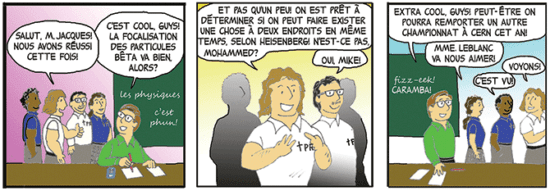
Scaffolded presentation of new vocabulary words, appropriate to grade level, are then given in a word table. Rewards are given for participation. Students take turns guessing the meaning of each word, and the answers are revealed one word at a time.
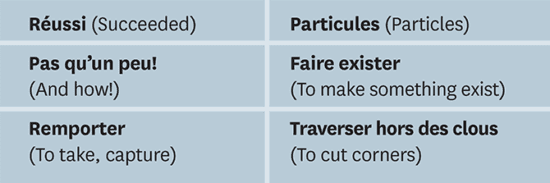
Then the final panel is revealed, along with the answers to the last words in the word bank, as applicable.

Participation rates from the very outset have jumped visibly during the six months of this project, even among usually reluctant learners. Prior to the cartoon French lessons, I made a baseline “average hands-up count” for each individual student as a measure of participation. The Core French teacher and I have tracked participation by individual student, as evidenced by counting the number of times they proffered a hands-up to each word bank question, and compared it to the baseline number.
Currently, during our second term, there seems to be no apparent waning of enthusiasm by the class. Even students who historically tended to dominate responses to questions seem generally happy to share the spotlight. I have also noted that some cartoons were immediately more popular with the class. Reflecting on this further, I identified that the use of colour versus black & white cartoons seems to have had no difference in impact with regard to student interest and participation. I had assumed initially, and wrongly, that the students would prefer colour pictures. This finding tells me that the story and “fun” content outweigh decorative frills.
I originally presented well-known samples from famous cartoon strips, in accordance with the fair usage laws,2 but have since migrated to my own original cartoons, such as that presented in this article. The children seem equally engaged, and participation rates were unchanged. When they ask about the cartoon sources, my use of original art seems to inspire them to further engagement, such as with student-initiated “sketch-offs” during their own recess time.
After the first month or so, I ventured beyond the most basic curriculum-mandated vocabulary into the use of slightly more complex constructions, such as past perfect and simple future verb tenses. The students seemed quite able to grasp and retain these concepts.
Therefore, once basic curriculum expectations have been addressed, this particular application of cartoon media seems to have the potential to bring students rapidly beyond grade level in Core French. Each cartoon strip is very carefully selected to be within reasonable range of the students’ average class capability; this implies careful selection of vocabulary and verb conjugations, in particular.
Obstacles were insignificant. The investment of lesson plan preparation time and effort was no different than any normal undertaking with which practicing teachers are already highly familiar. Required audio-visual equipment (in this case, a SMART Board™) was readily accessible. We make it a point to cite all artistic sources, and our principal was highly supportive.
Will it be possible to elicit the beginnings of a deeper, long-term increased interest in French among these junior students, who are learning French for the first time? By using the visual medium of cartoons, which has strong appeal for junior learners, with a group participation approach and inquiry-based learning (e.g. encouraging students to make predictions in an episodic storyline), we seem to have found a very promising pathway. Time will tell. I have since expanded this project to the intermediate and senior levels, with similar positive results.
Reading French cartoons brought me from Tintin to Voltaire, from Astérix to Molière and de Maupassant. I wish you, my dear colleagues, the same wonderful results with your students.
Cartoon: Paul Ling
First published in Education Canada, September 2018
1 Mary Cruden and Betty Gormley, “The State of French Language Education in Ontario,” Canadian Parents for French Ontario, October 2014, https://on.cpf.ca/research-advocacy/advocacy/the-state-of-fsl-education-in-ontario; Ontario Ministry of Education, A Framework for French as a Second Language in Ontario Schools (Toronto: Queen’s Printer, 2013), 36-37.
2 “More Information on Fair Use,” United States Copyright Office, March 2018, https://www.copyright.gov/fair-use/more-info.html
-
BrainReach/Mission Cerveau
Comments Off on BrainReach/Mission CerveauBrainReach, a volunteer program based in McGill University, sends graduate neuroscience students into classrooms across Montreal to lead hands-on science lessons about the brain.
When you ask a child to draw a picture of a scientist, what is the result? Many might think of an Einstein look-alike with wild hair, dressed in a while lab coat and mixing colourful, bubbling chemicals. But those perceptions can change dramatically when someone who doesn’t fit that image comes into a classroom, identifies herself as a researcher, and begins to make science tangible and accessible to young thinkers. Personal connection can break the traditional barriers that separate academia from the general public and circumvent the media-as-gatekeeper pattern that we see so often. It transforms science from “something that other people do” into “something I can interact with.” Here is the story of one graduate program in Montreal that is making just such a connection with kids throughout their province.
Beginnings
BrainReach was spearheaded in 2011 by Dr. Josephine Nalbantoglu, then-director of the Integrated Program in Neuroscience at McGill University. (See “Resources” for links to this and other programs mentioned in the text.) Ian Mahar, a graduate student presenter and coordinator at the program’s inception, remembers: “Josephine called a meeting and asked if anyone wanted to help build this initiative known as BrainReach, and a number of us raised our hands to get involved. We had no idea how it would build from there, though I’m sure we would have been surprised to know.”
BrainReach sends graduate student volunteer educators into classrooms across Montreal to lead hands-on science lessons about the brain. The key to BrainReach was having the same presenters come back to one classroom multiple times, to build a rapport with the students and field their questions as they grew in curiosity and comfort. According to Jenea Bin, another of the first BrainReach coordinators: “We decided to target underserved schools in Montreal, as these students do not always have the same access to science learning materials. At the high school level, these schools also tend to have higher dropout rates.”
Another approach that has distinguished BrainReach since the beginning is its emphasis on developing a curriculum that is coherent with the current research about learning – we are a neuroscience program, after all! Each presentation has to have a few interactive activities to help kids experience the material (not just hear it). We help the students observe brain cells through microscopes, touch a real brain, record electrical signals from their muscles, and learn about perception with prism goggles. Reviews are built in at the end of each session, as well as the beginning of the next one, to help with learning retention. The initial curriculum was developed over the course of a year, and from then on we have been updating it constantly, since neuroscience is a field under rapid development.
The BrainReach North branch was developed in 2013-14 to serve kids in the north of Quebec. “I have a family branch in a small community on Baffin Island called Cape Dorset,” explains Emily Coffey, who laid the groundwork for the new branch. “In those small communities up north, many children have even less access to science. They can’t be taken to museum trips, and may never meet a scientist.” This required a re-imagining of BrainReach, leading to online guides for teachers and videos to explain concepts and take advantage of the same hands-on activities in places we couldn’t send graduate students in person.
Responses to the program
“I enjoyed it immensely from the first presentation, and was hooked; I remember wanting to work with as many classrooms as I could,” recalls Ian. He and many volunteers after him were motivated to bring in the newest research, cultivate a hunger for learning in their students, and challenge neuroscience myths (Do you really use only ten percent of your brain? No!).
Nowadays, we also hear from parents asking for the BrainReach program to come to their son or daughter’s school. This is heartening, and we are thrilled that parents are willing to act as liaisons for us – but it is imperative that the teacher is also on board. Teachers have limited classroom time, and even in elementary school they have a curriculum to get through. In order for a teacher to feel that it is worthwhile for them to give us hours of classroom time, we have to address the ways in which BrainReach covers parts of Quebec’s standardized curriculum; we also have to adequately communicate the benefits of the program to their students. For example, students need to learn about the scientific method and its associated terminology. So, in our session about brain cells, we ask students to make a hypothesis (or “educated guess”) about what a neuron will look like before they take a look in the microscope, recording their predictions in the form of a drawing. Then, we have the children look and draw what they see, just like the great scientists who first observed these amazing cells.
BrainReach sessions are also used to inform students about the neuroscience behind relevant social issues. In the high school curriculum, a full session is devoted to mechanisms of drugs and addiction, and in elementary school, we talk about how sleep affects our attention, mood, and memory.
Once a solid contact is made, it is a “win-win-win” situation – teachers get help preparing their science class, the kids get to develop relationships with people currently involved in neuroscience research, and the graduate volunteers gain crucial presentation skills and a connection to the world outside academia. “The children are always excited to know that the BrainReach presenters are coming,” one teacher commented. Ben Gold, who has been a presenter with the program for four years straight, remarked that he has also learned a lot about neuroscience by returning to the basics, thinking about things from the students’ perspectives, and working with teaching partners who have different areas of expertise. Another volunteer, Cindy Hovington, was so inspired by her experience that she went on to found Curious Neuron, an organization dedicated to translating research into accessible content for the public.
Challenges
As the organization became bigger, we had to systematize and structure the program. This is a challenge for neuroscience graduate students, who are used to more solitary work in their own labs, and are contributing to BrainReach entirely on a volunteer basis. In fact, it was (and continues to be) a crash course in project management.
We formed subcommittees for Elementary, High School, and North, each with about ten people. While some recruited and matched volunteers with schools, others focused on refining the curriculum and translating it into French. Still others inventoried and distributed supplies for our interactive activities on a weekly basis. We streamlined our work using online tools such as Google Drive, Wikispaces, and Slack.
At each turn, we were supported by the boundless enthusiasm and energy of our program’s graduate students, but we also depended upon the consistent backing of program administrators. In addition to the Integrated Program in Neuroscience’s structural support, we partnered with Montreal’s Centre for Research in Brain, Language and Music for extra funding, an extended pool of potential volunteers, and the ability to give one-time workshops as a part of the 24 Hours of Science initiative. We even began taking on interns from Concordia University’s John Molson School of Business to help us develop a more professional presence and seek funding.
Kelly Smart, BrainReach North’s current president, has the additional task of communicating cross-culturally and establishing working relationships at a distance. “We approach this by collaborating whenever we can. We seek out people and groups who already have the connections and expertise we need, and we try to work with them and learn from them. It takes a lot of persistence and a willingness to listen and adapt constantly,” says Kelly.
Finally, as with any volunteer-based organization, resources are an issue. BrainReach does not have a fully sustainable funding model, and for the most part we have worked with donated equipment and temporary office spaces. However, the program has received some important boosts, including a Telus grant, as well as a recent crowdfunding campaign that brought in over $12,000! These funds will help us to plan better for the future, and invest in key infrastructure elements such as a website, as well as allowing us to send volunteers into Indigenous communities to give science camps as part of BrainReach North.
School engagement
We are still developing and refining the program based on feedback from volunteers and teachers, but the most reliable measure of success is whether schools continue to sign up. And they do! This year, we have sent 100 volunteers to over 30 schools in the Montreal area, and have sent volunteers on teaching trips to three remote northern communities. Under the leadership of Marisa Cressati as high school coordinator, we saw a spike in the number of registered high schools and non-traditional classes (like homeschool co-ops and classes for kids with special needs). We hope to see other university groups learn from our experience and establish similar programs, especially in an age where media trends can obscure the difference between good and bad science. Giving science a “face” can change the way people interact with it, at any age.
Resources
Brainreach: Come say hi to us on social media!
Facebook @BrainReachMissionCerveau
or follow the BrainReach North Blog
Integrated Program in Neuroscience
Photo: courtesy Anastasia Sares
First published in Education Canada, September 2018
-
Learning from Jacob
Comments Off on Learning from JacobGetting to know Jacob taught me that every child deserves education designed with their needs in mind.
“Alright, everyone. Remember, tomorrow is Crazy Hair Day. Bring in your loonies and rock the craziest hair-do you can think of! I’ll see you all tomorrow, class dismissed!”
“Miss Coleman, Miss Coleman!” Jacob calls after me as I walk down the hall. “Are you going to have crazy hair tomorrow too, Miss Coleman?”
“I think so, Jacob,” I reply. “How about you?”
“It’s a surprise! You’ll have to wait and see!” Knowing nine-year-old Jacob as I do, I can’t wait to see what he will come up with.
The next morning Jacob arrives with a Ninja Turtle lunch bag in one hand, a toonie in the other, and a huge grin from ear to ear. I break into an equally wide smile, for he has truly outdone my wildest expectations.
“Miss Coleman, Miss Coleman! Look!” Jacob’s bright blond hair is expertly gelled into numerous spikes. But that’s not all. Attached to those spikes are tiny clothespins, each bearing a colour image of a different MineCraft character – Jacob’s absolute favourite thing in the world.
“I’ve got Steve, and Alex, and the Pig, and, and, and..!” He starts pointing out all the different characters, very excited at his mini show and tell. I’m barely able to contain the absolute joy I’m feeling in seeing him express his passion in this way.
I was at a Teacher Education placement in a Grade 4 classroom, during the second year of my program. I’d been offered a chance to work very closely with Jacob, who was diagnosed with Autism Spectrum Disorder (ASD). Through my program, I had gained a basic but theoretical understanding of Autism. I jumped at the chance to learn more through practical experience.
I spent the first few weeks as any new teacher would: developing routines, fine tuning schedules, and most importantly, getting to know the students in the class. As I spent time with Jacob, I worked to build a positive, supportive relationship with him. I got to know him as a person, not just as a student who has Autism. Jacob could tell you literally anything you wanted to know about cars, light switches and especially Minecraft. He had a marvellous imagination, often creating elaborate stories about airports or train stations, and his attention to detail was impeccable. He was incredibly kind and a wonderful friend.
Jacob faced daily challenges in the classroom, too. His motor skills were still developing, so he had difficulty with tasks such writing and drawing, or participating in physical activity for an extended period. He would often request breaks if he was feeling overstimulated from the noise level in the room, which meant he sometimes did not accomplish very much during class time. Furthermore, Jacob required a highly structured program. When routines were disrupted, he could easily become distressed, flapping his arms or rocking back and forth in his chair. Knowing this, I wanted to do everything I could to ensure Jacob’s success while I was working with him, whether one on one, in a small group, or during whole class instruction.
It was through planning for Jacob that I realized how important differentiated instruction (DI) and assistive technologies can be – for students with ASD specifically, but also for all students. Because I had already built a relationship with Jacob, I knew he would have greater success if he was given input into which activities he participated in and how he could demonstrate his understanding. For each learning experience I planned, I incorporated ways in which I could differentiate, not only for Jacob but for everyone. I created opportunities for Jacob to move around the classroom or find a quieter space if needed. I researched a variety of online applications that would allow him to write assignments, create multi-modal presentations and draw artistic posters on his iPad that he was proud of. The classroom’s iPad camera was also incredibly useful for documenting his understanding and collecting assessment data. These assistive technologies were key in helping me differentiate my teaching to create inclusive and exciting learning experiences for everyone. Working with Jacob was essential in helping me understand this.
As I reflect upon my time with Jacob, I begin to see how this experience will impact on my future practice as a teacher. Planning with every student in mind is not easy, but it is essential. I believe the fundamental goal of teaching is to do all that we can to help each student we come across be the best they can be.
Students like Jacob should not be defined by their diagnosis and it is our responsibility as educators to ensure that they are not. Jacob taught me that.
Illustration: Dave Donald
First published in Education Canada, September 2018
-
Makey Makey as an Assistive Resource
Comments Off on Makey Makey as an Assistive ResourceMakey Makey is an invention kit that can be used as an assistive technology that overcomes barriers and increases motivation because of its playful and user-friendly possibilities.
A number of years ago, I was teaching a class to enthusiastic certified teachers who were working on obtaining specialist qualifications in special education. One of my students had quadriplegia, and he insisted that I must look into a product called Makey Makey. I did look it up online, but did not feel motivated to investigate further – until I did. While teaching a series on iPads to group home support workers caring for, and teaching, adults with complex physical and developmental disabilities, his words came to mind. I looked more – and purchased it, and learned how to use it.
21st century teaching and learning highlights the constructivist value of Science, Technology, Engineering and Math (STEM) inquiry: makerspaces, coding apps (like Scratch) and invention kits such as Makey Makey, which has garnered a steady stream of rave reviews in the STEM educational market as one the best tech toys.
What is Makey Makey? It is a deceivingly simple, hands-on tech tool created in 2012 by MIT graduates Jay Silver and Eric Rosenbaum. It’s an invention kit that “convert[s] physical touch to a digital signal, which is interpreted by a computer as a keyboard message.”1 Makey Makey Original, Classic, and Go all have the same design premise: teachers, parents and students can construct interfaces that turn conductive objects into computer keys and buttons. Alphabet soup becomes a drum kit, bananas transform into piano keys, and measuring cups turn into game controllers. “It’s a different way of connecting the physical world with the computer,”2 says learning expert Mitchel Resnick. Using Makey Makey as a standalone STEM or invention activity presents endless possibilities for student learning – and more! As it enters the mainstream, possibilities appear not just for curriculum and instruction, and but for accessibility.
How can Makey Makey change and improve the world of accessibility? Picture a student who has difficulty with pressing and clicking traditional keys. Or perhaps an adult with a hand tremor or visual disability finds it difficult to manipulate the tiny keys on a laptop keyboard.
Stephens, Chalaye, and Parkhouse (2014) used Makey Makey in a segregated school for students with complex needs.3 They saw improvement in areas such as cause-and-effect, trial-and-error problem-solving, interpersonal contact, and person-to-person contact. Lin and Chang’s (2014) study in a self-contained Kindergarten environment showed that Makey Makey could overcome barriers created by the students’ physical disabilities, such as waning interest in using traditional switches, and that the novel interface motivated children to increase their physical activity – both important attributes for this type of resource.4 Rogers, Paay, Brereton, et al. introduced Makey Makey to a group of retired individuals to empower and enable them in the world of technology.5 Their project focused on the power of interactive learning, playfulness, and exploration – experiences that learners of all ages can appreciate.
How it works
Makey Makey has few parts: a specialized circuit board, colourful cables, and small alligator clips. Users connect the circuit board and cables with clips. Then, the circuit board plugs into a computers’ USB port. Next, the other ends of the clips are fastened to items with a small electrical charge. You will be amazed at what you can use! Try chocolate, bananas, gelatin, tape, aluminum foil or:
- metal materials such as coins, cutlery, jewelry, tools, door handles, wheelchairs
- pencil lead (write or draw thick, dark lines on paper)
- plants, teachers, or friends!
These objects take on the role of “up” and “down” computer keys or other inputs, such as touchpads or mouse clicks, allowing navigation of the online world using almost anything in the “in real life” world that has even mild conductivity.
Possibilities
While accessibility applications are an “off-label” use of the invention kit, the Makey Makey website includes an assistive resource guide that offers many possibilities.
For example, a wheelchair can be used as the interface by its movement over two inputs. First, connect tin foil to a coat hanger hung on the back of a wheelchair and connect it as the ground on the Makey Makey device. Next, place two large tin foil squares on the floor and indicate what the function of each square is (e.g. up/down arrow keys, W A S D keys, or other inputs). Then, connect each square with the alligator clips to the inputs on the Makey Makey device. Now as the wheelchair is moved over each of the squares, the keys are controlled. Another example is found in Silver and Rosenbaum’s demonstration video. Makey Makey Classic is clipped to large chunks of play clay. Essentially, this clay makes large, pliable buttons for children or adults with fine motor difficulties or other motor challenges. From directional head movements, head tilts, shoulder shrugs, forearm or hand movements, or torso leans, using Makey Makey as an assistive device can open up a new way of interacting with technology so that new, exciting, experiences can be enjoyed. Another possibility: If a child is not motivated by or is unable to access traditional augmentative communication devices, MakeyMakey could be set up to widen communicative opportunities, by linking spoken words or short phrases to specific items.6
Accessibility tips
Always keep the voice and interests of the Makey Makey user in mind! Some further considerations include:
- Use larger objects for individuals with fine motor difficulties.
- Use objects that will specifically capture the interests of the individual you are working with.
- When supporting reluctant learners, encourage those learners by including their favourite things.
Makey Makey is a lower-cost alternative to other custom assistive technologies presently on the market. It has built-in novelty for the user since the input material can be changed easily and it is compatible with many web games and apps. This invention kit is hands-on, intuitive, creative, and encourages innovation. To learn more, check out the Makey Makey website, the vast number of demonstration videos on YouTube, or follow on Twitter at @makeymakey.
Photo: Makey Makey
First published in Education Canada, September 2018
1 Chien-Yu Lin and Yu-Ming Chang, “Increase in Physical Activity in Kindergarten Children with Cerebral Palsy using MaKey-MaKey-Based Task Systems,” Research in Developmental Disabilities 35 (2014): 1963.
2 Tom Cheshire, “MaKey MaKey: Who wants to use bananas as a computer keyboard?” Wired (blog), November 12, 2012. http://www.wired.co.uk/article/the-magic-fruit
3 Liz Stephens, Clare Chalaye, and Charlotte Parkhouse, “Exploring the Use of a ‘MaKey MaKey’ Invention Kit with Pupils in a Special School,” SLD Experience 20, no. 1 (2014): 10-14.
4 Lin and Chang, “Increase in Physical Activity in Kindergarten Children.”
5 Y. Rogers, J. Paay, M. Brereton, et al., “Never Too Old: Engaging retired people inventing the future with MaKey MaKey,” Proceedings of the SIGCHI Conference on Human Factors in Computing Systems (2014): 3913-3922.
6 Stephens, Chalaye, and Parkhouse, “Exploring the Use of a ‘MaKey MaKey’ Invention Kit,” 13.
-
CALL FOR APPLICATIONS: 2018 Ken Spencer Award
Comments Off on CALL FOR APPLICATIONS: 2018 Ken Spencer AwardHas your learning program made a positive impact on previously disengaged and disadvantaged students so that they connect with local and global cultural and environmental issues to develop a strong sense of ownership in their learning?
For ten years, the Ken Spencer Award has discovered and profiled courageous classroom innovators who have made learning relevant and exciting by providing students with the autonomy and flexibility to think critically and solve real-world problems.
Seven cash awards totalling $15,000 are available to be won for your school.
Check out our award-winning programs from last year for inspiration and apply today!
TELL US ABOUT YOUR PROGRAM IN 250 WORDS OR LESS
This could be your year to receive the recognition and validation that you and your colleagues deserve to honour your courage and perseverance.
Winning entries will be profiled nationally – to encourage peer-to-peer learning – in Education Canada Magazine (articles, Podcast interviews and opinion pieces). For ten years, we’ve seen the lasting positive impact that this award can bring to educators and their schools.
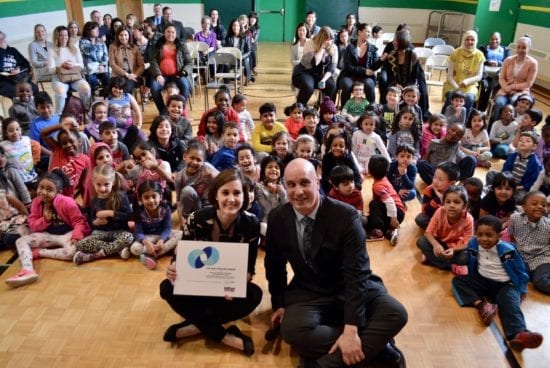
2017 Ken Spencer Award ceremony for Wexford Public School’s Deaf/Hard of Hearing Co-Enrollment Program, Toronto District School Board, Toronto, Ont. The deadline to submit your Stage 1 online application form – which will include a summary of your program in 250 words or less – is 5pm (Pacific Time) November 5, 2018.
For details on how you can apply, please visit: www.edcan.ca/kenspenceraward
-
Changemaker Education Summit
Comments Off on Changemaker Education SummitThis experiential K-Post-Secondary changemaker education day will give participants the opportunity learn from youth and the ingenuity of our Canadian youth-focused Ashoka Fellows. By providing an immersive experience in living a changemaker education, Ashoka Canada and Rideau Hall Foundation aim to further our goal of helping all young people see themselves as Canada’s future innovators who create change for the good of all.
In this unique un-conference, educators will learn from and alongside young changemakers with some of the most creative minds in the country.
-
From a focus on teaching to a focus on learning
Comments Off on From a focus on teaching to a focus on learningDr. Sharon Friesen is a professor and the President of the Galileo Educational Network at the University of Calgary’s Werklund School of Education. Stephen Hurley sat down with the renowned scholar to discuss nationwide revisions and redesigns to teacher education programs, including where we’re headed next. For new and future teachers – including all you history buffs out there – this one’s for you!
Read the article that inspired this conversation.
A Future Wanting to Emerge: Challenging assumptions about teacher education


IDEAS TO SUPPORT EDUCATORS : Subscribe to the EdCan e-Newsletter
Quality research, reports, and professional learning opportunities.