Archive
-
Truth and Reconciliation, K-12
Comments Off on Truth and Reconciliation, K-12My grandmother, Madonna Rose Toulouse, attended St. Joseph’s Residential School for Girls in Spanish, Ontario. She contracted pneumonia during her time there, nearly died and was sent home to Wikwemikong First Nation on Manitoulin Island. For the rest of her life she had chronic lung issues because of this illness. Madonna has been in the Spirit World for almost five years now. It is important to know that my grandmother was one of the strongest and funniest people I have ever known. She was a storyteller; known for her humour, conveying of genealogy and sometimes harsh (but true) advice. Madonna continues to have a profound and deep impact on me and this is why Truth and Reconciliation in our schools hits close to home. I am so glad that this complex part of our Canadian story is going to be remembered, retold and hopefully learned from.
So what is at the core of Truth and Reconciliation in K to 12? What does it actually look like in the day-to-day classroom activities of our children, youth and young adults? This article offers a glimpse of the possibilities for relationship building, curriculum connections and personal growth.
Learning together
Residential school impacts, Indigenous peoples’ contributions, understanding treaties and cultural teachings are themes that provide a foundation for all students.1 Each of these topics first and foremost has to be centred around the Indigenous communities where your school is located. For the educator, it means taking that step to reach out and connect with the First Nations, Métis and/or Inuit peoples in the area. This may begin with contacting the person responsible for Indigenous education at your school board. Or it may start with attending Indigenous events in your area (e.g. Walking With Our Sisters installation, Red Dress campaign, Louis Riel Day, Arctic Winter Games, powwows). Either way, this process will require your time and the ability to keep an open mind.
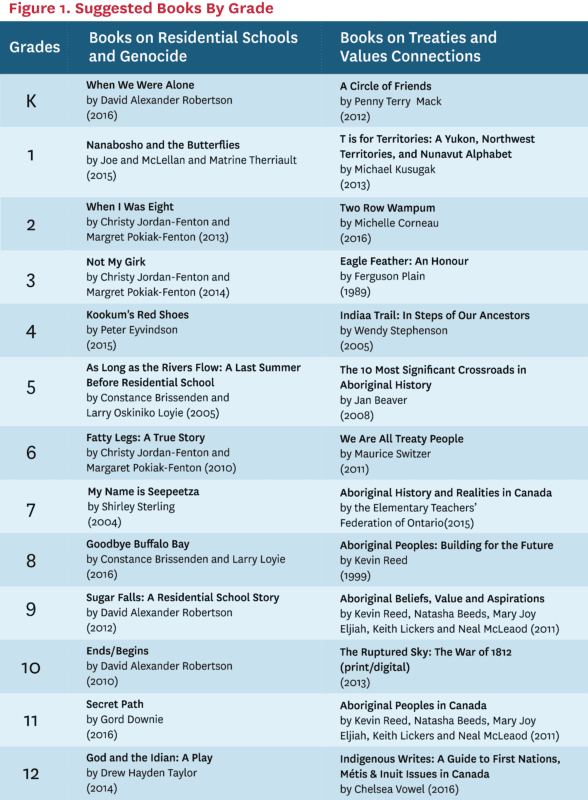
Having the ability to say “I don’t know” and learning together is what educators and students do in classrooms that honour Indigenous ways of knowing.2 Many educators in K to 12 fear getting Indigenous content wrong or misrepresenting the information. This is why it is important to include a variety of resources that are authentic, and why I am a strong advocate for Indigenous voices speaking for themselves and integrating them across the curriculum. I suggest having traditional and contemporary knowledge keepers about residential schools, treaties and the teachings be valued guests in K to 12. These meaningful visits need to be supported by lessons (pre and/or post) that are interactive, hands-on and have real-life applications.3 The content of these lessons can come from these suggested books on residential schools and treaties for elementary and secondary classrooms (see Figure 1). Please note that this is not meant to be an exhaustive list, as each province and territory may have its own suggested resources on these topics.
Reconciliation in action
I am very lucky to work with some amazing people at my university who have innovative ways of approaching reconciliation with action at the centre of it. Shelly Moore-Frappier is the Director of our Indigenous Sharing Learning Centre (ISLC). She comes from the elementary/secondary system and taught for a number of years at that level. Shelly and her team at the ISLC have designed and continue to deliver a program called “One Dish, One Spoon.” This program bridges elementary students (Indigenous and non-Indigenous) to the university with Truth and Reconciliation as the main driver. Grade 6 students from our region come to the university to hear from Indigenous youth who are making a difference in social change. Thirteen-year-old Autumn Peltier, known for her advocacy for water, is one of the key speakers, as well as other Indigenous role models. The Grade 6 students spend the day immersed in workshops and activities centred on their interests and ways to implement reconciliation in our schools and communities. Each school leaves with a commitment to a project that they will engage to implement Truth and Reconciliation (such as a community garden commemorating survivors and inviting residential school survivors to guest speak at their schools).
Project of Heart and their lived philosophy of students leading change is truly reconciliation in action. This national initiative honours the voices of survivors and provides a space for youth (and their mentors) to communicate their learning journeys. One can’t help but feel inspired by the multitude of stories where our young people share what they have learned (and are doing) about the residential schools legacy. Another project that touches my spirit is the 2016 Science Camp at Algoma University, where 40 Indigenous students from local First Nations participate in a week of focused activities. These 12- to 15-year-olds toured Shingwauk Residential School, listened to the stories of survivors and created wooden tiles (installation pieces) with personal reflections. When you take a closer look at the tiles, the message “forever loved, never forgotten” stands out. These words underpin the work of our youth and their brave mentors across this country.
I have had the honour of knowing Troy Maracle (Hastings Prince Edward District School Board), Jody Alexander (Ottawa-Carleton District School Board), Kathy Dokis-Ranney (Rainbow District School Board) and many other Indigenous Leads for years. I’ve seen their collective work in action and their tireless advocacy for Indigenous inclusion across K to 12. These individuals and their network of supports have implemented reconciliation activities like Orange Shirt Day, Shannen’s Dream, KAIROS Blanket Exercises, Treaties Week and National Indigenous Peoples’ Day on June 21 (for URLs and more activities, see box: “Reconciliation Activities for Schools and Allies”).
These folks, their students and their communities’ commitment to Truth and Reconciliation are making the difference. Their leadership and community connection is the promise of reconciliation in action.
The ally role
I am Anishinabe. My mother was Odawa and my father is Ojibwe. I also consider myself an ally for human and other-than-human rights (the earth and her children). Being an ally is a role that we all must occupy if we wish to see a better future for our children and the next seven generations. Allies from all walks of life are critical to implementing the Calls to Action from the 2015 Truth and Reconciliation Commission of Canada (TRC) Report.4 Defining oneself as an ally requires understanding who you are, why you are involved and how you can make a difference.
For myself, I see advancing the TRC calls as directly connected to my role as a teacher and a learner. I have spent a good part of 25 years focused on Indigenous education, with a specific emphasis on pedagogy. This has led me to some interesting and ever-evolving observations, the most prominent being that what works for Indigenous students often works for most others. Classrooms that build from a holistic model and/or consideration for the whole child tend to work for all students5 (see Figure 2). This means that allies need to commit to reconceptualizing their classrooms and how they teach all students. It further requires planning our school year with the spiritual, physical, emotional and intellectual aspects of education in mind.
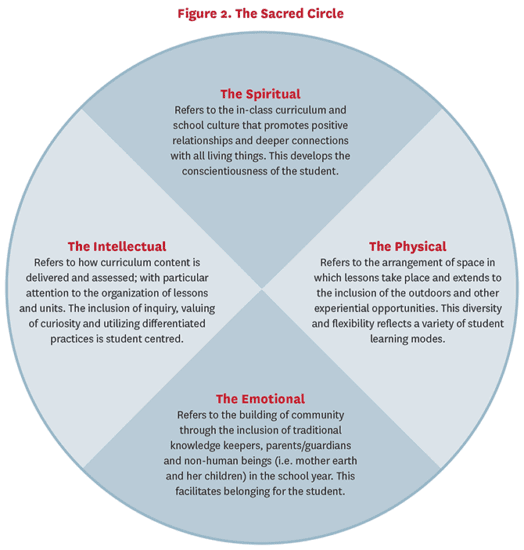
This model and teachings come from the Anishinabek of my area. Each Indigenous Nation has their own understanding of holistic education.
- The spiritual invites the educator to examine all the opportunities that their lessons, field trips and experiential learning activities offer to link students to each other, their communities and the globe. This aspect of holism in teaching/learning places emphasis on activities that develop deep and meaningful connections with a purpose “greater than the self.”
- The physical refers to the classroom space/s where learning takes place and encourages differentiated practices outdoors and in the community. This aspect of holism encourages teaching/learning at sites that make connections to local events, people, places and movements.
- The emotional concerns the inclusion of Elders, Métis Senators, Cultural Resource People, families and non-human experiences as foundational to the classroom and school year. This aspect of holism values the knowledge that “other teachers” bring to the shared world of education.
- The intellectual refers to the provincial/territorial mandated curriculum that the educator is entrusted with delivering to the students. This aspect of holism calls upon the educator to factor in inquiry, curiosity and differentiated evaluation as critical to meaningful student experiences in school.
The sacred circle is a place where we all belong and have a role to play in this journey towards Truth and Reconciliation. Being and becoming an ally for each other (human and non-human) is the only way to bring those Calls to Action forward in K to 12. Professional in-service, curriculum inclusion, policy development and engaging with each other is only part of the solution. Developing real relationships, acknowledging our failures and finding new ways to support the TRC in our classrooms will be the real challenge.6 I’ve accepted this call. I am reminded of it every time I drive past a school, stop behind a school bus, or talk to one of my students. I hope that you too accept this call as we move forward, together, in a space of respect, truth and transformative change.
Reconciliation Activities for Schools and Allies
You can support the TRC by becoming an ally and participating in these select initiatives:
- Jordan’s Principle
- I am a witness
- Our Dreams Matter Too
- Shannen’s Dream
- Orange Shirt Day
- Have a Heart Day
- Walking With Our Sisters
- Kairos Blanket Exercise
We want to know what you think. Join the conversation @EdCanPub #EdCan!
Photo: Shutterstock
First published in Education Canada, June 2018
1 Margaret Kovach, “Treaties, Truths and Transgressive Pedagogies: Re-imagining Indigenous presence in the classroom,” Socialist Studies/Études Socialistes 9, no. 1 (2013).
2 C. Savage, R.i Hindle, L. H. Meyer, et al., “Culturally Responsive Pedagogies in the Classroom: Indigenous student experiences across the curriculum,” Asia-Pacific Journal of Teacher Education 39, no. 3 (2011): 183-198.
3 G. Ladson-Billings, G., 2014. “Culturally Relevant Pedagogy 2.0: Aka the remix,” Harvard Educational Review 84, no. 1 (2014: 74-84.
4 Karina Czyzewski, “The Truth and Reconciliation Commission of Canada: Insights into the goal of transformative education,” International Indigenous Policy Journal 2, no. 3 (2011).
5 Jan Hare, and Michelle Pidgeon, “The Way of the Warrior: Indigenous youth navigating the challenges of schooling,” Canadian Journal of Education 34, no. 2 (2011): 93.
6 Rosemary Nagy, “The Truth and Reconciliation Commission of Canada: Genesis and design,” Canadian Journal of Law & Society/La Revue Canadienne Droit et Société 29, no. 2 (2014): 199-217.
-
Carrying the Fire
Comments Off on Carrying the Fire(A discussion moderated by Michelle Hogue and Holly Bennett)
When planning this special edition of Education Canada, one thing we knew for sure is that we did not want to overlook the insights and ideas of the people at the heart of the issue: Indigenous students. On January 19, 2018, four young adults joined us in a phone discussion to share their thoughts about what Truth and Reconciliation means to them and how that should be reflected in our schools…
Meet the Participants
- Gregory Francis is from Kingsclear First Nation in New Brunswick and is a 4th year student at the University of New Brunswick studying chemical engineering. Currently a member of the Prime Minister’s Youth Council, Greg acts as a positive role model through his actions to support youth. He has been a tutor for First Nation students in his community and has served as a facilitator for First Nation youth engagement.
- Talia Natowcappo is from Lestock, Saskatchewan and is registered to Fishing Lake First Nations Band. A proud Saulteaux-Anishinaabe woman, she is currently studying at Concordia University majoring in First Peoples Studies. She says, “My spirit name is Migiiziikwe; I am part of the Bear Clan family and I am also a pipe carrier. Discovering my culture saved my life, made me proud of something I was once ashamed of.”
- Tarene Thomas is from Enoch Cree Nation and the North West Coast of B.C. She is a writer, poet, and activist in the fourth year of her English major at the University of Alberta. Tarene also works with the transition year program at the University of Alberta, and is an Indigenous peer mentor for the faculty of arts.
- Hunter Martin is from Black Lake Denesuline First Nation in Saskatchewan and is a Grade 12 student at Bethlehem Catholic High School in Saskatoon. He has recently developed an interest in his people’s culture and hopes to contribute to the advancement of Truth and Reconciliation.
We want to know what you, as youth and young adults of today, think needs to happen as we move forward in this TRC era? Where do you think things should go?
I know these are big, open-ended tough questions, but really you are the next generation and are going to be the game changers, and ones who open up doors in a lot of different ways, so we’re very interested in what you have to say.
HUNTER: Moving into the 21st century, I do believe that we need to take action. Some of the reserves have been taking action. The chief for Whitecap, outside of Saskatoon here, really puts emphasis on supporting the youth in the community. There’s more funding going toward the school, and it’s creating a great environment for the young people of that community. I think we do need to put emphasis on the younger generation in order to move forward. There are other issues, such as domestic violence, sexual abuse, drug addictions and suicide, but if we teach the younger generation that this is not the way, that it doesn’t have to be like this, then they will strive to actually make things better once they graduate and go out into the world. That’s my take on reconciliation and youth.
I go to school in the city now. I transferred down south coming out of Grade 9, for the betterment of my education. My mom really didn’t want me to stay up north in my reserve because the education there is poor, the school system is underfunded.
TARENE: That’s what I think we should talk about a little bit, how Indigenous education systems are funded a lot less than mainstream education. It was the same with me, I grew up on a reserve and I did graduate from the high school on my reserve, but from Grade 1 to 9/10, I went to school in the city. It was for the same reason; I wanted a better education so I registered myself and my siblings in the public school system.
But that’s a huge problem, that we have to outsource ourselves to other places away from our community, where we can be involved in our culture and kinship. Those ties are sort of lost, and we have to make that leap just to have the same level of education that non-Indigenous people are having. That’s something that really needs to be addressed.
TALIA: I moved away from my territory, from the prairies, because it was really hard being there as an Indigenous person, with the negative stereotypes that come along with this heritage. It’s really frustrating. But for the years I’ve been travelling, I’ve always carried this big sense of guilt for leaving home, like I’m leaving my family or my siblings or somebody there that would need me. It was just going back this Christmas that I realized that I no longer have to feel guilty or selfish for leaving home, for wanting to better myself – and that came with giving up alcohol and trying to be more traditional and smudging more and trying to be more active in any type of discussion that involves Indigenous people. But I’m still contemplating whether, when I’m done with my academia, if I want to go back and try to create a positive space for the Indigenous people there.
HUNTER: I also have stresses from my family, knowing the problems that they are going through. It really hinders me sometimes from concentrating on what needs to be done. Like my cousin commited suicide, just a year and two days ago, and after that I did abuse alcohol for awhile. It was hard, really hard, getting over that. It took about a month before I realized, what can I do so this doesn’t happen again? So that’s when I decided to take an interest and learn about my culture and my people.
We should teach the true history of Canada. I think that if we start to teach those histories and the effects of colonialism, then we’ll start to clear the air a little bit because I feel like that’s where a lot of the racism and ignorance comes from.
TARENE: Another issue is Indigenizing education. We need to be starting in early elementary and right through to Grade 12, because a lot of the gaps between Indigenous and non-Indigenous people come from the ignorance and not knowing the history, not understanding colonialism and the effects it has on Indigenous people. So in social studies in Grades 4-7, you’re learning about settlers coming into Canada, and you have that small little paragraph that says First Nations People wilfully moved so settlers could live there. We should teach the true history of Canada. I think that if we start to teach those histories and the effects of colonialism, then we’ll start to clear the air a little bit because I feel like that’s where a lot of the racism and ignorance comes from.
I also think it’s really important to create spaces for Indigenous students wherever it may be, in communities, in the school system, in the city. And there needs to be relationship building between Indigenous and non-Indigenous students so we can start to break down the barriers that keep people focused on the negativity.
GREG: One thing that I wanted to talk about was creating that dialogue between Indigenous and non-Indigenous people. I spent my entire schooling in the public system. There was an elementary school on my reserve, but I was always put into the city school 15 minutes away. But as I transitioned from elementary to middle to high school, I noticed that people’s conceptions about Indigenous people had drastically changed, to the point that going into high school I felt uncomfortable and alienated. I think that trying to promote that dialogue and trying to have those conversations between Indigenous and non-Indigenous people will help us understand each other’s differences and find a common place to be able to agree on something that allows us to move forward. Too many times I feel that people focus on each other’s weaknesses when we should really be focused on what makes them strong, and on using those strengths to better our nation as a whole.
TARENE: Those are really good points. There need to be spaces made for those types of conversations, facilitated by people who are comfortable and trained, and they should be happening in school systems in all different levels and age groups. I think when people have these conversations in a… I don’t really want to say safe space, because no one can guarantee a safe space, but in a relatively safe space, I think a lot of times people come through with a better understanding, as opposed to learning something through a book.
HUNTER: I do agree with this. In Native Studies, we were reading about sweat lodges and smudging, but learning about it from a book is very different from actually doing it. You get a deeper understanding, you actually get a connection, when you actually do something that’s related to the topic. That’s true about anything, really, I think it’s one of the major problems with education as a whole. It emphasizes the memory of things and doesn’t really emphasize doing it. That also has to do with getting the students interested. They’ll have a deeper understanding of the subject and in turn will be interested in learning more.
If you could make one big change, what would it be?
TALIA: I want to help plan curriculum, I want to help change the way we teach our kids. And I think the first thing that needs to be instilled is that sense of cultural pride, getting those little kids into a sweat lodge, teaching them that our identity is valuable. Then they’ll be able to carry the fire, and then they’ll be able to be more prepared for the life we send them off into.
They’ve tried for the last 500 years to assimilate us, and it’s not going to happen. They say it takes two to three generations to lose your culture, but we’ve been fighting for it for the last seven. Yeah, it’s nice to teach it here at the university level, but before we even start sharing it with our European neighbours or our other minorities, who are really beautiful too, we have to instill it in our kids. We have to take it back before we can try to explain to anyone else how beautiful it is.
You know, I look at my friends who come from, I guess, a privileged lifestyle where their parents were successful, they had jobs, health care, health insurance… So they didn’t have to go through Indian Affairs, cause it sucks, you know? There’s such a huge stigma around it, that when people bring it up, I’m actually kind of still ashamed that I need help from Indian Affairs. And my non-Indigenous friends who are younger than me are getting their Masters degrees, while I… I’ve worked amazing jobs, travelled to the most Northern remote places, but I pretty much failed my first semester of university here in Montreal and I was scared – scared to go home, scared to tell anybody. I’m in therapy for this, and it’s help me realize that growing up I pretty much raised my siblings and I developed this sense of “I have to do it on my own, no one can help me.” And that I had to overcome all of the shitty things I went through as a kid and in my teens and what I’ve done to myself because I was really incredibly hurt, from being a residential school survivor survivor. I didn’t have to actually go to residential school to have the exact same effects happen to me – being taken away from my parents, being in foster care, the molestation and abuse. It was all there.
TARENE: If I could change one thing? It would be kind of adding on to what Talia was saying, teaching our youth that we are not vessels for white settler colonial shame. We’ve been talking a lot about barriers, and I think one of the reasons why there are so many barriers in front of our people is because it’s kind of the narrative we’ve been told. That’s what society teaches us – that our families are broken so they can’t teach us anything about who we are. So it’s important for our generation and for us when we have children, to instill that in our kids, to be proud of who we are. And then we need to start peeling back these layers, that colonial narrative that’s all over Canada that kind of fits Indigenous people into one box, you know, like the dumb drunk Indian. To do that we need to start within the school systems.
GREG: I know personally when I was younger I wasn’t really connected to my culture, and I did face a lot of mental health issues and alcohol abuse. I was a lost soul for a while. I was able to rediscover myself when I got more involved in my culture and learned a lot more about my traditions. It gave me a more holistic approach and allowed me to feel a lot more like who I am. I just really want that for every other Indigenous youth out there.
TALIA: I just hope they find it a lot sooner than we did. That’s one of the biggest issues right now that we’re facing as a generation: we are really fighting for who we are. I’m fighting to take back my language. I’m fighting to feel comfortable in my own skin for being brown. I have to fight to learn my name in my language and figure out what Bear Clan actually means, and what Eagle Woman means and Migiiziikwe, to find out where my people come from and why I carry a peace pipe.
I’m incredibly proud and happy now about who I am as an individual and what small accomplishments I’ve actually made. And it’s learning to be humble and to have humility, and to share and to laugh, and to just exude love all the time.
When you picture your kids or your grandchildren, what would you hope their school experience would be like?
TARENE: I would want it to be challenging, but also a space where they feel respected and where people know their histories.
HUNTER: I would like my children or grandchildren to find more fulfilment in life through their schooling. When they enter it, they are still on their journey of finding who they are, and when they leave I want them to have a stronger sense of who they are as a person and go off in the world from that place of knowing who they are. That’s my big thing with school: it’s very hard to find yourself in it.
I want to add, I want all kids to go to school feeling like they are not less human for who they are, their background, their people. I want them to feel fully human. I went to school feeling left out because of the colour of my skin.
TALIA: I just hope that, ten years from now, there’s a school on every fucking reserve! A properly funded school, with running water, that isn’t in trailers, that can give them a place to actually flourish and realize who they are and be proud of who they are – and also give them the life tools to be successful.
And I really want them to have a safe home. That truly depends on me and us as parents to not make the same mistakes.
GREG: Everyone pretty much covered it. I want my grandchildren to have that identity, and not to be at a disadvantage because of their ethnicity or because of who they are. That’s something that a lot of Indigenous people are facing today – we have had more struggles compared to other people. I don’t want our kids having to face those kinds of struggles.
HUNTER: I have just one thing to add I guess. I was told that it’s been seven generations before ours that have had a time of pain and suffering, and that it will take seven generations more until that pain has fully healed. I was told it is our generation, the Millenials, that is the start of that seven-generation healing process. When I was told this, I felt compelled and motivated to start doing things to better myself and my people. It is us who will rekindle the flame of hope. And through that hope, will inspire others to actually go on that journey.
We want to know what you think. Join the conversation @EdCanPub #EdCan!
First published in Education Canada, May 2018
-
Of Orcas and Learning on the Land
Comments Off on Of Orcas and Learning on the LandA THIN FOG hung above the restless water of Alaska’s Alexander Archipelago, veiling the mountains as they stood rooted in the ocean’s deep fjords. I had driven this route since the beginning of the school year nearly two months before. Timing the drive perfectly, I would arrive at the first bus stop, far up the finger-like inlet, at just the right moment to meet the two children who lived there at the end of their scamper from their front door, greeting them with my best bus-driver’s smile.
That morning, I noticed that I had arrived early at the widened shoulder a mile or two before that first, daily rendezvous. Wheeling the 11 ½-meter behemoth off of the highway, I chose to wait out my ten extra minutes here, where I could meditate on the rising sun and the scattering of the morning mists. Throughout Southeast Alaska the highways are chipped from the mountainsides along the water’s edge, and it was here, next to the perpetually rolling waves, that I now paused.
A sudden motion just off shore caught my eye. A deep, churning whirlpool pierced the surface of the waters. In a moment I was out of the bus and had hopped to a large boulder that rose above the rolling waves. No sooner had I landed than the black and white form of a killer whale drove three meters into the air beside me. Four meters out, the surface crashed with the fall of the returning whale. Immediately, I was aware of the pod, skimming, slicing and surfacing before me, to my right, to my left. Across the channel a second pod chased salmon in ritual feasting.
“Five minutes since I stopped…” I thought. “Perhaps I could collect the children early and return.” The engine fired; yes, the boy and his little sister (seven and five) headed out the door early as they saw the bus approaching.
As I was also completing a practicum in their school, I had seen these two children, who greeted me early each morning with such warmth, later in the day, dissolving into the social fabric of the school, silently disappearing. Conversations with the students themselves, their teachers and their parents revealed the deeper challenges they felt as they struggled to accommodate both traditional Tlingit values and the foreign expectations of formal academia. Their father was a world-renowned carver of Tlingit totems, some of which stood in European museums. Now his children, as well, were attempting to stand strong in their school.
“Why are we stopping here?”
“You’ll see. Look out there!”
“What is it?”
“It’s the orca. They have come here to eat.”
“Can we get out? What do they eat? Where are they going? How fast can an orca swim…?”
As the bus filled that day, I saw the two children melting again into silence, but as I glanced in my mirror from time to time, I saw a sparkle in their eyes, and I knew orcas played there.1 Over the course of the intervening 30 years, my work both in Alaska and on the Canadian prairies has taught me much about the value of land-based education. I have had the great privilege of sitting with many Elders, gaining insight into land-based learning as traditionally practiced and understood by the Tsimshian, Tlingit, Haida, Dene, Anishinaabe, Dakota, and Cree nations.
Institutionalized education and colonization
Settler societies around the world create educational institutions that function to perpetuate the philosophical understandings of the dominant culture. Consequently, they do a disservice to learners who are thereby deprived of broader understandings of the world. In the Canadian context, for example, children (Indigenous and non-Indigenous alike) might learn facts pertaining to the biology and habitat of killer whales, but they would not gain an understanding of the intricacies of relationship within the circle of creation.
The colonial, pedagogical structures within which educators are obliged to operate, both in terms of curriculum and instructional practice, consistently stand in stark contrast to understandings of the world that are rooted in diverse, Indigenous, philosophical perspectives. Teachers are required to hold forth in classrooms that are far removed from lessons that can be learned on the land. They are to teach classes of 25 or more with limited time for students and still less for those who are the silent ones. The inculcation of outcomes often supersedes real learning, and these outcomes reflect perspectives that have not been reconciled with philosophical truths found in Indigenous worldviews. Furthermore, learning on the land from the teachers one finds there is, all too often, discredited and deemed to be irrelevant and unquantifiable. Indigenous Elders, however, tell us that profound lessons can be learned from all whom we find on the land, including those of the winged, finned, plant, four and six-legged nations.
The educational machinery established by dominant, colonial culture exists to continue the larger societal systems. The enfranchised will remain enfranchised, and the marginalized will not escape marginalization in successive generations without a genuine process of reconciliation where alternative world-views are not only appreciated but embraced.
Of key concern, then, are questions of validation: are there not invaluable lessons being missed by all students when the lessons of the land, so familiar to traditional Indigenous individuals, are ignored? Stemming from this central philosophical concern arise other, practical considerations. For example, in what ways can the accomplishments and learning that take place on the land be validated, and how do we teach students to listen to the many teachers within the circle of creation?
Traditional land-based learning
Traditional land-based learning presents in two distinct categories: learning that is imparted by Elders and/or traditional knowledge keepers in the community, and learning that derives from the land itself. Teachings received on and from the land fashion both conceptualizations of the world and moral understandings pertaining to self-conduct in the world. In support of this dynamic form of education, the Coalition for the Advancement of Indigenous, Land-Based Education (CAILBE) was originated in Canada and is now an international coalition built around the revitalization of traditional, Indigenous ways of learning on and from the land. With adherents from around the world and members in seven nations (Australia, Brazil, Canada, New Zealand, Nigeria, Sweden and the U.S.), CAILBE is dedicated to promoting governmental and institutional changes that result in the acknowledgement of Indigenous understandings regarding LBE and to assisting individual teachers in the development and inclusion of traditional LBE experiences for their students. This work is accomplished not through direct political action but through the empowerment of educators to take part in engineering real and lasting change. CAILBE has grown rapidly since its inception in June of 2016. CAILBE members have made a commitment to infuse the work that they are already doing with promotion of LBE and the philosophical perspectives that underlie it. Members with initiatives, questions or academic presentations are guided and supported by this international association.
Dr. Richard Manning, CAILBE member from the University of Canterbury, Christchurch, NZ, has observed, “The last century of compulsory schooling has rendered young people disconnected from their… local ecologies of place.”2 If it is to be intuitive, land-based education (LBE) must begin early in life, frequently in the context of family structures and activities. Teachers seeking to implement Indigenous, land-based learning strategies have found that many students from almost every environment (not just “city kids”) lack these early, land-based learning experiences and must be given guidance in their first encounters with learning on the land.
Certainly, many teachers attempt to incorporate fieldtrips into the delivery of curricular outcomes. Although this is laudable, it does not reflect the realities of those who have learned deeply from the land. To pass through the natural environment on an excursion related to, for example, a science class, does not equate to this type of Indigenous, land-based learning. By contrast, in progressive models, students are taught the basic foundations of traditional LBE. (See Gakina Awiya Biindigeg below.)
Those who learn on the land must first develop a sense of respect for all the teachings that may be found there. Cree Elder Gerald Morgan frequently asks the students he teaches on the land if they have seen anything as they travelled to meet him in the bush. Very often they give a negative response, meaning that they have seen nothing that they consider noteworthy (e.g. moose, eagles, bears). Morgan then asks if they saw no trees, no sparrows, no rocks. He goes on to explain that the greatest lessons are often brought by the smallest of teachers. We are so schooled in hierarchical thinking of European origin that we fail to appreciate the smallest of these teachers.
Students who seek to learn on the land must also know how to wait long there. Lessons do not become a part of who we are until we consider deeply the implications for the way we walk in this world. In the same way that students must listen and observe closely to comprehend that which is being conveyed by a teacher in a classroom, so, too, learning on the land requires that keen attention be given in order to understand the lessons imparted there.
The goal of LBE within a great many Indigenous communities around the world is that each student learns to take his or her place in the circles of creation and community in a good way. This is the essence of the Anishinaabe/Cree teaching of pimatisiwin (walking in a good manner).3 To take our place well in the circle involves being in harmonious relationship with all others in the circle and with the Great Mystery (i.e. Creator) at the circle’s centre. We come to understand that all our relations in the circle can show what they have learned about these things, and, as respected teachers, they can guide us into better ways of being in the world as we learn from them on the land.
Dr. Maggie Walter, CAILBE member and University of Tasmania professor, describes Indigenous connection to the land in personal terms: “I am a descendant of the Trawlwoolway in Tasmania. The nation takes up the north east corner of Tasmania and is distinguished by wonderful white beaches, open wooded country and plentiful plant and animal resource around which our traditional people’s lifestyles were based. Not many of us live in the area these days – it is a relatively sparsely populated part of Tasmania – but if you travel there you can see the signs of our people’s occupation everywhere – in the midden lines in the sands and the shells along the beaches. You don’t have to be Aboriginal to understand our connection to country or to feel the continued presence of our ancestors in this place.”4
The future of land-based education
Clearly a significant paradigm shift must take place for land-based learning to be given weight in the schooling systems of settler societies. Some, such as Leanne Betasamosake Simpson, question whether this can be done at all.5 The argument here is that land-based learning and colonial educational practices are too disparate to be reconciled and that, should an individual seek to be educated on the land, the better course of action is to jettison any hope of incorporating this into the accredited procedures of education in mainstream schooling.
On the other hand, recent trends in pedagogy in Canada and elsewhere have begun to explore differentiated ways of learning. These efforts represent positive steps toward recognizing, validating and normalizing the learning of students in traditional ways on the land. A groundswell of support for change, of which CAILBE is merely one manifestation, is seeking to alter the direction of current practices in education. As with most philosophical shifts, one must think in terms of generations rather than in terms of years. For this reason CAILBE members recognize that the greatest need is to present educational experiences to coming generations that reflect Indigenous understandings and values. The central aims are that Indigenous ideals become valued at a level that is at least on par with those of the larger settler-societies and that, as part of this shift, time be allotted for Indigenous land-based learning. As this becomes a reality, LBE could potentially become a transformative force in the development of all students.
The revitalization of Indigenous, land-based education may, in some jurisdictions, involve the creation of alternate, accredited tracks toward graduation in which Indigenous philosophy and LBE are central. At the very least, a greater openness to the involvement of traditional knowledge keepers in the imparting of understanding to students must be forthcoming. Legislative enactment of policy and law governing education most often supports and finances those systems deemed to be efficient in confirming the status quo; nevertheless, it is at this legislative level that change must, eventually, come. Therefore, those who understand the importance of traditional LBE must raise a collective voice, both by joining organizations such as CAILBE and by infusing their current practices in education with an appreciation for Indigenous values and world-views, including ways of knowing and learning on the land.
Gakina Awiya Biindigeg
The Gakina Awiya Biindigeg student group at Springfield Collegiate Institute in Oakbank, Manitoba, is one example of a progressive land-based learning program. For over a decade students who participated in this optional programming were regularly taken onto the land to learn from Elders and traditional people. The scope of this learning was extremely broad and included traditional values and teachings derived from the experiences encountered while in a variety of remote locations. Students were shown how to relate to the various teachers that are encountered on the land (e.g. the four-legged, many-legged, finned, winged), enabling them to learn directly from these teachers during independent ventures onto the land. When Elders felt that a student was ready s/he would be put out onto the land for a vision quest or other ceremony. Through the avenue of Manitoba’s cultural exploration credit, students were enabled to use this traditional learning towards graduation.
We want to know what you think. Join the conversation @EdCanPub #EdCan!
Photo: iStock
First published in Education Canada, June 2018
1 The young boy mentioned in this story has now grown and has followed in his father’s footsteps as a carver. The young girl is a library assistant who has, among other things, initiated a children’s garden at the local public library where she works.
2 Richard Manning, Place, Power and Pedagogy: A Critical Analysis of the Status of Te Ātiawa Histories of Place in Port Nicholson Block Secondary Schools and the Possible Application of Place-Based Education Models ((PhD thesis, 2009): 56.
3 The late Dr. Mary Young elaborates on this concept in her book Pimatisiwin: Walking in a Good Way: A Narrative Inquiry into Language as Identity, (Winnipeg: Pemmican Publications, Inc., 2009).
4 Maggie Walter, “Meet the Presenter: Maggie Walter, Indigenous Studies,” Open 2 Study (August, 2014). https://blog.open2study.com/post/meet-presenter-maggie-walter-indigenous-studies
5 Leanne Betasamosake Simpson, “Land as Pedagogy: Nishnaabeg intelligence and rebellious transformation,” Decolonization: Indigeneity, Education & Society. 3, no. 3 (2014). http://decolonization.org/index.php/des/article/view/22170
-
Our Journey Into Reconciliation
Comments Off on Our Journey Into ReconciliationOn the morning of September 30, 2016 I wore an orange shirt to school. I had received an e-mail about Orange Shirt Day, including a short video, and I decided to wear orange and talk to my students about residential schools and reconciliation during our Social Studies time. I showed them the video, and the looks on their faces told me that they had questions. They asked me things like, “Is this for real?” and “Did this really happen in Canada?” They had legitimate questions and the desire to learn and pursue them was evident in our classroom conversation.
Watch the video montage documenting this Truth and Reconciliation project
I teach at Stavely Elementary School, a very small rural school in Southern Alberta. There are less than 100 students in our K-6 school and we teach multiage classrooms. I teach a Grade 5/6 split. We are about a 40-minute drive from the nearest First Nation reserve.
I had been looking to do some problem-based learning within our Social Studies that year and I decided that this would be our topic. We listed our questions, and ultimately defined our guiding question as, “How do we find out the truth about residential schools in Canada and make reconciliation with this part of our history?” This was a big question with lots to unpack for a class of Grade 5’s and 6’s. We began by doing research, using books and the Internet, but found that we were struggling to find appropriate resources. I then approached
our Livingstone Range FNMI (First Nations, Métis and Inuit) Success Coordinator, Georgina Henderson, who became an integral part of our work. She helped connect our class to residential school survivors and the Project of Heart.1 It was clear to me early on that this was a big project, with a lot of important thinking. It was not going to be done in one day or even a week. It became a thread that ran through our entire school year. I think this allowed us to begin to engage in some real reconciliation – you see, I don’t think reconciliation is something to be checked off a list as completed; it is a continual work in progress.For me, the story of reconciliation starts a long time ago. I grew up on a ranch on the Milk River Ridge that has been in my family for generations. I know places by the names that have been passed down through my family, and I appreciate the necessity of stewardship of the land. I also know that my family were not the first ones there. I remember being a very little girl and riding with my dad. We stopped to close a gate, and when I looked down from my saddle, I saw a rock that looked to be a hammerhead. From where we sat on our horses that day we could see the tipi rings in the grass and the river close by. Someone had clearly lost that rock long before I walked there.
I love the land, and I am a treaty person. It starts there for me. Home is a special and sacred place; I would hate to lose it. I know that it became my home through homesteading, which was made possible because of treaties signed with First Nations. Because of my presence on the land today I, too, am a treaty person. This story resonated for many of my students, many of whom come from farms and ranches and have strong a connection to the land in our area. I think in some ways this provided a point of connection for our investigation and project. We discussed what it would feel like to have special and important pieces of our land taken from us. Students could identify with this; they responded with anger and sadness. Then we started to talk about what it would be like to be taken away from our families, separated from our brothers and sisters, and placed in a school where everything was different. The students truly felt empathy for the students who attended residential schools. They questioned how it was even possible. We looked at the point of view of the government of the time. This angered and saddened my students. We learned a lot about how and why residential schools were used in Canada.
Our Project of Heart
Project of Heart is a collaborative journey of learning about residential schools in Canada from those who survived them. It includes general research about residential schools in Canada, then a more narrowed research journey into a specific residential school, including meeting with a residential school survivor, and then finally an artistic act of reconciliation. We had already done general research when I learned about this opportunity, and were ready to begin a more detailed look at a residential school that was near to us. Mrs. Henderson connected us with Ira Provost and the Piikani Traditional Knowledge Services centre in Brocket, and we felt that St. Cyprian’s Indian Residential School would be a good place for the class to focus our attention. Mrs. Henderson set out to find a survivor who would be able to work with our class. We found this in Mrs. Betty-Anne Little Wolf. I was thrilleto have her join our journey, as we had worked together previously at F. P. Walshe School, where she had been the Native Liaison Worker prior to her retirement.
As we were moving into Project of Heart, we had a launch in our classroom. Each student wrote about their thoughts, feelings, and the things they had learned through our research so far. We then shared them with our audience, which included residential school survivors, members of the Piikani Nation, parents, our superintendent, and our school principal. It was a big day; the sincerity of the students was palpable in the room. Some of the words that students shared that day were:
“Our learning is important because it has touched our hearts.”
“This project made me think how sad it must have been for parents that had to let go of their children… and how awful it must have been to go to residential schools.”
“I was saddened to learn about residential schools and the grief that they brought First Nations, but I also saw hope when I learned more about Orange Shirt Day.”
“Why would Canadians think of taking other families’ kids without their permission and trying to change their culture?”
At the end of our launch day I recorded the following reflection:
I was overwhelmed by the power of the student voices, their sincerity and true heart. I am thankful that I have the opportunity to work with such amazing students each day. I am reminded of the gravity of my job and position on days such as these; I have the chance to impact children in real ways. The lessons I choose, the areas we focus on, they matter – like really matter. I am not sure that five or ten years from now students will remember all of the geographic regions of Canada, but I do hope, with some confidence, that they have become better, more engaged, more knowledgeable, thoughtful, kind human beings because of this project. I can tell that they have really connected and I am honoured that I get to go along their learning and growing journey, for just as they are learning and growing, so am I.
Betty-Anne came to visit our class and speak of her experiences, which was a very powerful day for my students. They listened with so much respect and interest that I know that they will remember this experience for a long time. They innately seemed to understand the sacredness of the sharing they were part of. In addition they were able to take the information that we learned from her first-hand experiences and integrate it with the research that we had done. It also brought us opportunities to look at historical perspectives: after our visit, one of my students reflectively commented, “I learned a lot about what it was like to attend a residential school, but wouldn’t it be neat if we could also hear from a boy, because I bet that boys had a different experience from girls?” In that single comment I knew that my students were connecting the skills set out in the curriculum with the journey we were on. I also knew that they were coming to understand the depth and diversity of this area of history.
We defined reconciliation as the restoration of friendly relationships. As a class we worked with Mrs. Henderson, and survivors of St. Cyprian Indian Residential School, to try to learn more and really understand the residential school experience. We also worked through the Blanket Exercise2 as a way to deepen our knowledge and understanding. These were powerful experiences for the students, and everyone involved.
Throughout the process I always encouraged students to be honest with their questions and I promised to be honest with my answers. In the beginning some of the students talked a bit about being scared when they went to play hockey on local First Nations Reserves. I appreciated their honesty but I also wanted them to learn and appreciate that the teams they played there were just kids like them – this is where I think reconciliation really can grow. The more that we can all see that people are just people, regardless of where we live, the better off we will all be.
Our community is very small; most of the students have known each other their entire lives and spent all of their school years in the same class. This year, for the first time, a few of them openly spoke of their First Nations heritage, and even of their grandparents being residential school students. As a teacher, this change felt like a big deal for me.
It was amazing for me to see students really own what they were learning and apply it in new contexts. One day one of my students came and said, “I heard something about a bridge in Calgary being renamed because of residential schools.” As a class we researched, based on the information that we had, and learned about the renaming of the Langevin Bridge to Reconciliation Bridge. We had a great discussion about how we name things and then the way that the passing of time may change our views on those names. Another student asked if our work on residential schools was related to the National Inquiry into Missing and Murdered Indigenous Women and Girls. Students were taking the learning and our conversations in the classroom and extending them beyond our walls.
The impact of the project
While there are many areas that we did not explore in great depth in our classroom work and Project of Heart, I did acknowledge them as places that students may look into further as they get older. I acknowledged that sexual abuse also took place within the residential school system, but we did not delve deeply into this area. The same held true when I was asked about the missing and murdered Indigenous women. I did say that I believe that there may be connections through history to the things that we were learning about, but we did not explore it in depth. Students get this. This was made most clear to me this past September when I asked my Grade 6’s, the Grade 5’s from last year, to go talk to each of our other elementary classes about Orange Shirt Day. As we planned our presentations, they were thoughtful of the age of people they were presenting to. They were determined to be honest, to teach them about the impact of residential schools, but also to do it in an age-appropriate way. I believe that this can be done. Kids are more capable that we often give them credit for.
Our concluding act of reconciliation was visiting the St. Cyprian Indian Residential School site near Brocket, Alta. Surrounded by the physical context of where the school once stood, we were guided through the site by Albert Prairie Chicken, a former student who explained more about what it was like to attend St. Cyprian’s Indian Residential School. This was a powerful day for many students. Perhaps one of the most striking things that resonated with me was when he showed us a picture of himself and eight other boys, at about the same age as my students, and then told us that only two of them are still alive. This really struck me and caused me to reflect even further on the depth of the impact of the residential school system. As a part of Project of Heart, students need to make and present an item to represent the reconciliation to the survivor who has worked along with them in the process, in this case Betty-Anne Little Wolf. Given our connection to the land, our class opted to paint a large rock from a local field, and place our fingerprints upon it to show that we are forever changed by this experience, that we are people committed to the process of reconciliation. We decided to take this one step further and each student chose a small rock from our community to paint and leave at the St. Cyprian Residential School site. It was our personal marking of reconciliation.
While there were many heavy parts as we worked through our Project of Heart, we also found ways to have fun. As we concluded our school year we celebrated with some of the people who had helped us along they way by having Mrs. Lorraine Morning Bull and Mrs. Georgina Henderson make fry bread with us, and sharing a meal together. We also held a closing activity where we invited all of the guests from the launch back again. We sat together in a circle on National Indigenous Peoples Day and talked about what we had learned and how it had changed us. It was during this time we presented our rock of reconciliation to Mrs. Betty-Anne Little Wolf. Here are some of the things that my students had to share that day:
“This has changed the way I see First Nations, I now see them as heartbroken people from our past, I see them now as people who have been through so much. It also made me a different person, because since I learned so much I feel their sadness inside.”
“I have changed because I felt like our classroom changed the world in a way.”
“This project has changed me in so many ways. It has shown me the truth about residential schools and the harsh treatment of our Canadian government. Residential schools have brought sorrow, hardship, and a deep wound that might not recover for many generations.”
“Even though I am going to a different school next year I will bring all that I have learned with me.”
As a teacher, I always hope that my students learn but, more than that, I hope that my students leave my classroom better people. I know that they will not remember each of my lessons, but I do hope that this project has imprinted upon their hearts and has changed the way that they look at First Nations people. I hope that it has cracked the door to reconciliation for them. I hope that one day, when they are parents, they will raise a more aware and reconciled generation of children.
We want to know what you think. Join the conversation @EdCanPub #EdCan!
Photo: Courtesy Julaine Guitton
First published in Education Canada, June 2018
-
Learning Together by Learning to Listen to Each Other
Comments Off on Learning Together by Learning to Listen to Each OtherWithout question, we need discussions about Truth and Reconciliation in all classrooms in every community and every educational institution across Canada. From my traditional Mi’kmaw way of understanding the world, I firmly believe these discussions must begin with exchanges of stories because such is the foundational basis of all relationship. I also passionately believe these exchanges must be ongoing and that they must take place within an acknowledged journey of co-learning wherein we – Indigenous peoples and the newcomers in our Indigenous lands – seek to learn together, to learn from each other, and to learn to draw upon the strengths, indeed the best, in our different ways of knowing, doing, and being.
Many years ago, I brought forward the guiding principle of Etuaptmumk or Two-Eyed Seeing for co-learning. It encourages the realization that beneficial outcomes are much more likely in any given situation when we are willing to bring two or more perspectives into play. As such, Etuaptmumk / Two-Eyed Seeing can be understood as the gift of multiple perspective, which is treasured by the Mi’kmaw people and probably most Indigenous peoples. Our world today has many arenas where this principle, this gift, is exceedingly relevant including, especially, education, health, and the environment. I’ve often described Etuaptmumk / Two-Eyed Seeing this way:
“I, you, and we need to learn to see from one eye with the best or the strengths in the Indigenous knowledges and ways of knowing… and learn to see from the other eye with the best or the strengths in the mainstream (Western or Eurocentric) knowledges and ways of knowing… but most importantly, I, you, and we need to learn to see with both these eyes together, for the benefit of all.”
In my experience, many people across Canada and in different locations have a desire to bring together the ways of knowing of Indigenous peoples and newcomers. Different approaches and different names are in use for this type of work and Etuaptmumk / Two-Eyed Seeing is but one. Regardless, the work is not easy. I always emphasize that the ongoing journey of co-learning is essential in order to develop and nurture collective and collaborative understandings and capabilities. Otherwise, the work can all too easily slip into a lazy, tokenistic approach in which Etuaptmumk / Two-Eyed Seeing and similar efforts quickly become mere jargon, trivialized, romanticized, co-opted, or used as a “mechanism” where pieces of knowledge are merely assembled in a way that lacks the S/spirit of co-learning. And thus, we need ongoing co-learning in our classrooms. But we need also to act upon the recognition that informal learning environments exist in abundance throughout our communities and within the whole of society… and co-learning needs to occur in them as well as in the formal classroom setting. So I believe this educational need is both deep and broad.
I look forward to this special issue of Education Canada: We must share our stories and we must learn to listen to stories other than our own… our knowledges live in our stories.
Apoqnmatultl’k Jiksktuali’lk
L’pa ma’ pun tluow ta’n tettuji nuta’q sku’tminenow Ketlewo’qn aq Apiksiktuaqn msit wutaniminal aq msit ta’n te’sikl kina’matnuo’kuo’ml ta’n telki’k u’t Kanata. Ta’n ni’n tel nestm koqoey, amujpa tela’sik wlu wsitqamu’kminu. Amujpa etlewistu’ti’k aq wesku’tmu’k ta’n wejitaik mita ta’n tujiw etlewistu’ti’kw melkiknowatu’k ta’n teli-mawqatmu’ti’k u’t wsitaqmu. Paqsipki-tlamsitm ta’n tettuji nuta’q u’t tla’siktn ke’sk pemitaikl msit wutawtiminal. Nutaik toqi- kina’masultinew mawi kwilmu’kl ikjijitaqnminal aq kinu’tmasultinew ta’n koqoey maw-kelu’kl e’tasiw ala’tu’kl, muskajewe’l. Mu ajkine’nuk ta’n tettuji pilui-kina’masulti’k, ta’n tel-lukuti’k aq ta’n telo’lti’k – mawikwaik amujpa nike’ – l’nu’k aq ak’lasie’wk.
Sa’qiji’jk na nike’wesku’tm aq kekkina’muey ta’n ni’n telo’tm wela’sik tel-kina’masultimk kiskuk. Telui’tmap “Etuaptmumk.” Akklasie’wiktuk telui’tasik – “Two-Eyed Seeing.” Etuaptmin na koqoey, toqa’tu’nl ikjijitaqnn. Mnaqij akkaptmin u’t tel kina’masimk, nmitisk aq wetuo’tisk me’aji wl’a’sik toqa’tumk ikjijitaqnn l’nue’l aq aklasie’we’l. Na nekmowey wjit Etuaptmumk teliksua’tasik kutey iknmakumkl ta’n tujiw tel-kina’masimk l’nuimk. Nestmu’k, mita sa’q ki’s tel’ukuti’k aq kesite’tmu’k.
Kiskuk u’t eymu’ti’k u’t wsitqamu pukwelkl etekl koqoe’l ta’n kisi we’wmu’k Etuaptmumk. Kisi we’wmu’k wjit kinamasuti, t’an teli-tajiko’lti’k, aq ta’n te’li klo’tmu’k u’t wsitqamu. Kaqisk teluey amujpa ewe’wmin newte’jk pukik meknimin ta’n mawi-knaql lnueye’l ikjijitaqnn ta’n nenminn aq ta’n mawi-wla’sital wjit ki’l, ni’n, aq kinuk, tujiw kekknu’tmasin ewe’wmin piluey pukik ta’n te’sik nenmin ikjijitaqn akla’siewey koqoey kelu’k ta’n tel-nmitu’tij. Tujiw weswa’tu’nl ikjijitaqnn aq toqwa’tu’nl – Etuaptmumk msit kowey, mawa’tu’nl aq aji wlaptikemk kwilimimk mawi-kelu’k wjit msit wen. Ta’n ni’n telaptm koqoey aq ta’n tel nenm, pukwelk wen ewe’wk Etuaptmumk msit Kanata aq se’k u’t wsitqamu. Pukwelk wen wetnu’kwalsit kisi toqa’tun l’nuey aq akklasie’wey klaman wla’sitow aq klu’ktitow. Jel ap pilu’wi’tmi’tij ta’n tujiw wejitu’tij, katu newte’jk na pasik ni’n telo’tm etek – Etuaptmumk. Katu ap mu-ajjkine’nuk mita l’pa ma’ pun tluow ta’n tel nuta’q mawa’tunew aq toqa’tnow ikjijitaqnminal pemitaik kekknamasutimk klaman ml’kiknowatisnuk mawa’tu’kl ta’n te’sikl iknmatimkewe’l ala’tukl aq ta’n te’sikl me’ kisi kina’masultitesnuk.
Mu ml’kuktmuk u’t nike’, aq attikineta’wk toqa’tunew, aq e’tasiw kepmite’mukl kjijitaqnn lnu’eyl aq akklasie’we’l, na mnaqnatew aq ewliksu’a’tasiktitew koqoey maliaptmu’k. Na ni’n nekmowey ketlamsitm aq kejitu nuta’q u’t toqa’tasin kkjijitaqnn kina’matmuo’kuo’ml, katu elt nuta’q kepmite’tminow te’sik kisi kina’masimk wutaniminal aq msit u’t wsitqamu. Nuta’q elt tuwa’lanew kwijimuk ta’nik kekknamu’kik mita asa newte’ te’sik kisi kina’masultitaq kwijimuk aq malikwuo’mk. Ta’n tel-nemutu ni’n, kenek me’ eltaik kekkna’masulti’kl toqwa’tumk u’t kkjijitaqnn, pukwelk me’nuta’q pana’tunew. Nenaqite’tm u’t wi’katikn: Kina’masuti Kanata: Nuta’q kin’ua’tatultinew a’tukwaqniminal aq kina’masultinew ejiksitmu’kl atukwaqnn se’k wejiaql – kkjijitaqnminu mimajik atukwaqnnminal.
(Elder Albert’s voiced thoughts, written in Mi’kmaw by Carol Anne Johnson)
We want to know what you think. Join the conversation @EdCanPub #EdCan!
First published in Education Canada, June 2018
-
New report details how urban high schools can raise Indigenous graduation rates
Comments Off on New report details how urban high schools can raise Indigenous graduation ratesReconciliation in Action: Creating a Learning Community for Indigenous Student Success, praises B.C. education policies and demonstrates how non-Indigenous educators can implement reconciliation initiatives immediately.
In an effort to implement the recommendations for education contained in the final report of the Truth and Reconciliation Commission of Canada, provincial school systems are developing curricula that incorporates Indigenous perspectives respectfully and accurately for all students. But non-Indigenous educators, who’ve had limited learning experiences in their own schooling about Indigenous cultures, histories and issues, are now grappling with the fear of “getting it wrong” for their students. But a B.C.-based learning community model in Kelowna demonstrates how non-Indigenous educators can envelop students in a network of Indigenous teachers, adult advocates and the wider community to curtail Indigenous student dropout rates while immersing non-Indigenous students in Traditional Knowledge.
The Indigenous graduation rate has risen from 66% to 77% in six years at Mount Boucherie Secondary in West Kelowna, B.C, which has a high percentage of students with Indigenous ancestry. Educators have attested that culture is medicine, and that immersing students in land-based activities, First Nations-centred courses, the local Okanagan language and traditional drumming and talking circles has given them a sense of pride and a will to succeed.
This report provides practical examples complete with video testimonials from students and teachers on how the Academy of Indigenous Studies has built lasting relationships with local First Nations communities – demonstrating how existing provincial course offerings can be leveraged to create a for-credit learning track that allows Indigenous and non-Indigenous students to learn about Indigenous cultures throughout their entire high school journeys.
“We have well-intentioned, non-Indigenous educators across the country who are afraid of not teaching this material respectfully and authentically,” says Darren Googoo, Chair of the EdCan Network, a pan-Canadian collective of education leaders. “But doing nothing is also wrong, and this approach allows educators to effectively mobilize reconciliation in their schools right now.”
To access the full report and videos, please visit: www.edcan.ca/academy-report
-
A guide on how urban high schools can raise Indigenous graduation rates
Comments Off on A guide on how urban high schools can raise Indigenous graduation ratesA case study report on how one B.C. high school is mobilizing a whole-community approach to raise Indigenous graduation rates
This case study report provides practical examples on how the Academy of Indigenous Studies has built lasting relationships with local First Nations communities – demonstrating how existing provincial course offerings can be leveraged to create a for-credit learning track that allows Indigenous and non-Indigenous students to learn about Indigenous cultures throughout their entire high school journeys.
This B.C.-based learning community model in Kelowna demonstrates how non-Indigenous educators can envelop students in a network of Indigenous teachers, adult advocates and the wider community to curtail Indigenous student dropout rates while immersing non-Indigenous students in Traditional Knowledge.
Non-Indigenous educators in urban high schools can leverage this step-by-step report to create their own unique programs in consultation and collaboration with local Indigenous communities.
Practical how-to videos for teachers and principals
We’ve also put together a series of student and educator video testimonials demonstrating how “culture is medicine” that gives students a sense of pride and a will to succeed.
Tackling School Dropout, Pursuing Reconciliation: Why we should teach and celebrate Indigenous cultures and knowledge in schools
Reconciling Broken Promises: Advice on building partnerships with Indigenous communities
Culture Is Medicine: Confronting stereotypes on First Nations peoples
-
“First, We’re a School”
Comments Off on “First, We’re a School”The call to all Canadians to reconcile relationships with Indigenous peoples offers opportunity to heal old wounds and build a nation that aspires to equitable benefits of citizenship. The why of advancing reconciliation through schools is easy. We have the opportunity to shape the hearts and minds of the children and youth who will advance a vision of equity. The how is more difficult, as competing visions and interests precipitate countless priorities for educators to consider in fostering reconciliation.
I am convinced that as educators, our value proposition is captured in one of my principal’s frequent attestations that “first, we’re a school.” This principal leads a core neighbourhood community school in Saskatoon, serving 400 primarily First Nations students. She invokes this proclamation when considering priorities and initiatives, as the social and learning needs of students place a premium on instructional time.
This principal routinely defers to community to assist in the transmission of Indigenous knowledges, while ensuring that she maintains her commitment to instructional leadership. The “first we’re a school” disclaimer could just as easily be used to limit Indigenous influence, but when claimed by this principal, it is a commitment to ensuring that we assume our responsibility as educators. I, too, subscribe to the belief that when everyone with a role in the educational continuum does their part, then student success is attainable. We have a role that is unique and informed by our training and experience. No one else in the support network is as attuned to individual student learning needs by virtue of our assessment literacy and knowledge of diverse instructional practices.
As educators re-orient to the belief that they are potentially the greatest contributors to Indigenous student success, policymakers in Canada must confront the reality that learning is differentially resourced for on-reserve First Nations learners in Canada. First Nations communities have the desire and capacity to improve their schools, but professional educators – Indigenous and non-Indigenous, on and off-reserve – need to be resourced for success. Untying educators’ hands by appropriately resourcing the technical and relational work of teachers is paramount.
“First we’re a school” implores educators to maintain a laser focus on learning outcomes. Of course, if we recycle the same unwelcoming and unresponsive environments that alienated generations of Indigenous people from Western education, then we yield our potential to contribute to reconciliation through education. We need to integrate relational and Indigenous pedagogies to ensure that we are not perpetuating exclusion and stratification. Engagement, wellness, culture, and language are all vital aspects of a responsive and effective learning program.
The problem is that educators experience inertia by fixating on student deficits, their own knowledge gaps, or their belief that they have to be the expert. These distractions erode the primacy of responsive instruction. Teacher leaders must promote one year’s growth in one year’s time as the primary narrative associated with educating Indigenous students. The short-term actions of effective teachers accumulate to realize the long-term vision of equity of outcome for Indigenous students.
Through the many trends and innovations that punctuate the profession, the enduring truth is that, when students acquire core competencies, most notably literacy, then belonging and transitions are enhanced. Our commitment must be the provision of equity of opportunity to ensure equity of promise. Indigenous students come from resilient families with brilliant histories in intellectual traditions and complex languages. Their communities have contributed medicines, systems of governance, conservation practices and critical philosophies to the global context. Indigenous children will continue to advance and contribute Indigenous knowledges as they learn and grow. The question is whether Indigenous students will have to endure school and succeed in spite of it, or experience school as an endorsing part of their growth continuum?
In an era informed by the Truth and Reconciliation Commission of Canada’s Calls to Action, school jurisdictions are increasingly stating their commitments. It is my hope that their first commitment is to equity of opportunity and outcome. The role of the professional educator is instrumental in reconciliation. We need to adopt an epistemology of promise: know your students, understand their learning needs, believe in their trajectory of greatness, and do your part to ensure growth. I encourage professional educators across the country take the advice of a principal of an innovative and effective school in Treaty Six territory and, when discerning how to contribute to reconciliation with Indigenous peoples, consider that “first, we’re a school.”
We want to know what you think. Join the conversation @EdCanPub #EdCan!
Photo: Courtesy Saskatchewan School Boards Association
First published in Education Canada, June 2018
-
Speaking Our Truth
Comments Off on Speaking Our TruthAll Canadians are called to action by the Truth and Reconciliation Commission Report, but it is educators who have a particular responsibility. Most teachers though, don’t know how or where to begin and are nervous about making mistakes. In Speaking Our Truth: A Journey of Reconciliation, award-winning Indigenous author Monique Gray Smith invites educators to follow her on a journey to understand the impacts of colonialism and the Residential School system for Indigenous peoples. For concerned teachers, Smith offers a solution or a “call to teaching”; one that suggests educators learn with students and have them shape the outcomes rather than try to “teach” a particular curriculum. This is particularly important, as Dr. Marie Wilson says in chapter 4, because it will be “the children who will lead the way” forward.
Throughout the book, Smith provides ways to hold an open space in the classroom that enables students to ask the difficult questions and encourages them to “think with their heart” – the pedagogy of her book. Chapter one welcomes educators, provides the history of Residential Schools, and sets the landscape with the Seven Sacred Teachings. Smith uses the narratives of those on their journey towards reconciliation throughout Speaking Our Truth, to illustrate how we can “hold each other up” (the theme of her book for young readers, You Hold Me Up) and develop an understanding of what Indigenous and non-Indigenous relationships can look like moving forward. The questions asked throughout the four chapters, and the multitude of resources she provides, serve as a “curriculum” guide for educators and students to work together collaboratively to imagine a different society not tainted by racism and discrimination, where all ways of knowing are considered valuable. Her Cree philosophy of tawâw – “there is always room” – sets the tone for this book that welcomes us all on the path to reconciliation. Speaking Our Truth: A Journey of Reconciliation is a critical guide for all educators, at all levels.
First published in Education Canada, June 2018
Orca Book Publishers, 2017 ISBN: 978-1459815834
-
Education’s Call to Action
Comments Off on Education’s Call to Action“Education is the key to reconciliation.” – Justice Murray Sinclair, Chair, Truth and Reconciliation Commission
Canada’s Truth and Reconciliation Commission illuminated a history that has been ignored or glossed over for far too long: the suffering and damage caused to Indigenous children and their families by residential schools, and the ongoing impact and legacy of colonialism.
The challenge before us is to acknowledge these truths and work toward a just and respectful relationship with this land’s Original Peoples. It remains to be seen how well we as a country will meet this challenge, but one thing is clear: educators have a critical role to play. Through the education system, we can ensure that the next generation of Canadians grows up with some understanding of the histories and cultures of First Nations, Métis and Inuit (FNMI) peoples, and that FNMI students receive an equitable and culturally relevant education.
But how to begin? We know that many teachers feel daunted by their own lack of knowledge and fear of “getting it wrong.” There is great work being done, however, that can inspire and guide us – addressing both the specific needs of Indigenous students and the need to better educate all students.
I’m very excited that this special issue is entirely devoted to Truth and Reconciliation in education. It showcases inspiring models and practical ideas for educators who wish to take steps towards reconciliation in their schools. The articles we received were truly outstanding, and I am very grateful for the generosity and enthusiasm of our contributors.
I’d specifically like to thank two people. Michelle Hogue, our Guest Editor, sits on Education Canada’s Editorial Board and is a Métis scholar teaching at the University of Lethbridge. She was not only an invaluable guide and advisor but also took on nitty-gritty work like moderating our Youth Talking Circle (and please do read what these extraordinary young adults have to say – they blew us away with their openness, wisdom, and determination to contribute to a better world). I also want to thank Mi’kmaw Elder Albert Marshall, who set us on the right path with his introduction to this issue on.
Elder Albert says we are on “an ongoing journey of co-learning” from and with each other. Educators don’t need to know it all. We simply need to be ready to seek out the knowledge of those who do know, and to learn alongside our students.
We want to know what you think. Join the conversation @EdCanPub #EdCan!
Send your comments and article proposals to editor@edcan.ca
Photo: Dave Donald
First published in Education Canada, June 2018
-
The Best of Both Worlds
Comments Off on The Best of Both WorldsThe transformative changes coming to schools across Canada in the wake of the Truth and Reconciliation Commission’s (TRC) “calls to action” bring lots of opportunity for discussion around key issues. For example, what structural changes need to be implemented? What innovative frameworks have already proven useful? What are some of the pathways educators and educational authorities are following to work with communities, nurture the Learning Spirit for youth, and create curricula that “bring together” different cultural ways of being, knowing, and doing? What ways might be helpful to bring diverse energies into balance such that the inevitable negatives are meaningfully heard, consensus reached, and positive educational changes fostered?
In this article, we share a few such understandings. Our three voices are woven as a conversational discussion, plus we’ve included some of Elder Murdena’s understandings (unfortunately, her health precludes active involvement). We hope our discussion will help encourage many more both in and outside the classroom, given that learning is a lifelong journey with both formal and informal educational opportunities.
ALBERT: My strong intact Mi’kmaw Spirit enabled me to endure fierce, pervasive cruelty at residential school. Today, our school environments are profoundly different but our Indigenous youth still need to know who they are, where they come from, and how to speak their Ancestors’ language. Why? Because when you force someone to abandon their ways of knowing, their ways of seeing the world, you literally destroy their Spirit and once that Spirit is destroyed it is very, very difficult to embrace anything – academically or through sports or through arts or through anything – because that person is never whole. To have a whole person, their Spirit, their physical being, their emotions, and their intellectual being… all have to be intact and work in a very harmonious way.
CAROLA: At Mi’kmaw Kina’matnewey (MK),1 the Mi’kmaw educational authority in Nova Scotia, we understand this and are using Elder Albert’s guiding principle of Etuaptmumk / Two-Eyed Seeing (E/TES, see definition in this issue’s Network Voices, p. 6). It’s a co-learning journey for all because it’s a new approach. My role on the team is to develop and implement literacy programming while supporting teachers as they continue building their instructional strategies in literacy. I do this in a way that’s consistent with MK’s goal of “ensuring that our students see themselves reflected in the curriculum as essential to creating a strong literacy foundation.” There are so many different dimensions we need to consider, such as creating culturally safe environments, revisiting policies on a regular basis and in inclusive ways to ensure reconnecting with authentic cultural understandings, providing genuine cultural resources, renewing curricular content to address current (student) needs, and creating meaningful networking opportunities for everyone.
CHERYL: Here in Unama’ki – Cape Breton Island – Murdena Marshall had early understandings of these critical dimensions for post-secondary science. In the 1990s, she pushed for an E/TES-guided approach for post-secondary science education and thus we created the then-unique pathway, namely the Toqwa’tu’kl Kjijitaqnn / Integrative Science (TK/IS) program within a four-year undergraduate degree at Cape Breton University. The intent was to make post-secondary science more relevant and attractive for Mi’kmaw students. It functioned from 1999 to the late 2000s; there’s lots of information on the website2 and Carola was one of our early students.
CAROLA: Because of that program and the many traditional teachings I learned from Elders such as the late Gwen Bear, from Tobique First Nation in New Brunswick, and from my mom, Serena Francis, who is a retired language teacher in Elsipogtog First Nation in N.B., I know first-hand that the educational approach of Etuaptmumk / Two-Eyed Seeing can be truly empowering. At MK we are working with community Elders and educators to create foundational understandings for developing curricula whereby we will centre our Mi’kmaw ways of being and doing, and for which Elder Jane Meader from Membertou First Nation in N.S. has provided written understandings.3
Our team recognizes the need to change the way science stories are told and an excellent example in this regard is Muin and the Seven Bird Hunters. It’s an inspiring piece of Two-Eyed Seeing, where collaboration and co-learning are exemplified. This almost forgotten Mi’kmaw story of the north night sky was revived by Elder Lillian Marshall of Potlotek First Nation. Among many things, her work revealed rich Mi’kmaw Knowledge about patterns in the sky, showed the congruency of Western science with this Mi’kmaw Knowledge, and then went further by showing how the holistic Mi’kmaw science interconnects sky knowledge with the behaviour of birds and the actions of the L’nu’k (Mi’kmaw people). The project is an excellent example of what happens when respect for two knowledge systems occurs. Elder Lillian had been working for years to revive the story. But it was the UNESCO-designated International Year of Astronomy in 2009 that finally enabled completion of the work as her energies came together with those of Elder Murdena and other Mi’kmaw Elders, plus knowledgeable and supportive individuals in the Royal Astronomical Society of Canada and creative individuals on Cheryl’s Integrative Science research team at Cape Breton University. Their collaborative work resulted in a video and a children’s storybook4 and clearly showed how we can change the way we tell our science knowledge stories so that they are culturally inclusive, accurate, authentic, and respectful. This is exactly what the guiding principle of E/TES encourages.
CHERYL: Having taught in the TK/IS program, I am convinced its approach to teaching science by “bringing together Indigenous and Western scientific knowledges and ways of knowing” could benefit all science students, from all communities and ethnicities. Yet I know negative energies abound: some critics are racist, others poorly-informed or fearful. An excellent learning example for us came in February 2014, when the new federal legislation “Bill C-33 First Nations Control of First Nations Education” was under consideration and, in its regard, The Globe and Mail columnist Jeffrey Simpson commented that “… the big loser will be students, whose knowledge of basic science, math and other subjects will be so infused with cultural appropriateness by these theorists as to handicap them, rather than assist them, in wider Canadian society.”5 Elder Albert responded with a letter to the editor.
ALBERT: My letter emphasized that E/TES is not easy and that we need to embark on a co-learning journey in which our two paradigms will be put on the table to be scrutinized. We need to honestly be able to say that the essence, the S/spirit of our two ways, has been respected as we work to balance the energies of those ways; we need to put the two together. My letter had to be short. More recently, we have started pondering how we might better deal with negative energies and disagreements. And thus, we now emphasize that co-learning needs to embed capacity for i’l’oqaptmu’k, meaning “to revisit to renew, to maintain movement in the direction Spirit intended.” Differences of opinion or conflict are inevitable, so we need ways for the energies of the various parties to reach consensus. I asked my friend, artist Gerald Gloade from the Mi’kmaw community of Millbrook, to create an image of a Two Bowl Peace Pipe (see picture) to help us ponder how, within a sacred coming together, the negative energies could be burned off as they go through the pipe for purification towards consensus and our energies find balance. Our Mi’kmaw language also provides insights: Kisutmajikmeans “they decided to talk.” Kisutmauk means “we come to consensus so we can move forward because we have taken in these natural energies” (from the land, water, air, and Spirit). And Kisutasik means “consensus has been reached.” This is really the essence of co-learning because we can’t work on the basis of assumptions or hearsay. We need to take time to listen to each other rather than merely talking about each other. Lots of deep dialogue, deep co-learning, and hard work are required for E/TES and all four domains of being human, namely the physical, emotional, intellectual, and Spiritual, have to be involved.
A co-learning journey is necessary for this ‘together approach’ to be successful because, as in every journey, challenges exist: in our mindsets, points of view and perspectives, and approaches to teaching.
CAROLA: “Putting our knowledges together” most definitely needs to be done in appropriate ways. For example, within a typical mainstream framework there will generally be a focus on cognitive or intellectual development. As a Mi’kmaw person, however, I would begin with Spiritual development at the heart, interconnected with the emotional domain in ways that follow our Elders’ teachings and guidance. A co-learning journey is necessary for this “together approach” to be successful because, as in every journey, challenges exist: in our mindsets, points of view and perspectives, and approaches to teaching. Also and very importantly, what is called “Indigenous” has to come from genuine Indigenous voice, community, Spirit, and knowledge.
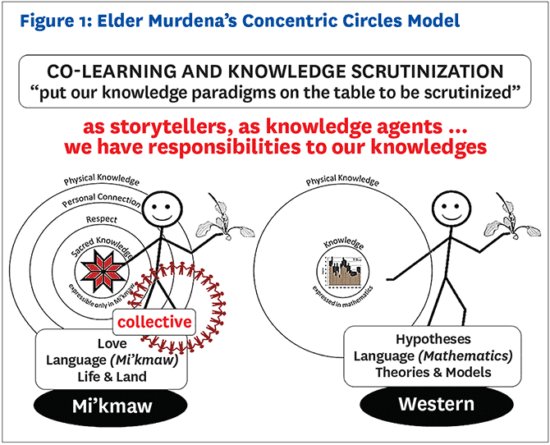 CHERYL: Years ago, Murdena created a model to emphasize the system nature of Mi’kmaw Knowledge and we’ve adapted it to help serve co-learning and knowledge scrutinization (see Figure 1). Murdena’s model has four concentric circles although, she says, traditionally there would be no intentional layering because stories were used to transmit knowledge in a holistic way. She indicates Mi’kmaw Knowledge and Western Science can share empirical observations of the physical attributes of, for example, a plant and its habitat (see outermost circles for both models in the diagram). In Mi’kmaw Knowledge, the middle circles of personal connection and respect are reciprocal, plus all four circles are interconnective. Sacred knowledge is innermost, can only truly be understood within the Mi’kmaw language, and generally cannot and should not be translated. Western Science relies on mathematical language and our model for it lacks middle circles because subjectivity is intentionally diminished. For Mi’kmaw Knowledge, “the Knowledge Holder / the knower” is an integral participant within the knowledge. In the Western science model, “the knower” stands outside the circles to emphasize objectivity.
ALBERT: These simple models are worth thousands more words… here I want to highlight that Mi’kmaw Knowledge is collective and thus any one Knowledge Holder has only a small piece, and also that our knowledge is alive and thus both physical and Spiritual with our language continually reminding us of our responsibilities.
CHERYL: In the Toqwa’tu’kl Kjijitaqnn / Integrative Science program, we worked within the broadened view of science as “dynamic, pattern-based knowledge shared through stories about our interactions with and within nature” for the Indigenous and Western sciences. Curricula evolved as we explored common ground (outermost circles in the knowledge models) while acknowledging and respecting differences (remaining circles). TK/IS eventually collapsed in the face of financial and political stresses. Nonetheless, it saw considerable student success and I will always say that community facilitators and tutors6 along with Elders and educators working together with mainstream allies were key… a “we together” approach.
CAROLA: At Mi’kmaw Kina’matnewey, we are learning with and from Elders in the many Traditional Districts in Mi’kma’ki. We are listening to their stories and envisioning how to put these into curricula woven within our Mi’kmaw Principles of Learning. We are at the beginning of this exciting journey to reconnect with our collective understandings as to how young people can best learn and to try to begin to grow these understandings within formal educational settings. In early elementary programming, Elders identified the importance of outdoor and experiential learning. The MK Board of Directors recognized the value of play and inquiry in learning. This administrative /community support is critical to successfully implementing change. This approach to learning, of framing learning experiences in real-life contexts through exploration via play, is one excellent way to teach our students. Teachers from Preschool to Grade 2 are receiving intensive training on ways to incorporate play-based, inquiry-based learning in their teaching. As we move forward our goal has to be: Toqikutimk / Together We Are Growing.
ALBERT: Again, I wish to say: E/TES is not easy. And so, we need to understand that sometimes our most important job is to plant seeds for the future, for the youth, knowing seeds germinate when the time is right. We must also accept that Indigenous communities need to generate their own understandings around re-awakening their own Indigenous Knowledge – this is what MK’s project through Carola and others is doing – and this takes time. We are entering an era in which what we once had and then came to consider as obsolete, is now coming back. This is especially true in regards to our traditional understandings that richly woven kinship relationships and interconnectivity are what make our natural world. The remembering and relearning will require much transformation of understanding – we will need to invite our Tribal Consciousness back into our daily lives so we are guided as to the way we initially were, and we will need to do a lot of inner reflection. We have for too long been in a period of disconnect from our natural world and from our traditional ways. We have lost a lot of the stories that would normally flow as to our responsibilities in sustaining ourselves as part and parcel of the whole. Education is key, for all of us.
I also want to emphasize that there are words in our language that would be more appropriate to use in place of the English phrases “Indigenous Knowledge” or “Traditional Knowledge.” For “Mi’kmaw Knowledge,” Murdena and I have suggested Ta’ntelo’lti’k meaning “the way we L’nu’k are.”7All Indigenous Nations have their own languages, their own words.
CAROLA: Nurturing the Learning Spirit of our students has to be central to everything we do and many of us firmly believe language is one key. For example, we can look to the community of Eskasoni, which has had an immersion program at the elementary school for at least 18 years. A research project that examined their program revealed the trend towards better educational success for Mi’kmaw students whose formal educational years began with immersion in our Mi’kmaw language.8
CHERYL: Murdena has always said, “We must bring Ta’ntelo’lti’k / Mi’kmaw Knowledge into the present so that everything becomes meaningful in our lives and communities. Our Mi’kmaw Knowledge was not meant to stay in the past; it is not static.9Like all things alive, it grows and changes… it is dynamic.”
CAROLA: We know that MK educational support helps foster our Mi’kmaw communities. In working with our communities and schools, we have seen high rates of graduation from high school.10Young people who know who they are and where they come from and who are connected with their Ancestors’ language, with Elders, with Ta’ntelo’lti’k / Mi’kmaw Knowledge, and with their community and Nation… find themselves woven into a multi-dimensional network of understandings that will help them find success in their chosen careers. This, in turn, helps to enrich our communities in ways that we can only begin to imagine. Our communities will grow. We all benefit.
ALBERT: Elders want to work with projects such as MK’s through Carola and others to ensure the accuracy, authenticity, and sacredness of the Mi’kmaw Knowledge being included. This is the validation by peer-review that we Elders insist must be an integral part of all efforts today involving Indigenous Knowledges. In 2009-2011, Elders from across Atlantic Canada worked together to provide formal recommendations in this regard. These are known as the “Elders Eight Recommendations for Honouring Traditional Knowledge”11and were supported by the Atlantic Chiefs in September 2011. I have great hope these recommendations will soon begin to be acknowledged and acted upon as the Elders intended… especially within educational institutions.
ALBERT, CAROLA AND CHERYL: We need to work together to do this. Indigenous Elders and Knowledge Holders are as interested in knowledge integrity as are mainstream academics and researchers. We need to do this in and for our classrooms, institutions, organizations, communities, Nations… across Canada. The educational need is deep and it is broad. Msit No’kmaq.
We want to know what you think. Join the conversation @EdCanPub #EdCan!
Illustration: Gerald Gloade
First published in Education Canada, June 2018
1 http://kinu.ca/introducing-mikmaw-kinamatnewey
2 www.integrativescience.ca
3 http://kinu.ca/document/mikmaw-ways-being-and-knowing
4 www.integrativescience.ca/uploads/activities/BACKGROUND-making-video-Muin-Seven-Bird-Hunters-IYA-binder.pdf
5 Jeffrey Simpson, “Money Alone Can’t Fix Aboriginal Education,” The Globe and Mail (Feb. 21, 2014). www.theglobeandmail.com/opinion/aboriginal-education-needs-money-and-more/article17008070
6 Student support was provided by the Mi’kmaw Science Advantage Program, better known as MSAP. This included tutors during 1999-2002 and recruitment facilitation in 1999-2002 plus 2003-2005.
7 www.integrativescience.ca/uploads/articles/2010June-Marshall-Bartlett-Integrative-Science-Two-Eyed-Seeing-environment-Mi’kmaq.pdf
8 www.apcfnc.ca/images/uploads/FinalReport-BestPracticesandChallengesinMikmaqandMaliseet-WolastoqiLanguageImmersionProgramsFinal.pdf
9 C. Bartlett, M. Marshall, and A. Marshall, “Two-Eyed Seeing and other Lessons Learned Within a Co-learning Journey of Bringing Together Indigenous and Mainstream Knowledges and Ways of Knowing,” Journal of Environmental Studies and Sciences 2, no. 4 (2012): 331-340.
10 http://kinu.ca/introducing-mikmaw-kinamatnewey
11 www.apcfnc.ca/images/uploads/ResearchSummary-HonouringTraditionalKnowledgeResearchSummary.pdf
-
Stavely Elementary School’s Project of Heart
Comments Off on Stavely Elementary School’s Project of HeartOki, Niisokowa. Nistoakoak Piikanikoan. Greetings, all my relations. My name is Ira Provost. I am a member of the Piikani Nation, who are members of the Blackfoot Confederacy of what is now known as Southern Alberta in Canada and the Northern State of Montana in the United States of America. I participate and am extensively involved in my Blackfoot culture.
I am an Indigenous educator. My career has granted me a decade-long experience in Indigenous education and educational programming as the Program Coordinator or Administrator of First Nations, Métis and Inuit (FNMI) Education Programs for a Southern Alberta school district. Although I have moved on from schools, my entire professional career has been, and continues to encompass, the role of educating non-Indigenous people about my Blackfoot Culture. It is a role and responsibility that I carry with astute honor and integrity.
Project of Heart
I returned to my First Nation as Manager of the Piikani Traditional Knowledge Services, my community’s on-reserve cultural centre. The local school districts often reach out to our organization to provide cultural awareness lessons and instruction to staff and students. On once such occasion, I got a call from the Livingstone Range FNMI Success Coordinator, Georgina Henderson, who invited me to a classroom presentation in Stavely, Alberta. Stavely is a small town in Alberta that would typically not have any Indigenous population in their community. It was not unusual to get a call from small towns in the area to come and present; as a centre, we’ve been to nearly all of them. But this time it was different.
The event was entitled the “Project of Heart Launch.” Invited guests included school board trustees, the superintendent, Stavely’s school principal, FNMI support personnel, and Elders from the Indigenous community. The teacher and project lead, Julaine Guitton, began the presentation by explaining that the students were engaged in a year-long project to learn about the Canadian residential school system. At this event the students had already had frequent lessons and teachings on residential schools, beginning with Orange Shirt Day in September. Each student had prepared a short speech about what they had learned, how they felt about it, and what they hoped they could learn from this point on. The speeches and presentations were absolutely amazing! The students were genuinely interested in their studies and the Indigenous people in attendance were deeply moved by the presentations. They concluded their day with a small feast and conversation with all staff and students.
I was greatly impressed and, like the other invited FNMI guests, was blown away by what was presented and what we had heard! In my view, and by all accounts, meaningful exchange and understanding of Indigenous people took place.
Based upon my experience, qualifications, and background, I believe Project of Heart was a great example of Indigenous learning because of the following:
Indigenous Education = Universal Education
One of the first impressions I had of the students and the project was that Julaine, the teacher, showed that learning about Indigenous people can take place regardless of your location.Many times in my career I have I heard teachers and school districts debate whether or not learning about Indigenous people or programs should take place as there were no identified First Nations, Métis, or Inuit students in the school. Stavely’s Project of Heart showed this was not the case.
In North America, whether you are near a First Nation reserve or Métis settlement or not, you are in someone’s Indigenous traditional territory. It is therefore important that you know and support who those nations are, as this leads to meaningful engagement with Indigenous communities. You can find out which nation’s traditional territory you are in by contacting the nearest First Nation administration office.
What does “meaningful” mean?
Meaningful engagement with the Indigenous community means taking the time to develop a relationship and nurturing that relationship for mutually beneficial success.
According to many anecdotal comments from the local Indigenous parents I’ve heard from over the years in schools, and from being a parent myself, school personnel do not take enough time to get to know the Indigenous community. I’ve witnessed many occasions where the school staff and students could not identify who their Indigenous neighbours are. Often school communities off reserves do not understand the Indigenous community norms, values and beliefs. Most times these norms and beliefs are quite contradictory to regular school policies and procedures. However, these differences do not mean that the Indigenous community does not value education – quite the contrary. Elders from the many communities I’ve worked with in multiple traditional territories give the same message – that education is important – and encourage their youth to value and attain their education.
Julaine and her students took time before and after their launch to keep the relationship going through local visits and exchanges with the Blackfoot community throughout their school year.
Beyond the provincial program of studies
Indigenous education is most effective when the learning goes beyond what is recommended or taught in the provincially mandated Program of Studies. This means that when teachers develop relationships with the Indigenous community, they must nurture that relationship and take measures to ensure it grows. There are many possibilities for utilizing Indigenous knowledge in the classroom to teach and benefit all students.
The primary reason that I believe the project has worked, and will continue to work in the education of these students, is that the learning was organic, interwoven into the continuum of their academic program over a long period of time. The teachings will continue to be a significant part of the Stavely students’ education going forward because the lessons were not structured or confined into a “one-time” or “one and done” unit/thematic lesson approach. Like Indigenous knowledge itself, the teaching of Indigenous knowledge needs “flow” and time to take root.
Indigenous generosity
This Project of Heart stands out for me in the fact that Julaine didn’t wait for training or learning experiences to be provided or for the curriculum to be revamped – she saw the need and she and her class took responsibility for educating themselves.
Generally speaking, non-Indigenous people tend to not take the first step to learn more about Indigenous people. When non-Indigenous people/educators reach out to understand Indigenous cultures, the Indigenous embrace the learners any way they can, as many Indigenous Nations refer to the value of generosity and compassion. When one is willing to learn and place their “Heart” into it, the best learnings come, and yes, Indigenous communities share.
The best advice I have for readers is that there are no quick solutions, lesson plans or instructional keys to creating great teaching moments in Truth and Reconciliation.
Truth and Reconciliation
In 2015, Canada’s Truth and Reconciliation Commission released the 94 Calls to Action. There are a number of the Calls to Action that address education and our need as a Canadian society to correct the gaps that continue to exist in education as one step to “reconciling” with Indigenous communities. In my graduate studies I looked at the life cycle of a teacher: post-secondary student, pre-service teacher, new teacher, and existing classroom teacher. I found that, at the present time, there is very little requirement for teachers to have Indigenous Studies as a significant part of their education to attain their teaching degree, to begin or to continue teaching in classrooms. As a result, there exist many gaps still evident in today’s education system regarding appropriate education for and about, and created with, the local Indigenous community and why these particular Calls to Action exist.
The important step in understanding how to realize the potential in the Calls to Action is to not take action without an Indigenous person to guide your curricular/program development. There is a myriad of possibilities as to how to create meaningful programming and they are quite easy to implement. But educators cannot possibly create educational programming without understanding what their Indigenous communities need and what their values are. Although fascinating, learning about the Haudenosaunee and Iroquois Confederacy is not as valuable as learning about the Blackfoot Confederacy when in Blackfoot Traditional Territory.
The best advice I have for readers is that there are no quick solutions, lesson plans or instructional keys to creating great teaching moments in Truth and Reconciliation. Julaine and her students showed that their learning took a lot of work and time and they achieved so much more at the end of their year by doing so.
Paths forward
As an Indigenous educator, Blackfoot knowledge keeper and ceremonialist, I will always look back and continually reference this Project of Heart as one that should and could be modelled in classrooms and schools across the country. I, as an Indigenous parent, strive to have my Indigenous heritage respected and appropriately represented and taught in my child’s school. For me, the Project of Heart attained what I hoped Indigenous education could be, an equal and balanced relationship between a teacher and her Indigenous community. Throughout the students’ journey, several of them came forward and acknowledged they were of Indigenous heritage and felt comfort in doing so. I believe it was a first time for the school.
I wish Staveley school and students and all readers a happy journey through Canada’s reconciliation. It really is a new dawn for a better next 150 years.
Katamustin (Blackfoot: Until we speak/meet again).
We want to know what you think. Join the conversation @EdCanPub #EdCan!
Photo: Courtesy Julaine Guitton
First published in Education Canada, June 2018
-
Truth & Reconciliation in Every School
Comments Off on Truth & Reconciliation in Every SchoolYou could not attend our event in Lethbridge? stream our panel discussion live into your staffroom.
Watch our panel discussion
This important and timely professional learning session will identify how we can respectfully and accurately incorporate Indigenous perspectives into all aspects of our schools and classrooms, including lessons on the history and legacy of residential schools. Our goal is to begin a dialogue to learn together and build relationships among Blackfoot First Nation Knowledge Keepers, community leaders, and non-Indigenous educators and teaching candidates who are striving to “get this right.”
Key questions that will be explored at this event include:
- Why should educators change their practices, how do we achieve “truth,” and how do we work towards reconciliation? What’s stalling the development of learning objectives that would incorporate all Canadians in the reconciliation process, and how should the TRC’s recommendations evolve education policy?
- How can we develop approaches that are community-specific and respectful of local protocols and practices? How can educators build trusting relationships with Indigenous communities?
- How can schools and post-secondary institutions commit to co-learning about reconciliation throughout the entire school year? How can post-secondary teacher trainers prepare the next generation of educators to value and feel confident in embedding Indigenous perspectives into all grade levels and subject areas?
No matter where you are on your learning journey, this event will equip you with valuable insights that can help you contribute to preparing the next generation of learners who will work collaboratively with Indigenous peoples to advance reconciliation.
Proudly supported by
-
New guidebook on early school leaving
Comments Off on New guidebook on early school leavingNew EdCan Network case study research report entitled The Rural Advantage: Rallying Communities Around Our Students calls on school-community leaders to consider a made-in-Canada approach that raises literacy rates, prevents early school leaving and breathes life back into small towns.
It’s an all-too-common scenario in Canada’s rural communities. Parents who struggle to read and write. Household incomes and unemployment rates that fall below the national average. Students with special needs who require a speech pathologist or a teaching assistant, but don’t get one. Schools at risk for closure and dwindling community services as young people dropout of school or opt for brighter opportunities in the big city. But these trends can be reversed with a “community ecosystem approach”: a Canadian-developed, step-by-step process for developing school-community partnerships that can reduce student dropout rates in rural and disadvantaged schools and municipalities.
“Our grade-four French-language success scores have risen from 50% to 98% in only five years,” says Sylvain Tremblay, principal of both an elementary school and a high school in Saint-Paul-de-Montminy, Quebec. “Instead of working in silos, we engaged parents, kids, teachers and community partners to collectively lead activities that increase the language skills of toddlers and encourage the academic and social success of our children and young adults.”
This guidebook was originally developed with the support of CTREQ – a Quebec-based research and knowledge mobilization centre – and provides a practical toolkit and worksheets for school and community leaders to create their own unique program, including guidance on how to engage hard-to-reach families, classrooms, schools, and whole communities.
“Schools can’t afford to work in isolation from the families and communities where their students live and grow up,” says Darren Googoo, Chair of the EdCan Network, a pan-Canadian collective of education leaders. “This approach isn’t about overloading busy educators; rather, it’s about community leaders rallying around a literacy action plan that leverages existing resources and strengthens existing efforts.”
Download the full report for free, including how-to videos and a practical toolkit, at: www.edcan.ca/ecoreussite-report.
SUPPORTED BY

This initiative is generously sponsored by State Farm Canada, which shares EdCan Network’s commitment to supporting leaders who are transforming Canada’s public education system.
-
A guide for leading dropout prevention in your small town
Comments Off on A guide for leading dropout prevention in your small townThis case study report calls on school-community leaders to consider a made-in-Canada approach that raises literacy rates, prevents early school leaving and breathes life back into small towns.
This step-by-step guidebook provides a practical toolkit and worksheets based on the concrete experiences of the “L’ÉcoRéussite” program, which has developed a “community ecosystem” action plan in collaboration with the CTREQ: a Quebec-based research and knowledge mobilization centre. This “community ecosystem” approach provides guidance on how to engage hard-to-reach families, classrooms, schools, and whole communities in order to collectively create and lead activities that increase the language skills of toddlers and encourage the academic and social success of children and young adults ages 0-24 years-old.
Schools, school districts and community organizations can leverage this guidebook to create their own unique programs adapted to their particular needs and situation.
The Ecosystem Toolkit
This toolkit contains worksheet templates, sample community surveys and model action plans that have been carefully developed by the “L’ÉcoRéussite” program. These hands-on tools can be used as exemplars for filling-in the blank templates below, which were developed by the CTREQ.
Phase 1: Explore
This phase consists in collecting qualitative and quantitative data to develop a community portrait, engaging community stakeholders and hosting your first community consultation meeting. (Refer to Phase 1 of the report).
PHASE 2: INITIATE THE PROCESS
understanding the protective factors of student retention and success, versus the risk factors of dropping out of school
Survey to evaluate current initiatives and gaps in community service offerings
developing a community portrait
determining community needs and objectives based on Key findings and Protective factors
PHASE 3: THE PLANNING STAGE – CREATING AN ECOSYSTEM ACTION PLAN
developing a community Action Plan
PHASE 4: IMPLEMENT AND EVALUATE
survey to ASSESS PARTNER SATISFACTION
Widening the scope to target individuals ages 0–24 years-old
survey to ASSESS COMMUNITY PRIORITy issues
sample results from the survey to ASSESS community PRIORITY ISSUES
Practical how-to videos for community organizations, schools, school districts and parents’ associations (in French only)
This video series on the “L’ÉcoRéussite” program will allow you to dive deeper into the winning conditions, challenges and key steps undertaken by this school-community team in creating a “community ecosystem” action plan.
How to Create a Community Action Plan in Support of Student Retention (in French only)
Building Upon Student success to Spur Parent Engagement (in French only)
The “L’ÉcoRéussite” Program: Supporting Student Success in Disadvantaged Rural Communities (in French only)
SUPPORTED BY
This initiative is generously sponsored by State Farm Canada, which shares EdCan Network’s commitment to supporting leaders who are transforming Canada’s public education system.
-
How do Makerspaces heighten student engagement?
Comments Off on How do Makerspaces heighten student engagement?Makerspaces are informal community or in-school learning spaces that offer tools and resources for community members and students to tinker with a mix of traditional technologies – such as cardboard, wood, recycled plastic, or fabric – and more cutting-edge technologies – such as 3D printers and scanners, robotics, laser cutters, open-source computers, microcontrollers, and sensors. Makerspaces can be found in community centres, libraries, schools, and other public spaces, including pop-up Makerspaces setup for single day events and mobile Makerspaces that reach remote populations. While definitions vary, there were an estimated 1,400 Makerspaces worldwide in 2016: 14 times as many as there were in 2006.
Makerspaces engage students to learn in and out of school, by providing opportunities to:
- Develop 21st century employment skills through solving problems and thinking creatively.
- Learn through play at their own pace by developing self-confidence through designing objects and creating them with 3D printers or through programming a robot.
- Deepen what is learned in Science, Technology, Engineering, Art and Mathematics (STEAM) classes, by making connections with real-life tasks and problems. Makerspaces are especially useful for engaging students who have not thrived in a traditional school setting, since these subjects are often taught in separate classes without practical applications.
- Explore their interests and develop creative solutions to real-world problems, showing that solving complex social issues often requires multiple skills and people.
- Develop intergenerational relationships and build communities through activities that draw from community expertise and build shared goals with community members. This allows knowledge and skills to be shared and personal connections to be created between people of all ages, including strengthening teacher-student relationships.
- Develop collaboration skills and teach others what they learn, so that children understand that they can take on a variety of roles, such as being a leader, a builder, an organizer, a planner, a technician, an engineer or a designer.
- Develop fine motor skills through using manual tools. This includes connecting circuits, assembling small parts together, and cutting, gluing, polishing or sanding objects.
- Learn by trial and error, take risks, and persevere in challenging situations where they feel supported in “getting their hands dirty.”
Evidence suggests that Makerspaces help develop practical skills that increase student engagement and prepare children for the 21st century job market. Whether repairing an old radio, knitting with embedded wearables, or building a robot, Makerspaces allow students to explore their interests, develop their passions, and thrive in the classroom and beyond.
Additional Information Resources
Davidson, A.-L. (2017). You too can experience the “maker scream. Concordia University. Retrieved from www.concordia.ca/cunews/main/stories/2017/05/03/maker-scream-education-professor-saltise-winner-ann-louise-davidson.html
Davidson, A.-L. (2017). On Focus. Retrieved from www.linkedin.com/pulse/focus-ann-louise-davidson/
Davidson, A.-L. (2017). This Easter, Conquer the Impossible with Your Kids. Retrieved from www.linkedin.com/pulse/easter-conquer-impossible-your-kids-ann-louise-davidson/
References
Andersson, P. (2015). Digital fabrication and open concepts: An emergent paradigm of consumer electronics production. (Bachelor thesis, Umeå University). Retrieved from www.diva-portal.org/smash/get/diva2:822484/FULLTEXT0
Davidson, A.-L., Price, D. (2018). Does Your School Have the Maker Fever? An Experiential Learning Approach to Developing Maker Competencies. Learning Landscapes, 11(1), 103-120. Retrieved from www.learninglandscapes.ca/index.php/learnland/article/view/926/918
Lou, N., & Peek, K. (2016). “By The Numbers: The Rise of the Makerspace.” Popular Science. Retrieved from www.popsci.com/rise-makerspace-by-numbers
Fleming, L. (2015). World of making: Best practices for establishing a makerspace for your school. Thousand Oaks, CA: Corwin.
Peppler, K., Halverson, E., & Kafai, Y. (Eds.). (2016). Makeology: Makerspaces as learning environments (Volume 1). New York, NY: Routledge.
Peppler, K., Halverson, E., & Kafai, Y. (Eds.). (2016). Makeology: Makers as learners (Volume 2). New York, NY: Routledge.
Sheridan, K., Halverson, E. R., Litts, B., Brahms, L., Jacobs-Priebe, L., & Owens, T. (2014). Learning in the making: A comparative case study of three makerspaces. Harvard Educational Review, 84, 505–531.
-
5th Canadian Assessment for Learning Network (CAfLN) Conference and Symposium
Comments Off on 5th Canadian Assessment for Learning Network (CAfLN) Conference and SymposiumThe conference is an opportunity to share, learn and network with educators from K-12 and post secondary settings. It will include presentations and break-out sessions with leaders in assessment and opportunities to connect your learning with your own teaching context. Guest speakers will include CAfLN’s founding members – Ken O’Connor, Lorna Earl and Damian Cooper.
-
Guided Physical Play in Kindergarten
Comments Off on Guided Physical Play in KindergartenFive-year-old Nancy is busy with clay. At first the chunk she pulls off is too hard to shape, but she’s learned to warm and knead it until it’s softer. She rolls it into a long cylinder and coils the tapering “bug” to attach to her leaf. Then she pulls off two larger bits of green clay to make more leaves for her growing tree. “Too big,” she mutters, and pulls them off again. She cuts one of the balls in half and tries again, this time using her fingers to spread the clay into a thin leaf shape perfect for her imaginary tree.
Play is often described as “the work of childhood.” While the idea of play eludes any single definition, the thread that unites various types of childhood play is pure and simple pleasure. It is its own reward and is self-reinforcing.
In this short article, we make a pitch for a greater focus on fine motor control through guided exploratory play in the Kindergarten program, emphasizing the importance of direct tactile experiences – handling and manipulating objects or materials in the real world in real time. This type of play fulfills several important goals of early childhood learning. First, body-object interaction (BOI) supports the development of stable, internalized models for learning the world: its shape, size, speed, distance, texture, structure, and whole-part relationships, for example. Concepts of shape and size are key to alphabet recognition and the type of reasoning that is foundational for early numeracy understandings in Grades 1 and 2.
Second, guided physical play promotes fine motor control. The Kindergarten years are the time to afford opportunities for play with tweezers, popsicle sticks, crayons, markers, and clothes pegs to strengthen the muscles and the neuropathways for the demands of written literacy, beginning just around the corner!
Finally, BOI develops the associated vocabulary as children learn to name and describe their interactions with the material world.1 Children with nimble fingers are found to have a larger developed lexicon of concrete objects, and interestingly, of more abstract concepts, too. Suggate and Stoeger suggest that “embodied cognition” enjoys a processing advantage, and that the connections between cognition, language and physical contact with the material world provide distinct benefits to youngsters who have had rich opportunities for these types of experiences in early life.
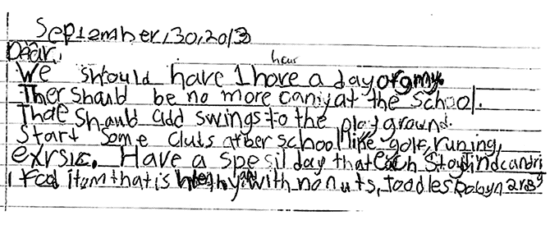
Figure 1: Writing Sample
We find plenty of evidence, however, that Canada’s young children are generally not sufficiently engaged in this type of play prior to their arrival in Kindergarten. The Early Development Instrument (EDI) analyzes Pan Canadian data on five-year-old children on five domains.2Outcomes indicate fewer than 50 percent of Canada’s young children are developing as they should along all five domains of early development. The ParticipACTION 2016 Report Card reports that only nine percent of Canada’s young children are getting the recommended amount of daily exercise, and increased numbers are not getting enough sleep.3 Our own work with Grade 2 children who are gifted revealed their overall lack of readiness for the demands of early written literacy learning, as noted in their distinct, belaboured printing efforts.4 (See Figure 1: Writing Sample.) Our intervention of explicit printing instruction using a programmatic, developmentally progressive approach can, we found, change the slope of the educational trajectory. However, remedial or “catch up” teaching is more difficult and time consuming than “just right teaching” might have been in the sensitive window of time in Kindergarten and Grade 1. Hence our motivation to focus on guided physical play at a much earlier stage in the educational experiences of young students.
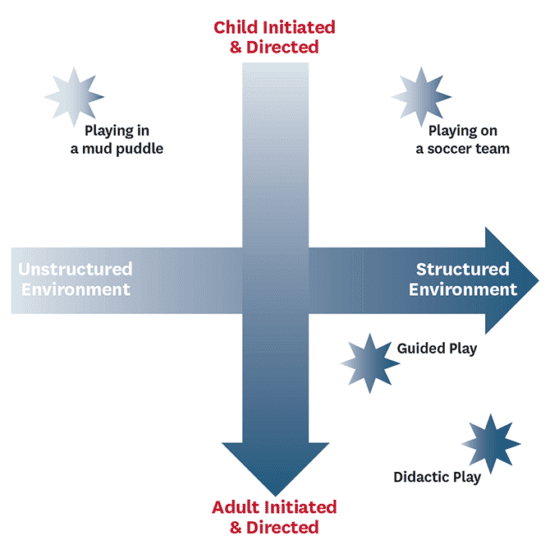
Figure 2: Matrix of Types of Play
We position various types of play by way of a framework we have organized around two continua: from child-initiated and directed to adult-initiated and directed; and from unstructured to structured play. (See Figure 2: Matrix of Types of Play.) We locate guided play in the mid-zone of the lower right quadrant, and define it as:
Purposefully designed activities and tasks that we think will be engaging and fun, are directed to some learning goal, and reflect a sense of pedagogical intent. Children’s motivation, curiosity, desire for mastery and their choices for how they interact with the materials are elements of the design. Children are actively involved in advancing embodied cognition and neuro-motor skills relevant and necessary to early language and literacy learning.
The research literature on play-based learning places a much heavier emphasis on inquiry, pretend, imaginative, discovery, fantasy, creative, and socio-dramatic play that is child driven, all types of play that would be located in the upper left quadrant. We advocate for a more balanced approach in the Kindergarten program.
Inspired by Montessori’s5 ideas about the role of the prepared environment and the importance of the materials children play and work with, we suggest the following 11 activities as a starting point to our colleagues in the field who might also be thinking of re-aligning their Kindergarten program. The possibilities are limited only by a teacher’s imagination, though!
- Blocks, bricks: Play with blocks and bricks promotes spatial reasoning as children develop concepts of size and shape, stability and structure.
- Lego pieces: Shapes that fit together and can be taken apart to create something new help to develop the concept of parts to a whole. Meanwhile, all that pushing together and pulling apart of little pieces develops fine motor skills and strong fingers. My friends who are architects and civil engineers say Lego was their favourite toy as children.
- Bits and pieces: Something as simple as a jar of buttons and a tray are enough for children to handle and sort for size, shape, colour, and then create sequences and patterns. As mentioned earlier, these foundational concepts developed through nimble fingers are crucial for numeracy and literacy learning.
- String and beads: Make a necklace! This can include making a pattern or sequence of coloured beads.
- Paper, scissors, crayons, markers, glue sticks, collage materials: Fold, cut, decorate, and print a simple message to make a card for Grandma’s birthday.
- Real-life objects: Using tweezers, clothes pegs, and chopsticks, children develop a good pincer grip through guided experiential play that simulates everyday tasks.
- Shared storybook reading: Books such as Rosie’s Walk (Hutchins, 1971) promote “languaging” around directional words, and imagining and drawing objects in space. Henry’s Map (Elliott, 2013) and Lucy in the City: A story about developing spatial thinking skills (Dillemuth, 2015) may serve as a bridge to learning activities that promote spatial reasoning through finger tracing and drawing maps.
- Play with clay: Kneading, molding and manipulating plasticine clay gives little fingers a great workout! Can they shape their ball of plasticine into an object that will float in a tub of water? Children delight in trying various shapes, with those “ahead of the curve” figuring out that weight and shape both play a role in whether the object will float.
- Origami for kids: folding and creasing, concepts of pattern, symmetry, sequence. There are dozens of simple projects for children to do: flowers, frogs, airplanes… the list is extensive.
- What’s in the bag? Fill a bag with “mystery” objects. Children take turns reaching in, focusing on one object, and describing the object by size, shape, structure, texture, what it might be used for, etc. for the class. Who’s the first to get it right?
- Slime! A current craze among kids is making and playing with magic slime. It is made with just a few easy-to-obtain ingredients, such as glitter glue and powdered fibre supplement. This strengthens small fingers. It also teaches procedural language and provides a simple chemistry lesson.
The human hand is complex and versatile – elegantly and exquisitely unparalleled in design to do the work of gripping, grabbing, holding, folding, pushing, pulling, punching, kneading, threading, stacking, rolling, throwing, squeezing and squishing.6Through our sense of touch and our tactile connection to the world, we learn the world and engage with it, constructing the stable internal models that are necessary for numeracy and literacy development. These experiences need to be mediated through elaborative and collaborative talk between adult and children. As educators, we are responsible for preparing children for literacy and numeracy learning by engaging little fingers in guided play that lies at the intersection of cognitive, linguistic and neuro-motor integration: embodied cognition. Guided play can make this mandate fun, exciting and productive.
We want to know what you think. Join the conversation @EdCanPub #EdCan!
Photo: iStock
First published in Education Canada, March 2018
1 Sebastian Suggate and Heidrun Stoeger, “Do Nimble Hands Make for Nimble Lexicons? Fine motor skills predict vocabulary of embodied vocabulary items,” First Language 34, no. 3 (2014): 244-261. http://journals.sagepub.com/doi/abs/10.1177/0142723714535768
2 Magdalena Janus and Caroline Reid-Westoby, “Monitoring the Development of all Children: The Early Development Instrument,” Early Childhood Matters 125 (2016): 40-46.
3 ParticipACTION Canada, “Are Canadian Kids too Tired to Move?” The ParticipACTION Report Card on Physical Activity for Children and Youth (2016). https://www.participaction.com/sites/default/files/downloads/2016%20ParticipACTION%20Report%20Card%20-%20Full%20Report.pdf
4 Hetty Roessingh and Michelle Bence, “Intervening in Early Written Literacy Development for Gifted Children in Grade 2: Insights from an action research project,” Journal for the Education of the Gifted 40, no. 2 (2017): 168-196. http://journals.sagepub.com/eprint/Qh7ZS5zKKStQgesK4ibZ/full
5 Angeline Lillard, “Playful Learning and Montessori Education,” American Journal of Play 5, no.2 (2013): 157-186. www.journalofplay.org/sites/www.journalofplay.org/files/pdf-articles/5-2-article-play-learning-and-montessori-education_0.pdf
6 Jerry Bergman, “The Human Hand: Perfectly designed,” Creation Research Society Quarterly 50 (2013): 25-30. www.creationresearch.org/members-only/crsq/50/50_1/CRSQ%20Summer%202013%20Bergman.pdf
-
The Signal: Multi-Grading iGen-ers and Alpha Geners
Comments Off on The Signal: Multi-Grading iGen-ers and Alpha GenersWhat?
Multi-grading – combining two grade levels in one classroom – may not appear to be a signal of change at first glance. After all, it’s been around for generations; some might say since one-room schools. However, in Canada more than 20 percent of students were registered in multi-grade classes in 2015, with the number continuing to grow – an educational trend being experienced worldwide.1 And yet, what do we know about our current students’ (iGen-ers) and future students’ (Alpha Geners) experiences with multi-grading? Do we know how to meet their multi-grading needs?
So what?
This worldwide educational trend is based on research that shows students in combined classes performing as well and better than peers in single grade classes.2 Greg has seen first-hand how students benefit from some aspects of multi-grading, especially in the context of smaller class sizes. He has found that pedagogical practices such as differentiated instruction and heterogeneous groupings are proving (anecdotally) more effective in supporting student growth, development, and learning in a multi-grading context.
However, there is a gap in our knowledge about how best to educate iGen-ers and Alpha Geners in multi-grading classrooms. In a time when multi-grading is showing unprecedented growth, we need current research supporting best practice. And although teachers like Greg, relatively new to multi-grading, have been provided professional learning on multi-grading, it has not always been best suited to the needs of the multi-grade teacher. To compensate for this, Greg has had to create his own online/email groups and set up meetings and opportunities to connect with his multi-grade peers on the weekends and evenings. Since research on current best practice can be difficult to locate, there is an overreliance on teacher trial and error to determine what will best serve these new generations of learners, the increased diversity of student learning and developmental needs within one classroom, and also departmental/ministry expectations.
What next?
Supporting student success is the ultimate goal of quality teachers and quality educational programming. With multi-grading gaining momentum in Canada and internationally, we need to capitalize on its strengths. This requires systematic implementation and investigation of multi-grading in today’s educational contexts, with and for current iGen’ers and future Alpha Gen’ers, as well as a community within which to share this information with and between practitioners.
Participant reflections on signals of change
Participants at the 2016 EdCan Network Regional Exchanges discussed more signals of change than we could possibly cover — but we wanted to share a sense of their range and significance. We invited a number of participants to write a short piece reflecting on one of the signals they brought to the Exchange.
Discover more signals at: www.edcan.ca/RegExReport
We want to know what you think. Join the conversation @EdCanPub #EdCan!
Photos: Max Cooke and Yolande Nantel
First published in Education Canada, March 2018
1 Globe and Mail (September 17, 2015). https://beta.theglobeandmail.com/news/national/education/are-split-grades-something-to-worry-about/article26390439/?ref=http://www.theglobeandmail.com&
2 E.g. Gajadharsingh, 1991; Goodland, 1987; Veenman, 1995.
-
The Signal: The demand to build adaptive expertise
Comments Off on The Signal: The demand to build adaptive expertiseWhat?
The demand to build adaptive expertise in educators is a powerful signal of change. Recently, I sat in on several sessions at an educational technology conference, where seven local school districts collaborated to share knowledge. As I watched teachers at all stages of their careers gather in classrooms to learn and exchange ideas in areas ranging from apps for teaching math to online portfolios for student assessment, it reminded me that the goals we share go beyond simply keeping pace with the latest tech tools. The premise of a peer-led conference is illustrative of how we must approach education’s most profound shift in a century.
So what?
The demand to develop adaptive expertise matters because educators must prepare learners for a world that few can imagine: a world where technology often outpaces our understanding of its implications, where the global village demands collaborative solutions, and where critical thinking is our only life vest in a swelling tide of information. Educators and learners alike need to build their skill set for adaptive expertise: critical and creative thinking, collaboration, and the willingness to engage with others.
Now what?
Teachers need to model the change in practice that allows these skills to become habits or attributes in the lives of learners. This is how we develop resilient learning communities. As Stephen Downes of Canada’s National Research Council wrote, “We need to move beyond the idea that an education is something that is provided for us, and toward the idea that an education is something that we create for us.” We demonstrate a willingness to adapt as we create space and opportunities for personalized learning, build understanding of shared histories, and use technology for deeper learning. Even learning spaces must transform – rows of desks and the hierarchies they underline are often incongruous with the collaboration required to propel real innovation. As educators, if we can recognize our own inter-dependence, we can build resilient, lifelong learners who understand their power to both adapt to and shape the world around them.
Participant reflections on signals of change
Participants at the 2016 EdCan Network Regional Exchanges discussed more signals of change than we could possibly cover — but we wanted to share a sense of their range and significance. We invited a number of participants to write a short piece reflecting on one of the signals they brought to the Exchange.
Discover more signals at: www.edcan.ca/RegExReport
We want to know what you think. Join the conversation @EdCanPub #EdCan!
Photos: Max Cooke and Yolande Nantel
First published in Education Canada, March 2018


IDEAS TO SUPPORT EDUCATORS : Subscribe to the EdCan e-Newsletter
Quality research, reports, and professional learning opportunities.