Archive
-
Personalizing Education
Comments Off on Personalizing EducationAs our modern economy shifts from the industrial era to an age of knowledge workers, we increasingly need an education system that teaches students to work in collaborative teams, master higher-order knowledge and skills, and creatively solve complex technical and social problems. For this kind of education to be possible, we need to be able to customize instruction in order to address each student’s unique learning needs.
In the last few years, many innovative educators have been leveraging technology to make this type of educational experience possible. They integrate online learning in their traditional schools to create new instructional models that are collectively referred to as “blended learning.” Sometimes people fear that online learning in schools will lead to a dehumanizing experience, where students are constantly plugged into devices and teachers are just passive monitors. In contrast to this conception, the leading pioneers in blended learning find that technology allows student and teacher interactions to be more meaningful and personal.
For example, high-quality blended learning frees up teachers from some administrative and instructional aspects of their jobs so that they have more time to focus on creating high-value learning experiences for their students. These teachers spend less time lecturing and more time mentoring and coaching. They offload basic instruction to online tools and resources so that they can focus their efforts on developing students’ critical thinking skills and fostering their character development. Additionally, blended learning allows students to take greater ownership of their learning.
Examples from the field
CARPE DIEM
In 2005, Rick Ogston found himself looking for a new campus for Carpe Diem Collegiate High School, the public charter school1 he had founded in 2002. The owners of the church facility that the school had been renting were selling the property. Finding a suitable school facility was a challenging task, but Ogston seized it as an opportunity to simultaneously transform the school’s instructional model and provide a more student-centered form of education.
The moment one walks in the door of a Carpe Diem school, the differences from the traditional classroom model are apparent. In Carpe Diem’s school in Yuma, Ariz., the center of the building is a large room filled with individual computer stations. On the periphery of that room are breakout rooms where teachers lead collaborative workshops.
Every 35 minutes, the students rotate among the computer stations and the breakout rooms according to individualized learning “playlists.” On the computers they learn using Edgenuity software, with paraprofessionals on hand to assist them if they get stuck. The software adjusts to the students’ learning needs by letting them test out of lessons they have already mastered, and provides them with rich video content of real teachers to explain the concepts they still need to master. In the breakout rooms, a face-to-face teacher reviews or applies the material introduced online through discussions and projects. The teachers are also aided by the software’s teacher dashboard, which alerts them when they need to intervene to help a student.
This model allows Carpe Diem to achieve noteworthy results. In 2010, Carpe Diem’s school in Yuma ranked first in its county in student performance in math and reading. Businessweek recognized Carpe Diem as one of the top high schools in America in its 2009 report, and U.S. News & World Report gave Carpe Diem the same recognition in 2010.
With online learning as the backbone of Carpe Diem’s instructional model, the role of teacher is substantially different from that of traditional teachers. Carpe Diem’s teachers do not have to present every single concept their students need to learn. Instead, they focus on figuring out how to intervene when students are struggling and how to push students to deeper understanding. Ogston explains that when online learning is used to provide basic instruction, teachers then get to do the exciting part of teaching, which is making the content applicable and relevant to students’ lives.
Blended learning affects not only how Carpe Diem’s students learn, but also how teachers and students interact with each other. As Ogston said, “When you’re leveraging technology like we are, people want to look at us in terms of technology. But the secret sauce is not the technology, it’s the relationships.”2
Carpe Diem’s teachers are able to spend more time working with students in small groups and on an individual basis. Carpe Diem’s online learning software also helps teachers better understand their students’ learning needs. The data generated by the software lets teachers know on a daily and hourly basis exactly how students are progressing in their learning and alerts them when they need to intervene. As one student describes it, “Here the teachers know where you’re at exactly, so if you have a problem they’ll talk to you about it and they help you with it.”3
Carpe Diem’s model also fosters longer-term relationships between students and teachers. Each school has one teacher per subject for all students in grades 6–12. As teachers work with students across multiple years, they get to know their interests, their career goals, their families, and their individual learning needs. They also get to see their students’ growth across their entire high-school experience. Luis Vanhook, one of Carpe Diem’s teachers, says that seeing students grow across multiple years “is the most beautiful part about my job.”4
SUMMIT PUBLIC SCHOOLS
A number of years ago, a group of parents from the San Francisco Bay Area came together to re-imagine the public middle and high school experience. In 2003 they founded Summit Prep, a charter school with the mission to prepare a diverse student body for success in college and to be thoughtful, contributing members of society. Today, Summit Public Schools operates six middle and high schools and enrolls 1,600 students. Its schools are some of the best in California, as they score consistently well above average on state tests and have over 96 percent of their graduates accepted into at least one four-year college or university. In 2011 Newsweek listed it as one of the top ten most transformational high schools in America.
Yet despite these successes, Summit’s leaders noticed a few years ago that many of its graduates were struggling to complete college. To address this problem, they began thinking about how to better prepare students with the content knowledge, cognitive skills, habits of success, and real-world practice necessary to succeed in college and as adults in 21st century society. What resulted was an innovative blended-learning model that aimed at helping students become self-directed learners.
To create its blended-learning experience, Summit had its teachers spend a summer writing out the learning objectives students needed to master each year and then developed online assessment items for measuring mastery of each of those learning objectives. The teachers then curated playlists of free online content – including articles, websites, videos, and web apps – to cover each learning objective. With these tools in hand, they redesigned their physical space and their instructional time during the school day to create a unique, student-centered learning experience.
Instead of assigning students to individual teachers and sending them to learn in separated classrooms, Summit’s students work in large, open learning spaces, and its teachers work as a team to serve the students they share. When students arrive at school, the first thing they do is power on their computers and sit down for an hour of “personalized learning time.” During this hour, they work through Summit’s playlists in order to master their personal learning goals for the current week. The playlists offer them multiple learning resources that they can choose among for learning the concepts they need to master. Once students feel they are ready to pass a learning objective, they go to their teacher to get the assessment for that objective unlocked. After taking assessments, they see their results immediately, along with a detailed explanation of their performance. This short-cycle feedback loop gives students actionable data on their progress that allows them to feel ownership over their learning. After the hour of personalized-learning time each morning, students then spend the rest of the day working with their teachers and fellow students on project-based learning activities. This gives them needed opportunities to apply what they have learned in a relevant, off-line context.
Summit’s blended-learning model has radically changed the roles of its teachers and their relationships with their students. Because teachers no longer spend the majority of the school day planning and delivering large-group instruction, they focus instead on developing personal, deep relationships with students as their mentors. Each mentor has stewardship over 10 to 15 students and meets with them at least weekly to review their progress toward their learning goals. Mentors also act as academic coaches, college counselors, family liaisons, and advocates for their students. School leaders knew that when they changed their model to put students in charge of their own learning, mentors would be vital to help them make progress toward rigorous but attainable goals.
For teachers, another benefit of Summit’s blended-learning model is that it relieves them from the siloed isolation of traditional single-teacher classrooms and gives them valuable opportunities to learn from each other. Emily Swegle, one of Summit’s teachers, says that co-teaching at Summit has allowed her to develop a trusting relationship with her co-teacher in which they each draw on their unique experiences and expertise to give each other ideas and constructive feedback.5
Summit’s founder, Diane Tavenner, acknowledges that when Summit first switched to a blended-learning model, the shift was difficult for teachers, but ultimately proved to be rewarding. “Teachers first had to mourn a little bit because they have this image in their mind of who they are, and now it suddenly looks a bit different. But our model has more of the stuff that teachers got into education for. There’s more meaningful one-on-one work, more opportunities to get to know their kids very well.”6
The future of personalized learning
Schools like Carpe Diem and Summit offer a promising glimpse of what our education systems might look like in the future. They are showing that personalized education is about not only personalizing the instruction students receive, but also the ownership students feel for their work and the relationships between teachers and students. Fortunately, we live in a unique time in history when the technology finally exists to make this kind of personalized education possible.
Not many teachers or school leaders have the operational freedom to create blended-learning models that are as radically different as those found at Carpe Diem or Summit. But many educators from around the world are finding creative ways to implement blended learning within their existing classrooms and schools. Some are setting up computer stations within their classrooms and then having students rotate in small groups between teacher-led instruction and personalized online instruction. Others are finding ways to leverage their existing computer labs to create tighter integration between what students do during lab time and what they do in their other classes. Still others are finding ways to “flip” their classrooms by assigning students to learn core concepts online for homework and then refocusing class time on applying that learning to solve problems, work on projects, and collaborate with their teachers and classmates. In all of these cases, educators are leveraging technology to create innovative learning environments that better address their students’ needs.
Making the shift to blended learning
Blended learning is a powerful enabler of personalized instruction, but the shift to high-quality blended learning is no small task. It is not merely a matter of purchasing devices and licensing good online learning software. Major shifts in aspects of school operations are often required, such as the schedule of the school day, the grouping of students, the roles and responsibilities of teachers, classroom procedures, classroom management strategies, classroom culture, and the architecture and layout of the physical learning environment.
Because blended learning is still a relatively new phenomenon, resources and best practices are just now emerging from the field. Fortunately, as more and more schools experiment with blended learning, successful models are providing lessons that can help streamline the planning and design processes for other schools that are looking to make the shift. Even so, the work of developing a successful blended learning model requires significant research, planning, collaboration, and reflective execution.
For more information on blended learning, please visit: www.christenseninstitute.org/blended-learning
Photos: courtesy Clayton Christensen Institute for Disruptive Innovation
First published in Education Canada, September 2014
EN BREF – L’apprentissage hybride, un modèle pédagogique novateur, intègre l’apprentissage en ligne à l’enseignement en personne afin d’engendrer des possibilités d’apprentissage personnalisé pour les élèves. De nombreuses écoles primaires et secondaires utilisent l’apprentissage hybride pour transformer les environnements éducationnels à l’école et pour aider tous les élèves à mieux se préparer aux études supérieures et à l’environnement de travail du 21e siècle. Un apprentissage hybride de qualité libère les enseignants de certains aspects administratifs et pédagogiques de leur travail de sorte qu’ils peuvent se concentrer davantage sur le mentorat et l’encadrement de leurs élèves. Il peut également aider les élèves à acquérir plus d’autonomie en tant qu’apprenants et engendrer des liens plus personnels entre les élèves et leurs enseignants.
[1] Both of the schools described in the article are U.S. charter schools. They are publicly funded and operated by private, non-profit organizations. They have open enrollment for any students living within their geographic areas, they do not charge tuition, and when they receive more applications than they can accommodate they admit students based on lottery.
[2] Frederick M. Hess and Bror Saxberg, Breakthrough Leadership in the Digital Age: Using learning science to reboot schooling (Thousand Oaks, California: Corwin, 2014), 19.
[3] Ian Murray, Carpe Diem Learning Systems (video, 2013), 7:14. http://carpediemschools.com/videos/
[4] Ibid.
[5] Silicon Schools Fund and Clayton Christensen Institute, Case Study #1: Teaching in a flex model at Summit Public Schools (video, 2014), 7:56. www.khanacademy.org/partner-content/ssf-cci/sscc-teaching-blended-learning/sscc-blended-case-studies/v/sscc-blended-summitteach
[6] Hess and Saxberg, Breakthrough Leadership in the Digital Age, 156.
-
A Virtual Window
Comments Off on A Virtual Window“Human beings were born to be in a community. We were born to create and share elements of our experience of life through art and through storytelling. We have been coming together in communities from the beginning of our existence.”
– Jamie Notter and Maddie Grant in Humanize1
When I was in elementary school (over 30 years ago), my mother would often stop by the school before or after the day to see how things were going. In our small town, the school was the hub of the neighbourhood. Parents were often physically connected to the school community, as many were able to visit; however what took place within the classrooms, aside from the monthly newsletter, was mostly kept between the teachers and students.
A new era
Fast-forward to 2014 and we see a different world. When my own children enter elementary school, my job commitments will rarely allow me to stop by their school and be a part of their life there. Due to a changed economy and social norms, most parents now work outside the home and few have the opportunity to stay home and be a consistent part of their child’s life at school.
On the other hand, parents now have an enhanced drive to “see” what is happening in their children’s classrooms and schools and they are more engaged in decisions affecting their children’s education. Although I will not physically be able to visit the classroom, I will want to stay in touch and would rather not wait to get a thick newsletter about events that occurred weeks prior.
Many parents and families strive for a strong home-school connection, but traditional structures can hinder this process. However, with the use of social media, we can not only create new avenues of connection to the school, we can actually enhance these connections in such a way that our families can have stronger relationships with the school and become more engaged and involved than ever before.
Share the stories
The stories of education in the mainstream media are often dominated by school rankings, test scores, political conflicts, and mistakes that occur in our educational organizations. Through a variety of social media tools, schools can change this lens and become the chief storytellers of the school. By providing small, frequent windows into the great things that are happening within their walls, schools can engage families and build an online community that works to enhance the physical school community. Sharing photos, videos and posts of the small stories that happen in a school can help parents and families to see and feel the culture of learning and care of the school. The photos that are taken can include students (with the proper media consent) but can also be of staff, student work, bulletin boards, reminders, and/or public events. When the school opens digital windows and becomes the chief storyteller, we can share the real culture of the school and create a sense of pride in the community.
When small events have a big impact
I have been at my current school since January and during this time, we have tried to create an online presence to help share the many positives that we are privileged to see each day. With the help of a dedicated teacher, we have created a new web page, school success blog, Facebook Page, Twitter account, and YouTube channel. Through these avenues, I am able to share with the community the learning and caring culture that I get to see as I visit classrooms.
We recently had a student who had been wearing her lost tooth on a necklace her teacher had given to her to ensure that it went home to the tooth fairy. Unfortunately, the girl fell outside, the container popped open and the tooth landed in the gravel. She was quite upset when we were unable to find it, so I suggested having the principal write a letter to the tooth fairy that could be placed under her pillow in place of the tooth. The student and I drafted a letter and before I sent it home, I took a photo of it and posted it on our Facebook Page. (The vast majority of items that we share are from the staff at James Hill Elementary, but on the rare occasion I do share something that I have done as a principal, so parents can know a bit about who I am and what I stand for.)
The crazy thing about this tooth fairy letter is that, unbeknownst to me, a Vancouver radio station saw it on our Facebook Page and reposted it on their page, which was then picked up and shared by a number of media outlets worldwide. This small moment now became a positive global story about our school. This experience emphasized for me that we need to share these stories more often. We know actions like these happen all the time, so the fact that this story spread so quickly revealed that there is a lack of public awareness of how often school staff members take the time to care for students. Social media cannot change school culture on its own; however, through a quick post or Tweet, families and community members can see some of the caring acts that so often go unnoticed. They can engage online with the school in ways that can help build important relationships.
A “window in” for new families
Many new students nervously enter our schools each year. Along with the new students, many new parents also become part of our school communities. Prior to the use of social media, new parents often had limited access to information about the school. Now, families can do virtual tours, catch up on updates, interact with other families, and begin building relationships with people within the school community. When many of the typical questions are answered on the website and through various platforms – questions around school safety procedures, codes of conduct, year and day schedules, school supply lists, or how to raise a concern regarding their child – the anxiety is lessened and the relationships are strengthened.
Trust is so important in working with our families. Families are bringing their “everything” to our schools. When we provide more transparency (including both the successes and challenges) and make information about the school accessible, we help build trust. By sharing who we are as an organization, we can create an open relationship with both our new and experienced parents.
From communication “to” to communication “with”
We can also use social media to engage in dialogue around events and issues at the school. In the past, some schools have become very effective at communicating to parents through newsletters, websites, and notices sent home. Now, we need to move to a goal of communicating with parents, through platforms that allow and encourage two-way dialogue. Social media is a great place to start, but it is important to use it to engage with readers, not just to push information (though providing information is still very important). If we post information or a link and a question arises, it is very important to respond. When we respond, we show we actually listen and are working to increase communication with parents.
A few years ago, there were concerns with students being placed in split/combined classes. In response to these private questions, I wrote a post on our Facebook Page with a few thoughts on combined classes. Parents responded with questions of their own and these led to quite a powerful dialogue on some parent anxiousness around combined classes. We were able to truly listen to concerns and respond in a meaningful way so that we helped to create better understanding of how students are placed in classes and how we can improve combined classes at the school. It would have been easy to broadcast the information on a static website, but posting it on Facebook allowed for respectful dialogue on an issue that was causing some concern in the parent community.
There is often the worry, when opening up discussion on social media, that there will be inappropriate comments posted online; however, this is rare and insignificant compared to the positives of social media. When we model an open, respectful environment, people maintain this culture during online communications.
Parents may not always comment publicly online, but by showing that we encourage feedback, we create an open environment whereby parents know that important issues can also be discussed in person, privately. By focusing on communication with parents, we not only increase our engagement online, we also foster enhanced face-to-face relationships with our families offline.
Start small
For many people, the idea of using social media is overwhelming. With so many options, it’s hard to know where to start. There is no one best way to communicate with families; we must find out where our parents are and meet them there. However, because social media is a stream, posted items can be missed and, therefore, a website and/or a blog is needed to have a home for the information we share.
In my experience, the following have been the most successful:
- A school success blog: On our school website, we have added a blog that we update each week. We have moved beyond the newsletter to an online blog called “10 Good Things To Talk About” in which we share ten positive stories from the classrooms at our school. This success blog helps both parents and staff to see into our classrooms and, in effect, creates a more positive school culture. In addition to the “10 Good Things,” we share upcoming events and important information on the blog. The school blog replaces the newsletter, so there is no extra time spent writing and it reaches a wider audience as it can be shared in many more places. The blog can also be printed off for those who do not have Internet access.
- A school Facebook Page: We are nearing the point in which the majority of our parents use Facebook. Facebook can be used to share images and videos of learning at the school as well as to post interesting links to articles and videos on educational change. As not all parents will use it (nor will all users see the posts), Facebook cannot be our sole method of communication.
- A school Twitter feed: Although fewer parents use Twitter, there are a growing number who do and it can be a great way to share the story of the school and interact with parents.
Some schools have also seen great success with YouTube, Flickr, Instagram and Remind101 (text messaging). The key to getting started with using social media is… to just start. Explore with the school blog and let input from the parents and community help guide the next steps.
Timesaving Tip
- Use the IFTTT.com website to create “recipes,” so that when you post in one place, it also posts in another. For example, when we post to our school blog, it can be set up to also post to Facebook and Twitter automatically so that no extra time is required.
We are in a new era of parent communication and it is time to move beyond the newsletter to a more interactive and engaging approach. By using technology to meet parents where they are and participate in dialogue around their child’s education, we can build community and effective relationships both online and in person.
Photo: courtesy http://jameshillelementary.com
First published in Education Canada, September 2014
EN BREF – Nous vivons une nouvelle ère de communication avec les parents. Le moment est venu d’aller au-delà du bulletin de nouvelles et d’adopter une approche plus interactive et mobilisatrice. Grâce aux médias sociaux, nous pouvons non seulement établir de nouvelles avenues pour créer des liens avec l’école, mais aussi pour les rehausser de façon à ce que nos familles puissent avoir des relations plus solides avec l’école ainsi que s’engager et participer plus que jamais. Dans cet article, l’auteur examine des façons efficaces d’utiliser les technologies et les médias sociaux pour « raconter l’histoire de l’école » et tenir les parents au courant, au moyen de canaux multiples.
1 Jamie Notter and Maddie Grant, Humanize: How people-centric organizations succeed in a social world (Indianapolis: Que Publishing, 2011).
-
Building Community
Comments Off on Building CommunityAround the world, our sense of community is changing. Technology and social media have made the world smaller than ever, and people are building their own communities, regardless of geographic boundaries. School communities are, inevitably, changing too. A more expansive concept of school seems to be emerging, with connections and relationships extending well beyond the school walls to encompass families, community partners and mentors, and “virtual” classmates from schools around the world. Within the school walls, an increasingly diverse student population and shifts in the roles of teachers and learners are also changing the dynamic. In this issue, we wanted to explore how educators can create and support vibrant, positive, creative school communities.
The articles that were contributed in response are a wide-ranging and inspiring look at what is possible. Chris Wejr (p.12) shares his experience using social media to include parents into the school community and reinforce positive school culture. Ray Derkson (p. 20) describes Manitoba’s innovative approach to ensuring strong community input and participation across a huge and widely diverse school division. And Thomas Arnett (p. 16) presents models of “blended learning” that change the structure of the school day and the relationship between student and teacher.
One of the inspirations for this issue was a two-day workshop CEA held in October 2013, titled, “What’s Standing in the Way of Change in Education?” As part of the process, participants were asked to share their personal vision of “the school of their dreams.” Person after person described schools rich in authentic, meaningful, and personalized learning experiences. But another strong thread had to do with community, as described in the summary report:
“The schools of their dreams are welcoming, collaborative environments, respectful of the many layers of diversity that now define the Canadian social fabric. They are places where a strong sense of community participation and contribution adds to the rich set of resources that can bring learning to life.”[1]
There may be a long way to go to fully achieve the “dream schools” described to us in the CEA workshop. But exciting changes are being made right now to create richer, stronger, more responsive school communities, as the examples in this issue demonstrate. Whether at the classroom, school or regional level, there is no lack of exciting ideas. To paraphrase Ray Derkson in his article, “Let’s try them and see what happens.”
Write to us!
We want to know what you think. Send your letters or article proposals to editor@cea-ace.ca, or post your comments about individual articles on the online version of Education Canada at: www.cea-ace.ca/educationcanada
Photo: Dave Donald
First published in Education Canada, September 2014
[1] Read the whole report at: http://cea-ace.s3.amazonaws.com/media/CEA-2013-2014-AR-Annual-Performance.pdf
-
2014-2015 School Calendar
Comments Off on 2014-2015 School CalendarThe School Calendar provides all opening and closing dates, statutory holidays, and spring breaks for elementary and secondary schools across Canada. This free resource, compiled annually, is an essential tool for conference, event and vacation planners. The School Calendar is published in mid-August.
-
The Challenge to Change: Discussion Guide
Comments Off on The Challenge to Change: Discussion GuideThe Challenge to Change
The Discussion Guide Version 2.0
August 2014Published by:
The Canadian Education Association (CEA)
119 Spadina Avenue, Suite 705, Toronto, ON M5V 2L1
www.cea-ace.caA Conversation About Change is Developing…
On October 23, 2013 over 300 teachers, students, parents, policy-makers, education leaders and community groups gathered in Calgary to join the Canadian Education Association (CEA) in a conversation around the question, What’s Standing in the Way of Change in Education? It’s a provocative question, to be sure, and one that continues to draw interest and attention from individual citizens and stakeholder groups right across the country. For this reason, CEA has designed several ways for you to contribute to the conversation.
-
Learning through empathy
Comments Off on Learning through empathyNone of us alive today are responsible for the decisions of those who crafted the laws that made some lesser than others. We did not write the Indian Act or build residential schools. We did not pass out pock infested blankets or exile whole populations of people to patches of land or steal one generation from another. This is not our doing, and, it is the history of our land. We share this history now. All of us who were born here or choose to live here: this is our shared history. We share these stories just as we do the beautiful, compassionate stories of our past.
-
Aboriginal education needs to be place-based education
Comments Off on Aboriginal education needs to be place-based education“Indian Control of Indian Education” was a brilliant piece of agenda-setting in the early 1970s.
Anything governments did about Aboriginal education from that point on could be measured against a common yardstick: Is this what the community wants? Is it what parents want?
All over Canada, education agreements have been negotiated with local Bands and other Aboriginal organizations on the basis of that simple idea.
The trouble is that the realities are not simple.
Aboriginal students are extremely diverse, and the histories and current situations of their communities are extremely diverse. Yet schools have a hard time dealing with diversity – not just in Aboriginal communities or towns and cities with large Aboriginal populations, but everywhere.
The fact is that schools were designed, back in the 19th century, to create a more homogenous, unified, mobile population across Canada. That is basically what schools are for. Sure, they can be tweaked in various ways to try and accommodate local differences, but such efforts are add-ons, not part of the basic logic of school.
Aboriginal students are extremely diverse, and the histories and current situations of their communities are extremely diverse. Yet schools have a hard time dealing with diversity – not just in Aboriginal communities or towns and cities with large Aboriginal populations, but everywhere.
A good example is the teaching of Aboriginal languages in schools. Bringing a community language into school changes it, and how students identify with it. Ironically, the effect can be to emotionally distance students from the language, especially if they don’t encounter it in daily use in the community.
This kind of double-bind is at the heart of the problems experienced by Aboriginal students. If they buy into the logic of school, they will find it very difficult to balance that view of the world with a strong sense of rootedness in a particular community and place. If they reject the logic of school, it can be a pretty meaningless and hostile environment to have to endure.
The solution, I think, is to come up with a different vision of schools in general – one that emphasizes their connections with place and community.
Aboriginal education needs to be place-based education in order to attend to the particularity of each community and nation, without making assumptions about the identities, backgrounds and values of individual students. By place-based, I mean that as much of the curriculum as possible should be taught in ways that connect directly with the history and circumstances of where and how the students and their families live.
Aboriginal education needs to be place-based education in order to attend to the particularity of each community and nation, without making assumptions about the identities, backgrounds and values of individual students.
This implies different ways of training teachers, different ways of designing curriculum, and different ways of teaching. It implies getting away from the simple idea of “control” of education. Control means relatively little unless you can change the logic of school so that the local and particular become more central to its mission.
In Canada, good place-based education has to be, among other things, good Aboriginal education. Aboriginal history, values, perspectives and issues need to have a central place in any authentically place-based curriculum. So do, for example, issues of environmental awareness, resource management, energy use, habitat protection, social justice, economic equity, democratic governance, fair trade, human rights, mental and physical health, sustainable agriculture, and so on.
These are issues of concern in every community in Canada – precisely because they are not fully amenable to local control, and larger forces that care nothing for community needs (Aboriginal and non-Aboriginal alike) are steadily undermining our ability to address them.
Our ambitions for Aboriginal students need to extend beyond academic success as currently defined. We need schools dedicated to their well-being as whole persons, and to that of their communities and the natural systems that sustain them.
Enough of add-ons. Let’s tackle the heart of the problem.
This blog post is part of CEA’s focus on aboriginal student success, which is also connected to Education Canada Magazine’s aboriginal student success theme issue and a Facts on Education fact sheet on what the research says about how can we create conditions for Aboriginal student success in our public schools. Please contact info@cea-ace.ca if you would like to contribute a blog post to this series.
-
How can we create conditions for Aboriginal student success in our public schools?
Comments Off on How can we create conditions for Aboriginal student success in our public schools?Aboriginal children under age 14 make up 7% of all children in Canada and the Aboriginal population is the fastest growing demographic in this country. Eighty percent of Aboriginal children attend off-reserve provincial schools. In terms of school success, there are significant gaps in learning outcomes and graduation rates between Aboriginal and non-Aboriginal students.
Nationally, provincially, and territorially, public school educators are committed to closing these gaps, and some success has been realized. For example, in classrooms where Aboriginal content and perspectives were incorporated into a high quality learning program, Aboriginal student grades increased significantly.
Strong leadership is critical to the development of high quality learning programs designed to provide Aboriginal students with every opportunity to succeed in Canadian public schools. Key strategies in creating environments to ensure this success include:
- Relationship building between the Aboriginal community and public school system administrators/educators and meaningful engagement of the Aboriginal community (Elders, Traditional Teachers, etc.) in all aspects of education from policy-making to creating curriculum and resources
- Increasing the numbers of Aboriginal teachers who share their culture and can identify with Aboriginal students and vice-versa
- Creating school cultures where Aboriginal students feel respected and can experience a positive sense of belonging
- Understanding and incorporating Aboriginal perspectives of learning that is: holistic; lifelong; experiential in nature; rooted in Aboriginal languages, cultures, and spirituality; community based involving family, Elders and other community members
- Incorporating Aboriginal perspectives and learning resources into daily curricula for all students – both Aboriginal and non-Aboriginal – rather than presenting them as add-on materials or special topics for some groups only
- Providing teachers with authentic and culturally appropriate resources reflective of local Aboriginal communities and perspectives
- Requiring the inclusion of Aboriginal history and perspectives in teacher training and professional development activities to inform and shape teacher attitudes and instructional practices in classrooms.
With the shared commitment and collaborative effort of all stakeholders – Aboriginal communities; policy makers; administrators, teachers, parents, and students – we can create schools where all students, both Aboriginal and non-Aboriginal, can learn and succeed at high levels.
ADDITIONAL INFORMATION RESOURCES
Shared Learnings: Integrating BC Aboriginal Content K-10
http://www.bced.gov.bc.ca/abed/shared.pdf
TDSB Professional Library, Education of Aboriginal Students in Canada: Selected Current References, August 2012
http://ramott.files.wordpress.com/2012/08/aboriginal-education2012_delinked.pdf
Resources for Rethinking: Aboriginal Voices in the Curriculum http://resources4rethinking.ca/en/resource/aboriginal-voices-in-the-curriculum
Western Canadian Protocol for Collaboration in Basic Education: Aboriginal Languages and Culture Programs
http://www.education.gov.sk.ca/wncp-common-language-framework
Edmonton Public Schools
http://aboriginaleducation.epsb.ca/
Successful Transitions for First Nations, Métis and Inuit Students http://www.education.alberta.ca/media/6397158/successful%20transitions%20fnmi.pdf
Promising Practices in Aboriginal Education
http://www.maei-ppw.ca/Ontario First Nation, Métis, and Inuit Education Policy Framework
http://www.edu.gov.on.ca/eng/aboriginal/OFNImplementationPlan.pdfEXAMPLES OF SPECIFIC ABORIGINAL EDUCATION POLICIES
Ontario
Aboriginal Education Strategy
http://www.edu.gov.on.ca/eng/aboriginal/curricNSNL.html
Manitoba
Integrating Aboriginal Perspectives into Curricula http://www.edu.gov.mb.ca/k12/docs/policy/abpersp/index.html
Saskatchewan
Aboriginal Education Initiatives in Saskatchewan Education: 1995-1998 http://www.education.gov.sk.ca/Aboriginal-Education-Initiatives
Alberta
First Nations, Métis and Inuit Education Policy Framework February 2002
http://education.alberta.ca/media/164126/framework.pdf
British Columbia
Ministry of Education Aboriginal Education Policy
https://www.bced.gov.bc.ca/abed/
REFERENCES
Anuik, J., Battiste, M., George, N., & George, P. (2010). Learning from promising programs and applications in nourishing the learning spirit. Canadian Journal of Native Education, 33(1), 63-82.
Canadian Council on Learning. (2007). Redefining How Success is Measured in First Nations, Inuit and Métis Learning, Report on Learning in Canada. Ottawa, ON: Author
Canadian Council on Learning. (2009). The State of Aboriginal Learning in Canada: A Holistic Approach to Measuring Success. Ottawa, ON: Author.
Claypool, T.R., & Preston, J.P. (2011). Redefining learning and assessment practices impacting Aboriginal students: Considering Aboriginal priorities via Aboriginal and Western worldviews. In Education, 17(3), 84-95.
Council of Ministers of Education, Canada (CMEC, 2009). Strengthening Aboriginal success: Moving toward Learn Canada 2020 (Summary Report from the CMEC Summit on Aboriginal Education, February 24-25) Summit on Aboriginal Education Summary Report. Retrieved from:
http://www.cmec.ca/Publications/Lists/Publications/Attachments/221/aboriginal_summit_report.pdf
Friesen, J., & Krauth, B. (2012). Key policy issues in Aboriginal education: An evidence-based approach. Toronto, ON: Council of Ministers of Education, Canada.
Gallagher-Mackay, K., Kidder, A., & Methot, S. (2013). First Nations, Metis, and Inuit Education: Overcoming gaps in provincially funded schools. Toronto, ON: People for Education.
Howe, E. C. (2011). Bridging the Aboriginal education gap in Saskatchewan. Saskatoon, SK: Gabriel Dumont Institute. Retrieved from:
http://www.gdins.org/ckfinder/userfiles/files/Bridging_AbEduGap_GDI_final.pdf
Kanu, Y. (2011). Integrating Aboriginal perspectives into the school curriculum: Purposes, possibilities, and challenges. Toronto, ON: University of Toronto Press.
Mattern, A. (2013, Fall). The best is yet to come: Aboriginal teacher education programs thriving. Green & White: University of Saskatchewan Alumni Magazine, p. 22-23. Retrieved from: http://www.usask.ca/greenandwhite/issues/2013/fall2013/output/GandW.pdf
Richards, J. (2013). Why is BC best? The role of provincial and reserve school systems in explaining Aboriginal student performance (Commentary No. 390). Toronto, ON:C.D. Howe Institute. Retrieved from:
http://www.cdhowe.org/pdf/Commentary_390.pdf
Richards, J., Hove, J, Afolabi, K. (2008). Understanding the Aboriginal/non-Aboriginal gap in student performance: Lessons from British Columbia. Toronto, ON: C. D. Howe Institute.
Richards, J., & Scott, M. (2009). Aboriginal education: Strengthening the foundations. Canadian Policy Research Networks. Retrieved from:
http://cprn.org/documents/51984_EN.pdf
Riley, T., & Ungerleider, C. (2012). Self-fulfilling prophecy: How teachers’ attributions, expectations, and stereotypes influence the learning opportunities afforded aboriginal students. Canadian Journal of Education, 35(2), 303-333.
Statistics Canada. (2013). Aboriginal Peoples in Canada: First Nations People, Métis and Inuit (Catalogue no: 99-011-X2011001). Ottawa, ON: Ministry of Industry.
Thomas, D.M. (2005). Incorporating Aboriginal content and perspectives in Saskatchewan curricula: Experiences of selected teachers. Unpublished Master’s Thesis, University of Saskatchewan. Retrieved from:
Toulouse, P.R. (2011). Achieving Aboriginal student success: A guide for K to 8 classrooms. Winnipeg, MB: Portage and Main. Retrieved from:
https://www.portageandmainpress.com/lesson_plans/plan_303_1.pdf
Toulouse, P.R. (2008, March). Integrating Aboriginal Teaching and Values into the Classroom. What Works? Research into Practice #11.
http://www.edu.gov.on.ca/eng/literacynumeracy/inspire/research/Toulouse.pdf
-
“Qanuippit?”
Comments Off on “Qanuippit?”As my students prepare for their day on a cold winter morning, they walk through the doors with rosy cheeks, bright eyes and smiles. My first words are usually “Qanuippit?” (How are you?), or “Ullaakkut” (Good Morning). There is a unique privilege in greeting and connecting with students in our mother tongue.
My students speak to me in both Inuktitut and English. I encourage them as much as possible to speak in Inuktitut. It can be a challenge sometimes to remind them to speak their language. I know it is important for them to understand that our language is one we must appreciate and use at every opportunity. I wonder if they really understand what it means when I ask them to speak Inuktitut or why they must feel constrained at times by the reduction of speaking in English. I want them to feel free, as free as they are and can be. Part of my job is to help them to see their own freedom as students, to embrace and appreciate their learning in any language.
The upbringing I received was different from what I imagine many of my students must experience today. I was not allowed to speak English within the boundaries of our home. When I was about 11, I remember my mother turned to me after one of my complaints about her strictness against English in our home and replied in Inuktitut, “I may not be able to give you everything from our culture, but I can give you the language.” That moment stuck with me. The depth of her words would not fully make sense until later in my life, but I attribute my personal strength in the area of Inuktitut to my mother.
Today, I continue to speak Inuktitut and am still learning new words, often ones associated with our school curriculum. I invite Elders to join our classroom to support me and my students in writing quality sentences in Inuktitut. There are also a plethora of words that I do not often use because of my own daily routine. Words that are associated with being on the land, the preparation of skins or traditional foods or the observation of weather, are often isolated to people who are connected to those areas on a regular basis. I have made it one of my goals to learn words outside of my routine and to make them more accessible to my students.
The more we use it, the more language lives and grows. I often see the seeds budding in my own students as I hear some of them repeating words in Inuktitut in their conversations. I feel a great sense of pride and responsibility in speaking to my students in Inuktitut, a language that was formerly forbidden to an entire generation before mine. There is a unique connection when speaking to another person in Inuktitut, if only to tell a joke or repeat a story. The students may not fully appreciate the positive experiences I yearn to share, but I know there will be lasting benefits to the encouragement I can provide and a space that allows them to speak in Inuktitut as freely as they choose. There will be days when they wonder why I am being “strict” when it comes to using Inuktitut, but I truly hope they will come to share and appreciate the joy and benefits of using our language as much as I have.
Photo: Ryerson Clark (iStock)
First published in Education Canada, June 2014
-
Is B.C. Getting it Right?
Comments Off on Is B.C. Getting it Right?Important changes to Aboriginal[1] education across Canada began to happen in the 1970s with the federal government’s recognition of the 1972 national policy, Indian Control of Indian Education (ICIE), which emphasized the principles of local control; parental responsibility; Indian culture, values and language; Indian teachers; and culturally sensitive non-Indian teachers and counselors. The National Indian Brotherhood (now Assembly of First Nations) led the development of this milestone policy with input from many provincial and territorial First Nations organizations. Forty-two years later, Aboriginal education remains a pressing concern across Canada. The 2004 Auditor General’s report cautioned that it will take up to 28 years for First Nation on-reserve students to reach high school completion parity with non-Aboriginal students.[2] Despite these dismal statistics, some areas of Canada are moving toward success in Aboriginal education.
British Columbia’s 2012-2013 six-year Aboriginal student high school graduation rate is 60 percent, a marked increase compared to 2008-2009 when it was 40 percent.[3] In the last three years, the increase has been three percent per year. So what is B.C. doing to achieve some success for Aboriginal learners? This article highlights multi-dimensional, interconnected, and long-term approaches that have contributed to Aboriginal education improvements, which include Indigenous teacher education, K-12 public and First Nation schools, and First Nations community and organizational leadership.
Each author shares her area of experience in a sole-authored section.
Creating change through Indigenous teacher education
by Jo-Ann Archibald
In October 2014, NITEP,[4] the Faculty of Education’s Indigenous teacher education program at the University of British Columbia (UBC), will celebrate its 40th anniversary. When NITEP began in 1974, there were approximately 26 Indigenous teachers in the province out of a teacher population of 23,000 (0.11 percent). NITEP has since graduated 366 Indigenous people who have Bachelor of Education degrees and who have completed a substantial concentration of Indigenous education courses and educational placements.
I am from the Sto:lo and Xaxli’p First Nations. My experience with NITEP spans 32 years. I have developed and taught NITEP’s Indigenous education courses, was a field centre coordinator and advisor to students, and have served as its director.
NITEP helps Indigenous people from Canada fulfill their dream of becoming a teacher, prepares them to become effective educators, and contributes to the improvement of Aboriginal education. NITEP also provides advocacy and support when needed, as well as helping its students develop Indigenous Knowledge pedagogical approaches and understandings about the intergenerational impact of colonization on Aboriginal people and Canadian society.
NITEP students demonstrate resilience and commitment to their studies despite issues such as limited finances, leaving their home community for part of the program, and experiences of racism. They begin their studies in regional field centres, where they complete most of the program from a local college or university, and Indigenous education courses from NITEP/UBC. A field centre coordinator teaches, advises, supervises educational placements, administers the centre, recruits new students, and maintains community linkages. The students move to UBC’s Vancouver campus for their final 12 months of the program. The family/cohort structure provides peer support and a “community-of-learners” approach throughout the program.
NITEP alumni are role models and mentors for their families, many of whom are inspired to become teachers because they have seen their parents, aunties, and uncles complete the program and then teach. NITEP graduates are teaching in public and First Nation schools, colleges and universities. They take on leadership roles in schools, school districts, professional organizations, and Ministry of Education positions. They are advocates for systemic change, they engage in new curriculum development, and they maintain community relationships – as demonstrated in the next section.
Making a difference in public schools
by DeDe DeRose
I am a member of the Secwepempc-Esketemc First Nations. In 1976 I became a student at the NITEP Field Centre in my home territory, graduating in 1981. NITEP provided me with a safe place to inquire, imagine and be inspired to pursue a career as an educator. In my career, I have been a classroom teacher, school-based principal, chair of the First Nations Education Advisory at UBC and province-wide educator. In 2012, I was honoured to become the first Superintendent of Aboriginal Achievement in the B.C. Ministry of Education – the first position of its kind in Canada. NITEP has opened many career doors and windows that I wouldn’t have dreamt were possible.
In my role, I meet with provincial school district senior administrators to discuss student success, and specifically Aboriginal student success. I use student data that the province has collected over time as a guide to inform and assist school districts and their Aboriginal communities in making local decisions in the best interests of students.
I have noticed that school district teams with certain practices are more likely to be successful. I see Aboriginal student success increase when school districts:
- work together with Aboriginal communities;
- track students and use local and provincial data to drive decisions;
- have an Aboriginal Enhancement Agreement (EA) with Aboriginal communities that includes measureable, attainable goals;
- embed local Aboriginal knowledge throughout their curriculum;
- offer provincially developed courses such as the English First Peoples 10, 11, & 12 and First Nations Studies 12;
- seek to employ Aboriginal educators and support staff; and
- offer ongoing professional development for all educators.
B.C. is the only province that collects and reports annually on student achievement and student satisfaction data.
District staff must also commit to providing educators with strategies to address barriers where students do not feel safe at school and do not have a sense of belonging,[5] with a belief that until students feel safe and welcome in schools, they will not achieve to their fullest potential. My observation, therefore, is that schools are successful where students, their families and communities, teachers, principals and senior administration take responsibility, understand their roles, are engaged, and work cooperatively and respectfully together.
I have also chaired the provincial K-12 Education Partners’ table. A Memorandum of Understanding signed in 1999 guides our work. It states: “We, the undersigned, acknowledge that Aboriginal learners are not experiencing school success in British Columbia. We state our intention to work together within the mandates of our respective organizations to improve school success for Aboriginal learners in British Columbia.”
First Nations community organizations leading change
B.C. has the benefit of having a key member, the First Nations Education Steering Committee (FNESC), leading and guiding its provincial partners in bringing about positive change. The FNESC[6] is an independent society led by a strong and diverse board of about 100 First Nations community representatives from B.C. FNESC is committed to improving education for all First Nations students in B.C., whether they live on or off reserve. Since its establishment in 1992, FNESC has worked to support First Nations communities in working together to advance education issues and to communicate their priorities to the federal and provincial governments. Communications, research, partnership building and advocacy are all central to FNESC’s activities. Some of FNESC’s important accomplishments include:
- winning legal recognition to be decision-makers in the education of Aboriginal children, which became protected in federal legislation in 2006 and provincial legislation in 2007;
- creating innovative curriculum, including English First Peoples 10-12, which is used in public and First Nation school classrooms across B.C.;
- co-founding the B.C. Aboriginal Post-Secondary Education and Training Partners’ Group in 2005, uniting stakeholders to improve participation and success of Aboriginal learners in post-secondary education and training; and
- co-founding the Education Partners’ Group in 1999, bringing together K-12 education stakeholders, including Métis people, to improve the success of Aboriginal students in B.C.
FNESC also created an association to work specifically with First Nations schools in B.C. The First Nations Schools Association (FNSA) is an independent organization directed by representatives of the approximately 130 First Nations schools in B.C. It is committed to supporting the development of high-quality, culturally appropriate education for First Nations students and to promoting First Nations control of First Nations education. Since its establishment in 1996, the FNSA has developed assessment instruments for gathering student data to inform planning and improvements in schools, and has built a strong system of mentorship, professional development and coaching to support school leadership and promote effective instruction.
Looking ahead
These programs, approaches, and organizations have made significant contributions to improving Aboriginal student success and Aboriginal education in B.C. NITEP, an Indigenous teacher education program, will continue to prepare its graduates to not only teach, but to make a difference in education. The UBC Faculty of Education continues to demonstrate its long-term commitment to Aboriginal education by hiring Indigenous faculty, offering innovative Indigenous graduate programs, and most recently, requiring that all teacher candidates take a course in Aboriginal education. The Ministry of Education made a bold move in creating the position of Superintendent of Aboriginal Achievement, which adds to its other strategies for making school districts more accountable for increasing Aboriginal student success in K-12. B.C. is the only province that collects and reports annually on student achievement and student satisfaction data. Provincial organizations, run by First Nations communities, are making some key systemic and legislative changes with provincial and federal governments.
But we must ask ourselves if we are satisfied with our success to date? It has taken at least 40 years since the introduction of the Indian Control of Indian Education Policy to reach the current level of B.C. educational success. To reach parity with non-Aboriginal student high school completion rates in B.C., currently at 86 percent, could take at least another nine years of sustained effort. Aboriginal students are still over-represented in special education, and the graduation rates of Aboriginal children in care are abysmal at 34 percent.[7] Moreover, while high school graduation is an important education milestone and marker of success, it is not the only relevant indicator. Appreciation and knowledge of First Nations, Métis, and Inuit history, culture and language are others, which still need to become integral and vibrant components of education. At the same time, we value the long-term commitment, sustained hard work, and wealth of knowledge and skills of the many Aboriginal people, allies, and organizations that have moved B.C. Aboriginal education forward. These continuing collective efforts will make it even better.
Photo: Don Erhardt
First published in Education Canada, June 2014
EN BREF – Les efforts collectifs de personnes travaillant dans des collectivités autochtones, des organismes, des écoles, des universités et le gouvernement provincial donnent enfin des signes d’une augmentation des taux d’achèvement des études secondaires des élèves autochtones fréquentant les écoles publiques en Colombie-Britannique. Cet article met l’accent sur le rôle et l’impact du personnel enseignant autochtone et de la formation d’enseignants autochtones sur la responsabilisation des écoles publiques et l’engagement autochtone, de même que sur le leadership communautaire exercé par les Premières Nations en vue de faire progresser l’éducation autochtone. Cependant, de nombreux aspects doivent encore être réglés afin d’améliorer la qualité de l’éducation pour les apprenants autochtones et de s’assurer que les savoirs autochtones sont intégrés de façon respectueuse et significative aux systèmes d’éducation. Les efforts collectifs soutenus des parties prenantes en éducation de la Colombie-Britannique peuvent régler ces questions afin d’accroître la réussite scolaire des Autochtones.
[1] The terms Aboriginal and Indigenous will be used interchangeably. “Indian” is used when referencing a time period when the term was commonly used.
[2] Office of the Auditor General of Canada, Report of the Auditor General of Canada to the House of Commons, Chapter 5 (2004), 1.
[3] B.C. Ministry of Education, Aboriginal Report 2008/9 – 2012/13: How are we doing? (Nov. 2013). www.bced.gov.bc.ca/abed/perf2013.pdf
[4] The Native Indian Teacher Education Program (NITEP) began in 1974. The leadership of the British Columbia Native Indian Teachers’ Association worked with the UBC Faculty of Education to establish this teacher education option for people of Aboriginal (First Nations, Métis, Inuit) ancestry. NITEP has become a name, instead of an acronym, associated with this teacher education program. Its name has not changed because of the loyalty that its graduates have toward it. For more information about NITEP, see www.nitep.educ.ubc.ca
[5] B.C. Ministry of Education, Aboriginal Report: How are we doing?
[6] The information taken from the FNESC and FNSA web site is used with permission from FNESC. www.fnesc.ca/
[7] B.C. Ministry of Education, Aboriginal Report: How Are We Doing?
-
Teaching by the Medicine Wheel
Comments Off on Teaching by the Medicine WheelThis article explores the teachings of Medicine Wheels from an Anishinaabe cultural perspective. A focus on its applications to education is addressed through pedagogy and the transmission of Medicine Wheel teachings. These concepts are then illustrated with an example of Medicine Wheel pedagogy in practice through the Anishinaabe Bimaadiziwin Cultural Healing and Learning Program, an Anishinaabe culture-based school.
A key question that needs to be addressed in the creation of an Indigenous, culturally relevant educational process is how to create a schooling environment that reflects Indigenous culture and instils traditional values while providing the students with the skills they need to “survive” in the modern world. Indigenous knowledge thus becomes important to understand. This knowledge is crucial to creating a culturally relevant space, pedagogy, and environment for teaching Indigenous children.
In many Indigenous cultures, the Medicine Wheel1 metaphor contains all of the traditional teachings and can therefore be used as a guide on any journey, including the educational process. While there is some variation in its teachings and representations, the underlying web of meaning to Medicine Wheels remains the same: the importance of appreciating and respecting the ongoing interconnectedness and interrelatedness of all things. Therefore, there is no “right” or “wrong” way of representing or using Medicine Wheels: all forms hold particular meaning to the various Indigenous nations while all transmit a common understanding of the interconnectedness and interrelatedness of all things.
The wheel drawing simply begins by making a circle. Superimposed on this circle are four equidistant points. These points symbolically identify the power/medicine of the four directions (east, south, west, north) using four different colours. The final drawing resembles a compass for human understanding. Around the spirit world of the four directions is the Creator above and Mother Earth below, whereby “a three dimensional sphere is created which mysteriously contains, reflects, and possesses within itself the perimeters and powers of the entire universe, indeed of reality itself.”2
There are many different ways that Elders and traditional teachers have expressed the four directions: the four teachings, the four winds, the four cardinal directions, and many other relationships that can be expressed in sets of four. “Just like a mirror can be used to see things not normally visible (e.g. behind us or around a corner), Medicine Wheels can be used to help us see or understand things we can’t quite see or understand because they are ideas and not physical objects.”3 Calliou reminds us that “Medicine Wheels can be pedagogical tools for teaching, learning, contemplating, and understanding our human journeys at individual, band/community, nation, global, and even cosmic levels.”4
Within Medicine Wheels there are many, many “rings” of teachings that exist. A ring of teaching is created by considering a part of the teaching from each of the four directions. These rings of teachings have significant meaning independently but are all the more powerful when understood as a collective of interdependent knowledge teachings and practices. Some of these rings include: seasons (spring, summer, fall, winter), times of day (morning, afternoon, evening, night), stages of life (infant, youth, adult, elder), and life givers (earth, sun, water, air).
Using Medicine Wheel pedagogy
The following Medicine Wheel diagram (Figure 1) reviews the gifts of each of the directions as informed by Cree Elder Michael Thrasher. In the east the gift of vision is found, where one is able to “see.” In the south one spends time in which to relate to the vision. In the west, one uses the gift of reason to figure it out. In the north, one uses the gift of movement to do or actualize the vision. According to Absolon,5 in following the path of Medicine Wheels “the fourth direction involves creating a healing movement towards change – this is possible only when the other components have been acknowledged.”6
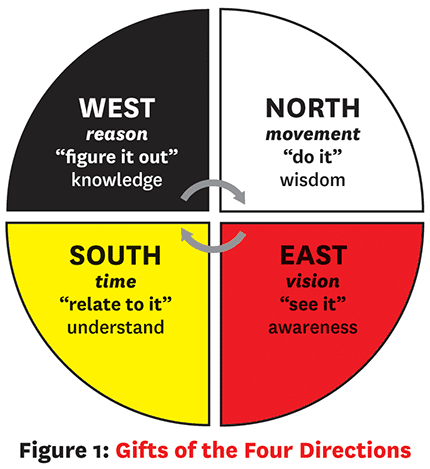
Moving into the “doing” phase of the north requires taking the knowledge gained from all the directions and enacting that knowledge. This form of praxis makes the balance achievable. Using Medicine Wheels as a tool for analysis in healing and learning demands the continuous and ongoing reflection of oneself in relation to others – thus balance must be maintained while embracing change. “The teaching and healing process is evolutionary and cyclical in nature, as is the continuum of medicine wheels. It begins with a desire to understand and identify with the balance, wholeness and interconnectedness expressed in the medicine wheel.”7
In order to create the movement required by the northern direction, one must re-visit the other directions to achieve a 360-degree vision.8 By going to the east where one visions to transform that which is, one can actively create a better life for oneself and others. Indigenous people can envision how they can be active in the “creation of oppositional analytical and cultural space.”9 Visioning allows them to engage in the hopeful utopian thinking necessary for radical transformation.10 Once a guiding vision is received or created, strategies can then be planned to help actualize it. Each person then has the responsibility to do the work required to fulfill the vision.11
Indigenous people are fighting to actualize their visions for change in the education of their children. A revolutionized world will not “come into existence in a linear way, as the result of a single-minded drive, but in a cyclic, circular way, working in all dimensions of a culture, moving from one position to another, not in reaction but in interaction with other forces.”12 Moving from linear models to the interconnectedness of the circle can guide the development of pedagogy and vision for the future.13
The transmission of Medicine Wheel teachings
Understanding Indigenous knowledge and worldview begins with Medicine Wheel teachings previously discussed: the gifts of the directions (vision, time, reason, movement), the actions of those gifts (see it, relate to it, figure it out, do it), and the learning process (awareness, understanding, knowledge, wisdom). Building from these understandings, Indigenous knowledge embraced by Medicine Wheels can be defined as wholeness, interrelationships, interconnections, and balance/respect. Wholeness requires that we look in entireties; that the whole is greater than the sum of its parts, yet the parts cannot be fully seen until the shape of the whole can be seen. Interrelationship requires that we establish a personal relationship with the “whole” – with all that surrounds us. In addition, we must establish a relationship with our whole being; this includes our spiritual, physical, mental, and emotional aspects. Interconnections create an environment which is mutually sustaining; where there is a transcending of logic and linear thought to reveal synthesis and dynamic interdependence. Balance and respect provide an order and structure to the whole and all its relationships and interconnections, while providing an appreciation for the “awe” of it all. (Figure 2)
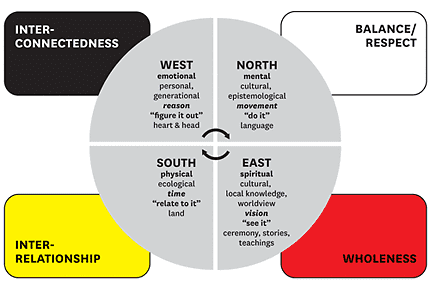
It is necessary to consider Indigenous knowledge as a collection of knowledges from different Indigenous nations. Indigenous knowledge is therefore culture specific, contained within the local knowledge and worldview of the nation. It therefore also has to be ecological, where the knowledge is contained within the land of the geographic location of the nation. Knowledge is also contained within the people of the nation. Indigenous knowledge then becomes personal and generational, as there is a process of generational transmission. Indigenous knowledge is epistemological, in that each nation culturally determines for itself how it knows what it knows.
While Indigenous worldview articulates that Indigenous people need to develop themselves, including their children, in a holistic way that addresses their spiritual, physical, emotional, and mental capacities, they need to address how to transmit learning through all of those personal aspects. The spiritual can be touched through ceremony, teachings, and stories. The physical can be transmitted through the land, while the emotional aspect can be developed through a balanced connection between the heart and the head. Mental capacities can be developed through ancestral languages and integrative learning.
Moving from linear models to the interconnectedness of the circle can guide the development of pedagogy and vision for the future.
Wisdom becomes the goal of any educational process including living – to say that we are truly knowledgeable as a person is to say that we not only “know” what is valued by a nation, but that we have lived our life in such a way that we have experienced what we know and can therefore be considered wise. Indigenous knowledge and worldview is attained by choosing to do what is necessary to obtain multiple perspectives from which to view the world. This in-depth searching for knowledge is what leads to wisdom. Wisdom is achieved by first becoming aware of the learning through all the senses, requiring the learning to be introduced to the students in multiple modalities. Understanding is achieved by providing students with enough time to solidify the learning so that they are able replicate the learning. A deeper understanding is achieved by students relating to the learning at a deeper level to become knowledgeable to the point that they are able to apply the learning in any situation. To say that the students have achieved wisdom requires that they are able to create some action with the learning and teach it to others.
Medicine Wheel pedagogy in practice
The Anishinaabe Bimaadiziwin Cultural Healing and Learning Program (operational from 2002-2006) was created to fulfill the cultural and academic needs of Anishinaabe children in the Burleigh Falls (Ont.) area. The program involved a synthesis of Anishinaabe worldview, spirituality and traditional education philosophy, incorporating these components into an Anishinaabe culture-based school program for Junior Kindergarten to Grade 12. The school was registered as a private school with the Ontario Ministry of Education and the curriculum was organized on a Medicine Wheel framework, where cultural teachings and traditional practices were addressed in the corresponding season on the Medicine Wheel.
A holistic educational experience was provided through a balanced emphasis on all personal aspects of the student. The spirit of the student was celebrated through daily ceremony such as a morning circle (similar to a sunrise ceremony), and the learning of traditional teachings and stories. The physical aspect of the student was actualized by interacting with the land through traditional practices such as maple syrup making, wild rice picking and fasting (a traditional ceremony of personal physical sacrifice to gain spiritual enlightenment). The emotional aspect of the student was addressed by an emphasis on healing and connecting the heart with the head through weekly healing circles, individual counselling, and following the seven sacred teachings (core values often referred to as the seven grandfather teachings). The mental aspect of the student was developed through the teaching and learning of the Anishinaabe language and integrative learning that blended Euro-Canadian and Anishinaabe knowledge, such as the study of earth and space systems in science and the Anishinaabe traditional worldview of all creation along with its teachings, stories, and songs.
The Anishinaabe learning process of awareness, understanding, knowledge, and wisdom as presented on the Medicine Wheel were actualized on an ongoing basis to ensure complete and deep learning occurred. An example of this included providing the students with the awareness of their culture by allowing them to experience it with all their senses (seeing it, tasting it, feeling/touching it, smelling it, hearing it) and then expecting them to show that they understood it by replicating it, such as being able to sing a traditional song. Knowledge of the learning was illustrated by the students in the school when they applied the learning in any situation, such as when a child made a connection between the concept of greed and a traditional Nanaboozhoo story. The ability to teach their culture to others and thus prove wisdom was achieved by becoming the teacher and sharing their culture with other children through workshops with Brownies or Cub Scouts groups.
While the above examples are specific to an Anishinaabe culture-based educational setting, the teachings of Medicine Wheels provide an educational framework that can be applied to any educational setting. The fundamental concepts of wholeness, inter-relationship, inter-connectedness and balance/respect are valuable for all.
Photo: courtesy Saskatchewan School Boards Association
First published in Education Canada, June 2014
Explore the latest edition of Education Canada, powered by voicEd Radio (March 2022)
EN BREF – Cet article explore les enseignements des roues de médecine selon la perspective culturelle anishinabe. L’accent est mis sur ses applications en éducation par le biais de la pédagogie et de la transmission des enseignements des roues de médecine. Ces concepts sont illustrés par un exemple pédagogique pratique de l’emploi de la roue de médicine dans le cadre du programme culturel de guérison et d’apprentissage des « Anishinabe-Bimaadiziwin », offert dans une école basée sur la culture anishinabe.
[1] The term “Medicine Wheel” was established when stone constructions in the shape of wheels were found on Medicine Mountain.
[2] J. Sanderson, The Cree Way: Traditional paths to learning (masters’ thesis, University of Saskatchewan, 1991), 51.
[3] J. Bopp, M. Bopp, L. Brown, and P. Lane, The Sacred Tree (Four Worlds Development Project, 1984), 9.
[4] S. Calliou, “Peacekeeping Actions At Home: A Medicine Wheel model for a peacekeeping pedagogy,” in First Nations Education in Canada (UBC Press, 1995), 51.
[5] K. Absolon, Building Health From the Medicine Wheel: Aboriginal program development. Paper presented at the meeting of the Native Physician’s Association (Winnipeg, Manitoba, March 1994).
[6] Absolon, Building Health From the Medicine Wheel, 18.
[7] F. J. Graveline, Circle Works: Transforming Eurocentric consciousness (Halifax, NS: Fernwood Publishing, 1998), 182.
[8] Dumont in S. Stigelbauer, The Individual is the Community; The Community is the World; Native Elders Talk About What Young People Need to Know. Paper presented at the meeting of the American Educational Research Association (San Francisco, CA, 1992).
[9] C. T. Mohanty, “On Race and Voice: Challenges for liberal education in the 1990’s,” in Between Borders: Pedagogy and the politics of cultural studies, eds. H. Giroux and P. McLaren (New York, NY: Routledge, 1994), 148.
[10] S. Benhabib, Situating the Self: Gender, community, and post-modernism in contemporary ethics (New York, NY: Routledge, 1992).
[11] G. Cajete, Look To The Mountain: An ecology of Indigenous education (Asheville, NC: Kivaki Press, 1994).
[12] French in K. Gould, “Feminist Principles and Minority Concerns: Contributions, problems, and solutions,” Affilia 2, no 3 (1987): 18.
[13] Graveline, Circle Works, 288.
-
Educating ourselves
Comments Off on Educating ourselvesI was a fresh graduate from the Native Studies department at Trent University, working part-time on my master’s degree, when Pauline Harper called from Wandering Spirit Survival School to say, “We’ve suddenly lost our admin assistant. Can you fill in?”
That job stretched to nearly two years, and I still count it as one of the most enriching experiences of my life. Wandering Spirit was what was then called a Native Way school, an alternative school within the Toronto School Board mandated to teach the students about Aboriginal (mostly Ojibwe, in our case) culture and worldview throughout the curriculum. We had about 45 students, K-8 in three classrooms. We began each day – all of us, all together – with a smudge and prayer in Ojibwe from our Elder, Mr. Solomon. There was a giant Medicine Wheel, painted by the kids, on the Grade 3-5 classroom wall and Ojibwe word labels displayed in the K-2 class. We hosted a monthly community feast that lasted all day. These visible details don’t begin to capture the deep differences that seep into the bones of a school when everything, from student discipline to the parent council, is filtered through the lens of Indigenous philosophies and cultural practices. I am deeply grateful for being welcomed into this world.
That’s why I was excited about planning this theme issue on Aboriginal Student Success. The topic is of critical importance; as Darren McKee notes (p. 11), education has been used as an extremely destructive colonial weapon, and the reverberations of that history continue into the present day. Yet education also has the potential to empower today’s Aboriginal students to create their own, better future. And while that education must be shaped and controlled by the First Nations themselves, part of what’s required, as some of our contributors point out, is to strengthen the teaching of Aboriginal history, issues and ways of knowing in all our schools. Educating ourselves is the place to begin.
I knew that finding outstanding Aboriginal scholars and practitioners, who could give us a sense both of the exciting work being done and of the complexity and varied viewpoints involved, would be key to a successful issue. And so I would like to send out a special thank you to our Consulting Editor Michelle Hogue, from the University of Lethbridge, who not only co-authored an article this issue but volunteered her time to advise and connect us with some of Canada’s leaders in Aboriginal education. K’chi meegwetch, Michelle!
Write to us!
We want to know what you think. Send your letters or article proposals to editor@cea-ace.ca, or post your comments about individual articles on the online version of Education Canada at: www.cea-ace.ca/educationcanada.
Photo: Dave Donald
First published in Education Canada, June 2014
-
Physical Activity in Kindergarten
Comments Off on Physical Activity in Kindergarten“In the past, it was assumed that children were naturally active on their own, but sadly, this is no longer the case.” – Myriam Benoit, BPHE.
Members of the Laurentian University Nutrition, physical activity, and Community Health (LUNCH) Research Group regularly engage in discussions related to the peripheral impacts that administrative change has on children’s health. Specifically, during educational reform, a key component to consider is the need for meaningful physical and health education; and not just in the gymnasium. One important example is school schedules. Schools have moved away from traditional schedules, which incorporated two recesses separated by a single lunch period. Today, many schools have adopted alternative schedules, the most prevalent of which is the “Balanced School Day,” which has two 40-minute nutrition/activity breaks, separated by three 100-minute teaching blocks. While modern schedules have their benefits, assessment prior to implementation seldom considers how the changes will impact children’s physical activity levels.
Most recently, implementation of the Early Learning Kindergarten (ELK) program has begun across Ontario. In this article, we discuss the impact of the ELK program on physical activity in Kindergarten-aged children and recommend ways to safeguard this important aspect of health and well-being.
The new ELK program has been developed on the premise that Kindergarten lays the foundation for future school experiences. According to former Ontario Minister of Education, Leona Dombrowsky,
“Full-day learning is part of our overall plan to help more children get a strong start in school, so they can go on to have successful, rewarding lives. By giving them more opportunities at a young age, we’re giving our children a brighter future.”[1]
Research has consistently shown that early success predicts long-term success and adjustment outcomes. We would like to extend this argument to include healthy lifestyles. Children who enjoy and participate in activities in kindergarten are likely to build upon this success in later years. We would also like to highlight that suitable physical activity can lay the foundation for academic success. Engagement in physical activity throughout the school day has been shown to improve student achievement and readiness to learn in addition to bettering classroom behaviour.
The ELK program will be fully implemented across Ontario in the 2014-15 school year. Several key changes have occurred with the implementation of this program, which have potentially positive and negative consequences with respect to student physical activity.
First, while Kindergarten class size will increase to a maximum of 30 students, they will be team-taught with both an Ontario Certified Teacher (OCT) and an Early Childhood Educator (ECE). We see this as being highly beneficial to maximizing individual needs, including health behaviour instruction. Second, children as young as three are now enrolled in school for the full day, and for the entire school week. This is a noteworthy change from previous generations that should facilitate children’s accommodation to the school setting and provide significant opportunity for developing healthy behaviours in the early years. Schools now have the opportunity to engage a large audience in active play and education from a very young age. Third, the curriculum has moved to an inquiry- and play-based approach. Students are given a leading role in their own learning, in an environment that is supportive of their self-regulation and development. We strongly support this type of learning and speculate that it will involve less desk-time and therefore enhance physical activity levels in the classroom.
In addition, some schools are also implementing a 60-minute Outdoor Exploration (OE) block, to use the outdoors as an extension of the classroom as the Ontario Curriculum suggests. We see this as an amazing opportunity for students to learn in a different environment, and also see potential for this time to be used as an opportunity for students to achieve an increased level of physical activity during the day.
However, we also note an important negative consequence of this schedule-change – specifically, the coinciding change in recess times. Before implementation of the 60-minute OE block, Kindergarten children went outdoors for free play during recess, which occurred twice a day in schools using the Balanced School Day schedule. However, with the implementation of the OE block, Kindergarten students remain in the school during these two blocks of time, extending their nutrition breaks. This gives the children more time to eat their lunches, addressing a concern that many parents have (i.e. that their children do not have enough time to eat). Research in our centre, however, has shown that this causes an overall decrease in the total amount of physical activity that the children engage in. From a time perspective, this seems surprising since 60 minutes outside is more time than the combined time for two recesses (40 minutes). However, there are two reasons why this does not result in increased activity. First, the instructional nature of this time may alter the degree of physical activity that the children engage in. Second, we know that during free time, children are most active in the first ten minutes. Therefore, frequent shorter breaks achieve more physical activity among students than fewer, longer breaks, as seen with this modified schedule.
Another significant factor is that individual school boards, rather than the Ministry of Education, decide how much time is allocated to Health and Physical Education instruction. Currently, Kindergarten children are excluded from the Daily Physical Activity Program mandated for other grades in Ontario. Therefore, the allocated time varies from school to school.
So how can schools adopt the ELK program while still creating a school environment that supports physical activity for our youngest learners?
We first need to consider the recommendations from the Canadian Society for Exercise Physiology for children’s physical activity.[2] In this document, young children between the ages of one and four are suggested to achieve a minimum of 180 minutes of physical activity at any level throughout the day, while children aged five to 11 should achieve at least 60 minutes of moderate-to-vigorous physical activity. Kindergarten students range from 3-5 years of age and therefore cross over into both of these categories. In this scenario, the benchmark more commonly used is that for the older children, i.e., 60 minutes of moderate-to–vigorous physical activity each day. Additional physical activity above these recommendations produces even greater health benefits for children.
Given that Active Healthy Kids Canada has rated Canadian children with a failing grade for physical activity levels for the last nine years, and less than half of all school-aged children are achieving daily activity recommendations, it’s important for schools to build physical activity into the curriculum right from the beginning.[3] When evaluating physical activity in the classroom, there are three target areas.
• First, recess time is important for children to have unstructured play. Play allows children to explore and interact socially with other students and learn from these experiences. As such, we recommend that all school children should enjoy two scheduled recess breaks.
• Second, we strongly support the adoption of the 60-minute OE block; however, we would urge instructors to ensure that physical activity is included as a component of this time. We note that resources, such as the Ontario Physical & Health Education Association, are readily available for schools to use and provide step-by-step instructions for a variety of games and activities for this age group.
Third, Physical Education (gym) classes are another important component of the elementary school curriculum, and we stress the importance of a structured program, delivered daily, for Kindergarten children. While the Ministry of Education has mandated 20 minutes of Daily Physical Activity (DPA) for grades 1 to 8 during classroom time, no recommendations have been made regarding DPA for Kindergarten classes, and the number of Physical Education classes expected per week is not explicitly stated.
We strongly recommend that these important elements be added to the Ministry of Education’s agenda. Likewise, teachers must ensure that a structured approach to physical activity is taken to maximize the benefits for children during this scheduled time. Schools need to have adequate infrastructure to support daily physical education and every school should have at least one Physical Education Specialist. To date, the many capabilities of these specialists are largely under-utilized and overlooked and we would urge all schools to examine their capacity in this area.
We are very excited about the direction the Ontario Ministry of Education has taken in developing this forward-thinking curriculum for the Kindergarten cohort. However, currently lacking are specific development plans to address best practice for physical activity during the school day. We believe the recommendations put forward in this article will promote future success.
Photo: McIninch (iStock)
First published in Education Canada, June 2014
EN BREF – L’activité physique est une importante partie d’une vie saine. L’intégration d’un mode de vie actif à un jeune âge jette les bases de la pratique d’activités plus tard dans la vie. Dans cet article, nous suggérons aux gestionnaires et éducateurs d’écoles primaires des « pratiques exemplaires » à mettre en œuvre pour que soient respectées les lignes directrices recommandées en matière d’activité physique. Nous proposons également l’élaboration de politiques en fonction de ces lignes directrices pour les élèves du nouveau programme d’apprentissage de la maternelle et du jardin d’enfants en Ontario.
[1] Leona Dombrowsky, Ontario Minister of Education, in The Full-day Early Learning Kindergarten Program (2010-11), 5. www.edu.gov.on.ca/eng/curriculum/elementary/kindergarten_english_june3.pdf
[2] Canadian Society for Exercise Physiology (CSEP), Canadian Physical Activity Guidelines. www.csep.ca/english/view.asp?x=804#
[3] Active Healthy Kids Canada, Report Card on Physical Activity for Children and Youth (2013). www.activehealthykids.ca/ReportCard/ReportCardOverview.aspx
-
When will Will become a won’t?
Comments Off on When will Will become a won’t?The following three paragraphs, I would like to point out, were not written by me.
“… I’m not saying that teaching isn’t something to aspire to, but …, I think it is a backup plan for many. Perhaps it was something to aspire to at one time, but now the profession seems to be saturated with mediocrity. There are very few people who would choose to teach if they had superior (or even above average) abilities in their chosen discipline or specialty… And why would someone settle with being a grade school teacher if they had the abilities for something greater…?
I have come to the conclusion that “[teachers] are often individuals who couldn’t make it in the real world, so they got a B.Ed.” through my own personal experiences in grade school, and even more so by looking back on them. I know teachers and people that are currently becoming teachers… They aren’t people who were top in their class, and many of them took a mindless BA for an undergrad… There are also a few professionals I know who were formerly teachers, and they often mention that teaching was the cushiest and least demanding job they have ever had.
When you work in an artificial market, a sheltered world, you become accustomed to it. What might seem like a large amount of work to a teacher would probably seem quite insignificant to [a] business professional. Grading 30 tests or marking 30 assignments? I was a grader in grad school, and it’s not that tough of a job… Don’t even try to talk about the difficulties and struggles of being a teacher when many other [people] work harder and longer for similar or less pay.”
No, those words are not mine. They were part of a longer comment I was sent recently by a business analyst who calls himself Will.
Now, I have never met Will, but I’ve certainly heard him before. Wherever there is an educational issue being brought forward, for better or worse, Will is there, usually dominating the online comment section of articles or, occasionally, writing an article himself. Sometimes his name is Paul. Sometimes his name is Bill. Sometimes he even goes by Margaret. Sometimes he appears in The Chronicle Herald, sometimes in The Globe and Mail, and sometimes in The Vancouver Sun. But regardless of the size of the paper, size of the reading audience, or region of the country, Will is there.
And let me tell you, Will knows a thing or two about education.
For example, Will knows that only “those who can’t do, teach”. Why else would anyone who had any sort of ability in another area, such as business (or perhaps, writing) not aspire to those particular professions? Obviously, it is the inability to “do” that causes the “teach”. Why, would someone settle for working in a grade school if they could achieve more?
Will also knows all about the system because he actually went to school. He remembers all those grade school teachers he had that were sub par. He went to University to study business, so knows a bit about “mindless BA’s” as well. I mean, philosophy and religion are good to know, sure, but who is going to hire someone with a degree in English? Really, what choice did those poor folks have besides teaching?
Finally, let’s not forget that Will understands the teachers’ artificial market, where the task marking 30 assignments seems daunting because it is a sheltered world. Such a task would seem minor to someone in the corporate world, especially when that someone, like Will, knows what it means to mark papers.
Will is certainly not unique in his opinions, and the voice he represents seems to have become a bit of a national phenomenon. It has been ringing loud and clear across this country for a few years now, and has been leading the charge to discredit teachers and undermine the profession. It has been chiming in on Tim Hudak’s plan to cut teaching jobs in Ontario, and has been particularly critical of recent job action by teachers in BC. These days, it seems there is a certain sector of the Canadian public that has, to use a local colloquialism, “an awful hate on” for teachers.
It is this small sector, this vocal minority, that is at the heart of so much of what is so plaguing education today. It seems that, lately, more media outlets, more policy makers, and more politicians are listening to the babble of outlandish and endlessly perpetuated myths coming from the Wills of the world than are actually listening to educators about flaws in the system.
And that should have everyone concerned.
You see, folks like Will have a hard time realizing some core truths about education in general. For one thing, their own experiences in school do not make them in any way qualified to pass judgment on the profession. When Will was in high school, he was probably, like many of us, a long way from being a particularly good judge of anything. To think that perceptions formed about education as a grade schooler are a valid basis for criticizing the system as an adult makes one wonder if Will is still sporting acid washed jeans and a mullet.
Will also fails to realize that for many of us, teaching is not a job, but a passion. Why else, indeed, would anyone decide to be a grade school teacher, considering the amount of public ridicule the profession is currently enduring? Not all of us had the same reasons for getting into teaching, granted, but very few remain because we couldn’t do anything else. Most remain, I believe, because we simply wouldn’t do anything else.But it is in his final paragraph, where he states that my market is artificial and that he understand the job because he has graded papers, where Will truly misses the mark. As a teacher, I don’t actually grade papers; I assess students. I assess them to help them learn and grow as individuals, to help them broaden their minds and to help them to think critically, much as I was helped to think critically while taking my own “mindless BA”.
I do this in a market where my customers are sometimes coming to me hungry, unable to even comprehend the idea of a hot breakfast each morning. I do this in a market where my customers are sometimes coming to me angry, unable to see that I am not the one who is hurting them. And I do this in a market where my customers are sometimes coming to me out of desperation, because in their world of drugs and suicide and depression and bullying and violence, I am the one adult they trust.
I can assure you, there is nothing artificial about that.
At the end of the day, I don’t really care what Will thinks of teachers. Even if I were to write a million words, I could not change his mind. But if I were to propose what I think is “wrong” with education, it would be that when I do get home at the end of the day, after dealing with the hunger and the anger and the bullying and the violence, as well as the joy and the fun and the learning and the excitement, I can not open a paper, or turn on the radio, or watch the news, without having to endure yet another bout of Willisms.
I also have to deal with the fear that somewhere there is a politician absorbing those same words as gospel who may very well make a decision based on them. A decision that is likely to make my job tougher, and take more of my energy away from the kids.
All in the name of placating Will.
We should never be satisfied with our education system in this country, should never stop looking for better ways of teaching, should never stop asking the tough questions. But the questions need to be framed by those who actually understand the system, not those who simply believe that they do.
Better education will result when we realize, as a nation, that those who can teach, should teach.And I hope to eventually see the day when all those critics who currently “Will”, simply won’t anymore.
-
Once Upon a Time: What’s Standing in the Way of Change in Education?
Comments Off on Once Upon a Time: What’s Standing in the Way of Change in Education?This content has been re-posted from https://storify.com/
For more information and to get involved in CEA’s ongoing What’s standing in the way of change in education? national conversation, please visit http://standingintheway.ca and follow @cea_ace and #CanEdChange on Twitter.
-
What’s Standing in the Way of Change? It Better not be Culture.
Comments Off on What’s Standing in the Way of Change? It Better not be Culture.This content has been reposted from Scott Slater’s personal blog at http://scottslater.org/2014/05/17/culture-of-change/ and does not necessarily represent the opinions of his employer.
The CEA’s What’s Standing in the Way of Change in Education workshop series across Canada brings together a variety of stakeholders and innovators including students, parents, university deans, teachers, trustees, K-12 and university administrators, superintendents, and Ministry of Education administrators, and tasks them with determining what is standing in the way of change in education, and how to work around or eliminate the barriers.
In the Vancouver session, which I had the privilege of attending on Wednesday May 14th, it seemed most participants agreed on three challenges in particular. Below, I share what I took from these discussions.
1. Mindset
Those who are in positions that can implement change may not have the mindset to do so. They may be married to what they currently do, either to maintain tradition, to please parents who might resist change, out of fear of the unknown of might lay ahead, or fear that adopting new practice will make “old” practice and the practitioner look bad. The idea of “best practice” is not helpful. It suggests that there is one best way of doing things and switching the term “best practice” to “effective practice,” is perhaps a small but important step in inviting change. Bruce Beairsto noted this Mindset is not so much a barrier or roadblock in the present or future, but an anchor dug into the past that slows or halts change.
2. Process
The BC Education Plan articulates many important goals for education: personalized learning, flexibility and choice, learning supported by digital access, etc. Even if the goals of change were understood to mean the same thing and agreed upon by all 40 000 teachers in BC, as well as administrators, School Board Office staff and Trustees, there is no clear process to implement change, and the process might look different depending on what form of change it is. One of the strengths of education in BC is that teachers, schools, and districts, have a high degree of autonomy to personalize and contextualize learning experiences to best meet the needs of unique students and communities; needs that might be different elsewhere. Interestingly, this strength is a weakness in implementing change rapidly. This decentralized system is thus designed to satisfy context-specific needs, but also makes implementing systematic change difficult.
Further, innovators have relatively small spheres of influence. An innovative teacher in a classroom has a huge impact on the many students they teach, and a district with a culture of innovation has a major impact both on students and educators, but classrooms, schools, school districts, and even universities, are relatively small spheres compared with the system as a whole. For systemic change, who is to bridge these spheres? The Ministry of Education’s Education Plan makes no connections, that I am aware of at least, between K-12 education and university, and coordination, particularly with respect to changing assessment practices, must occur between grades 11 and 12 and university entrance requirements. There is a separate ministry, the Ministry of Advanced Education, responsible for Universities. Who is responsible for bridging the gap between K-12 and University?
While there are great benefits to a decentralized, diffusion model of change (described by Chris Kennedy here), it does not promote the quick implementation of systematic change. In my opinion, it is better to do things well than do things quickly, so if speed is the cost for well-implemented, personalized and contextual change, perhaps it is worth it.
Peter Drucker noted that “Culture eats strategy for breakfast,” and Jordan Tinney has written on this topic in relation to the hit television show Downton Abbey, explaining culture’s inescapable role causing change. The show shares the change of the place of the aristocracy in the UK, including how an aristocratic family interacts with each other and with servants and other “commoners.” There are some major events like World War One that accelerate change, but for the most part, change happens in small decisions: a daughter’s decision to wear certain clothing or disagree with her father, a butler’s tolerance of certain behaviour, a decision to marry a commoner, and for the family to slowly accept that commoner into their circles. Occasionally, important laws such as female suffrage cause major changes, but it is for the most part, small decisions happening among relatively small actors that slowly shift and are then shifted by culture. In a decentralized system, culture, more than process, shapes change.
3. Support
A third inhibitor of change is that many believe there is not sufficient support for educators to develop their skillsets, perhaps in inquiry, assessment, and self-regulation. This support might include time for professional learning, support from collaborators or mentors/coaches, or learning resources such as books or technology tools that support professional learning or student learning. Further, if class composition is becoming more challenging, even if an educator hones their skillset, there is, or might be the perception, that educators cannot make full use of their skillsets because they simply do not have enough time to offer their skills to such diverse learning needs. If educators do not feel supported, financially and with sufficient human resources to meet the needs of learners, this third inhibitor of change – Support – can lead to the development of a mindset resistant to change.
Culture
It seems clear to me that if mindsets, process and support are identified as challenges to change, it is absolutely vital that classrooms, schools, districts and the Ministry of Education in general, must support a culture of innovation, written about by Chris Kennedyhere. Culture shapes mindsets, it permeates all spheres of influence, and it inspires educators to overcome limitations of support. In a Downton Abbey model of change, which we seem to have, all innovators with influence must develop their convictions and take action if they wish to be leaders. And as this work cannot be done alone; educators must work together to develop shared convictions and take shared action to implement change.
For more information and to get involved in CEA’s ongoing What’s standing in the way of change in education? national conversation, please visit http://standingintheway.ca and follow @cea_ace and #CanEdChange on Twitter.
-
What Can Teachers Do for students who Have More specific Anxiety Needs?
Comments Off on What Can Teachers Do for students who Have More specific Anxiety Needs?Some students excel and thrive on challenges related to performance, evaluation and social interaction. Others experience distress under such conditions. Students who experience significant stress at school are at risk of developing anxiety related symptoms.
-
What does Education have to do with the Mental Health of Children and Youth?
Comments Off on What does Education have to do with the Mental Health of Children and Youth?There is a clear and well-researched relationship between student mental health problems and academic difficulties. When students are preoccupied with emotional concerns they cannot participate fully in learning. Also, students who are experiencing academic challenges due to learning disabilities, intellectual disabilities, or other learning challenges can develop mental health problems, such as anxiety or depression. These concerns also interfere with social relationships and contribute to feelings of low self-worth, anger, worry and confusion. Since mental health problems are often difficult to treat, the earlier the intervention, the better the trajectory for a student vulnerable to mental illness.
Fortunately, there is now a significant body of research that shows there are programs and practices that can be used to support children and youth at risk. These programs can keep students from falling into a negative spiral by bolstering social, academic, or emotional skills, changing negative thought patterns, and nurturing a sense of well-being. As well, psychosocial treatments, like cognitive-behaviour therapy and parent training, have been proven to be effective in helping students with anxiety, depressed mood, and behaviour problems. The use of medication has also been shown to be helpful for some children and youth struggling with particular mental health problems. Even when difficulties are long-standing, there are ways to help students and families to effectively manage the disorder, just as you might with other chronic health conditions.
Since mental health problems are often difficult to treat, the earlier the intervention, the better the trajectory for a student vulnerable to mental illness.
Unfortunately, very few children and youth who struggle with mental health problems will access the help they need. There are currently several barriers to getting help:
- Often the stigma associated with acknowledging emotional problems prevents many people from accessing services.
- Caring adults and peers may be in a position to help, but they often feel ill-equipped to identify problems and to know where to find professional assistance.
- Finally, even when problems are voiced and/ or identified, in some communities there are not enough services to meet the demand.
Since every child is required to attend school, these issues with access make schools an important place to support students with mental health concerns. Indeed, schools are an optimal setting:
- to reduce stigma;
- to promote positive mental health;
- to build student social-emotional learning skills;
- to prevent the development of mental health problems in high risk groups;
- to identify students in need, and to support them in accessing community services.
It is very important that teachers and support staff understand that they are not expected to become counsellors or therapists nor are school boards expected to do the work of community mental health organizations. Rather, what is important is that education has a role to play in a full system of care. This role involves creating caring schools and classrooms, building social emotional learning skills, and helping to identify students in need of early intervention.
Adapted from: Leading Mentally Healthy Schools: A Resource for School Administrators (School Mental Health – ASSIST, 2013)
This blog post is part of CEA’s focus on student mental health, which is also connected to Education Canada Magazine’s student mental health theme issue and a Facts on Education fact sheet on what the research says about effective approaches to improving students’ mental well-being. Please contact info@cea-ace.ca if you would like to contribute a blog post to this series.
-
Creating an Ethos of Care in our Secondary Schools
Comments Off on Creating an Ethos of Care in our Secondary SchoolsRelationships, relationships, relationships! It sounds cliché but in fact this is the heart of the matter. Every student has a story and the story is crucial to his or her sense of well-being. It seems easier, more manageable to know the “stories” of our students in the earlier grades. One teacher and one group of classmates equal a family. Where we seem to have more difficulty navigating the storyline is in our secondary schools. Students have many teachers, many sets of classmates, changes throughout the year and from year to year.
Our school is the hub of the community. It is a safe place for students to reveal their story. There are professionals who care. Our teachers want to make a positive difference in the lives of students. However, teachers cannot do this work in isolation. It is crucial to develop practical systems that support their work. They want to impact society and prepare the minds of the future. Where the tension exists is when dealing with matters of the heart, the emotions? This was previously the responsibility of the parents. These were discussions that lived privately within the confines of the family. This has evolved and these conversations are presenting in our schools.
How do we foster an ethos of care in our school that extends beyond the confines of academics? As a school community we have been compelled to answer some hard and challenging questions. How we effectively equip our teachers to deal with students who are struggling? Do we know the true reasons why students are not succeeding? Is it intellect, effort, a lack of support or is it our systems and school culture that need transforming? Do we believe that all students deserve to experience success? How do we define success for our students? Are we just committed to preparing students for the future, for their “real life”? Can we agree that their real life is right now and are we able to assist our students in building their own positive futures? Are we willing to listen to the “stories” of our students and respond appropriately?
Where the tension exists is when dealing with matters of the heart, the emotions? This was previously the responsibility of the parents. These were discussions that lived privately within the confines of the family. This has evolved and these conversations are presenting in our schools.
These challenging questions are at the heart of many robust conversations amongst our staff. The discussions take time and do not happen overnight. There are implications for scheduling, teacher assignments, and the allocation of resources. Most importantly, what success indicators we will accept that we are moving in the right direction as a school and how we will celebrate the successes.
We agree that the most vulnerable times for students are when they experience transition. We have decided to get to know our students prior to them arriving at our door. We begin to work with our feeder schools as early as possible. We identify students who might be experiencing difficulties in their school and family lives. We put our energy into transitioning all students and do not just make room for the “good” ones.
We endeavor to ensure that there is one adult who knows the story of every child in our school community. Each teacher chooses a student to put some extra energy into, to find out his or her story. Teachers agree to document what works and even more importantly what fails. They agree to share this information with their colleagues on a consistent basis.
We have established a Mental Health program in our school. We have 4 youth support workers who act as mentors to students with mental health challenges. We discovered we were losing Grade 10s in their first semester of high school. We have our youth workers spend time in our feeder schools getting to know the Grade 9s. Their purpose is to build relationships and begin the conversations about successfully transitioning to high school.
We invite all of our Grade 9 students who present as having challenges to join us in summer programming prior to their Grade 10 year. We offer two courses that are required for a high school diploma. We staff these courses with “rock star” teachers. These students earn credits for two courses, they get to know us with a smaller student body, they become familiar with the school and our culture of high expectations and they don’t spend the summer worrying about the transition.
We want to debunk the myth that students will be “on their own” once they get to high school. We have built support systems for our teachers and their charges. Getting to know the stories of our students is the only way to begin to deal with the “health” of our school!
This blog post is part of CEA’s focus on student mental health, which is also connected to Education Canada Magazine’s student mental health theme issue and a Facts on Education fact sheet on what the research says about effective approaches to improving students’ mental well-being. Please contact info@cea-ace.ca if you would like to contribute a blog post to this series.
-
Creating More Mentally Healthy Schools
Comments Off on Creating More Mentally Healthy SchoolsThere seems to be a recent shift in the way educational institutions approach mental health. It’s an exciting time for me and the program I work for, and for all educators who just want to do their job better. It is also long overdue for families and students who are living with mental health issues. Here in Ontario, where I live and have worked as a teacher, I’m seeing giant steps in the right direction at the Ministry and Board of Education level. Hopefully this shift in approaching mental health and wellness will empower administrators, teachers and support staff to create more mentally healthy schools and ultimately improve the lives of students and their families.
It should be noted that this kind of top-down systems change is not the only exciting thing happening in student mental health. Young people can be a powerful force to initiate systems change and resource creation as well. Since its foundation in 2005, the program I work for, mindyourmind, has partnered with youth and young adults to co-create mostly web-based tools and resources around the topic of mental health. These resources are accessed by people in 195 countries, through millions of online interactions via www.mindyourmind.ca and mindyourmind’s other web platforms and social media accounts.
Hopefully this shift in approaching mental health and wellness will empower administrators, teachers and support staff to create more mentally healthy schools and ultimately improve the lives of students and their families.
As mindyourmind’s program progressed over the years, we realized that our site had become a kind of public utility – teachers and other youth-serving professionals were using our tools with their students and clients to facilitate and engage in discussions about mental health. As teachers continue to see students in need, and mental health is becomes a focus for more and more school boards across Canada, we have seen an increase in requests for resources and presentations. This may be indicative of the fact that educators want to address the topic of mental health, but may not feel like they have the time or the expertise to do so effectively.
In 2008, the Thames Valley District School Board (TVDSB) in Southwestern Ontario approached mindyourmind to develop resources for Grade 11 Physical Health Education, and Grade 9/10 Guidance and Learning Strategies. Through this collaboration, the outlines of the “Minding Your Mind” lessons were created. The lessons are digital modules which are housed online. They feature mindyourmind videos, games and interactives, are designed to meet Ministry expectations and the unique needs of the TVDSB’s populations. A teacher’s guide is included in the lessons, which offers class discussion primers and activity extension suggestions. The lessons can be self-directed by the student in a computer lab, each student clicking through and completing at their own pace, or be taught through a more facilitated approach by the teachers.
The lessons were later evaluated as part of The Mental Health Commission of Canada’s Opening Minds study, measuring the impact of different types of programs and their effect on stigma reduction. The changes in stigma and the increased social tolerance in student responses as a result of the Minding Your Mind lessons showed that this digital lesson approach was effective.
It was so encouraging to see actual research support what mindyourmind already felt about the work that we are doing: Creating resources with young people works. Our tools do a great job of presenting information effectively and in a way that is relevant to youth, and can help teachers address what can be a tricky topic for some in a positive way.
How do we insert mental health info into a Civics class, or a Writer’s Craft class, without disrupting what the teacher needs to get done in an already saturated course workload?
My role here at mindyourmind is to develop more resources that will help teachers bring conversations about mental health into their classrooms, even in subjects that wouldn’t normally directly address mental health. I’ve heard some compare this task to “hiding the vegetables”. How do we insert mental health info into a Civics class, or a Writer’s Craft class, without disrupting what the teacher needs to get done in an already saturated course workload? We have a few projects on the go, including a resource for dance educators, which is being piloted this spring. It’s exciting work!
If you are a teacher, how do you support conversations about mental health in your classroom? How might you address mental health while teaching a course that doesn’t explicitly ask you to in the curriculum?
This blog post is part of CEA’s focus on student mental health, which is also connected to Education Canada Magazine’s student mental health theme issue and a Facts on Education fact sheet on what the research says about effective approaches to improving students’ mental well-being. Please contact info@cea-ace.ca if you would like to contribute a blog post to this series.


IDEAS TO SUPPORT EDUCATORS : Subscribe to the EdCan e-Newsletter
Quality research, reports, and professional learning opportunities.