


This blog post is part of CEA’s focus on the state of Teacher PD in Canada, which is also connected to Education Canada Magazine’s Teachers as Learners theme issue and The Facts on Education fact sheet, What is Effective Teacher Professional Development? Please contact info@cea-ace.ca if you would like to contribute a blog post to this series.
Archive
-
2015-2016 School Calendar
Comments Off on 2015-2016 School CalendarThe School Calendar provides all opening and closing dates, statutory holidays, PA/PD days and spring breaks for mid to large school boards across Canada. This free resource, compiled annually, is an essential tool for conference, event and vacation planners. The School Calendar is published in late August.
-
Leaving School
Comments Off on Leaving SchoolReading through the blog contributions that accompany the CEA’s latest theme issue, Towards Fewer Dropouts, is a little like holding a diamond up to the light. The diverse perspectives presented here over the past few weeks have helped us to see that the challenges and opportunities that exist, as we pay closer attention to the students who choose to leave our public schools prior to graduation, are quite complex.
-
“Homeschool It Is”
Comments Off on “Homeschool It Is”The sun is low in Calgary and winter has set in. Despite frigid temperatures and snow-piled streets, the school buses are running. My eight-year-old daughter is rushing around trying to find the “right” pair of pants to wear. She needs to get dressed quickly and to be out at the bus stop before 8:35 a.m.
Rubbing her eyes, Mara takes a deep breath to calm herself down. She didn’t get enough sleep last night – again. Mara has always had trouble sleeping. These days, she can’t sleep without the television on and sometimes it takes too long to drift off. She feels lonely without the comfort and stimulation of the television to help her through the night, when it’s dark and the air is deathly quiet.
Never happy with her clothes, Mara is continually distressed with the feeling of all but her most comfortable favourites. She wants to wear the same pair of shorts all winter; too short for the season, but just the right fit and feel for her. Although we are hesitant to define her as abnormal and have not yet confirmed the label for Mara’s concerns, sensory issues and emotional sensitivity have made it difficult for us to get Mara to school on time, willingly. After discussing and exhausting all of the options with two different elementary schools, we have – reluctantly and at the same time enthusiastically – decided to exercise the homeschooling option.
“Mara is her own person, with her own mind,” we say, reinforcing ourselves. The truth is, the options are not available to us within the traditional educational system to meet Mara’s individual needs and wants. I would love to be working on my work instead of teaching her, but at the same time I want to do the best for my daughter and make her life as happy as possible. We are motivated to resolve the troubling distress Mara experienced at school, and in order to accomplish both work and learning, I have undertaken to provide education to my Grade 3 student, while focusing on my writing in the evenings and on weekends. It isn’t perfect, but we get to spend time with each other, no longer distanced by the two kilometres to the neighbourhood school.
Mara’s brother George, on the other hand, is asking to start school now. George is a different child than Mara. He is happy with structure and less bothered by his sensations. The next few years are going to be an experiment with George. He will see his sister learning at home, but he may crave the company of others and enjoy the routine of the day-to day in a typical elementary school. Not wanting to apply a template to George, we as parents need to give him his own chance with elementary school. Ultimately, we will support what he chooses for himself and what is best for him.
Given our experience, if someone were to ask what we would want as a family from the educational system for our children, I would say flexibility and funding. We need the flexibility to participate when we can without being hampered by the threat of legal measures to enforce attendance. On the other hand, funding for tutoring would help us at the homeschool to bridge the financial hardship that comes with meeting educational expectations when we can’t meet regular attendance requirements, despite our best efforts.
Like all parents, we want the best for our children. Our approach with Mara is based on this, so “homeschool it is” for us, and that’s the way it’s going to be.
We will wait for an education system that can better adapt to the individual needs of students and that offers students more choices and opportunities for independence – and maybe by high school we can find a happy medium for Mara in the school system.
Perhaps someday the school system will become more accepting and supportive of parents who need the flexibility to fulfill their parental roles, while attempting to meet their family’s needs as a whole. We can work together when parents, students and teachers are all included in developing and encouraging student achievement and growth, and families are recognized as central to academic success.
Photo: Scott Dunlop (istock)
First published in Education Canada, May 2015
-
Propelling a New Education Paradigm Forward to Reduce Dropouts
Comments Off on Propelling a New Education Paradigm Forward to Reduce DropoutsResearch demonstrates particular risk factors that impact a student’s decision to stay in school. These include, but are not limited to: academic failure, low socio-economic status and behavioural problems[i]. Other risk factors can include: family organizational problems, little emotional support from parents[ii], and the increasing disengagement among students at school. The harsh reality is that, for many students, staying in school and success in school means having to suppress personal identities to act within the traditional school paradigms of what a ‘good’ student looks like[iii].
The most significant education paradigms are those that include building strong relationships – beginning in early elementary school – to prevent future dropouts. The earlier that new education paradigms can emerge to support ‘at-risk’ students, the better the prognosis for their graduation. Strong relationship are those that foster student voice, involve students in real decisions, and create equitable power distributions. Strong schools also provide inclusive cultures, authentic assessments, curricula related to students’ lives, and are respectful of learning as a social process with the relationships being the major priorities[iv]. But first, we must recognize our traditional views about what school is, before we can map out new education paradigms to support at-risk students.
We know that the foundations of 19th-century schooling are based on standardized tests, textbooks, classroom management and organization strategies, and mandatory curriculum outcomes. Canada’s modern school systems are still based on the same hierarchical philosophies espoused by Egerton Ryerson[v] where schools are organized with the principal at the top, teachers in the middle, and students at the bottom. We’re also still using common school texts as advocated for by Ryerson himself. We reward behavioural outcomes with grades and other forms of reinforcing compliance from our students – embedded beliefs that we need to maintain group compliance for efficient organization, drill, memorization and standardized tests. However, in following this paradigm, we do a great disservice to those students who are at-risk. We inadvertently send strong messages that if you do not comply: “you will be a failure”, or that “you are a failure”. Attention is given to prescribed units of study learned in isolation of subject areas that are discrete and separate from each other, and in groups of same-aged peers. Families and communities are rarely included, and fixed mindsets are the norm where it is difficult if not impossible to move from your ‘rank’ in school i.e., who is at the top, who is in the middle and who is at the bottom. As a result, students who are at risk are left with little leeway for success in terms of the traditional school paradigm.
By contrast, if we focus on new paradigms of education that incorporate key strategies including relationship building, then I believe that students have a greater chance of graduating. Key strategies can include a deeper focus on student voice, inclusion, authentic learning and assessment, and involvement of knowledge from families and communities. We need to enable ourselves to step away from the limits of traditional schooling to focus on educating under the assumption that each child is individual, valued, and whole, with special needs to be met. Within this new paradigm, there would be great flexibility in terms of time, space and what is learned. Students would work on their own collaborative inquiries; those that need open-ended tasks would have access while others would receive more closed tasks. Education wouldn’t be limited to the school day, and it could also capitalize on after-hours aspects with parents and families. It is of course a complex problem with complex solutions. However, I think that this warrants increased attention to target specific variables beginning in early elementary school.
Another factor that needs to be addressed is that at-risk students do not see themselves reflected in their teachers. It may behoove us to consider alternate methods of choosing the teachers in our system, to include counsellors, family and community members, and to ensure a wider demographic of teachers who have lived experiences of at-risk students and can be positive models of instruction.
Schools are gradually aligning with the principles of the Education Paradigm that embody Community, Culture, Caring, and Character Education. Yet, they systematically remain unchanged, with continued vested interests in standardized testing results, separate subject areas and isolated units of study, funding for specific diagnoses and labels instead of the whole child, fixed schedules, grades and disciplinary tactics that propel the traditional School Paradigm forward. However, to promote a school system with fewer dropouts, education paradigms need to evolve to emphasize relationships and recognize traditional and contemporary contributions of individuals, families and communities from all walks of life.
[i] Suhyun, S. J. (2007). Risk Factors and Levels of Risk for High School Dropouts. Professional School Counseling , 10 (3), 297-306.
[ii] Fortin, L. M. (2006). Typology of students at risk of dropping out of school: Description by personal, family and school factors. European Journal of Psychology of Education , XXI (4), 363-383.
[iii] Smyth, J. (2006). ‘When students have power’: student engagement, student voice, and the possibilities for school reform around ‘dropping out’ of school. International Journal of Leadership in Education , 9 (4), 285-298.
[iv] Ibid.
[v] Egerton Ryerson. (2015). Retrieved from Wikipedia: http://en.wikipedia.org/wiki/Egerton_Ryerson
This blog post is connected to Education Canada Magazine’s Towards Fewer Dropouts theme issue and The Facts on Education fact sheet, How Can We Prevent High School Dropouts? Please contact info@cea-ace.ca if you would like to contribute a blog post to this series.
-
Going Beyond Caring to Mentorship
Comments Off on Going Beyond Caring to MentorshipOver the course of the past twenty years that I have worked with at-risk students, I have heard countless times from colleagues and professionals in the field that “it’s all about relationships”. This advice is usually passed on as requisite insight that everyone who works with at-risk youth either understands or will come to understand as a truism. I agree that it’s all about relationships, yet what does this actually tell you? How does it help? Does your relationship or empathy lead to students’ resilience?
(more…) -
Dropout Prevention: Finding a Compelling Answer to “Why stay in?”
Comments Off on Dropout Prevention: Finding a Compelling Answer to “Why stay in?”Dropping out is typically triggered by innumerable events, choices and experiences over years, so there is no magic remedy. Nonetheless, supportive adult relationships and a compelling answer to the question “Why stay in?” are key.
I have dedicated my professional life to developing programs to help educators help students plan their learning and career journeys. I believe the ultimate goal of education is to prepare students for successful lives beyond school. While adult life is much more than work, most of us spend more time on the job than anything other than sleeping for most of our lives. As adults, we know our career choices profoundly impact every aspect of our lives. Yet, we graduate students unprepared to make employment choices.
Roughly 1 in 2 young people, from dropouts to those with degrees, fail to “launch” smoothly from school to work. Many begin their careers in low wage jobs unrelated to their studies and interests, unsure how, or if, they will ever land a “good” job. “Many young people find out who they are and where they belong by bouncing off things (experiences) for several years until they eventually commit or settle.” [1] Their prospects for early student loan repayment (average $30,000), buying a car, home, and building a life and family may seem bleak to them, and to their parents.
Given the exodus of high-end “boomer” talent already underway, ensuring young people launch successfully from school to good jobs is critical. Today’s school leavers will carry the primary burden of taxation for the next 40 years. We all need them to be successful. Young people in good jobs are happier, healthier, and more productive, they pay higher taxes, and they contribute more to their families and communities. Those that lose their early adult years drifting between underemployment and unemployment may never recover lost ground. Rather than contributing to prosperity for all, they diminish it for all. From every perspective, dropouts and failed launches are simply too costly in human and economic terms to tolerate.
Young people are in school from Kindergarten until they enter the workforce. Preparing them to make good choices as they enter and navigate the complex, constantly changing maze that is today’s labour market isn’t in the curriculum. Most educators feel unprepared and unequipped to help students prepare for the working world. So, whose job is it?
To answer this question, I helped organize Thoughtexchanges[2] at the Harvard Graduate School of Education’s Pathways to Prosperity Conference in March, 2013, the National Career Development Conference in July, 2013 and The Association of Career and Technical Educators’ CareerTech Vision 2013. Over 500 eminent education, government, business, community and career leaders reflected for two weeks – one month prior to each conference – then submitted their ideas. They then had two weeks to read others’ responses and vote for the ideas they considered best of all. The results were shared at the conferences.
Of the hundreds of ideas generated, the following rose to the top:
- Educators and employers must collaborate to provide real-world, work- and project-based learning (learning by doing) opportunities for students.
- Career and labour market information and guidance provision must be enhanced so students can make informed decisions based on their interests and their employment prospects.
- All learning pathways to in-demand careers deserve priority and respect. The “university for all” mentality does a disservice to many students and yields too few graduates with the skills and experience employers need.
- Preparing students to transition from school to success requires collaboration among educators, parents, employers, and community agencies. It’s everyone’s job!
Like most jobs, this one requires training and tools. I believe the following, all of which are available, are essential:
- Engaging, experiential career learning programs and activities for teachers for students in Kindergarten, primary, middle, secondary, and post-secondary schools.
- Comprehensive and current online career, learning and labour market information for students, teachers, and parents.
- Online graduation planning systems linked to Student Information Systems to enable students, with help from teachers and parents, to choose learning pathways based on informed career goals.
- Online systems that safely connect students and employers, mediated by educators and parents, for experiential learning opportunities such as mentoring, coaching, workplace tours, classroom speakers, job shadowing, co-op placements, internships, apprenticeships, volunteering, community service, and part-time or summer jobs.
- Training for students, teachers, parents, employers and community agencies so all can effectively help students stay in school and prepare to transition from school to success.
To illustrate, here’s a true story from North Carolina, where the “tools” above are in place. Interestingly, they are from Canada.
A Grade 9 student hated school. He seldom completed assignments and was disruptive in class. The only thing he looked forward to each day was getting to his uncle’s garage to work on motors. He was a magician at this! He planned to drop out of school on his 16th birthday (in 3 months) and work on his passion full-time.
Then he received a message in his ePortfolio from John Deere saying “You might be the kind of person we are looking for. Would you like to come and see our facilities and meet some of our people?” When he got there his eyes lit up. Surrounded by tractors, lawn mowers, and off-road vehicles, this looked like heaven to him.
John Deere told him if he dropped out of school they wouldn’t consider hiring him. They said he needed to do well in his academics, particularly Math and Science, and work on his people skills and character. They didn’t promise him a job, but they offered him a mentor and the possibility of experiential learning (job-shadowing, internships, part-time job).
He was different person in school the next day. He now saw high school as a bridge he wanted to cross. His teachers and parents couldn’t believe his transformation. When he graduated with above average marks, John Deere paid his tuition for a 2-year community college small engine repair course. When he finished the course they hired him at $50,000, loan-free.
John Deere found this student because he had expressed his passion for and experience with motor repair in his ePortfolio. They found him, and he found a compelling reason to stay in school, and new supporting relationships with adults beyond school or home. It takes a community.
This can happen with any student, whether at-risk of dropping out or on the honour roll, when new connections between school and the “real world” occur and students with dreams meet employers seeking talented young candidates.
[1] Career Crafting the Decade after High School, Cathy Campbell and Peggy Dutton, CERIC 2015.
[2] Thoughtexchange (https://thoughtexchange.com/) is a British Columbia-based company that has developed a unique group inquiry software platform used by many school districts across Canada and the United States.
This blog post is connected to Education Canada Magazine’s Towards Fewer Dropouts theme issue and The Facts on Education fact sheet, How Can We Prevent High School Dropouts? Please contact info@cea-ace.ca if you would like to contribute a blog post to this series.
-
More than a Second Chance
Comments Off on More than a Second Chance“Sorry I’m late,” says a young woman breathlessly as she walks in, halfway through the class. “My sitter was late, and then I missed my bus.” The student, in her early 20s, has two children under four, and is constantly juggling childcare arrangements while waiting for full-time subsidized spots in the daycare near her home.
“No problem,” says the teacher, as she continues writing a formula on a whiteboard. “We were in the middle of reviewing yesterday’s work. You’re just in time to join us as we cover the trickiest part.”
A little later, a man in his early 30s raises his hand. “Miss? Um…” He hesitates awkwardly before addressing the teacher by her first name. “…um, Michelle, could you tell me what’s on this week’s quiz?” Although they are the same age, he is unaccustomed to using a teacher’s first name. All staff, including the administration, in this mature student program are on a first-name basis. The man was recently laid off, and wants to complete his high school education in order to enter a post-secondary program that will lead to new career.
From the back of the classroom an F-bomb is dropped. A young man, who looks like he could easily be in a regular high school, pushes his chair back from a computer desk in frustration.
“That’s a loonie for the coffee fund,” says the woman sitting at the computer next to him. Now in her 40s, she came to Canada soon after her marriage at the age of 16. She always regretted not being able to complete high school, but waited until her youngest child was in school full-time before returning to a mature student program.
The hoodie-wearing 19-year-old rolls his eyes but digs into his pocket. The students developed their own ground rules for the way that they want their class to run, including the fine for swearing in front of others while in class. This young man left school – and home – at 17. He reluctantly returned at the age of 18 as a condition of receiving income assistance. He walks over to a desk covered with tea and coffee supplies and drops the loonie into an empty coffee tin. On most days, the teacher stays in the class and joins the students for their morning coffee break. Everyone takes turns doing the clean-up.
These vignettes reflect some key differences between many regular high school programs and adult high school completion programs. The students are, of course, older. But it is the overall environment that researchers, including myself, have identified as a key element in the success of these programs. A supportive environment means program planning and scheduling decisions are responsive to the busy and complex lives of adult students. A sense of acceptance contributes to supportive and respectful interactions with teachers and peers, which can help students overcome previous negative school experiences.1 Most importantly, “Teachers attuned to the unique needs and circumstances of adults [are] integral to a positive program experience.”2 During interviews, students in Ontario programs commented on their teachers’ genuine passion for their work, their patience and empathy, and their ability to use a combination of creative and explicit teaching methods.
Mature student programs and high school completion rates
Mature student programs focused on high school completion operate in a variety of ways across the country. There may even be several distinct pathways or approaches within a province, including adult language and literacy programs, which can prepare students to enter a credentialed secondary level program. The programs can be found in schools, colleges, and community organizations, in store-front locations and in correctional facilities. Whether referred to as adult upgrading, basic skills, adult credit, basic education, or GED programs,3 they all lead to a provincially sanctioned high school diploma or equivalency certificate.
These programs have become an important part of the education system, helping to ensure that Canada continues to achieve one of the highest rates of high school completion in the world, Between 1999 and 2007, nearly one-fifth (17 percent) of young people in Canada left high school without a diploma, but by the time the cohort was 26-28 years old, only six percent were without a high school diploma or post-secondary education.4
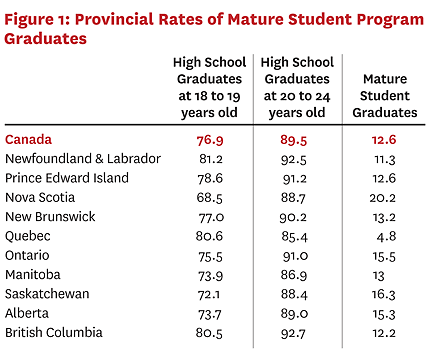
Figure 15 compares the percentage of graduates at age 18-19 in each province with the percentage at 20-24. It is likely that mature student programs helped boost the graduation rates in each province. Nationally, they generated 13 percent6 of graduates in 2009-2010. Programs in Nova Scotia, with one-fifth of young people obtaining a credential after the typical graduation age, play a particularly vital role.
Challenges facing mature student programs
Mature student programs are often referred to as “second chance” programs, suggesting that students somehow squandered their opportunities the first time around. However, adult students who attend these programs do so because they are compelled back into the secondary system or need an extended opportunity to complete secondary school. Those who are compelled back may need specific course pre-requisites for post-secondary education or may need to improve their marks. Some are recent immigrants who completed their secondary and possibly even post-secondary education, but who must now requalify in a system that doesn’t recognize or devalues foreign education credentials. Furthermore, as long as families live in poverty, there will be a need to offer an extended opportunity to adolescents and young adults to complete their diploma requirements. This is most apparent when looking at Aboriginal learners, who live in poverty at higher rates, and who are also more likely to delay their entry into the post-secondary system.7According to the Canadian Teachers’ Federation,8 living in poverty is connected to an inter-related and accumulating set of factors that can combine to compel students to leave high school, such as their readiness to learn; low self-confidence or motivation; social exclusion; frequent moves and interrupted attendance; and inability to participate in enrichment activities.
Adult education programs at the secondary level are a vital part of long-term poverty reduction strategies.9 They are also an essential conduit into the post-secondary system. However, these programs face their own inequities and a sort of “second class” status within the education system. Straddled between the concerns and interests of the regular K-12 system and post-secondary programs, mature student programs are rarely the focus of sustained policy attention, and are vulnerable to short-sighted funding decisions.
Two provinces, Newfoundland and Labrador and British Columbia, have recently instituted reforms in their college systems to either remove or substantially downsize adult programs leading to high school credentials. Newfoundland privatized its programs in the summer of 2013, removing them from the provincial college system and placing them in private career colleges. B.C. is eliminating funding for entry-level courses, after previously decreasing vital post-secondary access supports for social assistance recipients.10 B.C. is now focusing resources on those most likely to enter post-secondary education and decreasing access to those deemed less likely to proceed through all courses.11 There may be some room for optimism in Ontario which, after drastic cuts in the late 1990s, is beginning an extensive consultation process towards the development of a provincial adult education strategy centred on secondary completion and post-secondary access.
Mature student programs facilitate high school completion and access to post-secondary education, particularly for students living in poverty and for those compelled back into the secondary system. Given their importance to secondary graduation rates, especially for our most disadvantaged students, these programs deserve to have a more prominent place as an inherent and valued part of a comprehensive education system.
En Bref – Les programmes pour étudiants adultes visant l’achèvement des études secondaires offrent plus qu’une deuxième chance aux adultes. Ils sont maintenant une importante composante du système d’éducation pour les personnes qui doivent retourner au secondaire en vue d’entreprendre des études postsecondaires et pour celles qui ont besoin de ressources prolongées pour terminer leurs études secondaires. Un environnement de soutien tenant compte de la vie occupée et complexe des étudiants adultes se distingue des nombreux programmes réguliers d’études secondaires. Les programmes d’éducation de niveau secondaire pour adultes sont des éléments vitaux pour les stratégies à long terme de réduction de la pauvreté : ils contribuent à accroître les taux de diplomation d’études secondaires. Ils constituent également un mode essentiel de passage au système postsecondaire.
Photo: Chris Schmidt (iStock)
First published in Education Canada, May 2015
1 Christine Pinsent-Johnson, Shannon Howell and Rebekka King, Returning to High School in Ontario: Adult students, post-secondary plans and program supports (Toronto: Higher Education Quality Council of Ontario, 2013), www.heqco.ca/SiteCollectionDocuments/Formatted_CESBA.pdf ; Cassandra MacGregor and Thomas Ryan, “Secondary Level Re-Entry of Young Canadian Adult Learners,” Australian Journal of Adult Learning 51, no. 1 (2011): 143-160, http://files.eric.ed.gov/fulltext/EJ951990.pdf
2 Pinsent-Johnson, et al. Returning to High School, 37.
3 Students can prepare for and write a Canadian version of the General Educational Development (GED) test to receive a provincial high school equivalency certificate.
4 Statistics Canada, Interrupting High School and Returning to Education (Education Indicators in Canada: Fact Sheets, 2010). www.statcan.gc.ca/pub/81-599-x/81-599-x2010005-eng.htm
5 Statistics Canada, Interrupting High School.
6 From Kathryn McMullen and Jason Gilmore, A Note on High School Graduation and School Attendance, By Age and Province, 2009/2010 (Statistics Canada Catalogue no. 81-004-X, 2012).www.statcan.gc.ca/pub/81-004-x/2010004/article/11360-eng.htm The data do not directly distinguish between graduates with developmental disabilities, who complete modified diploma requirements at the age of 21, and graduates who complete standard diploma requirements between the ages of 20 and 24. However, related data do include the percentage of 20-24 year olds who had not graduated but were still in school; these would likely include students receiving a modified diploma. The percentage of these students is negligible in all provinces except Quebec, which has a different secondary/post-secondary system.
7 Educational Policy Institute, Access, Persistence, and Barriers in Post-secondary Education: A literature review and outline of future research (Toronto: Higher Education Quality Council of Ontario, 2008), 7.www.heqco.ca/SiteCollectionDocuments/Access%20Persistence%20and%20Barriers%20ENG.pdf
8 Canadian Teachers’ Federation, Supporting Education… Building Canada: Child poverty and schools. (Canadian Teachers’ Federation, 2009). www.ctf-fce.ca/Research-Library/FINAL_Hilldayleavebehind_eng.pdf
9 Shauna Butterwick, A Path Out of Poverty: Helping B.C. income assistance recipients upgrade their education (Canadian Centre for Policy Alternatives, B.C. Office, 2006).www.policyalternatives.ca/sites/default/files/uploads/publications/BC_Office_Pubs/bc_2006/path_out_of_poverty.pdf
10 Butterwick, A Path Out of Poverty.
11 Katie Hyslop, “Literacy Bumbled among Three Ministries: SFU prof,” The Tyee, March 8, 2013. http://thetyee.ca/News/2013/03/08/BC-Literacy-Mismanaged/
-
Community-based Dropout Prevention
Comments Off on Community-based Dropout PreventionPathways to Education, an after-school, community-based dropout prevention program for low-income youth, began in 2001 in Toronto’s underserved Regent Park community. It currently operates in 17 communities in Ontario, Quebec, Nova Scotia, Manitoba, and B.C. The program provides a comprehensive set of four support pillars – academic, social, financial, and one-on-one mentoring – and operates in partnerships with well-established local community agencies and schools. At each program site, students receive ongoing support from a team of full-time professionals, including a Student Parent Support Worker (SPSW), who checks in with the students, advocates for them in the school, and monitors school attendance, academic progress, and program participation. Other program staff manage the mentoring and tutoring components, as well as the work of countless volunteers who provide tutoring services in core subjects four times a week.
The Pathways to Education program, however, is much more than the sum of its parts. While the four program pillars provide a “complex set of supports”1 and are aligned with external research on dropout prevention, the program’s transformational impact on the lives of marginalized youth stems from its unique approach to youth engagement and well-being.
Individualized support
Early school-leavers are not a homogenous group. Existing research on early school-leaving shows that dropping out is a complex and often non-linear process of academic and social disengagement, influenced by both personal and external factors – “the intersection of a variety of academic, personal, and family experiences and resources.”2 As a result, dropout prevention “services and supports must be flexible and customized to meet individual student needs.”3 A key element of that customized approach in the Pathways to Education program is the commitment to get to know all students and work closely with them on a personal level. Corrie-ann, an SPSW at a Pathways to Education site in Kitchener, Ont., sees that relationship as the cornerstone of the program:
“Finding out who the students are inside and helping them to come to a point where they are feeling safe enough with me or one of my colleagues to express and share some of their deepest problems and what they want to achieve gives us a really good inside look as to what’s motivating the students and where they are coming from. It helps us understand how they might respond in different situations and, therefore, how to best support them. That relationship is the source of our knowledge and, therefore, our ability to provide individualized support.”
Young people who participate in Pathways to Education in their communities encounter many difficult barriers. They battle emotional and social challenges as well as toxic relationships and environments. They frequently take on part-time jobs to help their families, or care for their younger siblings while their parents juggle two or more jobs. In order to best support individual student needs, front-line staff build relationships by listening, recognizing the assets and the resilience that reside within, and providing stability and consistency. Tanya, an SPSW in Toronto’s Rexdale community, makes it clear that the program’s focus needs to be, first and foremost, on student well-being:
“You can’t expect a high school student to go into school every day and focus and do his work when there are so many adverse things affecting his life… If he didn’t have any food last night, or was beaten, or didn’t have a place to sleep because his mom kicked him out, or if he has court tomorrow, he’s not going to care about going to Math class and doing a pop quiz. So, it is crucial that we support the students through these tough times… they need to be OK on many different levels before they can be successful at school.”
In other words, progress towards academic attainment begins with the student’s well-being, a sense of trust, and a consistent connection to an adult who sees the whole person. Tanya echoes the voices of many of her front-line colleagues across the program’s 17 sites when she observes:
“These students are used to a kind of chaos and instability in their lives, so that adult presence is the one constant. Also, believing in them is key… even if they mess up or don’t meet some high expectations, they must know that there is someone there who’s going to accept it, walk them through whatever the situation is, and help them re-evaluate their direction and decisions.”
The program’s SPSWs, however, do not solve problems, tell students what to do, or remove barriers for the students. Instead, they work with them and see their role as supporting and participating in the student’s natural process of becoming. SPSWs model how to navigate systems or facilitate conversations and interactions with peers, parents, teachers, or school administration. They help students reflect on their experiences, mistakes, and successes. Jahmeeks, an SPSW in Kitchener, Ont., says this process builds on the strengths within: “We want them to see that there is always a lesson to learn. You failed that test. What happened? Let’s reflect on what went wrong and how you can move forward. A lot of our one-on-one mentoring conversations are about reflection.” His colleague, Corrie-ann, adds, “it’s very much about supporting them on their journey but not interceding and telling them what I think they should do.”
When life experiences become particularly challenging for students in the program, SPSWs help navigate all the relevant systems and relationships, connect students to appropriate services, and ensure that academic responsibilities are prioritized. When students face suspensions, for example, the program offers a place to come and focus on schoolwork to ensure that learning continues. But that’s not all. Tanya explains, “We work with the school, walk the student through the situation, make sure he understands the incident and the consequences, make sure he doesn’t make the situation worse, and work with the family to help them understand what took place and the implications.” She adds that “through it all the student is still at the centre. Everything is based on his or her needs, and we make sure we connect them to all the resources and services necessary.”
One of Corrie-ann’s students benefited from this type of deployment of good will, guidance, and ongoing support. When Corrie-ann noticed that Mariam stopped going to school and wasn’t attending the Pathways program, she began to worry that she “was probably at a point where she was going to be withdrawn from the program because she had very low participation.” Corrie-ann shared her concerns at a team meeting, and it soon became clear that Mariam was not attending school and the Pathways program because she was helping at home and taking care of her younger siblings.
“So we tried to connect with her in a different way,” Corrie-ann says, “and that was by giving her credit for the work she was already doing: helping her mom, picking up her brothers and sister after school, cooking.” Where other programs might have seen an insurmountable challenge, Pathways staff noticed a strength – a young woman who had taken on the role of a caregiver to her younger siblings. They saw something to build on. “That work can count as your mentoring component,” Mariam was told, “so, if you can come to tutoring one day per week, we can build on that.”
Corrie-ann believes that this “process of connecting with Mariam where she was at opened a huge door: a student who was very quiet, and always looking down, blossomed over the subsequent year. Her personality just burst through.” By recognizing Mariam’s context and working within it, the Pathways program gave her a chance to build on it. “In the end, Mariam graduated from high school and is now in college, doing very well.”
Tapping into resilience
Much like their more privileged peers, students in the Pathways program succeed because they work hard, go to class, turn in assignments, prepare for tests. Unlike those peers, however, they also overcome complex challenges, adverse childhood experiences, and difficult relationships and environments. They earn their success with hard work, determination, and resilience, but they also benefit from the support of a small team of dedicated professionals at a Pathways to Education site.
Unless the students feel supported, safe, engaged, and valued, no amount of tutoring or financial assistance will help. While the four pillars of the Pathways to Education program provide an important evidence-based set of support mechanisms, it is the personalized wraparound support created by the relationships between front-line staff and the students they serve that makes these pillars possible. Dedicated and reliable adults who provide scaffolding, opportunities for reflection, and skill-building in navigating systems and relationships can and do ensure a lasting impact.
En Bref – Passeport pour ma réussite est un programme parascolaire et communautaire de prévention du décrochage s’adressant à des jeunes de milieux à faibles revenus, qui a débuté en 2001 dans la collectivité défavorisée de Regent Park à Toronto. Il s’est étendu depuis à 17 endroits au pays. Le programme assure du soutien sur un ensemble complet de plans – scolaire, social, financier et mentorat individuel – et fonctionne en partenariat avec des organismes communautaires locaux bien établis et des écoles. Les élèves inscrits au programme profitent du soutien continu d’une équipe de professionnels à temps plein, notamment d’un travailleur de soutien élèves/parents (TSEP) qui maintient un lien avec les élèves, défend leur cause à l’école et assure le suivi de la fréquentation et des progrès scolaires ainsi que de la participation au programme. L’impact transformationnel du programme sur la vie de jeunes marginalisés résulte de son approche inédite de l’engagement et du bien-être des jeunes : le personnel de première ligne répond aux besoins des élèves individuels et les soutient par une gestion de cas très personnalisée et par l’établissement de relations.
Photo: courtesy Pathways to Education
First published in Education Canada, May 2015
1 Carolyn Acker Norman Rowen, “Creating Hope, Opportunity, and Results for Disadvantaged Youth,” The Canadian Journal of Career Development 12, no. 1 (2013): 63–81.
2 K. Alexander, D. Entwisle, and N. Kabbani, “The Dropout Process in Life Course Perspective: Early risk factors at home and school,” Teachers College Record 103, no. 5 (2001): 760-822.
3 B Ferguson, K. Tilleczek, K. Boydell, and J. Rummens, Early School Leavers: Understanding the lived reality of student disengagement from secondary school (Toronto: Community Health Systems Resource Group, The Hospital for Sick Children, 2005).
-
Reflections on “Dropping Out” of School
Comments Off on Reflections on “Dropping Out” of SchoolWhat are the transformative possibilities of schooling and education today? I answer this question with two words: hope and caring. I am hopeful that we can begin to address the problem of school dropouts. I also believe strongly that most educators care about and want the best for their students. However, as many educators have also noted, sometimes our good intentions are not enough. We need to focus on the effects and outcomes of our practices.1 It is imperative that as educators and practitioners, we take students’ perceptions seriously and examine our practices and beliefs to ensure that students get to know who we truly are, that we do care about learning, teaching and administration of education and that we are intent on creating an inclusive learning environment for all.
In the early 1990s, I led a longitudinal study examining Black youths and the Ontario public school system. We concluded that the term “push out” was more appropriate than “drop out.”2 Our contention was not that educators literally push students out of the door. However, the messages sent by schools – what is valued and deemed legitimate knowledge, what is discussed or not discussed in classrooms, what experiences and identities count or do not count, and how students are perceived by educators – lead a fair number of Black youth to feel unwelcome and, consequently, become disengaged. It is no longer acceptable for educators and local communities to accept dropping out as simply a matter of individual responsibility. So how do we interrogate conventional knowledge?
Tuck, in an excellent read, discusses how schools push out students through humiliating experiences and assaults on learners’ dignities such that these students no longer want to be in school. She reasons that U.S. schools produce dropping out as a “dialectic of humiliating ironies and dangerous dignities”3 that stem from educational practices including assessments, exit exams, testing, and school rule enforcements that students find very humiliating. Clearly, when students leave school prematurely they are fully aware of the consequences of their decision in the context of the social and cultural capital assigned to education. Therefore, we must seek to understand why students make these decisions and acknowledge the interplay of institutional and personal responsibilities when accounting for school dropouts.
What educational research in Ontario tells us
Statistics can help us establish the nature and context of a problem. However, considering the general reluctance to engage with race, recent statistics often employ coded language to speak about the experiences of racialized students. For example, studies often focus on language, country of origin, length of time in Canada, or citizenship status as it relates to student disengagement. These studies can provide a glimpse into the issue, though without an honest conversation about the role of race, it remains an incomplete picture.
Research conducted by the Toronto District School Board (TDSB) on dropping out by key languages shows that Portuguese-, Spanish-, and Somali-speaking students leave school at the highest rates: 38 percent, 37.5 percent, and 35.1 percent respectively.4 By region of birth, English-speaking Caribbean and Central/South American and Mexican students leave at the highest rates, 38 percent and 37 percent.5 Combined with earlier statistics, these indicate issues that extend above and beyond language and place of origin and point, instead, towards a hostile learning environment for racialized students.
Educational research on the performance of Ontario high school students shows that despite successes, Black/African-Canadians, First Nations/Aboriginals, and Portuguese- and Spanish-speaking students are at the forefront of student disengagement from school.6 Disproportionate numbers of students from these groups are also enrolled in special education and non-university stream programs.7 Even for those students alleged to be doing well (e.g. Asian “model minority” students) we observe narrow fields of academic choices, such as the over-subscription in science/mathematics-related occupations.8
But the figures do not tell us about the human side of dropping out. In our study, we noted the human dimensions to the story of Black and minority youth disengagement from school. These are stories of personal struggles, of family and home hardships, socialization and peer culture struggles – of youth with stolen dreams and unmet expectations who develop a lack of faith in the system. There are also the challenges of navigating the school system, unfriendly and unwelcoming schooling environments, low teacher expectations of minority students, the differential treatment by race, gender, sexuality or class, and the lack of curricular, pedagogic and instructional sophistication.9 For Black/African students, the cost of school/academic success may be one’s identity and emotional stability.10 The process of disengagement starts early in the life of the student, culminating in the decision to leave school prematurely.
This calls for a critical interrogation of the structures and processes of educational delivery. Such interrogation allows us to hold systems accountable while also calling for community and parental responsibility. Producing school success is more than an individual undertaking. In asking parents and communities to share responsibility for the education of their children, we must avoid pathologizing families, individual learners and their communities. Such pathologies only reinforce constructed or false negatives of marginalized (working class and racialized) communities and stifle counter-debate. We often throw out the term “taking responsibility” without situating discussions with the recognition that taking on responsibility is only possible when we have the means to support our actions. It easy to sit in the comfort of one’s living room and say, “Gee… these people must take responsibility.”
Hence, in addressing youth dropping out of school we can maintain blind spots on the daily struggles and challenges of families and their resilience to succeed against all odds – and fail to learn from these real-life struggles. We do not value counter- and oppositional stances; yet, it is these counter-stances and strategies of resilience that offer crucial lessons for re-visioning education and thereby promoting change.
Dropping out: philosophical contentions
Rather than pinpoint specific causes and factors contributing to youth dropping out of school, I want now to work with a different intellectual gaze, highlighting some philosophical contentions. I see such analysis as part of a needed paradigmatic shift to understand schooling and education. A major discursive position I am taking is that dropping out is actually a consequence of the structure of the Euro-Canadian/American educational school system, and the collective inability or failure to look at its foundations. The foundation itself contributes to students dropping out – yet we are adding stories to a weak foundation rather than building a new one.
The current school system focuses on individual excellence and success. There is a heavy play on meritocracy, which promotes and sustains rugged individualism and competition. The values and credentials privileged by the Euro-American school system simply mask Whiteness, White power and privilege as the norm. What is presented as “universal” is, in fact, the particularity of the dominant. The values of the dominant that undergird the educational system do not hold for everyone. They are being questioned not because they are wrong, but because they are not universally tenable. They are not inclusive and we need to cultivate values shared by all of our humanity.
We are all in a collective struggle to transform our communities; we are each implicated in the existing inequities.
The implication for dropping out is that the absence of a “school community of learners” they can identify with makes some students feel alienated and disengaged. For example, while a competitive mode may help generate individual brilliance and creativity, it does not necessarily create sustainable communities for everyone. We need to bring back a positive reading to “community.”
It’s important to recognize that we are all in a collective struggle to transform our communities; we are each implicated in the existing inequities. As an educational response we must have all hands on deck, with value given to everyone’s knowledge, history, experience and contributions. This includes students, educators, administrators, policy makers, private, business and public sectors and parents, guardians, community workers and our varied communities – and especially dropouts. We cannot find solutions outside the contributions, experiences and voices of the school dropouts themselves.
Integrating learners into society is seen as an important mission of school. In Canada, there is unquestioned faith in integration, which is rooted in the multicultural paradigm. Our approach to integration is one size fits all. Those who do not fit are cast aside. But we must begin to ask: Integration for whom, how and at what/whose expense? Those who drop out do not find a place in the school system as currently designed. One size cannot fit all. Multiple visions of schooling, including educational innovations and initiatives from marginalized communities, must be envisaged and encouraged. They must equally be valued, promoted and supported. At the policy level, it is troubling to see how a blind faith in integration continues to lead even non-dominant, immigrant, racial minority, and Indigenous learners along the path of “cultural destruction.”
We cannot hope for success while continuing to do the same thing that is failing us. The denial of White dominance distorts reality and does not allow us to put our collective hearts and minds together to find solutions. We have not developed any explicit investment in creating a level playing field. This is because we have failed to recognize the uneven and inequitable circumstances in which education is embedded – the a priori inequality existing among students, within school cultures and educational discourse and in the Euro-American curricula. Teaching and learning should be about decolonizing minds, bodies, souls and spirits to be more critical of ourselves and of our communities.
Strategies for student retention
Dropping out of school is fundamentally a problem of youth disengagement from and disaffection with school. While solutions must embrace school, home and community connections, there are also some concrete strategies that educators and administrators can undertake to retain students in schools.
Many of the strategies discussed here relate to inclusion issues. I am increasingly skeptical of the bland and depoliticized talk of inclusion that ignores issues of power, transparency and accountability. I believe inclusion should lead to structural transformation rather than simply adding to what already exists, since oftentimes what already exists is the source of the problem. Instead, I want to work with “radical inclusion.” We need to recognize the space in between ourselves and others, where all the history, pain, trauma, resistance and love live, in order to see inclusion as about a wholeness, completeness and varied, complex communities.
Education must work with students’ lived experiences, myriad identities, histories, cultures, and knowledge bases – in other words, it must be meaningful and relevant to the students themselves. A holistic education should encompass the material, social, cultural, political, physical, psychological, spiritual and metaphysical realms of learners’ existence, including teaching about society, culture and Nature (i.e. environments and Lands). We need to reclaim multiple and multi-centric ways of knowing. Such knowledges are key to affirming learners’ and educators’ myriad identities, histories and social contexts of learning and teaching; promoting Indigenous cultures and language heritages; and addressing broader questions of curricular, instructional and pedagogic relevance.
All students must feel included and welcome in our schools. Identity is linked with knowledge production. Teaching must recognize the myriad identities that our learners bring to classrooms (e.g. racial, gendered, classed, sexual, (dis)abled). These social differences implicate schooling and are consequential for educational outcomes. Therefore, educators should teach about social difference as sites of power, strength and identity. Teaching must engage the home and community cultures of students. Local and Indigenous languages of learners must be broached alongside teaching in dominant lan-guages. Students must see themselves reflected in the school culture and in the visual and physical landscape of their schools. A diverse teaching and administrative staff will allow students to identity with people in positions of power and influence as equally coming from their own communities.
It is important for educators to access pertinent resources for developing an inclusive curriculum. Students themselves can be used as knowledge holders of their own experiences; parents, Elders, and guest speakers from diverse backgrounds can be welcomed as teachers engaging in multiple conversations with students and staff. Public conferences, seminars and community workshops, local print media and television, community bookstores and public libraries, and popular culture are all resources for youth education. These resources can be employed with a discussion of their social contexts and histories as entry points of dialogues.
Nasir highlights “four aspects of teaching and learning that support this sense of belonging and identification: fostering respectful relationships, making mistakes acceptable, giving learners defined roles, and offering learners ways to participate that incorporate aspects of themselves.”11 These strategies hold lessons for the classroom. Fostering respectful relationships and making mistakes an acceptable part of the learning process can create cohesion, a sense of community, and build confidence by reframing failure as an opportunity to learn and grow. Defining informal roles based on interests and strengths gives learners a sense of expertise and a valued identity within the group.
Educators should strengthen students’ abilities to ask new and difficult questions in class. The students can begin by questioning their own selves and local communities, the school and wider society. Teaching should also emphasize learners’ responsibilities to their communities, peers and to themselves. Allowing all students to showcase their own voices and knowledges, and to reflect on and assess their own schooling, are important educational strategies of inclusion. Prioritizing students whose voices and knowledges are absent is critical. Educators can also examine their own classroom pedagogies, diversifying the curriculum through the infusion of multiple teaching methodologies. For example, there must be a consideration of more dialogical curriculum co-creation involving students, parents, local communities, and schools.12
Educators must re-conceptualize rigid Euro-centered evaluation and assessment methods and work with multiple definitions of success. Classrooms should promote collective successes, with evaluations taking into account how students are supporting each other. A failing class would be one that could not support all its members. We could evaluate on the basis of improvement. We can introduce peer reviews and grading, so that the teacher is not solely in control of grades and the hierarchies are less severe.
Educators can recognize and honour multiple ways of knowing and being by enabling students to be creative and present non-traditional papers (arts-based, multimedia).13 We can consider orality as an equal medium to written text. Educators must include community-based events, which often provide access to Elders or other “teachers,” as sites of learning. School-based learning becomes more meaningful and practical when students can connect it to community work.
These strategies allow students to develop a sense of ownership of their knowledge and knowledge creation process.
Decolonizing education is about looking critically at the structures and processes of educational delivery and changing the ways we teach, learn and administer education. Decolonizing education is about promoting counter and oppositional voices, knowledges and histories, bringing into focus the lived experiences of students who have been marginalized from the school system. Through inclusive practices that engage the diverse group of learners, schools can become welcoming spaces, and the resulting sense of belonging and ownership of the schooling process can help engage students and allow them to stay in school. It is difficult to understand why someone who feels welcome, valued, and engaged will decide to leave school prematurely.
Thanks to Kate Partridge of the Department of Social Justice, OISE/UT, for commenting on an earlier draft of this article.
En Bref – Comment peut-on revoir la scolarisation en fonction des besoins des élèves différents? Dans cet article, George J. Sefa Dei réfléchit aux liens existant entre le décrochage scolaire et les pratiqueséducatives (enseignement, pédagogie et initiatives liées au curriculum, ainsi que culture d’école) qui sont et peuvent être documentées par les apprenants, leurs histoires, identités, mémoires culturelles et patrimoines, ainsi que par leurs expériences et attentes de tous les jours. Il confronte des questions difficiles relatives au pouvoir, au discours et à la représentation des expériences des jeunes qui provoquent et contextualisent le décrochage scolaire. Il se demande comment nous pouvons commencer à démanteler les relations hiérarchiques du pouvoir liées à la scolarisation. Il examine également certains facteurs conventionnels menant au décrochage scolaire et suggère aux éducateurs et aux écoles des façons pouvant favoriser la rétention et la réussite. Il est reconnu que le milieu de scolarisation peut être inhospitalier pour les élèves ne faisant pas partie de la culture dominante (marginalisés par la race, le genre, la sexualité, la classe, etc.) et qu’en décolonisant l’éducation, plus d’élèves auront un sentiment d’appartenance et s’approprieront leur éducation.
Photo: Rich Legg (iStock)
First published in Education Canada, May 2015
1 M. Fine, Framing Dropouts: Notes on the politics of an urban public high school (New York: State University of New York Press, 1991).
2 G. J. S. Dei (with L. Holmes, J. Mazzuca, E. McIsaac, and R. Campbell), Drop Out or Push Out? The dynamics of Black students’ disengagement from school. Report submitted to the Ontario Ministry of Education and Training, 1995; G. J. S. Dei, J. Mazzuca, E. McIsaac, and J. Zine, Reconstructing “Dropout”: A critical ethnography of the dynamics of Black students’ disengagement from school (Toronto: University of Toronto Press, 1997).
3 E. Tuck, “Humiliating Ironies and Dangerous Dignities: A Dialectic of school push out,” International Journal of Qualitative Studies in Education 24, no. 7 (2011): 817.
4 R. S. Brown, Research Report: The Grade 9 Cohort of Fall 2002: A five-year cohort study, 2002-2007 (Toronto: Toronto District School Board, 2008),16.www.tdsb.on.ca/Portals/0/AboutUs/Research/The%205%20Yr%20Study%2002-07.pdf
5 R. S. Brown, Research Report (2008).
6 R. S. Brown, A Follow-Up of the Grade 9 Cohort of 1987 Every Secondary Student Survey Participants (Toronto: Toronto Board of Education, Research Services, Report No. 207, 1993); M. Cheng, M. Yau, and S. Ziegler, The Every Secondary Student Survey, Part II: Detailed profiles of Toronto secondary school students (Toronto: Toronto Board of Education, Research Services, Report No. 204, 1993).
7 R. S. Brown and G. Parekh, Research Report: Special Education: Structural overview and student demographics (Toronto: Toronto District School Board, 2010), 35.
8 M. Cheng, “Factors that Affect the Decisions of Racial/Ethnic Minorities to Enter and Stay in Teaching and their Implications for School Board’s Teacher Recruitment and Retention Policies” (Ed.D diss., Department of Sociology and Equity Studies, OISE/UT, 2002).
9 Fine, Framing Dropouts; Dei et al., Drop Out or Push Out?
10 Dei et al., Reconstructing “Dropout”; G. J. S. Dei, “Schooling and the Dilemma of Youth Disengagement,” McGill Journal of Education 38, no. 3 (2003): 241- 256.
11 N. Nasir, “Everyday Pedagogy: Lessons from basketball, track, and dominoes,” Phi Delta Kappan 89, no. 7 (2008): 530.
12 G. J. S. Dei, “Decolonizing the University Curriculum,” Socialist Studies/Etudes Socialistes 10, no. 2 (forthcoming: June 2015). www.socialiststudies.com
13 Dei, “Decolonizing the University Curriculum.”
-
The Rocky Road to Dropping Out
Comments Off on The Rocky Road to Dropping OutI’ve always understood that kids leave high school before graduating for all kinds of reasons, often affected by multiple converging factors. But the chance to speak with three young adults generous enough to share their school stories with me (and with our readers) really brought home just how varied and complex the road to dropping out can be.
I worried at first that my “sample” was not broad enough: after all, all three interviewees were now back in school. But as Christine Pinsent-Johnson points out (p. 9), the majority of early school leavers in Canada do go on to earn their secondary school equivalency. And even though I was missing the voice of a student who dropped out and stayed out, I was amazed at how many threads were present in just these three stories. I heard about the sense of unwelcome, the experience of racism and the systemic “push out” experienced by many students from non-dominant cultures that George S. Dei writes about (and challenges us to address) in his article, “Reflections on Dropping Out of School” (p. 12). I heard about personal crises, such as depression and addiction, that stood in the way of school success. I heard about unsuitable – or nonexistent – support for learning challenges. And I heard, loud and clear, that the standard school approach is just not a good fit for some students, and that alternative, mature student and transitional programs play a critical role in enabling students to succeed academically and personally.
I found it interesting, then, to read that as part of a province-wide push to increase graduation rates, the English Montreal School Board (p. 26) found it important to strengthen their early literacy and alternative school programs. The early literacy intervention will ensure that more children are equipped to succeed at school, while the alternative high school program acknowledges that for some students, a different approach is needed.
Just as there is no one path to dropping out, there is no one strategy that will help all kids graduate. I hope you will find much to think about – and renewed resolve – in this issue. And don’t forget to look up our web exclusive articles, which profile some inspiring programs that support at-risk students.
Write to us!
We want to know what you think. Send your letters or article proposals to editor@cea-ace.ca, or post your comments about individual articles on the online version of Education Canada at: www.cea-ace.ca/educationcanada
-
Working Together for Change
Comments Off on Working Together for ChangeOne of the many interesting features of Thunder Bay, Ont., is the concentration of grain elevators from the city’s heyday as the transportation breakpoint for Prairie grain. In the same way that the elevators can separate and hold different grains, secondary schools can often appear as organizational silos, with knowledge and practices being held in rigid discipline-based subject departments. This article considers the role of the principal in working with departments and their chairs in order to implement changes that will improve the quality of teaching and learning within schools. Unfortunately, this is a task that traditionally has not been well handled.
A common theme in the research literature about secondary schools and their departments is pessimism: Principals tend to assume they have little influence over departments and lack explicit strategies for working productively with departments.[1] We believe that a major source of this pessimism is a misunderstanding of the place of the department in the life and work of the school. So, we would like to begin by briefly discussing how this came to be, and two important features of departments that have implications for the work of the principal.
The rise of public education in the mid to late 19th century, and the demands of university entrance examinations, drove both the academic content that schools taught and the evaluation of that learning. To accommodate the universities’ demands, schools began to adopt standardized systems of timetables, lessons and school subjects. The subject became the predominant conceptualization for organizing the curriculum. Academic subjects gained the ascendency in the life of schools, a reflection of their university designation as high-status knowledge. These academic subjects were to be taught by content specialists, and it was these content specialist teachers who formed the first school subject departments.
The first modern usage of the term “department” was in 1905 by the American educator Kilpatrick, and by the 1930s departments dominated secondary school organization, with the most important being the Big Four of Mathematics, Science, English and the emerging Social Studies, which were based on Geography and History. Over time, other subjects have either gained departmental status (e.g. Physical and Health Education), or lost their status (e.g. Latin). The school structure you see in your school has evolved over the past 150 years.
The department’s functions
The development of departments has given them two vital functions: the social and the organizational. The social function is a powerful one, since it is within departments that teachers are socialized into what is important in their subject content, how it should be taught, and why it should be taught. This social function is foundational to departments’ organizational power, which lies in the capacity to influence how and what teachers teach. Teachers educated into a discipline will generally replicate the academic traditions of that discipline; this is a principal reason why secondary teachers apparently maintain their own practices in the face of efforts to reform teaching and learning. Taken together, the social and organizational functions of departments fill them with tremendous political power – which is at the source of the pessimism that so many principals feel when working with departments.
So what does this history mean for principals who are seeking to work with their chairs and departments to improve teaching and learning? We would like to suggest that there are two important areas in which principals can take action, and so begin the work of aligning the purposes of the school and departments. The first is to cultivate a trust-based reciprocal relationship with the chairs in your school. The second follows from this: respect for the role and responsibilities that chairs, and their departments, have. At all costs, please try to avoid the story of one Australian principal who stood before his staff and boldly declared, “How do you expect me to treat you like professionals when you won’t do what I say?”
Hasten slowly
Before doing anything, read Sergiovanni’s warning:
“… for schools and school districts that are less effective in bringing about change, trust is an afterthought… often preceded by vision, strategy, and action.”[2]
It is vital that principals are proactive in developing reciprocal long-term relationships with their chairs. These relationships must be built on a mutual respect for the professional and personal responsibilities of the other. Chairs have a responsibility for their subject and the instructional leadership of the department, while principals have responsibilities to school boards and the wider school community. One of the major responsibilities of the principal is in “defining, defending and enabling a viable educational philosophy throughout the school.”[3] But the actual implementation of so much of that philosophy is in the hands of chairs, and they can be placed in an awkward position. As middle managers, they often have divided loyalties. On the one hand, they have a commitment to their subject and to developing (and maintaining) collegial working relationships with their teachers. On the other, they are also responsible for implementing school-level administrative decisions. Do we see a tension here, and what is a principal to do?
Build the foundations
How can a principal initiate reciprocal long-term relationships? The answer lies in developing clear lines of communication with chairs and playing politics (in the non-pejorative sense of the word). This means that principals must distribute leadership (and power) to department chairs as they seek to improve teaching and learning within their departments. For many principals (and their boards), this may mean challenging their own views on leadership, a task that is never easy.[4]
In working with chairs, the principal needs to understand how the practices (and yes, agendas) of different departments can be brought to bear in pursuing school-level changes that aim to improve teaching and learning. This means that the principal needs to be involved in the work of the department. We are not advocating involvement in the minutiae of the day-to-day operations of the department – that is a sure road to disaster. We mean engaging with chairs in conversations around where the department is, and where the department would like it to be in the next five to ten years. Yes, we said five to ten years – because meaningful change needs to be considered over this sort of timeline. The continuity of working together for an extended period is so important because, as people get to know each other, they can develop the trust that leads to a deeper professional relationship. It is this deep relationship that allows chairs, supported by principals, to lead changes in teaching and learning that will move us to sustainable student success. As an aside, there will still be arguments and tension within trusting relationships, so expect this tension but don’t let it detract from the bigger picture.
To give an example, think about the notion of student success, which, according to Ontario’s Ministry of Education, is supported by tailoring students’ education to “their individual strengths, goals and interests.”[5] A principal is responsible for promoting student success by leading conversations that promote a school-level understanding of the notion in practice. And at the department level, principals and chairs need to be asking what that school-level understanding looks like within, and across, departments:
- What does student success look like in your subject?
- What does your subject association regard as best practice?
- How do you know when students are successful?
- What forms of success are activated across subjects?
- How can the school and department together work to achieve student success?
Subjects can have different criteria for success, which can all concurrently work toward supporting a school-wide understanding of success. A department we have worked with was considering replacing the final Grade 9 exam with a culminating performance, through which students would demonstrate what they knew and understood about the topic. The principal was the first person the chair went to talk to about the proposal. Having engaged in previous conversations about teaching and learning, the chair expected that the principal would raise legitimate questions about the proposal, and prepared accordingly. The principal did raise concerns about the culminating performance process, and how it linked evaluation, recording and reporting. Working together, these concerns were addressed; the principal supported the proposal and the department could promote best practice in their subject. A further development from this work was that the chair of another department began to discuss with her department, and the principal, changes to the structure of her courses to better address the needs of students who had been identified as at-risk by the school.
Formalizing the conversation
Conversation is important, but we would go further and suggest that it is necessary to develop administrative structures that recognize the particular interactions between schools and their departments. One school that we worked with has established a structure that explicitly recognizes that, while the board and principals establish school-level plans, it is departments that, in large part, operationalize those plans. The principal in the school described it thus:
“In our leadership structure we take our board and school improvement plan goals and recognize the role of the department chair as an instructional leader. Chairs receive lots of support through our program forums. All the chairs get together and receive professional development to advance mandated issues like literacy and numeracy instruction, and subject-specific best practice. On top of this, we have a PLC (Professional Learning Community) structure for departments that happens every six weeks, where they discuss those practices and work to shape them.… The role of the chair is to improve instructional practice in a very careful but directed way that’s aligned with the school and board improvement plans.”
PRINCIPALS offer both tangible and intangible supports to teachers and departments. Tangible supports, such as the provision of resources, time for planning and preparation, public recognition and encouragement, and addressing organizational constraints are certainly important. But, make no mistake; intangible supports can be far more effective in shaping improvements in teaching and learning. These supports can include engagement in the life of the department, managing the inevitable politics associated with reforms and addressing parental concerns when they occur. By encouraging chairs as instructional leaders, and departments as places for teacher professional learning, principals can move their schools from a collection of knowledge silos towards places in which the whole-school philosophy is simultaneously shared and lived in subject specific ways.
Illustration: iStock
First published in Education Canada, May 2015
Notes
[1] J. Gray, D. Hopkins, D. Reynolds, B. Wilcox, S. Farrell, and D. Jesson, Improving Schools: Performance and potential (Buckingham, UK: Open University Press, 1999).
[2] T. J. Sergiovanni, “The Virtues of Leadership,” The Educational Forum 69 (Winter 2005): 119.
[3] B. Lingard, And P. Christie, “Leading Theory: Bourdieu and the field of educational leadership. An introduction and overview to this special issue,” International Journal of Leadership in Education 6 (2003): 329.
[4] See J. Murphy, M. Smylie, D. Mayrowetz, and K. S. Louis, “The Role of the Principal in Fostering the Development of Distributed Leadership,” School Leadership and Management 29 (2009): 181-214.
[5] Ontario Ministry of Education, Growing Success: Assessment, evaluation and reporting in Ontario Schools (Toronto: Queen’s Printer for Ontario, 2010), 10. www.edu.gov.on.ca/eng/policyfunding/growSuccess.pdf
-
Homework Zone
Comments Off on Homework ZoneThere is a controlled chaos in the cafeteria. It is 3:30, classes are over and most kids have already left for the day. Yet groups of five to ten still remain seated or mill around the picnic-style cafeteria tables. There is a buzz about the room. Some students are reading, some are completing math assignments, others are making collages, but most everyone is deeply engaged in one or many conversations, all at once. This is Homework Zone (HZ).
Homework Zone connects McGill students with an after-school tutoring program for inner-city children between the ages of six and twelve. The goal of HZ is to help elementary students form an emotional connection to school through positive educational experiences. The rationale behind the project is an aspirational one: that the forging of strong links can impact the young in positive ways; that tutoring can give them the tools to be successful learners; that mentorship can provide a model of educational attainment that young learners can identify with.
Mentors volunteer for many reasons, but they all agree that it is as much a growth experience for them as it for their mentees. Friendships blossom over weeks and months, and what is learned goes well beyond the textbook. The older students mentor about hard work and perseverance, while learning about active listening and relational being.
One volunteer recounts helping his student persevere: “I was trying to teach him Mathematics and he was just giving up too fast. I was like, ‘Come on. We’ll do it together.’ And I was really trying to show him my support and not be hard, like, ‘I’m with you.’” Working through hard problems together, mentors provide an affective anchor, giving the students the support they need to find their own solutions. The mentors create a safe place for the mentees where they can learn to do things with the help of a more knowledgeable other – what Vygotsky termed the zone of proximal development, where students can try things they might not yet be ready to do on their own.
Now in its third year, Homework Zone is a partnership between McGill’s Social Equity and Diversity Education (SEDE) office and Montreal’s Lester B. Pearson School Board (LBPSB). Matthew Albert, project leader and consultant with LBPSB, builds links with local Montreal organizations to improve student retention and success rates as part of the Hooked on Schools initiative. SEDE is one such partnership. Anurag Dhir, community engagement coordinator for SEDE, has helped build up a network of local partners that enables McGill to connect and share resources with the Montreal community at large. Together they coordinate HZ activities along with a cadre of undergraduate volunteers. Gabrielle Jacobs, a full-time political science major at McGill, has been the HZ Program Coordinator for the last two years. Hired by SEDE, she’s responsible for the day-to-day operations of HZ including recruitment, training, and providing year-long support for the mentors at the schools and through mentor reflection events. Gabrielle believes strongly in the transformative power of HZ. She says, “It’s really amazing to witness how volunteers grow out of their shell. A really shy volunteer in the fall semester will have turned into a leader by the winter.”
SEDE organizes two training events for the HZ volunteers, an orientation at the beginning of the semester, and a reflection event, near the end. These events are meant to equip students with tools and strategies but also to have them reflect on their role with the program by asking, “What does it mean to be a mentor?” and “What is community engagement?” During one such reflection event, Anurag leads a dialogue about establishing and maintaining a positive mentoring relationship, dealing with conflicting agendas, and fixing a mentoring identity between being a friend and a figure of authority. Once these practical concerns have been addressed, there follows a deeper reflection of the goals and ends of mentoring and community engagement. The hope is that students will pursue their mentoring relationship beyond their initial commitment. Many students do choose to continue over more than one term; unfortunately, many others find it hard to negotiate the demands of a full-time university course load and their volunteering work. As an added incentive, SEDE provides their volunteers with a certificate attesting to their experience, which they can add to their resumé.
So what is being a mentor? It’s about empathy – about transcending horizons of difference. In the words of one volunteer, “It’s a lot about sharing your experience and about hearing theirs and trying to teach them something at the same time. You have to be open-minded. You have to realize that this person might be very different from you, in terms of background, or opinions or values.”
Homework Zone may ostensibly be a tutoring program but the structure of the day belies a more complex reality. In addition to providing help with homework, mentors and invited guests lead workshops throughout the year. But most tellingly, HZ just feels different; it’s less study hall, more drop-in centre. In fact, witnessing HZ, one is struck with the impression that it is more about human connection than homework. Sure, the original impetus lies with tutoring in numeracy and literacy, but as is so often the case when we talk about education, discussions of academic achievement conceal the multifaceted character of the educational project. Defining school solely by its activities “misses the forest for the trees.” In the end, school is fundamentally a relational enterprise, connecting people and places and ideas. Many students struggle with feeling disconnected; Homework Zone gives them a place and a community to connect with.
In September, when Matthew greets the newest cohort of undergraduate student mentors, he repeats what’s become the mantra of Homework Zone: “Just the fact of your being here, makes you successful,” he tells these university students. “Just you being here, in this role, makes you a hero in these kids’ eyes.”
More info
For more information, visit Homework Zone’s website:
Photo: courtesy David Lemay
First published in Education Canada, May 2015
-
Moving Beyond “Sit’n’Git” Pro-D
Comments Off on Moving Beyond “Sit’n’Git” Pro-DI often wonder if what we see as teaching at professional learning events would be acceptable in a high school classroom. If the purpose of professional development (Pro-D) is professional learning, then what is our evidence that learning does, in fact, occur? Are we using effective teaching practices in Pro-D?
Although Pro-D is evolving, the “Sit‘n’Git” way of learning seems to still be alive and well in many conferences and workshops throughout Canada and the U.S. In the past five years, I cannot tell you how many times I’ve sat in a large conference room for a number of hours with hundreds of other dedicated educators and not been provided with the opportunity to even talk to the person beside me. People are spending hundreds and thousands of dollars to attend these events to listen to a series of lengthy lectures without the opportunity to network and wrestle with the presented ideas. I’m not opposed to a keynote address to start off the day with some inspiring, thought-provoking ideas; however, if there is no opportunity to take these ideas and move deeper, many of the thoughts that are initiated in the keynote get lost as I move on to the next session or listen to the next presenter. It’s no secret that in order for deeper learning to occur, we must DO something with a new concept; we must apply new learning to take it from an idea to implementation. Our current typical model of Pro-D makes deeper learning a challenge and often only leaves participants with a few ideas that are unfortunately left on the shelf with the many glossy white binders from workshops of years past. At some point we need to stand up and say that a high volume of “Sit‘n’Git” style of Pro-D is no longer acceptable and is an insult to those who have spent money, time, and effort to attend. While doing this, we also need to rethink the conference model and professional learning so that it better aligns with what we want to see in classrooms.
There are many articles written about rethinking professional learning (for example – http://news.nationalpost.com/2012/04/20/is-the-pd-day-broken/ and http://www.cea-ace.ca/sites/cea-ace.ca/files/cea_fone_teacherpd.pdf) For me, the experience needs to be relevant, continual, and collaborative. As educators, we need time to take an idea, wrestle with it, discuss it, and then plan for implementation. Ideally, there should also be time for follow up with reflective dialogue either as a staff or as a group.
In B.C., the current learning model for teachers is five to six separate (often not aligned, surface level) PD days, monthly staff meetings, and (optional) after school workshops. Is this the best we can do? We know the importance of professional autonomy, so how do we offer this and also ensure that professional learning moves beyond surface level workshops or lectures that give participants the chance to mentally opt out? What is our collective responsibility as schools and districts to create the conditions for deeper learning that affects positive change?
It will likely be some time before we completely rethink Pro-D, so how do we make the best use of our current model?
One of the most effective ways to create change is to focus on the bright spots and build from there. There is a powerful movement of professional learning opportunities that have moved away from the “Sit’n’Git” model to one that taps into the strengths of participants and creates more opportunities for networking. All of these require TIME and it is important for us to change the question from “CAN we provide time for Pro-D?” to “HOW CAN we provide more time for effective, ongoing professional learning?”.
Here are eight ideas to move us beyond the “Sit’n’Git”:
1. NETWORKING/COLLABORATION TIME AT CONFERENCES – We don’t have to blow up our system; we can start small and ensure that there is important “blank” space in between workshops or following keynotes for teams or groups of people to move the learning deeper. Within workshops, always provide time for participants to DO something with their learning; move from the “sit’n’git” to the “make’n’take”. We can use models that encourage inspiring ideas (keynote, workshop) as well as the time to take the WHY of ideas and move to the WHAT and HOW.
2. TEACHER ACTION RESEARCH – B.C. teacher, Jennifer Delvecchio, shared a grassroots concept of a “growing learners/pedagogy from within” group of teachers that used some of the allocated Pro-D days – along with school supported time (and some of their own time) – to take a concept and spiral deeper over time. Teachers looked at published research and then reflected on their own practices to question and implement change to benefit student learning. By continually analyzing practice in their own classrooms and making the time to meet a priority, they were able to use the published research in a way that actually created positive change in their classrooms. By tapping into teachers’ curiosity and providing small bits of time for reflective dialogue based on gathered evidence of student learning, we can drive powerful professional learning forward.
3. COLLABORATIVE TIME AND INQUIRY – This year in the Langley School District, time that was previously allocated into two learning days in the year has been spread out over the year in the form of six collaboration mornings (80 minutes each). This model is more organic and teacher-driven than the typical professional learning community (PLC) model as educators are encouraged to choose an inquiry question with a small group of colleagues and then take the time to spiral deeper into their inquiry (see Spirals of Inquiry by Halbert and Kaser). Another example of providing small bits of collaboration time at a school level (based on the passions and curiosities of staff) can be read here.
4. IGNITE EVENTS – Ignite sessions can feel kind of like an “underground” professional learning experience where a number of people meet and listen to others share a story, an idea, or an experience through a short series of slides (20 slides, 15 seconds per slide). There is some sit’n’git but the best part about the events is the networking that occurs before, during, and after the series of five-minute presentations that plant seeds of conversations.
5. EDCAMPS – More and more districts and even some schools are offering Edcamps as a way to tap into the strengths and knowledge of participants. With no formal set agenda and no formal lectures, participants bring their topics to the day and help facilitate conversation on participants’ areas of interest. The challenge with Edcamp, along with many of these participant-driven events, is keeping the passionate dialogue going beyond the event.
6. RETHINKING STAFF MEETINGS – Many schools are making professional learning the focus of staff and department meetings. If information can be sent out in a memo/email, leave it off the agenda and free up time for engaging discussions and reflections on student learning. Something as simple as “what have you tried since the last workshop/conference/collaboration that has had an impact (small or large) on student learning?” should be discussed at staff meetings.
7. INSTRUCTIONAL ROUNDS – The Kamloops School District has been exploring the use of Instructional Rounds (based on the work out of Harvard as a way to provide ongoing dialogue and reflections based on non-judgmental observations of educators by educators). The challenge is providing release time for rounds to take place but if a district is willing to consider HOW money is spent on professional learning, instructional rounds should be on the table.
8. SOCIAL MEDIA – There are many different platforms (Twitter, blogging, etc.) that can continue conversations past the event (and also help with the sharing of good ideas). Social media can help to connect people in areas of passion or curiosity who can have conversation that can lead to deeper dialogue in other platforms. Dean Shareski challenges us to connect with one person at an event and keep the conversation going beyond that event.
The Sit’n’Git, single event idea of Pro-D does not align with what we know about teaching, nor about professional learning. We need a sense of urgency to create change in this area. Start small. Build on what is working. Let’s work together to making professional learning more relevant and continual so it leads to deeper change in education.
-
The Patchwork Pieces of Professional Development
Comments Off on The Patchwork Pieces of Professional DevelopmentHow do we support teacher learning in schools? Do we give real, authentic opportunities for teachers to learn or do we tend to offer “sit’n’git” PD based on what we, in official educational leadership positions, think teachers need. Regardless of where teachers are in their learning, or where they are in their teaching career, relevant learning can happen throughout a school.
I recently received two requests relating to leadership. One was to speak to a group of current educators taking a leadership module and another was from a university student wanting to research “shared leadership” at my school which consisted of conducting an interview with me then with a teacher in order to find out the extent to which the sharing of leadership is occurring. In both instances the question of teacher professional development came up. It made me stop and consider leadership in general. How are we as a school embracing shared leadership and what benefits does it provide? How are we embedding continuous learning in our school culture in order to sustain shared leadership? Any school leader today would say having a successful school is not possible without both. So how does shared leadership correlate with professional learning?
As educators, I think we all would agree that PD is the key to improving the quality of all leadership in schools with the main focus on student learning. Professional learning represents a way of reform that stresses the importance of partnership and working together to make student outcomes better. With that partnership, there must be mutual collaboration. I only fully realized this through my tenure as principal, yet it reminded me of an article I read many years ago called The Pattern Quilt Metaphor by S.A. Maxwell. It stated, “Prioritizing the partnership through planning will enable the innovative aspects of reform to shape into a structured whole similar to how a seamstress combines pretty scraps of fabric into the envisioned patterned quilt”[i]. It goes on to say, “Professional growth becomes the binding to the quilt that makes a meaningful whole out of the patterned quilt of learning.”[ii] What beautiful imagery! I realized that this comparison of professional growth to a seamstress making a quilt so eloquently defines the purpose and focus of PD. That is, the major focus being on planning and the framework with which is required to make it all work, creating an environment where everyone is excited and energized to learn. It requires teaching to become an everchanging, dynamic experience that will not become stagnant. And for that to happen, there is a need for a school improvement plan that is site-based and driven by staff, enabling shared leadership and defining the PD that is needed. With that being the case, any change in professional learning would be looked at as a good thing. Different ideas would be welcomed. Individual teachers would be like a piece of the fabric in the quilt, with the teams being a block of the quilt and the quilt being the school. Each piece would be reviewed constantly, spreading the quilt out and seeing that all fits together for the whole and the pattern would be reflected on to see if the results are where we want them to be.
The article referenced is not recent so this is not a newfound phenomenon. It just begs for re-visiting. Re-visiting by looking at PD through in-servicing, school restructuring, and school reform. Working collaboratively in all these areas: in-servicing, consisting of teaching and learning for understanding; and school restructuring and reform, meaning that not only the school administrator would determine the school improvement plan, but it would be a collaborative effort to develop goals and actions. The opportunity for everyone to be involved would draw a school closer to a new reform, consisting of new positive attitudes and new teacher initiatives. Certainly there is no argument that with everyone involved with the process of implementation, there would be more ownership and keenness. That is the essence of shared leadership that is strongly aligned with teacher driven PD.
Thus, effective PD is not dictated, but is facilitated, according to identified individual teacher needs, team needs, and the needs of the school as a whole. This allows many things to happen: inclusivity, creativity, innovation, and collaboration. All together are like pieces of material making a beautiful quilt. Some can take the same fabric, but make a totally different quilt, but it would be just as beautiful. It just takes thought, planning, and options. In education, this translates to better education for students. As educators, wouldn’t we all want to be masters in quilting?
[i] Maxwell, S.A. (1996). The Pattern Quilt Metaphor: Revisiting the PDS Concept Contemporary Education, 67(4),196.
[ii] Ibid. pg. 199.Related Reading
Nancy Matthews wrote this feature-length article in the Nov 2014 issue of Education Canada Magazine.
The Courage to Lead Change
Making difficult changes to school culture requires perseverance – and a thick skin!
http://www.cea-ace.ca/education-canada/article/courage-lead-change
This blog post is part of CEA’s focus on the state of Teacher PD in Canada, which is also connected to Education Canada Magazine’s Teachers as Learners theme issue and The Facts on Education fact sheet, What is Effective Teacher Professional Development? Please contact info@cea-ace.ca if you would like to contribute a blog post to this series.
-
My Two PD Hats
Comments Off on My Two PD HatsAs a school climate lead teacher, I often find myself wearing two hats. I receive both formal ongoing professional development (PD) opportunities alongside school board personnel and at board functions and provide the PD to my colleagues at staff meetings and on P.A. Days. Playing dress up with both hats simultaneously has in my opinion, placed me at the perfect vantage point.
When I am wearing my ‘’learner’’ hat, I have found myself metamorphosing from the once passive listener at formal functions like board conferences into an engaged learner-participant using a backchannel such as Twitter, which is 21st century ‘’note passing’’ for teachers. I can take pictures, write down direct quotes, share my thoughts and feelings and “pass’’ my note in a mere matter of seconds! If only this approach was used when I was in elementary school, I wouldn’t have been Ms. Chatty Cathy of the 8th grade! What could have turned into me not learning, growing or even networking, has suddenly become a place where I connect to anyone in my school board (regardless of their position) and pore over the material being presented, reflect on my teaching practice and refine my skill-set.
This brings me into my next point: Teachers won’t learn when you tell them to learn, they learn when they want and are ready to! A designated day for when all teachers board wide, shall or must learn, seems the tired days of our past. Almost any teacher you talk to, would prefer being an active voice in the process of deciding when and how they best learn (just like our students)! To add to this, I would argue that most teachers would choose an informal means of developing their pedagogy by way of independent book studies, release time to work with grade partner(s), blogging and reading blogs, taking part in regular Twitter chats, taking an additional qualification course, meeting with a mentor, taking part in a 4Cs model and so on and so forth.
Also, from what we know of our students and selves, it’s best to study in short segments rather than long drawn out mornings or days full of all the ‘’latest’’ teaching methodology. So, as someone who provides PD, I’m trying to take what I know from my observations as a learner and apply it to when I’m wearing my “lead teacher cap’’. I try to use games and activities that are engaging, memorable, quick and applicable for the classroom. I follow up the games and activities with a brief reflection and share further information through Google Docs. This allows teachers to decide if they like or need the information presented and when and where they will be open to receiving it. By doing this, I am intentionally respecting my colleagues’ time. I am also mindful of who I’m sharing information with. I’m not a university professor teaching a masters level course. As much as I believe in research guiding my teachers practice, I’m not about to print out full psychological studies to share with my colleagues at staff meetings and asking them to read such studies aloud paragraph by paragraph. I’m realistic about the amount of content and the information that I provide.
If there is anything that I take away from wearing my decorative hats, it is the imperative notion of building both choice and trust into PD opportunities. Choice, being given back to the teacher-learners to decide what, when and where learning should happen and trust, in each teacher-learner having the desire to improve their teaching practice and the means for that matter to select the best fit, for themselves.
This blog post is part of CEA’s focus on the state of Teacher PD in Canada, which is also connected to Education Canada Magazine’s Teachers as Learners theme issue and The Facts on Education fact sheet, What is Effective Teacher Professional Development? Please contact info@cea-ace.ca if you would like to contribute a blog post to this series.
-
A Design-Based Approach To Teachers’ Professional Learning
Comments Off on A Design-Based Approach To Teachers’ Professional LearningAs the issues and problems that challenge education and the teaching profession become increasingly complex, our collective need for innovative solutions and new knowledge for learning in diverse educational contexts increases. Yet school leaders and classroom teachers often fail to see a connection between educational theory and research conducted in universities and the real-world, complex and contextually rich teaching, learning and leading contexts in schools. Design-based research (DBR) is one response to the gap between theory and practice in education, to the resounding call for change and innovation in education systems1, and to the need for teachers to continually develop the principled practical knowledge required to design authentic, challenging and engaging learning experiences for students.2
Dr. Carl Bereiter contends that the theory and practice gap in education cannot be filled solely by practice knowledge or by traditional research. Instead, Bereiter argues that principled practical knowledge “goes to a depth that is sufficient for a field of practice to advance”. “Best practice, evidence-based practice, and reflective practice all refer to ways of making optimum use of know-how”3; however, while necessary, these are insufficient for creating new insights into practice, or “know-why” directed towards advancing practice. From our research, design-based professional learning appears to develop principled practical knowledge. Having spent the past 15 years immersed in numerous design-based professional learning studies, our findings would confirm Bereiter’s assertions.4 5
Design-based research focused on teachers’ professional learning employs research processes and methods to create and study innovation in authentic learning contexts. Within design-based research, solutions to complex problems of practice are conceptualized and then implemented and studied iteratively and collaboratively by researchers and teachers in natural settings. We contend that design-based research is necessary to create and identify productive innovations with participant teachers. Design-based professional learning, which builds upon design-based research findings and theories, provides the bridge for teachers to advance practice in a principled, practical way.
Researchers and mentor teachers from the Galileo Educational Network have adopted design-based professional learning as a way of assisting administrators and teachers to build upon the design-based research for improving student outcomes – defined as student achievement, engagement and well-being. Teachers learn to design worthwhile learning tasks and assessments for students based upon the deep understandings this work is intended to sponsor. Teachers learn to bring forward evidence of the students’ learning, to analyze and determine how that student work reflects the deep understandings identified in the design, and to determine next learning steps for students and next teaching steps for themselves. Teachers engage with each other, researchers and mentors through an iterative process of design, enactment, evaluation, and redesign. Teachers learn to:
- identify what deep understandings their students must build to make learning advances;
- collaborate with colleagues, researchers and mentors from the Galileo Educational Network to design worthwhile tasks, activities, and assessments6 for their students directed towards building these understandings;
- bring forward evidence of student learning to determine the ways in which their students built deep understanding;
- discern which instructional practices led to improved student learning and understanding; and
- assess the impact of these improved or changed teaching practices on student learning.
Through this design-based, iterative learning process, classroom teachers gain principled practical knowledge, “know-how” and “know-why”.
We have found that design-based approaches to professional learning – ones that have an explicit goal of improving student outcomes (achievement, engagement, and well-being) through assisting teachers in developing principled practical knowledge – is rare. Teachers in our design-based studies and design-based professional learning sessions report that episodic events, under the guise of professional development, still dominate. While design-based professional learning is more time consuming, we have found that this approach provides teachers with the necessary knowledge to advance their practice and provides a way for teaching to become a scholarly activity.
1 Jacobsen, M. (2014). Design based research: Sponsoring innovation in education. Education Canada, 54(5), 22-24. Retrieved from: http://www.cea-ace.ca/education-canada/article/design-based-research
2 Bereiter, C. (2013). Principled practical knowledge: Not a bridge but a ladder. The Journal of the Learning Sciences, 23(1), 4-17. DOI:10.1080/10508406.2013.812533
3 ibid.
4 Jacobsen, M., Lock, J., & Friesen, S. (2013). Strategies for engagement: Knowledge building and intellectual engagement in participatory environments. Education Canada, 53(1), 14-18. Retrieved from: http://www.cea-ace.ca/education-canada/article/strategies-engagement
5 Jacobsen, D. M., and Friesen, S. (2011). Web Exclusive: Hands On vs. Hands Up: Technology-Enabled Knowledge Building in High School. Education Canada, 51(3). Online: http://www.cea-ace.ca/education-canada/article/web-exclusive-hands-vs-hands-technology-enabled-knowledge-building-high-sch
6 Friesen, S. (2009). Teaching effectiveness framework: A framework and rubric. Canadian Education Association. Retrieved from: http://www.galileo.org/cea-2009-wdydist-teaching.pdf
This blog post is part of CEA’s focus on the state of Teacher PD in Canada, which is also connected to Education Canada Magazine’s Teachers as Learners theme issue and The Facts on Education fact sheet, What is Effective Teacher Professional Development? Please contact info@cea-ace.ca if you would like to contribute a blog post to this series.
-
A Living System
Comments Off on A Living SystemThere are many big ideas in education right now that school communities are wrestling with. Student and adult inquiry, project-based learning, differentiating instruction, student engagement, assessment practices and self-regulation are just a few. How are teachers to make sense of all these disparate ideas and integrate this knowledge into their practice? A good approach is to use the framework provided by a “learning community” (LC), often called a “professional learning community” (PLC). Yet for all the great promise they hold for improving both student and adult learning,1 PLCs often flounder when introduced in schools.
My research for my EdD began with this question: Why do learning communities flourish and develop in some school settings, while not in others? I was hoping to discover ways in which we could better develop and sustain LCs.
Traditionally, LCs have their structure “managed” top-down by a supervisor.2 A new “Living Systems” paradigm for implementing LCs was described by Mitchell and Sackney (based on the thoughts of Capra),3 where the stakeholders inside the LC heavily influence the interaction and structure. Thinking of an LC as a living organism that has both patterns of behaviour (interactions) and physical bodily properties (structure) might be a helpful metaphor, as both patterns and structure are necessary for life.4
In a Living Systems LC, the structure serves the needs of the people who are interacting. In a more traditional PLC, the people are often expected to serve the structure that has been put in place. When people must serve a structure they can feel stressed. When a structure serves the people, growth is more likely to occur.
I was curious if this different structure might be more conducive to the formation and longevity of a school’s learning community. It was with this in mind that I began my research in the greater Vancouver area of British Columbia.
How is a Living Systems learning community different?
A Living Systems style of learning community does not set down prescribed ways of meeting and doing business. This does not mean that it’s a free-for-all! It means that the leader (usually the principal) provides a structure that will suit the needs of the community, and the initiative/meat of the meeting (which always links to improving learning for students) comes from the staff. In a nutshell, LC meeting time is staff-driven and principal-facilitated. Appropriate teacher leadership is encouraged, and there is acceptance of the messiness that must happen in order to work through the process.
By contrast, in a managed system, the interactions (patterns) and structure (time for meeting) are highly prescribed and quite compliance-driven. This limits the PLCs opportunity to respond within the context of what is happening in the community in a way that makes sense.
According to researchers Mitchell and Sackney:
“We came to understand that a managed system is structured to handle simplified problems and simplistic solutions, but this approach fails to address the inherent complexity, interconnectedness, and generativity of living systems.”5
In a Living Systems learning community, both structure (e.g. times to meet) and pattern (e.g. the interactions between people) are important. People are invited to be more inquiry driven, to pay attention to what is working or not working, and therefore decide what action might be best.6 The principal plays the role of facilitating structures and conversations to help guide the continuous learning of students and of staff.
In the course of my research I studied schools that were using facets of a Living Systems style of LC. District-based leaders chose the schools for me based on a set of criteria I gave them. These school communities also had teachers who had worked in school settings that were not conducive to developing LCs, so they were uniquely situated to comment on the differences between the schools.
My research results suggested that a Living Systems approach to LCs does, indeed, show promise for increased sustainability:
“…Schools that were able to foster a more Living Systems approach to create and maintain their LC were experiencing:
- shared and supportive leadership
- shared vision and values
- collective learning and application
- shared personal practice
- supportive relational and structural conditions and
- the ability to operate within the British Columbia (BC) educational context in a healthy way.
This led to enhanced learning and growth within these school communities for students and teachers alike.”7
One school’s Living Systems experience
I was eager to introduce Living Systems theory to the school where I was starting a new principalship. Though every school community (and therefore every school’s process) is different, my four years illustrate one way that Living Systems learning communities grow and how they begin to affect the school as a whole.
This is how we grew towards this ideal in my school over four years.
Year 1
- A visioning process
- Purposeful and fluid collaborative time
As most principals do, I spent most of my first year at the school observing and working with teacher leaders to put in place a foundation to build from. To this end, we began a visioning process in September to make sure we were “pulling together” or developing “systemness,”8 as well as further developing adult capacity. Students, staff and the parental community were involved in this process in a myriad of ways.
As developing a Living Systems learning community is a relatively new idea, and as I did not want to prescribe to the community what the process and structure should be, we moved one step at a time and then evaluated and tweaked along the way (comfort with discomfort was necessary on my part here). Although staff members were aware of my research topic, I did not get into the theory with them. Instead, I began with our students and staff. I met with students in each class in the school in order to find out what they liked about their school and what they thought a good school should have. Students then recorded their thoughts, and these were displayed at the front entrance of the school for all to see. Teachers were present to hear these conversations, so they had this knowledge as a backdrop to the conversations we then had as a staff about what was important to us as we moved forwards. Parents were also invited to share what they appreciated about the school and where they would like to see us grow. Teaching staff took the thoughts of all and worked during collaboration time to develop the words that would best describe our values, our purpose and mission, and our future direction. I dropped in on these meetings in order to answer questions, to ask questions and to discuss, but I did not direct the process or the end product. The work of these teachers was then brought back to the whole staff to ensure that the wording truly represented the group.
During this first year, teachers began to question why students were having difficulty with their self-regulation. In addition to our visioning process, much of our collaborative time was spent investigating this question. Different teachers met to decide how to best address this student need within the school. As a result, there were many initiatives that enhanced the learning experience for both students and adults alike, among them team teaching, demo lessons for teachers by colleagues, research into what was being done elsewhere, and planned “just in time” professional development. The adults in the building were taking charge as a group, not just as individuals, in the service of their students.
As with all groups of adults, the early adopters moved right in and got going, pulling the middle grounders along with them in short order with the evidence of student success. Even the late adopters were pulled along, as they were given the space they needed to see that our collaborative time was good for the adults as well as for students. By the end of year one, all adults in the building were using collaborative time, and people often had to wait their turn for more time – whereas my colleagues in other schools often told me that they could not give away collaboration time.
A colleague in another district had this to say after he and his school team met with me to talk about how to implement aspects of a Living Systems learning community:
“This would be time for teachers to meet and tinker with ideas. The simplicity of this model concerned me. Would this really have any impact on our students? Would staff use the time effectively? We are one month into our experience of being a Living Systems learning community and the impact thus far has been significant.”9
- Expansion of collaborative structures
- Expansion of collaborative patterns
By harnessing the forward thinking, collaborative thoughts of the school community, we were able to expand both helpful patterns of thinking and interacting, and helpful school-wide structures.
Structural changes: We chose to have periods of time during the week that were common to all so that students could sometimes be grouped according to their interests or according to their “zone of proximal development.” (These groups were often multi-age or multi-grade.) This also ensured that students had more than one staff member to connect with and to help them with their growth.
A few of the other common times/structures we put in place include:
- Intermediate (all Grade 4-7s) leadership groups/activities;
- Grade 1-7 direct reading instruction groups (helpful for a school with a high proportion of English language learners);
- Kindergarten (all classes) ‘Reggio’ inspired afternoons;
- Grade 7 inquiry focus group (students who partnered with lead staff in the work of the school’s inquiry question).
Not all groups/structures existed in all four years. Some were maintained, and some changed in configuration over time. A Living Systems LC allows for critical and timely analysis of systems that are in place in order to make sure they are best serving students’ needs.
Changes in pattern: Over time, more staff were seeing all students (not just their own class) as their collective responsibility. Teacher leaders began to teach self-regulation strategies to students (and fellow teachers observed and participated in these lessons). Co-teaching and planning was embraced by a number of staff. Collaboration time was being used well by all staff to move learning forward in a positive way for students. Staff saw themselves as explorers of what might be, and were not as concerned about being expected to “know all the answers.” Staff continued to be highly respectful of each other, and of students and their needs. As one teacher stated:
“Teachers need growth and with the atmosphere we’ve developed, you’re pulled along because this is the way it works. And eventually staff like the connectedness so much they could not go back to the way it was.”10
- Involving students in the collaborative process
- “Our Secret Garden” – growing our LC and presenting to others
Having adults working together to help move their schools forward is a great first step. Involving students in those initiatives however, is far more powerful. In year 4 we had a Grade 7 group that worked regularly throughout the year with our adult leaders. These students presented lessons to their peers, co-taught with teachers and worked alongside our staff in regard to the growth focus taken by the school.
One teacher observed:
“Our students are happy to go to work with many teachers, as they don’t see our roles as closed. All of the teachers belong to all of the kids. At many schools, students would not feel comfortable with someone who was not their classroom teacher. Non-living systems schools create boundaries between people. Living systems schools create multiple connections between adults and students.”11
In May 2014, we were thrilled to be asked to present at the provincial Network of Inquiry and Innovation symposium, in order to share what can happen when students are directly involved in shaping the direction that a school takes. There were adults in the audience who expressed amazement, both with how articulate our students were and by the personal stories our students shared.
The overarching picture here is one of multi layers and multi dimensions, or of lush growth within a life-enriching environment. This requires the autonomy of staff within a framework of positive interconnectedness. This does not exist at many schools and, as one teacher said, it is difficult for teachers enmeshed in a Living Systems LC to explain how it is different to their colleagues:
“When I go to broader district meetings I get a lot of questions from others about how things are done here. When I try to explain the interconnectedness, they don’t understand. We are different from the other schools.”
Janet welcomes inquiries and is interested in helping other educational leaders develop Living Systems learning communities. Email: laumanjanet@gmail.com. Blog: http://jmlauman.wordpress.com. Twitter: @jmlauman
What does a Living Systems LC look like?
1. Staff collaborate with one another in varying teams for varying lengths of time. Collaboration time is not meant to be distributed evenly.
2. Autonomy is balanced against responsibility to students and to the learning community.
3. Team teaching occurs in many forms.
4. There is evidence of multi-class collaborative projects (long or short term).
5. Staff take active ownership of their own PD, using professional development days to further goals they have set within the LC.
6. Students and parents are included in LC activities/discussions. They have a direct voice in helping with the forward direction of the school
7. Leadership is shared where this is helpful.
8. All actions taken within the school have the learning needs and well being of students (and secondly adults) at the centre.
9. Playing with ideas that show promise is recognized as legitimate work – staff understand that not all initiatives will pan out.
10. Decisions are explicitly connected to the vision that the staff has set.
En bref – Pourquoi des communautés d’apprentissage s’épanouissent-elles dans certaines écoles et certains conseils scolaires, mais pas dans d’autres? Cet article indique comment une éducatrice a instauré une communauté d’apprentissage sur les systèmes vivants très prometteuse afin d’assurer une croissance positive tant chez les élèves que chez les adultes. Découlant des travaux d’études doctorales qu’elle a réalisés en 2011, le cadre adopté par Janet Lauman diffère de façons subtiles, mais efficaces, de la démarche plus conventionnelle des communautés d’apprentissage professionnel (CAP).
Illustration: Dave Donald
First published in Education Canada, March 2015
1 C. Mitchell and L. Sackney, Profound Improvement: Building capacity for a learning community (London: Taylor & Francis, 2000).
2 R. DuFour and R. Eaker, Professional Learning Communities at Work: Best practices for enhancing student achievement (Bloomington, IN: Solution Tree, 1998); R. DuFour and R. Eaker, eds. On Common Ground: The power of professional learning communities (Bloomington, IN: National Education Service, 2005).
3 C. Mitchell and L. Sackney, Sustainable Improvement: Building learning communities that endure (Rotterdam, The Netherlands: Sense, 2009); C. Mitchell and L. Sackney, “Sustainable Learning Communities: From managed systems to living systems” (Paper presented at the annual conference of the International Congress for School Effectiveness and Improvement, Vancouver, BC, 2009).
4 F. Capra, The Web of Life (New York, NY: Anchor, 1997).
5 Mitchell and Sackney, Sustainable Improvement, 11.
6 J. Halbert and L. Kaiser, Spirals of Inquiry: For equity and quality (Vancouver, BC: BC Principals’ and Vice-Principals’ Association, 2013); Capra, The Web of Life.
7 J. Lauman, “Why Do Learning Communities Develop in Some Elementary Schools and not in Others? A Study of selected elementary schools in greater Vancouver, British Columbia” (EdD diss., 2011). http://summit.sfu.ca/item/11268
8 M. Fullan, The Principal: Three keys to maximizing impact (San Francisco CA, Jossey-Bass, 2014).
9 C. Wejr. “Creating Time for Teachers to Tinker with Ideas” (blog post, 2013). http://chriswejr.com/2013/10/05/creating-time-for-teachers-to-tinker-with-ideas-rscon4/
10 From staff at Heath Elementary (Delta, BC, 2014).
11 From staff at Heath Elementary (Delta, BC, 2014).
-
Professional Development Starts with a Learner Mindset
Comments Off on Professional Development Starts with a Learner Mindset“It is difficult for teachers to create, for their students, experiences and social conditions they have not experienced for themselves.” Brown & Cherkowski
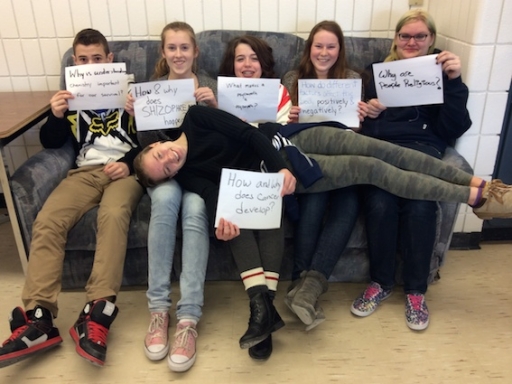
BUILDING MY IDENTITY AS A LEARNER, RATHER THAN A TEACHER



IDEAS TO SUPPORT EDUCATORS : Subscribe to the EdCan e-Newsletter
Quality research, reports, and professional learning opportunities.