Archive
-
Nova Scotia Report Cards make an odd bit of summer reading
Comments Off on Nova Scotia Report Cards make an odd bit of summer readingI have spent the better part of my first two weeks of summer vacation actually vacationing away from my home in Halifax this year. And although I promised to unplug, I could not refuse myself the guilty pleasure of checking the papers late at night by the campfire to see what might be trending educationally. And I was surprised to find the comment columns of Nova Scotia’s largest daily publication fairly awash in gripings, groanings and complaints about, of all things, report cards.
The entire kafuffle began on July 2nd when a piece appeared in The Chronicle Herald entitled “Parent’s Weary of Report Card ‘Mumbo Jumbo'”. The article was an attack on jargon filled report cards whose comments on student achievement left parents baffled. The next day, the CBC’s Nova Scotia office also ran a piece on how many parents were confused by the comments that were written on their students’ report cards, and how this complaint was widespread. As is often the case in this neck of the woods, criticism in the media was followed the very next day, July 4th, by an announcement from our Minister of Education that she would be looking at the way report cards are written in the province. The final word went to the papers, as it always does, this time in a scathing, wrap-it-up editorial on July 8th. The piece questioned Minister Jennex for claiming that these were the first complaints she had heard on the matter, Deputy Minister of Education Carole Olsen for suggesting that parents who were confused should call the school for clarification, and provided an overall berating of the Nova Scotia Department of Education for using an assessment software program called PowerSchool for this purpose in the first place.
Apparently, I should have delayed my vacation.
This issue, unfortunately, can not be faulted to any one individual or organization. It is actually the assessment experts who lie at the base of this ugly and unlikeable tree. You see, a few years back, the Province of Nova Scotia decided that it would begin to institute outcomes based education, or O.B.E., to standardize what was taught in schools.
And that’s when the trouble began.
As OBE took hold through the late nineties and early oughts, the idea began to develop that outcomes were carved in stone and were the only thing that could be assessed in the classroom. Curriculum guides were no longer guides as much as they were commandments. Teachers were told that they could no longer reduce points because a child submitted work late. Lateness was not an outcome. They were told that marks could not be reduced for work that was messy. Neatness was not an outcome. Teachers were told that they must not reduce points for things like homework, or class work, or behaviour. Because as important as these things might be, they were not outcomes.
There was research to support these ideas. Names like O’Connor and Guskey became well known around staff rooms. And as these ideas grew in popularity, the next logical step was reporting on student achievement using only the outcomes. If I could not give a student a mark on something that was not an outcome, how could I address it in a report card?
Now, all might have been right in the world if that had been a simple instruction to teachers. “Hey, folks. Let’s lay off the ‘Johnny is a good kid’ comments for awhile and tell parents what the kid needs to do to improve in the outcomes.” But, alas, many jurisdictions here in Nova Scotia took it one step further, instructing teachers that comments needed 1) an anchor statement explaining the student’s achievement of the outcomes followed by 2) an area of strength, 3) an area of required improvement, and 4) a strategy for making those improvements. These comments were to be solely outcomes based, less than 400 characters and approved by administrators. Comments deemed as not following the guidelines were sent back to be redone, often under exceptionally tight timelines.
So here was the dilemma of the classroom teacher. Create purposeful comments about student achievement following a rigorous standardized format using only references to the outcomes and wording that parents can understand and, oh, by the way, do not change the intent of the outcomes when messing with the wording. Got it?
Yeah, me neither.
The result, of course, was a recent series of report cards that have been aptly referred to as “robo-cards”. As more and more administrators concerned themselves with following assessment trends, more and more teachers were asked to redo, reword and recreate report card comments. It has finally reached a point where the only safe approach for many has been a “give ’em what they want” capitulation. This essentially boils down to an edu-jargon based report that, although satisfying the criteria, does almost nothing to tell parents how their kids are doing in schools.
The maddening thing for us teachers is that we have seen this coming. We knew the “outcomes only” approach would, if practiced chapter and verse, result in chaos. Because at the end of the day, we know that the outcomes are not important. It is not the destination, it is the journey that creates brilliant education.
We have learned many good things from the last few years of the standardization movement. But it is time to recognize that educating teachers in good practice then refusing them autonomy in the application of that practice is counterproductive at best, and counter-education at its worse.
Oh, and one last thing. I’ve done up a little report card for the CEA. They scored an “A”. My comment reads “The CEA had a great year in my class. Enjoy your summer!”
Mr. Frost
-
So What’s On Your Summer Reading List?
Comments Off on So What’s On Your Summer Reading List?As June melts into July, one can almost hear the anticipation as teachers and students across the country listen for the final school bell that signals the start of Summer 2013. And while many prepare to head off to vacation spots, splash pads and backyard sprinklers to unwind from what has been a busy and, in some cases, contentious school year, there are a great number of Canadian educators for whom professional learning, planning and dreaming about ways to improve their programs are a natural part of their summer lives!
For me, I always go to my bookshelf during this last week of June and pull down a few volumes—books that I may not have had the opportunity to get to during the school year, or ones that I may feel an urge to revisit. I thought that I would tell you briefly about the four that have made it to this year’s reading table. The interesting thing about the list is that, with one exception, these are not books directly related to education and schooling. Instead they center on the wider social context in which we live our lives. They may resonate with you, but you may have others that you have selected for your summer reading list.
Getting To Maybe: How the World is Changed by Francis Westley, Brenda Zimmerman and Michael Quinn Patton. I picked up this book at the very first Canadian Education Association I attended several years ago and have gone back to parts of it a couple of times. Grounded in complexity theory, Getting To Maybe challenges and inspires readers to look at the world around them from the perspective of social change, possibility and the relationshipis that are woven throughout each of our lives. For me, the book jarred me out of a mindset that had me looking at things from a linear, rational, problem-solving stance and opened up whole set of possibilities that emerge when the world is rendered complex as opposed to merely complicated.
Intimately connected with my first choice, How to Change the World: Social Entrepreneurs and the Power of New Ideas by David Bornstein taps into the growing energy around social innovation by dcoumenting the lives of people whose passion and ideas for change are transforming villages, towns and cities around the world. The thing that drew me to purchase this book in the first place was the promise that those featured in Bornstein’s narrative are not really all that famous. They are ordinary people doing extraordinary things—people who are cutting into the social, political and economic fabric of their local contexts to make a difference!
Inquiry as Stance by Marilyn Chocharn-Smith and Susan L. Lytle is an exciting addition to my library. The two authors, well-known for their work in connecting educators’ knowledge to the work that they do, have here tried to widen the circle around what counts as practitioner research and have sought to place the act of education-based inquiry in the context of other social change, innovation and justice conversations. This promises to be more than a book about teacher research. Instead, it could be just what the doctor ordered in terms of expanding the conversation around what counts as inquiry and the depth of insights and possibility that can come from adopting an attitude of Inquiry As Stance.
Finally, the most recent addition to my library, and a book that now sits on the top of my stack of summer reading is Human Dynamics: A New Framework for Understanding People and Realizing the Potential in Our Organizations by Sandra Seagal and David Thorne. I was drawn to this book a few weeks ago through a conversation with my new colleagues Don Simpson and Dawn Ralph. We were talking about how strong communities, teams and relationships are built by recognizing the diversity among us. Seagal and Thorne’s work outlines in vivid detail five of the most predominant personality profiles operating in Western societies and provides insights on leveraging those personalities to enhance communication, connectivity and learning in organizations. I’m very excited to discover how the principles of Human Dynamics might be able to inform our conversations about student diversity, but also how efforts to transform our systems of education might be inspired, not by policy mandates, but by stronger connections between the people at the center of our sites of practice.
Now I realize that this may seem like heavy reading for the dog days of summer, but with the appropriate pairing of text and refreshment, you never know what might happen! But, I present these here really as an invitation for you to share some of what is on your summer reading list. You may have things in mind that are directly related to education, but perhaps they resonate with other interests or passions that you may have. Feel free to share a couple of items on your reading table. Who knows, your suggestions may be just what one of us may be looking for as June melts into July!
-
Literacy Dons a Cape
Comments Off on Literacy Dons a CapeWhen you have a student body that is high energy, very tactile and physical, with equally vigorous and energetic personalities, you’d better be prepared to keep up! As a Language Arts teacher at Northmount School, an independent, all-boys elementary school in North York, Ontario, I set my sites in early 2012 on enhancing the Language Arts program with something that would capture my students’ imaginations – something with an inventive element.
Some of our boys are voracious readers, taking up to seven library books out at a time – but there are others who would not be reading independently were it not mandated by the Language Arts curriculum. My students are typically not interested in the nuances of relationships or ad nauseam descriptions as found in many of the novels touted to be excellent for junior and middle school readers (Tuck Everlasting, Little Women); instead they revel in stories about action. Role-playing games, Choose Your Own Adventure books, Warhammer, and other stylized activities and books reign supreme.
Into this amalgam came the idea of a comic book club. Having been a collector since I was nine years old, I wondered if the same zeal and enjoyment for these books might still exist with today’s children. Out of a population of 93 Grade 3 to Grade 8 students, a third joined the Comic Book Club. Clearly, I had struck a vein of potential gold!
In our Language Arts program, students learn the skills of inference, prediction, summarization, making connections, and character construction and motivation, which allow them to discover the world behind the book. Fascinatingly, I discovered that many of our comic book readers were already using this skill set.
As we, in the Comic Book Club, exchanged our various Spiderman, X-Men, Superman, and Avengers books, I observed that even some very reluctant readers remained absolutely silent and thoroughly focused. I asked a number of these students questions regarding plot, character, mood, theme, and complex vocabulary, while also employing terms like antagonist and protagonist. The responses exceeded my expectations. Recently, I interviewed Joe Kilmartin of the Comic Book Lounge and Gallery. When I shared my observations of my students, he commented: “With the world becoming very media/visually literate, someone who is learning English could use the comic book, engaging a sense of prediction and revision at the same time, by following sequential design, yet being able to flip back and restore the immediate visual hit again and again.”
The students played out scenarios in their minds and with their peers, engaging the higher-capacity thinking skills of analysis, synthesis, prediction and evaluation. But there was still a missing piece in this tremendous literacy experience.
The design of a comic book was the natural end goal of this literacy initiative. Students had only been expanding on the written word and the worlds fashioned by other authors; it was time they struck out and constructed their own fantastic realms.
Comic books had fueled their imaginations and provided a basis for writing to commence. Now I needed a program that would suit both reluctant and prolific writers. The popular Internet-based programs Bit Strips and Go Animate were good starting points. They structured the students’ mindset in regards to how sequential thinking and writing looked in a more dynamic form than their comic books, but they lacked the much-needed organizational infrastructure that powers graphic novels and comics. I searched the Internet for a program that would fill this missing gap, and I found it in Dr. Michael Bitz’s Comic Book Project/Comics Go Global initiative. Created in 2001 in partnership with Columbia University and Dark Horse Comics, the program, designed as a means to bring creativity back into children’s lives, recently became its own entity within the Centre for Educational Pathways in New York City. It can be found all through the U.S., in the United Kingdom, New Zealand, Australia, and now at Northmount School, its first school in Canada!
The Comic Book Project/Comics Go Global was truly that missing piece of best practice. Each student is given a character guide that narrows the creation process, and character creation is accomplished by the use of t-charts and other diagrams. Elements of graphic organizers are used to structure and storyboard the narrative, while blocking out each of the scenes. Participants are guided by the efforts of the organizing teacher and through satellite conferences with Dr. Bitz and other global participants who edit, guide, and share their work. Students then receive a 12-page booklet, closely resembling a comic book but with a blank cover and rectangles of varying sizes on the inside pages. The students’ stories unfold through these pages. The final edit of each student’s creation will be published on the Comic Book Project’s website. This publishing component, along with the global conferencing with other students, comprises the “Comics Go Global” side of the program.
This program was a masterful addition to the series we were already using, Six Plus One Writing Traits and Spectrum Writing. Essentially, participants learn sequential planning, thinking, and writing in a cloak of imagination and inspiration. The process of scaffolding writing ideas, using vocabulary lists (comic books have a high incidence of complex words), and graphic organizers found within the aforementioned programs and in Comics Go Global proved to be invaluable. While Internet-based programs perhaps provided a spark of novelty, this program tapped into the three pillars of boys’ enthusiasm for writing and reading: relevancy, duration, and exposure. Weekly conferences via Skype to New York and with our partner class in Indiana created a constant resurgence in passion for the project. Whenever technology can be incorporated into the writing process, it accelerates the desire of students to participate. Excitement reached a fever pitch when both Global Television and the Space Channel came to cover the Comic Book Project and our Skype sessions, and broadcast our project across Canada! Ultimately, the students’ comic books will be published online for the whole world to see. Truly the three pillars of boys’ enthusiasm were satisfied, as were many curricular tenets of media literacy.
In many respects, the Comic Book Project is a summative of sorts. It combines all of the strands, proficiencies and competencies of our Language Arts program, in a format that allows students to be the architects of their own worlds. What makes it truly unique is the thought and scaffolding behind the narrative of the comic book. While the videoconferences were the crescendo of the week’s work, the story talk and idea sharing amongst the participants were truly the idea factories in motion. I witnessed collaborative efforts, peer-to-peer critique without negative emotion or reaction, and the genuine application of higher-order thinking skills – not in some teacher-led discussion and response sequence, but rather occurring in independent and unsupported student application and learning. There was also a lot of fun taking place – the smiles and sound effects said it all. Our boys really got into their stories and began proposing the typical “what-if” scenarios and humorous accounts. They enjoyed designing their first comic book cover, using exemplars from the comic book club and their own collections to guide their way. A great deal of time was spent on the covers, as they also established their antagonists and protagonists there. Once through to the main body of the book, they stopped and worked on graphic organizers, so their stories would, as Mark D., in Grade 3, said, “Be really action packed and most of all, be understandable to the whole world!” After this, the panels, rich in text, imagery, and quality of vocabulary and story, began to be unveiled. It was an awesome sight when the prolific writer consulted with the reluctant reader on how to make his book shine, and truly spectacular when the voracious reader informed the reluctant writer that he had enjoyed his work. Yes, there is still very much a sense of wonder and magic in the pages of comic books – and now its readers have learned to cast their own spells.
First published in Education Canada, June 2013
Northmount School will become the national hub for the Canadian project launch and Mr. Von Vulte will be its national representative. Beginning in September 2013, independent schools and school boards across Canada will be offered an opportunity to become involved in Comics Go Global and the Comic Book Project in Canada. Mr. Von Vulte will be conducting the Skype sessions from Toronto. For more information, contact him at: manfred.vonvulte@northmount.com
-
The Children in the Numbers
Comments Off on The Children in the Numbers“The face that launched a thousand ships.”
“A picture is worth a thousand words.”
“The personal is political.”
Through the ages, astute observers have understood the extra motivation created by personalization. Establishing a human connection evokes emotion and is a powerful catalyst for motivation that inspires and moves us to action. The same is true in schools.
Student achievement goals are often rooted in numbers; but numbers seldom motivate humans working with humans. They hardly ever motivate teachers. In fact, numbers can hide our true goal as teachers: children’s learning. For example, consider the following “typical” learning goals established in schools in relation to improving student achievement:
“Our school is focusing on increasing the percentage of Grade 2 students achieving ‘acceptable’ on the district’s reading assessment from 72 percent to 80 percent over the next three years.”
“This year, our goal is to improve student absence rates from an average of 2.1 days absent to 1.5 days absent.”
“Over the next two years, we plan to decrease the number of suspensions related to male misbehaviour from 112 to 50.”
On the surface, there is little wrong with any of these three goal statements. Each statement meets the SMART criteria connected to effective goal development. Each is Specific, Measurable, Attainable, Relevant and Time-bound.[1] Each can be further developed with related strategies to promote attainment. The problem is that common school goals like these focus on overall averages, percentages, or totals. And that is where they can lack power. By emphasizing overall averages, percentages, or totals, two basic problems emerge: 1) numbers, rather than children, become the focus; and 2) subgroups or individual students can be hidden within the overall averages.
Focus on students
Sharratt and Fullan remind us, “We are wired to feel things for people, not for numbers.”[2] A goal like improving overall student absence rates from an average of 2.1 to 1.5 absent days may not inspire much passion or commitment. It is hard for teachers to get excited about making a difference for children when the focus is on nebulous “school averages.”
What if the issue were framed in the following way:
Last year, our overall student absence rate was 2.1 days per student from Grades 3 to 6. When examining our current student population of 300 students, actually 200 students missed less than a day all year! Another 50 students missed 2 or fewer days. However, 30 students missed 5-10 days and 20 students missed more than 10 days. We have compiled a list for each grade level of the students with 5-10 days absent, which are coloured yellow, and the students with more than 10 days, which are coloured red. Let’s start to talk about what actions we can be putting in place to specifically address these yellow- and red-coded students. Which yellow students can we reduce down to 2 or less days absent? With appropriate interventions, which red students could become yellow?
Such personalized focus shifts teachers’ conversations from general school-wide strategies to goals for specific students. Interventions can be established that focus on specific students and subgroups of heightened concern, and ongoing monitoring can be established to focus on individual student progress.
Consider this literacy example:
In previous years, the Grade 3 team used multiple measures to determine students who were reading at grade level upon entering and exiting Grade 3. Last year, we succeeded in raising students’ overall entry to exit progress from 75 percent to 82 percent, although students fell short of our goal of 85 percent overall. This year, the grade-level team will focus on individuals rather than the overall average. The team has found that 22 students entering Grade 3 are not yet reading at grade level. They posted these students’ pictures whenever they met as a Grade 3 team; and, by mid-year, they already knew that Susan, Michael, Philip, Esther, Frank, Desmond, and Cecilia were well on their way to reading at grade level. That only leaves another 15 students to place special attention and focus on for the remainder of the year.
It is easy to see that the approaches taken in the two examples personalize and make learning goals about children, not numbers. We are not suggesting that schools eliminate the formation of goals, and we subscribe to the power of SMART goals as foundations for sound school improvement. However, attempting to raise an overall school average by 5 percentage points likely will fail to elicit the commitment needed to succeed. By contrast, when specific students are identified and collectively targeted, the overall averages, percentages, and totals will take care of themselves. Teachers will expend tireless efforts when they see a difference being made for one child.
First steps
When starting to focus on children rather than faceless averages, consider using pictures. It is powerful when teachers see the faces of those children most in need of everyone’s support. We are not suggesting public displays that inherently ostracize children and families! But in closed staff or team meetings, sharing children’s photographs on PowerPoints or posters personalizes the goal.
We have experienced a celebratory final staff meeting where, rather than showing a bar graph of yearly school progress from 75 percent to 78 percent reading proficiency overall, photographs of students who moved from at-risk to at grade level were shared. The emotion and celebration among teachers was inspiring, and they shared success stories with each other and found it fulfilling to see for whom exactly they had made a difference. The buzz in the room also definitely motivated teachers to continue to build upon these successes. There were still students who needed help!
The importance of disaggregation
Moving from overall to individual analysis more than just inspires and creates purpose. It pulls back the veil to display children (and sub-groups of students) who can be lost when focusing upon overall averages. Consider Alan Blankstein’s observation:
Data represent all groups within a school. Overall averages can hide persistent problems that do not reveal themselves until the data are disaggregated in order to describe each group that makes up part of the student population. A school can take pride in the fact that its mean Grade 8 reading score is at the 72nd percentile, but that figure may hide evidence that although 10% of the class reads at the 99th percentile, a troubling 15% are reading below the 40th percentile. Unless this school examines disaggregated data, the needs of 15% of its students may be overlooked.”[3]
We further suggest that the “lost” 15 percent in Blankstein’s example should be individually identified, regularly monitored, and supported through specific interventions or focused strategies. In addition, sometimes successful overall scores and averages can foster or promote a degree of comfort (at best) or educational apathy (at worst) within a school. Our experience suggests that it can be difficult to create a sense of urgency for that small sub-group of students that remains at-risk when heralding the success of a superior overall average.
A school where 91 percent of students are proficient in reading has achieved an outstanding accomplishment. We should take time to celebrate this school success. Then, let’s go back to work! There remains nine percent of the population (almost one child in ten) still not achieving at grade level. Those children may be frustrated, upset, confused, hurting, and blocked from growing towards personal goals. We are still falling short of our mission to ensure success for all our students – each child.
Numbers distance; faces motivate. By remembering that a single child’s learning success is our ultimate teaching goal, schools can ensure the development of strong emotional connections between educators and their students that carry a sense of urgency. The faces of children should be the goals of our teaching – it is these young faces who will launch our ships.
First published in Education Canada, June 2013
EN BREF – Les cibles de réussite des élèves sont souvent numériques, mais les chiffres motivent rarement les individus qui travaillent avec d’autres personnes. Les chiffres créent de la distance, les visages motivent. Au lieu de s’appuyer outre mesure sur des cibles globales de réussite, les écoles et leurs éducateurs doivent trouver les enfants derrière les chiffres. Établir un lien humain engendre l’émotion, puissant catalyseur d’une motivation qui inspire l’action et qui rehausse les efforts d’amélioration dans les écoles.
[1] P. J. Meyer, “What Would You Do if You Knew You Couldn’t Fail? Creating S.M.A.R.T. goals,” in Attitude Is Everything: If you want to succeed above and beyond (Meyer Resource Group, 2003).[2] L. Sharratt and M. Fullan, Putting FACES on the Data: What great leaders do! (Thousand Oaks, CA: Corwin, 2012), p. 2.[3] A. Blankstein, Failure Is not an Option: Six principles that guide student achievement in high-performing schools (Thousand Oaks, CA: Corwin, 2004), p. 150. -
Telling Time with a Broken Clock – by Joe Bower
Comments Off on Telling Time with a Broken Clock – by Joe Bower“The more we learn about standardized testing, particularly in its high-stakes incarnation, the more likely we are to be appalled.” — Alfie Kohn
What do standardized test scores really tell us? Like many public policy issues, this is a complex question – yet too many people assume to know the answer. Whole school jurisdictions and entire nations define themselves by their standardized test results, including provincially administered examinations and international instruments such as the Program for International Student Assessment (PISA). All of these programs, justified by their so-called impartiality and objectivity, share the assumption that the scores must be the public’s “transparent” window into the quality of our schools.
Bestselling author and blogger Seth Godin reminds us that the worst kind of clock is a clock that randomly runs fast or slow. “If there’s no clock,” Godin writes, “we go seeking the right time. But a wrong clock? We’re going to be tempted to accept what it tells us.”[1] Godin’s message is that tracking the wrong data or misreading good data can get us into trouble. What if standardized test scores aren’t telling us what we think they are telling us? What if the scores are illusions that are giving us false confidence? What if our reliance on standardized testing to judge our schools is like relying on a broken clock for time?
If education policy pundits (many of whom are not teachers) and politicians expect the public to trust the scores as prima facie evidence of the quality of teaching and learning that goes on in our schools, then the public needs to know more about the costs and consequences of standardized testing. It is time to move past our historic reliance on standardized testing programs driven by educational bureaucracies satisfied to measure what is easiest to measure. Canada’s already strong public school systems will not punch past their current levels of performance unless we move to a new approach to public assurance.
Measuring what matters least
Ask any parents what their long-term concerns and goals are for their children, and seldom will you hear about test scores and world rankings. Their concerns are compelling, existential and heartfelt. Parents want their kids to be happy, hard-working, motivated, responsible, honest, empathetic, intelligent, collaborative, creative and courageous. Of course we want our children to grow academically, but we also want them to grow emotionally, socially and physically, and this requires a well-rounded education that cannot be evaluated by standardized tests. This is not an argument against academics; academics should play a large role in school. However, even when it comes to numeracy and literacy, standardized tests tend to be limited to measuring forgettable facts while ignoring the higher-level creative and critical thinking. It makes a lot of sense to question the scores when you know that the tests are a contrived and unrealistic form of assessment that measures what matters least. It’s time we shifted from valuing what we measure to measuring what we value.
Campbell’s Law
Well-known (but not well-known enough) in social science, Campbell’s Law tells us that “the more any quantitative social indicator is used for social decision-making, the more subject it will be to corruption pressures and the more apt it will be to distort and corrupt the social processes it was intended to monitor.”[2] In the case of standardized testing, corruption and distortion can come in a variety of ways. Here are three examples:
Teaching or testing? Teaching to the test and excessive test preparation invalidates inferences that can be drawn from the scores – yet they are the inevitable response to pressure to produce good test scores. Classroom time is devoured by not only the tests themselves but also practice tests, pre- and post-tests, field tests for the tests, benchmark tests, teacher tests, district tests, and state or provincial tests. Because testing is not teaching, this ultimately leads to a loss of opportunities for students to have a broad range of educational experiences, and the first things to go usually end up being the arts and physical activity – which do not lend themselves to be easily tested.
Learning or cheating? The moment low-stakes test scores are publicized to rank and sort teachers or schools, they become high-stakes tests. Where there is smoke, there is usually fire, and where there is high-stakes standardized testing, there is cheating. We can bemoan this inconvenience or play the blame game, but it won’t change anything. Systems thinking tells us that cheating has less to do with the characteristics of individual teachers or students and more to do with the priorities of schools and school systems.
Raising children or raising scores? When schools are encouraged to focus on test scores, some come to see children less as individuals of worth regardless of their academic ability, and more as score increasers and score suppressors. Sadly, the more the scores are made to count for teachers and schools, the more the scores count against the children who need the most help. They will be seen as undesirable; after all, they are the students most likely to score low, dragging down the school’s ranking. This becomes even truer when (as in the U.S.) merit pay schemes marry teacher pay to the scores and/or when a school’s reputation hinges on being publicly ranked. Under these twisted circumstances, schools may come to know more about raising scores than raising children.
We can no more skirt the real-world ramifications of Campbell’s Law than Wile E. Coyote could avoid the punishing effects of gravity. Nichols and Berliner explains, “apparently, you can have (a) higher stakes and less certainty about the validity of assessment or (b) lower stakes and greater certainty about validity. But you are not likely to have both high stakes and high validity. Uncertainty about the meaning of test scores increases as the stakes attached to them become more severe.”[3]
Socio-economics
Alfie Kohn begins his article “Fighting the Tests: A practical guide to rescuing our schools” by stating, “Don’t let anyone tell you that standardized tests are not accurate measures. The truth of the matter is they offer a remarkably precise method for gauging the size of the houses near the school where the test was administered.”[4] The inconvenient truth about standardized testing is that socio-economic status is responsible for an overwhelming proportion (50 to 70 percent) of the variance in test scores. The strongest predictor of student performance on achievement tests is socio-economic status, which is why it is a mistake to believe that the scores tell us about school quality when really they are reflecting affluence or poverty.
No school or school system has ever become great without great teachers, but what can an excellent teacher do about a child who needs glasses or is hungry? To say that teacher or school quality is the most important variable in education is at best naive. Education historian Diane Ravitch writes, “Reformers tell us that teachers are the most important influence within the school on student scores, and that is right. But the teacher contribution to scores is dwarfed by the influence of family and other out-of-school factors.”[5]
Ultimately, great teachers make great schools, but great teachers can’t do it alone – they require the support of an equitable society. If we are not careful, we risk misinterpreting the scores, and instead of waging war on poverty and inequity, we end up waging war on teachers and schools.
Dispelling the corporate “reform” agenda
Alongside the rush to introduce unproven technologies into classrooms, standardized testing in the United States has become a political instrument wielded by organizations such as Students First, Democrats for Education Reform and the American Legislative Exchange Council. Linking teacher pay to student test scores, and eliminating tenure and collective bargaining, have become popular methods for undermining confidence in public schools so that education entrepreneurs can pour private equity and venture capital into companies that aim to profit from public education.
After a decade of intense standardized testing and sanctions under No Child Left Behind, California Democrats recently passed a resolution stating, “The reform initiatives of Students First rely on destructive anti-educator policies that do nothing for students but blame educators and their unions for the ills of society, make testing the goal of education, shatter communities by closing their public schools, and see public schools as potential profit centers and children as measurable commodities.”[6]
Over the last two decades, the U.S. has proven to be a cautionary tale for how Canada, and the world, should not reform education, and Canadians would be wise not to think that the 49th Parallel offers any inherent insulation from the corporate education reform agenda.
Building a better clock
The way forward is not to build schools that are a better version of yesterday. It is telling that the demand for standardized testing intensifies the further you get from classrooms, and yet authentic accountability and public assurance needs to happen within schools and communities.
A move away from standardized testing is not a case for the absence of accountability – it is a pathway to supporting innovation and creativity. Ruth Sutton reminds us, “The issue is not whether we need information about the learning and achievement of our children and young people, but what kind of information we need, and how best to gather it.”[7] Once we can see that standardized testing is like a broken clock, we can work together to figure out how to build a better clock.
Building a better clock and better schools starts with asking tough questions – which is precisely the spirit behind an Action Canada Task Force report titled Real Accountability or an Illusion of Success?[8] that invites Canadians to take a deeper look at the goals of public education and the role of standardized testing.
Alberta should be congratulated for their recent move away from their Grades 3, 6 and 9 Provincial Achievement Tests. Now Alberta requires the insight and courage to see that the replacement for the old tests should not be new tests. From a policy perspective, accountability models based on census testing of entire student populations do little to support student progress and are not cost effective. A shift to a sample program using performance-based assessments would be less obstructive, cost less and provide more meaningful information.
Given the highly relational nature of the teaching and learning process, the best teachers know that assessment is not a spreadsheet – it’s a conversation. They also know that there is no substitute for what teachers observe while their students are actively learning, and this is why the best assessments ask students to actually do something that is in a context and for a purpose. Unlike standardized tests, which cannot provide anything more than an incomplete snapshot of a student on a single day, a collection of performance assessments assembled in a learning portfolio can inform the teaching and learning process in a timely fashion, while simultaneously assuring the public that students are receiving a high-quality education.
To enhance public assurance, Andy Hargreaves suggests departments of education should shift from a “bureaucratic accountability model to a locally focused, student-driven assurance model based on school-development plans and teachers as leaders in innovation.”[9] The means for accomplishing this can be found in programs like Alberta’s Initiative for School Improvement (AISI), which was recently axed by the Alberta government. A number of similar school improvement initiatives exist throughout Canada, but are also vulnerable to cuts by governments that use times of fiscal belt-tightening as an excuse to reduce investments in innovation.
It might be argued that standardized testing has allowed us to build good enough schools; after all, even a broken clock is right twice a day. However, business guru Jim Collins reminds us that “good is the enemy of great.” If we aspire to create great schools for all children, we need to seek an end to standardized testing and replace it with more sophisticated and demanding processes for public assurance.
First published in Education Canada, June 2013
EN BREF – Que nous révèlent les résultats d’examens normalisés? La question est complexe, pourtant trop de personnes présument en connaître la réponse. Et si les résultats aux examens normalisés s’assimilaient à une horloge déréglée diffusant des renseignements erronés? Une véritable reddition de comptes, c’est fournir au public les renseignements qu’il requiert sur les écoles publiques. C’est donc une question de transparence. Mais les examens normalisés tendent à obscurcir plus de choses qu’ils n’en révèlent. Le temps est venu de les remplacer par des processus plus évolués et plus exigeants.
[1] Seth Godin, “The Worst Kind of Clock,” Seth Godin (Blog), September 21, 2012, http://sethgodin.typepad.com/seths_blog/2012/09/the-worst-kind-of-clock.html.
[2] Sharon Nichols and David Berliner, Collateral Damage: How high stakes testing corrupts America’s schools (Massachusetts: Harvard Education Press, 2008), 26-27.
[3] Nichols and Berliner, Collateral Damage, 27.
[4] Alfie Kohn, “Fighting the Tests: A practical guide to rescuing our schools,” Phi Delta Kappan (January 2001). http://www.alfiekohn.org/teaching/ftt.htm
[5] Diane Ravitch, “Why VAM Is Junk Science,” Diane Ravitch’s Blog, July 16, 2012, http://dianeravitch.net/2012/07/16/why-vam-is-junk-science
[6] The California Democratic Party, Resolution 13-04.47: Supporting California’s Public School and Dispelling the Corporate “Reform” Agenda (April 14, 2013).http://www.cadem.org/admin/miscdocs/files/Resolutions-Report-FINAL-2.pdf
[7] Alberta Assessment Consortium, A New Look At Public Assurance: Imagining the possibilities for Alberta students. http://www.aac.ab.ca/resources/pdf/Public%20Assurance%20Doc_final_may31.pdf
[8] Real Accountability or An Illusion of Success? A Call to Review Standardized Testing in Ontario. Action Canada Task Force Report.http://testingillusion.ca/wp-content/uploads/2013/01/illusion_of_success_EN.pdf.
[9] Andy Hargreaves, foreward to A Great School for All: Transforming education in Alberta (Edmonton: Barnett House, 2012).
-
So, These Three Strings Walking Into A Classroom
Comments Off on So, These Three Strings Walking Into A Classroom[ibimage==4951==Original_size==none==self==null]
CC photo by: horizontal integration
From my earliest years, I’ve always been known as someone who loved comedy. On days when the bookmobile came to our elementary school, I remember gravitating towards joke and riddle books before the more sought after “chapter books” that my peers were reading. In 1966, the year I was in grade two, our family received our first record player for Christmas, along with two LP’s: a Perry Como Christmas album and Bill Cosby’s “Why is There Air?”. The latter was my first experience with stand-up comedy and I remember listening to that album until it wore out. Someone was speaking my language.
By the time I entered grade eight, my love of laughter and comedy was pretty well-established and pretty well-known. In fact, my classmates—and my teacher—were all aware of the fact that, if Hurley really started to laugh, there would be no way that any work was going to get done until I stopped. The fact I could find humour in the smallest details of life actually turned into a strategy that other kids—and my teacher— would use to get out of having to do work. Get him laughing and we might miss Math!
On Sunday nights, I used to sleep with the radio under my pillow so that I could listen to the “Sunday Night Funnies” on a local rock station. An hour of stand-up comedy just before having to return to school on a Monday morning was just what the doctor ordered. To this day, my favourite radio station is a 24/7 comedy station that has started to broadcast locally. In fact, it was during yesterday’s four hour feast of stand-up during a long drive to supervise a teacher candidate that I began to think about the role that the intentional use of comedy could play in the life of our schools. What might happen if both the study and experience of comedy and laughter became part of the culture of our classrooms?
Brain science is now beginning to affirm what the folks at Reader’s Digest have sensed for many years: Laughter is a great form of medicine. We are, for example, learning that laughter can help reduce stress, boost our immune systems and help people connect. Emerging studies looking at brain activity during periods of laughter are indicating that some of the things that we find funny actually cause us to use a large portion of our brain. This could be owing to the fact that jokes, riddles and other forms of comedy are structured so that deeper cognitive connections need to be made in order to find something funny.
Consider your favourite comedy bit. We are drawn into some sort of connection with the scenario being described, it resonates with us, we’re following along and BAM—there’s a comedic turn that totally surprises us and we begin laughing. It’s more complicated than that, I’m sure, but you get the point. Good comedy is well-crafted with much of the same narrative structure as an engaging story. We are hooked by the familiarity and delighted by the twist that comes in the punchline.
Now I’m not suggesting that schools install “Now Appearing” marquees on the front lawn. Nor am I suggesting that we add Comedy to our list of curriculum responsibilities. But I am suggesting that we start to take seriously the importance of laughter and the power of comedy in the lives of our students and our teachers.
On a very basic level, more opportunities to laugh can only help to relieve the stress that often builds up in our learning environments. In my own classroom, I used to put on classic comedy tracks at various points in the day, just to lighten things up a little. I wonder what might happen if we allowed students to listen to appropriate comedy just before provincial assessment periods or final exams.
Many teachers find the use of humour in the presentation of lessons to be a wonderful tool for engagement. Hooking people with a joke or a story is a well-used strategy for public speakers.
Socially, the experience of sharing of a humourous experience together can bind groups together. People that hang out at comedy clubs know this. In fact, there may be some room here for exploring the effect that the intentional use of humour and comedy can affect social tensions that can lead to things like bullying. You may have stories of that student that surprised everyone at the annual talent show by getting up and performing a 5 minute comedy sketch that she had written.
On a deeper level, looking at the structure of comedy—the way that jokes are constructed, the way that comic stories are written—can prove to be a wonderful tool for literacy development. Comedy as text that students learn to read and write could be effective on so many levels.
As you can see, I’m just starting to explore the idea, but I think that it has more legs than we might first imagine. On so many levels, I can see the use of laughter, humour and comedy becoming much more than something that is relegated to the schoolyard.
What is your experience of laughter and comedy in your life as a student, an educator or a parent? Could we be missing an important way to connect with our students and our colleagues? What ideas do you have for integrating comedy and laughter into the life of your school? A comedy festival? A lunch hour comedy club? A comedy writing workshop?
So, these three strings walk into a classroom…
-
STEMming the tide of creativity in schools
Comments Off on STEMming the tide of creativity in schoolsThis time of year, I find myself having the same conversations with students with what seems like increasing frequency.
Me: “Hey Janice! I see you are doing your course selections for next year. Coming back to drama?
Janice: (With a pained, embarrassed and somewhat apologetic expression) “Sorry, Mr. Frost. I can’t take Drama in grade 11. I have to get my (*Insert Science class here) next year. I will be a) too busy or b) have no room in my schedule.”
If I had a nickel for every time I heard that, I might actually be able to retire at a reasonable age. Whether it be Advanced Placement this or High Academic that, students in our public schools, it seems, are often forced to choose. And for many, the choice is not really a choice. As a society, many Canadians seem to think of Arts education as a quaint little endeavour, meant to serve no greater purpose than to “round out” a course load. A nice little diversion from the rigors of academia. Not to be dismissed, mind you, unless of course, it gets in the way of true educational pursuits.
It seems that even here in Nova Scotia, where we tend to be fairly Art centered, we are not immune to the view of Arts education as secondary subjects. We like to say that we consider the Arts as valuable as the core sciences, but proof to the contrary can be found in the latest move by our Province towards a full year math program in grade 10. One day, the media is reporting that our math scores are low and the next day, BAM!, a brand new full year math course and a brand new curriculum. This may mean better math students, but it may also means students with fewer course options. I would love to see what sort of media storm could bring about a similar result for, say, dance.
There is a large body of research that points to the retention of math skills being inversely related to time away from the classroom, so I certainly see the value in a full year math credit. But why must there be a trade-off? Why must the pursuit of one academic path so often eliminate the exploration of another?
For many students in our schools, this is the reality that is their high school experience. In school after school, year after year, this conversation is repeated. Students must choose between courses which they feel, (and are often told), are valuable and those which are self enriching. The recent rabid “slash and burn” approach to cutting public education funding certainly has not helped the matter. I have always considered this constant, often one-sided battle for students as a fundamental structural flaw in the system. And the more I read about education, the more I see people who are agreeing with me.
All over the world, from Canada, to the US, to the U.K., people are recognizing that in order to remain vibrant and innovative, economies need to embrace areas of development outside what has been referred to as the STEM core (Science, Technology, Engineering, Math). Just this past week, the Globe and Mail carried two such stories, one talking about how educator’s in Oklahoma are working toward focussing more on the Art , and one from the UK, which had an expert exclaiming that “creative types…are key figures who have the potential to push stagnant economies back into growth.”
It is interesting to note that both these articles appeared in the paper’s business section.
I am not anti STEM. I am simply pragmatic. We want innovation and creativity in our villages, towns and cities. We want vibrant, engaged next generations. We want new ways of approaching old problems. If this is what Canadians truly want, then we need to see the value in a wide based approach to public education which equally foots Chemistry and Drama, Physics and Dance. Yes, it will cost. But to not encourage creativity and innovation among our youth will ultimately prove much more expensive.
-
Children Should Be Seen and Not Heard!
Comments Off on Children Should Be Seen and Not Heard!It’s not uncommon to hear those advocating for deep and resounding change in education to introduce their position by reminding us that our current way of designing, organizing and “doing” school is based on principles inspired by the industrial revolution: a time when mass production, factory-based assembly lines and a whole culture of efficiency began to replace home-based, hand-crafted and time-intensive approaches to the creation of goods. Our attempts to create a new vision for schools, and for the type of education that occurs there, are constantly bumping up against the deeply rooted assumptions and beliefs that are part of this industrial-age thinking.
But there’s another equally stubborn set of assumptions that runs alongside this industrial mindset—a set of assumptions that is currently being challenged by some of the work being done on student engagement.
Isn’t it just a little ironic that so many initiatives are emerging that seek to raise the voices of students when, in fact, schools were designed to do just the opposite.
Consider for a moment how the very familiar proverb, children should be seen and not heard has had a profound influence on the practice of schooling. From the assumption that a quiet classroom is a well-run classroom to the image of groups of students walking silently through the halls. From the requirement that students raise their hands in order to speak, to the expectation that tests and evaluations, in order to be legitimate, must be completed in silence. From the familiar warning, “Shh…the teacher’s coming!” to the admonition, “Boys and Girls, please keep your voices down!”
Isn’t it just a little ironic that so many initiatives are emerging that seek to raise the voices of students when, in fact, schools were designed to do just the opposite. Take a good look at the physical structure of school buildings, the way that students are gathered into physical spaces, the rules governing movement from place to place, the way that curriculum and programs are designed and delivered, and you’re likely to realize that there isn’t a great deal of room for the honest and authentic voices of our students. These very familiar and recognizable aspects of the school experience may have been fine for a time when the authority of the teacher was central, but they quickly become curiosities when we attempt to make room for other voices.
Yet we know that deep levels engagement are intimately connected with real and meaningful opportunities for student participation through both voice and choice. And at both local and regional levels, the valiant and innovative energies of educators are starting to capture some imaginations and inspire further action. Some are looking to redesign traditional school spaces in order to encourage and facilitate more conversation, dialogue and collaboration among students. (For some great resources on thinking about this on an “elemental” level, see the DesignShare Project: The Language of School Design).
Many educators are beginning to work with colleagues to redesign school timetables, curriculum relationships and pedagogical approaches to create more open spaces for student voice. (See this year’s Ken Spencer Award Recipient project descriptions.
On February 28th, Clarence Fisher (@glassbead), Heather Durnin (@hdurnin) and Andy Forgrave (@aforgrave) had the courage and ingenuity to begin the Hive105, and internet-based radio station that has as a mission and vision to provide students with a motivating opportunity to develop comfort sharing their voices
And on May 13, 2013, Canadian educator Darren Kuropatwa (@dkuropatwa) tweeted from a student led unconference held at the Winnipeg Technical College.
All of this is hopeful, inspirational forward-thinking and inspirational. It really is! It is, however, just the beginning. Despite what we know about school design I would venture to suggest that most new schools are still erected using the same basic architectural blueprint that has been used for the many years, without being informed by current learning research or serious consultation with educators, students and the community. (I would be very happy to be proven wrong on this. Despite what we know about the effect that powerful conversation can have on learning, schools that I visit are still pretty quiet places—still a definite division between indoor and outdoor voices!
I’m thinking that the way many of us think about school is still very much influenced by the snippet of wisdom: children should be seen and not heard.
So two different items to place before you.
First, tell us about the initiatives in which you’ve participated (or ones that you know of) that have aimed to raise the voices of our students in meaningful and effective ways.
Second, what would you change about your school design (physical, or otherwise) that would help you to raise the voices of your students on a more authentic level.
In collecting instances of people working on the edges of school design, and imagining how that energy can become part of the way that we think about our own environments, we may be able to begin to challenge some of those assumptions that still hold us firmly grounded in our traditional practices and approaches.
-
Not Reformation…Not Transformation, but Restoration
Comments Off on Not Reformation…Not Transformation, but RestorationI have a bucket list, but it’s not the one derived from the movie of the same name. No, my bucket list is a compilation of all the household chores that I’m unable to complete in a cursory manner. The things on my bucket list, generally speaking, require a bucket—as well as warm soapy water, scouring pads and a lot of elbow grease. Like many of you, these are things that, while not necessarily appealing at the moment, end up leaving us with a feeling of deep satisfaction and pride.
Late last week, inspired by weather that far exceeded my expectations and accompanied by a brand new bucket, a selection of cleaning supplies, my iPad and an afternoon beverage, I headed to the backyard to tackle one of the dirtiest jobs on my list. I know, I really should have done this late last fall, but I assured myself that I would continue to cook outside during the winter months!
I purchased a new grill last year, justifying the extra cost by making a firm (!) commitment to its maintenance and care, so this was an important task. After watching a YouTube video produced by the manufacturer, I began the task of dismantling the appliance, piece by piece, and laying it carefully out on the patio. As expected, I was initially overwhelmed by the enormity of the task ahead of me.
But as I examined the various pieces of cast iron and stainless steel that lay before me, it suddenly struck me that this wasn’t just a cleaning job but a project in restoration.
The layers of grease that had collected in the various nooks and crannies could not simply be wiped away with a damp cloth or dissolved with some caustic chemical. They needed to be loosened and scraped away—layer by layer, bit by bit. The igniter tubes could not just be dusted off. The particles of residue that can clog the fine openings in each tube required some very careful brushwork, with the appropriate tool, and in the proper direction. The stainless steel coverings and shelves couldn’t be quickly wiped down. Instead, the degreaser that I used needed some time to work before being shone back to their original lustre.
Whether we’re talking about an outdoor grill, a piece of antique furniture, a system or a human life, restoration is something that takes time, attentiveness and effort. It’s not for those in a hurry, or those without a belief that something worthwhile lies in wait beneath the accumulated layers of stuff. In a culture that, increasingly, appears to favour quantity over quality, fast over slow, information over knowledge and disposablity over longevity, it is difficult to begin a conversation about restoration.
But it’s an idea that has lingered with me throughout this past week, and its an idea that I would like to dedicate some time to in the weeks to come.
What if we were to shift some of our discourse about school reformation—even transformation—to one of restoration? Instead of adding more and more layers to our systems of education, what would it look like if we started to strip away some of what has built up over the decades? What might we discover if we took the time to look at what lies beneath the surface? What might we learn about our core values and purpose if we adopted a restorative perspective towards education? What might we discover about the people who enter our schools everyday?
What if we were to add restoration of our systems of education to our bucket list?
-
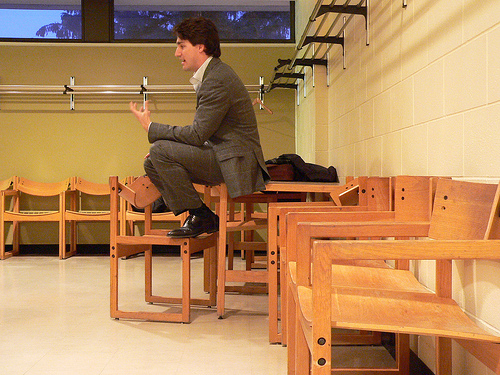
Drama teaching experience NOT going to help Trudeau
Comments Off on Drama teaching experience NOT going to help TrudeauRecently, a great deal of concern has been expressed around the Tory ad campaign attacking Justin Trudeau as “too inexperienced” to tackle the complexities of being Prime Minister. As well, a great deal has been made about the slant the Tories have taken in this campaign, which points to Trudeau’s past work experience as a detriment to true leadership. In particular, his experience as, of all things, a drama teacher, has caused his leadership ability to be questioned.
-
Our Roots Are Showing
Comments Off on Our Roots Are Showing“Sir, why are we learning this?”
“Miss, when am I ever going to use this?”All of us will likely recall asking similar questions ourselves at some point along our journey through school. Those of us who are teachers, especially those involved with students older than, say, TEN, will likely have memories of that uncomfortable silence that hangs between, “I don’t know what to tell you” and “I should know what to tell you”. As a grade eight teacher, when all else failed, there was always an easy—but less than satisfying—default position. “You’ll need to know this for high school,” I would say, a little bit of an edge to my voice.
It is always a little discomforting when the context for learning is expressed as preparation for the next stage of learning. While there is no denying the fact that there are many aspects of learning that, necessarily, build on accumulated skills and knowledge, when it comes to creating a context for learning, the storage for future reference argument is never that inspiring.
The parochial roots of our education systems are showing and they are holding us back from taking seriously the renewed conversations about widened contexts for learning that we so desperately need to be having. Oh, we’ve done a fine job of imagining what transformed schools could look like if we opened up the doors of the schoolhouse to new technologies. We’ve dreamed of learning spaces that both reflect and encourage a focus on skills like collaboration, creativity and communication. We’ve talked about forging new types of relationships between schools and the wider communities that surround them. This is all important stuff but, to borrow from Simon Sinek’s now famous TED Talk , it is the stuff of the what and not the why.
Yet, when we talk about creating a context for learning that is, at once, compelling and inspiring for all involved, we need to hold the why firmly in front of us. Perhaps the best way to reconnect with the why of schooling is by looking closely at the curriculum structures that currently form the foundations of modern schooling. Instead of asking how we can make history more interesting, science more relevant and mathematics more accessible, let’s start to take a deeper look at why these disciplines are important to our sense of quality education in the first place. Curriculum reform movements, including the ones that are happening across the country, and south of the border, all seem to begin with questions about what is important to know and be able to do at various stages of the educational process. But what might happen if our energies were first spent on coming to a clearer understanding of the purpose behind studying particular disciplines and what that study can do to nurture our vision of the educated person?
Why is it so important that we learn history? What is it that science can do for our individual and collective consciousness? What is it about mathematics that contributes to our image of a civil society? Why continue to study the great literature of both the past and present? These are questions that are often glossed over when we talk about new approaches to curriculum and pedagogy.
But they are the very questions that will help us to engage in deeper, albeit more philosophical, conversations about deeper and richer contexts for learning.
In his brief, yet powerful, essay, The Reform of Thinking and Education in the Twenty-First Century, philosopher/sociologist Edgar Morin suggests four foundational aims of education:
1) A brain well-formed rather than a brain well-filled
2) Learning about the human condition
3) Learning how to live
4) Citizenship training
In Morin’s view, curriculum needs to placed in the service of our aims, and not the other way around. And he starts to provide some engaging thinking around how our thinking about existing curriculum approaches might begin to change.
For example, when science is seen as a way of helping us place human existence within the cosmic story, a powerful and compelling context is created. When the study of history takes on a similar narrative purpose by helping learners to better understand the creation of communities, nations and cultures, then the discrete facts that we associate with the discipline take on a a richer and more meaningful purpose.
But, Morin argues, education is also about the subjectivity that can be realized and understood through the study of literature, poetry, art and media. These are the places where the human condition is brought home and placed in the context of personal and interpersonal relationship. It is here where the art of living is explored and connections among individuals and cultures are made manifest. And what’s more exciting, possibilities for connections between traditional disciplines become much more apparent and realistic
In a sense, curriculum is the place where the dance between the objective and subjective, between the global and personal contexts, takes place—an important and necessary dynamic! For me, the exciting part of this type of thinking is that it brings us face-to-face with the why of our work as educators. It doesn’t in any way discount the importance of learning content but it forces us to make our intentions very clear around how it fits into the wider context of our work.
How might our response to the why are we learning this questions change if these types of these deeply-rooted conversations began to take place at all levels of our education systems, throughout our communities, and in the public square?
-
Students determine the classroom rules
Comments Off on Students determine the classroom rulesEvery year at this time, right when the cherry blossoms are reminding us that the grey days of winter are almost gone, my Grade 8 students go crazy. They start taking a really long time to settle down into the silent reading period that starts most of our classes. They can’t help but talk to a buddy across the room. They squirm around in their desks and look to their groups for conversation, until I remind them to open their books and start reading. And then I remind them again. And again.
A couple week ago I realized that I had turned into a nag: I do Not. Like. Nagging.
-
Putting 21st Century Learning in Context
Comments Off on Putting 21st Century Learning in ContextGrowing up, I knew a whole lot about Anteaters, Aardvarks and Africa.
Walla Walla and Zanzibar? Not so much.
You see, beyond the walls of my school, the only consistently accessible sources of information were the 3 sets of encyclopedias that graced our living room bookcase. The challenge was that they were somewhat incomplete. We owned four volumes of the Columbia Encyclopedia; the first volume of Funk & Wagnall’s New Encyclopedia, 1968 and 1969 and, curiously, Volume ‘M’ of the World Book. My best explanation is that the latter was spirited away from our elementary school library during a project on either Magellan or Madagascar! The only inspiring thing about our little collection was the spine of one of the Columbia editions: Volume 4—DARE to DREAM. (Admittedly, that may only resonate with those steeped in encyclopedia culture!) I kept that one close to me.
It seems that in the 1960’s, grocery stores had forged occasional partnerships with major publishing houses to provide the opportunity for shoppers to combine their weekly shopping trips with the purchase of a reputable source of knowledge for their family. The first few volumes were offered for $0.99 each, and after that, the price increased to the point where my parents eventually stopped purchasing—at least until the next offer came along. As a result, much of the knowable world beyond the first few letters of the alphabet was pretty much a mystery to me during those early years of my life.
In an interview earlier this year with TVOntario’s Steve Paikin, educator and author, Douglas Thomas, suggested that technology is helping to shift the role of teacher from a provider of content to a framer of context. But, what does that mean, and what implications does that shift have for the way we think about schools: how they are designed, organized and even staffed?
Despite the caricatures of “traditional” schooling that are often carted out in conversations about education reform, I’m not sure that there was ever really a time when teachers saw their role as simply pouring discrete pieces of information into the minds of students. The challenge of making content meaningful and relevant—the heart of context—has always been on the minds of good teachers, and one of the goals of quality education.
But technology has substantially changed the game, hasn’t it?
The advent of complex and more accessible information networks has done three important things—each of which supports the case for a major redesign in the way we approach schooling and education.
First, the boundaries between information acquisition and information creation have been considerably blurred. Not only can we now access great vast stores of data, facts, figures and thinking about the world, but it is now possible for more of us to actually contribute to those volumes!
Second—and I think that there’s lots of room for conversation here—technology has not only opened up greater stores of information to a greater number of people, but it has also introduced us to multiple conversations and interpretations of what all of that information means. No longer is the traditional and fairly homogenous family-(religion)-state-school dynamic the only game in town. Quite the opposite! Within a couple of hours of any major news event occurring, it’s quite likely that we’ll be able to access several different versions of the facts, as well as several different contextualizations. This is both exciting and challenging and clearly calls on different ways for us to “make sense”.
Connected to this is the realization that the task of helping students make meaning of information has become much more complex of late. The job of creating rich contexts that will help students weave strong connections among and between knowledge domains has been made more challenging by the variety of perspectives that live in our classrooms and pulse through our information networks. But the very complexity that makes this challenging also makes it important and extremely worthwhile.
So, there is plenty of real estate to walk around here, but I’m finding that using the context argument as both a frame and a filter for thinking about transformation is proving useful.
To what degree do the innovations suggested by those excited about changes in education actually help educators and students build stronger contexts through which they might view and participate in the world? How does the familiar list of 21st century skills relate to the shift from becoming experts in content to masters of context? What new approaches to teacher education begin to emerge when this transition becomes the focus? What types of people should we be trying to attract to the teaching profession in light of the content-context shift?
-
Key Ingredients for Scaling Up Innovative Teaching in our Schools
Comments Off on Key Ingredients for Scaling Up Innovative Teaching in our SchoolsInternationally renowned edtech expert Ewan McIntosh shares ideas on how to expand innovative teaching in our schools.
-
The Role of the Resource Teacher in an Inclusive Setting
Comments Off on The Role of the Resource Teacher in an Inclusive SettingToday, more and more schools are embracing inclusive beliefs and values and putting into practice structures that will permit each student to learn in an environment that welcomes diversity. If schools are to succeed at including students who present challenging behaviours or diverse learning abilities, regular classroom teachers and students need to be supported by a team of professionals.
(more…) -
School Inclusion
Comments Off on School InclusionSettings that promote inclusion are more successful in achieving learning for all, the ultimate goal of education. Despite research and provincial/territorial legislation stating that inclusive education is the preferred system, a large percentage of students with exceptionalities continue to be excluded from the regular classroom. This article examines some of the barriers to inclusive education and presents key strategies for the education system to become more inclusive. By following research-based strategies we will be able to answer yes when asked if we are getting it right.
Given the recent ruling of the Supreme Court against the school board in the Jeffrey Moore case, we should ask ourselves whether we have improved in inclusive education in the last 15 years. The suit was filed in 1997 based on the tenet that Jeffrey was discriminated against, as he had a severe learning disability and was not receiving adequate literacy instruction. Jeffrey was denied a “service customarily available to the public.” According to the Canadian Association for Community Living website,1 the service that Jeffrey was entitled to was public education. This decision should make us all ask the question, “Are students with disabilities obtaining the supports they require to fully participate and be included in education services like any other students?”
Settings that promote inclusion are more successful in achieving learning for all, the ultimate goal of education. Despite research and provincial/territorial legislation stating that inclusive education is the preferred system (see “Inclusion FAQ” for more information), a large percentage of students with exceptionalities continue to be excluded from the regular classroom.2 This exclusion can take the form of placement in a segregated classroom, but it may also result from failing to address the academic and social needs of students when they are placed in the regular classroom. All students need to be provided with education that meets their learning needs.
Make no mistake, there are pockets of excellence. There are some classrooms and some schools that are doing a fantastic job of ensuring that all members of their community are valued and feel that they belong. The question is not whether inclusive education is effective, but rather why it is not done well everywhere. I believe that it begins with making the moral decision to do the right thing – to ensure that all members of your community feel welcomed and included – and you go from there. Special education exists because of a culture of believing that students with disabilities are somehow “less” than those without. It is still a popular belief that students are more or less deserving of an education based on “ability,” yet if we substituted other forms of diversity (such as First Nations students, poor students, or girls), this attitude would be unimaginable. The fact of exclusion has come to be seen as part of the order of things.3 Alternatively, there is a paternalistic attitude that we need to protect people with disabilities. I have no doubt that people working in segregated classrooms are excellent teachers who care very much for their students, but it is time to realize that people with disabilities want a life just like people without disabilities.
According to Slee,4 we need to begin to ask how we build the capacity of schools to grow with and work with difference, rather than asking how we train people to recognize difference and run to the special education teacher for support. The entire system of schooling really needs to change. However, we are stuck in a bureaucracy and we can either accept that and do the best we can within it or give up all hope. Given the moral purpose, I would prefer to do what we can within the system, while at the same time attempting to change attitudes and beliefs about exceptionality and the nature of exclusion.
A wise friend once said to me, “How many places do you have to see inclusion working in to know that it can?” The fact that inclusion is carried out effectively in some schools means that it can happen in all – the moral purpose just needs to come to the front. A recent book by Thomas Hehir and Lauren Katzman, Effective Inclusion Schools ,5 reports on three highly effective inclusive schools in the U.S. and discusses the difference between these schools and less effective schools. By highly effective, they mean schools with a range of people with disabilities whose large-scale test scores are high for students with and without disabilities. The ideas in that book mirror the model of inclusion presented by Canadian Jennifer Katz in her recent book, Teaching to Diversity.6 Her model brings together years of research in inclusive education and presents the necessary components for success in three blocks. These blocks or components together create a school system that is both socially and academically inclusive, in which all students feel a sense of belonging and competence, and are challenged to learn and grow. Block 1 develops social and emotional well-being by valuing diversity. Block 2 ensures that instructional and assessment practices are effective for all students. Block 3 addresses systemic structures and strategies for supporting inclusion. The three blocks are interrelated and together are necessary for effective inclusion. Readers are encouraged to investigate these two books for specific ideas.
It is imperative that we understand that moral purpose and goodwill alone are not enough. Research provides information on how to effectively educate students with diverse needs together in the regular classroom. We must support our education community in implementing good practice. What follows are some strategies from research and practice that help us create inclusive schools. Specifically, we must create community, engage in effective instructional practice, and provide sound leadership.
inclusive COMMUNITY
In order to create a sense of belonging in our classroom, we need to help students with their social and emotional learning. This is an aspect of teaching that is essential to create the acceptance of diversity in our classrooms. Around the world, schools recognize the critical importance of addressing the human need for connectedness with one another and with the teachings of diverse people. Teachers who meet the diverse needs of their students are more likely to have children and youth in their classrooms who perceive school, themselves, and each other favourably.
In a recent comprehensive review of the research literature,7 it was determined that programs that taught social and emotional learning to students provided many benefits, including improved emotional skills, improved attitudes about themselves and others, improved connections to the school, improved positive behaviour, and improved school achievement. The most notable outcome of this review was the identification of common practices found in all the successful programs. The reviewers use the acronym SAFE to sum up their results:
S: use a sequenced set of activities to achieve skill objectives;
A: use active forms of learning;
F: include at least one program component focused on developing personal or social skills;
E: explicitly target particular personal or social skills for development.
With so many choices available when it comes to programs that promote respect for diversity, it is useful for educators to know that if a program contains these elements, it is likely to produce the desired results.
Student engagement in learning, and in school life, is a critical link in creating schools that truly value diversity, and in connecting social and emotional learning with academic achievement.
INSTRUCTIONAL PRACTICES
Universal Design for Learning (UDL) and Differentiated Instruction (DI) are two instructional practices that are promising in terms of engaging all students.
Universal Design for Learning
UDL is a theoretical framework that guides the design of environments, materials, and instruction, to ensure that all students can access and learn from the curriculum. The Centre for Applied Special Technology (CAST) presents this framework based on brain research concerning the different aspects of learning. According to CAST8 we have regions of the brain that focus on:
- gathering information and organizing it (the what of learning);
- planning and performing tasks (the how of learning);
- and the excitement, interest, and challenge of tasks (the why of learning).
This framework provides guidance on how to make the curriculum accessible by providing multiple means of:
- representation – by presenting information through different modalities;
- expression – by enabling students to express their knowledge through oral, written or other modalities; and
- engagement – by providing multiple ways to keep student motivated.
As educators, we need to ensure that we are providing meaningful learning experiences that motivate and challenge our students. With the diversity that exists in our schools this is not an easy task, but if we continue to try to determine how to reach the students with the most need, we will reach many more students than with traditional methods of teaching. Teachers in schools that are effective (inclusive and have high academic achievement) do not see disability as a barrier; rather they see it as an opportunity to create the best learning environment for all students.
Differentiated Instruction
DI recognizes that if there is diversity in the class, all students will not be working on exactly the same task or accomplishing it at exactly the same time. DI is defined as being responsive to students’ learning with respect to variation in readiness, interests, and learning profiles. Broadly, DI focuses on how either the instruction or assessment is varied for different strengths. In a recent article, Roy, Guay, and Valois9x discuss the development of an inventory based on the research on differentiation. The items provide an excellent guideline for what DI looks like in the classroom. As educators, we can use the ideas from this inventory to ensure that we are broadening our lessons to bring all students to the learning process. Underpinning these ideas is the principle that we do not simply identify students as exceptional and forget about them. There needs to be constant monitoring to ensure that students are responding to effective instruction.
The question is not whether inclusive education is effective, but rather why it is not done well everywhere.
In classrooms where DI is used effectively, teachers:
- adjust the amount of work required in accordance with students’ capabilities (e.g. number of pages in a story or an essay);
- provide students with additional aids or tools (e.g. study guide);
- evaluate the effectiveness of teaching adjustments (e.g. monitor subsequent achievement and progress);
- frequently analyze data about students’ academic progress (e.g. check for understanding as you move through a unit);
- use students’ data to make decisions about teaching adjustments (e.g. if reading level has improved, provide more appropriate texts);
- use alternative materials to match students’ current level of achievement (e.g. if math facts are weak, provide more concrete materials);
- plan different assignments to match students’ strengths (e.g. write, perform, draw, speak);
- adapt assessment to match students’ abilities (e.g. write, perform, draw, speak);
- vary the complexity of assignments to match students’ abilities (e.g. make judgments about a text or summarize, recognize the main themes);
- adapt the lesson plan format (e.g. present information in a different sequence, give more explanations).
By thinking of different ways to instruct and assess all students, we will engage more learners. We need to move beyond the traditional paper and pencil measures of linguistic and mathematical abilities and determine how students can best learn and then show what they have learned. For example, if a student can tell you how to get the area of a square, but has difficulty writing it down, why does he or she need to write it? As educators, we want to ensure that students know and understand; how they demonstrate that understanding should be inconsequential.
inclusive LEADERSHIP
Without question, schools function well when they have good leaders. From the Minister of Education to the educators in the classroom, all have the responsibility to provide leadership. Policymakers need to move to a system of inclusion, not one that continues to allow for a range of placements. This range of placements allows people to continue seeing regular education and special education as separate entities. By continuing to separate some students, we undermine classroom teachers by telling them, “You cannot really teach children with exceptionalities.” Children do not need to be sent to separate classes or schools for their entire education career because they need extra help with their learning or behaviour. Merely placing children in a special classroom because of their identification labels without thinking of their educational needs is just as ludicrous as placing them in the regular classroom without thinking of their needs.
It is essential that administrators understand inclusive education and all that comes with it. In effective schools, people with specializations work as a team and collaborate to bring their strengths to the students. Occupational therapists, psychologists, resource teachers, and classroom teachers all take responsibility for the learning of the students. If some students need to have more intense reading instruction because the excellent instruction that is occurring in the classroom is not enough, that is done.
Educators cannot continue to be isolated in their own classrooms. Great steps have been made with co-teaching, collaboration and professional learning communities, which enable educators to discuss and plan how inclusion works in their schools. Professional development is no longer about sitting in a seat for a few hours and returning to the classroom. We know that educators need activity-based learning opportunities that include chances to practice and reflect, with people who teach similar subjects or grades. There are creative ways to ensure that this process happens. In larger schools, preparation periods can be coordinated to ensure that teachers who teach the same grades or subject areas can meet once or twice a week to discuss their teaching strategies. In smaller schools, classes can be doubled up and teachers can meet while the administrative staff covers the class. Teaching cannot be an isolated event and good leaders recognize the many ways to help educators work together.
Many students with exceptionalities are still segregated; they still experience negative classroom climates and peer interactions; they are still alienated and bullied; and they still fail to reach their academic potential. The challenge is to equip and empower the educational community with the competence and confidence required to teach students with exceptionalities in inclusive classrooms. This article has provided a few strategies and resources that our education system can employ to ensure that all members of our society are valued, feel that they belong, and are able to reach their full academic potential.
Inclusion FAQ
Q: My child does not have an exceptionality – how will she learn if the teacher has to spend all of his time with the kids with the exceptionalities?
A: Research shows there are no adverse effects or differences in the achievement of typically developing peers when students with exceptionalities are included in the regular classroom.10
Q: Aren’t the kids with the exceptionalities better off in smaller classes with other kids like them?
A: The inclusive classroom environment typically shows more positive (or no different) academic outcomes than segregated settings for students with learning disabilities, intellectual disabilities, and language impairments.11
Q: But are the kids with severe disabilities really better off in the inclusive classroom?
A: Children with exceptionalities who are educated in high-inclusive settings are in better health, enjoy going to school more, progress more quickly in school, and interact more positively with peers compared to students educated in low-inclusive settings, regardless of the severity of disability.12
Q: My child needs specialized instruction effective for her particular disability. How will she get that in an inclusive classroom?
A: This question highlights key concerns of parents and teachers alike and is the biggest roadblock to inclusion. It is a belief that specific labels can tell us how we should teach individual students. In reality, student needs are as different within a disability label as they are between. If we provide opportunities to engage in the same content in different ways, all of our students will get what they need in the inclusive classroom. The concepts of Universal Design for Learning and Differentiated Instruction mentioned in the article are key to all students getting what they need.13
The Canadian Research Centre on Inclusive Education
The Canadian Research Centre on Inclusive Education at Western University (www.inclusiveeducationresearch.ca) has been established to bring together university and community partners committed to equitable education for all. Its goal is to work collaboratively to produce and mobilize research-informed knowledge that enables Canadian educators to teach all learners about including and valuing every member of our diverse Canadian society.
First published in Education Canada, March 2013
EN BREF – Les encadrements qui favorisent l’intégration permettent mieux de réussir l’apprentissage de tous les élèves, le but ultime de l’éducation. Malgré les recherches et les lois provinciales et territoriales affirmant que l’intégration scolaire constitue le système à privilégier, une importante proportion d’élèves à besoins particuliers demeure exclue des classes ordinaires. Cet article examine certains des obstacles à l’intégration scolaire et présente des stratégies clés favorisant l’inclusion au sein du système d’éducation. L’instauration de stratégies fondées sur la recherche nous permettra de répondre affirmativement lorsqu’on nous demandera si nous réussissons.
[1] Canadian Association for Community Living, “Victory at the Supreme Court of Canada on the Right to Education (Nov. 9, 2012), http://www.cacl.ca/news-stories/blog/victory supreme-court-canada-right-education.
[2] Canadian Council on Learning, “Equality in the Classroom: The educational placement of children with disabilities,” Lessons in Learning (2007), http://www.ccl-cca.ca/pdfs/LessonsInLearning/May-01-07-Equality-classroo.pdf
[3] R. Slee, The Irregular School: Exclusion, schooling, and inclusive education (London, UK: Routledge, 2011).
[4] R. Slee, “Revisiting the Politics of Special Educational Needs and Disability Studies in Education with Len Barton,” British Journal of Sociology of Education 31, no. 5 (2011): 561-573.
[5] T. Hehir, and L. Katzma, Effective Inclusive Schools (San Francisco, CA: Jossey-Bass, 2012).
[6] J. Katz, Teaching to Diversity: The three-block model of universal design for learning (Winnipeg: Portage & Main Press, 2012).
[7] J. A. Durlak, R. P. Weissberg, A. B. Dymnicki, R. D. Taylor, and K. B. Schellinger, (2011). “The Impact of Enhancing Students’ Social and Emotional Learning: A meta-analysis of school-based universal interventions, Child Development 82 (2011): 405-432.
[8] Center for Applied Special Technology, Universal Design for Learning Guidelines version 2.0 (Wakefield, MA: Author, 2011), http://www.cast.org/research/ud/index.html.
[9] A. Roy, F. Guay, and P. Valois. “Teaching to Address Diverse Learning Needs: Development and validation of a Differentiated Instruction Scale, International Journal of Inclusive Education (2012): 1-19.
[10] A. Kambouka, P. Farrell, A. Dyson, and I. Kaplan, “The Impact of Placing Pupils with Special Educational Needs in Mainstream Schools on the Achievement of their Peers,” Educational Research 49 (2007): 365-382.
[11] Canadian Council on Learning, “Equality in the Classroom.”
[12] V. Timmons and M. Wagner, “Inclusive Education Knowledge Exchange Initiative: An analysis of the Statistics Canada Participation and Activity Limitation Survey,” (2008), www.ccl-cca.ca/CCL/Research/FundedResearch/201009TimmonsInclusiveEducation.html
[13] J. W. Valle, and D. J. Connor, Rethinking Disability: A disability studies approach to inclusive practices (New York: McGraw Hill, 2011).
-
One One Condition: Time is of the Essence
Comments Off on One One Condition: Time is of the EssenceI entered school as one of the youngest kids in my class. Born at the beginning of October, I began my kindergarten year standing a little shorter, arriving a little less seasoned in the ways of the world, and a little less able to do some of the basic things that many others in my class seemed to do rather effortlessly. Although I eventually caught up with my grade level peers (I can now tie my own shoe laces!), it was clear from reading some of my early report cards that I was being measured against an external standard of what children at various ages should be able to do by the end of the school year. Unfortunately, when you talk about catching up, I really didn’t start to excel at school until it was almost time to leave the system. My high school marks were barely high enough to gain acceptance into the Ontario university system, and my first year results at the University of Toronto were really nothing to write home about.
Something happened, however, in my second and third years of post-secondary schooling. First, I found the campus pub and I started to have a good time, fitting into a social scene that was more determined by interest than it was by age. Second, I started to earn consistently higher marks and this encouraged me to take a deeper look at what I was studying, spend more time in the library and consider extending my educational journey.
Interestingly enough, other people appeared to have more confidence in my intellectual abilities than I did, myself. In fact, when I asked one of my philosphy professors for a letter of reference in support of my application to theology school, he took the opportunity to express his disappointment that I wasn’t considering grad school in his particular discipline. He felt that I was selling myself short and that I could definitely handle the greater intellectual demands involved in being a philosopher, as opposed to a priest. I remember leaving his office on a late winter afternoon thinking to myself, “Wow, after all these years of being in school, this is the first time that I heard someone say that I could actually do more than I had learned to assume.”
As Sir Ken Robinson points out, one of the beliefs around which our current systems of education are organized is that kids enter school stamped with a best before date. Parents and teachers are made keenly aware of how children are doing in relation to others in the class, even though a student born in January may differ in “real development age” by an entire year when compared to the student born at the end of December. Convenient for registration and processing purposes, but questionable for many aspects of learning and development.
Notwithstanding my personal story, it wasn’t until many years later that I became aware of the advantage afforded to children who are born earlier in the calendar year. From school admission to registration in a hockey program, birth date matters a whole lot, and according to folks like Malcolm Gladwell, creates a playing field that is, from the very beginning, uneven.
To be sure, schools can have a mitigating effect on many of the factors that are at play in the life of a child as they enter formal schooling. The seemingly universal movement of students based primarily on date of birth, however, is a factor that is almost completely within our locus of control.
Although I have some ideas regarding how we might re-imagine our current approach to student progress, I would first like to hear about your stories and ideas.
How was your own experience of school affected by your birthdate? Are you aware of being advantaged/disadvantaged by your age? Has your school district found creative ways to rethink the way that schools move through the system? As a parent, teacher or administrator, do you think about birthdate as a factor in school success? Are there other questions or thoughts you have about the issue of the age-grade dimension of our current schooling practices?
-
On One Condition: Time Is Limited (and limiting)
Comments Off on On One Condition: Time Is Limited (and limiting)You’re walking along the beach—possibly on your spring break—and you happen upon a rather odd-looking object that was left behind by the receding tide. As you pull the object from the moist sand, releasing it from its net of seaweed and shells, you begin to recognize that the object is not that odd-looking after all. In fact, what you are holding in your hand is a ceramic model of a one-room schoolhouse, complete with bell tower, separate entrances for girls and boys, and a picket fence in need of a little white paint. As you rub away the last grains of sand, the puff of smoke that emanates from the school’s brick chimney transmutes into a rather overbearing, stern-looking schoolmarm who, looking over her spectacles demands, “What is that you want?”
“What do you mean,” you ask, confused as to the nature of the question.
“Because you have rescued me from my watery prison, you have been granted one wish—a wish that will allow you to change one aspect of this place we both know as school.” She gestures toward the ceramic model.
“Only one wish? I thought that the standard allocation was three,” you timidly suggest.
“Cutbacks!” comes the sharp reply, accentuated by two short, violent swipes of the figure’s yellow-tipped pointer.
“Ok, let me think.” You cower slightly and she notices and purses her lips.
“Time is limited.”
“Yes,” you say, “Alright then, I think if I were able to change just one thing about schools, it would have to be the way we…”
My own response to the invitation would come rather quickly and would follow directly from our schoolmarm’s own admonition, “time is limited.” If I were able to change just one thing about schools, it would have to be the way we deal with time.
You know, we talk a great deal about encouraging an attitude of life-long learning, but schools are set up to give a very different message. In most schools, there is a very real sense in which learning is time-bound along both the X and Y axes.
On the one hand, grade level expectations define what counts as the acceptable package of knowledge and skills when you are six, eight, twelve, etc. Formal schooling pushes us along a horizontal plane from Kindergarten to Graduation and measures success based on a student’s ability to meet these arbitrary requirements within the time allotted. Time is limited, indeed, and the self-perceptions that we develop as learners (and as teachers) are tied up with staying on track, and on schedule.
I’m convinced that a major part of our school transformation conversation needs to address the “X-axis”. Imagine what might happen if, right from the beginning, we were to untether our students from their date of birth and, instead, were to allow them to develop personal paths based on something other than age.
When we look along the “Y-axis”, we’re faced with a model of schooling that separates knowledge and skills, divides them up into neat little packages and places them on a daily schedule with strict guidelines around how much time is devoted to each package. And the model does exactly what it is designed to do, allowing for discrete and focused attention, time management and a division of labour across a school staff. But as more and more teachers are insisting, the model does little to promote really deep learning, integrated curriculum, project-based opportunities, collaborative teaching or the type of critical thinking that can lead to connected understanding. Many educators will vociferously attest to the fact that this approach to time has led to curriculum—and learning—that is a mile wide and an inch deep.
So what might happen if we were to give educators the freedom to play with the way in which daily allotment of time is imagined? What if talking about learning time took the place of tracking seat time, and our schedules became just a little more porous and a lot more flexible? What could be drawn into the learning experience that currently sits on the sidelines? What could be drawn out of the experience?
I realize that these are broad and somewhat familiar strokes related to the concept of time within our schools. It is my hope that you might help me fill in some of the details, bring your own experience to the conversation and even push back on some of what is here.
Or, as I toss the ceramic schoolhouse back into the sea, you might wish to retrieve it and answer the “What is it that you want?” question in a totally different way.”
-
Transformation in Education: On One Condition
Comments Off on Transformation in Education: On One ConditionMost of the work on educational transformation that I’ve read over the past 20 years has, normally by way of introduction, hurried to point out the fact that our schools would be one of the few places in 21st century culture that would still be recognizable by our parents and grandparents. This observation is rarely offered as a type of glorious testament to the power and value of tradition; most often, it is meant to jolt us out of our complacency and into a state of awakened action.
Notwithstanding the tremendous amount of energy that educators, policy-makers, parents and other thought-leaders are exerting to drag the modern schoolhouse into the 21st century, there are many times when the challenge seems almost Herculean! In my work here and elsewhere, I have met many, many enthusiastic, inspirational and forward-thinking groups and individuals who continue to work with dogged commitment to hold open that critical space between what is and what could be. It’s an important democratic tension to both maintain and explore.
These days, I continue to be inspired by the statement most often attributed to Marshall McLuhan, “I’m not sure who discovered water, but I’m pretty sure it wasn’t a fish.”
Stepping outside the familiar and taking a very close look at the waters in which many of us are so immersed might allow us see that an alternative starting point for transformation may be a focus on the the assumptions of the past as opposed to the demands of the present, or the promises of the future. And although there is a real sense in which assumptions are not readily visible to the naked eye, we can rest assured that, in the case of school, they are deeply embodied in our language, our practices and, most important, in the institutional conditions that define both the boundaries and the horizons of formal education.
You’re likely very familiar with what these structural conditions are: age-based progression through the system, compartmentalized schedules and calendars, one-to-many classroom configurations, the classroom as the locus for learning, hierarchical leadership models, linear approaches to initial teacher preparation, individualized workspaces, individualized approaches to evaluation and reporting for both students and educators. There are more, but when you think about it, these are some of the most resilient conditions that surround educators, students, parents and policy-makers. These are the things that assure us that, in fact, we are in a school. In fact, try to alter even one of these conditions and you’ll most always get the response, “Hey, this doesn’t feel (look, sound, smell) like school!”
Stepping out of the water and identifying these conditions is one thing. That’s the all important what of the conversation. Even more important, however, is the why? Why do these conditions exist? In what assumptions about teaching, learning, knowing and understanding are they rooted? Do we still accept the validity of these assumptions?
Over the next few weeks, I’d like to open up a dialogue that pokes and prods some of these conditions. In doing so, it’s my hope that we might be able to loosen up the ground that holds our ways of thinking about school rather firmly in place.
If you’ve already done some writing yourself, or have encountered other reflections on any of these, feel free to share them. If you have insights on the origin, purpose or rationale for any of these conditions, you are very welcome to participate. If you’ve come across resources—books, articles, websites or videos—that might deepen our thinking, share away! And if you have any other conditions that might engage us in thinking more critically about the why of our current model of schooling, the floor is yours!
So, with apologies to Dylan Thomas, I plunge my hands into this complex and knotty place called school and bring out whatever I can find. In goes my hand, into that chalk-white ball of school days, both past and present, and out comes TIME.
So we’ll start next entry with a conversation about time and how it is viewed and organized in our current version of the schoolhouse. Stay tuned!
-
Charles Fadel: Rethinking the Curriculum that Students Really Need
Comments Off on Charles Fadel: Rethinking the Curriculum that Students Really NeedGlobal education thought leader Charles Fadel shares his ideas on redesigning the curriculum that students really need.


IDEAS TO SUPPORT EDUCATORS : Subscribe to the EdCan e-Newsletter
Quality research, reports, and professional learning opportunities.