Archive
-
In and Of the World
Comments Off on In and Of the WorldThe rain came down in lancing spears of cold. The wind carried the rain forward in great wet sheets. Into this mess, only a day removed from the last of autumn’s sunshine, we trudged – two teachers and ten students from the St. Bonaventure’s College garden and compost program. We came carrying buckets and bags to gather up the bounty from our school garden plot – our first harvest! I looked round, taking in our small garden. Tomatoes clung pluckily to vines. Some had fallen and split, reclaimed by the ground that nourished them, but most were still in good condition. The zucchini had multiplied prodigiously. I had almost convinced myself that it was our collective green thumb that led to such size and quantity, until a friend took the wind from my sails.
“They’re prolific,” she said. “A nuisance really. I mean, who eats that much zucchini?”
I pushed on. The potato plants had largely withered to a deadened brown from the recent cold snaps. I took a pitchfork out, dug them up and found the potatoes hard, golden and plentiful. They quickly washed clean in the exposing rain. The carrots were stubby, orange and deliciously sweet.
As we worked, I found it hard to think of the garden plot as anything besides a garden. Though I had been here when it was nothing but grass edging towards the treeline, it seemed to me it that this place had always been a garden planted over with vegetables. Perched atop the hills that rise away from St. John’s proper, I could see all the way to Cabot Tower and beyond to the blue-grey expanse of ocean that separates Newfoundland from Europe.
To see it worked over, planted, weeded and now harvested was to see the land transformed. We had put our stamp on this place. The swampy heat of summer had given way to the cold lash of autumn’s storms. Through it all we had come, learned and taken away a successful haul of vegetables.
As a student and teacher, I have found some of my most rewarding educational moments happened beyond the walls of the classroom. The garden and compost program is a case in point. When we began it, we did not foresee it as anything beyond an extracurricular program. Yet it grew into something that students, teachers and the wider community became invested in. C. A. Bowers contends, in Revitalizing the Commons,[1] that vegetable garden plots offer an opportunity for intergenerational dialogue, whereby young people see older folks as reservoirs of experience and knowledge. This isn’t curriculum-based learning and teaching, per se. Rather, it is a dialogue, seeped in learning and teaching of the world, that helps buttress a local community. In this way are plant, animal and human communities able to find common ground, a shared space of interaction.
Those of us who have been involved in the garden and compost program have been moved by it. We’ve developed relationships with pioneering organic farmers like Mike and Melba Rabinowitz, who’ve farmed in Newfoundland for over 30 years. They have mentored our students and teachers in the finer points of planting, weeding, and harvesting. Though this work might be described as tedious, it has fostered a dialogue. This narrative, shared between students and the Rabinowitzes and their workers – ranging in age from their 20s to 60s – has allowed young and old, doing the same job, to find common purpose. Students genuinely clamour to help out at the Rabinowitzes’ Organic Farm, as much for the conversation and Melba’s post-labour lunches as for what they learn.
As we move into the Anthropocene Era – the Age of the Humans – we need more opportunities, as students and teachers, to recognize the effect we have had on the world around us and dialogue with the world we live in. In a previous article[2] I noted that the skills of reading a landscape are slowly being lost. The people who needed these skills – fishermen, farmers, loggers, trappers – are finding themselves pushed to the economic periphery, expendable to the demands of profit. Their knowledge of place – of geology, meteorology and culture – is out of touch with the dictates of a global market. The dominant curriculum in our society is one of consumption. Even (and maybe even particularly) here in Newfoundland and Labrador, we are caught in the throes of this trap, enjoying the golden glow of an oil boom. As though no lessons need have been learned from the collapse, after 500 years of extraction, of that previous Newfoundland boom, codfish.
We need to find the courage, as teachers and students, to see beyond the world that we have created. I had thought that the garden and compost program would be a means of access into the commons: a place where students and teachers could find themselves in the world, participate in it, get dirt under their fingernails. In and of itself, the program has been successful. Yet, in being just one of a score of extracurricular activities, our program suffers from attracting only a certain type of student. These students are extraordinarily keen, committed and often see the larger picture. They are the program’s greatest strength. However, when we only reach these students we are preaching to the choir.
Extracurricular programs like ours should not supplement a curriculum that refuses to encourage learning and teaching of the world in the world. Rather, we need to rethink the manner in which curriculum is delivered. Increasingly, I find that the curriculum we teach our students ignores the possibility of economic models beyond consumer capitalism, speaks of climate change barely at all. Students today are asked to be proficient across a broad scope of learning outcomes, learned largely from a textbook or from lectures and notes delivered by a teacher in a classroom. These same students spend most of their leisure time in front of a screen of one sort or another. We need a curriculum that encourages care and love for the communities we live in, by situating the learning-teaching conversation in our lived places. Colin Trudge notes in The Secret Life of Trees that, “when science is done its primary role is not to change the world but to enhance appreciation…”[3] I would extend that over the entire ecology of learning. We need to learn, anew, to appreciate the world we live in.
The day was overcast, but humid. The last of the season’s blueberries, ripe, beckoned with promise for those who would seek them out along the trail. We were walking into Freshwater Bay, an abandoned outport community just beyond the growing sprawl of St. John’s. Once there were a hundred souls living there, alongside cattle and sheep, with vegetable gardens and haying grounds. To this day, an apple tree remains, gnarled but bearing fruit in the lee of the winds that swirl round the island. The community was supported by the inshore fishery, which flourished well into the early 20th century. Then, like so many other outport communities, Freshwater Bay lapsed into a state of abandonment. There were better jobs to be had in St. John’s, with better wages and hours then those of the fishery.
We need more opportunities, as students and teachers, to recognize the effect we have had on the world around us and dialogue with the world we live in.
Which was the reason we were visiting. A class of Grade 8 students were hiking in to explore and document the community. They were looking for what might have allowed people to settle here, of all places. Two other teachers walked in with us – the Science and Literature teachers – to broaden the scope of the day. To see a community for what it might have offered its inhabitants is beyond the capabilities of one academic specialty area.
At one point I stumbled across Ms. Power, the Science teacher, explaining which plants were edible, and which were not. This would have been crucial knowledge for the first pioneers settling Newfoundland’s shoreline – as important as building a shelter, or being able to “see the boat in the trees,” as old boat-builders used to say. In short, knowing what plants were useful was a skill crucial to survival. Seeing her hand around plants for students to try that would, just moments before, have blended into the greenery struck me as a particularly powerful learning moment.
Students spoke in their journal entries of how much they’d enjoyed the day for the hiking, the time out of class, the opportunity to swim in the freshwater pond, which gave the community its name. But they also spoke of being able to better see the outport community. And that, for me, was crucial. To be able to imagine a place beyond the textbook – a place where they had spent a day, experienced the community, explored the ruined house foundations, eaten plants previously unknown to them – is to know a place a little better; to understand its roots. Too often students today are divorced from their history. And once we are removed from the world, it is harder to imagine how we might change it.
First published in Education Canada, September 2013
EN BREF – Tant à titre d’élève que d’enseignant, je constate que certains de mes moments éducatifs les plus enrichissants se sont produits ailleurs qu’en classe. Les élèves et leurs enseignants sont souvent coupés du monde. En effet, nous ne sommes pas suffisamment exposés à la nature pour en apprendre quelque chose, peu importe le sujet. Dans son livre The Secret Life of Trees, Colin Trudge écrit : « lorsqu’on fait des sciences, leur rôle principal ne consiste pas à changer le monde, mais à en rehausser l’appréciation… » [traduction] J’étendrais cet énoncé à toute l’écologie de l’apprentissage. Nous devons réapprendre à apprécier le monde où nous vivons. J’ai tenté, par un programme de jardin d’école et de compostage ainsi que par des voyages enrichissant le curriculum dans des collectivités locales, de combler ce fossé afin que les élèves et les enseignants connaissent mieux le monde où ils vivent – et qu’ils en viennent ainsi à s’en soucier et à en prendre soin.
[1] C. A. Bowers, Revitalizing the Commons: Cultural and educational sites of resistance and affirmation (Lanham, MD: Lexington Books, 2006).
[2] Chris Peters, “Finding Place in Education” Education Canada 50, no. 2 (Spring 2010): 26-29.
[3] Colin Trudge, The Secret Life of Trees: How they live and why they matter (London: Penguin, 2006).
-
Word Play
Comments Off on Word PlayDanielle Workman’s* Grade 3 class loves to play Whirly Word on their iPads. I learned this from interviewing the children as part of a research project on iPad use in Language Arts. Whirly Word is a simple software application (app) involving six scrambled letters, with the purpose being to find as many words as possible with three letters or more. The ultimate goal is to make a six-letter word from the letters given. This reminded me of Patricia Cunningham’s work with Making Words,[1] so I was not surprised that the Grade 3 students found the game appealing.
-
Sharing Shouldn’t Seem Scary
Comments Off on Sharing Shouldn’t Seem ScaryNowadays in education, we hear a lot of encouragement to share our ideas. In general, there is quite a bit of support for educators to belong to professional learning communities (PLNs), for schools to create some sort of mechanism that affords teachers the time to collaborate and more recently, for educators to build PLNs through social media. We all know that some of our best learning comes from speaking, exchanging and working through ideas with our colleagues.
(more…) -
Giving and Getting
Comments Off on Giving and GettingDuring the blustery winter of 2012, Nevella Schepmyer-Erwin was excitedly anticipating a move the following school year from her six-year stint teaching core French and Physical Education to her newly assigned Full-Day Kindergarten (FDK) classroom. She prepared for her new role by taking the Kindergarten Part I Additional Qualifications (AQ) course, with the hopes of completing her Kindergarten Specialist AQ in the future. But she also sought out information by researching online, using Facebook, Pinterest, and an assortment of Kindergarten blogs to virtually meet with educators more experienced with early learners in a play-based environment.
One of the groups she regularly visited was the Ontario Teachers Facebook Group, which primarily focuses on ideas and resource sharing. When she inquired about FDK topics such as inquiry-based learning, she noticed the same member typically answered her questions. As this repeated and continued, these two educators had a virtual conversation about creating their own group with a more specific focus. After checking to see if such a group was already in existence, Nevella became one of seven facilitators or administrators of what is now the Ontario Kindergarten Teachers Facebook Group. This group is currently close to 2,000 members strong – a rich group formed of not only Ontario Certified Teachers, but also Registered Early Childhood Educators working in both school and child-care settings, educational assistants, and out-of-province educators from as far away as the Northwest Territories. The challenge in this group isn’t encouraging its growth – simply with a posting to the Ontario Teachers group, some word-of-mouth promotion, and an announcement made at the Elementary Teachers’ Federation of Ontario Summer Institutes conference, it grew almost on its own and very quickly – but rather managing to continue to support its membership in an authentic way.
Like all of the administrators, Nevella signs into the group regularly, checks for spam, approves and welcomes new members, reads almost everything posted, and responds to questions or comments where she can provide support or point the way to resources (either saved in the not-so-user-friendly online filing system of the Facebook Group, at other online locales, or offline). She may “tag” members to point the way to a potential collaborator, photo, file, or resource; or “pin” important messages to the top of the group, so others are encouraged to read them – for example, on a hot topic like the current discussion on appropriate iPad apps for the Kindergarten environment. Other topics of high interest, discussion, and debate include inquiry-based learning, guided reading, welcoming new students, and behaviour issues, though these tend to ebb and flow with the demands of various phases of the school year. In theory, Nevella and the other administrators also help to manage the professional behaviour of group members, encouraging respect and support in their online postings; however in practice, such reminders have not been a necessary role in managing this enthusiastic group.
Though she helped to start this group as a means of supporting others and sharing resources, such as her classroom strategy descriptions and visuals using the Notability iPad app,[1] her intentions were not purely altruistic. She is getting as much as she is giving. Nevella finds that, in general, social media is a positive and impactful way to share resources, ideas, points of view, experience, and information about professional development events – and just to network with others in the field. The Ontario Kindergarten Teachers Facebook Group itself is, she says, almost a “one-stop place for anything you are looking for.”
The feedback she has received from other educators shows that others feel the same way:
“What would we do without it?”
“This Facebook page has been a lifesaver!”
“Thanks for starting this group; it has been a great inspiration.”
“A ton of appreciation for all you’re doing with this FB group – it is THE MOST helpful resource out there for us Ontario FDK teachers new to the role.”
“It has helped me (and so many others so much).”
“I love the group and you always have amazing ideas to share!!”
Nevella easily summarizes her thoughts and feelings about the group: “As a teacher teaching a brand-new grade, social media (and specifically our Ontario Kindergarten Teachers Facebook Group) has been a lifesaver! Whenever I have a question, I know that I can post and within minutes I will receive several replies from fellow educators. It’s wonderful to be able to share information and advice with likeminded professionals who have a similar goal.”
Social media and teachers
Online social media can be defined as “sites that allow for a public profile, a public list of friends and visible friend connections” and which are “making visible social interactions between people.”[2] Many professionals newly entering the workforce – including teachers – have grown up with social media, which have their roots in the late 1990s. For them, social media is a part of everyday life and work, while more seasoned professionals may see their use as a major individual benefit, both personally and in the development of their professional identity and skills.
Whether used as a professional tool or in the classroom, cautions for the judicious use of social media still apply. Education’s professional organizations both utilize social media and simultaneously provide warnings about its use. Refer to your professional association, federation, or college to find best practices, guidelines, tips, rules, cautions, and concerns (e.g. potential legal and disciplinary implications).[3] (See “Cautions and Best Practices” for a summary of some of these recommendations, as well as feedback from educators on the front lines of teaching.)
Within these needed cautions, guidelines and regulations, exemplary practices are happening. Nevella Schepmyer-Erwin and The Ontario Kindergarten Teachers Facebook Group are not alone in their positive experiences with the professional use of social media.
Across Canada: three perspectives
Three front-line educators shared their experiences with the professional use of social media. All of these educators use social media in their personal lives as well as professionally, and all three use these tools in a different manner professionally than for their own personal needs.
Lara Lacroix is a job-sharing educator in the Lower Mainland of British Columbia. New to the province, Lara has three different classroom positions: Grade 5/6, Grade 6/7, and a board-level position teaching and mentoring educators about technology in the classroom. Lara explains the professional benefits of social media in the context of her multiple teaching environments: “Social media helps me grow professionally because it allows me to expand my personal learning network beyond the walls of my classroom, past the school and district boundaries and permits me to connect with teachers and educators from around the globe. Within seconds, I can discover the latest trend in education and within minutes I can access resources to help me incorporate my findings into my classroom or to share it with others.”
Krista Mackinnon is an Instructional Resource Teacher at Botwood Memorial Academy in Newfoundland and Labrador, about a four-hour drive from the province’s capital of St. John’s. In her 11th year of teaching, she primarily provides in-class support to Grade 6 classes for Math and Language as part of an inclusionary co-teaching model. Ashley Kean is new graduate of Primary/Elementary Education from Memorial University, and a first-year teacher in her native town of St. Anthony (and area). Located on the tip of the Great Northern Peninsula, she is a lengthy 13-hour drive from St. John’s. Since her graduation last year, Ashley has been substitute teaching in local schools in all grades and subject areas, including a three-month-long replacement Kindergarten position. For more rural and/or geographically isolated educators like Krista and Ashley, social media’s information-sharing capability is a paramount advantage. Ashley considers these issues from her northerly locale: “The greatest benefits of using social media professionally are that you can easily stay connected to other teachers and learn from and work with them in your classroom setting… not just from Canada but in different parts of the world. It also helps teachers who may be in small, isolated areas come up with ideas – with almost unlimited resources at their fingertips. It’s kind of a co-teaching opportunity online.” Krista would agree: “The greatest benefit would be the sharing of ideas and information. The truth is, teachers do not have a lot of time built into their day to be creative and generate their own ideas for every learning activity they plan. Teaching is a profession where collaboration is an essential part of the job. It is great to be able to have quick access to a wide variety of ideas.”
What do teachers value about the professional use of social media? The common threads in the opinions of these four educators are easy access, time savings, and most of all, the inherent communicative, collaborative nature of these venues – the giving and getting of resources, ideas, knowledge, strategies, and recommendations for everyday practical classroom applications. For these educators, and likely countless others across Canada, the advantages of prudently using social media for their own professional use outweighs its potential risks. Used intentionally, social media are not “just” a time for social sharing about everyday life, but a valuable venue for professional growth.
Cautions and Best Practices in Social Media
- Always read, know, and heed professional standards and professional boundaries when in your online presence, just as you would in person.
- Consider separating your personal and professional personas, online profiles and circles of contacts, even so far as using a pseudonym and an avatar as privacy safeguards.
- Think carefully before you share information, photos, videos, etc. online. Once posted, information typically cannot be retracted as it moves through cyberspace.
- Remember that, although you can carefully control what you share, you cannot always control what others share in or on your public spaces.
- Where possible, adjust your privacy settings to “high” so you can control who contacts you and who views the information you share.
- Be cautious who you link with or “friend,” especially when it comes to students and/or the parents of students.
- Use great care if suggesting or accepting less conventional communication from parents, such as text messaging.
- Don’t forget that that phone calls and face-to-face conversations are far better suited to complex and contentious issues than electronic-based communications.
- Teach, model, and monitor the safe and effective use of social media for school community members.
First published in Education Canada, September 2013
EN BREF – Cet article traitant de l’utilisation des médias sociaux pour favoriser la collaboration professionnelle des éducateurs de la maternelle à la 12e année au Canada présente la croissance et le développement du groupe Facebook Ontario Kindergarten Teachers, avec des commentaires d’une fondatrice du site. Trois enseignantes de Colombie-Britannique, d’Ontario et de Terre-Neuve-Labrador illustrent l’utilisation professionnelle positive des médias sociaux. Les mises en garde et pratiques exemplaires dans ces médias y sont également résumées.
[1] Notability (Ginger Labs, 2012) is an inexpensive iPad app for taking notes and annotating PDFs with Dropbox and Google drive sync. https://itunes.apple.com/ca/app/notability-take-notes-nnotate/id360593530?mt=8
[2] A. M. Cirucci, “First Person Paparazzi: Why social media should be studied more like video games,” Telematics & Informatics 30, no. 1 (2013): 47-59.doi:10.1016/j.tele.2012.03.006
[3] Jurisdictions across Canada have compiled professional communication with respect to social media practices in the teaching profession. See, for example: B.C. Teachers’ Federation, Guidelines and Rules for BCTF Social Media and Discussion Forums (2012), http://www.bctf.ca/help.aspx?id=22472&libID=22462; Ontario College of Teachers, Professional Advisory: Use of electronic communication and social media (2011), http://www.oct.ca/resources/advisories/use-of-electronic-communication-and-social-media; Newfoundland and Labrador Teachers’ Association, Cyberconduct and Electronic Communications: Important information and guidelines for teachers (2012), http://www.nlta.nl.ca/files/documents/infosheets/info_26.pdf
-
2013 Ken Spencer Education Award – $15,000 in Prizes
Comments Off on 2013 Ken Spencer Education Award – $15,000 in PrizesRon Canuel, CEA CEO, invites educators to apply for the 2013 Ken Spencer Award.
-
Everyone has an excuse for not wanting to change
Comments Off on Everyone has an excuse for not wanting to changeWhen thinking of the challenges to change in education, I’m reminded of a recent story about the CEO of Myers, one of Australia’s largest and oldest department stores. It’s comparable to the Bay, or Macy’s in the U.S. He has a problem. For the past five years, his profit has been dropping, yet each year his rationalization of that has been different.
(more…) -
So, what’s standing in the way of change in education?
Comments Off on So, what’s standing in the way of change in education?As we usher in the back-to-school season, a growing number of parents will have already begun to ask why we still have chalkboards, and desks in rows with the ‘sage on the stage’. Are we able to agree on how we would answer their concerns? Our responses may contain conflicting myths and misconceptions – an indication that no matter what the research says about 21st century learning, many educators still rely on the longstanding assumptions in public education to justify maintaining the status quo – simply because this is how we have always ‘done school’.
In my work, I have the opportunity to meet with many educators developing exciting pilot projects – with tremendous transformative potential – that are sadly never brought to scale as district-wide initiatives. There are thousands of brilliant well-intentioned leaders in Canada pushing the edges of innovation in their schools, but they are working within a system that continues to value conformity, compliance, and control over creativity, risk-taking, and critical thinking. Collectively, we should be forging ahead, but our eyes are too often fixated on the rear-view mirror.
[ibimage==5063==Original_size==none==self==null]
Think back ten years ago… even five years ago. Are you using the same tools to work and to learn now as you were then? I used textbooks and a pencil when I grew up, as do most students in 2013! Why aren’t we providing our teachers and students across-the-board with the tools they need for 21st century learning?
Is the actual structure of education an impediment to innovation? Does the educational system demonstrate signs of organizational wisdom? Does it allow for innovation and risk-taking to occur systemically?
Throughout its history, the Canadian Education Association has served an important role as pan-Canadian convener of education leaders and our conference title/key question – What’s standing in the way of change in education? (#CEACalgary2013) – has clearly struck a chord based on our growing attendee list of teachers, administrators, Ministry of education representatives, and other stakeholders. The unprecedented response has forced us to move to the larger venue to accommodate demand.
CEA wants to build a plan moving forward on how you, in your work, can eliminate the barriers to change in education. How do we collectively transcend old-school thinking? What is really getting in the way of the change that we need to see in Canadian public education? What are the barriers that limit us to change our mindsets about the way we deliver education? What assumptions about teaching and learning are we holding on to? CEA doesn’t have the answers for you. You do though, and we will be collecting your ideas on our blog and on our Twitter feed (@cea_ace) in the next few weeks, which will serve to kickstart conversations leading up to our Oct 21-22 Calgary Conference.
So let’s get the conversation started. Share your perspective from where you sit in the education spectrum about what’s standing in the way of change. And remember; start first by looking at your basic assumptions about education!
-
Pulling It Together: The People Puzzle
Comments Off on Pulling It Together: The People PuzzleThere are many fine people in education, contrary to what media pundits with dubious expertise and experience might say. My colleagues in schools and in faculties of education with whom I collaborate work hard, are busy, and try to be thoughtful within the seeming chaos of education policy. Yet not every great classroom teacher or education researcher is cut out for the bridging that is teacher education.
So what sorts of people best fit teacher education and how can we help them?
- They must be skilled in either research or practice + have an interest in the other side as well as the educators who represent the best of research and/or practice.
- They must have a mindset to avoid the schylla of cynicism or the Charybdis of faddism.
- They really want to mentor younger teachers; this should be a requirement for anyone wishing to move into an enhanced role such as grade or department chair, consultant, teacher educator, or administrative role.
- They must be open, fair, and critically minded to resist the “curse of knowledge” or the “confirmation bias”.
I first came across this through the work of Chip and Dan Heath who define it thus. “The problem is that once we know something—say, the melody of a song—we find it hard to imagine not knowing it. Our knowledge has “cursed” us. We have difficulty sharing it with others, because we can’t readily re-create their state of mind.”
We often do this in senior high school or college teaching. It is one reason why great coaches usually come from the ranks of athletes who had to think through things to keep up with the “stars” who seemed to do it automatically. Good coaches and mentors are more like Batman who needs discipline and tools to work well rather than Superman who does it “naturally” without having to think about it.
“Confirmation bias is a phenomenon wherein decision makers have been shown to actively seek out and assign more weight to evidence that confirms their hypothesis, and ignore or underweight evidence that could disconfirm their hypothesis.”
Even scientist and teachers and researchers in education do this—automatically seek out articles and people who agree with them rather than struggle with ideas that are different. We need to think these things through do determine their veracity. We are all too familiar with “magic bullets” in education!
How can we resist the thinking flaws above?
Collaborate with lots of folk, listen more and talk less (that’s why we have two ears and one mouth). Working with teachers outside of our subject area is one way to do this. I went to grad school nearly 30 years ago and connected with science teachers looking at the same learning issues as I did. I learned a great deal from them and still do.
So teacher education reform as I have tried to articulate in the four posts in this series needs to be thoughtful and rigorous with a dash of humility: humility for those of us with experience who think we know it all, including me.
Teaching is much too complex.
-
Positive Practicum Experiences
Comments Off on Positive Practicum ExperiencesLengthening teacher education programs means lengthening the clinical experiences of teachers in school. But how can we match the quality of these experiences with the quantity? Programs vary throughout Canada in both length and design. I have worked in some, observed others, and talked to teachers and teacher educators in Canada, the U.S, and beyond. A year ago I did a survey of practicum practices for OISE as we were considering changes in the way we supervise in the secondary grades. I also owe Linda Darling Hammond (Stanford University) for her insights and research. As I noted in an earlier post on program, clinical experiences MUST align with course work.
I offer the following suggestions whatever the length of practice teaching.
- Teacher educators and mentor teachers in schools should both play a role in the supervision experience. Given their roles in education in general—and I shall expand on this in my final post in this series— mentor teachers are best positioned to help student teachers work with the complexities of classroom and school life as they work with students and colleagues and looking at the challenges of executing those “brilliant” teaching strategies and ideas they get in teaching faculties.
- Teacher educators can help students look at the big picture and the challenges of dealing with classroom complexities.
- Ideally teacher educators and school mentors can establish a relationship so they can in fact work together. Some of this work might even spill over into school professional learning over time.
- There should be time after the practicum experience for student teachers to reflect on their experiences in the faculty classroom.
- Some programs attempt to match the assessment of student teacher performance with provincial or state standards for regular teachers.
- If teacher educators are to have any “meaningful” supervision role they must observe students several times in order to observe growth and to work the feedback process as it is meant to work. In addition they need to make deeper connections with the schools and teacher mentors with whom they work. Some possibilities include:
- playing a professional development / learning role
- regular communication through visits and emails; I send out an online newsletter ClassNotes, highlighting ideas used in my faculty classes and applied by teachers throughout my area, including teacher mentors who contribute to this work
- in some programs mentor teachers have an opportunity to take a course on “clinical supervision” in order to feel more confident in working with student teachers; I took such as course decades ago and those insights still help me and my student teachers
- if teacher mentors, especially in senior elementary and secondary schools, have expertise in the “content”, then university faculty can organize their visits geographically, thus seeing more students more often since their supportive role requires roles not tied to subject expertise.
The use of technology from email consulting to video observations is growing and I hope both schools and education faculties can take full advantage of the possibilities.
-
Programming in Teacher Education
Comments Off on Programming in Teacher EducationMany have written about the nature of programs in teacher education: too varied, too theoretical, too much reliance on craft knowledge rather than based on elements of research, too little research on the effects of teacher preparation programs, a lack of attention to determining their effects on student achievement, and so on. For John Hattie, to whom I referred in my earlier post, teacher training is “the most bankrupt institution I know”, with too much time debating “things that don’t matter” or wasting time on fads looking for the “magic bullet” .
Surprisingly little research has been done to determine how teacher preparation programs actually influence student achievement. So if we are to do such research here are some questions to consider.
I suggest that we need better alignment between research and practice, between coursework and practicum, and between initial teacher education and the early years of teaching. I know of no one who was at the peak of teaching effectiveness out of the gate. Programs in teacher education need to be complementary with professional learning in school districts. I shall say more about this in subsequent posts.
What should this alignment look like in the faculty of education program area?
- The primary goal of ALL programs, workshops, institutes, and courses should be improving student learning. This should include the ability to demonstrate evidence that it does. One way to do this in a teacher education course is to use “purposeful reflection”. For example, there are many contextual factors in every classroom that influence the successful use of a teaching strategy. Student teachers should be able to identify these during practicum and share with colleagues their insights in debriefing. “Colleagues” include faculty course teachers, fellow student teachers, and school mentors / supervisors.
- Teacher programs and all profession learning MUST have lots of dialogue. The day of planning and teaching in isolation ought to be over. Society has changed; so must teacher education from pre-service to in-service.
- “Powerpointless” (thanks to Jamie Mackenzie for the word) presentations about teaching strategies, even good ones is a waste of time since any transfer of such potentially useful ideas to classroom reality is wasted. A large part of program work should be experiential with structured observation and debriefing on its effects in the faculty course class so that effects on student engagement and student learning can be anticipated and debriefed following practicum (see #1). The use of “guest speakers” parachuted into classes without attention to program context lessens a course’s coherence and viability or does it make up by providing interest? In a future post in this series I shall share an experiment that shaped my thinking.
- Courses that are “foundational” such as those connected to the sociology or philosophy of education should have an application component: perhaps teaching or observing teaching. Theory is important as far as it connects to practice through providing context for understanding how learning does or does not occur. Research has its power and its limits.
- Technology is increasingly touted as a magic bullet. Is it? For an overview written a decade ago see http://www.fno.org/mar01/howlearn.html. I ask, “Does this set a standard to strive for in teacher education programs?”
-
Children Should Be Seen and Not Heard!
Comments Off on Children Should Be Seen and Not Heard!It’s not uncommon to hear those advocating for deep and resounding change in education to introduce their position by reminding us that our current way of designing, organizing and “doing” school is based on principles inspired by the industrial revolution: a time when mass production, factory-based assembly lines and a whole culture of efficiency began to replace home-based, hand-crafted and time-intensive approaches to the creation of goods. Our attempts to create a new vision for schools, and for the type of education that occurs there, are constantly bumping up against the deeply rooted assumptions and beliefs that are part of this industrial-age thinking.
But there’s another equally stubborn set of assumptions that runs alongside this industrial mindset—a set of assumptions that is currently being challenged by some of the work being done on student engagement.
Isn’t it just a little ironic that so many initiatives are emerging that seek to raise the voices of students when, in fact, schools were designed to do just the opposite.
Consider for a moment how the very familiar proverb, children should be seen and not heard has had a profound influence on the practice of schooling. From the assumption that a quiet classroom is a well-run classroom to the image of groups of students walking silently through the halls. From the requirement that students raise their hands in order to speak, to the expectation that tests and evaluations, in order to be legitimate, must be completed in silence. From the familiar warning, “Shh…the teacher’s coming!” to the admonition, “Boys and Girls, please keep your voices down!”
Isn’t it just a little ironic that so many initiatives are emerging that seek to raise the voices of students when, in fact, schools were designed to do just the opposite. Take a good look at the physical structure of school buildings, the way that students are gathered into physical spaces, the rules governing movement from place to place, the way that curriculum and programs are designed and delivered, and you’re likely to realize that there isn’t a great deal of room for the honest and authentic voices of our students. These very familiar and recognizable aspects of the school experience may have been fine for a time when the authority of the teacher was central, but they quickly become curiosities when we attempt to make room for other voices.
Yet we know that deep levels engagement are intimately connected with real and meaningful opportunities for student participation through both voice and choice. And at both local and regional levels, the valiant and innovative energies of educators are starting to capture some imaginations and inspire further action. Some are looking to redesign traditional school spaces in order to encourage and facilitate more conversation, dialogue and collaboration among students. (For some great resources on thinking about this on an “elemental” level, see the DesignShare Project: The Language of School Design).
Many educators are beginning to work with colleagues to redesign school timetables, curriculum relationships and pedagogical approaches to create more open spaces for student voice. (See this year’s Ken Spencer Award Recipient project descriptions.
On February 28th, Clarence Fisher (@glassbead), Heather Durnin (@hdurnin) and Andy Forgrave (@aforgrave) had the courage and ingenuity to begin the Hive105, and internet-based radio station that has as a mission and vision to provide students with a motivating opportunity to develop comfort sharing their voices
And on May 13, 2013, Canadian educator Darren Kuropatwa (@dkuropatwa) tweeted from a student led unconference held at the Winnipeg Technical College.
All of this is hopeful, inspirational forward-thinking and inspirational. It really is! It is, however, just the beginning. Despite what we know about school design I would venture to suggest that most new schools are still erected using the same basic architectural blueprint that has been used for the many years, without being informed by current learning research or serious consultation with educators, students and the community. (I would be very happy to be proven wrong on this. Despite what we know about the effect that powerful conversation can have on learning, schools that I visit are still pretty quiet places—still a definite division between indoor and outdoor voices!
I’m thinking that the way many of us think about school is still very much influenced by the snippet of wisdom: children should be seen and not heard.
So two different items to place before you.
First, tell us about the initiatives in which you’ve participated (or ones that you know of) that have aimed to raise the voices of our students in meaningful and effective ways.
Second, what would you change about your school design (physical, or otherwise) that would help you to raise the voices of your students on a more authentic level.
In collecting instances of people working on the edges of school design, and imagining how that energy can become part of the way that we think about our own environments, we may be able to begin to challenge some of those assumptions that still hold us firmly grounded in our traditional practices and approaches.
-
Putting 21st Century Learning in Context
Comments Off on Putting 21st Century Learning in ContextGrowing up, I knew a whole lot about Anteaters, Aardvarks and Africa.
Walla Walla and Zanzibar? Not so much.
You see, beyond the walls of my school, the only consistently accessible sources of information were the 3 sets of encyclopedias that graced our living room bookcase. The challenge was that they were somewhat incomplete. We owned four volumes of the Columbia Encyclopedia; the first volume of Funk & Wagnall’s New Encyclopedia, 1968 and 1969 and, curiously, Volume ‘M’ of the World Book. My best explanation is that the latter was spirited away from our elementary school library during a project on either Magellan or Madagascar! The only inspiring thing about our little collection was the spine of one of the Columbia editions: Volume 4—DARE to DREAM. (Admittedly, that may only resonate with those steeped in encyclopedia culture!) I kept that one close to me.
It seems that in the 1960’s, grocery stores had forged occasional partnerships with major publishing houses to provide the opportunity for shoppers to combine their weekly shopping trips with the purchase of a reputable source of knowledge for their family. The first few volumes were offered for $0.99 each, and after that, the price increased to the point where my parents eventually stopped purchasing—at least until the next offer came along. As a result, much of the knowable world beyond the first few letters of the alphabet was pretty much a mystery to me during those early years of my life.
In an interview earlier this year with TVOntario’s Steve Paikin, educator and author, Douglas Thomas, suggested that technology is helping to shift the role of teacher from a provider of content to a framer of context. But, what does that mean, and what implications does that shift have for the way we think about schools: how they are designed, organized and even staffed?
Despite the caricatures of “traditional” schooling that are often carted out in conversations about education reform, I’m not sure that there was ever really a time when teachers saw their role as simply pouring discrete pieces of information into the minds of students. The challenge of making content meaningful and relevant—the heart of context—has always been on the minds of good teachers, and one of the goals of quality education.
But technology has substantially changed the game, hasn’t it?
The advent of complex and more accessible information networks has done three important things—each of which supports the case for a major redesign in the way we approach schooling and education.
First, the boundaries between information acquisition and information creation have been considerably blurred. Not only can we now access great vast stores of data, facts, figures and thinking about the world, but it is now possible for more of us to actually contribute to those volumes!
Second—and I think that there’s lots of room for conversation here—technology has not only opened up greater stores of information to a greater number of people, but it has also introduced us to multiple conversations and interpretations of what all of that information means. No longer is the traditional and fairly homogenous family-(religion)-state-school dynamic the only game in town. Quite the opposite! Within a couple of hours of any major news event occurring, it’s quite likely that we’ll be able to access several different versions of the facts, as well as several different contextualizations. This is both exciting and challenging and clearly calls on different ways for us to “make sense”.
Connected to this is the realization that the task of helping students make meaning of information has become much more complex of late. The job of creating rich contexts that will help students weave strong connections among and between knowledge domains has been made more challenging by the variety of perspectives that live in our classrooms and pulse through our information networks. But the very complexity that makes this challenging also makes it important and extremely worthwhile.
So, there is plenty of real estate to walk around here, but I’m finding that using the context argument as both a frame and a filter for thinking about transformation is proving useful.
To what degree do the innovations suggested by those excited about changes in education actually help educators and students build stronger contexts through which they might view and participate in the world? How does the familiar list of 21st century skills relate to the shift from becoming experts in content to masters of context? What new approaches to teacher education begin to emerge when this transition becomes the focus? What types of people should we be trying to attract to the teaching profession in light of the content-context shift?
-
Key Ingredients for Scaling Up Innovative Teaching in our Schools
Comments Off on Key Ingredients for Scaling Up Innovative Teaching in our SchoolsInternationally renowned edtech expert Ewan McIntosh shares ideas on how to expand innovative teaching in our schools.
-
Parent Engagement
Comments Off on Parent Engagement- Parenting Helping parents fulfill their role as parents, providing information on items such as health, nutrition, child development, etc.
- Communicating Effective ways to keep parents informed about student progress and happenings at school.
- Volunteering Includes examples of how parents can be volunteers even when they can’t come to the school building.
- Learning at Home Involving families in homework and other home learning activities. The Teachers Involving Parents in Schoolwork (TIPS) program is a great resource for encouraging learning at home. Parents are provided with activities that directly involve them with their child in classroom work. My favourite is an activity that uses liquids like ketchup, corn syrup and oil to learn about viscosity.
- Decision Making Ways to include families in school decision-making and governance. Schools normally establish annual goals and objectives and the framework suggests including parents in this process.
- Collaborating with the Community Describes how schools can build links among family, school and ex-ternal groups and services.
For more details on how to use this helpful framework, I recommend the book The School, Family, and Community Partnerships: Your handbook for action. [1]
As host of the Parents as Partners webcast at EdTechtalk, I am fortunate to have met many great people who work hard on building trust. Below I share some of the lessons I have learned about working with parents, and some of the initiatives that put these tips into action.
Ask for input
I recently interviewed Aaron Puley, the Parent Engagement Facilitator for the Hamilton-Wentworth District School Board in Ontario, and that interview was a moment of enlightenment for me. I was lamenting how difficult it was to change the approaches used by schools when working with parents – there is lots of research and the programs are ready-waiting, but progress is slow. Aaron’s advice was about ownership. He observed, “Often principals and teachers are given binders for programs that they are asked to implement, sometimes without indexes and very often without input from the end user.” Ideally, input from both parents and schools is needed when developing activities for working with parents. That is the secret, not only to effective programs, but to willing implementation.
Sometimes just asking for input is all that is needed to build a solid relationship between parents and schools. Chris Wejr, principal at Kent Elementary School in Agassiz, B.C., shares his philosophy of building trust with parents in his school community on his blog, “The Wejr Board.” Wejr routinely invites two-way dialogue with parents. He encourages: replies to emails; face-to-face meetings focused on listening to parents; making parent phone calls; using websites and blogs that invite comments; Twitter announcements that encourage replies; Facebook and discussion boards that are open and moderated.
The number one way to engage parents is for you to personally believe that it works and makes a difference in the learning of your students.
Be open and honest
You may be thinking, “But what do I do when I don’t feel I can implement a parent’s input or when a parent doesn’t like the answers given?” It may not be possible to satisfy all parent questions and concerns, but in my experience open and honest communications help clarify issues, and your thoughtful responses can allay fears. For responding to shared parent concerns, a public forum can be very helpful. Wejr demonstrated this when he responded to parent questions about split grades on the school’s Facebook page. The Facebook conversation led to an extensive blog post that all parents were able to read addressing the question: “Will my child be OK in a split grade?”
Recognize the limits parents have in interacting with schools
Work schedules and commitments can conflict with the timing of school events. Language and cultural differences can inhibit participation. Joe Mazza, Principal (he calls himself Lead Learner) at Knapp Elementary School, an inner-city school in Philadelphia, Pennsylvania, has found ways to overcome these barriers. Mazza believes that you should never lose sight of the need for meaningful face-to-face interaction. It is the number-one best way to communicate with parents.
He told me about the time his home and school team visited the local mosque to talk about the school and to help parents understand how they could participate, and how that participation benefits students. Using the mosque’s Internet connection, the team later held a monthly Home & School meeting from that location to bring everyone together. These efforts aim to “meet parents where they are,” whether physically or virtually. Parents at the mosque have been so pleased with the school’s efforts that they have begun to visit the school more often, and even dropped off lunch for the staff earlier this school year. It’s this positive relationship that matters most.
As Lead Learner, Mazza has not held back when it comes to trying new ways to work with parents. He uses applications like YouTube to feature a tour of the school, Twitter and Facebook to post information and activities and free streaming applications like Ustream and AnyMeeting to host concurrent face-to-face and online PTA meetings. He uses Poll Everywhere to collect responses from parents at home. Joe is so convinced that these tools work that he developed a Knapp Elementary mobile app, so parents can use their mobile phone to connect with the school.
How does Mazza find the time to tweet all day? He says it’s easy. “I walk around the school with my cell phone and I tweet out good news about what is happening in school. Not only is it good to send out information to parents about what their students are doing in class, but it also lets my teachers hear what other teachers are doing at school and how much they are appreciated.”
Parents and educators all over the world participated in the Knapp Elementary Twitter Hall meeting, held to teach parents how to use Twitter to interact with the school and each other. PTA President Gwen Pescatore, once new to Twitter, now connects with parents and teachers globally as an active participant in the #Ptchat that Joe hosts on Twitter every Wednesday night.
The results are telling. More parents are now present at Knapp Elementary school events and parents are accessing the online meetings from their own homes. The numbers have grown from an average of 12 parents in attendance to an average of 52.
Help parents understand
Some parents say it seems like teachers speak a different language. Terms like rubrics, curriculum, pedagogy – the language of teachers – can create confusion and apprehension in parents, and they can feel humiliated or even guilty for not knowing what they mean. At the same time, “eduspeak” often doesn’t convey the main thing parents want to know, which is simply what their child is doing in school.
Aviva Dunsiger, a classroom teacher with the Hamilton-Wentworth District School Board, uses classroom blogs so that her students can demonstrate their work online and engage parents with an invitation to comment on their child’s work. One appreciative parent gave this feedback to Dunsiger: “It was wonderful to see what my child was learning as well as how you taught, because I was able to use some of the same language you use to reinforce at home what my child was learning.” Blogs are an effective way to translate “teacherese” into parent understanding of student work.
Dunsiger also set up a class Twitter account; her students created a daily message together announcing what they had learned that day. Students were also able to tweet from home with their parents, to answers questions posed during the school day. For a busy parent unable to attend meetings at school or volunteer for class outings, these practices make a big difference in how they see the school.
Let parent leaders build bridges with you
Parents understand how and what other parents think and their volunteer efforts can make the connections between home and school more successful. Tracy Bachellier, past chair of the Avon-Maitland (Ont.) District School Board Parent Involvement Committee, is a parent who helped spearhead “Ignite Parents,” an event inspired by the Ignite Show. Twelve educators were challenged to present to parents their passions in education and how their students benefit. Each presenter had five minutes to present with 20 slides. The event was fast-paced, meaningful – and well attended. All the presentations are available at www.igniteparents.ca.
Use parents as inspiration
Heidi Hass Gable is an Ed Tech Consultant and the president of the District Parent Advisory Council in Coquitlam, B.C. Her YouTube video, “What I Want for my Children: Creating great schools together” has been enjoyed by over 38,000 viewers. This motivating and inspirational message for parents and teachers is well worth sharing with your school community.
I’d like to share some of her advice. Hass Gable would tell you to believe in parents’ desire to do the best for their kids, and to believe in yourself as an educator as well.
Communicate often
We need to be respectful of each other’s limitations and refrain from making assumptions. One reason relationships between parents and schools fail is poor communication. So communicate often and in different formats, to make sure your directions and questions are received and acted upon.
It’s worth the effort: Students do better in school when teachers and parents are on the same page.
First published in Education Canada, March 2013
Resources
Below are URLs for people and programs mentioned in the article:
- Lorna Costantini – Parents as Partners at Edtechtalk, www.ourschool.ca
- Aviva Dunsiger – Living Avivaloca, www.adunsiger.com
- Heidi Hass Gable – “What I Want for my Children: Creating great schools together,” . Blog: I was thinking, www.iwasthinking.ca
- Ignite Parents – www.Igniteparents.ca
- Joe Mazza – Electronic Family and Community Engagement, www.efacetoday.blogspot.com
- National Network of Partnership Schools at Johns Hopkins University – www.csos.jhu.edu/p2000
- Aaron Puley – www.bloggucation.learninghood.ca
- TIPS (Teachers Involving Parents in Schoolwork) resources – www.csos.jhu.edu/p2000/tips/index.htm
- Chris Weir – The Wejr Board, www.chriswejr.com
EN BREF – De nombreuses recherches démontrent que la participation des parents favorise la réussite des écoles et des élèves. Pourtant, les parents et le personnel enseignant éprouvent trop souvent de la difficulté à collaborer.
L’article indique que les écoles peuvent trouver des solutions pratiques pour développer des liens de travail positifs avec les parents, citant le fructueux modèle de participation des parents mis en œuvre par Joyce Epstein. L’auteure résume comment ce modèle engendre des partenariats entre l’école, les familles et la collectivité. Elle décrit également des pratiques suggérées par des invités de ses webémissions Parents as Partners. Ces innovateurs en établissement de liens entre les parents et l’école recourent à des moyens comme Twitter, des blogues, des webémissions et YouTube pour échanger avec les parents pour demander des commentaires, leur fournir des renseignements et les rencontrer en ligne.
Les approches que proposent ces éducateurs pour obtenir la participation des parents contribuent à surmonter les obstacles du temps, des occasions, de la culture et de la distance confrontant de nombreux milieux scolaires. Leurs exemples d’innovation s’adaptent aisément aux besoins de tout milieu scolaire.
[1] Joyce L. Epstein, M. G. Sanders, S. B. Sheldon, B. S. Simon, K. Clark Salinas, N. Rodriguez Jansorn, F. L. Van Voorhis, C. S. Martin, B. G. Thomas, M. D. Greenfeld, D. J. Hutchins, and K. J. Williams, School, Family, and Community Partnerships: Your handbook for action, 3rd Edition (Thousand Oaks, CA, Corwin Press: 2002).
-
On One Condition: Time Is Limited (and limiting)
Comments Off on On One Condition: Time Is Limited (and limiting)You’re walking along the beach—possibly on your spring break—and you happen upon a rather odd-looking object that was left behind by the receding tide. As you pull the object from the moist sand, releasing it from its net of seaweed and shells, you begin to recognize that the object is not that odd-looking after all. In fact, what you are holding in your hand is a ceramic model of a one-room schoolhouse, complete with bell tower, separate entrances for girls and boys, and a picket fence in need of a little white paint. As you rub away the last grains of sand, the puff of smoke that emanates from the school’s brick chimney transmutes into a rather overbearing, stern-looking schoolmarm who, looking over her spectacles demands, “What is that you want?”
“What do you mean,” you ask, confused as to the nature of the question.
“Because you have rescued me from my watery prison, you have been granted one wish—a wish that will allow you to change one aspect of this place we both know as school.” She gestures toward the ceramic model.
“Only one wish? I thought that the standard allocation was three,” you timidly suggest.
“Cutbacks!” comes the sharp reply, accentuated by two short, violent swipes of the figure’s yellow-tipped pointer.
“Ok, let me think.” You cower slightly and she notices and purses her lips.
“Time is limited.”
“Yes,” you say, “Alright then, I think if I were able to change just one thing about schools, it would have to be the way we…”
My own response to the invitation would come rather quickly and would follow directly from our schoolmarm’s own admonition, “time is limited.” If I were able to change just one thing about schools, it would have to be the way we deal with time.
You know, we talk a great deal about encouraging an attitude of life-long learning, but schools are set up to give a very different message. In most schools, there is a very real sense in which learning is time-bound along both the X and Y axes.
On the one hand, grade level expectations define what counts as the acceptable package of knowledge and skills when you are six, eight, twelve, etc. Formal schooling pushes us along a horizontal plane from Kindergarten to Graduation and measures success based on a student’s ability to meet these arbitrary requirements within the time allotted. Time is limited, indeed, and the self-perceptions that we develop as learners (and as teachers) are tied up with staying on track, and on schedule.
I’m convinced that a major part of our school transformation conversation needs to address the “X-axis”. Imagine what might happen if, right from the beginning, we were to untether our students from their date of birth and, instead, were to allow them to develop personal paths based on something other than age.
When we look along the “Y-axis”, we’re faced with a model of schooling that separates knowledge and skills, divides them up into neat little packages and places them on a daily schedule with strict guidelines around how much time is devoted to each package. And the model does exactly what it is designed to do, allowing for discrete and focused attention, time management and a division of labour across a school staff. But as more and more teachers are insisting, the model does little to promote really deep learning, integrated curriculum, project-based opportunities, collaborative teaching or the type of critical thinking that can lead to connected understanding. Many educators will vociferously attest to the fact that this approach to time has led to curriculum—and learning—that is a mile wide and an inch deep.
So what might happen if we were to give educators the freedom to play with the way in which daily allotment of time is imagined? What if talking about learning time took the place of tracking seat time, and our schedules became just a little more porous and a lot more flexible? What could be drawn into the learning experience that currently sits on the sidelines? What could be drawn out of the experience?
I realize that these are broad and somewhat familiar strokes related to the concept of time within our schools. It is my hope that you might help me fill in some of the details, bring your own experience to the conversation and even push back on some of what is here.
Or, as I toss the ceramic schoolhouse back into the sea, you might wish to retrieve it and answer the “What is it that you want?” question in a totally different way.”
-
Transformation in Education: On One Condition
Comments Off on Transformation in Education: On One ConditionMost of the work on educational transformation that I’ve read over the past 20 years has, normally by way of introduction, hurried to point out the fact that our schools would be one of the few places in 21st century culture that would still be recognizable by our parents and grandparents. This observation is rarely offered as a type of glorious testament to the power and value of tradition; most often, it is meant to jolt us out of our complacency and into a state of awakened action.
Notwithstanding the tremendous amount of energy that educators, policy-makers, parents and other thought-leaders are exerting to drag the modern schoolhouse into the 21st century, there are many times when the challenge seems almost Herculean! In my work here and elsewhere, I have met many, many enthusiastic, inspirational and forward-thinking groups and individuals who continue to work with dogged commitment to hold open that critical space between what is and what could be. It’s an important democratic tension to both maintain and explore.
These days, I continue to be inspired by the statement most often attributed to Marshall McLuhan, “I’m not sure who discovered water, but I’m pretty sure it wasn’t a fish.”
Stepping outside the familiar and taking a very close look at the waters in which many of us are so immersed might allow us see that an alternative starting point for transformation may be a focus on the the assumptions of the past as opposed to the demands of the present, or the promises of the future. And although there is a real sense in which assumptions are not readily visible to the naked eye, we can rest assured that, in the case of school, they are deeply embodied in our language, our practices and, most important, in the institutional conditions that define both the boundaries and the horizons of formal education.
You’re likely very familiar with what these structural conditions are: age-based progression through the system, compartmentalized schedules and calendars, one-to-many classroom configurations, the classroom as the locus for learning, hierarchical leadership models, linear approaches to initial teacher preparation, individualized workspaces, individualized approaches to evaluation and reporting for both students and educators. There are more, but when you think about it, these are some of the most resilient conditions that surround educators, students, parents and policy-makers. These are the things that assure us that, in fact, we are in a school. In fact, try to alter even one of these conditions and you’ll most always get the response, “Hey, this doesn’t feel (look, sound, smell) like school!”
Stepping out of the water and identifying these conditions is one thing. That’s the all important what of the conversation. Even more important, however, is the why? Why do these conditions exist? In what assumptions about teaching, learning, knowing and understanding are they rooted? Do we still accept the validity of these assumptions?
Over the next few weeks, I’d like to open up a dialogue that pokes and prods some of these conditions. In doing so, it’s my hope that we might be able to loosen up the ground that holds our ways of thinking about school rather firmly in place.
If you’ve already done some writing yourself, or have encountered other reflections on any of these, feel free to share them. If you have insights on the origin, purpose or rationale for any of these conditions, you are very welcome to participate. If you’ve come across resources—books, articles, websites or videos—that might deepen our thinking, share away! And if you have any other conditions that might engage us in thinking more critically about the why of our current model of schooling, the floor is yours!
So, with apologies to Dylan Thomas, I plunge my hands into this complex and knotty place called school and bring out whatever I can find. In goes my hand, into that chalk-white ball of school days, both past and present, and out comes TIME.
So we’ll start next entry with a conversation about time and how it is viewed and organized in our current version of the schoolhouse. Stay tuned!
-
Charles Fadel: Rethinking the Curriculum that Students Really Need
Comments Off on Charles Fadel: Rethinking the Curriculum that Students Really NeedGlobal education thought leader Charles Fadel shares his ideas on redesigning the curriculum that students really need.
-
How Blogging and Tweeting Reinvigorated my Passion for Teaching
Comments Off on How Blogging and Tweeting Reinvigorated my Passion for TeachingI remember a certain teacher in high school whose reputation was built upon years of making students work extremely hard in order to achieve good grades in his course. He was tough. His course was tough. You had to be tough to make it through… or at least it felt that way. In retrospect, I’m fairly sure that his reputation intimidated his students more than he did. There was one year, though, that seemed different. His entire character seemed to change, and even he admitted that he could identify a bit more with his students. What happened? He took a course. The teacher who was known to push his classes to their limits suddenly had an awakening and learned what it was like to be a student.
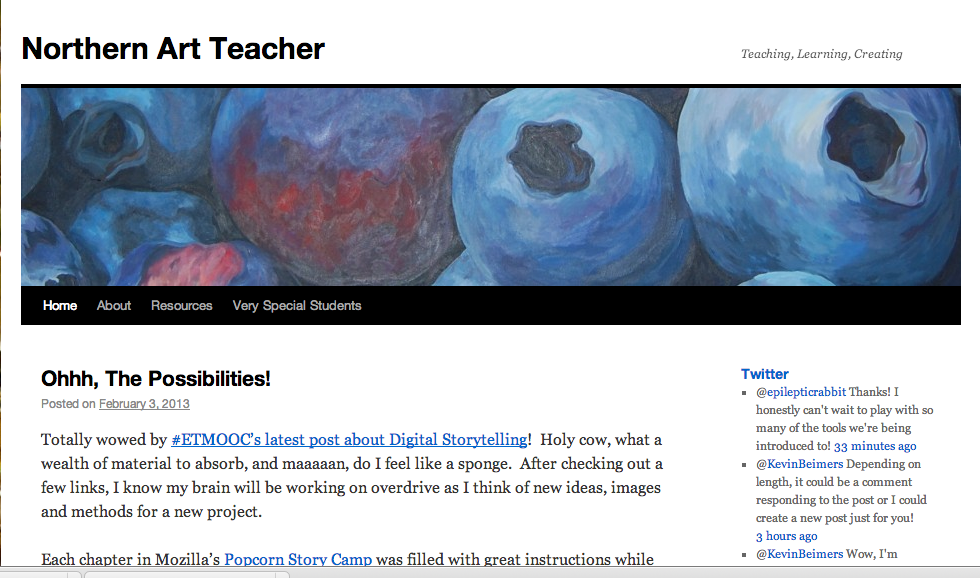
One year ago, I began blogging. It was my first attempt to try something new in quite a while; to share some ideas with the world and to learn for the sake of the students who learn from me. Here are my thoughts from that first post:
The worst thing that anyone can do is to get stuck in a rut. This is especially true ifyou are a teacher! This blog is the beginning of a challenge that I have made for myself (and for any other teachers): try something new!
We are forever telling our students to experiment and take chances, but many timeswe don’t follow our own advice. What is the result? Fuddy-Duddy Teachers. Don’t tell me you don’t know what I mean. You remember them from your own days in high school… the teachers that relied on the same old assignments like they relied on their same old wardrobe. Change is necessary. Clean out your binders and see your classroom with a new set of eyes. Who knows what we’ve been missing.
http://northernartteacher.wordpress.com/2012/01/21/hello-world/
What seemed like such a huge step soon became a stepping-stone as I cautiously explored different ways to connect with teachers online. Thanks to my principal, I was introduced to Twitter and managed to begin following many other educators who were more than willing to share wonderful resources.
There was no way to anticipate the extent to which blogging and tweeting would change my understanding of education, but these simple steps allowed me to enhance my practice and provide a richer learning environment for my students. Reaching beyond our classroom walls has meant so much for our school, and we’ve been rewarded with learning experiences worth remembering.
Exploration and risk-taking have become the norm for teachers who want to invite the world into the classroom – these new experiences don’t have instruction manuals that explain the steps to success. Students become co-learners on many projects that haven’t been tried before, and have often taken a teaching role as they have shared resources and knowledge.
We now have a class blog where projects and pictures are shared, and a class hash tag on Twitter that we use to share notes, questions and links. Often, students will send me a tweet while they’re working on an assignment just to make sure they’re on the right track. Who knew social media could be used to provide useful feedback?

Our experimentation with student blogging has also added a different dimension to learning activities, as each post automatically becomes globally accessible. Projects that used to be shared on our class bulletin board are now available online to anyone, anywhere. Our audience has changed, making it that much more important to become responsible for what we share. I say ‘we’, because my students and I are exposing our words and our thinking. This transparency urges us to be accountable to our school, our district, and anyone else who might happen upon our work.
As I celebrate the anniversary of my first blog post, I’m happy to be able to reflect on the changes that have occurred in my classroom. My students have found more relevance in their learning endeavors, and their teacher is excited to share new possibilities with them. Who knows what this next year will bring?
Please click here to listen to a full Teaching Out Loud Podcast featuring Colleen Rose
-
Viewpoint: Why Intellectual Engagement Matters
Comments Off on Viewpoint: Why Intellectual Engagement MattersToo many of our children are physically present in school but psychologically absent, their minds drifting to whatever might be more interesting than the lesson unfolding in front of them on the whiteboard. How many of us have stared out of the window longingly, prepared to believe almost anything could be more interesting than sitting in class?
The danger, even for successful school systems, is that they hit the targets but somehow contrive to miss the point. They produce great “results” and find themselves favoured by parents and politicians, as they climb up the all-important league tables and PISA rankings. Yet amidst all this success something vital goes missing.
Schools with excellent results can train children to pass the test, to play the game of reproducing what the examiner – and in some cases that is an automated examiner – is looking for, and yet they fail to excite the imagination. More importantly, they fail to provide the deeper knowledge of the underlying principles behind a subject that would allow children to reassemble and reapply what they know in novel contexts. They cover the ground, sometimes over and over again, without delving any deeper.
That ability to make and remake knowledge in different combinations to address new problems is perhaps the true test of learning. Too often, successful schooling seems to be teaching children to do the opposite: rather than teaching them to think critically and creatively, good schooling, as measured by exams, teaches them that success comes from correctly predicting and then regurgitating the answer that is expected. Veering away from the prescribed answer is unlikely to be rewarded and likely to be punished.
This is a troubling development, given how much of our economic and social lives will depend on our ability to collaborate and innovate in order to find new and more effective solutions to pressing challenges. From how we earn our livings and look after an elderly population to saving the planet from climate change, the challenges of the future will require novel solutions rather than trotting out the standard answer. Children schooled in passing tests are not being well prepared for living in a society that needs a capacity for collaborative creativity.
Innovation involves creating new recipes: the ingredients are rarely new, but the way they are blended together is. That requires people who are able to combine their own ideas with those of others, to spot how different bits of knowledge might fit together. Innovation rarely comes from taking a straight route from problem to answer. Instead, it depends on opening up problems and trying out different solutions. Often that requires taking a bit of a detour or adopting a different vantage point to attack a problem sideways. Successful innovators like Pixar and Apple have very high standards; they do not practice “anything goes” relativism. But neither do they prescribe answers in advance. They trust their skilled and able staff to find answers to open questions.
Moreover, deep learning is not a straight function of how well children do in tests. Learning is often a highly charged activity: it involves challenges and failures, setbacks and triumphs, as children overcome obstacles and solve problems. Those challenges excite emotions ranging from elation to humiliation and depression. Learning how to cope with those feelings is vital so children build the persistence and grit they will need in the wider world.
Monique Boekaerts, from Leiden University in the Netherlands, is an expert in the emotional aspects of learning. She has found that children feel positive about learning when they feel competent and in control, when they are self-regulating and yet also working well with their peers. Children are more likely to feel positive about a challenge if they feel they have the resources to complete it successfully. That makes them open to new ideas and feedback; they become more playful and energized. By contrast, if students fear they will lose face and be shown up by their lack of knowledge, they become more closed and defensive, unwilling to accept feedback and averse to taking risks.
To be motivating, learning has to be meaningful for students. They have to see where what they have learned fits into what they already know and what the point might be.
Large, anonymous, impersonal, system-driven secondary schools which pass students in batches along an educational conveyor belt seem designed to deny children the excitement they need to pull them into meaningful learning. We push lessons at children and push them through these systems. Yet the most effective kind of learning experience pulls them, because it captures their interest. It stretches and challenges them, but also provides them with the support they need to succeed.
Engaging students in this way matters if we expect schools to encourage young people to want to carry on learning, regardless of how well they did in their tests. The most important factor that draws people back to learning is that it can be a rewarding and enjoyable experience: it is intrinsically rather than socially or economically rewarding. Too often, education teaches children that learning is just instrumental: a means to a good grade rather than a pleasure in itself.
This approach is creating what Tony Wagner, Professor of Education at Harvard University, calls the global achievement gap: “The gap between what even our best suburban, urban and rural public schools are teaching and testing versus what all students will need to succeed as learners, workers and citizens in today’s global knowledge economy.” In The Global Achievement Gap, Wagner argues that modern education should be organized around interesting questions children should explore, rather than the answers they should memorize to get top marks in exams. The whole idea of a curriculum that specifies the body of knowledge that children should be tested on, he says, is outdated.
Yet skills, including the skills of intellectual inquiry and critical thinking, need building up through diligent practice. They also need to be applied to some content; they cannot be learned in the abstract. It is difficult for children to learn how to interpret history without learning some basic facts, dates and events.
The specifics of curriculum content, argues cognitive scientist Daniel Willingham in Why Don’t Students Like School?, is far less important than how pupils are invited to engage with it and what they can make of it. To be motivating, learning has to be meaningful for students. They have to see where what they have learned fits into what they already know and what the point might be. The truly effective school excites students’ curiosity and stretches their imaginations, but then helps them safely navigate their way across the unfamiliar terrain.
The new mission of schools should be to prepare children to work in jobs that do not exist, to solve problems that are not yet apparent, using technologies that are still to be invented, according to Professor Linda Darling-Hammond of Stanford University. That means equipping them with the ability to apply and reapply knowledge in inventive ways. In a nutshell: collaborative creativity should be at the heart of modern education, rather than the culture of compliance of schools in the industrial era.
Making the case for learning to be intellectually engaging is like arguing the food industry should provide fresh, tasty and healthy food. But somehow schooling has become a self-interested system, setting targets and exams that it then strives to meet as a measure of its success.
Learning without intellectual curiosity and engagement is like curry without spices. Take the spices away and it becomes a dull stew.
First published in Education Canada, January 2013
EN BREF – La nouvelle mission des écoles devrait consister à préparer les enfants à travailler à des postes qui n’existent pas encore et à résoudre des problèmes qui ne sont pas encore apparents à l’aide de technologies qui restent à inventer. Cela signifie les habiliter à utiliser leur savoir et le réutiliser de façons inventives. Or, les écoles contemporaines, même celles qui obtiennent d’excellents « résultats », n’arrivent pas à inculquer une connaissance approfondie des principes sous-jacents d’un sujet qui permettrait aux enfants de reconstituer et de réutiliser leurs savoirs dans de nouveaux contextes. Dans son essai, l’auteur soutient que l’éducation moderne devrait être axée sur la créativité coopérative, plutôt que sur la culture de conformité des écoles de l’ère industrielle.
-
Strategies for Engagement
Comments Off on Strategies for EngagementResearch on how, where, and when people learn has expanded greatly in the past 15 years. Learning is a cultural, social, and ongoing process of inquiry, engagement, and participation in the world around us. People learn best when trying to do things that are challenging and of deep interest to them – activities that reflect a close interplay of emotion and cognition in the development of capacity. Willms, Friesen and Milton have termed this interplay “intellectual engagement.”1
In contrast to academic engagement, which describes on-task behaviours such as attentiveness, enthusiasm and questioning, intellectual engagement is an absorbing, creatively energized focus resulting in a deep personal commitment to exploration, investigation, problem-solving, and inquiry, maintained over a sustained period of time.
In this article, we argue that participatory learning environments with a focus on knowledge building offer clear learning benefits to students and teachers. We describe three inquiry projects that were designed to promote intellectual engagement through knowledge building in participatory learning environments. In each of these projects, socially and digitally connected learners sought out complex issues and problems, worked hard to understand and solve them while collaborating with peers, and engaged with audiences and expertise beyond the classroom. Finally, we observe that strong task design and ongoing, continual assessment of the learning taking place were essential to ensuring a rich learner experience.
Why is knowledge building a killer app?
In marketing terms, a killer app is a new game or application that is so desirable or necessary that people will buy the entire hardware system or device just to run it. In education, knowledge building is the killer app for idea improvement and knowledge in community. Knowledge building emphasizes a continual process of building, and extending upon, what is known in the social creation, sharing and improvement of new knowledge.2 Elsewhere, Friesen has argued that 21st century learning “is better conceived of as ensuring students have the competencies required to fully participate in and make meaningful contributions locally, provincially, nationally, and/or globally, not for someday in the future, but now.”3 A focus on building and sharing knowledge globally represents a major shift in how we approach teaching and learning.
A focus on knowledge building means that teachers design or co-design tasks that require students to intentionally build upon existing knowledge and to contribute their ideas and original findings to the community. Intentionality means that students who are engaged in knowledge building know they are doing it and that advances in knowledge are purposeful. The idea of community knowledge asserts that while learning is a personal matter, knowledge building is a socially mediated process that is done to improve knowledge itself and to benefit the community. Learners need to work together to build their own and their peers’ knowledge, rather than just mining and memorizing existing information and ideas by themselves.
When learners are given opportunities to build knowledge, the teacher’s role changes from a conveyor of information to a designer who is intentional about the work he or she asks students to do. Teaching changes from preparing one message for a whole class to being mobile and responsive to individual and group learning needs, and to providing ongoing feedback to help all learners continually improve their work.
World as One: knowledge building in action
In the World As One inquiry project, Grade 7 learners worked collaboratively to build knowledge of ecosystems. Learners actively explored whether local light, soil and temperature conditions would support the propagation of fruit seeds harvested from their lunch kits. Collaborative design of science experiments involved identifying growing conditions, manipulating variables, collecting data over time, organizing and analyzing data in spreadsheets, discussing and evaluating findings, documenting results and publishing the outcomes of their research to the community.
Short, teacher-led whole-class lessons were followed by long periods of group work. In 11 small groups, learners carried out experiments, discussed findings, added photos, measurements and observations to an online science journal, and shared strategies, results, and ideas with other classmates. The teacher moved from group to group to provide feedback on the work, to answer questions, to observe and interact with students and to push their thinking further. From time to time, the teacher did mini-lessons based on questions about how to best document plant growth, how to write observations and measure outcomes, or how to form conclusions based on data. Google Docs was the collaborative learning space students used to document and share outcomes of their plant experiments and build upon each other’s ideas.
Each day, the teacher gathered students together as a class to review and discuss outcomes and achievements. During this time, the teacher shared resources, asked groups to share a problem to get feedback and advice, invited student observations, explored next steps, polled the group for ideas, or provided overall feedback on the learning thus far. All instructional materials were posted online so that each group could access the other groups’ work. Each student built knowledge from their own group’s experiment, gained knowledge from the other groups’ experiments, helped to improve and strengthen ideas through peer review and discussion, and contributed to community knowledge by making their learning visible.
What are participatory learning environments?
Digital and social technologies have changed how people of all ages learn, collaborate, play, socialize, access resources and services, and connect. A participatory classroom is one in which students make choices about what they learn and negotiate how they learn. In a digitally connected environment, they seek out, choose, and play with rich online resources, build ideas, work on projects, and design solutions with local and global peers, and publish creations in local and online spaces. Knowledge sharing and knowledge building is expected, and learners know their contributions matter as they interact and connect online with experts and learners beyond the school, who comment and provide feedback as the students improve their work.
Participatory learning designs require teachers to balance both structure and openness, to offer flexible boundaries that support and guide learners as they undertake meaningful, challenging and complex collaborative inquiries into enduring ideas and complex questions, problems and issues in a discipline. Teachers communicate standards and expectations to structure the work, brainstorm questions and ideas with students, and provide ample space for student voice, creativity and self-direction in choosing, negotiating and managing their collaborative work. Teachers intentionally design and cultivate learning experiences that engage students’ creativity, imaginations and prior knowledge, and also lead students in appropriate digital citizenship practices and strategies.
Millarville Archeology Dig Preparation: amplifying participatory learning
In this student-inspired inquiry project, curious Grade 4 and 5 students wondered about the origin of the rusty nails and shards of pottery their teacher dug up in her garden every spring. How did they get there? Who left them there and why? Along with the students, the classroom teachers designed a project to study the local history of the people and the area, interview long-time residents and historians, do archival research, and map out an area of the schoolyard in which to conduct an authentic archeological dig.
Online and on-site connections were made with experts, including researchers from the University of Calgary, the Archaeological Society of Alberta, and the provincial government. Students learned that a permit is required to run an archaeology site in Alberta and that the Alberta Historical Resources Act serves to protect and preserve archaeological sites and ensure that people excavating these sites have the necessary background to make relevant interpretations of their findings. From a variety of experts, students learned how to use appropriate technologies, tools, and methods for planning the dig and for excavating, documenting, and preserving historical artifacts. Teaching and expertise was distributed so that the most experienced and knowledgeable learners mentored new learners on data collection methods, strategies for digging and screening, and cataloguing artifacts. Students mentored adults who visited to learn more about the students’ work, and received feedback on the quality and importance of their work from peers, teachers, parents, community members, and discipline experts.
Students were involved right from the start in shaping and directing the work and making it their own. Drawing upon diverse interests and skills in the class, learners took on a variety of tasks and served in different roles that moved the project forward, such as marking the site, digging, documenting and interpreting findings, interacting with experts, and taking pictures and making videos. An extensive website was created to document and share this inquiry project beyond the school (www.galileo.org/schools/millarville/archaeology/index.html).
In this Governor General’s Award-winning history project, teachers designed and facilitated intellectually engaging learning experiences in which students explored, created, represented, and re-represented their knowledge as part of a participatory learning collective. Teachers designed a learning experience that developed from the students’ need to know. Learners had a personal stake and interest in the topic and were socially connected to each other and to the world.
The power of play
Play is a critical element in a participatory learning environment. To engage cognition and emotion – two key elements of intellectual engagement – teachers need to explore what is playful about learning, and why play is important to learning. To build knowledge and to be functional in a knowledge society, students and teachers need to explore to the “edges” of ideas, instead of focusing on finding one right answer. Learners need to be able to play with diverse possibilities, play with designs and revisions, and play with different materials and media as they build and invent new ideas/artifacts. Learners need opportunities to be playful in local and global relationships, to role-play and think creatively as regular parts of school experiences. It is through participatory and playful approaches to learning that deep understanding can emerge.
The Science, Intellectual Complexity and Collaboration Project: playful discovery
In this project, junior high students in three science classes collaboratively built, programmed, and tested a working robot that would meet given specifications.4The teacher gave groups a LEGO® MINDSTORMS® robotics kit and the following three jobs: planning, construction and programming, and videotaping. In each group, students volunteered for one of the jobs. Students were intellectually engaged as they worked collaboratively, played with ideas, explored different plans, and constructed and tested a robot. Student videographers shared a movie to convey what had occurred with regard to construction, problems, and the current stage of development of the robot. Knowledge sharing occurred between groups by making public the building processes, achievements and goals. Videos were posted online so the next group of students who were assigned to that particular robot could review and build upon the work started by the previous group of students.
In this robotics inquiry, a number of cognitive and emotional skills were demonstrated, including creativity, innovation, critical thinking, planning, negotiation, problem solving, communication, and collaboration. Knowledge building and participatory learning was key as each class was responsible for sharing the current state of construction with the next group so they could continue the building process.
Assessment for learning
Our research demonstrates that engaged teaching and great task design, accompanied by strong assessment practices, result in engaged learning. 5 Learners need ongoing, formative feedback in order to continually improve their work as it is taking place, and they also need summative feedback on the final result.
In the design of inquiry tasks, teachers need to consider how learners will get continuous feedback on depth of understanding, the quality of their work, and the strength of their ideas. Teachers need to set clear expectations so that learners know the outcomes to aim for and what they need to do or change in order to get there. How will students share their work with peers? Online? With experts? Teachers use feedback to assess if lessons and activities are hitting the mark for each student. Feedback on learning guides both the teacher and the learner on next steps.
In each of the three inquiry projects, the teachers communicated clear expectations, made visible the curricular connections and discipline standards, and provided structure for student work. Each teacher either designed, or co-designed with students, the assessment rubrics that served as an authentic and academically rigorous basis for conversations about the quality and standards expected in the work, progress and status, individual and team responsibilities, and deadlines and deliverables.
Levels of student achievement and the quality of learning are strongly linked to the amount and type of ongoing assessment feedback that students receive while they are learning.6 As students engage in knowledge-building inquiry, they need access to quality information and evidence that guides them to continually refine, improve and progress in their work. In participatory learning projects, both teachers and students need to decide how they will gather data throughout the learning process and how it will be used.
A passion for learning
Very little cognitive and emotional investment is required for listening to a lecture or watching a demonstration, versus designing and conducting an experiment or digging up artifacts for analysis. In our research, we analyze learning tasks on a scale from “passive” – such as those that require the recall of existing information – to more challenging “flow zone” types of personally absorbing and creatively energizing work. Intellectual investment in the flow zone requires critical and creative thinking and feeling processes, such as teamwork, planning, negotiation, decision making, diagnosis, synthesis, peer review, conjecture, reasoned judgment, creation, and innovation.
Young people learn best when engaged in worthwhile work that interests them, when they have opportunities to share ideas beyond school and when they receive regular feedback on what and how they are learning. Given the opportunity to intellectually engage in work that is personally meaningful and relevant beyond school, students show up early and stay late – they lose track of time while working, instead of watching the clock. As demonstrated in the three inquiry projects, teaching for intellectual engagement involves the design of authentic tasks that tap students’ critical thinking and their feelings, preferences and social nature.
Great Inquiry Projects: Design tips for teachers
What makes a great inquiry project or learning task that leads to intellectual engagement?
• The tasks involve active learning, choice, and expression.
• The tasks require deep thinking and result in deep understanding.
• The tasks immerse students in authentic, discipline-rich inquiry.
• The tasks connect learners socially and to the world outside the classroom.
• The tasks involve substantive conversation, collaboration, and idea creation.
• The tasks involve expertise and teaching to be distributed among the learners.
• The tasks involve the appropriate and pervasive use of educational technology.
• Formative feedback and summative assessment reflects academically rigorous discipline and industry standards.
Good task design must be accompanied by engaged teaching strategies, such as modeling, coaching, scaffolding, and providing ongoing formative feedback on the learning.
First published in Education Canada, January 2013
EN BREF – L’engagement intellectuel implique un intérêt captivant et motivant sur le plan créatif donnant lieu à un ferme engagement personnel à explorer, à approfondir, à résoudre des problèmes et à poser des questions sur une période prolongée. Les auteures de l’article soutiennent que les environnements d’apprentissage participatif mettant l’accent sur la construction de savoirs confèrent des avantages marqués sur le plan de l’apprentissage, tant par les élèves que par les enseignants. Ils décrivent trois projets de recherche élaborés pour promouvoir l’engagement intellectuel par la construction de savoirs dans des environnements d’apprentissage participatif. Dans chacun d’eux, des apprenants ayant des liens sociaux et dotés d’outils numériques ont examiné des sujets et des problèmes complexes, ont travaillé résolument pour les comprendre et les résoudre en collaboration avec leurs pairs, et ont eu recours à des publics et des experts à l’extérieur de l’école. Enfin, les auteures observent qu’une expérience riche pour l’apprenant dépend d’une solide conception des tâches et d’une évaluation continue de l’apprentissage en cours.
1 J. Doug Willms, Sharon Friesen, and Penny Milton, “What did you do in school today? Transforming classrooms through social, academic and intellectual engagement,” Final National Report, (Canadian Education Association, May 2009). Retrieved from http://www.ccl-cca.ca/pdfs/otherreports/WDYDIST_National_Report_EN.pdf
2 Marlene Scardamalia and Carl Bereiter. “Knowledge Building: Theory, Pedagogy, and Technology,” in The Cambridge Handbook of the Learning Sciences, ed. Keith Sawyer (New York: Cambridge University Press, 2006) 97 – 119.
3 Sharon Friesen, “Galileo Educational Network: Creating, research, and supporting 21st century learning,” Education Canada 49, no. 5 (2009): 7.
4Alberta Education, “Emerge One-to-one Laptop Learning Initiative: Final Report,” prepared by The Metiri Group and the University of Calgary for Alberta Education, School Technology Sector (2010). Retrieved from http://education.alberta.ca/media/6343889/emerge%20final%20report%202010-10-17.pdf
5 Alberta Education, “Emerge One-to-one Laptop Learning Initiative: Final Report.” and Michele Jacobsen and Sharon Friesen, “A Three-Year Design-Based Research Initiative That Influenced Educational Practices In A One-To-One Laptop School,” presented at AERA 2011: Inciting the Social Imagination: Education Research for the Public Good (Annual Meeting of the American Educational Research Association, New Orleans, LA, Apr 8 – 12, 2011).
6 Linda Darling-Hammond, Performance Counts: Assessment systems that support high-quality learning (Washington, DC: Council of Chief State School Officers, 2010). and John Hattie and Helen Timperely, “The power of feedback,” Review of Educational Research 77 (2007): 81-112.


IDEAS TO SUPPORT EDUCATORS : Subscribe to the EdCan e-Newsletter
Quality research, reports, and professional learning opportunities.