
Archive
-
Redoing Gym Class
Comments Off on Redoing Gym Class*Note: The aims of the article are certainly applicable to girls’ physical education, but this particular piece centralizes boys and young men.
AS A RECENT elite-level athlete, varsity coach, and current educational researcher, I remain very concerned with the ways that locker rooms and physical education classes are still reproducing, reiterating, and regurgitating hegemonic forms of masculinity. A social hierarchy that rewards typical bodies, traditional expressions of masculinity, and athletic ability still seems to come to fruition as a result of the ways that gym class is taught. These elements of doing masculinity and doing sport collide head-on in gym class. Masculinity is policed and labelled by the ways that boys physically move their bodies (Kehler, 2016). Thus, male gym class must not be seen as an environment for “boys to be boys,” nor one of hardcore competitive sport. It is a comprehensive educational domain that needs to focus on the development of holistic young men (Gerdin & Larsson, 2017). School hierarchies will never change if gym class continues to reward the most physically typical and gender-conforming learners. Physical education can be about teamwork, collaboration, hard work, positivity, fun, and friendships (Gerdin & Larsson, 2017). Until this is applied to pedagogy, physical education will remain a regressive forum for the recapitulation and celebration of hegemonic masculinity.
Much research has recognized that the construction of masculinities is heavily linked to physical endeavours and sport (Wellard, 2009). This makes the appropriate facilitation of inclusive physical education even more important for the robust development of young men and boys. Despite the hegemony within physical education, now, more than ever, boys and young men are desperately trying to safely and publicly perform types of masculinity that do not meet the traditional requirements of what it means to be a “boy.” But these attempts at gender diversity seem to draw the most attention and danger in the realm of physical education and school-sanctioned sports. It is sadly known, province to province, that physical education enrolment numbers after Grade 9 often drop precipitously (Dwyer et al., 2006). Too often, educators are ignoring the early warning signs of many boys’ discomfort with physical education. Many boys intentionally forget their athletic wear, conjure up imaginary injuries, skip class, and create ailments, all as a way to avoid gym class. The same avoidance tactics are deployed within the locker room because many boys fear how their masculinity will be read based on their physicality. This means many of them nervously change in a washroom before entering the locker room, seek refuge in a cubicle, strategically position themselves in a corner, or simply do not participate (Kehler & Chaudhry, 2018).
Physical education should not promote an uncomfortable atmosphere of ableism and heteronormativity, and its pedagogy should not perpetuate this. I am concerned with how physical education is still pedagogically deployed in such an exclusive manner. Gym and physical education classes are comprised of learners who range from the lowest of physical capabilities to the highest, and of learners who express masculinity in a multiplicity of ways. Pedagogy should reflect this. It is certainly not always an easy task to fulfill the athletic or social needs of all learners, but the young men and boys who struggle in the domain of sport and fitness, or express diverse masculinity, deserve a serious effort. They deserve to not be forgotten and to not be left out. They deserve to flourish in an athletic environment that supports their broad range of masculine gender expressions and athletic skills.
I would like to encourage educators and teacher-coaches to foster a physical education environment that instills confidence, positivity, passion, and excitement in all learners, no matter their physical capabilities or unique expressions of masculinity. To do so, I provide a framework of steps that can be cyclically applied within the classroom, and on the field, court, or rink.
Step 1: Always start with a conversation. Before every class, unit, or semester it is important to transparently set the stage, much like providing learning goals. Learners need to know the structure of the class and what the aim of the time being spent there is. It is essential to let learners know that this is not a place of high-intensity competitive sport. It is a place to learn about inclusivity, collaboration, teamwork, fun, and friendship. Additionally, learners need to realize that understanding a sport is simply one assessed component of their time in gym class. They need to know that they are being evaluated in the areas listed above.
Step 2: Level the playing field. The curriculum is certainly a guideline for what to teach, but diversifying it as much as possible is an exciting way to reposition or disrupt traditional ability and the social power imbalance it can create. Incorporating adaptive modes of sport that make them accessible to all learners is a fantastic way to level the playing field (Wood, 2015; School Adapted Team Sports, n.d.) It is important to strive toward equally spreading the feeling of comfort. By disrupting or altering traditional sport, educators are allowing students who may have otherwise never felt it to feel comfortable in gym class. Or, create a more universal sense of discomfort by introducing new forms of sport that allow all students to be of equal ability and confidence.
Step 3: Never stop role modelling. Often physical education teachers or teacher-coaches are highly regarded by students as being cool. I encourage educators to use this influence as a way to constantly perform masculinity or allyship in a healthy, robust way. This means speaking up when phobic pejoratives are used, establishing relationships equally with all learners, and embodying inclusivity at all times.
Step 4: Always debrief. Allocate at least ten minutes to unpack the lesson, practice, or class. It is another explicit reminder of what was learned and gained from the session. Refer back to Step 1’s emphasis on inclusivity, collaboration, teamwork, fun, and friendship. Have students share moments where they collaborated, engaged in teamwork, had fun, and built new friendships. Let them leave knowing that these were the true goals of the session.
Step 5: Never stop checking in. Make it a habit to speak confidentially with learners or observe while teaching. Ask what their needs are. Discuss ways to address or remedy their needs. Restructure pedagogy in a way that facilitates the solution to these issues or needs. This step is the engine of inclusivity. Continue to come back to this step as way to persistently address the needs of all learners in a physical education class or school-sanctioned sport. When you begin a new season, class, practice, school year, or semester. Return to Step 1 and fuse it with Step 5. The cycle will then restart.
Photo: Adobe Stock
References
Dwyer, J., Allison, K., LeMoine, K., Adlaf, E., Goodman, J., Faulkner, G., & Lysy, D. (2006). A provincial study of opportunities for school-based physical activity in secondary schools. Journal of Adolescent Health, 39, 80–86.
Gerdin, G., & Larsson, H. (2017). The productive effect of power: (Dis)Pleasurable bodies materialising in and through the discursive practices of boys’ physical education. Physical Education and Sport Pedagogy, 23(1), 66–83.
Kehler, M. with U. Chaudhry (2018). Body building or building bodies: Improving male body image through Health and Physical Education. What works? Research Into Practice, The Literacy and Numeracy Secretariat.
Kehler, M. (2016) Examining boys, bodies and PE locker room spaces: “I don’t ever set foot in that locker room.” In M. Messner & M. Musto (Eds.), Child’s play: Sport in kids’ worlds (pp. 202–220). Rutgers University Press.
School Adapted Team Sports (n.d.). American Association of Adapted Sports Programs. http://adaptedsports.org/school-programs
Wellard, I. (2009). Sport, Masculinities and the Body. Routledge. https://doi.org/10.4324/9780203874400
Wood, R. (2015, August). Sports for the Disabled. Topend Sports. https://www.topendsports.com/sport/disabled-sports.htm
-
Lessons Learned
Comments Off on Lessons LearnedThis week, the librarian who wrote the Yale Book of Quotations published his list of the top quotes of 2020; unsurprisingly, the top two spots on the list were held by “Wear a mask” (Dr. Anthony Fauci) and “I can’t breathe” (George Floyd). These two quotes, which speak to the COVID-19 pandemic and to racial/social injustice and inequity, point clearly to two of the most pressing issues we face in today’s world. So it is fitting that the EdCan Network has chosen the theme of “Educational Equity in the COVID-19 Era.”
The series of 12 articles published this fall tackle the issue’s theme from a wide array of perspectives, including school and central office leaders, teachers, students, and parents. As the series comes to a close, we consider the narratives and lessons that emerge from both the content of these articles and our own experiences, and we ask ourselves what these narratives might tell us about where we go from here.
Lesson 1: Educators can, and do, leverage technologies in powerful and creative ways, but inequitable access to devices and connectivity remains a major barrier to student success.
In her article, “Teaching through the Screen,” Stephanie Cortese describes her struggle to connect authentically to her students via digital platforms, as well as the joy she experiences as she discovers new ways to leverage technology to “cradle interconnection and create a new dimension of teacher/student relationships.” Indeed, as we progress through the pandemic, we have witnessed incredible examples of teachers’ creative, effective, and innovative uses of technology, with educators turning to platforms like YouTube and TikTok to engage students in learning. However, we can’t rely on educators alone to make e-learning work for all students; in “E-learning at Home,” the authors note that access to digital devices has been a significant challenge, particularly for children in more vulnerable communities. And while many provincial and territorial initiatives have been devised to equip low-income families with laptops and Internet access, the fact remains that without sufficient training on the use of technology for educational purposes, these programs will do little to remedy the inequities that exist. It is clear that more comprehensive long-term solutions, including equitable access and tech-related instruction for students, and professional learning programs and support for teachers and administrators, are needed to bridge the digital divide in our schools.
Lesson 2: As home-school relationships become increasingly important, parents’ abilities to support their children’s learning can have a major impact.
As educators, we’ve long known the importance of strong home-school relationships. But as schools transitioned to online learning in the spring, those relationships became even more critical as the tasks of supervising and supporting children’s learning fell increasingly on parents and guardians. For example, researchers found that for families of students with special education needs (SEN), the quality of at-home schooling was closely correlated with the quality of the “working alliance that existed between parents and school staff”; the best outcomes occurred when there was frequent and positive communication between home and school. However, for many working parents, the task of supervising at-home learning presented a considerable challenge, with lower-income families finding it particularly difficult to balance their own work schedules with the added pressures of increased parental involvement in remote learning. Indeed, in “Class Matters,” Andy Hargreaves argues that the issue of socio-economic diversity is frequently ignored in discussions of inclusivity and calls for increased focus on the effects of class inequality on educational outcomes.
Lesson 3: School climate has a significant effect on how teachers, learners, and parents experience school, but care must be taken to ensure inclusivity for all members of the school community.
Life in the midst of a pandemic can be incredibly stressful, and adding the anxiety of remote learning into the equation creates incredible pressure for families. A positive school climate can play a major role in lowering stress levels all around, and effective, frequent, and consistent communication is an important factor. School and central office leaders can set the tone for teachers, parents, and students, and a “clear focus on calm, steadfast, patient messaging” is key. As we grapple with the disproportionate effects of the pandemic on vulnerable communities, however, leaders must also ensure that they maintain focus on these inequities and should carefully consider “what kind of spaces they are creating for teachers, students, and their families to dialogue about equity issues.”
Lesson 4: The move to remote learning has laid bare the degree to which teachers’ (and schools’) roles extend beyond academic instruction.
With the move to online learning, those outside of the field of education are beginning to understand what we as educators have known all along: that “the role of ‘teacher’ is much more than one of providing academic knowledge and skills to students.” Indeed, schools and teachers play a number of important roles in students’ lives, relating to many aspects of students’ health and well-being. For the most vulnerable students, at-home schooling has in some cases meant a loss of access to food, to a safe space, or to mental and physical health supports. This is partly why, as Paul Bennett notes, “Closing all schools should be the last resort this time around.” But some researchers now point to the opportunity offered by this realization of the critical role of schools and teachers, calling not for a return to business as usual but to a future in which teachers are no longer asked to “do more with less” and our education systems are rebuilt on “solid foundations of sustainable equity and well-being.” And this brings us to our final lesson.
Lesson 5: The challenges of the COVID-19 pandemic offer a tremendous opportunity for transformational change in our education systems, should we choose to take it up.
While many of us may crave a return to normalcy, we must also consider the injustice and inequity that “normalcy” actually entails. The current moment, while challenging on numerous fronts, also offers a chance for a fresh start; this message of hope and possibility is woven through a number of the articles in this issue. Indeed, as Stephanie Cortese reminds us, “As we transfer our binders and printed lessons onto digital platforms, and blend our classrooms into interactive and accessible hubs, we need to embrace a new vision of what an educator can be. It is not the end of the role, but rather a transformation of it, which we get to be part of.”
This transformation holds the promise of profound structural change: it might allow us, for instance, to explore “the ways that white supremacy has been manifested by COVID-19 and to challenge the devastating effects the pandemic has on racialized students.” The return to “normalcy” is certainly the easier route to take, but as educators, we must recognize the profound implications of the path that we choose going forward, and the impact that it will have on the students in our classrooms for many years to come. As we sit at the crossroads of the twin crises of COVID-19 and social inequity, we should take to heart Vidya Shah’s words: “May we find the individual and collective courage to centre relationality, community, and collective care above our individual fears, insecurities, and self-interest.”
Photo: Adobe Stock
-
Happy Teacher Revolution Partnership Program
Comments Off on Happy Teacher Revolution Partnership Program
Happy Teacher Revolution has officially launched in Canada!
EdCan and Happy Teacher Revolution are excited to offer EdCan members exclusive access to Happy Teacher Revolution’s online training and certification program to initiate and lead their own teacher support group within their school community.
All EdCan Membership categories – Individual, School District Members, Not-for-Profit, Faculty of Education, and Corporate – receive an exclusive 20% discount.
Not an EdCan Member? That’s okay! Click here to learn more about becoming a member.
PRO TIP: If you’re an employee of a School District, Not-for-Profit, or Corporation that is an EdCan Member, then you, too, are an EdCan Member! What’s more, if you’re a student or employee of a Faculty of Education that is an EdCan Member, then you’re a member, as well! Click here to find out if your organization is already an EdCan member.
What is Happy Teacher Revolution?
-
Professional Well-Being Through Coaching
Comments Off on Professional Well-Being Through CoachingHow can we support our school leaders to do their best work?
In a pandemic year, many of our traditional structures for professional development are changing radically. People aren’t permitted to gather in person, to share and to collaborate as we normally do. In this context, how do we maintain that personal connection to each other? How do we collaborate on the complex work that leaders do? And how can we support the growth and development of our principals, vice-principals, and other leaders when our traditional structures are disrupted?
In response to these questions, in the spring of 2020, Surrey Schools in B.C. began implementing an online one-to-one virtual coaching model to support the growth and development of principals and vice-principals. Mirroring hybrid models in our schools, this model focuses on leadership in times of complexity. Each participant received dedicated one-to-one support from a trained and experienced coach, who served as a confidante and learning partner to support their unique and individual learning needs. The model and the support it provides have been extremely well received, and we now have extended this work and coaching from the summer into the fall, with more than 90 district principals, principals, and vice-principals participating. This article explains the rationale for our model, how it works in practice, the feedback we have received, and our hopes for the future.
Coaching offers personalized support
While we were designing new learning experiences for our students, we also began to consider how to best design hybrid models of professional development for our school leaders. We had an opportunity to engage in an online coaching program tailored specifically to address the pressures of leadership during a pandemic. This was a unique opportunity at a unique time.
Years ago, I (Jordan) changed my own professional development strategy to include personal coaching. Rather than travelling to conferences, watching presentations or speakers, I found someone to coach me, to hold my feet to the fire about my own strategic plans, initiatives, and goals. To me, the change was transformational. It wasn’t transformational because I learned new things; it was transformational because I had someone at my side, a confidante, to hold me personally accountable for the work I committed to do.
Coaching is a strategic partnership. Everyone should have a safe space in which to discuss any aspect of their work. The ability to have someone external to your organization who can reflect, clarify, and challenge your beliefs and work can be enormously rewarding. In a COVID world, leaders are under intense pressure. We need to find ways to support our leaders, and this opportunity to provide safe, external, and confidential coaching was timely.
Strategies for personal resilience
We decided to partner with BTS Spark, a non-profit education group that matches school leaders with professional leadership coaches. In our collaboration together, it became clear that our first priority was to offer a summer program for school leaders focusing on personal resilience and well-being. We knew leaders were experiencing higher levels of stress in facing not only the challenges caused by the disruption of the pandemic to the previous school year, but also the uncertainty of what the upcoming school year might look like. We co-created a program to meet those needs, as well as our timescale and budget.
The Surviving to Thriving program was offered as an optional program to principals, vice-principals, and district principals. As a completely voluntary offering during the summer vacation, we were unsure how many school leaders would be interested in the opportunity. We hoped that 10–12 people might sign up. We were pleasantly surprised and delighted that 85 school leaders signed up to take part in the summer program.
FIGURE 1: Surviving to Thriving Coaching Journey
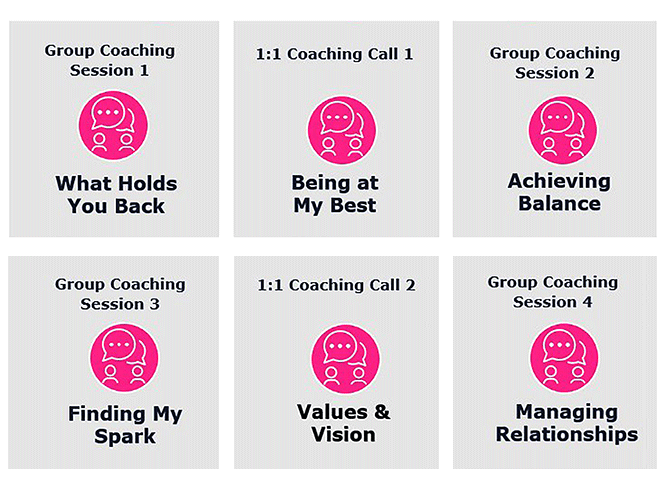
The virtual program was designed to combine one-to-one coaching sessions (providing personalized support to match each individual’s needs and context) with group coaching sessions (offering much-needed connection between school leaders during a time of stress and isolation). (See Figure 1). Over a period of a month, small groups of six people met weekly via Zoom for 90 minutes with a professional leadership coach. The goal was to hone and develop their skills to build personal resilience and resourcefulness. The work included reflecting on their well-being and balance, learning how to manage their state of mind, understanding what motivates them, exploring how to bring their “spark” into their work, and learning practical tools to help them deal with difficult interpersonal interactions, whether with parents, colleagues, or students. In between group sessions, participants could access one-to-one coaching sessions to process individually with their coach how to recover from the challenges of the spring and prepare themselves for the unknowns of the fall.
Feedback from the program – both formal evaluation and anecdotal feedback – was extremely strong. Participants were surveyed both before and after the program, and their responses consistently showed positive experiences. As a result of the program, our principals reported being more able to manage their state, stay resilient, achieve a work-life balance, deal with energy-sapping relationships, tackle difficult conversations, and go into the new school year with a clear vision (see Figure 2). All those surveyed said that they would recommend coaching to colleagues.
FIGURE 2: What impact did this coaching have?
Principals/VPs participating were asked to self-rate… Before After I have strategies to stay resilient and effective in stressful situations… 64% 100% I am able to create a balance in my life… 44% 90% I have a clear vision for the new school year… 43% 100% I feel that I have the tools to manage energy-sapping relationships… 30% 100% I feel confident having difficult conversations… 39% 90% As one participant commented, “I appreciated the opportunity to connect with my colleagues and to sort through the areas of my personal and professional life that are diminishing my spark. I feel I have tools to go forward this year with more positivity and resilience.” Another principal added, “I am looking forward to putting the strategies in place when I get back to work. I know that certain issues that I had at the end of the last school year are now put in a better perspective for me. If I didn’t have this program, I believe I would have opened this new school year with these issues holding me back.”
Personal coaching through the fall
I know we were not alone in facing the dilemma of how to provide support to our school leaders through a school year full of unknowns. What we did know was that the school year was likely to be a challenging one, that leaders would need to find new ways of leading in uncertainty, and that the usual face-to-face professional development and conferences were not on the horizon. We felt that leaders would want to draw on support that was responsive to what they were facing in their own context.
Our school leaders can build their capacity by tackling the very real challenges they are facing in their schools, all with professional guidance and support.
On the strength and feedback of the summer coaching program, we invited coaches to support our principals, vice-principals, and district principals through the fall. Participants were offered six hours of one-to-one time with a professional leadership coach, connecting virtually via Zoom at times to suit them. The coaching is responsive, focusing on their most pressing priorities and the challenges they are facing in their schools.
Again, this coaching was an optional offer and we saw relatively strong take-up, with 40 percent of all school-based administrators selecting to access the support. At the start of their coaching program, principals were guided through a self-reflection on their leadership capabilities, to identify both their natural strengths and the areas they wanted to develop in their current school context. As you can imagine, there was no shortage of needs identified!
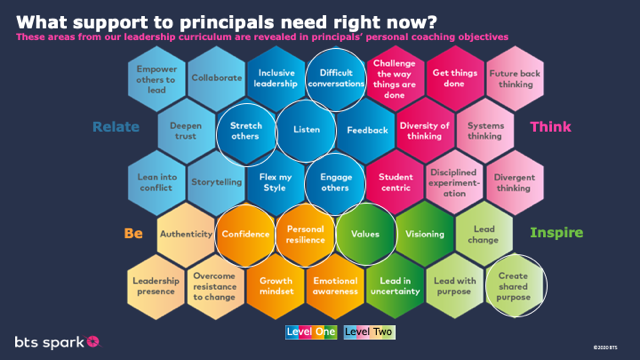
It was interesting to see where principals wanted to focus. Our principals’ coaching objectives were analyzed and mapped to their curriculum of 33 leadership mindsets (see Figure 3). This revealed that our principals asked for help with:
- Engaging others, honing their listening skills to support others, e.g. “I’m aiming to become an active listener, to understand and engage those around me.”
- Skills and confidence to hold difficult conversations where needed and to stretch others, e.g. “I would like to be more courageous in giving feedback and having challenging conversations.”
- Bringing their core values to life in their work and creating a sense of shared purpose with their teams, e.g. “My current challenge is establishing purpose and creating a common goal as a staff.”
- Building personal resilience and gaining confidence, e.g. “I would like to have more self-assurance to bounce back from setbacks and find my power when I get nervous.”
As Superintendent, seeing the selected areas of focus gave me a window into the uppermost needs of our principals as they headed into the new school year.
FIGURE 3
An equitable and differentiated approach
We talk a lot about equity of access for students, but less about equity of access for our school leaders to quality professional development. This coaching model is delivered virtually, via Zoom, and is thus accessible to all schools at times that suit them. With this model, principals in the most remote schools in our country can still access top-quality leadership coaching, and they are also able to access French coaches.
While virtual coaching has provided support throughout the COVID-19 pandemic when face-to-face professional development is not a viable option, we feel that we may have tapped a valuable new method of personalized support. Coaching is offering our school leaders something new and vital. They have a thought partner, a critical friend outside our school district, and a leadership expert with access to a wide-ranging curriculum of practical strategies to enhance their leadership. This professional development is differentiated and is not a one-size-fits-all approach to leadership development. Our school leaders can build their capability by tackling the very real challenges they are facing in their schools, all with professional guidance and support. The potential to extend this offer to teacher leaders is enticing, and we are considering next steps.
We continue to look at how coaching can be one powerful mechanism to help support the development of leaders at all levels. We are also asking what it looks like to be more coach-like across the organization. We are excited to offer professional coaching to leaders in our education system, and I look forward to seeing the difference this will make as we move through this unsettled year and beyond.
Photo: Adobe Stock
First published in Education Canada, January 2021
-
Threads of Continuity
Comments Off on Threads of ContinuityThe school shutdown triggered by the COVID-19 pandemic in spring 2020 required system and school leaders to reimagine schooling and articulate how the very nature of teaching and learning would be impacted.
At the time schools were shuttered, school leaders identified four immediate challenges necessitating reconsideration of their roles and responsibilities:
- Student, parent, and teacher anxiety reached, in some cases, near-frantic levels around such issues as food stability, student safety, health, and medical needs. As one principal explained, “My major responsibility in those days was to adopt a calm and thoughtful approach to reduce everyone’s stress levels.”
- Technology, previously assistive, became the primary pedagogy. Ensuring that all teachers and students had access to equipment and services was a first-phase challenge; more complex was leading the learning of teachers to achieve a level of efficacy with remote delivery. One vice-principal suggested, “This wasn’t just teaching them the technology, it was helping teachers adjust to the dramatic change of not having students in front of them.”
- Managing school operations and facilities involved everything from gathering and distributing student belongings in a safe and orderly way, to implementing health services protocols, to orchestrating multiple schedules for building access. Revising plans to communicate with numerous groups, some of whom had limited levels of access to electronic platforms, assumed a level of heightened priority.
- The sheer speed and depth of change contributed to overwhelming uncertainty. One principal said, “I stopped counting how many versions of the school access plan I wrote. I came to accept that any decision on Monday would be changed every day before Friday.” This ambiguity contributed to school leaders’ heightened sense of frustration, futility, and fear that the magnitude of decision-making was beyond their grasp.
Given these emerging realities, we became curious about how equity was being experienced on a broader scale and were prompted to ask the question: What systemic interventions, structures, and processes were implemented to assure school leaders that that they would receive the support necessary to maintain effectiveness throughout this environment of uncertainty?
A brief history
In 2017, we began a leadership development initiative in a southeastern Alberta school division with the goal of enhancing school leaders’ awareness of and capacity to engage in effective leadership. Over three years, we implemented a model of generative leadership (Adams et al., 2019) to support principals’ and vice-principals’ instructional leadership growth. Specifically, we were interested in the impact of four processes that informed leadership development:
- supportive monthly visits by the central office leadership team with school leaders to facilitate reflective practice through the use of generative dialogue
- individual and collaborative inquiry by system and school leaders that transformed problems of practice into essential questions
- reliance on the Professional Practice Standards to guide perceptions, vocabulary, and definitions of leadership effectiveness (Alberta Education, 2018a, b, c)
- fostering conscious competence by nurturing relationships, building a culture of learning, and maintaining a focus on student learning as a non-negotiable goal.
Over months of collaboration, we observed system and school leaders develop understandings about their roles as leaders and grow in confidence to engage in and facilitate inquiry-based professional learning. Then schools closed.
Seeking threads of continuity
Previous research has explored the ways in which change influences the professional identity of leaders and teachers and how they go about their work (see, as examples, Flores & Day, 2006; Helsing, 2007). As researchers, we recognized the potential for these dramatic circumstances to undermine the work of school leaders; however, we also recognized that times of turmoil might prompt new ways of thinking, being, and acting. With this in mind, we relied on the work of Marris (1975) and his understanding of the human need for “threads of continuity.”
Marris suggested that in response to experiences of change and uncertainty, individuals seek threads of continuity to sustain their perceptions of meaning, purpose, and identity. He explained that individuals assimilate new experiences by placing them in the context of a familiar, reliable construction of reality. His model provided a framework for our thinking as we sought to understand why and how leaders were able to negotiate the rapid and comprehensive changes that emerged in response to the pandemic.
The research
To help understand the ways in which school leaders were accessing divisional supports provided by system leaders, we asked principals and vice-principals six open-ended questions through an online survey. The questions addressed:
- challenges
- supports
- the role of embedded structures, such as professional learning time and monthly school visits by central office leaders
- processes to learn alongside teachers, such as collaborative inquiry and reflection through generative dialogue
- thoughts surrounding the role of professional learning during the pandemic.
Responses were received from two central office leaders, ten principals, and ten vice-principals, representing 48 percent of the participant pool.
Renewed commitment to existing processes
One school leader highlighted the importance of continued monthly visits and monthly professional learning workshops:
“Previous routines and structures at our school greatly assisted us and prepared us for the pandemic. Our school continued to move forward, despite the challenges we faced. The collaborative, trusting relationships we have developed over the years helped move us in a positive manner.”
Specifically, school leaders identified their work with generative dialogue (Adams et al., 2019), the collaborative response model (Hewson et al., 2015), distributed leadership (Spillane, 2006), and their school division’s focus on student and staff well-being, as being helpful as they responded to the new demands of the pandemic.
The processes associated with generative dialogue provided leaders with tools for sustained and purposeful conversations with teachers about student learning. One leader noted, “[My] generative dialogue skills helped administrators in collecting feedback to inform planning.” By using collaborative processes such as analysis of student work exemplars, school leaders worked closely with staff to track students who were less engaged with learning in the home delivery model; supported grade-level teams to collaboratively plan for student learning and to share their individual expertise in areas such as technology, student engagement, and formative assessment; and provided professional learning opportunities for the transition to at-home inclusive education delivery.
Leaders identified the importance of their division’s established focus on distributed leadership. Key to the distribution of leadership was the work of classroom support teachers and family school liaison workers. These support personnel were important to meet the learning needs of children prior to the pandemic, but have been critical since its onset.
The existing three-year jurisdictional plan encouraged leaders to focus school goals on the well-being of both students and staff. During these early weeks, identifying and facilitating emotional supports was given a heightened priority. Often in school leader responses, the word “calm” was used. They recognized that their reaction to these circumstances could either exacerbate or de-escalate the anxiety associated with uncharted territory – so they took the calm approach.
“Purpose built” emergent structures
New structures were also created and were described as “purposeful,” “thoughtful,” “robust,” and “powerful.” The structures were modelled first by central office leaders; school leaders acknowledged the critical role of central office leaders in ensuring that planning processes were in place to address the evolving needs that arose throughout the spring.
The notice of school closure was quickly followed by an emergency learning plan developed by the central office leadership team. The plan’s meaning and intent were further highlighted and reinforced through regular “Principal Huddles” involving central office and school-based leaders. Classroom support teachers worked closely with educational assistants (EAs) and classroom teachers to ensure that supports continued for children on Individual Student Learning Plans (ISPs). EAs (many of whom remained employed throughout the pandemic) played a more directive role in supporting children and often became the “go-to” person for the child.
Collaboration took on an expanded role. For many teachers, collaboration became a focal point of their learning. The structure for collaboration existed in the schools, but it now became essential to meeting the challenges imposed by home learning. Time, formerly in short supply for collaborative work, suddenly became available. Teachers were meeting virtually in grade groups, interest groups, learning groups, large groups, and thematic groups (e.g. literacy or numeracy focused) on a weekly and sometimes daily basis.
Professional learning focused on supporting the work of teachers in this new learning environment. Generative dialogue was used to support leader and teacher conversations “in emergent items like assessment and reporting and instruction in e-learning like never before.”
Divisional initiatives supported the purchase, dissemination, and use of technology. The first step was “the establishment of a universal level of tech ability (Google Classroom/Meet) and access to the technology by staff and families.” A division-wide purchase plan allowed individual staff members to access technology so they could work from home; families were provided Chromebooks/iPads for student use, and where necessary, Internet connection was also made available to families in need.
The primacy of communication
Led by central office leaders who were purposeful in their “common messaging,” communication between and among central office leaders, school-based leaders, teachers, staff, and families took on an amplified level of importance. Central office leaders ensured close and regular contact with their designated schools, and shared feedback from school leaders with the central office team. Communication was scheduled and focused on essential messages. The superintendent was in regular communication with all leaders and staff through video announcements and recorded messages, giving voice and personalization to the jurisdiction’s pandemic emergency plan and to the division’s commitment to student learning as the hallmark of success in the midst of uncertainty. Through his lead, school leaders also embraced a priority of more frequent communication with staff through a variety of modalities, both technological and personal.
Lessons learned
We observed that school leaders relied on three threads of continuity to maintain their sense of meaning, purpose, and identity as they coped with these challenges:
- Recommitting to established structures that had been effective in the past: system and site professional learning days, professional learning collaborations, classroom and school visits, and a focus on student well-being as their primary learning requirement. School leaders relied on the sense of stability provided by these structures as they navigated the daily fluidity of operations.
- Establishing processes that privileged relationships, connections, and conversations: emphasizing ways that generative dialogue could be broadly taken up; or introducing new processes where collaborations and connections could be made between teachers and leaders and school leaders with system leaders. These processes reaffirmed purpose and offered clear direction, in spite of the enormous magnitude of change.
- Enhancing and extending the frequency and modes of communication, with clear focus on calm, steadfast, patient messaging. More than ever, communication on an individual scale was prioritized and was supplemented weekly by personal and video messages from system leaders.
These three threads of continuity were instrumental in ensuring that school leaders were supported in their learning and growing toward increased effectiveness in a global environment of uncertainty. As organizational strategies, they offer potential for system leaders to consider in times of rapid change.
Photo: Adobe Stock
References
Adams, P., Mombourquette, C., & Townsend, D. (2019). Leadership in education: The power of generative dialogue. Canadian Scholars’ Press.
Alberta Education (2018a). Leadership quality standard. Alberta Government. https://education.alberta.ca/media/3739621/standardsdoc-lqs-_fa-web-2018-01-17.pdf
Alberta Education (2018b). Superintendent leadership quality standard. Alberta Government. https://education.alberta.ca/media/3739619/standardsdoc-sqs-_fa-web-2018-02-02.pdf
Alberta Education (2018c). Teaching quality standard. Alberta Government. https://www.alberta.ca/assets/documents/ed-teaching-quality-standard-english.pdf
Flores, M., & Day, C. (2006). Contexts which shape and reshape teachers’ identities: A multi-perspective study. Teaching and Teacher Education, 22, 219–232. https://doi.org/10.1016/j.tate.2005.09.002
Helsing, D. (2007). Regarding uncertainty in teachers and teaching. Teaching and Teacher Education, 23, 1317–1333. https://doi.org/10.1016/j.tate.2006.06.007
Hewson, K., Hewson, L., & Parsons, J. (2015). Envisioning a collaborative response model: Beliefs, structures, and processes to transform how we respond to the needs of students. Jigsaw Learning Inc.
Marris, P. (1975). Loss and change. Pantheon Books.
Spillane, J. (2006). Distributed leadership: The Jossey-Bass leadership library in education. Jossey-Bass.
-
COVID-19’s Second Wave: How are teachers faring with the return to physical schools?
Comments Off on COVID-19’s Second Wave: How are teachers faring with the return to physical schools?
A team of researchers from the University of Winnipeg have been studying stress and resilience in teachers since the pandemic began. Based on responses from more than 2,200 teachers from across Canada who completed surveys in April, June, and September of 2020, and several follow-up interviews, the researchers were able to gain a detailed understanding of the demands, resources, and stressors experienced by teachers, including their strategies to cope.
Note: These findings are part two of a survey series on supporting teachers during the COVID-19 pandemic. Survey responses were first collected in April/May 2020, when teachers had just begun to teach remotely (click here to check out the first set of survey results!). The survey was administered a second time in mid-June 2020. Data was collected once more in September 2020, when students (in most provinces) were physically back in school practicing safety protocols related to COVID-19.
Continue to survey results here
-
Centring Equity in the COVID-19 Era
Comments Off on Centring Equity in the COVID-19 EraSecond only to the impact of classroom instruction, decades of educational research has demonstrated the important role school leaders play in supporting student success (Robinson, 2011). Leading for equity, however, often requires a different way of thinking about student success; one that recognizes that diverse contexts require decolonized and socially just approaches (Lopez, 2016). And so, leading schools is a socially complex and adaptive process, even in the “best” of times. The pandemic, coupled with social uprisings and a reckoning with our colonial past, has added additional layers of complexity that many school leaders are struggling to balance.
On the one hand, the pandemic has created a firestorm as school leaders grapple with new roles as “the other first responders” of the pandemic (Osmond-Johnson et al., 2020). Workload intensification and work-life balance have been an ongoing challenge for school-based leaders (Pollock et al., 2017). COVID-19 has exacerbated these issues, creating new accountability expectations around health and safety protocols that school leaders had little to no input in creating.
On the other hand, COVID-19 has also laid bare long-existing racial inequities that school leaders are compelled to address. Originally thought to be “the great equalizer,” according to McKenzie (2020), COVID-19 actually exploits differences between communities, using the existing “cracks in our system to get in, take hold and maintain its position.” In school reopenings, we have seen the continued proliferation of systemic inequities. A recent analysis of registrations in the Toronto District School Board, for instance, found that parents from low-income neighbourhoods comprised a much larger share of those opting for online learning. These neighbourhoods were also found to have a higher incidence of positive COVID-19 cases, larger populations of racialized families, and a higher percentage of multi-generational homes. So, while some can pay for personal in-home teaching and tutoring, “others who are fearful of sending their children back to school but cannot pay for private help are becoming test subjects for a new realm of online learning” (Bascaramurty & Alphonso, 2020).
White supremacy does not go away just because there is a pandemic. Rather, fault lines in an educational system that had been comfortably managing the status quo have been further exposed. In this sense, school leaders must understand the challenges and see the opportunities to ensure systems of white supremacy are challenged and dismantled. Complacency and wilful ignorance will no longer suffice.
Grounding leadership in equitable practices
If school-based leaders are to focus on equity, wellness, and dismantling systemic racism amid the complexities and challenges of leading during a pandemic, how can they operationalize that focus to ensure the needs of their students and teachers are being met?
First, school leaders must remain laser-focused, keeping equity at the forefront of their practice – not as something they do if they have time, but the lens through which they plan and engage in leading (Lopez, 2016). During COVID-19 this might include additional attention to pedagogy, particularly in the online environment. For instance, some students may not have spaces for online learning they want to share with others, and may not want to turn their cameras on. Educators should be mindful to not act on their own stereotypes and biases in such an instance, with school leaders supporting teachers in these endeavours.
Second, enabling the focus on equity necessitates a solid plan to deal with the most challenging aspect of leading at this critical juncture: the pace at which information, expectations, and directives are constantly changing. Within this context, a desire to plan with equity in mind is easily scuttled by the need to just survive the onslaught of new and often conflicting information. Developing a school-based communication plan as part of a distributed leadership model can help navigate the seemingly endless amount of “crucial” and “urgent” information leaders are tasked with addressing. This might include allocating specific responsibilities around various aspects of COVID communications to administrative support personnel and formal and informal teacher leaders within the school. Knowing when to defer to advice from public health officials is also important. This kind of distributed approach creates space for school-based leaders to also focus on the difficult work of addressing the systemic racism, educational inequities, and oppressive practices that have been made even more visible as a result of COVID-19.
Third, it is important that school leaders ask themselves what kind of spaces they are creating for teachers, students, and their families to dialogue about equity issues. This journey of change cannot be viewed as a series of tasks to be completed at the direction of a school district. Dismantling systemic inequities can’t be “workshopped” or managed with tips, tricks, and strategies. School leaders must explain the purpose of the work, connect it to a shared set of values articulated by the collective, and clarify the vision for moving the work forward. They must build a critical mass of support, encourage and empower those looking for opportunities to lead, and remain resilient and focused when challenged by those resistant to change. The moment we are currently in also provides school leaders with a great opportunity to build deep, lasting and respectful relationships with communities as a pathway to exploring the ways that white supremacy has been manifested by COVID-19 and to challenge the devastating effects the pandemic has on racialized students.
Finally, and perhaps most crucially of all, school leaders must honour the time, effort, and resilience required to engage in this work. Any leader who is prepared to invest time, energy, and resources into sustainable change knows that leading anti-racist work requires a focused and persistent long-range plan, driven by our students’ expectations for an education worthy of their desire to be academically challenged and socially engaged. It is important, then, that school leaders also engage in self-care to ensure they have the emotional and physical health to challenge white supremacy and its impact on their practice and their schools.
While it may seem safety protocols are the only thing school leaders have time for at the moment, it must be understood that wellness and equity are intrinsically linked. In this sense, school leaders must be prepared to centre equity as they lead through COVID-19; as Gaymes and San Vicente (2020) recently stated, “A crisis does not negate such responsibilities. It only enhances them.”
Photo: Adobe Stock
References
Bascaramurty, D., & Alphonso, C. (2020, September 5). How race, income, and ‘opportunity hoarding’ will shape Canada’s back-to-school season. The Globe and Mail.
www.theglobeandmail.com/canada/article-how-race-income-and-opportunity-hoarding-will-shape-canadas-back/Gaymes, A., & San Vicente, R. (2020, March 27). Schooling for equity during and beyond COVID-19. Behind the Numbers. https://behindthenumbers.ca/2020/03/27/schooling-for-equity-during-covid-19/
Lopez, A. E. (2016). Culturally responsive and socially just leadership: From theory to action. Palgrave MacMillan.
McKenzie, K. (2020, August 13). Toronto and Peel have reported race-based and demographic-based data – now we need action. Wellesley Institute. www.wellesleyinstitute.com/healthy-communities/toronto-and-peel-have-reported-race-based-and-socio-demographic-data-now-we-need-action/
Osmond-Johnson, P., Campbell, C., & Pollock, K. (May, 2020). Moving forward in the COVID-19 era: Reflections for Canadian education. EdCan Network.
www.edcan.ca/articles/moving-forward-in-the-covid-19-era/Pollock, K., Wang, F., & Hauseman, C. (2019). Proactively mitigating school leaders’ emotionally draining situations. Canadian Journal of Educational Administration and Policy 190, 40–48.
Robinson, V. (2011). Student-centered leadership (1st ed.). Jossey-Bass.
-
“Does It Have to Be That Hard?”
Comments Off on “Does It Have to Be That Hard?”Among the many things that were interrupted by the pandemic shutdown in March was a cherished weekly food program for high-school students with developmental disabilities. Prior to the shutdown, the students in the program talked about nutrition and made grocery lists at the beginning of each week. On Wednesdays, they travelled to the grocery store where they used their numeracy skills to buy the groceries that they needed. Thursdays were for food preparation, and they spent Fridays cooking and eating their special meals. In addition to learning to prepare food and use money, the program provided opportunities for physical activity, collaboration, and planning – important life skills for these students!
The educational team decided that the food program, as a much-loved and beneficial component of the classroom, was too important to be allowed to wither at the start of the pandemic. Even though the students could no longer travel to the store and cook together, perhaps the teacher could use video conferencing software to host a class where everyone could see the cooking? And, if the students had the ingredients at home, could the students cook along with the teacher? It seemed simple enough. An easy workaround here, a little extra time and energy there, and soon enough everyone would be cooking together remotely. And yet, it was not to be.
The first challenge they faced was the security of the video conference software. The principal, Peg Harper (all names are pseudonyms), told us: “We weren’t supposed to use Zoom because it’s not safe, so then we had to get them onto Microsoft Teams.” But the safety features of the new software program came at the cost of “lots of layers of security.” For many of the students, the new video software was difficult to access and navigate.
Another challenge was finances. Not all families had the money to buy they groceries they would need, so Harper offered to pay for the groceries: “Let’s take away the equity problem… whatever you need, we will just buy it.” It would require quite a bit of extra work, but the teachers said they were willing to wear the masks, buy the food, and then deliver the ingredients to the students’ houses.
Having worked through challenges related to technology and equity, safety policies from the board office raised the final obstacle. Even if they used contactless delivery, teachers were not allowed to deliver groceries. As Peg Harper was told, “What if a teacher dropped off a bag of groceries at the door and then a student gets COVID… so no, you can’t do that anymore.”
In the end, the barriers were too much. In spite of creative problem solving and everyone’s willingness to contribute extra support, the food program ended. We could hear the frustration in Harper’s voice when she told us:
“My story has to do with all the barriers. You think it’s really simple, that you are going to create this experience for your students remotely, and then just bang, bang, bang, bang, bang, bang, everything was hard. I kept thinking, ‘Does it have to be that hard?’”
The story of this food program typified many of the stories we collected from principals across Canada about their experiences during the COVID-19 pandemic from March to June of 2020. We interviewed 38 principals to find out what it was like to lead schools during those first four months of emergency home-based schooling. We asked them specifically to reflect on their efforts to support students with special education needs (SEN). Many of the principals told us their success stories, of how the school rallied together to support the students and the community more broadly. But the principals also told us stories where even their teamwork and the best of intentions were not enough to overcome the complex interlocking barriers related to technology, equity, and safety.
Work intensity
It has long been recognized that principals work extended hours. Nearly 70 percent of Ontario principals recently reported that they work more than 50 hours a week, with one in five working more than 60 hours (Pollock & Wang, 2020). In fact, substantial literature on principals’ work intensification has demonstrated that principals find it increasingly difficult to keep up with the pace of work. And yet, in addition to the amount of work that already comes with the job, the principals we spoke with told us that the pace of work exploded during emergency schooling. Their efforts to develop meaningful educational spaces outside of the school building became a second full-time job, on top of their regular responsibilities. Sanaya Cresswell, a principal participant in our study, told us that emergency schooling increased her regular day of work by about 8.5 hours: “When this started to happen, [my day] was anywhere from 6:30/7 a.m. to 11 p.m. – I just seemed to be continuously trying to figure out how to create some consistency when there really wasn’t any.”
Technology tools and essential supplies
One of the first challenges that principals faced was getting the tools of school into students’ hands. “It took a while to mobilize these people, give them tools, tell them how to synchronize with the family technology, and everything,” said Lily-Mae Lord. Online schooling was especially difficult in rural areas, where access to high-speed Internet tends to be inconsistent or unavailable; many rural students had to use a parent’s cell phone as a hotspot hub to stream data to attend online class. The switch to online schooling was also difficult for students from homes with few digital devices: “If you’ve got three siblings in the house who are all fighting over one Chromebook, that becomes a challenge,” noted Priyanka Brookes.
The challenge was not just to provide the technological tools that one might expect students would need (laptops, microphones). The pandemic also interrupted programs set up by the schools to provide essential items and services for families, such as reams of paper, craft supplies, food vouchers, gift cards, and even food. “We have a hospitality program that often will feed kids during the day… so these things are absent to these families and we worry about that,” explained Brookes.
Students’ academic needs
Students with SEN were at great risk of not being well served by the emergency schooling provided through online platforms. As one principal, Nicholas Cairns, stated, “These are the ones who are going to fall off the cart and get left by the wayside.” Watching students with SEN struggle was difficult on the school team: “[It is] really heart-wrenching to watch them go through this, and to listen to the parents who are calling almost in tears because they’re frustrated,” said Lochlan Figueroa.
Translating in-person learning experiences to online formats was a major obstacle, especially for students who rely on a familiar adult to assist with their learning. One principal, Christine Lynn, stated, “It hasn’t been easy to even try to meet those needs when we don’t have the young person in front of us physically.” Mia Foley told us that even though she was able to coordinate teaching and support schedules so that students with SEN worked with the caring adult with whom they were most comfortable, “It’s still not the same as having the child seeing that person who sits beside them.”
Complex problems require creative solutions. Murray Brandt told us that one of his teachers “Would do basically porch teaching with these students every week. Because [the students] could not manage the technology… and they needed someone to walk through it with them.” This illustrates the level of commitment that principals witnessed as educational staff sought to support students with SEN during emergency schooling.
Emotional support
In addition to maintaining academic programs during emergency schooling, the priority for many principals was the social and emotional well-being of their students. Principals shared examples of students who were sad, upset, and unmotivated because of the fears and anxieties that the pandemic had provoked in their households. Building relational connections required more effort during the pandemic, and principals told us that they had to find creative ways to connect with students: “It is easy to get lost in the paperwork and getting the stuff done, but it is that human connection that’s really missing,” said Figueroa. To support students with SEN who were feeling disoriented by the sudden absence of familiar adults, many principals prioritized regular check-ins with students with SEN and their families.
Principals also tried to protect their teaching staff. Percy Little organized individual meetings with his teachers to check in with them and try and alleviate some of the additional workload they were facing. By taking on more of the workload themselves, many principals avoided delegating additional tasks to their teachers. As Kelan Mueller said, “I have to recognize the fact that right now they’re overwhelmed with what they’re doing in their new role and supporting all the children as best they can, making phone calls, supporting parents.”
Principals also worked hard to maintain their own emotional reserves. Even for those principals who were experienced with emotionally draining situations, the pandemic magnified the intensity of their mental fatigue. Principal Jadine Lovell explained it this way: “There are times when you close the door, and you say phew! It’s starting to go too fast, the pressure is strong.”
Moving forward
We also asked principals what they learned from the first four months of schooling during the pandemic. The principals provided three major takeaways for the future.
Incorporate distance learning in regular schooling. For many students with SEN, learning online came with some benefits: “Some of the kids that we think don’t do well in school, for whatever reason, have actually succeeded with online learning. That distance model works well for them, that they are out of the classroom, out of the distractions,” said Griffin Gamble. Facilitating synchronous learning allowed for easily formed small group interactions. Being forced to consolidate programs of study for online schooling reduced the cognitive load for students with SEN. By strengthening cross-curricular connections, “you’re reducing the amount of work for kids, and realizing that you don’t have to overwhelm them,” observed Rhiannon Prosser.
Coordinate SEN support with parents. Many students with SEN relied on parents for support when navigating technology, self-regulation, and academic development. “If you don’t have the parent helping the child turn on the computer, encouraging them to sit and work through, managing their behaviour in their home setting, [learning] is just not going to happen,” said Carson Moran. Students with SEN required intense and ongoing supports to participate in online schooling, and underprivileged families had a harder time providing that support.
Emphasize human connections. Principals had to be more explicit when it came to developing the kind of human connections that tend to happen organically in face-to-face learning: “Students need to know that you care about them and you are dedicated to their success before you move on to sharing content,” explained Figueroa.
Final thoughts
Peg Harper’s question, “Does it have to be that hard?” is one that school principals, teachers, and school board members will mull over for years to come. Many of the procedures and policies necessary for emergency schooling were in place by the time school resumed in the fall, but there is no doubt that those first intense, scrambling, anxious months took a toll on everyone in the school system, and perhaps none more than the principals at the helms of their schools. When most of us were locked in our houses and making signs to celebrate front-line workers, principals and their school teams were reorganizing budgets, scheduling virtual visits, and doing whatever they could to maintain consistency for the most vulnerable students in our system. Like bakers making cake without flour or eggs, school teams came together to make school without access to the buildings, learning resources, and in-person interactions that form the ingredients of Canadian schooling. In spite of the challenges, there is much to celebrate. After all, those months may have been messy and frustrating but, as the principals told us, students with SEN were never far from their minds.
Photo: Adobe Stock
References
Pollock, K., & Wang, F. (2020). Principal well-being: Strategies and coping mechanisms in times of uncertainty. OPC Register, 22(3), 22–27.
-
Back to School: The First 30 Days
Comments Off on Back to School: The First 30 DaysAs teachers, principals, and system leaders facing the reality of reopening schools amidst COVID-19, we entered the summer with trepidation; there would be no “holiday,” as travelling south of the Northwest Territories’ border and returning was discouraged. Instead, we frantically planned for both physical re-entry and remote learning to ensure equity and accessibility, while juggling to meet continually changing COVID-19 needs. August 2020 saw multiple email reminders about PPE, re-entry safety guidelines, and Chief Public Health Officer protocols. Staff familiarized themselves with safety plans, PPE wearing, and etiquette, and repeatedly reviewed new directives ranging from what to do if a child/staff member became sick to how to fulfil playground supervision, class bubbles, and how they functioned, one-way traffic, and laundering masks in cohort groupings. Then we looked at Essential Learning Outcomes, while preparing for in-class and remote teaching as needed.
The South Slave Divisional Education Council, situated on the south shores of Great Slave Lake in the N.W.T., serves a unique and diverse student population spanning both remote and regional communities, many with significant socio-economic challenges. It was in this challenging physical environment that we set about re-entry after months of school closures in the face of COVID-19.
August 27, 2020
PPE and provisions (in some cases washers and driers!) haven’t arrived! Logistics in the North can be tricky, so it’s understandable that staff are tense. Teachers, parents, and communities are all anxious as we recognize the serious potential consequences of having students return during a pandemic. Considering the bleak historical consequences of colonization, and the devastating effects of European diseases on the Indigenous peoples, the potential for further trauma in the North is huge. No one wants to get sick, or be branded Typhoid Mary in a small northern community.
By 8 p.m., the monumental efforts of all involved pay off as PPE, sanitizer, and handwashing stations are delivered and set up by staff, along with self-isolation rooms, to ensure readiness for opening day. The hand sanitizer dispensers challenge our collective problem-solving talents: the bag of sanitizer resists efforts to get it into the standing station. Brute force proves the answer; as one principal put it, “Take the cap off the bag and use a significant amount of force to shove the nozzle for dispensing the hand sanitizer in.” Next came figuring out how not to dispense too much liquid (another principal described it as “too squirty”).
We breathe a sigh of relief – we made it! Tomorrow, August 28, some schools will reopen, and those of us who get the weekend to further prepare secretly sigh in relief and watch to see how it goes. The new school routine begins: temperature check everyone (thank goodness for touchless thermometers), remind parents to keep sick students home, check for masks, keep a staff log, track symptom checker declarations, sanitize hands, and then do this all over again in the afternoon. All goes surprisingly well; the students are happy to be back; their crinkled eyes above masks tell us they are smiling! We may feel like medical personnel, and be quite nervous about that, but we are still teachers and love having our students back, knowing they are safe, seen, and we are learning together.
Our twice-daily routine becomes our mantra: wear masks, sign in, sign out, limit visitors to the school, no swapping of masks, don’t touch your face, sanitize hands, stay two metres apart, don’t mix your bubbles! Mantras are followed by disinfection – desks, doorknobs, high-touch surfaces. We teach, we clean, and now we have a second mantra: If it moves, TEACH it, if it doesn’t move, CLEAN it!
We hold our breath, follow the rules, and ruthlessly focus on Essential Learning Outcomes, prepared to pivot to emergency remote teaching at a moment’s notice. We prepare in-class, blended, and home learning packages for our immunocompromised, self-isolating students and those on rotational schedules due to physical distancing requirements, and try to use every minute of instruction efficiently.
Sept. 8
We make it to Labour Day and relax just a smidge. No cases so far! Aside from wanting all staff to be well, the lack of substitute teachers in the North is a challenge, one which we greatly fear. A slight COVID spike has the potential to shut schools down due to lack of teachers and support staff.
We forge ahead, focused on excellent teaching and strong assessment practices to ascertain gaps in learning over the months of remote instruction in spring 2020. We actively plan remediation and work on deep transfer learning. Our high-school students meet counsellors, courses are planned, and they are excited to start semester one.
September 21
We’ve been back in the saddle almost four weeks. We’ve had our first virtual “meet the teacher” event for parents and are finding other ways to engage virtually. We remain committed and healthy. The habits of good hand hygiene and mask etiquette are ingrained now, and thankfully the Northwest Territories remains COVID-free. However, we see signs of exhaustion and stress (the workload of regular in-class delivery plus home/online packages, plus daily COVID routines is unrelenting). We are somewhat traumatized by the last five months, and our students, families, and communities feel the same way.
Mental well-being for staff and students appears to be deteriorating, social disconnection still exists, and relationships suffer. The unintended consequences of hypervigilance, mask wearing, physical distancing, mandatory self-isolation, and non-essential travel bans are surfacing. Is it the masks, the physical separation, or the five months of school closures that have eroded authentic connections? Is it everything at once?
Reinvigorating social emotional learning is necessary to build empathy, resilience, and healthy connections to support the learning community. We recognize that, even though exhausted, we must lean into our empathic skills and values of compassion, and learn to self-regulate before we can actively teach students to do the same in a time of significantly heightened stress. Being on the front lines, we need to be agile and responsive to emerging and changing social emotional needs, including our own. That all sounds great, but what can we do right now?
Building capacity
We must build teacher capacity through vibrant professional learning communities (PLC) and professional development focused on researched self-regulation and empathy-building practices. The need for empathy is so great that those who have it are now being dubbed as having the “empathy edge” (Ross, 2019) or seen as a “need to have” (Goleman, 2004). Jody Carrington (2019) states, “First, last and in all ways, it comes down to connection. To relationship…. It’s all about connection. Full stop.” Now is not the time to let empathy and social emotional education outcomes fall by the wayside.
In the North, we fundamentally include our communities. The focus is on the connection we share to ourselves, each other, and the land. Research from the Ashoka Empathy Initiative, highlighted in the Making Caring Common project of the Harvard Graduate School of Education (Jones et al., 2018), reveals five powerful reminders for intentional empathy teaching and best practices that in turn can support both teacher and student mental health:
1. Model empathy. Everyday moments matter! As students enter the one-way systems in schools for daily checks, we look them in the eye and greet them by name. This says, “I see you and you matter!”
2. Actively teach what empathy is and why it matters – across all learning areas, at every grade seamlessly to promote a safe and caring school culture.
3. Practice. Use every opportunity to be empathic: in class, on the playground, in staff rooms, out in the community, everywhere. Students are always watching!
4. Set clear ethical expectations. Lean into personal values, show up each day with intention and authenticity, and self-regulate yourself, always modelling for students.
5. Make school culture and climate a priority. Use professional development time and PLCs to collaborate and generate ideas for intentional, authentic empathy education. Professional development, case studies, and dialogue can all be leveraged to collaboratively build trust and establish a community of practice focused on empathy, relationship, and positive connections.
The work of many researchers, notably Goleman (2006, 2004), underpin the research-based programs we actively use (e.g. 4th R, Zones of Regulation, Leader in Me). These reminders are not just for school leaders; all staff are interconnected across our common fears or joys, and we deserve to be treated with empathy and dignity. In a socially and physically distant world, we need to expect more relationally from each other, hold each other accountable to the connections we have made or need to make, and actively cultivate compassionate empathy, whether in class or via video-conferencing, to support resiliency. So, in returning to schools, we think outside the box for ways to connect with students, parents, and communities, ensuring we are all seen and heard.
September 29
We watch previously postponed 2019–20 school awards ceremonies streaming live on Facebook! We share in the joy of what our students and staff have achieved in the middle of the COVID storm. We now have a “Conferencing on Demand” initiative (a designated day and time each week for parent calls to teachers), we live stream our opening Feeding the Fire ceremonies and promote cultural connections. We honour the lessons learned in the previous five months, to ensure we grow through this crisis. Live streaming is one of those lessons: post-COVID, we will continue to use this means to include and promote more parent engagement opportunities.
September 30
It’s Orange Shirt Day, and we remember the legacies of the residential school system and honour our commitments to truth and reconciliation. This resonates with our commitment to reinvigorate and consistently build empathy and positive restorative relationships. We commit to intentionally using our professional learning time to continue applying a structured approach to enhance social emotional learning. We commit as leaders to model what we want to see in our schools, from both staff and students, and to share with each other what works and what doesn’t so we can grow as a professional learning community and be of service to our staffs.
October 2
So far, so good! Thanksgiving is on us, and we wait to see what the next 30 to 60 days bring. We know teachers and communities are concerned about whether or not there will be Christmas and spring breaks, but we also know that by practising empathy and connection, we will not just survive but thrive.
Photo: Adobe Stock
References
Carrington, J. (2019). Kids these days: A game plan for (re)connecting with those we teach, lead, & love. Friesen Press.
Goleman, D. (2004). What makes a leader? Harvard Business Review, January, 24–33.
Goleman, D. (2006). Social intelligence: The new science of human relationships. Bantam.
Jones, S., Weissbourd, R., Bouffard, S., Kahn, J., & Anderson, T. R. (2018). For educators: How to build empathy and strengthen your school community. Making Caring Common Project, Harvard Graduate School of Education.
https://mcc.gse.harvard.edu/resources-for-educators/how-build-empathy-strengthen-school-communityRoss, M. (2019). The empathy edge: Harnessing the value of compassion as an energizer for success. Page Two, Inc.
-
It’s OK to Be OK, Too
Comments Off on It’s OK to Be OK, TooAs a team of university researchers and educators, we have been studying stress and resilience in teachers since the pandemic began. Based on responses from more than 2,200 teachers from across Canada who completed 92-question surveys in April, June, and September of 2020, and several follow-up interviews, we were able to gain a detailed understanding of the demands, resources, stress, and coping experienced by teachers. We have published widely in both academic journals and media to share teachers’ voices and the lessons we learned from them.
As we were collecting and analyzing our data, there were two related dialogues taking place about issues akin to our research. First, we read headlines suggesting the effects of the pandemic could be viewed as trauma, and that both teachers and students would suffer long-term losses from their current educational experiences during COVID-19.
Second, we began to hear the term “toxic positivity” and witness verbal attacks on teachers who made positive or optimistic comments on social media. The catchphrase “It’s OK to not be OK” gained traction as the mantra of the day.
These two separate dialogues seemed to accept pathology as the logical consequence of stress, while concurrently eroding attempts at recovery and resilience by those teachers who responded to the challenges in different ways. Given our discomfort with these observations, we decided to dig deeper into the science of toxic positivity, long-term effects of trauma, effects of positivity, and resilience to see if we could better understand the relationship between them.
Given that our study showed chronic and increasingly elevated stress in teachers from April to September, we were interested in looking at the long-term effects of both high levels and extended durations of stress. Specifically, teachers in our study reported a 10% deficit in coping with their stress in April and a 6% deficit in June, suggesting that teachers across Canada were adjusting to the realities and challenges of remote teaching. We were alarmed to find that teachers reported a 30% deficit in coping in late September, when most teachers were returning to classroom instruction, but under unusual conditions due to COVID-19 safety requirements. Our September findings clearly demonstrated that additional resources are needed to meet demands. Considered together, the results of our three surveys suggested that teachers had the capacity to recover from abrupt, major changes to their teaching, but that repeated, incremental changes and challenges resulted in lower capacity for coping.
Our review of the literature revealed that the experiences of teachers’ stress and coping could be understood through Bruce McEwen’s concept of allostasis. Allostasis is the evolutionary capacity to respond to immediate threat through a fight, flight, and freeze response – an adaption to the experience of acute stress. Humans have developed this capacity as a protective measure for survival. However, allostasis is a double-edged sword that can create safety, but can also cause harm. While allostasis has biologically prepared us to respond to emergencies, the cumulative burden of repeated exposures to stress leads to a chronic stress condition related to “allostatic load” – a situation that can have physiological and psychological health costs. Gauging by the survey and interview responses, it seems that this may be what was happening with Canadian teachers over the course of our study. They had begun to recover from the pivot to remote teaching by June but, instead of spending the summer continuing to recover, they entered July 2020 with a 6% deficit in coping that was never fully addressed. Between worrying about what would happen in the fall, preparing for possibly teaching remotely or in person (or both), and then returning to teaching situations that in many cases did not resemble typical classrooms and involved worry for the health of front-line educators and their families, teachers’ stress increased greatly. As we cautioned during an interview with CBC Radio, the 6% deficit we found in June might have seemed small, but if left unaddressed it had the potential for damaging and enduring effects. It was the canary in the coal mine, and ignoring it could have serious consequences for both teachers and students.
Is there an alternative to predictions of long-term costs to teachers’ health as a result of the pandemic? As we know, good science always considers the counter-argument, and we found an equally convincing one in the work on resilience by George Bonnano. His research challenges the concept of distress and illness as a singular response to trauma and disruption, suggesting that there is a different and more typical path that can result from traumatic events. With reference to people who had experienced terrible challenges such as being victims in the terrorist attacks on the World Trade Center, Bonnano found that while some people developed post-traumatic stress disorder (PTSD), most demonstrated resilience. This is not to dismiss the real and important needs of those who experience PTSD, but instead points out that pathology is not the only, or even the most typical, response to traumatic events. Canadian Senator and researcher Dr. Stanley Kutcher noted that there is an increased public perception that negative emotions are an indicator of pathology and illness. In contrast, Kutcher suggested that negative emotions are an important part of addressing life’s challenges and essential when adapting for the future. Without such emotions, he argued, we cannot develop resilience.
Bonanno found that one of the predictors of resilience as opposed to pathology was a positive outlook. This is where the ideas of balance and toxic positivity come into play. Toxic positivity seeks to reject, deny, or displace any acknowledgement of the stress, negativity, and possible disabling features of trauma, and instead looks only through rose-coloured glasses. In contrast, a positive outlook acknowledges both the negative, challenging aspects as well as the more optimistic frames and pathways. Optimism, unlike toxic positivity, encompasses both reality and pathology instead of ignoring potential and actual psychological disability experienced by some people in response to trauma.
Confusing optimism with toxic positivity comes with two kinds of costs. First, by mistakenly interpreting and silencing optimism as toxic positivity, individuals who embrace positivity as a coping mechanism are denied this support for their own resilience. Given Bonnano’s findings about the importance of optimism for resilience, we cannot afford to squelch this resource for teachers who need it to maintain their well-being. Second, observations of those we view as important to us serve as exemplars of how we normalize responses to change. If there are no longer voices of optimism because they have been silenced due to accusations of toxic positivity, then pathology and negativity by default become the exemplars. Just as it is OK to not be OK (and to seek supports for this response to what is clearly a very stressful situation), it is also OK to be OK.
Collectively, we are all going through a very challenging time together. Each of us will need to use everything we can – both internally and externally – to face the future beyond the pandemic. However, teachers work in a variety of settings, with a spectrum of resources and challenges, and a range of student and family needs – not every teacher is “in the same boat” during this pandemic, even though we are all experiencing the same storm. There are other pathways to understanding teacher responses and contexts besides the false dichotomy between pathology and toxic positivity. In fact, a person can be both optimistic and realistic at the same time. Therefore, it is important to consider the cost to individuals as well as groups when we call out presumed “toxic positivity” – when in reality we are all just doing the best we can with the resources we have.
The pandemic does not define us – it reveals us. Let it reveal our best selves, as teachers who show compassion, support, grace, and acceptance for both ourselves and our colleagues as we all respond to and recover from the challenges of COVID-19 in the best (yet different) ways we can.
Photo: Adobe Stock
-
Class Matters
Comments Off on Class MattersWhen my family and I emigrated to Canada from England in 1987, we left behind a country with a deep-seated history of social class division and class-consciousness. Britain has long been obsessed with social class. My memoir, Moving (2020) – about growing up and being educated in a working-class community in Northern England – describes how social class differences affected every aspect of my own education.
My own struggles were with upward mobility – how to reconcile the culture of my selective grammar school with that of my working-class community. My two brothers had different struggles. At age 11, a standardized test marked them out for failure. I eventually made it to university on the other side of the country. They ended up in factories at the bottom of the hill. Social class mattered a lot in England then. It still does.
But in 1987, I was leaving all this behind. My Dean envied me. He had just returned from his first visit to Canada, the world’s first constitutionally bilingual, multicultural society. How lucky I was to be going there.
I arrived in a country that didn’t really talk much about social class at all. There were other serious sources of inequality to attend to instead. Race, immigration, language, poverty, and disability were foremost among these. Attention to inequalities in Indigenous and LGBTQ2+ communities would follow later. In our research, Dennis Shirley and I (2018) witnessed how assiduously Ontario educators addressed these issues from 2014–2018. But Canadians didn’t really seem to be concerned about social class at all. Working class inequality was a silent and invisible feature of the educational and social change agenda.
The coronavirus pandemic has suddenly brought the health and education of working-class people and their families to the forefront of our attention. They are the most likely to contract COVID-19, to have no one on hand to supervise them when they need to learn at home, and to live in overcrowded and unstable conditions unsuitable for learning or health.
What it means to be working class is a matter of debate, with some commentators defining it in terms of poor income or low level of education, for example. Traditionally, though, social class is about the kind of work people do and how that structures people’s opportunities and identities. In general, working class people do manual work (either skilled or unskilled), and/or have little control over their work conditions – think call-centre employees, people who have to work on contract in multiple care homes, or employees in the gig economy, for instance.
Social-class inequality is closely tied to student achievement and well-being, but compared to other causes of educational inequality, like race or poverty, it has received little attention. There are four explanations for this neglect and for why coronavirus is changing all that.
Don’t mention the white working class
Why has Canada’s commitment to diversity not included social class? One reason is that acknowledging the struggles of the working class might be equated with acknowledging the white working class. That would risk associating whiteness with disadvantage instead of with its historic racial privilege.
The coronavirus crisis, though, has made clear that the working class is actually very diverse. Vulnerable, essential front-line workers include migrant farm labourers, immigrant care home workers, hospital cleaners, Uber drivers, and virtual shoppers. Whatever their race or ethnicity, they are all working class. They have the low pay, contractual insecurities, and vulnerability to COVID-19 to prove it.
In 1989, Kimberlé Crenshaw coined the term intersectionality. Her study of battered women’s shelters (1991) showed that the experience of an abused white middle-class woman was different from that of a low-income immigrant woman speaking English as her second language. So, we had to examine the intersectionalities of oppressed women’s multiple identities. Working-class identity intersects with many other aspects of diversity. Social class needs to come back into our reckoning about inequality – and the coronavirus crisis is doing that with a bang.
We’re all middle class now
Joan Williams (2017), author of White Working Class, says that the U.S. has become “clueless” about social class. Canada has its own (working class) cluelessness, expressed in the widespread belief that the vast majority of Canadians are middle class.
“Most Canadians think of themselves as middle class,” says Julie Cazzin in Maclean’s magazine (2017). Around 70 percent of Canadians self-identify as middle class, according to a poll conducted by the magazine. In another Maclean’s article, Shannon Proudfoot (2019) reflects on her own working-class background. She warns that “the way we elide, erase and ignore socio-economic class in Canada” makes it “like an invisible fact that shapes everything, but is acknowledged nowhere.”
Wolfgang Lehmann, Professor of sociology at Western University, has studied social class and education in Canada. The son of German immigrants, Lehmann grew up in a working-class family and, like me, still struggles with his identity as a middle-class academic. Lehmann’s research (2014) with 70 university students from working-class backgrounds shows how their experiences of educational success are corroded by “conflicting relationships with parents and former friends.” The upwardly mobile students’ new knowledge, experiences, and relationships set them apart from family members and friends in their former communities. They are also more likely to disengage or drop out from their studies. They feel caught between two cultures, belonging to neither one nor the other.
“Conflating class in Canada” and “making everybody middle class who isn’t rich” is “maybe dangerous,” says Lehmann. My own biography and 50 years of research support Lehmann’s findings that the particular culture of academic success is constantly tugging students away from their class identity. There has been a positive movement for schools to enable young people to retain pride in their race or gender identities, for example, as they strive to succeed. But working-class identity seems to be something that upwardly mobile students feel pressured to leave behind.
Our schools must accord as much dignity to the labour and values of working-class life as they do to other aspects of identity.
Coronavirus has witnessed displays of appreciation for front-line workers (many of whom are working class) on signs by the roadside and in pots being clattered on balconies. But we must do more. The hard work, labour, dedication, and sacrifice of these workers have kept the rest of us alive. Post-pandemic, we must no longer condemn workers in the gig economy to job insecurity and working multiple, contract-based jobs just to get by. Our schools must also accord as much dignity to the labour and values of working-class life as they do to other aspects of identity in a diverse and inclusive society.
Working class does not equal poor
Poverty continues to have massive consequences for student achievement and well-being. Several of the Ontario school districts that Dennis Shirley and I have studied instituted a wide array of anti-poverty strategies. But it is impossible to turn poverty on its head and celebrate it in the way we do with Black power, gay pride, and other kinds of diversity. And being working class is more than having a certain income level.
Until the 1970s, skilled manual labour had dignity and worth. Working-class labour and working-class communities were a source of collective pride. In Canada’s Museum of Human Rights in Winnipeg, for example, alongside the harrowing depictions of genocide and the inspiring tributes to champions of human rights, is a compelling display on labour rights that includes the women and men who founded the Polish Solidarity Movement in the 1980s.
What should our schools be teaching about working-class identity? Where in our curriculum is the history of labour, labour rights, and trade unions, alongside business entrepreneurship and financial literacy? We should teach the concept of class through literature, history, and interdisciplinary projects, as robustly as we do race, gender, and gender identity. How can and should our schools engage with the class culture of our students, as well as other aspects of their culture? If equity is now about inclusion, it should be about social class inclusion and addressing socio-economic privilege too.
One consequence of the pandemic will be that some manufacturing will come back home from overseas. The availability of essential goods can no longer depend on vulnerable global supply chains. These new, working-class manufacturing jobs will be highly technical and involve sophisticated training.
In Germany, vocational education for skilled trades has very high status. In North America, though, it has become a second-class alternative for those who have failed to get into university. Commitment to vocational education, traditionally a politically conservative priority, must now become a priority of all Canadians. The labour, culture, skills, and pride of the working class and its educational preparation must be acknowledged, not ignored.
It’s time to talk about wealth as well as poverty
If we say we’re all middle class, this doesn’t just mean we ignore the working class. We ignore extreme wealth, too. We’re all becoming familiar with how the richest 1 percent of the world’s population owns more than half of the world’s wealth. The revenue of any of the Big 5 tech companies is greater than the GDP of many European nations. During the pandemic, the profits of the Big 5 have increased by about one-third. Meanwhile, for 40 years, the bottom half of society has barely advanced in real income terms at all – despite working longer hours and taking on more debt to make ends meet.
In Plutocrats: The rise of the new global super-rich and the fall of everyone else (2012), Canada’s Deputy Prime Minister and Finance Minister, Chrystia Freeland, claims that more and more of the world is now a plutocracy of rule by the wealthy. Although many modern plutocrats worked their own way up from modest beginnings, they now protect these gains for themselves, their class, and their families. The meritocrats have turned into aristocrats, she says.
Along with a growing number of influential economists – most of them women – Freeland lists how the super-elite protect their wealth. They do this by tax avoidance, by lobbying parliament, by establishing not-for-profit foundations where they can shelter their wealth and champion their own causes, and by buying their children places in top global universities with sizeable “legacy” donations.
Plutocrats also hijack the global discourse of improvement and change by defining what is transformational and what is not. In Winners Take All: The elite charade of changing the world (2019), Anand Giridharadas interviews one of the key organizers for the vastly popular TED Talks. This organizer describes how TED Talks might address questions of how to reduce poverty. But one thing it absolutely won’t touch is economic inequality. Poverty and diversity get airtime. Wealth and inequality do not.
It’s time for this to change. Emboldened by the pandemic crisis, Freeland and other economists, like Joe Biden’s Economic Advisor, Heather Boushey (2019), propose a series of measures to combat the effect of extreme economic inequality on society. “Now is not the time for austerity,” said the Throne Speech on September 22. Instead there must be investment to support the vulnerable, restart public education, and create jobs that in turn will stimulate the consumer demand that will regenerate the economy. The new normal should be about prosperity, not austerity. The Latin origin prosperus means, simply, “doing well.” Prosperity is about reducing inequality and improving well-being and quality of life. In education, well-being should not be an afterthought or an add-on. It is integral to creating a prosperous society.
For too long, social class has been the masked face of inequity, disadvantage, and marginalization. We must no longer pretend we are all middle class. This ignores the privilege of extreme wealth and the profound struggles of the millions of front-line workers on whom all our lives depend. It also runs the risk of equating working-class identity with poverty and turning it into the only identity that has to be left behind in the struggle to improve. The role of front-line workers during the pandemic has taught us that working-class identity is part of diversity, not an exception to it.
To be fully equitable and inclusive, our schools must re-engage with working-class identity. They must teach working-class identity as a history and culture of pride involving the dignity of labour, solidarity with one’s fellows, the value of hard work, and the importance of self-improvement. They must resurrect and reinvent vocational education as a high-quality commitment. They must address socio-economic diversity as a fundamental aspect of inclusion, and must approach class inequality as something that entails the privileges of the extremely wealthy and not just the privations of the poor. They must teach students about wealth tax and tax avoidance as well as financial literacy and income tax management. They must, in other words, rethink everything they do on social class lines, as much as they have in relation to all other aspects of diversity.
Photo: Adobe Stock
First published in Education Canada, January 2021
References
Boushey, H. (2019). Unbound: How inequality constricts our economy and what we can do about it. Harvard University Press.
Cazzin, J. (2017, June 16). What’s middle class? It’s as much to do with values as with income. Maclean’s. www.macleans.ca/economy/why-everyone-feels-like-theyre-in-the-middle-class
Crenshaw, K. (1989). Demarginalizing the intersection of race and sex: A Black feminist critique of antidiscrimination doctrine, feminist theory and antiracist politics. University of Chicago Legal Forum, 1989(1), Article 8. https://chicagounbound.uchicago.edu/uclf/vol1989/iss1/8
Crenshaw, K. (1991). Mapping the margins: Intersectionality, identity politics, and violence against women of color. Stanford Law Review, 43(6), 1241–1299. doi:10.2307/1229039
Freeland, C. (2012). Plutocrats: The rise of the new global super-rich and the fall of everyone else. Doubleday Canada.
Giridharadas, A. (2019). Winners take all: The elite charade of changing the world. Knopf.
Hargreaves, A., & Shirley, D. (2018). Well-being and success: Opposites that need to attract. Education Canada, 58(4), 40–43. www.edcan.ca/articles/well-being-and-success
Hargreaves, A. (2020). Moving: A memoir of social mobility. Solution Tree.
Lehmann, W. (2014). Habitus transformation and hidden injuries: Successful working-class university students. Sociology of Education, 87(1), 9. https://doi.org/10.1177/0038040713498777
Proudfoot, S. (2019, July 16). What does it mean to be working class in Canada? Maclean’s. www.macleans.ca/society/what-does-it-mean-to-be-working-class-in-canada
Williams, J. D. (2017). White working class: Overcoming class cluelessness in America. Harvard Business Review Press.
-
Supporting LGBTQ2+ teachers in the workplace
Comments Off on Supporting LGBTQ2+ teachers in the workplace -
Opportunity Solving
Comments Off on Opportunity Solving“I believe that education is the civil rights issue of our generation. And if you care about promoting opportunity and reducing inequality, the classroom is the place to start. Great teaching is about so much more than education; it is a daily fight for social justice.” – Arne Duncan
The COVID-19 pandemic has magnified inequities in our school system – barriers based within poverty, language, ability, and racism. But Stephen Covey argued that organizations could potentially arrive in a better place after a crisis than prior to it having occurred, a concept he called “opportunity solving” (2004). Will educational organizations make use of this opportunity? Through surveys and representative interviews of 1,668 Canadian teachers while they pivoted to remote learning and then back to the classroom during the COVID-19 pandemic, we saw examples of actions by teachers, administrators and parents that set the stage for a better, more equitable kind of Canadian schooling.
Teachers: Beyond an instructional role
Teachers who participated in our study let us know that their foremost concern was for the welfare of their students. The stress caused by the quick pivot to remote learning and public displays of new online pedagogies in front of administrators and parents – along with their early stumbles and self-critique – was a distant second concern. One teacher told us,
“My biggest stress right now is not knowing about the well-being of all the students – how are kids coping, how are families coping? That’s another aspect of it that’s hard. I’m not even really worried about what we’re teaching – that’s the last of my worries in some senses.”
The priority placed by teachers on student welfare above instruction points to two important foundations of our current educational system. First, the role of “teacher” is much more than one of providing academic knowledge and skills to students, having become conflated with many other functions in children’s lives, such as ensuring they are physically and emotionally safe and healthy. Second, this responsibility is one that teachers and administrators willingly accept and embrace. Of her students’ reliance on her and the classroom community, one teacher said, “It’s nice how much they miss it.” The acceptance by teachers and administrators that they had a role to play in their students’ welfare was evidenced through their actions as well as their stated feelings, as will be shown in the examples below.
Equal but not equitable
It became evident very early in the pandemic that some children’s needs – both in terms of education and well-being– were not being met. Teachers shared with us their concerns about inequities in access to online learning that challenged the sustainability of schooling for some of their students. These included children who lived in poverty, children whose parents were unable to assist due to work obligations and students with lack of access to the language of instruction. Teachers were also worried about students whose additional learning needs required specialized planning and programming, which was difficult to support outside the classroom and school.
All hands on deck
Teachers and administrators organized quickly and creatively to address these needs. One teacher described how school buses in his province were repurposed to drop off and pick up homework. Other teachers participated in delivering hampers to students’ homes to replace the nutrition programs typically offered in their schools: As one teacher from the Maritimes explained, “There are a lot of families who are really struggling, and [the pandemic] has made it extra hard for them. They might not have a meal that day, so we’re reaching out to them and delivering food.” One administrator in Winnipeg quickly put the school division’s tablets into the hands of his students in their homes and then funded $40,000 for Internet for those homes. “Anything we can do to keep kids on pace with their peers, making progress, and socially engaged with their teachers and peers is just the right thing to do,” explained Brian O’Leary, Superintendent of Seven Oaks School Division. Additionally, a response planning team of Manitoba educators and administrators worked together with provincial officials to quickly gather resources to create an online repository for parents trying to support differentiated learning taking place at home. One team member said, “These plans, resources, supports, and activities adopted key messaging and practices to guide both educators and families during a time of uncertainty.”
Heroism and hopefulness
These inspirational stories highlight the commitment and partnership of educators, families and communities, and it would be tempting to call them heroes. Indeed, their work is inspirational. However, the need for these “heroic” acts is prompted not by the pandemic, but by inequities revealed within the foundation of the wider social safety net. These “cracks” have for too long been silently filled by educators, and the broadening disparities continue to be addressed by the goodwill of caring education professionals during the pandemic. Nonetheless, teachers are tired. One told us, “I feel inadequate, if that makes sense, in my ability to teach over the phone.” Another said, “I found I was almost getting depressed and felt completely helpless basically – [from] the inability to help the kids like I typically would.” A common sentiment was that teachers just wanted to go back to the way things were before the pandemic: “Just let us go back to school. I miss [my students], and I want them to know that I miss them.” But to return to school as it was before the pandemic would be a mistake. While we collectively yearn to return to our former and familiar systems, we are now called upon to opportunity solve to ensure that the lessons taught to us by COVID-19 are used to build an enhanced, equitable, and more robust Canadian school system.
The challenges of change
The pandemic has provided the opportunity and the impetus to transform our current practices in education. Change is uncomfortable, yet necessary for growth. In his latest book, The Catalyst, Jonah Berger (2020) explores barriers to change, and his findings articulate the factors that make it easy for us to be lured back to the past, especially after a worldwide pandemic. They include the endowment of value we place on what is familiar, our discomfort with the distance from past practice, and the uncertainty of moving forward in a new way. Given these barriers and teachers’ current “pandemic fatigue,” it just seems more comfortable to restore our former educational system rather than to try something different… once again.
Michael Mindzak (2020) challenges us to “shift our gaze to reconceptualise contemporary education.” Rather than looking at how we can return as quickly as possible to the way things were, he suggests we consider how things can be approached differently going forward. Mindzak encourages us to re-examine expectations in the current educational narrative – such as the myth of finite resources resulting in educators having to do more with less, and the belief that formal learning can only occur in a classroom or designated school building. Ultimately, he asks us to rethink the purpose of education within this re-framed context. Navigating a pandemic has allowed us to see first-hand the inefficiencies and ineffectiveness in our current system. Likewise, Fullan et al. (2020) describe the opportunity for Canadian educators to harness this knowledge and move from a period of disruption and transition to “re-imagining” – not restoration. Rather than focusing on ways to return our educational organizations to places that clearly have structural challenges, we are called upon to opportunity solve new systems built on solid foundations of sustainable equity and well-being. With equity as a guiding principle, creating a new Canadian social/school system where every child is safe, nourished, cared for, and has access to technology is an action-oriented pathway.
From crisis to opportunity
The abrupt and disruptive changes resulting from the COVID-19 pandemic have effectively propelled education from a zone of crisis and uncertainty to one involving learning and growth. Fullan et al. say that what has emerged in the process is recognition that we are no longer working on provisional solutions for the short term. Rather, educators are refocused on enduring, student-centred technological innovations that combine the most effective approaches for both classroom and remote engagement – a sustainable and dynamic hybrid learning model. In this regard, the pandemic crisis can be viewed as an opportunity taken for improvement in education, bringing the essential levels of creativity and inspiration to bear, and ensuring that school communities are in a better place both now and in the future.
“It’s the long game we’re in. And the way it’s played will keep changing. Adapt and respond. Use compassion and the best available science. Pivot quickly when necessary. Accept that life is different now. Keep calm and carry on. Reset not return.”
– Senator Stan Kutcher
Read the report
Read a more detailed summary of the authors’ research survey here:
https://edcan.atavist.com/teacher-covid-survey
References
Berger, J. (2020). The catalyst: how to change anyone’s mind. Simon & Schuster.
Covey, S. (2004). The 7 habits of highly effective people. Free Press.
Fullan, M., Quinn, J., Drummy, M., & Gardner, M. (2020). Education reimagined: The future of learning. https://edudownloads.azureedge.net/msdownloads/Microsoft-EducationReimagined-Paper.pdf
Mindzak, M. (2020). COVID-19 and the ongoing problem of educational efficiency. Brock Journal of Education, 29(2), 18–23. https://journals.library.brocku.ca/brocked
a
Photo: Adobe Stock
-
Education Canada, September 2020 – Flipbook Edition
Comments Off on Education Canada, September 2020 – Flipbook EditionSTRESSED AT SCHOOL
School is a learning environment, but we need to recognize that it is also a workplace. In this issue, we look at K-12 staff and student stress as being two sides of the same coin. We share the realities of staff burnout through real-life accounts, look at the relationship between staff and student stress, and bring new perspectives and approaches to alleviating stress at school. This theme is an extension of EdCan’s Well at Work initiative and recognizes that stress, anxiety, violence, and bullying negatively impact both staff and students as well as the overall school culture. The rising complexity of student needs, the lack of adequate supports for students with special needs, difficult or abusive relationships (whether peer-to-peer, parent/teacher, principal/teacher, trustee/director, or other), overwhelming expectations, and exposure to trauma all challenge the mental health of the whole school community. Stress and burnout in students and K-12 staff are interconnected, affecting each others’ well-being and teaching effectiveness, and ultimately learning outcomes.
WEB EXCLUSIVES:
RELATED EDCAN FACT SHEETS:
-
Cultivating Well-Being
Comments Off on Cultivating Well-BeingThe stress that teachers experience has many sources. Teachers often report feeling undervalued, underprepared, unsupported, overworked, isolated, and marginalized. A Canadian Teachers’ Federation (2014) survey found that eight in ten teachers feel their stress levels have increased over the previous five years. Reasons cited for elevated stress levels include an inadequate amount of preparation time, limited opportunities for planning and collaboration with colleagues, lack of professional development opportunities, and insufficient support with curriculum implementation. Stress impacts teacher well-being, social emotional competence, and the ability of teachers to provide the emotional and instructional support that is characteristic of safe, caring, learning environments.1
When educators experience burnout, the emotional exhaustion that sets in can negatively impact teacher instruction and elevate student stress levels, leading to further mental health issues in the classroom.2 Teacher burnout can cause students to perceive the classroom as negative, which can lead to increased behavioural problems – and it is problem behaviours that teachers cite as a major source of job dissatisfaction, turnover, and lowered expectations. In Canada, stress and burnout has contributed to the high number (25 to 30 percent) of teachers who leave the field entirely within the first five years of beginning their career.3
A district-wide model for supporting teacher well-being
The OECD (2016) has conceptualized an integrated School as Learning Organization model4 with seven key dimensions, described in Figure 1 below. The Surrey School District (SD 36) has developed and implemented a district-wide shared vision for learning – Learning by Design – that puts into action each of the OECD dimensions.
A key aspect of Learning by Design is our commitment to supporting ongoing professional learning through research, innovation, and collaboration as part of our four Priority Practices:
- Curriculum Design that deepens learning and supports students in gaining important core competencies
- Quality Assessment that focuses on the learning process and provides multiple opportunities for students to demonstrate their learning
- Instructional Strategies that are carefully crafted by teachers to enrich learning experiences for all students
- The implementation and support of quality Social and Emotional Learning through research-based processes and practices.
Below we describe a collection of district-wide initiatives, aligned with our four Priority Practices that promote educator well-being, self-efficacy, and connectedness. These initiatives were underpinned by research into best practices, and designed and implemented by multi-department teams. Within our systems change approach, we have in place formalized research, monitoring, and evaluation activities to ensure program challenges are identified and addressed.
Strategies for supporting teacher well-being
Social Emotional Learning for educators When educators demonstrate social emotional competencies (SEC), it translates into positive impacts on teacher-student relationships, a healthier classroom climate, greater student Social Emotional Learning (SEL) and academic achievement, and implementation of more effective SEL and classroom management strategies. Research finds that teachers high in SEC tend to have lower levels of workplace stress, a greater sense of personal accomplishment and satisfaction in their career, and are often better able to provide emotional and instructional support to students.5
Providing professional development grounded in SEL for educators not only provides them with skills to improve their own mental well-being and emotional resiliency, it also provides them with tools to take those skills and implement them with the learners in their schools.
The Surrey Schools’ SEL for Educators (SEL4E) initiative has been offering a series of workshops that provide educators with tools to increase their SEC by developing:
- A greater sense of self-awareness and teacher efficacy
- Mindfulness practices that support teacher well-being
- Increased emotional resilience
- Self-compassion in teaching and learning.
Educators who took part in this initiative reported that they have the confidence to bounce back from a challenging day due to a better understanding of SEL practices, that the skills they learned will support them in overcoming challenges in their career, and that they can identify, assess, and implement strategies that will support their SEC and resiliency.
A district of our size faces barriers to offering SEL professional development opportunities on a wide scale. While it’s great that we have many requests from school staff to take part in SEL4E, the number of requests often exceed what our resources will allow. The district is committed to increase capacity and provide for more collaborative and experiential learning opportunities.
Supporting an SEL climate in schools Educational research finds that system-wide approaches can contribute to improved social emotional competencies for student populations and school staff.6 The Surrey SEL Initiative is a school-wide systems approach to integrating academic, social, and emotional learning (SEL) across the district as a means to promote equitable outcomes for all students, while also promoting teacher wellness and resiliency.
To fuse SEL practices at the level of a school community, our approach incorporates capacity building, collaboration, and reflection on the pedagogical practices teachers adopt and implement in their classrooms. It uses resources from the CASEL Guide to School-wide Social and Emotional Learning to support our schools in assessing the SEL climate of the student population and staff, and to guide planning and monitoring of implemented SEL programs and activities.
Teachers and administrators form a school-based SEL Team and participate in a collaborative process, supported by the District SEL Team. Each school receives release time for one teacher (SEL Lead) one day per week to support the implementation of quality SEL practices. The SEL Lead works side-by-side with classroom teachers in their school to co-plan and co-facilitate the implementation of SEL-based curriculum to enhance learners’ skills development.
This model builds on relationships that exist within a staff. While changes in staff are always the concern, we have found that the nature of this work is taking root and proving sustainable beyond one individual. Evaluation efforts are currently underway to better understand the impacts of the Surrey SEL initiative and the sort of district supports that are needed at all levels of the school system.
Comprehensive mentoring support Mentor 36 is a joint initiative between Surrey Schools (SD 36) and the Surrey Teachers’ Association. It aims to foster a sustained culture of collaborative mentorship at every site in Surrey, supporting professional growth and a sense of belonging for Surrey teachers, through strength-based, non-evaluative learning opportunities such as:
- Ongoing professional learning sessions for teachers who are in the first five years of the profession and new to the role
- Ongoing professional learning for mentors/facilitators
- Peer-to-peer support and collaborative cohorts.
Currently, Mentor 36 has 91 elementary mentors and 126 elementary mentees, as well as 136 secondary mentors and 110 secondary mentees. Feedback data revealed that the majority of mentees (59 percent) were comfortable sharing their vulnerabilities and discussing instructional strategies with their own mentors. About two-thirds of mentors (67%) felt they had developed a safe and trusting mentoring relationship, as evidenced by their mentees reaching out and connecting, feeling comfortable and safe to ask for support, and discussing classroom issues.
At a Mentor Learning Session, mentors created a collaborative drawing depicting the benefits of teacher mentorship.
Collaboration time and efficacy building as strategies to address stress
A review of best practices by the Centre for the Use of Research Evidence in Education7 finds that collaboration that enables co-learning, co-development, and joint work for educators is linked to improved professional knowledge, skills and practices, and increased expectations for student learning. Increased collaboration and communication between teachers often both reduces feelings of isolation and improves teachers’ knowledge and skills. These in turn lead to lower teacher burnout and greater feelings of capability to meet challenges in the classroom.8
Two of Surrey’s programs to support students also support teacher wellness by providing opportunities to collaborate and share learning to better meet the needs of specific students:
The Inner-City Early Learning initiative provides early literacy and numeracy support for “at-promise” students in Kindergarten and Grade One who may be demonstrating challenges in literacy and/or numeracy development since the 2012-2013 academic year. Specialist teachers in literacy and numeracy work collaboratively with classroom teachers in 26 inner-city schools.
Grade One students collaborate to build (with onset-rime trains) and record words with the support of their Early Literacy Teacher.
These early literacy and numeracy supports have provided a success story for our inner-city schools. One challenge is that only three of the original 25 early literacy and early numeracy teachers from the 2012-2013 start-up are still with the program. This rate of turnover impacts the professional capacity building of the department as a whole, and it is more difficult to maintain connections and trust when relationships between early learning support staff and classroom teachers have to begin anew each school year. Despite these challenges, this initiative continues to successfully support some of the district’s most vulnerable learners.
The Knowing Our Learners Initiative offers School Teams (teachers and administrators) the opportunity to participate in Knowing Our Learners (KOL), a collaborative initiative that aims at enhancing instructional and assessment practices with the support of Curriculum and Instructional Helping Teachers. This year, 175 teachers in 55 schools participated in this program, which focuses on knowing our learners’ stories, strengths and challenges, and using this knowledge to design effective learning environments that keep social and emotional well-being, quality assessment, and evidence of learning at the heart of every child’s learning experience.
KOL activities led to teachers feeling supported and more aware of ways to align their learning intentions with student needs and to make informed decisions about teaching strategies and interventions based on research and other supports. Beyond the impacts KOL sessions had on teacher practices, the initiative was grounded in teacher-to-teacher relationships, open dialogue, and peer reflections. KOL was effective because it was “situated in relationships.” As one participant commented, KOL sessions “made me feel working with [my colleague] made me more [sensitive to] what is working and what’s not. I felt it improved our capacity to know how each other worked to help students.”
Knowing our Learners Honeycomb Activity: Teachers wrote and made connections of strengths and stretches of their own Core Competencies with those of their students.
Sustainability challenges and the road ahead
While many Surrey schools have embraced the initiatives previously discussed, maintaining motivation and engagement year over year can be challenging. Additionally, while we have found school-wide buy-in for many sites, in some instances only pockets of teachers have been engaged in these collaborative opportunities. We are working toward overcoming these challenges by ensuring rigorous research and evidence collection activities are embedded throughout each initiative, in order to make adjustments for future planning of district-led initiatives. Our process and outcomes-based program evaluations are formative in nature, grounded in best practices in evaluation designs, and include the stories and reflections of school staff.
The district also ensures that participation in its professional learning opportunities is predicated on school staff either forming or being part of a team at their school site (e.g. SEL School-based Teams). This can still pose a challenge when team members bring to the initiative different goals and competencies on which they wish to focus. We address these differences by connecting Helping Teachers and teacher mentors with specific school sites to help facilitate team discussions and bring clarity around the team’s goals and activities.
With a district focus on social and emotional learning, we are addressing not only the health and well-being of students, but of our teachers as well. We believe that healthy and capable teachers foster healthy school classrooms and give students the best possible chances for success. Surrey School’s Learning by Design framework reflects our systems approach to cultivating well-being. By building teachers’ SEL competencies, we are able to address teacher burnout and stress, support teacher wellness, elevate teacher autonomy and voice, and build resiliency through cross-departmental collaborations.
The primary authors wish to recognize contributions from: Gloria Sarmento (Director of Instruction, Building Professional Capacity Department), Taunya Shaw (District Helping Teacher, Social and Emotional Learning), Courtney Jones (District Helping Teacher, Inner City Early Learning Support), and Sharon Lau (District Helping Teacher, Mentoring)
Illustration: iStock
Photos: Courtesy authors
First published in Education Canada, September 2020
Notes
1 M. T. Greenberg, J. L. Brown, and R. M. Abenavoli, Teacher Stress and Health: Effects on teachers, students, and schools, (Edna Bennett Pierce Prevention Research Center and Pennsylvania State University, 2016).
2 Schonert-Reichl, “Social and Emotional Learning and teachers,” The Future of Children, 27, 137-155.
3 P. A. Jennings and M. T. Greenberg, “The Prosocial Classroom: Teacher social and emotional competence in relation to student and classroom outcomes,” Review of Educational Research 79 (2009): 491-525.
4 OECD, What Makes A School a Learning Organisation? A guide for policy makers, school leaders and teachers, (Paris: OECD, 2016).
5 K. A. R. Richards, C. Levesque-Bristol, T. J. Templin, and K. C. Graber, “The Impact of Resilience on Role Stressors and Burnout in Elementary and Secondary Teachers,” Social Psychology of Education 19 (2016): 511-536.
6 G. G. Bear, S. A. Whitcomb, M. J. Elias, and J. C. Blank, J. C. (2015). “SEL and Schoolwide Positive Behavioral Interventions and Supports,” in Handbook of Social and Emotional Learning: Research and practice (New York, NY: Guilford Press, 2015).
7 CUREE, Understanding What Enables High-Quality Education: A report on the research evidence (London: Pearson Education, 2016).
8 Richards et al., “The Impact of Resilience on Role Stressors and Burnout in Elementary and Secondary Teachers.”
-
A Tale of Two Programs
Comments Off on A Tale of Two ProgramsTEACHERS ARE ASKED to play many roles. They must be creators of engaging lessons, leaders who can motivate students to learn, operation managers, administrators who report and document increasing levels of paperwork, and compassionate counsellors caring for an increasing array of students’ needs. Teaching is also a unique profession as you are “on” all the time. You cannot hide behind a computer screen when you are having a bad day. No wonder a teacher is considered stress-hardy if she remains in the teaching profession for merely five years! Teacher well-being has to be viewed as the essential ingredient to the overall well-being and learning success of students.
Over the period of 2014-2019, I consulted on self-regulation initiatives in two similar northern educational jurisdictions, and observed the resulting relational wellness between student and teacher. I promoted “self-regulation” as an alternative to the traditional cognitive or motivational view of student behaviour. Helping teachers shift the lens through which they view their most vulnerable students can foster both student and teacher wellness.
Both jurisdictional staffs were already acquainted with the concept of self-regulation as introduced by Stuart Shanker and Chris Robinson;1 my task was to translate an abstract understanding into accessible and tangible classroom tools, behaviours, language and wellness actions. The interventions I provided combined social-emotional components promoting self-awareness, social relationships, restoration practices, and self-regulation of optimal energy levels of functioning.
What is self-regulation?
Stuart Shanker2 describes self-regulation as a physiological or energy state that is constantly responding to stressors, both internal (sleep, nutritional, sensory) and external (cognitive tasks, emotional upheavals, social discomforts). It is not self-control, which is a cognitive skill to control an impulse. Rather, it is learning to maintain an optimal level of energy functioning. When stressed, we are affected by an increase in chemicals such as adrenaline and cortisol, and we try to reset ourselves back to a state of equilibrium. We may choose healthy self-soothing options such as exercise and talking with others, or resort to unhealthy choices such as addictions, anger towards others or deep withdrawal. Self-regulation fosters your ability to take pause and recover when feeling stressed.
If teachers want students to act differently, then they must model, co-regulate and guide students towards alternative ways of behaving. To do this, self-regulation must occur within teachers first. This is the premise and philosophy I sought to instill in the teachers with whom I worked.
Two approaches to a wellness program
It should be noted that we began our self-regulation journey in Jurisdiction A, experimenting with what self-regulation in a school setting could look like, and took the lessons learned into Jurisdiction B. Both the infrastructure and delivery of the self-regulation projects were radically different in these two jurisdictions, with one jurisdiction choosing a more comprehensive approach in terms of both depth and breadth. Some key differences are described below:
Leadership and participants
In Jurisdiction A, a single senior executive at the Department of Education who had a personal interest in self-regulation championed the initiative. The file was assigned to me, with other departmental consultants informally involved, responsible to lead three enthusiastic pilot schools. External consultants were also hired to provide an advisory role.
In contrast, in Jurisdiction B self-regulation became a strategic initiative collaboratively discussed among the entire senior leadership team. Every regional area in Jurisdiction B selected its own pilot school, with expansion to include additional requests by individual schools, making a total of approximately 15 schools. A committee of department consultants that I mentored was formed, and the union was invited to informally partner on the initiative with the entire jurisdiction, making self-regulation and wellness a priority for all its members.
Finances and target audience
Funding in Jurisdiction A was modest and drawn from the senior leader’s budget. Funding was unknown year to year, and required schools to supplement from their own budgets. Each pilot school selected one vulnerable or dysregulated student as the focal point for programming support. The program targeted the class or student, and did not incorporate teacher wellness.
In Jurisdiction B, the self-regulation initiative was assigned a more substantial and sustained five-year budget as a pillar of their overall strategic plan. The target audience included the entire teaching staff and student population of each pilot school.
Communication and program delivery
Communication in Jurisdiction A was top-down and limited to those directly involved. To start the program, the external consultant provided webinar training to the pilot schools focused on the neuroscience and physiology of self-regulation. I provided classroom consultations to each of the pilot schools, as well as consulting on strategies to support the one dysregulated student. The pilot schools also received a classroom observation, accompanied by environmental and sensory recommendations (e.g. decluttering, lighting, seating options). I handed out sensory tools and program materials on mindful breathing, self-regulation, emotional literacy and movement. A number of schools, beyond the pilot schools, applied separately for funding for structural equipment such as stationary bikes.
Unfortunately, program delivery was a bit haphazard. Further, the uncertainty of funding left pilot schools questioning the overall direction and frankly losing enthusiasm. It was dependent on individual teacher interest if self-regulation became a supported practice in a classroom or school.
Jurisdiction B adopted a comprehensive 4-step program communication and delivery approach:
1) Details of the initiative were widely dispersed. From senior leadership to front-line educators in pilot schools, all were exposed to both theoretical concepts and implementation practices for self-regulation, for both students and teachers. All schools, not just the pilot schools, had access to teacher mindfulness webinars and an online self-regulation book club.
2) We started with a kickoff presentation for program specialists, classroom teachers, and administrators in all pilot schools. Subsequently, a group of consultants joined me for a dedicated week in each pilot school, offering both leadership and classroom support.
3) We took teacher wellness as the starting point. This delivery sequence is espoused by social-emotional author Linda Lantieri,3 who after the 9-11 tragedy insisted that work be with teachers – not students – acknowledging that it’s the teachers who must model for the students. Each school visit began with professional development dedicated to teacher personal wellness, including personalized and doable self-calming and up-regulatory tools.
Some examples of teacher-specific training goals include:
- Learn how to satisfy personal regulatory needs in the classroom, as teachers cannot leave the classroom.
- Manage personal stressors to model effective problem-solving techniques when stressed through self-examination and self-awareness.
- Understand how co-regulation guides students to recognize their stressors, and discover effective self-regulatory options.
Subsequent training focused on individual supports for dysregulated students, as well as classroom-wide observations on the physical environment and student-teacher interactions. Teachers had the opportunity to leave the class for immediate follow-up coaching with the consultant. There were classroom demonstrations where I modelled lessons such as:
- Learning our body signals when stressed (do you feel tension in your shoulders, stomach, jaw?) and belly breathing (feeling your belly expand when you breathe in)
- Determining individual emotional and sensory soothing tools (e.g. take in air at the window, walk around the school, drink of water) to reset back into an optimal zone of energy
- Learning how assertiveness draws boundaries, protects personal integrity and reduces resentment and stress.
Parent evenings at each school used experiential activities to explain self-regulation.
4) At the end of each school visit tour, the team consulted on lessons learned and we followed up with schools on action items. There were pre-and post-surveys.
Lessons learned
Feedback I received during the school visits, sustainable or long-term behaviour and language changes I observed over a five-year period, and the collected surveys, all informed the following learnings.
Size matters. By sheer numbers, there were more Jurisdiction B schools exposed to the self-regulation initiative (15 schools versus three in Jurisdiction A), and thus there was overall more uptake and success in terms of student and teacher understanding and application of self-regulation. The entire school region was aware and supportive of the initiative, from senior level to front-line staff. At the same time, having more dedicated funds allowed Jurisdiction B to have some quick wins, with schools visibly seeing environmental changes such as lighting, alternative seating, and program resources.
Level of intervention matters. In Jurisdiction A, the level of intervention were brief school visits targeting one dysregulated student. In Jurisdiction B, one week of dedicated time, with substitutes provided, were allocated for us to model practical classroom interventions and debrief with staff.
School culture matters. In Jurisdiction A, the initiative was relatively short-lived. The schools in Jurisdiction B that found observable, sustainable, success with this initiative could envision the potential benefits of self-regulation because the concept aligned with their whole-school orientation toward students. In these schools, leadership held power with staff and the staff was a cohesive community. Self-regulation became another part of their culture, with teachers explicitly expressing their own energy levels and need for daily breathing and movement breaks. Schools that adopted self-regulation already recognized the critical prerequisite of positive relationships with teachers for students to achieve, and school staff and leaders accepted a longer-term perspective on behavioural and academic changes.
Teacher wellness is a necessary component of self-regulation. Schools in Jurisdiction B that integrated self-regulation into school practices also prioritized teacher wellness, beyond yoga workshops or other one-day add–ons. Teacher wellness was understood as necessary to student success and supported with concrete stress reducers such as decreased photocopying, time between classes to just breathe, and streamlined reporting systems.
Reduced stress was most notable in Jurisdiction B, where there were directed self-regulatory supports for both students and teachers. The self-regulation lens invites more compassion for dysregulated students, and teachers reported this reduced their own stress levels. Also, when teachers were self-regulated themselves, they were able to co-regulate the students. A teacher noted, “The self-regulation work was one of the most influential pieces of professional development that I have been a part of in my career. First, and most importantly, it had a profound impact on my professional and personal well-being.” When self-regulation resonated with the teachers’ own sense of well-being it was more likely to be integrated into the classroom for students as well.
Some gains with both approaches. An overall win in both jurisdictions was that there is now more acceptance of the belief that children are doing the best they can and that relationships with students are critical to success. Sensory circuits, the use of movement, and stationary bikes have become standard school tools. Unfortunately, where stationary bikes were placed in classrooms without explicit rationale, they sometimes became glorified coat hooks.
Not a quick fix. Neither of the jurisdictions found the widespread transformational change in student self-regulation and overall achievement levels that they hoped for. While improvements were seen in this student population, a self-regulation initiative alone cannot quickly shift the outcomes for dysregulated children, as school is only one part of their overall life experience. I believe self-regulation is a viable initiative to lead to such success, but it requires a long-term and multidimensional approach.
Leadership is key. The vast differences in the two jurisdictions’ approaches certainly impacted the reach and level of success. However, I believe the most profound ingredient necessary for the widespread success of any educational initiative is the priorities of all leadership and whether they themselves integrate and model the change they wish to see.4 Sustainability of an initiative comes from leadership enthusiasm.
SELF-REGULATION is not easy to adopt into practice. A significant philosophical change is required in how teachers and administrators view students’ behaviour. It requires enhancing our own self-awareness and it requires the belief that student-teacher relational health is a prerequisite to engaged learning and student academic success. Teachers need to work in a safe, supporting culture to begin self-examination of their practice. Moreover, it takes time to see changes. Given that schools work on a yearly basis with limited timed academic objectives, it is not always feasible to look beyond the academic demands nor at long-term initiatives.
The larger net cast and more comprehensive supports provided in Jurisdiction B led to more in-depth exposure to the concept, and thus greater probability of reaching the right, enthusiastic leaders and teachers who deeply integrated self-regulation into their personal lives. Seeing positive changes within themselves, they were positioned to model and translate it at the school level. As one school administrator reported, “We are able to use language that helps to diffuse rather than exacerbate difficult situations, and we have a better appreciation of our own need to self-regulate.” Teacher wellness must be an integral component of any self-regulation initiative for students.
Photo: iStock
First published in Education Canada, September 2020
Notes
1 http://www.selfregclinic.com/
2 Stuart Shanker, Calm, Alert and Learning: Classroom strategies for self-regulation (Toronto, On: Pearson Canada, 2015).
3 https://casel.org/consultants/linda-lantieri
4 S. Sinek, Leaders Eat Last: Why some teams pull together and others do not (New York: Penguin Random House, 2014).
-
WEBINAR: A Need for Proactive Educator Wellness
Comments Off on WEBINAR: A Need for Proactive Educator WellnessThis webinar is primarily for school district leaders, school principals and vice-principals.
It is now more apparent than ever before that taking care of the health of our K-12 educators can no longer be a reactive response. Leaders must begin to be proactive, putting accessible initiatives in place that prioritize the health of their teams. If we hope to impact our student’s success, we must be our best self – mentally, physically, and emotionally. Leadership at all levels must set an example for all to follow.
This webinar originally broadcasted on September 21, 2020 was all about bringing a proactive approach to the culture of educator wellness.
-
The Dirty Little Secret
Comments Off on The Dirty Little Secret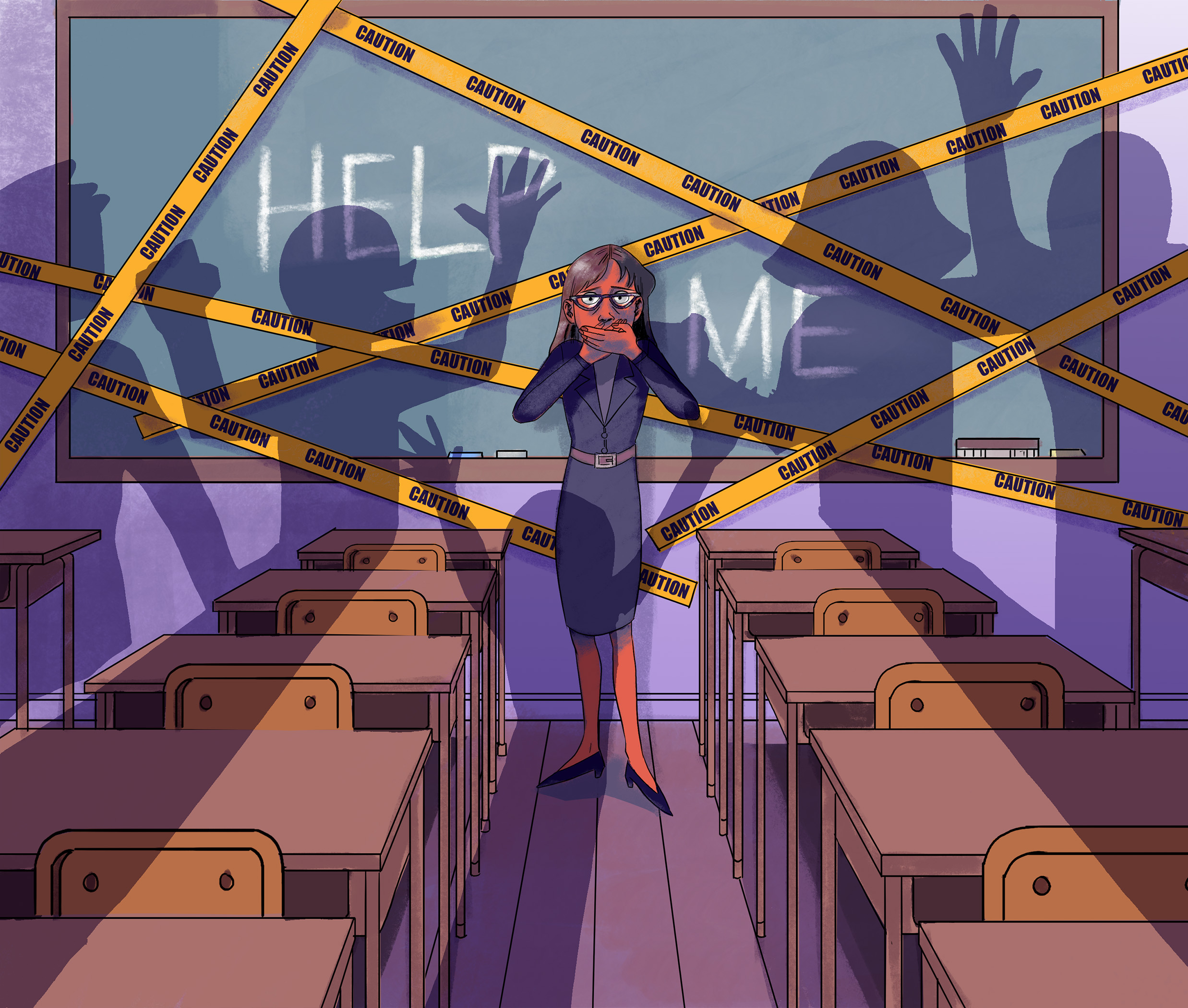
“Teachers should not feel that it’s normal to feel unsafe at school.”
– Special education resource teacher
Violence in schools is usually framed in relation to student-on-student bullying, but schools are also workplaces for (predominantly women) teachers and educational assistants: workers who are entitled to – but do not always experience – a safe and violence-free workplace. Over the last decade, unions representing education workers have mobilized to shed light on the “dirty little secret” of educator-directed violence, and the issue has received a measure of media attention. Surprisingly, however, while there are numerous studies examining peer-on-peer violence among students, the harassment and violence experienced by educators has received limited scholarly attention. Indeed, while research on bullying, harassment, and violence against students number in the thousands, we were able to locate less than ten studies on educator-directed harassment and violence in Canada.
To start to address this gap in the scholarly literature, we surveyed 1,688 Ontario English public elementary school educators (contract and occasional teachers, PSP/ESPs, ECEs/DECEs, and other educational professionals) in December 2018 about their experiences of workplace harassment (e.g. slurs, insults, and put-downs) and violence (i.e. acts, attempts, and threats of physical aggression) in the 2017-2018 school year. The Harassment and Violence against Educators (Ontario) Survey endeavoured to assess the frequency, impact, and response to harassment and violence against educators as well as to determine how experiences of, and the response to, harassment and violence are impacted by intersecting factors such as gender, dis/ability, and racialization.
Our full report, Facing the Facts: The escalating crisis of violence against educators, can be downloaded at www.educatorviolence.net. Below, we have summarized select key findings.
- Most harassment and violence experienced by educators in Ontario’s public elementary schools is student-initiated and rates are alarmingly high. Fifty-four percent of educators reported experiencing one or more acts of student-initiated physical violence during the 2017-2018 school year; 60% reported one or more attempts to use physical force, and 49% experienced one or more threats. (See Figure 1.) In terms of harassment, 72% of educators reported experiencing explicit verbal insults, put-downs, and/or obscene gestures from a student in the 2017-2018 school year.
- Results of the study suggest that there has been an almost ten-fold increase in the experience of violence against educators since the first Canadian surveys were conducted some two decades ago. Results from a 1999 study on behalf of the British Columbia Teachers Federation1 showed that fewer than 5% of educators experienced some form of physical violence during the 1997–98 school year – approximately one-tenth of the rate indicated in the current study.
- Harassment and violence against elementary school educators is gendered violence. Not only are upwards of 85% of elementary school educators women, but gender is evident in the nature of the violence (language deployed, the mobilization of gendered tropes, microaggressions, and sexual harassment) and in the institutional response, including the routine responsibilizing and blaming of educators for the harassment and violence they experience.
- Vulnerability to harassment and violence is conditioned by intersecting factors. For example, rates of harassment and violence from students are statistically higher among educators identifying as racialized, disabled, women, or LGBTQ2+; they also experience elevated levels of reprisals from their administrators. (See Figure 2.) Women with disabilities experience the highest levels of harassment and violence.
- Harassment and violence are often repetitive, frequent, and ongoing occurrences. Educators who experience harassment report an average of 8.5 occasions of insults, put-downs, or obscene gestures from students, 2.77 from parents, 3.98 from colleagues, and 4.21 from administrators in the 2017-2018 school year.
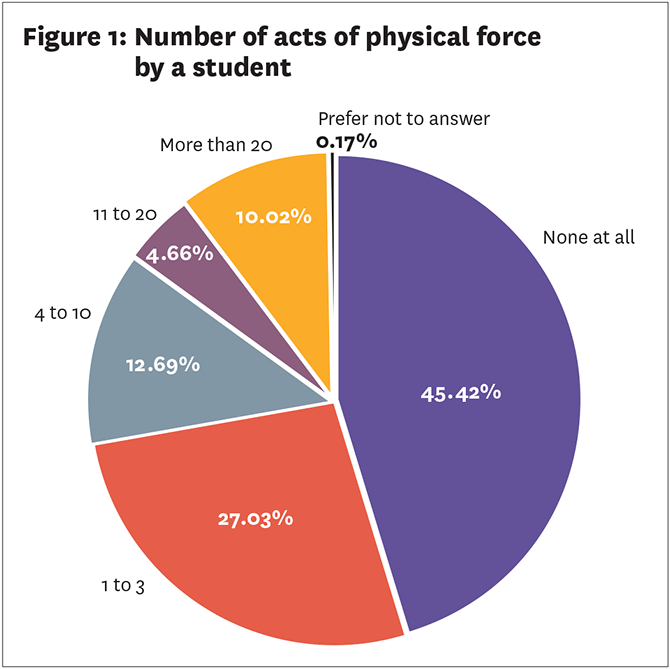
- Qualitative data reveals that educators often feel unsupported by administrators, that common strategies such as requiring educators to wear personal protective equipment (e.g. spit shields, concussion caps, or Kevlar arm and shin guards) are addressing symptoms rather than root causes, and that there is a disturbing normalization of violence in Ontario’s elementary schools.
- The impact of harassment and violence is long lasting. Higher levels of harassment and violence are associated with decreased physical and mental health as well as job performance, even when assessed some six months after the school year in which the harassment and violence occurred.
- Almost half of educators (47%) did not report their worst incident of workplace violence in the past year. Reasons for not reporting included a lack of time, being dissuaded from doing so, and concern about repercussions.
- Only 36% of educators were confident in their ability to deal with an incident of physical violence; the majority would welcome social-emotional learning programs (68%) and non-physical intervention training (55%).
- The financial impact associated with harassment and violence is considerable. Educators reported taking an average of 6.84 days off work following their worst instance of harassment in the 2017-2018 school year and an average of 5.18 days off work following their worst instance of physical violence. The costs associated with lost time due to harassment and violence against public school educators in Ontario are conservatively estimated to be in excess of 3 million dollars annually.2
- Educators overwhelmingly identified the need for more and better allocation of physical and human resources (e.g. educational assistants, mental health specialists) and earlier identification of student needs. They also noted the importance of additional educational resources, clear policies that are followed, consistently applied consequences for violent and harassing behaviour, and better trained, more responsive and supportive administrators.
The escalating crisis
“I love teaching… However, the emotional and mental abuse that I have been subjected to on a daily basis, and the physical toll it has been taking on my body is unbelievable… I took a medical leave from work due to the stress and abuse. I learned that [my health issues] are due to a prolonged exposure to these conditions.” – Grade 2 French Immersion teacher
The 2017-2018 Harassment and Violence against Educators (Ontario) Survey provides stark evidence that educator-directed harassment and violence is escalating and quickly becoming a crisis. Indeed, rates of harassment and violence are critically high. In a single year, as many as one in two educators will experience violence and as many as 70% will experience harassment, whether from a student, parent, colleague, or administrator. Moreover, harassment and violence are increasing dramatically. Rates of harassment have at least doubled, and rates of physical violence have increased seven- to ten-fold over the last two decades. At the same time, we see a disturbing normalization of violence against educators by administrators, educators, and students operating in tandem with the widespread minimization and/or denial of its multifaceted impacts by administrators, school boards, and politicians. In addition, findings from the Harassment and Violence against Educators (Ontario) Survey indicate that workplace violence is being underreported, and when reported, is all too often accompanied by blame and reprisal. This suggests that official rates underestimate the true prevalence and speaks to an organizational culture that is ill-equipped to address the issue. In real terms, while school boards have embraced the language of progressive discipline mandated under the provincial Education Act, educators told us that, in practice, there are few consequences for students’ harassing and violent behaviour. Finally, findings from the current study suggest that many educators feel neither adequately supported nor prepared and trained to deal with the student-initiated harassment and violence that they are experiencing.
Rates of harassment have at least doubled and rates of physical violence have increased seven- to ten-fold over the last two decades.
The escalating crisis of educator-directed harassment and violence speaks to the compounding impact of structural, fiscal, and social factors. The past 20 years have seen significant changes in society, including growing income disparity, social inequality, and economic stress, a rise in both moderate and severe mental health difficulties among children,3 and the ubiquity of electronic devices, all of which have increased the needs of students. At the same time, we have seen significant shifts in provincial education policies, including a commitment to mainstreaming (placing students with complex needs in regular classrooms with correspondingly decreased use of segregated classrooms) institutionally structured “corrective and supportive” progressive discipline policies,4 and ministry-mandated “Learning for all”5 approaches based on the recognition that “all students learn best when instruction, resources, and the learning environment are well suited to their particular strengths, interests, needs, and stage of readiness.”6 To be successful, these evidence-based practices require significant investment in infrastructure, materials, professional development, and human resources. Unfortunately, as needs and expectations increase, funding formulas have not been recalibrated. Indeed, in Ontario, the impact of deep funding cuts introduced under the Mike Harris government (1995 to 2002) continues to echo.7 In classrooms across Canada, educators are scrambling to meet ever-expanding expectations – from more Individual Education Plans to increased class size to standardized testing requirements – with decreasing levels of support and resources. The result is entirely predictable – frustrated, struggling children whose needs are not being met are “lashing out.”
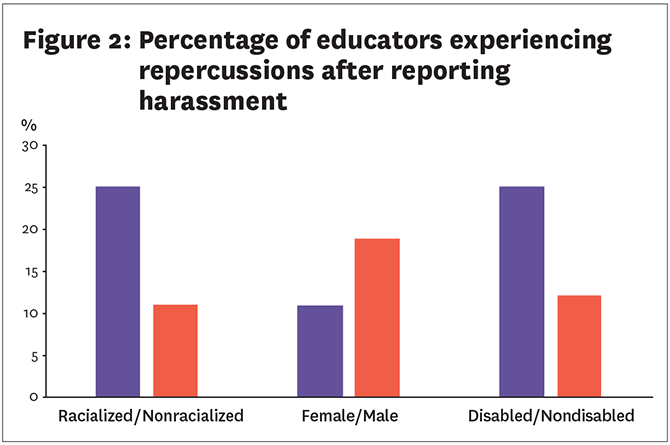
Harassment and violence, coupled with inadequate (and potentially declining) resources to meet the needs of students, the normalization of harassment and violence against educators, a fear of reprisal for reporting, low levels of support, increasing levels of incivility, the uncertainty about how to effectively respond to harassment and violence, and an unwillingness on the part of administrators to consequence aggressive behaviour is having detrimental impacts on the classroom learning environment, students, and the health and well-being of educators. Indeed, in light of the high rates of harassment and violence experienced by educators in the performance of their duties, it is reasonable to expect that most educators will suffer a mental injury (e.g. PTSD, burnout) at some point in their careers. Accordingly, in addition to strategies to reduce harassment and violence in schools, it is essential that adequate resources (such as access to mental health professionals) are available to ensure that educators who experience harassment and violence have the opportunity to address any mental or physical injuries they sustain, as well as to learn the skills needed to cope with ongoing exposure to harassment and violence.
Action is needed
Addressing this significant problem will require a commitment to immediate action, including:
- Increased resources to ensure that the most vulnerable students are getting the help they need and that all students have access to the supports they require to flourish and learn. This will require, among other things, augmented health services (e.g. early diagnosis and interventions), more educational assistants and other educational supports, and smaller classes to facilitate the individualized attention mandated by provincial education legislation.
- Support for teachers to enable them to manage the increasing breadth and intensity of needs in their classrooms, and resources to address educators’ mental and physical health needs in the context of the escalating harassment and violence they are experiencing.
- Training for administrators to ensure that they have the skills to adequately address harassment and violence in schools and provide meaningful support to educators who experience harassment and/or violence.
- Ensuring that policies and protocols concerning harassment and violence are understood and consistently applied, including the implementation of student consequences that are appropriate and effective.
- Ongoing monitoring of workplace harassment and violence and the development of strategies to address the heightened vulnerability of designated groups, such as racialized, Indigenous, disabled, women, and LGBTQ2+.
- Adoption of a population health approach that examines and addresses the broad range of factors influencing harassment and violence against educators.
The workplace violence educators experience has significant and far-reaching costs. It impacts educators’ health, well-being, careers, ability to do their jobs, and relationships. In real terms, the violence reverberates through their personal and professional lives and in turn though the lives of their families, their colleagues, and the students they teach – creating ever more ripples that impact other families and indeed the broader community and society. The impacts also ripple over time – we can only imagine how the casual normalization of violence against (predominantly women) educators is shaping the perceptions and expectations of a generation of students.
Illustration: Diana Pham
First published in Education Canada, September 2020
Notes
1 David R. Lyon and Kevin S. Douglas, Violence Against B.C. Teachers: Report of the Simon Fraser University/British Columbia Teachers’ Federation violence against teachers survey (Burnaby, B.C.: SFU Mental Health, Law and Policy Institute, 1999).
2 The financial costs associated with days of work following an incident of harassment and violence were calculated in the following manner. Assuming a conservative rate of violence or harassment that would require time off work, of say just 10% (which is less than one fifth of the rate reported in this survey), then it can be expected that some 8,000 educators would have taken time off work at the time that the survey was conducted. If 25% of those 8,000 educators took the average number of 6.84 days off work, the average cost of replacing these educators in the classroom would be $1,652.31 each, amounting to over 3 million dollars annually. It is important to keep in mind that this estimates a very low rate of exposure to harassment and violence and estimates only the replacement costs associated with a single incident of harassment (and not violence) in any given year. It is important to keep in mind that educators in this survey reported multiple instances of violence and harassment in a single year.
3 A. Boak, H. A Hamilton, et al., The Mental Health and Well-being of Ontario Students, 1991-2017: Detailed findings from the Ontario Student Drug Use and Health Survey – CAMH Research Document Series No. 47 (Toronto, ON: Centre for Addiction and Mental Health, 2018).
4 Ontario Ministry of Education, Supporting Bias-Free Progressive Discipline in Schools (2013). www.edu.gov.on.ca/eng/policyfunding/SupportResGuide.pdf
5 Ontario Ministry of Education, Learning for All: A guide to effective assessment and instruction for all students, Kindergarten to Grade 12 (2013). www.edu.gov.on.ca/eng/general/elemsec/speced/LearningforAll2013.pdf
6 Ontario Ministry of Education, Learning for All: 8.
7 H. Mackenzie, Course Correction: A blueprint to fix Ontario’s education funding formula (Canadian Center for Policy Alternatives, 2018). www.policyalternatives.ca/sites/default/files/uploads/publications/Ontario%20Office/2018/03/Course%20Correction.pdf
-
Scylla and Charybdis
Comments Off on Scylla and CharybdisIn the Odyssey, Homer writes of the fear that Greek mariners felt as they attempted to cross the narrow channel of water flanked by Scylla, the six-headed monster on one side, and Charybdis, the violent whirlpool, on the other. My circumstances were not as dire, but I can empathize with the pressure these ancient sailors felt. My dilemma between the proverbial “rock and a hard place” occurred during the heated 2014 contractual dispute between the B.C. Ministry of Education and the B.C. Teachers’ Federation, during which I walked an ethical tightrope between my responsibilities as teacher to my inner-city school, and as a representative of the Federation.
The educational landscape of British Columbia in 2014 was marked by extreme tension, with heated contract negotiations that escalated into a full-scale strike and lockout. The union ordered members to discontinue participation in extracurricular programs. At the time, I had taken on many extracurricular duties at my school, which was situated within one of the poorest socio-economic pockets of the Lower Mainland. Many of our families found themselves in a constant state of crisis as a result of chronic poverty. Many of our children were in and out of the revolving doors of foster care. Some families were refugees who had fled civil and political strife in their home countries. Opportunities were sparse for the children of this community. This is not to say that the parents did not care for their children – some worked two or even three low-paying jobs to provide as many opportunities as were accessible to them. As a professional, I found it gut-wrenching to balance my response to these competing claims on my loyalty.
On the one hand, I had a legal and professional responsibility to my union. Issues of key importance to me, such as benefits, working conditions, salary, student funding, and the overall integrity of public education had all been secured as a result of the tireless effort of the union. At a critical time when the union was engaged in negotiations, I recognized the importance of teachers presenting a united front. If the union needed us to withdraw extra-curricular activities and strike to pressure the government, I felt compelled to support their decisions. It was also clear to me that to maintain productive relationships with my colleagues, I needed to show the same level of commitment to the union as they did.
On the other hand, I also felt a strong sense of obligation to my students and the community. I was acutely aware that many of the children at my school were already marginalized. I thought their extracurricular opportunities helped to address the lack in their lives and provided these children, who were at constant risk of becoming statistics themselves, with rare opportunities to engage in enriching and constructive activities. My conscience told me that I needed to exercise compassion for those less fortunate. The care of one’s fellow humans is a responsibility that I feel we are born with and should not abdicate, and this lay at the heart of my dilemma.
I wrestled with finding a balance between the opposing claims. I believed in both! Was it possible to serve two masters when they were locked in conflict? This situation led me to a paralytic state of inaction. I was unable to make a move in either direction. The more I tried to find a way forward, the more paralyzed I became. Was it even possible to reconcile this ethical duality when the solutions were so mutually exclusive? How could I choose one side over the other, and how could I look at myself in the mirror after doing so? To choose one side would betray the other side and my ethical principles as well. These were unanswerable questions that preyed on my mind and put me in conflict with myself.
But ultimately my story had a happier ending. Like the mariners who found the narrow channel between Scylla and Charybdis, I finally found a middle path through my dilemma. I was able to connect our underprivileged students with a non-profit agency that would provide extracurricular activities during the strike, which allowed me to withdraw my own extracurricular services in better conscience.
Looking back, this dilemma did more good than harm for my practice, because it enabled me to clarify why I choose to teach and how I choose to do so.
Illustration: iStock
First published in Education Canada, September 2020
-
Battling Bad Feelings
Comments Off on Battling Bad FeelingsTeachers often describe feeling anxious, exhausted, and unwell, and the sense of “being pulled in too many directions.” What is it about teaching that can feel so depleting, that induces what University of Toronto Distinguished Professor Mari Ruti calls “bad” feelings: those feelings that arise from the sense of not doing enough, not doing it well enough, and not being better at it? Stacey, a young and enthusiastic teacher from our research study,1 described teaching as feeling like, “physically and mentally you have nothing left to give.” While Stacey avowed that she loved her job, she also described being overwhelmed – exhausted by the demands of others and the needs of children, and torn by the expectations of the public, parents, principals and colleagues. Through Stacey and the other teachers we interviewed, we see how teachers are inundated with bad feelings.
Unsurprisingly, teachers, teachers’ organizations, and school districts have been seeking ways to help teachers cope with such bad feelings. Efforts to help teachers cope are often constructed through various discourses of self-help and manifest in the language and practices of wellness, well-being, and mindfulness. However, as educators and as researchers, we are concerned with the ways in which these self-help narratives might actually be unhelpful – a tempting snake oil aimed at “treating” the ailments of the teacher. Dr. Ruti explains that bad feelings often result from society’s increased demands for heightened performance, greater productivity, incessant self-improvement, and constant cheerfulness. Like Ruti, we understand these demands as effects of neoliberalism. In education, neoliberalism often manifests as a business model approach to education where costs and efficiencies override moral concerns and in which teacher success is defined in terms of student performance outcomes. Meanwhile, teachers’ professional development is based on expectations of relentless self-improvement.
Here, we want to critically consider teacher self-help narratives and their potential to magnify and misunderstand the bad feelings that teachers experience. We want to consider these feelings from a different perspective; that is, to consider bad feelings as important and intrinsic to the experience of teaching. We do this not in order to dismiss teachers’ feelings, but in a way that might make these feelings more bearable, allowing teachers to deflect the associated sense of inadequacy. We hope to illustrate how a different understanding of these bad feelings might enable us to appreciate the emotional toll of teaching and the ways in which they reflect living an ethical life in teaching.
Curing the ailing teacher
Through the increased societal demands of performance, productivity and self-improvement, self-help discourses become a method of blaming and responsibilizing the teacher for her protest. In other words, not meeting these expectations of improvement is projected as an individual problem – the fault of the teacher. Attempts to cure the ailing teacher have subsequently spawned endless numbers of products and services. For example, a Google search of the terms teachers and self-help elicits over 1,700,000,000 hits; literally, over a billion websites that offer tips, strategies, books, and lists that make suggestions such as, “choosing to live joyfully.” Indeed, as Stacey explained, “I always thought happiness was a choice and that, oh, ‘you can be positive.’” These expectations of self-improvement and incessant cheerfulness feed a lucrative well-being industry, which according to the Global Wellness Institute is worth over four trillion dollars. Thus, the requirement of constant self-improvement makes teachers the target of often-costly self-help products that include books, herbal remedies, medication, therapy, mindfulness training, and yoga. Dr. Ron Purser, an ordained Zen Dharma Teacher in the Korean Zen Taego order for Buddhism and a Professor of Management, likens these individualistic and hip pursuits of self-help as a form of McMindfulness, a corporatized and marketable product that promises self-fulfillment and self-improvement. Although these products might offer some benefits to individuals, the point here is that the increased expectations and scrutiny of teachers’ performance and productivity, makes teachers like Stacey feel as though they must work harder and longer, self-improve, and avail of costly treatments or programs in the process. Teachers must not only shoulder increasing pressures, they are expected to “stay calm and carry on” without protest!
We understand education as a public good and teaching as an ethical endeavour, wherein teachers seek to cultivate students’ understandings of and relationships with themselves, with others and with the world around them, in an effort to lead good and worthwhile lives. Yet, in education, neoliberalism has incited increased managerialism, fewer resources, more standardized testing, greater focus on individualism, and amplified competition. Stacey described feeling “quite conflicted, when admin are talking about a certain initiative or when they are saying ‘This is what you need to focus on,’ but that’s not necessarily what I feel is important for my kids.” These neoliberal ideologies create what Wendy Brown calls “miserable conditions,” in which the task of teaching is constructed as a technical means of knowledge transfer in the name of higher test scores. This creates a tension between teachers’ everyday obligations to engage ethically with students and the often-inhumane expectations of increasing performance indicators.
From this perspective, the self-help discourses serve to redirect the problems of the changing education system to those of problems of (or within) the teacher. In other words, self-help discourses consider teacher stress as the teacher’s fault, and subsequently directs teachers to choose happiness, to declutter, and to breathe. These simplistic “fixes” to teachers’ bad feelings distract us from considering – and critiquing – the conditions in which teachers are situated. Understood in this way, self-help discourses become the means to the neoliberal ends. Instead of cultivating ethical explorations of the self and one’s relationship with the world, self-help operates as another mechanism to control and manage the teacher. The message is, if Stacey could just fix her bad feelings, she could improve both productivity and performance.
Responsibilization of teachers
As education professor Julie McLeod explains, a teacher’s sense of responsibility – to her students, the profession, and the greater good of society – is different from responsibilization. Responsibilization is the requirement on teachers to take greater responsibility for the management of schooling and of children as a technical and regulatory event rather than as an ethical one. Stacey stated, “I feel responsible all the time” and gave examples of feeling responsible for educational assistants, the decisions of her principal, and “carrying her weight.” Responsibilization increases pressures on the teacher, reinforces regulation (of the teacher and of the student) and increases individualism, and thereby recasts teachers’ work from relationships with students to better management of others – and also better management of herself. Consider Stacey’s comment: “I learned a lot of great strategies to stay well. And I’m still working on that balance of like how do I take care of myself and what can I just say no to, so that I can actually feel well.” We see in Stacey’s response her internalized sense of responsibilization; wherein she feels responsible for finding better strategies in order to “feel well.” This internalized sense of responsibilization places the onus on Stacey to “fix” her bad feelings through self-improvement, individualizing and regulating her feelings and her being. Responsibilization recasts what is difficult about teaching as something that should be – and can be – better managed by the teacher.
Teachers’ bad feelings are not a sign of weakness or deficiency, but are symptoms of their sensitivity to students’ needs.
Moreover, the responsibilization of teaching is premised on gendered stereotypes of the teacher. As scholars Alison Prentice, Marjorie Theobald and Madeline Grumet have helped us to understand, teaching has long been considered women’s work, constructed as emotional labour, and relegated to the domestic, private sphere, like the home. Thus, teachers’ protestations about the conditions of their work are dismissed as “complaints,” fueled by gendered stereotypes of teachers as emotional, irrational, and even hysterical. The “complaining” teacher is ignored in political arenas and the teacher’s complaint is seen a symptom of her being unwell – and perhaps even irresponsible.
The emotional toll of obligation in teaching
As we discussed in the opening, self-help narratives make the teacher feel as though she needs to constantly improve her performance, productivity, and cheerfulness in order to be a “good,” or perhaps an even “better,” teacher. Yet, these discourses target and responsibilize the teacher, ultimately serving neoliberal agendas of improved performance, productivity and consumerism – privileging economic goals over ethical engagements. The alluring promises of such a productive and cheerful teaching life are what professor Lauren Berlant would call a “cruel optimism,” or the promise of something that is ultimately impossible to attain. Moreover, even striving to attain it might not be good for us. The constant pressure to improve one’s performance, productivity and cheerfulness is like a greyhound dog race; the unwitting dog is tricked into chasing the lure – but it is never meant to actually catch it.
In our research, we explored the emotional toll of obligation, considering bad feelings as intrinsic to the experience of teaching – not in order to fix or dismiss these feelings or to construct the teacher as hopeless or woeful, but rather to understand these feelings in a way that might make them more bearable. We are interested in shifting discourses about teachers and their feelings away from the faults and flaws of the teacher, and toward understanding teaching as a profoundly relational endeavour, replete with emotional experiences. Perhaps if teachers understood these feelings from a different perspective, they might fend off self-blame and deflect demands for self-improvement.
In exploring the emotional toll of teachers’ obligations, we are guided by the philosopher John Caputo, who describes obligation as a visceral sensation that compels teachers to act. Obligation is that force that teachers experience when they are compelled to respond to the student who is hungry, crying, lonely, failing, joyful, or angry. Obligation in these moments fixes the teacher to a sense of urgency and responsibility while necessitating judgement. When Stacey discovered that one of her students had been writing about suicide and self-harm in her notebook, Stacey described being “worried about her and trying to figure out my next steps.” In Stacey’s story, the anxiety of obligation was animated by bad feelings: she worried about the uncertainty of her decision (what to do?), wondered if she responded appropriately, feared that she might not meet the demands of others, and agonized about being harshly judged. It is in the midst of such bad feelings that we see the teacher’s ethical response – sensitive to the student, no script to follow, and yet, required to act. What we see in Stacey’s stories, and what is emblematic of the teachers we interviewed, is that teachers’ bad feelings represent the visceral responsiveness that characterizes educational relations: teachers feel their obligation to students, and those feelings can become burdensome. These feelings are, however, distinct from the feelings of frustration associated with the increased managerial demands of neoliberalism and its focus on student achievement and teacher accountability.
Put simply, teachers’ bad feelings are not a sign of weakness or deficiency but are a symptom of their sensitivity to students’ needs. With that in mind, teachers deserve the support of the larger society in shouldering education’s obligation to the young. As a starting point, governments, school districts, families, and communities need to engage in substantive conversations about what matters educationally; to consider collectively: What is education for? What is it we want for our children – and our world? How do we know that what we want is “good”? These are the questions that confront teachers in the everyday moments of classroom life. These are the questions that both guide and overwhelm the teacher. These are the questions that constitute an ethical life in teaching.
Photo: iStock
First published in Education Canada, September 2020
Notes
1 This article draws on research supported by the Social Sciences and Humanities Research Council. Our research team conducted qualitative interviews in two Canadian provinces with teachers who left, or who had considered leaving the profession due to its emotional toll. More about this research can be found at: Melanie D. Janzen and Anne M. Phelan, “‘Tugging at Our Sleeves: Understanding experiences of obligation in teaching,” Teaching Education (2018): 1-15. https://doi.org/10.1080/10476210.2017.1420157


IDEAS TO SUPPORT EDUCATORS : Subscribe to the EdCan e-Newsletter
Quality research, reports, and professional learning opportunities.